A Daily History of Holes, Dots, Lines, Science, History, Math, Physics, Art, the Unintentional Absurd, Architecture, Maps, Data Visualization, Blank and Missing Things, and so on. |1.6 million words, 7500 images, 4.9 million hits| Press & appearances in The Times, Le Figaro, Mensa, The Economist, The Guardian, Discovery News, Slate, Le Monde, Sci American Blogs, Le Pont, and many other places… 5000+ total posts since 2008.
The RAND Corporation (Research And Development) is a think tank originally formed in 1946 by the US Army Air Force as part of a contract to the Douglas Aircraft Company.After 1948 RAND Corp was funded by a number of different sources, private and governmental, and left the sphere of being a direct arm of the U.S. military. (Maybe.)It still did enormous amounts of work on behalf of the military, and seems to have been their chieftheoreticians during this period.It was also the time that the policy of Mutually Assured Destruction (MAD) was formulated at , partially under the direction of we’ll-see-him-again-down-the-road Robert McNamara.And of course much else.[This pamphlet is available for purchase from our blog bookstore.]
This publication is an internal RAND document, not meant for the eyes of the outside world, at least in 1957.I own a number of these reports, and I must say that this one is odd—it is rather flippant, sometimes oddly and darkly (dare I say it?) funny.It is also short (four pages) and gets to the very meaty part of the issue immediately.The author(s) assume that the US and the USSR will have achieved a point of stasis such that it would make absolutely no sense for either actor to actually employ their arsenal (and excluding “the possibility of the button pusher ‘flipping his lid’ “.The paper attempts then (“let’s jump right in and assume we find ourselves in this stalemated period”) to envision the next kind of war in which the ICBM would not be an active factor. “We therefore postulate here that the kind of war we will be engaged in…in the period of nuclear stalemate of the non-violent war, the opening phase of which has been called the cold war.”
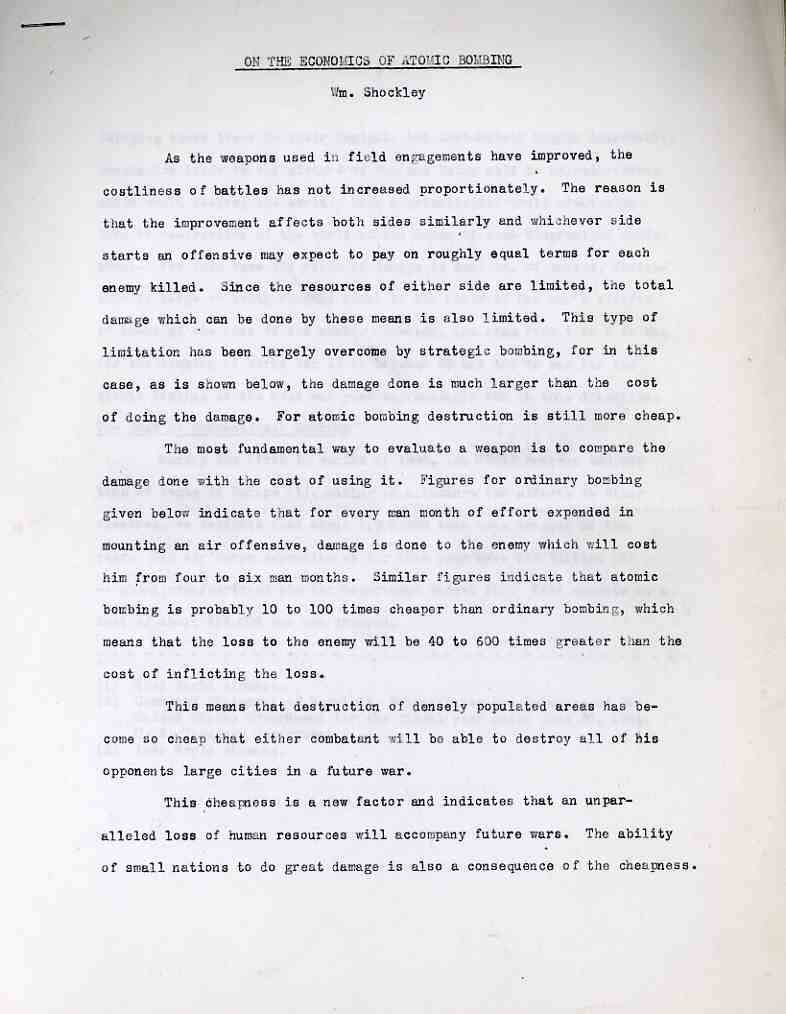
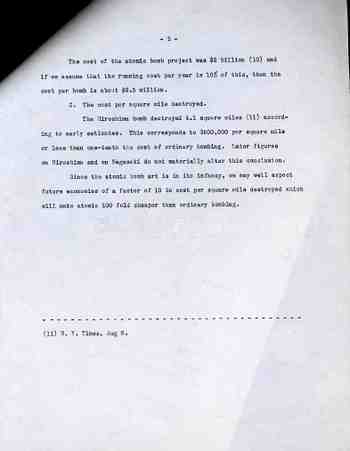
“For atomic bombing destruction is still more cheap”–WIlliam Shockley1.
(Click image to enlarge; the other four pages are located in the “Continue Reading” section, below.This is also available for purchase via our blogbookstore.)
This paper is one a small archive of background and draft papers and proposals by the Vannevar Bush group working on the question of the control of atomic weapons and the formalization of the American position regarding the use and control of atomic weapons, October 1945-February 1946. This archive consists of 38 documents relating to the development of U.S. atomic policy, with contributions by President Harry Truman, Secretary of State James Byrnes, Dr. Vannevar Bush, (future AEC director) Carroll Wilson, Alger Hiss, I.I. Rabi, William Shockley, Frederick Dunn, Joseph E. Johnson, Leo Pasvolsky, Philip Morrison, Col. Nichols, William McRae, Admiral W.H.P. Blandy, George L. Harrison, and others.
I have written elsewhere on this site about Vannevar Bush and the coming atomic/nuclear arms problem–as perhaps one of the pre-eminent scientific minds in the Roosevelt/Truman administrations, Bush and others foresaw the development of the atomic arms race in 1943, and by 1945 Bush became a fundamental thinker and advocate on the problem. The items in this archive are low-formal background papers, drafts of proposals, informal studies, as well as mature statements of thought that would become implemented in the core of U.S. policy regarding the spread and control of atomic weapons. They are generally carbon typescripts and necessarily of extremely limited distribution, generally have no letterheads, occasionally carry the authors’ full names (although sometimes only initials are used).
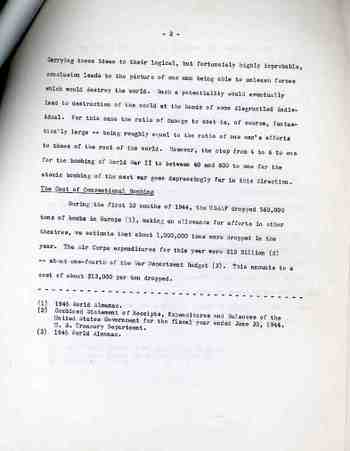
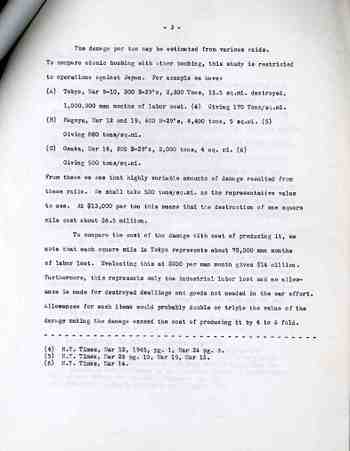
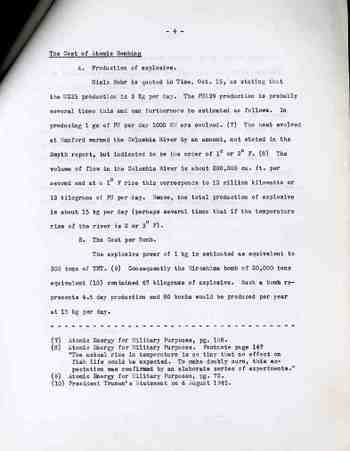
The William Shockley paper was written towards the end of 1945 and is on five pages and runs about 1500 words, and is an extension of work he had already been doing for Henry Stimson with Quincy Wright on evaluating the combinations of casualties that would lead the Japanese to surrender3. He begins this paper with a logical statement of the issue of the economics of conventional and atomic bombing, ending with the sentence “For atomic bombing destruction is still more cheap”. What Shockley is getting to is the overall cost of the amount of destruction caused per square mile, and the conclusion that he draws over these five pages is the destruction caused by the atomic bomb is 1/100th the cost of conventional bombing per square mile destroyed (“atomic bombing is probably 10 to 100 times cheaper than ordinary bombing”).
Shockley also recognizes that the problem in the near future will be the increasing cheapness of producing atomic (and greater) weapons, and their developing accessibility to small nations. “This cheapness is a new factor and indicates that an unparalleled loss of human resources will accompany future wars. The ability of small nations to do great damage is also a consequence of the cheapness.” He writes further that taking this thinking to its “logical conclusion”, that at some point in the future a single individual will be able to use this new technology to destroy the world. The main point though that he was making in this line of thinking was the dispersion and proliferation of the new technology–that an arms race would occur, and that it would be dangerous, and that it could be very very bad. Shockley has of course nothing to say about any of that or the implications of his finds as that was not his charge.
After figuring that the cost of destruction by the atomic bomb was about $600,000 per square mile (compared to $6,500,000 per square mile for conventional bombing), Shockley concludes that “since the atomic bomb art is in its infancy, we may well expect future economies of a factor of 10 in cost per square mile destroyed…”
Shockley on the likelihood of casualties during the final invasion of Japan.
(The following three paragraphs are taken entirely from CASUALTY PROJECTIONS FOR THE U.S. INVASIONS OF JAPAN, 1945-1946: PLANNING AND POLICY IMPLICATIONS by D. M. Giangreco in the Journal of Military History, 61 (July 1997): 521-82
“As for Dr. Shockley’s initial report to Dr. Bowles, it was not submitted until after Stimson had left for Potsdam. He proposed that a study be initiated “to determine to what extent the behavior of a nation in war can be predicted from the behavior of her troops in individual battles.” Shockley utilized the analyses of Dr. DeBakey and Dr. Beebe, and discussed the matter in depth with Professor Quincy Wright from the University of Chicago, author of the highly-respected A Study of War; and Colonel James McCormack, Jr., a military intelligence officer and former Rhodes Scholar who served in the OPD’s small but influential Strategic Policy Section with another former Rhodes Scholar, Colonel Dean Rusk. Shockley said:
“If the study shows that the behavior of nations in all historical cases comparable to Japan’s has in fact been invariably consistent with the behavior of the troops in battle, then it means that the Japanese dead and ineffectives at the time of the defeat will exceed the corresponding number for the Germans. In other words, we shall probably have to kill at least 5 to 10 million Japanese. This might cost us between 1.7 and 4 million casualties including [between] 400,000 and 800,000 killed.”–W. B. Shockley to Edward L. Bowles.2 .
No accurate total of German military and civilian deaths was available at the time he prepared his report, but the number was eventually set at roughly 11,000,000. was not invaded and finished the war with just over 7,000,000 casualties, most of them from its armed services on the Asian mainland in fighting from September 1931 to September 1945.
Notes:
1. The brilliant Shockley’s story is difficult and problematic: from the way in which he misused his interaction with the rest of his team at Bell Labs in the discovery of the junction transistor to his sinful racial and eugenic (and dysgenic) public persona later in life–it is a hard and long one to tell, and I’ll not try to do it here. (I should point out that his attacks started in 1966 when he “delivered the first of a series of controversial papers to the National Academy of Sciences (NAS) in which he called for a renewed focus on racial biology, synthesizing under the title of eugenics the compulsive element of population control with the targeting of the dysgenic fertility of the black population”.[From “Confronting the Stigma of Eugenics: Genetics, Demography and the Problems of Population” by : Ramsden, Edmund in Social Studies of Science, Vol: 39 Issue: 6, 12/2009 pages: 853 – 884.] Suffice to say that I’m very aware of the very long shadows, and I think that other people should at least be aware of them as well, regardless of the staggering importance of “his” (with the wonderful Walter Brattain and John Bardeen) monumental discovery.
2. 21 July 1945, “Proposal for Increasing the Scope of Casualties Studies,” Edward L. Bowles Papers, box 34, Library of Congress.
3. For a detailed look at Shockley’s work in this area see Predicting the Termination of War: Battle Casualties and Population Losses, by Frank Klingberg in The Journal of Conflict Resolution, Vol. 10, No. 2 (Jun., 1966), pp. 129-171. Dr. William B. Shockley (later a joint winner of the Nobel Prize for his work in developing transistors) was an expert consultant to the Secretary of War, engaged in part in gathering and organizing information bearing on the problem of casualties in the Pacific war. He believed that historical studies of casualties might be helpful &dquo;for consideration in connection with the total casualties to be expected in the Japanese war, the rate at which land invasion should be expected in the Japanese war, the rate at which land invasion should be pushed ahead in Japan or held back while attrition by air and blockade proceeds, and the relativeapportionment of effort between the Army Air Forces and the Army Ground Forces…”
Self- and purposefully-deceptive belief in spectacular and unsupportable scenarios espoused by governmental leaders which affect the lives of hundreds of millions of people deserve their own Dante-esque categorization:and that’s one that I haven’t come up with yet.This post is one of a continuing thread on the history of atomic weapons. {Incidentally, the pamphlet described here is available for purchase from our blog bookstore, here.]
I wonder how it was that we humans didn’t blow ourselves into melty dissolving bits during the Cold War.Somehow all of those thousands of megatons of disastrously radioactive explosives that were completely and reliably deliverable didn’t get launched—not even by accident, not even during all of those hot itchy-finger DEFCON 2situations.Did MAD (Mutually Assured Destruction ) actually work?Did the attempt at making a winnable nuclear confrontation keep people from actually trying to do so?Did the overwhelming and insane buildup of weaponry actually have so much enormous and foul intellectual weight that no one could actually make the decision to use the weapons for fear of snuffing out all human life?
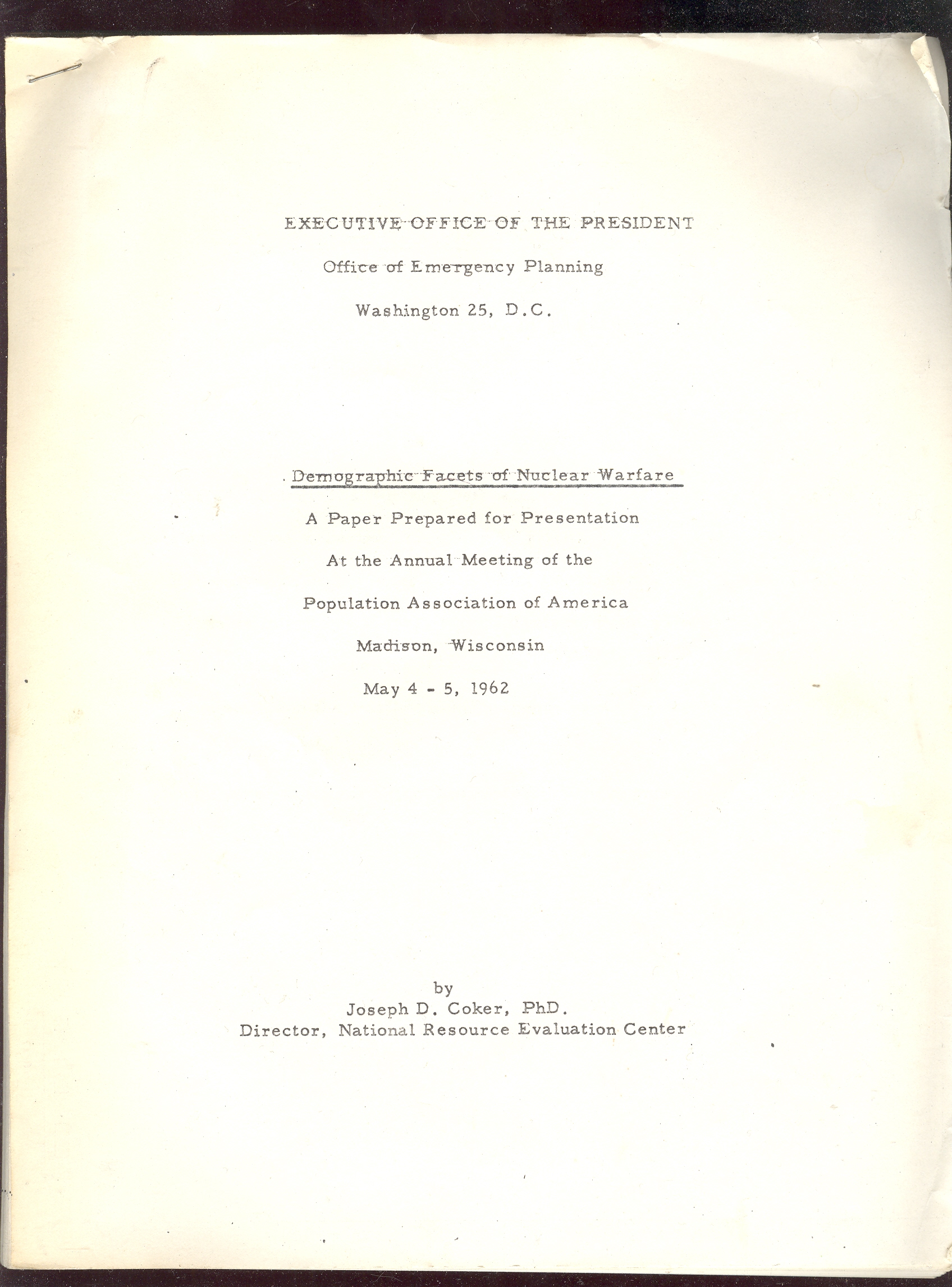
Here’s an embarrassingly shining case in point: Dr. Joseph D. Coker’s paper to the Population Association of America representing the thinking of the Office of Emergency Planning and the Executive Branch in general, which freely discussed the survivability of the United States following even a post-massive nuclear exchange. Dr. Coker was the director of the National Resource Evaluation Center, which tried mightily to figure out how/where /what/how the essential ‘stuff” of America could be saved/stored/allocated after the end of the world.Actually, Dr. Coker said that the big attack wouldn’t be the end of the world, so we needed to plan for surviving.
A few cases in point, some of which, I must warn you, are breathtaking and Strangelovian in their myopia:
Since Dr. Coker was addressing the Population Studies people, he related much of what he had to say (regarding national resources) to the American people.He found that millions of people could be saved if they built a blast shelter (not a fallout shelter) that was covered with mounds of heavy material and outfitted for an extended stay of two to 22 days.The unfortunate part of this scenario, Coker says, is that these shelters work best when 10 miles or more away from a detonation zone.And since these zones were all over the country targeted by thousands of warheads, very few people (especially in cities) would be outside the 10-mile ring, which made the blast shelter basically useless.
Coker notes that if an attack of 1000 megatons [a limited exchange] was aimed exclusively at U.S.air bases, “total fatalities will approximate 10% of the U.S. population”.If this attack was aimed at population centers rather than the air bases, it would kill 40% of the population. A 5,000 megaton attack on air bases would produce 50% overall fatalities in the U.S.; if that amount was centered on large populations, the number would jump to 80% of the population.10,000 megatons would yield 75% and 95%, respectively.“A 50,000 megaton attack would kill almost all U.S. citizens under either targeting assumption”.These figures didn’t include radiation deaths.
A big variable here not controlled for was the distribution of population at the time of attack.The numbers that were used were compiled by the census and counted folks who would be at home.So, the numbers above worked if and only if the Soviets attacked after dinner when everyone was at home for the night.Since it would make sense to attack when people were at work at their industry or job or whatever during the day—thus maximizing the effect of the bomb—the casualties would actually be higher.
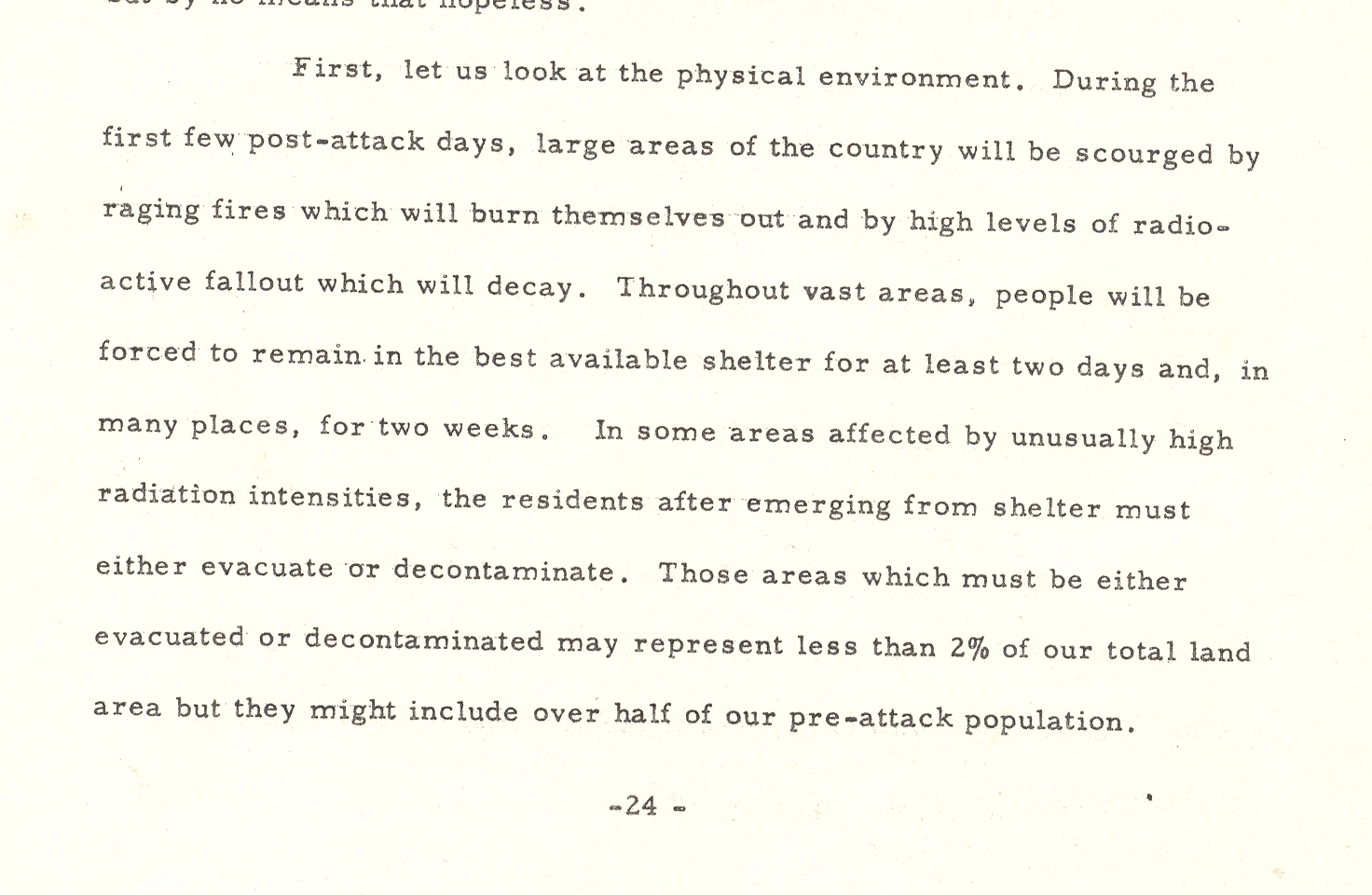
And what does that mean?Dr. Coker relates this gem (on page 21): “The post-attack labor force available thirty days after the attack probably will represent a significantly lower fraction of the population than does the preattack labor force….” And this: “A nuclear attack can be expected to alter the occupational composition of the labor force.”
This sort of thinking overtakes the factual aspects of massive attack, with Coker stating on page 24 “I wish to sayemphatically that it [post-attack America] will not be anything like that depicted in Neville Shute’s On the Beach.It will be bad enough, but not that hopeless.”
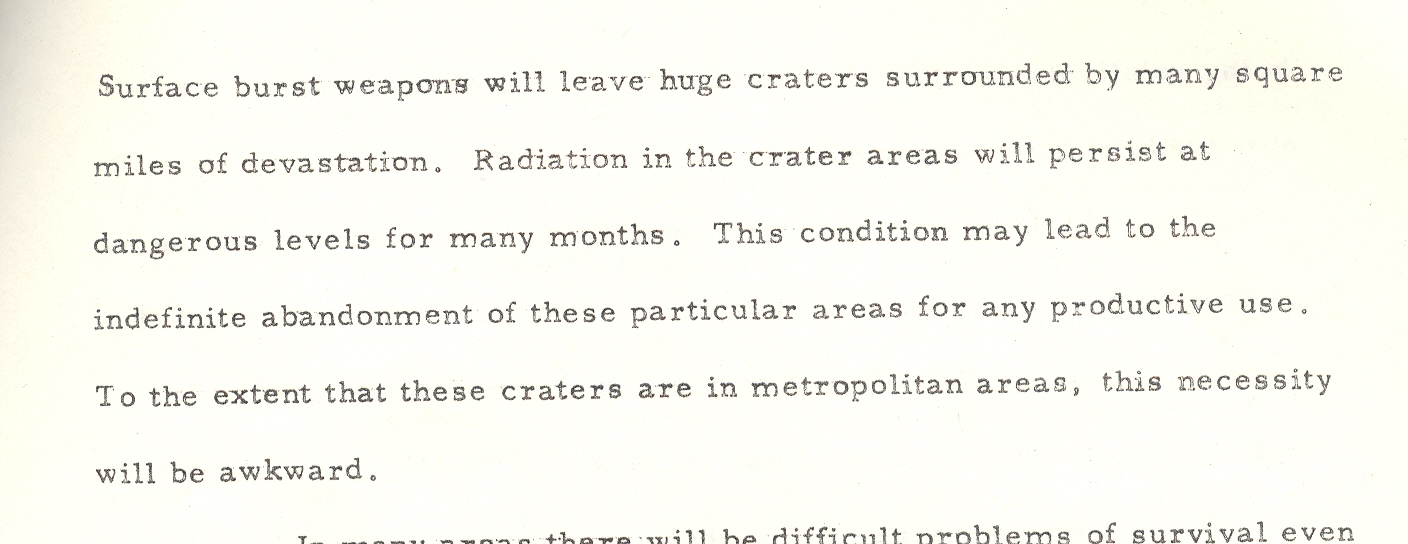
And this absolutely incredible/horrendous and perhaps worst-use-ever of the word “awkward”:
For the love of King Neptune’s Pants:Awkward?How in the name of _______ could someone in such a high position and authority relate massive attacks on every major American population center which would cover the area in fire and thousands of gigantic highly radioactive craters in which a city used to exist be called “awkward”?How great a sin was this, to influence opinion on holocaust via pathetic and unreasonable means?
And then this, on the survivability of our governmental and economic institutions:
“The post attack institutional environment will depend on the continuity, resourcefulness and general effectiveness of our leadership and the survival and resilience of pre-attack institutions…”
Hm?The post-attack institutions will depend on themselves?
This of course is followed by a major plug for Dr. Coker’s own work, because the preparations undertaken by the NREC will directly affect the survivability of post-attack America.So don’t stop the funding.“The more complete and realistic our preattack [sic] planning and preparations have been and the more effectively the government is at all levels in inspiring and retaining the confidence and support of the population, the less drastic institutional changes will be.”So it is the mealy aspect of inspiration that will direct the survivability of whatever it is that makes America so.
I should point out that Coker’s use of “post attack” and “pre attack” appear as two words, one word and a hyphenated word, depending on nothing. This is only a forty-page document.
Another nugget on the post-Armageddon future on the distribution of wealth, mostly hinging on blast shelters:“Per capita wealth in material terms may or may not be reduced by attack.”There will be a relatively proportional number ofpeople who emerge from the smoking holes to staff surviving industry, and so per capita wealth will stay about the same.If, on the other hand, people build more blast shelters, then the proportion of surviving workers to factories will increase, and “the surviving plant capacity will be spread more thinly among them”. It is left unstated, but what that means is that more successful implementation of blast shelters would mean a reduction in per capita wealth. Dr. Coker also forgets what he said earlier that the blast shelters really didn’t work unless they were more than ten miles from a target.Considering that the industrial workers would be living close to, um, industry, they will no doubt be (in 1962) in a ten-mile radius to where the blast would be.Then of course there would probably be more than one bomb, so the blast area would be more than a ten-mile circle, and so on and so forth.
In the following paragraph, Dr. Coker somehow draws all manner of feel-good high-probables around him, encasing himself like a sandman in a thin layer of improbability, to come to the following conclusion:
“…few of the analysts who have studied carefully these post-attack [sic] survival and recovery problems take any stock in the oft-repeated theory that the survivors will envy the dead.On the contrary, after a very rough year or two, the surviving population, if it so chooses, can begin to enjoy the advantages of a social structure and a physical environment not so very different from those which prevailed before the attack.” [Emphasis mine.]
This is an astonishing work of incredible deceit, and may be the worst quote of the lot.But it is so difficult to choose between unacceptable bits of thinking like this, raking out the horrible from the terrible.
Here’s another deceit that was absolutely better understood in 1962 than the writer acknowledges:“The long-term effects of radiation are subject to much less understanding and certainty than are the short term effects.There is some evidence that increased radiation exposure results in reduced life expectancy and increased evidence of leukemia and various degenerative diseases…”And this:“Genetic effects are more controversial.”Than what?! And this: “Studies of the Hiroshima and Nagasaki experience are said thus far to be inconclusive.” Honestly this was very well understood in 1962, and statements like these were enormously irresponsible if the data were actually misunderstood and criminal if they weren’t.
There are many more examples—I’d say actually that the entire paper was at the level of Apocalypse Fairy Tale—but I’d like to close with just one more, this one using another fanciful version of the possible post-nuclear future and another highly insulting euphemism.On transportation:“We hope in the near future to develop a family of network and transportation models to estimate capabilities to move surpluses into deficit areas in order to cover deficits during each time period and to support the use of more ambitious resource management techniques focussed [sic] on recovery problems.”Aside from bad sentence structure and misspellings I could hardly imagine sitting through a presentation where a person thought this stolen undercooked tripe.What we have arrived at here at the end of the paper is references to smoke-in-a-hole cities being “deficit areas”, and the successful removal of human consideration from the conversation—strange as Dr. Coker was addressing the Annual Meeting of the Population Association of America.(I’d love to know what the association members thought of the talk afterwards.)
And so what can we draw from the experience of knowing thinking like this?Is it as sterile as it might seem, so distant from our experience?The scenarios have changed, as have the leaders and delivery systems, but the insatiable stupidities have evolved and morphedinto our own time.Its easy to raise our eyebrows now on the whole MAD approach and the writings of people like Dr. Coker.The truth of the matter is that we have plenty of this sort of thinking going on right now, big head-waggers that will loom in our futures with the attached questions of “how could this have happened?”.WMD is one of the many examples of this, a Big Lie that was repeated for years and which ultimately cost the lives of many thousands of people and a great perpetuator of the culture of fear.President Bush drove that one into the ground and so far as I know still employs it when necessary, threatening listeners with fear of those three letters like they were a practice hand grenade.(I recall that a far-right radio personality filled with afterbirth blood and urine eyes said that he would resign his show “in a year” if WMD were not found in Iraq; that was five years ago, and of course he is still there, bloated and ponderous and mostly violently wrong as ever.)The Savings and Loan debacle.The deathly ambitious practices leading to our recent depression.The billion malnourished and desperate children in the world.And so on. The point is that there is no paucity of thinking displayed by Dr. Coker in the past, and there is definitely no lack of it right at this very moment.The problem is seeing it for what it is in the present and to not have to wait for the future to get to the truth of the matter.
[And how can I end this discussion without a bit more of Stanley Kubrick’s magnificent Dr. Strangelove.., who pointed out these absurdities better than,perhaps, anyone?]
Ah, don’t fret! The ending is just below (and just when you are about to laugh (“Mein Fuhrer, I can WALK” the other and last shoe drops.).
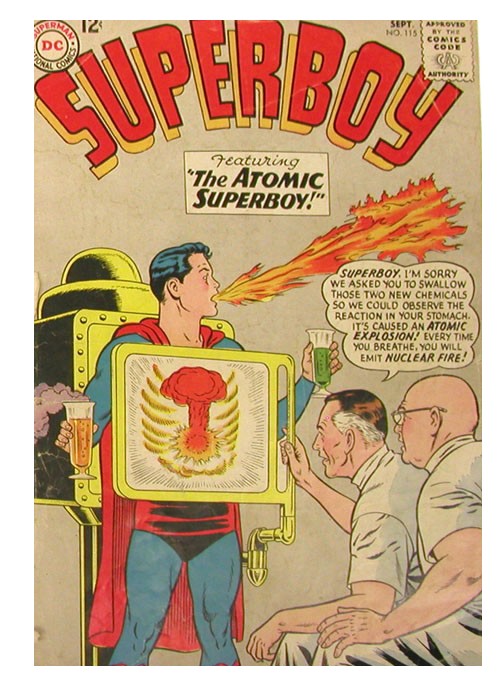
I don’t know why, but I cannot remember ever having seen an x-ray of an atomic explosion taking place inside of a person, before today. I guess that Superboy’s body is susceptible to x-rays but is also at the same exact time capable of preventing a nuclear explosion from escaping his body–all except for the “nuclear fire” coming from his mouth.Now that’s some sort of body control! The men in white seem pretty confident, being so close to the Trinity-like action and all.
Superboy evidently needs fewer ribs than humans, and it looks like the detonation point is right on the transpyloric plane, taking out kidney, liver, gall bladder and just about everything else. And his spine doesn’t show up, either–along with a lot of other innards.
The original (published in September 1964) comes from the Oak Ridge Associated Universities, and they point out that this issue comes right after the signing of in-air nuclear weapons testing ban (after a speech by JFK in June 1963, marked by a memorial that was about 10 feet away from where I used to practice the shot put in D.C.)
Talking to the Future: a Note of Pity to Ourselves in 300 Generations
In the history of words I’ll take a wild guess and say that fractions of 1% of everything communicated is directed at ourselves in the future–or at least it has the possibility of being directed to someone else when our deeds are long, long since forgotten.
And by writing to the future I don’t mean in an off-hand way, our words being read in 12,010 by chance, idea archaeologists looking at what people were talking about 10,000 years earlier; and I don’t mean via “reconstructing” our radio or tv broadcasts (in the not-right Jodie Foster Contact kinda way). I mean intentional messages to be read a long time from today.
A more problematic entry would be images and symbols design to be read by future generations, in the deep future. This is not a very deep category, though a famous (if not well designed) example being the one associated with Carl Sagan that was attached to the 1972 Pioneer 10 and 1973 Pioneer 11 spacecraft, which attempted to explain what humans were should either vehicle in any eon come into contact with other-than-Earth life.
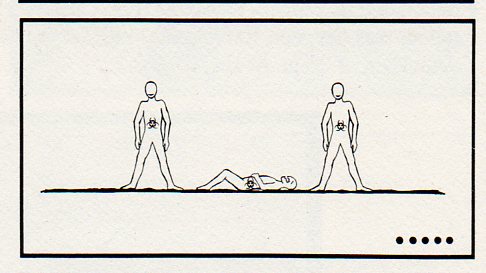
Another is the pictograph presented here, which appeared on page 117 of the ironically and extraordinarily-titled Reducing the Likelihood of Future Human Activities That Could Affect Geologic High-Level Waste Repositories1, the first half of which (bolded above) could make a nice departure for some other science fictiony type story. But what these folks were talking about, plain and simple, was how to prevent future generations from digging into or other disturbing in any way buried masses of nuclear waste.
This pictograph is meant to be a non-linguisitc, universally-understood warning to future generations that the ground they are standing on is above a nuclear waste storage site. The plan was that nuke waste would be solidified and buried in rock hundreds of meters below the surface in an effort to keep in line with governmental policy of waste disposal2. The pictograph relates to the restricting of future human activities part of the title of the work in question–that is, folks in the future who might muck around, drilling, into the nuclear waste site. This pictograph tells them why they shouldn’t do so, because of all of the terrifically lethal mojo underground.
As one might guess by the title, the report has its own communication problems–it is dense, turgid and not a particularly clear document. It is a fine document illustrating the problems of communication, but not in the way it would have wanted to be, celebrating a reverse triumph in a Darwin Award/IgNobel type of way. And all of this in spite of/or because of a healthy slice of linguists, semioticians, logicians, artists, graphic designs, politicians,. sociologists and so on constructing the thing.
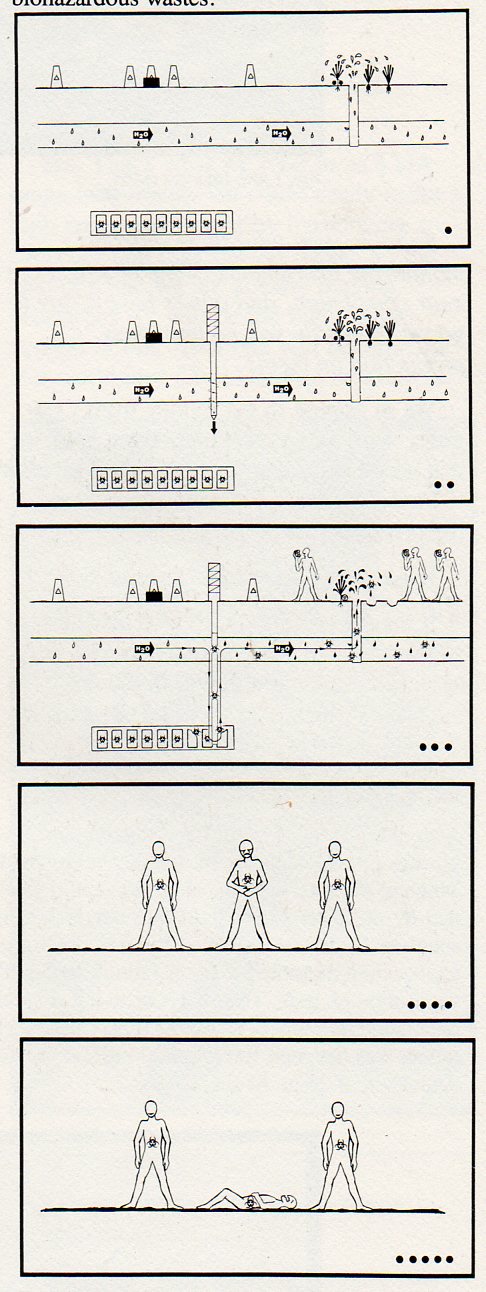
The sign basically says that if you drill at this spot (to some unspecified depth) through aquifer or underground stream or water source or something that some point you may reach the biohazard nasty, which will then get into the water supply and into humans, which will then kill them.
The sign was designed for 10,000 years hence, and depended upon pictures to convey the message rather than words (except for H20, and the biohazard symbol). Of course the radioactive nastiness will be there for millions of years, which would be an entirely different story in terms of imaging. Perhaps.
The one thing the design of the pictograph has in its favor is that it is read top to bottom–no language on Earth (so far as I know) is read bottom to top, though there are many differences in reading right-left/left-right. Beyond that, the pictograph stumbles over itself–except for the last two images, which may or may not tell someone that something bad is happening.
There are plenty of time capsules and idea-vehicles to the future–I’m saddened that this was seen to be one of the essentials that we would pass on to our future selves.
Notes:
1. Reducing the Likelihood of Future Human Activities That Could Affect Geologic High-Level Waste Repositories (Technical Report prepared for Office of Nuclear Waste Isolation, Battelle Memorial Institute; BMI/ONWI-537; May 1984)
2. “Present society’s responsibility is to dispose of radioactive wastes in a manner that is safe, is environmentally acceptable, and does not require long-term maintenance or surveillance. This ground rule is consistent with the objectives in the U.S. Department of Energy.”Reducing…, page 2.
The pictograph, explained, pp 115-116 from Reducing….
The pictograph…was developed using the concepts and guidelines discussed by Givens (1981). The objective is to convey to the reader the sense that if the area below the markers is disturbed, toxic substances will enter the ground water and lead t o severe consequences. relies on several visual images acting in concert to relay the message.
The ground surface exhibits peripheral markers and a central monument to denote relevance to the site where those markers and monument exist.
The ground-water system is indicated by water-drop shapes and by the chemical symbol for water (the only departure from icons, used as a redundant measure).
A repository far below the surface is depicted with the biohazardous symbol. The fact that the object portrayed below the surface is a repository may not be at all evident to a future reader from the first frame; however, the movement of the dark material from the repository through the aquifer and into the vegetables in the third frame, coupled with the movement of the biohazardous symbol, should imply the burial of biohazardous materials below the surface.
The pictographic sequence exaggerates reality with regard to the rapidity of contaminant transport and uptake, and with regard to the severity of the consequences. However, exaggeration is necessary because both the clarity and the relevance of the message may suffer if.the pictograph attempts to indicate contaminant transport time of thousands of years. Similarly, the consequence portrayed, a painful death, over-exaggerates the cause-effect relationship and the rate of the individual’s demise (one out of three suffer death in the pictograph, whereas a to chance would be more representative).
On this anniversary of the second atomic weapon to be detonated in Japan I just would like to point out a long (perhaps 75 posts) series that I’ve made in this blog on the history of atomic and nuclear weapons.
The most recent–on the clouds of Nagasaki and the fate of Kokoura–was made on 6 August.
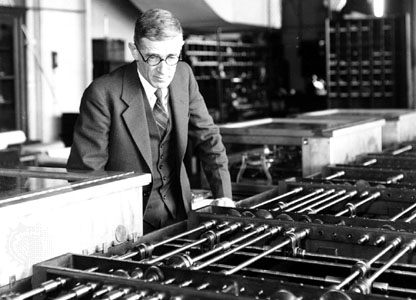
I’ve written a number of times about Vannevar Bush in this blog. He was a brilliant, practical, deep-sighted Yankee of an old school, capable of selecting the correct course of action and getting to it, his quiet resolve apparent to everyone. He also had a large part in the winning of WWII, being in charge of scientific and technical development for military and war-related affairs, deciding how to spend time and effort and money for the best possible result to win the war (That would be the OSRD, the Office of Scientific Research and Development, which he headed, and created–actually he outlined the whole thing on one sheet of paper and had the mammoth idea approved by President Roosevelt in a quick 10-minute session in 1942.)
He had a brilliance to him in choosing the important stuff that was necessary and the important stuff that could wait. For example, he told Norbert Wiener that the war needed to be won before investing in the challenge to develop the digital computer–it just wouldn’t be developed quickly enough, he felt, to do the jobs necessary to substantiate its time and effort before war was won.
He also could say “no” to Einstein, a man who he admired and respected, but also a man who he thought he could not trust with the development and construction of the atomic bomb. As much as he wanted to share the project with Einstein, he couldn’t, and wouldn’t, and didn’t. And he had a point.
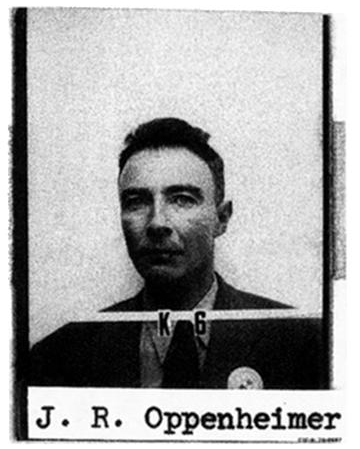
He stood on tall ground in regards to Oppenheimer when the witches went to gather Oppenheimer’s soul. At a time when major forces decided that Oppenheimer must go, that he should be excluded from Q clearance and from being involved with the development of the thermonuclear bomb–and that he must go because he was seen as a security risk because of a series of minor incidents (like light associations with the Communist Party in the 1930’s), Bush would have none of it. Mostly, Oppenheimer represented a threat to political desires for the development of new weapons, not so much, really, as a possible Soviet agent. Bush supported Oppenheimer, and questioned the entire legitimacy of the hearings themselves.
“Here is a man who is being pilloried because he had strong opinions, and had the temerity to express them”, Bush said, ending his testimony with this forceful statement:
“I think this board or no board should ever sit on a question in this country of whether a man should serve his country or not because he expressed strong opinions. If you want to try that case, try me…”
Many of course stood by Oppenheimer; Bush’s support seems to me to be among the strongest. Perhaps even more pissed than Bush was I.I. Rabi, who in disgust of the proceedings said: “”He is a consultant, and if you don’t want to consult the guy, you don’t consult him period…We have an A-bomb…and what more do you want, mermaids?”
There was also John Lonsdale, chief of security for the Manhattan Project and who investigated Oppenheimer thoroughly, as he said during the hearings: “We kept him under surveillance whenever he left the project. We opened his mail. We did all sorts of nasty things”. Lonsdale firmly believed in Oppenheimer, thought him innocent in this ‘non-trial”, and defended the man throughout the rest of his long life (dying at age 95 in 2003).
Others of high importance questioned Oppenheimer’s integrity, patriotism and trustworthiness:
JF Ptak Science Books Post 1106 [Atomic and Nuclear Weapons Series]
This post is one in a continuing series on the history of holes–the appearance of this particular hole meant the difference of life and death for hundreds of thousands of people, and it killed almost as many people as it didn’t kill.
The hole was in a cloud. It was a corollary cloud to missing clouds from a few days earlier.
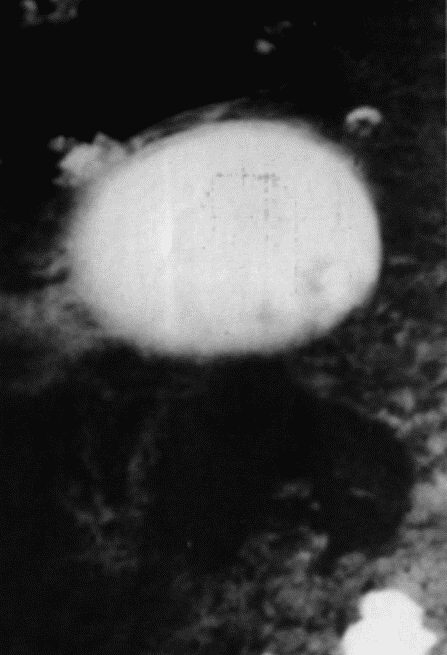
On 6 August, 1945, the primary target of the first atomic bomb to be dropped on Japan was Hiroshima1–had there been unfavorable weather conditions, had the target been obscured by clouds or haze, a second target would be engaged–that was the Kokura Arsenal on the north shore of Kyushu. But conditions were bomb-favorable on that day, and Hiroshima was the city that was killed. Little Boy, the U-235 bomb dropped by Paul Tibbets from the Enola Gay exploded 1,900 feet above Hiroshima. The bomb detonated and–with blast and shock wave and the ensuing damage and conflagration–70,000-80.000 people were killed (and at least double that number within five years).
It was a day before the news of the bombing was verified for Tokyo, and another day before the Big Six leaders of the Japanese army and government decided that they couldn’t decide in what to do with the Potsdam declarations and order of surrender. It was a raging debate among those leaders, and it was a failure.
The second bomb, the plutonium Fat Man, was to be dropped by Major Charles Sweeney from Frederick Bock’s B-29 Superfortress Bock’s Car on the next target, which was decided to be the Kokura Arsenal. And so Fat Man was taken over Kokura on 9 August, but by the time Major Sweeney (who had piloted the Great Artiste behind the Enola Gay on the Hiroshima bombing) had arrived the previously comfortable atmospheric conditions had turned cloudy, overcast, the target obscured. Sweeney made three runs over the target, but it stayed hidden from the bombardier, and so the people of Kokura were spared. Major Sweeney tuned to his secondary target, Nagasaki. With fuel running out, the clouds were also running thick over Nagasaki, until the last moment, when a hole opened in the canopy and the bomb was released through it, exploding with the impact of 22,000 tons of TNT at about 1640 feet above the city, killing 70,000 people (by the end of the year, 140,000 by 1950).
The hills around Nagasaki confined the blast and protected those on the other side of them. Kokura had no such terrain, which means that had the bomb been dropped there, even more people would have been killed outright and many more so over time.
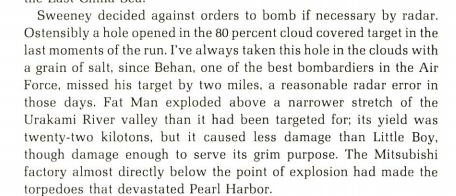
The hole theory though is not necessarily complete–there may not have been a hole. Nobelist (physics) Luis Alvarez, who made major contributions to the firing mechanism for the weapon and a genius-in-general, and who flew as part of an Aerial Observation Team to assess the yield of the bombs, thought that perhaps there was a hole in the clouds and perhaps there wasn’t–“ostensibly” there was a hole, he wrote. Perhaps the bombardier saw the target, and perhaps not. In his Adventures of a Physicist (1989), Alvarez writes about the misery and the snaufedness of the mission, the clouds over Kokura and the multiple runs, the very low fuel which allowed only for one run on the Nagasaki secondary, and the growing accuracy of the flak from below. On page 145 he states that pilot Sweeny had decided against orders to attempt a radar-guided bombing of the 80% cloud-covered target–until suddenly the famous hole appeared, and bombardier Kermit Behan found the target and released the weapon. Alvarez records that the bomb detonated about 2 miles off-target, which he said would have been an acceptable margin of error for a radar-controlled drop, which would fit nicely with the his claim that Behan was Air Forces’s “best bombardier”. Alvarez said that he took the report of the hole “with a grain of salt”2. (See extract below.)
In any event, some sort of hole opened for Nagasaki, and closed for Kokura.
Notes:
New York Times correspondent William L. Laurence flew in the Great Artiste, following the that delivered the bomb 1640 feet over Nagasaki. His report on Nagasaki appeared a month later in the newspaper, and the full text is available via the Atomic Archive blog here.
1. The targets discussed by the Targeting Committee (“Minutes of the second meeting of the Target Committee, Los Alamos, May 10-11, 1945″) on 10 and 11 May 1945 included the following: (1) Kyoto (the former capital with one million people, a center of religious and intellectual life in Japan This target is an urban industrial area with a population of 1,000,000. It is the former capital of Japan and many people and industries are now being moved there as other areas are being destroyed. From the psychological point of view there is the advantage that “Kyoto is an intellectual center for Japan and the people there are more apt to appreciate the significance of such a weapon as the gadget”; (2) Hiroshima (listed as an Army depot though “due to rivers it is not a good incendiary target”; (3) Yokohama (one of the largest remaining untouched industrial centers in Japan); (4) Kokura Arsenal (one of the largest in Japan and situated by urban industrial sprawl); (5) Nigata (port on Honshu) and (6)the Emperor’s palace (which was discussed as a possible target but dismissed almost immediately).[Yawata was also considered (as an industrial center) (during the preliminary meeting of the targeting committee on 2 May 1945) (along with Tokyo, Nagoya, Osaka, Kyoto, Kobe, Hiroshima and Nagasaki.] . The members of the targeting committee (source for this material is Gene Dannen at Dannen.com, transcribing targeting material of the U.S. National Archives, Record Group 77, Records of the Office of the Chief of Engineers, Manhattan Engineer District, TS Manhattan Project File ’42-’46, folder 5D Selection of Targets, 2 Notes on Target Committee Meetings) included (on 10 May): “General Thomas Farrell, Dr. Charles C. Lauritsen, Colonel L.E. Seeman, Dr. Norman Ramsey, Captain Parsons, Dr. Robert L. Dennison, Major John A. Derry, Dr. John von Neumann, Dr. Stearns, Dr. Robert R. Wilson, Dr. Richard C. Tolman, Dr. William G. Penney, Dr. Robert Oppenheimer.” In attendance for the 11 May discussion was Dr.Hans Bethe and Dr. Brode, plus: Colonel Seeman, Dr. Stearns, Captain William S. Parsons, Dr. John von Neumann, Major Derr, Dr. Robert L. Dennison, Dr. Richard C. Tolman, Dr. Penney, Dr. Oppenheimer , Dr. Ramsey and Dr. Wilson.”
2. Alvarez on the hole:
[Source, Luis Alvarez, Adventures of a Physicist, 1989, p 145.]
Note: our poll site crashed I think under the weight of unexpectedly high traffic. At last count there were over 12,000 responses, 10,000 of them coming in the last few days. I will update the analysis section on 7 August. My apologies for the disappearance of the poll.
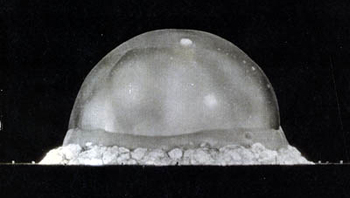
This is a continuation of my post/thread “Deciding to Use the Atomic Bomb: The Chicago Metallurgical Lab Poll, July, 1945″ which is part of a 50-post thread on the history of atomic and nuclear weapons. Thus far more than 2400 people have responded to this poll on whether/how to use the atomic bomb that was first taken by the Manhattan Project metallurgical lab physicists at Chicago. (Image: the 600-foot wide fireball of the first detonation of an atomic weapon at .016 seconds. The event, codenamed “Trinity”, detonated an implosion design plutonium device code at Alamogordo, New Mexico (near Socorro), 16 July 1945.)
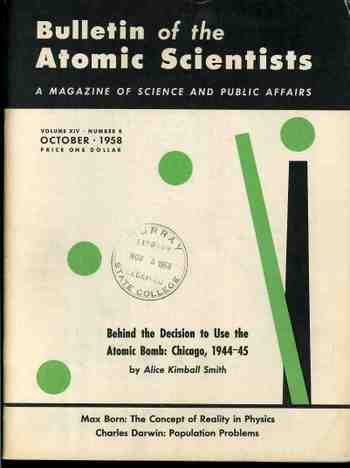
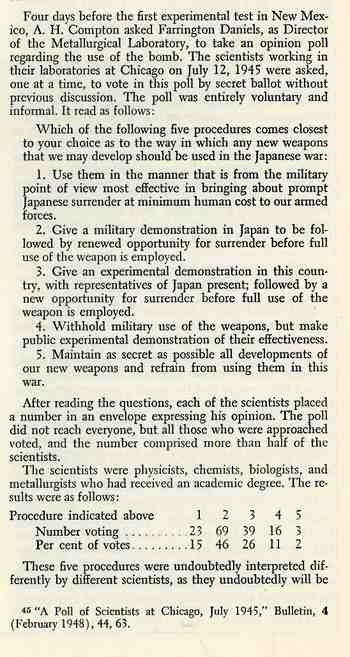
In July 1945 (but before Trinity), Arthur H. Compton asked Farrington Daniels (Director of the Metallurgical Lab section (at Chicago) of the Manhattan Project) to poll the 250 or so scientists at work under Farrington on the coming immediate use of the atomic bombs. (The results of the poll, answered by 150 of the 250 people, were originally published as “A Poll of Scientists at Chicago, July 1945,” Bulletin of the Atomic Scientists, February 1948, 44, page 63. and again published in Compton’s own book, Atomic Quest, in 1956. You can follow the images of the Bulletin of Atomic Scientists for October 1958, p 304 here.
The results of the five-option poll were interesting. Of the 250 asked to take the poll, 150 responded, with 15% (as you will be able to see in the Results section below) of the scientists thinking that the bomb should be immediately employed against a military target. 46% thought that there should be a demonstration of the weapon in Japan in a show of strength, while another 26% thought that the bomb should be demonstrated here in the U.S. and witnessed by members of the Japanese government. Rounding out the poll was the 11% who thought that the bomb should be demonstrated but not in front of the Japanese, and the final 2% holding the option for keeping the weapons secret and unused.
The 2010 results thus far are displayed below, though if readers were interested in taking the poll they should do so now and then return to read the results.
To take the poll, go HERE. You can be a part of this poll anonymously. Please try and keep in mind the time
and place of the events unfolding: the Japanese resistance to the
unconditional surrender ultimatum developing at Potsdam; the resistance
to massive air raids which in the year or so previous to 6 August saw the destruction of 66 major cities (destroying half of all the combined major centers, killing about 900,000, wounding over a million and making another 9 million homeless); the tenacious fighting in the islands at the
outreaches of the Empire; the thousands of American POWs; the
circulating estimates of the coming Japanese invasion casualties
(hundreds of thousands of Americans, far more so Japanese), and so on.
Caveat: this is a curiosity-poll more than anything–it is hardly scientific. Admittedly the original poll was taken by a very distinct population which represents only itself and could hardly be thought of as representing any wide section of the American population. Still it is interesting to see how folks today respond to the poll even in this environment (where the writer has already discussed the results of the original poll, for example) where the history of the decision to use the bomb and its results are so iconic and well known.
The story goes so (this from my original 2008 post): “In late June 1945, the Interim Committee (a secret, blue chip group established by Secretary of War Stimson with the approval of President Harry S. Truman to examine the problems that could result from the creation of the atomic bomb). decided what exactly to do with the weapons. The group (also including James F. Byrnes, former US Senator soon to be Secretary of State, as President Truman’s personal representative; Ralph A. Bard, Under Secretary of the Navy; William L. Clayton, Assistant Secretary of State; Vannevar Bush, Director of the Office of Scientific Research and Development and president of the Carnegie Institution; Karl T. Compton, Chief of the Office of Field Service in the Office of Scientific Research and Development and president of Massachusetts Institute of Technology; James B. Conant, Chairman of the National Defense Research Committee and president of Harvard University; and George L. Harrison, an assistant to Stimson and president of New York Life Insurance Company) found the following:
The opinions of our scientific colleagues on the initial use of these weapons are not unanimous: they range from the proposal of a purely technical demonstration to that of the military application best designed to induce surrender. Those who advocate a purely technical demonstration would wish to outlaw the use of atomic weapons, and have feared that if we use the weapons now our position in future negotiations will be prejudiced. Others emphasize the opportunity of saving American lives by immediate military use, and believe that such use will improve the international prospects, in that they are more concerned with the prevention of war than with the elimination of this specific weapon. We find ourselves closer to these latter views; we can propose no technical demonstration likely to bring an end to the war; we see no acceptable alternative to direct military use.
The Manhattan Project Poll on the Use of Atomic Weapons, July 1945.
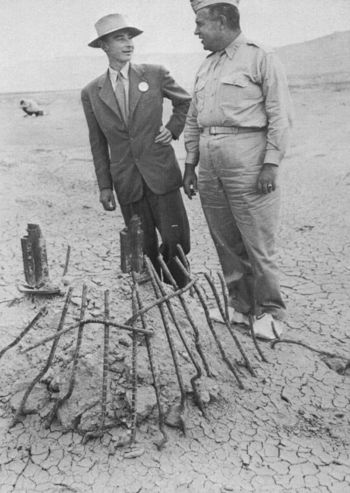
Overall the results are fairly similar—of course there were no controls in the 2008-2010 poll, and it was taken by more than just the scientists at Chicago who helped build the bomb in 1945, and of course people were asked to try and place themselves with some judiciousness back into 1945. So the results are necessarily problematic. Even so, I’m not sure right now how to interpret them. (Image: Oppenheimer and Groves at what was left of the tower that suspended “the Gadget” at Alamogordo.)
The results thus far for Option 1—drop the bomb, drop it now, and drop it on a military target–show that roughly twice the number of people were willing to go straight away to military application than among the Chicago scientists in 1945, 27% in 2010 said to use the bomb “now” compared to only 15% in 1945.
I’m not sure if I’m surprised by this or not—people today certainly know and probably could not put out f their mind that the Japanese didn’t surrender until days after the dropping of the Nagasaki bomb. Wouldn’t this mean that more people would think to drop it?
The second option, which frankly I thought would be the overwhelming choice in ’08-’10 (the demonstration of the effectiveness of the bomb) fell from 46% to 36%, which is just about the percentage of folks who were more willing to drop the bomb more-or-less immediately. I was thinking that this number would increase dramatically. On the other hand I would guess, though, that if the general public was given this poll (somehow) in 1945, that the overwhelming response would be option #1. After all there were millions of Americans in uniform who would’ve been put at risk in an invasion of Japan. There were also dozens of thousands of American GIs who were in POW camps whose well-being would not have been a primary concern if the Japanese homeland was invaded. Also it must be remembered that just a few weeks before this poll was
given and before the American public could have imaginarily taken it,
there was a massive firebombing of Tokyo–334 of Curtis LeMay B-29’s were
loaded to utmost capacity with the newly-conceived M-69s bomb, an incendiary
so vicious that the fires it produced were all but inextinguishable. The B29’s bombed
Tokyo for hours, killing 100,000 people and making over a million
homeless. In spite of this overwhelming display, the Japanese movement
towards surrender was still secretive and extraordinarily slow1.
My suspicion is that this number would be overwhelming on the order of 90% or something like that, because by this point the U.S. was swimming in reports of terror and blood and death with nothing but the promise of more, the invasion of Japan leading to the possibility of hundreds of thousands of soldiers being killed. The chance of ending it all in one or two steps was irresistible to the decision makers; had the use of the bombs been publicly debated I feel that there would have been no debate. Remember: no major decision-maker in the U.S. government had any reservations about the military use of the bomb. There were private reservations on the use of the bomb among America’s top military men (Eisenhower, for one), but these men would not make the ultimate decision. (This is a shallow description of a complex situation, but for our purposes here I think it will do.) . Results thus far (as of 26 July 2010):
2008 poll takers= 2418 people. 1945 poll takers= 150 people
Option 1. “Use them in the manner that is from the military point of view most effective in bringing about prompt Japanese surrender at minimum human cost to our armed forces.” 2010= 27% (1945=15%)
Option 2. “Give a military demonstration in Japan to be followed by renewed opportunity for surrender before full use of the weapon is employed.” 2010= 36% 1945=46%)
Option 3: “Give an experimental demonstration in this country, with representatives of Japan present; followed by a new opportunity for surrender before full use of the weapon is employed.” 2010= 22% (1945=26%)
Option 4. “Withhold military use of the weapons, but make public experimental demonstration of their effectiveness.” 2010=10% (1945=11%)
Option 5. “Maintain as secret as possible all developments of our new weapons and refrain from using them in this war.” 2010=5% (1945=2%)
Notes:
1. The business of whether the Japanese were ready to negotiate a peace in the weeks before 6 August is complicated and far from conclusive. It does seem though that no negotiating team could’ve spoken with a unified voice for the Japanese government, and that the issue of an unconditional surrender further complicated the situation.
Medical and scientific experimentation on humans has a long and painful history. In the early days it seemed much more acceptable to perform tests on people while they were alive more so than to cut up and autopsy their bodies when they were dead.
William Beaumont–the “father of gastric physiology” –was also perhaps a very early leader in the field of bioethics. Beaumont’s most famous series of experiments1 were performed on a living subject, but only with the patient’s full knowledge of the procedure and consent (and also with te ability to terminate the procedures). (Part of the defense of the Nazi concentration camp doctor-monsters brought Beaumont into their courtroom as an example of early American compliance to their bestialities, but purposely failed to mention the pertinent rights of Beaumont’s patients, whereas their thousands and thousands of human subjects were in concentration camps and were treated without regard to any moral, ethical or humanitarian consequences.) Claude Bernard–one of the 19th century’s leading experimental medical researchers and physiologists–reported in his monumental 1865 Study of Experimental Medicine… that a physician must “… perform an experiment on man whenever it can save his life, cure him or gain him some personal benefit.” Hopkins’ great William Osler (in 1907) was entirely on board with the Bernard appraisal of the duties of the physician, saying that any new procedure or pharmaceutical must be used on humans before general release.
Then of course three’s the other side of the coin: the STD experimentation in the infamous Tuskegee case (1932), the widespread studies of the U.S. Army’s Chemical Warfare Service, the Cornell Medical School’s wincingly bad study that gave the name to the placebo effect, th e1942 Chicago malaria studies on inmates, the long series of atomic and nuclear weapons tests with passive involvement of sailors and soldiers, and on and on, back into dim history. (The experiments by the Nazi doctors and their Japanese Unit 731 counterparts deserve their own categories.)
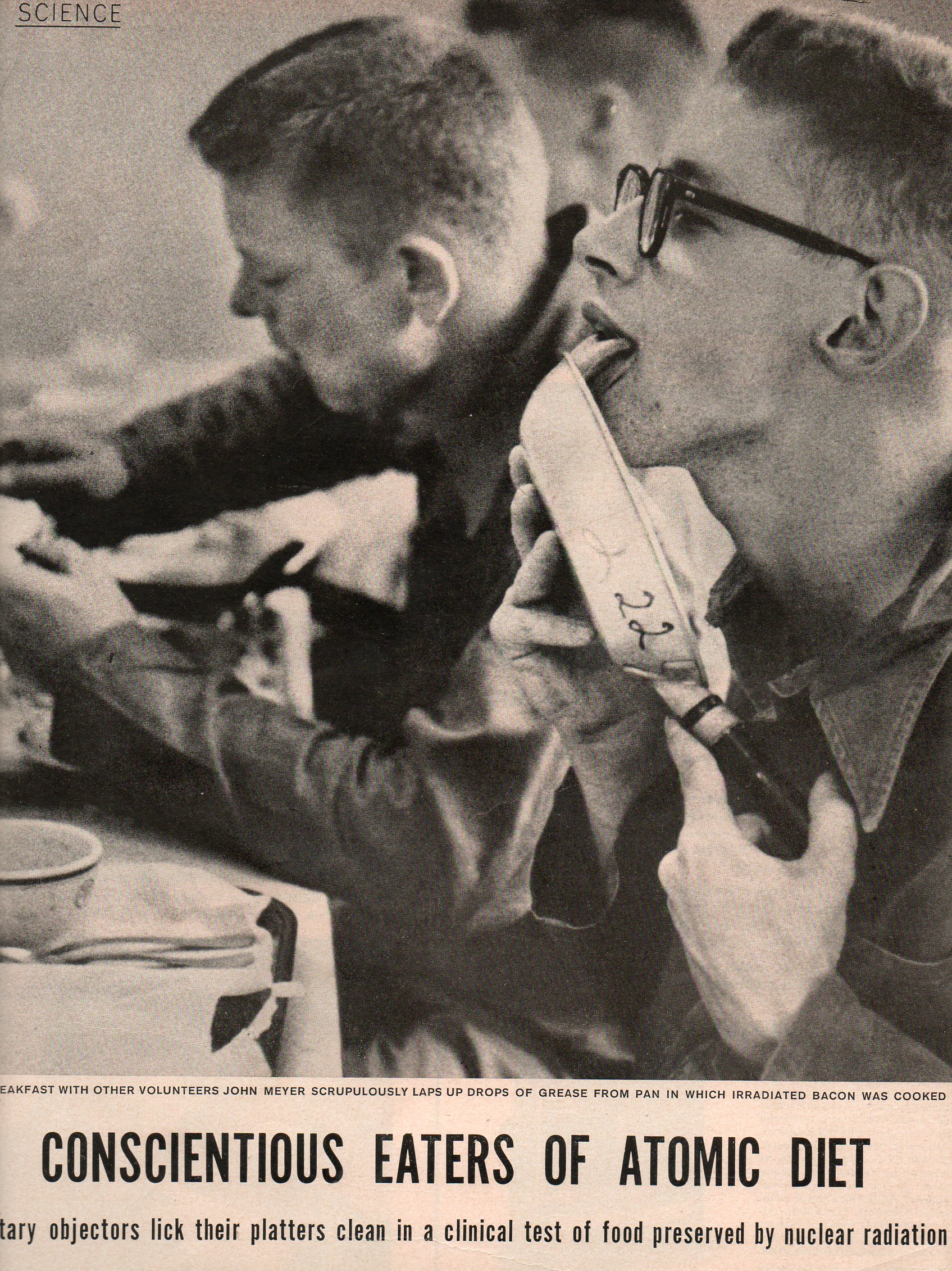
This photo from Life magazine on the story (“Conscientious Eaters of an Atomic Diet”) of 1955 must be among the most wholesome general cover stories in the history of the idea of human experimentation. These young conscientious objectors2 declared (for whatever reason, ethic, moral or religious) their inability to serve in the armed forces, and were sent to a different task to replace military service. Their exchange would be to test the effects of nuclear radiation on food products. (This was the process of using radiation to kill bacteria and insects and whatever other living badie in food that might cause disease or illness of cause the food to spoil. The long-term result for the military could be enormous, allowing for more inexpensive and less difficult ways to keep food for longer periods of time for troops, and could also keep troops healthier by eliminating certain food-borne illness that could spread from one person to another.)
Still, what was being asked of these young men was far beyond the “debt” implied by their CO status. The effects of this sort of exposure were still not well known, and these men were absolutely being place in harm’s way, and for the cameras of Life. The ideas of “Radiation sickness” and “Acute Radiation Syndrome”–created by the two atomic bombs detonated in Japan in August 1945–were only about ten years old at the point where these young men were licking the irradiated grease form their plates. (As a matter of fact there was no immediate medical research team in place to study the biological effects of the bombs in those two cities; after a few weeks and by the end of August there was a organization in place, headed by Colonel Ashly Oughterson.) These men weren’t going to suffer any radiation poisoning from the process (the ionizing radiation used by irradiators “was not strong enough to
disintegrate the nucleus of even one atom of a food molecule”) , but the effects of irradiating food at this point were still not known.
Notes:
1. Published in his 1838 Experiments and Observations on the Gastric Juice, and the Physiology of Digestion.
2. The business of conscientious objection to military service is milennia old; in the United States it goes back easily to the Revolutionary War. It becomes a little less defined in the Civil War, where a CO or anyone else faced with military service could purchase a stay of service for $300 or provide someone in his place. (In the CSA the same could be done but for a little more–$500.) The whole business got considerably tightened up by WWI, and in WWII–when there was a spike in declarations by Cos–the code for declaration of objection to military service was considerably clarified, though not making it any less painful experience for the CO to endure. In 1948 the worldwide issue of the right to “conscience” was addressed by the United Nations General Assembly in Article 18 of the Universal Declaration of Human Rights, part of which reads: “Everyone has the right to freedom of thought, conscience and religion; this right includes freedom to change his religion or belief, and freedom…”
During WWII the CO declaration form/questionnaire DSS 47 asked these ten questions:
1. Describe the nature of your belief which is the basis of your claim. 2. Explain how, when, and from whom or from what source you received the training and acquired the belief which is the basis of your claim. 3. Give the name and present address of the individual upon whom you rely most for religious guidance. 4. Under what circumstances, if any, do you believe in the use of force? 5. Describe the actions and behavior in your life which in your opinion most conspicuously demonstrate the consistency and depth of your religious convictions. 6. Have you ever given public expression, written or oral, to the views herein expressed as the basis for your claim made above? If so, specify when and where. 7. Have you ever been a member of any military organization or establishment? If so, state the name and address of same and give reasons why you became a member. 8. Are you a member of a religious sect or organization? 9. Describe carefully the creed or official statements of said religious sect or organization as it relates to participation in war. 10. Describe your relationships with and activities in all organizations with which you are or have been affiliated other than religious or military.
For human experimentation, see also:
Hoerni B. [Medical ethics. Evolution century after century] Hist Sci Med. 2003 Jul-Sep;37(3):331-8.
Lyon J. Experimenting with humans. Part I: History and context. Second Opin. 1987;6:63-89
Numbers RL. William Beaumont and the ethics of human experimentation. J Hist Biol. 1979 Spring;12(1):113-35.
For more on radiation studies at Hiroshima and Nagasaki:
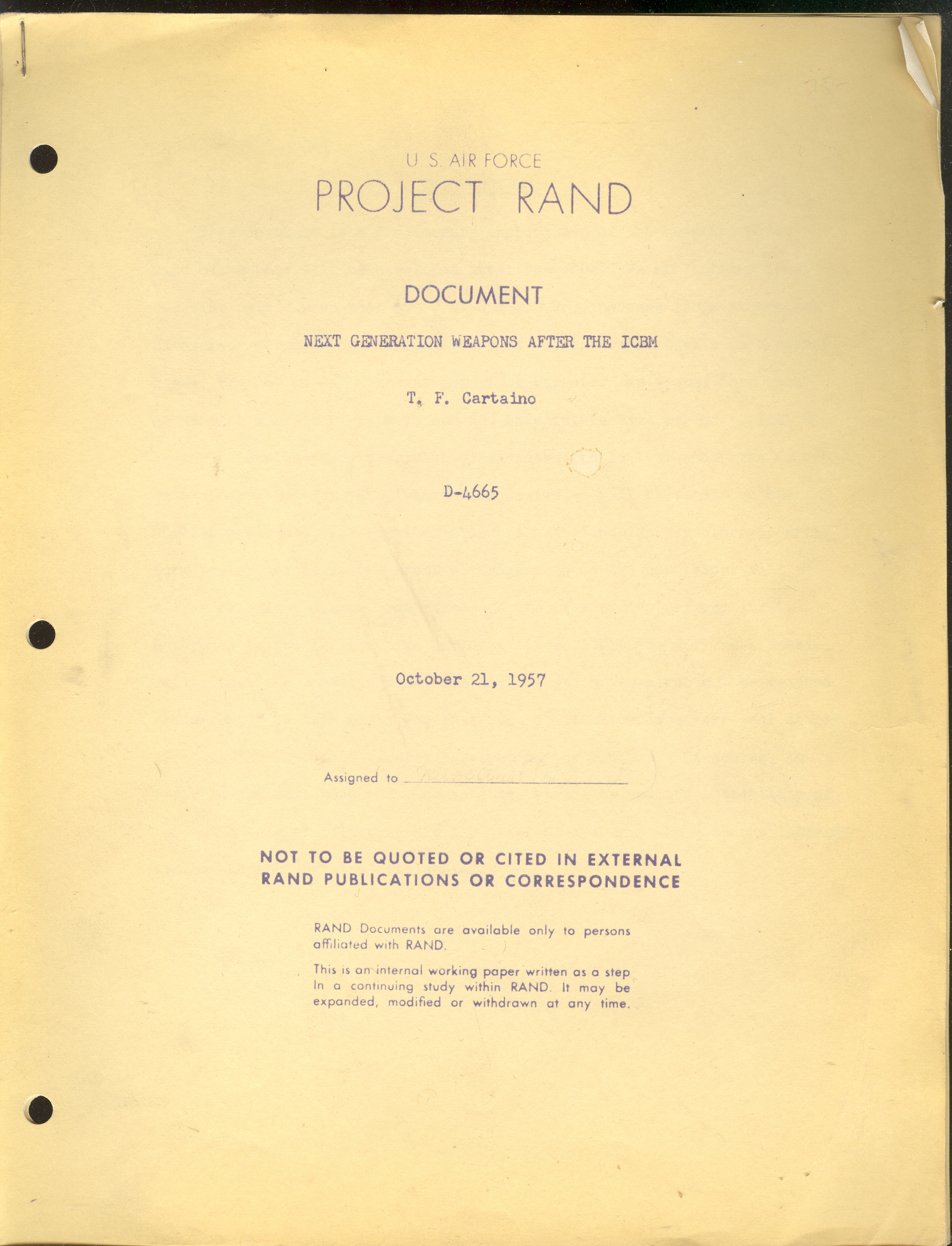 The RAND Corporation (Research And Development) is a think tank originally formed in 1946 by the US Army Air Force as part of a contract to the Douglas Aircraft Company. After 1948 RAND Corp was funded by a number of different sources, private and governmental, and left the sphere of being a direct arm of the U.S. military. (Maybe.) It still did enormous amounts of work on behalf of the military, and seems to have been their chief theoreticians during this period. It was also the time that the policy of Mutually Assured Destruction (MAD) was formulated at , partially under the direction of we’ll-see-him-again-down-the-road Robert McNamara. And of course much else. [This pamphlet is available for purchase from our blog bookstore.]