A Daily History of Holes, Dots, Lines, Science, History, Math, Physics, Art, the Unintentional Absurd, Architecture, Maps, Data Visualization, Blank and Missing Things, and so on. |1.6 million words, 7500 images, 4.9 million hits| Press & appearances in The Times, Le Figaro, Mensa, The Economist, The Guardian, Discovery News, Slate, Le Monde, Sci American Blogs, Le Pont, and many other places… 5000+ total posts since 2008.
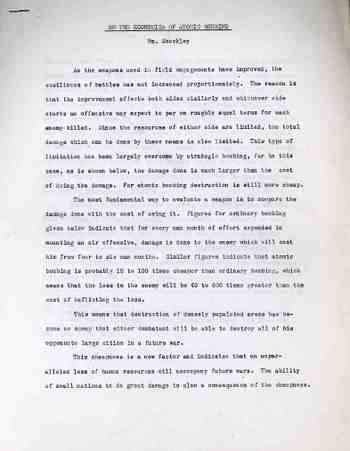
(Click image to enlarge; the other four pages are located in the “Continue Reading” section, below.) William Shockley on the Economics of the “Atomic Bomb Art”
This paper is one a small archive of background and draft papers and
proposals by the Vannevar Bush group working on the question of the
control of atomic weapons and the formalization of the American
position regarding the use and control of atomic weapons, October
1945-February 1946. This archive consists of 38 documents relating to
the development of U.S. atomic policy, with contributions by President
Harry Truman, Secretary of State James Byrnes, Dr. Vannevar Bush, (future AEC director) Carroll Wilson, Alger Hiss, I.I. Rabi, William Shockley, Frederick Dunn, Joseph E. Johnson, Leo Pasvolsky, Philip Morrison, Col. Nichols, William McRae, Admiral W.H.P. Blandy, George L. Harrison, and others.
I’d like to say that this was a class-of-its-own sort of work, but as it goes this is hardly the case. If I cared a little I guess I could establish a collecting sub-category in the nuclear fission–atomic–nuclear <continue>
This indelible image has two big residences
for this blog, as follows:
Perspective 1:Waiting to Say Goodbye Department, part
2.
Yucca Flat
is a big, wide place in the desert,
about 65 wide-landscape miles northwest of Las Vegas, Nevada. As part of the Rhode-Island-sized Nevada Test Site (NTS) it is also the
most irradiated and radiation-polluted place in the country.It was the site of some 749 nuclear tests–about
80% of all the nuclear tests carried out at NTS. And it shows, and will show,
pretty much forever.
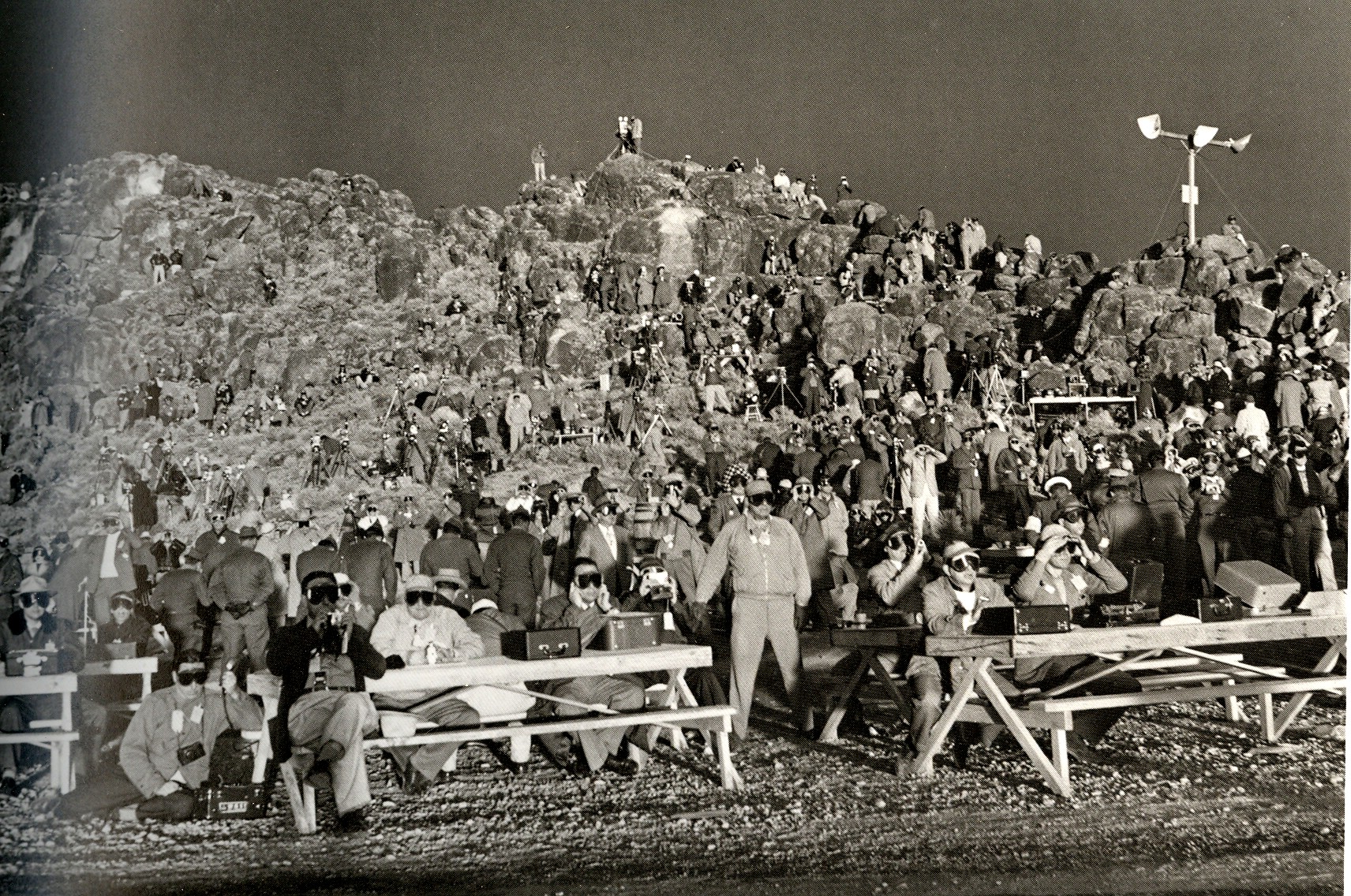
This remarkable photo of a test shot
was made at Yucca in the mid-1950’s—in the dark.Actually it was dark, pre-dawn before the
viewing station of observers was completely, Georgia-O’Keefe-like illuminated
by the brilliant explosion.The people
here were gathered at “News Knob”, about seven miles away from the detonation
point, and all wearing dark, welder-strength goggles to prevent the blindness
that would’ve occurred if they looked at the explosion without protection—best
yet was to wear the goggles and have your back turned to the flash (as some in
this picture did).
This is perhaps the greatest single photo demonstrating the power of nuclear
explosions. You can see the devastating effects, and the giant rising mushroom
clouds and all, but they’re like photos of the Grand
Canyon—nothing really captures the essence of the thing.This image makes the entire idea somewhat “habitable”,
graspable, in a weird, visceral way, placing the power of the event in an
imaginable context.
Perspective 2: Where to be and Where to Look Department; Turning Around.
This is another monumental photographic image in the turning-completely-away-from-what-everyone-else-is-looking-at
department, following such massive images as Ed Clark’s iconic FDR
photo.Just as Mr. Clark pointed (see my post from last year), the picture to be made was not the newsreel shot of the
President’s casket being borne to the train, but it was in the face of the
accordionist, who Mr. Clark found by turning away from the scene being recorded
by a hundred other photographers.It was his picture that told the emotional story of that evident.Just as is the case with this anonymous,
undated photo from the test shot at Yucca, bringing the unimaginable back to some degree of human understanding.
Notes:
Photo from Frances Fralin, The Indelible Image, Photographs of War, 1846 to
the Present, based on a show at the Corcoran Art Museum, Washington DC, 1985,
and published by Harry Abrams.
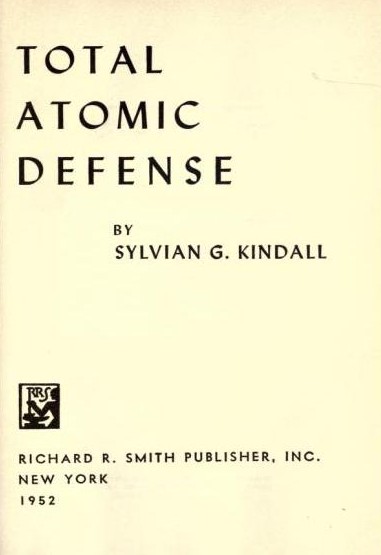
Sylvian Kindall’s Total Atomic Defense (published
by a very severely right-wing publisher in 1952) is one of a series of
books made for a deceived American population, offering the general
reader both fear and hope, often from the same, exact source. But
Kindall has a somewhat diffident approach, offering his belief that
the country and its population can largely survive an all-out nuclear
war–intact. Of course the “intactness” is dependent upon massive
internal change of the social and industrial fabric of the country,
which would have to transform in ways as to make it largely
unidentifiable from that which we would quickly recognize. A quick
look at the table of contents tells the story in miniature, with the
exception of the solution to the problem, which was generally to build
underground. (The neutron bomb would soon complicate this solution.)
Suffice to say that Dr. Strangelove would approve of the publication of
such a work though would hardly believe in any of it for himself… [read the rest of the story here]
Would it have made a difference to Watergate if, years later, Woodward & Bernstein had reported on the prosperity of Cambodia and the largess of Pol Pot? Perhaps it would cause you to wonder about their interpretation and judgment, overall, but becoming a lickspittle to the atrocious Pol Pot wouldn’t have changed the facts surrounding Nixon’s abysmal behavior. Such is partially the case with the Australian reporter Wilfred Burchett (1911-1983), who enjoyed an interesting, combative, contrarian and occasionally awful carreer around moments of great insight, courage and brilliance.
It is Burchett’s
reporting from Hiroshima that attracted my attention–his was the first report made by an Allied reporter.Against explicit and direct orders, Burchett
traveled south from Tokyo to Hiroshima to bear witness to the bombing.Noting could prepare him for what he saw in
the devastated ruins—or in the people who survived the blast.What he found to his great shock was that one
month after the explosion was that people were still dying—slow, tortured, horrific
deaths, a toxic visual tableauxHe saw that they were dying of
the effects of the explosion, though not from the blast itself.The interviews he did with medical personnel
on the scene confirmed his own confusion—no one knew what was killing these
thousands of people.Burchett called it
“the atomic plague”.What he was
witnessing was lethal radiation sickness. He published his observations in a story
called“Atomic Plague”in the Daily
Express, on 5 September 1945.
The official government
position was that there was no lethal radiation generated by the atomic
bomb.The government and the sixth
column (in general) came down very hard on Burchett, saying that he was an
agent of the Japanese working to win sympathy for that country.That, or he was a Communist spy. Or that he
was just wrong.Or crazy.
The New York Times
published a story on 12 September, 1945, rebuking Burchett’s account of
“plague” as “Japanese propaganda”: “US Atom Bomb Site Belies Tokyo Tales: Tests on New Mexico Range
Confirm that Blast and Not Radiation Took Toll” ran the story. The article was
written by William Laurence, a future Pulitzer Prize winner.
At about the same time
another journalist—the American George Weller—made his own harrowing way to Nagasaki
(again against orders from General MacArthur) to report on the damage done by
the bomb.Although Weller’s
interpretations of the bomb and its use were diametrically opposed to Burchett’s
(“The atomic bomb may be classified as a weapon capable of being used
indiscriminately, but its use in Nagasaki was selective and proper and as
merciful as such a gigantic force could be expected to be.”), his story was
censored and seized when submitted for publication.
It would take several years for the story of radiation poisoning to reach the general public, and for the government to reverse its earlier position.
In the meantime Burchett moved on to other provocative and unfortunate things. After covering the war for four years through the Pacific and Europe, he moved on to middle Europe, reporting on the ghastly show trials of the Soviet regime, and for the most part taking the sides of the prosecuting agents. He also covered the Korean War for a far-left leftie publication, taking the side of the Chinese. (In one infamous bit, Burchett reported from North Korean and Chinese POW camps, saying that they were like comfortable Swiss retreats.) And then on the some eye-squinting, not-so-great observations from the North Vietnamese viewpoint in the 1960’s. And then of course there was the whole Khmer Rouge pro-Pol Pot romance–which I just can’t see any way around. I don’t know what happened to him on this one. (I should say that Pol Pot was brought into power by a CIA-backed coup and received support and largesse from the United States, the United Kingdom, China, Thailand and Australia, among others. The detestable, scumbag genocidist died in his sleep only a few years ago, another totalitarianist gone terribly wrong after receiving arms and money from my country.)
But there was a time when Burchett did deliver a story and delivered it well. His reporting from Hiroshima is a classic of pursuing the logic of observations–and it stands still in light of all of his future missteps.
I guess the immediate response to this question would the U-235. This is the stuff (an isotope of Uranium-238, a fissile element that causes a rapidly expanding fission chain reaction), the heart of the atomic bombs that were exploded over Hiroshima and Nagasaki.
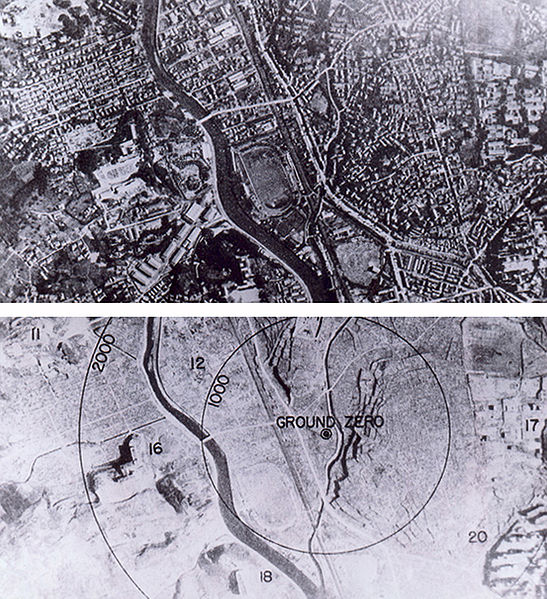
On 6 August, 1945, the nuclear weapon “Little Boy” was dropped on Hiroshima, killing as many as 140,000 people, many of those dying lingering deaths over the course of the next few months; the bomb “Fat Man” was detonated over Nagasaki three days latter, and killed 80,000 over the same period. Most people died of radiation and its extended influences than were killed in the initial moments of the bombs’ explosions.(Below is an image of Nagasaki, before and after.)
It is M-69 though that may be the larger killer.
[Image source: Roger Williams University Archives]
The components of M-69 were naphthemic acid, palmitic acid, aluminum soap, oleic acid, and gasoline. They were placed in tubes about two inches in diameter and 20 inches long, then placed in a 19-unit hexagonal, bound, and located in a bomb shell with a three-foot long paper tail (to slow its descent)..
When this bomb was exploded about a hundred feet over the ground, it was dispersed like a burning, sticky aerosol, and attached itself to anything that it could find. It burned more furiously than any other incendiary device, exhausting as fuel whatever flammable thing it contacted. It could also be dropped all the way to the ground, where it would lay for some number of seconds before exploding, sending dozens of flaming fragments (embedded in cheesecloth) flying in all direction, for a hundred yards or more, looking for flammable things to eat. One such bomb—a 6-pound unit—could start dozens of fires.
This was a product of the US Army Chemical Warfare Services, and manufactured by Nuodex Products and the Arthur D. Little Company. (The Arthur D. Little Company–today an international management firm–was also instrumental, at the same period of time, in producing the first massively-available dosages of penicillin.) The flammable element is more commonly known now as napalm. In a popular article in Collier’s Magazine (14 April, 1945), the M-69 was dubbed “Tokyo Calling Cards”
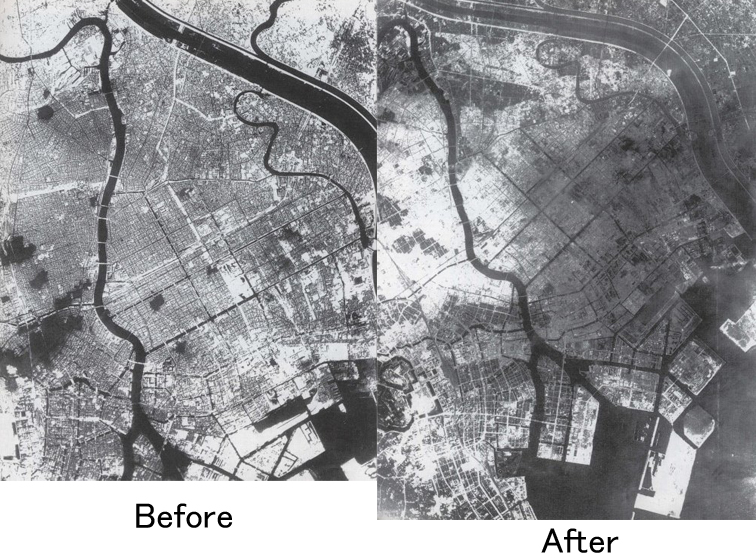
On March 9-10, 1945, 339 B-29’s dropped 2000 tons (4 million pounds, about 496,000 bombs) of M-69 on Tokyo. Two initial passes were made on the city, marking a large, burning “X” in the city. Each plane had the capacity to cover a drop area of 350 feet by 2000 feet, which means a much greater area was affected. The citizens of Tokyo met their ends with buckets of water and brooms in defense. Hours later fifteen square miles of the city were destroyed. In the months prior to Hiroshima and Nagasaki, 66 cities were bombed with M-69, killing about a million people, and wounding more. (Photo below shows Tokyo, before and after.)
[Tokyo images via Wikipedia https://en.wikipedia.org/wiki/Bombing_of_Tokyo]
Its easy to remember the destruction of the atomic bombs of August, mainly I think because of what those bombs became. I don’t know why the 1945 series of firebombings of Japan aren’t recalled as often, especially given the continuing employment of the heart of the weapon that caused that destruction. Perhaps it is the sheer inconceivable nature of what the atomic bombs became, while napalm, as terrible as it was/is, is knowable, somehow.I’m not at all sure. But I think the M-69 should be brought up for discussion every now and then, and remembered.
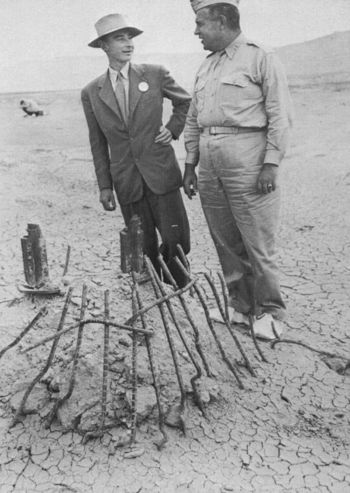
Today is the 64th anniversary of the explosion of the first atomic bomb in the pre-dawn New Mexico desert. I’ve made a number of posts about that event, as well as the decision to use the bomb along with its consequences and subsequent control. Mostly the posts can be found here. I’ve reposted parts of the beginnings of two of those posts relating to 16 July below. [That’s Oppenheimer and Groves standing at the remnants of the base of the tower that held the suspended weapon on 16 July, everything pretty much gone.]
Now we are all sons of bitches—Kenneth Bainbridge, Trinity
Director.
There were many profound thoughts in many profound heads there in the
desert, at the reaches of the Jornarda del Muerto (“The Dead
Man’s Walk”, a formerly nearly-impenetrable stretch of desert in the Llano Estacado) at the Trinity Test Site, Alamogordo, New Mexico, on
16 July 1945 for the successful testing of the first atomic bomb. Robert
Oppenheimer famously cited the Gita (“Now I am Become Death, the Destroyer of
Worlds…”): Enrico Fermi was so busy with his little and excruciatingly
wonderful experiment with strips of paper calculating the effect of the blast
(he reckoned a very-close 10,000 tons) that he didn’t actually hear the
explosion; Edward Teller thought Tellerian thoughts, and so on. Actually
the observation points (like S-10000 and Campania Hill)were crowded with big
brains: in addition to Oppenheimer, Teller and Fermi were people like
Hans Bethe, James Chadwick (whose discovery of the neutron sort of started the
whole thing), Richard Feynman, George Kistiakowsky, Phil Morrison, Robert
Serber, Vannevar Bush, James Conant, and many others. The were all
thinking pretty big things (except for the occasional if-you-can-believe-it
stuff like that which maybe came from Feynman’s mouth, which was “hot
dog!”). I think that Bainbridge’s statement was the best, and truest,
summation of the morning’s activities…
July 17, 1945 (Trinity +1 or Hiroshima -20), the day after the Trinity test
of the first atomic weapon, was the first day in which very concerted, very
real discussions ensued about what to do with the bomb and where to us
it. Actually the discussions were mostly on the “where” than on the
“whether”. (As it turns out part of a minor segment of the “whether” part
was Leo Szilard’s petition to President Truman not to use the bomb and which was signed by 155
Manhattan Project scientists, and which had reached its final version on this
day.)
The truth of the matter was that it was a very complex issue, an easily
misunderstood tapestry of circumstance and consequence. The major issue of
course was that the Japanese would not surrender, and that there would be
“fanatical resistance” once the invasion of the Japanese islands had
begun. The battle of Okinawa had just been fought—it was a
horrible confrontation taking 12,5000 American lives and more than 1000,000
Japanese , demonstrating that even in impossible circumstances that the
Japanese simply would not surrender (unconditionally). This is just
one instance—there are many others, not the least of which was t he recent
firebombing of Tokyo,
taking 150,000 lives. Air strikes in general seemed to not make a
difference in the will of Japan to fight—as was demonstrated again and again in
the British and American bombing of Germany—as was further demonstrated in
General Curtis LeMay’s and General Hap Arnold’s 60-city attack in the
May-August span. The thought was that if there was an invasion that it
could well cost the U.S.
1000,000+ casualties and would be completely…
This is a continuation of a series of posts relating to the development of the atomic bomb.
Park Avenue. 1600 Pennsylvania Avenue.
10 Downing.112 Mercer. Institute for
Advanced Studies. The Cavendish Lab. All pretty good addresses. I have a hard time though coming up with a single best address that
beats POB 1663, Santa Fe, New Mexico. For the sheer breadth of those represented by this simple location, I
just can’t think of anything more specific or more inclusive.
Oppenheimer lived there. So did Fermi. And Feynman. And Teller. And Bohr. And thousands of
others.
Post Office Box
1663, Santa Fe hid
something very important—at the time, it was so important that the place that
it was hiding didn’t even have a real name, just a moniker: Site Y.
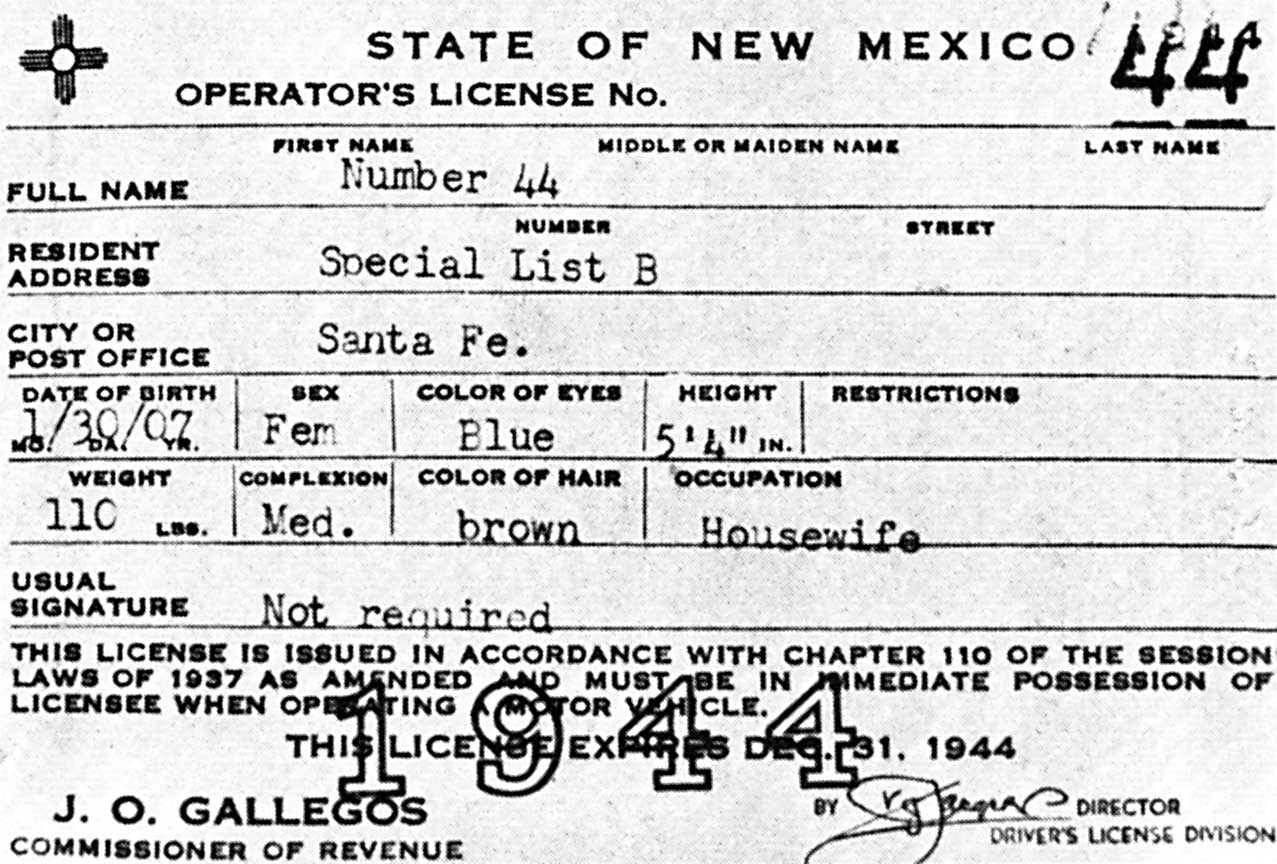
Many of the people who lived there didn’t have the use of
their real names outside of Site Y. Driver’s licenses were issued with numbers, and people paid taxes
according to code numbers and weren’t allowed to vote.They were as invisible as their address, or
as invisible as thousands of people could be in 1942.Being a place filled with mostly quite-young men
and women, there were natural tendencies followed leading to a spike in birth
rates, responded to famously by the facility’s chief to direct that actions be
taken to stem the flow. Or perhaps not*. A radio station popped up featuring
live performers, everyone identified by given name only. And to confound things
further it was nestled within the range of the Blood of Christ (the Sangre de
Christo) Mountains, all the while working with matter that was literally
hotter than hell. That was plutonium, and the “hot” was radioactivity.
Site Y (begun in June 1942) was of course the location of Los Alamos, a major cog in the machine of the Manhattan
Project, a gigantic, secret project that actually stayed secret, which was
remarkable given the wide swath and numbers of people involved and the
relatively simple security. But it was really important stuff (as Richard
Feynman would say),
and there was a life-and-death war on, a fight to the finish1, a death
struggle, so the importance of security—given the staggering consequences of
its breach—was paramount.2.
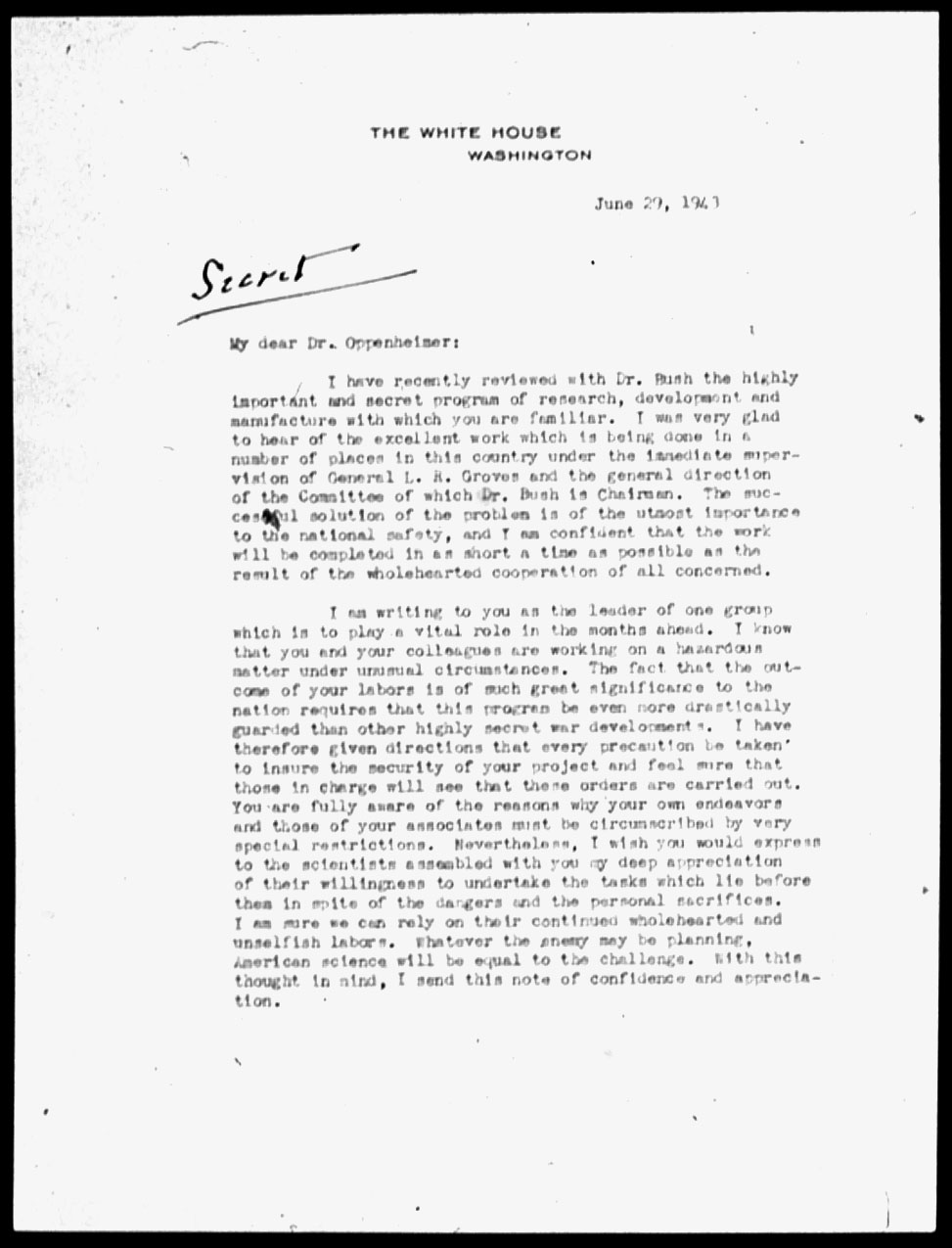
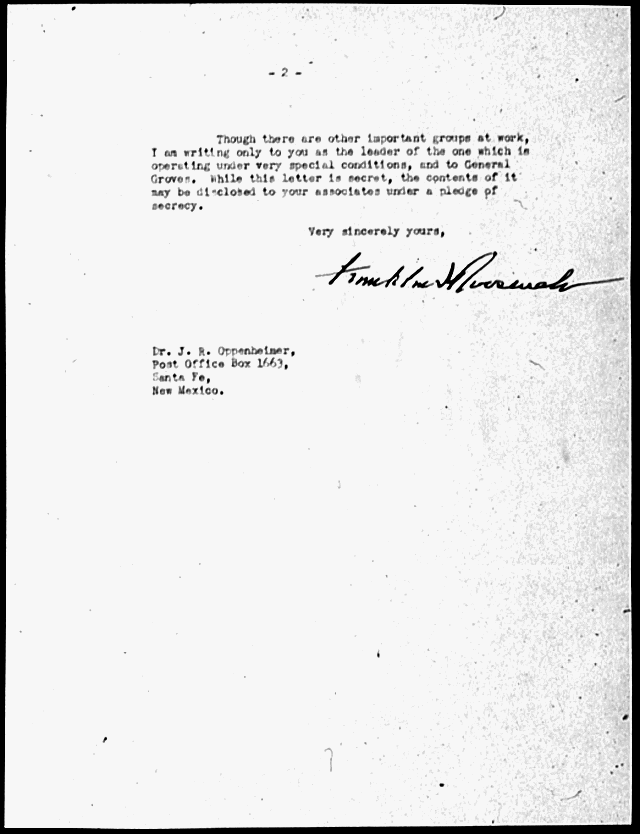
This letter of congratulation and support was written by
President Franklin Roosevelt to J. Robert Oppenheimer, and sent to The Address
of POB 1663.It is an odd letter full of
sleight, though it is obvious that Roosevelt
knows exactly what is going on, and is just not acknowledging the elephant in
the room.And that “room” was at Oppenheimer
& Co., Santa Fe,
Box1663.No scientific project had ever been bigger,
then or (perhaps) since.That’s a lot to
cram into one post office box.
______
1. By the way, in describing this item from their collection the
Library of Congress website understates WWII in a way that I don’t think I had
ever seen before:
“In the midst of World War II when the United States was engaged abroad in a major
conflict with Germany and Japan, it was also working furiously at home
toward the completion of the Manhattan
Project..” A “major conflict”? I should say so, though “major conflict
just doesn’t quite cover it, doesn’t nearly come close to describing what kind
of “conflict” was going on.Odd.A very odd description.
2. Given the vast, extraordinary amount of the resources
consumed by this effort, I don’t think that the atomic bomb could’ve been
produced by any other country at this time—I think that, materially speaking,
it was an impossibility.
*The fact was though that the place did seem to be a
baby-maker, surpassing national averages, with roughly a fifth of all the married
women on the base being pregnant in 1944. See John Hunner’s Inventing Los
Alamos for an interesting discussion of the baby topic. Babies and bombs and radioactive hell-mush in the foothills of the Sangre de Christo.
In the history of science there are a number of instances where discoveries
get passed by, or un-noticed, or un- (or under-) appreciated.Gregor Mendel’s 1865/6 paper embodying the
discovery of genetics didn’t get noticed (for real) until 1899.The Alpher-Gamow-Herman paper (1948)
postulating the background radiation for the Big Bang went unnoticed even after
Penzias and Wilson found it (by accident) right where it was supposed to
be.And so on.There’s another whole category of names
associated with discoveries that have faded into obscurity even though their
idea has not:Walter Pitts (neural
networks), Vannevar Bush (the internet), Michael Servetus (pulmonary circulation,
Rosalind Franklin (DNA), Robert Hooke (too much to mention), and so trippingly
on.
I had this second category in mind while grazing through the year 1940 in
the Physical Review.I came across a
very significant paper—a paper of exceptionally high standing, of direct
interest to hundreds of working nuclear physicists—that, after publication,
became invisible—or actually publicly invisible.The problem was that it was also of very high
interest to the war effort, and it was published by a Russian.By a Soviet. The paper was by G.N. Flerov and K.A. Petrzhak (Spontaneous fission of uraniumvolume 58, page 89, 1940), and it addressed isotopes
U-238, U-235 and U-234 and the influence of neutrons of different energies; their
experiments revealed a new type of nuclear transmutation and observed the world’s first occurrence of spontaneous
fission. And this of course was a big
deal because of the military applications of the continuing series of
discoveries on nuclear fission, and so the paper—as monumental as it was—passed
without comment and without notice.Not
because the paper didn’t merit it, of course, but because the powers that be
thought it most prudent not to tip the very secret developmental hand of
creating an atomic bomb.
Years later in his book The Advisers, Oppenheimer, Teller and the Superbomb,
Herbert York recorded the thoughts of Igor Golovin, who supported the work of
Kurchatov who sponsored the research of Flerov and Petrazhak:“the complete lack of any American response
to the subject of this discovery was one of the foundations which convinced the
Soviets that the Americans were developing the bomb”.As was everyone else, probably. Peter Kapitza, one of the greatest Russian physicists of the century noted
(on 12 July 1941) that—based on this work— it was entirely possible that a bomb
could be developed that could kill millions of people.And it was right after this that these papers
were no longer published in the Physical Review—for national security
reasons.
There was another reason for not responding to the Soviet paper.On August 14, 1939, Josef Stalin started a letter
so:
To the chancellor of
the German Reich, Herr A. Hitler.
And finished it thus:
I thank you for your letter. I hope
that the German-Soviet Nonaggression Pact will mark a decisive turn for the
better in the political relations between our two countries. .
J. Stalin
The Nazi-Soviet Nonaggression Pact was a pretty good reason for not wanting to “share” with the Soviets.
The Soviets wouldn’t see the light until the Nazis ripped off the curtains
with the start of their June 1941 offensive in Operation Barbarossa, beginning
a brutal attack on Mother Russia that wouldn’t end until the Germans where
defeated by Winter.Keeping the Soviets
out of the loop was a good policy decision.
In a way though it may not have mattered. The only country on earth that had the facilities and resources to develop the bomb was the United States–the sheer amount of energy alone would’ve consumed something like the majority of all energy resources needed to fight the conventional war for both the Japanese and the Germans. This list goes well on, but that’s another story.
I wouldn’t look at this linked video if it is bedtime where you are. It is a singularly creepy experience, at least for me, to watch this exceptionally bad marionette go through the paces of explaining how rural folks should/could prepare for the consequences of Atomic Armageddon. Delivered to god knows where by the Department of Defense in 1965, this cretinous, bunch-crotched, simian-fingered, dead eyed, helmet haired, waxy marionette with a Joker mouth that goes from ear-to-ear wants to help in ways that make you want to run into the flames to drink a flaming glass of Pure Radiation. As we watch the ten or so shorts unfold, the creepiness grows denser and bolder, watching the shaky walls behind hay bales in the basement fortress, collecting the errant cow to stuff it into the bomb shelter with a pat on the butt, the deeply disturbing profile of Marionette Man watching tv, the fully-dressed-wide-eyed-shocked-into-consciousness-zombie sleep, the black mirror, and on and on.
These films are bizarre, errant, meaningless masterpieces, sugar coating the End of Things with flippant advice from a scary man moved with shining string–could such an important message be delivered with less care and still be delivered? Well, yes, of course, as anyone who can still remember “duck and cover” exercises can tell you. These supposedly “uniquely” stupid messages bombed onto the American population were basically part of an entire genre of visual seduction that induced an intellectual collitis that enabled such broadcast monologues to be delivered in the first place. The best way to lie and have your message be believed is Lie Big, and these public betterment messages were among the Biggest Lies of the decade.
 (Click image to enlarge; the other four pages are located in the “Continue Reading” section, below.)