JF Ptak Science Books LLC Post 195
- Background Documents on the Control and Proliferation Issues of the Atomic Bomb
- Vannevar Bush Group, October 1945-January 1946
- Paper 1: William Shockley
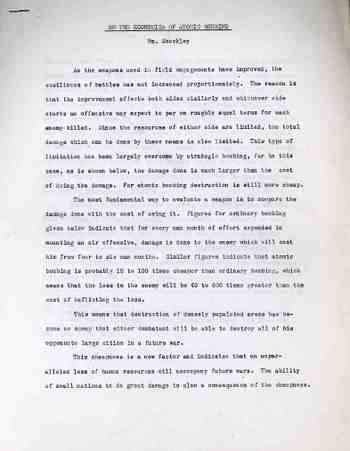 (Click image to enlarge; the other four pages are located in the “Continue Reading” section, below.)
William Shockley on the Economics of the “Atomic Bomb Art”
This paper is one a small archive of background and draft papers and proposals by the Vannevar Bush group working on the question of the control of atomic weapons and the formalization of the American position regarding the use and control of atomic weapons, October 1945-February 1946. This archive consists of 38 documents relating to the development of U.S. atomic policy, with contributions by President Harry Truman, Secretary of State James Byrnes, Dr. Vannevar Bush, (future AEC director) Carroll Wilson, Alger Hiss, I.I. Rabi, William Shockley, Frederick Dunn, Joseph E. Johnson, Leo Pasvolsky, Philip Morrison, Col. Nichols, William McRae, Admiral W.H.P. Blandy, George L. Harrison, and others.
I have written elsewhere on this site about Vannevar Bush and the coming atomic/nuclear arms problem–as perhaps one of the pre-eminent scientific minds in the Roosevelt/Truman administrations, Bush and others foresaw the development of the atomic arms race in 1943, and by 1945 Bush became a fundamental thinker and advocate on the problem. The items in this archive are low-formal background papers, drafts of proposals, informal studies, as well as mature statements of thought that would become implemented in the core of U.S. policy regarding the spread and control of atomic weapons. They are generally carbon typescripts and necessarily of extremely limited distribution, generally have no letterheads, occasionally carry the authors’ full names (although sometimes only initials are used).
A note on William Shockley. The brilliant Shockley’s story is difficult and problematic: from the way in which he misused his interaction with the rest of his team at Bell Labs in the discovery of the junction transistor to his sinful racial and eugenic (and dysgenic) public persona later in life–it is a hard and long one to tell, and I’ll not try to do it here. Suffice to say that I’m very aware of the very long shadows, and I think that other people should at least be aware of them as well, regardless of the staggering importance of “his” (with the wonderful Walter Brattain and John Bardeen) monumental discovery.
The William Shockley paper was written towards the end of 1945 and is on five pages and runs about 1500 words. He begins the paper with a logical statement of the issue of the economics of conventional and atomic bombing, ending with the sentence “For atomic bombing destruction is still more cheap”. What Shockley is getting to is the overall cost of the amount of destruction caused per square mile, and the conclusion that he draws over these five pages is the destruction caused by the atomic bomb is 1/100th the cost of conventional bombing per square mile destroyed (“atomic bombing is probably 10 to 100 times cheaper than ordinary bombing”).
Shockley also recognizes that the problem in the near future will be the increasing cheapness of producing atomic (and greater) weapons, and their developing accessibility to small nations. “This cheapness is a new factor and indicates that an unparalleled loss of human resources will accompany future wars. The ability of small nations to do great damage is also a consequence of the cheapness.” He writes further that taking this thinking to its “logical conclusion”, that at some point in the future a single individual will be able to use this new technology to destroy the world. The main point though that he was making in this line of thinking was the dispersion and proliferation of the new technology–that an arms race would occur, and that it would be dangerous, and that it could be very very bad. Shockley has of course nothing to say about any of that or the implications of his finds as that was not his charge.
After figuring that the cost of destruction by the atomic bomb was about $600,000 per square mile (compared to $6,500,000 per square mile for conventional bombing), Shockley concludes that “since the atomic bomb art is in its infancy, we may well expect future economies of a factor of 10 in cost per square mile destroyed…”
Shockley on the likelihood of casualties during the final invasion of
Japan.
(The following three paragraphs are taken entirely from
CASUALTY PROJECTIONS FOR THE U.S. INVASIONS OF JAPAN, 1945-1946:
PLANNING AND POLICY IMPLICATIONS by D. M. Giangreco in the Journal of
Military History, 61 (July 1997): 521-82
“As for Dr. Shockley’s initial report to Dr. Bowles, it was not
submitted until after Stimson had left for Potsdam. He proposed that a
study be initiated “to determine to what extent the behavior of a
nation in war can be predicted from the behavior of her troops in
individual battles.” Shockley utilized the analyses of Dr. DeBakey and
Dr. Beebe, and discussed the matter in depth with Professor Quincy
Wright from the University of Chicago, author of the highly-respected A
Study of War; and Colonel James McCormack, Jr., a Military Intelligence
officer and former Rhodes Scholar who served ! in the OPD’s small but
influential Strategic Policy Section with another former Rhodes
Scholar, Colonel Dean Rusk. Shockley said:
“If the study shows that the behavior of nations in all historical
cases comparable to Japan’s has in fact been invariably consistent with
the behavior of the troops in battle, then it means that the Japanese
dead and ineffectives at the time of the defeat will exceed the
corresponding number for the Germans. In other words, we shall probably
have to kill at least 5 to 10 million Japanese. This might cost us
between 1.7 and 4 million casualties including [between] 400,000 and
800,000 killed.”–W. B. Shockley to Edward L. Bowles, 21 July 1945, “Proposal for
Increasing the Scope of Casualties Studies,” Edward L. Bowles Papers,
box 34, Library of Congress. … No accurate total of German military and civilian deaths was
available at the time he prepared his report, but the number was
eventually set at roughly 11,000,000. was not invaded and finished the
war with just over 7,000,000 casualties, most of them from its armed
services on the Asian mainland in fighting from September 1931 to
September 1945.