JF Ptak Science Books LLC Post 196
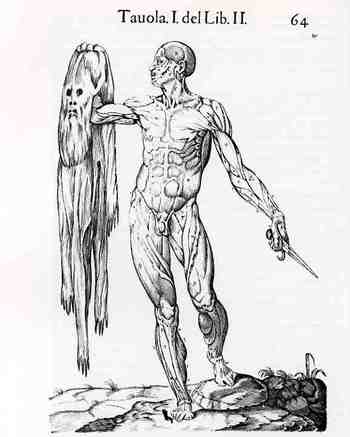 Continuing a thread of interesting and odd observations of things that are empty, absent and disappeared are the following two images. The first is from Valverde’s Historia de la compiscicion del cuerpo humano (Anatomia del corpo humano in Latrin), published in 1560, by the artist Gaspar Becerra, who was a student of Girogo Vasari (another “V”) and thus, by extension, a grand-student of Vasari’s teacher, Michelangelo. Valverde’s work was one of the most popular anatomical texts printed in the 16th century–second only perhaps to the great work by Vesalius (a third “V”, which is a little unusual)–though it may be an ironic understatement, as Valverde “heavily borrowed” from his master teacher, with some of the illustrations being virtually identical. One illustration that he definitely did not borrow from Vesari though (according to Samuel Edgerton in his masterful Pictures and Punishment, Art and Criminal Prosecution during the Florentine Rensaissance, Cornell, 1985) is this esorche figure showing the sample (a human male) standing and displaying his muscular system, holding his flayed skin in his hand. (“Esorche” is a relatively new term for an older idea, meaning “flayed” and in the artistic sense meaning the drawing of creatures with their skin removed, was brought into use in French art circles in the mid-19th century, though Leon Battista Alberti (February 14, 1404 – April 25, 1472, a polymathic humanist renaissance man of the renaissance) at least recommended that artists draw a figure muscles outward, applying skin later.) For our purposes the Becerra image is like very few others, so far as I can determine, with the flayed man holding his own skin, the cleaving knife in hand–the skin empty, wanting its form.
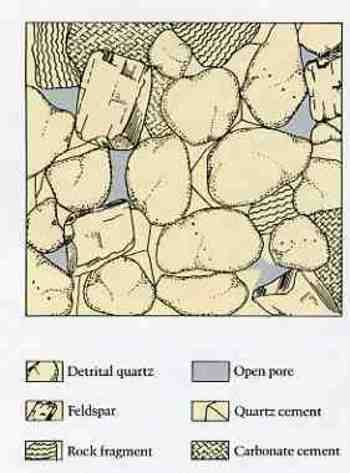
Coming tonight directly from the beaches of the Georgia coast brings to mind a second, less “demanding”, image of emptiness. Sitting here in a developing pile of sand which seems to come of course from everywhere and nowhere, I’m reminded of the formation of sandstone, or I guess the deformation of sandstone. What I’m thinking about are the empty bits in sandstone, illustrated below (from Sevier’s deceptively fabulous book, Sand, showing “open pores”, the unfilled blank spaces in sandstone. I know there’s no real connection between these two (except that I do have a massive sunburn caught on the Tybee Island sands) but I just couldn’t not list them together.