A Daily History of Holes, Dots, Lines, Science, History, Math, Physics, Art, the Unintentional Absurd, Architecture, Maps, Data Visualization, Blank and Missing Things, and so on. |1.6 million words, 7500 images, 4.9 million hits| Press & appearances in The Times, Le Figaro, Mensa, The Economist, The Guardian, Discovery News, Slate, Le Monde, Sci American Blogs, Le Pont, and many other places… 5000+ total posts since 2008.

Category: Atomic and Nuclear weapons

  • Really Big Bangs: On Massive Explosions and Billion-Mile-Long Trains Filled with High Explosives

    JF Ptak Science Books LLC  Post 473

    The largest, greatest explosion of all time as time itself, being the Big Bang, as explosion of immeasurable, incomprehensible magnitude.  Among the sub-infinite explosions in deep space, the largest “observed” explosion  was 120 star mass supernova 240 million light years away through the veil of Perseus.

    Nuclear explosions are of course the largest man-made terrestrial explosions, the largest of these being the 50 megaton “Tsar Bomb” exploded over Noveya Zemlga by the Soviet Union—this is known as the Father of all Bombs.  (The Soviets were making these enormous bombs to make up in destructive capacity and real estate damage for what they lacked in missile control—they couldn’t match the accuracy of the American weapons, so they developed bombs big enough so that the accuracy factor fizzled away by sheer nuclear tonnage.)

    I guess though that the largest explosion is yet to come, not in the Rapture but in the Rupture:  the possibility that a meteor will at some time strike the earth.  A massive mass 30 kilometers across, say, hitting at the wrong place at a high speed could cause a Pacific-ocean sized disruption in the surface of the planet, the result being something like 150 trillion tons of explosive.  I’m not sure how to illustrate this sort of tonnage, except that it might be something on the order of filling up the Manhattan skyline with TNT and blowing it up.

    [ NOTE:  I just found the memory that produced that last statement.  In The Loom of God, Mathematical Tapestries at the Edge of Time, published by Plenum Trade in 1997), author Clifford Pickover thinks about craters and impacts of asteroids and such, calculating that an asteroid with a diameter of 20 km arriving at Earth at 40 km/sec would leave a crater size of 439 km (!) and have the equivalent power of 140 billion Hiroshima bombs, which would be about 20 of these bombs per person for everyone on the planet.  The hole would be about the width of New Mexico, and have the equivalent firepower, as Pickover points out, of a coal train filled with high explosives that was 1.4 billion miles long.]

    The more non-nuclear terrestrial explosions:

    In 2005 the Hertfordshire Oil Storage Terminal fire resulted in the explosion of 60,000,000 imperial gallons;

    In 1985, the Defense Military Agency introduced the   Minor Scale and Misty Picture explosions, which used 4744 and 4,685 short tons of ANFO, with a yield of about 4 kiltotons of TNT.

    Texas City, Texas just about exploded in 1947 when the SS Grandcamp, loaded with 8,500 short tons (7,700 t) of ammonium nitrate (the equivalent roughly of 2.7 kilotons of energy) exploded in port (killing  581 and injuring over  5,000).

    Also in 1947 was the Heligoland explosion, a 3.2 kilotons explosion of 4,000 long tons of WWII surplus ammo.

     A 2.9 kt TNT explosion resulted from the collision of the SS Imo and the SS Mont Blanc in the harbor of Hallifax; the Mont Blanc carried 2,653 tons of explosives, including picric acid, killing 2000.

    A miserable social tragedy took place in 1944 in Chicago (at the Port Chicago Naval Magazine) where questionable procedures of offloading munitions from a  naval ship resulted in an explosion equivalent to about 1.8 kt, killing 320 sailors and civilians, most of the sailors being African Americans performing a task that was probably all screwed up.  Just a month later a similar procedure was being undertaken, the Black sailors, this time refusing to participate and carry out what they saw as needlessly dangerous order, the result being the court martial of the 50 sailors (Port Chicago 50).

    Some Bits in the Chronology of the Detonations of Nuclear Weapons (of the 2000 or so that have been used or tested in the last 54 years):

    1945-07-16 Trinity, (USA) First fission device test, first plutonium implosion detonation

    1945-08-06 Little Boy 15 kt (USA) Bombing of Hiroshima, Japan, first detonation of an enriched uranium gun-type device

    1945-08-09 Fat Man 21 kt  (USA) Bombing of Nagasaki, Japan

    1949-08-29  RDS-1 22 kt (USSR) First fission weapon test by the USSR

    1952-10-03 Hurricane 25 kt (UK) First fission weapon test by the UK, Montebello Islands, Western Australia

    1952-11-01 Ivy Mike 10,400 kt (USA) First “staged” thermonuclear device test, not meant to be a deployable weapon

    1953-08-12 Joe 4 400 kt (USSR) First fusion weapon test by the USSR (not “staged”, but deployable)

    1954-03-01 Castle Bravo 15,000 kt(USA) First deployable “staged” thermonuclear weapon using dry fusion fuel; fallout accident

     1955-11-22 RDS-37 1,600 kt (USSR) First “staged” thermonuclear weapon test by the USSR (deployable)

     1957-11-08 Grapple X 1,800 kt (UK) First (successful) “staged” thermonuclear weapon test by the UK

     1960-02-13 Gerboise Bleue 70 kt  (France) first fission weapon test by France

     1961-10-31 Tsar Bomba 50,000 kt USSR Largest thermonuclear weapon ever tested.

     1964-10-16 596 22 kt (PR China) First fission weapon test by the People’s Republic of China

     1967-06-17 Test No. 6 3,300 kt  (PR China) First “staged” thermonuclear weapon test by the People’s Republic of China

     1968-08-24 Canopus 2,600 kt (France) First “staged” thermonuclear test by France

     1974-05-18 Smiling Buddha 12kt  (India) First fission nuclear explosive test by India

     1998-05-11 Shakti I 45 kt  (India) First potential fusion/boosted weapon test by India 

     1998-05-11 Shakti II 12 kt (India) First deployable fission weapon test by India

     1998-05-28 Chagai-I 9–12kt (Pakistan) First fission weapon test by Pakistan
     

    ·Posted by :

    ·in:


  • Thinking the Unthinkable Department: Moving DC to the Rocky Mountains. Or Idaho. 1952

    JF Ptak Science Books Post 457

    Blog--untinkable tp
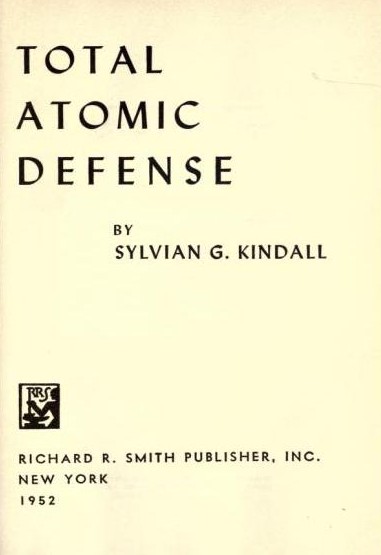
    Sylvian Kindall’s Total Atomic Defense (published by a very severly right-wing publisher in 1952) is one of a series of books made for a deceived American population, offering the general reader both fear and hope, often from the same, exact source. But Kindall has a  somewhat diffident approach, offering his belief that the country and its population can largely  survive an all-out nuclear war–intact.  Of course the “intactness” is dependent upon massive internal change of the social and industrial fabric of the country, which would have to transform in ways as to make it largely unidentifiable from that which we would quickly recognize.  A quick look at the table of contents tells the story in miniature, with the exception of the solution to the problem, which was generally to build underground.  (The neutron bomb would soon complicate this solution.)  Suffice to say that Dr. Strangelove would approve of the publication of such a work though would hardly believe in any of it for himself. 
    Blog--unthinkable


  • American Cities at the End of the World: a List of Nuclear Targets, 1953

    JF Ptak Science Books LLC  Post 456

    0 blog jan 05 target346

    “Those who control the present control the future. Those who
    control the future control the past.” –George Orwell, Nineteen Eighty-Four

    “Political language — and with variations this is true of
    all political parties, from Conservatives to Anarchists — is designed to make
    lies sound truthful and murder respectable, and to give an appearance of
    solidity to pure wind”. –George Orwell, Nineteen Eighty-Four 

    “Logic: The art of thinking and reasoning in strict
    accordance
    with the limitations and incapacities of the human
    misunderstanding.”—Ambrose Bierce, Devil’s Dictionary

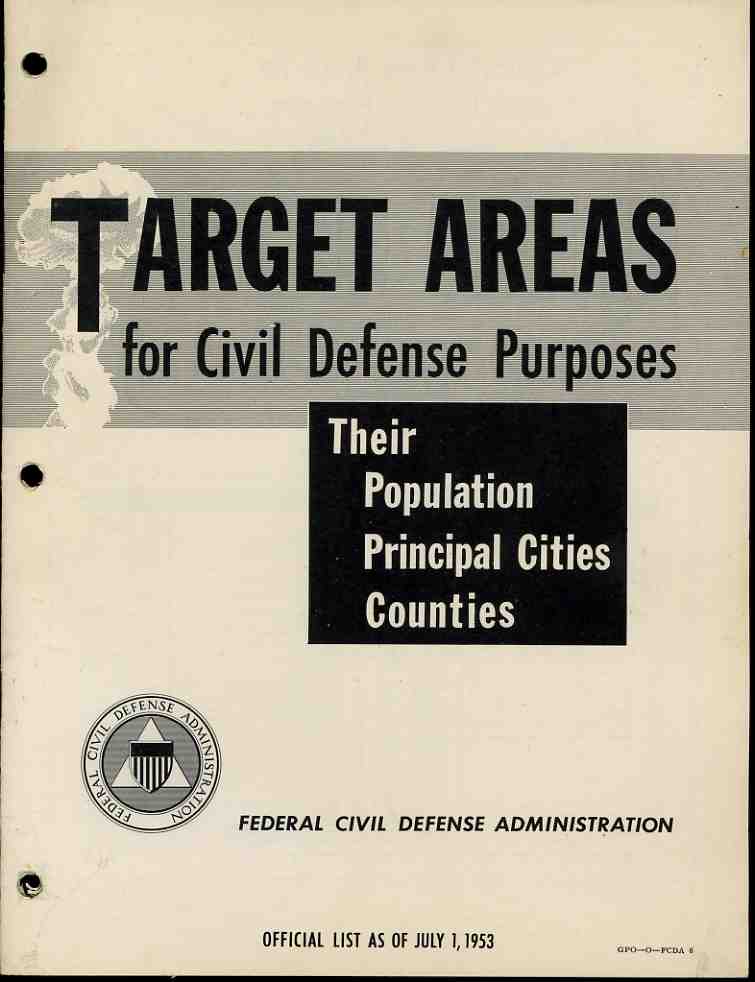
     Making the unthinkable thinkable was the de facto aim of
    this pamphlet.  It described the complete
    vulnerability of any nation in total “atomic war”, yet proceeded to advise the
    population of the United
    States
    to proceed as actors in a drama that
    could have variant endings.  And so began
    the concept of the winnable, survivable nuclear holocaust, a petulant and
    terrifically arrogant attempt to control the language in which the idea of
    nuclear war would be discussed with a government-made language. 

     This simple (1953) pamphlet was a product of the Federal
    Civil Defense Administration and was a public document, though it replaced the
    edition of 1952, which was a “restricted document”.  (We are also warned that if we have this
    earlier document that we are to burn it, even though the information contained “as
    no longer of a classified nature”.)  It
    outlined the cities and regions in the United States that would be the
    subject of an attack.  “City” is
    redefined here as a “Target Area for Civil Defense Purposes”, and then
    redefined in terms of a greater population as a “Critical Target Area for Civil
    Defense Purposes”.  There were 193 such “areas”
    defined, of which 70 were “critical targets” encompassing a population of 67
    million.  (I hate to say it, but if you
    were to map the “critical” zones it would look much like the Blue State map of 2008.)

    I am surprised to see that my own little city, Asheville
    (N.C.), makes the list for a “target area”, somehow, as one of the four cities
    mentioned for North Carolina.  I have no idea why, except that it is the
    seat of a sort-of populous county–there
    was nothing here of interest to the Soviets. 
    On the other hand there are two cities specified forNew
    Mexico, both of which are 70 miles or so east of the Los Alamos installation. 

    The unnamed author(s) warn the reader that the 100+ million
    people specified in the two major attack areas was open to a greater blanket
    attack than described, what with the number of warheads available and all—everyone
    was subject to being bombed.  Also, the
    whole issue of chemical and biological weapons was not addressed:  ‘therefore, the resources of the entire
    country outside the listed target areas, as well as within them, must be
    mobilized for civilian defense”.

    The only mobilization for defense was that against fear–there really wasn’t anything else worth talking about.


  • Some Vintage, Interesting, Declassified CIA Reports–Nuclear War and the Coming of the Communists

    JF Ptak Science Books LLC

    Following up on a few posts over the last two days on some striking CIA reports on such topics as the tactical employment of nuclear weapons in Vietnam are the following (the links taking you to the full documents), all taken from the CIA-Freedom of Information Act website of declassified reports:

    Cia-seal
    Soviet Capabilities for Attack on the U.S. through mid-1955  

    The Strategic Value of the U.S.S.R.  the Conquest of Western Europe and theNear East
    (to Cairo) 

    1948 

    Probable developments in China,. 
    1949 

    Probable Effects Soviet Union Atomic Bomb on the Security of the United States,
    1950

    Prospects for the Defense of Indochina
    against a Chinese Communist Attack
    ,
    1950

    Prospects for Survival of the Republic of Korea,
    1948


  • Nuclear Weapons and Vietnam, Part II: Richard Nixon & Henry Kissinger

    JF Ptak Science Books Post 493

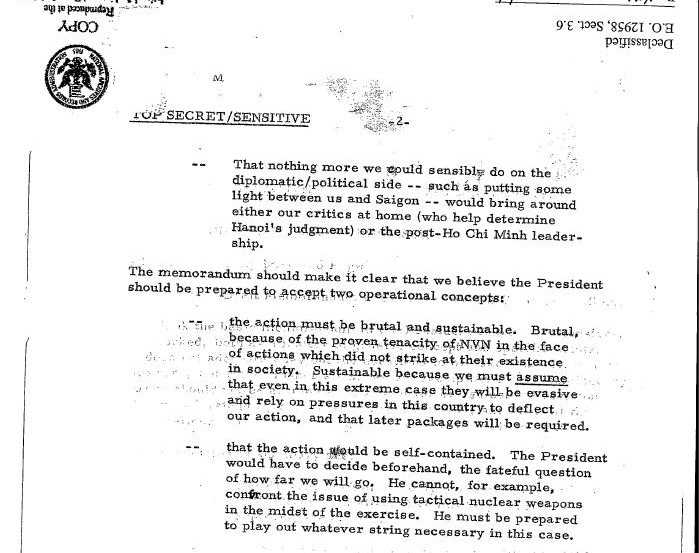
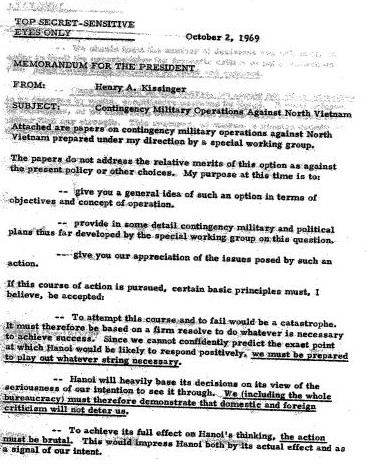
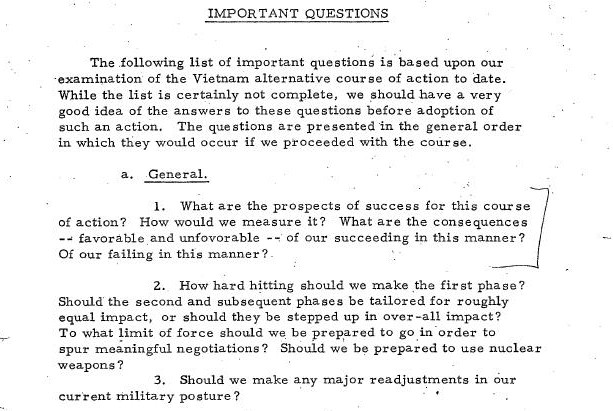
    Richard Nixon continues a post from last night on the Executive Branch and the considerations for using nuclear weapons in the Vietnam War.  Yesterday’s document related to the Johnson administration in 1966, Richard Nixon took up the issue in the first year of his failed presidency, in 1969, brainstorming the idea of first strike to end the war.  This of course was a an early decision of his on the war, before it became much more politically expedient for him (in 1971/2)  to prolong the war so that he could run for re-election to end the war in his second term–a more repugnant decision unmatched and unchallenged until he was nearly checked by the embarrassment who just left office.  As part of a study codenamed “Duck Hook” the following memorandum (Tony Lake“Memorandum from and Roger Morris, NSC Staff, to Captain [Rembrandt] Robinson, Subject: ‘Draft Memorandum to the President on Contingency Study’, 29 September 1969, Top Secret/Sensitive. Source: folder 4: VIETNAM: (General Files), Sep 69-Nov 69, box 74, National Security Council Files: Subject Files, Nixon Presidential Materials Project, National Archives.”) concerning “military expediency” was introduced into the thought pool, stating that the President should at bottom-line have considered the use of nuclear weapons against the North Vietnamese.  Melvin Laird, the Seretary of Defense at the time, thought the proposal for the tactical use of nuclear weapons to be “laughable” and completely off the table.  However, he also said that for Henry Kissinger, nothing was off the table:  “(for Kissinger) Laird recalled, “nothing was out of consideration” with respect to Vietnam; the nuclear threat was “always . . . there as an option.” That was “not my approach,” and he said that he had told Kissinger at the time, “just forget it.”(–George Washington University website, National Security Archive Electronic Briefing Book No. 195, Edited by William Burr and Jeffrey Kimball.)

    Nuclear weapons Vietnam 1969

    In typical fashion, Henry Kissinger was not necessarily “for” the use of nuclear weapons against North Vietnam, but was in favor of using massive, brutal force against military targets–he said that he had ruled out the use of a “nuclear weapon”, but had not ruled out the use of a “nuclear device”. 


    Nucelar weapons VN kissinger


    In a summary of the issue (in another of this series of Top Secret-Eyes Only declassified documents) of the bombing of North Vietnam by Kissinger and addressed to the President (though, as the editors at GWU point out, there is no evidence that this was actually read by Nixon), retains the question about the use of nuclear weapons–the editors reaching the conclusion that the documents were “implying that the matter was still up in the air or on the table”.

    Nuclear weapons Kissinger 2


  • Using Nuclear Weapons in the Vietnam War: a Perversion of Logic in a Top Secret CIA Report, 1966

    JF Ptak Science Books LLC  Post 492

    I cannot remember ever thinking about this, or reading about it, or havng any serious consideration of the use of any sort of nuclear weapons against the North Vietnamese or the Chinese at any time during the Vietnam War.  Or after it, for that matter.

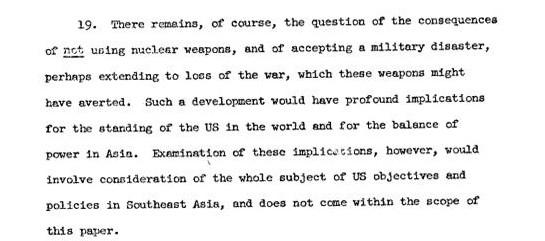
    But it makes sense that the issue was discussed and analyzed and vetted, if for no other reason than to dismiss it.  And here it is, in small part, on the CIA website of declassified materials.  What makes this document so uneasy to me is that even though it addresses the issue of the war not quite being winable and the use of nuclear weapons being (basically) not acceptable and perhaps tactically irrelevant, the idea, at the end of it all, isn’t completely let go.  It wasn’t the idea that you whisper into a helium balloon and then set free–it was tethered in a final “what if” circumstance and let stand for further thought. 

    What happens at the end though, is this:  there is a consideration for what would happen if the U.S. DID NOT use nuclear weapons, which is on page 12, section 19–it is the “aha” part of this paper and the foot-in-the-door to Armageddon.  And what the CIA report from 1966 tells us is this, overall–it doesn’t look good if the U.S. used nuclear weapons; but it also doesn’t look good, perhaps, if we didn’t.  Dr. Strangelove didn’t have anything over these guys.  Finally, these astonishing folks throw up their hands and admit that the non-use wasn’t, somehow, “within the scope of the paper”. 

    Nuke weapons Vietnam


    This is the cover sheet for the twelve-page report; click to enlarge.  The full text is below in the “continue reading section”. 
    Image of document. Alternative text version is not available.


  • Unpublished Atomic Bomb Documents, 1945: the Proliferation of Nuclear Energy and Bombs, 1945

    JF Ptak Science Books LLC  Post 489

    0 blog jan 27 hiss446
    This paper is one from a small archive of background and draft papers and
    proposals by the Vannevar Bush group working on the question of the control of
    atomic weapons and the formalization of the American position regarding the use
    and control of atomic weapons, October 1945-February 1946. This archive
    consists of 38 documents relating to the development of U.S. atomic policy,
    with  contributions by President Harry Truman, Secretary of State James Byrnes, Dr. Vannevar
    Bush, (future AEC director) Carroll Wilson, Alger
    Hiss, I.I. Rabi,
    William Shockley,
    Frederick Dunn, Joseph E. Johnson, Leo Pasvolsky, Philip Morrison, Col.
    Nichols, William McRae, Admiral W.H.P. Blandy, George L. Harrison, and
    others.

    I have written elsewhere
    on this site
    about Vannevar Bush (not related to the outgoing) and the coming atomic/nuclear arms problem–as
    perhaps one of the pre-eminent scientific minds in the Roosevelt/Truman
    administrations, Bush and others foresaw the development of the atomic arms
    race in 1943, and by 1945 Bush became a  fundamental thinker and advocate
    on the problem. The items in this archive are low-formal background papers,
    drafts of proposals, informal studies, as well as mature statements of thought
    that would become implemented in the core of U.S. policy regarding the spread
    and control of atomic weapons. They are generally carbon typescripts and
    necessarily of extremely limited distribution, generally have no letterheads,
    occasionally carry the authors’ full names (although sometimes only initials
    are used).

    The former owner of this framework, Alger Hiss (Baltimore-born, 1904-1992) is primarily known for one generation as being accused of being a Soviet spy, and by another generation (mine) for defending himself for the rest of his long life against those charges.  (As it turns out in the small-world department, during WWII Hiss lived six doors away from my Georgetown store on Volta Street–the street so-called because Alex Bell’s “Volta Bureau” was perched at its head.)  I suspect that the current generation doesn’t know his name at all–his crime belongs to another time, but the execution of his prosecution is one of those botched and troublesome things that long outlive the subject as an example of how not to do things, and also about things that just shouldn’t be done.   He was tried (twice) for espionage right after WWII and spent 44 months in Lewisburg Federal Prison from 1949 to 1952–he wasn’t convicted on espionage charges, though; he was found guilty of some relatively serious perjuries, but nothing really to convince a reasonable jury that he was a Soviet tool.  His principal accuser, Whittaker Chambers, is at best problematic element, pulling himself in many different ways through his curdled memory of Hiss’ affairs.  The post-Soviet record (according to former KGB agents’ testimonies, project VERONA and the like) of Hiss’ story are also confusing and somewhat misleading and work at odds, some of the sources confirming his existence as a spy, others offering exculpatory evidence and pointing to another man.  It seems that after everything is said and done that he was probably not guilty of the espionage charges, and that he was a victim of the forces feeding the ravenous appetite of HUAC (House Un-American Affairs Committee), a sensory-blunted beast that consumed many people through little more than fear.  (The loathsome Richard Nixon was one element of this drama–he was a young Congressman from California who used the skulls of the people he wantonly bullied and ruined to reach the lowest rungs of his political ladder to success.  Yes, the man was rotten all the way down.)

    0 blog jan 27 hiss447

    Back to the paper–in 1945, when this paper was written, Hiss was a delegate to the Yalta Conference, which was also primarily involved in the planning of postwar Europe.  The main concern of the Bush group was to create an environment in which the coming development of nuclear weapons by the Soviet Union could be at least understood–the greater goal in this work was the control of the proliferation of these weapons,m but I think that everyone involved knew that this was a hopeless issue.  To this end the group looked at different ways in which newly-created agencies in the brand-new United Nations could somehow serve as a distiller of information and also, improbably, as a policing force.  Again, it was very widely recognized by the members of the Bush group that the Soviet Union would have the Bomb in short order:  the educated guess by the members was from three years following the war, to ten (somewhere between 1948 and 1955). 

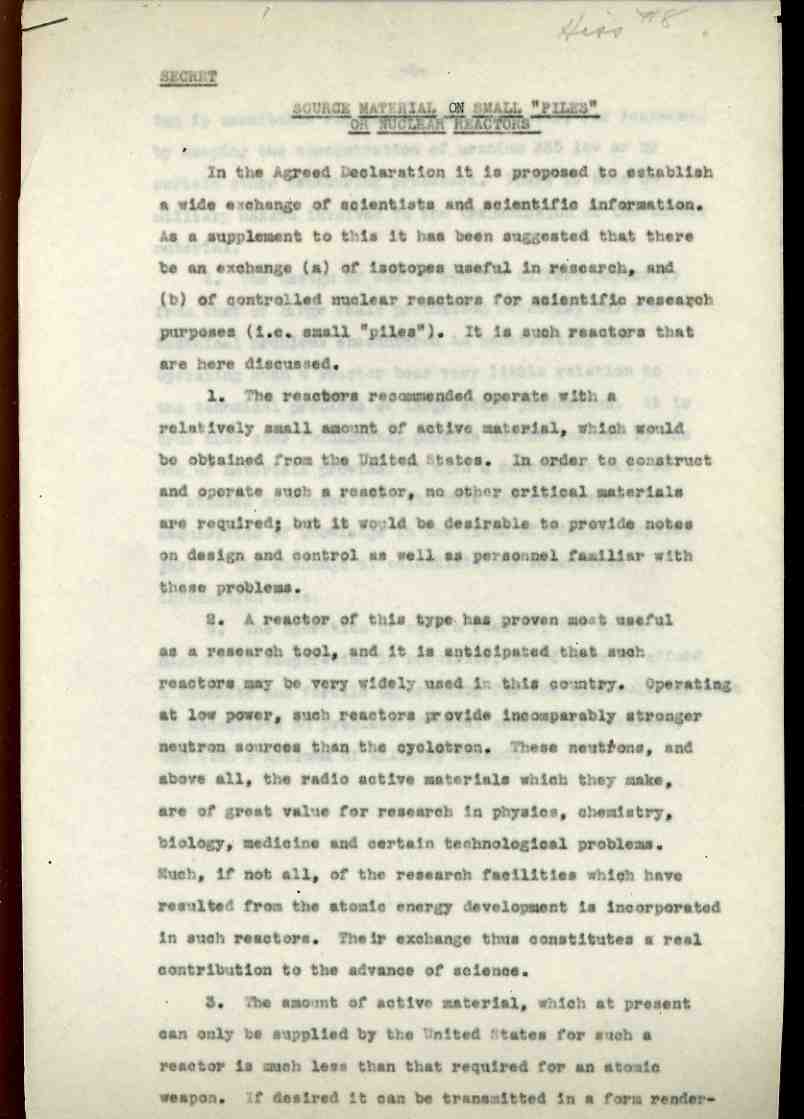
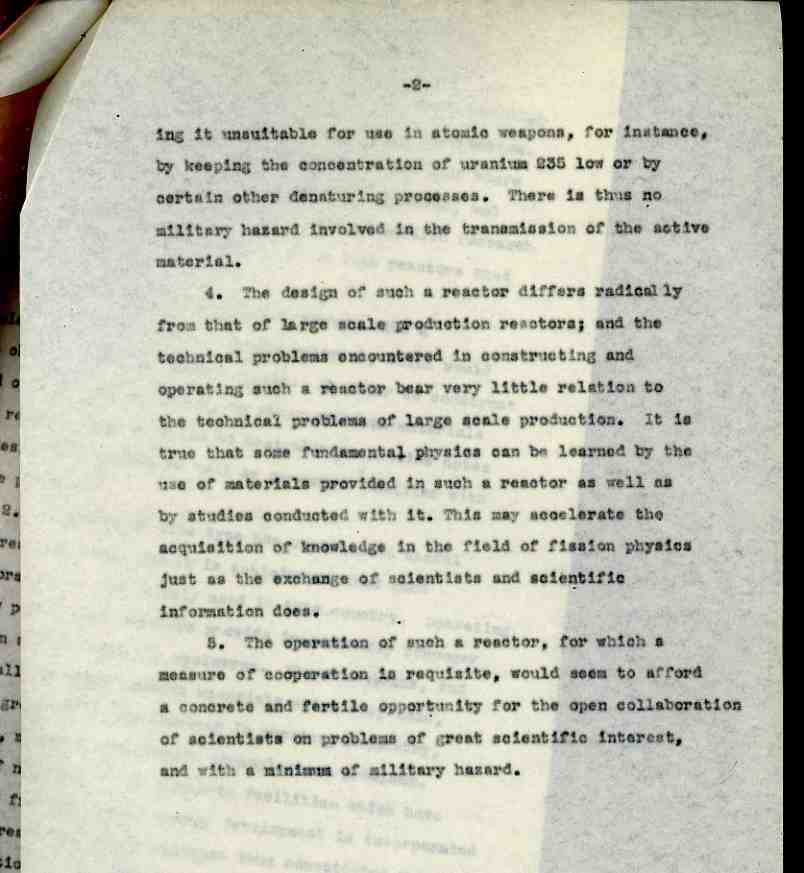
    The authorship of this paper, “Source Material on Small ‘Piles’ or Nuclear Reactors” is not acknowledged, though there are two reasonable guesses about who this might be. FIRST:  my guess is that it may be the work of Philip Morrison. This guess is good if and only if (“iff”) we limit the possible authorship to only those people in the Bush group; if not,  my bet is off.  SECOND:  if this paper was written by an ‘outside” member, then it may very well be the paper referenced in the American Philosophical Society’s Henry DeWolf  Smyth (who I’ve written about earlier) archive as an unpublished work by Smith himself–there is a paper there by the same very uncommon title, and said to have been intended for the State Department, and dated December 1945.  Hiss was working for State at the time, so this very well may be the best fit.And of course Smyth is the author of the official history of the making of the atomic bomb, Atomic Energy for Military Purposes; The Official Report on the Development of the Atomic Bomb under the Auspices of the United States Government, 1940-1945.  Smyth is definitely the best fit but for the exception of there being no others papers in this archive that were not the product of a Bush group member.  (This could be simply solved if it was possible to here the first sentence of the APS paper but I have not been able to do so. This material also doesn’t seem to be in the Smyth book, though the prime candidate for its inclusion would’ve been in chapter four, the entire text located at the excellent Atomicarchive.com site.) The odds-on favorite here though is for Smyth.  The paper is a carbon copy of the typed original; Hiss’ name (along with #8) is written in pencil at the top right; it is possible to pound your way through eight layers of onion-skinned carbon paper, but probably not much more. Hiss was probably one the bottom of the list to receive this summary–at least that’s my guess.  the paper is only two pages long so it is reproduced in full and from what I can determine for the first time. 

    For the topic it covers and for the brevity of the paper, it is a very well-written account of the military value of small nuclear reactors (or “piles”)–that is to say the author correctly identifies the military threat value for a research-grade reactor as low (“a minimum of military hazard”) while the consequences for advancing scientific knowledge as a result of the use of these reactor would be quite high.  In short this little paper outlines what would be the general opinion of teh U.S. government regarding the proliferation of small nuclear reactors, and would function in much the same way as the large Smyth report, settin gthe limits of acceptable and prohibited information and technology. 

    ·Posted by :

    ·in:


  • The Urgent Normalcy of Nuclear Weapons Training: 1966

    JF Ptak Science Books  Post 487

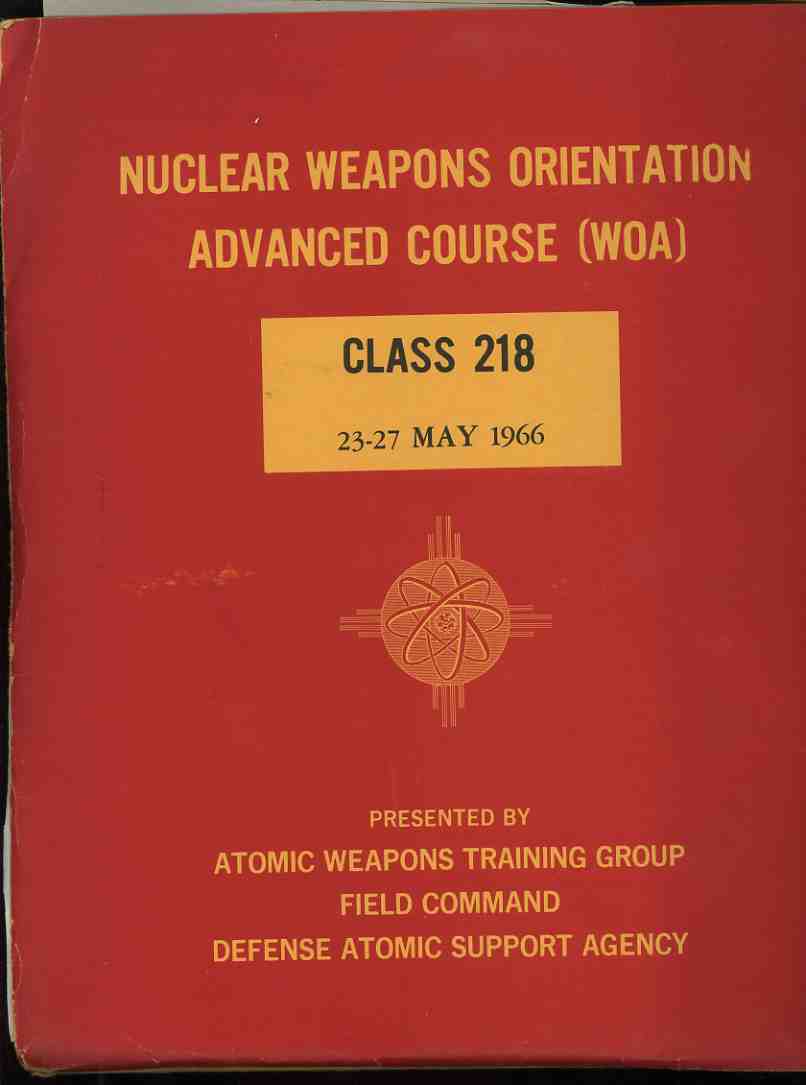
    0 blog jan 05 nuke weapons course360 This folder, colored in the bright colors of New Mexico, contained a number of small pamphlets intended for the new-comers working in the filed of nuclear weapons construction and deployment.  It is an “advanced” course, and I’m not so sure why.  Most of the material in it was pretty elementary, which makes you atop and think some.  Like, for  example, what would the “elementary” course look like when these efforts stop just shy of being Classic Comics Illustrated?  This was not a confidence-builder, this simple approach to getting to the end of the world, but then again it wasn’t intended to be so.  There were a number of references to test observation, which was perhaps the most glaring oddity (with the exception of the overall ordinariness) in these pamphlets.  There were perhaps tens of thousand of these military veterans who suffered unspeakable radiation sickness and were largely ignored and abandoned by the federal government.   An excellent book on this topic was written by Robert del Tredicci, At Work in the Fields of the Bomb (the images from which can be found here.)

    I’m posting a simple list of some of the first series of nuclear tests and their observers, as follows:


    Timeline of Atomic Tests, 1945-1962

    This data is taken from the  Naval historical Center of the Department of the Navy (805 Kidder Breese SE, D.C., the Washington Navy Yard).  Almost all of the data here is presented on the website for the NHC and re-arranged by me for easier use here.  The research and thinking had already been done by the good people at Navy History. 

    1945-6.  Project Trinity, 1945-1946.  . Detonation of the world’s first nuclear device during July 1945, in New Mexico.Witnesses, participants and human experimental subjects:  1000.

    1946. Operation Crossroads.  “2 detonations conducted by JTF-l during June-July 1946, at Bikini Atoll, Marshall Islands,Pacific Ocean.” At least 36,262 Navy and 550 Marine Corps personnel, as well as 251 ships, participated.Witnesses, participants and human experimental subjects:  36,262 Navy and 550 Marine Corps personnel, plus 251 ships. 

    1948.  Operation Sandstone.. “3 detonations conducted by JTF-7 during April-May 1948, Enewetak Atoll, Marshall Islands.” Witnesses, participants and human experimental subjects:   At least 7,759 Navy and 182 Marine Corps personnel participated.

    1951. Operation Ranger: Shots Able, Baker, Easy, Baker-2, Fox, 25 January-6 February Witnesses, participants and human experimental subjects:  “5 detonations conducted at the Nevada Proving Ground, involving at least 6 Navy and 1 Marine Corps personnel.”

    1951  Operation Greenhouse. “4 detonations conducted by JTF-7 during April-May 1951, at Enewetak.”  Witnesses, participants and human experimental subjects:   At least 2,900 Navy and 80 Marine Corps personnel were involved.

    1951. Operation Buster-Jangle. “7 detonations conducted from October-November 1951 at Nevada Proving Ground.”  Witnesses, participants and human experimental subjects:  involving at least 319 Navy and 188 Marine Corps personnel.

    1952.  Operation Tumbler-Snapper. “8 detonations conducted during April-June 1952 at Nevada Proving Ground.” Witnesses, participants and human experimental subjects:  At least 556 Navy and 2,042 Marine Corps personnel participated.

    1952.  Operation Ivy. “2 detonations conducted by JTF-132 during October-November 1952, at Enewetak. One of the events, designated Mike, was the first thermonuclear or hydrogen bomb.” Witnesses, participants and human experimental subjects:   At least 5,258 Navy and 178 Marine Corps personnel participated.

    1953. Operation Upshot-Knothole. “11 detonations conducted during March-June 1953 at Nevada Proving Ground.” Witnesses, participants and human experimental subjects:   At least 773 Navy and 2,275 Marine Corps personnel participated.

    1954.Castle Series. “6 detonations conducted by Joint Task Force (JTF) 7 during March-May 1954, at Enewetak.” Witnesses, participants and human experimental subjects:   At least 8,633 Navy and 303 Marine Corps personnel were involved.

    1955. Operation Teapot. “14 detonations conducted during February-May 1955 at Nevada Test Site.” Witnesses, participants and human experimental subjects:   At least 541 Navy and 2,305 Marine Corps personnel participated.

    1955. Operation Wigwam. “A  single deep underwater detonation conducted by JTF-7 during May 1955, in the Pacific Ocean, approximately 500 miles southwest of San Diego CA.”  Witnesses, participants and human experimental subjects:   At least 6,567 Navy and 110 Marine Corps personnel as well as 30 ships participated.

    1956. Operation Redwing. “17 detonations conducted by JTF-7 during May-July 1956, at Bikin
    and Enewetak.”  Witnesses, participants and human experimental subjects:   At least 5,654 Navy and 253 Marine Corps personnel were involved.

    1957.  Plumbbob Series.  “24 detonations conducted during April-October 1957 at Nevada Test Site.” Witnesses, participants and human experimental subjects:   At least 574 Navy and 2,148 Marine Corps personnel participated. Naval aircraft included 4 model ZSG-3 airships, an HSS-1 helicopter and fixed-wing aircraft.

    1958. Operation Hardtack I.  “35 detonations conducted by JTF-7 during April-August 1958, at Bikini
    and Enewetak.”  Witnesses, participants and human experimental subjects:   At least 9,736 Navy and 219 Marine Corps personnel were involved.

    1958.  Operation Argus. “3 high-altitude detonations conducted by TF (Task Force).” 88 during August-September 1958. over South Atlantic Ocean.

    1958.  Operation Hardtack II. “19 detonations conducted during September-October 1958 at Nevada Test Site.” Witnesses, participants and human experimental subjects:   At least 33 Navy and 2 Marine Corps personnel were involved.

    1961. Projects Gnome and Sedan : The Plowshare Program  “27 nuclear detonations conducted between 1961 and 1973 at Nevada Test Site, Colorado, and, New Mexico.”  Witnesses, participants and human experimental subjects:   At least 82 Navy and 1 Marine Corps personnel participated.

    1962.  Operation Dominic I.  “36 detonations inc. Polaris and ASROC tests conducted by JTF- 8 during April-November 1962, in Johnson and Christian Island areas, and a single detonation 371 nautical miles southwest of San Diego CA.” Witnesses, participants and human experimental subjects:   At least 18,163 Navy and 659 Marine Corps personnel participated.

    1962.  Operation Dominic II. Shots Little Feller II, Johnie Boy, Small Boy, Little Feller I “4 detonations during July 1962, at Nevada Test Site.” Witnesses, participants and human experimental subjects:   At least 81 Navy and 89 Marine Corps personnel participated.

    ·Posted by :

    ·in:


  • Two Minutes to Doomsday: “Get out of Hell Free” Card, 1957. Armageddon and All That…

    JF Ptak Science Books  Post 402

    0--blog---dec 1 hell162
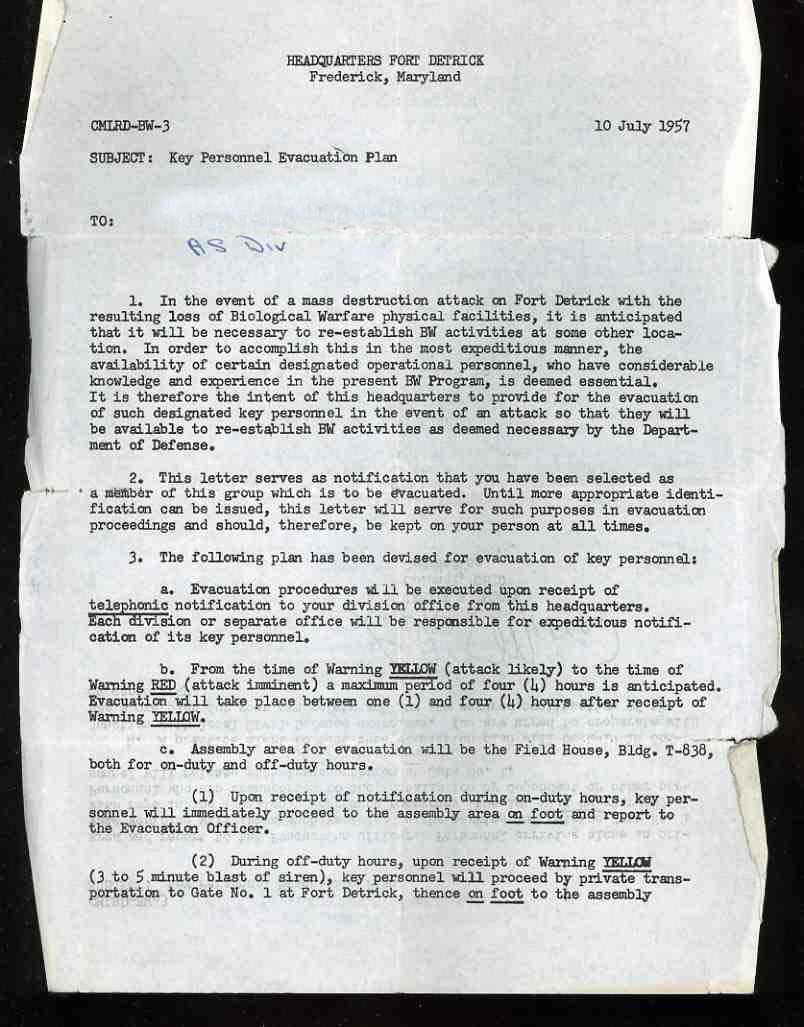
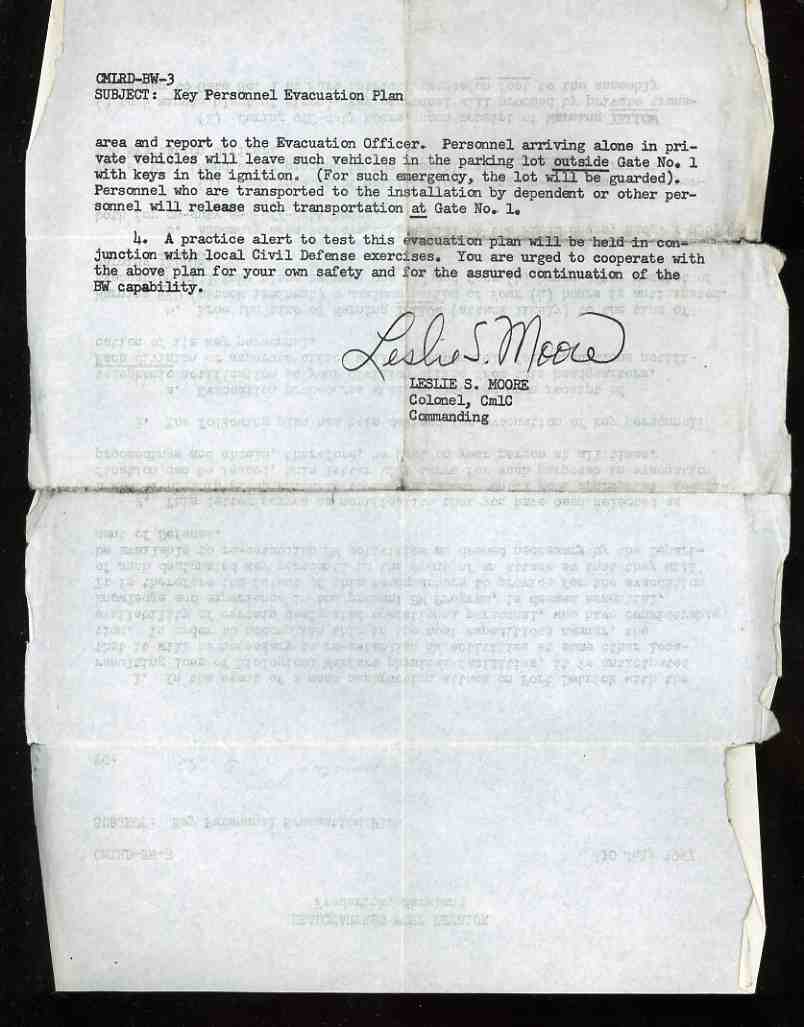
    This letter, written in 1957  by Colonel Leslie S. Moore of the U.S. Biological Weapons Program at Fort Detrick, Maryland, to a member (whose name I’ve removed) of the “A.S.”(“Atmospheric Sciences”)  division, was basically a get-out-of-hell-free card for its bearer in the case of devastating nuclear attack.

    “In the event of a mass destruction attack on Fort Detrick with the resulting loss of Biological Warfare physical facilities, it is anticipated that it will be necessary to re-establish the BW activities at some other location.”

    “In order to accomplish this in the most expeditious manner, the availability of certain designated personnel…is deemed essential.”

    The “letter serves as notification that you have been selected as a member of this group which is to be evacuated”  to get the biological weapons program up and running again.  As you can read in the clickable version of the document, there are directions about what top do and when to do it.  There is no mention of family.  My read is that this is Endgame stuff, end of civilization as we know it, and that this was the Darwinian sweep of necessary people.  Or is it Dr. Strangeloveian?  I get the two confused.

    Suffice to say that Fort Detrick, which had been established in 1943 (constructing and delivering anthrax bombs by 1944) as Camp Detrick, already had a fairly full career before it was up-named to “Fort” in 1956.  It was the recognized home/collecting node  for the American Chemical and Biological Weapons programs until Richard Nixon, of all people, disbanded that capacity at Detrick in 1969.

    0--blog---dec 1 hell163

    It is interesting to note that the person to whom this letter was addressed was actually in aerolized particle release, and at the time, in 1957, was working on Operation Large Area Concept, which simulated and studies a very large airborne attack over thousands of mile of land.  It was an obvious two-sided study about how-to and how-to react to a mass scale biological attack.

    1957 was about the height of the Cold War. According to the ticking Doomsday Clock of the venerable Bulletin of the Atomic Scientists, the minutes-to-midnight–with the stroke of midnight being the Big One, the ultimate attack, the carnal release of all nuclear power, The End–was set at about two (two minutes to midnight) from 1953 to 1960.  The clock admittedly was set very close to that mark anyway, starting out life at seven minutes to midnight in 1947, but it was probably accurate at how close we all were, our toes stuffed into  Stanley Kubrick’s Dr. Strangelove’s bitterly polished shoes, to walking (finally!) towards the explosive closing roll of the movie.

    I might have been overstating the “Get out of Hell Free” aspect of this letter.  Probably it was a “Survive Many Aspects of Hell at Not-Understandable Personal and Societal Costs” card , but it doesn’t have the snap of the former, though it is more factual.

    The letter tells the recipient to keep it on his person at all times for use in an emergency.  I don’t think you’d need to be told that twice. 


  • Inglorious Glory of the Atomic Bomb: National Geographic Society’s Mistaken Salute to Admiral William Blandy

    JF Ptak Science Books LLC  Post 369

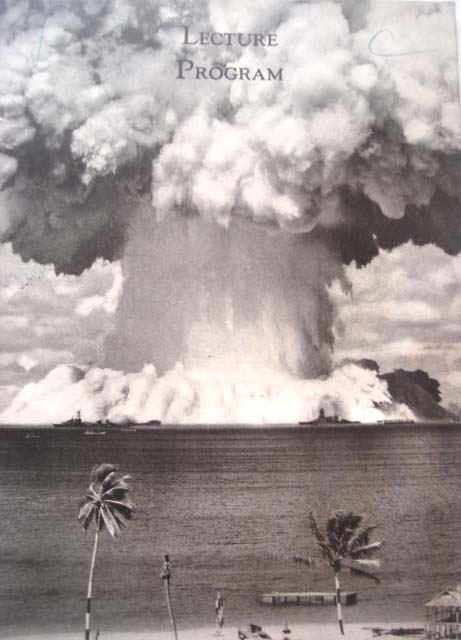
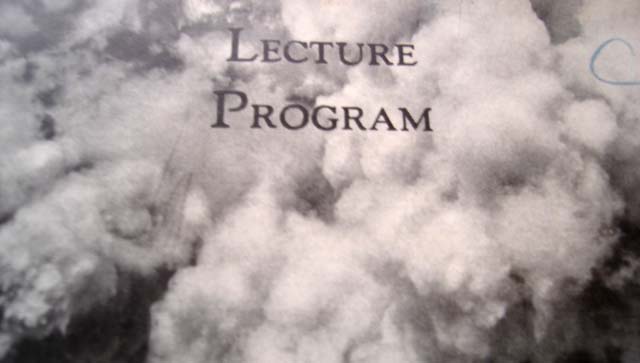
    Ballistics 132This odd graphic appeared as the entire front cover of the National Geographic Society’s Lecture Program pamphlet for 1946.  It is strange to me, the use of the photo and its cropping, its brightness–weirdly, the image seems to me to be almost “happy”.  The lead lecture for the series was Admiral William P. Blandy, who was one of the only leading military men (along with Dwight Eisenhower) to voice disapproval on the military use of the atomic bomb.  Blandy (28 June 1890 – 12 January 1954, first in his class at USNA, Chief of the Bureau of Ordnance from 1941 to 1943; then Commander, Group 1, Amphibious Force, Pacific Fleet.) went on after the war to become the Deputy Chief of Naval Operations for Special Weapons, most notably in the early periods at Operation Crossroads.  

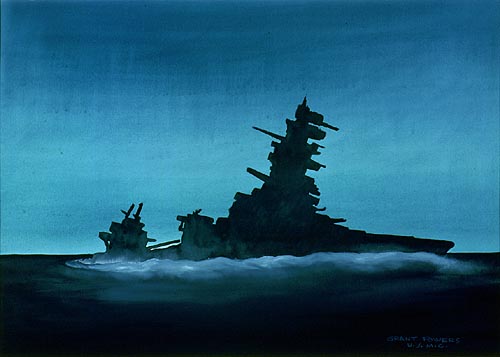
    Crossroads was the nuclear weapons tests conducted during the summer of 1946 at the Marshall Islands, and included the fourth and fifth (Able and Baker) tests of atomic bombs (the first being at Trinity, the other two at Hiroshima and Nagasaki). The picture on the front cover of the NGS pamphlet is for Test Able—the Japanese battleship Nagato (shown in the painting below, listing, 1946), the ship in command of the Japanese forces for the attack on Pearl Harbor, was one of the ships used in this blast for test purposes.  It was not sunk in the explosion, nor was it sunk immediately afterwards when charges were detonated on her sides.  The ship did eventually list and sink.

    The choice of this image for Bandy’s lecture bothers me.  He never liked the bomb, being more dissatisfied with “the breath of death” from the weapon—its radioactivity—than its immediate destructive power.  He referred to it as “a form of poison warfare”.

    Blog--bikini

    I don’t think he was much satisfied with his position.  Of his work there in the Marshalls he said:
    “The bomb will not start a chain-reaction in the water converting it all to gas and letting the ships on all the oceans drop down to the bottom. It will not blow out the bottom of the sea and let all the water run down the hole. It will not destroy gravity. I am not an atomic playboy, as one of my critics labeled me, exploding these bombs to satisfy my personal whim.”

    Just so there is no confusion:

    Ballistics 133