A Daily History of Holes, Dots, Lines, Science, History, Math, Physics, Art, the Unintentional Absurd, Architecture, Maps, Data Visualization, Blank and Missing Things, and so on. |1.6 million words, 7500 images, 4.9 million hits| Press & appearances in The Times, Le Figaro, Mensa, The Economist, The Guardian, Discovery News, Slate, Le Monde, Sci American Blogs, Le Pont, and many other places… 5000+ total posts since 2008.

Category: Atomic and Nuclear weapons

  • Atomic Bomb Exposure Effects on Pregnancy at Hiroshima and Nagasaki

    JF Ptak Science Books Post 228

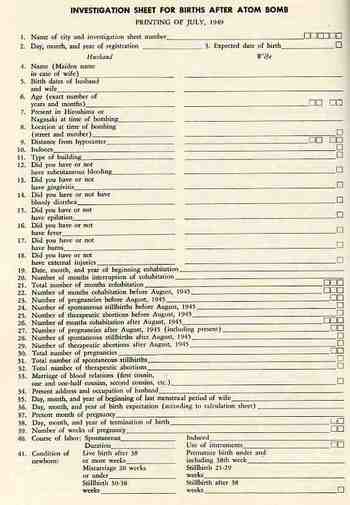
    The total number of casualties at Hiroshima and Nagasaki today exceed the initial figures of  1945–people were of course dying years after the blasts due toBlogaugust_28_atomic_birt_pamph46_2 excessive exposure to ionizing radiation and other complications.  To understand the long-term affects of the use of these weapons the  National Academy of Science (under the instigation of the Truman White House) created the Atomic Bomb Casualty Committee in 1945.  Its earliest concerns were hematological, but then quickly spread into other areas such as leukemia, radiation cataracts, fertility, aging, mortality and genetics.  By 1950 there were more than 1000 Americans involved in this program, which had begun to whither by 1953 but which lasted until 1982.
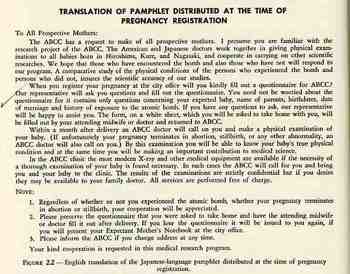
    This questionnaire comes from the ABCC and published in The Effect of Exposure to the Atomic Bombs on Pregnancy Termination in Hiroshima and Nagasaki by the prolific and important Neel and Schull) and published by the Academy in 1956. (The two would address the issue many times, and seem to have summed it up in The Children of Atomic Bomb Survivors, A Genetic Study.  Washington, D.C.: National Academy Press, 1991. The 1947 report of the ABCC may be read HERE.)

    This study addressed the question of generational radiation damage and–after 1953–whether and if so how radiation damages DNA.  The issue was whether future generations of children would express increased birth defect ratios as a result of exposure to the bomb.  This questionnaire was given every fifth lunar month to the pregnant women of Hiroshima and Nagasaki–who were made to register their pregnancies with the government–and carried on for six years.   

    ****

    Also see the following:

    Liebow, Averill.  Encounter with Disaster, A Medical Diary. New York: W.W. Norton and Company, Inc., 1970.

    Marston, Robert Q. M.D., and Fredric Solomon M.D., eds.  The Medical Implications of Nuclear War.  Washington, D.C.: National Academy Press, 1986.

    ****

    The figures for the dead and injured at Hiroshima and Nagaski, August 1945:

      Hiroshima Nagasaki
    Pre-raid population 255,000 195,000
    Dead 66,000 39,000
    Injured 69,000 25,000
    Total Casualties 135,000 64,000

    (Click on image to enlarge)

    Blogaugust_28_atomic_birt_q467  

    ·Posted by :

    ·in:


  • Atomic Bomb: Reporting on the Nagasaki Bomb in the “Manzanar Free Press”, 11 August 1945

    JF Ptak Science Books LLC Post 192
    Atomic_bomb_manzanar_2

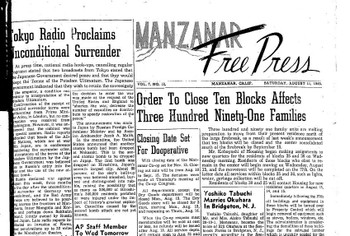
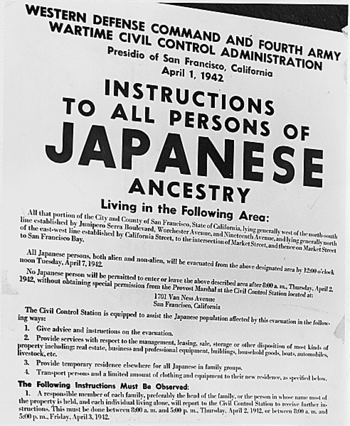
    For another project I’ve been reading through the Manzanar Free Press Newspaper (volume 7, no. 12) and came upon this slight coverage of the bombing of Nagasaki, printed 11 August 1945.  What’s unusual here is that this newspaper was published by the “internees” at the Japanese Relocation Center (officially “The Manzanar War relocation Center” and also called a  “relocation camp,” “relocation center,” “internment camp,” and “concentration camp,)  at Manzanar, California.   110,000 people of  Japanese origin (including a large percentage of American citizens) were forcibly removed and imprisoned via the U.S. Executive Order 9066, issued by President Franklin Roosevelt on 19 February 1942.   Manzanar was a semi-dead town 220 miles NE of Los Angeles, located in high desert with huge swings of temperature and unrelenting and challenging weather—semi-killed by the city of Los Angeles, which purchased the water rights to the region in 1929, forcing out the remaining inhabitants.  Manzanar had a peak population of about 11,000 before the Japanese were returned to what remained of their previous lives.

    Manzanarattention_2

    In this quick coverage, a report is made on the Japanese accepting the terms of the Potsdam “Ultimatum”, putting an end to the war.  The next part is of the reporting is very subdued, announcing the dropping of the second bomb,  theorizing that as many as 200,000-300,000 people may have perished in the bombing of Japan’s seventh largest city.  And not much more than that.  Two hundred words were I’m guessing all that was allowed by the powers-that-be at Manzanar.

    Elsewhere in this same issue is a report on the meeting of the Manzanar Boy Scout troop.  And something on the graduating class of the Manzanar High School (the high school yearbook for 1945, the last class at Manzanar, was called “Valediction”).  Familiar trappings in an unfamiliar trap.

    Manzanar is located near Lone Pine in the Owens Valley, which today suffers terrible environmental problems brought on by water-dependent LA sucking out all of the water in the region.


  • Atomic Bomb–Historic American Building Survey, Trinity Site

    JF Ptak Science Books  Post 224

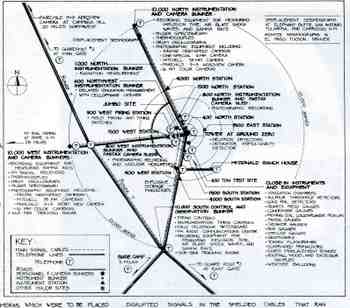
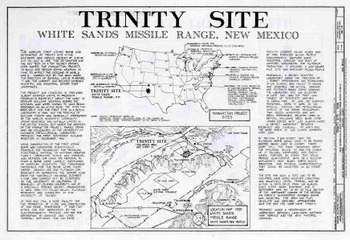
    I just came across these engineering drawings for a detailed survey of the Trinity Site in New Mexico,  location of the first detonation of an atomic bomb (16 July 1945).  The work was completed by Rossana Santos for the DARCOM Recording Project as part of the American Historic Building Survey (Historic American Engineering Record NM-1-B, Department of the Interior).  There are a number of interesting renderings, but the most useful (and scarcest) is the map showing the location of bunkers and instrumentation for the 16 July event. (Click on the images to enlarge.)  This series of drawings pretty much speak for themselves. 
    Blogaugust_27_trinity_map2466


    Blogaugust_27_trinity_1461

    ·Posted by :

    ·in:


  • The Birth of the “Internet” at the End of WWII: Vannevar Bush & the MEMEX, July 1945

    JF Ptak Science Books LLC  Post 190

    Dsc00022 In the midst of running the American scientific war effort (As Director
    of the Office of Scientific Research in charge of some 6000 scientists)
    and in the middle of trying to figure out the best way of dealing with
    the coming proliferation of atomic weapons, Vannevar Bush somehow found
    the time to write what many consider to be the first scientific paper
    on what would become the internet. The paper,   “As We May Think”;  was
    published in the Atlantic Monthly in July 1945.

    (It might be odd to look at it this way, but if you were a Nazi time traveler able to assassinate three people in the U.S. that would change the direction of the American effort in WWII, one would certainly be Roosevelt (who rose to the tasks of the Depression and the War  with Lincolnian sustainability), and I’m not unconvinced that one f the other two might very well be Bush–he kept the scientific agenda on course, direct, and to the point, saving time, effort and lives.  Its an interesting bit to think about….)

    Bush was doing A LOT of thinking on the organization of thought in that year.  I suspect that in trying to deal with the problems of the coming atomic arms race (beginning in the year before Trinity) and in trying to figure out how to distribute the knowledge-base that lead to the building of the bomb, that the idea of the MEMEX may very well have been the future consequence formed by his immediate concerns.

    The MEMEX (Mechanical Aid to Memory) was Bush’s breathtaking idea for a design for the organization of associative thought and memory.  It was a mechanical “aid” to memory, building “trails” of associations of ideas.  The MEMEX was another in the long line of art-of-memory attempts, from the ancients to the memory palaces and theaters of Raymond Lull and Francis Bacon and Athanasius Kircher and Giulio Camillo. What made this so appealing to the next generation of thinker on the distribution of information in the computer age was its ideas on making massive amounts of information obtainable; it was more about *thinking* about order and ability and access to information (in quantities unthinkable and by means unknowable) in 1945. 

    Looking at the future square in the face, Bush writes (on page eight of his short paper) with extraordinary perception: 

    “Wholly new forms of encyclopedias will appear, ready-made with a
    mesh of associative trails running through them, ready to be dropped
    into the memex and there amplified. The lawyer has at his touch the
    associated opinions and decisions of his whole experience, and of the
    experience of friends and authorities. The patent attorney has on call
    the millions of issued patents, with familiar trails to every point of
    his client’s interest. The physician, puzzled by its patient’s
    reactions, strikes the trail established in studying an earlier similar
    case, and runs rapidly through analogous case histories, with side
    references to the classics for the pertinent anatomy and histology. The
    chemist, struggling with the synthesis of an organic compound, has all
    the chemical literature before him in his laboratory, with trails
    following the analogies of compounds, and side trails to their physical
    and chemical behavior.

    “The historian, with a vast chronological account of a people,
    parallels it with a skip trail which stops only at the salient items,
    and can follow at any time contemporary trails which lead him all over
    civilization at a particular epoch. There is a new profession of trail
    blazers, those who find delight in the task of establishing useful
    trails through the enormous mass of the common record. The inheritance
    from the master becomes, not only his additions to the world’s record,
    but for his disciples the entire scaffolding by which they were erected.”

    Sounds pretty familiar, yes? 

    Some of the great internet developers who have recognized the
    importance of this paper by Bush include Doug Englebart, (who would
    write to Bush acknowledging the influence Bush’s article had had on his
    own work. (Zachary, 267).);  J.C.R. Liklider  (Waldrop, 2000): and Ted
    Nelson (Internet pioneer and coiner of the term hypertext and know as
    “one of the most influential contrarians in the history of the
    information age.” (Edwards, 1997)).  And of course many, many others. 

    The full text of the paper “As We May Think” is below.


  • Trinity at 63: The First Atomic Blast, Alamogordo, July 16, 1945

    JF Ptak Science Books LLC   Post 171

    Trinity
    Now we are all sons of bitches
    —Kenneth Bainbridge, Trinity Director.

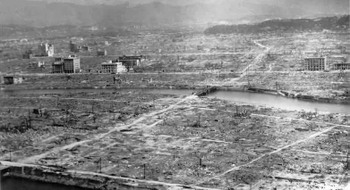
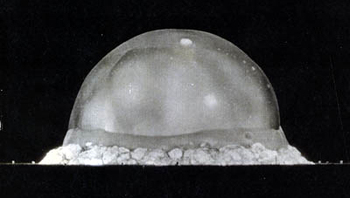
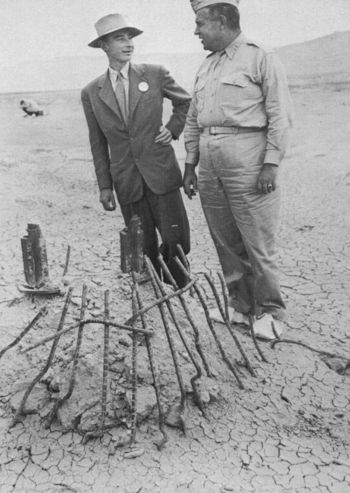
    There were many profound thoughts in many profound heads there in the desert, at the reaches of the Jornarda del Muerto (“The Dead Man’s Walk”, a formerly nearly-impenetrable stretch of desert in  the Llano Estacado) at the Trinity Test Site, Alamogordo, New Mexico, on 16 July 1945 for the successful testing of the first atomic bomb.  Robert Oppenheimer famously cited the Gita (“Now I am Become Death, the Destroyer of Worlds…”): Enrico Fermi was so busy with his little and excruciatingly wonderful experiment with strips of paper calculating the effect of the blast (he reckoned a very-close 10,000 tons) that he didn’t actually hear the explosion; Edward Teller thought Tellerian thoughts, and so on.  Actually the observation points (like S-10000 and Campania Hill)were crowded with big brains:  in addition to Oppenheimer, Teller and Fermi were people like Hans Bethe, James Chadwick (whose discovery of the neutron sort of started the whole thing), Richard Feynman, George Kistiakowsky, Phil Morrison, Robert Serber, Vannevar Bush, James Conant, and many others.  The were all thinking pretty big things (except for the occasional if-you-can-believe-it stuff like that which maybe came from Feynman’s mouth, which was “hot dog!”).  I think that Bainbridge’s statement was the best, and truest, summation of the morning’s activities.
    Oppenheimer_groves_090945

    In a strong and inestimable claim to naïve weirdness, Edward Teller—at about 5:00 in the morning, waiting for the explosion with the others—broke out a bottle of sunblock lotion, applying it to his face and hands.  The bottle was passed around and was used by others. I can not imagine what must’ve been going through the mind of any observer watching these scientists prepare themselves for the blast, except perhaps for “oh, s___”). 

    Just about everyone wrote of the moment in their memoirs or reflections, and I’ve read a lot of them; the description that stands out from the others to my mind, the one that put an understandable spin on an untranslatable moment, belonged to the ueber-literate Morrison.  He wrote that although the flash and the brightness were stupendous, there was something else that was more astonishing—that was the blast of heat from the shock wave that he felt on his face in the cold desert morning. He was 10 miles away from Zero, and in those few moments when the scientists had recreated the birth of the universe, he was an epoch in time away from the 32 simultaneous detonations that set the bomb off 5:29:45 am. 

    At almost the same moment as the blast, Little Boy shipped out on the Indianapolis (which would encounter its own horrific date with the future on her return trip) from Hunter’s Point Naval Shipyard at San Francisco.

    Everyone who knew about the bomb that day knew that the war was over.  The question of course how to make it so. 
    Hiroshima_aftermath

    ·Posted by :

    ·in:


  • On the Atomic Bomb: 16 July-9 August, 1945

    I’ve made a number of posts recently relating to the building of and the decision to use the atomic bomb, from the Trinity Test to the Nagasaki bomb, 16 July-9 August, as we are in that time of year when all of this happened, 63 years ago.  To look at all of these post, click here.  Beginning on 6th August I will begin posting a series of 38 documents  (written in 1945 and early 1946) from the Vannevar Bush group tasked with the problem of  the coming proliferation of atomic weapons.  As far as I can determine NONE of these documents have ever been published. The first of these papers to be presented is by William Shockley (nobelist and highly problematic late-life thinker) on the Economics of the Atomic Bomb (1945).

    ·Posted by :

    ·in:


  • Atomic Bomb, 1 August 1945: Stimson on the Publication of the Smyth Report

    JF Ptak Science Books LLC  Post 188

    Secretary of War Henry Stimson’s Diary Entry for 1 August 1945, centering on the publication of Henry DeWolf Smyth’s history of the Manhattan Project (bold is by me as are any statements made between [ ] ):

    Smyth_2
    August 1, 1945
    “As soon as I arrived at the Department I called in General Marshall and asked him whether he had received my message through McCarthy and he told me that he had and that the speech had been changed and made in an entirely different form.”

    “I then took up with Harrison, Bundy and Groves the third paper to be issued in S-1, namely that of the scientists.  The draft of this paper [Henry DeWolf Smyth’s A general account of the development of methods of using atomic energy for military purposes, which would be known later in the year as  Atomic Energy for Military Purposes, 1945, and then more generally and unofficially as the Smyth Report]  is about two hundred pages long – manifestly so big that I cannot possibly read it now, and I therefore went over the skeleton of it and the pros and cons of making any speech (as to which I am very doubtful) with my three consultants. The aim of the paper is to backfire reckless statements by independent scientists after the demonstration of the bomb. If we could be sure that these could be controlled and avoided, all of us would much prefer not to issue such a paper. But under the circumstances of the entire independence of action of scientists and the certainty that there would be a tremendous amount of excitement and reckless statement, Groves, who is a very conservative man, had reached the conclusion that the lesser evil would be for us to make a statement carefully prepared so as not to give away anything vital and thus try to take the stage away from the others. We debated long over the situation for it is a very difficult question and all of us recognize its difficulty. Rules have been drawn under which this present paper has been formulated. I went over those rules and then postponed the matter until tomorrow when I shall have a talk with Conant, Groves, Bundy, and some of Groves’ assistants on the whole matter. I am of course much influenced by the fact that Groves has reached a decision in favor of the statement.”

    (General Groves I believe recognized the expediency of the report as well in spite of his expectedly ferocious adherence to security protocol—the report, while revealing a lot of data, would also establish the limit of publication of information on the Project and on the bomb.  Overall, it was a smart thing to do, establishing the control of the dialog on the subject of the bomb. It was after all Groves (in 1944) who appointed Smyth to the Richard C. Tolman Committee to make recommendations for the post-war development of atomic energy; Smyth recommended publishing a report on the making of the bomb that would be published soon after it was no longer a secret; Groves concurred.  The report was officially released (in 160,000 copies) on 12 August 1945.)
    Smyth_s1

    S-1 Executive Committee, Manhattan Project,
    September 14, 1942
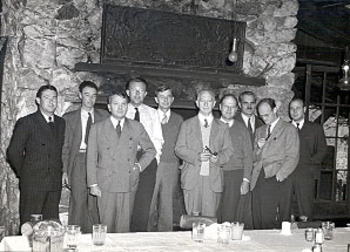
    l. to r.: Thomas Crenshaw, Robert Oppenheimer, Harold C. Urey, Ernest O. Lawrence, James B. Conant, Lyman J. Briggs, E. V. Murphree, Arthur Compton,  Robert Thornton,  K. D. Nichols
    .

    Picture at top is of Smyth with what looks like the advance copy (the famous “lithoprint” edition).

    Following are the opening paragraphs of the Smyth report from the Preface and Introduction: 

    Preface

    “The ultimate responsibility for our nation’s policy rests on its citizens and they can discharge such responsibilities wisely only if they are informed. The average citizen cannot be expected to understand clearly how an atomic bomb is constructed or how it works but there is in this country a substantial group of engineers and scientists who can understand such things and who can explain their potentialities of atomic bombs to their fellow citizens. The present report is written for this professional group and is a matter-of-fact, general account of work in the USA since 1939 aimed at the production of such bombs. It is neither a documented official history nor a technical treatise for experts. Secrecy requirements have affected both the detailed content and general emphasis so that many interesting developments have been omitted…”

    First Paragraph of the Introduction:

    “1.1. The purpose of this report is to describe the scientific and technical developments in this country since 1940 directed toward the military use of energy from atomic nuclei. Although not written as a “popular” account of the subject, this report is intended to be intelligible to scientists and engineers generally and to other college graduates with a good grounding in physics and chemistry. The equivalence of mass and energy is chosen as the guiding principle in the presentation of the background material of the “Introduction.””

    The full text of the report is located HERE.


    ·Posted by :

    ·in:


  • The Atomic Bomb: the Only Order to Actually Use Nuclear Weapons, 25 July 1945

    JF Ptak Science Books LLC 
    Atomic_bomb_target_selection

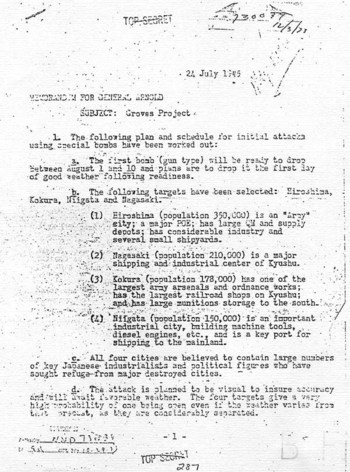
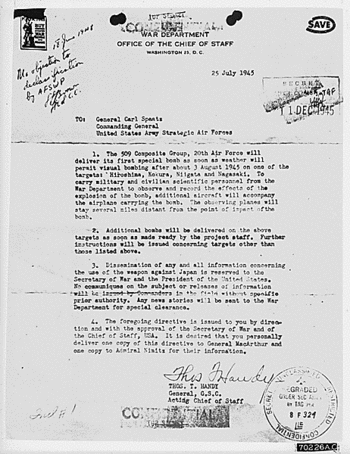
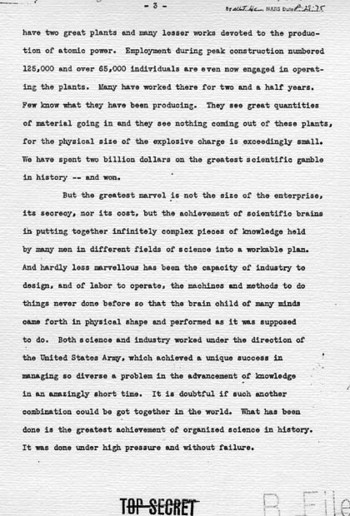
    Here are the two basic documents which prepared the actual use of atomic weapons against Japanese targets (written 22 July and 25 July, respectively).    The first was prepared by Colonel John Stone for his superior General of the Army Air Forces Henry H. Hap Arnold, initiated by General George Marshall through General Thomas Handy—updating Arnold on the progress at the Potsdam Conference from which he (Stone)  had just returned.  The next is the only actual signed-off document authorizing the use of nuclear weapons, and comes under the direction of George Marshall’s directive to General Handy:  basically relating that the P{resident had authorized Secretary Stimson who had authorized Marshall to authorize Handy to authorize General Carl Spaatz (Commanding General, U.S. Army Strategic Air Force) to use the weapon. Spaatz is also directed to deliver a copy of the order (“personally”, that is, by hand)  to General MacArthur and Admiral Nimitz.
    Source: The National Security Archive

    Atomic_bomb_handy_to_spaatz_1945

    ·Posted by :

    ·in:


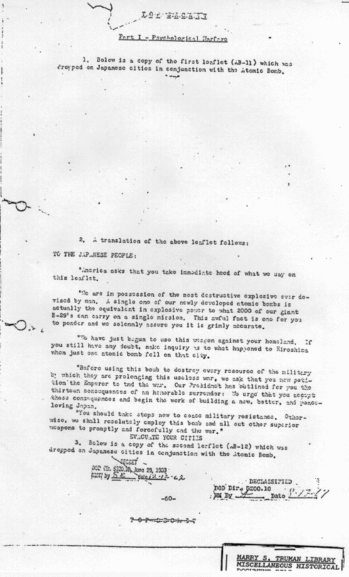
  • The Atomic Bomb: 6 August 1945. Propaganda Leaflet Dropped on Japanese Cities

    JF Ptak Science Books  LLC  Post 186

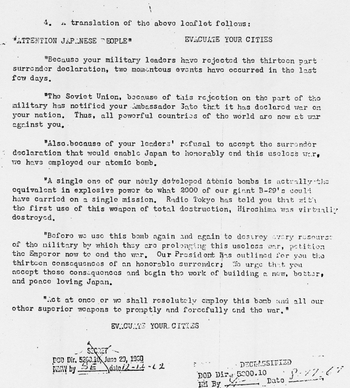
    These are translations of leaflets that were dropped on Japanese cities in the immediate aftermath of the bombing of Hiroshima (as Nagasaki, which would be bombed three days later on 9 August is not mentioned). Both of these are again from the Harry Truman Presidential Library.  The Japanese did not submit to the demand of unconditional surrender as laid out in Potsdam on 26 July, not did they submit when the Soviet Union declare war, nor did they submit after the 9 August bombing of Nagasaki.  They did finally accept the conditions of unconditional surrender surrender on 15 August, signing away the war two weeks later on the USS Missouri, 2 September 1945.  A third atomic bomb was nearly ready for use by the middle of August.   

    Atomic_bomb_leaflet

    Atomic_bomb_leaflet

    ·Posted by :

    ·in:


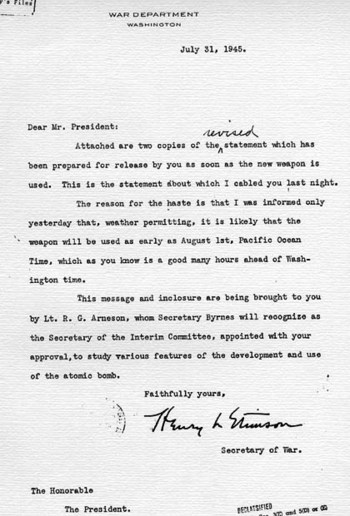
  • The Atomic Bomb, 31 July 1945: Truman’s Statement on the Bombing of Hiroshima

    JF Ptak Science Books LLC  Post 185

    Truman_letter_x

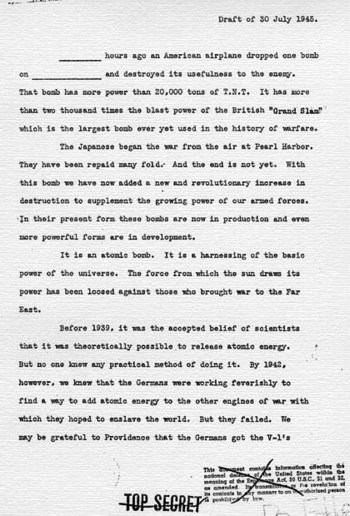
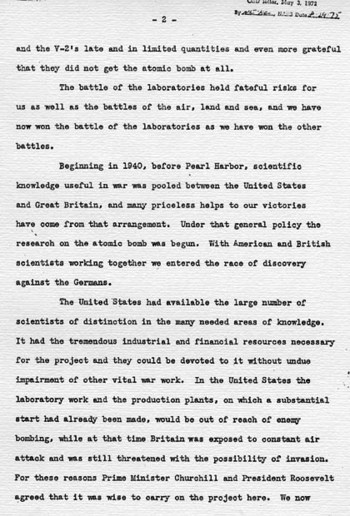
    I’ve made several posts on the development of the first atomic bomb(s) as we approach the anniversary of the bombing of Hiroshima (6 August 1945) and Nagasaki (9 August 1945).  At this point in 1945, the Potsdam Declaration had been announced demanding the unconditional surrender of Japan, Little Boy was being assembled, and Fat Man had arrived at Tinian Island.  The last bits of the Manhattan Project were being put into place.  One of public relations parts—the first PR involving the use of the bomb–is a document that I’ve never seen before, found at the Truman Presidential Library (and available digitally). 
    Henry Stimson, the Secretary of War, sent this message to President Truman as the statement to be released by the White House once the (secret) bomb had been dropped (also known as “Use Day”)—an explanation to the American people about what would happen on 6 August.

    Truman_letter_1

    Truman_letter_2

    Truman_letter_3

    ·Posted by :

    ·in: