A Daily History of Holes, Dots, Lines, Science, History, Math, Physics, Art, the Unintentional Absurd, Architecture, Maps, Data Visualization, Blank and Missing Things, and so on. |1.6 million words, 7500 images, 4.9 million hits| Press & appearances in The Times, Le Figaro, Mensa, The Economist, The Guardian, Discovery News, Slate, Le Monde, Sci American Blogs, Le Pont, and many other places… 5000+ total posts since 2008.

Category: Atomic and Nuclear weapons

  • Atomic Bomb Darts–Kids’ Games from the 1950’s

    JF Ptak Science Books Post 339

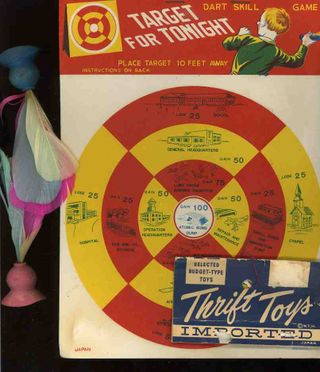
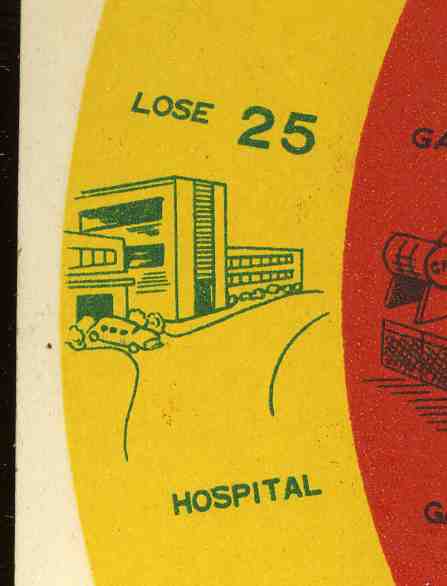
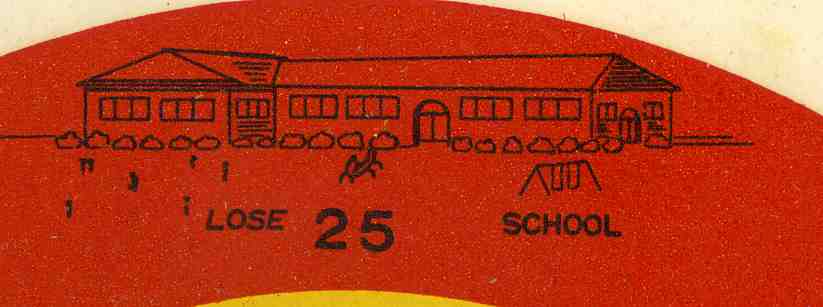
    Outside of duck-and-cover routines and other schemes for teaching children the survivability of nuclear holocaust, the approach for installing nuclear-think in the psyche of the young was through games. One such game was this cheap, affordable-by-all bombing game, “Target for Tonight” (a “Selected Budget-type Toy” by “Thrift Toys, Imported”), in which kids would use their “Atomic Darts” to reign terror over foreign lands.  But be careful!  Missing the primary targets and hitting something in the outside ring will cost you points!  If you bombed the hospital, school or chapel, you’d lose 25 points; if you hit the “civilian city” you’d get 50 points docked from your total.  Of course the game goes on no matter how many points you lose, just so long as you hit something positive and whose point add up to a total of 175. 

    00-blog-Oct 27 atomic926

    00-blog-Oct 27 atomic det hospital927

    The bullseye of the game is the “Atomic Bomb Dump” (an expression I’ve never seen before) at center.  Since it would be relatively easy to score 175–you could do it with four or five decent hits–the makers must’ve assumed that there would be plenty of collateral damage taking points from the total, otherwise the game would be over in two rounds and how much fun would that be?  So I guess that the message in this medium would be that into every winning effort some considerable unhappy rain must fall. 

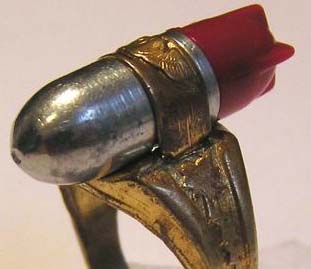
    00-blog-Oct 27 atomic det school928 I guess too that the kids playing this game could’ve been throwing their atomic darts wearing their Lone Ranger Atomic Bomb ring.  I’m no toy expert, but I cannot remember any other children’s jewelry from before 1960 (this ring is from 1946) using such a graphic depiction of The Bomb for casual wear.
      I’m also fairly positive that there must’ve been a good, causal bit to go along with “Atomic bomb” and “the Lone Ranger”, though I can’t think of what would connect the Western hero with the a-bomb.

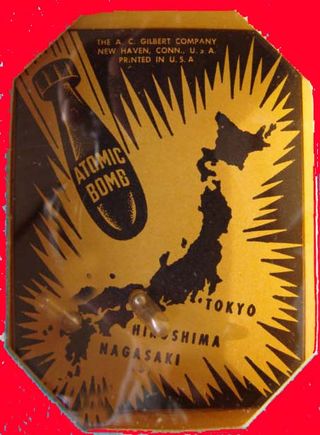
    Another no-holds-barred toy appears in the form of this manual dexterity game from the late 1940’s–the child was supposed to maneuver the three marbles into the hole/position at Hiroshima, Nagasaki and Tokyo.

    Did I mention that the “Target for Tonight” game was made in Japan?Lone_Ranger_Ring

    Atomic bomb marble


  • Atomic Bomb Protection: Blast Briefcases and Anti-Heat Linen, 1950: What to Do When the Big Ones Come

    JF Ptak Science Books Post 282

     This anti-CYAG plump-piece comes to us by virtue of the helpful folks at LIFE magazine in their issue of 18 August 1950.  The article”Atomic Handbook is a Best-Seller/New Government manual tells what will happen and what to do if A-bombs fall on U.S. cities”.

    1ebay_sept_26_atomic_2676

    But what excellent material to work with when multi (multi) megatons come raining down from over the Pole. 

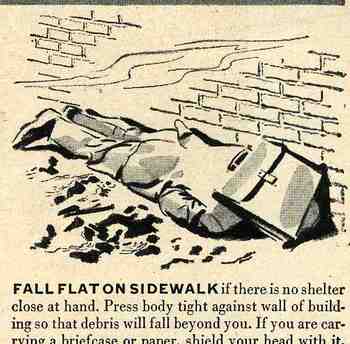
    Here are the helpful hints that were being sold to the American public in a family magazine:

    1)  If there is nothing to hide in, put your face in the crack where the sidewalk and a building meet, and put your attache case over your head.  Too bad the case wasn’t bigger–like a few tons of lead and concrete. Make sure the metal clasp is facing out, rather than in, otherwise it will fuse with your skull, if there was any skull left.

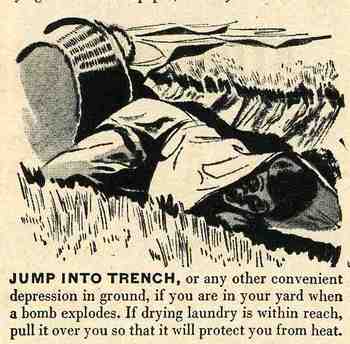
    2)  So, if you’re hanging up the laundry in the backyard when the bombs go off, get into a

    1ebay_sept_26_atomic_3677 trench (that just happens to be there in the middle of the yard) and cover your head with a sheet “to protect you from heat” (“if your drying laundry is within reach”).  I hope that its an Oxford double weave.

    3) (Illustrated below.)  Find a doorway to hide in, and hope that you’re not within two miles of the blast, otherwise you’re a part of the rubble.

    4)  (Illustrated  below.)  If you’re within two feet of a tree, hide behind it. Honestly  The warning is for two feet:  if you’re three feet away, you might be toast.  That’s the message.

    5) (Illustrated below.)  Crawl under a table and cover yourself with the table cloth to “ward off glass splinters”.  That was a real suggestion.  Somehow the cotton of tablecloths and linens and such had magical anti-glass and heat-reductive power brought on only during a nuclear holocaust. 

    The trick to all of this is to put yourself fifty years into the future and try to look back at whatever these LIFE images might be here in 2008. 


  • The Prehistory of the Manhattan Project: the MAUD Committee, 1941

    JF Ptak Science Books Post 280

    (Note:  both the MAUD and Frisch-Peierls documents are reprinted in the continued reading section below)

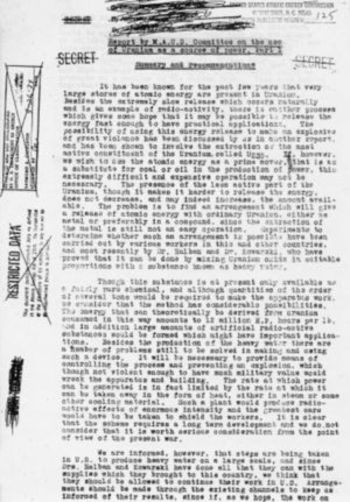
    As stated in the first paragraph of what once was a supremely-guarded secret, the British MAUD Committee (Britain’s initial steps towards the construction of an atomic weapon) :”Work(ed) to investigate the possibilities of utilizing the atomic energy of uranium for military purposes has been in progress since 1939, and a stage has now been reached when it seems desirable to report progress…”  There was quite allot of this work done between 1937 and 1939 (and even deep into 1940 the American physics journal Physical Review was still publishing papers they probably shouldn’t have on this subject), and the MAUD committee sought to get a handle on it all.
    Maud_report

    As stated in the first paragraph of what once was a supremely-guarded secret, the British MAUD Committee (Britain’s initial response to constructing an atomic weapon): “(w)ork(ed)  to investigate the possibilities of utilizing the atomic energy of uranium for military purposes has been in progress since 1939, and a stage has now been reached when it seems desirable to report progress…”  There was quite allot of this work done between 1937 and 1939 (and even deep into 1940 the American physics journal Physical Review was still publishing papers they probably shouldn’t have in the area). Then, coming out of UK’s Birmingham in February 1940, Otto Frisch and Rudolf Peierls, considered the possibility of fast fission in uranium-235. They estimated the likely effects of the bomb, possible methods of assembly and made estimates on how feasible it was to separate the uranium-235.

    The opening paragraphs of the 1940 Frisch-Peierls Memorandum. The text reads:

    Strictly Confidential. Memorandum on the properties of a radioactive “super-bomb”.The attached detailed report concerns the possibility of constructing a “super-bomb” which utilizes the energy stored in atomic nuclei as a source of energy. The energy liberated in the explosion of such a super-bomb is about the same as that produced by the explosion of 1000 tons of dynamite. This energy is liberated in a small volume, in which it will, for an instant, produce a temperature comparable to that in the interior of the sun. The blast from such an explosion would destroy life in a wide area. The size of this area is difficult to estimate, but it will probably cover the centre of a big city.

    In addition, some part of the energy set free by the bomb goes to produce radioactive substances, and these will emit very powerful and dangerous radiations. The effect of these radiations is greatest immediately after the explosion, but it decays only gradually and even for days after the explosion any person entering the affected area will be killed.

    Some of this radioactivity will be carried along with the wind and will spread the contamination; several miles downwind this may kill people.

    Their work was summarized in what was to become known as the Friesch-Peierls memorandum (see below for a WORDLE/word map of the report), and sent on to Marcus Oliphant, who passed the document on to Henry Tizard, chairman of the Committee on the Scientific Survey of Air Defence. The Maud Committee–molded into existence by Tizard and consisting of Sir George Paget Thomson,  Chairman Marcus Oliphant, Patrick Blackett,  James Chadwick, Philip Moon and John Cockcroft.–first met on 10 April 1940 to consider Britain’s actions regarding the mass of possibilities swirling around the “uranium problem”, and

    The MAUD committee approved two reports (See below for the World word map of the report below) on 15 July 1941 and disbanded; the first report was on ‘Use of Uranium for a Bomb’, giving a technical description of the bomb with specs and cost estimates, concluding that the bomb was indeed feasible. The other was on ‘Use of Uranium as a Source of Power’ and discussed the implementation of the bomb as well as the peaceful uses for what we would call a reactor.  It was a penetrating discussion.

    Meanwhile, in the U.S., Arthur Compton and the National Academy of Sciences (prompted and urged by folks like E.O. Lawrence and Vannevar Bush) studied and then, on 17 May 1941, issued a report on nuclear energy, incorporating the MAUD findings (which had been received in the U.S. by March 1941) discussing the possibilities of a bomb though without entering into any detail about actually producing one.

    The Brits evidently felt that the U.S. needed to take a much more advanced and urgent look at the issue than what was being allowed.  The Americans were still not in the war (and Britain had been fighting for 1.5 years by that point) and were still 7 months out from Pearl Harbor.  Pursuing and building the bomb was a gargantuan undertaking unlike almost anything else, and the fire had still not been lighted that would ignite this fuse. The bomb also could be built probably nowhere else on earth given the manpower and raw material and electricity and knowledge demanded by the project–at the end of the day, the Nazis, I think, just didn’t have the raw stuff for the project and were still removed from the theoretical aspects.  Britain of course couldn’t afford the project what with actually fighting the war.  Japan just wasn’t in the realm of possibility.  It had to be the U.S.

    And so it came to pass that Sir Marcus ‘Mark’ Laurence Elwin Oliphant, a 42 year old Australian (who died only recently, in 2000), came to the US  in  to do a very hard sell on the Americans for bomb production.   Oliphant, who with the rest of the nuclear establishment of Britain was puzzled by the inaction of the U.S. on MAUD  meet  with Lyman Briggs, his American counterpart to whom the report had been sent.  Oliphant recalled:
    “the minutes and reports had been sent to Lyman Briggs, who was the Director of the Uranium Committee, and we were puzzled to receive virtually no comment. I called on Briggs in Washington, only to find out that this inarticulate and unimpressive man had put the reports in his safe and had not shown them to members of his committee. I was amazed and distressed.”  I should say so

    Oliphant moved up the ladder and met with his friends EO Lawrence, James Conant and Enrico Fermi about his “problem”, which was evidently instantly digested.  It was from this point that Lawrence got together with Compton and Bush (who at that time was chair of the National Defense Research Committee), and created the vaster and more encompassing Office of Scientific Research and Development–perhaps one of the smartest American moves of the entire war. (I should also point out that it was also under the leadership and guidance of Vannevar Bush that this organization functioned so well and produced the amount of work that it did, which as really astonishing.  Bush in my my is one of the truly great unsung heroes of the war.)   It was from the OSRD that the Manhattan Engineering District was born after Pearl Harbor.  And then everything else, um, happened.

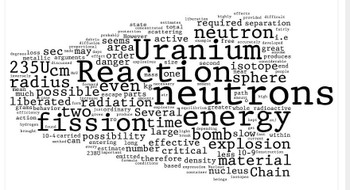
    MAUD Wordle

    Wordlemaud


    Frisch Wordle


    Wordlefrisch


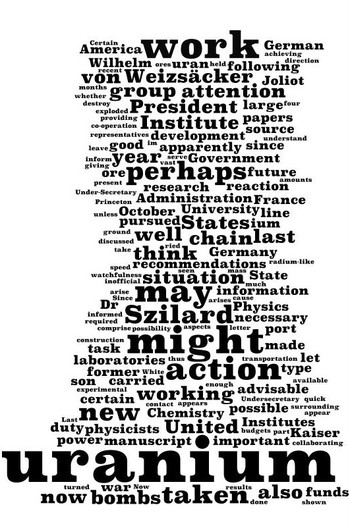
  • Wordle Word Art–Vocabulary from Einstein’s Two Letters to Roosevelt on the Atomic Bomb

    JF Ptak Science Books LLC

    The newest contribution to my new-found category of Found Word Art is constructed from the text of Albert Einstein’s two letters (August 2 1939 and March 7 1940) to President Franklin Roosevelt about the use of the coming atomic weapon.  The text of the letters was simply deposited in the wonder-engine word-atomizer at WORDLE, and the relative distribution of the most commonly-used words were given new representation in relative sizes.  I should point out the earliest post I did on the cautionary letters of Einstein and Szilard to FDR and refer to it for the explanation the occurrences of some of the Wordle words.

    If you click on the image it will become larger and clearer.

    The complete text of the two letters is found below in the Continue Reading section.

    Wordleeinstein


  • Wordle Word Art–Vocabulary from our Atomic Bomb Chronology

    JF Ptak Science Books LLC

    This is the newest installment of Found Word Art engineered by the good folks at WORDLE.:  this iteration uses the text block from my page on the chronology of the creation of the atomic bomb, with the entire thing dumped into the Wordle wonder-engine which produced this piece of art.  I should point out that the size of the word refers to relative appearances of the word in the post. 

    If you click on the image it will get larger and clearer.
    Wordleatomic_bomb_cchronology

    ·Posted by :

    ·in:

    — —

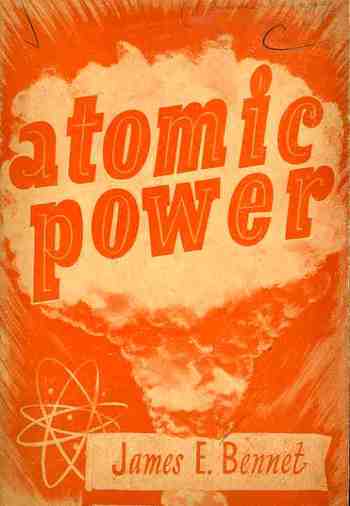
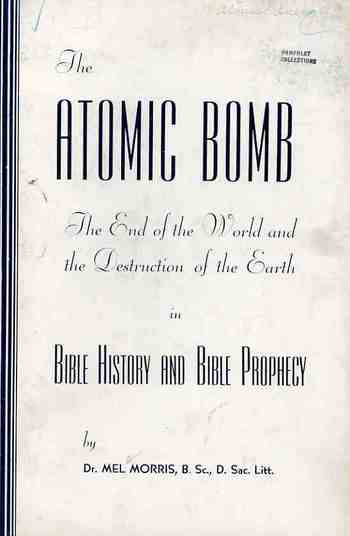
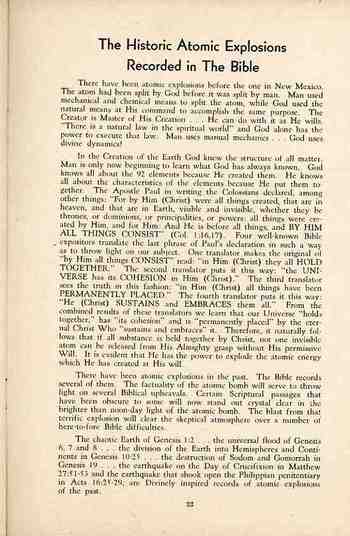
  • God’s Atomic Bomb: the Divine, the Infinite, and its “Gift” of the Bomb, 1946

    JF Ptak Science Books  Post 234

    Blogsept_2_atomic_bomb_god481

    I’d like to say that this was a class-of-its-own sort of work, but as it  goes this is hardly the case.  If I cared a little I guess I could establish a collecting sub-category in the nuclear fission–atomic–nuclear weapon collection for the popular belief that god ordained and transmitted the atomic bomb.  There are at least five other pamphlets like this floating around in the store, and I am certain that there must’ve been dozens of other grabby little publications like this proclaiming Almighty Influence in the creation of the atomic bomb.  I can understand the reasoning behind the power grab:  the bomb ended the war a week after its second use, sparing the lives, perhaps, of a million soldiers (American and Japanese) and years of societal/infrastructure rehabilitation by eliminating the need of an American invasion of the Empire.  So the denominator was simply the “saved (American) lives” part. 

    Blogsept_2_atomic_bomb_god_2482

    Again, I can understand how this felt in 1945/6, but I still feel that getting the suspected creator of the universe involved in the making and use of the bomb was ill-advised.  The author of the first pamphlet reached back into history and credited god with simple solutions to complex situations:  employing the more modern political technique of controlling language in the Tower of Babel case (wher he also said that since Babel was only 105 years after the flood that Noah was still alive, and that certainly Noah “would’ve voted ‘No’” for the building of the tower); and using “Johnny Snowflake” to stop the “non-satanic” Napoleon from reaching “Britain’s doorstep (and obviousy not the Soviet Reds).  Bennet also  credits god with giving “Dr. Currie” (sic) the genius to “split atoms” in 1896. 

    The second pamphlet uses the atomic weapon a little more figuratively.  The author, Mel Morris, published this in 1945, which means he must’ve worked a little feverishly to pump up his bible prophesy and history to include the new atomic weapon to replace whatever else he had been using as a prophecy for end of times.  (As it turns out, “God’s Atomic Bomb” was more tempest and disaster in the bible, and not (whew!) the bomb itself.  Though as we’ve learned from scientologists and the sort-of creative mind of Ron Hubbard, a civilization came to the earth thousands of years ago and pummeled it with “atomic bombs” and other nastiness, polluting humans for milennia to come.  But that’s another story–suffice to say that Morris found many dozens of examples of “God’s Atomic Bomb” being used in the deep biblical past, and that the use of the real atomic bomb in 1945 was pre-ordained, and not without its figurative historical counterparts.  I’m not sure why any of this was necessary outside of proving to some small minority that these preachers could at least be contemporary and topical. 

    Blogsept_2_atomic_bomb_god_2txt483


  • Deciding to Use the Atomic Bomb: The Chicago Metallurgical Lab Poll, July, 1945

    JF Ptak Science Books LLC  Post 194

    Interested in responding to the poll yourself?  Answer the Metallurgical Lab (July 1945) Poll here--we’ll post the results next month.  

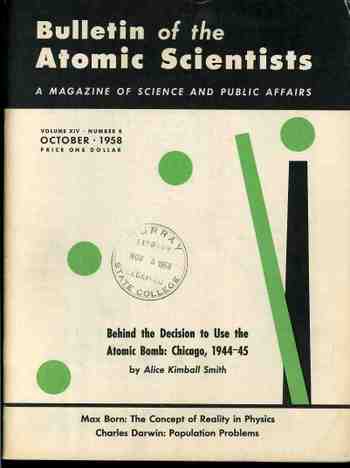
    Blogaugust_4_bas_cvr373In late June 1945, the Interim Committee (a secret, blue chip group established by Secretary of War Stimson with the approval of President Harry S. Truman to examine the problems that could result from the creation of the atomic bomb). decided what exactly to do with the weapons.  The group (also including James F. Byrnes, former US Senator soon to be Secretary of State, as President Truman’s personal representative; Ralph A. Bard, Under Secretary of the Navy; William L. Clayton, Assistant Secretary of State; Vannevar Bush, Director of the Office of Scientific Research and Development and president of the Carnegie Institution; Karl T. Compton, Chief of the Office of Field Service in the Office of Scientific Research and Development and president of Massachusetts Institute of Technology; James B. Conant, Chairman of the National Defense Research Committee and president of Harvard University; and George L. Harrison, an assistant to Stimson and president of New York Life Insurance Company) found the following:

    The opinions of our scientific colleagues on the initial use of these weapons are not unanimous: they range from the proposal of a purely technical demonstration to that of the military application best designed to induce surrender. Those who advocate a purely technical demonstration would wish to outlaw the use of atomic weapons, and have feared that if we use the weapons now our position in future negotiations will be prejudiced. Others emphasize the opportunity of saving American lives by immediate military use, and believe that such use will improve the international prospects, in that they are more concerned with the prevention of war than with the elimination of this specific weapon. We find ourselves closer to these latter views; we can propose no technical demonstration likely to bring an end to the war; we see no acceptable alternative to direct military use.

    AND

    …that the weapon be used against Japan at the earliest opportunity, that it be used without warning, and that it be used on a dual target, namely, a military installation or war plant surrounded by or adjacent to homes or other buildings most susceptible to damage.

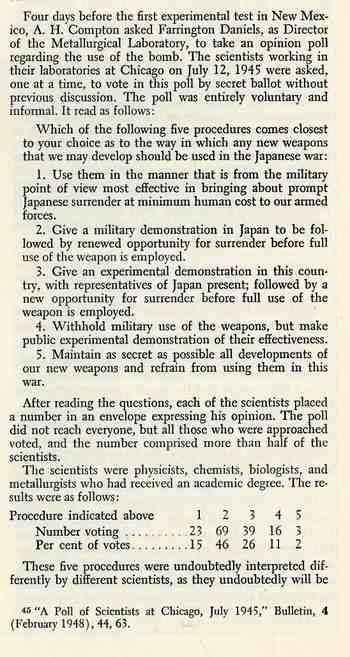
    Slightly later, in July 1945 (but before Trinity), Arthur H. Compton asked  Farrington Daniels (Director of the Metallurgical Lab section (at Chicago) of the Manhattan Project) to poll the 250 or so scientists at work under Farrington on the coming immediate use of the atomic bombs.  (The results of the poll, answered by 150 of the 250 people, were originally published as “A Poll of Scientists at Chicago, July 1945,” Bulletin of the Atomic Scientists, February 1948, 44, page 63. and again published in Compton’s own book,  Atomic Quest, in 1956. The images below come from the Bulletin of Atomic Scientists for October 1958, p 304.)

    Here are the questions and the results of the responses:

    Blogaugust_4_bas_survey374

    The results of the poll were widely interpreted, and seemed to fit the needs of whomever was stretching the statistical canvas.  On the one hand, for example, 87% of the anonymous respondents favored some sort of military use of the bombs, though just 15% of all of the scientists thought that the bombs should be dropped straight-away.  Almost half thought that the bombs were best used in demonstration to the Japanese first, followed by renewed negotiating efforts for unconditional surrender, before the bombs were employed on targets; another 26% felt that the Japanese be invited for a demonstration in the US of the weapon.  So even though 87% believed that a military use was prescribed, 72% felt that the military use was best first as a demonstration device.  2% (3 of the 150) felt that the bomb should basically be buried and not used at all.

    Compton’s response to it all and to the immediate demands presented to him on 23rd July (Washington wants to know what you think”) was hardly quintessential:  “My vote is with the majority….it seems to me that as the war stands the bomb should be used , but no more drastically than needed to bring surrender>” (Reported in Lewis Morton’s “The Decision to Use the Atomic Bomb”, Foreign Affairs, 35, January 1957, pp 334-353).

    ·Posted by :

    ·in:


  • Atomic Bomb Exposure Effects on Pregnancy at Hiroshima and Nagasaki

    JF Ptak Science Books Post 228

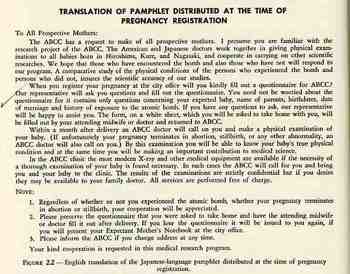
    The total number of casualties at Hiroshima and Nagasaki today exceed the initial figures of  1945–people were of course dying years after the blasts due toBlogaugust_28_atomic_birt_pamph46_2 excessive exposure to ionizing radiation and other complications.  To understand the long-term affects of the use of these weapons the  National Academy of Science (under the instigation of the Truman White House) created the Atomic Bomb Casualty Committee in 1945.  Its earliest concerns were hematological, but then quickly spread into other areas such as leukemia, radiation cataracts, fertility, aging, mortality and genetics.  By 1950 there were more than 1000 Americans involved in this program, which had begun to whither by 1953 but which lasted until 1982.
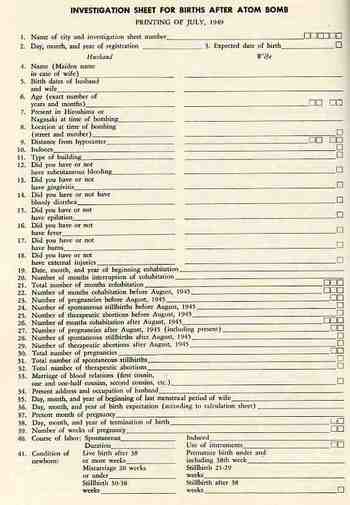
    This questionnaire comes from the ABCC and published in The Effect of Exposure to the Atomic Bombs on Pregnancy Termination in Hiroshima and Nagasaki by the prolific and important Neel and Schull) and published by the Academy in 1956. (The two would address the issue many times, and seem to have summed it up in The Children of Atomic Bomb Survivors, A Genetic Study.  Washington, D.C.: National Academy Press, 1991. The 1947 report of the ABCC may be read HERE.)

    This study addressed the question of generational radiation damage and–after 1953–whether and if so how radiation damages DNA.  The issue was whether future generations of children would express increased birth defect ratios as a result of exposure to the bomb.  This questionnaire was given every fifth lunar month to the pregnant women of Hiroshima and Nagasaki–who were made to register their pregnancies with the government–and carried on for six years.   

    ****

    Also see the following:

    Liebow, Averill.  Encounter with Disaster, A Medical Diary. New York: W.W. Norton and Company, Inc., 1970.

    Marston, Robert Q. M.D., and Fredric Solomon M.D., eds.  The Medical Implications of Nuclear War.  Washington, D.C.: National Academy Press, 1986.

    ****

    The figures for the dead and injured at Hiroshima and Nagaski, August 1945:

      Hiroshima Nagasaki
    Pre-raid population 255,000 195,000
    Dead 66,000 39,000
    Injured 69,000 25,000
    Total Casualties 135,000 64,000

    (Click on image to enlarge)

    Blogaugust_28_atomic_birt_q467  

    ·Posted by :

    ·in:


  • Atomic Bomb: Reporting on the Nagasaki Bomb in the “Manzanar Free Press”, 11 August 1945

    JF Ptak Science Books LLC Post 192
    Atomic_bomb_manzanar_2

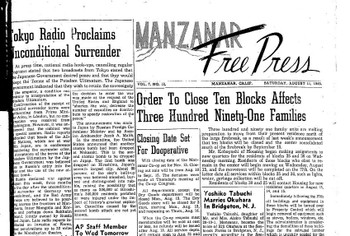
    For another project I’ve been reading through the Manzanar Free Press Newspaper (volume 7, no. 12) and came upon this slight coverage of the bombing of Nagasaki, printed 11 August 1945.  What’s unusual here is that this newspaper was published by the “internees” at the Japanese Relocation Center (officially “The Manzanar War relocation Center” and also called a  “relocation camp,” “relocation center,” “internment camp,” and “concentration camp,)  at Manzanar, California.   110,000 people of  Japanese origin (including a large percentage of American citizens) were forcibly removed and imprisoned via the U.S. Executive Order 9066, issued by President Franklin Roosevelt on 19 February 1942.   Manzanar was a semi-dead town 220 miles NE of Los Angeles, located in high desert with huge swings of temperature and unrelenting and challenging weather—semi-killed by the city of Los Angeles, which purchased the water rights to the region in 1929, forcing out the remaining inhabitants.  Manzanar had a peak population of about 11,000 before the Japanese were returned to what remained of their previous lives.

    Manzanarattention_2

    In this quick coverage, a report is made on the Japanese accepting the terms of the Potsdam “Ultimatum”, putting an end to the war.  The next part is of the reporting is very subdued, announcing the dropping of the second bomb,  theorizing that as many as 200,000-300,000 people may have perished in the bombing of Japan’s seventh largest city.  And not much more than that.  Two hundred words were I’m guessing all that was allowed by the powers-that-be at Manzanar.

    Elsewhere in this same issue is a report on the meeting of the Manzanar Boy Scout troop.  And something on the graduating class of the Manzanar High School (the high school yearbook for 1945, the last class at Manzanar, was called “Valediction”).  Familiar trappings in an unfamiliar trap.

    Manzanar is located near Lone Pine in the Owens Valley, which today suffers terrible environmental problems brought on by water-dependent LA sucking out all of the water in the region.


  • Atomic Bomb–Historic American Building Survey, Trinity Site

    JF Ptak Science Books  Post 224

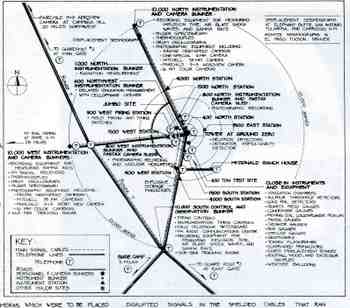
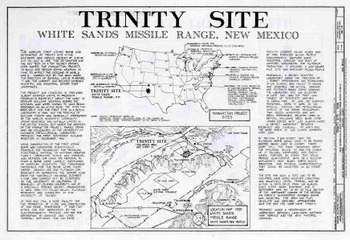
    I just came across these engineering drawings for a detailed survey of the Trinity Site in New Mexico,  location of the first detonation of an atomic bomb (16 July 1945).  The work was completed by Rossana Santos for the DARCOM Recording Project as part of the American Historic Building Survey (Historic American Engineering Record NM-1-B, Department of the Interior).  There are a number of interesting renderings, but the most useful (and scarcest) is the map showing the location of bunkers and instrumentation for the 16 July event. (Click on the images to enlarge.)  This series of drawings pretty much speak for themselves. 
    Blogaugust_27_trinity_map2466


    Blogaugust_27_trinity_1461

    ·Posted by :

    ·in: