JF Ptak Science Books Post 280
(Note: both the MAUD and Frisch-Peierls documents are reprinted in the continued reading section below)
As stated in the first paragraph of what once was a supremely-guarded secret, the British MAUD Committee (Britain’s initial steps towards the construction of an atomic weapon) :”Work(ed) to investigate the possibilities of utilizing the atomic energy of uranium for military purposes has been in progress since 1939, and a stage has now been reached when it seems desirable to report progress…” There was quite allot of this work done between 1937 and 1939 (and even deep into 1940 the American physics journal Physical Review was still publishing papers they probably shouldn’t have on this subject), and the MAUD committee sought to get a handle on it all.
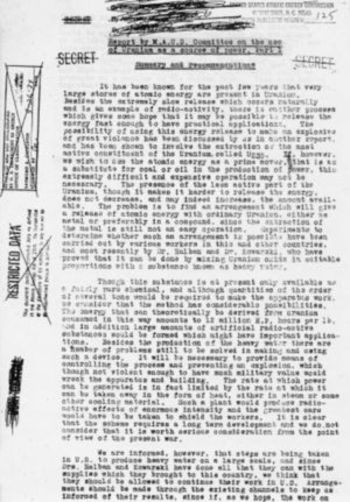
As stated in the first paragraph of what once was a supremely-guarded secret, the British MAUD Committee (Britain’s initial response to constructing an atomic weapon): “(w)ork(ed) to investigate the possibilities of utilizing the atomic energy of uranium for military purposes has been in progress since 1939, and a stage has now been reached when it seems desirable to report progress…” There was quite allot of this work done between 1937 and 1939 (and even deep into 1940 the American physics journal Physical Review was still publishing papers they probably shouldn’t have in the area). Then, coming out of UK’s Birmingham in February 1940, Otto Frisch and Rudolf Peierls, considered the possibility of fast fission in uranium-235. They estimated the likely effects of the bomb, possible methods of assembly and made estimates on how feasible it was to separate the uranium-235.
The opening paragraphs of the 1940 Frisch-Peierls Memorandum. The text reads:
Strictly Confidential. Memorandum on the properties of a radioactive “super-bomb”.The attached detailed report concerns the possibility of constructing a “super-bomb” which utilizes the energy stored in atomic nuclei as a source of energy. The energy liberated in the explosion of such a super-bomb is about the same as that produced by the explosion of 1000 tons of dynamite. This energy is liberated in a small volume, in which it will, for an instant, produce a temperature comparable to that in the interior of the sun. The blast from such an explosion would destroy life in a wide area. The size of this area is difficult to estimate, but it will probably cover the centre of a big city.
In addition, some part of the energy set free by the bomb goes to produce radioactive substances, and these will emit very powerful and dangerous radiations. The effect of these radiations is greatest immediately after the explosion, but it decays only gradually and even for days after the explosion any person entering the affected area will be killed.
Some of this radioactivity will be carried along with the wind and will spread the contamination; several miles downwind this may kill people.
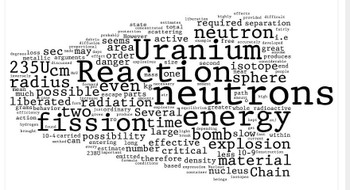
Their work was summarized in what was to become known as the Friesch-Peierls memorandum (see below for a WORDLE/word map of the report), and sent on to Marcus Oliphant, who passed the document on to Henry Tizard, chairman of the Committee on the Scientific Survey of Air Defence. The Maud Committee–molded into existence by Tizard and consisting of Sir George Paget Thomson, Chairman Marcus Oliphant, Patrick Blackett, James Chadwick, Philip Moon and John Cockcroft.–first met on 10 April 1940 to consider Britain’s actions regarding the mass of possibilities swirling around the “uranium problem”, and
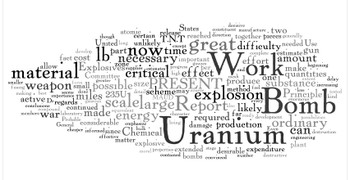
The MAUD committee approved two reports (See below for the World word map of the report below) on 15 July 1941 and disbanded; the first report was on ‘Use of Uranium for a Bomb’, giving a technical description of the bomb with specs and cost estimates, concluding that the bomb was indeed feasible. The other was on ‘Use of Uranium as a Source of Power’ and discussed the implementation of the bomb as well as the peaceful uses for what we would call a reactor. It was a penetrating discussion.
Meanwhile, in the U.S., Arthur Compton and the National Academy of Sciences (prompted and urged by folks like E.O. Lawrence and Vannevar Bush) studied and then, on 17 May 1941, issued a report on nuclear energy, incorporating the MAUD findings (which had been received in the U.S. by March 1941) discussing the possibilities of a bomb though without entering into any detail about actually producing one.
The Brits evidently felt that the U.S. needed to take a much more advanced and urgent look at the issue than what was being allowed. The Americans were still not in the war (and Britain had been fighting for 1.5 years by that point) and were still 7 months out from Pearl Harbor. Pursuing and building the bomb was a gargantuan undertaking unlike almost anything else, and the fire had still not been lighted that would ignite this fuse. The bomb also could be built probably nowhere else on earth given the manpower and raw material and electricity and knowledge demanded by the project–at the end of the day, the Nazis, I think, just didn’t have the raw stuff for the project and were still removed from the theoretical aspects. Britain of course couldn’t afford the project what with actually fighting the war. Japan just wasn’t in the realm of possibility. It had to be the U.S.
And so it came to pass that Sir Marcus ‘Mark’ Laurence Elwin Oliphant, a 42 year old Australian (who died only recently, in 2000), came to the US in to do a very hard sell on the Americans for bomb production. Oliphant, who with the rest of the nuclear establishment of Britain was puzzled by the inaction of the U.S. on MAUD meet with Lyman Briggs, his American counterpart to whom the report had been sent. Oliphant recalled:
“the minutes and reports had been sent to Lyman Briggs, who was the Director of the Uranium Committee, and we were puzzled to receive virtually no comment. I called on Briggs in Washington, only to find out that this inarticulate and unimpressive man had put the reports in his safe and had not shown them to members of his committee. I was amazed and distressed.” I should say so
Oliphant moved up the ladder and met with his friends EO Lawrence, James Conant and Enrico Fermi about his “problem”, which was evidently instantly digested. It was from this point that Lawrence got together with Compton and Bush (who at that time was chair of the National Defense Research Committee), and created the vaster and more encompassing Office of Scientific Research and Development–perhaps one of the smartest American moves of the entire war. (I should also point out that it was also under the leadership and guidance of Vannevar Bush that this organization functioned so well and produced the amount of work that it did, which as really astonishing. Bush in my my is one of the truly great unsung heroes of the war.) It was from the OSRD that the Manhattan Engineering District was born after Pearl Harbor. And then everything else, um, happened.
MAUD Wordle
Frisch Wordle