A Daily History of Holes, Dots, Lines, Science, History, Math, Physics, Art, the Unintentional Absurd, Architecture, Maps, Data Visualization, Blank and Missing Things, and so on. |1.6 million words, 7500 images, 4.9 million hits| Press & appearances in The Times, Le Figaro, Mensa, The Economist, The Guardian, Discovery News, Slate, Le Monde, Sci American Blogs, Le Pont, and many other places… 5000+ total posts since 2008.

Category: Atomic and Nuclear weapons

  • Atomurbia: Responding to Atomic Threat by Moving Everyone Everywhere. 1946

    JF Ptak Science Books LLC  Post 1018

    “It is probably not worth putting (all) railways under ground.”  Ed Teller, 1947

    [See also our 50+-part Atomic & Nuclear Bomb series here]

    There is a universe of alternate universes constructed of nothing but the dim bits of bad thinking that is the very DNA of the history of bad ideas.  In those realms there are bad ideas that are bad, bad ideas that are toweringly bad, and bad ideas that are so bad that they’re not even bad as they transcend communication capacities of badness.  The idea I’m writing about today lives at that unspeakably-bad level.

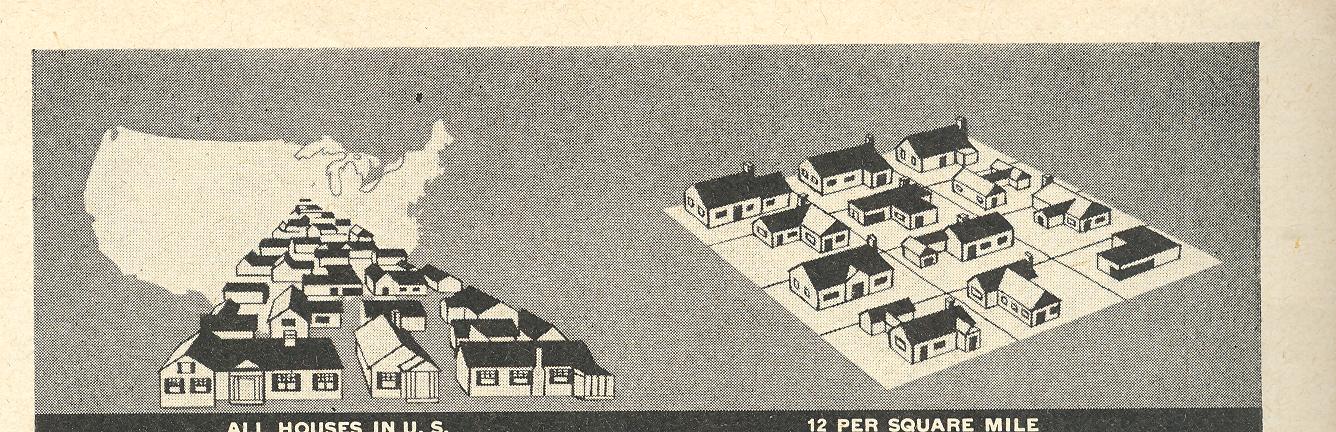
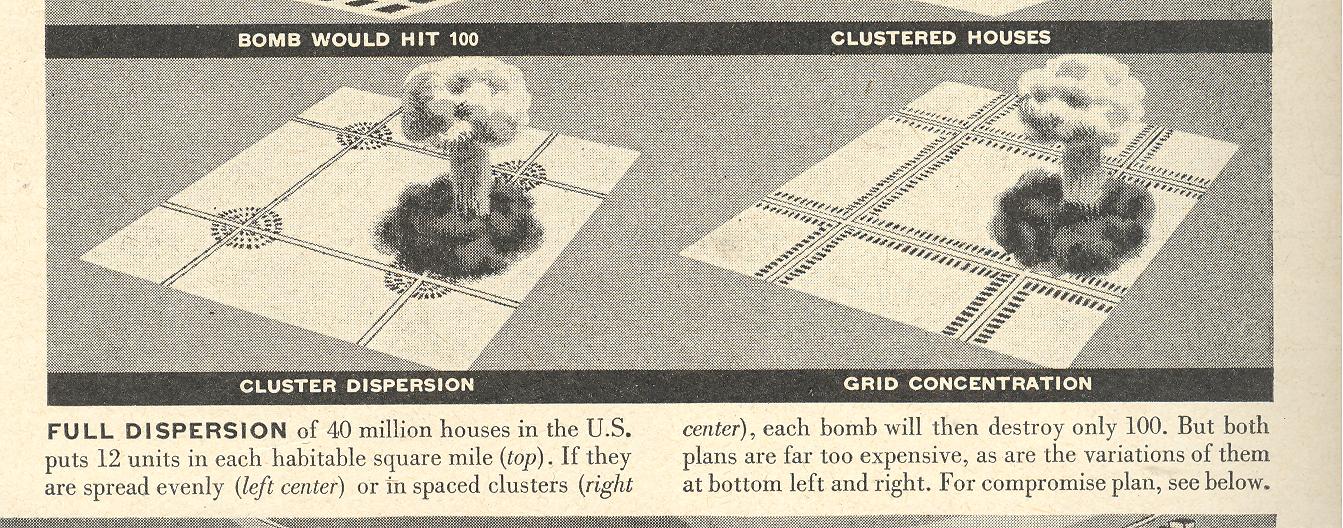
    And that bad idea is this: relocating and dispersing the entire population of the United States into a geometric grid-work covering all parts of the country, emptying all American cities into a vast nothingness of exurban Atomburbs. 
    1-may 3-atomic 2

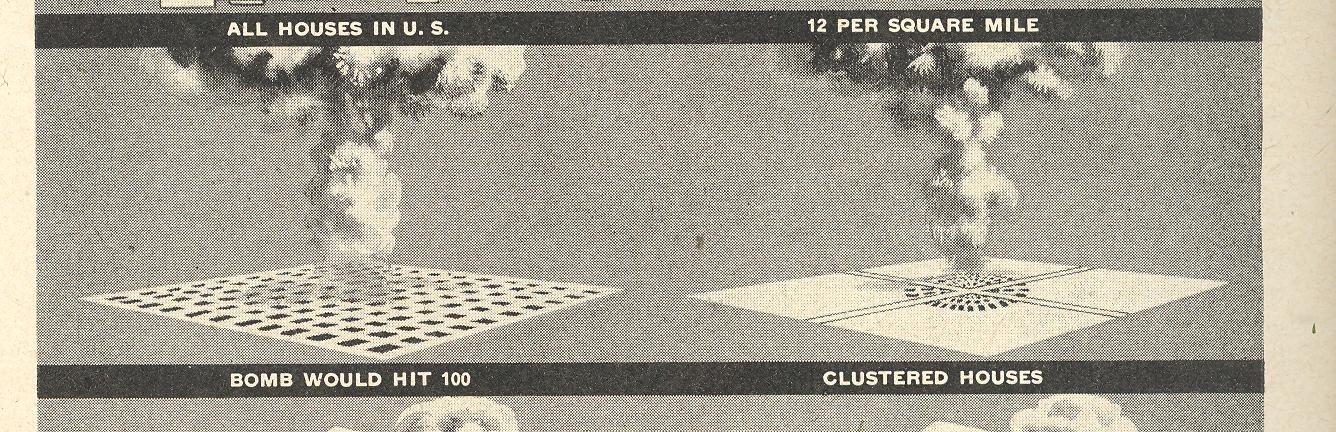
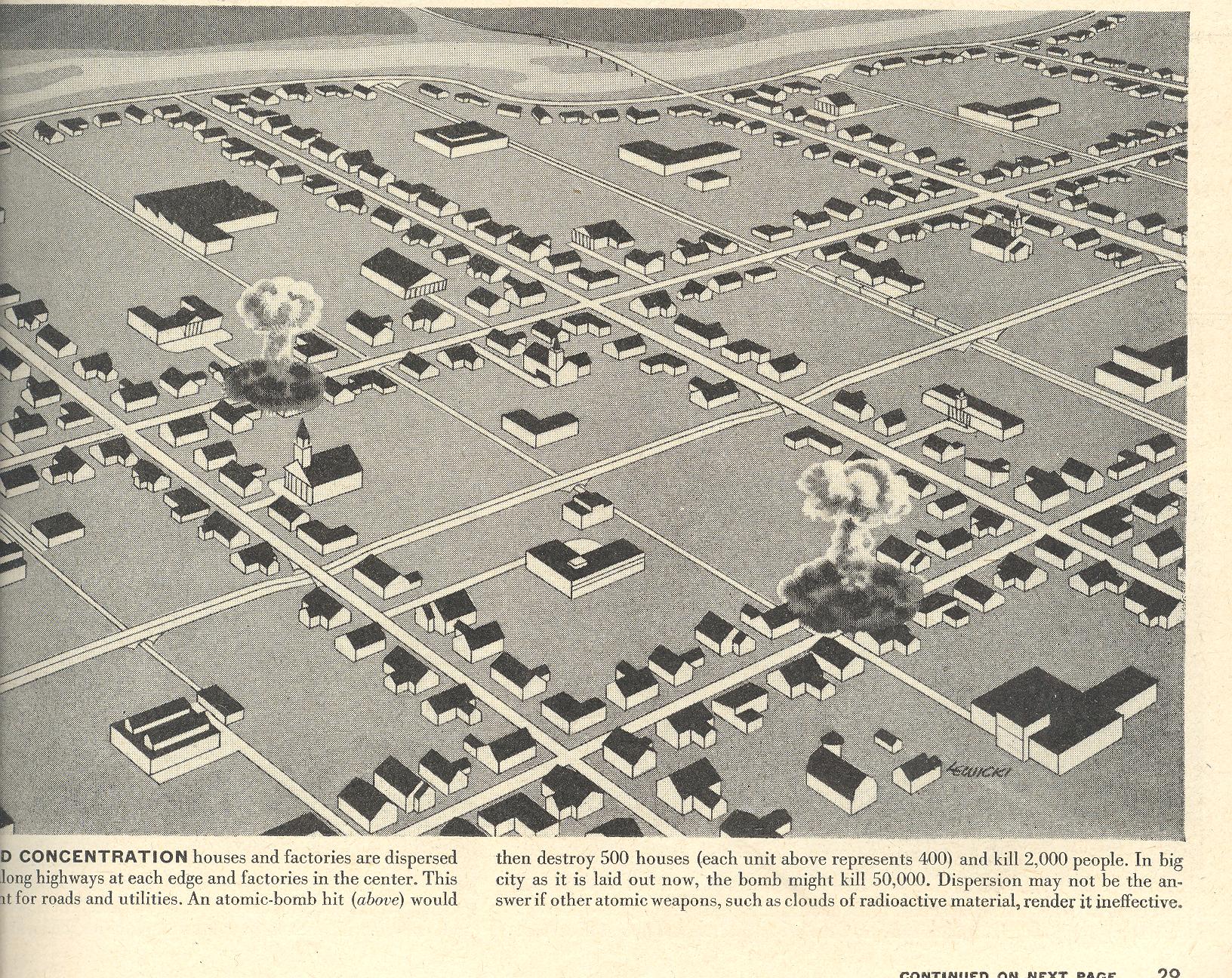
    There.  I said it.  Unfortunately, the thoughtfully blank idea was “real” and  was worked out by three smart guys, the result published in the Bulletin of Atomic Scientists in 19461.  The kernel of the proposition was republished for the masses in LIFE magazine in (15 June) 1947, complete with maps which stand on their own as being spectacular and peculiar examples of visual propaganda.         

    Listen: the crux of the issue was to remove everyone from any American city with a population greater than 50,000 people and place them in newly-built communities set out across the country’s landscape (mostly) like a chess board, the towns existing on all of the connecting lines. [As weird as this sounds, the great Norbert Wiener came up with a similarly astounding, untouchable idea using circles.]. The authors proposed to build 20,000,000 new homes, relocate industry (preferably underground), reallocate and redistribute energy supplies and natural resources, and recreate the very fabric of social and economic life in America.  
    1-may 3-atomic 4
    The governor of this thinking was the coming arms race and the American susceptibility to clouds laced with Soviet atomic weapons–and worse.[The calculations for destruction being used here were for the Hiroshima atomic bomb; in 1952 the U.S. would detonate the first hydrogen bomb, followed by the Soviets the next year.  These bombs would be measuring explosive force in terms of hundreds of thousands–and then dozens of millions–of pounds of explosives.]  How does this idea get thunk in a group and not abandoned?  And then how does it manage to be published by a a reputable organization?  These are smart men, these authors, and I just cannot think of how they could’ve come to these conclusions–though Teller, who was part of the genius flotilla of superb and essential Hungarian scientists, was undoubtedly mentally affected by his supernova hawkishness. I didn’t know this about Marshak, and I really am not very familiar with Klein.  They were all University of Chicago, and the Bulletin was originally published as the Bulletin of the Atomic Scientists of Chicago. 

    There are deeper, more disturbingly anti-spectacular ideas laced through the short article, some of which are so soaringly and diligently insane that it is difficult to address them.  For example, the authors suggest that the “ribbon cities” wouldn’t necessarily have to be “laid out in exactly straight lines” and that the lines could be adapted to the terrain.
    1-may 3-atomic 1

    Even though the authors propose moving and rehousing 20 million people (and so on), this was not what they really wanted to do.

    They wanted to put everything in lines and underground. 

    “We shall have to forgo elaborate schemes of underground cities” because of expense, they write.  And what of the cost, as long as we’re at it?  Somehow a figure of 200 billion is floated around–200b in 1947 dollars, which is 5 trillion in 2010 dollars (or so), which really doesn’t seem to be a figure that is in any way near to what an undertaking of this magnitude would cost.  (The odd thing about this figure is that $200 billion is about the same percentage for a single year of 1950 GDP as the $5 trillion is of the 2010 GDP.) [It seems unfair to take things out of context like this, but, well, it isn’t–the entire article is filled with almost nothing but these statements.  In a way I’m doing the authors a service by taking things out of context so that the entirety of their madness isn’t revealed as the ugly road-kill thinking it is.]

    Of course, g_d knows where all of this building material was going to come from.  Or the people who would actually do the work.  Were there 3 million construction/building folks in the 1950 census?  I don’t think so.

    And so in spite of the overwhelmingly underestimated cost, and the rerouting of the infrastructure of the entire country, and moving everyone in the country, and building 20 million houses, and finding the material to do so, and finding the workers to build them all and reconstruct all of the infrastructure and build all industry underground and have the tools to do it all with, the authors felt as though the whole thing could be pulled off in 10 years.

    Someone, somewhere, was certainly going to be working late.
    1-may 3-atomic 3

    And so the interesting part of this thought-tragedy for me is–what is the equivalent idea of this going on right now?  I know there is one, and there will be a new one tomorrow. 

    Notes
    1.. Jacob Marshak, Edward Teller, and Lawrence R. Klein. “Dispersal of Cities and Industries.” Bulletin of the Atomic Scientists 1, April 15, 1946, 13.

    See also:
    “Naked City.” Time. Nov. 28, 1949, 66. Also at.  Also see .The City Under the Bomb.. Time, Oct. 12, 1950

    Charles Grutzner. “City folks‘ fear of bombs aids boom in rural realty.. “ New York Times. August 27, 1950, 1.

    Michael Ray Fitzgerald.  Sitcoms and Suburbia. The Role of Network Television in the Deurbanization of the U.S., 1949-1991.
                   
    Molella, Arthur P. “The City as Communications Net: Norbert Wiener, the Atomic Bomb, and Urban Dispersal” Technology and Culture – Volume 45, Number 4, October 2004, pp. 764-777


  • Bombing and the End of the World: the Physics of 1932 And All That

    JF Ptak Science Books 

    1932 in my book turns out to be one of the most collectively epochal years in the history of science.  Certainly others stand out for individual achievements, like 1905 (Einstein’s four papers over two volume of the Annalen), 1687 (Principia), but there are other yeas with fabulous achievements by numerous people.

    Mar 7 airmen det


    1543 is one.  That year witnessed the published of Copernicus’ De revolutionibus and Andreas Vesalius’ De humani corporis fabrica, two giant achievements for the outer and inner worlds, one challenging the structure of the universe and the other the Galenic tradition of physiology and anatomy. (To a lesser extent is Peter Ramus’ Animadversions on Aristotle which was a very sustained and elegant attack on the ancient-precept Aristotle an physics.)

    1859 saw the publication of On the Origin of Species…JC Maxwell’s work on the kinetic theory of gases, Riemann’s hypothesis, and the spectacular invention of the spectroscope of Kirchhoff and Bunsen (that turned much of the invisible universe visible).

    Mar 7 airmen det 2


    1939 (nuclear fission, chain reaction, neutron stars, magnetic moments, penicillin (advancement), Vit K, FM) and 1948 (nuclear structure, QED, transistor, Big Bang) also come quickly to mind.

    1932, though is really quite something, seeing a sweeping array of discoveries in the large and small.  Carl Anderson identified the positron while James Chadwick discovered the neutron; also, the Joliot-Curies’ made their monumental discoveries in radiation.1 Iwanenko described the neutron as a constituent f the nucleus, while Heisenberg described the nucleus as composed of protons and neutrons.  Knoll and Ruska built the electron microscope, allowing a vision of the interior parts of the interiors of the smallest things, offering images almost as spectacularly new as Hooke’s two centuries earlier.  Looking up and out, in the same year, Lev Landau postulated the existence of neutron stars while Karl Jansky invented radio astronomy. There was also the perfection of the “Polaroid” process by Ed Land, and the isolation of ascorbic acid (Vit C, by  Charles Glen King, and the beginning of a long war between him and Szent-Gyorgyi on priority of discovery).  (In the non-sciences, there was the addition of Franklin Roosevelt and Adolf Hitler to their national agendas. It was also a banner year for literature: Death in the Afternoon, Ernest Hemingway; Light in August, William Faulkner; 1919, John Dos Passos; The Thin Man, Dashiell Hammett; Tobacco Road, Erskine Caldwell; Young Lonigan, James Farrell; Little House in the Big Woods, Laura Ingalls Wilder; and Brave New World, by Aldous Huxley…)

    Mar 7 airmen 


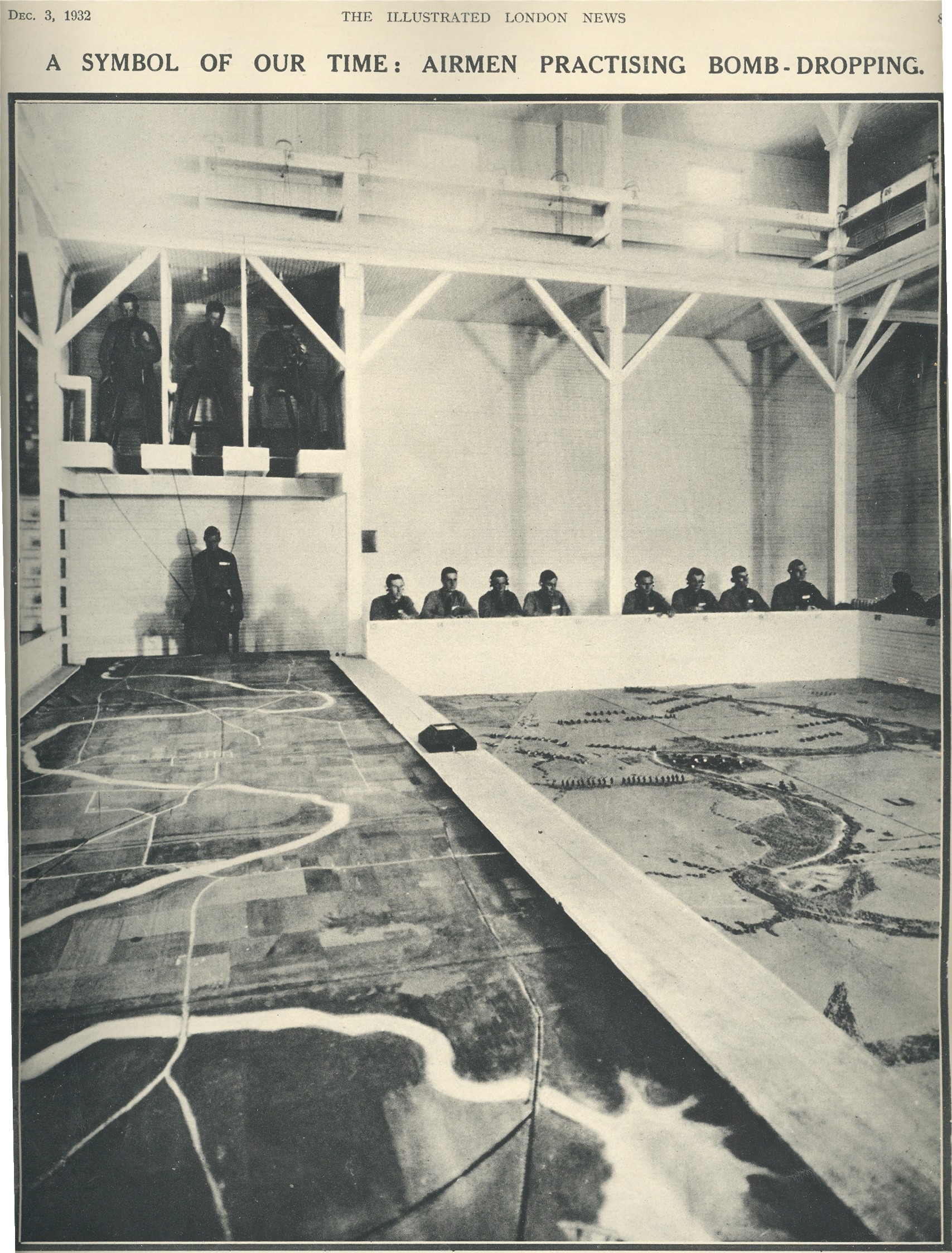
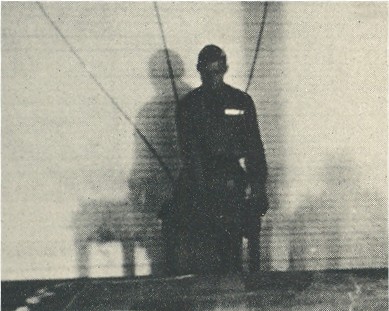
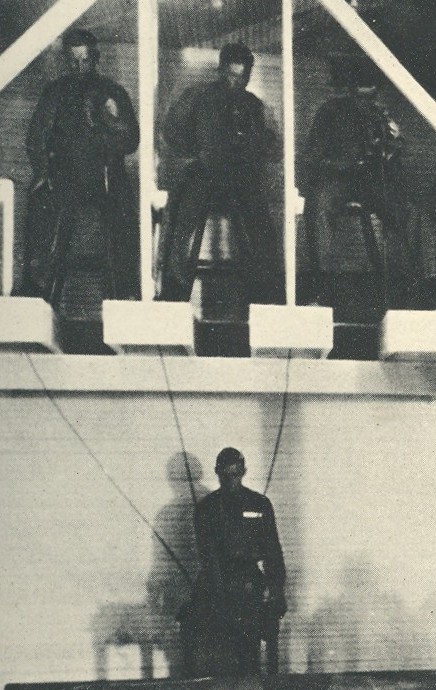
    The thread of thinking about all of this came to mind looking at this image of a bombing instruction room for aviation in England in 1932.  The image is also a great one; the aviator at far left looks like a marionette; the three men above responding to his piloting maneuvers as he concentrates on the endless panoramas of landforms that advances before him on a horizontal diorama.  It is a fabulous analog flight simulator constructed at a time of great change in aviation

    Wonder stories

    1932 is also the year of the publication of Carl W. Spohr’s classic future-vision/speculative fiction apocalyptic-atom bomb end-of-the-world two-parter (so many hyphens!) that appeared in Wonder Stories.2 The story begins with a relatively simple series of catastrophic bombings that lead to a sort of détente, a kind of mutually assured destruction, which is then upset when the combatants discover and construct the atomic bomb.   MAD breaks down, and the ensuing massive exchanges result in a  devastated world.   Pretty prescient stuff, all-in-all, even so far as the policy goes—especially so when you wrap this sci-fi story around the elements of 1932—Chadwick, Anderson, Joliot-Curie—that made all of this stuff possible just 13 years later.

    Notes

    1 The Joliot-Curie discovery was called “one of the most important discoveries of the century… the consequences of the discovery of artificial radioactivity are immense” from Segrè, From X-rays to Quarks, 198-199).  

    2.  Part one appeared in the March issue, which also carried stories like“Red April, 1965” by Frank K. Kelly; “The Eternal World” by Clark Ashton Smith; “Waves of Compulsion” by Raymond Gallun; “Mutiny on Mercury” by Clifford D. Simak; “The Time Stream” by John Taine (Eric Temple Bell), and others.  Pretty good bumper crop of sci-fi writers in itself.


  • TomorrowVision: U-235, Project Orion, and City-Sized Space Ships, 1941-1968 (+)

    JF Ptak Science Books Post 943

    “One conversation centered on the ever accelerating progress of technology and changes in the mode of human life, which gives the appearance of approaching some essential singularity in the history of the race beyond which human affairs, as we know them, could not continue.”— Stanislaw Ulam, May 1958, referring to a conversation with John von Neumann  [Ulam, S., “Tribute to John von Neumann”, Bulletin of the American Mathematical Society, vol 64, number 3, part 2, May 1958, pp 1−49.]  This is also said to be the first use of the term “singularity”, referring to the sometime-in-the-future point where artificial intelligence reaches such a level as to create a race of super-intelligent artificially-enhanced human beings.

    In the history of perfect tomorrows, what happens to people when we no longer die, or live to enormous ages, or replicate necessary organs to such a degree that cell death is no longer an issue, or are just able to get rid our biological corpus and live in something else?

    6--crowded earth


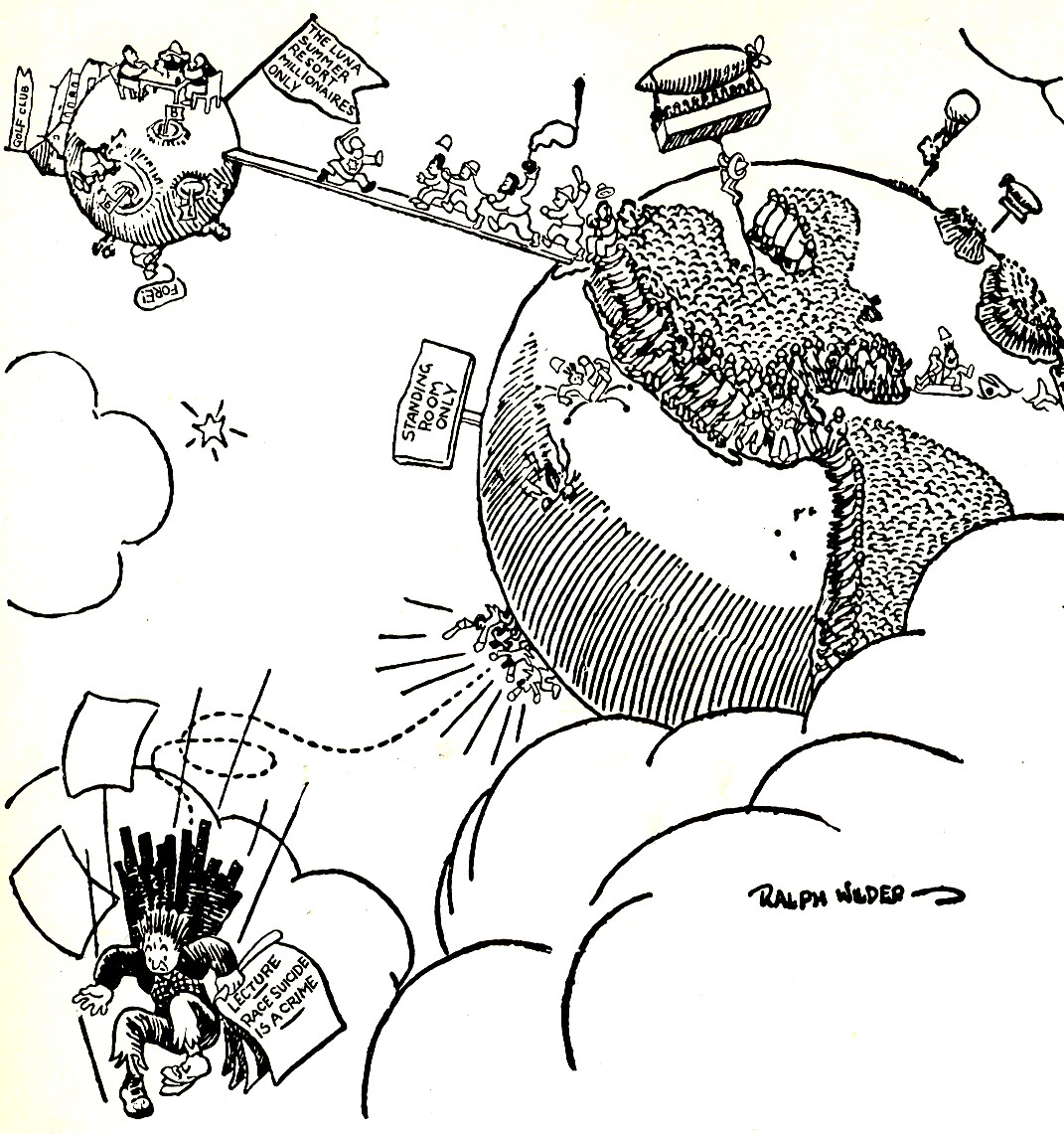
    I can’t tell when the first references start to appear in literature, scientific or otherwise, regarding the sustainability of the population of the Earth, or of simply filling up the Earth, for that matter. This cartoon (above) by Ralph Wilder, published ca. 1915 (source unknown, unfortunately), may well be in the first wave of what must have seemed at the time to be absurd speculation.

    It is impossible for me to imagine what the future of medicine and medical technology may hold for all/some of us in the next 150 years.  I chose this number as it gets us back to one of the greatest advancements in the history of surgery—sterilizing instruments and keeping the surgical room clean. 


    This is the work of Dr. Joseph Lister (remember badly via a popular consumable) who in one fell swoop (and over the course of several years) brought the survivability rate for all surgeries up by half or so, an extraordinary feat, and only four generations old.  It is less than 400 years ago that William Harvey figured out pulmonary circulation and paid hell for it for many years.  To imagine the obverse, the medical advances that will occur in 2400 may be as foreign to educated us here in 2010 as 2010 looked to William Harvey in 1628 or Joseph Lister in 1863.  DNA is only a few years older than me (discovered in 1953), and even though its discovery may seem antiqued at this point, the technologies and understanding initiated by that discovery may look as quaintly fundamental to those in 2150 as the necessity of having a clean surgical environment looks to us. 

    6--crowded earthdet

    And who knows how advancements may spiral ahead of themselves once intelligent machines start producing machines that are more intelligent than themselves leading to god-knows-what.

    But back to the cartoon, and the mathematician Stan Ulam, who is really at the base of this post.  The image depicts the Moon as an escape pod for those who could afford it, the signs suggesting that money would determine who had space to lie and who didn’t.  Of course, there was the problem of actually getting there, which in 1915 or thereabouts was still science fantasy (being twelve years after the Wrights and four years before Goddard).6--u-235 space ship

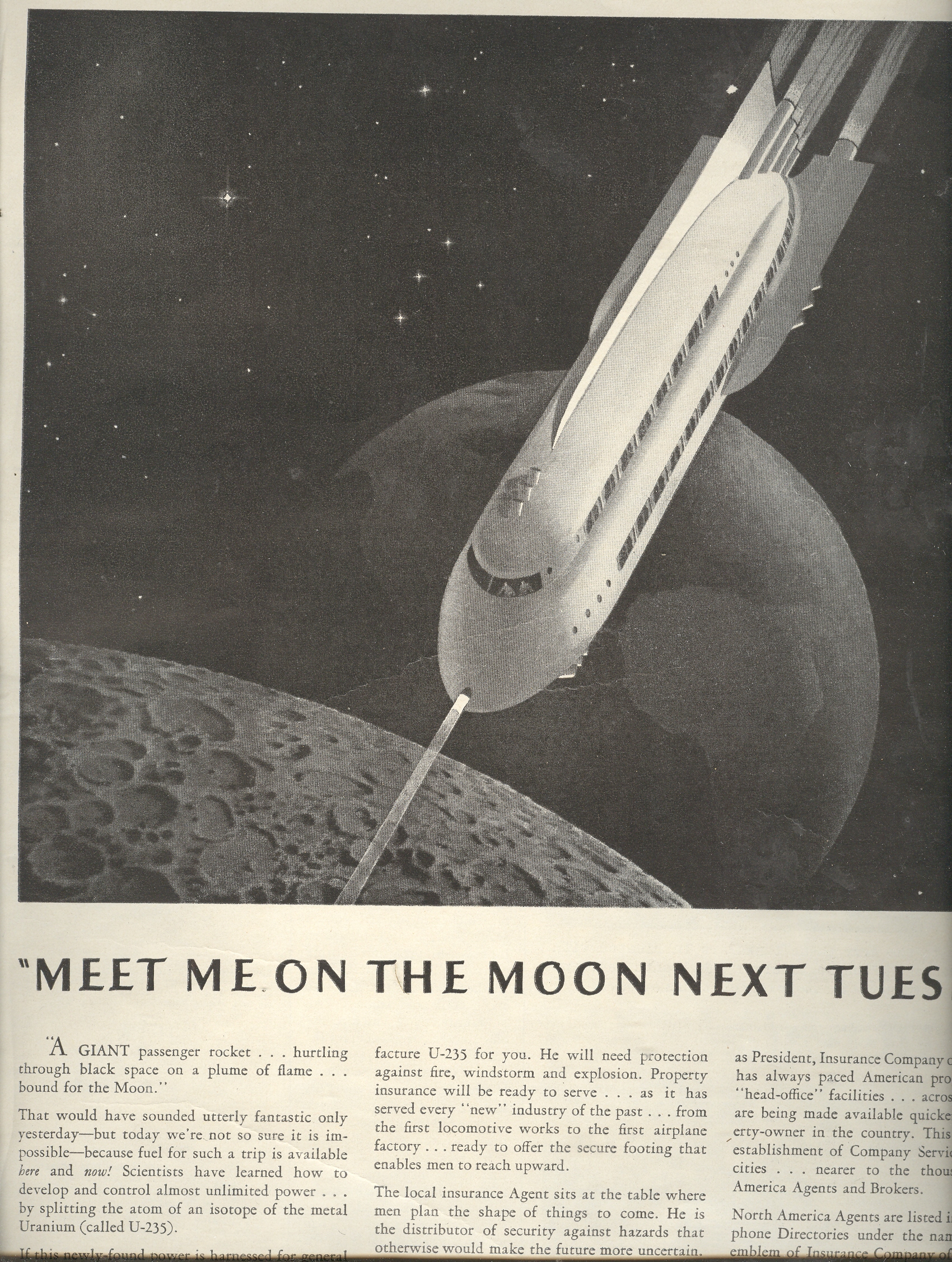
    The second image, from LIFE magazine in 1941, shows a rather massive space vehicle powered by U-235. Discovered by Arthur Jeffrey Dempster in 1935, U-235 was a fissile material capable of sustaining a fission chain reaction. (Dempster, 1886-1950, was a Chicago Ph.D. who during the war would be the Chief Physicist of the great Metallurgical Lab at Chicago, from 1943 to 1946.) The ad (for an insurance firm) shows the ship being powered by what would be a series of nuclear explosions—quite a remarkable thing to be printing in a mass market periodical in the second year of WWII. As it turns out the Physical Review was still publishing sensitive articles on these topics ‘till right about this point, after which their appearances were suspended for the duration of the war. 

    And as it turns out the thinking here was prescient.  It was Stan Ulam who first suggested this use of atomic energy in 1947; and it was Freeman Dyson and others who (beginning in 1958)  took this many steps further with Project Orion.  In short, this project was a think-sink for a pulsed nuclear propulsion system for a class of space vehicle that would range in (three) sizes from 8,000 tons to an incredible, space-insatiable 8 million tons. 

    Yes, that’s 8 million tons.  That was for a city-sized space ship with a diameter of 400 metres and which could travel at 20,000-30,000 m/s with meganewton thrust, being pushed along by series of nuclear explosions, carrying fantastic payloads and enabling the construction of vast structures on, well, other places. 

    I don’t know how the thing would get off the ground.  Evidently this was not an issue, for even in the late 1980’s drawings and plans for this monstrous ark were still being published. But even as I write this I wonder if my own incredulity with the possibility of such travel will be seen incredulous to folks just a few generations down the road.  I suppose this is just another small stop in the history of the time it takes for absurd ideas to look not so.


  • Bombing New York City with Women, Meteorites, Nazi Amerika Bombers and Atomic Weapons

    JF Ptak Science Book LLC  Post 941

    Having just finished a post here on missing and duplicated-in-outer-space New York Cities, we return to the more grim possibilities of pre-Cold War cityicide.

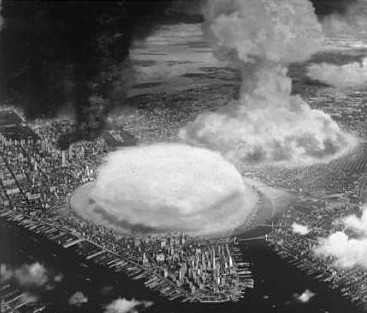
    I haven’t seen very many images at all of NYC under attack, and this one from nuclear attack on NYC from Collier’s Magazine (1948) is fantastically poignant, showing perhaps three ground-bursts of atomic bombs in Manhattan and Brooklyn.  At the time, 1948, the Soviets had just developed their bomb and I think had no way of getting one here.  But this didn’t speak to the future, and my guiess is that Collier’s was just taking it a little easy with the popular reading clientelle.  I can’t remember now how many weapons would’ve been targeted at NYC by the mid-1950’s, but I know it wasn’t a simple dozen.

    Atomic nyc

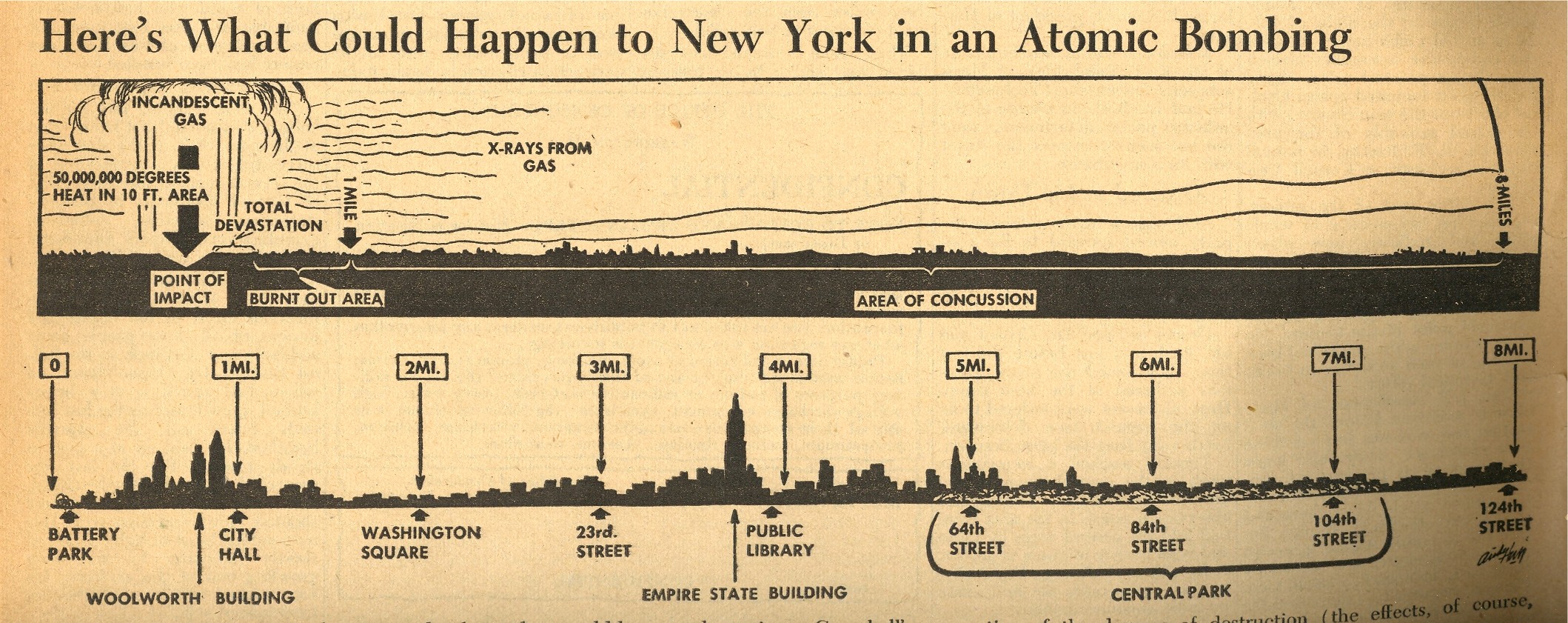
    A lateral view of this sort of explosion in Manhattan was presented in an extraordinary issue of the liberal PM Magazine, issued with a 7 August 1945 date (though I think it came out a few days later).  This would have been just a day after the Hiroshima bombing, and the 12 pages of dedicated coverage t the atomic bomb was really quite spectacular.  Included is the following small graphic that appeared on page seven which shows what effect the Hiroshima atomic bomb would have if dropped on New York City—it was no
    doubt gigantically sobering to anyone who looked at it, and brought the power of
    the bomb and its destruction to a common, understandable point. 
    I’m not an historian of the first newspaper coverage of the bomb, but
    it strikes me that this may well be the first graphic to depict the
    effects of an atomic bomb exploded over NYC.

    ==Blog July 26=PM cvr bomb map

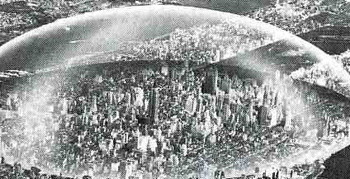
    Seeing the Collier’s pictures makes it that much more difficult to think about the idea of Buckminster Fuller that would help rid ourselves of radiation anxiety (which I wrote about earlier, here).
    Fuller’s idea is multiple orders of magnitude removed from the
    original idea of the arcade, constructing a dome1 to encapsulate NYC
    from the East River to the Hudson along 42nd St, and from 64th to 22nd
    St:  that’s two miles in diameter and, plus a mile high (or about five
    Empire State Buildings pile one on top of the other).  I’m not so sure
    how this would be built, or how things would be heated or cooled, or
    what the construction material was for the skin of the dome, or how
    people get in and out, or how you deal with heating and cooling, or how
    any noxious chemicals are expelled—but Mr. Fuller thought that the
    savings alone from snow removal from NYC streets would pay for the dome
    in ten years. 
    Big_archfuller_detail141

    Mr. Fuller also thought that the dome would protect the city (or
    this part f the city) from radiation fallout.  That could be true,
    assuming that of all the hundreds of nuclear warheads that the Soviets
    would’ve launched against NYC alone none of them would’ve found their
    target, except perhaps for the Ridgways or Staten Island, where the
    shock wave or winds produced by ensuing firestorms would not have
    disturbed the dome.  Of course if a warhead actually came close—or
    actually hit—the dome, the protection from radiation would be moot. 

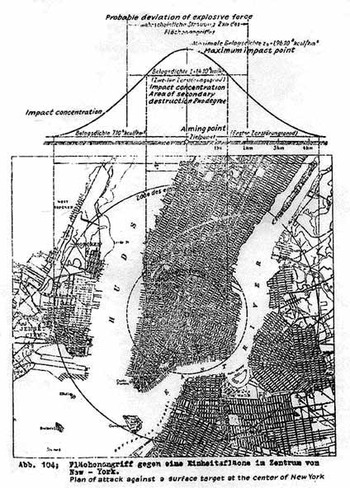
    Another odd and stomach-wrenching image comes from that devilish scamp Eugen Sanger (dead before he was fifty,
    1905-1964), a German rocket designer and engineer for the National
    Socialists, went to work for the French Air Ministry following the end
    of World War Two after doing his all and thankfully falling short for 
    the Reichsluftfahrtministerium (RLM, or “Reich Aviation Ministry”).
    Manhattan_bombed_4

      He
    worked without rancor there until he was nearly kidnapped by Joe
    Stalin—for the purpose I suppose of continuing work on what may have
    been his greatest effort, unfulfilled during the war years—the Amerika
    Bomber.  The Soviets evidently thought that this might come in handy in
    1947.

    The Sänger Amerika Bomber (or Orbital Bomber, Antipodal Bomber or
    Atmosphere Skipper) was designed for supersonic, stratospheric flight,
    and had much more bang for the buck than the V2 (10000 feet/second
    exhaust velocity, as compared to the later V-2 rocket’s 2000
    meters/second, 6560 feet/second) and since it was stratospheric had a
    far greater range, coming in at better than 14,000 miles.  The
    22,000-pound weapon carried one large 8000-pound free-falling bomb.

    Sanger’s idea in the early 1940’s was to get this bomb to around
    Times Square. And since the Amerika Bomber was a relatively inexpensive
    weapon compared to the damage it could cause, there was room for
    producing a lot of them.

    Seeing Manhattan in the cross hairs like this is quite sobering, and it is an image that is rarely made.

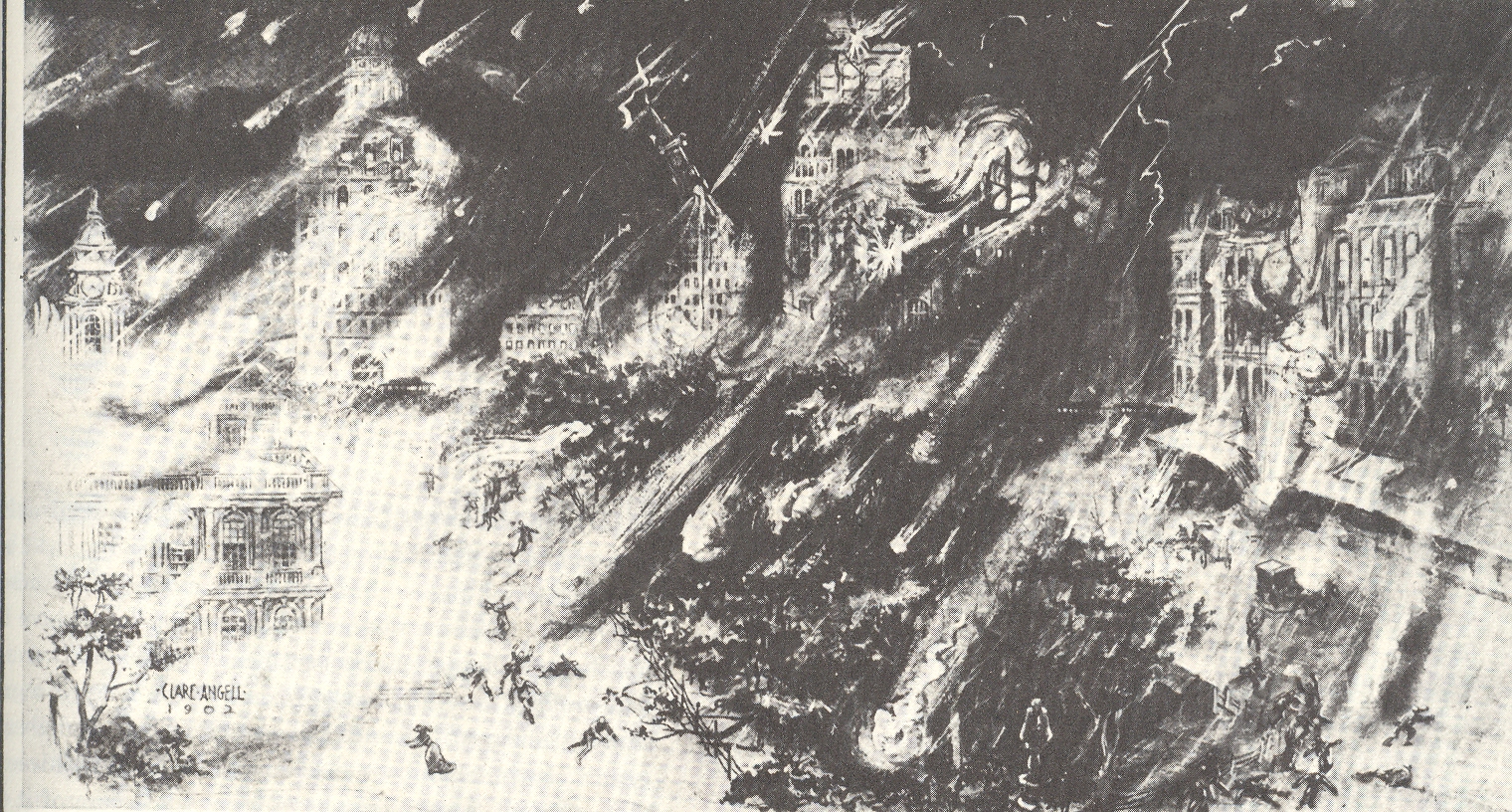
    Another attack on Manhattan depicted here comes from above, way above, Manhattan decimated by a meteorite “shower” of enormous magnitude. The image appears in an article by Hudson Maxim (1853-1927, brother of the 5--meteor more famous Hiram) “How the World Will End”, printed in 1910, and shows dozens of small meteorites striking NYC in the City Hall area. 

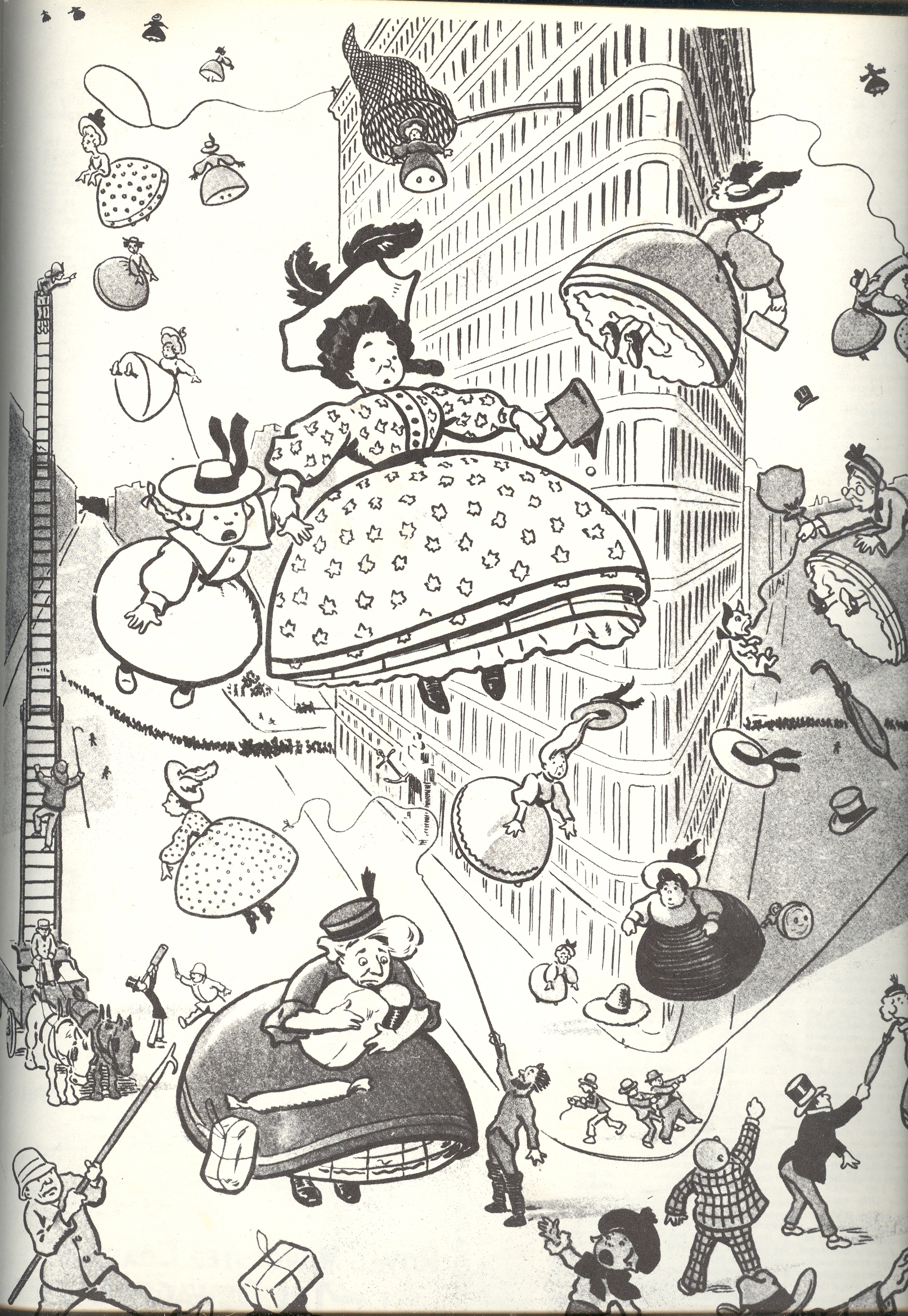
    The last image comes from 1904 and–when taken out of context–it seems
    as though Manhattan is in for the worst of it, with a view in front of
    the Flat Iron Building of an aerial bombardment of women.  This is
    probably one of the few bad things that weren’t done with/at women, and
    would actually predate the first use of explosives being dropped from
    aircraft.  Unfortunately the original, intended image was a poke at  crinoline ,
    and featured women being blown up into the air rather than the other
    way around, though I like my interpretation better.

    5-women

    Notes:

    (Source:  Buckminster Fuller in Think magazine, vol 34, Jan/Feb 1968.  AND of course the lovely work by Alison and Sky Michele Stone, Unbuilt America, McGraw Hill, 1976, pg. 99.)


  • Bad Grandeur: Predicting Post-Nuke USA (1966) and the Loss of 76% of all Authors

    JF Ptak Science Books LLC  Post 932Abomb-cvr

    [Part of the Atomic and Nuclear Weapons series.]

    I
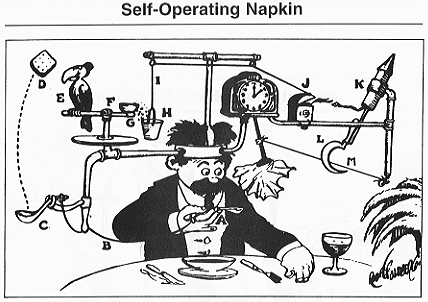
    think no plumb line was ever so worked with pulleys and wheels, strings and
    catclaws and other Rube Goldberg devices as were the demographic studies of
    nuclear warfare.  It is as though their
    compass rose had no compass, with everything centered on the center, no way
    out, no way in. just there.  A faceless
    clock face describing “G-2 o’clock” whenever it pleased.  These studies seem to me the nuclear warfare
    equivalent of the Bellman’s map (described earlier in this blog as the most
    perfect map ever constructed): a pretty polygon describing a totally blank
    surface.

    Atomic goldberg

    I
    have a number of these things here, some of which are restricted-distribution
    publications, works of statistical fancy/fantasy meant for other eyes in the
    same community dedicated to the fancies described, a tautological audience for
    self-referential.

    One
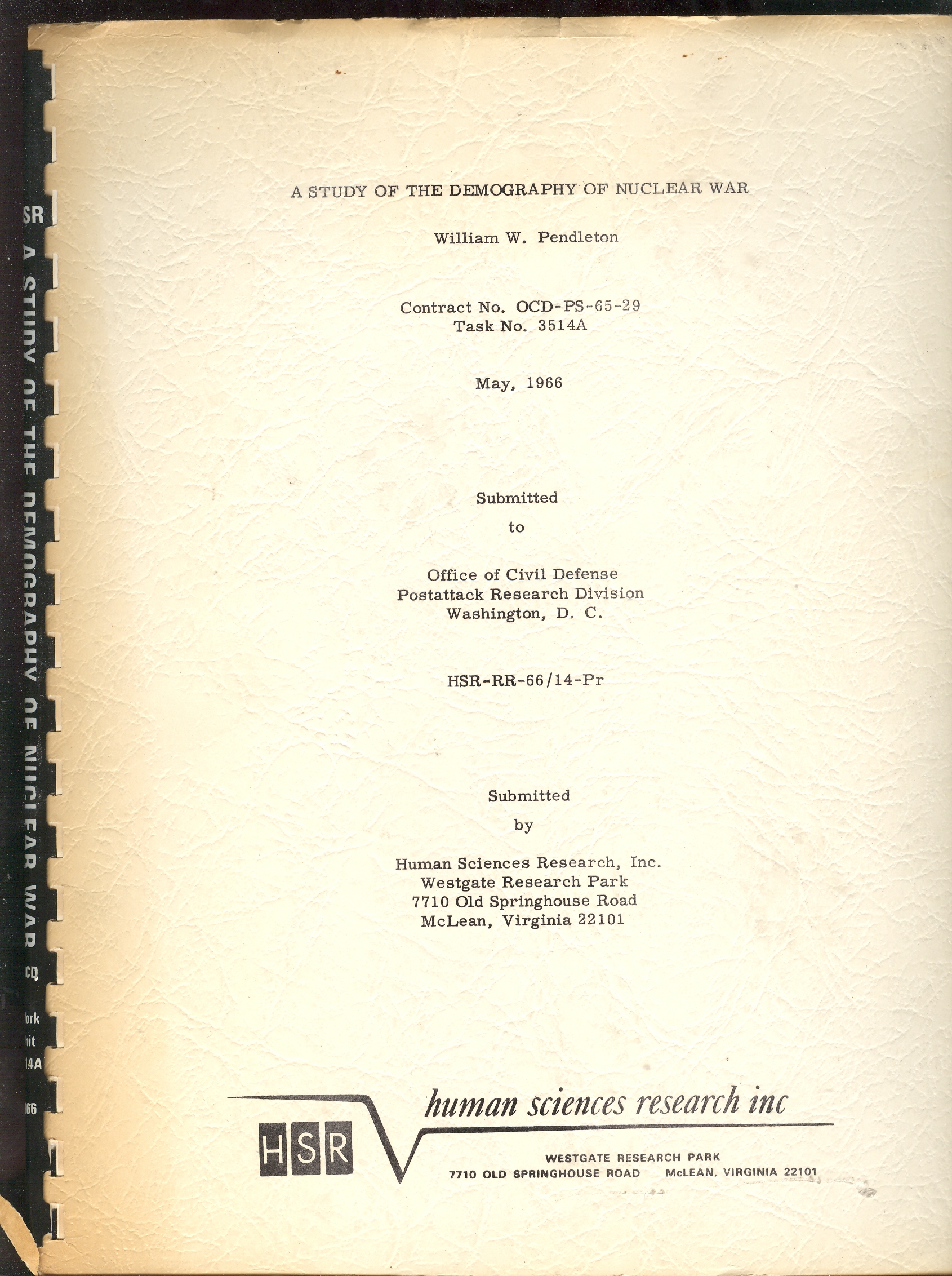
    such bit, plucked from this pile is William W. Pendleton’s A Study of the
    Demography of Nuclear War
    produced by “Human Sciences Research, Inc.” Outside
    of its statistical foray in survivability and the procreative prospects of the
    left-overs of vast nuclear exchanges, the work is a solemn attempt at
    institutionalizing the death requirements of nuclear combat.  The necessity of overwhelming carnage is
    presented in ironic and underwhelming language, the first bits of which are
    seen in the conclusion of pamphlet’s abstract1:

    “Cities differ in the kinds and magnitudes of
    change to which they might be subjected
    . Considerable variation in the demography
    of surviving populations can be expected; that variation would be related to
    policy decisions; and those decisions should therefore be examined for their
    demographic implications.” [Emphasis mine.]

    Put
    another way, the city is the main focus of the survivability equations, and the
    chances of the humans being bombed in those cities would change with—god help
    us—the amount of bombing.

    Cities differ in the kinds and magnitudes of
    change to which they might be subjected
    .

    This
    is the key I think to understanding documents like this, making a simple
    foundation statement so convoluted and tortured that it and most of what
    follows make any sense outside of restating themselves. Which I guess is a
    strength.Abomb-conclu 1

    Back
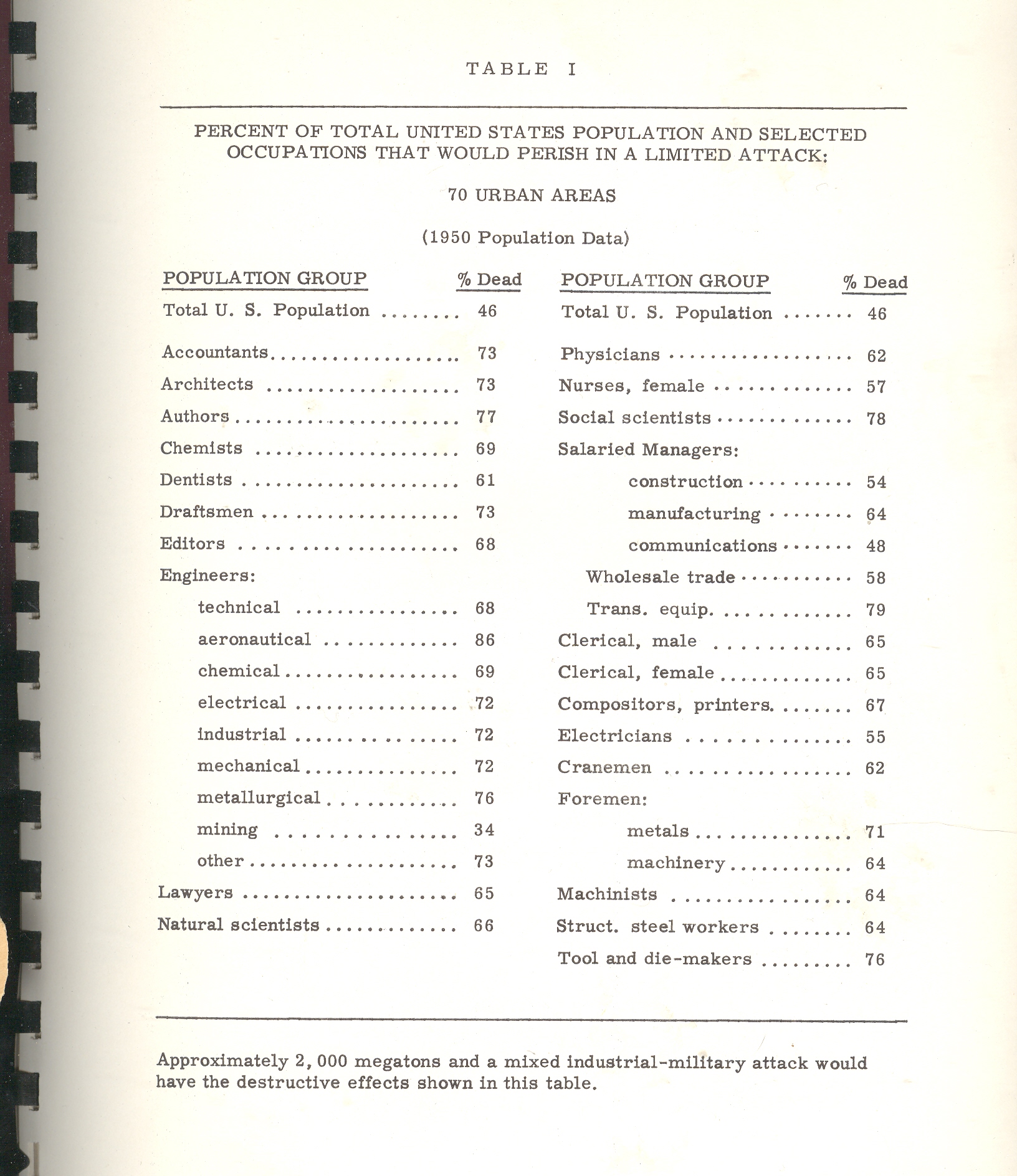
    to the pamphlet and the interesting table that attracted my attention.  According to one study [and for the sake of
    brevity I’m not going to describe the scenarios or data estimation methods and
    so on] the U.S. would suffer 46% casualties [meaning immediate deaths and not
    as a result of radiation or illness or starvation or the encyclopedia of
    whatever that would lead to death somewhere down the road].  The resulting demographic of the “perished”
    by job description postulates that the most-killed category of worker would be:
    (#1) aeronautical engineers, 86% dead; (#2) transportation equipment salaried
    manager, with 79% killed; (#3), social scientists, with 78% of them going down
    with their clients; (#4), authors, with 76% gone.

    Abomb-casualties2

    Authors?  Of what, I wonder?  The good ones with the bad?  Are authors different from writers?  And what do you call folks who produce tv
    shows?  Since the stats here are for 70
    cities there’s no wonder that there aren’t any farmers in this table, as the
    majority target areas (some 450 cities cited elsewhere as targetable, including
    my own little burgh of Asheville,
    N.C.
    ) would naturally have city
    folk in them.  And so I’m guessing that
    three-quarters of all “authors” in 1960/6 were living in these target cities
    and were going to go up in smoke.  The
    aeronautical engineers category is more understandable as every one of those
    industries employing 50 or more people would be a target; frankly I’m surprised
    that given the possible firepower of the Soviet Union
    in 1966 that 14% would survive; I’d guess offhand that the number would be
    2%. 

    Abomb-conclu 2
    Even
    though this stuff is spread out in only 98 pages or so it would keep a person
    busy segregating the Orwellian gems from those not; it would be a tricky
    business as most of the “text” in the “not” category would be largely limited
    to prepositions. 

    Here’s
    another bit:  a parenthetic poke at the
    post-attack composition of Congress. It is stated that the “postattack”
    (hyphenated no longer) Congress would be “quite different”.It would also be (“in
    their eyes”) “more Conservative than the pre-attack (hyphenated!)  Congress. 
    It isn’t a cause for great prognosticational (?) liberty to assume that
    the Congress might be more Conservative, but why on Earth did the author
    qualify the assumption by saying “their eyes”? 
    Pish and posh.

    The
    paper goes on its merry way, connecting the necessaries of Goldbergian delight,
    and somehow nothing ever happened, which to me is a secret miracle.  Especially given the weight of papers like
    this one, which seems to medicate the effects of war, assuming that there will
    be a Congress and that people will report back to work once the factories are
    rebuilt and that there will be more segregation in the colossal world of post-attack
    America, and on and on into the red dawn. 


    Mr.
    Mencken’s view of Warren Harding comes to mind when I read this stuff and
    wonder about how it was that we didn’t blow the whole place up:

    “I
    rise to pay my small tribute to Dr. Harding. Setting aside a college professor
    or two and a half dozen dipsomaniacal newspaper reporters, he takes the first
    place in my Valhalla of literati. That is to
    say, he writes the worst English that I have ever encountered. It reminds me of
    a string of wet sponges; it reminds me of tattered washing on the line; it
    reminds me of stale bean soup, of college yells, of dogs barking idiotically
    through endless nights. It is so bad that a sort of grandeur creeps into it. It
    drags itself out of the dark abysm of pish, and crawls insanely up to the
    topmost pinnacle of posh. It is rumble and bumble. It is flap and doodle. It is
    balder and dash.”

    Notes

    1. The
    abstract from the above paper: “The basic problem with which this report
    is concerned is that of determining the kinds of demographic change that might
    result from a range of nuclear attacks, ascertaining the effects of those
    changes on the future of the surviving populations, and indicating possible
    areas for Civil Defense action and planning. Earlier studies of the demography
    of nuclear war were examined and their relevant conclusions and methodology
    incorporated in the report. A different methodology–expected to be more
    sensitive to compositional effects–was then designed. The new methodology was
    tested and found to be more effective than the old. Surviving populations
    representing a wide range of variation in attack conditions were created on the
    basis of both old and new methodologies, and the demographic significance of
    these populations was examined. Assuming a range of post-attack demographic
    conditions, a series of projections was made on the surviving populations. The
    demographic significance of the recovering populations was then examined. On
    the basis of the analysis a series of recommendations relevant to Civil Defense
    planning was made: Within the framework of this analysis the crucial variable
    is the demographic pattern of the city. Changes in composition, as well as
    size, could be of substantial magnitude and would last for generations in some
    cases. Cities differ in the kinds and magnitudes of change to which they might
    be subjected. Considerable variation in the demography of surviving populations
    can be expected; that variation would be related to policy decisions; and those
    decisions should therefore be examined for their demographic implications.”


  • Ueber-Spectacular Understatement Dept.: the Happy Post-Apocalyptic America and the “Awakwardness” of Holocaust, 1962

    JF Ptak Science Books LLC  Post 829  Blog Bookstore

    Self- and purposefully-deceptive belief in spectacular
    and unsupportable scenarios espoused by governmental leaders which affect the
    lives of hundreds of millions of people deserve their own Dante-esque categorization:  and that’s one that I haven’t come up with
    yet.  
    This post is one of a continuing thread on the history of atomic weapons.

    I wonder how it was that we humans didn’t blow ourselves
    into melty dissolving bits during the Cold War. 
    Somehow all of those thousands of megatons of disastrously radioactive
    explosives that were completely and reliably deliverable didn’t get
    launched—not even by accident, not even during all of those hot itchy-finger
    DEFCON 2
    situations.  Did MAD (Mutually Assured Destruction )
    actually work?  Did the attempt at making
    a winnable nuclear confrontation keep people from actually trying to do
    so?  Did the overwhelming and insane
    buildup of weaponry actually have so much enormous and foul intellectual weight
    that no one could actually make the decision to use the weapons for fear of
    snuffing out all human life? 


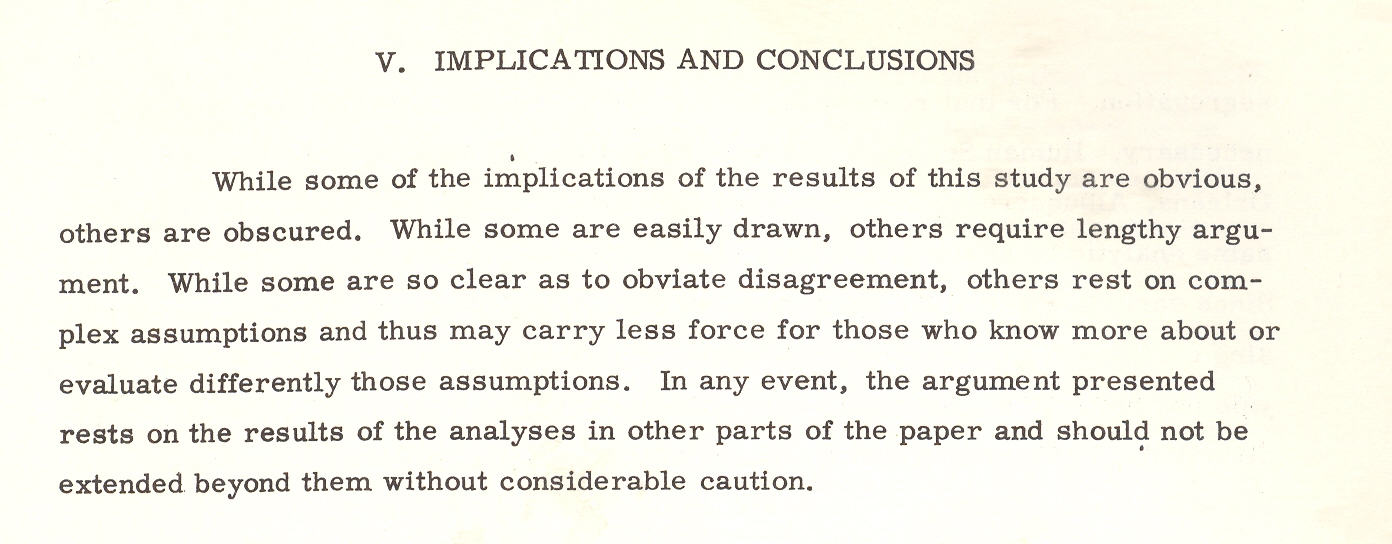
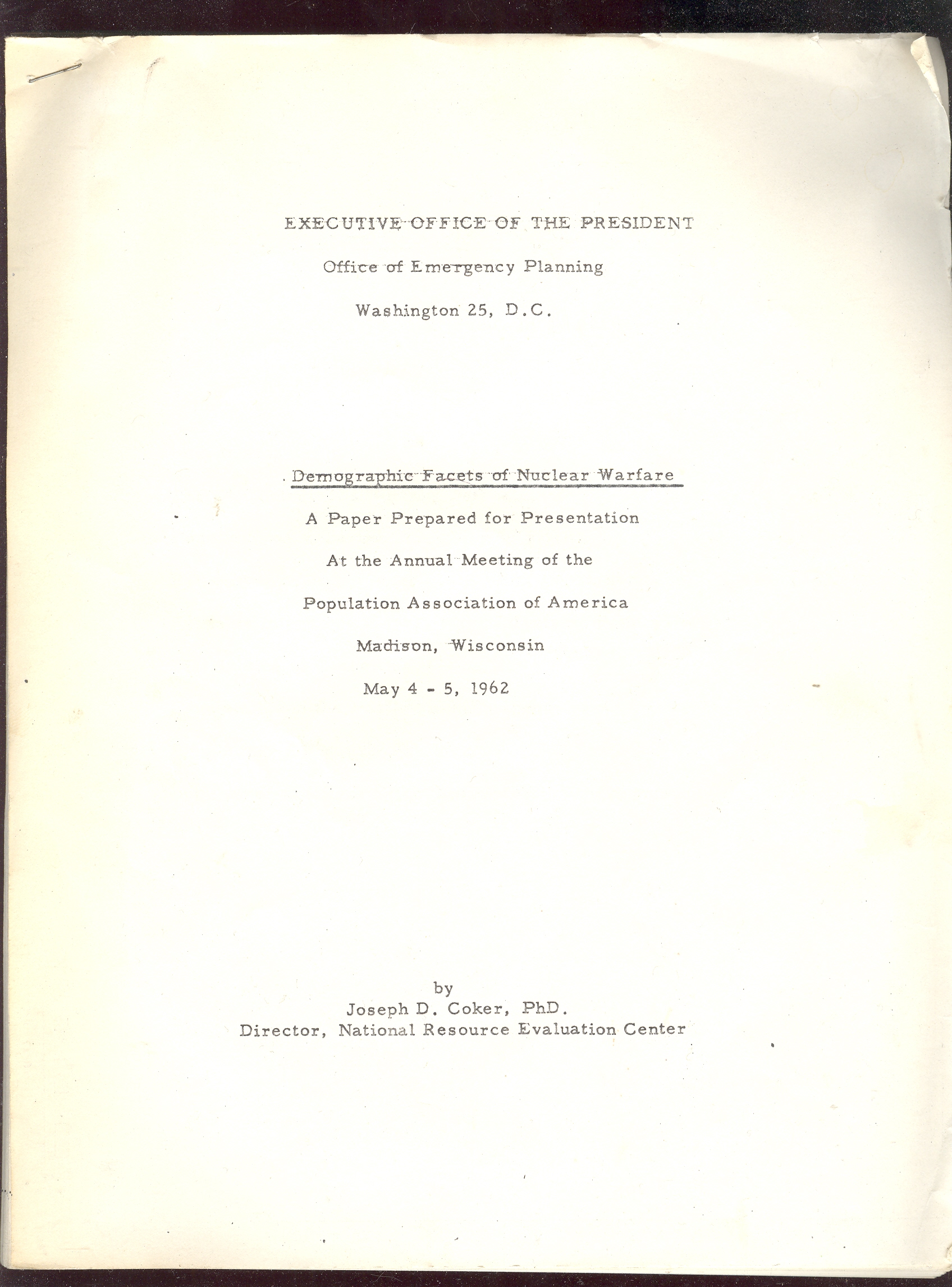
    Here’s an embarrassingly shining case in point:  Dr. Joseph D. Coker’s paper to the Population
    Association of America representing the thinking of the Office of Emergency
    Planning and the Executive Branch in general, which freely discussed the survivability
    of the United States
    following even a post-massive nuclear exchange. Dr.
    Coker was the director of the National
    Resource Evaluation
    Center, which tried mightily to figure
    out how/where /what/how the essential ‘stuff” of America could be saved/stored/allocated
    after the end of the world.  Actually,
    Dr. Coker said that the big attack wouldn’t be the end of the world, so we needed
    to plan for surviving.

    ++ blog nov 11 coker tp

     A few cases in point, some of which, I must warn you, are
    breathtaking and Strangelovian in their myopia: 

    Since Dr. Coker was addressing the Population Studies people, he
    related much of what he had to say (regarding national resources) to the
    American people.  He found that millions
    of people could be saved if they built a blast shelter (not a fallout shelter)
    that was covered with mounds of heavy material and outfitted for an extended
    stay of two to 22 days.  The unfortunate
    part of this scenario, Coker says, is that these shelters work best when 10
    miles or more away from a detonation zone. 
    And since these zones were all over the country targeted by thousands of
    warheads, very few people (especially in cities) would be outside the 10-mile
    ring, which made the blast shelter basically useless. 


    Coker notes that if an attack of 1000 megatons
    [a limited exchange] was aimed exclusively at U.S.air bases, “total fatalities
    will approximate 10% of the U.S.
    population”.  If this attack was aimed at
    population centers rather than the air bases, it would kill 40% of the
    population. A 5,000 megaton attack on air bases would produce 50% overall
    fatalities in the U.S.;
    if that amount was centered on large populations, the number would jump to 80%
    of the population.  10,000 megatons would
    yield 75% and 95%, respectively.  “A
    50,000 megaton attack would kill almost all U.S. citizens under either
    targeting assumption”.  These figures
    didn’t include radiation deaths.

    A big variable here not controlled for was the distribution
    of population at the time of attack.  The
    numbers that were used were compiled by the census and counted folks who would
    be at home.  So, the numbers above worked
    if and only if the Soviets attacked after dinner when everyone was at home for
    the night.  Since it would make sense to
    attack when people were at work at their industry or job or whatever during the
    day—thus maximizing the effect of the bomb—the casualties would actually be higher.

    And what does that mean? 
    Dr. Coker relates this gem (on page 21): “The post-attack labor force
    available thirty days after the attack probably will represent a significantly
    lower fraction of the population than does the preattack labor force….” And
    this: “A nuclear attack can be expected to alter the occupational composition
    of the labor force.” 

    This sort of thinking overtakes the factual aspects of
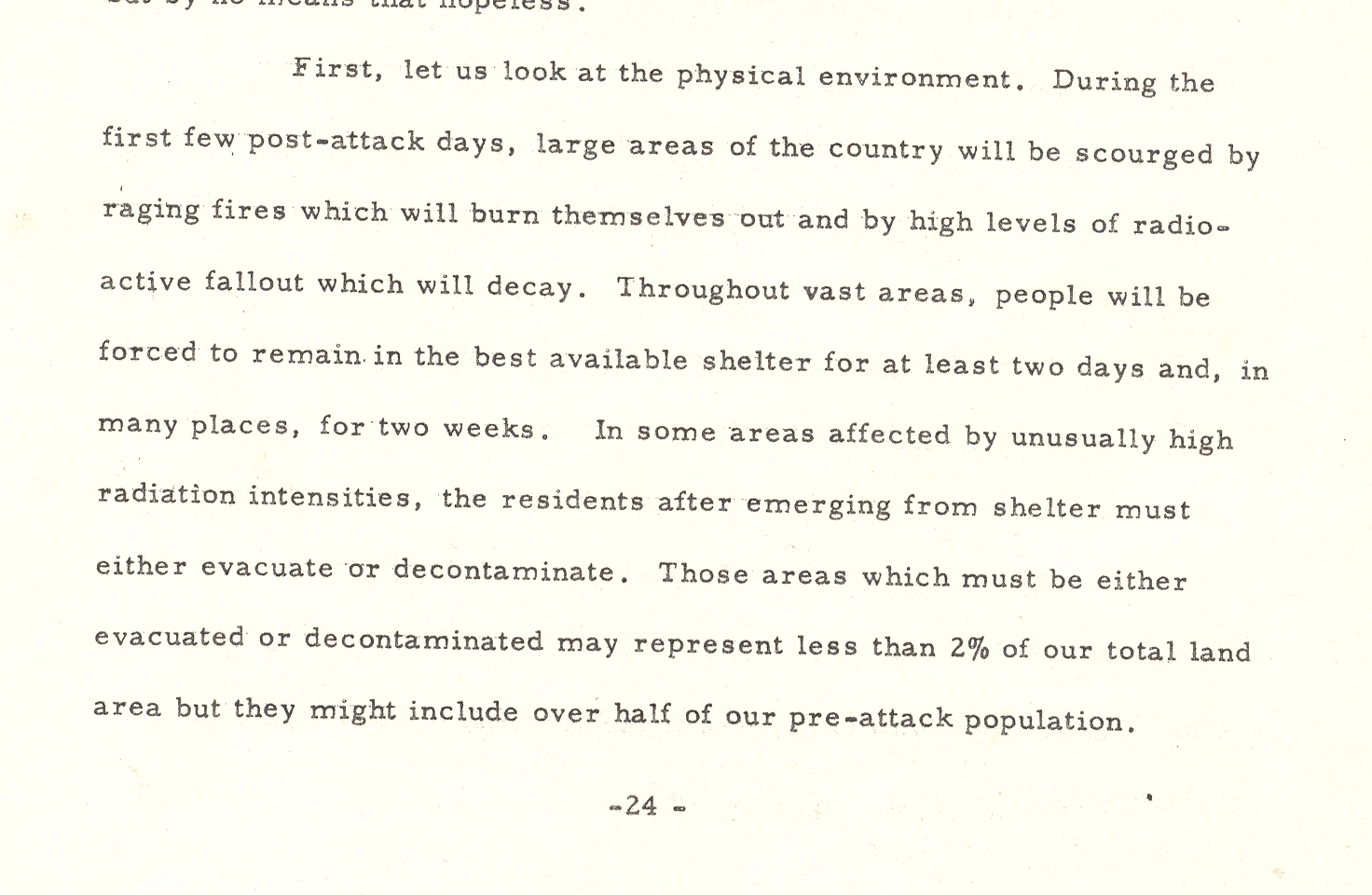
    massive attack, with Coker stating on page 24 “I wish to say  emphatically that it [post-attack America] will
    not be anything like that depicted in Neville Shute’s On the Beach.  It will be bad enough, but not that
    hopeless.”

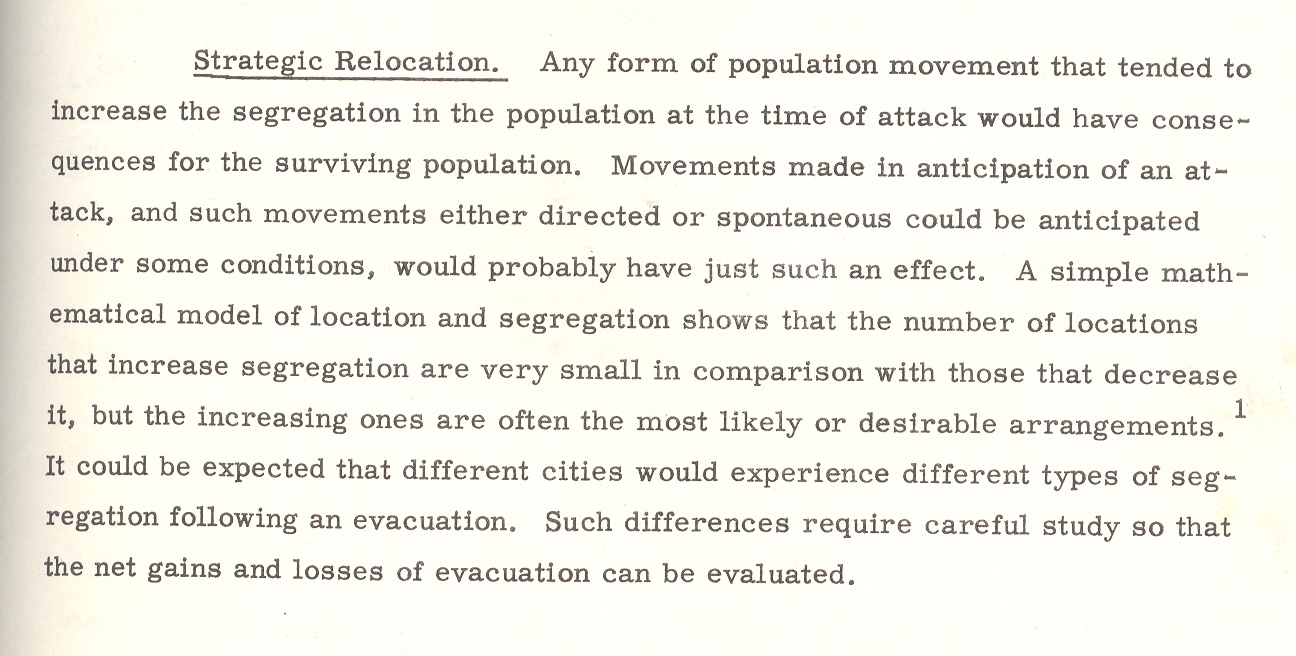
    ++ blog nov 11 coker pg 24


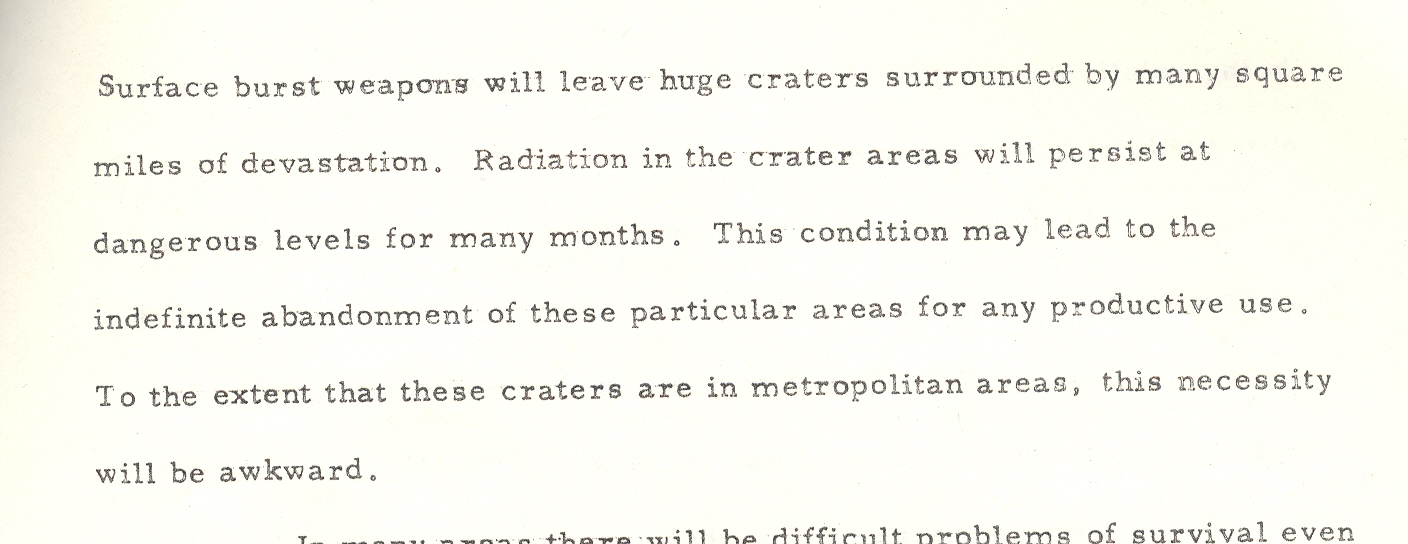
    And this absolutely incredible/horrendous and perhaps worst-use-ever
    of the word “awkward”:


     ++ blog nov 11 coker pg 25

    For the love of King Neptune’s Pants:  Awkward? 
    How in the name of _______ could someone in such a high position and
    authority relate massive attacks on every major American population center
    which would cover the area in fire and thousands of gigantic highly radioactive
    craters in which a city used to exist be called “awkward”?  How great a sin was this, to influence
    opinion on holocaust via pathetic and unreasonable means?

    And then this, on the survivability of our governmental and
    economic institutions:

    “The post attack institutional environment will depend on
    the continuity, resourcefulness and general effectiveness of our leadership and
    the survival and resilience of pre-attack institutions…”

    Hm?  The post-attack
    institutions will depend on themselves?

    This of course is followed by a major plug for Dr. Coker’s own
    work, because the preparations undertaken by the NREC will directly affect the
    survivability of post-attack America.  So don’t stop the funding.  “The more complete and realistic our
    preattack [sic] planning and preparations have been and the more effectively
    the government is at all levels in inspiring and retaining the confidence and
    support of the population, the less drastic institutional changes will
    be.”  So it is the mealy aspect of
    inspiration that will direct the survivability of whatever it is that makes America
    so. 

    I should point out that Coker’s use of “post attack” and
    “pre attack” appear as two words, one word and a hyphenated word, depending on
    nothing. This is only a forty-page document.

    Another nugget on the post-Armageddon future on the
    distribution of wealth, mostly hinging on blast shelters:  “Per capita wealth in material terms may or
    may not be reduced by attack.”  There
    will be a relatively proportional number of 
    people who emerge from the smoking holes to staff surviving industry,
    and so per capita wealth will stay about
    the same.
       If, on the other hand,
    people build more blast shelters, then the proportion of surviving workers to
    factories will increase, and “the surviving plant capacity will be spread more
    thinly among them”. It is left unstated, but what that means is that more successful implementation of blast
    shelters would mean a reduction in per capita wealth
    . Dr. Coker also
    forgets what he said earlier that the blast shelters really didn’t work unless
    they were more than ten miles from a target. 
    Considering that the industrial workers would be living close to, um,
    industry, they will no doubt be (in 1962) in a ten-mile radius to where the
    blast would be.  Then of course there
    would probably be more than one bomb, so the blast area would be more than a
    ten-mile circle, and so on and so forth.


    In the following paragraph, Dr. Coker somehow draws all
    manner of feel-good high-probables around him, encasing himself like a sandman
    in a thin layer of improbability, to come to the following conclusion:

    “…few of the analysts who have studied carefully these
    post-attack [sic] survival and recovery problems take any stock in the
    oft-repeated theory that the survivors will envy the dead.  On the contrary, after a very rough year or
    two, the surviving population, if it so
    chooses
    , can begin to enjoy the advantages of a social structure and a
    physical environment not so very different from those which prevailed before the
    attack
    .” [Emphasis mine.]

    This is an astonishing work of incredible deceit, and may be
    the worst quote of the lot.  But it is so
    difficult to choose between unacceptable bits of thinking like this, raking out the horrible from the terrible.

    Here’s another deceit that was absolutely better understood in 1962
    than the writer acknowledges:  “The
    long-term effects of radiation are subject to much less understanding and
    certainty than are the short term effects. 
    There is some evidence that increased radiation exposure results in
    reduced life expectancy and increased evidence of leukemia and various
    degenerative diseases…”  And this:  “Genetic effects are more
    controversial.”  Than what?! And this: “Studies
    of the Hiroshima and Nagasaki experience are said thus far
    to be inconclusive.”  Honestly this was
    very well understood in 1962, and statements like these were enormously
    irresponsible if the data were actually misunderstood and criminal if they weren’t.

    There are many more examples—I’d say actually that the
    entire paper was at the level of Apocalypse Fairy Tale—but I’d like to
    close with just one more, this one using another fanciful version of the
    possible post-nuclear future and another highly insulting euphemism.  On transportation:  “We hope in the near future to develop a
    family of network and transportation models to estimate capabilities to move
    surpluses into deficit areas in
    order to cover deficits during each time period and to support the use of more
    ambitious resource management techniques focussed [sic] on recovery problems.”  Aside from bad sentence structure and
    misspellings I could hardly imagine sitting through a presentation where a
    person thought this stolen undercooked tripe. 
    What we have arrived at here at the end of the paper is references to
    smoke-in-a-hole cities being “deficit areas”, and the successful removal of
    human consideration from the conversation—strange as Dr. Coker was addressing the
    Annual Meeting of the Population Association of America.  (I’d love to know what the association
    members thought of the talk afterwards.)

    And so what can we draw from the experience of knowing
    thinking like this?  Is it as sterile as
    it might seem, so distant from our experience? 
    The scenarios have changed, as have the leaders and delivery systems,
    but the insatiable stupidities have evolved and morphed  into our own time.  Its easy to raise our eyebrows now on the
    whole MAD approach and the writings of people like Dr. Coker.  The truth of the matter is that we have
    plenty of this sort of thinking going on right now, big head-waggers that will
    loom in our futures with the attached questions of “how could this have happened?”.  WMD is one of the many examples of this, a
    Big Lie that was repeated for years and which ultimately cost the lives of many
    thousands of people and a great perpetuator of the culture of fear.  President Bush
    drove that one into the ground and so far as I know still employs it when
    necessary, threatening listeners with fear of those three letters like they
    were a practice hand grenade.  (I recall
    that a far-right radio personality  filled with afterbirth
    blood and urine eyes said that he would resign his show “in a year” if WMD were not found in
    Iraq; that was five years ago, and of course he is still there, bloated and
    ponderous and mostly violently wrong as ever.) 
    The Savings and Loan debacle.  The
    deathly ambitious practices leading to our recent depression. 
    The billion malnourished and desperate children in the world.  And so on. The point is that there is no
    paucity of thinking displayed by Dr. Coker in the past, and there is definitely
    no lack of it right at this very moment.  The
    problem is seeing it for what it is in the present and to not have to wait for the future to get to the truth of the matter.

    [And how can I end this discussion without a bit more of Stanley Kubrick’s magnificent Dr. Strangelove.., who pointed out these absurdities better than,perhaps, anyone?]


    Ah, don’t fret! The ending is just below (and just when you are about to laugh (“Mein Fuhrer, I can WALK” the other and last shoe drops.).


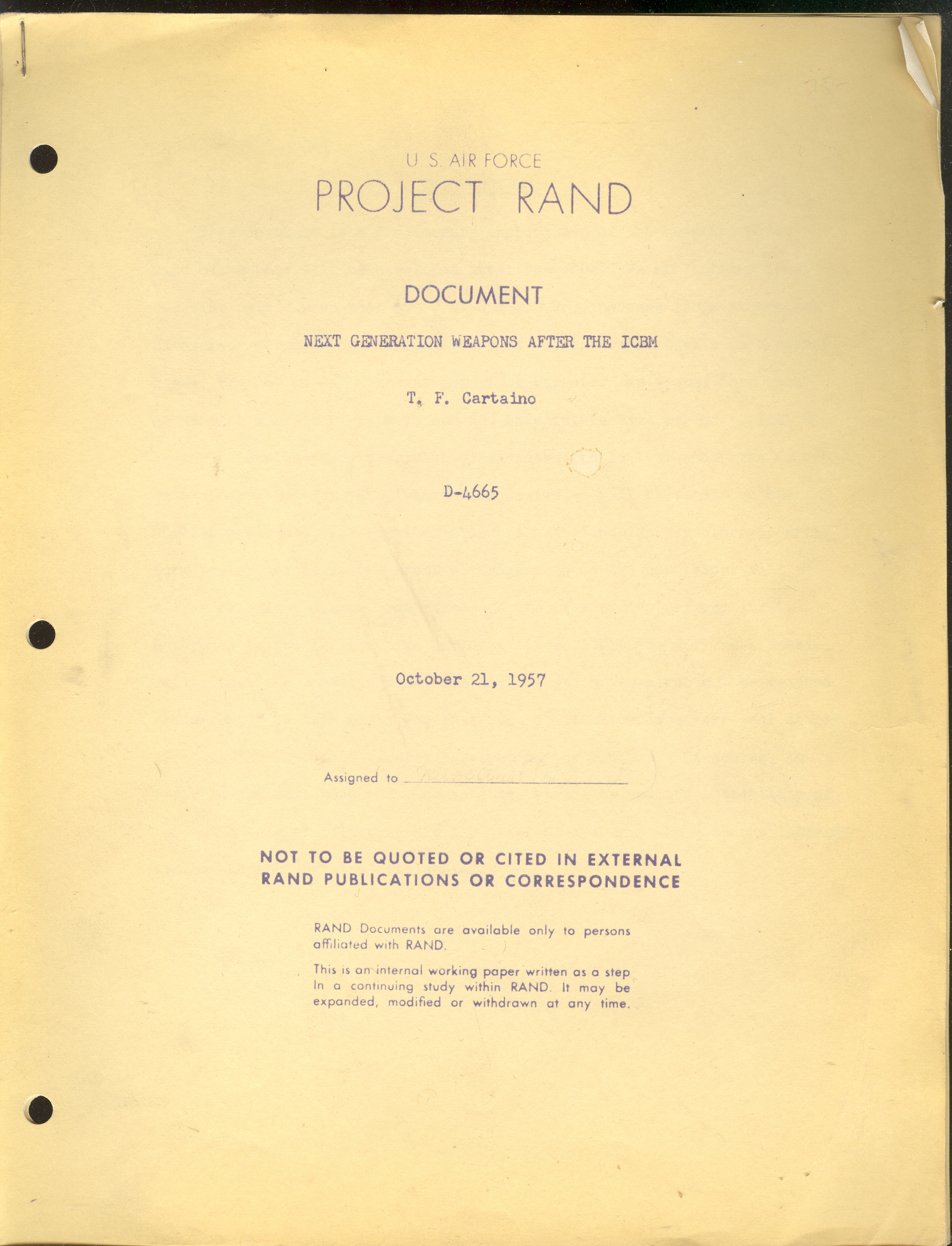
  • RAND Report on Post-ICBM Weaponry: the “Non-Violent” War, 1957

    JF Ptak Science Books LLC  Post 750  Blog Bookstore

    +()+ebay icbm The
    RAND Corporation (Research And Development) is a think tank
    originally formed in 1946 by the US Army Air Force as part of a contract to the
    Douglas Aircraft Company.  After 1948
    RAND Corp was funded by a number of different sources, private and
    governmental, and left the sphere of being a direct arm of the
    U.S. military. (Maybe.)  It still did enormous
    amounts of work on behalf of the military, and seems to have
    been their chief  theoreticians during
    this period.  It was also the time that
    the policy of Mutually Assured Destruction (MAD) was formulated at , partially under the direction of we’ll-see-him-again-down-the-road
    Robert McNamara.  And of course much
    else. 

    This
    publication is an internal RAND document, not
    meant for the eyes of the outside world, at least in 1957.  I own a number of these reports, and I must
    say that this one is odd—it is rather flippant, sometimes oddly and darkly
    (dare I say it?) funny.  It is also short
    (four pages) and gets to the very meaty part of the issue immediately.  The author(s) assume that the US and the USSR
    will have achieved a point of stasis such that it would make absolutely no
    sense for either actor to actually employ their arsenal (and excluding “the
    possibility of the button pusher ‘flipping his lid’ “.  The paper attempts then (“let’s jump right in
    and assume we find ourselves in this stalemated period”) to envision the next
    kind of war in which the ICBM would not be an active factor. “We therefore
    postulate here that the kind of war we will be engaged in…in the period of
    nuclear stalemate of the non-violent war, the opening phase of which has been
    called the cold war.”


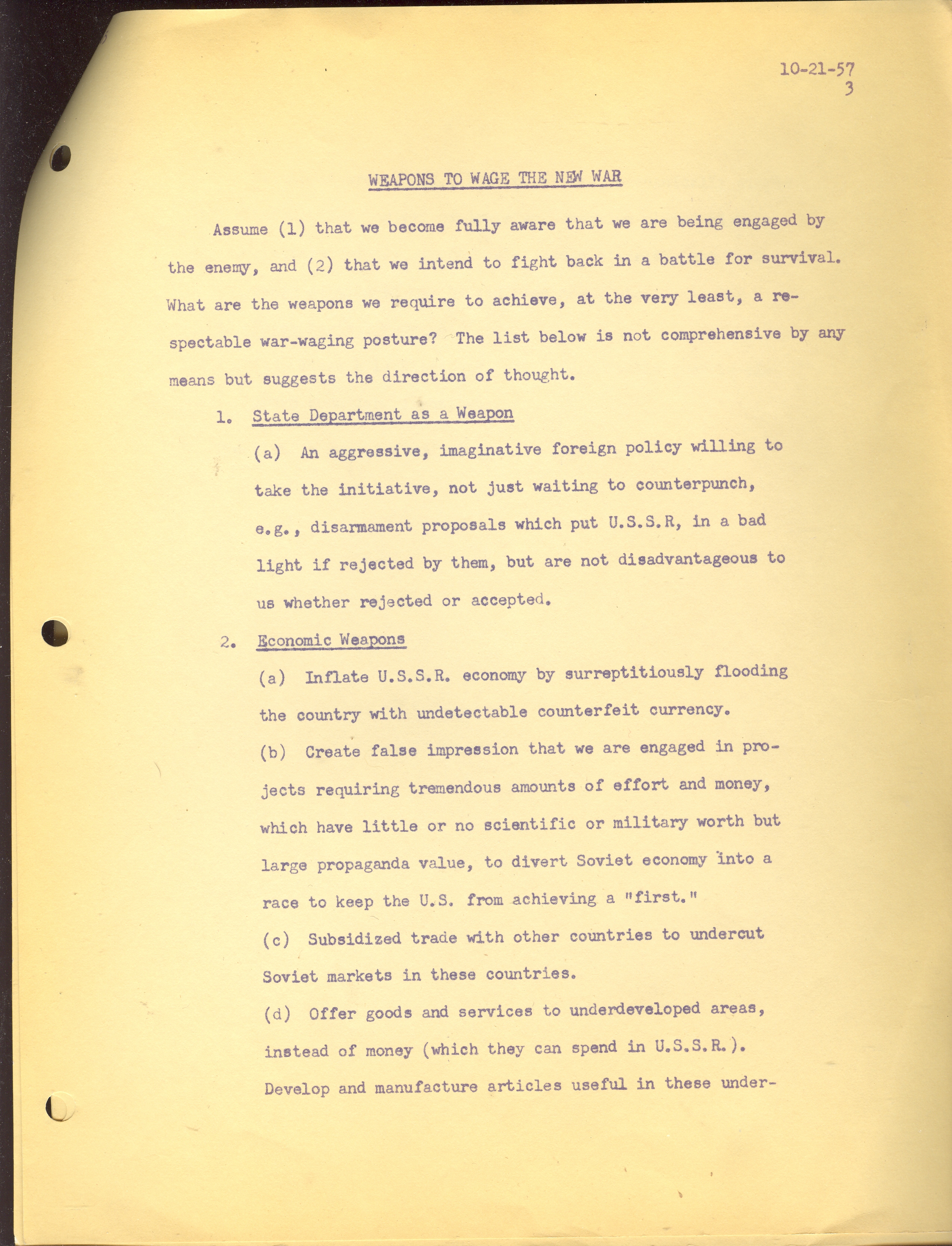
    +()+ebay icbm2

    The tools of war in this non-violent war, the report
    speculates, included: (1) the State Department as a Weapon, issuing “an
    aggressive, imaginative foreign policy”. (2) Economic Weapons, which
    interestingly included “inflate USSR economy by surreptitiously flooding the country with undetectable counterfeit
    currency”.  (I remember that the late
    Sen. John Moynihan suggested in the first Iraq
    war, televise don the floor of the U.S. Senate in the final debate on
    engagement, that we do this exact thing in Iraq…especially
    since the Iraqi dinar was being printed in London.) The third section was “Psychological
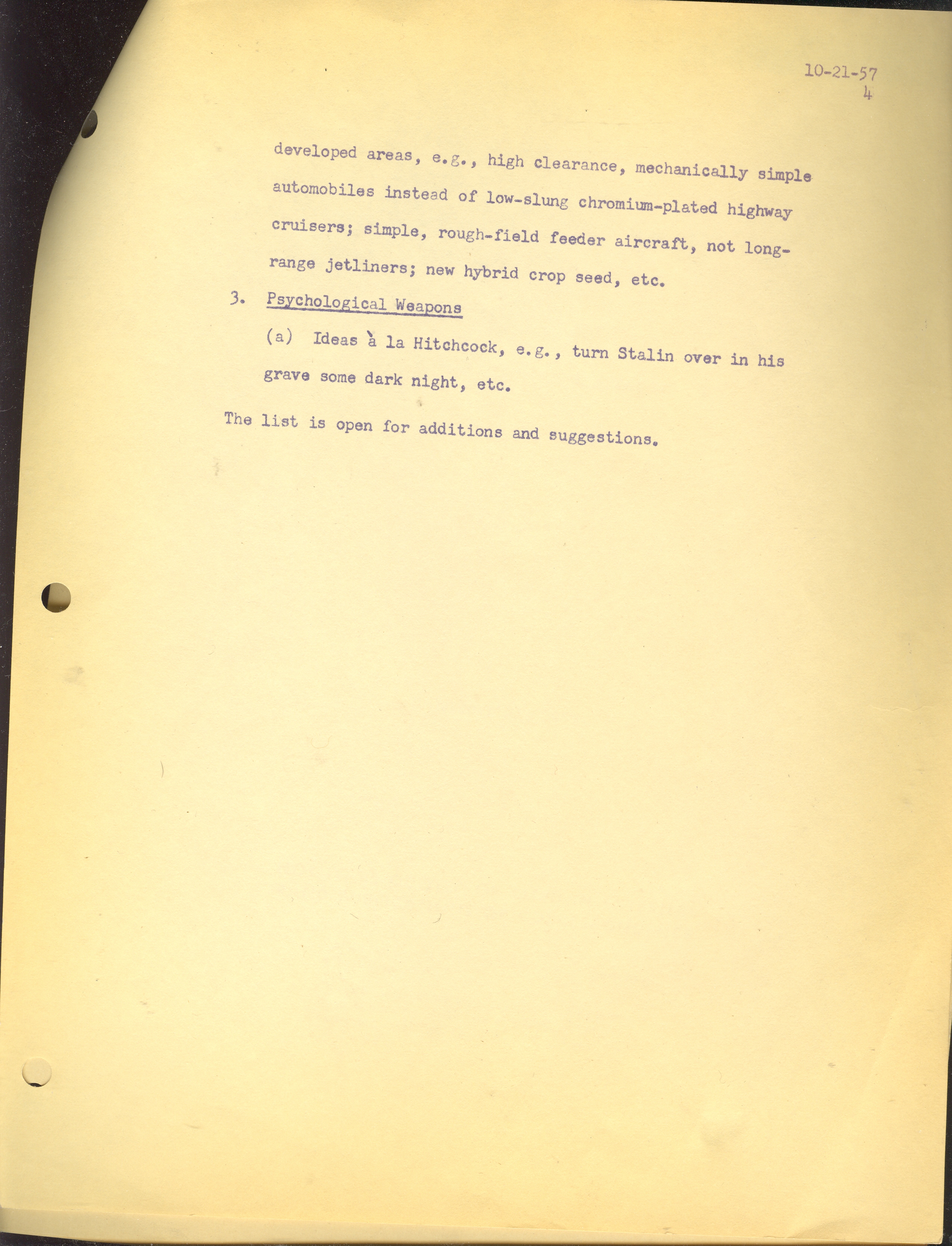
    Weapons”, and was very tongue-in-cheek short (?), suggesting “ideas a la
    Hitchcock, e.g., turn Stalin [dead in 1953] over in his grave some dark night,
    etc.” I’m not sure what to make of that, especially as the paper finishes on
    this line: “This list is open for additions and suggestion.”  Indeed.  Out of all of the internal reports that I’ve read from RAND this is the only one that approached its topic with such dark familiarity and removed humor. 

    +()+ebay icbm3


  • Estimating Casualties in the Invasion of Japan, July/August 1945

    JF Ptak Science Books LLC  Post 709 Blog Bookstore

    It is interesting to visit William Shockley again (after having seen his
    work on the economics of the atomic bomb here), this time weighing in on the
    prospects of an atomic bomb-less WWII Pacific endgame. 
    The results are not pretty, and weigh the number of casualties as seen
    in past invasions of widely-interpreted type. 
    Shockley describes his work in a letter (21 July 1945, “Proposal
    for Increasing the Scope of Casualties Studies”)  to Edward L. Bowles, an MIT Radlab guy who was
    brought to D.C. in 1942 to help develop RADAR. 
    The content is summarized in the following three paragraphs taken in
    their entirety from CASUALTY
    PROJECTIONS FOR THE U.S. INVASIONS OF JAPAN, 1945-1946: PLANNING AND POLICY
    IMPLICATIONS

    by D. M. Giangreco in the Journal of Military History, 61
    (July 1997). pages 521-82

    “As for Dr. Shockley’s initial report to Dr. Bowles, it was not submitted
    until after Stimson had left for Potsdam.
    He proposed that a study be initiated “to determine to what extent the
    behavior of a nation in war can be predicted from the behavior of her troops in
    individual battles.” Shockley utilized the analyses of Dr. DeBakey and Dr.
    Beebe, and discussed the matter in depth with Professor Quincy Wright from the University of Chicago, author of the highly-respected A
    Study of War
    ; and Colonel James McCormack, Jr., a Military Intelligence
    officer and former Rhodes Scholar who served in the OPD’s small but influential
    Strategic Policy Section with another former Rhodes Scholar, Colonel Dean Rusk.
    Shockley said:

    “If the study shows that the behavior of nations in all historical
    cases comparable to Japan’s has in fact been invariably consistent with the
    behavior of the troops in battle, then it means that the Japanese dead and
    ineffectives at the time of the defeat will exceed the corresponding number for
    the Germans. In other words, we shall probably have to kill at least 5 to 10
    million Japanese. This might cost us between 1.7 and 4 million casualties
    including [between] 400,000 and 800,000 killed.”

    “W. B. Shockley to Edward L. Bowles, 21 July 1945,
    “Proposal for Increasing the Scope of Casualties Studies,” Edward L.
    Bowles Papers, box 34, Library of Congress. Attached: “Historical Study of
    Casualties,” by Quincy Wright. Dr. Shockley extrapolated these numbers from earlier analyses
    summarized in Health and others compiled by the Military Intelligence Division
    from field reports. No accurate total of German military and civilian deaths
    was available at the time he prepared his report, but the number was eventually
    set at roughly 11,000,000. Japan was not invaded and finished the war with just over 7,000,000 casualties, most
    of them from its armed services on the Asian mainland in fighting from
    September 1931 to September 1945.”

    The War Department was very busy trying to figure out the
    American casualties for the final invasion of Japan.  In one famous paper, Memorandum for the Chief of Staff: Amplifying Details on Planners’
    Paper for Presentation to the President
    . (17/18  June 1945). prepared by General Hull,
    estimates for American casualties invading Kyushu (on the way to the mainland) were
    based somewhat on the very recent experiences at Okinawa.
    Kyushu was the site of an enormous Japanese military build-up in a final
    preparation for the defense of the homeland—there were more than six times the
    number of soldiers here than at Okinawa, totaling some 550,000.  By August 8, today, the American casualties
    at Okinawa were about 49,000.  There would still be a very long and bloody
    war to wage had not the Empire of Japan finally surrendered four days after the
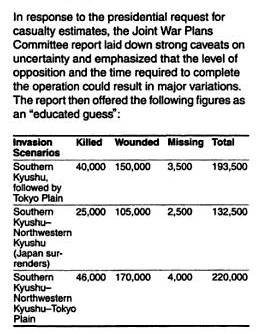
    use of the second atomic weapon at Nagasaki.  Estimates are as follows (this taken from
    Douglas MacEachin, The Final Months of
    the War with Japan : US  Signal Detection, Invasion Planning and the
    Atomic Bomb Decision
    , CIA, 1999):

    ===blog--atomic bomb--invasion tokyp

    MacEachin continues:

    “In an apparent effort to close or narrow the gap between
    presenting no casualty figures at all and presenting numbers that the Joint
    Planning Staff was unwilling to use with the President, the Army’s Director of
    Operations, Maj. Gen. J. E. Hull, asked his staff for casualty figures for
    operations on Okinawa, Iwo Jima, Leyte and Luzon (both in the Philippines), and
    “overall figures on MacArthur’s operations to date.” He said these
    could be used as background at the upcoming meeting with the President, whom Hull described as “very much disturbed over losses on
    Okinawa.” Hull then incorporated the following casualty
    figures into a summary of the longer report that had been prepared for the
    President’s meeting.

    Islands Invaded Earlier US

    Killed/Wounded/MIA

    Japanese Killed/Prisoners
    (Not including wounded) Ratio (US to Japanese)
    Leyte    17,000  78,000 1:4.6
    Luzon    31,000 156,000 1:5
    Iwo Jima   20,000 25,000 1:1.25

    Okinawa   34,000(ground) 7,700(Navy) 81,000 (Not a final count) 1:2”

    And so what on earth are we left with, really? 200,000+ American  and 2 million Japanese casualties, plus untold destruction, in an atom bombless attack on the Empire. This is not part of an argument about using the bomb–there wasn’t an argument to be made at virtually any high-level command structure about not using the bomb militarily…it just wasn’t on the table.  (There were people who–like Eisenhower–were appalled with the military use of the weapon, but they weren’t part of the groups whose charge was to figure out the bomb’s deployment.) I’m just trying to illustrate the effects of war had there been no bomb at all, or if the impossible decision was made not to use it.  As it was, the bomb existed, it was used with virtually no hesitation, twice, and it brought the war to a close.  It must be remembered that even after Nagasaki, it still took the Japanese command three more days to decide to surrender, with the final acceptance occuring three days after that, on 15 August.  

    ·Posted by :

    ·in:


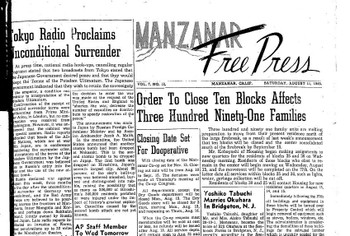
  • Reporting Hiroshima in American Japanese Internment Camp Newspaper, 11 August 1945

    JF Ptak Science Books LLC         Post 708 (Continuing #192)   Blog Bookstore
    Atomic_bomb_manzanar_2

    For another project I’ve been reading through the Manzanar Free Press Newspaper
    (volume 7, no. 12) and came upon this slight coverage of the bombing of
    Nagasaki, printed 11 August 1945.  What’s unusual here is that this
    newspaper was published by the “internees” at the Japanese Relocation
    Center (officially “The Manzanar War Relocation Center” and also called
    a  “relocation camp,” “relocation center,” “internment camp,” and
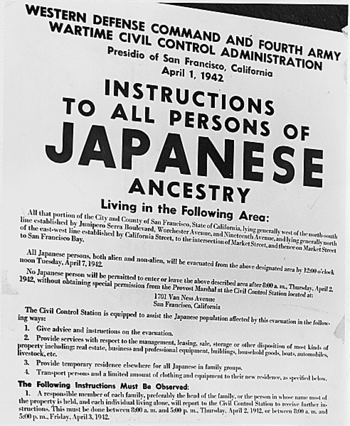
    “concentration camp”,)  at Manzanar, California.   110,000 people of 
    Japanese origin (including a large percentage of American citizens)
    were forcibly removed and imprisoned via the U.S. Executive Order 9066,
    issued by President Franklin Roosevelt on 19 February 1942.   Manzanar
    was a semi-dead town 220 miles NE of Los Angeles, located in high
    desert with huge swings of temperature and unrelenting and challenging
    weather—semi-killed by the city of Los Angeles, which purchased the
    water rights to the region in 1929, forcing out the remaining
    inhabitants.  Manzanar had a peak population of about 11,000 before the
    Japanese were returned to what remained of their previous lives.

    Manzanarattention_2

    In this quick coverage, a report is made on the Japanese
    accepting the terms of the Potsdam Ultimatum, putting an end to the
    war.  The next part is of the reporting is very subdued, announcing the
    dropping of the second bomb,  theorizing that as many as
    200,000-300,000 people may have perished in the bombing of Japan’s
    seventh largest city.  And not much more than that.  Two hundred words
    were I’m guessing all that was allowed by the powers-that-be at
    Manzanar.

    Elsewhere in this same issue is a report on the meeting of the
    Manzanar Boy Scout troop.  And something on the graduating class of the
    Manzanar High School (the high school yearbook for 1945, the last class
    at Manzanar, was called “Valediction”).  Familiar trappings in an
    unfamiliar trap.

    Manzanar is located near Lone Pine in the Owens Valley, which today
    suffers terrible environmental problems brought on by water-dependent
    LA sucking out all of the water in the region.

    ·Posted by :

    ·in:


  • Deciding to Use the Atomic Bomb: The Chicago Metallurgical Lab Poll, July, 1945

    JF Ptak Science Books LLC  REPOST  Blog Bookstore

    Interested in responding to the poll yourself?  Answer the Metallurgical Lab (July 1945) Poll here-–the results are immediately available.

    Blogaugust_4_bas_cvr373In
    late June 1945, the Interim Committee (a secret, blue chip group
    established by Secretary of War Stimson with the approval of President
    Harry S. Truman to examine the problems that could result from the
    creation of the atomic bomb). decided what exactly to do with the
    weapons.  The group (also including James F. Byrnes, former US Senator
    soon to be Secretary of State, as President Truman’s personal
    representative; Ralph A. Bard, Under Secretary of the Navy; William L.
    Clayton, Assistant Secretary of State; Vannevar Bush, Director of the
    Office of Scientific Research and Development and president of the
    Carnegie Institution; Karl T. Compton, Chief of the Office of Field
    Service in the Office of Scientific Research and Development and
    president of Massachusetts Institute of Technology; James B. Conant,
    Chairman of the National Defense Research Committee and president of
    Harvard University; and George L. Harrison, an assistant to Stimson and
    president of New York Life Insurance Company) found the following:

    The
    opinions of our scientific colleagues on the initial use of these
    weapons are not unanimous: they range from the proposal of a purely
    technical demonstration to that of the military application best
    designed to induce surrender. Those who advocate a purely technical
    demonstration would wish to outlaw the use of atomic weapons, and have
    feared that if we use the weapons now our position in future
    negotiations will be prejudiced. Others emphasize the opportunity of
    saving American lives by immediate military use, and believe that such
    use will improve the international prospects, in that they are more
    concerned with the prevention of war than with the elimination of this
    specific weapon. We find ourselves closer to these latter views; we can
    propose no technical demonstration likely to bring an end to the war;
    we see no acceptable alternative to direct military use.

    AND

    …that the weapon be used against Japan at the
    earliest opportunity, that it be used without warning, and that it be
    used on a dual target, namely, a military installation or war plant
    surrounded by or adjacent to homes or other buildings most susceptible
    to damage.

    Slightly later, in July 1945 (but before Trinity), Arthur H. Compton
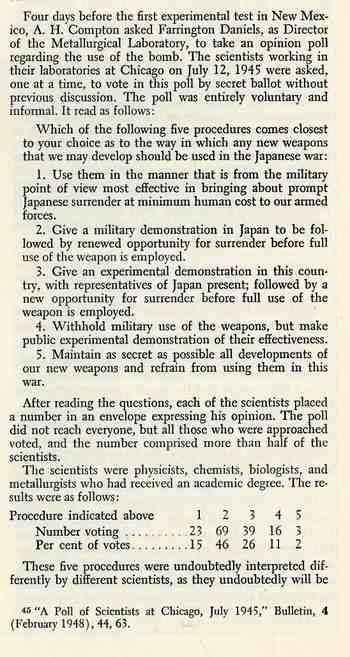
    asked  Farrington Daniels (Director of the Metallurgical Lab section
    (at Chicago) of the Manhattan Project) to poll the 250 or so scientists
    at work under Farrington on the coming immediate use of the atomic
    bombs.  (The results of the poll, answered by 150 of the 250 people,
    were originally published as “A Poll of Scientists at Chicago, July
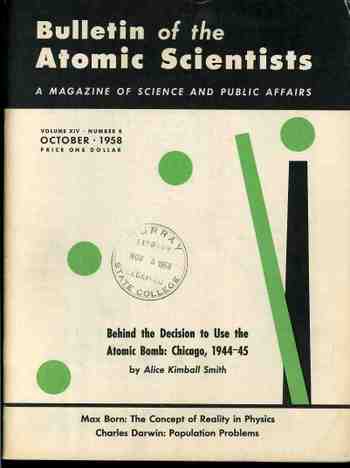
    1945,” Bulletin of the Atomic Scientists, February 1948, 44, page 63. and again published in Compton’s own book,  Atomic Quest, in 1956. The images below come from the Bulletin of Atomic Scientists for October 1958, p 304.)

    Here are the questions and the results of the responses:

    Blogaugust_4_bas_survey374

    The results of the poll were widely interpreted, and seemed to fit
    the needs of whomever was stretching the statistical canvas.  On the
    one hand, for example, 87% of the anonymous respondents favored some
    sort of military use of the bombs, though just 15% of all of the
    scientists thought that the bombs should be dropped straight-away. 
    Almost half thought that the bombs were best used in demonstration to
    the Japanese first, followed by renewed negotiating efforts for
    unconditional surrender, before the bombs were employed on targets;
    another 26% felt that the Japanese be invited for a demonstration in
    the US of the weapon.  So even though 87% believed that a military use
    was prescribed, 72% felt that the military use was best first as a
    demonstration device.  2% (3 of the 150) felt that the bomb should
    basically be buried and not used at all.

    Compton’s response to it all and to the immediate demands presented
    to him on 23rd July (Washington wants to know what you think”) was
    hardly quintessential:  “My vote is with the majority….it seems to me
    that as the war stands the bomb should be used , but no more
    drastically than needed to bring surrender>” (Reported in Lewis
    Morton’s “The Decision to Use the Atomic Bomb”, Foreign Affairs, 35, January 1957, pp 334-353).

    ·Posted by :

    ·in: