JF Ptak Science Books LLC Post 686 Blog Bookstore
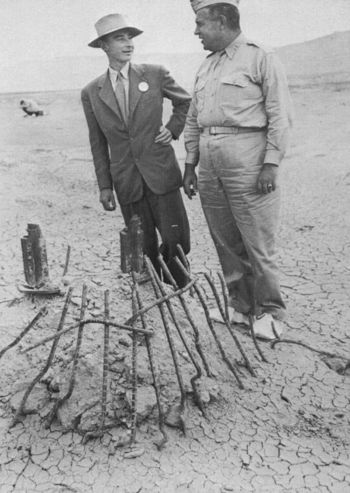
Today is the 64th anniversary of the explosion of the first atomic bomb in the pre-dawn New Mexico desert. I’ve made a number of posts about that event, as well as the decision to use the bomb along with its consequences and subsequent control. Mostly the posts can be found here. I’ve reposted parts of the beginnings of two of those posts relating to 16 July below. [That’s Oppenheimer and Groves standing at the remnants of the base of the tower that held the suspended weapon on 16 July, everything pretty much gone.]
 Trinity at 63: the Explosion of the First Atomic Bomb, 16 July 1945
Now we are all sons of bitches—Kenneth Bainbridge, Trinity
Director.
There were many profound thoughts in many profound heads there in the
desert, at the reaches of the Jornarda del Muerto (“The Dead
Man’s Walk”, a formerly nearly-impenetrable stretch of desert in the
Llano Estacado) at the Trinity Test Site, Alamogordo, New Mexico, on
16 July 1945 for the successful testing of the first atomic bomb. Robert
Oppenheimer famously cited the Gita (“Now I am Become Death, the Destroyer of
Worlds…”): Enrico Fermi was so busy with his little and excruciatingly
wonderful experiment with strips of paper calculating the effect of the blast
(he reckoned a very-close 10,000 tons) that he didn’t actually hear the
explosion; Edward Teller thought Tellerian thoughts, and so on. Actually
the observation points (like S-10000 and Campania Hill)were crowded with big
brains: in addition to Oppenheimer, Teller and Fermi were people like
Hans Bethe, James Chadwick (whose discovery of the neutron sort of started the
whole thing), Richard Feynman, George Kistiakowsky, Phil Morrison, Robert
Serber, Vannevar Bush, James Conant, and many others. The were all
thinking pretty big things (except for the occasional if-you-can-believe-it
stuff like that which maybe came from Feynman’s mouth, which was “hot
dog!”). I think that Bainbridge’s statement was the best, and truest,
summation of the morning’s activities…
[Continue reading via link above]
The Decision to Use the Bomb: Trinity +1
of the first atomic weapon, was the first day in which very concerted, very
real discussions ensued about what to do with the bomb and where to us
it. Actually the discussions were mostly on the “where” than on the
“whether”. (As it turns out part of a minor segment of the “whether” part
was Leo Szilard’s petition
to President Truman not to use the bomb and which was signed by 155
Manhattan Project scientists, and which had reached its final version on this
day.)
The truth of the matter was that it was a very complex issue, an easily
misunderstood tapestry of circumstance and consequence. The major issue of
course was that the Japanese would not surrender, and that there would be
“fanatical resistance” once the invasion of the Japanese islands had
begun. The battle of Okinawa had just been fought—it was a
horrible confrontation taking 12,5000 American lives and more than 1000,000
Japanese , demonstrating that even in impossible circumstances that the
Japanese simply would not surrender (unconditionally). This is just
one instance—there are many others, not the least of which was t he recent
firebombing of
taking 150,000 lives. Air strikes in general seemed to not make a
difference in the will of Japan to fight—as was demonstrated again and again in
the British and American bombing of Germany—as was further demonstrated in
General Curtis LeMay’s and General Hap Arnold’s 60-city attack in the
May-August span. The thought was that if there was an invasion that it
could well cost the
1000,000+ casualties and would be completely…
[Continue reading via link above]