A Daily History of Holes, Dots, Lines, Science, History, Math, Physics, Art, the Unintentional Absurd, Architecture, Maps, Data Visualization, Blank and Missing Things, and so on. |1.6 million words, 7500 images, 4.9 million hits| Press & appearances in The Times, Le Figaro, Mensa, The Economist, The Guardian, Discovery News, Slate, Le Monde, Sci American Blogs, Le Pont, and many other places… 5000+ total posts since 2008.
Louis Turner’s Review of Published Work on Nuclear Fission, 1934-1940.
With a List of Turner’s References (Below)
JF Ptak Science Books Reference Tool
I’ve found this article1 by physicist Louis A. Turner to be very helpful over the years. He was an I-was-there guy (and actually an I-am-here guy) who wrote a stuccato article on the history of nuclear fission which was top heavy in references, and did so in 1940, just before the clamp came down on publication on the topic. Certainly there are other more modern efforts in this area that are far more detailed, but few have managed to do so good a job in as limited space as Turner, which the fabulous John A. Wheeler recognized as a “great and timely” review2.
Notes:
1. Louis Turner. “Nuclear Fission.” Lancaster: American Physical Society, 1940. An article in the Reviews of Modern Physics, vol 12/1, January 1940, pp 1-30 of an issue of 85pp Original orange wrappers. Fine condition. Also contains articles by Seaborg and Zwicky.
2. J.A. Wheeler, “Fission in 1939, the Puzzle and the Promise ” Annual Reviews, 1989.
His 133 references can be read as a succession of one-line histories of the subject (barring the permissions to reproduce the entire article):
E. Fermi, Nature 133, 898 1934.
E. Amaldi, O. D’Agostino, F. Rassetti and E. Segrè, Proc. Roy. Soc. A146, 483 1934.
I. Noddack, Zeits. f. angew. Chimie. 37, 653 1934.
O. D’Agostino and E. Segrè, Gaz. Chim. Ital. 65, 1088 1935.
I. Curie, H. von Halban and P. Preiswerk, J. de phys. [7] 6, 361 1935; C.R. 200, 1841 1935; 200, 2079 1935.
Perhaps nothing is obvious unless it is established oar labeled so;
perhaps the obviousness must be stated at least once before it can be
officially, recognizably, the case. And perhaps the greater the
obviousness is, the more the need to make it officially so. Perhaps
nothing is so incredibly obvious that it can be studied and dissected
and established.
This seems to be more the case in more recent history than in time
more further removed: that millions of dollars can be spent “proving”
that children do not like to be separated from their mothers, or that
cars will go faster downhill than up, or that people will respond to
proper medication better than not, and so on, so on into the night,
just seem not to need a vastly-funded proof.
And so the case with nuclear warfare, people, and cities.
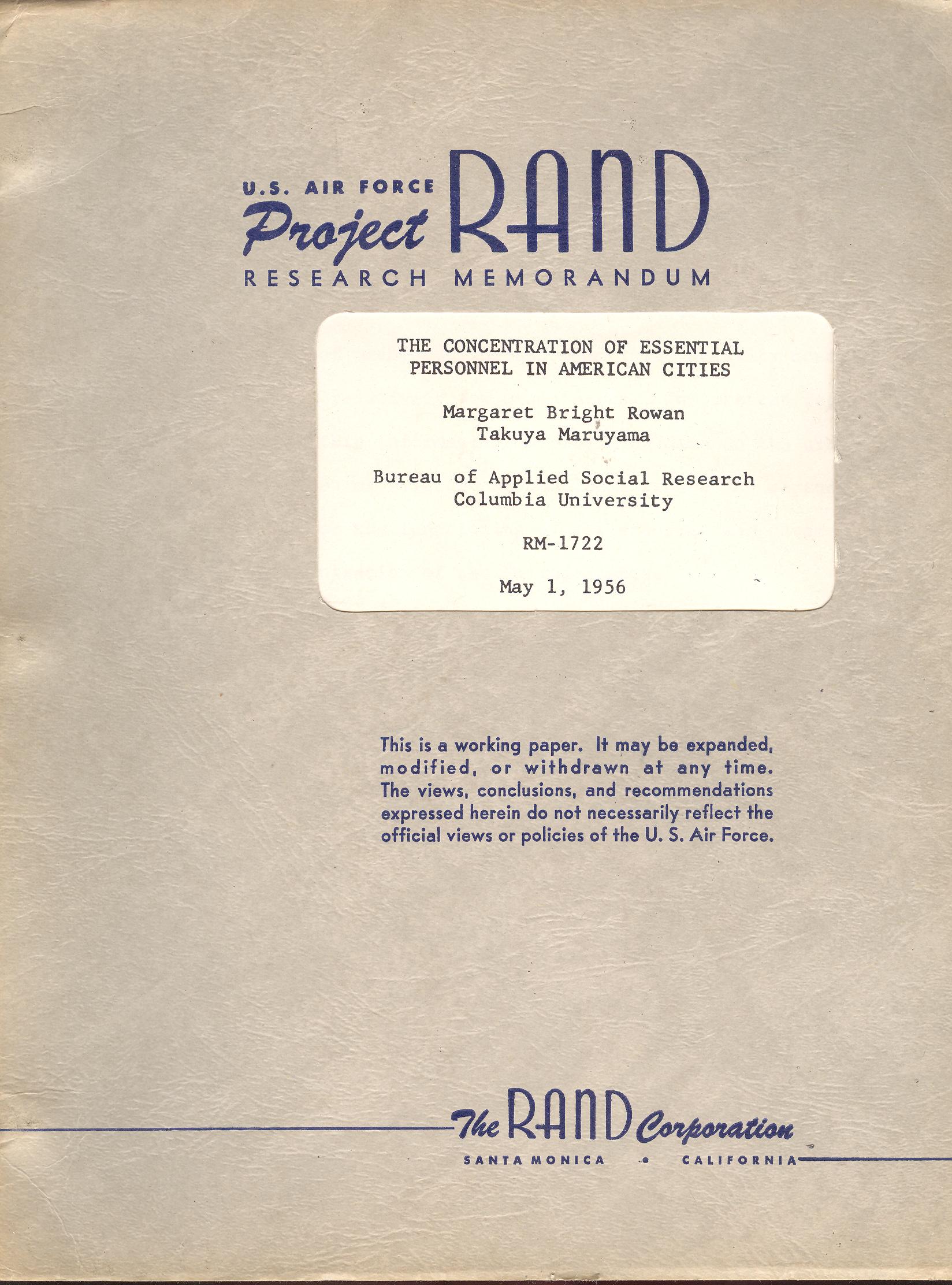
In this RAND report from 1956 (The Concentration of Essential Personnel in American Cities, by Margaret Bright Rowan, published by the RAND Corporation, May 1956, in 72pp) the great issue seems to be laid to
rest, once and for all: the problem with nuclear weapons being exploded
in/over cities is that since cities are filled with people, people
will be killed. And if those people in the cities are there because of
professions that depend on city-settings, then more of those people
will be killed than not.
But what this report was really about was the unfortunate aspect of
the impact if nuclear warfare on leadership and working positions in
significant and strategic industrial/business/government professions.
And what the report finds is this: since the vast majority of these
positions are located in cities (defined as 100,000 population and
above), and since cities will be the major targets in a nuclear
“exchange”, the overwhelming majority of these people will be killed,
thus leading to strategic human resource vacancies post-war.
It seems that 95% of aeronautical engineers in the U.S. would be
killed in a nuclear war, which I guess would mean that it would be
difficult to design new aircraft and such in the post apocalypse
world. Of course these people would be killed because it was their
industrial base that was being targeted and they were collateral
damage, so there wouldn’t be any industrial base to produce the
components necessary to build, say, a B-52. That part of the equation
is not addressed here, though. Nor is there any sort of recommendation
presented to fix the problem.
The RAND document just painfully points out the obvious, once and
for all; no one really knew what to do with the information now that it
was there, in black and white. Certain people could be evacuated,
saved from the maelstrom; but saved for what? There were other
evacuation plans that were completely doomed from the beginning,
sheltering plans, Dr. Strangelove arrangements, but all of that would
come into their pitiful being later on.
First, though, the bitter reality of what everyone already knew–one
of the greatest of all obviousnesses–had to be make its appearance in
print. And so it did.
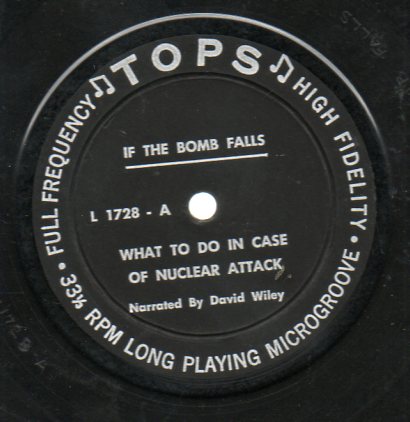
Nothing quite sells like the smell of fear–or the sound of it. In 1961, about the scariest sound was the air raid siren, which is what opens this record album, If the Bomb Falls. At what was probably the highest height of the Cold War, with schoolchildren taught to “duck and cover” under their wooden school desks to protect themselves from a massive nuclear fireball, and in which thousands of families constructed their own fallout shelters, the Tops record company decided to fan the flames of public fear by producing a this-is-what-it-takes to survive effort.
For the most part, Tops was a low rent label, producing stuff that sounded like (‘sound alikes”) a current hit, and by indulging in ‘exotic” music like its Voodoo hit. If the Bomb Falls answered its own fear-stoked questions with not-very-good responses. That’s where the napkins come in–among other things, the album suggests that you keep a two-week supply of napins on hand, in addition to general-purpose paper towels and the like. Also: batteries, just in case the power goes out, and DDT, which went unexplained. And: be aware that in the fallout shelter there will be a period of unusual closeness at hand, testing your privacy.
There is of course a lot of pertinent information survival information on the record, though it comes with very padded edges, and with very little flavor for what radiation is all about, and what it will do. Plus all of that wicked winged death stuff that was waiting for you outside the bunker.
But this is what was done, at the time, to prevent general panic in the though of nuclear attack–stuff like this offered their own bits of religiosity, with the promise of possible islands of heaven here and there, heavens buried in your backyard or scooped out the side of your basement. Like any belief system, it was based in, well belief–and belief doesn’t take that much firming-up once somebody believes in it. Things will work out if you believe they will; science and logic take the background in cases of a staggering hope of survival based upon belief (and instructions from micrgoove vinyl).
In the end, what you are left with in the event of nuclear holocaust is what is in the middle of this record:
Other Tops producers included these lovelies (source of which is here):
[Thanks to Eric Edelman of Retrocollage who put me on the trail of a bomb shelter for 5 million Manhattanites in the Kenneth D. Rose book, One Nation Underground, (NYU Press, 2001) in which the following thread was found. Incidentally, here’s the RAND report on the Manhattan mega-shelter, to have been located 800′ in bedrock–to date the deepest part of the NYC subway system is 191 St station, at 180’…]
I think that there may be some room to put together a gazetteer of depictions of American cities in imaginary destruction and nuclear desolation–as seen in newspapers. And perhaps just the front pages of newspapers. There is a lot of material for this in general, though the restriction of front page coverage might be a little difficult–if the imagery was left open to views of decimated cities that appeared in large circulation newspapers and magazines, there might be enough stuff for a gazetteer and alphabet.
Part of the great source for these images is FearSell, which seems to have been made into a $100 billion advertising industry, plus the stuff that it advertises. No longer is it just a “weather report” on the television, it is “Storm Center 4 with Super Doppler”; streaming radio isn’t just for listening to local reports from different cities but a way to ‘protect your family” int he event that the radio station you listen to is destroyed somehow. Fear as a packaging implement has worked its way into nearly everything, though I must say that I haven’t seen any anti-fear protein FDR supplements for food enhancement (though there are plenty of ads for ‘victory seeds” and pre-packaged long-term bomb shelter food and so on). Yet.
[Source: Rose, One Nation Underground]
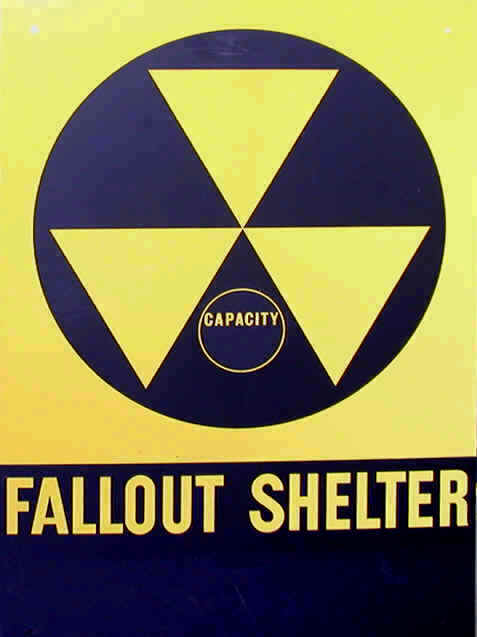
This was of course the time of the Great Fear, of nuclear Armageddon, of “going toe-to-toe with the Russkies” (General Buck Turgidson), the highest height of the Cold War, when personal underground bomb shelters (or at least plans for them) were becoming common and the escalation towards at least an accidental foul-up that could end the world was becoming a more distinct possibility. Duck-and-cover exercises in school on a weekly basis were weird and scary, especially the part where your wooden desk was going to save you from the eye-of-god fireball that was going to envelope your city. Those odd and rusting signs that have been scraped from buildings now for a few decades in the 1950’s and 1960’s were daily fear reminders of the threat from above.
There were also the not-subtle fear/training campaigns of the federal government, such as with Operation Alert, which “simulated attacks on major cities in the U.S. to see how city defenses and people might react to actually having to do something in the face of a nuclear exchange. The exercises were mostly futile and even obsolete, but they did manage to create a huge amount of fear. (Robert Moses, the great NYC-planner, noted that if even one subway car was derailed or had a problem that there would be massive consequences and failure, and that plans to evacuate any large city–even if there was a place to evacuate people to–was “like so much moonshine”. (See the Rose book, page 27.) )
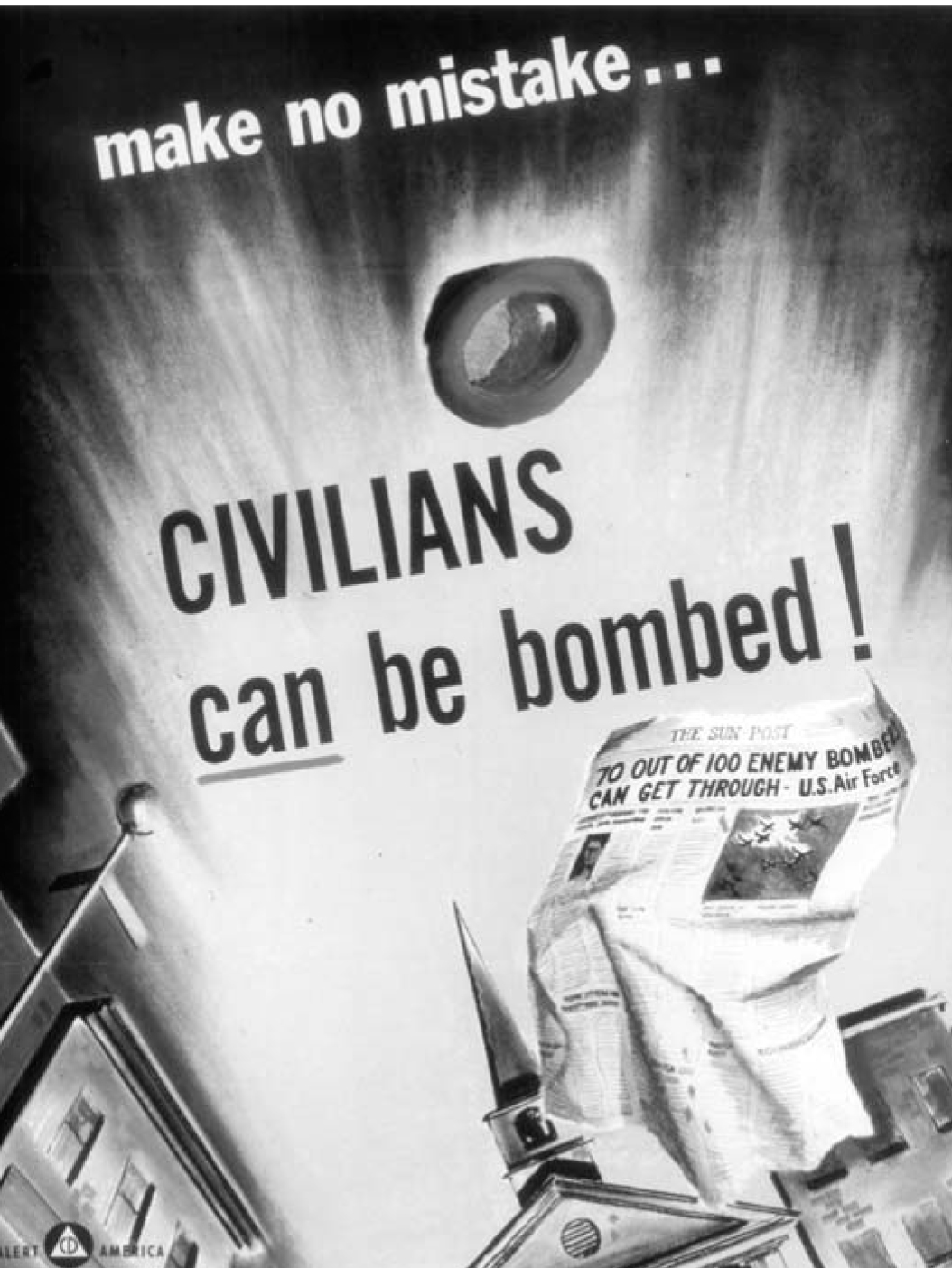
And the threat came to everyone–not just military targets:
But this practice of bombing populations-in-general was basically in place–at least from the air–almost since the beginning of modern flight, from about 1911 or so. There were plenty of conferences and protocols restricting the use of bombs dropped from planes on civilians, but then there was the debate about what was it exactly that defined the “civilian” population, and the arguments peeled themselves away in the face of common practice. Anyway, during the Cold War the bombs were so very gigantic that there was little home of rescuing the idea of what a “civilian population” meant, especially in the face of perhaps destroying most of the planet.
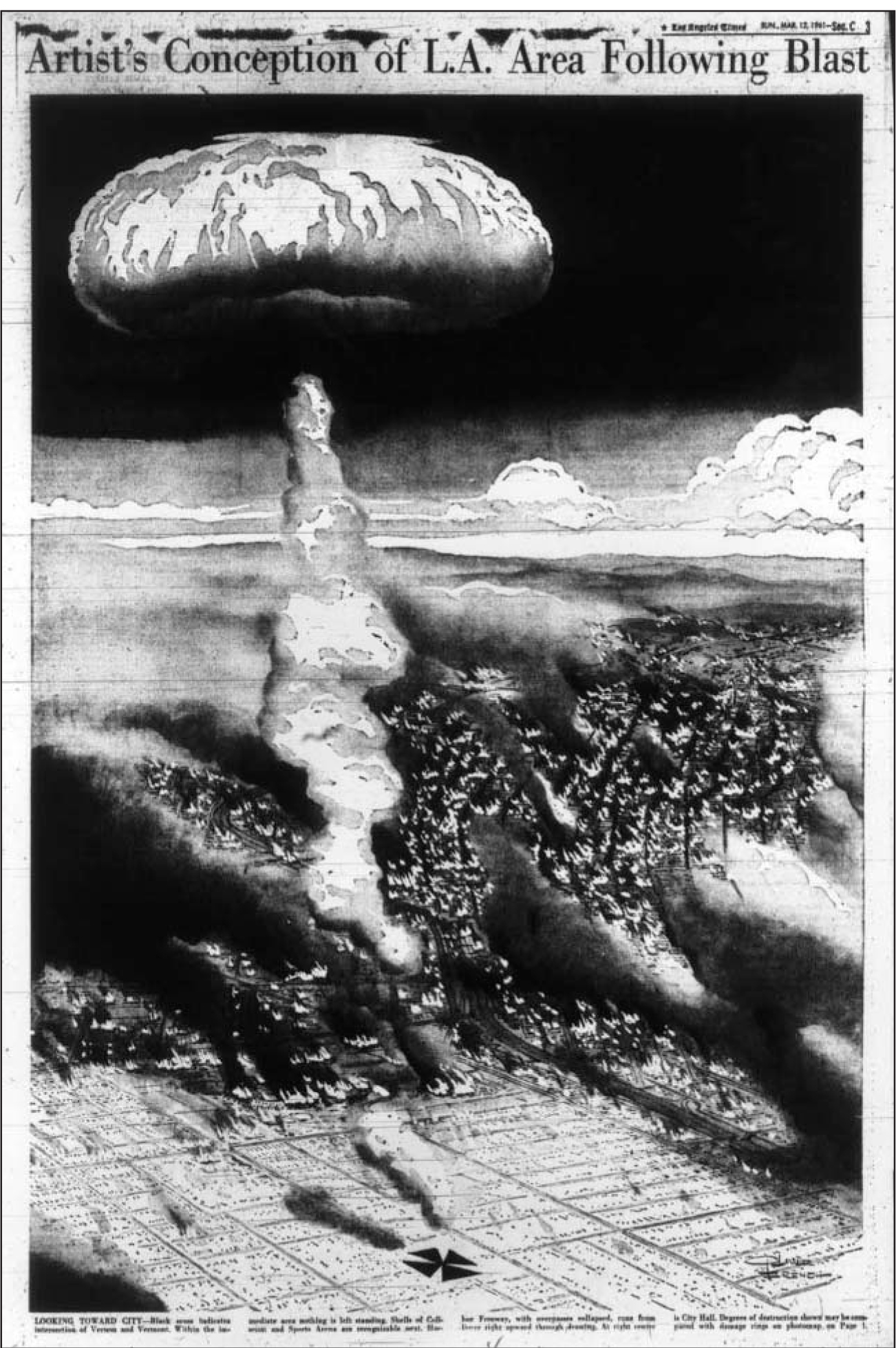
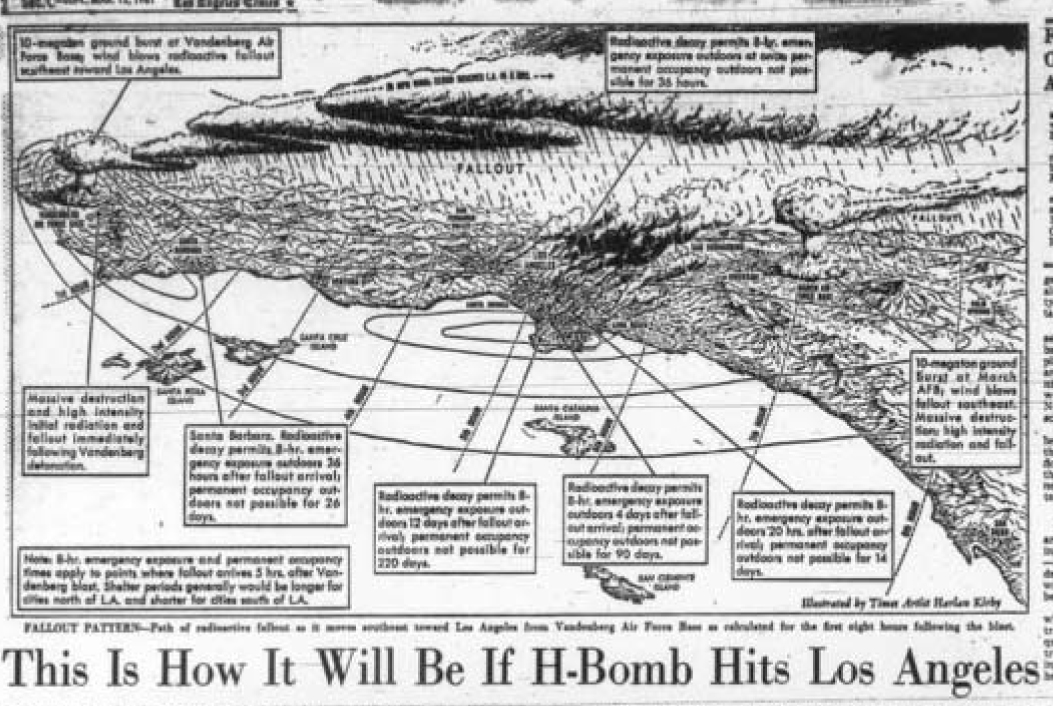
This first story (“Red Alert. What if an H-Bomb Hit L.A?”) appeared in the Los Angeles Times 12 March 1961, and made no doubt for some very sobering contemporary wake-up-and-die reading. If you were living anywhere in the country at the time and had never seen a representation of your city in ruins, and you encountered such a story and images before coffee, you might remember that missing cup for the rest of your life. The dramatization and mapping was done by Harlan Kilby, and it portrayed the destruction of the city and millions of people in the event of detonation of a 10 megaton nuclear weapon–it gave the reader a vague notion of what city-eating looked like, the bomb ‘flattening” everything in a 3-mile radius of its central zone and killing everything in 28 square miles. (A little earlier, in 1960, there appeared a work by Harrison Brown and James Real called Community of Fear, which was a sci-fi kill-’em-up that used a kill zone with a 25-mile radius.)
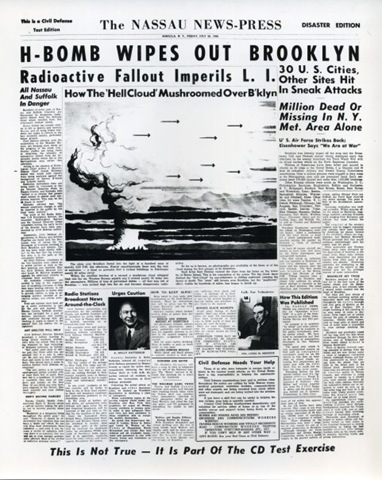
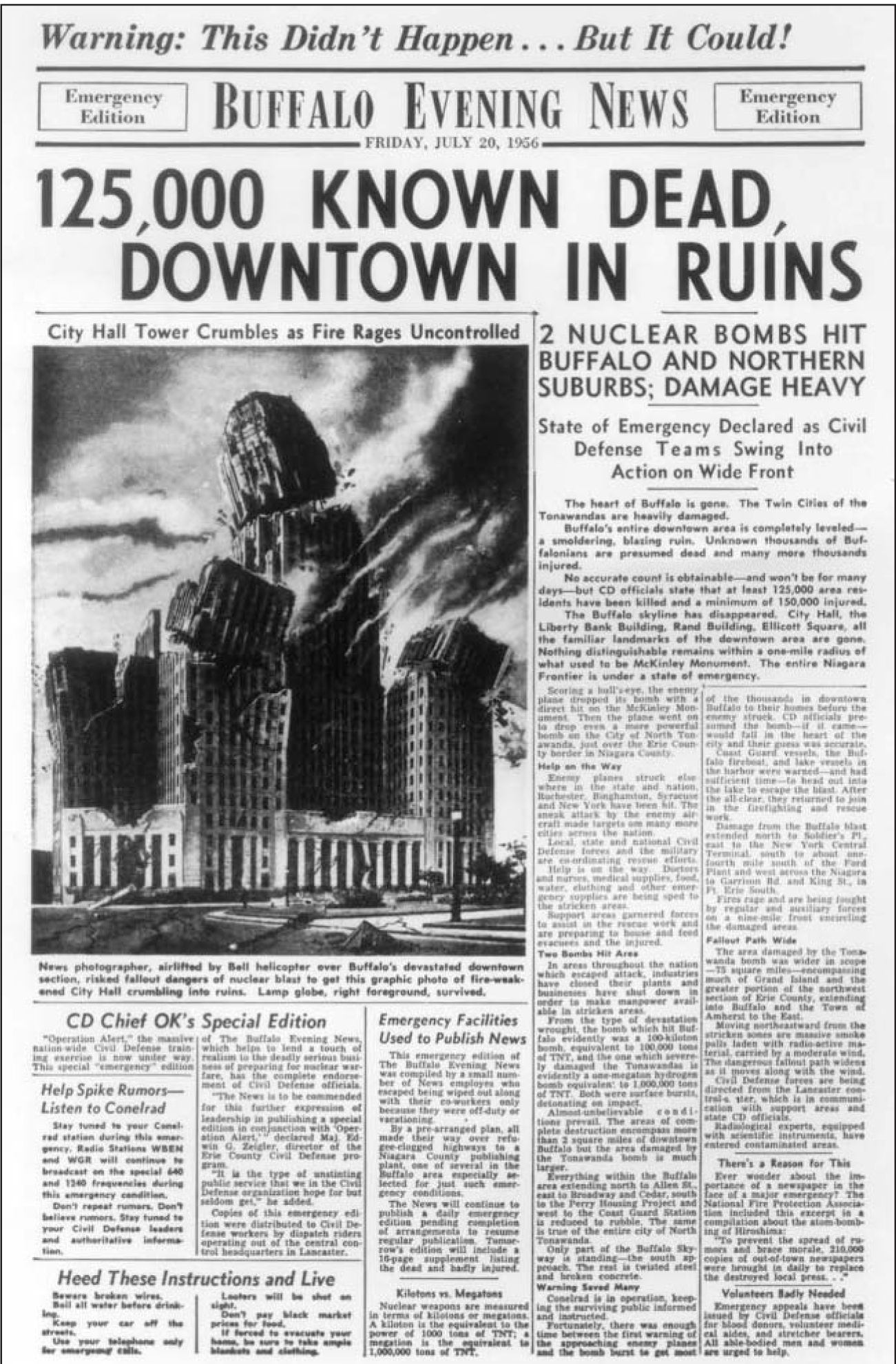
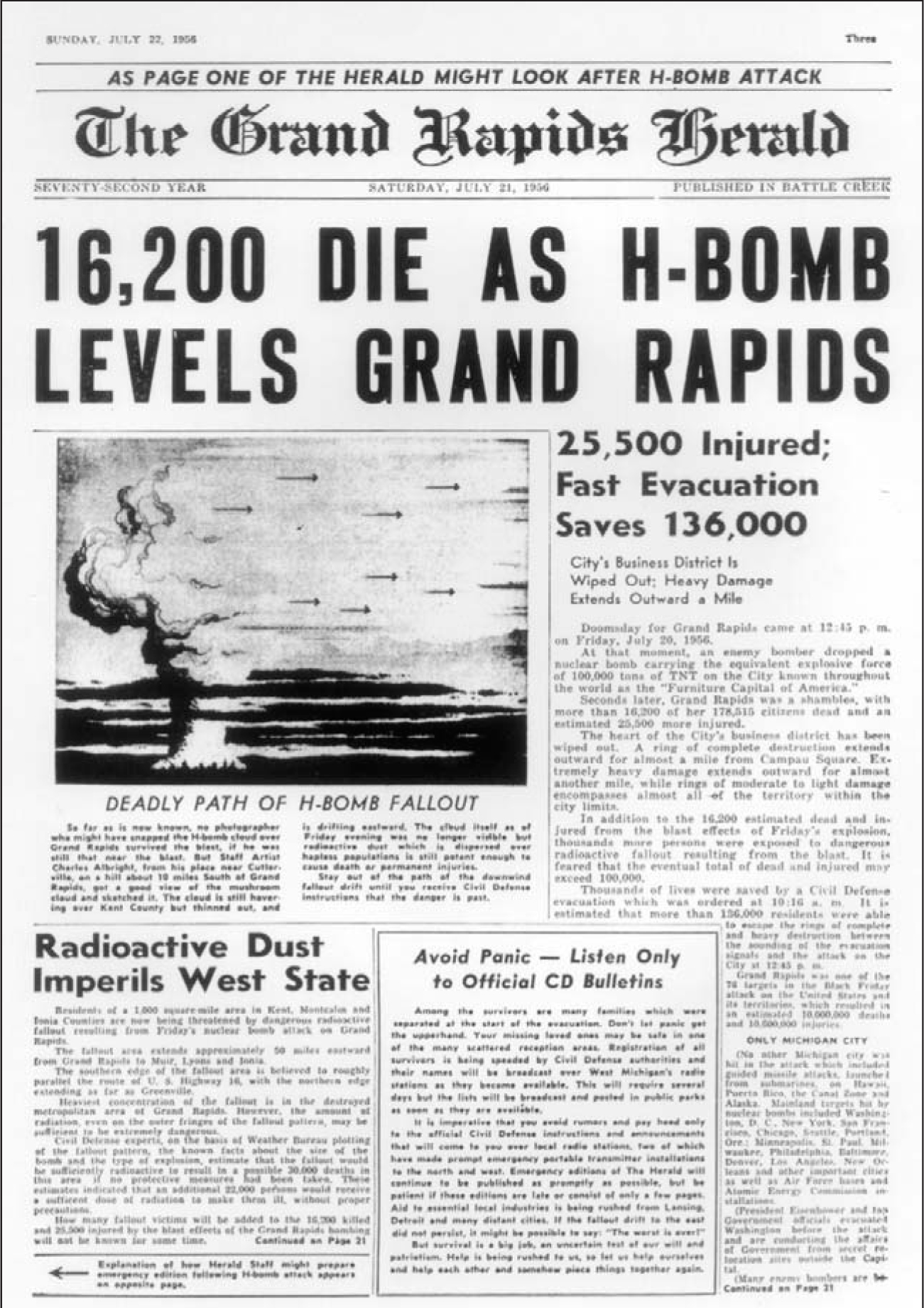
Since this appeared in a newspaper story–and a long story at that–it gave the exercise a real sense of urgency, to say nothing of the amount of fear that it generated. At least it didn’t appear as the front page, as was the case with some other end-time scenarios, like these newspapers for Brooklyn and Buffalo and Grand Rapids (below).
Seems today like it might be a stretch for Grand Rapids and Buffalo to be bombed into oblivion by our arch-Cold Warriors, but there were more than enough delivery capabilities to make these cities into targets, so the possibility was definitely real.
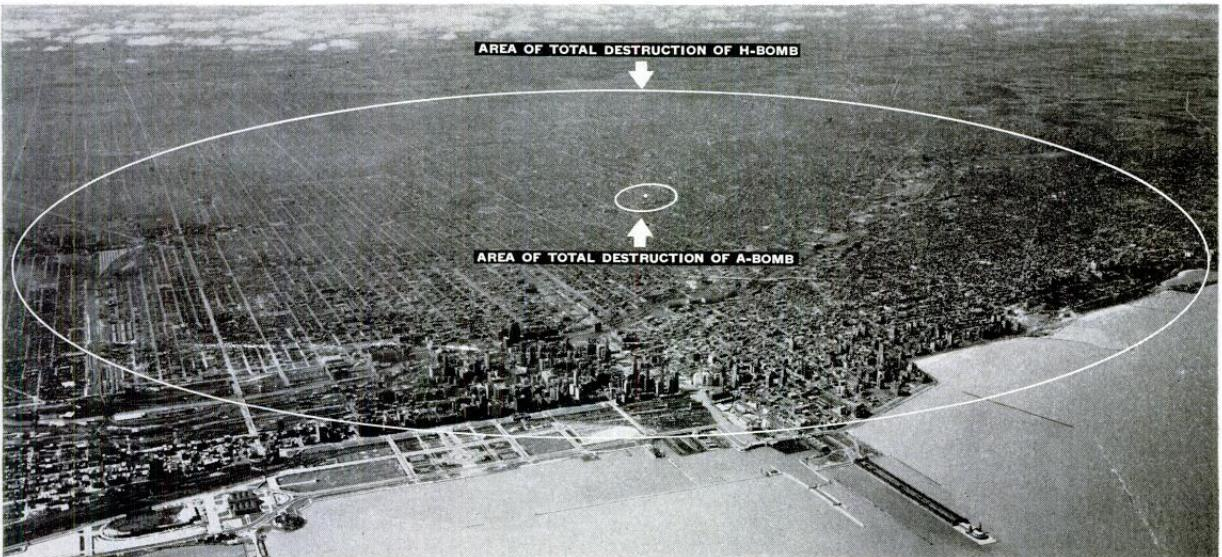
This next graphic shows the difference in destructive capacity of an atomic bomb (small circle beneath an air-burst detonation) and a hydrogen bomb (the large circle showing area of total destruction, which in this case would be about 50 square miles) on the city of Chicago. this one did not appear ont he front page of a newspaper, but did appear in a sort-of “America’s Magazine”, though not on the cover. There are many other examples of this sort of imagery–perhaps I’ll put together a gazetteer of mega-doom with images for them…
[Source: LIFE Magazine, 30 Jine, 1950]
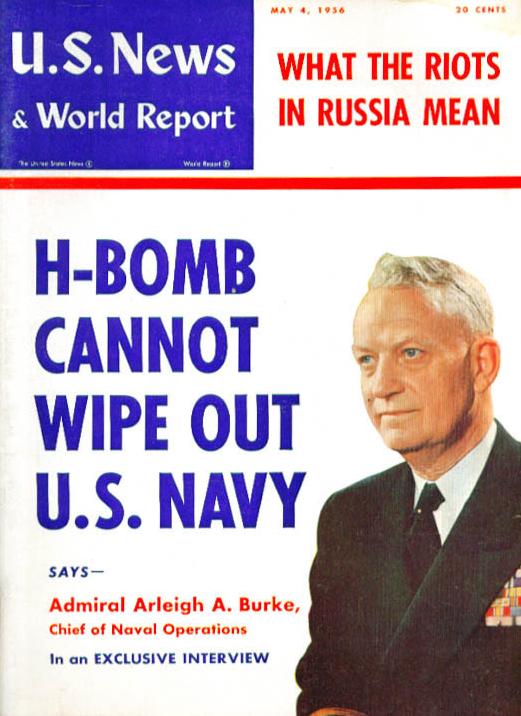
But don’t worry, even if the Chicago and Brooklyn and New York and so on were destroyed, the U.S. Navy would survive, which would be either great or horrible if you were a sailor:]
In any event, this is a small start to the Nuclear Doomsday Gazetteer–enough of this for this morning.
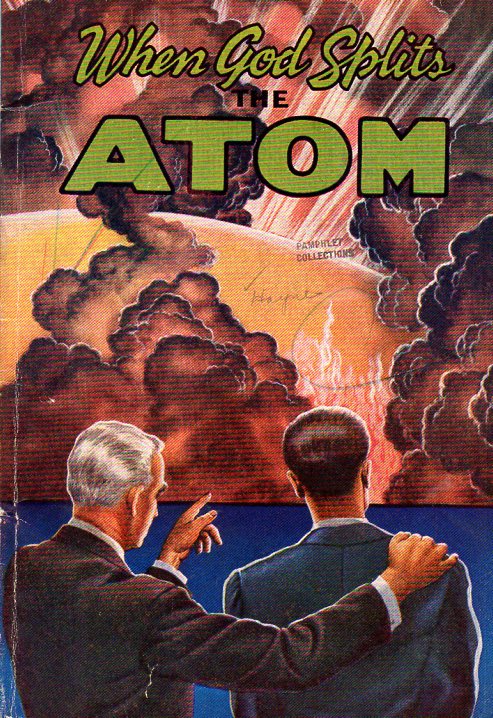
This wonderful, semi-impossible sulphur-laden pamphlet emerged from the bottom of one of the “Naive Surreal” boxes today in the warehouse:
When God Splits the Atom (1956) offers a not-so-friendly piece of advice: “its later than you think”. We are told that God delivered the atom and the atomic bomb and the end of the war and the beginning of the United Nations. None of that will save us from the burning ring of fire, and the U.N. will fail, and so on, down to the firey pit if there is no repentence and acceptance of the higher power. The cover pretty much tells the entire story.
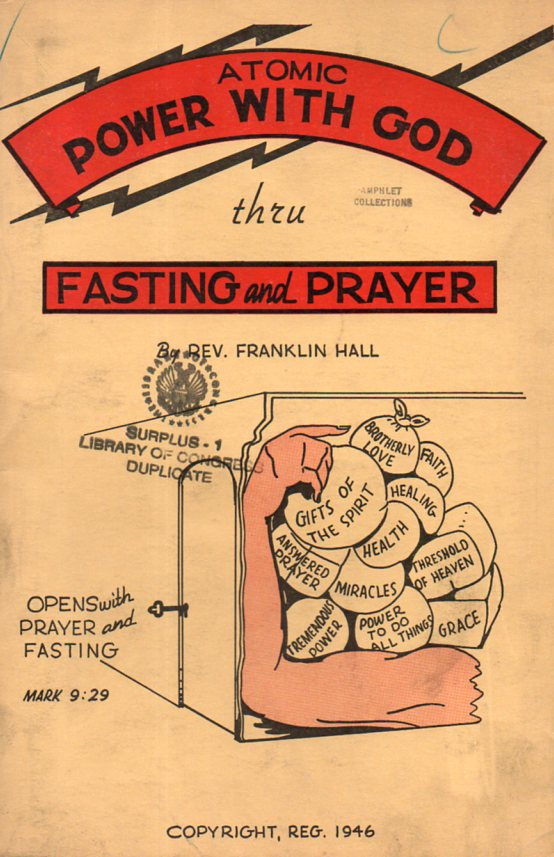
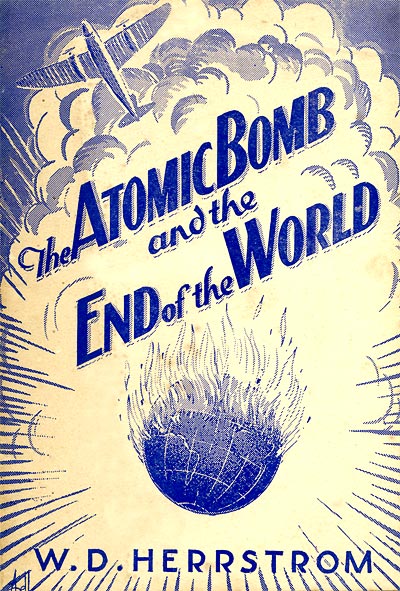
There are a few other God-and-athe-atomic-bomb posts on this blog, like, well, this one:
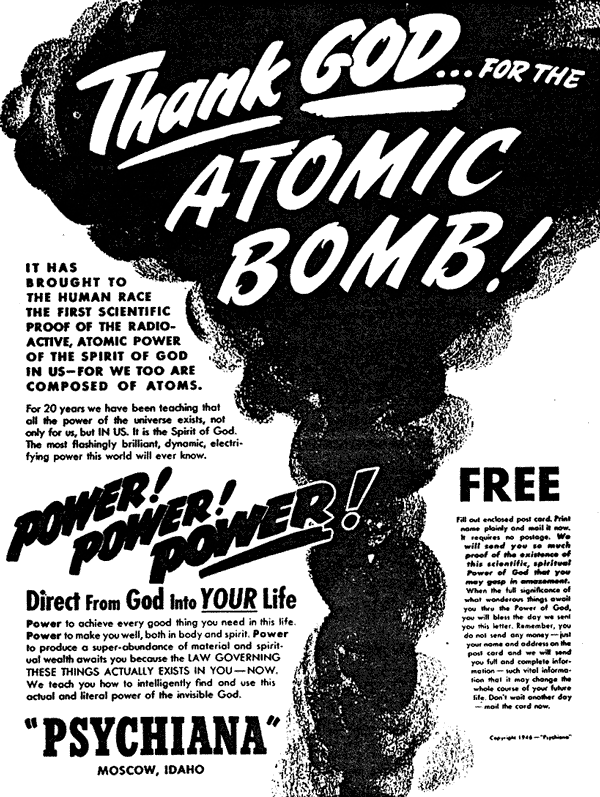
The idea and imagery of the atomic bomb was instantly re-purposed and used to identify and sell food and comfort, and was employed for hotel names, cakes, dart games, watches, restaurants, patience games, and so on–God was just one of a series in a long line of a-bomb apps.
This is document 63 of 80 from “The Atomic Bomb and the End of World War II, a Collection of Primary Sources”, from the National Secuiry Archive Electronic Briefing Book No 162, edited by William Burr (2005). (The full source is available here.) It is here where there is a brief review of supposed Japanese development of an atomic bomb. the information was courtesy of the MAGIC, a cryptonym for the successful effort of the United States Army Signals Intelligence Section (SIS) and the Navy Communication Special Unit to decode intercepted high-level Janapese messages. (A quick appraisal of MAGIC is available here.) Suffice to say for this quick post that the efforts of American cryptographers (with some help from our cousins in the U.K. at Bletchley Park) landed the U.S. the ability to read and render Japanese critical and encoded communications virtually from the very beginning of the war.
Perhaps the way you get around the constant fear of Total World Annihilation is to triviliaze the thing that would bring this state of affairs about. I’m not sure that this has been the case too very often in the history of Potential WorldWide Disasters outside of the great atomic fear of 1950-1990 (and soon to re-emerge, perhaps/probably). So far as I know there were no V-2 Motels to correspond to the Atomic Motels of the American 1950’s; nor was there Pestilence Wax, or AIDS Cakes, or Influenza Burgers, or Plague Patter, and so on. I’m certain that some cases exists outside the atomic realm, but putting the atomic bomb to work on the runaway train that was an advertising antithesis to itself seems to me to be so far beyond anything else that I can think of…well, nothing seems to compete with its ready meanness to the great/monsterous possibilities of itself. To wind up with a picture of an “a-bomb” on a ball of kid gum seems spectacularly evaporative to what the atomic bomb was.
I’ve collected some examples of the atomic fear reversal at work:
This table was primarily compiled in Japanese by Masaaki Koarashi and then translated into English by the Tokyo Physicians for Elimination of Nuclear Weapons. I’m using it here as a template for a larger chronology for the development of the atomic bomb for 1930-1945.
I have added bits here and there and will continue to do so, especially with regards to noting the Nobel Prize efforts in physics. But the great majority of this table was generated by Masaaki Korashi, and not my own work.
[Numbers following the year refer to the month and (sometimes) the day of the month. So 1933.1.30 is 30 January 1933.]
1930 [Germany] Discovery of radiation which penetrates a leadblock by Walter Bethe. (Received 1954 Nobel prize.)
1932. Jan. .18 [France] Proton emission from beryllium irradiated by alpha-ray, discovered by Frederick Joliot and Irene Curie.
1932. Feb. [England] Neutron discovered by James Chadwick, verifying Rutherford’s Baker Lecture.(Received 1935 Nobel prize.)
1932.Feb. [USA] Cylotron developed by Ernest Orlando Lawrence and M.S.Livingston of California University, 27.5 inch size developing One million electron volts. (Received 1939 Nobel prize)
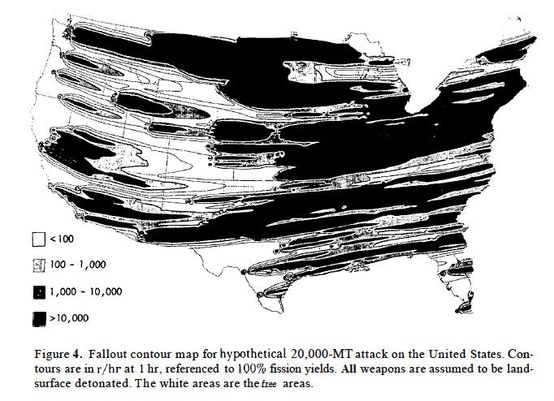
I found this map via Alex Wellerstein–a very odd, very visual map of radiological effects of a massive nuclear weapons exchange, which basically leaves little in the way of hope for survivability. It was published in Brookhaven National Laboratory’s Ecological Effects of Nuclear War (edited by G. M. Woodwell) as part of symposium sponsored in part by the Ecological Society of America and the American Institute of Biological Sciences in 1963. Wellerstein (an historian at the Center for the History of Physics at the American Institute of Physics) correctly points out the problems with the model–among which are the 100% ground detonation and 100% achievability in yield–but there was something else that bothered me. Well, two things: first. the swath of death obliterated state lines, so you could sort of tell who was affected (although it seems as though my own mountain city of Asheville, NC is in a very slim thread of beige spiking into the death blotch), not that these distinctions would matter very much in the light of nuclear holocaust.
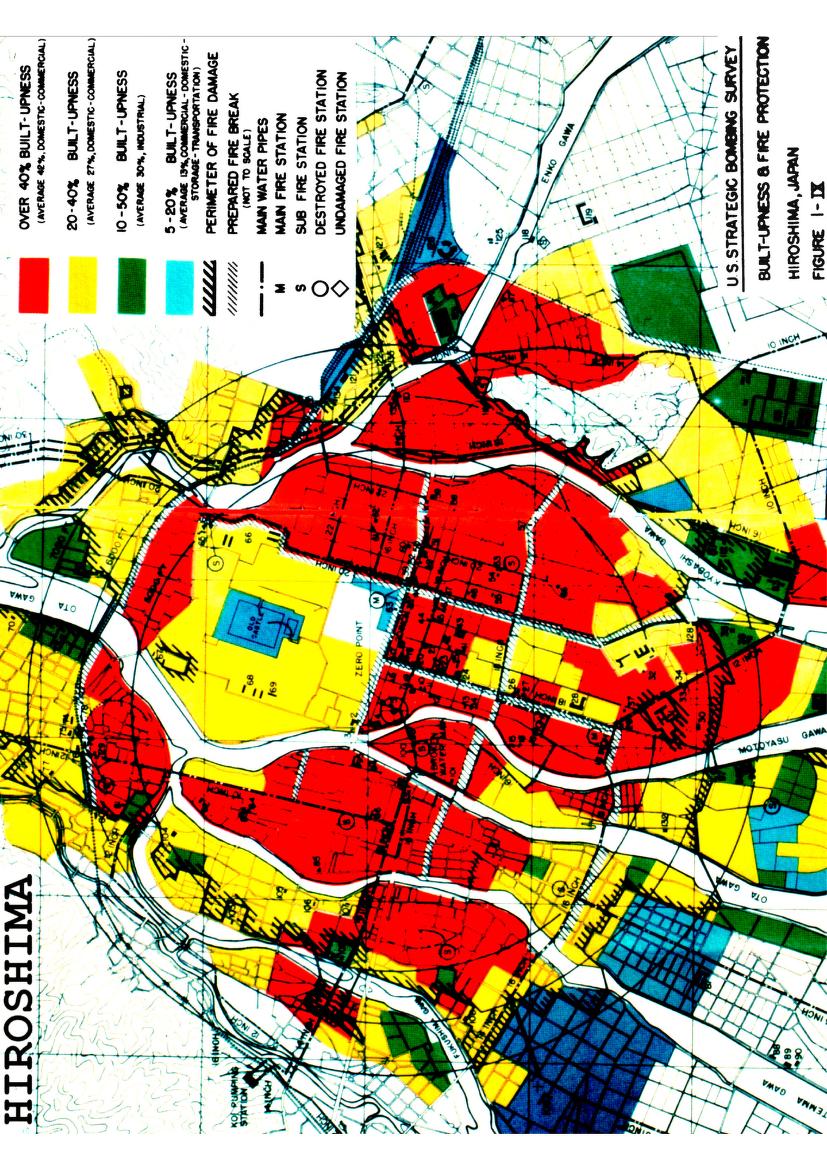
The second part didn’t occur to me until later. The missing state lines wouldn’t matter because there would be basically nothing left, or a something that approached nothing. As Sven Lindqvist points out in his book A History of Bombing (The New Press, 2001), a study conducted at the Max Planck Institute in 1982 showed that an exchange of 5,000 megatons was enough to throw hundreds of millions of tons of soot from burning forests into the atmosphere and create a cloud barrier that would last for six months and cause the temperature on Earth to drop 100 degrees. At the end of that time, after the sun poked its way through again, the damage to the ozone would be such that virtually anything that survived would be killed by UV radiation. Plus all of that nuclear exchange radiation. at the time–in 1982–the worldwide stockpile of nuclear weapons was acknowledged to be about 13,000 megatons.
It is estimated that 13,000 megatons had the damage capacity of 1,000,000 Hiroshimas, due not to increase weight but also to more efficient weight usage. That’s one Hiroshima for every 6,000 people.