JF Ptak Science Books Post 2087
Perhaps nothing is obvious unless it is established oar labeled so;
perhaps the obviousness must be stated at least once before it can be
officially, recognizably, the case. And perhaps the greater the
obviousness is, the more the need to make it officially so. Perhaps
nothing is so incredibly obvious that it can be studied and dissected
and established.
This seems to be more the case in more recent history than in time
more further removed: that millions of dollars can be spent “proving”
that children do not like to be separated from their mothers, or that
cars will go faster downhill than up, or that people will respond to
proper medication better than not, and so on, so on into the night,
just seem not to need a vastly-funded proof.
And so the case with nuclear warfare, people, and cities.
In this RAND report from 1956 (The Concentration of Essential Personnel in American Cities, by Margaret Bright Rowan, published by the RAND Corporation, May 1956, in 72pp) the great issue seems to be laid to
rest, once and for all: the problem with nuclear weapons being exploded
in/over cities is that since cities are filled with people, people
will be killed. And if those people in the cities are there because of
professions that depend on city-settings, then more of those people
will be killed than not.
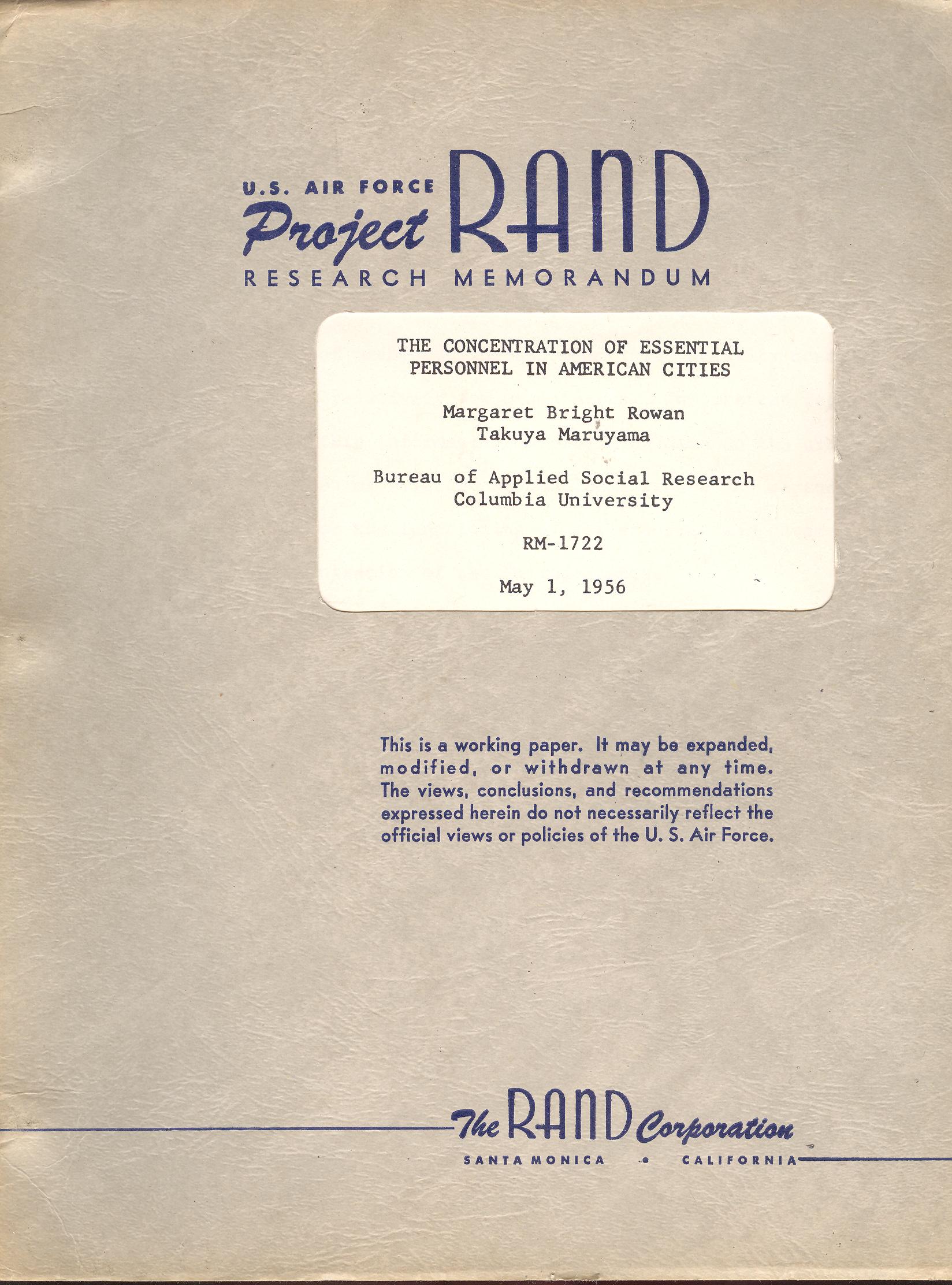
But what this report was really about was the unfortunate aspect of
the impact if nuclear warfare on leadership and working positions in
significant and strategic industrial/business/government professions.
And what the report finds is this: since the vast majority of these
positions are located in cities (defined as 100,000 population and
above), and since cities will be the major targets in a nuclear
“exchange”, the overwhelming majority of these people will be killed,
thus leading to strategic human resource vacancies post-war.
It seems that 95% of aeronautical engineers in the U.S. would be
killed in a nuclear war, which I guess would mean that it would be
difficult to design new aircraft and such in the post apocalypse
world. Of course these people would be killed because it was their
industrial base that was being targeted and they were collateral
damage, so there wouldn’t be any industrial base to produce the
components necessary to build, say, a B-52. That part of the equation
is not addressed here, though. Nor is there any sort of recommendation
presented to fix the problem.
The RAND document just painfully points out the obvious, once and
for all; no one really knew what to do with the information now that it
was there, in black and white. Certain people could be evacuated,
saved from the maelstrom; but saved for what? There were other
evacuation plans that were completely doomed from the beginning,
sheltering plans, Dr. Strangelove arrangements, but all of that would
come into their pitiful being later on.
First, though, the bitter reality of what everyone already knew–one
of the greatest of all obviousnesses–had to be make its appearance in
print. And so it did.