JF Ptak Science Books LLC Post 932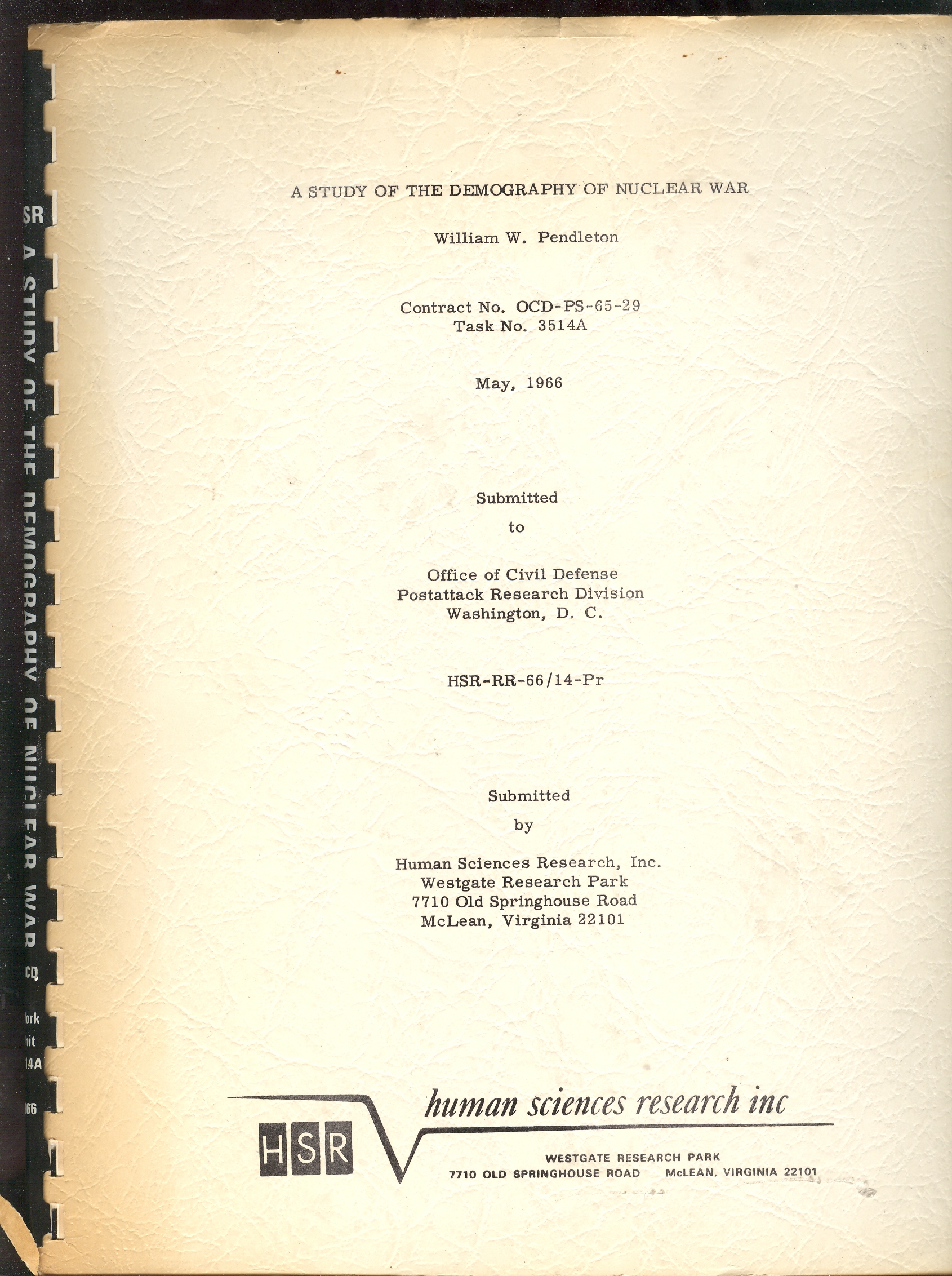
[Part of the Atomic and Nuclear Weapons series.]
I
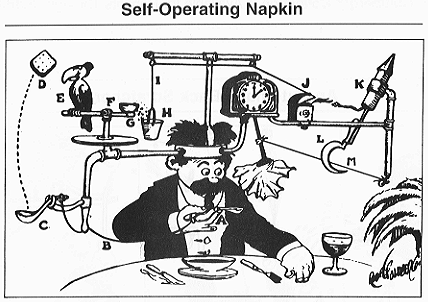
think no plumb line was ever so worked with pulleys and wheels, strings and
catclaws and other Rube Goldberg devices as were the demographic studies of
nuclear warfare. It is as though their
compass rose had no compass, with everything centered on the center, no way
out, no way in. just there. A faceless
clock face describing “G-2 o’clock” whenever it pleased. These studies seem to me the nuclear warfare
equivalent of the Bellman’s map (described earlier in this blog as the most
perfect map ever constructed): a pretty polygon describing a totally blank
surface.
I
have a number of these things here, some of which are restricted-distribution
publications, works of statistical fancy/fantasy meant for other eyes in the
same community dedicated to the fancies described, a tautological audience for
self-referential.
One
such bit, plucked from this pile is William W. Pendleton’s A Study of the
Demography of Nuclear War produced by “Human Sciences Research, Inc.” Outside
of its statistical foray in survivability and the procreative prospects of the
left-overs of vast nuclear exchanges, the work is a solemn attempt at
institutionalizing the death requirements of nuclear combat. The necessity of overwhelming carnage is
presented in ironic and underwhelming language, the first bits of which are
seen in the conclusion of pamphlet’s abstract1:
“Cities differ in the kinds and magnitudes of
change to which they might be subjected. Considerable variation in the demography
of surviving populations can be expected; that variation would be related to
policy decisions; and those decisions should therefore be examined for their
demographic implications.” [Emphasis mine.]
Put
another way, the city is the main focus of the survivability equations, and the
chances of the humans being bombed in those cities would change with—god help
us—the amount of bombing.
Cities differ in the kinds and magnitudes of
change to which they might be subjected.
This
is the key I think to understanding documents like this, making a simple
foundation statement so convoluted and tortured that it and most of what
follows make any sense outside of restating themselves. Which I guess is a
strength.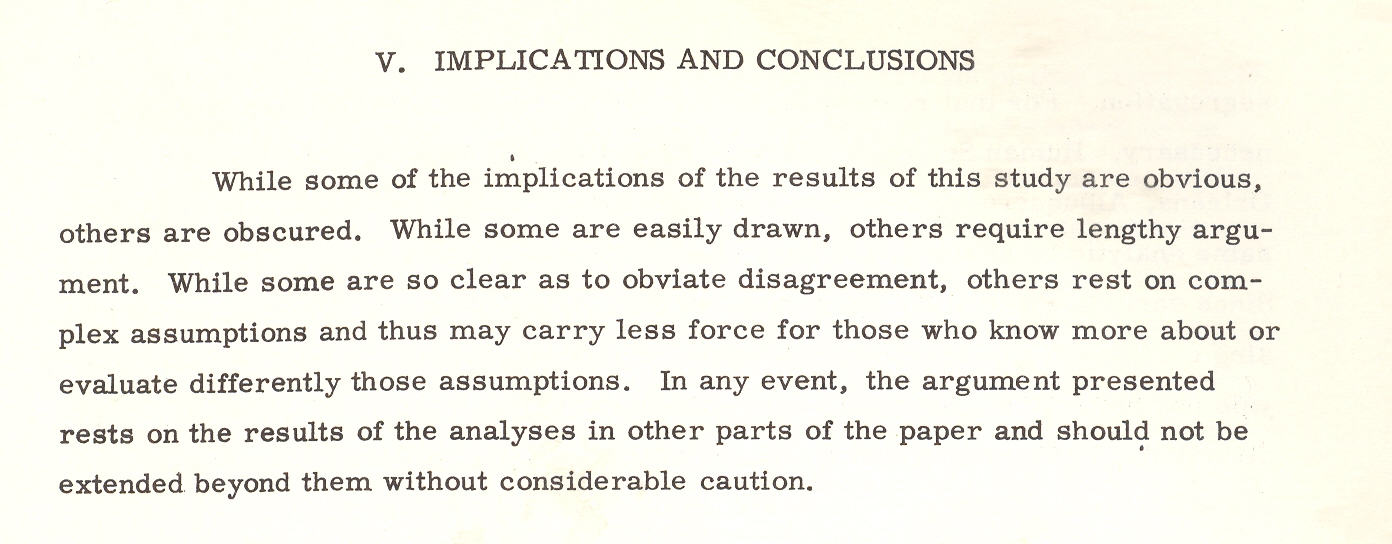
Back
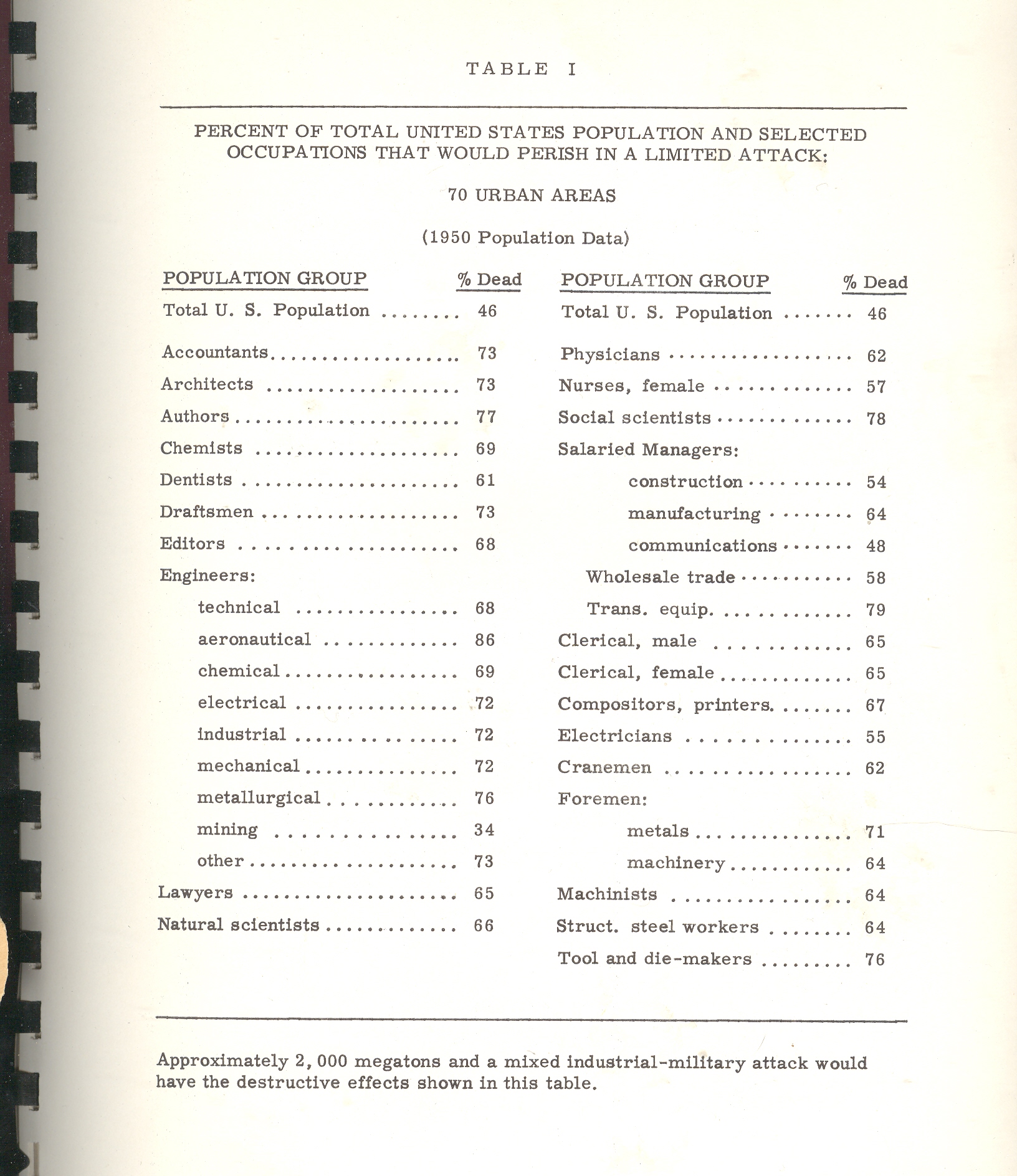
to the pamphlet and the interesting table that attracted my attention. According to one study [and for the sake of
brevity I’m not going to describe the scenarios or data estimation methods and
so on] the U.S. would suffer 46% casualties [meaning immediate deaths and not
as a result of radiation or illness or starvation or the encyclopedia of
whatever that would lead to death somewhere down the road]. The resulting demographic of the “perished”
by job description postulates that the most-killed category of worker would be:
(#1) aeronautical engineers, 86% dead; (#2) transportation equipment salaried
manager, with 79% killed; (#3), social scientists, with 78% of them going down
with their clients; (#4), authors, with 76% gone.
Authors? Of what, I wonder? The good ones with the bad? Are authors different from writers? And what do you call folks who produce tv
shows? Since the stats here are for 70
cities there’s no wonder that there aren’t any farmers in this table, as the
majority target areas (some 450 cities cited elsewhere as targetable, including
my own little burgh of
folk in them. And so I’m guessing that
three-quarters of all “authors” in 1960/6 were living in these target cities
and were going to go up in smoke. The
aeronautical engineers category is more understandable as every one of those
industries employing 50 or more people would be a target; frankly I’m surprised
that given the possible firepower of the
in 1966 that 14% would survive; I’d guess offhand that the number would be
2%.
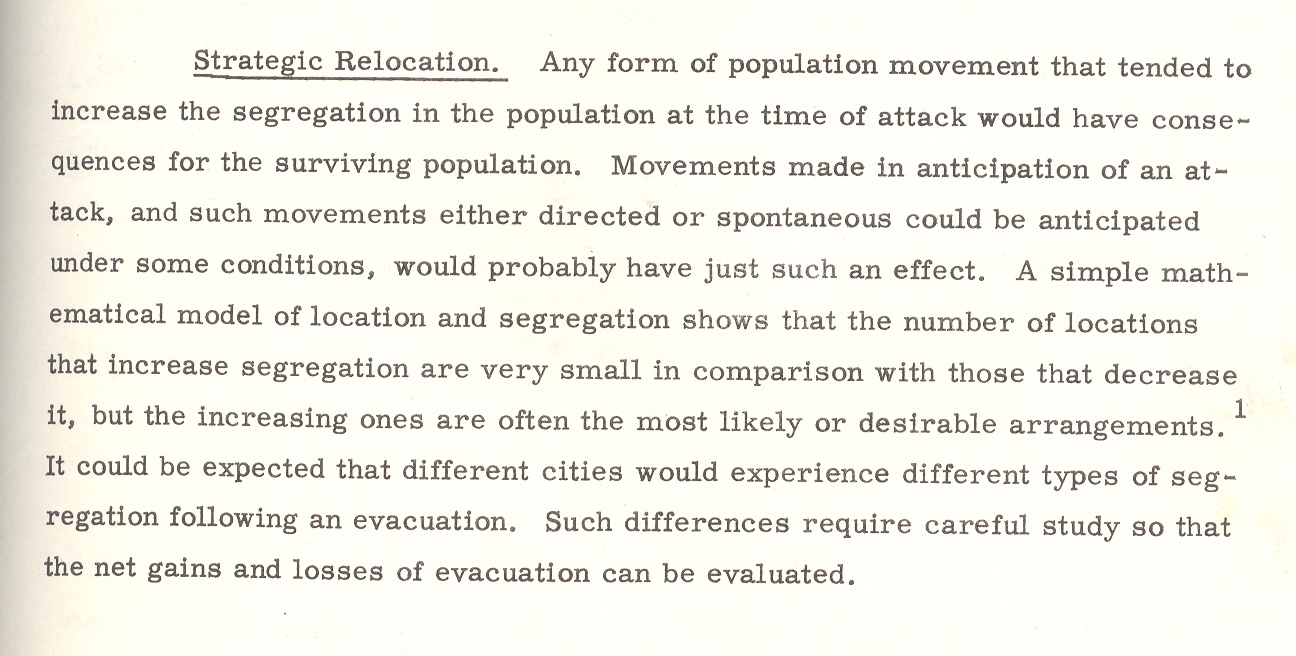
Even
though this stuff is spread out in only 98 pages or so it would keep a person
busy segregating the Orwellian gems from those not; it would be a tricky
business as most of the “text” in the “not” category would be largely limited
to prepositions.
Here’s
another bit: a parenthetic poke at the
post-attack composition of Congress. It is stated that the “postattack”
(hyphenated no longer) Congress would be “quite different”.It would also be (“in
their eyes”) “more Conservative than the pre-attack (hyphenated!) Congress.
It isn’t a cause for great prognosticational (?) liberty to assume that
the Congress might be more Conservative, but why on Earth did the author
qualify the assumption by saying “their eyes”?
Pish and posh.
The
paper goes on its merry way, connecting the necessaries of Goldbergian delight,
and somehow nothing ever happened, which to me is a secret miracle. Especially given the weight of papers like
this one, which seems to medicate the effects of war, assuming that there will
be a Congress and that people will report back to work once the factories are
rebuilt and that there will be more segregation in the colossal world of post-attack
America, and on and on into the red dawn.
Mr.
Mencken’s view of Warren Harding comes to mind when I read this stuff and
wonder about how it was that we didn’t blow the whole place up:
“I
rise to pay my small tribute to Dr. Harding. Setting aside a college professor
or two and a half dozen dipsomaniacal newspaper reporters, he takes the first
place in my
say, he writes the worst English that I have ever encountered. It reminds me of
a string of wet sponges; it reminds me of tattered washing on the line; it
reminds me of stale bean soup, of college yells, of dogs barking idiotically
through endless nights. It is so bad that a sort of grandeur creeps into it. It
drags itself out of the dark abysm of pish, and crawls insanely up to the
topmost pinnacle of posh. It is rumble and bumble. It is flap and doodle. It is
balder and dash.”
Notes
1. The
abstract from the above paper: “The basic problem with which this report
is concerned is that of determining the kinds of demographic change that might
result from a range of nuclear attacks, ascertaining the effects of those
changes on the future of the surviving populations, and indicating possible
areas for Civil Defense action and planning. Earlier studies of the demography
of nuclear war were examined and their relevant conclusions and methodology
incorporated in the report. A different methodology–expected to be more
sensitive to compositional effects–was then designed. The new methodology was
tested and found to be more effective than the old. Surviving populations
representing a wide range of variation in attack conditions were created on the
basis of both old and new methodologies, and the demographic significance of
these populations was examined. Assuming a range of post-attack demographic
conditions, a series of projections was made on the surviving populations. The
demographic significance of the recovering populations was then examined. On
the basis of the analysis a series of recommendations relevant to Civil Defense
planning was made: Within the framework of this analysis the crucial variable
is the demographic pattern of the city. Changes in composition, as well as
size, could be of substantial magnitude and would last for generations in some
cases. Cities differ in the kinds and magnitudes of change to which they might
be subjected. Considerable variation in the demography of surviving populations
can be expected; that variation would be related to policy decisions; and those
decisions should therefore be examined for their demographic implications.”