JF Ptak Science Books Post 1863
After billions of work hours invested in the Absolutely Enormous project to build atomic weapons in WWII, much of it (for a short period of time, anyway) was balanced in the hand of Sergeant Herbert Lehr:
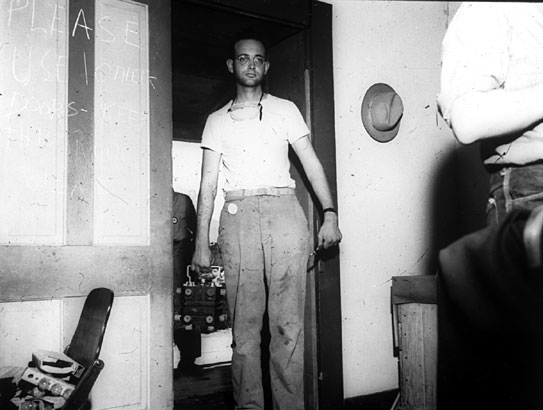
This was the plutonium core (or in one caption, “half” of it), being transported by the sergeant, the plutonium housed in a shock-proof carrying device, passing through the door to the assembly area at the George McDonald Ranch farmhouse. (The image first spotted by me in Richard Hewlett’s The New World, 1939/1946, Volume 1, a History of the United States Atomic Energy Commission, 1962.)
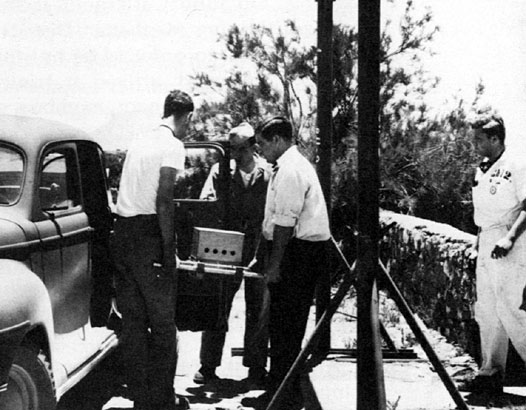 The photo above shows the plutonium being delivered to the McDonald Ranch, carried from the Plymouth through the small wooden structure that we can clearly see in the color photo below, in which you can also see the short stone fence that surrounds (in a roughly 85’x85′ square) the compound. The plutonium was then sent into the dining room, which had been converted into a clean room, where the device was assembled.
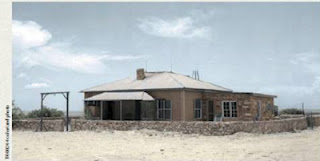
(Source: Nuclear Weapons Journal, March-April 2003, p. 21, via the very interesting Diehard Empiricist site.)
The McDonald Ranch was right there at the heart of the Trinity Test Site, or nearly so (the explosion on 16 July 1945 being about two miles away, slightly damaging the structure), in the Llano Estacado. This is a section of New Mexico and Texas (the “Staked Plain”), which had for centuries been a ruthlessly mercy-free zones for people for centuries until it was conquered in the late 19th century–a hard and arid place where people disappeared. Much of the Trinity Site was actually located in the Jornada del Muerto, or “Path of the Dead Man”, or more poetically, the “Dead Man’s Walk”.
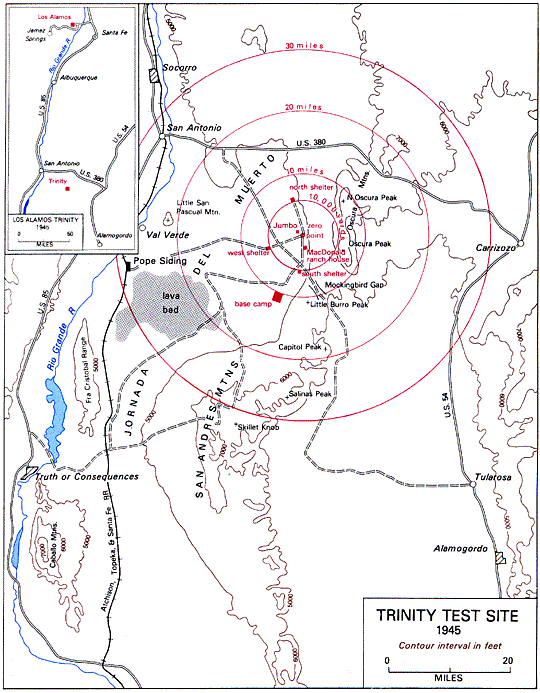 (Source: Trinity Remembered site, here.)
In any event, seeing the plutonium core taken out of a Plymouth and moved into a converted farmhouse and ultimately carried in one hand by a U.S. army sergeant into an assembly area that used to be a bedroom created an odd emotion, one that I’m still trying to identify, seeing the smallness of it all the result of enormous expenditures of energy and effort and brainpower over a thousand-day period all represented in the hand of one man.
See also: ALSOS: Trinity Remembered, here and Atomic Archive