A Daily History of Holes, Dots, Lines, Science, History, Math, Physics, Art, the Unintentional Absurd, Architecture, Maps, Data Visualization, Blank and Missing Things, and so on. |1.6 million words, 7500 images, 4.9 million hits| Press & appearances in The Times, Le Figaro, Mensa, The Economist, The Guardian, Discovery News, Slate, Le Monde, Sci American Blogs, Le Pont, and many other places… 5000+ total posts since 2008.
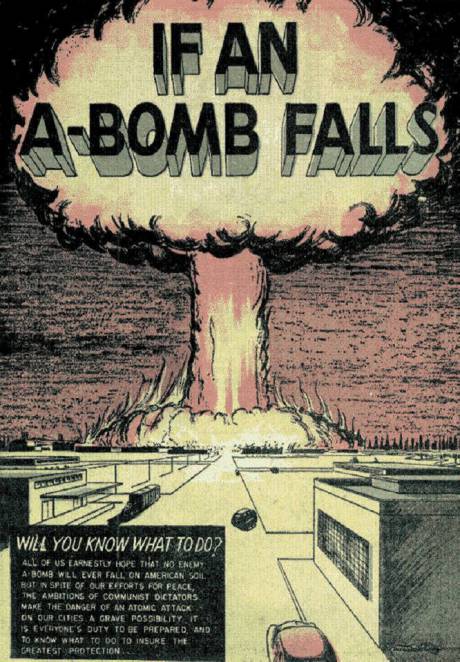
I was reminded of this 1951 pamphlet yesterday, a softly-shocking piece of Red Scare propaganda that played on everyone’s fear and offered not much more than newspaper and a hole for protection from a nuclear attack. But the thing I hadn’t noticed before was how quiet the very noisy cover is.
The point of view here is from a suburb, or exurb, and there seems to be nothing going on–not only is there no activity, but there are also wide swaths of no buildings where there should be. For example the second car on the right is parked at an empty city block-blob, and the whole of the foreground seems to be intensely deserted. It strikes me as odd, given that there is an enormous explosion going on less than a mile away. There is definitely a scene of destruction at the base of the explosion, though we also see the slight outskirts of the city dotted with factory silhouettes, which makes me think that this part of the illustration was also selling a hope-to-survive-vibe.
Covers of pamphlets/comics are legion with more vicious examples of apoca-art–even those publications aimed at kids, like this one–so it wasn’t like the times were too gentle to portray real destruction and chaotic noise and viciousness, so I’m not sure what this artwork is really trying to achieve–except that it does manage, in away, to convince a viewer that there may be some calm in the soup of horror.
Describing computer programs “Picnic” for biological/chem weapons damage, and “Dusty” , for radioactive casualties
While preparing for all eventualities of all-out toe-to-to conflict with the Ruskies it is of course advisable to have ways to figure out what might be left after an “exchange” and how it might be used–but really, the important thing is to be able to have an inventory of the post-apocalypse world so that plans could be made for the next part of existence.
And that is what the following workbook outlined in part.
Mathematics and Computation Laboratory, National Resource Evaluation Center, Analytical Program Compendium NREC Technical Manual No. 119 (Revised) (December 1964. 11×8″. 92 pp. GVC-bound, with stiff wrappers of the Executive Office of the President NREC/Office of Emergency Planning) holds some of overall answers to the survival issue.
The preface is signed by Joseph D. Coker, (Chief, National resource Evaluation Center) who writes: “The Analytical Program Compendium gives a brief description of the National Resource Evaluation Center’s current general purpose analytical programs and replaces earlier editions of the NREC Glossary of Damage Assessment Programs. It is intended as a guide for users and potential users of these programs to indicate the various programs that are presently available and those that are being produced. Separate Technical Reports or Technical Manuals are available for the standard operating programs and for a number of those which are in preparation. Reference to these manuals and reports can be obtained in the Bibliography of Publications (Technical Manual No. 121) published by the NREC. The Compendium contains descriptions of the computer programs of a substantive nature.”
[The NREC and the Office of Civil Defense used the UNIVAC scientific programs USE assembly language and 3600 Fortran.]
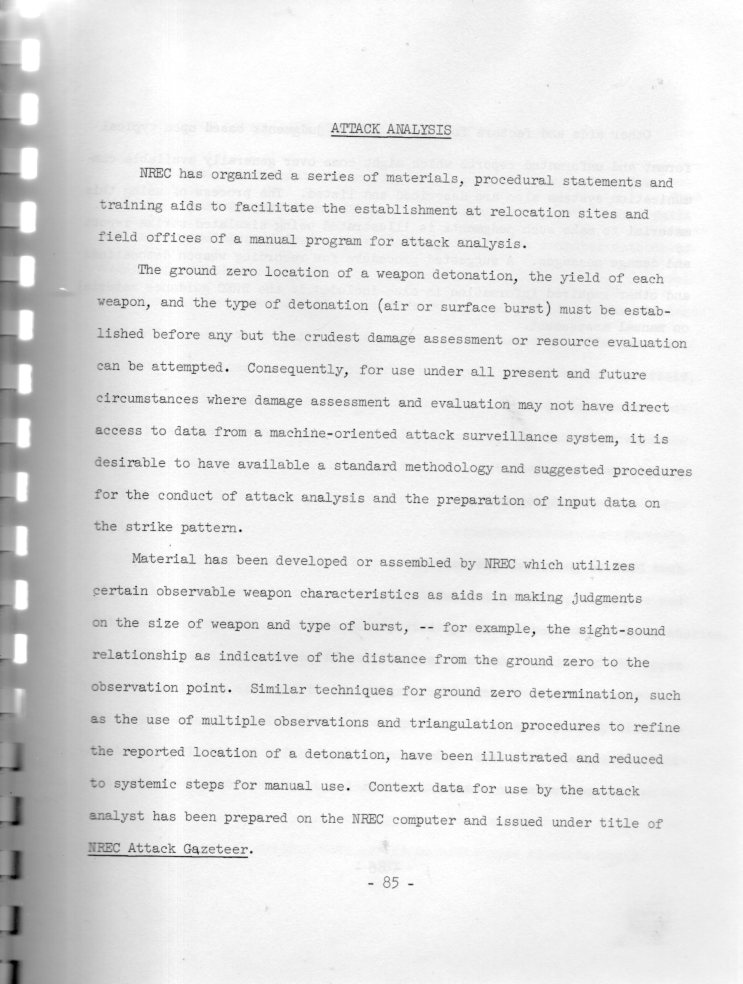
The list of the contents of the 92-page work is pretty interesting, the book presented in eight sections (or “casualty classes programs”): (I) Attack Analysis Programs; (II) Vulnerability Analysis Programs; (III) Damage Assessment Programs (Direct Effects, sections dedicated to nuclear shots Dusty III, Flame I, Jumbo III, Streak IV, Dart II, Dart III, Picnic, Ready I.(IV) Resource Evaluation Programs; (V) Economic Analysis Programs ; (VI) Resource Management Programs; (VII) Mapping and Display; (VIII) Manual Procedures for Damage Assessment and Resource Evaluation.
Under section III are described the various other programs computing availability of surviving resources and damages to the rest, and to assess capability and loss. For example: Weapons Edit III (working on an 1103 AS or 1105 computer) calculates missile availability; Dusty III (fallout intensity “…at weapon oriented points”; Flame I (“computes an estimate of the extent of the spread of uncontrolled fire”) and can compute fire maps; Jumbo III (a casualty assessment program); Attack Environment III (“determines the blast effect from the dominant weapon and combines the separate effects of fallout and from from all weapons that affect each resource point”); Facility Assessment (Namepoint) III ( for physical damage to facilities); Time-Phased Accessibility (“listing of accessibility of resources in various conditions of damage after an attack”); Population III (summing up casualties in populations after attack; Manpower III (translating population losses into labor losses and how it would affect x,y, and z); Livestock III (keeping tabs on livestock “and livestock products”); Streak IV (‘high speed estimate of blast and fallout casualties, estimates of damage and denial of facilities…”); Picnic (!, estimating casualties from biological or chemical weapons), and a number of other programs.
There are some other interesting programs for end game times: Net Inventory (“(a) routine (that) is a balance sheet between supply (inventory and production) and demands (requirements)” and Amounts of Production (“a routine (showing) the production based in facility damage and labor casualties; and of course Survival II, which computes “the total requirements…for regions”.
Of course it was necessary to figure all of this stuff out so that in the event of The Big One there is a certain control over what is where and what is left and what is needed and so on.
The last section helpfully describes programs of manual damage assessment (“developed by agency representatives for use when computer estimates are not available”).
There is no mention made to where these computers are housed.
Below are 66 examples of Cold War era stuff and consumer bits relating to atomic/nuclear and big-boom weapons. All are found in my pinterest page, here, which also houses about 4,000 odd/interesting images that have been collected by Dr. Odd of the Unbelievablorium.
I had never seen this video/film before last night–it is pretty solid, and interesting, and I’m a little surprised because for a general-public sort of production it makes some good-sized presumptions of its audience in relation to any physics background. Most of all though there are appearances of Albert Einstein (at 52:15 and 1:01:14), Otto Frisch (1:03:00) and J.D. Cockcroft (1:17:50).
Source: U.S. National Archives http://research.archives.gov/description/88106
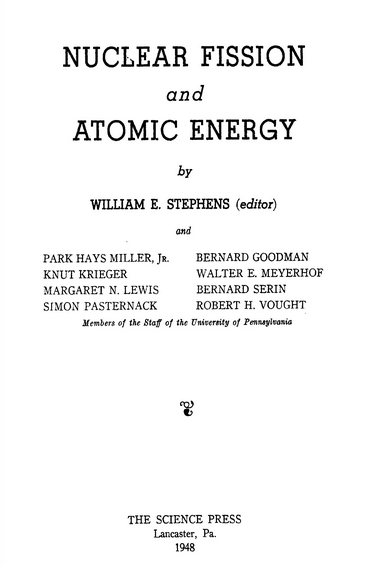
Here’s a very useful tool for the early days of nuclear fission and atomic energy–the bibliography from William Stephen’s Nuclear Fission and Atomic Energy (published by the Science Press in 1948). The OCR is a little unsteady but the info is there even if it isn’t as clear as it might be.
The full text for the work is found at the Internet Archive, here: https://archive.org/details/nuclearfissionan030064mnb
Also see the excellent Louis Turner bibliography for nuclear fission, 1934-1940 (133 items) in an earlier post on this blog, here: https://historyofideasblog.com/thesciencebookstore/2013/08/turners-bibliographic-review-of-nuclear-fission-1934-1940.html
Partial Bibliography on Nuclear Fission and Transuranic Elements
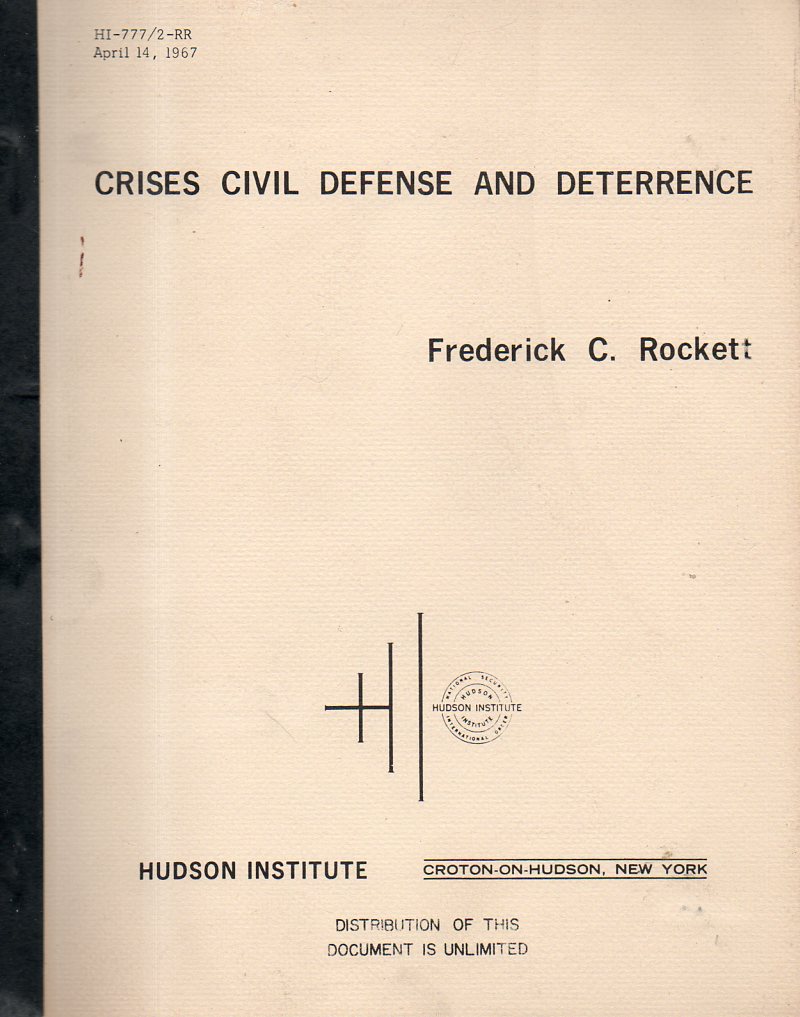
Frederick Rockett’s Crises Civil Defense and Deterrence makes a curious display of itself on it title page, what with no punctuation and all–same for the title page, though that changes a little to Crisis Civil Defense and Deterrence. With a comma here and there, the title changes meanings a bit. In any event with my little screed over the document was published by the Hudson Institute in 1967 and is actually about how the Soviet Union, China and some other countries could reduce their vulnerability to nuclear attack by undertaking (emergency) civil defense precautions like large-scale evacuations and fallout protection. The author adopts a curious term here–“hostages”–to apply to the civilian population in relation to the nuclear policy of deterrence. And what that means is that with increased numbers of civilians surviving there would be a greater recover capability after a nuclear strike; in deterrence, enemy populations are part of the scheme, being seen as “hostages” to a nuclear strike and therefore a deterrent for that country to initiate an attack. With an increase in the number of survivors to an attack via the civil defense advancements there are fewer “hostages” and therefore the concept of deterrence is weakened, perhaps to the point where countries could begin to think of first-strike capacity with a more-protected population.
[The original document is available for sale at the blog’s bookstore, here.]
And so down the rabbit hole we go, discussing mine shaft gaps. This is five year after Dr. Strangelove, but this was very real stuff–and I imagine that if I were in a position to have to think about nuclear strikes and deterrence and etc., I probably would have been thinking in these terms, too.
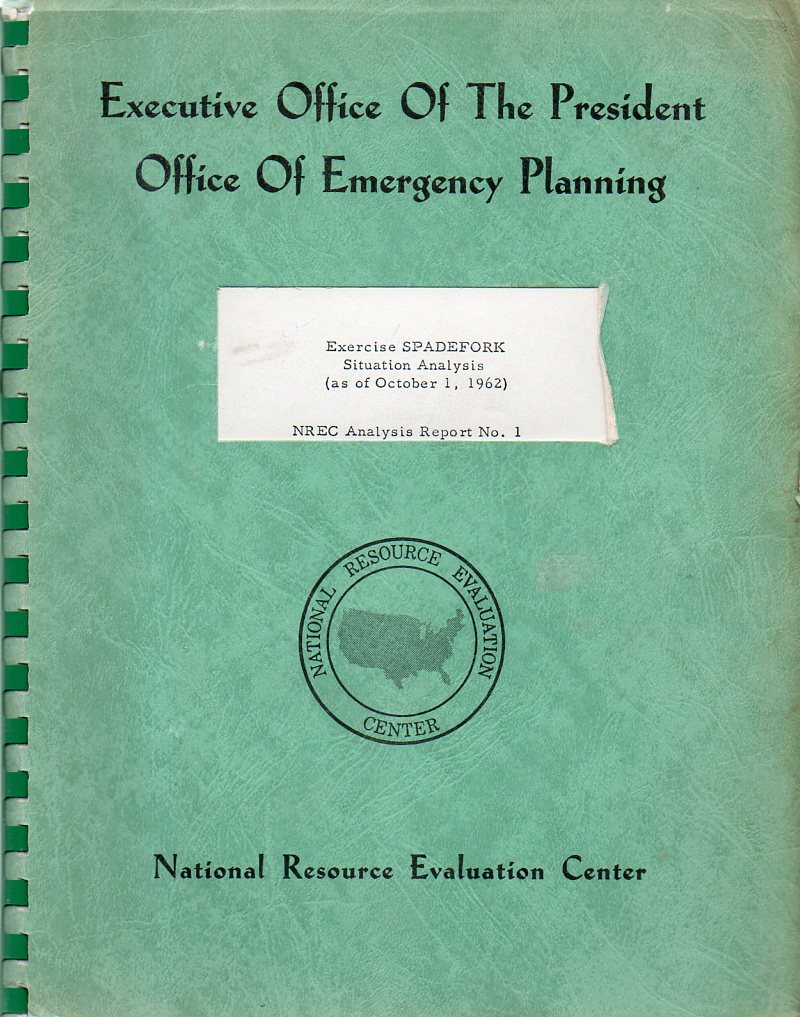
This report on Exercise Spadefork was issued at the very beginning of the Cuban Missile Crisis on October 1,1962. Undertaken by the National Resource Evaluation Center (NREC) and other agencies it was supposed to give a good indication of what happens after a very large nuclear attack on the United States, “Measuring the Capability of Survival”, evaluating what remains of the country and its sovereignty.
The theoretical attack began at 3pm, Friday 21 September 1962. 221 nuclear missiles were exploded in/over the U.S. In the first hour, with a total of 355 in the first 48 hours. [I’m not sure that the Soviet Union had 221 intercontinental ballistic missiles at this time, nowhere near that, unless of course they were able to get their 700-missile medium-range ballistic missiles closer to the U.S.]
A total of 1, 779 megatons were exploded almost equally between ground and air bursts.
20 were 1 megaton; 15 were 10 megaton, and 320 were 5 megaton.
The Hiroshima weapon was about 20 kilotons, so in the roughest sense each one of the 5 megaton weapons carried about 250 Hiroshima weapons; the total 1,779 megaton delivery would (grossly) be equal to about 178,000 Hiroshima weapons.
Most of the attack was delivered against military sites, “population and industrial centers appeared to be secondary targets, with only about 50 major centers receiving signifcant amount of blast damage”. Somehow “no major sections of the country were isolated due to fallout contamination”.
How we make out:
Military & “Sovereignty”: not so bad. Air Force and Navy take major hits (something approaching 50% casualties) but the Army does better, not being targeted so heavily, with 20% losses.
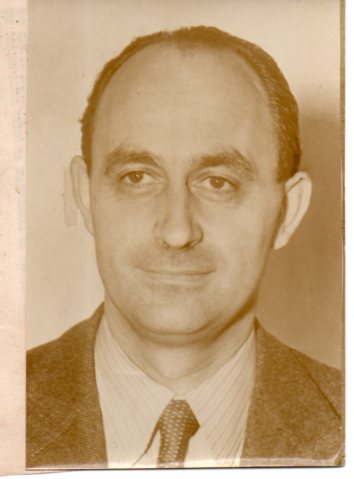
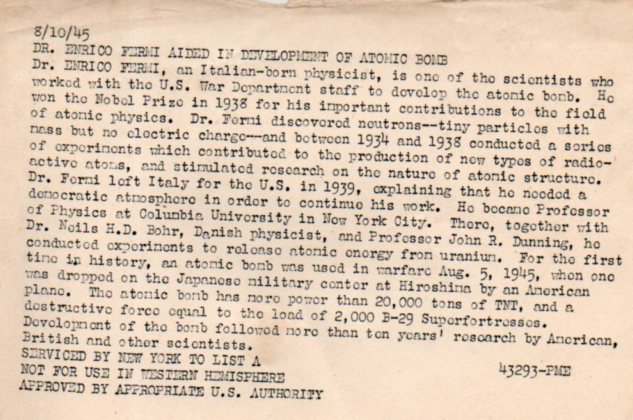
This is a good, typical portrait of Enrico Fermi–the thing that makes it “unusual” I think is that it comes with the official caption and also is dated just a few days after the bombing of Hiroshima and Nagasaki.
[Source: private. 6 1/2 x 4 1/2 inches, sepia-toned, head-and-shoulders portrait of Fermi.]
The photograph is definitely original and at the very least an issue of either a news photo service agency or the U.S. Government. Given how quickly the image was released with its association to the atomic bomb (just four days after Hiroshima) I’m guessing that this is a federal source. My limited experience with governmental press releases concerning the atomic bomb leads me to believe that this was issued on 10 August–the government no doubt had prepared documents like this for pre-release (as we have seen with the initial Trinity tests and documents associated with that), but I feel confident that this photo and description are in fact in the first wave of “publicity” following the use of the bombs at Hiroshima and Nagasaki.
We saw it, and prepared for it, the Impossible Thing, the oncoming of megakilll, or what Henry Adams called The Distinguished Thing, acknowledged and prepared and built ourselves a reserve of anti-fear for it.
Once the Soviets demonstrated their capacity to field and then deliver an atomic weapon in August 1949, the great race to Armageddon was underway, a zero-sum game of nuclear dimensions, where an canonical victor is mostly that in name once the million-megaton war was fought and over.
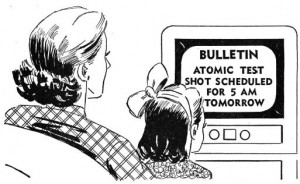
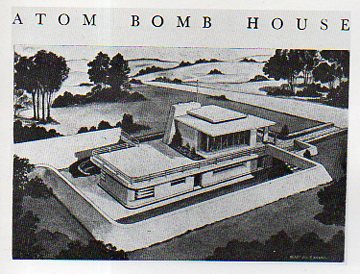
The best that could be done so far as the general American population was concerned was to stockpile foods, recognize the sounds and sights of an attack, pay attention to the EBS, and possibly prepare for the worst by digging a fallout shelter, or hide under your wooden desk at school, or wear an atom bomb suit, or build an atom bomb house. Of course if you lived in the 100+ metro areas that were deemed targetable you could also plan your escape route; however,
since hundreds of thousands(and more) other drivers would be thinking the same thing, getting out of town might not be a possibility. (This was true even if you paid to one of the government-issue nuclear attack evac maps and stayed to the even/east odd/west as dictated by your car’s tags, there would still be an impossible mess.)
[Image source: Yesterday’s Tomorrows: Past Visions of the American Future, by Joseph J. Corn, a slender and pretty book and very easy to underestimate–it is a wonderful work of real depth and reach, remarkable given its brevity.]
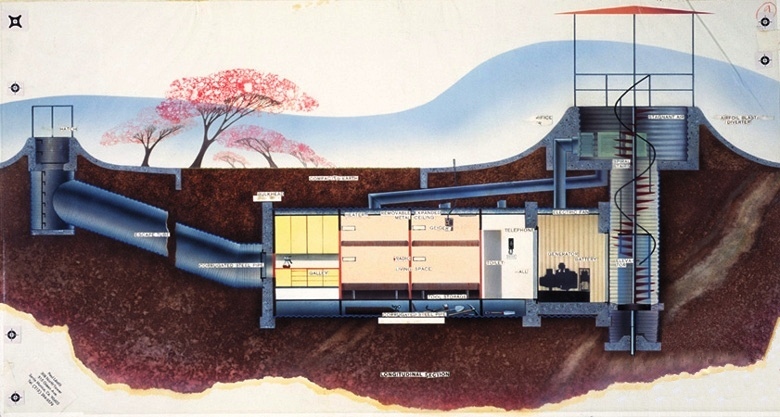
The Atom Bomb House, by Robert C. Scull and Jacques Martini, was designed and published in 1946, and for all intents and purposes supposed that the house and furnishing and all inside it would be safe from an atomic attack. The blast walls around the house’s perimeter are a curious touch, and actually look pretty nice–I don’t know how much they would deflect the effects of an atomic bomb, though. Still, it was a way around thinking about the impossible.
Making the next logical leap, I guess, the architect Paul Laszlo presented Atomville in 1954, which was a collection of dwellings and structures that were bomb-survival as part of a design-survivable community.
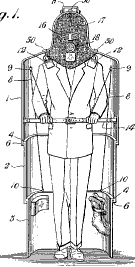
And of course there was some thinking about making each person their own Atomville, with atomic bomb suits (which I wrote about earlier on this blog, here):
[Source: U.S. Patent and Trademark Office, via Google Patents]
So for 15 or 20 years of getting ready for the Soviets to attack Americans were probably desensitized to what that attack actually meant–after hundreds or thousands of warnings and exposure to the possibility of war and nuclear holocaust, many people grew immune to what it all actually meant, swirling away in the mists of Mutually Assured Destruction like a bad song that you know by heart because you’ve heard it on the radio fifty times.
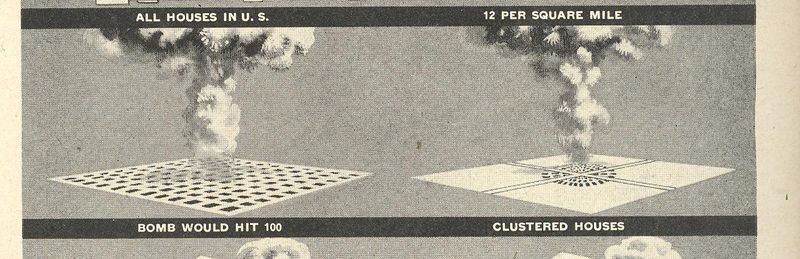
Then there were those like Ed Teller who thought to spend the equivalent of many multiples of trillions of dollars in the hopes of spreading the country out so that there was an equal distribution of people and factories and such, making the U.S. impossible to attack because there were no centers of population and industry, meaning that the USSR would have to attack everything, everywhere. This would have involved building 20 million new homes and all of the infrastructure that goes along with that, as well as moving all business and relocating all of the means of production in the United States. That was a towering idea that towered low, but it did represent another line of thinking on survivability that moved from the Atom Bomb House to Atomville to the seeming opposite of those, to AtomExUrbia. (See here for the fuller story.)
[Image source: LIFE magazine in (15 June) 1947]
So preparing for the worst, preparing for the thing that you really couldn’t prepare for, became an object of desire.
It was as though people could not see the forest for the trees–which is quite ionic, because one piece of nuclear weapon test films that is no doubt very familiar to most anyone over 40 depicts a “forest” being blown apart by a blast. The “forest” was actually a stand of trees constructed in the Nevada desert to see what would happen to flammable trees in a nuclear conflagration. (“…The U.S. Forest Service brought 145 ponderosa pines from a nearby canyon and cemented them into holes lined up in tidy rows in an area called Frenchman Flat, 6,500 feet from ground zero. Then the Department of Defense air-dropped a 27-kiloton bomb that exploded 2,423 feet above the model forest…” on May 8, 1953.1) Not surprisingly, they were mostly destroyed, even using a tactical nuclear weapon. I guess that the issue was not if they would be destroyed but how destroyed they would be. Still, looking at a forest and looking at a nuclear weapons test would leave little doubt that the forest would be pretty-well destroyed–it’s just the distance that the destruction would reach would be open to question.
Notes
1. Check here for the atomic bomb test on the artificial forest in the Nevada desert (an article by Ann Finkbeiner in Slate).
Well: this is “inside” the book in which nuclear fission is announced–the backstrip/spine was pulled away on one edge from my um “lovely” copy of Naturwissenschaften, volume 27, 1939, to reveal the chocolatey-nugget equivalent of the guts of a book. This is the famous volume which contains (at least) six seminal contributions in the history of nuclear physics including the big one by Otto Hahn and Fritz Strassman (on January 6) in which they announce the discovery of uranium fission1. The spine cover is still hinged on one side, making it a convenient flap to see the covering for the glue etc. holding the sewn signatures and the spine together.
The anatomy of the book reveals a pretty and interesting art-ish composition, with a surprise: there are major elements of Albert Ein(stein’s) name display, clear as an azure sky of deepest summer (a line by Peter O’Toole from The Ruling Class).
This is highly appropriate. Einstein naturally knew of all o these developments and felt deeply threatened by them because of the next step, which would be atomic-bomb-building. So on August 2, 1939, he and Leo Szilard wrote a letter to Franklin Roosevelt urging American development towards this end, because surely the Germans would be up to it as well. Although written in August the letter (the first of three) would not be delivered by Szilard to the President until October. I think that it can be safely said that this meeting was the first step in the development of the Manhattan Project. Roosevelt’s immediate reaction in this meeting was to insist that the U.S. do The Mega Big Something to ensure that “the Nazis don’t blow us up”.
In any event, I found it at first artistic and then weirdly interesting that Einstein’s name almost appears in the hidden part of this important volume.
Notes
1. This would be cleared up further as nuclear fission by Lise Meitner in the February 11 1939 issue of the journal Nature.
The papers contained in this volume of Naturwissenschaften:
HAHN, Otto and Fritz Strassmann. Six papers announcing the discovery of nuclear fission, including:
“Über den Nachweis und das Verhalten der bei der Bestrahlung des Urans mittels Neutronen entstehenden Erdalkalimetalle” (On the detection and characteristics of the alkaline earth metals formed by irradiation of uranium with neutrons)
____. Nachweis der Enstehung aktiver Bariumisotope aus Uran und Thorium durch Neutronenbestrahlung’ Nachweis weiterer aktiver Bruchstucke bei der Uranspaltung.
____. Uebervdie Bruchstucke beim Zerplatzen des Urans
____. Zur frage nach dervEzistenz der “Trans-Urane”.
____. Weite Spaltproduckte aus der Bestrahlung des Urans mit Nuetronen.
____. F. Strassmann und S. Fluegge. ueber einige Bruchstuckebeim Zerplatzendes Thoriums.
All in Die Naturwissenschaften volume 27. The volume of 862pp.

![Just 14 years before Slim Pickens in Stanley Kubrick's "Dr. Strangelove," Kirk Alyn (as Superman) took a somewhat less fatal missile ride in Columbia's "Atom Man vs. Superman," (Chapters 12-15). [pr]](https://media-cache-ec0.pinimg.com/236x/29/77/9f/29779facbdcf5eaccedee3ae5080c0c1.jpg)