JF Ptak Science Books Post 2418
This report on Exercise Spadefork was issued at the very beginning of the Cuban Missile Crisis on October 1,1962. Undertaken by the National Resource Evaluation Center (NREC) and other agencies it was supposed to give a good indication of what happens after a very large nuclear attack on the United States, “Measuring the Capability of Survival”, evaluating what remains of the country and its sovereignty.
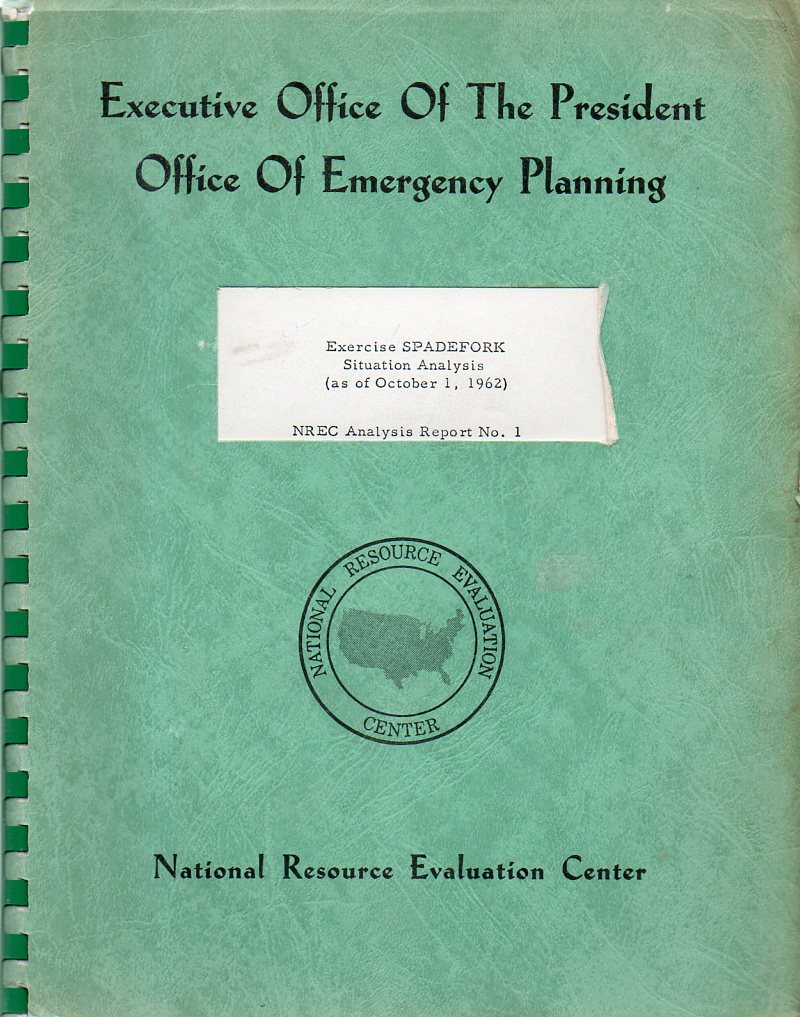 The theoretical attack began at 3pm, Friday 21 September 1962. 221 nuclear missiles were exploded in/over the U.S. In the first hour, with a total of 355 in the first 48 hours. [I’m not sure that the Soviet Union had 221 intercontinental ballistic missiles at this time, nowhere near that, unless of course they were able to get their 700-missile medium-range ballistic missiles closer to the U.S.]
A total of 1, 779 megatons were exploded almost equally between ground and air bursts.
20 were 1 megaton; 15 were 10 megaton, and 320 were 5 megaton.
- The Hiroshima weapon was about 20 kilotons, so in the roughest sense each one of the 5 megaton weapons carried about 250 Hiroshima weapons; the total 1,779 megaton delivery would (grossly) be equal to about 178,000 Hiroshima weapons.
Most of the attack was delivered against military sites, “population and industrial centers appeared to be secondary targets, with only about 50 major centers receiving signifcant amount of blast damage”. Somehow “no major sections of the country were isolated due to fallout contamination”.
How we make out:
Military & “Sovereignty”: not so bad. Air Force and Navy take major hits (something approaching 50% casualties) but the Army does better, not being targeted so heavily, with 20% losses.