A Daily History of Holes, Dots, Lines, Science, History, Math, Physics, Art, the Unintentional Absurd, Architecture, Maps, Data Visualization, Blank and Missing Things, and so on. |1.6 million words, 7500 images, 4.9 million hits| Press & appearances in The Times, Le Figaro, Mensa, The Economist, The Guardian, Discovery News, Slate, Le Monde, Sci American Blogs, Le Pont, and many other places… 5000+ total posts since 2008.

Category: Atomic and Nuclear weapons

  • JANCFU on Yellow: Nagasaki, August 9, 1945

    JF Ptak Science Books   Post 2515  [Part of the Atomic and Nuclear Weapons Series]
    Somewhere between transporting the Fat Man bomb to the loading lift and raising it up into the bomb bay of Major Charles Sweeny’s B-29 Superfortress Bockscar,  it acquired a stencil-painted acronym: JANCFU, right on its nose.  

    JANFU detail

    [Source:  http://military.wikia.com/wiki/Fat_Man]

    It was black on a bomb painted mostly yellow, a zinc-chromate yellow.  The yellow similar to the cover of Dr. Seuss’ One Fish, Two Fish…; the color yellow symbolizing courage/nobility in Japan, Wisdom in Islam, and a deity-color in Hinduism; the color so fond of many great writers like London and Doyle, and Harte and Stevenson that they employed in in titles of the books.  The favorite color of Van Gogh1, and perhaps not-so-favorite of Shakespeare (appearing in references to bile and melancholy and falling leaves), it is usually a positive color–except that it also can signify cowardice, ego, caution, and illness (malaria, jaundice).  It is also the color of the Star of David worn by Jewish people living under Nazi-occupied/controlled places/  

    JANFU

    Fat Man was yellow.  But it was yellow because like a fire truck it was the easiest and quickest thing for the eye to register, and what needed to be registered with Fat Man was its trajectory on its way down to detonate 1640 feet above Nagasaki.  

    JANCFU, painted or airbrushed on the nose of the bomb at the last moment, or so it seems, stood for “Joint Army Navy Civilian Fuck Up”.

    It was hardly that.  It was like another yellow–Yellowstone–but of a different sort of indescribable awesomeness, this more like an impending enormity, too large to be known.  

    Fat Man movie

    [Source: Business Insider, For the video, see here:  http://www.businessinsider.com/nagasaki-raw-video-2014-2   The article is worth the read, but if you just want the video, scroll to the end.]  

    Notes:

    1. The Van Gogh museum’s “Van Gogh Letters” is a must-visit if you are interested in his correspondence. http://vangoghletters.org/vg/  Actually the word “green” pops up about 15% more often than “yellow” as the most often mentioned color in the correspondence, though I think that the scholars say that his favorite color hands-down was yellow.  

    John Coster-Mullen’s  Atom Bombs: The Top Secret Inside Story of Little Boy and Fat Man must be the most complete description of the bombs ever published.  And it was accomplished by the relentless study of the “nuclear archaeologist” Mr. Coster-Mullen, a truck driver by trade who had no formal education in physics or metals or engineering.  He produced not only this remarkable work, but also created a life-size nearly perfect replica of Fat Man. I’m pulling up this reference because in there Coster-Mullen states that it was Project Alberta engineer Harlow Russ who painted the JANCFU on the bomb.  There was other stuff written on the bomb, but nothing quite so surprising, or shocking, than this.  Perhaps the small tattoo underneath the acronym is almost as shocking, but not really–the Fat Man bomb profile with the letters “FM” (“Fat Man”) in the interior of the design has its moment of shock/recognition, as though any identifier was needed for the thing.  (It is like the surgeon circling the correct kidney he needs to remove, drawing on their patient–just in case there was any confusion, this stencil assured everyone that this was indeed what it was.)  See this great article in The New Yorker about Coster-Mullen, here.  


    ·Posted by :

    ·in:


  • A History of Holes: the Hole in the Clouds Over Nagasaki, revisited

    JF Ptak Science Books  (An earlier post from 2010, revised)    [Atomic and Nuclear Weapons Series]

    This post is one in a continuing series on the history of holes–the appearance of this particular hole meant the difference of life and death for hundreds of thousands of people, and it killed almost as many people as it didn’t kill. 

    The hole was in a cloud.  It was a corollary cloud to missing clouds from a few days earlier. 

    NagasakiCloud1Large


    On 6 August, 1945, the primary target of the first atomic bomb to be dropped on Japan was Hiroshima1–had there been unfavorable weather conditions, had the target been obscured by clouds or haze, a second target would be engaged–that was the Kokura Arsenal on the north shore of  Kyushu.  But conditions were bomb-favorable on that day, and Hiroshima was the city that was killed. Little Boy, the U-235 bomb dropped by Paul Tibbets from the Enola Gay  exploded 1,900 feet above Hiroshima. The bomb detonated and–with blast and shock wave and the ensuing damage and conflagration–70,000-80.000 people were killed (and at least double that number within five years).       

    It was a day before the news of the bombing was verified for Tokyo, and another day before the Big Six leaders of the Japanese army and government decided that they couldn’t decide in what to do with the Potsdam declarations and order of surrender.  It was a raging debate among those leaders, and it was a failure.           

    The second bomb, the plutonium Fat Man, was to be dropped by Major Charles Sweeney from Frederick Bock’s  B-29  Superfortress Bockscar on the next target, which was decided to be the  Kokura Arsenal.  And so Fat Man was taken over Kokura on 9 August, but by the time Major Sweeney (who had piloted the Great Artiste behind the Enola Gay on the Hiroshima bombing)  had arrived the previously comfortable atmospheric conditions had turned cloudy, overcast, the target obscured. Sweeney made three runs over the target, but it stayed hidden from the bombardier, and so the people of Kokura were spared. Major Sweeney tuned to his secondary target, Nagasaki.  With fuel running out, the clouds were also running thick over Nagasaki, until the last moment, when a hole opened in the canopy and the bomb was released through it,  exploding  with the impact of 22,000 tons of TNT at about 1640 feet above the city, killing 70,000 people (by the end of the year, 140,000 by 1950).

    The hills around Nagasaki confined the blast and protected those on the other side of them.  Kokura had no such terrain, which means that had the bomb been dropped there, even more people would have been killed outright and many more so over time. 

    The hole theory though is not necessarily complete–there may not have been a hole. Nobelist (physics) Luis Alvarez, who made major contributions to the firing mechanism for the weapon and a genius-in-general, and who flew as part of an Aerial Observation Team to assess the yield of the bombs, thought that perhaps there was a hole in the clouds and perhaps there wasn’t–“ostensibly” there was a hole, he wrote. Perhaps the bombardier saw the target, and perhaps not. In his Adventures of a Physicist (1989), Alvarez writes about the misery and the snaufedness of the mission, the clouds over Kokura and the multiple runs, the very low fuel which allowed only for one run on the Nagasaki secondary, and the growing accuracy of the flak from below. On page 145 he states that pilot Sweeny had decided against orders to attempt a radar-guided bombing of the 80% cloud-covered target–until suddenly the famous hole appeared, and bombardier Kermit Behan found the target and released the weapon.  Alvarez records that the bomb detonated about 2 miles off-target, which he said would have been a “reasonable error” for a radar-controlled drop, which would fit nicely with the his claim that Behan was Air Forces’s “best bombardier”.  Alvarez said that he took the report of the hole “with a grain of salt”2.  (See extract below.)

    In any event, some sort of hole opened for Nagasaki, and closed for Kokura.

    It is interesting to note that “the luck of Kokura” or “Kokura luck” is a translated Japanese euphemism for the unknown avoidance of disaster, of escaping a tremendous fate without knowing it.  (This appears often on the internet though I am using as a source The History and Science of the Manhattan Project, by Bruce Cameron Reed, Springer, 2014, pg 400.)

    Notes:

    New York Times correspondent William L. Laurence flew in the Great Artiste, following Bockscar  that delivered the bomb 1640 feet over Nagasaki. His report on Nagasaki appeared a month later in the newspaper, and the full text is available via the Atomic Archive blog here.  

    1. The targets discussed  by the Targeting Committee (“Minutes of the second meeting of the Target Committee, Los Alamos, May 10-11, 1945″) on 10 and 11 May 1945 included the following:
    (1) Kyoto (the former capital with one million people, a center of religious and intellectual life in Japan This target is an urban industrial area with a population of 1,000,000. It is the former capital of Japan and many people and industries are now being moved there as other areas are being destroyed. From the psychological point of view there is the advantage that “Kyoto is an intellectual center for Japan and the people there are more apt to appreciate the significance of such a weapon as the gadget”;  (2) Hiroshima (listed as an Army depot though “due to rivers it is not a good incendiary target”; (3) Yokohama (one of the largest remaining untouched industrial centers in Japan); (4) Kokura Arsenal (one of the largest in Japan and situated by urban industrial sprawl); (5) Nigata (port on Honshu) and (6)the Emperor’s palace (which was discussed  as a possible target but dismissed almost immediately).[Yawata was also considered (as an industrial center) (during the preliminary meeting of the targeting committee on 2 May 1945) (along with Tokyo, Nagoya, Osaka, Kyoto, Kobe, Hiroshima and Nagasaki.]
    .
    The members of the targeting committee (source for this material is Gene Dannen at Dannen.com, transcribing targeting material of the U.S. National Archives, Record Group 77, Records of the Office of the Chief of Engineers, Manhattan Engineer District, TS Manhattan Project File ’42-’46, folder 5D Selection of Targets, 2 Notes on Target Committee Meetings) included (on 10 May): “General Thomas  Farrell,  Dr. Charles C. Lauritsen, Colonel L.E. Seeman, Dr. Norman Ramsey, Captain Parsons,  Dr. Robert L. Dennison, Major John A. Derry, Dr. John von Neumann, Dr. Stearns, Dr. Robert R. Wilson, Dr. Richard C. Tolman, Dr. William G. Penney, Dr. Robert Oppenheimer.”  In attendance for the 11 May discussion was  Dr.Hans Bethe and Dr. Brode, plus: Colonel Seeman,  Dr. Stearns, Captain William S. Parsons, Dr. John von Neumann, Major Derr, Dr. Robert L. Dennison, Dr. Richard C. Tolman, Dr. Penney, Dr. Oppenheimer , Dr. Ramsey and Dr. Wilson.”

    2.  Alvarez on the hole:

    Alvarez nagasaki[Source, Luis Alvarez, Adventures of a Physicist, 1989, p 146.]


  • Eyewitness Account “Atomic Bomb on Hiroshima” April 1946

    JF Ptak Science Books   Quick Post   Series on Atomic and Nuclear Weapons 

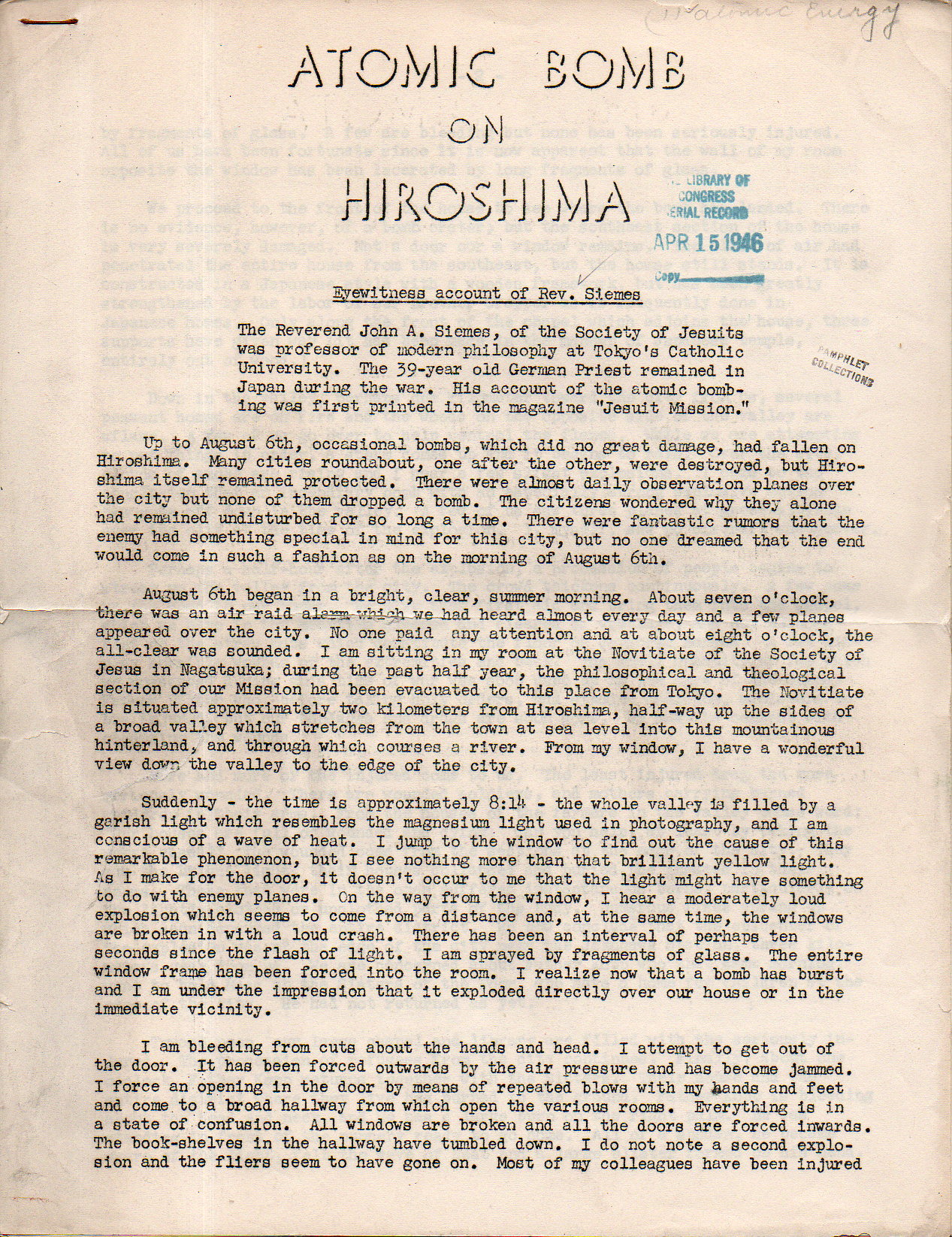
    About eight months after the atomic bomb was detonated over Hiroshima the Jesuit Rev. John A.Siemes contributed his well-known first-hand account of the devastation that he found there hours after the event.  Siemes also published his story in the Irish Monthly, volume 74 (#873, pp 93-104) in 1946.   This 10-page account in this version evidently is not very widely kept in libraries worldwide, as WorldCat locates only two copies (one at “New York State Library” and another at the Peace Collection of Swarthmore).  There are full-text versions of it online, though there are differences in the telling of the story–Yale University has this as a full-text version posted at their Avalon Project here:  http://avalon.law.yale.edu/20th_century/mp25.asp    It is well worth a read.

    • The original publication is available for purchase via the blog’s bookstore, here. 

    Atomic bomb on hiroshima211

    ·Posted by :

    ·in:


  • The Atomic Bomb and Satan’s Release, 1947

    JF Ptak Science Books    Quick Post   The series on Atomic and Nuclear Weapons

    • [There have been 99 posts to this blog since June 1–check out other work via the “Archive” at left]

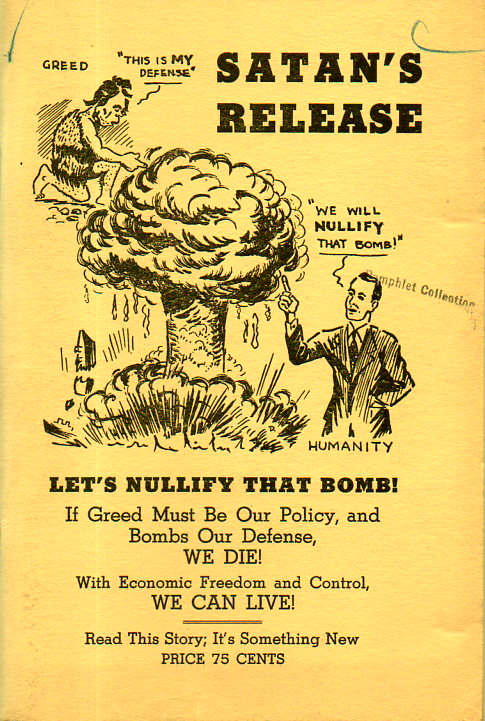
    In the 100+ or so posts in the Atomic/Nuclear Weapons history thread there are a number that address somewhat Outsider-y notions and imaginary insights into the weapons.  There are some that prophesy the advent of the bomb, and some that initiate the creator in its creation.  The pamphlet below (published in DeRidder, Louisiana, in 1947, a town of 4,000) is one such example–the atomic bomb so far as I can tell exists only allegorically, as in the greed bomb, that would destroy us all.  Still, it has a mushroom cloud on the cover, and so it qualifies as an atomic-bomb-in-popular-culture item.  

    Atomic bomb Satan's release202


  • Collect Call to Armageddon (ca. 1950)

    JF Ptak Science Books    Quick Post   The series on Atomic and Nuclear Weapons

    • [There have been 99 posts to this blog since June 1–check out other work via the “Archive” at left]

    Big Call197

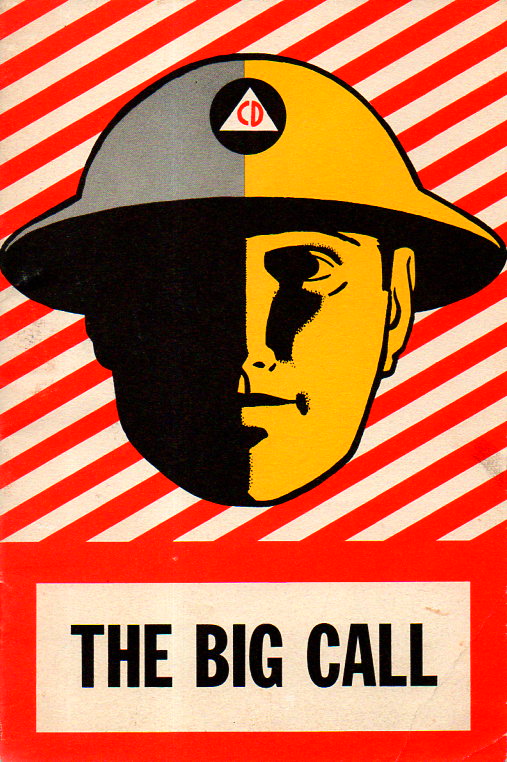
    One thing is for certain–the design of this Civil Defense (“trained helpfulness”)  pamphlet issued by Bell Telephone of Pennsylvania was very determined, and obvious, and provocative, and it may have been the best thing about this publication. It is not clear to me how much of the plans for reacting to a nuclear attack (“an atomic Pearl Harbor”) were implemented or implementable when this work was printed (ca. 1950?), but the plans were certainly orderly–and so they seem in the maps of action.

    Here’s one interpretation of an action plan for Armageddon in a large city–it is a bare-bones, comforting plan,even though it looks like half of the map is missing (though it isn’t); it is really just a suggestion about the course of action after an attack:

    Big Call199

    All it shows, really, is that something is going to happen.  

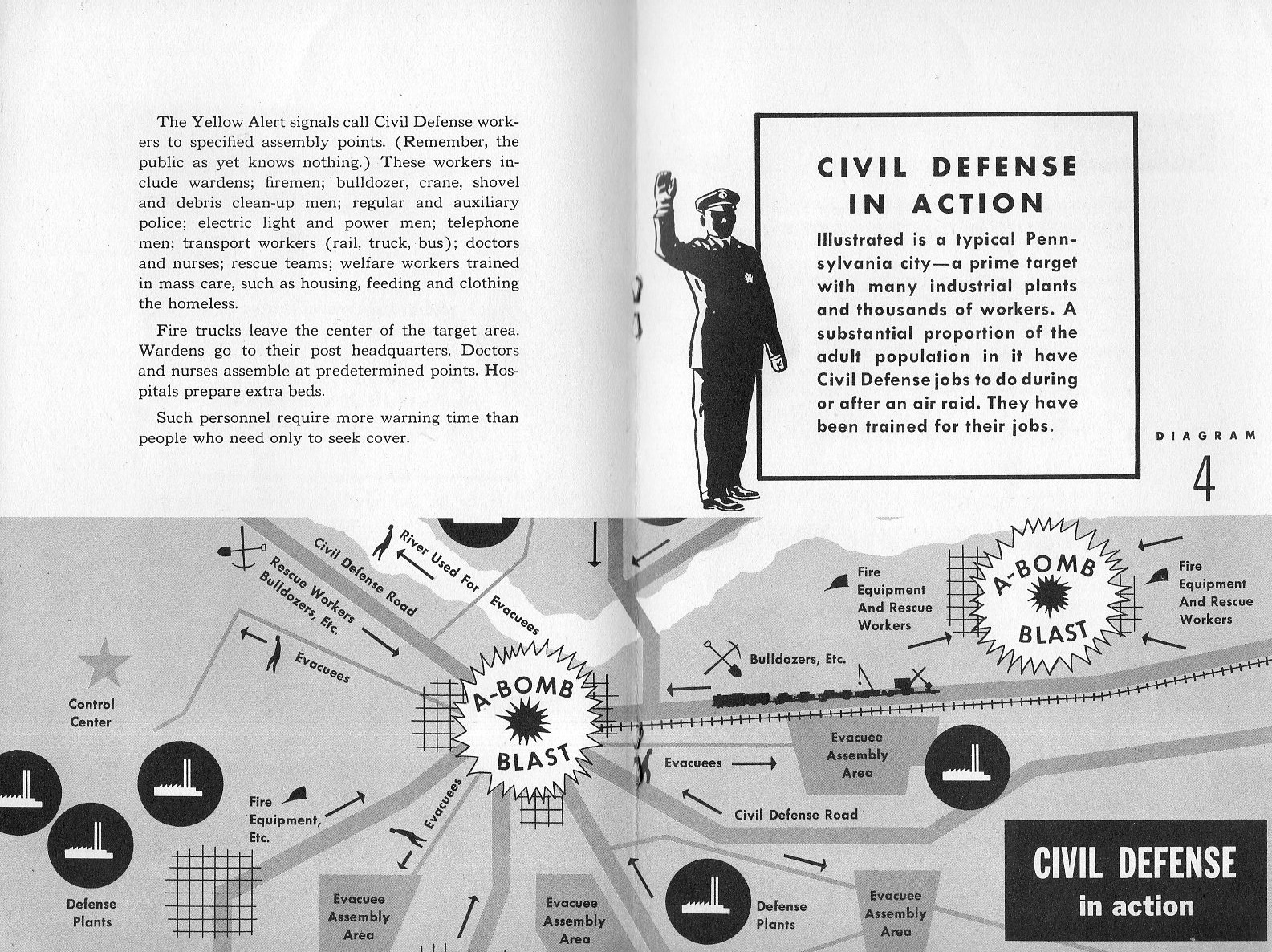
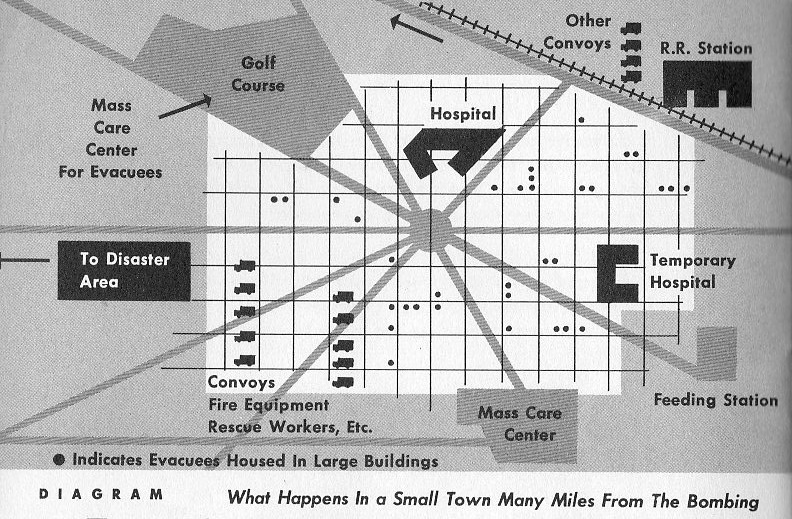
    Here’s another vision of action, this taking place in a small Pennsylvania town “100 miles away” from bombed centers:

    Big Call200

    There are no plans for the population to go anywhere, though there are plenty of plans for convoys going to the bombed areas. Also there’s plenty of expectation, what with a hospital, temporary hospital, mass care center, and a golf course dedicated to mass care for evacuees–there would be plenty of people being removed to the town (as hospitals “prepare(d) extra beds”).  

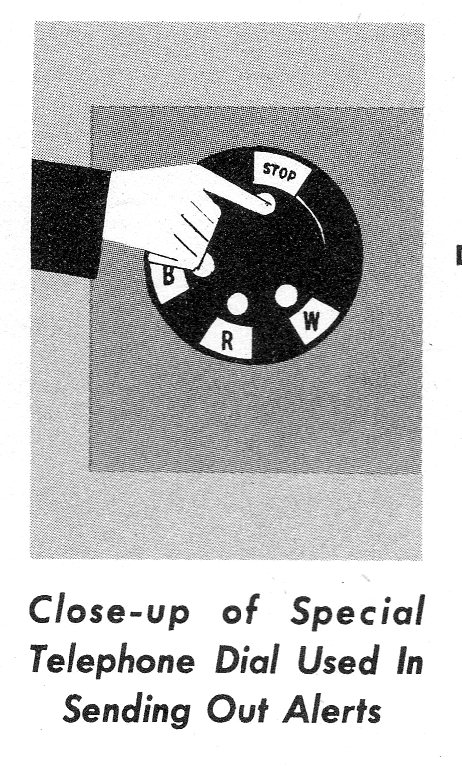
    There wasn’t much in this pamphlet about what to actually do in the event of an (ultra) emergency, though you were told that people would respond to calls–telephone calls. As a matter of fact the phone features largely in this pamphlet:

    Big Call201Maybe it was all about selling telephones–as in would you be ready to receive The Big Call if it was made?  


    ·Posted by :

    ·in:


  • Atomurbia II: Expanding on the Dis-Utopian-Dystopia (1951)

    JF Ptak Science Books    Post 2491    Part of the series History of Atomic and Nuclear Weapons

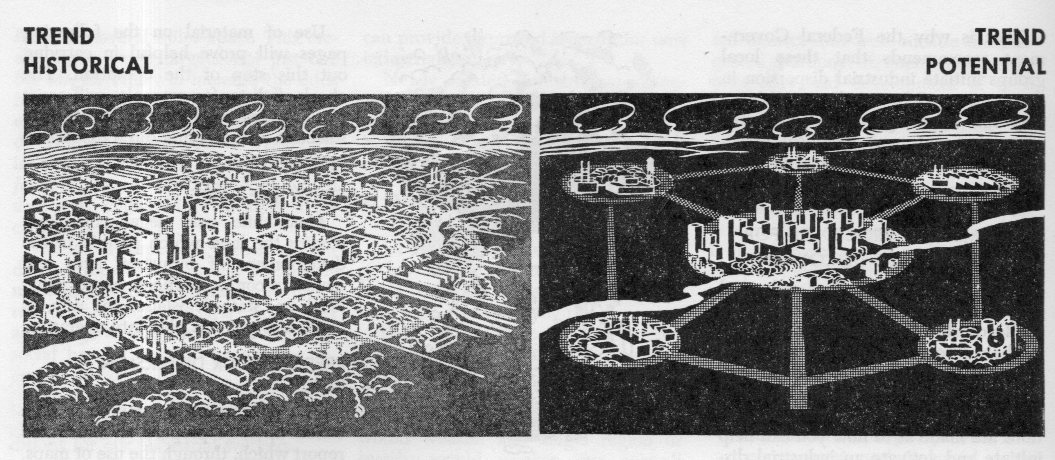
    Earlier in this blog in 2010 there appeared a post called “Atomurbia: Responding to Atomic Threat by Moving Everyone Everywhere, 1946“–it turned out to be very popular, being about the dispersal of the U.S. population centers to thwart nuclear attacks.  (I’ll repeat: it was about the plan to redistribute the population and industry and appropriate infrastructure of the United States of America.)

    Atomurbia II179

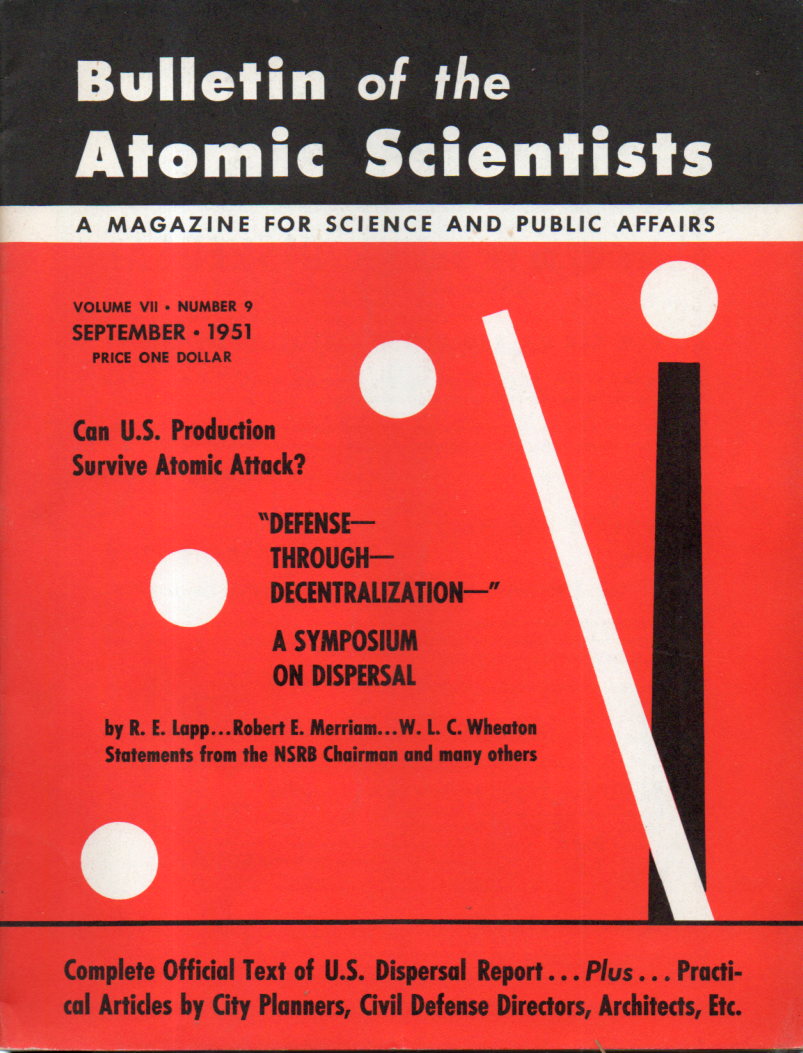
    It was of course (as Somerset Maugham would say in “The Three Fat Women of Antibes”) an Enormous Situation, involving (basically) moving everyone everywhere.  The term was “dispersion”, and the planners of such plans meant it–and I’ve come across it again–unexpectedly–in another issue of the Bulletin of Atomic Scientists for September 1951.

    You may recall that this is the journal that keeps a doomsday clock ticking off the minutes on its front cover showing the advance or retreat from the Midnight of Armageddon.  On this issue the clock is at three minutes to midnight, though I think that the greatest distance from the zero hour was ten minutes to the hour–so for decades the clock has been very close to striking the doomed hour without much relief.  

    In this issue of the Bulletin nearly every article is dedicated to the idea of dispersion (at that point under the auspices of the National Security Resources Board) and the creation of a federal program to directly oversee dispersion (the National Defense Dispersal Administration (NDDA)). And people are talking about moving around cities and people and industry as though it wasn’t that big a deal, though I must admit I haven’t seen any cost or time estimates in this source.  Moving the populations centers of the U.S. to a more “garden city” idea involves so much effort and expense it seems almost impossible to contemplate actually paying for all of it.  (And we haven’t begun to talk about how people and essential personal are actually ‘enticed” to leave their surroundings, nor is there any talk about the property rights of the owners of all of that land that is to be built on.)

    As much as Frank L. Wright’s “Broadacre City” seems to be a lead balloon so far as actual implementation goes for size and scope, this type of “dispersion” idea would be of gargantuan, orders-of-magnitude bigger/costlier than what Wright was talking about. At least in this department Wright was thinking in terms of a utopia; the dispersion business was more like a dis-utopian-dystopia, or something, no matter how these authors attempted to green-up and de-slum their proposal.

    I am mostly making this post for the image at the top of this post(from page 268 of the Bulletin), which fits nicely with those others posted in the earlier Bulletin article (reproduced in the link above). 

      Atomurbia II180

    ·Posted by :

    ·in:


  • Recovery to Normal Existence: Found-Surreal Images in Nuclear Survival Handbook

    JF Ptak Science Books    Post 2499

    Nuclear Attack LIVE230
    In the not-modest stream of thin paperback  nuclear holocaust survival literature in the 1950’s and 1960’s appears this effort: LIVE, Three Plans for Survival in a Nuclear Attack. It was published by the Stanford Research Institute in 1960, and was part of nuclear health physics pioneer Lauriston Taylor’s donation to the National Council on Radiation Protection and Measurement, where I bought it some time ago when they were thinning out their stuff.  It is an unusual publication to me for its illustrations, some of which are odd, and a few of which are positively semi-surreal when view out of context.

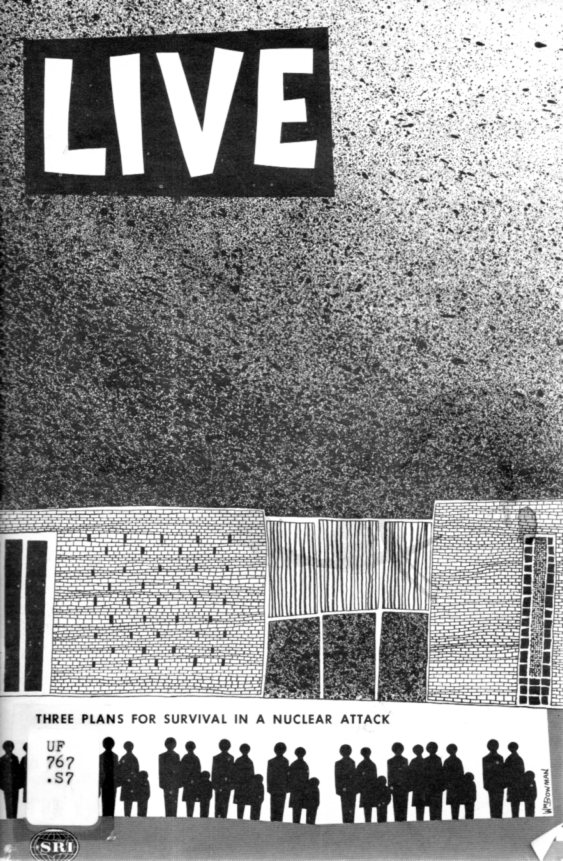
    The pamphlet overall is fairly helpful, assuming that you had as much time to get yourself together in an impending attack, and that is a major assumption.  But I’m sharing this tonight for some of those images–and the cover, which is an unusual design in itself, not the least of which is the heavily-borrowed part from LIFE Magazine.

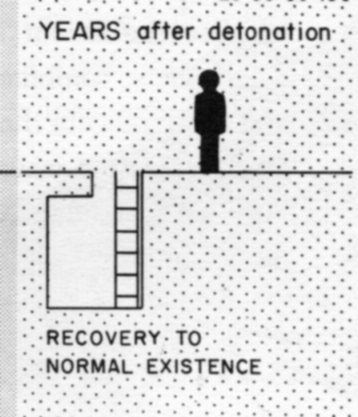
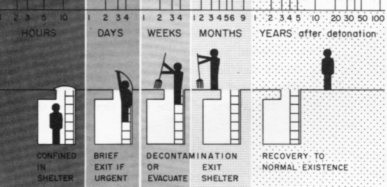
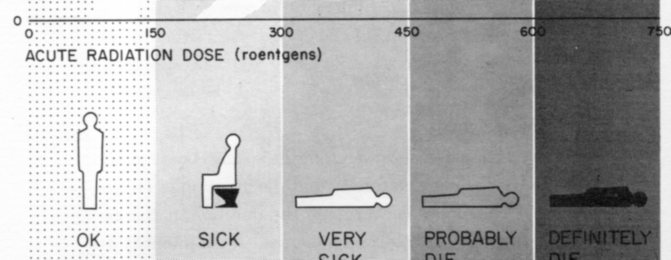
    So the first of the few that I’ll post here (above) is a detail from this illustrated graph, a march of teh intellect and survival from being in a dark hole to a rather stiff return to normal existence:

    Nuclear Attack LIVE229

    Here’s another sobering bit, showing a progression of NOT-recovering to normal existence:

    Nuclear Attack LIVE231

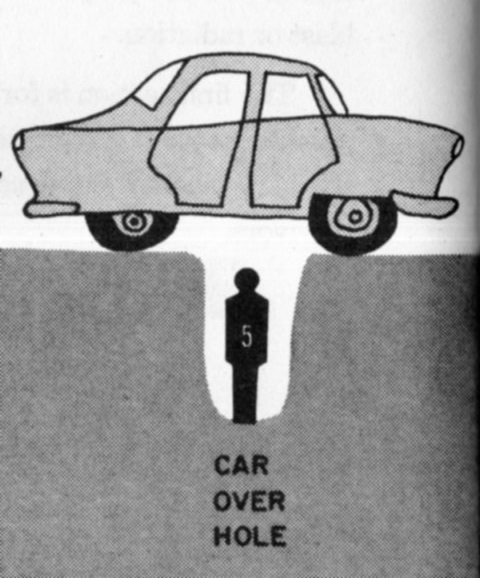
    And of course the hole:

    Nuclear Attack LIVE233

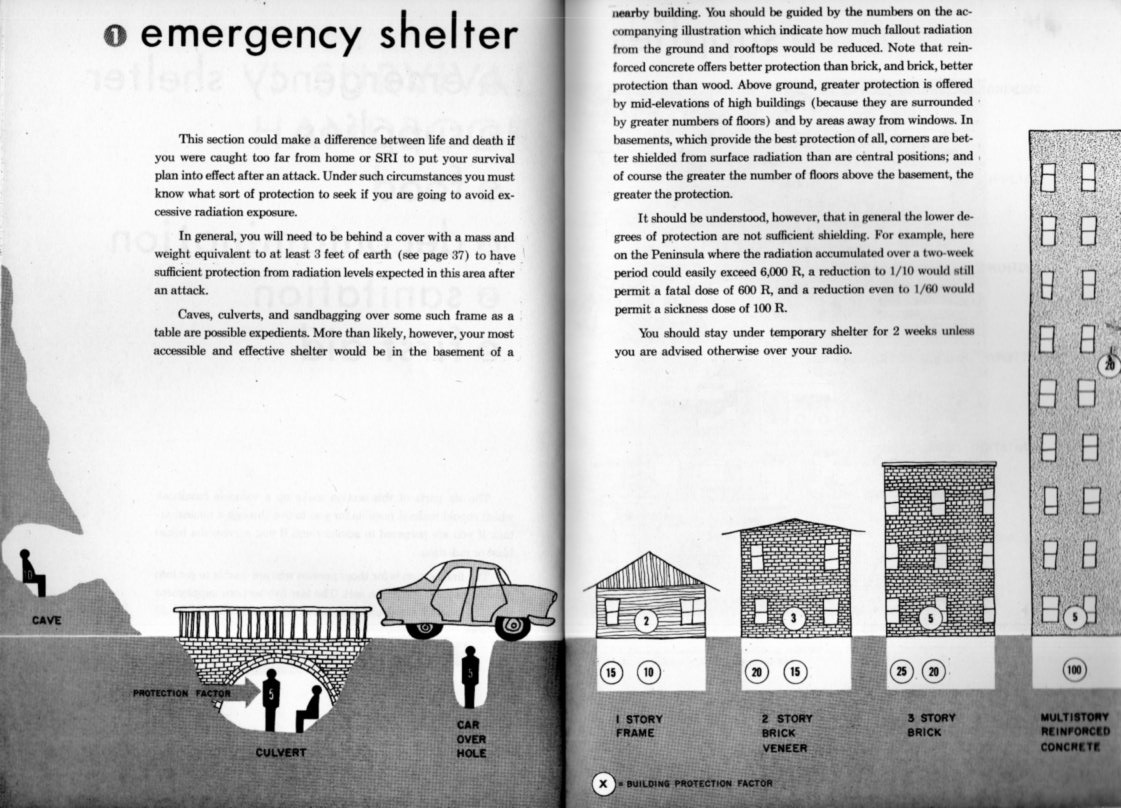
    Which is a detail from:

    Nuclear Attack LIVE232

    And the cover, which has some blotchy Ralph Steadman-y elements:


    Nuclear Attack LIVE228

    And so, there are some of the major themes.  I found the work unsettling in general for using mostly dark silhouettes for the people, that profile having been sort of established to represent dead folks.  Ah, well.


  • Putting the “IF” in “LIFE”: Welcome to Dystopia! (1950)

    JF Ptak Science Books   Post 2486

    LIFE logo detail

    So, grazing my way through a random issue of America’s magazine, LIFE, for August 28, 1950, I was struck by the profound amount of unhappy welcome-to-your-stinking-future-you-poor-stinking-sod articles contained in its heavy and mostly colorful pages, all packed into a quarter-inch thick package.  

    The issue starts out with a waxy portrait of MacArthur, followed by two big pages of freckly boys modelling Peter Pan Peanut Butter and Ice Cream Dixies, then a big splashy two-page ad for soles for your shoes, then contrasting color combos in a Glidden paints ad, a Swank tie-clip-ruler-mechanical-pencil, Vaseline cream hair tonic, then bits for DeSoto and Chrysler, and Ford.  Ads done, there’s a two-pager on an old lost film starring Babe Ruth, and a  big/weird coverage of people flocking to a far-removed farmlet because the woman living there claimed to see the Virgin Mary.

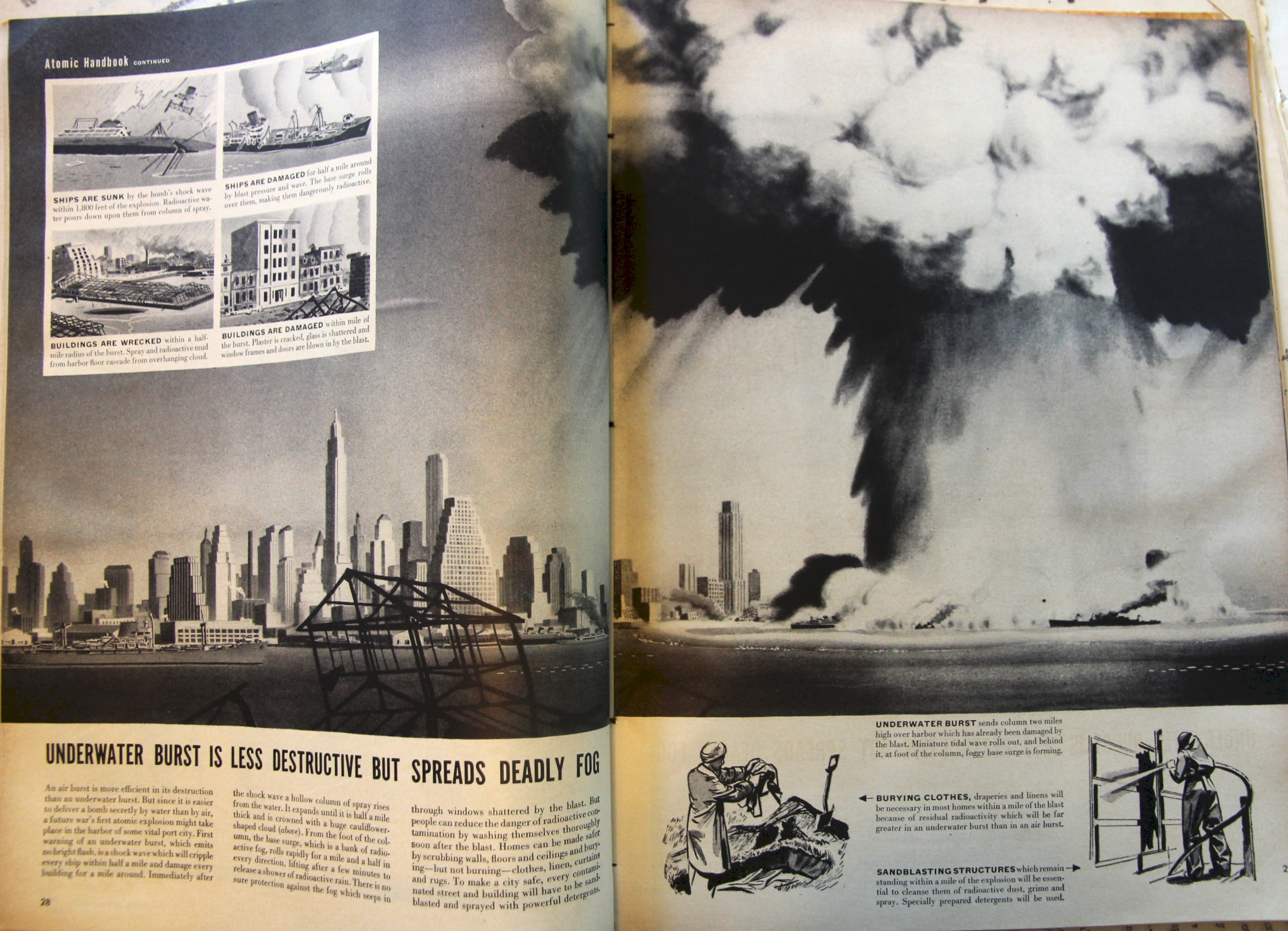
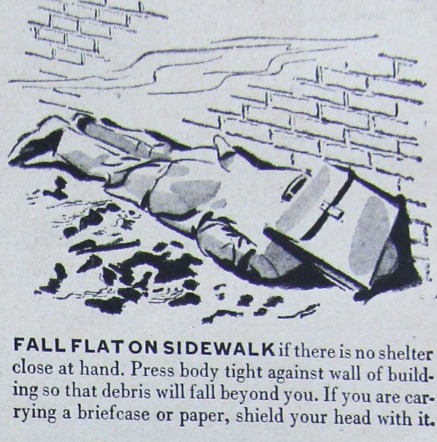
    LIFE Mag Aug 1950 bomb

    Then comes the rain:  it starts with a story on an unexpected best seller for civil defense (“Atomic Handbook a best seller”), followed by:

    • A hand-drawn illustrated page on how to protect yourself from nuclear extermination if the bomb catches you unawares on the way to work;
    • the effects of an underwater detonation in the harbor of a large unnamed (ahem, New York) city illustrated by a very forceful two-page drawing;
    • a story on the opinions of New Yorkers on the building of a skyscraper when there is such an imminent possibility of an attack by the Soviets (who had developed their own Fat Man type atomic weapon in the autumn of 1949 and which was announced as confirmed by Truman in early 1950, so the threat as it was was new)
    • then comes a story of bombing patterns in Korea
    • then a short account of a vicious Korean battle at No Name Ridge

    These tales are then interrupted by a full page ad for Old God cigarettes, with a pack of them floating on a lily pad in a pond.

    LIFE Mag Aug 1950 bomb detail

    The salvo is opened again with:

    • a long story on Viet Nam, and the French involvement, and the components of the Foreign Legion fighting there, and how much they need the help of the U.S. to stop this fight for the control of Asia by The Communists, and that it may be a “matter of days” in which we needed to act
    • then a big spread (which will get a blog post of its own) on ramping-up the U.S. air force components for the continuation of the new war in Korea.

    That is where the bad news almost stops, mostly, the rest of the magazine filled out by fluff and stuff, with a lot of ads.  Some of the ads are very puzzling, and some are just disturbing, like the big stretching crotch-shots for jockey underwear for men, and a bra ad featuring a model with Indian headdress saying “How how how”, and a terrifically unsavory racist ad for Dumont televisions featuring a cartoon-clownish minstrel figure for no good reason whatsoever. Reeling in the back of the mag are a bunch of big red ad for bacon and pork and Big Red Meat, PBR, mustard, razor blades, a few movies, and lots of people smoking cigarettes.

    But just when you thought you made it out of the issue pops up two final stories–a boring thing on “War and Politics”, and  a picture essay “Iowa Town Dies a Slow Death”.  

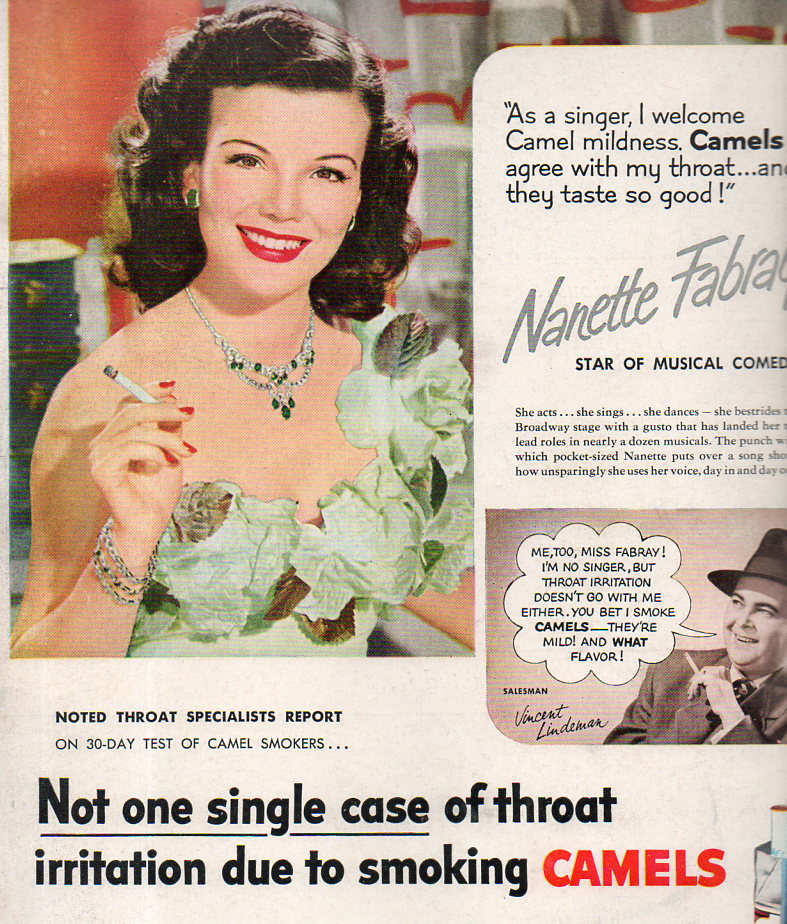
    The back cover features a flat cover ad for unfiltered Camel ciggies, decorated with Nanette Fabray in a cabbage leaf dress,  which loudly states “Not one single case of throat irritation due to smoking Camels”.   Giving the devil its due  they also state that that (quoted?) nugget was for a 30-day trial. Certainly after x-years millions wouldn’t have this complaint because they wouldn’t have any throats anymore, being dead from cigarette-induced cancers and all, so the statement was shown to be not necessarily untrue.

    Ciggie cabbage dress154

    August 28, 1950.  

    All that reading done, you were supposed to keep your eyes on the skies but not let it interfere with your eyes on the prize, which was spending money, and to have you hopefully go out to get some peanut butter that you could put on your new tv, while you and your honey watched it in your new sparkling white underwear, slathered in vaseline hair creme, drinking a PBR, smoking several brands of cigarettes, and thinking about the Parkay margarine-slathered big meat products in the refrigerator.  Just make sure to wash your house after the series of Joe-1 Soviet nukes annihilate the rest of your city.  

    There was a lot of scary stuff in this issue, which certainly helped to put the “if”into “life” in the high summer of 1950–then again, as a summer of fear, there was a lot of it to go around, and with some good reason.  

    LIFE logo156


    Notes

    See here for a good article on the Life article on this town, “Bradgate, the Town that Wouldn’t Die”, at iagenweb.com (Iowa Genealogy) 


  • New York City Destroyed, Part XV (February 1950)

    JF Ptak Science Books   Quick Post 

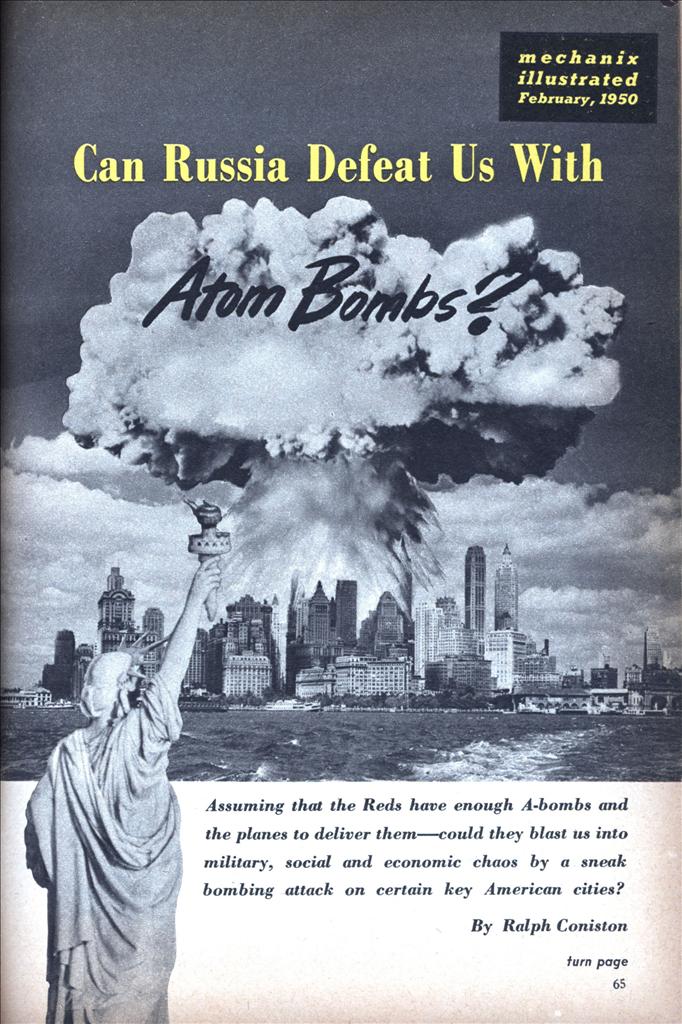
    Atom bombs from Russia

     Here’s another maim-and-blame piece of provocative semi-future/tomorrow speculation from Mechanix Illustrated (of all places) in February, 1950, hosted by the wonderful Modern Mechanix website (where the entire War-of-the-Worlds-like article is included).  So February 1950 was pretty early in the development of the brand-new atomic Cold War.  The Soviets had been experimenting since 1946 (thanks in large part to “intelligence received” from agents working in the U.S.)  and in August 1949 successfully detonated their first atomic weapon. This came several years before most experts thought possible, with the weapon (called RDS-1, or “First Lightning”, or in the West, “Joe 1”), which was a Fat Man/implosion device, generating a yield of 22kt.  The news of the test took a few months to filter out to the rest of the world–as the U.S. had previously initiated a bomb/detection plan employing the B-29 Superfortress–with President Truman making an announcement regarding the test on September 23, 1949.  The Soviet had hoped to keep their experimentation “quiet” so that they could have a few more years of catch-up while developing a hydrogen bomb, but that didn’t work out for the evidently surprised Russians.

    In any event this image fits nicely with the other 15 or so depicting a mostly pre-1960 NYC in ruins. (Check the GOogle search box at left for NYC destroyed/attacked.)

    And yes Lady Liberty is facing the wrong way.

    http://blog.modernmechanix.com/can-russia-defeat-us-with-atom-bombs/

    ·Posted by :

    ·in:


  • The H-Bomb in L.A., 1961

    JF Ptak Science Books    Quick Post

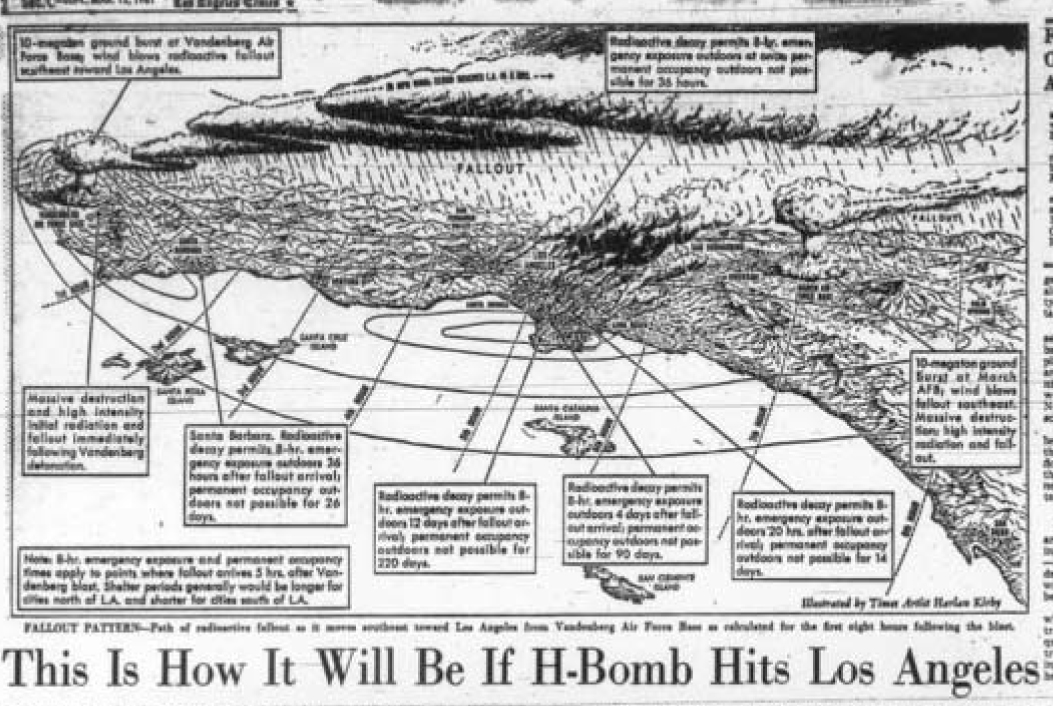
    The illustration below was for the story, “Red Alert. What if an H-Bomb Hit L.A?”which appeared in the Los Angeles Times 12 March 1961, and made no doubt for some very sobering contemporary wake-up-and-die reading.  If you were living anywhere in the country at the time and had never seen a representation of your city in ruins, and you encountered such a story and images before coffee, you might remember that missing cup for the rest of your life.  The dramatization and mapping was done by Harlan Kilby, and it portrayed the destruction of the city and millions of people in the event of detonation of a 10 megaton nuclear weapon–it gave the reader a vague notion of what city-eating looked like, the bomb ‘flattening” everything in a 3-mile radius of its central zone and killing everything in 28 square miles.

    (A little earlier, in 1960, there appeared a work by Harrison Brown and James Real called Community of Fear, which was a sci-fi kill-’em-up that used a kill zone with a 25-mile radius. For more on this film see Kenneth D. Rose One Nation Underground: The Fallout Shelter in American Culture, page 61.]

    LA Bomb bird's-eye copy[Image via the Library of Congress]

    Anyway, waking up to this in 1961 must have been an eye-opener. 

    ·Posted by :

    ·in: