A Daily History of Holes, Dots, Lines, Science, History, Math, Physics, Art, the Unintentional Absurd, Architecture, Maps, Data Visualization, Blank and Missing Things, and so on. |1.6 million words, 7500 images, 4.9 million hits| Press & appearances in The Times, Le Figaro, Mensa, The Economist, The Guardian, Discovery News, Slate, Le Monde, Sci American Blogs, Le Pont, and many other places… 5000+ total posts since 2008.

Category: Bad Ideas

  • “Castration vs. Vasectomy in the Feebleminded as a Surgical Problem” (1941)

    JF Ptak Science Books  Post 2886

    This is an issue that you don’t hear every day…and offhand it seems to be a little late in the asking by 1941. But it wasn’t too late, unfortunately, and the question was a debated one in some halls of practicing eugenic and mental health academe. This is the title to a paper1 written by Dr. Charles C. Hawke (M.D., F.A.C.S.) while superintendent of the Kansas State Asylum in 1941, and it entailed a discussion of the efficacy of the enforced sterilization practice–a procedure under law that was basically discontinued as a medical/surgical response to mental issues in 1950 (in Kansas). 
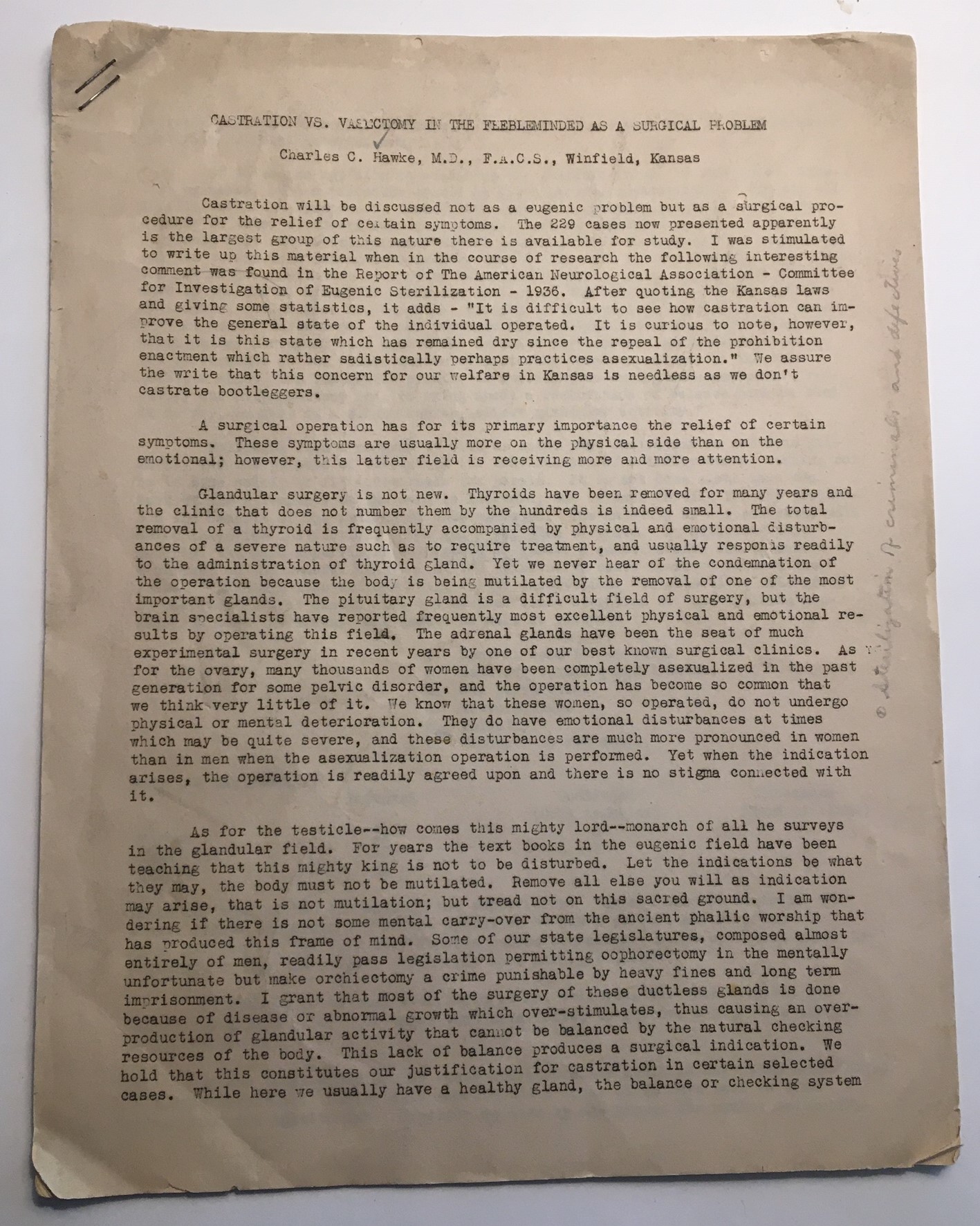
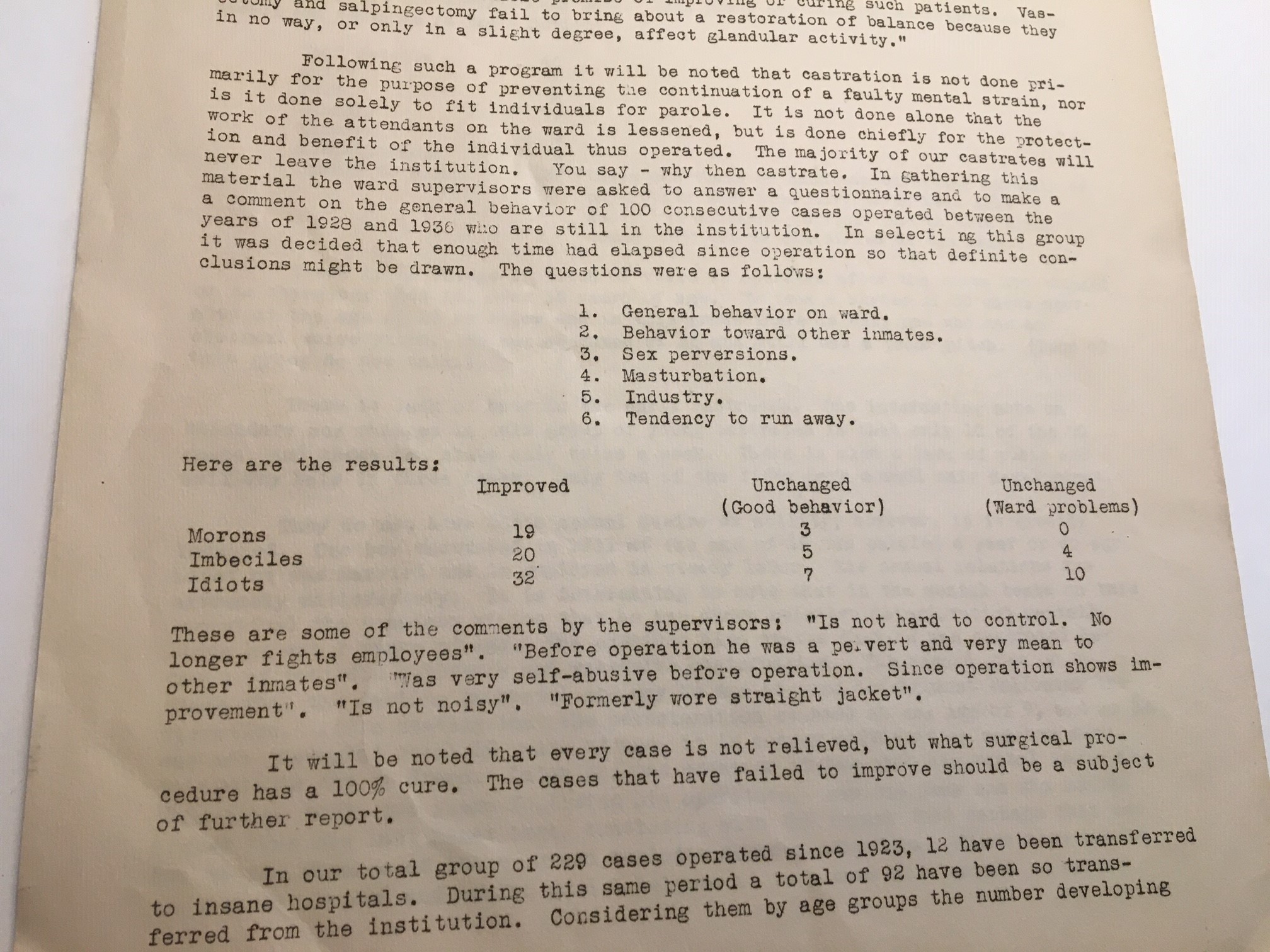
    Castration Hawke _1_Dr. Hawke wonders—somewhat facetiously to my reading—about the reluctance of including testicles in the field of “glandular surgery”, noting that “text books in the eugenic field” teach that “this mighty king is not to be disturbed”, along with a few other purplely examples. He quickly establishes the castration (and ovariectomy) as well as vasectomy and salpingectomy may be the way to stabilize “the unstable group” (in institutions), “be they idiot, imbecile or moron” and that the procedure should “be given serious consideration”.

    He states that “the majority of our castrates will never leaves the institution. You ask—why then castrate[?]” He doesn’t seem to answer this directly, but does provide some evidence (below) that the behavior of 71% those castrated and confined does improve. It is not 100%, Dr. Hawke notes, and adds the corollary “…but what surgical procedure has a 100% cure [sic]”.

    There are other reports of successes in castration, including a long paragraph of Dr. (F. Hoyt) Pilcher, (Superintendent of the Kansas State Asylum for Idiotic and Imbecile Children) who began his work in the early 1890s. There is also a review of the 1917 (and 1928) laws passed by the Kansas legislature on “asexualization”. It seems that the state can uphold recommendations from medical officials recommending castration; the person in question can register a “protest” (“which are rare”). These laws extended its reach into “state penitentiaries, the boys’ reformatories, state hospitals for the insane, and the state hospital for epileptics, the state home for the feebleminded and the state industrial school for girls…”
    Castration Hawke _2_

    It is quite a document of those eugenical times.

    Notes:

    1. Charles C. Hawke (M.D., F.A.C.S., Winfield, Kansas).  Castration vs. Vasectomy in the Feebleminded as a Surgical Problem. 12 leaves (including a 17-item bibliography. Mimeographed. Stapled. GOOD+ copy. This copy’s provenance: “Gift from the author, 1941” in pencil notation on the back of the first leaf, with the LC rubber stamp on the rear leaf.  WorldCat records only ONE copy (Tozzer Libray, Harvard), so as a single-issue “offprint” it is a rare thing.

    2. For a deep review see: Cean T. Collins, “CHILDREN OF SORROW: A History of the Mentally Retarded in Kansas”, in Bulletin of the History of Medicine, Vol. 39, No. 1 , 1965, pp. 53-78

    ·Posted by :

    ·in:

    —

  • Cell vs. Cell: Photoelectric Cell and Shooting a Prisoner for Escaping their Cell (1930)

    JF Ptak Science Books  Quick Post

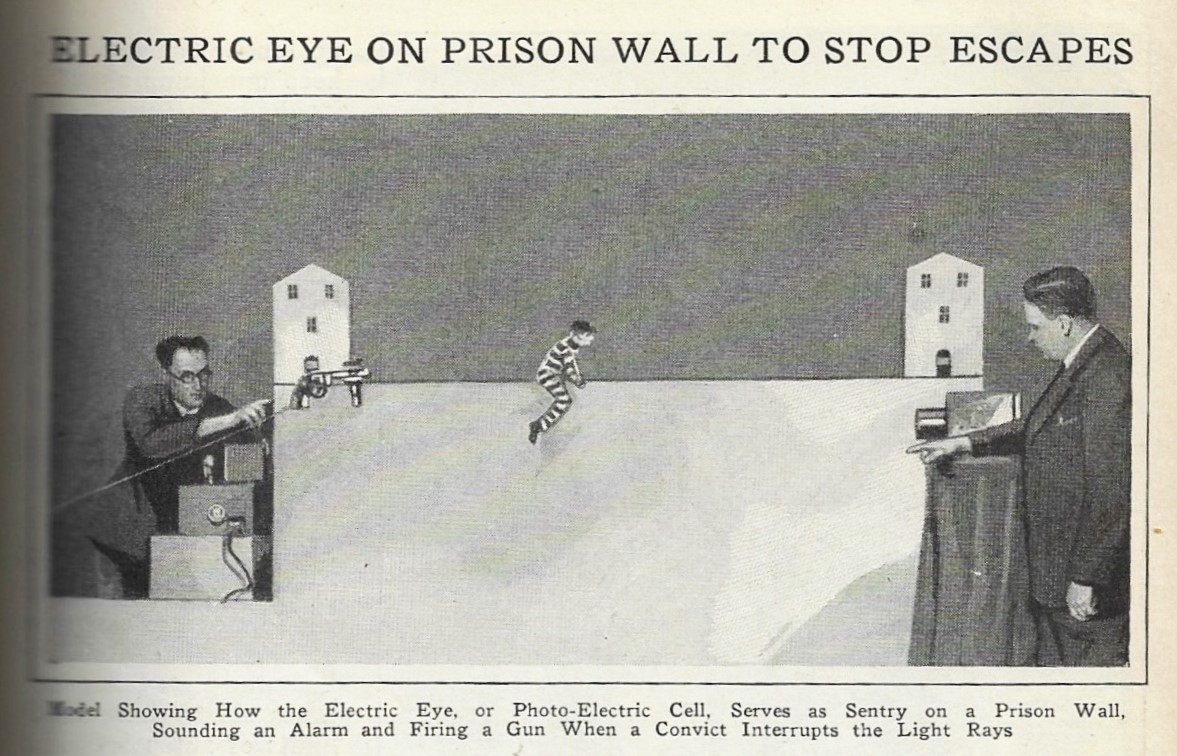
    The photoelectric cell was a mature invention (appearing in 1883) when it became armed and lethal in 1930.  Popular Mechanics published this photo (explained with only a caption and a paragraph) in its July 1930 issue. We see that should a prisoner make a dash up and over the prison wall, they interrupt the “electric eye” sentry which we read (1) fires a pistol positioned along the wall and (2) sounds an alarm, simultaneously.  It seems as though the alarm system could be reconstituted at the base of the wall, sounding an alarm before the prisoner got to the wall (let alone up and over it), rather than shooting as the alarm sounds.  The consequences of this idea–which I suspect was never implemented–were, well, rather extreme.

    Pop Mech 1930 Convict Killer

    ·Posted by :

    ·in:

    —

  • A Sober Appraisal of “the Flying Saucer” (1948)

    JF Ptak Science Books  Quick Post

    Pop Sci 1948 flying saucersThis slightly engaging cover of Popular Science offers its readers a sober appraisal of the still very popularly new phenomenon of “the flying saucer”. Not “flying saucer” plural–”the” flying saucer phenom, complete at this point with a definite article…I have no idea when the “the” disappeared. In any event it is a pretty good explanation, though there is no mention here of “The Battle of Los Angeles”, when in 1942 aircraft batteries and searchlights blazed away into the high night air trying to stop a supposed Japanese attack. Six people on the ground were killed by shrapnel and debris, with no damage to anything flying overhead reported. There were some wild theories about what the “attack” was, along with accusations of cover-ups and political/economic conspiracies, and that seems to have been the extent of the matter. In any event, Pop Sci takes up the case of the weather balloon as a general explanation to people seeing intelligent life forms scooting around in our sky but not bothering to stop and say “hello”.

    Just in case anyone is interested, here’s the Oxford English Dictionary entry for “flying saucer”:

    –flying saucer  n. the fanciful name given to various unidentified disc- or saucer-shaped objects reported as appearing in the sky.

    • 1947   Times 8 July 4/4   During the past fortnight reports that dish-like objects, nicknamed ‘flying saucers’, have been seen travelling through the air at great speed..have come from the United States and Canada.
    • 1948   Jrnl. Brit. Interplanetary Soc. 7 199   I haven’t examined the details carefully, but the ‘flying saucers’ bear all the hall-marks of mass-suggestion.
    • 1953   D. Leslie & G. Adamski Flying Saucers have Landed i. i. 13   Ever since the cliché ‘flying saucer’ was coined, the greatest and most exciting mystery of our age has been automatically reduced to the level of a music hall joke.
    • 1965   New Society 9 Sept. 14/2   When Kenneth Arnold saw something from his airplane near Mount Rainier in June 1947, he gave them the happy name of flying saucers.

  • Nature Magazine Reviews Hitler (1933)

    JF Ptak Science Books  Quick Post

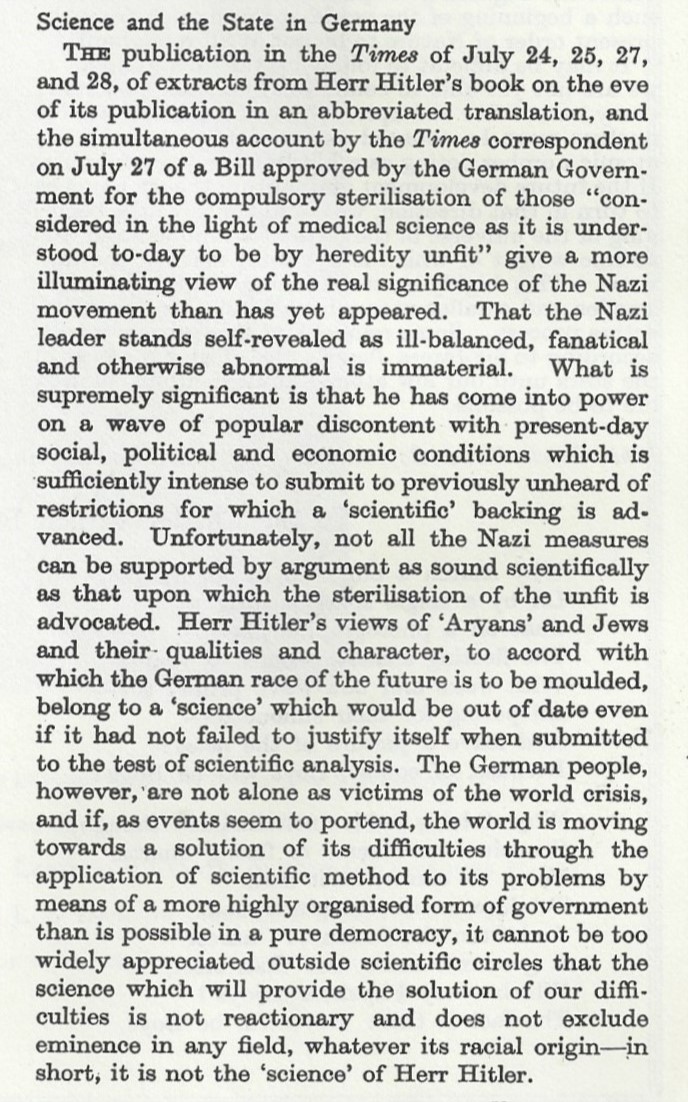
    Here’s a razor-sharp summation and review of Adolf Hitler, being an uncommon appearance of that man and his “science” in Nature, volume 132, p. 198, 1933. 

    “That the Nazi leader stands self-revealed as an ill-balanced, fanatical and otherwise abnormal is immaterial. What is supremely significant is that he has come into power on a wave of popular discontent  with present day social, political and economic conditions which is sufficiently intense to submit to previously unheard of restrictions for which a “scientific” backing is advanced.”

    Nature 1935 HITLER

    ·Posted by :

    ·in:


  • A Nasty Piece of Propaganda from French Collaborationists (1943)

    JF Ptak Science Books   Quick Post

    The offending pamphlet here is a celebration of the invasion of the Soviet Union by Germany, a “two year anniversary” of the beginning of “Operation Barbarossa”. The author(s) presented the new front in WWII as a “joined” effort on the part of European nations to rid the world of the Bolshevik threat. (The title of the work: Toute l’Europe contre le Bolchevisme, 2eme Anniversaire which was published by CEA, the Centre d’Etude Antibolchéviquethe (Anti-Bolshevik Studies organization), a French organization running with Nazi funding.)

    The pamphlet of course fails to mention the turning of the tide against the Germans, especially with the defeat and destruction of von Paulus and the 6th Army at Stalingrad in January/February 1943, the failure of the Caucasus push, and so on. Then again, this is a piece of propaganda, and facts can be conveniently excluded whenever necessary.  A few pages later by the way there is the introduction of Bolshevism being the invention of “International Judaism” and other anti-Semitic lies that was an attempt to perpetuate the fiction of the Nazis and the Allies working together to defeat Stalin and his Jewish co-conspirators in quest of world domination.. Besides the text supporting this stab-in-the-heart thinking is a horrible caricature of “international Jewry” combining with Bolshevism and Freemasonry (?) as a force out to capture the world. 

    Events antithetical to this propaganda were excluded–I did check out some of the numbers for the battle represented below (like Smolensk and Vizma (Moscow) and those are correct…these battles were mainly fought in 1941/early 1942 at which point the Nazi offensive was still going forward, so there’s not much from 1943. So numbers and events that supported the crucially insane claims of the pamphlet were used; everything else was ignored or re-packaged with false data and employed. 

    Maps Propaganda Barbarossa _2_


  • When the Opposite of an Idea is the Better Idea (1922)

    JF Ptak Science Books  Quick Post

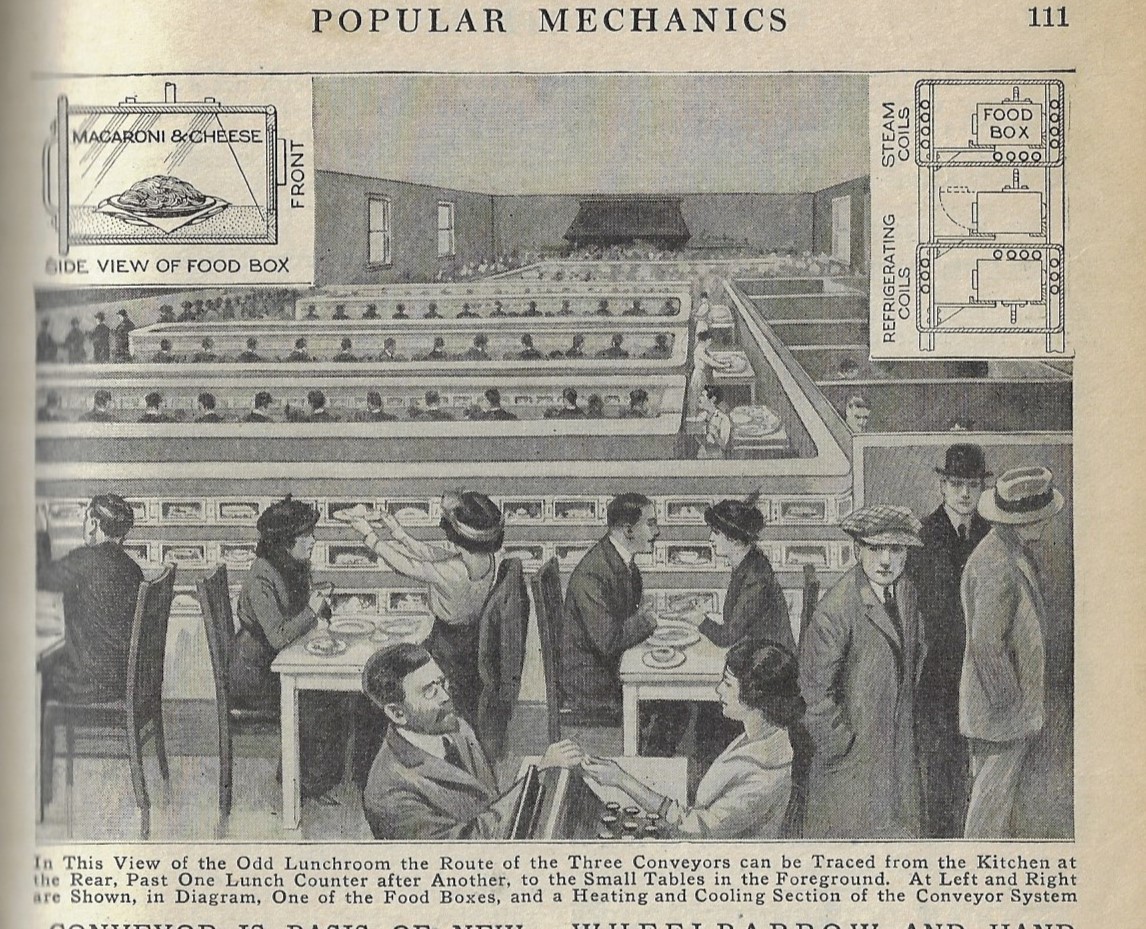
    Here’s a suggestion for a new category for this blog: Ideas That May Be Better Backwards. The idea is presented in this wonderful image from Popular Mechanics in 1922 and features an endless trolley/conveyor of food that moves past stationary diners at a restaurant. You’d sit down, and gobs of food would be presented on an endless conveyor, moving along at probably 1 mph. This idea makes sort of very quick 3-beer sense, until you think of the probable waste and the cost of machinery and energy that it took to trundle the food along, and then replacing all of it that went cold, and so on. It seems to me the opposite might be the better if not still-bad idea: putting the patron seating area on a revolving stage and have a central location for the food where they’d take what they wanted. The conveyor-of-food idea withers next to the great Automat, where people would simply walk up to a long bank of small windowed receptacles with different foods inside, drop a few coins into the slot opening the lovely little (but thick) door, after which you’d simply find a place to sit and eat. (This automat was a German 19th c idea, and it became popular in the U.S. in the 1930s’-1960’s, with Horn & Hardart leading the way with 30 or so locations in NYC. The H&H variety closed up by the early 1990’s, their locations converted into Burger King meat/fat/carb slingshops.) Here it is:

    Pop Mech 1920 luncheon

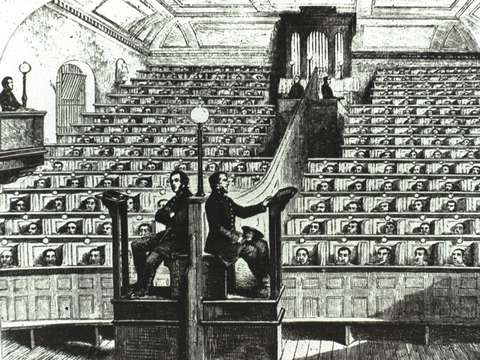
     The image reminded me of one I saw for the very restrictive penitent/observer prisoner in chapel at Pentonville Prison in 1855–I know it is hardly similar whatsoever to the food-on-a-belt, but the two did come together somehow in my head:

    Prison chapel Pentonville

    [Source: lost! Apologies.]

    ·Posted by :

    ·in:


  • A Tank at an Amusement Park (1920)

    JF Ptak Science Books  Quick Post

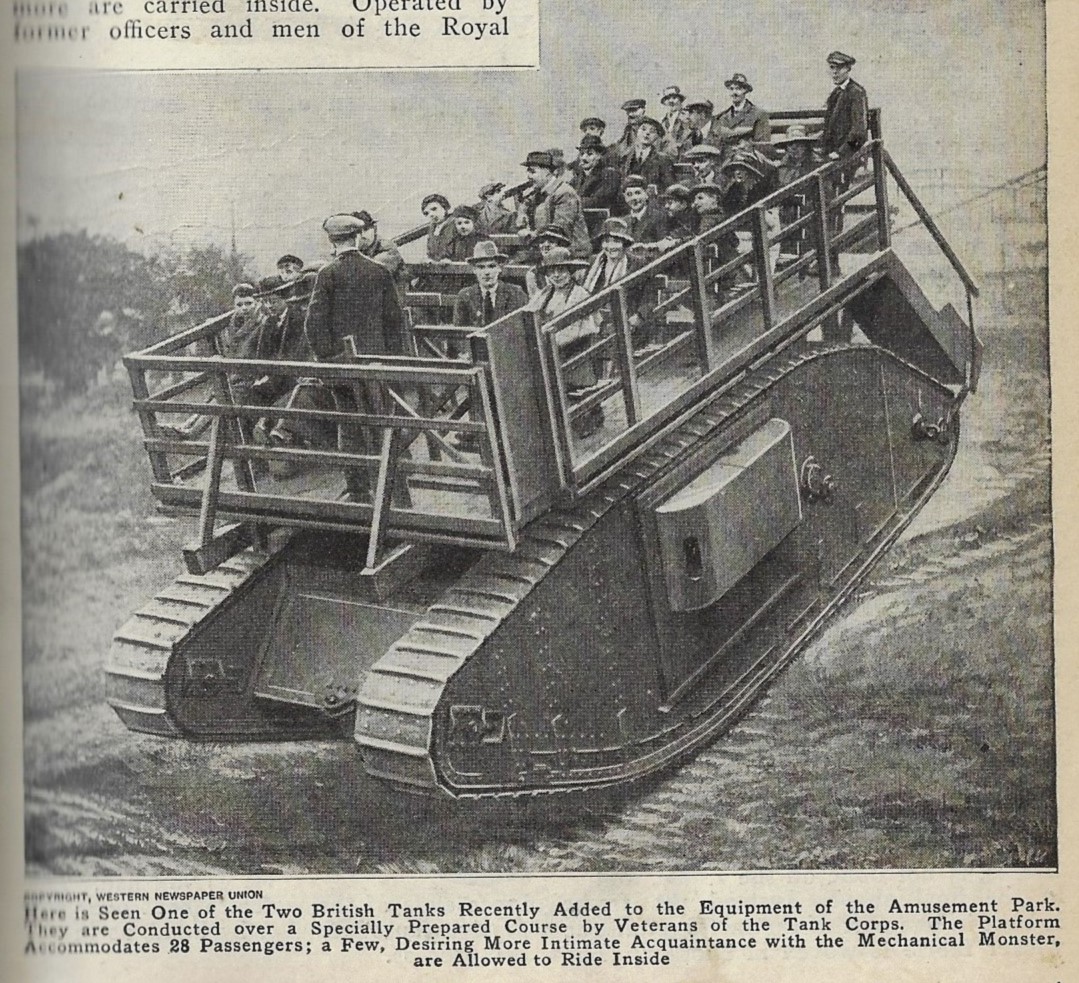
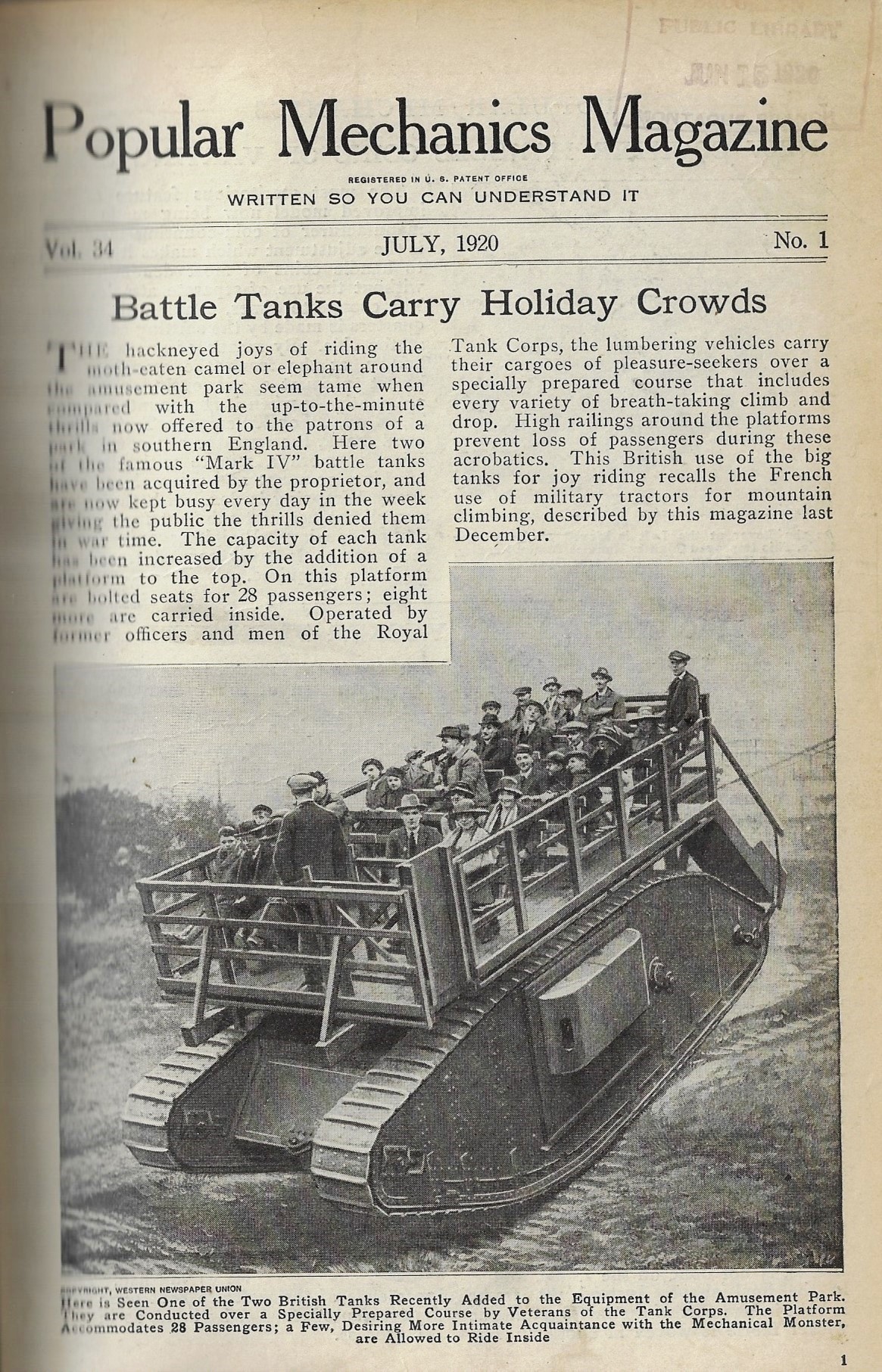
    Pop Mech 1920 tank amusement park_2_There is something lingering and heartbreaking about this image found in Popular Mechanics for July, 1920. The image shows a refitted tank being used as a curious ride at an amusement park. No doubt people wanted to put WWI behind them, as the end of the war was still only two years old or so, and the imagery of millions of people killed during the conflict was still very recent, with the hardships and loss still quite present in the minds of nearly everyone in the world.  That said, the image of the smiling faces on the retrofitted tanks a bit much, seeming to be this side of disrespectful. Seeing the “Jeep” brand doesn’t affect me like this–as the logo has almost nothing left in connection to the WWII vehicle, though I do feel a bit annoyed when I see a deluxe High Mobility Multipurpose Wheeled Vehicle  HMMWV, or Humvee) tooling around in the suburbs, begging attention in its mostly-useless incarnation, carrying with them the memory of hundreds of U.S. soldiers being killed in them. I just don’t like the idea of desensitizing the imagery of these vehicles into something sugary. 

    Pop Mech 1920 tank amusement park

    ·Posted by :

    ·in:

    —

  • When the Words Feel Like the Bad Paper They’re Written On–Trashing Frederick Douglass (1895)

    JF Ptak Science Books  

    1895 was a great big year in science–there were major contributions by Cantor, Poincare, Ramsay, and Perrin, among others, though the biggest of them all was the semi-accidental discovery by Roentgen of X-rays, a monument in the pursuit of further/deeper.

    My own little 1895 discovery last night may be a well-established bit but was unknown to me, and it proved to be the opposite of further/deeper. I was trying to squeeze some life out of what looked like a pamphlet as dry and brittle as the bad newsprint it was made of:  History of the General Assembly of North Carolina, January 9-March 15, 1895, Inclusive (printed by E.M. Uzzell in Raleigh, 1895), which sounds just flat-out anti-interesting (especially with the very specialized time period).  It turns out that the 160-page work is written in a easy, journalismo sub-Menckian way, with a nod to humor here and there and a dose of familiarity, a good narrative style that was useful and breezy.

    And as I hunted for some sparkly point in the daily comings and goings of the legislature, I ran right into the dark void.

    The hole was a short report, “The Douglass Infamy”, which was an infamy of its own. Over the few pages of the article/review it discussed the  “humiliation of the white people of the south” caused by the General Assembly of the legislature choosing to suspend and adjourn their meeting out of respect  for Frederick Douglass, who had suddenly died during the session. The author referred to the action as “an offense against the dignity and sentiments of this proud State” (“State” is capitalized, “Negro” is not),  Douglass to as “the miscegentionist” straight-away after condemning the act of respect due the man, and was an “…author of many malignant and untruthful aspersions on the whites”,  and referred to his as “an inferior race, incapable of civilization except for that under the whites”.  Closing down the government was a “humiliation to white people” and disgusted some legislators to the point where they denied that the action had taken place. I think this was because it elevated Douglass to a level of equality, which just would not do: “The whites of North Carolina…regard any approach by the Negro to social equality with…abhorence [sic]”. 

    The was a significant amount of hateful nonsense in this entry, railing against Douglass, who in their view wrote terrible untruths about white people and who was “also guilty of miscegenation”, having married a white woman.  

    “Thoughtful Democrats who have looked beyond the present moment and who have preferred to bear such party ills as they had, if such there were, rather than fly to others they knew not of, predicted that the fusion with Republicans of any considerable number of those who were formerly Democrats meant Republican domination, and that Republican domination meant, in one form or another, negro [sic] domination. The Douglas incident reveals the animus of that party and is a menace of its aims. (After the official declaration of the Fusionists, the General Assembly did not adjourn in honor of the birthday of Robert E. Lee, a legal holiday, but did adjourn out of respect for the memory of Frederick Douglas.)”

    Finding this article was not surprising, really, though it was unexpected to some degree; there were a few other bits in the pamphlet similar to this, so the article did not stand alone. The part that is so amazing is that it the “Douglass Infamy” was just part and parcel of a documentary and interpretive  report on the action of the state legislature for a few months in 1895; and yet, there was this hateful business, taking up as much space and brain waves as noting that it was a cloudy day.  

    ·Posted by :

    ·in:

    — —

  • Massive Paper Coronary for the Coroner’s Office of NYC, 1915

    JF Ptak Science Books   Quick Post

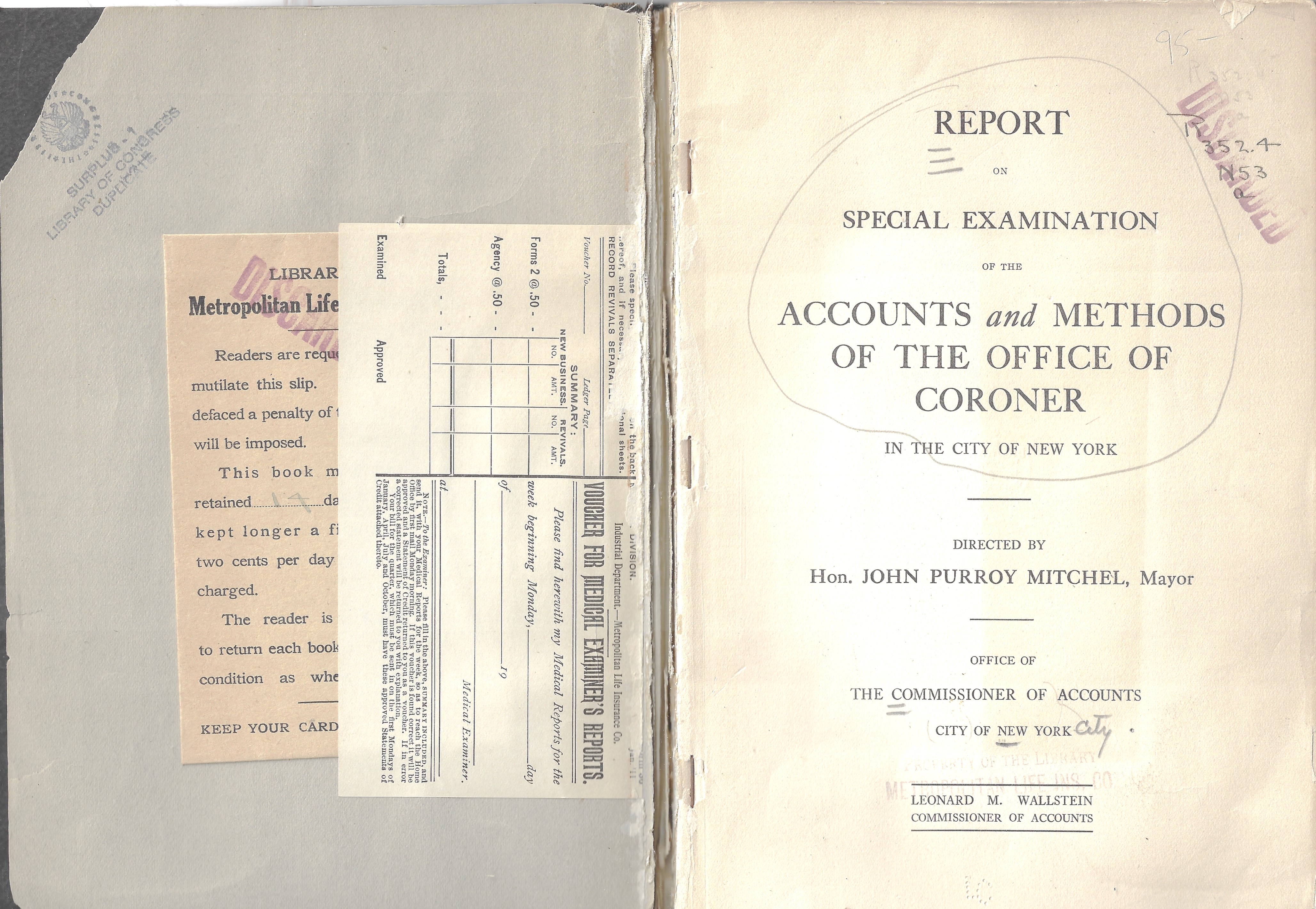
    If you ever had any interest—known and unknown—in reading about very impressive amounts of corruption and its constituents in the coroner’s office for NYC 104 years ago, here’s your chance to satisfy it. I’ve found a scarce report documenting the extraordinary conditions of that agency and also found a copy of it online, and include a link to the report (below).

    You don’t want to be on the other end of this paper—it is scathing, and angry, and well-written and documented. From a quick read of it the office of the coroner of NYC was simply a fantastic mess of incompetent work and very highly competent corruption.

    The report starts at the end, with a summary of findings, and then goes downhill from there:

    • “The elective coroner in New York City represents a combination of power, obscurity and irresponsibility which has resulted in inefficiency and malfeasance in the administration of the office. With constant temptation and easy opportunity for favoritism and even extortion, with utter lack of supervision and control, and without the slightest preparation and training to create in the coroner’s mind a scientific and professional interest in the performance of his duties, the present system could not have been better devised intentionally to render improbable, if not impossible, the honest and efficient performance of the important public function entrusted to his office.

    Of the 65 men who have held the office of coroner since consolidation, not one was thoroughly qualified by training or experience for the adequate performance of his duties….”

    Coroner rept

    There’s a ton of bitter accusation of wrongdoing along with the evidence to back it up. 

    • Here’s the full text via Hathitrust: https://babel.hathitrust.org/cgi/pt?id=mdp.39015055432580;view=2up;seq=4

    ·Posted by :

    ·in:


  • A Not-So-Good Idea for Air Travel (1922)

    JF Ptak Science Books   Quick Post

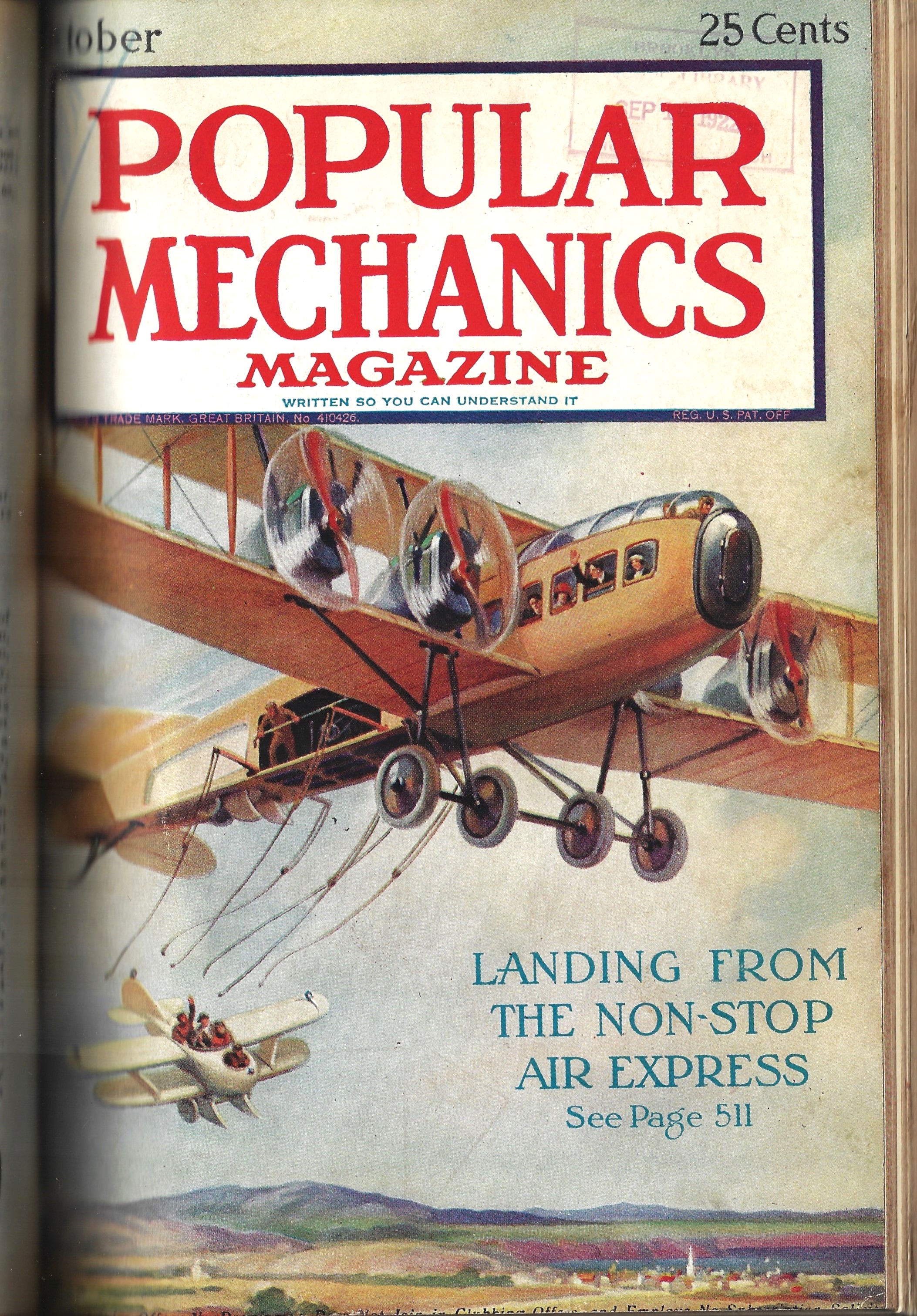
    This October issue of Popular Mechanics 1922 is robust! Here’s another attractive piece of design with loads of character and one central question:  “why?”  The image is that of a giant aeroplane capable of hauling 100 or more souls (not this particular version, though) for long distance uninterrupted flight of 1000 miles–so in order for there to be no in-between landings the aircraft came equipped with a glider aircraft (an altogether different version of the “hang glider”) that was released for the mother ship. As you can see it is a much smaller aircraft and looks to me to be pretty well packed, leading no doubt to questionable utility and much prayer. The thing is, why bother with another aircraft when you can just stop the plane and let people off? This beast was half-stopped in the air anyway by modern standards, probably chugging away at, what, 100mph? (The airspeed record at this time was just a touch over 200mph.) and it wasn’t flying very high (relative to even 1950), so stopping may not have been such a big deal. The airport or air station wouldn’t’ve been an issue either, because the glider would near to land somewhere. Anyway, I just couldn’t figure out this piece of The Possible Future.

    Pop Mech 1922 hang glider

    ·Posted by :

    ·in:

    —