A Daily History of Holes, Dots, Lines, Science, History, Math, Physics, Art, the Unintentional Absurd, Architecture, Maps, Data Visualization, Blank and Missing Things, and so on. |1.6 million words, 7500 images, 4.9 million hits| Press & appearances in The Times, Le Figaro, Mensa, The Economist, The Guardian, Discovery News, Slate, Le Monde, Sci American Blogs, Le Pont, and many other places… 5000+ total posts since 2008.

Category: Bad Ideas

  • A Visionary and Somewhat Contradictory Peace Plan for Humanity (1927)

    JF Ptak Science Books   Quick Post

    “All [people] dream, but not equally.”–T.E. Lawrence

    Although this tall (13″)0 pamphlet is rather short, it is a potential toothache to read. To that end I am not reporting on the contents, just the cover, which tells its own story.  This was printed in 1927, and was once owned by H.L. Mencken.  

    Human Trust Fund


  • On Brain Light, Clairvoyants, and the Uselessness of X-Ray Photographs

    JF Ptak Science Books  Post 2703

    • [The principles of light and color: including among other things the harmonic laws of the universe, the etherio-atomic philosophy of force, chromo chemistry, chromo therapeutics, and the general philosophy of the fine forces, together with numerous discoveries and practical applications, by Edwin Dwight Babbitt (1828-1905) chromopathologist and psychophysician, and published 1896.]

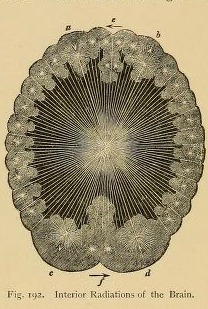
    Brain light detailI must admit to only knowing this book by two dart throws–one that landed on page 495 (with its remarkable image) and then the other on page 56-0, very nearly the end of the book–and sometimes that is all you need, especially in this case, where all you really need is the title.  The author of this mega-themed title and the book that wrapped around its axle seems to promise something having to do with color/light therapeutics, or something, and I was pulled in for perhaps some entertaining pre-non-representational artwork, but I never got that far, stabbing away as I did in the copy on the Internet Archives, finding myself with a light-filled neuroanatomy drawing, and it s explanation.  Whatever the creative light that was reputedly displayed in this image had its existence and purpose proved by clairvoyants, which I don’t often see too often in 19th century anatomies or physiologies.  Anyway, they were there, consulted (either near or far), and the case made, and thus the curtains drawn. I did like the drawing, though.

    When I went to see how the book closed out, I found an addendum on the “so-called Roentgen or X Rays”, which the author says he discovered and wrote about in the first edition of this work back in 1878. He makes some complimentary remarks about the work of Crookes and Edison in this field (the x-ray being discovered in 1895), but then goes on to fuss about the unnecessary use of photography with the x-ray, finding it gratuitous and wasteful. Using your eyes in real time and not a photo was his choice, and that was that, the author ending by saying “I am done with the photographic end of it, entirely”, which no doubt places him in a highly restricted group of people looking at the future of the x-ray.  

    [Image source: Full text: https://archive.org/details/principlesofligh00babb]

    The explanation of the image of brain light:

    ·Posted by :

    ·in:

    —

  • Flat Out Wrong–Flat Earth, 1871

    JF Ptak Science Books  Quick Post

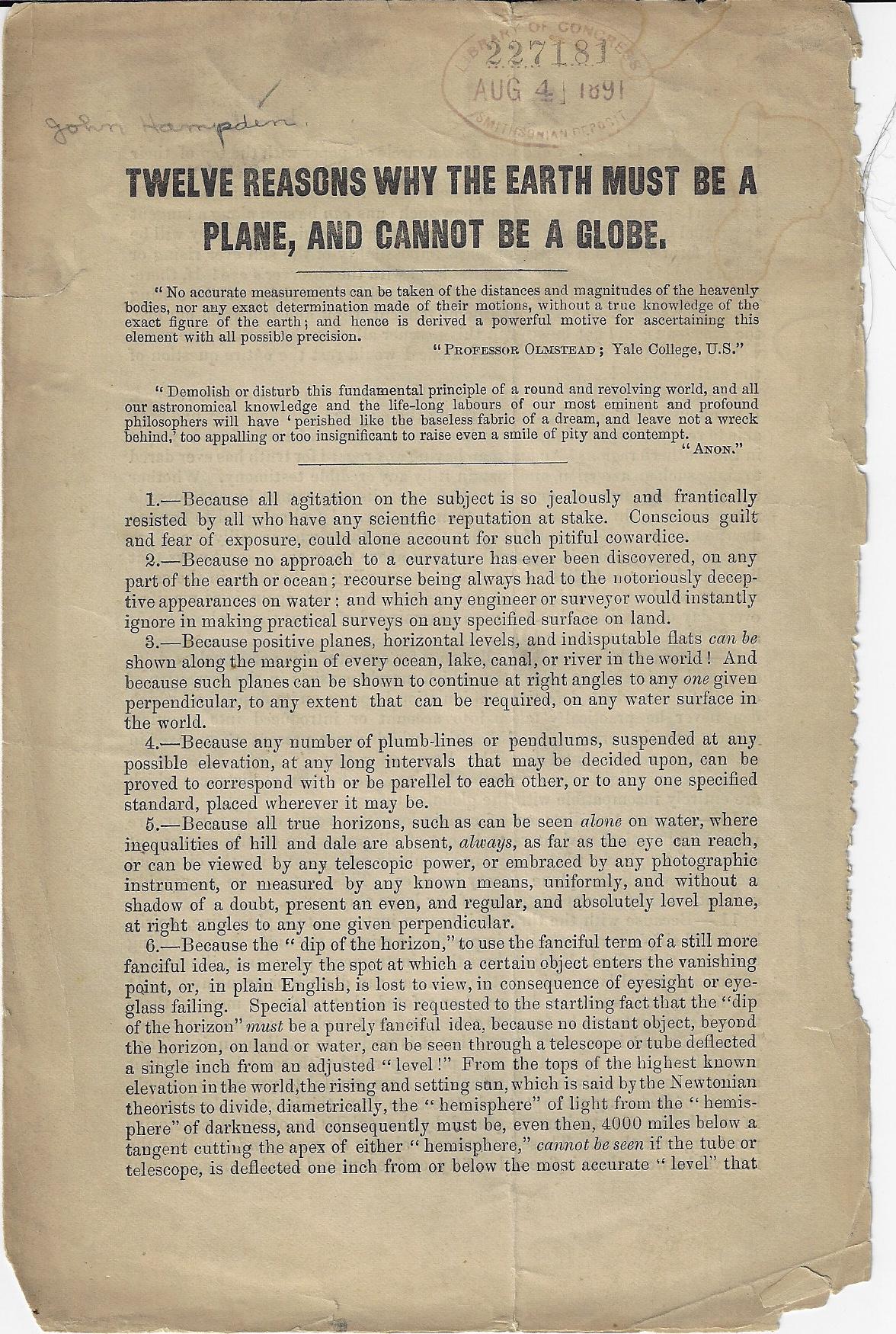
    John Hampden (d. 1891) was a fire-breathing Bible-literalist flat earther who rejected Newton & Co. at every opportunity and at all costs, doing as he was the work that the creator of the universe that he felt demanded of him. He famously feuded with the great Alfred Russell Wallace over a lost bet disproving the flat earth and pursued him via lawsuits and published vindictive. I don’t want to spend too much time with this, but I will reproduce below his leaflet missive advancing his theory, mainly because it looks as though it is pretty rare. It seems as though this was a separately-printed affair of his article that appeared in the rather bumpily named Weston-Super-Mare Gazette on November 11, 1871.  

    Flat earth _1_

    ·Posted by :

    ·in:


  • A Flying Aircraft Carrier, 1942

    JF Ptak Science Books   Quick Post

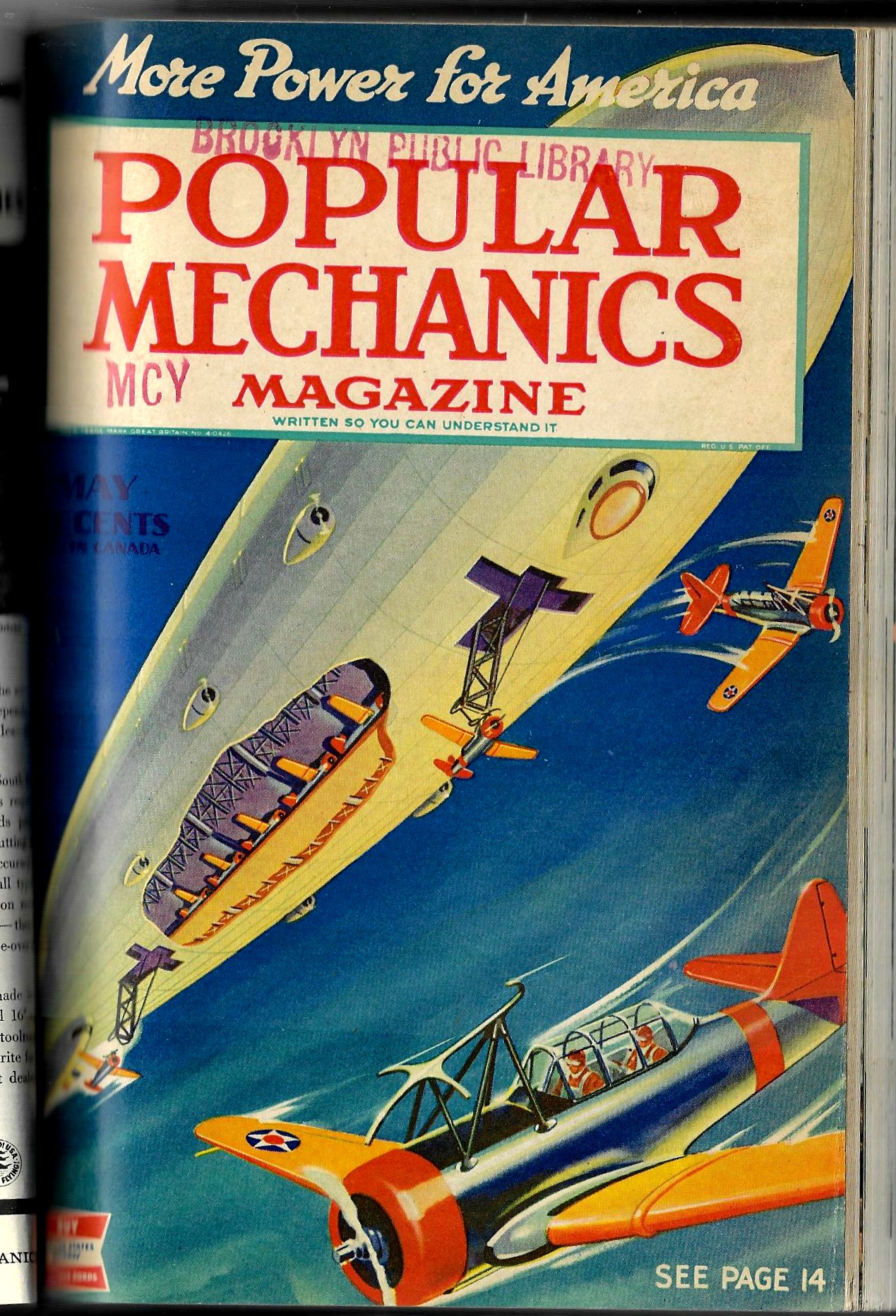
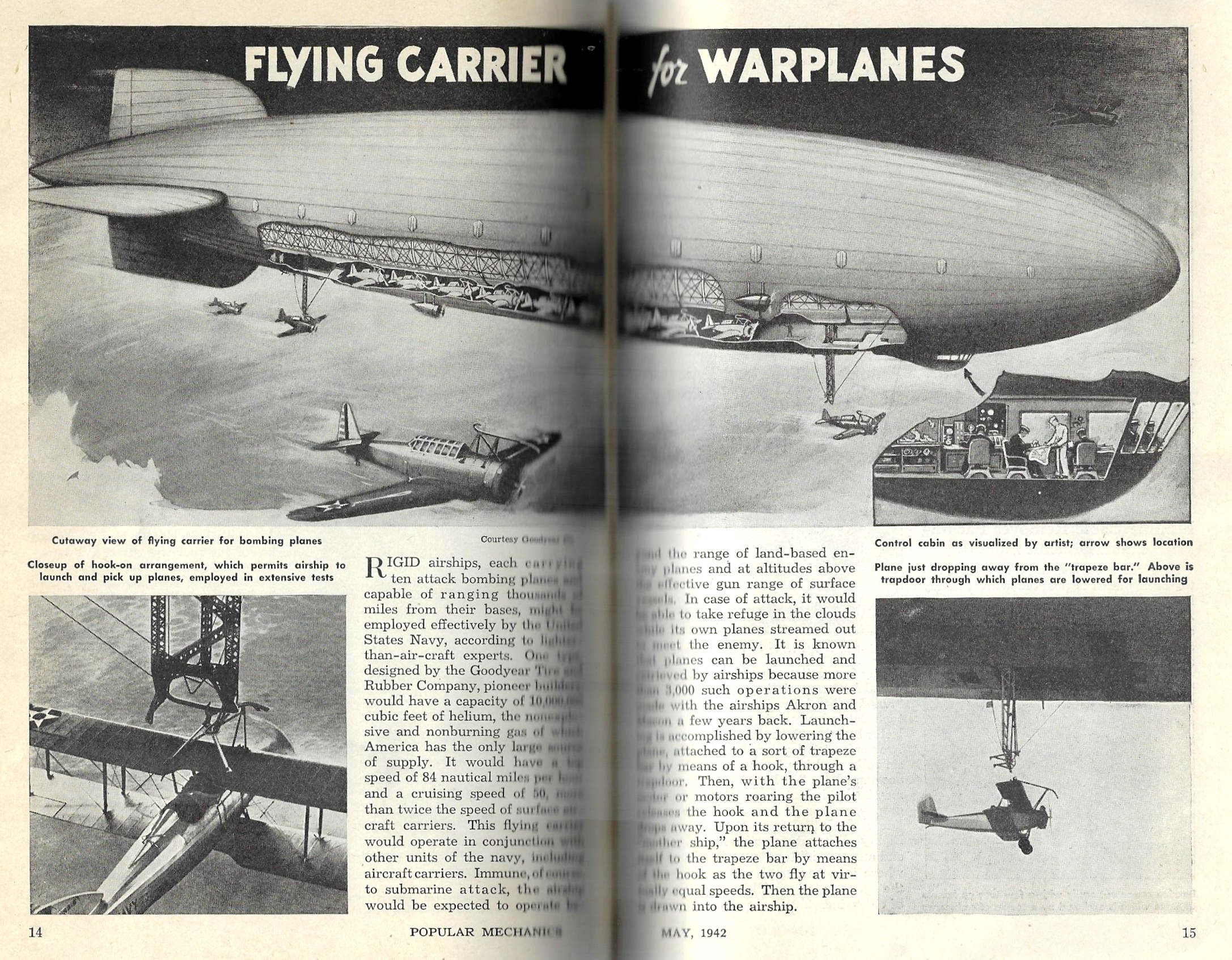
    Here’s an interesting idea: the flying, floating, helium-filled rigid-airship to serve as a flying aircraft carrier, and it appeared in the May 1942 issue of Popular Mechanics Magazine.  That places the idea in print six months after Pearl Harbor, when the U.S. was gearing up for its own direct involvement in WWII.  At the time of the attack at Pearl, the U.S. had 7 carriers; from this point out (from May 1942) to the end of the war there would be 16 more aircraft carriers constructed, plus another 33 escort carriers and light aircraft carriers, and of course those were all seaborne–and in addition to everything else that was being manufactured, that was a huge achievement.

    One thing the article points out that is an unimpeachable positive for the rigid airship carrier–they were not threatened by submarines. 

    Pop Mech 1942 May dirigible airplanes

    And the cross section giving a clearer idea of what is going on in the airship: 

    Pop Mech 1942 May diribible cross section

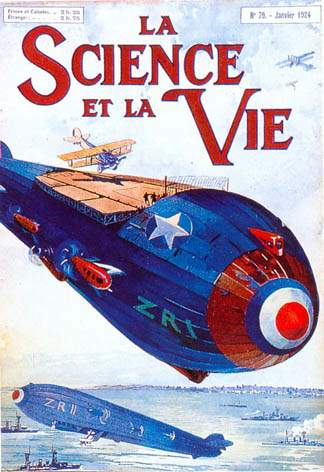
    And another, far more awkward variation, from 1924–this has little to do with the idea above though it is somewhat related:

    https://historyofideasblog.com/a/6a00d83542d51e69e2012875ea3636970c-pi


  • A Big Head of Nothing (1865)

    JF Ptak Science Books  Quick Post 

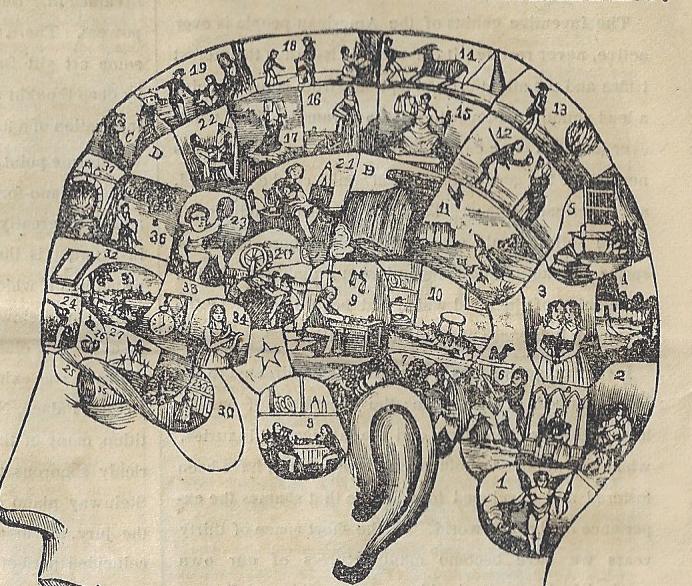
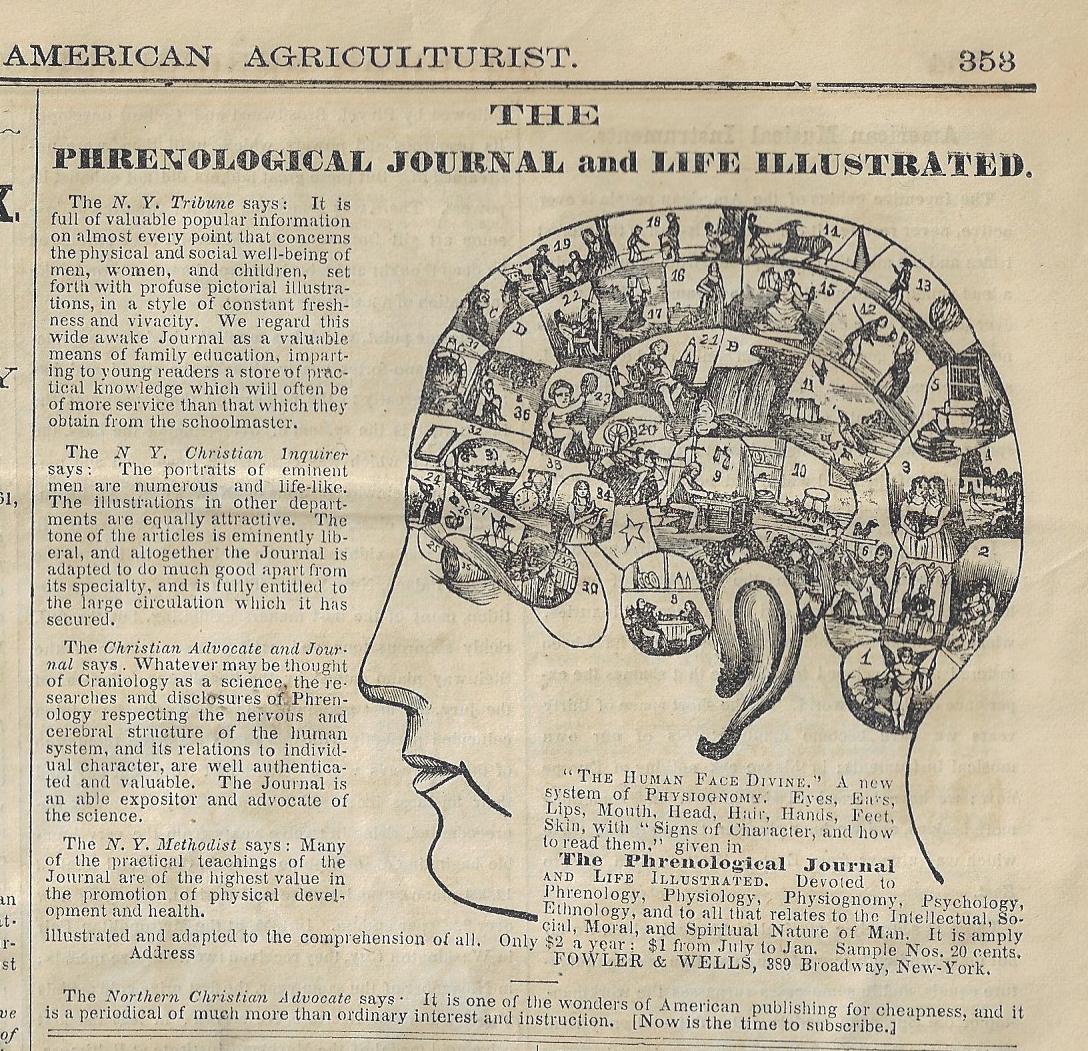
    This advertisement to subscribe to the Phrenological Journal appeared in November, 1865, with promises of profuse understanding of the connection of the nervous and mental life and its connection to, well, bumps on the head. There was also the promise of higher intellectual life by infusing the journal with devotion to psychology, ethnology, physiology, and of course physiognomy. It is interesting to note that four of the five endorsements come from religious newspapers, G_d knows why.

    American Agriculturalist 1865 phreology detail


    American Agriculturalist 1865 phreology

    ·Posted by :

    ·in:

    —

  • Rocket Mail Delivery, 1934

    JF Ptak Science Books  Quick Post

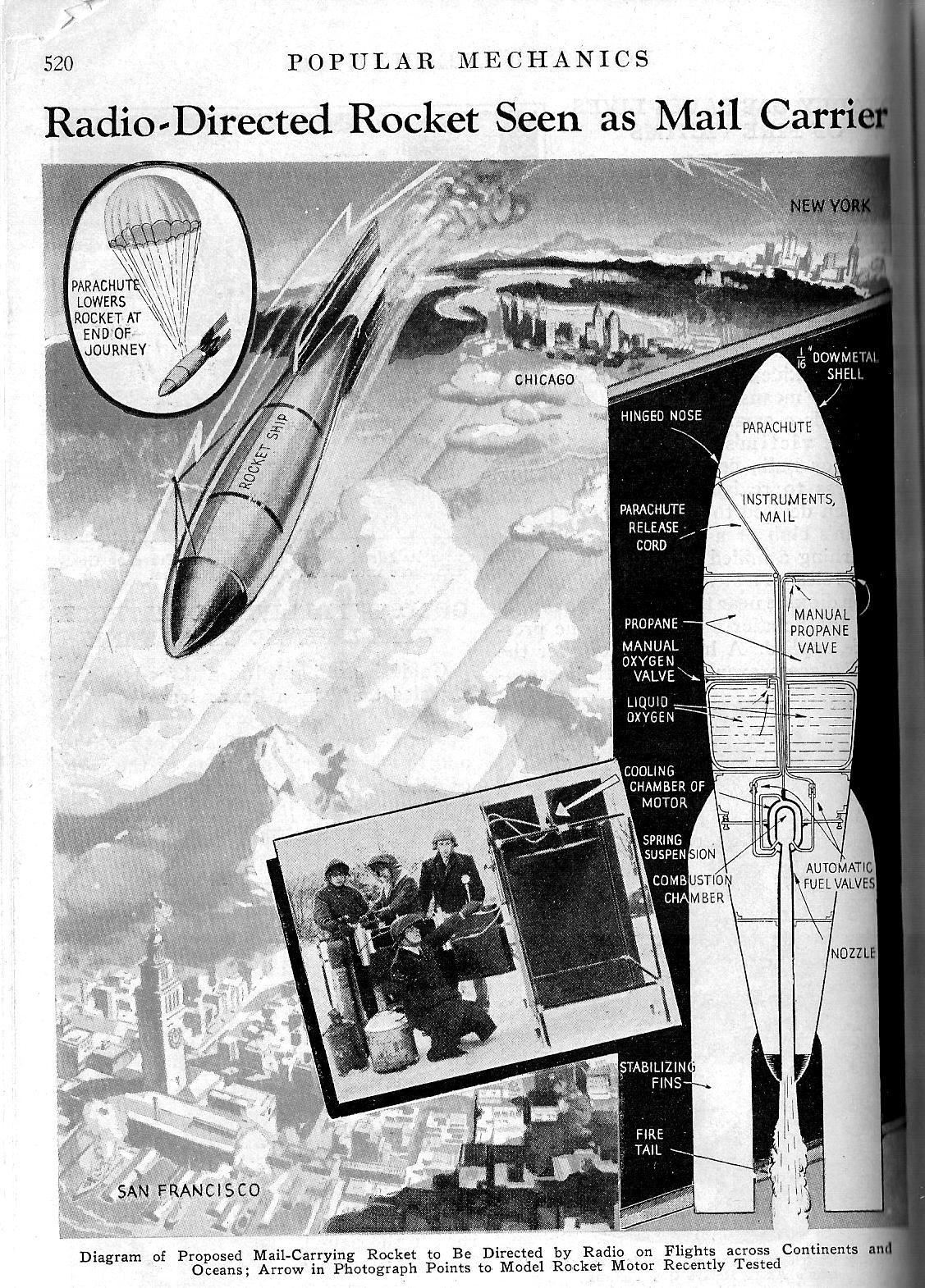
    This seems as though it was an interesting idea back in 1934–but no doubt there were others thinking that instead of dropping mail on a city by a rocket that another payload could be substituted…better yet, just use the entire rocket for this delivery-of-something-else item and dispense with the parachute altogether. In any event, the idea never caught on (though megastars of rocket flight Hermann Oberth and Eugene Sanger discussed its possibilities in a positive light), and it seems as though there was only one instance of USPS rocket mail delivery–a converted nuclear-warheadless SSM-N-8 cruise missile was used to do so in 1959, and that seems about it. 


    Pop MEch 1934 Rocket Mail

    {Source:  Popular Mechanics, April 1934]


  • From the Just-a-Few-Months-Shy-and-Everything-Changes Department (1941)

    JF Ptak Science Books  Quick Post    

    War and the People791This pamphlet enumerates the benefits of Communism and the pact of the Soviet Union with Hitler. It was printed in February 1941, and after describing the Imperialist world war, the war and the Middle Classes, “how the war hobbled the working classes”, it goes on to (obtusely) describe how the understanding between the Soviet Union and Germany has saved 150 million lives.  All of this goes away four months later when the Soviet Union is viciously and brutally attacked by Germany in Operation Barbarossa, and then, most of those “saved lives” turn out not to be so.

    ·Posted by :

    ·in:

    —

  • A Radium Shadow (1920)

    JF Ptak Science Books   Quick Post

    Undark.

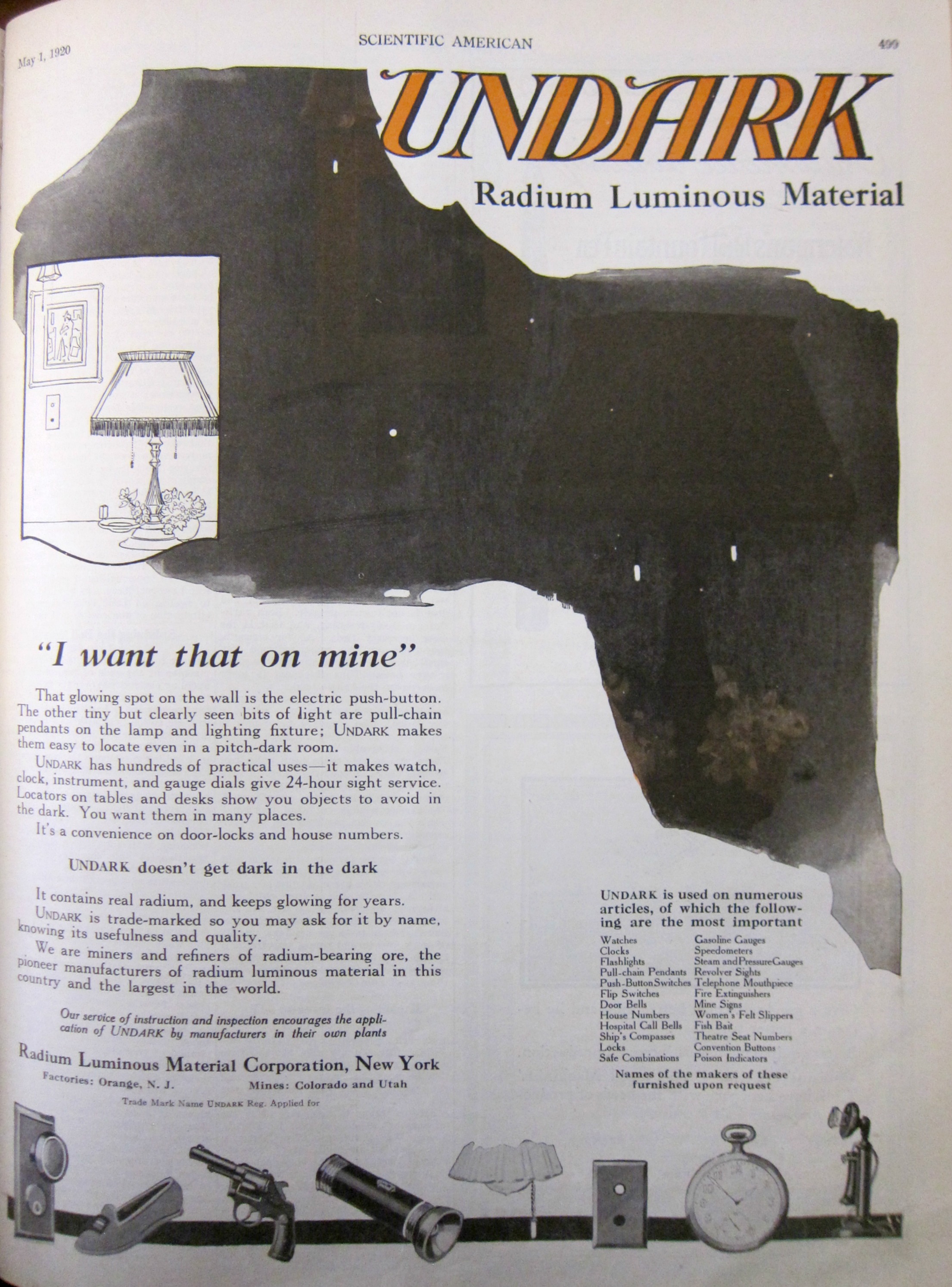
    UndarkNow, that is quite a name for a product–for a glow-in-the-dark product, for something that will not darken. The advertisement displayed here was for a product that “doesn’t get dark in the dark”, and appeared in the Scientific American on May 1, 1920.  The particularly cringeworthy part of Undark, viewed from the future of this advertisement, is that the spots of light on the wall and etc. that make Undark what it was was an applied radium paint. And it was the famous or infamous case of “The Radium Girls” (that really brings the cringe into sharp focus, as it was this same company and product that was being advertised (left) that brought all of those workers into their sometimes-lethal encounter).  

    [It is a little difficult to make out what is going on in that dark patch, but essentially it is the room at left, in the dark, and the little specks of white are the items on which the Undark has been painted. So if you needed to find the fobs of a lamp or the edge of a table or a gun in the dark, Undark will get you there.]

    The women were workers for the U.S. Radium Corporation–which started out its business life as the Radium Luminous Materials Corporation–who worked with radium and luminous paints and who contracted radiation poisoning from their close contact (and ingestion) of the paint, a result of  “sharpening” their paint brush tips by touching it to their lips and tongues.  The injurious effects of radium was well known to the chemists and executives at U.S. Radium, but that information was kept from the women hired to apply the paint to (in this case) watch dials. 

    Historic litigation ensued in the early 1920’s, and when the case was settled in 1928 the workers received relatively modest settlements–the result of the case though was wide-reaching in labor rights law and also in occupational health and safety–all of that was a lot more valuable than the $10k payment and $660/year annuity awarded to the Radium Girls. 

    Evidently the inventor of the first radium-based luminescent paint, Sabin Arnold von Scohocky (1883-1928) developed aplastic anemia (a developing deficiency and failure to produce all three blood cell types) most probably as a result of his prolonged exposure to radioactive material. Marie Curie, Max Valier, Otto Lillienthal (and so on) also died as a result of working on their discoveries/breakthroughs, though what ultimately cost von Scohocky his life was nowhere near as significant as the work of the other three.  


    ·Posted by :

    ·in:


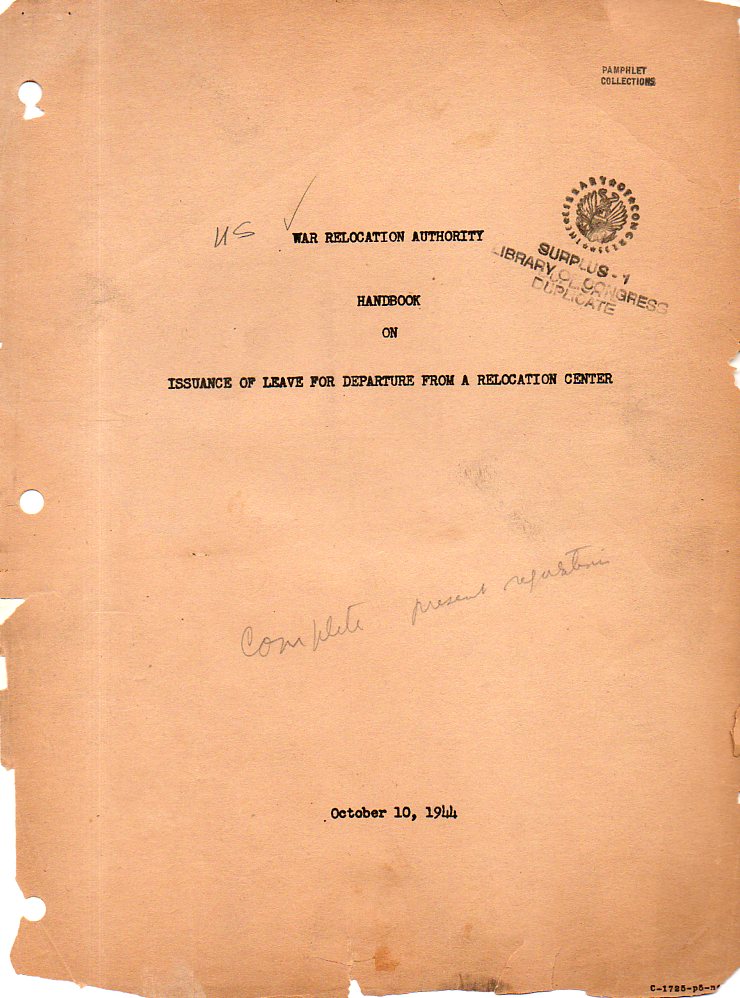
  • 115-Pages of Directions on How to (Possibly) Leave Manzanar (1944)

    JF Ptak Science Books   Post 2635
    WRA_1_732
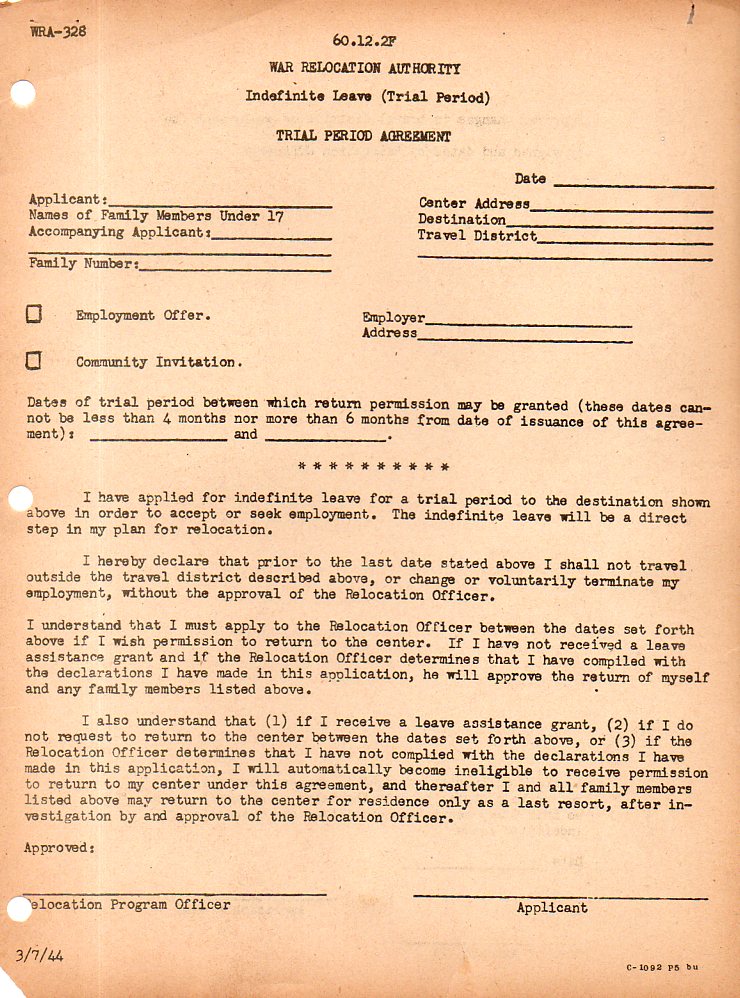
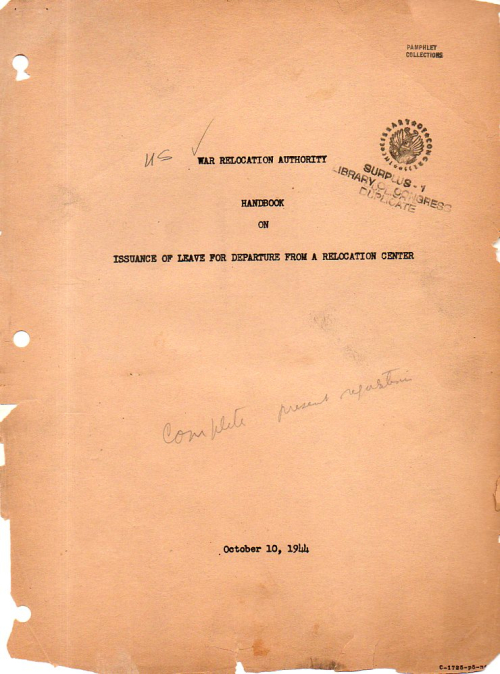
    Just this morning I unearthed this interesting document: War Relocation Authority Handbook on Issuance of Leave for Departure from a Relocation Area October 10, 1944, which was basically a set of rules and regs on how an a Japanese person/”evacuee” could apply for dispensation for leaving the relocation center /internment camp. The language and organization of the document is dense, misleading, and labyrinthine, and spread wide and thin over 115 pages. It is in fact difficult to go from page one to the final page, as there is no real pagination that one can distinctly follow to get through the document in order–if you were to take the thing and toss it into the air and then try to put it back together again, it would not be a straightforward task. It is a confusing and seemingly-contradictory work bibliographically, at least if you were try to define it by its structure. Perhaps this speaks to the administration of the places that this document was trying to describe: there are numerous versions of the document issued over several years, some replacing parts of sections and other replacing entire sections though leaving in place sections contiguous to and within the new sections; the tiny sub-pagination at the bottom right of each sheet doesn’t necessarily follow from one page to another although the text does (for example, there is a page “C-109 2 p1 of 11 nubu-cos-pun-wp”; further, the pagination which is the most useful is the section/page designation at top right, however the numeration of sections and paragraphs in the actual text seems a little thick, starting sections as “.1” rather than “1” and the “.1 A.” rather than 1A or some such. In the end,  when I figured out that the document was actually complete, I was very surprised, because it hardly looked so while trying to follow pagination alone. 

    The War Relocation Authority was formed on March 18, 1942 via Executive Order 9102, following the Japanese attack on Pearl Harbor and the U.S. Entry into WWII, with Milton S. Eisenhower as the director. This was the action taken in the interests of national security resulting in rounding up and deporting to remote internal U.S. Destinations more than 125,000 people—mostly U.S. citizens—of Japanese heritage. The WRA was the consequence of the larger initiative, the Roosevelt administration’s Executive Order 9066 (19 February 1942), which was the legal bombshell that gave the War Department the authority to authorize the removal of the Japanese and theoretically prevent those people from engaging in sub rosa and fifth column activities as wartime terrorists fighting for Imperial Japan within the United States—and this effort concentrated mainly on the Pacific coast and West. For the greatest majority these people stayed in the “Relocation Centers” (routinely referred to as “internment centers” and “U.S. Concentration Camps” for the remainder of the war, and then some. The Japanese/internees were bused away from their homes and lives and businesses with extremely limited notice, and were forced to sell nearly all possessions (including lands and businesses) at what were less than fire-sale prices.  They were made to board buses and trains and were shipped to locations (mainly in California) where they were processed and sent further and deeper into the trying hinterlands of the West for their final destinations until the war was won.  (One of the processing centers was the Santa Anita racetrack, where thousands of Japanese were sent to live for periods in converted, just-painted horse stalls.)  After 3+ years and WWII won, the relocation centers were closed, with Tule Lake was the last (that once included Gila River, Granada, Heart Mountain, Jerome, Manzanar, Minidoka, Poston, Topaz,and the Rohwer War Relocation Centers) to close, though that didn’t take place until March 20, 1946, via Executive Order 9742, signed by President Harry S. Truman on June 26, 1946.

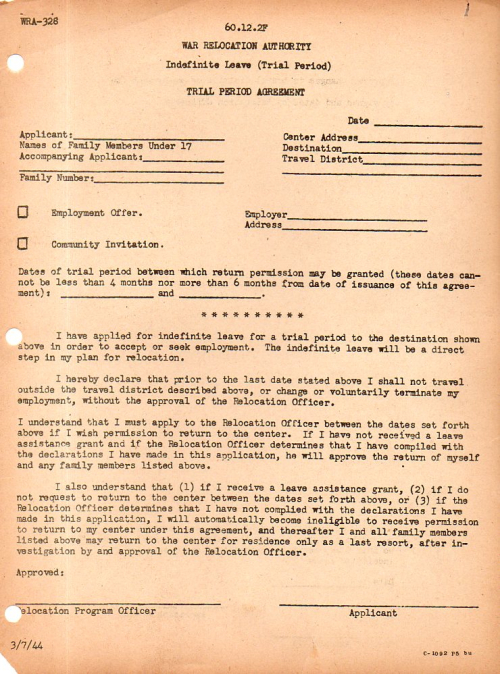
    Here is what seems to be a sample of what the interned Japanese would fill out and submit for leaving the internment camp:
    WRA_3_734

    The overall introduction to the document is signed (in the original, and then reproduced) by Dillon S. Myer, who was the Director and oversaw the WRA from 1942 until 1946; other sectional introductions in the document are signed similarly by Duncan Miller (who in 1945 was at the Colorado River Relocation Center at Poston, AZ), Malcolm Pitts (who was an executive administrator and who wrote Administrative Highlights of the WRA in 1945), E(?)D. Brooks, and Leland Barrows—all but Brooks are located as being “Executive Officers” of the WRA.

     From my reading this series of rules and regulations for the possibility of an “evacuee” to leave the relocation center is a Menkenian example of using 10 words where one word will do. The introduction is sufficient enough for a general reader to be able to guess at what is to come over the next 100+ pages:

    ·Posted by :

    ·in:

    — —

  • Questionable Quidity: the Fire Escape Head Parachute, 1879

    JF Ptak Science Books   Quick Post

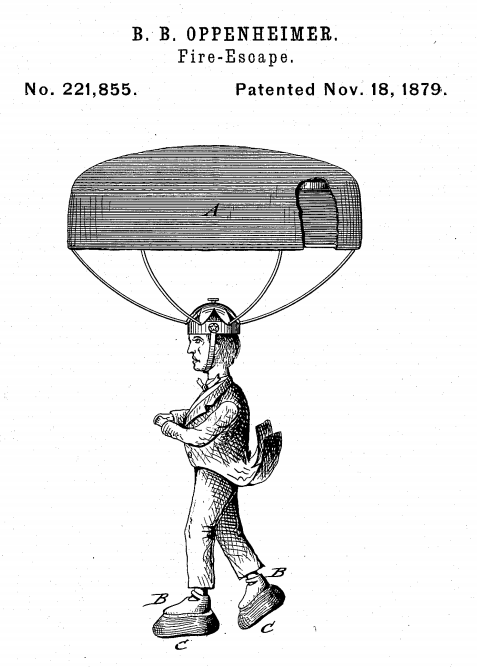
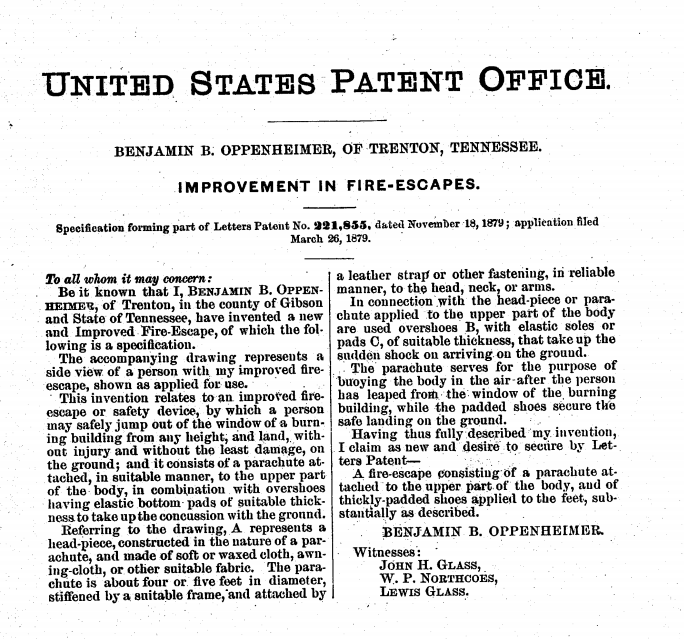
    When I first saw this image I thought, naturally, that it was an unreal real patent; it turns out that Mr. Oppenheimer was a real person and that this patent was a real patent. I doubt that someone would have their necks broken by this device when deployed thinking that it would just pop off–then again, if fastened very securely, it becomes a very cringeworthy thing to think about. The shoes don’t help much.  

    Patent parachute fire escpae _2_

    And the report:

    Patent parachute fires escape

    ·Posted by :

    ·in:

    — —