A Daily History of Holes, Dots, Lines, Science, History, Math, Physics, Art, the Unintentional Absurd, Architecture, Maps, Data Visualization, Blank and Missing Things, and so on. |1.6 million words, 7500 images, 4.9 million hits| Press & appearances in The Times, Le Figaro, Mensa, The Economist, The Guardian, Discovery News, Slate, Le Monde, Sci American Blogs, Le Pont, and many other places… 5000+ total posts since 2008.

Category: Naming Things

  • The Gulf Stream in 1678

    JF Ptak Science Books   Post 2831

    Kircher gulf stream074

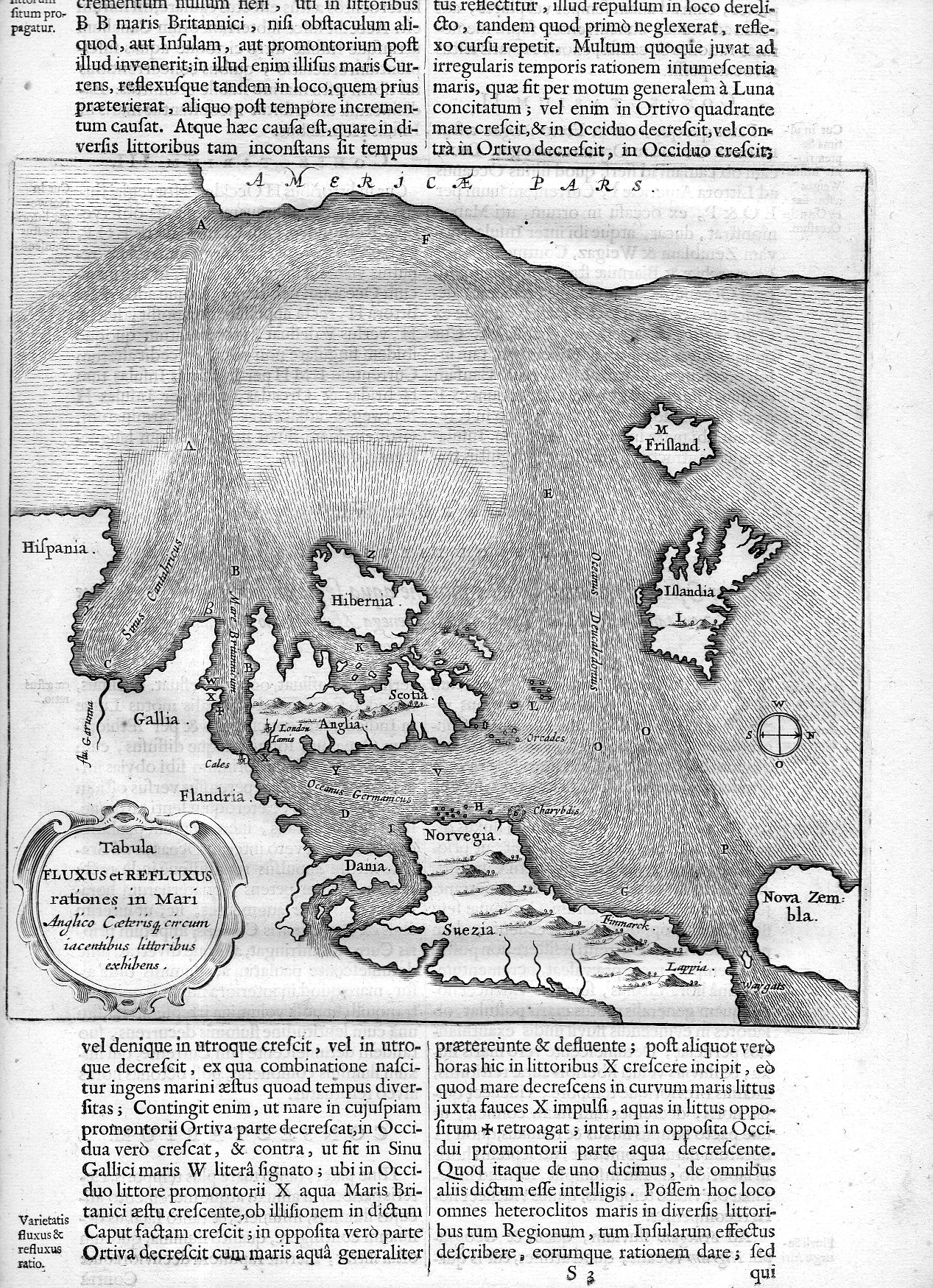
    This is one of the earliest depictions of what we know today as the Gulf Stream, and it appears one among many wonders in Fr. Athanasius Kircher’s Mundus Subterraneus (1678). The map appears about a century before the first map to truly distinguish the Gulf Stream (the B. Franklin/Folger map of 1768-1785) and shows the remarkable activity that must have come with the acquisition of the data necessary to show on even this popular map.  Given that the data was necessarily spotty at this early period the Kircher effort was largely theoretical (and for what it was worth he likened the currents to something similar to blood moving though the body, which at least put to use the work of William Harvey).   (Eberhard Happel is on a similar wavelength as Kircher with the currents map, and published his map a few years later, though he was mainly a science popularizer who “relied” heavily upon the Kircher map and was nowhere near to being Kircher’s intellectual rival–his map is still interesting given its very heavy lining and beauty.)

    • Tabula Fluxus et Refluxus rationes in Mari Anglico…
    • The map measures 7 3/4 x 7 3/4″ on a 14 3/4 x 9″ sheet, being folio 141/142. 

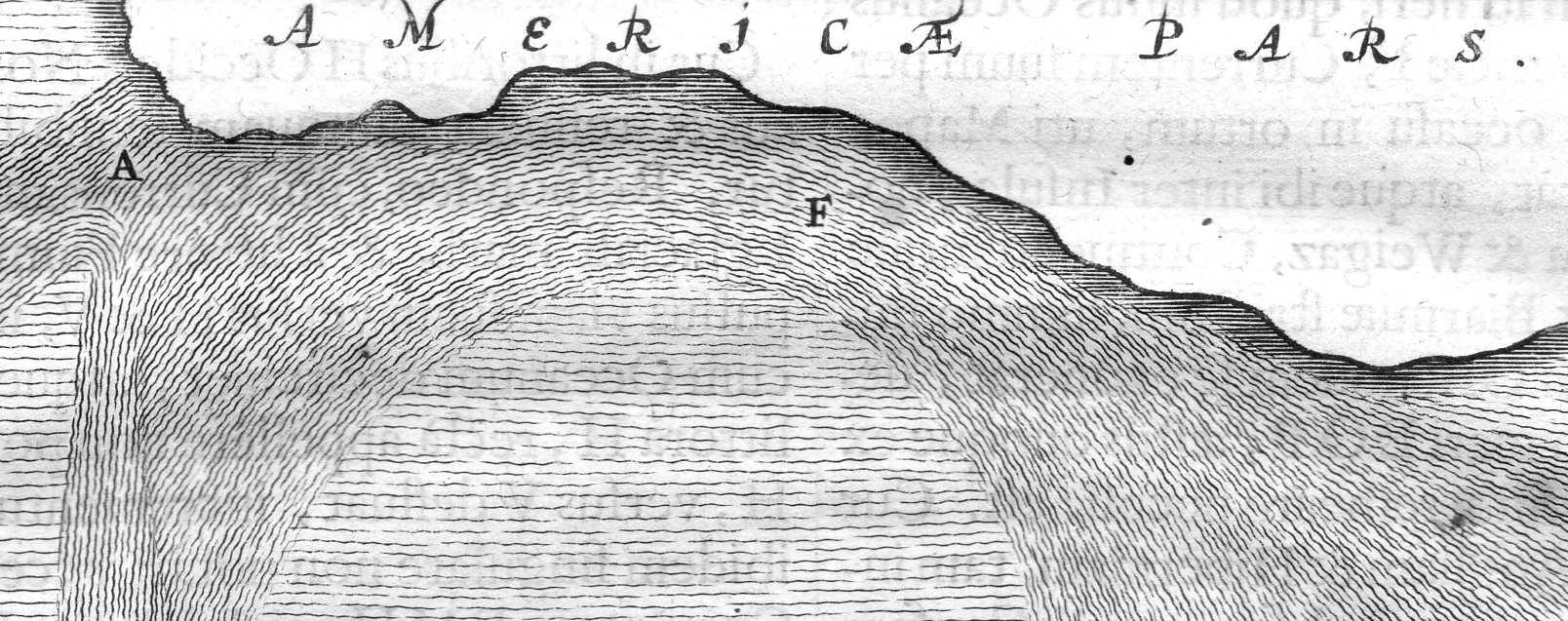
    This is a detail of the larger map (below) with a East-West orientation for bottom-to-top, making  the northern North American coastline along the top of the map, with the European coast from Spain to Denmark, and then hopping over to the Nordic countries, and of course with England and Ireland, and lonely Iceland. 

    Kircher gulf stream073


  • Life in Stone–Some Interesting Work by the Great Fr. Kircher (1678)

    JF Ptak Science Books   Post 2825

    The great semi-mystifying polymath Athanasius Kircher (1602-1680) lived for a long time and filled his life with ideas and words,  producing dozens of books during his time on Earth, some of which were never published even though written, some manuscripts lost forever. His was a massive output of extraordinary breadth.  He wasted little time what I can see, writing on a spectacular range of subjects, enlightening people, confusing people, generating great theories and some bad ideas. 

    The images below comes from his Mundus Subterraenus (“Athanasii Kircheri Mundus subterraneus in XII libros digestus… “), an edition published in 1678, and which was concerned mainly with geology and the theory of the Earth.  Kircher a product of the great Jesuit institution, the Collegio Romano, postulated the structure of the interior of the Earth, the origin of heat, the source of the tides, the composition of light, mechanics, the structure of music, linguistics, astronomy, and of course the existence of the Virgin Mary in amber.  There was also a fair amount of work on one of his side interests that populated a number of his works, alchemy and the search for the organization of materials.

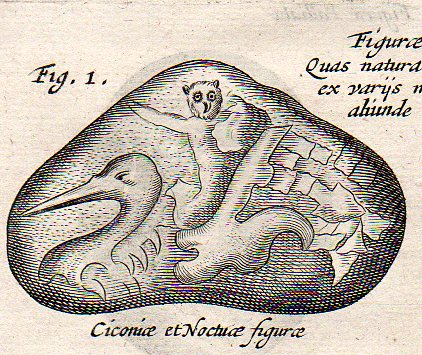
    But what I am looking at today with Kircher is the Mary-in-Amber part, his investigations (and theorizing, and documentation) on naturally-appearing, organic objects found in inorganic material–rocks and minerals–like these birds:

    Kircher  lapidibus birds451

    Which is a detail from  

    Kircher  lapidibus birds449

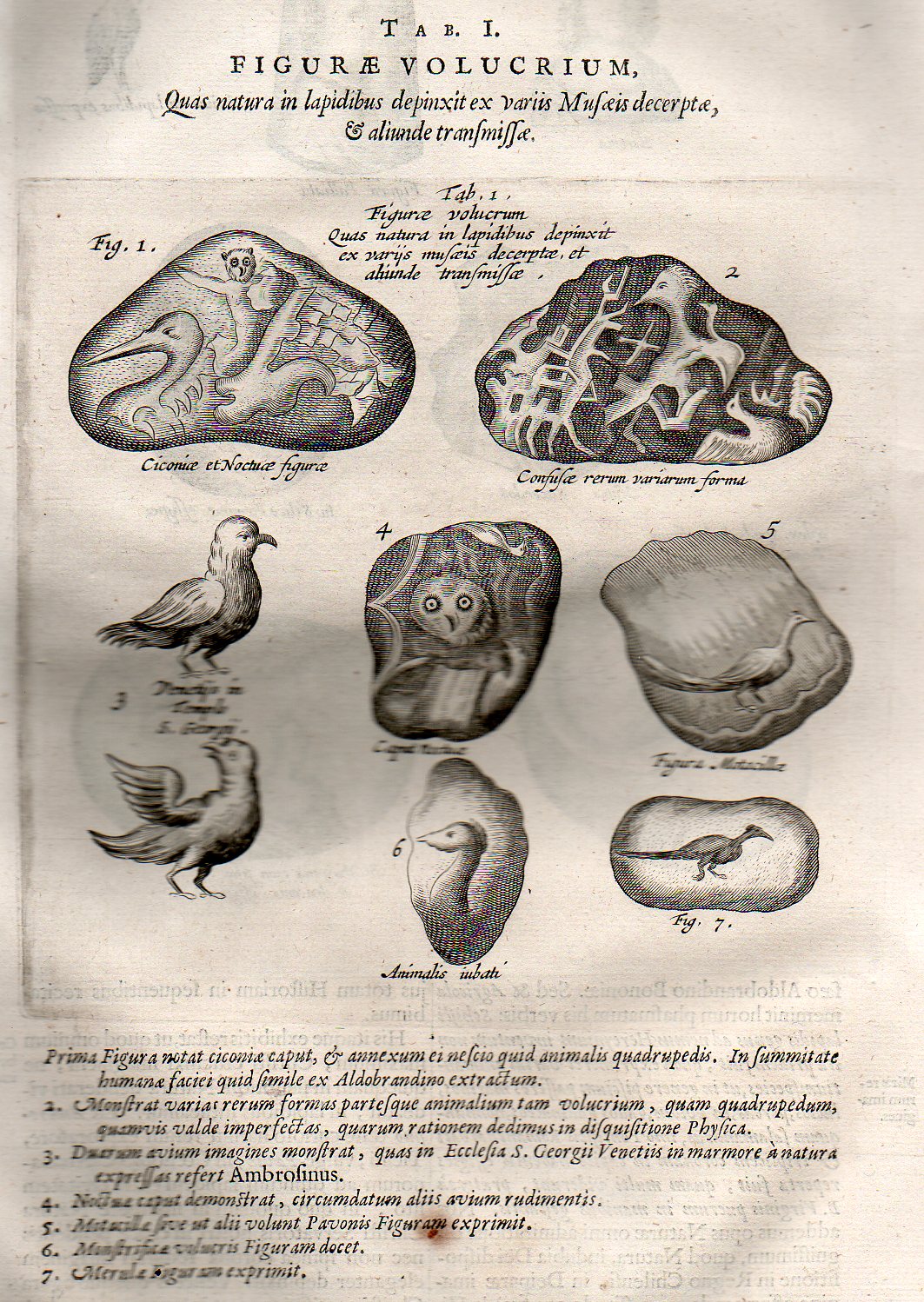
    The engraving, entitled Figure Volucrum, quas Natura in lapidibus depinxit, ex variis Museia decerpt et aliunde transmissa (or “Figures of winged creatures, painted by nature on stones, taken from various museums, and otherwise transmitted.”) shows Kircher’s collection of anthropomorphically based inorganic items.  It is a remarkable exercise to try and place yourself within the context of the scientific world of Kircher’s time, 350 years ago, and try to explain these naturally-occurring phenomena, without even the benefits of the conception of long geologic time, or of expanded time in general.  

    The descriptive text (at the bottom of the engraving) from Kircher on these objects is translated, as follows:

    1.  The first figure represents a head of a Stork, together with some, but I do not know what, quadruped. At the top is something like a human face. Extracted from Aldobrandinot (see PI. XXIII. Fig. 1). 
    2.  Shows various forms and parts of animals, winged creatures as well as quadrupeds, although very imperfect, the cause of which we give in the physical examinations (see PI. XXIII. Fig. 2). 
    3.  Represents the figures of two birds expressed by nature on marble in the church of St. George’s, at Venice, referred to by Ambrosinua (see Vol. VII. PI. II. Figs. 3, 4). 
    4.  Shows the head of an Owl, surrounded by rudiments of other birds (see PI. XXIV. Fig. 2). 
    5.  Represents the figure of a Wagtail, or as others prefer, of a Peacock (PI. XXIV. Fig. 3). 
    6.  Shows the figure of a monstrous bird (Vol. VII. PI. II. Fig. 4). 
    7.  The figure of a Merle (Vol. VII. PI. II. Fig. 5).

    ·Posted by :

    ·in:

    —

  • Music, Color, Shape, and Synesthesia (1890)

    JF Ptak Science Books  Quick Post

    • “A studious blind man, who had mightily beat his head about visible objects, and made use of the explication of his books and friends, to understand those names of light and colours which often came in his way, bragged one day, That he now understood what scarlet signified. Upon which, his friend demanding what scarlet was? The blind man answered, It was like the sound of a trumpet.”— John Locke, An Essay Concerning Human Understanding.

    This is a big subject for a quick post, the subject of synesthesia having an origin enfogged in mist and with ill-defined boundaries, or at least that is until we get to the 19th century. If we leave aside the earlier thinking (by folks like the quoted Mr. Locke, above) we can speed ahead to Gutav Fechner (the father of psychophysics) with his empirical study of a group of synesthetes in 1871. He was quickly followed by Francis Galton (in 1881, a paper that I write about elsewhere on this blog), though neither Fechner nor Galton’s work in this area achieved very much recognition beyond pale acknowledgment. Things speed up somewhat in the early 20thc when the empirical work is taken more seriously.

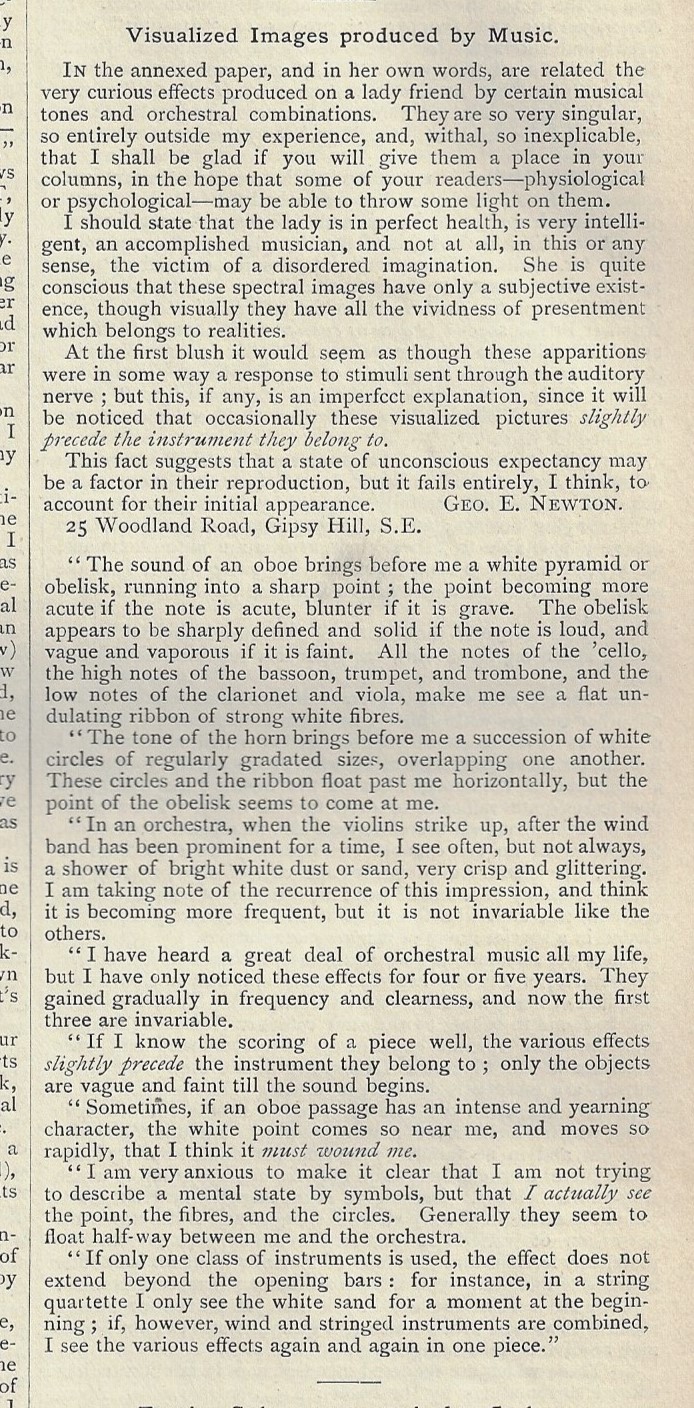
    But stepping back for a moment, I’d just like to share this unusual and interesting 1890 paper from Nature. I never bumped into it before nor could I find more than a couple of bare references to it. So I’m wondering if anyone out there knows anything about it—this is done in the spirit of the original author of the paper, George Newton, who posted his story (“Visualized Images Produced by Music”, March 6, 1890) to see if anyone else in nature-world recognized anything like the situation he describes.

    The opening paragraph of the paper:

    “IN the annexed paper, and in her own words, are related the very curious effects produced on a lady friend by certain musical tones and orchestral combinations. They are so very singular, entirely outside my experience, and, withal, so inexplicable, that I shall be glad if you will give them a place in your columns, in the hope that some of your readers-physiological or psychological-may be able to throw some light on them.”

    Nature 1890 Newton synesthesia

    ·Posted by :

    ·in:

    — —

  • On Looking for One Thing and Finding Another (1878). What Does Criminality Look Like?

    JF Ptak Science Books   Quick Post

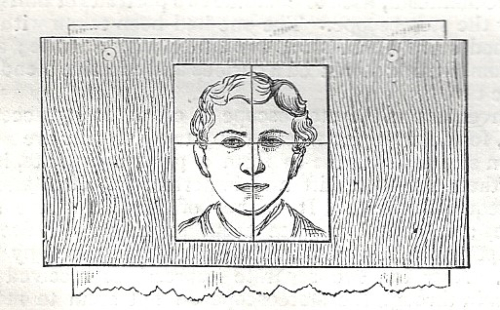
    Galton faceSir Francis Galton’s “Composite Portraits” article in May 23, 1878 volume of Nature (pp 97-100) came early on in the prehistory of cognitive and computational aspects of “facial recognition”, though more like an analog development for a later digital environment. In this paper he discusses his attempts to see the face of criminality before crime was committed. Galton put together and projected a number of portraits of criminals to see if a fundamental picture of criminality arose–what he found was the opposite, and poetic. He started with a first set of eight portraits of people convicted of murder, manslaughter, or robbery accompanied by violence. What he found I’m sure must’ve been surprising to him: the composite of the eight were “much better looking” than the individual components, and that the “special villainous irregularities…have disappeared”. It was the “common humanity that underlies each of them (that) has prevailed”.

    Galton continues to state that the composite “represents not the criminal, but the man who is likely to fall into crime”.

    There is then a fair amount of discussion of the many uses of the composite photograph, though I think for our purposes we can stop right here.

    [A sample composite image, above.]


    ·Posted by :

    ·in:

    — —

  • “The Western Frontier” and How Old That Name Might Be

    JF Ptak Science Books  (From the series on “Naming Things”)

    I’m returning to this post (from ten years and 4300 posts ago) on the question of “where is the West?” because I thought I had stumbled upon a very early mention of the related idea of “the western frontier”. The phrase popped up in an article on the telegraph systems of the world (in the Journal of the Franklin Institute for 1852) and in the section on the U.S. there is a mention of telegraphs “now extending from the verge of civilization on the western frontier (east of the Rocky Mountains) to the northeast extremity of the United States”. It struck me that–I thought–I really didn’t recall seeing “western frontier” (without a capitalized “W”) all that much in the mid-19th century, let alone discussing it in terms of Colorado. 

    To check out the scarcity of this phrase I checked out the Frederick Jackson Turner piece that started this whole idea of the study of the U.S. frontiers and scanned for the elements, finding “frontier” mentioned 168 times, “west” 107 times, “western” 42 times, but with only four appearances of “western frontier”, and that usually in reference to the slavery issue. The OED was no help on this, unfortunately, and could not establish “western frontier” in the long entry on “frontier”, which has a very old and long usage in English. From there I went over to WorldCat, and checked out the appearance of “western frontier” in the titles of books printed 1800-1860, and found in the dozens of millions of book records that it seemed to occur hundreds of times. However, once getting rid of duplication, and works that had “western” and “frontier” in the title but not together, it looked as though there might only be 10 or 20, but a short look at that set showed the usage in the form I was looking for reaching back into at least the 1820’s.  So, my 1852 reference was way late, but I think I might be able to say that “western frontier” really doesn’t pick up in usage until after Turner’s 1893 piece. 

    Anyway, here’s the rest of that earlier post: 


  • A Proto-typewriter, 1857.

    JF Ptak Science Books  Quick Post

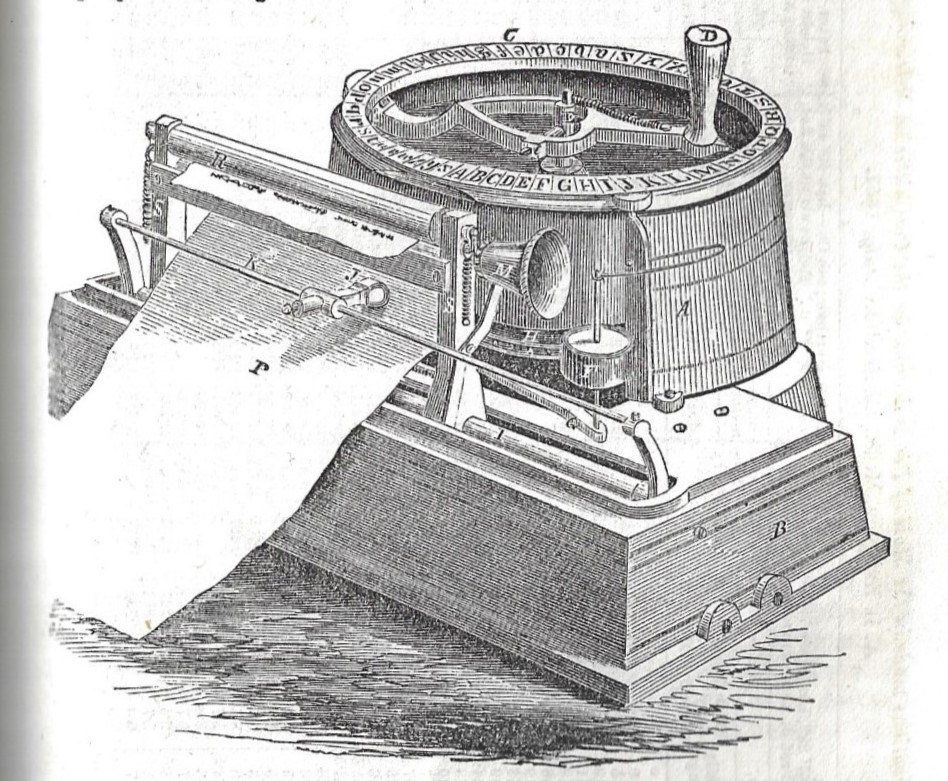
    Here we have a lovely attempt at what is close to being a typewriter (a “hand-printing machine”), found in the Journal of the Franklin Institute for June 1857. The size isn’t given but my guess is that it would be about the size of foolscap paper, easily desk-top. It seems fairly simple in a slightly complex way, and I can easily see where it would serve as a stop-gap implement between what came before and the typewriter. 

    The short article introducing the workings of the machine is surprisingly, and very readable, even though it is brisk and sharp. It is just well done.

    It is difficult to see some of the annotations, even in the original, and even with a magnifying glass, but for that first indicator “H” you can find it just southward of the bell-like object (“M”, which turns out to be a handle for the paper roller), and “E” was another difficult one to find, and that one turns out to be the pivot in the center of the type circular.  In any event, the thing operates much like a typewriter, the lever “D” moved to the position of the letter needed, then pressed down, moving the type into place against the ink and the paper, which is loaded in rollers much like a modern typewriter. 

    JFI 1857 typewriter _2_


  • On Doing and Done: the Differences in describing the Difference Engine of Charles Babbage, 1832.

    JF Ptak Science Books  Post 2792
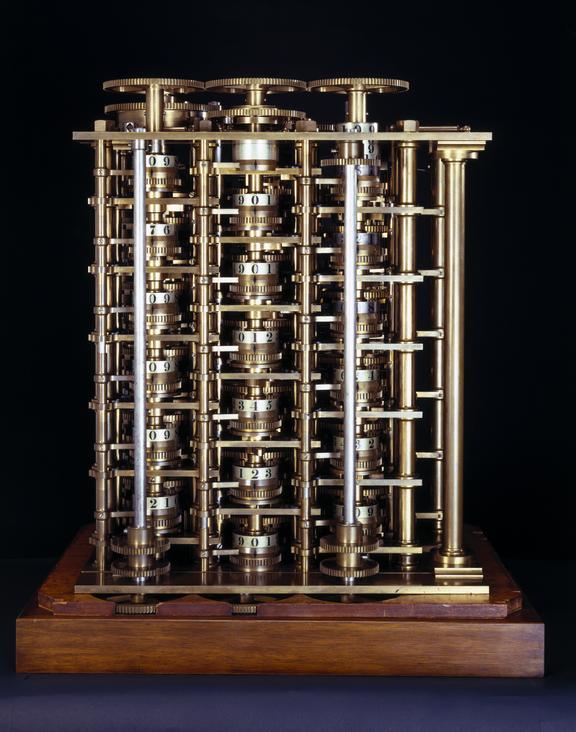
    Babbage difference engineThere’s a big difference being “inventing” and “invented”. You virtually never hear or read of someone declaring “I am inventing thus-and-so” imply that they’re working on something; “I invented the letter number seven” implies that you’ve completed the act of invention and the number seven exists. 

    In cataloging a book for my bookstore I came upon this difference in reference to Charles Babbage and his early calculating machine, and proceeded to make a mountain of a molehill, and then the reverse. 

    The “incident” was sparked by a volume of the Journal of the Franklin Institute1 with the appearance of a very early mention of Babbage having built his Difference Engine  (No. 1) found in a one-paragraph mention in the article “The Results of Machinery”:

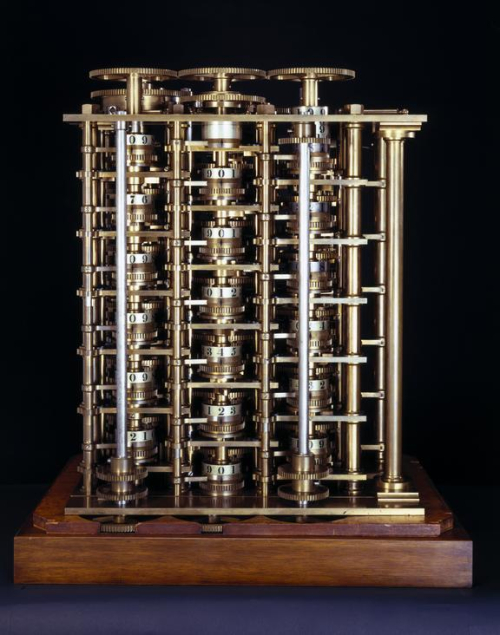
    [Image at left of Babbage’s machine in 1832, from the Science Museum http://collection.sciencemuseum.org.uk/objects/co62243/difference-engine-no-1-difference-engine-portion-only]

    “Mr. Babbage…has invented a calculating machine…” referring to the newly (1832) “completed” 1/7th  of the machine. (The Difference Engine No. 0 announcement came June 14, 1822; the Difference Engine No. 1 appeared in this year, 1832, though work was suspended on it in 1833 (with government funding removed);’work soon to begin on Difference Engine No.2 (1846-9), (and with A. Lovelace’s famous “Notes” appearing on the Analytical Engine in 1843.)

    The article is a review/abstract of the book by Charles Knight, The results of machinery : namely, cheap production and increased employment exhibited : being an address to the working-men of the United Kingdom, which appeared in a second edition in London in 1831 (and a fifth in 1832) with a first American appearing in 1831. The Babbage calculating machine bit from the JFI is taken very nearly verbatim from these editions, where in the original the mention of the machine is referred to as “almost perfected”–here in the JFI it shows up as “invented”, which as they say is something quite different, the world of “almost-perfecteds” being much wider broader deeper than that of “the perfecteds”.

    Leaving out the fact that the machine was yet really built is of course a minor thing compared to the overall message of the paper and the book in general, but I just got my scarf wrapped around the axle on it. 

    The full note on Babbage reads:

    “The inventions for saving mental labour, in calculations of arithmetic, have been carried so far, that Mr. Babbage, a gentleman whose name we have twice before mentioned, has invented a calculating machine, which not only does its work of calculation without the possibility of error, but absolutely arranges printing types of figures, in a frame, so that no error can be produced in copying the calculations, before they are printed. We mention this curious machine, to show how far science may go in diminishing mental labour, and ensuring accuracy.”

    This was part and parcel the principle thrust of this article: investigating the application of machinery in a positive way to production and labor and showing its “…effects of saving unprofitable labor”.

    The few paragraphs of background leading to the Babbage reads as follows:

    “The foot-rule of the carpenter not only gives him the standard of a foot measure, which he could not exactly ascertain by any experience or any mental process; but it is also a scale of the proportions of an inch or several inches, to a foot, and of the parts of an inch to an inch. What a quantity of calculations, and of dividing by compasses does this little instrument save the carpenter, besides ensuring a much greater degree of accuracy in all his operations! The common rules of arithmetic, which almost every boy in England now learns, are parts of a great invention for saving mental labour. The higher branches of mathematics, of which science arithmetic is a portion, are also inventions for saving labour, and for doing what could never be done without these inventions.

    There are instruments, and very curious ones, for lessening the labour of all arithmetical calculations; and tables—that is, the results of certain calculations, which are of practical use, are constructed for the same purpose. When you buy a joint of meat, you often see the butcher turn to a little book, before he tells you how much a certain number of pounds and ounces amounts to, at a certain price per pound. This book is his “Ready Reckoner,” and a very useful book it is to him; for it enables him to despatch his customers in half the time that it would otherwise require, and thus to save himself a great deal of labour, and a great deal of inaccuracy.

    The inventions for saving mental labour, in calculations of arithmetic, have been carried so far, that Mr. Babbage, a gentleman whose name we have twice before mentioned, has invented a calculating machine, which not only does its work of calculation without the possibility of error, but absolutely arranges printing types of figures, in a frame, so that no error can be produced in copying the calculations, before they are printed. We mention this curious machine, to show how far science may go in diminishing mental labour, and ensuring accuracy.”

    So in this message of insight and hope I got stuck on one word, which ultimately really doesn’t mean anything. The message was significant and an interesting and insightful way of phrasing the possibilities for the application of more advanced machines in the future, and was much bigger whatever the state of completion of the Babbage machine was.
  • The Fires of London, 1832

    JF Ptak Science Books  Quick Post

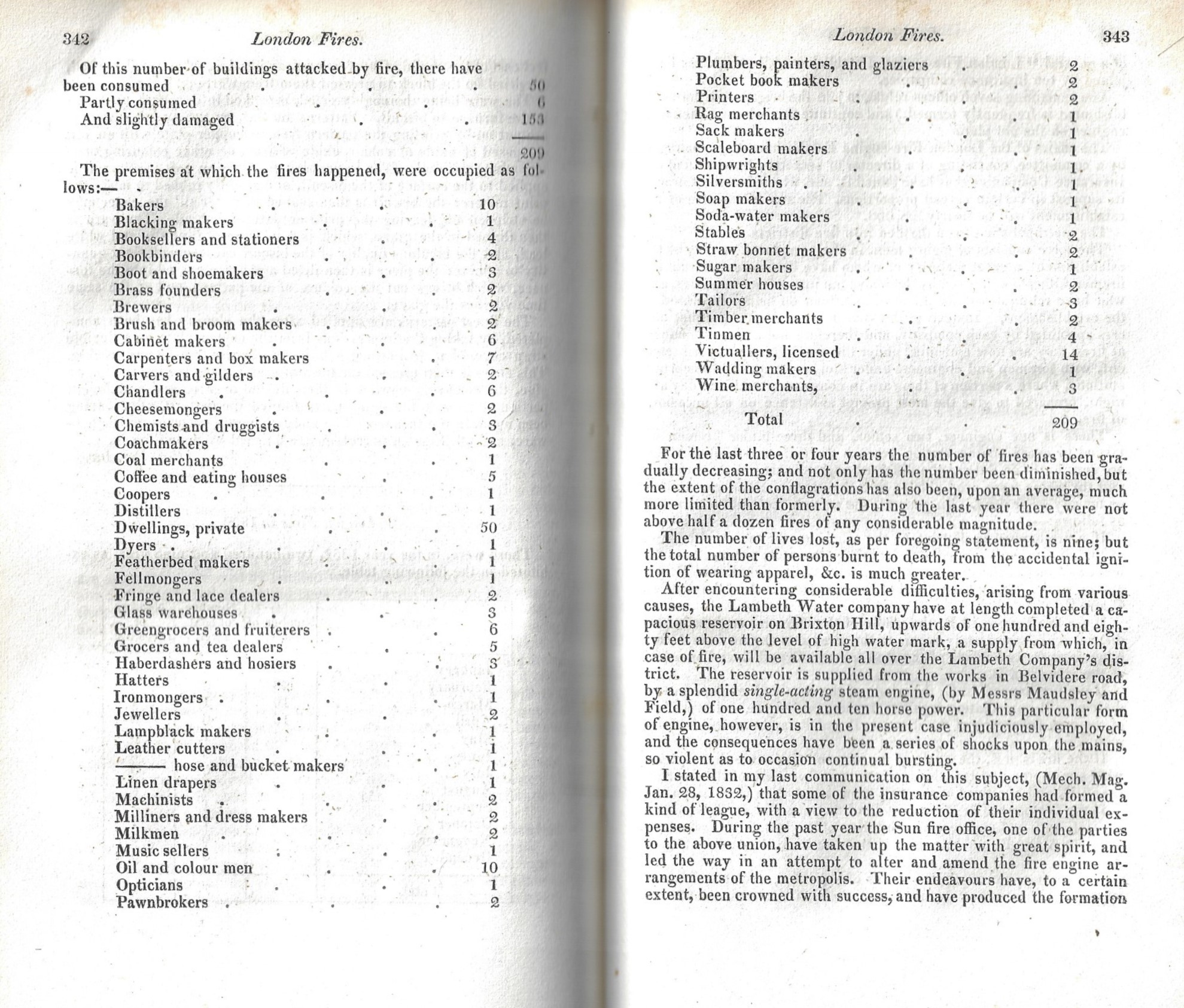
    This bit of not-common data (below) just came to me while I was fussing around in a volume of the Journal of the Franklin Institute (January-June, 1833), and details the fires and the businesses in which they started. It is a curious bit, reminding me of a post I did some years ago about Charles Babbage’s tour of the broken windows of London. There were 209 fires, which really doesn’t seem to be an awful lot, all things considered. The business, though (“the buildings attacked by fire”), the ones consumed by fire, are mostly in themselves consumed now by time. Blacking makers, brass founders, brush makers, carvers and gilders, coachmakers, coopers, feltmongers, fringe makers, lampblack makers, milkmen,, , oil and color men, rag merchants, sack makers, scaleboard makers, straw bonnet makers, tinmen, and wadding makers, are all pretty much gone as standard enterprises. 

    JFI 1833 Fires in London

    ·Posted by :

    ·in:

    —

  • Colossal, Super Colossal, and Mega Colossal: The “Terrible Seismical Manifestation at Java” (1883)

    JF Ptak Science Books  Quick Post

    I came to this terrible majesty/rex tremendae of words browsing an 1883 volume of Nature, landing on two articles on the Krakatoa eruption of 26-7 August 1883. The editors were just then coming to grips with what scant information came their way, though they knew  that what they were trying to present to their readers was a very major event.  There was little to prepare them for what they would understand the eruption to be, no doubt filling themselves with images of dread (Quantus tremor est futurus, “what horror invades the mind”, calling again–sorry!–on Mozart’s Requiem for the appropriate language).

    The eruption is well known and the subject of innumerable stories and papers, so I’ll not get into that. I do want to look at the expansive and changling vocabulary describing these events, though. The way eruptions are categorized in modern times for relative description and is the Volcanic Explosivity Index (the VEI). a logarithmic scale which runs 0-8. The basis of categorizing the terrific nature of the eruption is made in terms of the volume of ejecta, the plume height, length of eruption, and that sort. I find the defining terms of type of eruption to be very entertaining, with eruptions being described as (level VFI 0) effusive, (1) gentle, (2) explosive, (3) catastrophic, (4) cataclysmic, (5) peroxysmic, (6) colossal, and of course (7) super-colossal, and (8) mega-colossal. (Just a quick note: “colossal” appears in the OED by 1664; “supercolossal” as an unhyphenated word appears by 1875; and “mega-colossal” just doesn’t appear.)

    Krakatoa was a VFI-6, a peroxysmic event with 10 km3 of ejecta, which is 1 billion meters3, or 1 trillion litres, or 264 billion gallons (which would weigh in at 1.8 trillion pounds, or about the equivalent of 17,819.7 Titanics), or about 10 times the ejecta of the 1980 Mt. St. Helen’s eruption. These are very messy approximations as ejecta is varied, but it does give you an idea of the magnitude of what was going on.  

    ·Posted by :

    ·in:


  • Examples of the First Use of Words by George Orwell Found in the OED

    JF Ptak Science Books  Quick Post   [Part of the series on Naming Things.]

    While looking for something else in the Oxford English Dictionary I looked up the instances of the works of “George Orwell” being used as illustrative/descriptive examples for a word and found 484 usages and 9 first-time-use references. That’s a lot for a modern writer in the OED–Shakespeare on the other hand has 15,986 listings and 1,591 first uses, the orders of magnitude fully expected; coming to another massive wordsmith in Gibbon,  we see the numbers skewed deeply down to 1,741 and 32. Anyway, Orwell/Blair shows well in comparison to The Rise and Fall, which to me is impressive.  Here are his 9:

    Doublethink: The mental capacity to accept as equally valid two entirely contrary opinions or beliefs.

    • 1949   ‘G. Orwell’ Nineteen Eighty-four i. iii. 37.   His mind slid away into the labyrinthine world of doublethink. To know and not to know, to be conscious of complete truthfulness while telling carefully constructed lies, to hold simultaneously two opinions which cancelled out, knowing them to be contradictory and believing in both of them, to use logic against logic, to repudiate morality while laying claim to it, to believe that democracy was impossible and that the Party was the guardian of democracy.

    ·Posted by :

    ·in: