A Daily History of Holes, Dots, Lines, Science, History, Math, Physics, Art, the Unintentional Absurd, Architecture, Maps, Data Visualization, Blank and Missing Things, and so on. |1.6 million words, 7500 images, 4.9 million hits| Press & appearances in The Times, Le Figaro, Mensa, The Economist, The Guardian, Discovery News, Slate, Le Monde, Sci American Blogs, Le Pont, and many other places… 5000+ total posts since 2008.

Category: Naming Things

  • Human Maps of Cyborg Parts, Wounds, and Blood

    JF Ptak Science Books

    A Map of Man’s Ability to Replace Himself, 1610-1723

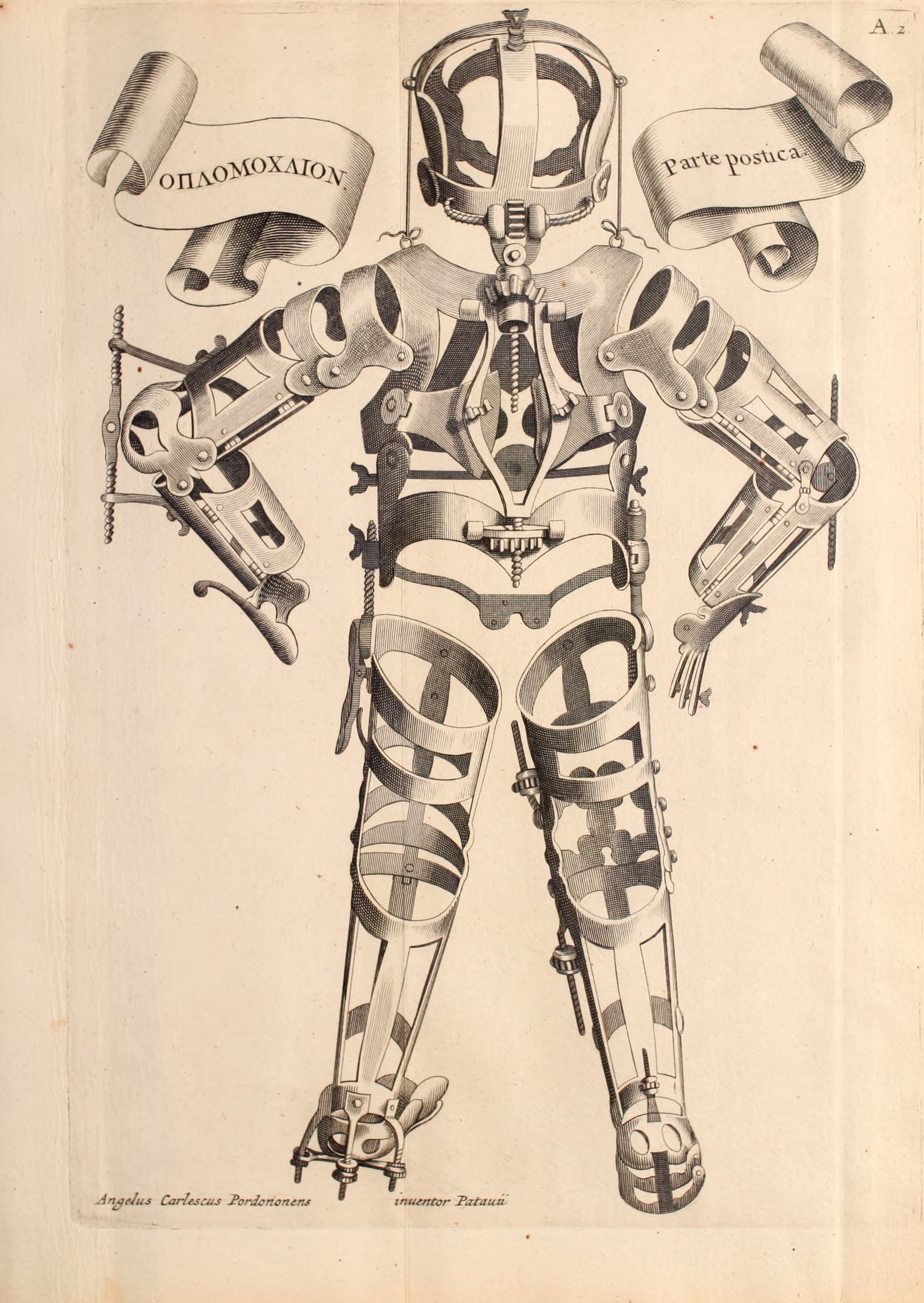
    FabriciThis woodcut of applications and applicators to injured humans, lacking the human, waiting for the human, the missing human, was made by Hieronymous Fabrizzi (or Jerome Fabricius, 1537-1619), and found in his Opera Chirurgica… printed in 1723.  Even though this is a pretty straight-forward image, it strikes me as a little odd, a little off,  looking a bit like inhuman trappings, the entrapments of a human waiting to be built, an artificial skin with artificial bones.  It was much less than that, and in its way, much more—it was a statement of the advances of medicine in the 16th century, a map of the ability of man to replace himself; a map of the artificial man. Perhaps the image of our own artificial man, showing our ability to replace organs, bone, skin, limbs, etc.may come to look to the people of the near future the same way that we here in the present look back on Fabricius’ image. 

    [Image source: Wikimedia Commons]


    A Map of Getting Wounded

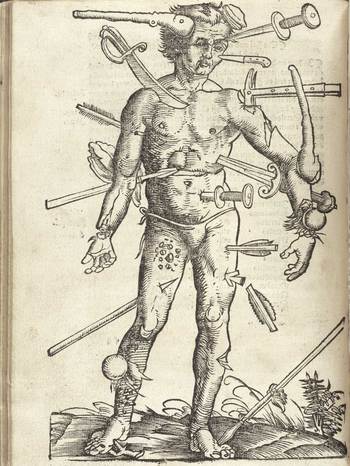
    This map of the wounded man was a very popular, much reproduced

    Gersdorff_p21v_3image, seeing publication in many works since it first appeared in
    Johannes de Ketham’s Fasciculus Medicinae,  printed in the year Columbus set sail for India.  It was a battle map, really—a battle for the human body, showing the effects of what happened to that body when someone tried to erase its existence.  The image is graphic, realistic and fairly gruesome, and highly useful.  It was accompanied by instructions on how to deal with all of the trauma, and to save the man thus that he could fight again. 

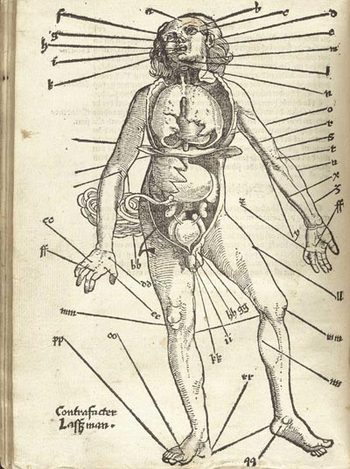
    This woodcut, as the next, appeared in Hans von Gersdorff. Feldtbüch  der Wundartzney (printed in Strassburg, by  H. Schotten, in 1528).


    A Map of Letting the Blood out of the Human Body

    Gersdorffx400jpg_other_2Well, it really wasn’t like that, not how I mean by a snippy modernist viewpoint looking back on medical history with no contextual appreciation.  Bloodletting was an approach to healthfulness, as blood was seen as one of the four major elements (or “humours”) of the human body that needed to be kept in balance.  This was accomplished via the application of leeches or by the more common (and quicker) practice of venesection, or opening a vein to allow the blood to come out. (Let’s reference Steve Reich’s magnificent “Bruise Blood” creation of 1966 at this point—I don’t think that I’ll ever have a better chance to drop a reference to this piece of revolutionary music in regards to venesection again.)  Thus this map was map for the practitioner of bloodletting—the physicians, and more probably the barbers and other assistants who would inherit this lesser procedure from the more-busy doctors.  In the history of maps of anatomy and the general practice of mapping the human condition, this woodcut x-ray of the best places to drain human blood would not survive close to the age of modernity, disappearing almost entirely by the 18th century, and becoming much more scarce well before that.


  • The Found-Poetry in Erasing Straight Lines from Maps of Mars (1909)

    JF Ptak Science Books   Post 2759

    There was good strong debate on the issues of Martian “canals” and whether or not they were there by chance or by Percival Lowell’s (and others) intelligent design. The debate dates range from about 1886 to 1909 or so, though the real method in the intelligent life argument comes in at about 1895.  The “1909” part of the endgame is embodied in the interesting paper “Observations de la planete Mars, faites a l’Observatoire de Meudon”1 by Eugene Michel Antoniadi, which is also the holder of some superior and evocative vocabulary and imagery.

    Antoniadi made a series of painstakingly-executed photos of the planet with Europe’s largest telescope (the 33″ “Grande Lunette”) at Meudon. They revealed that the canals as hard geometric forms had indeed been a sort of optical illusion, and that the new and more-definitive photographs showed them in their true and far more complex existence, more as naturally-occurring objects than something that was designed by another life form.

    • (“During the planetary opposition in 1909, Antoniadi observed Mars at the celebrated 33-inch Meudon Observatory telescope, the largest in Europe. Although he observed for only nine nights during a month-long stay in Paris, he reported seeing Mars so clearly at times that the linear appearance of the canals dissolved into an intricate mess of smaller, irregular details, and he noted that ‘the geometrical “canal” network is an optical illusion; and in its place the great refractor shows myriads of marbled and chequered objective fields, which no artist could ever think of drawing’.)–“Mapping the Mars Canal Mania: Cartographic Projection and the Creation of a Popular Icon”, Imago Mundi, 58:2, 2006.

    The Antoniadi photos came only about five years after the true “first” photograph of what were thought to be canals was made by Percival Lowell’s assistant, Carl O. Lampland. (Antoniadi by the way spent nine years as a special assistant to Camille Flammarion at his personal observatory.)  In addition to the debate of how the “canals” came to be, there was another on whether the features identified as “canals” were there at all. It was Lampland’s work that seemed to settle at least that issue, establishing photographically that there was indeed something there. Lowell seized on this work as confirmation of his theories–that if the canals were proven to be there then it followed logically that his iterations of Martian intelligence would also be true. Here Lowell probably acted too rashly, as the photos showed that the canals also weren’t like the patterned and highly-geometrical structures shown in Lowell’s maps. (That said, the British Astronomical Society adopted the position in their 1906 annual meeting that the Lampland photos served as the confirmation that Lowell had been seeking…)

    The Lowell canals as constructed objects hypothesis lost steam after 1905, and met the large part of its end on the work by Antoniadi on what was evidently a perfect night of viewing on 30 September 1909, the primum mobili aspect removed in favor of natural causes.

    In the paper Antoniadi observed 50 canals and before he described them he defined them, the definition coming from one of the original namers of the canals as “canali” (or “channels”)–Schiaparelli–and not Lowell, who interpreted the “canali” as “canals”, with the armature that they were constructed by someone or something. Antoniadi writes with certainty in this paper: “a canal is a [banrle?] or greyish line of regions called the differences of brightness of neighboring points, which constitute the details of the image…”2  which leads us far away from the material intelligence argument.

    Antoniadi then sets down an 8-point descriptive list of canal characteristics, which is beautifully written and when presented in a certain way takes on a very poetic form. His original description reads: “(a) En ombres diffuses, plus ou moins îrréijulières, dont quelques-unes paraissent doubles d’une manière fugitive;  (b) en estompages noueux;  (c) en masses grises, informes et disjointes;  (d) en estompages irréguliers, minces dans le vcuMiiage d’une haie des mers martiennes, et s’élargissnnt en une ombre vaste et confuse plus loin, comme des neuves avec leurs tributaires, vus a une très grande distance; (e) en alignements d’un très petit nombre de lacs; (f) en lacs in-éguliers, simples et bien isoler-; (g) en bords de pâles demi-tons; (h) en lignes noires très courtes, sinueuses ou courbes.”

    Here’s the description, reformatted and translated:

    “Our observations lead us to divide the channels into several categories, namely:

    In diffuse shadows, more or less irregular, some of which appear

    double in a fleeting way;

    In gnarled blobs;

    In gray masses, shapeless and disjointed;

    In irregular, thin blurring, in the construction of a hedge of

    Martian seas, and widen into a vast and confused shadow further on, like

    new with their tributaries, seen at a great distance;

    In alignments of a very small number of lakes;

    In ‘simple lakes, simple and well insulated;

    In edges of pale semitones;

    In very short black lines, sinuous or curved.


    Antoniadi concludes (translated):

    “In this nomenclature, we have not understood the fugitive straight lines, often called channels, which are visible only during a fraction of second and which can be due to an illusion.. These first observations do not confirm the existence of a network of geometric straight lines, crisscrossing in all directions. Even, by very calm images, we have recognized, not in a fleeting way but for several consecutive seconds, a structure of continental regions quite different from the previous one. These regions are shown covered with a large amount of greyish mottling, irregular, complex and gnarled, which no artist can render.

    I was very surprised to find such a significant paper rendered in such a poetic manner.

    Notes:

    1. ANTONIADI, E.-M. “Observations de la planete Mars, faites a l’Observatoire de Meudon. In: Comptes Rendus, 15 November 1909, pp 836-838 in the weekly issue, WITH a lovely full-page map of Mars.

    2. Antoniadi remarks elsewhere that the lack of geometry on the planet “was conspicuous by its complete absence”.–McKim, R. J., “The life and times of E.M. Antoniadi, 1870-1944. Part II: The Meudon years”, Journal of the British Astronomical Association, vol.103, no.5, p.219-227, 1993. There is a long report with 100 illustrations by Antoniadi in the Memoirs of the British Astronomical Association (vol XX, part II) published in the second year of the War, 1915–on the cover of that report is a very strong but still measured statement by George Ellery Hale: “The total absence of straight lines…seems to me significant”. 

    McKim goes on to note the polite correspondence between Antoniado and Lowell, including the very generous suggestion to Lowell that the later’s observations were obscured and complicated by Martian cloud cover. 
    ·Posted by :

    ·in:

    — —

  • A Good Question on the Canals of Mars: “Are They Really There?” (1903)

    JF Ptak Science Books  Quick Post

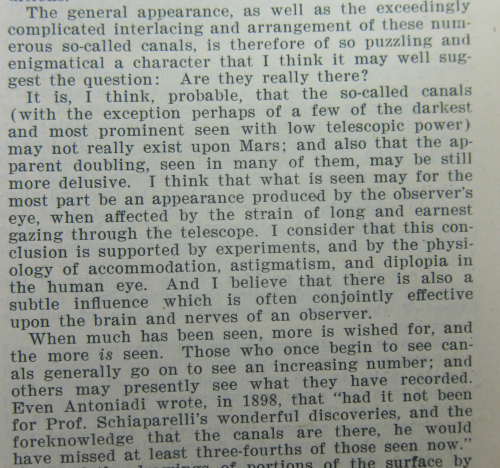
    Edmund Ledger (1841-1914, 38-year Member Royal Astronomical Society, professor of astronomy at Gresham College, 1875-1914) asks an excellent question in his short article, “The Canals of Mars”, in the Scientific American Supplement of 1903 (#1434 June 27, 1903, p 22983-4). He quickly reviews some current thinking on Schiaparelli’s canali and their reception as “canals”, made by Martians, and in his doubt asks the question: “Are they really there?”1

    Mars Ledger

    The canals had been questioned before of course, including by Ledger himself. Earlier in 1895 Ledger described one impossibility of the Seechi-named and employed-by- Schiaparelli canali as canals just in their sheer size: that in order for astronomers to observe the canals that they had to be at least 20 miles wide in addition to being thousands of miles long…a feat too great for anything to accomplish, something far beyond comprehension. (The Suez canal, completed not long before this, would have been nothing compared to the Martian works, being just about five times as long as the canali were thought to be wide. Also thinking no doubt would have been tempered in a bad way—like a poorly tempered anvil and its unpleasing response to being struck by a hammer—by the French failures in the decades that they squandered trying to build the 50-mile-long Panama Canal.)

    ·Posted by :

    ·in:

    —

  • First Appearance in Print of the Terms “Relativity Theory” and “Theory of Relativity” 1906

    JF Ptak Science Books  Quick Post    Part of the series on “Naming Things”

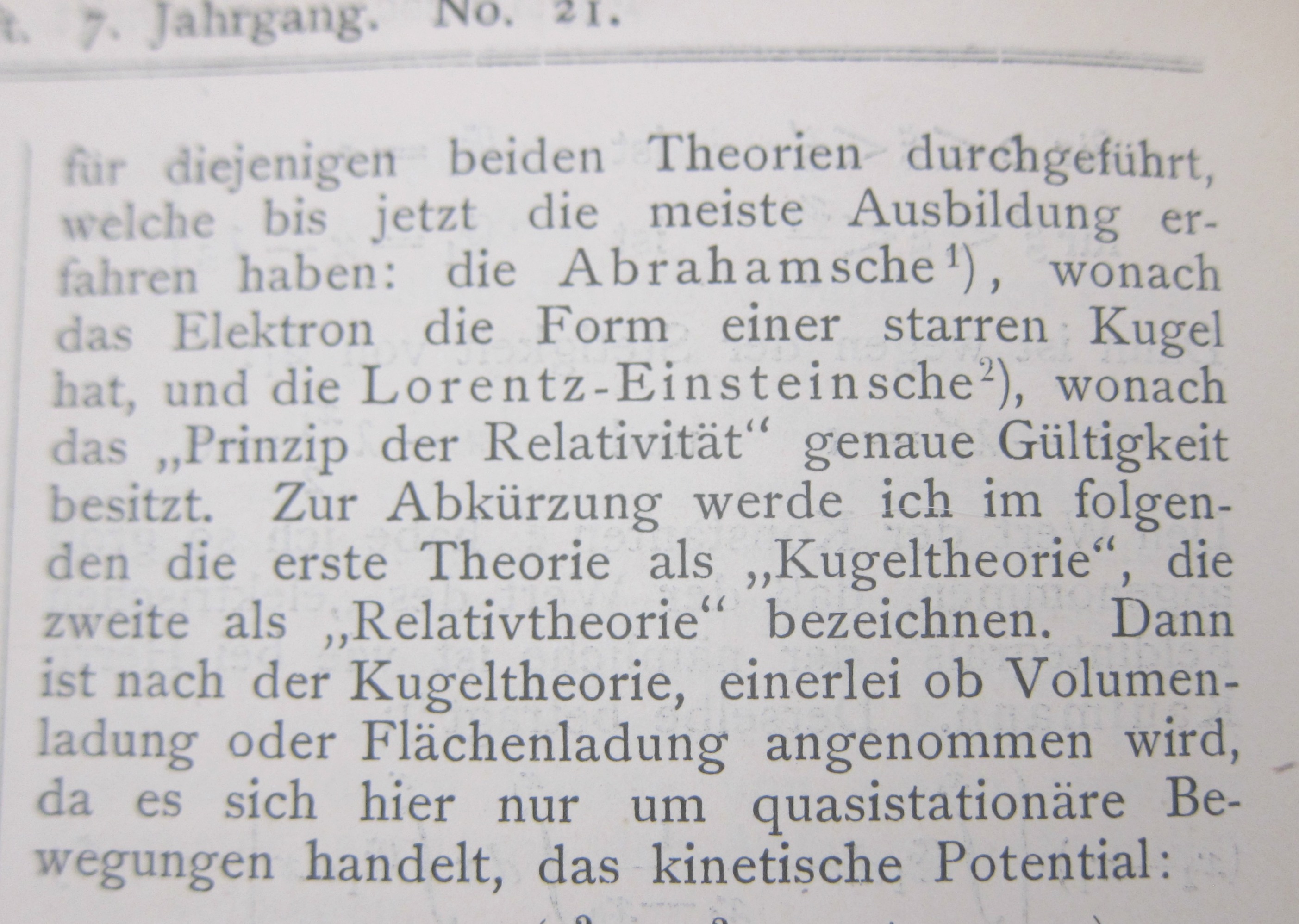
    It was very surprising, finding this, the first time that something so familiar as “relativity theory” appeared in its most familiar form. It appears very soon after the publication of the Einstein 1905 paper, a work by Max Planck1 that appeared in the Physikalische Zeitschrift in 1906:

    Einstein relativtheorie

    Prior to using the words “postulate” and “principle” associated with relativity (as in “Prinzip der Relativitat”, appearing in the second paragraph of Einstein’s June 1905 “Zur Elektrodynamik bewegter Körper” in Annalen der Physik)  it is first referred to as “relativity theory” (“Relativtheorie”) by Max Planck on p. 756 (col 2 line 9 and also on pp 758+759) of this volume. Then in the “discussion” part of the Planck paper the“theory of relativity” (“Einsteinische Relativitatstheorie”) appears for the first time in print just a few pages later (p. 760 col 2 line 15) by Alfred Bucherer.

    And there it is.

    Notes:

    1. Max Planck, “Die Kaufmannschen Messungen der Ablenkbarkeit der β-Strahlen in ihrer Bedeutung für die Dynamik der Elektronen” [The Measurements of Kaufmann on the Deflectability of β-Rays in their Importance for the Dynamics of the Electrons],Physikalische Zeitschrift in 1906, volume VII, the paper occupying pp 753-761 (printed in double columns), printed in Leipzig by S. Hirzel. There are other papers of relativity in VII including Wacker (p 300), Farkas (p 654), Stark (p 353), and Wilkens (p. 846).

    • “The term “theory of relativity” was based on the expression “relative theory” (German: Relativtheorie) used in 1906 by Planck, who emphasized how the theory uses the principle of relativity. In the discussion section of the same paper, Alfred Bucherer used for the first time the expression “theory of relativity” (German: Relativitätstheorie).”–Wikipedia

    ·Posted by :

    ·in:

    —

  • Finding Einstein ‘Neath the Liver Pills (1920)

    JF Ptak Science Books   Quick Post

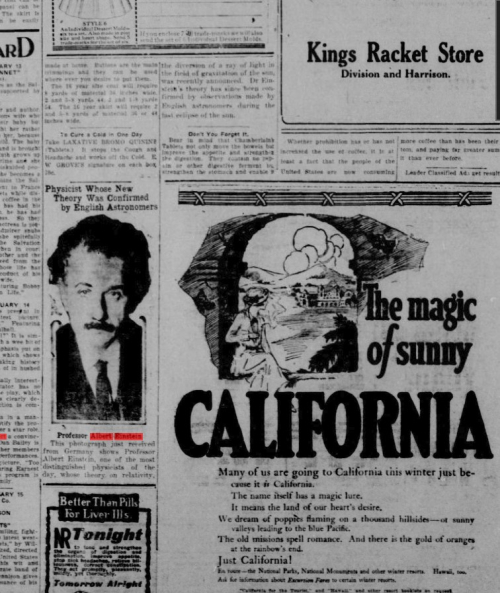
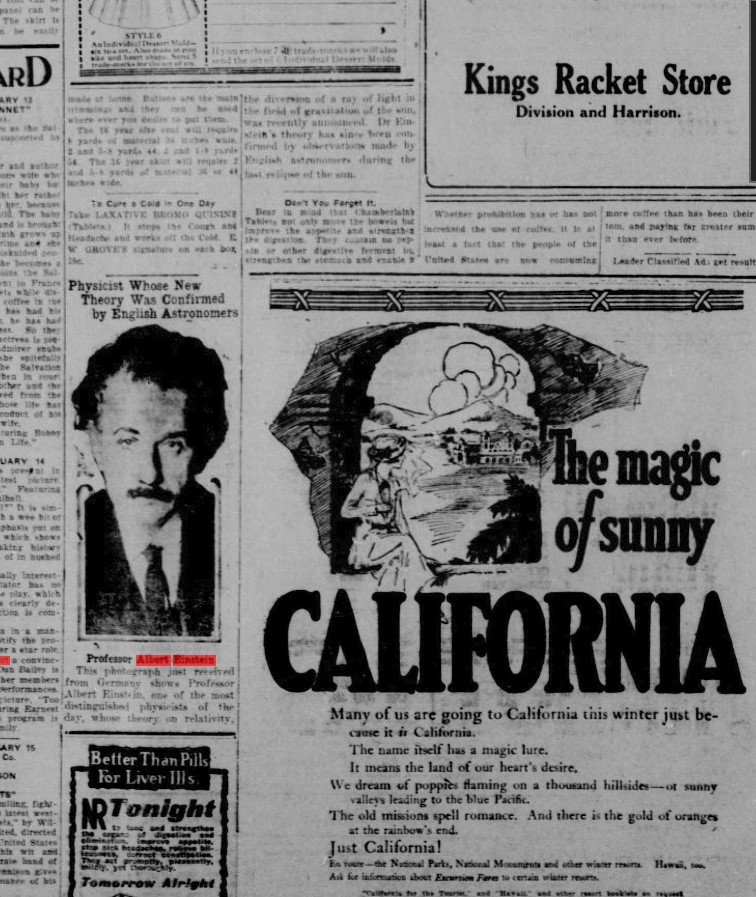
    If you were sitting in a cafe on a  cold winter morning in Guthrie, Oklahoma, on January 13, 1920, and opened to page two of the town paper, The Leader, and worked your way down the page, past the ads for KiMoids heartburn pills,  Jiff-Jell gelatin desserts, eczema cream, dress patterns, liver pills, adventures to sunny California, and Mr. Louis Bennison starring in a play called “High Pockets”, you’d find a picture of Albert Einstein.  Snugly nestled amidst this visual candy is a short report on one of the great experimental results of the 20th century, the verification of the general theory of relativity. Results of the observations made during the May 29 eclipse and then reported to a joint meeting of the Royal Society and the Royal Astronomical Society on November 6, 1919, confirming the theory was an enormous occasion. Einstein of course expected it; had the results not obtained, he quipped then that The Creator would have some explaining to do. But everything turned out just fine.  J.J. Thomson (as president of the Royal Society)  closed the great meeting and and remarked that  “This is the most important result obtained in connection with the theory of gravitation since Newton’s day, and it is fitting that it should be announced at a meeting of the society so closely connected with him. . . . The result [is] one of the highest achievements of human thought.” Thomson was not given over to being hyperbolic, and if anything was just stating the case as it was.

    The event was carried loudly by leading newspapers all in about a week or so after the event, the effect of which established the beginning of Einstein being about the most famous man in the world.  Two months earlier he more than likely would have been an unknown except to a very small percentage of a reading population. And so here he is, in  almost the center of Oklahoma, and then almost in the center of the U.S., in a tiny report–but the report had a photograph, and the story was at least on page two, making him a known-something in about the middle of the middle.  

    Einstein newspaper guthrie ok 1920

    Detail of page two, from the Library of Congress’ fantastic Chronicles of America (digitized) newspaper collections:

    • The Guthrie daily leader. (Guthrie, Okla.), 13 Jan. 1920. Chronicling America: Historic American Newspapers.

    ·Posted by :

    ·in:

    —

  • Money: How Much did a Sergeant’s Chevrons Cost in 1870?

    JF Ptak Science Books  Post 2735

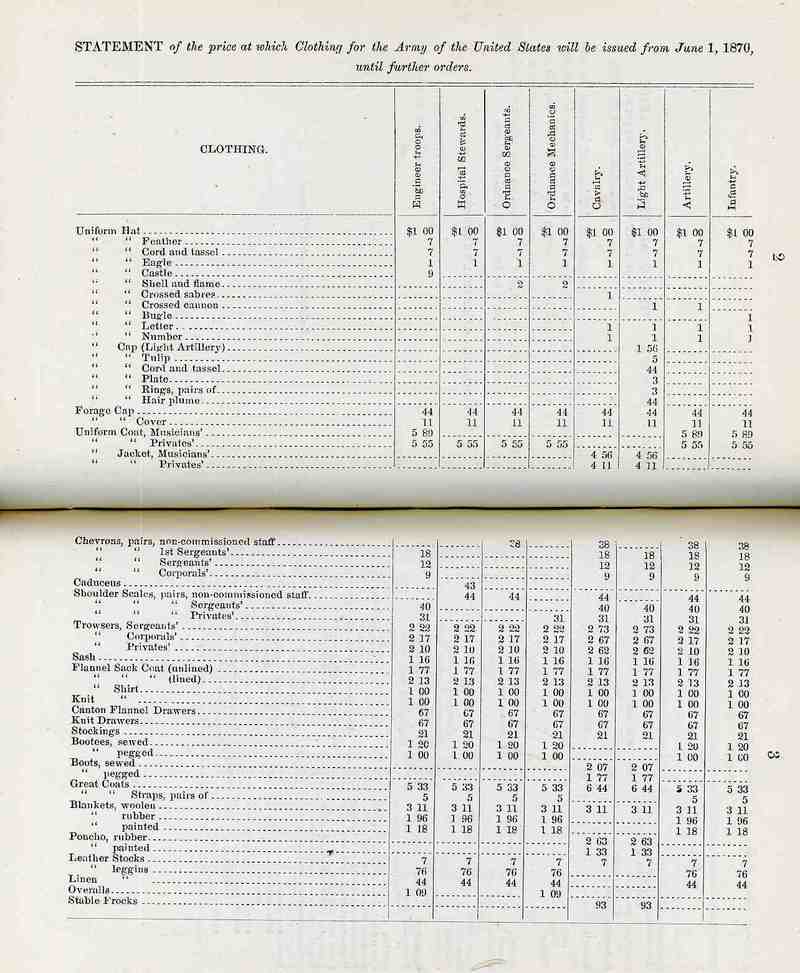
    Here’s an interesting list of prices, outfitting U.S. Army personnel stem to stern so to speak. The major thing here that I do not know is who it was paying these prices–was this the cost to the government in supplying these goods to soldiers? Or are these the prices that soldiers paid for replacement goods? Or did new recruits pay for their uniforms with the costs deducted from future pay?  My suspicion is that these are the costs to the government in outfitting the army, plus arms and munitions and food and all of the rest.  Interesting numbers, if you can use them.  

    There were a number of things here that cost only a penny, like the eagle emblem for a private’s uniform hat, while the most expensive items listed here for soldier accoutrement were the cavalryman’s greatcoat ($6.49) and the musician’s uniform (at $5.89). 

    Some other interesting bits:

    • Underwear, 67 cents
    • Mess can, 22 cents
    • Standard tent, $17.11
    • Sash, $1.21
    • Shovel, 59 cents
    • Sergeant’s trousers, $2.32 (for the corporal, $2.17, and the private, $2.10)
    • Stockings, 21 cents
    • Hospital tent, complete (though without medical equipment) $106
    • Garrison flag, $48

    What does it mean for the average person to spend 5 bucks in 1870?  How does that translate to current currency?  There’s a ton of difficulty in doing that, but one simple way that gives at least some clue to understand the value of those dollars is to put it into the context of how much of a weekly salary something might absorb for a worker at that time. For example, here are some weekly salaries for a few professions:

    • rag cutters at a paper mill, $7.45 (male) and $4.00 (female)
    • blacksmith at iron works, %15
    • “forger of nuts” in carriage works, $20
    • forgers of lightning rods, $10
    • coopers in lime works, $12
    • sail makers $10
    • laborer in a varnish works, $11
    • shoemaker, $14

    These are average weeklies, and would varying according to location (with high and sometimes substantially so being paid in the West and unusual destination points). So in general, a $2 expense is about a day’s labor for a 6-day/10-12 hour week, which means it is not like buying a cup of coffee. This is simplistic, but useful.

    [Source for the data above: the very interesting and exhaustively-titled Special report on immigration : accompanying information for immigrants relative to the prices and rentals of land, the staple products, facilities of access to market, cost of farm stock, kind of labor in demand in the western and southern states, etc., etc., to which are appended tables showing the average weekly wages paid in the several states and sections for factory, mechanical, and farm labor, the cost of provisions, groceries, dry goods, and house rent in the various manufacturing districts of the country, in the year 1869-’70, by Edward Young, chief of the Bureau of Statistics. https://babel.hathitrust.org/cgi/pt?id=hvd.32044024335481;view=1up;seq=248

    And the army?  Here are some figures I found for Union pay during the Civil War, per month:

    • Private and Corporal, $13
    • 1st sergeant, $20
    • 1st Lieutenant, $105.50
    • Captain, $115.50
    • Major $169
    • Lt Colonel, $181.
    • Colonel $212, Brigadier General, $315

    [Source: Civil War Trust https://www.civilwar.org/learn/articles/military-pay]


    (Click for a larger, readable image.)

    Sergeant shirt


    ·Posted by :

    ·in:

    —

  • Two Pythagorases, or Pythagorii

    JF Ptak Science Books  Quick Post

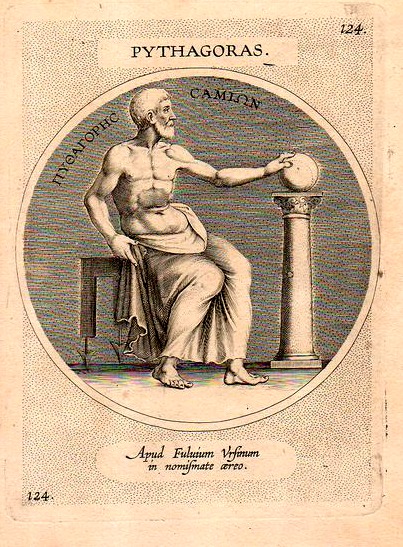
    Pythagoras

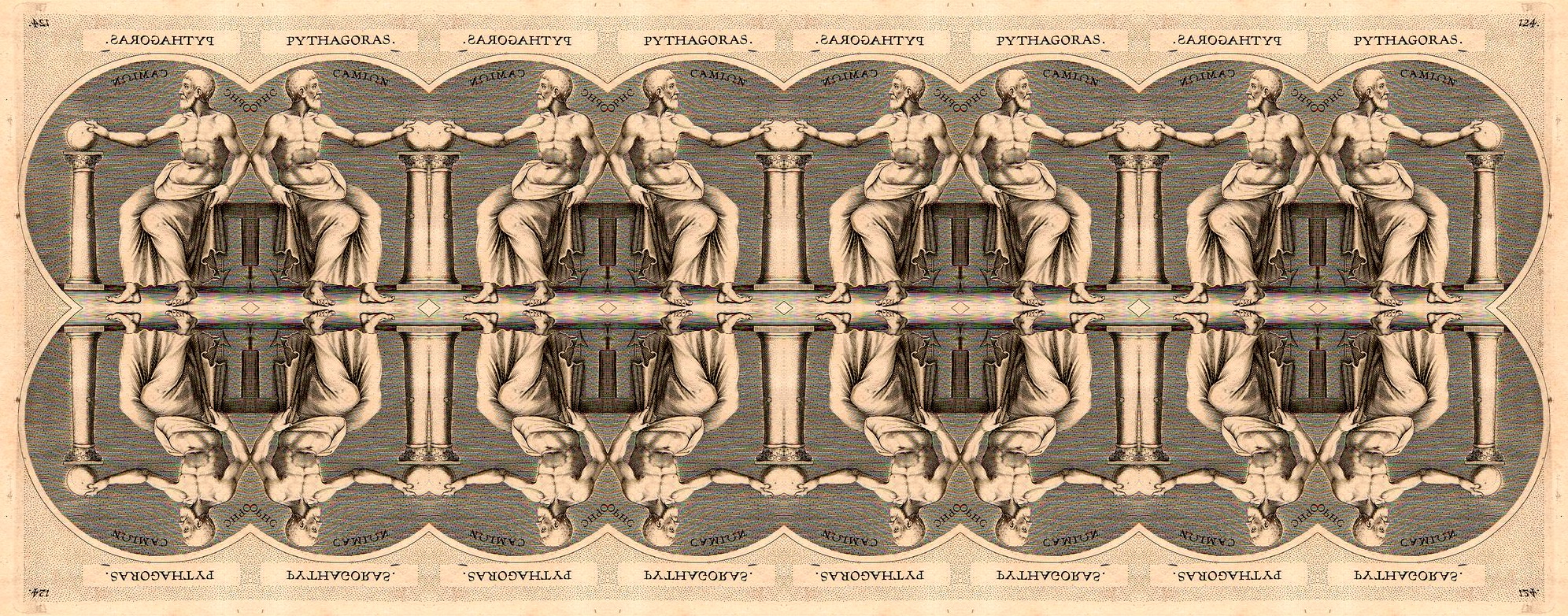
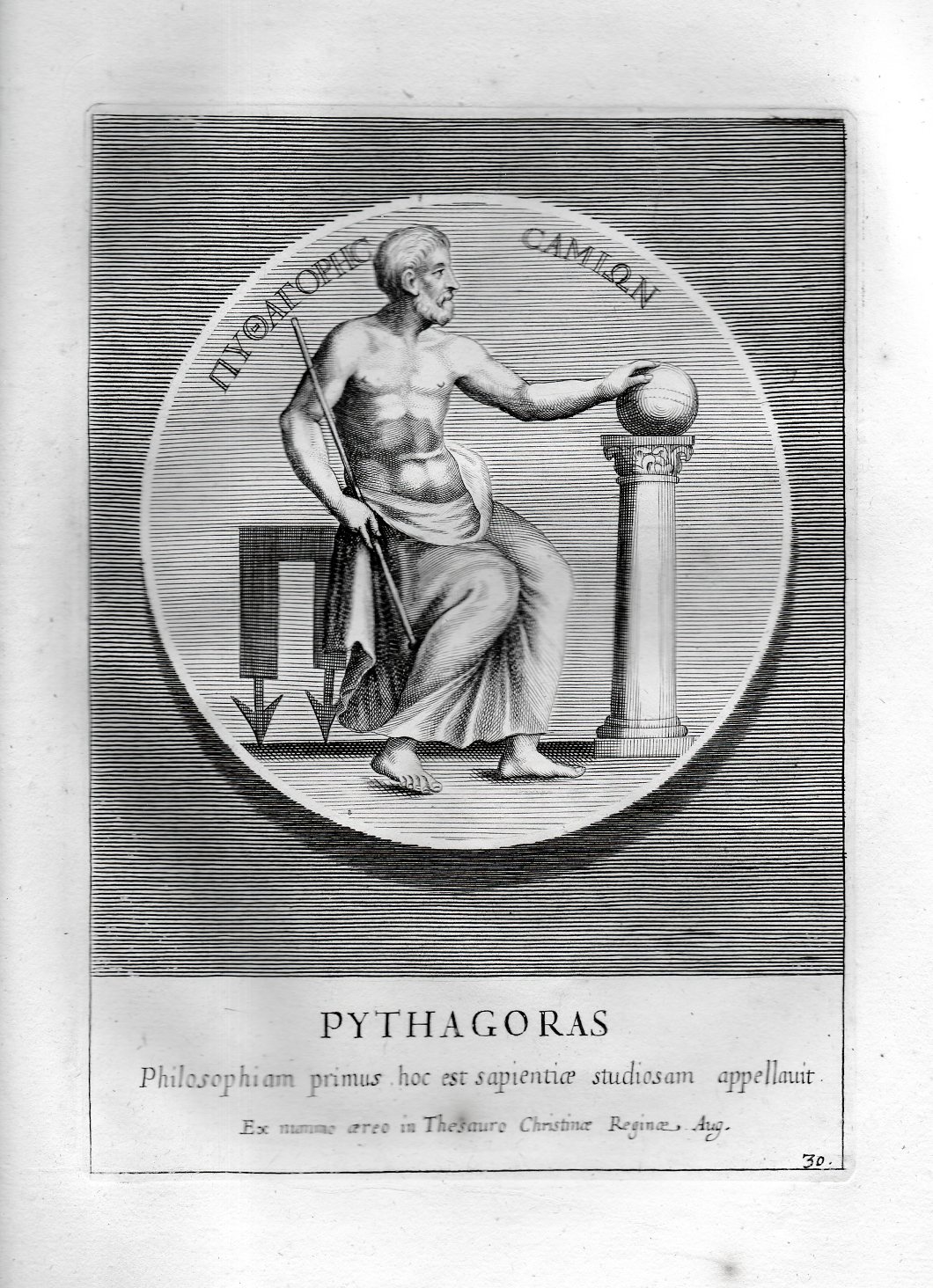
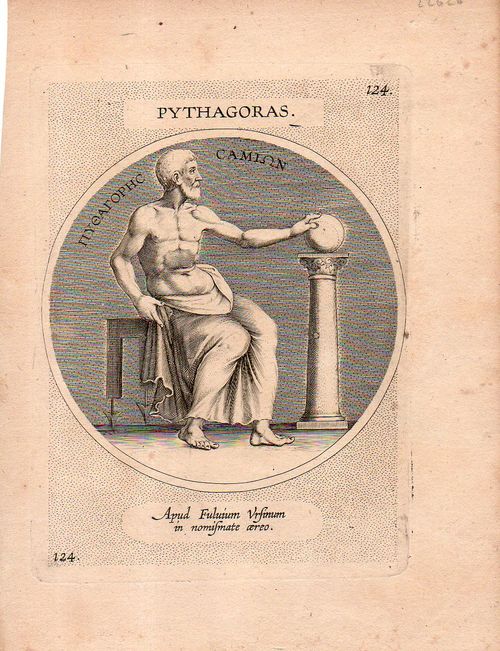
    I wanted to take a moment to share these two versions of the same image. This fine engraving of Pythagoras was printed in 1739  and appeared in Veterum Illustrium Philosophorum, Poetarum, Rhetorim et Oratorum Imagines…by Jo. Petri Bellorii, and published in Rome.  (The image measures 8.5×5″inches on a sheet 13×9″, and is on very heavy and thick paper.) It very closely follows the portraits of Pythagoras that appeared on coins and medallions from 1500+ years ago, so the attitude and the design is ancient. What is shows is a ripped Pythagoras gently touching a globe which is undoubtedly representing the Earth, as one of the many achievements of Pythagoras was to show that the Earth was a sphere. This is a problematic priority to establish, but certainly Pythagoras was among the earliest to establish this idea. (I still have not heard how Flat Earthers deal with the issue of different night skies for the northern and southern hemispheres, among other things.)

    The image differs somewhat from that below, and is sharper, with greater detail, which is a little odd, as it is newer than the other, though I guess it is possible that this was simply copied and a new plate was made for the engraving–generally after time and use the the engraved plate will show some wear and eventually the image will show dings and other bits.

    Bike triplett188
    Here’she other version, which I think was executed by an engraver copying Theodor Galle, which would make it 16th century, though for the life of me the print doesn’t feel to me to be that age–it is old, for sure, and I would’ve guessed 17th or 18th century, but not 16th.  I’ve not found this image anywhere though I’ve found similar that point to Galle in the 16th c. (And oh yes, the image is 4″ round on a 7.5×5.5-inch sheet.)  Perhaps the original plate was reworked hundreds of years later to yield an inferior print–and for some reason the staff does not appear in the earlier version, though some artist reworked Pythagoras’ hand so that he could better hold the staff in the modern version. 

    Pythagoras

    ·Posted by :

    ·in:


  • On a Non-In-Incompleteness Theorem

     JF Ptak Science Books   Post 2726

    BIBLIOTHEQUE

    This is a short bit about incompleteness, the discharge of connection and of knowing. And no, I’m not talking about The Incompleteness Theorem, the big revolutionary one…just a little incompletelness, the small “i” incompleteness, that sometimes doesn’t even make it to the first “e”. It is the sort of frustrating incompleteness that holds you hard when you think you know something, but you really don’t—and then you wonder if you knew it at all, once the connections are made and the analysis done, when the answer is more surprising and insightful than you thought you knew.

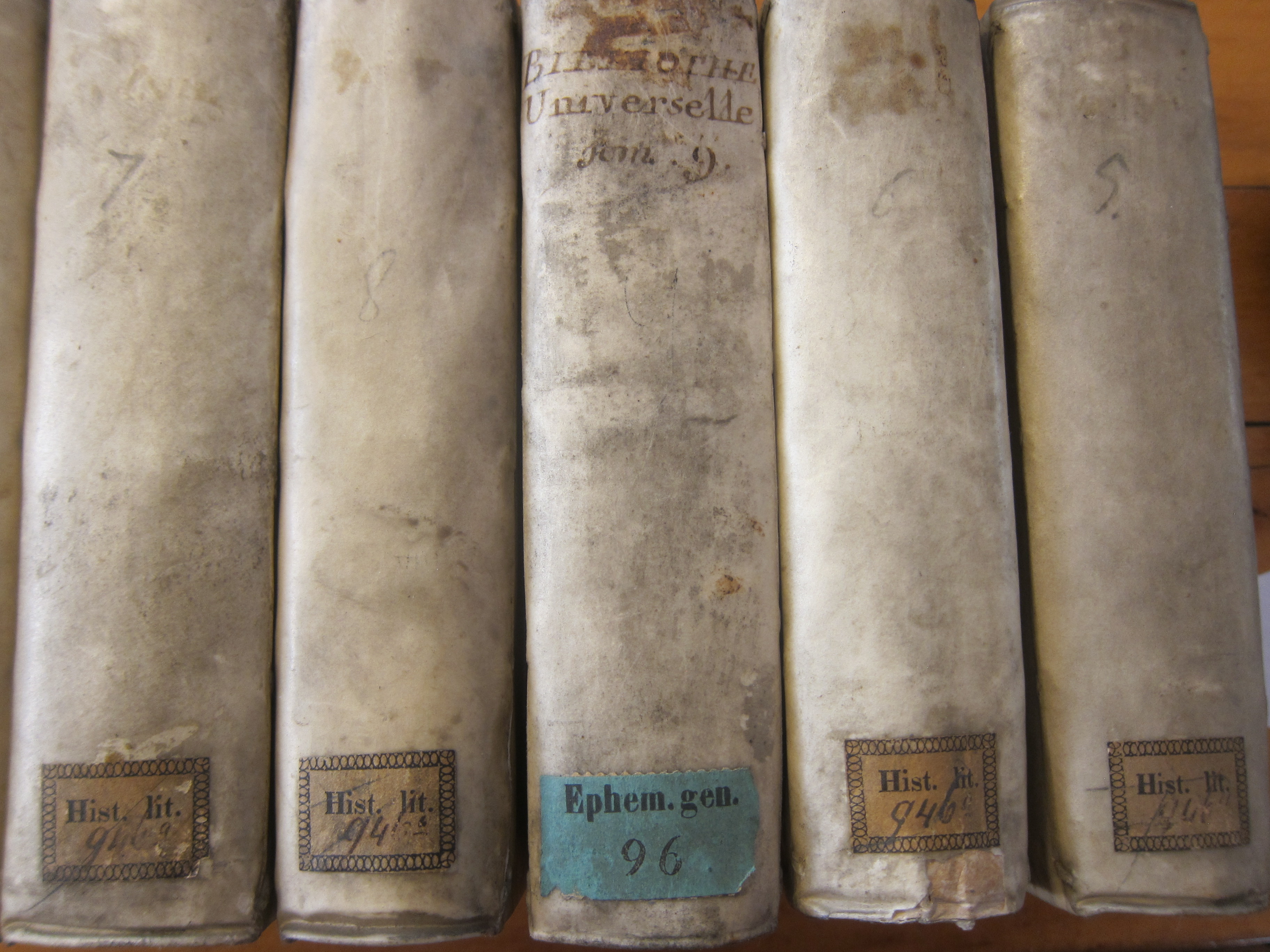
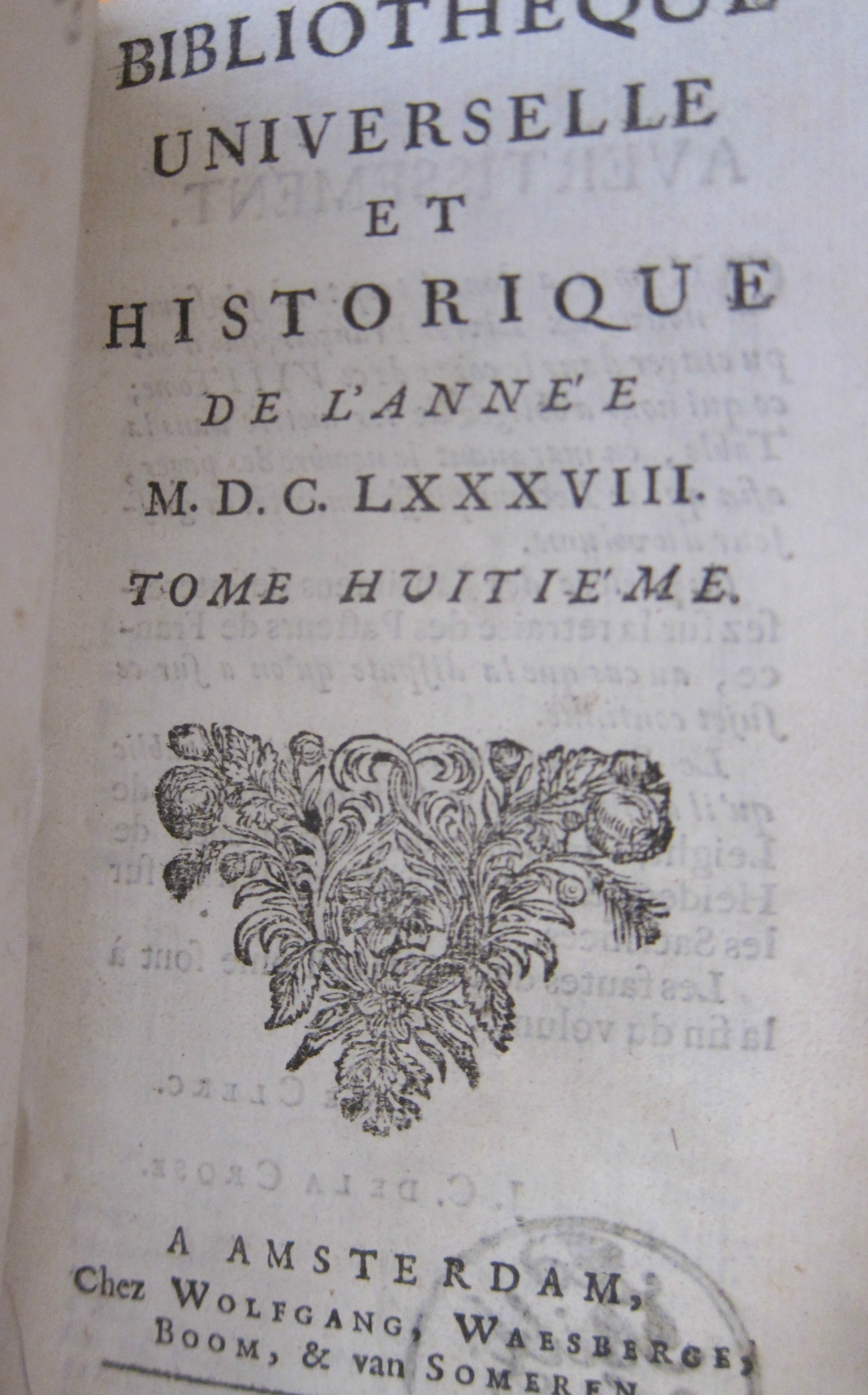
    Bibliotheque vol 8 title pageA big Incompleteness set in the two days ago, thumbing through a volume Jean Le Clerc’s mini-massive journal, Bibliotheque Universelle et Historique, which was printed in Amsterdam in the late 1680’s and early 1690’s, and in its 25 volumes or so covers only about five years in the history of ideas (covering 1688-1792). The books are as stubby as they are lovely, standing a little over 5” high, they are only about 3” wide, and generally about an inch-and-a-half thick. Pocket-sized.

    I did not recall this journal, though it does sound like a lot of other book titles that I’ve bumped into—so I thought I may have known it, but it turns out I didn’t. That was interesting because as it turns out it is a fairly significant publication, with Le Clerc (and other contributing writers and editors1) publishing works on and by some leading figures in the sciences and philosophy. I found out further that the journal was reprinted a number of times, here and there, over a 30-year period or so, which means it achieved some popularity. 

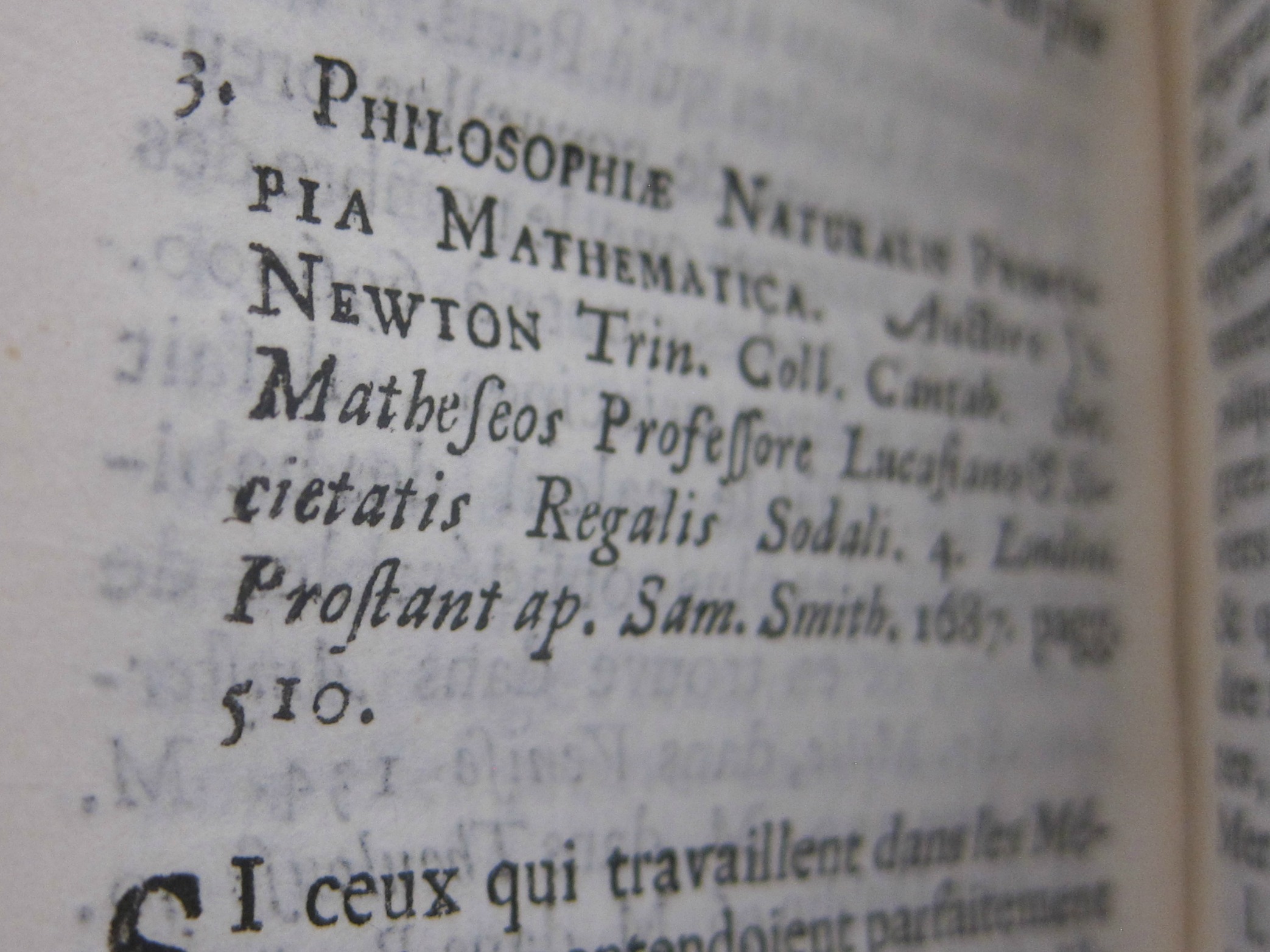
    The first thing I did with the volumes was to check the tables of contents for the biggest name in the sciences that would’ve been covered by this journal for the years 1687 and 1688. 1687 is one of the biggest years in the history of science, and the name that goes with it is Isaac Newton, as this is when he publishes his fully articulated theory of universal gravitation (and etc.) in Principa mathematica philosophiae naturalis [Mathematical principles of natural philosophy]. I worked my way through the volumes, finding interesting entries for Leeuwenhoek (in vols 1 and 5), but didn’t come across Newton until vol 7, where there is an entry for the book but no pagination for it–and then, looking through the volume, I couldn’t find any sight of it, even after finding a digital version and cruising that under the expected words. The big break came in volume 82, with an article on Newton and the book sitting there on page 436-450 (though running about 2000 words for the 14 pp). 

    The Principia was mostly universally well-received from inception, though there were very highly notable exceptions, with Leibniz and Huygens among others criticizing the work. The troubling part, though, for me in my memory, was that this conversation on the book didn’t seem to take place in print within a few years of publication. This is where the incompleteness comes in—I just couldn’t remember why I had this lingering thought about the scarcity of seeing this “review” of the book in print, and this within a year or so of the book’s publication, and why I was shocked to see one.

    Bibliotheque newton princiaWhen I researched the earliest records of published receptions or reviews or comments on the Principia, I was stunned to see that after Edmund Halley’s  notice of the work (which was published in July 1687) in Philosophical Transactions in September 1687, there were only three other notices made in the first year following publication. In that following year, 1688, there were articles in the Bibliotheque (which appeared in March);  the Acta Eruditorum  (in June) and the Journal des Scavans in (a one-page review in August), which makes it appear that the Bibliotheque published first on the Principia following its editor Edmund Halley’s piece in the Phil Trans. The other big surprise is that not only are there significant contributions by John Locke3 appearing in this same volume 8, but I found that the entry on the Principia had been edited by Locke himself4,5.  I have since found out that this is well known to scholars, though I was pretty happy to find this out in my poke-and-hunt operation.  In spite of it all, Locke was probably not the person to undertake the article, and the journal was not terribly science-y, but there it is–the author of the Acta paper, on the other hand, was Christoph Pfautz (1645-1711), who may have been as qualified to address the book, and the journal in which the review appeared was perhaps the most important of its kind at that time.  (This reference to Pfautz comes from Bernard Cohen, who also points out that although Newton seems not to have read any of the four reviews, there is some slight evidence that he may have seen Pfautz’s. The interesting piece here is that Pfautz seems to have been excited by a passerby reference to God the creator of the universe and presented it as important; in the next edition of the Principia, the book’s one reference to God is removed.) But it does seem that the Bibliotheque and Mr. Locke were the first on the continent to publish on the book. (I should note that the Journal des Scavans anonymous review was “hostile and derisive”.7)

    As J.R. Milton writes on Locke’s work on the Principia:

    “This is anonymous, and has generally been assigned to Locke on the basis of a considerable overlap with the notes Locke himself made while reading the Principia. Some writers on Locke and Newton have firmly attributed it to Locke, while others have been rather more cautious. The question of its authorship is, however, settled by a remark – hitherto overlooked – that was made by Le Clerc in 1714 in his own review of the second edition of the Principia: ‘The first edition of this book appeared in 1687 and we published a small extract, composed by Mr Locke, in volume VIII of the Bibliotheque universelle.’ “8

    And so this little journey into incompleteness ends, and I think I’ve figured out a tiny aspect of what I didn’t know and when I didn’t know it.

    Notes

    1. Editors and contributors included: Jean Le Clerc et Jean Cornande de al Crose, vols 1-9; Jean Le Clerc, 10, 12, 14-19; Jean Cornand de La Crose, vol 11; Charles le Cene and Jean Le Clerc, vol 13; Jacques Bernard and Jean Le Clerc, vol 20; Jacques Bernard, vols 24-5. The journal was published every 4 months in vols 1-3; every 3 in 4-19, and then twice a year for 20-25.
    2. According to Hans Botts, volume 8 appeared in January 1688.–Hans Bots, “Bibliotheque Universelle et Historique (1686-1693)” entry in Dictionnaire des journaux, 1600-1789  The article on Newton’s Principia has been established as March, 1688. 
    3. “Indeed the reports or extracts of books are the most numerous, but at the same time there are original contributions from some correspondents, such as The Philosophical Essay Concerning the Mind of John Locke, inserted in this journal two years before publication of the book same (v. VIII, Jan. 1688, pp. 49-I42)”–translated from Hans Bots, “Bibliotheque Universelle et Historique (1686-1693)” entry in Dinctionnaire des journaux, 1600-1789.  
    4.  “The publication in July 1687 of Newton’s Principia mathematica gave rise to only four reviews in the European periodical press. The first was Edmond Halley’s pre-publication notice in the Philosophical Transactions. Then a year elapsed before the Bibliotheque Universelle, the Acta Eruditorum, and the Journal des Scavans, approached the book. Of these reviews that which appeared in Jean Leclerc’s widely read Bibliotheque Universelle has received least attention from historians. This is unfortunate because, of several merits, two in particular are important for the intellectual history of the period: it was written specifically for the large and growing intellectual class of western Europe who for the most part were interested in the new physical sciences, but were untrained in the mathematics necessary to understand many of the newest advances in them. And the author of this review, which was the first independent account of Newton’s book to reach this Continental (largely French-speaking) audience, was John Locke, then a voluntary political exile…”–James L. Axtell, “Locke’s Review of the “Principia”, Notes and Records of the Royal Society of London, Vol. 20, No. 2 (Dec., 1965).   
    5. “(Bibliotheque Universelle…) was the only journal only journal in the Dutch Republic that had published a review of the Principia, anonymously written by John Locke.”–“Newton through the eyes of an amateur”, University of Utrecht website
        The Locke Digital Bibliography project also attributes this review as a work of Locke’s.
    6.  Bernard Cohen, “Reviews of the First Edition of the Principia“, in Peter M. Harman, Alan E. Shapiro (eds), The Investigation of Difficult Things: Essays on Newton and the History of … p 325.
    7. The University of  Florida Newton Timeline makes the following note: “1688 – An anonymous reviewer for the Journal des scavans (Paris 1688) raises objections concerning Newton’s Principia, suggesting quite pointedly that the Englishman should now write a second book where he finally addresses the ‘true motions [of the planets] instead of those that he [merely] assumes’ [JS, August 1688: 128].”– http://users.clas.ufl.edu/ufhatch/pages/13-NDFE/newton/05-newton-timeline-m.htm 

      Bernard Cohen remarks that this anonymous person may have been Pierre Silvain Regis, “a strict Cartersian” and “a hostile critic” (Cohen, Newtonian Revolution, p 96.

      Martin Schonfeld in his The Philosophy of the Young Kant: The Precritical Project notes the JdS review as “critical and derisive” (pg 254).

    8. J.R. Milton, “Locke’s Publications in the Bibliothèque Universelle et Historique”, British Journal for the History of Philosophy, 05/2011, Volume 19, Issue 3.

    ·Posted by :

    ·in:

    —

  • The Only Plan of a (?) Illustrated in the 219 Years of the Great Journal, Annalen der Physik (1816)?


    JF Ptak Science Books  Quick Post

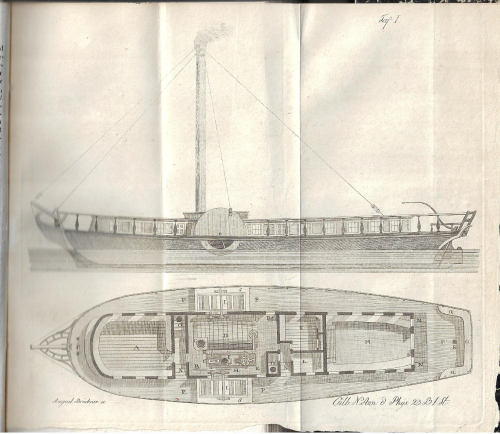
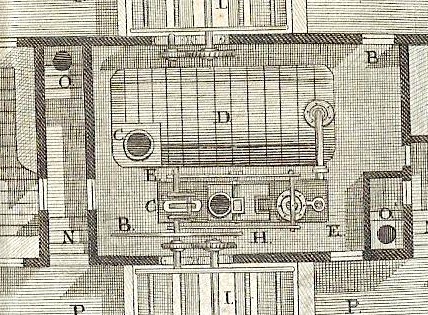
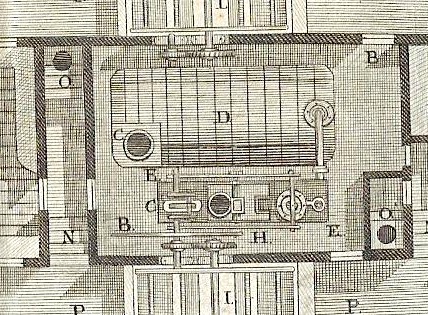
    There aren’t many illustrations of steamboats in the great physics/chemistry journal, Annalen der Physik. Rarer still is seeing a plan for such a vessel that includes something that is seldom included–can you find it? I’ve made an enlargement of it and posted it below the first image.

    Annalen 1816 steamboat

    Here it is (“O”):

    Annalen 1816 steamboat detail

    This identifies the “water closet”, the bathroom, noted as “O”, in two locations.

    It seems to be little more than a tiny closet with a box with a hole in it, but, well, there it is.

    I suspect that this is the first and last time a W.C. is pictured in one of the most important scientific journals in history.

    Notes: 

    The engraved plate is found in Annalen der Physik, series I, vol 53; vi, 446pp., 1816, in the article “Noch einige neuere Zeitungs-Nathrichten, Dampfshiffe betreffend… (with a small folding plate, with two views of the vessel), pp 110-119.  The volume also includes the following steamboat-related papers: 

    • “Einige geschichtliche Nachrichten von der Erfindung der Dampf-Schisffahtr…” pp 63-70;
    • Robertson Buchanan, “Ueber die sogennten Dampfboote…”, pp 70-77; 
    • Isaac Weld. “Die erste Serreise mit einem von einer Dampsmachine bewegetn Schiffe, vom Glasgow in Schotland um Cap Landsend nach London”, pp 77-102;
    • “Zwei schriben an Herrn Isaac Weld…die Dampf-Schiffharht und dem merkwurdigen…pp 102-110; 


  • Hammer, Sickle, Skull (1919)

    JF Ptak Science Books  Quick Post

    Here’s a very provocative piece of design meant to equate death and communism–and in that there is no question.  Sowjet-Rußlands wahres Gesicht, aus eigener Anschauung und Erfahrung geschildert von drei einst begeisterten Kommunisten,  (“The Real Face of Communism, as Told from the Personal Experiences and Intuition of Three Once-Enthusiastic Communists”) was written by Friedrich Oskar Kloetzner in 1919 in the bad days of early social struggle that led to the bad days of middle and later struggle and then Apocalypse. Here, in 1919, just after the end of the war, the great supposed golem was Communism–that would of course morph and change and accommodate other fears and hatred, but for now, there were things needed to fill the vacuum left by defeat and the coming of a bad peace, and the Communists served to fill at least one of the many niches to come. 


    SOwjet-russlands


    Notes:

    The pamphlet measures 7×5″,  and is paginated 223-256. Provenance: Library of Congress.  This has a funny record in WorldCat—there seem to be 21 results in the search on this title, though this looks like a cataloging error–for all of the different “references” there are only eight libraries locating copies of this pamphlet, with half of those in Europe.)