A Daily History of Holes, Dots, Lines, Science, History, Math, Physics, Art, the Unintentional Absurd, Architecture, Maps, Data Visualization, Blank and Missing Things, and so on. |1.6 million words, 7500 images, 4.9 million hits| Press & appearances in The Times, Le Figaro, Mensa, The Economist, The Guardian, Discovery News, Slate, Le Monde, Sci American Blogs, Le Pont, and many other places… 5000+ total posts since 2008.

Category: Naming Things

  • The World of Words & Some Hidden Future-Physics Poetry of 1826

    JF Ptak Science Books LLC   Post 197

    Blogaugust_13words_small383_2

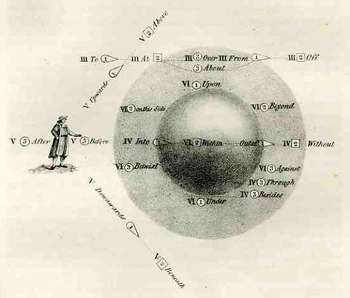
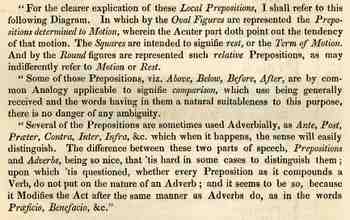
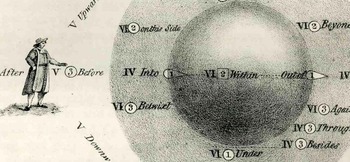
    I found this interesting image in David Booth’s An Analytical Dictionary of the English Language in which the Words are Explained in the Order of their Natural Affinity, Independent of Alphabetical Arrangement...(2nd edition), printed in London in 1836.  In it on page 187 he quotes a long section from an earlier work by Bishop Wilkins Essay Towards a Real Character and a Philosophical Language (1668) on the properties and classifications of prepositions.  Wilks defines prepositions in the following way:  “prepositions are such particles whose proper office sits to joyn Integral with Integral on the same side of the Copula signifying some respect of Cause, Place, Time or other circumstance wither Positively or Privately.”  Indeed! 
    Blogaugust_13words_middle382

    He then spends several pages looking at the combinations of prepositions, distributed into six classes.  The illustration below is meant to illustrate classes 3 through 6:  the third containing the combinations “doth consist of such as respect to Space, in general”; the fourth “in respect to Space, with a particular restriction to the notion of containing, being absolutely determined to Motion; fifth, “doth contain such Prepositions as relate to the Imaginary parts of a thing”; and sixth, “such Prepositions as are applied both to motion and rest, relating to the situation of some third thing spoke of….”

    And so on, and of course it all makes sense in ways that I’ve not about in many years—but I’m just so attracted by the language and the many nearnesses to some very big ideas in physics, and the great and distinctive beauty of the illustrative diagram that I just needed to pass this along before it dipped away forever into the shadows. 
    Blogaugust_13words_text384

    ·Posted by :

    ·in:


  • First Sentences of Great Literature: 30 Examples

    JF Ptak Science Books LLC Post 170

    Just a slight, little quiz here, a true/false quiz, linking great first sentences to their novels.  Hint:  they’re all true.  I just wanted to see them collected like this. 

    (1) “All children, except one, grow up.”  Peter Pan    

    (2) “In an old house in Paris that was covered with vines lived twelve little girls in two straight lines.”  Madeline, Ludwig Bemelmans

    (3) “The Mole had been working very hard all the morning, spring-cleaning his little home.” Wind in Willows, Kenneth Grahame

    (4) “In the great green room, there was a telephone and a red balloon.” Goodnight Moon, MW Brown

    (5) “Alice was beginning to get very tired of sitting by her sister on the bank, and of having nothing to do: once or twice she had peeped into the book her sister was reading, but it had no pictures or conversations in it, “and what is the use of a book,” thought Alice “without pictures or conversation?” Alice in Wonderland.

    (6) “When Mrs. Frederick C. Little’s second son arrived, everybody noticed that he was not much bigger than a mouse.” Stuart Little EB White

    (7) “This is George. He lived in Africa.”  Curious George  HA Rey

    (8) “Chug, chug, chug. Puff, puff, puff. Ding-dong, ding-dong.”  The Little Engine that Could
    .

    (9) “For many days we had been tempest-tossed.” Swiss Family  Robinson

    (10) “The first place that I can well remember was a large pleasant meadow with a pond of clear water in it.”  Black Beauty

    (11) “I will begin the story of my adventures with a certain morning early in the month of June, the year of grace 1751, when I took the key for the last time out of the door of my father’s house.”  Kidnapped

    (12) “It was the best of times, it was the worst of times, it was the age of wisdom, it was the age of foolishness, it was the epoch of belief, it was the epoch of incredulity, it was the season of Light, it was the season of Darkness, it was the spring of hope, it was the winter of despair, we had everything before us, we had nothing before us, we were all going direct to Heaven, we were all going direct the other way–in short, the period was so.”  Tale of Two Cities

    (13) “Once upon a time and a very good time it was there was a moocow coming down along the road and this moocow that was coming down along the road met a nicens little boy named baby tuckoo.” Portrait of the Artist

    (14) “My father’s family name being Pirrip, and my christian name Philip, my infant tongue could make of both names nothing longer or more explicit than Pip.”  Great Expectations

    (15) “Whether I shall turn out to be the hero of my own life, or whether that station will be held by anybody else, these pages must show.” Personal History David Copperfield

    (16) “The day broke gray and dull.”  Of Human Bondage

    (17) “Now, what I want is Facts.”  Hard Times

    (18) “This is the saddest story I have ever heard.” Good Soldier, FM Ford

    (19) “As I walked through the wilderness of this world, I lighted on a certain place where was a Den, and I laid me down in that place to sleep: and, as I slept, I dreamed a dream. ”  Pilgrim’s Progress, John Bunyan

    (20) “I am an invisible man.”  Invisible Man R Ellison

    (21) “Serene was a word you could put to Brooklyn, New York.” Tree Grows in Brooklyn  Betty Smith

    (22) “In my younger and more vulnerable years my father gave me some advice that I’ve been turning over in my mind ever since.”  Great Gatsby

    (23) “The village of Holcomb stands on the high wheat plains of western Kansas, a lonesome area that other Kansans call “out there”.” In Cold Blood.

    (24) “A few miles south of Soledad, the Salinas River drops in close to the hill-side bank and runs deep and green.”  Of Mice and Men

    (25) “When he was nearly thirteen, my brother Jem got his arm badly broken at the elbow.” To Kill a Mockingbird

    (26) “In the town there were two mutes, and they were always together.”  Heart is a Lonely Hunter

    (27) “Through the fence, between the curling flower spaces, I could see them hitting.”  Sound and the Fury

    (28) “Isaac McCaslin, ‘Uncle Ike’, past seventy and nearer eighty than he ever corroborated any more, a widower now and uncle to half a county and father to no one —- this was not something participated in or even seen by himself, but by his elder cousin, McCaslin Edmonds, grandson of Isaac’s father’s sister and so descended by the distaff, yet not withstanding the inheritor, and in his time the bequestor, of that which some had thought then and some still thought should have been Isaac’s, since his was the name in which the title to the land had first been granted from the Indian patent and which some of the descendants of his father’s slave still bore in the land.”  Go Down Moses

    (29) “Samuel Spade’s jaw was long and bony, his chin a jutting v under the more flexible v of his mouth.”  Maltese Falcon, Dashiell Hammett

    (30) “To the red country and part of the gray country of Oklahoma, the last rains came gently, and they did not cut the scarred earth.”  Grapes of Wrath
    ·Posted by :

    ·in:


  • Nails and Screws: Beautiful and Well-Designed Simplicity

    JF Ptak Science Books  Post #148

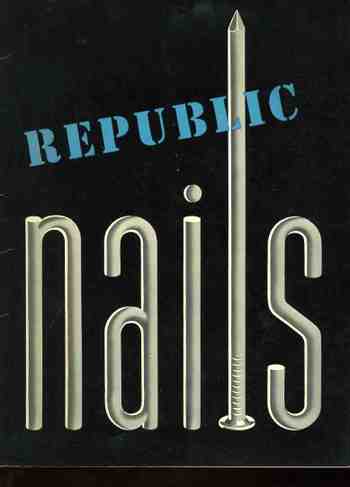
    Here we have two glorious, lovely examples of craftsmanship of simple things. The first is The Republic Steel Corporation (Chicago) manufacturer’s catalog for their production of nails and other wire goods.  It is about fifty pages long, and a third or so of it is devoted to the history of nail and nail-making as well as the history of the company.  The rest is all about the product.  And mostly about nails.  All sorts.  It is just fantastic!  I must say in all the years of my own nail consumption I didn’t know that there were so many different sorts of nail POINTS (diamond, blunt, chisel, needle, duck bill, side, and so on) ion addition to the various widths and lengths and special uses.  The points just never entered into the equation to me, but, of course, it is very important. 

    Blognails_cover225

    And speaking of special uses, there are a number of interesting specified nails in this catalog that, I think, are long gone from modern hardware store  shelves, as the needs they addressed are gone:  beer case strap nails (oh my god I love the sound of that) AND beer case hinge/lock/latch nails AND beer case cleat nails, basket nails, shade roller pins, pole marking and dating (!) nails, barbed berry box nails, and egg case fasteners are among what I imagine to be extinct nails. 

    Blognails_barre227

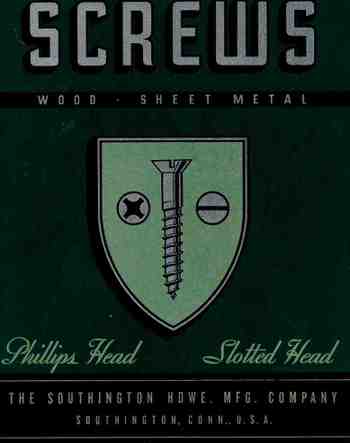
    Then there’s the beautifully designed Southington Hardware Manufacturing Company’s screw catalog, called, wonderfully, Screws, (Wood, Sheet Metal, Phillips Head, Slotted Head), catalog 41 (with prices) for 1935.  There’s page after page (actually, forty-five pages) of very detailed specifications (dimensions of heads, diameter, thread and tolerance, each description accompanied by two (or more) engineering drawings of the screw itself. 
    Now THIS is a way to describe a product.

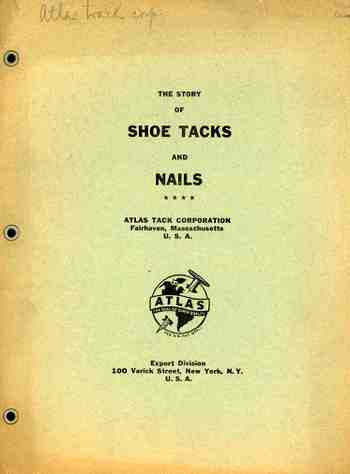
    This is followed up by a concise, nine-page (3,500 word) pamphlet published by the Atlas Tack Company (Varick St, NYC) on the history of shoe tacks and nails, bound, I’m happy to say, with metallic eyelets.  It contains pretty much all you need to  know on the history of shoe tacks, and I’m 100% behind the publication of odd-obscure histories such as this.  (I own perhaps a hundred “different” histories like this, including the massive non-classic “The History of Refrigerated Nuts”.) 

    Blognails_screws231


  • Underground Horses, 1875

    JF Ptak Science Books   Post 22

    Unusual cross sections have always fascinated me–they are an X-ray of the techy-inards of the physical world , showing you a slice (literally) of the Unseen and Unapproachable. 

    Mine_height_2

    The first engraving here is of an (unidentified) Western-U.S. mine, printed 1869, and shows the comparative depth of an un-effacing mining operation in terms of height, nestling it in against Trinity Church (NYC).  The “21 stories” depth  of this mine would have been astonishing to the 1869 mind thinking of it in terms of height. Few office buildings in NYC for example exceeded 5 or 6 stories at that time. [It was in 1872 that the tall buildings’ fortune turned, as C.W. Baldwin (working for the Otis Company) invented the geared hydraulic elevator, meaning that buildings could now be taller than the strength and endurance of its occupants’ legs.  (Actually, to my mind it is the invention of the elevator safety brake that clinched the deal, making it safe to enter an elevator and expect to survive the experience.  There’s a lot of other stuff that comes into play, not the least of which is steel framing, lightening the buildings weight and displacing the weight from its’ normal receptacle of the foundation, but I digress.) ] So trying to imagine something that was 15 time the height of the spire of Trinity Church was doing some pretty large-scale imagining. 

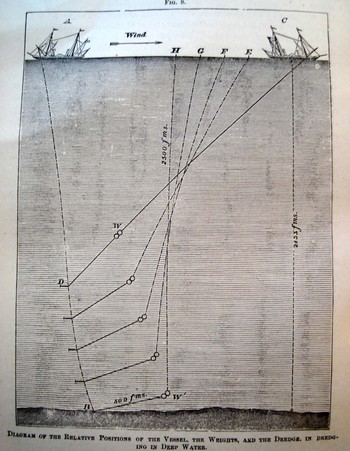
    A corollary the the height of the mine is, perhaps, a cross section of the depths of waters. Here we see an 1877 illustration from an article on new methods of determining the depths of ocean waters, giving a very clear indication of the enormous “height” of the ocean even in its most measurable (and not-so-deep) section.

    Depth_sounding 

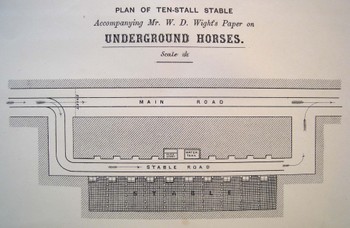
    I simply could not resist this 1875 engineer’s drawing (“Plan of Ten-Stall Stable….for W.D. Wight’s Paper on Underground Horses”)–and yes indeed these were horses kept underground, used for hauling the heavier wagons (on tracks) of whatever, brought out to these larger chambers by men doing the same work with lighter loads in smaller areas.  (For perhaps the best description ever of men at work in a coal mine, see the gorgeous George Orwell’s Down and Out in Paris and London)Underground_horses

    This is one of those images I think that will elicit a pretty light-hearted reaction until your brain catches up to the reality of what the print is really depicting.

    Coal_mine_black_3


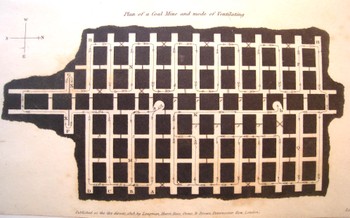
    This  image is actually much rarer than a mining cross section–it is a plan (looking from the top and down) of a mine showing the mode and direction of ventilating the whole bit, printed in 1818.  (As it turns out it is rarer still to see a plan depicting a mine’s numerous layers–I’ve honestly not seen another one of these done before 1900.)  What an incredible image this must have been to the early 18th-century eye, seeing such a novel, and rare, depiction of (important!) data.

    Mine_cross_mosaic

    In the Victorian panoply, the technological temple ma have had an entryway mosaic constructed from the idea of the mine cross section or plan–it is a structural, semi-architectural bit after all, made to withstand advanced weight and pressure.  Or how about a mine cross section template for a stained glass window?  I can imagine the Temple of Technology boasting a design schema of nothing but elements like these–those people trusted, perhaps even worshiped, the small and great mechanical machines and contrivances of their era.  All you have to do is look at the housings for even some of the simplest objects and you’ll find a metallic skin of awe and beauty, a symbol of admiration and respect for analog creativity.


    Mine_stained_glass


  • Homer Simpson on Perspective: the Rare Antique Image Looking Straight Down from a Height

    Blogstraight_homerJF Ptak Science Books LLC  Post 20

    I welcome the chance today to use our non-classical Homer instead of the beautiful Paolo Uccello to look at an issue of imaging a certain form of perspective drawing.  I’ve always been intrigued by antiquarian images that looked straight down, or up, at things–90 degree, perpendicular, real straight-on stuff, giving a feel for depth (or height) and perspective.  Funny thing is that in the wide world of scientific images, they really don’t show up very often.

    A Mock-straight-down is found in this prettily-designed example (French, ca. 1860)–it seems to be view form a height of 250 feet or so down on the square of a low- (Western) renaissance town. That’s partly true, except that it is a mosaic from Pompeii (or Herculaneum), found imbedded in the floor of one of those mummified houses.  Dsc04640

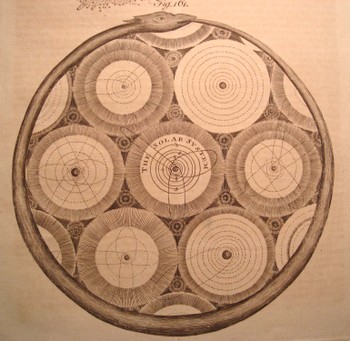
    Another pretender is this god’s-eye view (from Abraham Rees’ mammoth encyclopedia of 1800-1820) of the universe, centered upon our own helio-centric Solar System, which is centered, nested, amidst a whorl of other (contiguous and touching but not overlapping) solar systems, all of which is held in the Dsc04642
    infinite but knowable confines of an ourobus.   This
    again qualifies as a straight-down/up if and only if (iff) you squint real hard and imagine you’re seeing the scene through your CreatorView (TM!) glasses.  (The Creator needs glasses?)

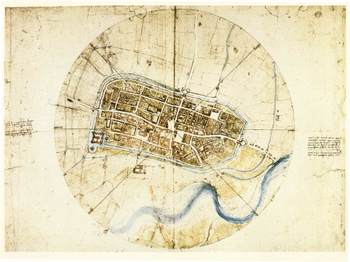
    The drawing by Leonardo of the town of Imola (currently resident with the Windsors) does come quite close to the concept–it has more artistic features than the common city plan , and is definitely at a perpendicular to its subject.Blogstraight_imola

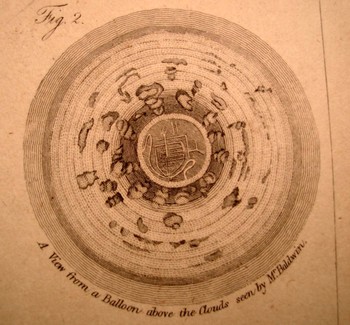
    But it is this that is so terribly interesting to me–a small part of a
    little print from an unidentified encyclopedia from the turn of the
    19th c. It shows a picture of the earth looking straight down from a
    balloon, looking through an opening in the cloud cover, down to a small
    town. There is an iconic work on the representation of the world as known to succeeding generations where the picture of the world is seen through a succession of gradually diminishing clouds (being opened like drapes over time), but I honestly cannot think of an early image of looking at clouds from above and straight down.  My sense is that this image would have caused as much Dsc04639_2
    interest and wonder as the first (Soviet) images of the other side of the Moon (back in 1959). 

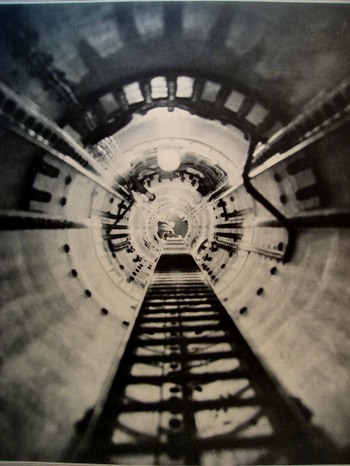
    Even when moving into the pre-satellite 20th century image, the straight-down picture is a rarity. In the last few years after having looked at dozens of thousands of popularly-published images (for another project), the straight-down/up were a scant tenth or perhaps hundredth of a percent of the total. There were a number of photographs made looking straight up (as in the two examples here, looking up the main mast into the crow’s nest of the Queen Mary, and the other with the same view, only in the Bremen. 

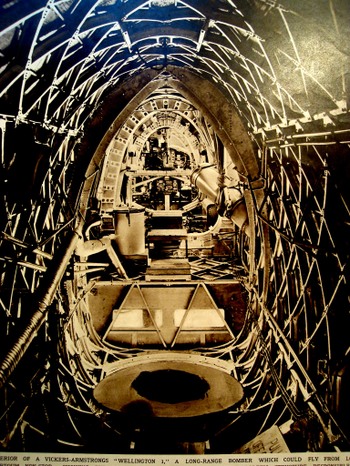
    Occasionally the view like this will show up (looking laterally through the Vickers-Armstrong “Wellington I” bomber aircraft (June 1939)

    I can’t leave this topic without mentioning two recent additions to this genre–the first is the Eames’ wonderful PowerDsc04643_2
    of Ten movie (go to youtube HERE, where in 40 steps we look at existence from quark to quasar. 

    The second is a little goofy but I like it nonetheless–the introduction to the Jodie Foster movie Contact (go to youtube HERE)  built on the bones of the Carl Sagan book. Here we swing out from the Earth and into space, following a broadcast-audio trail of humanity into the not-too-distant time/space (ignoring the signal degradation bit but so it goes), and then leaving that quickly behind, hurling itself backwards, to the outer reaches of the universe, until (and we don’t see this in the youtube clip) we wind up back in the iris of the heroine (and a bit too much like the Dave Bowman trip in “2001 a Space Odyssey”).  Dsc04644

    But we don’t see stuff like this very often, and I’m happy to go along for the ride. It really is just about seeing something new, after all.

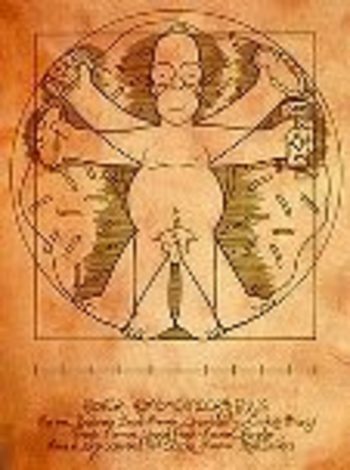
    Perhaps the lack of this perspective is summed up by our old friend Homer J. Simpson. In one episode of the Simpsons (long ago and far away…or last week) Homer explains (to Lisa?) why cartoon characters’ faces are always oblique in profile. Homer turns and looks directly into the
    camera,” and his face gets all pancakey. It’s just not done “because it’s goofy” he says. And at least in Homer’s case, the proof is definitely in the puddin’.
    Dsc04645


  • The Wrong Stuff, Righted–the Attack on Darwin’s Descent, 1871

    JF Ptak Science Books LLC Post 17

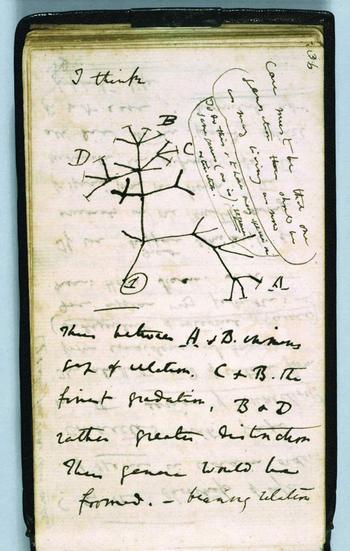
    I enjoy the good defense of the wrongfully accused–The Encyclopedia of Incorrect Reviews of Literature andDarwin_first_tree_2
    Science
    is an enormous and multi-generational work, filled to its festering brim with The Bad Stuff:   Everyone is represented here, glory rendered to trifle:  Hamlet was ripped by Voltaire (“vulgar and barbarous”) while Pepys raped Midsummer Night’s Dream (“insipid, ridiculous”); Moby Dick was “trash, bedlam literature”; Kipling couldn’t write in English (SF Examiner 1889); and Max Eastman weirdly and famously trashed Hemingway and his manhood in the New Republic while reviewing For Whom the Bell Tolls in 1940 (“lacks the serene confidence that he is a full-sized man”).   Perhaps one of the very prettiest of the bad/wrong review was made by The Bookman (the professional bookseller’s reviewing organ in the United States) in 1906, in reviewing Sinclair’s The Jungle:  “His reasoning is so false, his disregard of human nature so naïve, his statement of facts so biased, his conclusions so perverted, that the effect can be only to disgust many honest, sensible folk with the very terms he uses so glibly”.  Well put; better still if it were correct.  The list goes on and on and touches, well, just about everyone (including Dr. Seuss).  What I really enjoy is the response to the bad review, especially when the bad review was, simply, bad. 

    One good example, .a great example, really, is Thomas Stebbing’s response to an inciting, raw and hateful attack upon Darwin’s Descent of Man by The Times of London newspaper (April, 1871).  Incredibly, or predictably, The Times saw the work as an attack upon society: it accused Darwin of undermining authority and principles of morality, opening the way to “the most murderous revolutions”. A “man incurs a grave responsibility when, with the authority of a well-earned reputation, he advances at such a time the disintegrating speculations of this book.” Stebbing’s  review of the Review is drippingly but properly sarcastic, pointing out obvious errors in specific and the tone of the article in general in the defense of theAntievolutionleague_2
    book. Darwin’s “facile method of observing superficial resemblances” (says The Times) moves  Stebbing to issue the following: “they may fancy that truth is worth discovering , even when it seems to involve some contradictions to our pride and some loss of comfort to our finer feelings…”  It is a gorgeous line ending a proper, staid defense of what would seem prima facie to be something in need of no defense whatsoever—in 1871 or 2008. 

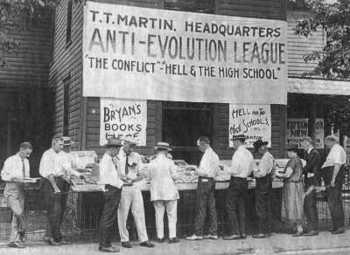
    Reverend Stebbing, a Darwinian, Naturalist and fellow of the Royal College of Surgeons, lived another 55 years after this article was published—one year longer than the issuance of the (negative, anti-Darwin) verdict in
    the Scopes/Monkey trial.  I wonder what he was thinking on that day in 1925…

    ·Posted by :

    ·in:

    — —

  • Things That Were But Almost Weren’t, Part II: the Disappearance of Alex Bell

    JF Ptak Science Books LLC Post 10

    Part (A)–Alex Graham Bell as a Purposefully Forgotten Element in the History of the Telephone,
    and
    Part (B)  the Author Who Forgets Bell Fails to See the Future of the Telephone as a Communication Device.

    Blogbell
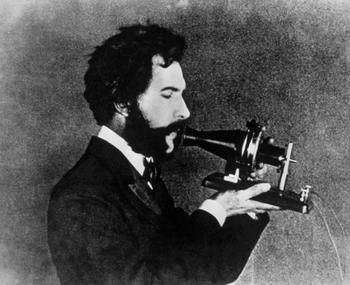
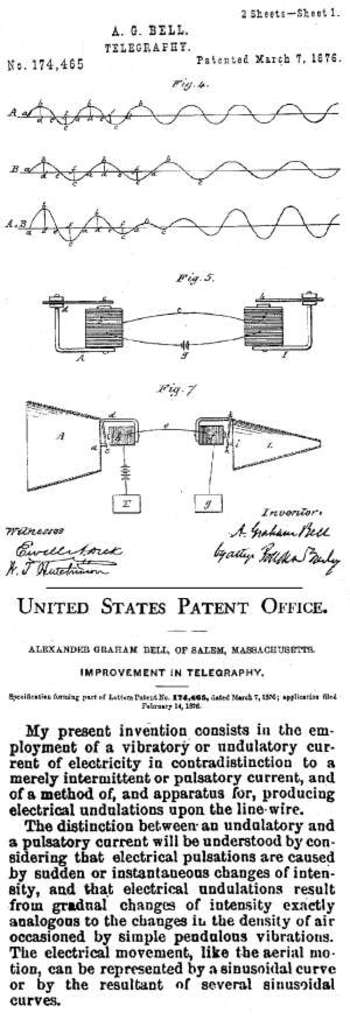
    Well, Alexander Graham Bell didn’t totally disappear in these very early reports on the telephone (published in  the  very influential Nature, an Illustrated Weekly Journal of the Science, London, May and August, 1876), but might as well have.  The author of these two reports, published just on the heals of Bell’s announcement in America in March 1876, was J. Munro and he was not a Bell-believer.  In these two reports Munro champions Elisha Gray   as the inventor of the telephone, and does so with the exclusion of discussing Bell. There are however numerous other references to others working in the field–which was crowded in 1875 and 1876–so at least according to my line of thought the omission of Bell needed to be accomplished with some severe and anti-penetrating thought. 

    Now it must be stated that the history of the patent for the telephone from 1861 to 1876 is indeed complex and trickyBlogbellpatent
    , and there are at least four others who may be considered to have preceded Bell, in some regards that is, but the fact that Bell was granted the patent and that he resisted all claims and attempts at penetration against his patent(s) beginning even within a year of the invention, says something pretty rock-solid about his place in the priority of the invention.  Munro does come around to this , somewhat in his early summation and history of the telephone (Heroes of the Telegraph), but his desire for not-Bell comes through very strongly.  (It should be noted that Sir William Thomson  , who introduced the telephone to Europe in the fall of 1876, thought of it being the most perfect development of the telegraph, a “speaking telegraph” if you will, and hence the name of Munro’s book.) 

    In the second paper (the first appeared 15 May 1876, the second 24 August 1876)  Munro continues on with his appreciation of  the telephone’s musical virtuosity to the exclusion of using the telephone for spoken communication. “There is a possibility here, we must admit, of a curious use of electricity. When we are going to a dancing party there will be no need to provide a musician”, he writes, as the dancers will be able to pay their electrician for the privilege of getting their piano via wire. It is understandable to some degree to appreciate the telephone as a sort of radio, but Thomson had by this time made his report of the spectacular sensation of hearing *spoken words* coming from the telephone and what that experiment meant, and it is hard to understand (even at such great distance and hindsight) how Munro could’ve missed this report from Thomson, and how he could no make the intuitive leap to using the new invention for communication rather than amusement.  I think Munro just plain got it wrong, or got it only partially right, which in this case makes him totally wrong. 

    (I should note here for the sake of clarity that when Thomson heard the spoken words that he missed, or the telephone missed, all of the monosyllables–still, one could assume that improvements would be made and that at some near point they could be understood.)