A Daily History of Holes, Dots, Lines, Science, History, Math, Physics, Art, the Unintentional Absurd, Architecture, Maps, Data Visualization, Blank and Missing Things, and so on. |1.6 million words, 7500 images, 4.9 million hits| Press & appearances in The Times, Le Figaro, Mensa, The Economist, The Guardian, Discovery News, Slate, Le Monde, Sci American Blogs, Le Pont, and many other places… 5000+ total posts since 2008.

Category: Naming Things

  • The Society for the Friendless and the Child Home Finding Society, 1921

    JF Ptak Science Books

     The Charities Bureau of Kansas City published this handbook in 1921 for the annual fund raising season: The Hand Book for the Campaign
    is a concise account of the principal helping-hand organizations, many
    of which have (from our seat here in the future) quite extraordinary
    names.  
    0-blog---Nov 21 social agencies090

    We find “The Rest Cottage” (“maintained as a refuge and
    rehabilitation sot for homeless and unfortunate women and girls and
    their destitute children”), the “Receiving Home for Children”, “The
    Home for Infants”, “The Orphan Home for Girls”, “The Child Welfare
    Club”, “The Children’s Hotel”, “The Whatsoever Circle”, “The Home for
    Aged Women and the Destitute”, “The Presbyterian Home and School for Crippled Children”, “The Helping Hand Association for the Blind”, “The Girls Hotel”, “the Childrens Bureau”, “The Finding Society”, “The Home for Aged Women of the Mexican Christian Institute”, “The Hopkins receiving Home”  and of course “The Society for the Friendless” (providing aid to the “man who comes from prison”, from Lansing, Leavenworth and St. Joesph.  Actually the members of this society would receive the newly released convict as well as visit them in prison; the society reached over 13,000 men (and “girls in Industrial Schools”) between 1919 and 1921. 
    Riis4

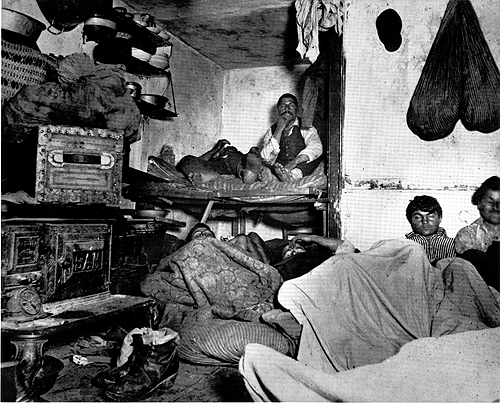
    There were dozens of these agencies that were providing help and relief to the needy in the Kansas City area in the pre-Federal-help days.  It is very interesting to see these charities divided along lines of need, rather than have them gathered together under a giant umbrella like, oh, the Department of Health and Human Services or some such agency.  Or just the Department of “Human Service”(?) on the state level of many states.  It seems more appropriate to actually specify the nature of relief rather than hide it away under a giant Orwellian blanketing cover of general services–it would be okay to be reminded that there are needs for abandoned children and destitute girls.  Perhaps it would make us all a little more aware of who needs what in this rich and capable society. It just seems to me that codifying the extreme of social need into more amorphous units like we have done in the last 50 years or so smooths the edges that people like Thomas Nast and Jacob Riis* and Charles Dickens and Virginia Woodhull and Dorothea Lange and Dorthy Day** managed to sharpen.  Sharp edges are good.

    Dorothy day

    * Jacob Riis was perhaps the first documentary photographer of the American “underclass”, putting an indisputable photographic face on the living and working conditions of the laboring poor.  A photograph of these conditions was irreproachable–it was something you could absolutrely trust, mroe so than an “artist’s representation”; like seeing a photograph from the surface of the Moon.
    ** Dorothy Day, (above), perhaps the least-known of these names, was a tremendous figure in the civil and workers rights movement and the founder of the Catholic Worker. 
     

    ·Posted by :

    ·in:


  • Naming Things: Re-naming the Badly Named

    JF Ptak Science Books   Post 321

    Among the Ash-Heaps and Millionaires (some of the attempts at a title for what became The Great Gatsby) of novel titles great and small, I offer the following modest list of attempts at titles and what became the real title of the book.  Can you guess if the proposed title (in parentheses) is real or just a bad attempt at humor? (Hint:  they’re all real–not much of a quiz, is it?)  This is a follow up on the Marianne Moore/Edsel/Standard Model Naming Things post from yesterday, though this more about re-naming–in most of these cases though it is more like anti-naming, as the proposals for some of these titles are just so painfully bad.  I think that we can all be thankful that the editors, or the author, finally made a more correct decision on the titling of the work at hand.  

    (Naked Lust)
    Naked Lunch

    (Tomorrow is Another Day)
    Gone with the Wind

    (Army Post)
    Reflections in a Golden Eye

    (The High-Bouncing Lover)
    The Great Gatsby

    (The Exorcism)
    Who’s Afraid of Virginia Woolf

    (Something that Happened)
    Of Mice and Men

    (The Iron-Bound Bucket)
    Mr. Roberts

    (The Drunkards)
    Tender is the Night 

    (The Education of a Personage)
    This Side of  Paradise

    (The Inside of His Head)
    Death of a Salesman

    (O Lost)
    Look Homeward Angel
    (*Actually his bones are only about 1000 feet from we’re I’m writing)

    (Catch-18)
    Catch-22


    ·Posted by :

    ·in:


  • Naming Things; Names Good and Bad

    History of humans may boil all the way down to the history of
    naming things. Sometimes the naming is good, sometimes not. Moby-Dick sounds a
    whole lot better than The Whale; Ulysses and The Odyssey are not really
    inspired titles for fantastic books, nor is The Heart is a Lonely Hunter, or The
    Recongitions
    for that matter. The Bible doesn’t say much about the book, and
    Love in the Time of the Cholera does; why You Should Refrigerate Food does tell
    you what’s inside a basically empty book, and Catch-22 does not.

    Standard_model_chart

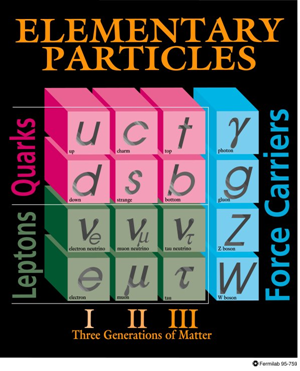
    The Standard Model (with quantum chromodynamics folded into
    it)  is a very bad name for something
    that describes the world of elementary particle physics;  Democritus’ “atom” has stood the test of 24
    centuries and is pretty, while muon (god help it) will survive by sheer fits of
    agony.  QED and ACD are good initials for
    big things, but big things like giant laboratories tend to have pretty bad acronymic
    names (SLC, CERN, DESY). 

    I just wrote a post about the creation of the binomial
    naming grid of Linnaeus, which was one of the greatest naming inventions of all
    time—it performs an organizing principle that created other organizing
    principles. 

    Sometimes the names of things outlive their usefulness, and
    come full circle, sometimes providing an unintended and ironic reminder of untimely
    pasts.  In

    India there’s   Lodhi Road,
    Mughal Gardens
    and Aurangabamnd; we have our own in this country in places like the Jefferson-Lee
    highway and Fort Myer’s
    (Virginia)
    Mosby Gate.

    The massiveness of this idea is just overwhelming—all I
    really want to do here is get to the naming of a Ford Motor car.  And the namer, in this case, was the poet
    Marianne Moore.  (I’ve always liked her,
    and her poetry, and her love for Mickey Mantle and baseball and Muhammad Ali
    and so on)  Ford found itself a little behind
    the times back there in the autumn of 1955, trying to figure out a new,
    with-it, tiger-whipping name for its new $250 million dollar car from their
    Special Products Division  They had
    something like “Firebird” in mind—unfortunately for them the name was already
    taken.  David Wallace, the head of Ford,
    wanted something elegant and fleet, and to that end contracted with the great
    poet Ms. Moore to come up with one.

     Marianne_moore

    Ms. Moore had a dry sense of humor and did submit a number
    of entries, though none were successful, and probably none were intended to
    be.    After looking at sketches and drawings of the
    new car, she came up with “The Ford Silver Sword” almost right away (named
    after a flower she said that grew only on Mt. Haleakala
    above 10,000 feet or some such thing).  She then submitted a
    number of others  including the “Patelogram”,
    the “Mongoose Civique”, and the “Utopian Turtle Top”, and then many many more.

    Mr. Wallace came to realize that Ms.Moore was having a bit of fun with his
    company, and sought to terminate their relationship, with some aplomb.
    He wrote:

     Dear Miss Moore,

    Because you were so kind to us in our early days of looking
    for a suitable name, I feel a deep obligation to report on events that have
    ensued.

    And I feel I must do so before the public announcements of
    same come Monday, November 19.

    We have chosen a name out of more than six thousand-odd
    candidates that we gathered,  It fails
    somewhat for the resonance, gaiety, and zest we were seeking.  But it has a personal dignity and meaning to
    many of us here.

    Our name, dear Miss Moore—is Edsel.

    I’m sure that Ms. Moore must’ve had a good, solid laugh on
    that one.

    ·Posted by :

    ·in:

    —

  • Allegory and Symbolism: the New Botany and a New Way of Classifying, 1737

    JF Ptak Science Books   Post 318

    Carl Linnaeus (1707-1787) was the father of modern botany–he was a Swedish zoologist, physician, and above all, way above all else, he was a botanist. He was also widely recognized  as an accomplished, applied polymath:  Rousseau said of him “Tell him I know no greater man on earth”, and Goethe, one of the greatest of all polymaths and an expert on recognizing another one,  wrote: “With the exception of Shakespeare and Spinoza, I know no one among the no longer living who has influenced me more strongly”.  Pretty strong stuff from giants.

    1blog_oc_t11_linnaus814

    In addition to much else, Linnaeus contributed a template, a grid for identification and discussion,  establishing conventions for the naming of living organisms that became universally accepted in the scientific world—the  the starting point of binomial nomenclature. 

    And perhaps it is small of me, but I concentrated a bit on the frontispiece to his greatest books (rather than on the writing)–it is truly a capstone of the botanical canon.  The book is Hortus Cliffortianus plantas exhibens quas in Hortus tam vivis quam siccis… and it was published in Amsterdam in 1737, and it was as beautiful as it was important. The book was basically the product of the desire of the entrepreneur and multiply-rich East India Company investor and Anglo-Dutch banker George Clifford, whose desire to catalog his massive and extraordinary gardens brought him to Linnaeus.  The partnership, or at least the bringing of Linnaeus on-board for this unique and monumental opportunity, was one of the most fortuitous in the history of 18th century science. 

    The fine, baroque frontispiece allegorical engraving by Jan Wandelaar pretty well drips symbolism and allegory–which is a good thing since that is what is was supposed to do.  The main figure in all of this is a crowned Europa, seated before the very gates of the Clifford garden, holding a set of keys (to the botanical kingdom).  She is surrounded by activity, including three people representing the continents (Africa, Asia and America) offering  her gifts of plants.  Europa is bathed in light, perhaps because the figure to her right, Apollo, is just now removing a drape or cloak from her (which I guess is the pre-Linnaean coverlet of incomplete  and incorrect botanical knowledge), and providing her with his own source of light (with the torch in his left hand).  Between Apollo’s legs we can see the arm/tentacle of some sort of beast/hydra/dragon, no doubt another representation of incomplete knowledge, or worse. 

    Around the edges of the print , beginning in the foregorund, we see a map (represnerting Clifford’s gardens, probably, or the general sense of planning an approrpiate way of growing and displaying plants); to the right of the map are two cherubs/imps sitting before a roaring brazier, one holding a staff of some sort and the other pointing to a (celsius) thermometerm which Linnaeus had a hand in invneting.  Moving up the side of the print we come to my favorite part, the producing banana tree (you can see the bananas if you look closely), which I imagine must’ve been a great rarity in Eruope in the 18th century).  All in all I’d say that the artist accomplished the task of allegorically depicting the importance of the pages that followed.


  • What Things Are Not Department: Life, Cityscapes, and the Virgin Mary in Stone.

    JF Ptak Science Books   Post 305

     1blog_oc_t_9_not_here791

    Stone has preserved the evidences of much of the life on Earth—in the fossil record (which happens to stretch some number of years back before 4004 BCE contrary to what one of the vice presidential candidate believes), or an arrested day in Pompeii; indeed the entire landscape shows the way life looked by filling in the negative of what you see today., a negative landscape in a way of what has come before. The City of Rocks, New   Mexico, for example, out there near  Silver City, is a wonderful example of trying to employ your imagination to render in your mind the massive volcano that once stood there, the “City” being the last remnant of its existence. Better yet is the great Ship Rock (hello Officer Jim Chee!), a massive 1,800 foot tall fractured volcanic breccia spire in Navajo Land (Tsé Bit’a’í, in Navaho, “rock with wings”), the internal remnant of yet another massive volcano, though in this case the enormous radiating dykes (igneous rock called “minette“.) exploding away from its base gives you a better idea of the footprint of the missing mountain. You can see this magnificent mountain from a great distance, and it is only when you start to get closer and drive through one of the dikes (that has been separated for the road) that is 20’ tall and still a long way from the base of the mountain that you get a =good appreciation of just how massive it all is. 1blog_oc_t_9_not_here792


    I cannot imagine the gargantuan profundity felt by the person who first realized that the Grand Canyon was formed by erosive forces over previously unimaginable long periods of time, its awesome and enormous silence a negative punctuation to the enormity of the idea.

    Prior to the major discoveries in geology in the 19th century, say from the mid-18th century and earlier, there were many “discoveries” of life in stone—they weren’t very useful and most often were very misleading, but they were, in two words, pretty and unusual.

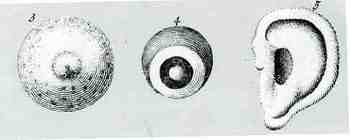
    The people who made and recorded these discoveries were often more circumspect about what they were finding than their readers; sometimes not. Jean-Baptise Robinet (1735–1820) was a French naturalist, Jesuit-philosopher and encyclopediaist (best  known for his five-volume work De la nature (1761-8)) who found all manner of interesting and scientifically-divergent items in stone—eyes, ears, skulls and occasionally an entire body. Antoine J.D. d’Argenville at about the same time in the 1750’s also uncovered silhouettes of dressed human,  birds, cityscapes, trees and the like in stones, which seeped its recordings of the animate into receptive fantasies.

    1blog_oc_t_9_not_here_kircher_793
    But these durable micro- explorations in agate go back thousands of years, expounded by Pliny and some of the other ancients, who followed the origins of humanity back into the rocks. This was a popular idea for the origin of animate beings, propounding itself for centuries, even winding up in the bony lap of Leibniz of all people, who wrote that “men derive from animals, animals from plants, plants from fossils, which in turn derive from bodies that the senses and imagination represent to us as being totally dead and formless”. Stoners therefore held the seeds of the formation of the world; all things living, breathing, and not.

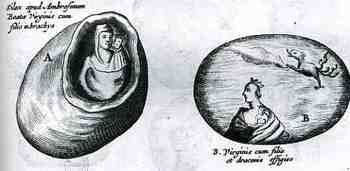
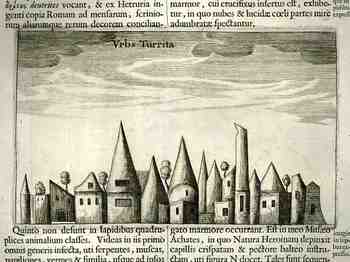
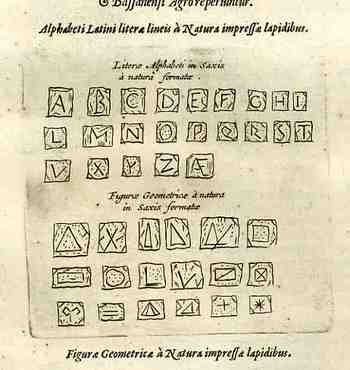
    Our own Athanasius Kircher, the definition of Polymathic ability and superior imagination was responsible for many such observations and discoveries. It seems to me that as much as Kircher gave, he took away, keeping ahead of his critics and the rest of the scientific community with tremendous output…people I think just couldn’t keep up with him. He found all sorts of things in stone: as early as 1619  he exhibited an image of   St. Jerome (in no less a place than the cave of the Nativity in Bethlehem!) that he found in agate. His Munduis Subterraneus (1661) is ahome to a wide range of these objects: quadrupeds of all shapes and descriptions, human full-length portraits, hands with jewels, and even the Virgin Mary and child. AS spectacular as these are there is always more: the magnificent cityscape (reproduced here) and the sublime discoveries of a full set of the alphabet and a series of 15 geometrical drawings, all naturally impressed in stone.

    1blog_oc_t_9_not_here_kircher_alpha

    Perhaps these men gave little more regard to the details in this stone than was necessitated by accepted theory; perhaps they added details to suit their observational needs, as they images were, after all, drawings of the susceptible and the fantastic, and were not photographs. Recording their record was as much open to interpretation as were the theories. I have no doubt that if you look hard enough at things you will at some point find what you are seeking. Only here it is by chance that these figures appeared, and not by the will of a divine creator placing a seed of potential in the stone.

    My five-year-old daughter, Tessie, asked me just the other day about where numbers and letters “came from”. She wanted to know “why are they here?”, which is a fabulous question with a long difficult answer. I do know though that they didn’t come to us from agate. 


  • Specialized Vocabularly: Hobo Slang 1939

    JF Ptak Science Books Post 304

    1blog_oct_8_hobo_cvr785
    There have been many Kings of the Hobos, and Emperor of the Hobos, in the history of American Hobodom.  The most widely recognized of all this royalty is, probably, Mr. Jeff Davis, who was elected King of Hobos each year from 1908 to 1935, until in 1935 at the Pittsburgh meeting of the annual “Hobos of America” his minions gave up elected him King for Life. Of hobos, that is, the Knights of the Road; he was also a real hobo, unlike the pretenders, who in general were not. (Nels Anderson in his Men On The Move, written just as the Depression was broken, (1940) observed: “Whatever else may be said of King Jeff, his romanticizing the hobo is not without a basis in reality, and his poetic interest in the species arose from experience. But King Jeff has placed on a pedestal a man who belongs to the past. The hobo belongs with the pre-Hollywood cowboy and the lumberjacks of the Paul Bunyan legends.”)

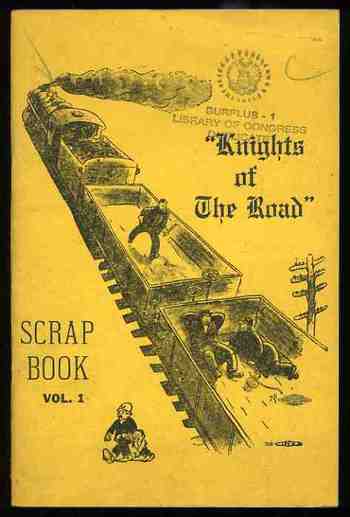
    Mr. Davis was certainly very effective in getting the message out—on freedom and responsibility to irresponsibility—and was a great organizer and popularizer. He helped to establish hobo meetings, newspapers and literature (a sample of which is at left). He also had a few movie appearances: in The Arkansas Traveler, 1938 and The Bridge of Sighs, 1915, he ably played the role of a hobo.


    And what about the missing counterpart of Jeff Davis–the Queen of the Hobos? There were certainly allot of women hobos during the Depression; Harry Hopkins estimated that there were something like 13,000 “sisters of the road” who were out and about in the 1930’s. I guess the most famous of them though was one who did not exist; and what parts of her that were real were mostly those of one man: Ben Reitman. Sister of the Road (1940) was supposed to be an autobiography of legendary Boxcar Bertha, but it was really an assimilation of Reitman’s own experiences sprinkled about those of women from his life. Reitman, who was described (by himself) as a “hobo, whorehouse physician, musician and tour manager/lover of Emma Goldman” (??) was probably not without enough experiences to float another character or two, had his story of Bertha wind up in the hands of exploitation movie maker Roger Corman. The good news about that though was that Corman gave the project to the very young Martin Scorcese who produced an odd and not bad film on no budget, and Boxcar got to live again.

    1blog_oct_8_hobo_cvr786

    But what brought me here to begin with was Davis’ breakdown of some very colorful hobo slang, all of which was found in the little yellow pamphlet (pictured above), and published as a “reference manual” in 1947.  And so:

    Gay Cat. Someone who “beats it from town”, settles down with a job and puts together some money so that he can get on the road again.

    Gandy Dancer. “Is a hobo shovel stiff, a muck-stick artist”, a common laborer

    Pearl Diver. A hobo dishwasher and who works for his meal.

    Mush fakir. A hobo umbrella mender with a patch kit and a second-hand umbrella strapped to his back. (Evidently these guys were put out of business when larger stores began offering umbrella repair on their own.)

    Bindle stiff. A hobo who carries his stuff in a sack on a stick, including toothbrush, “but he does NOT carry blankets”.

    Kywah. An honest hobo pitchman peddling soap, perfume, jewelry, novelties, pens, knives and potatoes peelers.

    Kewah. :Makes and sells articles such as willow stands…”

    Scenery Bum. “A young tramp who bums it around the country, just for the fun of it.”

    Ring-tail. “An ignorant, harmless tramp.

    Fuzzy tail. “A smart aleck tramp, jack of all trades, a fourflusher, big bluff, false alarm, and piker of the worst sort, who most always carries a “punk kid” or “road kid” (a runaway boy).”

    Dingbat. “An old tramp professional beggar who dings the main stem (begs on the main street).”

    Stew bum. “An elderly tramp who wastes his time continually drinking rot booze.”

    Jungle Buzzard. “A tramp who loves to eat but is too lazy to get the ingredients for a mulligan stew. He eats what is left when the gang leaves the jungle fire.” Yum.

    Road Yegg. “A vicious tramp of the petty larceny type, a cheap crook.”

    I like the collection—it has a high color, not terrible low cant at all.

    Notes:

    A Few Books on the History of Hobos:

    Allsop, Kenneth  Hard Travellin': The Hobo and his History. 1967.
    Black, Jack.  You Can't Win. 1926.
    Bruns, A.  Knights of the Road. 1980.
    Davies, W.H.  The Autobiography of a Supertramp. 1929.   
    Drew, Betina. The Texas Stories of Nelson Algren. 1995.
    Etulain, Richard W.  Jack London on the Road: The Tramp Diary and Other
    Writings. 1979
    Flynt, Josiah. Tramping With Tramps. 1969 reprint. 
    Flynt, Josiah. My Life. 1908.   
    Graham,  "Steam Train" Maury   Tales of the Iron Road: My Life as King of the
    Hobos. 1990.
    Kemp, Harry.  Tramping On Life: An Autobiographical Narrative, 1922.
    Kerr, Lenox.     Back Door Guest [Foreign Travelers in America
    1810-1935].  1930
    Kromer, Tom.  Waiting for Nothing. 1935.   
    Monkkonen, Eric H. Walking To Work: Tramps in America, 1790-1935.
    Ormser, Richard.   Hoboes.1994.
    Tully, Jim.  Beggars of Life: A Hobo Autobiography. 1924
       
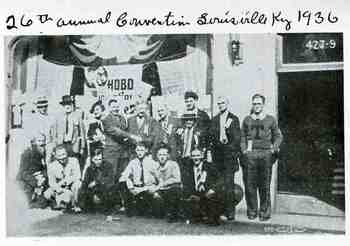
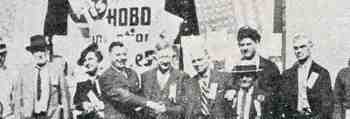
    And, by the way, this detail of the photo in the Davis book for the 1936 Hobo meeting in Kentucky--
    where, exactly, are the hoboes?  these people look pretty middle class.  And who is the lady?

    1blog_oct_8_hobo_cvr787

    ·Posted by :

    ·in:

    — —

  • Deep Discrimination in a Classic of Anti-Discrimination: Japanese Americans and World War II

    JF Ptak Science Books LLC  Post 299

    1ebay_oct_4_these_are_americans744
    For another project of mine I’ve been reading about the
    Japanese internment camps (posting an earlier post here), and just started to
    read some post war material on the interpretation of those actions. The first book I turned to is regarded as a
    liberal (in the classic sense of the word) regard and homage to the Japanese in
    the Hawaiian Islands by John Adrian Rademaker, (a Professor of Sociology at the University of Hawaii 1944-1947), who in 1951
    published These Are Americans: The Japanese Americans in Hawaii During
    World War II
    . It documents the
    contributions made to the war effort by of people of Japanese ancestry living
    in Hawaii, including the Varsity
    Victory Volunteers, the 100th Infantry Battalion, and the 442nd RCT, and so far
    as I can determine is one of the earliest pioneering works to attempt to right
    the significant wrong done to these people.

    In the past I always thought of it as a photographic essay,
    and I’m sure that I never actually read the thing., But this time I, I did, and I was stopped
    almost immediately, half-way through the first sentence.

    It reads:

    “During World War II, I was one of a considerable number of
    persons who were directly concerned with the care and re-establishment of the Japanese Americans in the continental
    United States.”

     To be honest about it, I’m not sure what this means or where it came from.   The rest of the sentences in the 277 pages of
    this book are laudatory and informative and attempt to right the public opinion
    wrongs of the wartime Japanese-American persona. But “care and re-establishment” is awful and
    weird, and stupid—so much so I wonder if the phraselet was stuck in there by
    some zealot editor. Removing 110,000
    Americans from their lives and residences and families and communities and
    businesses, stripping them ¾ of whom
    were American citizens) of their rights, forcing them to sell whatever they
    couldn’t carry at fire sale prices, and then sticking them all in horse stalls
    or deeply removed and very difficult locations for three years is disgustingly-not
    “care and re-establishment”.

    Unless of course the author believed it, and if such is the
    case then he really didn’t understand what happened to those 110,000 people, sociologist
    or not; or at least didn’t get it in 1951.

    He did make a strong case overall for the American Japanese
    in Hawaii being loyal
    citizens/ Rademaker points out that 1,440
    Americans of Japanese Ancestry (AJA) who were detained by local authorities (excluding
    Federal efforts) out of a population of over 150,000 AJA in Hawaii. They were nearly all Issei (first generation immigrants)
    and Nisei (born in the USA)

    From December 7, 1941till the end of the war, some 1,440 AJAs were
    picked up by the authorities. This constituted nine-tenths of one percent of
    the AJAs in Hawaii. 879 of those were Japanese Issei, first-generation immigrants. 534 were
    Nisei. Nearly half of this number were
    released after preliminary hearings, with the rest being “kept” for other
    reasons, though they were simply community leaders (doctors, nurses, school teachers,
    benign) and that sort of thing. He
    states that no AJA in Hawaii was ever convicted or found to have committed any treasonable offense or
    committed any sabotage whatsoever.

    I’m just pointing out how odd this
    first sentence is in the face of the rest of the book. Was it meant to diminish the American government’s
    actions in rounding up and removing these people? (The government has had a very long history
    of doing exactly this, and doing it deathly well—just look at the hundreds of Indian “removals”, the entire
    institution of slavery, and many, many others, up to and including to a lesser
    degree the displacement of Katrina refugees.) Arrest and disappearing people is
    not “care and re-establishment”, period.

    For the record, another truly
    measurable aspect of AJA fortitude is their military participation during WWII
    which stands as follows (presenting the 100 Battalion of the 442 and then the
    442 as a unit):

    The 100th Battalion and 442nd Combat
    team:

    Killed in action  569.
    Died of wounds 81.
    Missing in action 67.
    Wounded in action 3,506.
    Injured in action  177.
    Total casualties  4,120.

    The 100th Battalion and the 442nd
    Combat Team won the following decorations:

    1 Medal of Honor

    1 Medal of Honor
    47 Distinguished Service Cross
    1 Distinguished Service Medal
    12 Oak Leaf Cluster to Silver Star
    350 Silver Star
    18 Legion of Merit
    16 Soldier’s Medal
    41 Oak Leaf Cluster-to Bronze Star Medal
    823 Bronze Star Medal
    1 Air Medal
    500 Oak Leaf Cluster to Purple Heart Medal
    3600 Purple Heart Medal
    2 Army Commendation Ribbon
    40 Army Commendation
    87 Division Commendation
    1 brigade Commendation
    12 Croix De Guerre (French)
    2 Palm to Croix De Guerre (French)
    2 Croce Al Merito Di Guerra (Italilan)
    2 Medaglia De Bronzo Al Valor Militare (Italian)

    Overall the 442—composed entirely of Japanese Americans, emerged
    as the most decorated combat unit of its size in the history of the United
    States Army —suffered an “unprecedented casualty rate of 314 percent and
    received over 18,000 individual decorations. Many were awarded after their
    deaths for bravery and courage in the field of battle. Among the decorations
    received by the 100th/442nd soldiers were one Medal of Honor, 52
    Distinguished Service Crosses, 560 Silver Stars, 28 Oak Leaf Clusters to the
    Silver Star, 4,000 Bronze Stars and 1,200 Oak Leaf Clusters to the Bronze Star
    and, perhaps most telling of the sacrifices made by these gallant soldiers,
    9,486 Purple Hearts.” The 442nd Combat
    Infantry group emerged as the most decorated combat unit of its size in the
    history of the United States Army.

    ·Posted by :

    ·in:

    — — —

  • The History of Images of Aerial Bombing–First Images

    JF Ptak Science Books  Post 322

    I had written out a good, chunky post on the history of the images of aerial bombing; wrote it all down in my little notebook down at Tybee Island, and then promptly hopped into the hot tub fully clothed (for the benefit of our five-year old Tessie) and stayed there for a half-hour, with my notebook still in my pocket.  Of course once the thing sort of dried out all of the notes were just one blue stain, an Andy Warhol post.  I just can’t do the whole thing over again, but I can post about the one odd bit that was in there.  And it is this (very) minor bit that escaped Sven Lindqvist’s attention in his glorious A History of Bombing (printed in 2000 by The New Press), a book that is a chrono-intellectual historico-philosophical treatment of aerial bombing in general.

    1blog_oc_t11_robur810

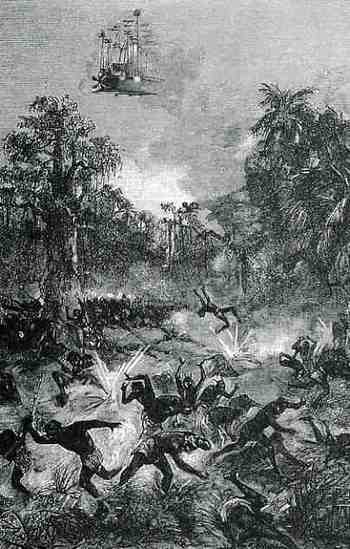
    One of the earliest illustrations of bombing from an airship (at left) occurs in the incomparable Jules Verne’s Roburs the Conquerer (also known as The Flight of Engineer Roburs) in 1886.  It turns out that this floating monstrosity (the Goahead) made its way slowly over Paris, illuminating the city with powerful lights, in a helpful, positive way; on the other hand, it confronts “dark criminals” with bullets, mowing them down.  Oddly enough, the book’s opening two words are “Bang Bang”.

    1blog_oc_t11_anti_ac813

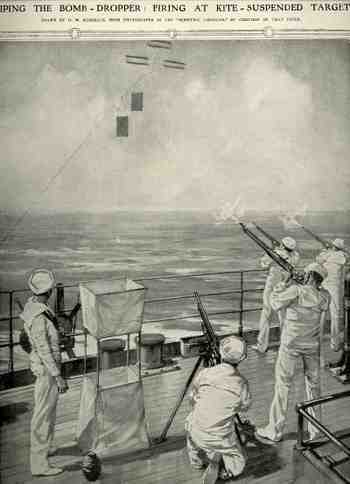
    This may well be the first anti-aircraft (and anti-bomber) image ever printed  in England–it comes from The Illustrated London News for 16 December 1911, just six weeks after this same magazine printed the first image of an aircraft dropping a bomb on a military target. (And it seems originally to have been first published weeks earlier in the U.S in the Scientific American.)  “Airman-shooting with Springfield Rifle; Aerial Gun Practice on a United States Battle-Ship” is the sub title to “Sniping the Bomb-Dropper:  Firing at Kite-Suspended Targets” .  The kites carried the targets up to a height of about 300 feet, and the navy let loose with “one-pounders and three-pounders” as well as rifles (?!) The text to the print continues the story: “The Springfield rifle…will afford no inconsiderable defense against any aeroplane that might attempt to execute feats of ‘bomb-dropping’.” I don’t know about that, though it may have been true that this 30-caliber weapon with a muzzle velocity of 2700’/sec might’ve done some damage to a 1911 aircraft….I guess they could have tracked it too, what with the plane moving 75 miles an hour or so.

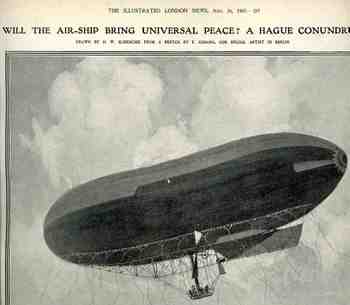
    It was just a few years earlier that in this same journal (for 4 August 1907) that the possibility of the air-ship being an instrument of peace was discussed.  It seems that this “peace” would come about in a sort-of MAD (mutually assured destruction) kind of way, stumbling its way to peace because of the difficulty in defining the terms of war–rather than obtaining a stalemate by the endgame of obliteration via inconceivable amounts of instantaneously-released energy, these folks thought that peace/stasis might come about simply because they weren’t able to fully outlaw reckless bombing because they couldn’t come to terms with what an “airship” actually *was*.    Bombing by airship was outlawed at the Hague Conference of 1899, and in 1907 it was argued that a five-year extension of that treaty should be enacted–again, mainly due to the ungentlemanly ungainliness of what it meant exactly to drop bombs from the air and what aspects of that action were illegitimate. 

    All sides would get over the definition issues pretty quickly, as 1912 comes up just a little short of the guns of November two years hence.  After all, we can’t have ill-defined terms in communication, can we?

    1blog_oct_13marconi_at_sea818


  • Food Bomb, 1942

    JF Ptak Science Books  Post 285

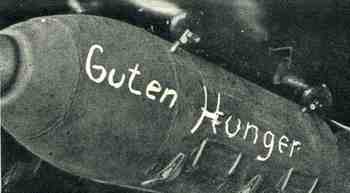
    1ebay_sept_30food_bomb694 In an earlier post (The Most LIterary Fireworks Catalog Ever Published?  The Naming of Explosions) I wrote a little bit about names found on shells and the naming of explosions.  The chances for adding to this category are slim, given the ephemeral nature of the item of discussion–I did however stumble upon this Food Bomb, found in the 25 April 1942 issue of The Illustrated London News.  “Guten Hunger”, the inscription on this “bomb”  (basically “good appetite” or “eat well” or “down the hatch”) was actually “not a weapon of destruction, but an enormous food container” that was going to be dropped on the German soldiers on some slender part of the Eastern Front.  In April the situation was turning now away for the Germans with the Soviet counter offensive, and it was still cold. Something like 3 million German soldiers would be awarded the service medal for the Winterschlacht im Osten 1941/42–not many of them would get to look at it after 1945.   The campaign in the east against their former allies started on 7 June 1941 (and named variously die Ostfront 1941-1945, der Rußlandfeldzug 1941-1945 (Russian campaign) or der Ostfeldzug 1941-1945 (Eastern Campaign)) and lasted to mid-May, 1945, when the campaign line shrunk from as far away as Moscow back down to east Berlin. 

    ·Posted by :

    ·in:

    —

  • The Most Literary Fireworks Catalog Ever Published? The Naming of Explosions.

    JF Ptak Science Books  Post 267

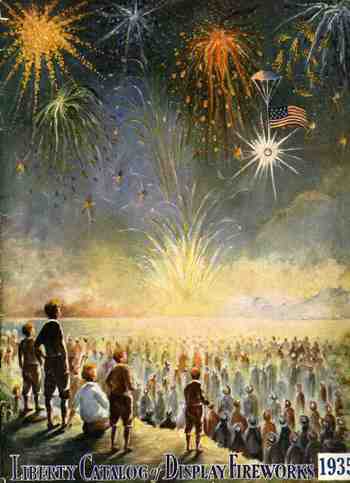
    Ebayfireworks_cvr579

    I found this wonderful catalog this morning–the 1935 Liberty Catalog of Display Fireworks.  It is big (11×8 inches) and its 64 pages are filled with descriptions of the hundreds of different advanced firework displays that you could purchase.  Mostly the company was interested in selling very large, packaged displays, hovering in the hundreds of dollars, which was quite allot of money in the 1930’s, even without considering the impact of the Depression on the fireworks-pursuing populace.  These people were definitely not selling firecrackers to kids.

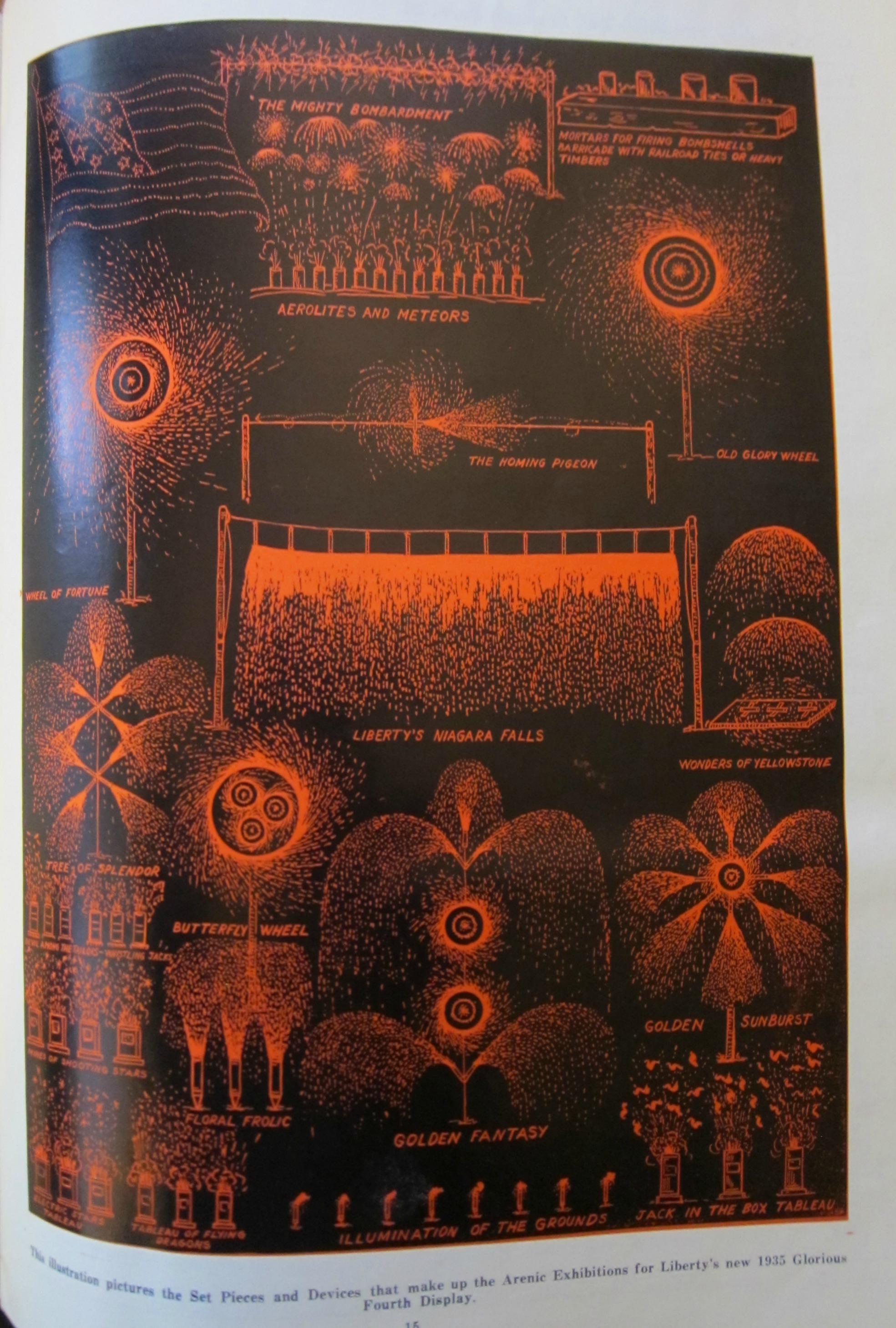
    The illustrations in the pamphlet are remarkable for displaying so many of their goods, and were printed in high relief, being dark red on a field of black.  Very effective!

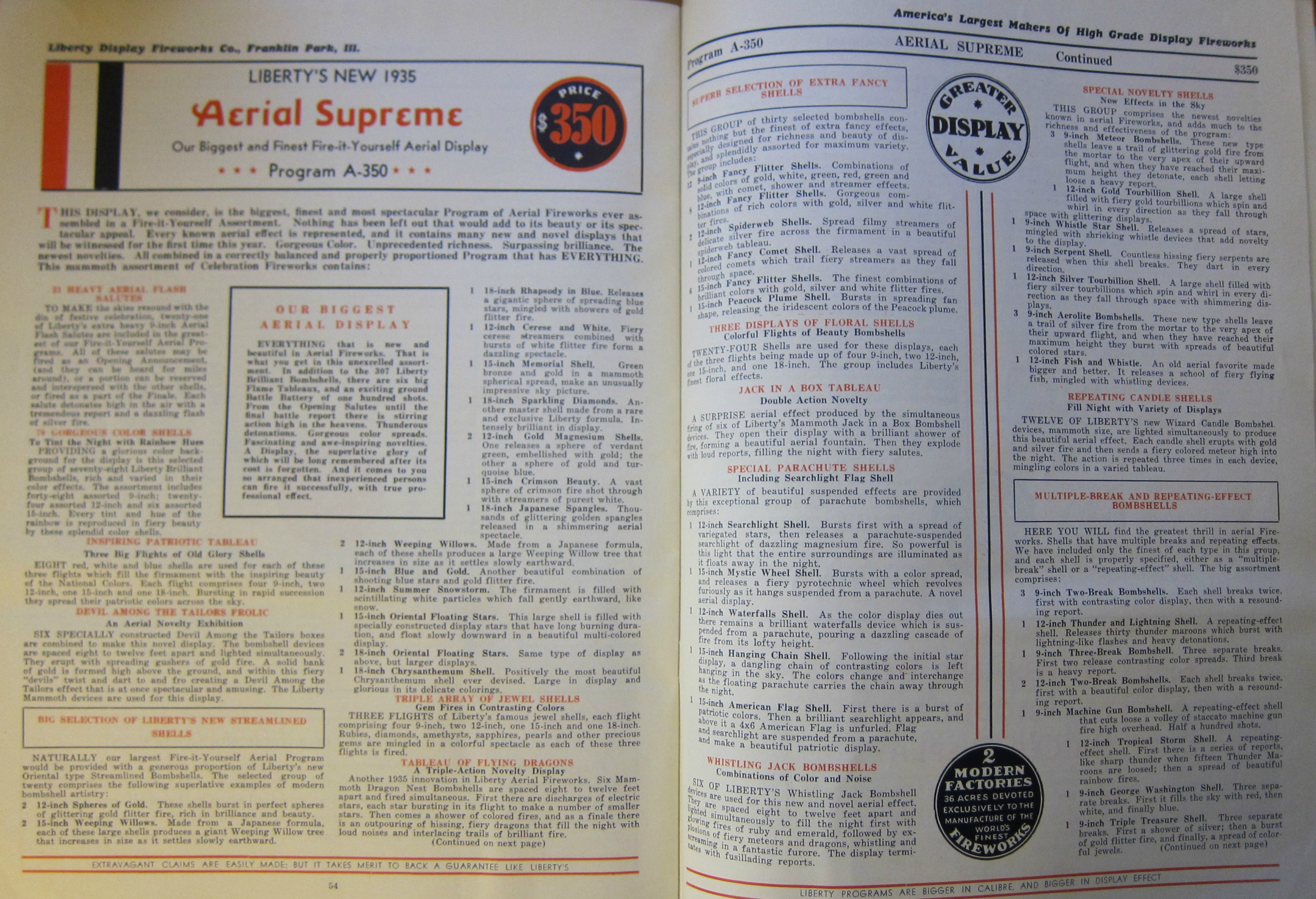
    What is particularly striking about the catalog, aside from its terrific visual elements, are the names given to the fireworks–they are artistic, literary, mythological.  No “brainbusters” or “Finger Splinters” here. Some of the names include Cleopatra’s Jewels, the Victor Jerome Battle in the Clouds Shell, Flight of Egyptians Repeating Bombshells, Spiderweb Comet, the Arenic Festival of Flowers, Devil Among the Tailors, the Palmetto Fountain, Selma Lee Shell of Shells, Sparkling Diamonds and the Sparkling Diamond Merry-Go-Round, Temple of Isis, the Mammoth Devil Wheel, Prismatic Devil Wheels, Whistling Jack Bombshells, Messengers to Starlands, Radio Flash Rockets, Ceylon Rubies, Fish and Whistle, the End of the Rainbow, and my favorite: The End of the World.

    Fireworks _c_

    Funny thing is that they do sort of describe the effect of the fireworks.  I thought that I might learn something of the social under- or over-currents by having a peek at the names, but there was little of that:  several FDR displays are sprinkled around the catalog, a couple of special radio-related items, but really, that’s about all.  No insights there.  No  “Honey I’m Going to Catch the Danvillle Train and Get Me Some Dough” or “Brother Can You Spare a Dime” displays; who wants to be reminded of the not-so-nice when celebrating something with gigantic loud colorful controlled explosions?

    Fireworks _b_

    No. The surprising element was the naming of the explosions.  And naming explosions goes back quite a way in the history of military affairs, not that I really know anything about that–I do have photographs of French soldiers decorating their 15-inch shells with messages to the Germans in 1918, and there’s no end to the images of American soldiers writing/naming their bomb-to-be-delivered to whomever it was we were blasting.  But they weren’t quite in this Liberty Catalog arena of fresh literariness, though the more-modern military epigrams were more pithy, and drenched in their own sea of color. (This of course is Slim Pickens as he climbs aboard a thermonuclear device, nearly ready to buckaroo it down to its destination; the other device I think was called “Dear John”.) The atomic device at Trinity was decorated with scribble, but I’m not sure that any of the photos were ever clear enough to reveal the sentiments.
    Slim_picken_nuclear_2
       The U.S. government had names for every one of their test shots of nuclear devices, though none approached anything like a creative caliber:  Able, Baker, Prisiclla, Operation Plumbbob (yes, there is a double b), Thunderwell, Smoky, Diablo….pretty ordinary.  The government did wake itself up to use some scientific-biographical names for some of the tests in the Plumbbob Operation:  Franklin, Kepler, Pascal, Stokes, Galileo, Doppler, Fizeau (!), and Newton.  I think that only Sir Isaac would’ve been pleased with this honor.   Maybe Franklin.