JF Ptak Science Books LLC Post 299
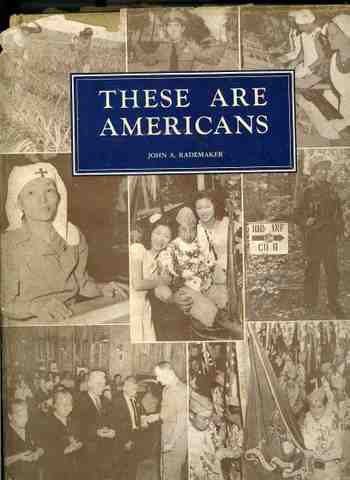
For another project of mine I’ve been reading about the
Japanese internment camps (posting an earlier post here), and just started to
read some post war material on the interpretation of those actions. The first book I turned to is regarded as a
liberal (in the classic sense of the word) regard and homage to the Japanese in
the Hawaiian Islands by John Adrian Rademaker, (a Professor of Sociology at the
published These Are Americans: The Japanese Americans in Hawaii During
World War II . It documents the
contributions made to the war effort by of people of Japanese ancestry living
in
Victory Volunteers, the 100th Infantry Battalion, and the 442nd RCT, and so far
as I can determine is one of the earliest pioneering works to attempt to right
the significant wrong done to these people.
and I’m sure that I never actually read the thing., But this time I, I did, and I was stopped
almost immediately, half-way through the first sentence.
“During World War II, I was one of a considerable number of
persons who were directly concerned with the care and re-establishment of the Japanese Americans in the continental
this book are laudatory and informative and attempt to right the public opinion
wrongs of the wartime Japanese-American persona. But “care and re-establishment” is awful and
weird, and stupid—so much so I wonder if the phraselet was stuck in there by
some zealot editor. Removing 110,000
Americans from their lives and residences and families and communities and
businesses, stripping them ¾ of whom
were American citizens) of their rights, forcing them to sell whatever they
couldn’t carry at fire sale prices, and then sticking them all in horse stalls
or deeply removed and very difficult locations for three years is disgustingly-not
“care and re-establishment”.
case then he really didn’t understand what happened to those 110,000 people, sociologist
or not; or at least didn’t get it in 1951.
in
citizens/ Rademaker points out that 1,440
Americans of Japanese Ancestry (AJA) who were detained by local authorities (excluding
Federal efforts) out of a population of over 150,000 AJA in
and Nisei (born in the
From
picked up by the authorities. This constituted nine-tenths of one percent of
the AJAs in
Nisei. Nearly half of this number were
released after preliminary hearings, with the rest being “kept” for other
reasons, though they were simply community leaders (doctors, nurses, school teachers,
benign) and that sort of thing. He
states that no AJA in
committed any sabotage whatsoever.
I’m just pointing out how odd this
first sentence is in the face of the rest of the book. Was it meant to diminish the American government’s
actions in rounding up and removing these people? (The government has had a very long history
of doing exactly this, and doing it deathly well—just look at the hundreds of Indian “removals”, the entire
institution of slavery, and many, many others, up to and including to a lesser
degree the displacement of Katrina refugees.) Arrest and disappearing people is
not “care and re-establishment”, period.
For the record, another truly
measurable aspect of AJA fortitude is their military participation during WWII
which stands as follows (presenting the 100 Battalion of the 442 and then the
442 as a unit):
The 100th Battalion and 442nd Combat
team:
Killed in action 569.
Died of wounds 81.
Missing in action 67.
Wounded in action 3,506.
Injured in action 177.
Total casualties 4,120.
The 100th Battalion and the 442nd
Combat Team won the following decorations:
1 Medal of Honor
1 Medal of Honor
47 Distinguished Service Cross
1 Distinguished Service Medal
12 Oak Leaf Cluster to Silver Star
350 Silver Star
18 Legion of Merit
16 Soldier’s Medal
41 Oak Leaf Cluster-to Bronze Star Medal
823 Bronze Star Medal
1 Air Medal
500 Oak Leaf Cluster to Purple Heart Medal
3600 Purple Heart Medal
2 Army Commendation Ribbon
40 Army Commendation
87 Division Commendation
1 brigade Commendation
12 Croix De Guerre (French)
2 Palm to Croix De Guerre (French)
2 Croce Al Merito Di Guerra (Italilan)
2 Medaglia De Bronzo Al Valor Militare (Italian)
Overall the 442—composed entirely of Japanese Americans, emerged
as the most decorated combat unit of its size in the history of the United
States Army —suffered an “unprecedented casualty rate of 314 percent and
received over 18,000 individual decorations. Many were awarded after their
deaths for bravery and courage in the field of battle. Among the decorations
received by the 100th/442nd soldiers were one Medal of Honor, 52
Distinguished Service Crosses, 560 Silver Stars, 28 Oak Leaf Clusters to the
Silver Star, 4,000 Bronze Stars and 1,200 Oak Leaf Clusters to the Bronze Star
and, perhaps most telling of the sacrifices made by these gallant soldiers,
9,486 Purple Hearts.” The 442nd Combat
Infantry group emerged as the most decorated combat unit of its size in the
history of the United States Army.