A Daily History of Holes, Dots, Lines, Science, History, Math, Physics, Art, the Unintentional Absurd, Architecture, Maps, Data Visualization, Blank and Missing Things, and so on. |1.6 million words, 7500 images, 4.9 million hits| Press & appearances in The Times, Le Figaro, Mensa, The Economist, The Guardian, Discovery News, Slate, Le Monde, Sci American Blogs, Le Pont, and many other places… 5000+ total posts since 2008.

Category: Naming Things

  • An Unkindness of Ravens; a Murder of Crows. Naming Things.

    JF Ptak Science Books LLC  Post 690  Blog Bookstore

    Names given the collectives or gatherings or units of animals are useful and
    informative, and occasionally fabulous and bizarre.  It seems to me that such characterizations could
    be made with people as well,  Why should
    humans have such a uniform label for collective employment members (a “group”
    of lawyers, a “gathering” of architects, and so on) when animals have such a
    rich vocabulary to draw from?  Admitedly,
    animals don’t go out and get lawyers when they feel maligned by a broadly
    advanced descriptor, so there’s little chance that more appropriate upfittings
    could be applied to different job classifications.  Unless of course you consider the “managed
    corporate associate monetary inventorialist” (cashier) as an example—but that
    is not what I’m talking about. 

    In the animal world, for example, a group of gorillas is a simple “band”,
    chicks a “clutch”, and quail a “covey”, which is simple enough.  The names get more adventurous as things
    progress in the food chain:  hippos are a
    “bloat”, a word which seems to identify a characteristic of the animal,
    especially when they’re half-submerged, watching the sun move across the sky
    with their eyes just above the waterline.. 
    Ferrets are a “business”, semi-inscrutable in their nervous activity. Hyenas
    are a “cackle”, hawks are a “boil” and finches are a “charm”.

    A group of rhinos are beautifully referred to as a “crash”, and squirrels
    are poetically announced as a “scurry”

    Perhaps the second greatest of all of these names is that for a gathering of
    crows, called a “murder”.  It is probably
    the crow which, among all animals, may be the only one “smart” enough to commit
    the crime—it is an undoubtedly intelligent animal, with a brain-to-body mass
    ratio third to that of humans (behind apes) and have been shown to work in
    concert with one another toward a common end, and have also used tools in the
    pursuit of food.  They have also been
    depicted for thousands of years in mythology and story as intelligent, crafty
    creatures.  My choice for the most
    fabulously-named:  an “unkindness” of
    ravens.   These birds enjoy a similar
    heritage to the crow, but have a greater literary heritage.  Unkindness and Poe seem to go together quite
    nicely. 

    A leap of leopards, a gulp of cormorants, a romp of otters, a parliament of
    owls.  An ostentation of peacocks, a
    prickle of porcupines, a stand of flamingoes, a pride of lions, a wake of buzzards,
    a tower of giraffes: all seem to fit quite nicely. 

    What would the human equivalent be?   A “grotesque” or a “provident” of attorneys,  a “shushing” or “shepherding” of librarians, a “scribble” or “release” of writers, an “envy” or “relief” of actors?  I think it needs to be Latin and deep for the politicians.  Very deep. 

    (A directory of names follows in the continued reading section)

    ·Posted by :

    ·in:


  • First and Early Impressions: Hitler, Mass Production and the Use of the Long View

    JF Ptak Science Books LLC  Post 666

    Harold, like the rest of us, had many impressions which saved him the trouble of distinct ideas  George Eliot.

    A novel is balanced between a few true impressions and the multitude of false ones that make up most of what we call life.
    Saul Bellow

    First (and other early) impressions get made once, for the very first time, and then re-invented, re-examined every time after that, especially as the first impressions start to age and get forgotten, slipping around the windsock of time.  But every so often these antique first impressions come back onto the playing field, and it is remarkable, really, what lessons can be learned of them. 

    A review of a very early biography of Adolph Hitler appeared in the pages of The Illustrated London News for 27 August 1932—this was the year before Hitler assumed formal control of the government and nine years after he began his rise to power.  The book was Hitler, by Emil Lengyel, published by Routledge in 1932; it is the subject of a very sharp-eyed review by “C.K.A” in the pages of the ILN. It was also reviewed so to speak by the Nazi leadership, which ordered that Lengyel (1898-1985) be picked up and disappeared at any early opportunity for being an enemy of the state.  Some of the interesting bits that the reviewer pulled from the Lengyel book include the following—I’ve included several here because of his particular and early insight):

    “There are no limits, however, fantastic, to which this fanaticism will not go; though what the Jews have done to Germany to deserve this frantic vendetta remains obscure.

    “It is almost incredible to Englishmen that this barbaric mania (Jew hating) should be erected to the position of a fundamental political tenet…”

    “Some of the Party principle are Olympic in their sweep and scope.  Thus:” “offenders against the interests of the community, usurers, profiteers, etc., are to be punished with death…” Much virtue in your ‘etc.”!

    “Behind all stand the emotional political impulses—repudiation of war-debts, hatred of France, hostility to the League of Nations, fanatical exaltations of race,…All this was to be expected…it is not too much to say that by the Treaty of Versailles the allies brought the Nazi movement upon themselves. The marvel is that it has been so long postponed.”

    “What Hitler’s flag stands for he has never revealed beyond irresponsible generalizations and decrepit platitudes…”

    “(On Lengyel’s Hitler):  He is a vox et praterea nihil—a shallow, paltry, neurotic person, with no constructive ability, a woodly intelligence, and little to comment except glibness and passionate prejudice. This is difficult to believe but by no means impossible.”

    “It may well be…that Hitler the man is as empty as his absurd Swastika”.
    Blog==june 26--1st impression

    The Yellow Spot, The Extermination of the Jews in Germany (1936) was the earliest printed document on the coming of the Nazi Holocaust, the earliest
    catalog on the mistreatment and systematic dehumanization of the Jews, and the
    earliest book to associate “extermination” with Nazis and the Jewish people. (The “yellow spot” part coming from the early history of racially marking Jews–it appeared first it seems in the 11th century in Islamic lands and then used periodically around Europe and the middle east for hundreds of years afterwards.  Using the Star/Shield of David seems  be a 20th century invention.)  It was also one of the earliest books on Hitler and what he represented.  (My friend Andy Moursund has published a very
    compelling poster on the early books regarding Hitler and Nazism and can be
    seen here.)  Another sort of first
    impression that makes it mark is a series of pictures by the great Margaret
    Bourke-White (who seems to have been everywhere from the Depression to the
    Korean War and wrote and photographed what she saw brilliantly) made at the
    Buchenwald Deathcamp just after liberation. 
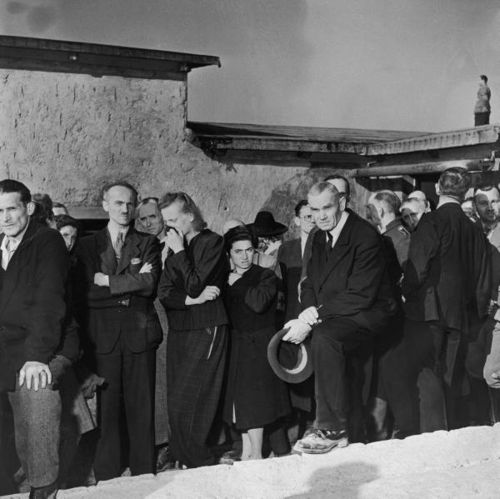
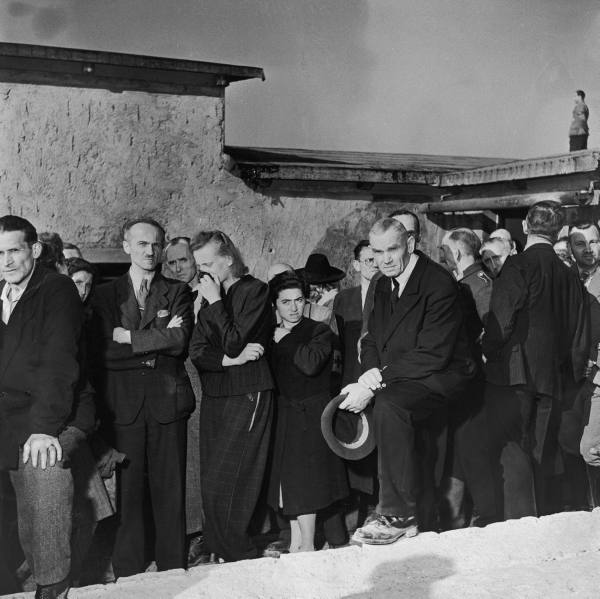
    She did make photographs of the horrors of the place, but she also turned
    the camera around to record the faces of the locals who were forced to tour
    and view the camp in their communal midst. You can see very clearly in the
    faces of these people—for whom Blog==june 28 chaplinthe camp could not have been a mystery unless it was internalized so—how much they wanted to not see what they were looking at.

     

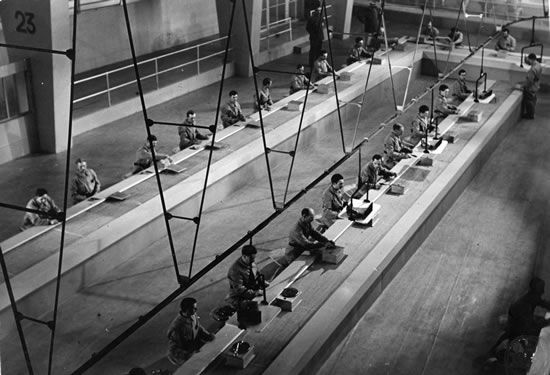
     And speaking of Hitler, Henry Ford’s contribution to the
    ethos of the American standardization and robotization of the workforce—the industrial
    production line—was well portrayed in the first cinematic appreciations of the
    idea.  (Writers had long since made
    observations on the evils of industry and society, going back at least as far
    as Charles Dickens—but its representation in the most democratic medium of the
    first half of the last century–the movies–received it first treatments in two strong
    impressions in the 1930’s.  The film that
    comes quickest to mind is Charlie Chaplin’s still-brilliant and
    still-applicable Modern Times (1936,
    though originally named The Masses)—a
    dire film (in one place dissolving sheep entering a slaughterhouse with a scene
    of workers entering a factory) that offered no solution to the factory.  Aldous Huxley wrote about the sickness of
    production in his Brave New World (1932)
    which is even scarier in its own right—though the scary image of the future
    delivered with the dark humor of Chaplin is tough to surpass—if for no other
    reason than it winds up discussing the “principle of mass production applied to
    biology”.  But earlier still is the
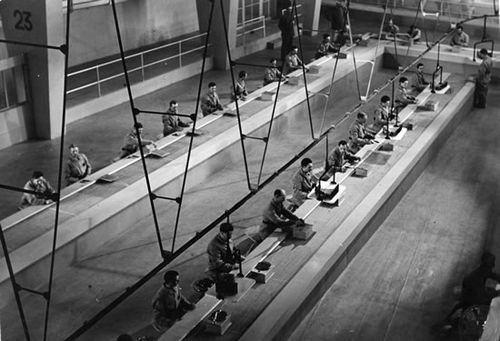
    little-seen film by Rene Clair (1931) A
    nous la libertie
    (Give Us Liberty/Freedom),
    which presents the mass production system as a thin metaphor for a prison labor
    system.  (Upton Sinclair said that the
    Ford assembly plants should be presented in “Museums of Unnatural History”.)
    Blog==jine 28 clair This really is an endless and mammoth subject as what I’m
    talking about is a history of perception, and all I’ve done here really is to
    draw a few things together that I have within reach.  It seems an interesting pursuit, following the
    threads of thought regarding early impressions of major (and minor) events, and
    one could easily construct a large Borgesian encyclopedia of them.  Check under “C”, for cable, for example:  the physicist Jacques Babinet thought it
    impractical and far too expensive to construct a communication line under the Atlantic ocean (as did many others, seeing the starts and
    fits of the various cable companies that were begun to try to capitalize the
    operation.  The cable business barely had
    a heartbeat, at times, in the mid-century even. 
    And speaking of heartbeats, William Harvey withstood blistering attacks
    on his correct statements on the circulation of the blood (costing him nearly
    all the patients in his practice). 
    Though at least Harvey
    lived to see a brighter day:  Michel
    Servetus, on the other hand, didn’t, and was burned at the stake for his heresies,
    one of which was the centering of the circulation of the blood in the heart
    rather than the brain.  The list goes on
    and on:  Semmelweis was killed but did
    wind up ion an asylum; Galileo didn’t wind up in an asylum but did wind up
    imprisoned; Copernicus wound up in neither place, escaping possible clerical
    criticisms by dying just as his revolutionary work was published.  Phillippe Lebon’s ideas for illumination by
    gas were seen as ridiculous, as were the revolutionary ideas of Edward Jenner
    and Luigi Galvani.  Einstein’s 1905 ideas
    weren’t happily received in France
    for a decade, and David Hilbert’s impressions of mathematics in the middle of
    the third decade of the 20th century was that it was “done”.  (Actually the young Einstein was also
    cautioned about going into physics because that field was seen as pretty much “completed”.)
      There was of course the other side of
    the impressions coin to all that I’ve mentioned above—for example, the resistance
    to Copernicus was not actually  as
    fearful as we think of it today, most thinking people were ready for it and
    were relieved with his 1543 publication.  The idea of looking at first impressions may actually have some utility in seeing how we view new things in our contemporary culture–or at least it would give us the sense of wideness and of the future, and to be at least circumspect about newness. 

    *A note on the production technology using interchangeable parts–this idea really did have its seat in  American industry. Colt’s “system of manufacturing” (c. 1851), Charles Tomlinson’s
    1853 Rudimentary Treatise on the Construction of Locks, rifle manufacturing at
    the Springfield Armory in the early 1850’s,  Eli Whitney and the cotton gin, Singer Sewing
    Machines,  (ca. 1865) phonograph machines
    produced on conveyors by Thomas Edison, and so on, till you get to Ford’s own
    Highland Park Factory around 1913.  All are indicators of this sort of conveyor belt, standardized parts, interchangeable units that marks this brand of manufacture. For an early, interesting reading see Charles Fitch’s “Report
    on the Manufacture of Interchangeable Mechanism” (1881)  as part of one of the reports of the massive
    overall report of the Tenth U.S. Census,
    and also  “The Rise of the Mechanical Ideal”
    in the Magazine of American History
    (1884)

  • What Things Are Not Department: Freeing Sex from Sin in A. Niphus, 1549

    JF Ptak Science Books LLC    Post 652   Blog Bookstore

    Blog--jun 15--love I suppose that one could write about virtually anything in
    terms of what that subject is not:  everything
    that is tangibly matter or energy could be something else, and everything not
    (like shadows and thought) are the stuff of being what they are and aren’t at
    the same time. 

    In 1549 Augustinus Niphus wrote a beautiful, not-so-little
    work on the subjects of beauty and love. Niphus (or Agostino Nifo,
    or Niphus Suessanus, or Niphus
    and sometimes  Nyphus) was born in the Kingdom of Naples

    around 1473, and was around 55 or so when he died in
    1538-1540.  He was a philosopher and
    historian of medicine in the high-Renaissance sense, was a great Aristotlean
    and Averroist,  and proved to be an able
    antagonist to the Christian churches on the subject of the blessed
    interpretations of millennially-dead Aristotle. 
    There are some who claim that Niphus was a little incoherent on the
    subject of Aristotle because, well, he taught the corpus aristotlelicum at university—but Aristotle at this point in the
    Renaissance was incredibly deeply ingrained in the curricula of all
    universities all across Europe, and was opne of the great basics of education. There
    was no escape.

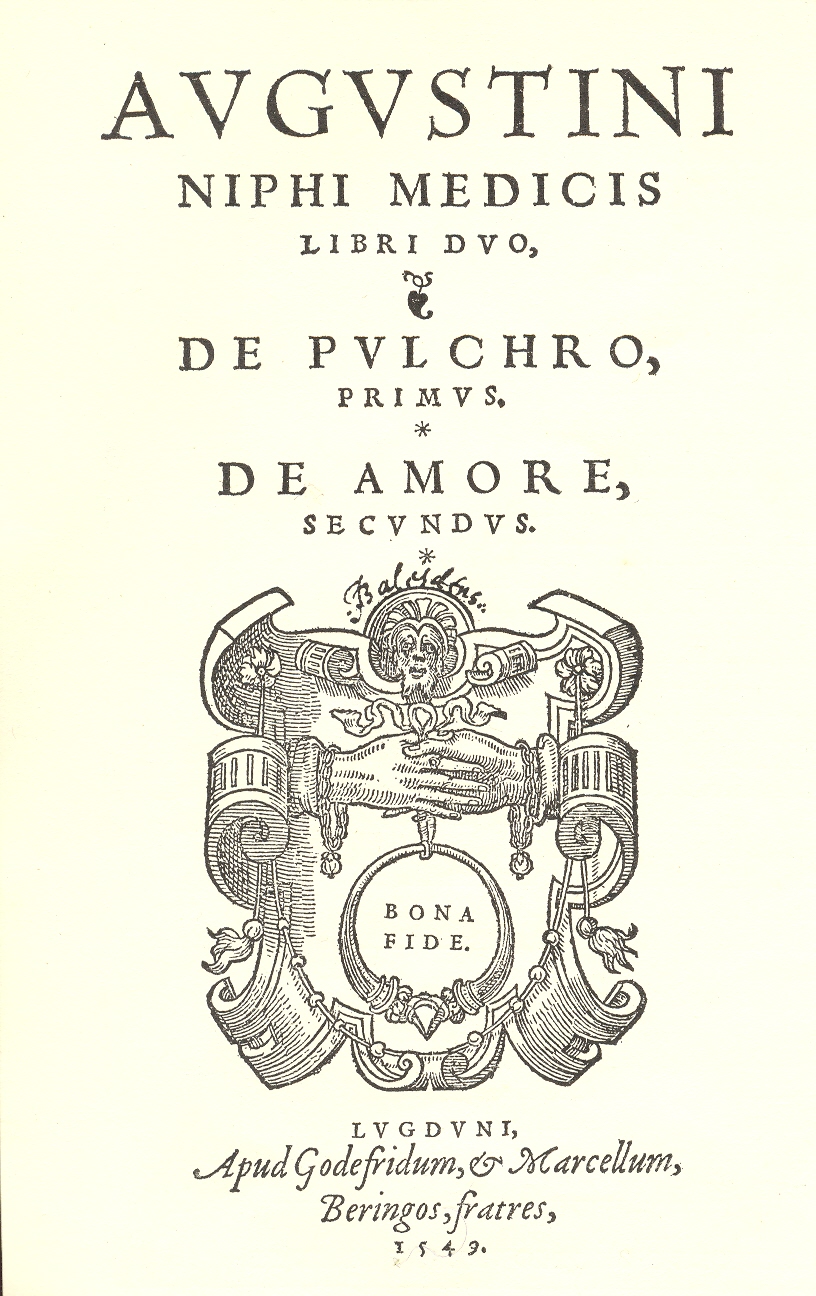
    But back to love.  Niphus’ Libri duo, de pulchero liber primus, de amore liber secundus was a
    277-page work printed at
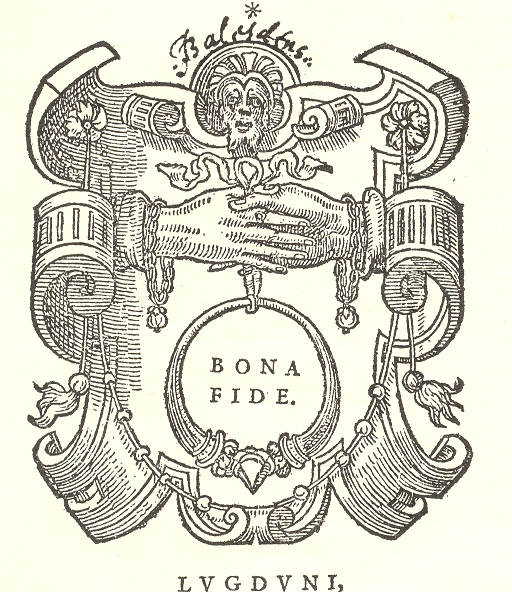
    Lyon (Latinized as “Lugduni”) by the Berigens.  The publishers also provided Niphuis with a
    beautiful title-page device showing the joing on hands under the watchful eyes
    of Christ, a love signified with an emblem announcing “bona fide”.  The book was about beauty (“pulchero”) and
    love (“amore”).  The first part of the
    two books deals with all levels of beauty and shows derivations on the subject
    from the most ancient philosophers./  The
    second part, on love, begins innocently enough on the philosophical and moral
    aspects of the emotion and institution, but then goes further, treating love in
    all of its aspects, including psychological and physical.  It is an enormously full treatment of the physiological
    side of sex, which was something that just wasn’t often encountered at this time.  

    Blog--jun 15--love det

    The main contribution of
    Niphus on love/sex was this—humans have a certain psychological and physiological
    disposition to sex, and how sex could not be considered sinful.  Not content with controlling the poor
    believing people’s thoughts with fear of eternal damnation, the church reached
    right into the very bedroom, specifying that sex was sinful, an abomination,
    dirty, laced with the potential of Satan himself, if not used for the purposes
    of procreation.  All other fruit was
    forbidden under dire threat of the
    Lake of Fire.  (And still
    is:  driving to the bagel store
    yesterday, Sunday morning, I tuned the radio to one of the preaching shows—an easy
    thing to do and sort of hard-to-miss on Sundays as I live in the Bible belt—and
    someone was railing away at “Satan’s fornicators”, which was “the basis of the
    Original Sin”, and on and on.  I don’t
    know how he got to the Original Sin part because the bagel shop is only a
    5-minute drive.) So the case made by Niphus was not popular in the minds of the
    social controllers—who knows what structurally-threatening powers might be
    unleashed in the libidinously un-hellish enjoyments of two people?

    I found this illustration in an old E.P. Goldschmidt (bookseller) catalog, and the old bookseller recognized the medical value of the work and wondered aloud why it hasn’t turned up in the major medical book collections.  I wonder about that, too. Be that as it may, Niphus should really show up as one of the great educators on the function of sex, and to physiologically and psychologically announce that sex was not the sin the church would have you believe it was.  Perhaps in a way, too, Niphus was among the earliest of those to release woman from thousands of years of blame as the proprietesse of selfish Satanic fornication–at least with Niphus, if sex were to be insisted upon as being a sin, there is the possibility of having two actors in the process, rather than having woman carry the blame for the entirety of the sin.

    ·Posted by :

    ·in:

    — —

  • Redefining “the Present”: Bitter Bierce, James Joyce and H.G. Wells

    I do not define time, space, place and motion, as being well known to all.  Isaac Newton, Principia, 1687

    Books--burgess I had some lingering thoughts about my post from two days ago which briefly touched on Joyce’s dreamy Finnegan’s Wake (published in 1939, just two years before the author’s death), which led me to the language-creating, never-endingness of one day in his Ulysses* (1922).  It is also a novel of time, reprocessing its time-units lile old Zeno, finding halves of time in regressive size and in greater numbers, roiling around like fly-swatted mercury; we never do get to the bottom of time although it does slow it down considerably.  It follows a slight but powerful literary history, treating time somewhat like the earlier (earliest?) Poe, and especially like that clock ticking in Dostoyevsky’s Crime and Punishment (1866), where action is laid bar to exhaustive and minute interpretation, waiting for no person. 

    A little later on comes Ambrose (“Bitter”) Bierce, a crummudeonly misanthrope with a razor eye for criticism for everything beyond himself.  My guess is that every other person in the U.S. past the age of 30 has read his Alabama-based “An Occurence at Owl Creek Bridge” (1893) in which a lifetime or so could be lived in the moment that it takes for a man killed by hanging. (I have a feeling that this was a very apt way for Bierce to look at his own life, right up to the moment where he rode into infinity in the Mexican desert.)  The prgoression of time is interrupted to tell the tale, everything taking place in the time that it takes to travel eight feet. What I didn’t know when I read the story for the first time was how unusual, groundbreaking, it was for the distortion of time in this way in literature.  Monet and Impressionism Inc.  were at it for a little from the 1860’s or so, but it seems to me that in literature this fracturing of time was pretty scarce.

    These authors were performing experiments with the vast horizon of time, creating a new space in the very slim spectrum that we call the “present”.  In another way, Proust’s Remembrance of Things Past explores past action in a way that redefines what we can think of as a “normal” present.  Looking forward, too, can have a pulling effect on the present, as we can see in the novels of the future by Jules Verne and H.G. Wells. 

    Time in physics is the orders-of-magnitude incendiary to this discussion–it is the fundamental, measurable scalar unit from which stuff like motion  and energy and fields are derived. Things get really interesting in the history of science once you move through Galileo and Newton and Maxwell and get to the time of Planck and Einstein and Minkowski .  Interestingly, the most significant changes occurring in the treatment of time and the definition of the present come in the period from 1865-1915–a particularly fertile period of revolution and modernity, where nearly every discipline undergoes a radical, fundamental change. Everything except political studies, where the only really new thing to come into the fray at that time was the introduction of the concentration camp during the Boer War.  Everything else changes in remarkable ways:  physics, mathematics, art, music, literature, theater, dance.  Astonishing. SpongeBob-SquarePants-AM-FM_F43403B5

    If I was really clever I would find a way for this post to be circuitous, but I can’t, so I’ll just end by saying that I’m out of time.  

    *I’ve included the first lines of the Joyce novels in the continued reading section, along with a few choice others. 

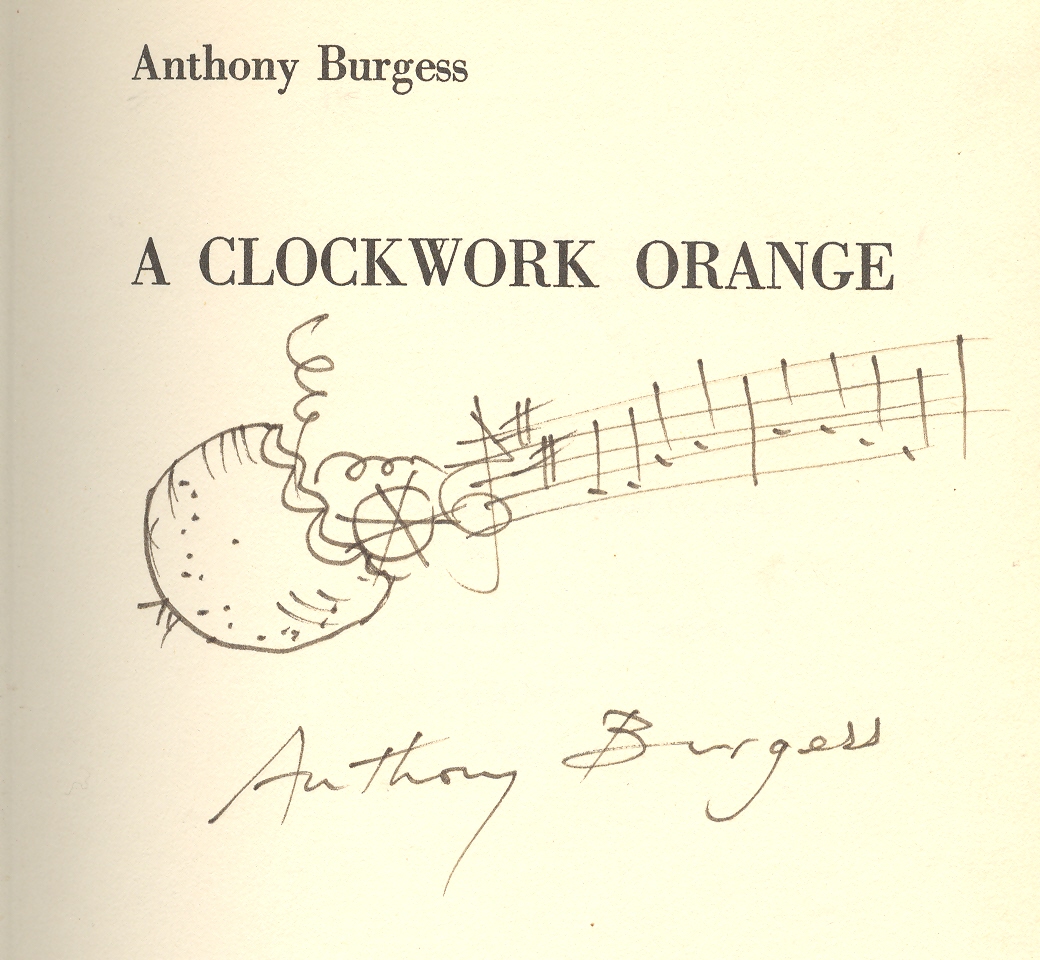
    **For several years in the early 1980’s I read all of Anthony Burgess’ novels, collecting them as well.  I always liked A Clockwork Orange for its dark humor and inventiveness, and for each of  the few times that I met Burgess I had a copy of the book for him to sign.  He was always very gracious, signing my books with appropriate flourishes–with music, or Arabic, or whatever was implied by the subject of the book. The exploding orange is far and away my favorite.


  • Darwin and Lincoln and the Emancipation of Thought

    JF Ptak Science Books LLC  Post 511


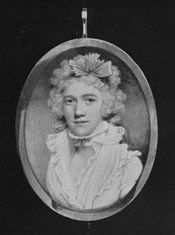
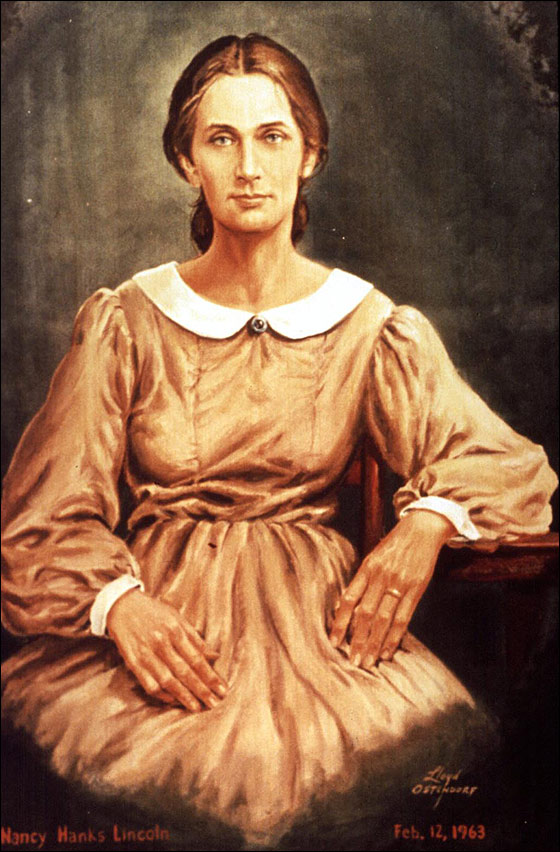
    0 blog feb 12 darwin mom Today is a much-loved day for Abraham Lincoln and Charles Darwin, born within a few hours of one another 200 years ago on this day in 1809.  I’m not so sure that we should celebrate them on their birth dates—it has always seemed a bit off to me; perhaps we should celebrate their mothers (Darwin’s left, Lincoln’s below) instead, leaving another date of importance/accomplishment for the celebration of the birthday boys.  Darwin would be an easier pick for this than Lincoln—23 November 1859 being the red-letter day, for the publication of his On the Origin of Species, which is also up for a big 150th anniversary this year.  The book was an instant best seller, selling out of the first printing almost immediately (at least for the publishing world of 1859) before going on to a life of its own, with five more editions being published before Darwin was finally sem0through with it (and that in the wake of at least a dozen other influential works to his credit).  Lincoln is harder in this respect—there’s Juneteenth, of course, but finding one particular day for his monumental and successful task of not letting the country fizzle away is a bit hazy; perhaps the day of his beautiful second inaugural address, or Gettysburg?  Dates like this would make their celebration much more specific, with a great idea in mind, rather than just a foggy celebration of a birth date celebrating the span of a big life.  (Also, we combine Lincoln and Washington into a Lincington Day, and barely recognize Darwin at all, unless we’re busy throwing him out of the schools [like, say, in Kansas] to better protect our children from the man with the big white beard.  Darwin, not god.)

    23 November seems like a good choice for Mr. Darwin.  He did write much else of course, but Natural Selection was his paramount idea.  As ideas go, in the entire history of ideas, it is about as good an idea as anyone has ever had—big, muscular, profound, explanative, correct.  (There are many big ideas that are harmful but whose idea-ness stretches/breaks the social fabric of societies:  the Big Lie, Slavery, Compound Interest, Inferiority, to name a few.  I’m not so sure about how good an idea heaven might be.) 
    0 blog feb 12 lincoln mom
    Darwin came to the idea of Natural Selection 20 years* or so before he actually published on it, though there was a chosen circle of friends and correspondents who formed a mesh through which Darwin passed some of his ideas.  Listen:  I heard a “science” report on NPR this morning talking about why it took “so long” for Darwin to actually publish.  And what the science commentator came up with—so far as I could listen—was something about a bubbling god/marriage/love/embarrassment/social debate curative, that Darwin was somehow saving his wife-to-be the retribution of society as Charles did away with the creator.  In this porridge of lint I see nothing.  Darwin didn’t publish because, for almost all of those years, he wasn’t ready; rather, the theory of natural selection wasn’t ready for presentation.  Darwin was still putting together the evidence for his case; and when he was ready, his case was superb.  He knew the implications of what he was saying, and he needed to have This Most Beautiful Theory ready, spending 20 years building a castle.  He was finally convinced/cajoled into writing a bit about it in 1858 with the young Alfred Russell Wallace (Charles Darwin and Alfred Russell Wallace “On the Tendency of Species to Form Varieties; and on the Perpetuation of Varieties and Species by Natural Means of Selection.”  Journal of the Proceedings of the Linnean Society, III, 9, (1858). —a man who like Darwin’s younger self aboard the Beagle in South America  made his way around the Malay Archipelago collecting, analyzing, theorizing, until he too came up, independently, with the theory of natural selection.   Priority in this case was not in question.

    Perhaps we should also recognize the people who were important to the development of the greatnesses of these two men.  Speaking to Darwin, there are many, but to make a few examples, we have Thomas Burnet (whose The Theory of the Earth, 1684-90 was the first critical investigation of the implications of geological change, and that in spite of his religiosity and biblical foundations).  James Parkinson’s  Organic Remains of a Former World, (1804-1811),  was an important interpretation of the fossil record albeit with an evolution in favor of god’s continuous actions.  Charles Lyell’s Principles of Geology was perhaps the greatest influence on Darwin’s thinking, the young Charles taking a copy of it aboard the Beagle (after being told by friend Henslow not to believe in the book) where it was studied and devoured, being scientifically introduced to the idea of actions over long periods of time. 

    Seldom mentioned in groups like this, though, is a great scientist and physician, the polymathic Hermann von Helmholtz.  This man is principally remembered for experimentally determining what was thought to be impossible—the rate at which the nerves in the body function, and as the inventor of the ophthalmoscope, and as a leading color theorist, and for major contributions to mathematics and physiology, and for his independent discovery of the conservation of energy, the second law of thermodynamics (On the Conservation of Force, 1847).  (This is a little problematic, as Joule and Mayer came up with the same thing at about the same time, but the 26-year-old physician figured it out at the same time on his own.) There is much else, but what concerns us here is his Darwin-related bit, an epochal discovery that Darwin must’ve known about—the discovery of the age of the sun, when the sun would expend all of its energy, and then, the age of the universe.  These were enormous ideas in 1854—that the impervious sun could actually have a life span, and that by extension so too could the earth and the universe writ large, and that the universe was on the order of hundreds of millions of years old (at least), were shocking revelations.  And Helmholtz was more correct than not, giving another verification of massive time that was so necessary to the function of natural selection. 

    And so I wish good tidings to Mrs. Darwin (Wedgewood), Mrs. Lincoln (Hanks), Alfred Wallace, Charles Lyell, Thomas Burton, and  James Parkinson—and also of course to Abraham Lincoln and Charles Darwin.

    _______

    *Darwin was undoubtedly an evolutionist by 1837, and probably earlier.  As Francis Darwin points out that this date may be as early as 1832, pointing out that Darwin, in his Autobiography, wrote:

    “During the voyage of the Beagle I had been deeply impressed by discovering in the Pampean formation great fossil animals covered with armour like that on the existing armadillos; secondly, by the manner in which closely allied animals replace one another in proceeding southward over the Continent; and thirdly, by the South American character of most of the productions of the Galapagos archipelago, and more especially by the manner in which they differ slightly on each island of the group; none of the islands appearing to be very ancient in a geological sense. It was evident that such facts as these, as well as many others, could only be explained on the supposition that species gradually become modified; and the subject haunted me.”

    ·Posted by :

    ·in:

    —

  • Things that Are and Aren’t Dept: the Names of Colors


    JF Ptak Science Books                                          Part of the series Naming Things

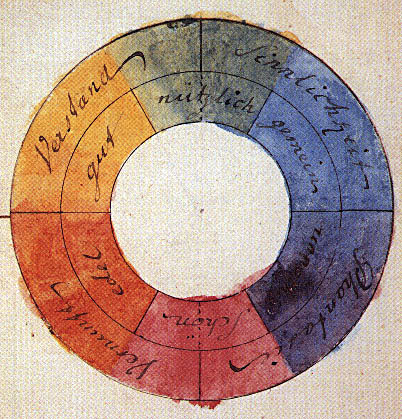
    GoetheFarbkreis

    (Almost) in the beginning were monsters.  The epic battle that Moses wages early on is not with Pharaohs, but with the dragon(s?) that the creator itself had fought on the opening whisper of creation (Book of Job 26:12, Psalms 89:10) and who would again meet at the very last bits of the closing days.  Behemoth, Leviathan, Rehab may all well have been monsters to these ancient folks, but they very well might look like rhinoceros or crocs or hippos to us.  Monster demons like Rehab (Psalm 87:4), a slaughtering beast who would be reintroduced to a different part of the world as Tiamar who would or could also be known as the Red Sea,  lifted straight from Mesopotamian mythology and placed directly into that of the Old Testament among the rest of the borrowed stories and beliefs, a problem by any other name.

    Following names and their cyclonic twists, and absences and sudden  re-emergence through the history of storytelling is dizzying—just consult your Robert Graves on myths  if you want to have  your memory plumbed (the great poet and writer doing not such a poetical or writerly job in this effort in my opinion though most people love it).  Keeping an eye on the mix and mash of gods and goddess and associated super beings from thousands of years ago, the god of the Old Testament makes it very clear and precise about just who he is in his self-introduction to Moses:  “I am the God thy Father, the God of  Abraham, the God of Isaac, and the God of Jacob” (Exodus 3:6)

    Equally almost in the beginning, again so far as the Bible is concerned, are colors—before that maybe everything was black and white, or just white, or maybe just black, depending on your epistemological concept of everythingness or nothingness.  (It looks like green may be the first color mentioned in the bible, (Gen 1:30 And to every beast of the earth, and to every fowl of the air, and to every thing that creepeth upon the earth, wherein there is life, I have given every green herb for meat: and it was so) though the mixing up of meat and veggie is a little confusing to me.))

    Over the years color names themselves have creepethed among themselves like a vocabularic ocean, a fluid dynamic of naming.  Names have flowed across their individual spectra, some names sticking, some not; the originator of the concept of the naming of “red”, the original namer of the color, lost to the earliest and deepest part f the collective human memory.

    I don’t know where many of the names of colors come from, or why.  Index to Color Names and Color Numbers of the Standard and Season Color Cards of America (published and created by the Textile Color Card Association), and published in 1923, is filled with color names whose meaning and origin are a mystery and whose necessity seem to hinge on sunspots.  Which is fine, though it might be interesting to have had color names more dependent on that which went before. Like the names of the streets on most of Connecticut Avenue in D.C. are alphabetical, and once the first 26 letters or so are monosyllabicly employed, the second set starts with two syllables, and then three.  It is a system that usefully indicates where long the long avenue you might be. It might be useful to employ such a method in color names; or not. 

    And I suspect it would be “or not”, unless the poetry and art and music inherent in these formulations would be imaginatively employed

    But on to the color names:  Ambulance, Basketball, Bosom,  Cowboy,  Squirrel, Chit, Old, Nymph, Old mephisto, Pelt, Racket are examples of some of the mystery colors.                             

    Some names which were part of institutionalized racism I’m sure are now gone:  Arab, Negro, African; Bagdahd (?), Bombay Brown,  Coolie Yellow, Coolie, Congo Brown, Egyptian Husk, Hankow (yellow), Kyoto Yellow, Korea Yellow, Mandarin Yellow, Punjab Brown, Kafir, Tar Baby.

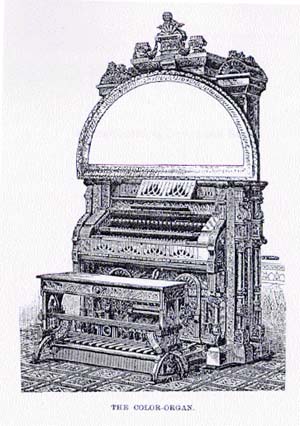
    Colororgan But I’ve got to say, even though the names may not have much to do with the colors, most of the names in the pamphlet sound quite lovely, and many are yummy: London Smoke, Log Cabin, Leadville, Madonna, Naked, Pitchpine, Pompeii, Prelate, Smoked Pearl, Swamp, Lucky Stone, to name a few. Overall I doubt that this is what Newton, Goethe, Chevreul, Rood, Maxwell and the rest had in mind when they were figuring out what color *is*, but I do think that all of them had large enough poetic natures (Newton the weakest and Goethe by far the strongest) to appreciate the occasional beauty of naming.  The unbelievable Shakespeare seems not to have spent that much time on color (so far as I know, and I don;’t much about the Bard), but (in a dear-sweet-god understatement) other people did:  people like Richard Feynman synesthesically thought in mathematical color terms, others created musical  instruments which would produce color from music while most of the rest of the world produced music which conveyed color, and on and on.  And then of course there’s the whole world of art.

    But I won’t go there now–I just wanted to follow this loose thread in what seemed to be a pretty inert pamphlet–in the end it opened itself to a lot of possibilities with just a little thinking. 


  • A History of Dots, Periods & Points, Part I: Descartes and a Year-Ending Post

    JF Ptak Science BookS   Post 450

    In closing out my first year of blogging [2008], I’d like to take an incidental look at one of our language’s most important fragments.  Like Mr. Eliot’s observations of Baudelaire being a fragmentary Dante, and like the brilliantly arranged frammenti of Piranesi, the great bits of our communication processes owe a breathy thanks to the lowly period.  A dot.  A point.  It separates to provide analysis and coherent recognition of thought. 

    0 blog dec 31 descartes330

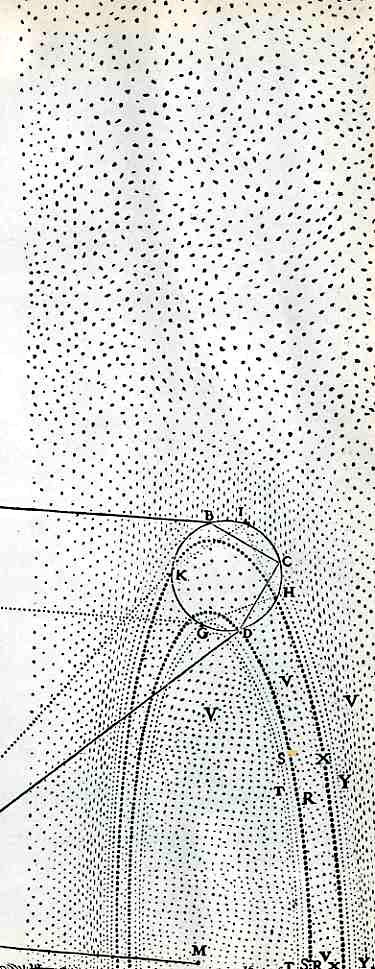
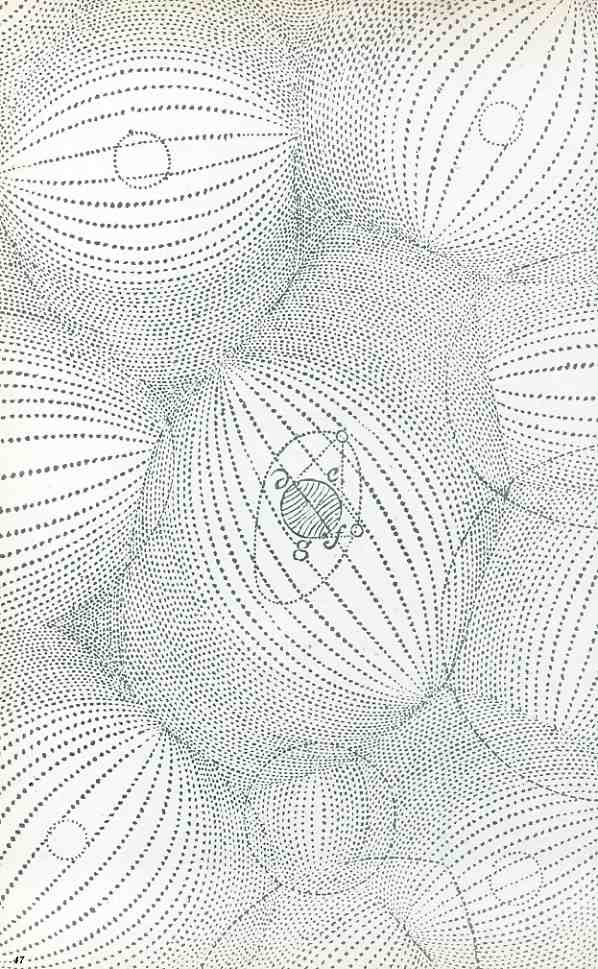
    A simple dot.  (.)  But dots are as little or as big as you need:  there’s “Little Dot” (the cartoon character of Harvey Comics, created 1947, who was fascinated bylines and dots and dashes), “Admiral Dot”, polka dots, Mama Dots.  Dots get considerably ratcheted up in quantum dots, and then expanded beyond that with the idea of the dot as an abbreviation for the multiplication sign, both of which increase things rather than bringing them to an end, a conclusion.  The dot used after a musical note delineates that there is an increase in time by half, which would be an interesting notation to adopt in literature, if we were somehow able to magnify and increase that which would normally have been ended by the same notation.

    Dots have formed the background to some of the most significant scientific illustrations of all time, like these two images, the first of which Descartes’ illustration of the decomposition of the rainbow, found in his Dioptrics, a fabulously important illustration. The second is from Descartes’ Principia Philosophiae (1684) which display his theory of vortices, accommodating an idea of physics eliminating atoms and vacuums and joining matter and space, matter being constantly deflected from moving in a straight line, moving in vortices.  Then of course there’s the fantastically appreciated advancement of Samuel Morse’s telegraphic instrument and his abbreviated transmitting alphabet (his “code”), which fascilitated the distribution of information in the 1840’s  in the same sort of way that the internet increased the flow and ease of data in the 1990’s. (Actually that’s only half correct for Morse, as his was a system of dots and dashes.)

    0 blog dec 31 descartes331


    Things get more interesting if we expand the idea of the “dot” to a “point”, as just about everything we have discussed in math for thousands of years has been based upon the idea of a “point in space”, forming the bits of the coat hanger on which the whole fabric of the heavens has been hung.  Going the other way, there’s the decimal point, which brings us to negative powers of ten, into smaller and smaller worlds, to the incomprehensibly small, showing that “nothing” probably doesn’t exist. (We’ll leave the idea of “spot” alone, tonight.)

    That’s quite a bit of expansion from a word that starts out life in Middle English as the definer of the head of a boil.

    But this year will end in about 50 minutes from now, and I wll be able to put the final keystroke to the final sentence to my final post of the year, and put it all to sleep.  And the year will end, at 12:00, precisely.  On the dot.

    ·Posted by :

    ·in:

    — —

  • A War by Many Other Names: the Japanese Invasion of China, 1931-1945; How to Trivialize 20 Million Killings Without Really Trying

    JF Ptak Science Books Post 404

    I have forced myself to contradict myself in order to avoid conforming to my own taste.
    –Marcel Duchamp

    0--blog---dec 2 china168

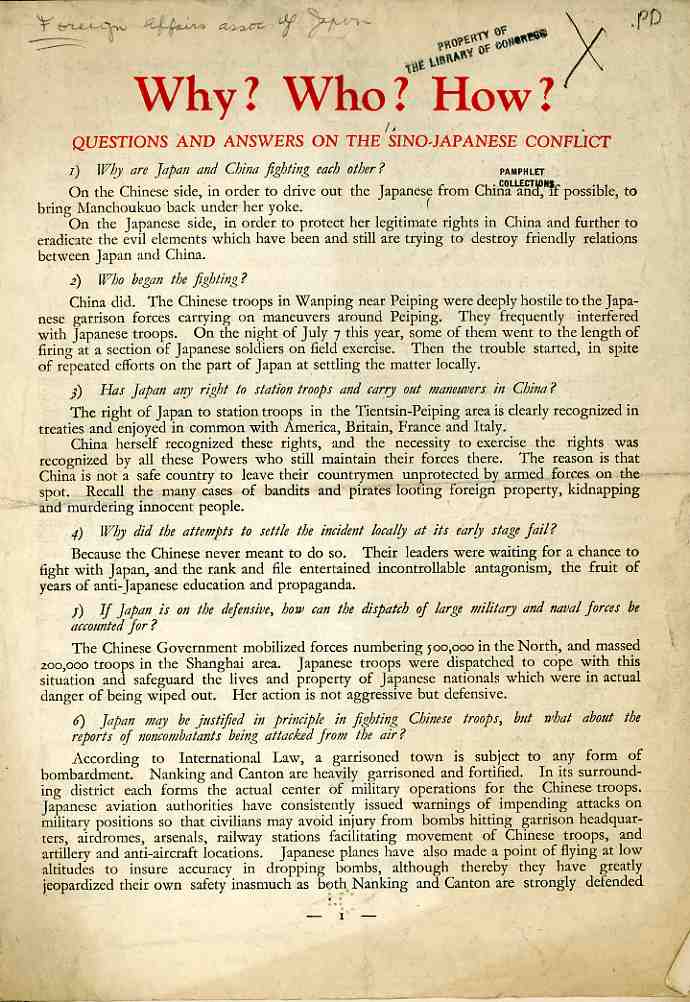
    I have a good number of English-language propaganda pieces published by such Hearts and Minds institutions as the Foreign Affairs Association of Japan describing, through the merriest and most defensive eyes, the Japanese viewpoint of exactly what it was that was going on in China between 1931 and 1945.  This leaflet, Why? Who? How? Questions and Answers on the Sino-Japanese Conflict (1937), is particularly worth noting because of how quickly and cleverish-cleanly the issue of the war and the fault of fighting was dispatched, and done with such astonishing condescending alacrity, and with such an enormous bodyguards of lies,as to be staggering.  I guess this is why the Duchamp quote came to me just now.  Old Marcel, the supremely gifted magician, certainly meant to be an enormous, itchy pain in the butt and a source of confusion, an artistic anarchist;  the thinking behind the quote served him well, and I think that it can be well-applied here.                             

    The first issue is in the subtitle:  the “Sino-Japanese Conflict” implies that the Chinese were at fault for having the Japanese invade Manchuria back in 1931; secondly,  the Chinese started a conflict and not a war. 

    Actually, the naming of the war there is quite an issue, and an issue still—and an issue at it most base level:  the word “war” is not generally used in Japan.  It wasn’t used in Japan during the war, or at least until the bombing of Pearl Harbor.  Until 1941, the millions of Chinese who were being killed by the Japanese armed forces were the result of a series of ”incidents”.  Even though there was a war raging from the beginning in 1931 to the start of total Japanese-Chinese war on 15 July 1937, the stuff that was happening from ’37 to ’42  was still an “incident” except for a period of 1940-ish to Pearl, when the idea of the Holy War (“Seisan”, eight corners of the world under one roof, etc.) was introduced by the Japanese Diet in 1940.  After that there was the occasional use of the “Great East Asian Conflict”, with the word “war” not being the part of any Japanese vocabulary.

    An interesting phrase that entered into the parlance though, if not “war”, was “Sanko Sakusen”, the “Three Alls”, as in KILL All, LOOT All, BURN All.  The Japanese wound up getting part of the Chinese All, eventually killing 20 million people or so in those 15 years.  But it wasn’t a war.

    This four-page document asks twenty questions, and answers them usually, emphatically, with simplicity, starkness, and with total complicity of innocence on the side of Japan.  For example, in discussing the “incident” in Beiging in 1937 which led to the total war between the two countries, asking the reader “why did the attempts to settle the incident locally at its early stage fail?,  we are told “Because the Chinese never meant to do so”.  Which of course is not the case.

    An incredible bit of thinking comes next, when the question “If Japan is on the defensive, how can the dispatch of large military and naval forces be accounted for?” Indeed!  Its hard to explain the invasion of another country as a purely defensive action. (We have seen this rather recently ourselves, the fictionalized account of terror-sponsorship in Iraq being about the only fuel necessary for a full-fledged defensive invasion and 2000-day long war.)  But the answer in 1937 was the Chinese defensive maneuver of massing troops for an impending invasion of China by Japan was then threatening Japanese interests in China, thus necessitating a defensive invasion of China which was mobilizing to defend itself from a Japanese offensive, which wouldn’t have come if the Chinese hadn’t adopted a defensive posture.  Basically, to paraphrase the immortal Mayor-for-Life of Washington, D.C, Marion S. Barry, “basically, the man dead”. (This was Barry’s response to reporters who were clamoring to find out what exactly had happened to a crazy man who climbed into a step van in a Buck Rogers suit and threatened to blow up the Washington Monument with a bucket of pee, an old rifle, and spray paint and then was shot about 200 times by cops of every shape and description. True story.)

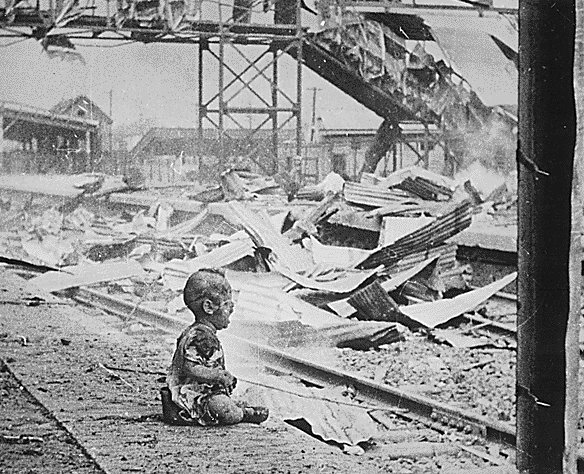
    War_shanghai-baby_Japan_bombing_shanghai_south_station_1937 (This is a picture of a baby survivor of a Japanese bombing “incident” at  South Station, Shanghai, 1937–sometimes it is better to see what something is than have someone define it for you..)

    We further find out that the attacks on the schools and hospitals in China were carried out, somehow, by Chinese troops; that a Chinese fishing fleet that was attacked and pulverized by Japanese submarines really wasn’t, and that they just disappeared; that Japan was protecting the rights of third party powers by “removing” Chinese troops occupying foreign-owned properties; that the Japanese fight against the “Sovietization” of China would “protect” foreign democracies, and so on.  The questions hardly matter, as the answers are all sort of the same.  Japan would “reach a settlement” (the word “peace” is not used anywhere here) however, if China “realized the error if her ways”. 

    Word do control mental images, and the further you get away from the situation described the more powerful the words become.  Somehow the Korean Conflict seems less so than a war because it wasn’t “legally” so; it was a “police action”.  And the Japan-China War isn’t a “war” in name in most Japanese histories of the period.  I think you can dissolve things with loose undefined language to such a point that the thing itself no longer exists; the only stuff that survives are the words used to hide it. 

    ·Posted by :

    ·in:

    — —

  • A Forgotten (?) Photographic Protest of the 1933 Chicago World’s Fair

    JF Ptak Science Books  Post 352

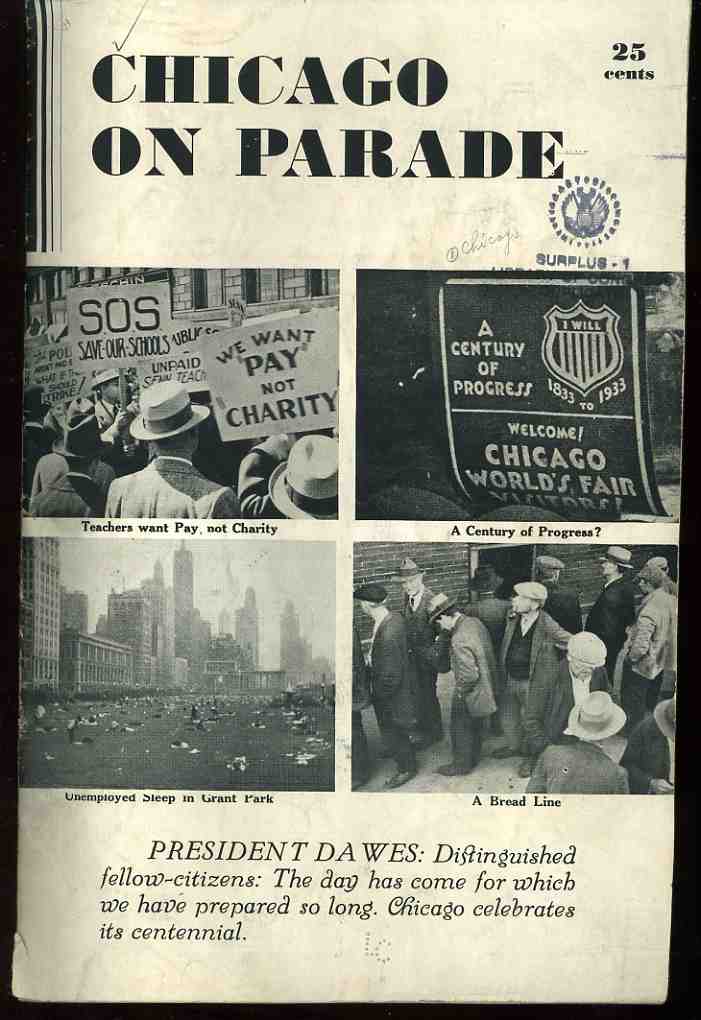
    000-ebay--Nov 4--chic 1985 This short pamphlet is a very strong tonic to those thinking about Chicago’s “Century of Progress” celebration and World’s Fair that was taking place in the middle of the Depression in 1933. (It was intended to instill hope and foster a little forgetfulness during a time in which the Depression in full swing nationwide, plus native-Chicago problems of gangsterisms, race riots, red scare, and economic distress ) As a matter of fact this pamphlet didn’t seem to find much distribution, or at the very least it didn’t get saved in spite of the fantastic documentary images that it contains.  This copy of Herman O. Duncan’s Chicago on Parade (1933), was his own, sent to the Library of Congress as a gift in 1942 before it came to me in 1999. I can find only three other copies of this pamphlet located in libraries world wide (Oxford, Duke, Chicago), and it seems very strangely underrepresented. 

    Duncan addressed the work directly to the Rufas Dawes (President of the Century of Progress Celebration), and to the mayor of  Chicago and governor of Illinois as a very blunt request to not forget the actual world of real Chicagoans living in dire straits within site of the fairgrounds.  Duncan was obviously taking issue with the many statements of wonderment and flourishes of progress that accompanied the propaganda surrounding the fair, so that the attention of the public would not be “diverted by our political and civic leaders”.  Duncan continued that these photographs, “none of which had been published previously in the United States” could “perhaps suggest a point of reference from which Chicago can measure its Second Century of Progress”. 000-ebay--Nov 4--chic 6 det991

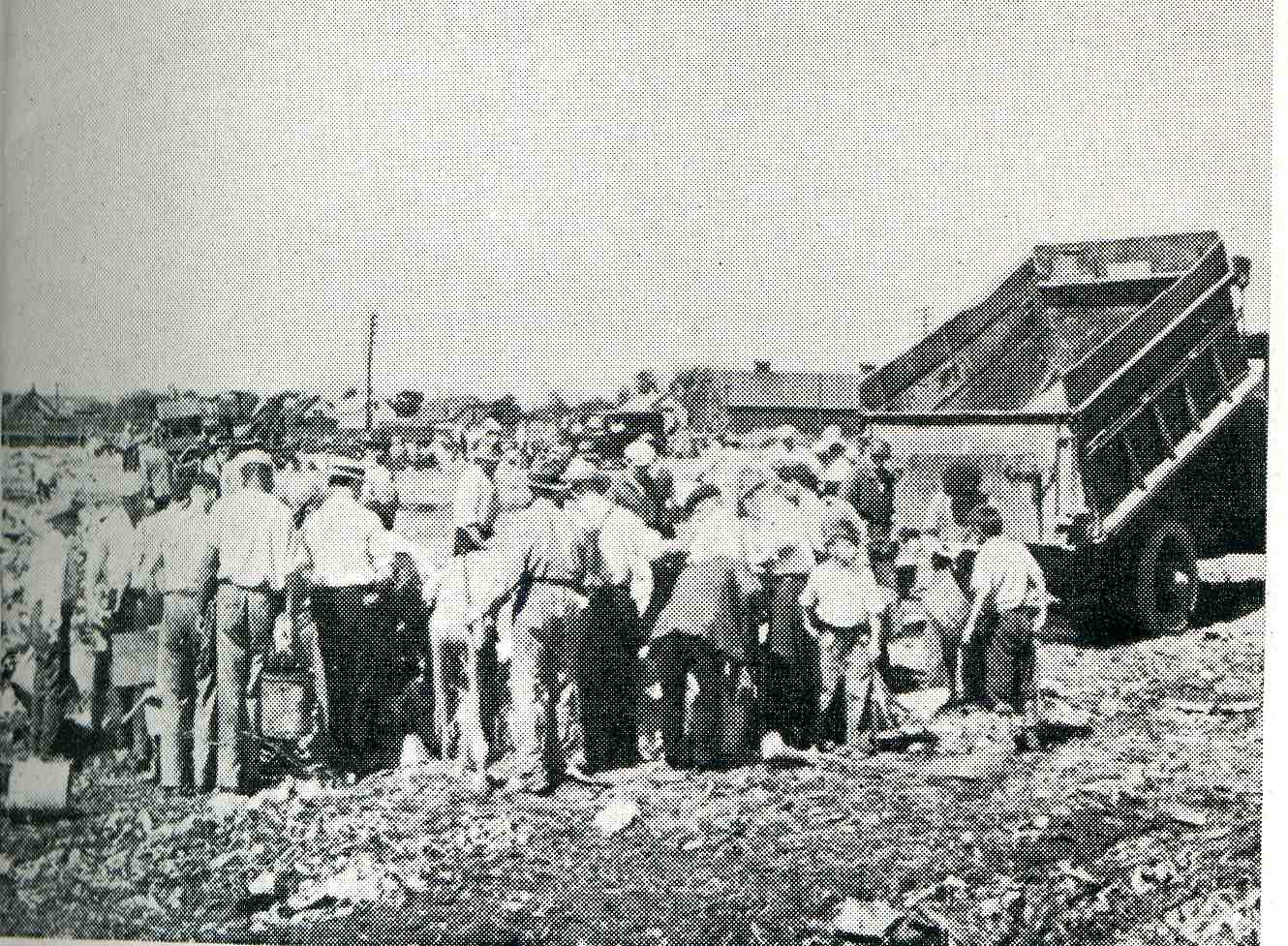
    Duncan (who unfortunately did not identify the photographer(s)) was very strong in the use of images.  He was not afraid to show long bread lines, people (including children) scavanging at the city dumps, blacks and whites marching together in protest of police brutality, (many hundreds) of people sleeping out of doors in Grant Park (Chicago’s “front yard”),because they had no where else to go, and much more.  The photographs had a real touch of journalistic acumen, and none of the images look forced or posed–they are the real stuff of social documentary, and how they have escaped wide notice is not known to me
    . 

    000-ebay--Nov 4--chic 2986
    Perhaps the strongest statement (outside of the
    photos of the children scrounging for food in dustbins and at the dump) is this series (below) showing views of the city of Chicago that were within site of the tower for the Century of Progress Sky Ride (“See the Fair / Come Up in the Air”).  The series make an elegant and strong and incontrovertible point, and that there was definitely something very wrong going on outside the walls of the celebration which had been scooped out of the city’s east side.  (The images remind me of series of photos of the US Capitol Building that appeared in the great classic of social and cultural recording of class division, Neglected Neighbors, which my friend Andy Moursund introduced me to many years ago in Georgetown.)

    The logo design for the event is terrific and I’m sure that everyone had seen it at least once in their lives, but out of the many hundreds of other pamphlets and display materials that I have here for the expo I’ve got to say that the overwhelming majority of them are luridly colored with a palette found outside nature.

    And anti-nature colors are somewhat schizoid-happy  colors, like MGM technicolor cartoons from 1949, which applies a massively ugly chromo-palette to the blight of the surrounding Depression problems.  Mr. Duncan was determined that this not happen, at least so far as he could help it, and published these arresting images to remind the rest of Chicago that the vividly colored happy face placed over the city like a stamp for the Century of Progress was not the case in fact. 

    There are another few images in the “continued reading” section.

    Note:  click on the photos for a larger, more detail view.


  • The Tomb of Broken Dolls–an Appeal for Respect for Outgrown and Disabled Toys

    JF Ptak Science Books  Post 349

    “No two toys are ever broken in the same way or with the same emotional results.” RobertGraves, Poetic Unreason

    000-ebay--Nov 1 doll tomb975


     I first wrote about this fabulous idea–a tomb or memorial for broken and lost toys–on this blog almost three years ago–it still seems like an utterly fantastic practice.

    000-ebay--Nov 1 doll tomb975

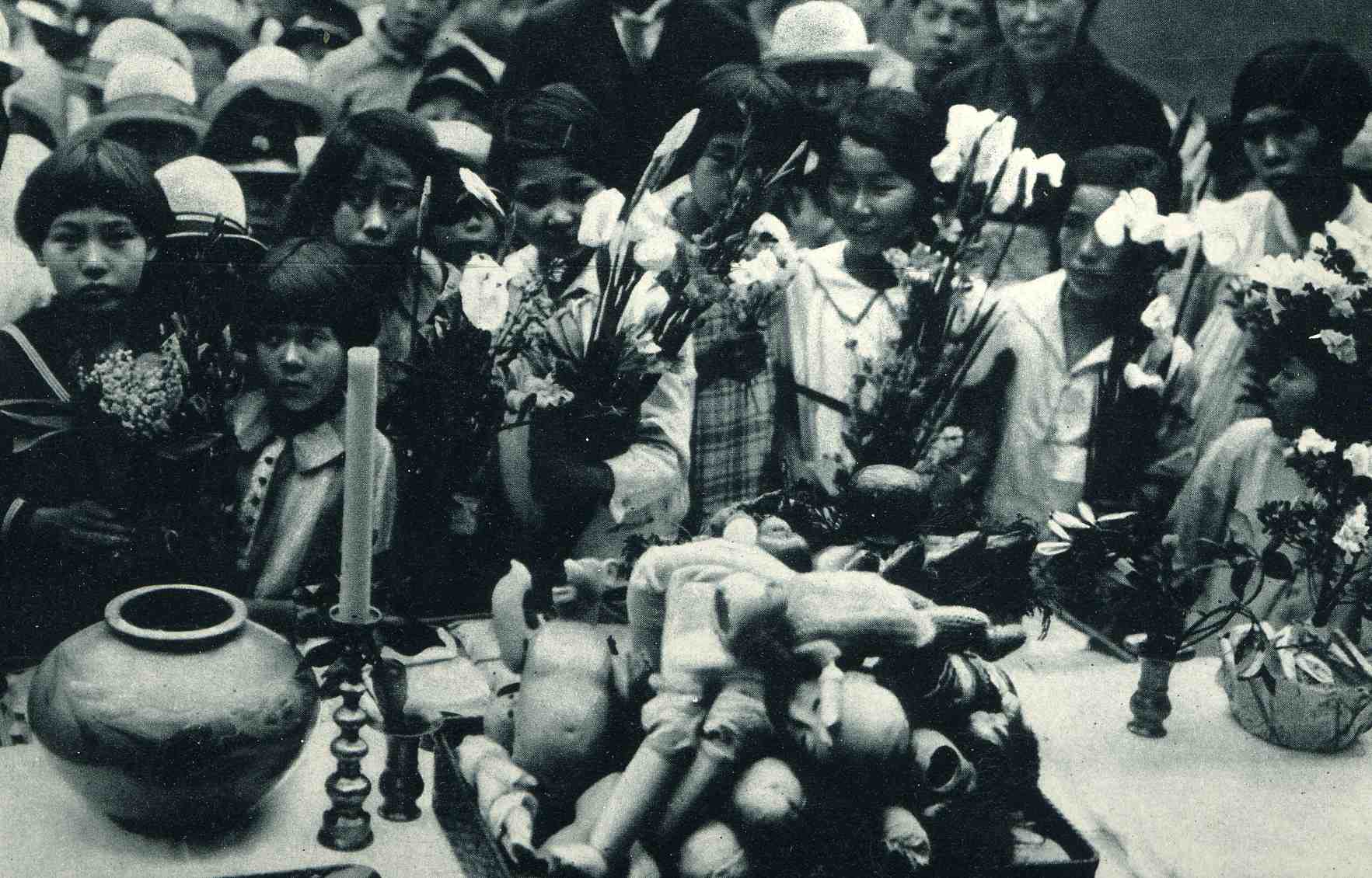
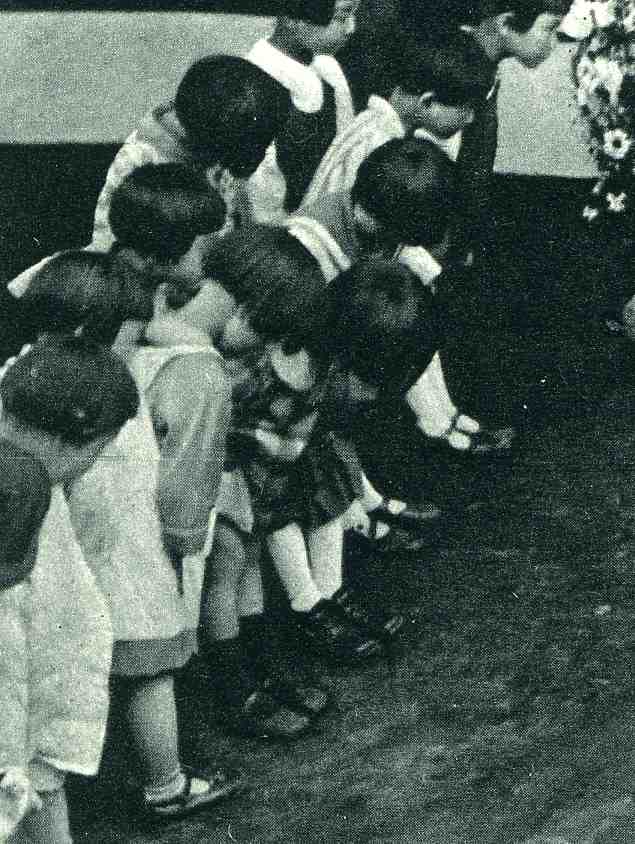
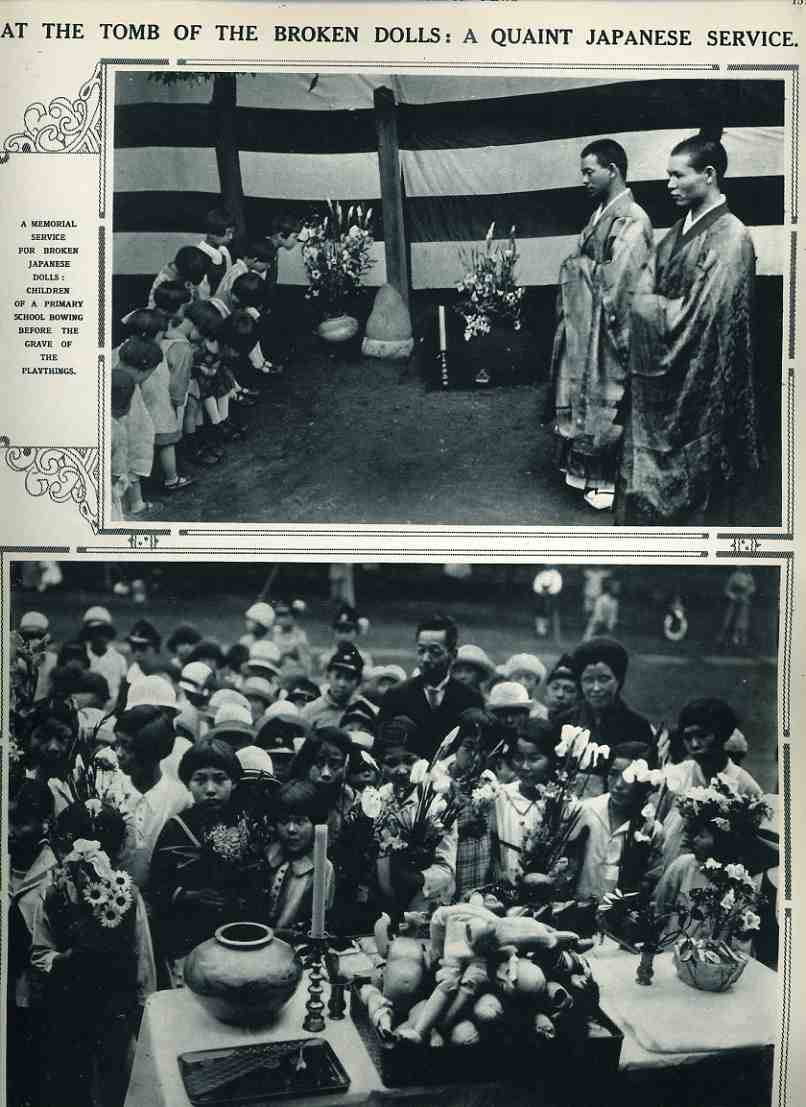
     This is an absolutely outstanding concept, and I simply have no notion as to why we don’t have such observations in the United States.  (The following two details are from the larger images, below, found  in the 27 July 1929 issue of The Illustrated London News, page 157.) The story provides these two pictures and unfortunately scant details of the ceremony which was held at the Imperial Primary School at Sugamo, Japan. 

    The first photo shows the detail of children offering flowers for the altar on which their tray of broken dolls is being venerated; and to the right is the detail of children bowing to the grave of “broken playthings”, though the markings on the (grave?) stone indicate that it is for dolls.  It also seems to be a marker for a mass of toys, not that each toy would have its own marker; I suspect it to be enough to have a place where allot of kids could come to venerate objects in which they might have invested countless hours of their time, effort, attention and affection.  That it is a shared place and experience makes the monument all the more so powerful.

    000-ebay--Nov 1 doll tomb976

    There are few better things to teach a child than to pay respects for something that has given them pleasure or helped them, or, say, for returning the love which has been showed them from their doll or toy.  It has always struck me as not-quite-right that a toy can be a beloved object one day and a dust-magnet the next, destined for the trash heap.  Certainly these are holy objects in themselves, and deserve a better and more kinder fate than being mixed with broken glass and greasy unmentionables. 

     000-ebay--Nov 1 doll tomb974


    Are there greater things to be concerned with?  Yes, of course, but only on the face of it–I think that helping kids understand the underlying dignity of inanimate objects such as their playthings could give them a greater awareness for the other seemingly invisible things that they will find throughout their lives. Further I think that a visible, constant reminder for these objects would be really more like a memory-monument for a period of time, a place in nearly everyone’s life in which held a certain purity and promise, a protected and beloved frailty of the human experience shared by all.  I can honestly think of no other monument that could reach across religious or philosophical or belief systems to arouse a feeling of common goodness than this. Everyone has had a toy that they’ve loved, and I have no doubt that if remembered these would be powerful emotions, and could be about the most common denominator we have on the planet.  I can think of no divisive element in such a monument of veneration.