A Daily History of Holes, Dots, Lines, Science, History, Math, Physics, Art, the Unintentional Absurd, Architecture, Maps, Data Visualization, Blank and Missing Things, and so on. |1.6 million words, 7500 images, 4.9 million hits| Press & appearances in The Times, Le Figaro, Mensa, The Economist, The Guardian, Discovery News, Slate, Le Monde, Sci American Blogs, Le Pont, and many other places… 5000+ total posts since 2008.

Category: Naming Things

  • History of Children, 2/7–the First Illustrated Rendering of the World for Kids: Anatomy

    JF Ptak Science Books  Post 1286    Continuing the post 1285

    “Taking the Scarecrows out of Wisdoms Gardens”

    This is Part 2/7 of John Comenius’ great work, the first illustrated instructional to children, first written in 1676 and then translated into English in 1726–it is from this translation that all of the images (below) are taken.  This is the second of seven installments on introducing 17th and 18th century children to wide ideas, the other sections including: Part 1, Occupations; Part 2, Anatomy; Part 3, Books and Book Arts; Part 4, the Sciences; Part 5, Morals and Philosophy; Part 6, Games and the Arts; and Part 7, the Military.  

    The work itself: John Amos Comenius’ Orbis Senfualium Piélus: Omnium Principalium in Mundo Rerun/ &f m Vita АШопит,  translated as Pictura et Nomenclatur, the Visible World, or A Nomenclature, and Pictures of all Chief Things that are int he World, translated into English by Charles Hoof…1726.

    The purpose of the book, writes the translator in the introduction of the 1726 12th edition, is:  

    To entice witty children to it, that they may not conceit a torment to be in the school, but dainty/are., For it is apparent, that children (even from their infancy almost) are delighted with Pictures, and willingly please their eyes with these fights: And it will be very well worth the pains to have once brought it to pafs, that fcare-crows may be taken away out of Wifdom’s Gardens…”

    Even at this early stage of publishing books for children it was easily recognized that children learn better when eased into their subject with pictures.  This is not so far off the mark with the moderns, and in its own way a precursor to the Dick and Jane and Dr. Seuss books–not so much for subject matter, but for the very act of putting a book into the hands of a child and getting them comfortable wit the idea of reading.  It seems to me that this is by far the most important lesson-the actual content at tis point is secondary to the act of holding a book.  

    [graphic]

    Septan Mtaies Hominis. A Man is ßrjt un Infant, 1. j Homo di primum Infasts, 1.

    tien

    [ocr errors]

    [merged small][merged small][ocr errors][ocr errors][merged small][graphic][merged small][merged small][ocr errors][ocr errors][ocr errors]
    [graphic]
    [ocr errors]
    [ocr errors]

    [merged small][graphic][ocr errors][ocr errors]

    a Tongue and Palate,
    and Teeth, 16.
    in the Cheek-hone.

    A Man s Chin
    is covered ivith a Beard, 14.
    mnd the Eye
    {in •which is the White
    and the Apple)
    •with Eye-lids,
    and an Eye-hrow, 15.

    The Hand heing clofed, is a Fift, 17. heing of en ira palm, i8, in the midß is the hollow, 19. of the Hand i the extremity is the Thumh, 10.iviehfour Fingers, the Fore-finger, 2s. the Middle-finger, гs. the Ring-finger, 23 and the Little-finger, 24. .

    In every one are three ]o\ms, a. h. C. and asman knuckles, d. e. f. ivith a nail, 25.

    [ocr errors][ocr errors][ocr errors]

    [merged small][graphic]

    In the Body are the Skin .nvith the Membranes, the Fleih ivith the Mafcles, the Chanel;, .,

    the Griffles,
    tie Bones andthe Boweli.

    The Skin, i: heing puttV ef, the Fleih, 2. appeareth, vol in a continued lump, Lut heing diftnhuled, es it ‘were in ßufi puddings, fuihuh they callMukks, ivhireof1here aie reckoned four hundred and five, heing the Chañeis cf the Spirits to move the Members.

    The Bowels are the inward Members:

    As in the Head,th.rBrains, 3. heing compajfed «bw with a Skull, and

    In Corpore funt Cutis cum Mimhranis, Caro cum Mufcults, ..’

    Canales,
    Cartilagines,
    Oßi & Vecera.

    Cute, 1. detraíla,
    Ca”o, 2. appaiet,
    non continua raafsâ,
    fed dil.tributa,
    tanquam in farcimina,
    quos vocant Mu/tules,
    quorum numerantur
    quadringenti quinque,
    canales Spirituum,
    ad movendum Memhra,

    Vijcera funt Memhra interna:

    Ut in Capite, Cerehrum, 3. cire umda tum Crem», Sc
    [ocr errors][ocr errors][ocr errors][graphic][merged small]

    The Arteries currying Blood from the Heart;

    4’he Veins returning the Mood to the Heart}

    The Nerves carrying Setife and Motion throughout the Body from the Brain.

    You jkallßnd thefe three, 1. t’very inhere joined together.

    Beßdes, from the Mouth into the Stomach it the Gullet, 2,

    the way of the meat and drini, and-hy it to the Light!, the Wezand, 5. for hr.athing; f cm the Stomach to the Arfe it a great Gut, 3. to purge out the Ordure; from the Li-ver to the Bladder, the Ureter, 4. for making ‘wJter. .

    Tie Bones are in the Head, the Skull, 6. the ttuo Cheek-bones, 7. with thirty tTvo Teeth, 8. Then the Back-bone, 9. the Pillar of the Body, tonfifling of thirty four turning Joints, that the Body may hend itfelf

    The Ribs, re. ,uihereof there are twenty four.

    The Breaft-bone, 11. the five Shoulder-blades, ii. the Buttock-bone, 13.. the bigger Bone in the . Atta, 15. *W/¿/kfi’crBone inthi Arm.

    V-Л ù •;

    vi;

    [ocr errors][ocr errors][merged small]

    [merged small][merged small][merged small][merged small][graphic][merged small][merged small]

    Mußcal Типа.

    The Nofe, 3. fcenteth fmelh and ßinhs.

    The Tongue, 4. •with the reef of the Mouth taßet Favours, •what is fweet or hitter, keen or hiting, four or каф.

    The Hand, 5. hy touching difcerneth the quantity and q: ality of things; the hot and cold, the moifl and dry, She hard andfft, the fnooth and rough, the bsavy and light. The in•ward Sen fes are three. . The Common Senfe, 7. under the forepart of the head, afprehendeth i

    t/.ings taken from the oufward Senfes.

    The Phantafye, 6. under the crown of the head, judgeth ofthefe things, t hinket h and drcameth

    The Memory, 8. under the hinder part of the head, layeth up every thing end fctcbeth them out; it Ufethfome, and this is forgetfulnefs.

    Sleep, is the reft of the Senfes.

    [ocr errors][ocr errors]

    [merged small][graphic]

    The Soul is the Life tf the Body, oie in the ivhole. Only Vegetative in Plants;

    Withal Seníltive in Animals;

    And alfo Rational in Men.

    This confifteth in three things;

    In the Underftanding, wherehy it judget h, and underßandethy – a thing good and evil, or true, or apparent.

    In the Will, •whereby it choofeth, and deßreth, tr rejeéleth, er mißiketh a thing knovn.

    In the Mind, •whereby it purfueth

    Anima eft vita corpoiii, una in tota.

    Tantum Vegetativa In Plantis;

    Simul Senßtinsa in Ahímalibus J,

    Etiam Rational is in Hernie/i

    liaec coniiftet in trihu»;

    In Mente (Intelleflu) qua cognofcit, & intelligit, honum ac malum, vel verum, vel apparent»

    In Voluntate-, qua eligir, Sc concupifcit, aut rejicit, & averfatur cogniuim.

    In Animo, quo prpfequituv

    [merged small][merged small][merged small][graphic][merged small][table]


  • What a Fascist Really, Really Is: Defining Things, June 1945

    JF Ptak Science Books   Post

    In the history of words and the history of writing them, the history of writing down what words mean came relatively late in the word game.  The first dictionary for the English language is difficult to establish–it wasn’t Dr. Johnson’s 1746 effort, as fabulous as it was.  There were more than a hundred earlier efforts, the earliest of which may be Robert Cowdry’s A Table Alphabeticall… as the first English dictionary, which was written in 1604. (Its more easy to determine the first American dictionary, Dr. Webster’s, 1828 .) It may be that dictionaries and assemblies of rogue/thieves language appeared well before Johnson, by perhaps as much as 175 years, providing the good readers and listeners in England with a ready tool for understanding “non-standard” (slang) words of the English language (with A New Dictionary of the Terms Ancient and Modern of the Canting Crew, by “B.E.”, being the best known of these early works, published in 1698.)

     It is interesting to me that in addition to Johnson et al another  writer–or rather set of writers–were responsible for the first Johnsonian-first dictionary in German, the  Deutsches Wörterbuch by the Brothers Grimm.  These are good examples of modernity, though there are earlier examples for other languages–Petrus de Alingio’s manuscript of 1286 and the Catholicon as the first printed alphabetical listing of Latin words appeared very shortly after Gutenberg’s Bible did on the same press.  But then these were both many centuries into the use of the language.

    WWII--Italy Fascist a042

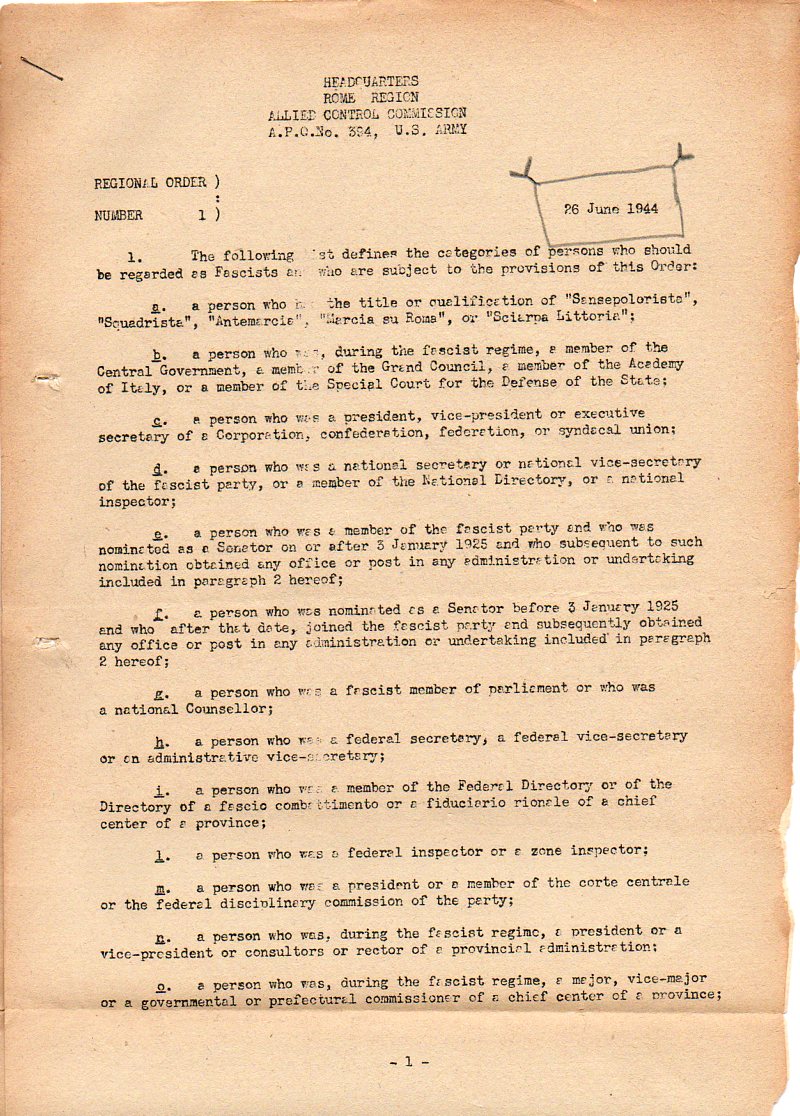
    And this just to say how much I like the road to words–especially when they come from unexpected places. One fine example of this is the directive below, issued by the headquarters of th Allied Control Commission (“APO No 394″) in Rome in the summer of 1944.  (This would actually be the American arm of the ACC, which was commission set up by the Allied Powers to deal with the administration of defeated countries at the end of the war.  Three weeks after D-Day the end of the war was in sight (Bastogne and Co. not withstanding), though far more so in Italy than just about anywhere else, and so the implementation of governing and occupying plans needed to be established.  One of the primary features here was to ensure that the old Fascists not be included in the new Italian governments (along the lines of denazification in Germany, which had a more laissez-faire approach to defining Nazis, especially wealthy and useful ones), and the primary issue in finding and excluding Fascists was to define what was meant by “fascist”1.  These are those working guidelines, at least on 25 June 1944. 

    Notes

    1. The first use of “fascism” in English reported by the Oxford English Dictionaries occurs in 1921:
    1921    19th Cent. July 148   The Fascismo was born in the provinces, where the extremistic menace was stronger.      

    Other interesting reports of the usage of the word continue in the OED:

    1922    Q. Rev. Jan. 148   A section of the Press..now veered completely round to the cause of Fascism. The Fascist terror increased in intensity.
    1923    Contemp. Rev. Jan. 44   We do not want Fascismo in this country.
    1923    Contemp. Rev. Nov. 557   Fascism in Germany will never be more than one of several factors.
    1925    Weekly Westm. Gaz. 10 Jan. 320/2   The outrages which have been associated with Fascism have gradually alienated much of the support which it won two years ago.
    1934    tr. K. Heiden’s National Socialism xvii. 354   The electoral victories all over Europe with which the Labour Parties have replied to German Fascism.
    1936    Discovery Dec. 378/1,   I have strongly criticised modern education and the methods of handling youth generally as inculcating excessive respect for authority and thereby conducing to the growth of Fascism.
    1939    A. Cobban Dictatorship v. 124   In March 1919..Fascism was still..a revolutionary and socialist movement, hostile to the monarchy, to finance, and to parliamentary government, demanding social reform and workers’ control, but separated from the other branches of the socialist movement by its intense nationalism.
       
    And the definition of the word “fascist” from the same year, 1921:
     “One of a body of Italian nationalists, which was organized in 1919 to oppose communism in Italy, and, as the partito nazionale fascista, under the leadership of Benito Mussolini (1883–1945), controlled that country from 1922 to 1943; also transf. applied to the members of similar organizations in other countries. Also, a person having Fascist sympathies or convictions; (loosely) a person of right-wing authoritarian views. Hence as adj., of, pertaining to, or characteristic of Fascism or Fascists…”


  • Warsaw Ghetto Uprising–Full Text of a Rare 1944 Pamphlet

    JF Ptak Science Books  Post 1294

    “There will be a dawn.”–Dorothy Thompson, 1943

    “The former Jewish quarter in Warsaw is no longer in existence”–Jurgen Stroop, liquidator of the Warsaw Ghetto.

    Dorothy Thompson got that one wrong–or so at least got the “dawn” wrong when it comes to the Jewish uprising in the Warsaw Ghetto in 1943.  There wouldn’t be a dawn, there, mainly because there would be hardly any Jews, or Warsaw.  [This battle took place about three years after the Nazis established it as a means of control for the city’s 400,000 or so Jews. In the intermediary years hundreds of thousands of Jews had been “deported” (that is, sent to the concentration camps to be exterminated or worked to death), so that by the time of the Uprising only 60,000 people remained in the Ghetto.  And by this time there was no doubt in anyone’s mind who lived there (and perhaps too in Warsaw as a whole) what the euphemism of “deportation” actually meant.  The battle started off well for the home defence (the ZOB) but, ultimately, with little access to resource and with nowhere to actually retreat or regroup in the few acres that remained of the original Ghetto, whoever was left in the Ghetto were either killed or captured by 16 May.  The German commander, SS Brigadefuhrer Jurgen Stroop reported on that day that “the former Jewish quarter in Warsaw is no longer in existence”.]

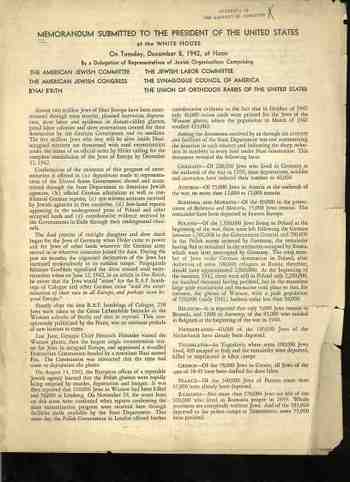
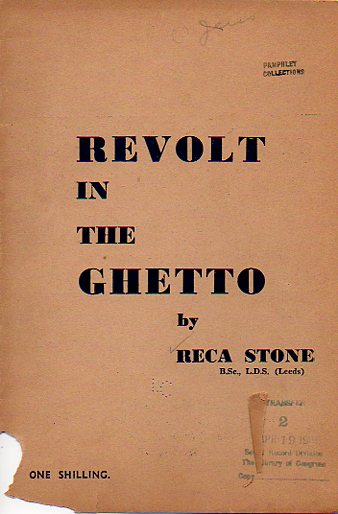
    This small pamphlet was written by Reca stone in 1944 on the Jewish counter-attack against the Nazis in the ghetto of Warsaw. It is one of not-many that documented not only the resistance in Warsaw, but also of the wholesale liquidation going on in that city and in the concentration camps. in general.  (Again, this was written in 1944. )

    There weren’t many accounts like this, but there were enough, certainly enough to have made a difference, I think, in how the leaders of the war effort approached whether concentration camps existed or not.  Franklin Roosevelt had exactly one meeting on this topic (which I wrote about here), while many others decided that the idea of exterminating all of European Jewry was so enormously bad and so gigantic that it could not possibly be true.  

    Felix Frankfurter famously replied to a first-hand report on the extermination from the great Jan Karski that he just couldn’t “beieve” Karski’s story–not because the Supreme Court Justice (and Jew)  thought Karski wasn’t telling the truth, just that the story itself was unbelievable.  And whether people thought that the stories were the truth but unbelievable (like Frankfurter) , or whether they thought they to be exaggerations, or whether they thought it was impossible, the responses and the subsequent actions mostly seem to have come to the same end of nothingness. Even after years of reports of extermination and brutalities and millions of people missing (as FDR was warned of in that 1942 meeting), the actual eyewitness accounts of the concentration camps were still received as being unbelievable.

    Blogsept5_memorandum_1494_2

    This is one of the reasons why General Eisenhower–when viewing the  concentration camp at Ohrduf in April 1945 with Generals Patton and Bradley–suggested that world leaders and other high-rankers come to the camps to bear witness so that future generations would know that such a thing actually existed.  And so we come to the Reca Stone pamphlet.  There are many other accounts of course of the uprising, and many of those are available on-line–but the Stone account, which is a rare thing in itself (only seven libraries worldwide having a copy of the work) is not on-line, but it is now.  I think that it is a significant report, and it should have a wide audience–things like this should reach as large a readership as is possible. 

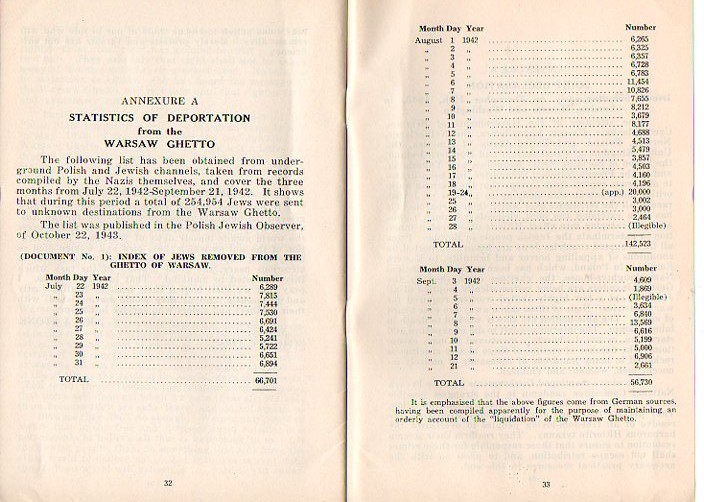
    An example of Stone’s reporting, coming from Underground sources and the Polish Jewish Reporter, on the number of Jews “removed” from the Ghetto of Warsaw between July 22 1942 and September 21, 1942–254,954 over a period of about three months:

    A--warsaw ghetto213

    But Stone gives no sentiment to the idea of Jews “perishing”.  On page 20 she describes the death camp Treblinka, and how thousands and thousands of Jews met their death in the gas chambers, or by suffocation and scalding, or by execution, or by live burial.  

    She writes boldly: In this manner 250,000 Jews were transported from the Warsaw Ghetto…and in this manner tjhey met their death”.  Period.  No euphemism here.

    She also quotes Washington sources that “two million” Jews had “perished” (the Federal term, not Stone’s), and that “five millions were imminently threatened with death”.  She pretty much got everything correct, as unbelievable as it sounded, then.  Or now.  

    A--warsaw ghetto196


    The original pamphlet is available for purchase here.

    The full test, below–all of the images are expandable:


  • Jackson Pollock’s Fractals

    JF Ptak Science Books    Rapid Post

    Thinking about the “evolution” of music, I came to the 1940’s and 1950’s , and then to Jackson Pollock, and then to thinking about how his artwork evolved, and then, about how it might have truly evolved in a classic sense, like an evolutionary period.  None of this made much sense to me until I started thinking about the representation of Pollock fractally–and then things started to get interesting.  Could this work come about, again, as a result of the evolution of fractals?

    Obviously the Pollock drips aren’t self-same, not easily observably, anyway–but what about statistically, especially under magnification?  

    It turns out that someone has taken a look at this: Richard P. Taylor, et al, in “The Construction of Jackson Pollock’s Fractal Drip Paintings”1This team concludes that–after analyzing paintings and films of Pollock painting them–“the painting process that…Pollock used a remarkably systematic method capable of generating intricate patterns that exhibit fractal scaling criteria”.  

    I’ve never been comfortable with mid-century modern, but I must say that this Ollock/fractal business is interesting to think about, though I’m not sure it has anything to do with art. 

    Notes:
    1. Found in: Johnson, Colin G. Romero Cardalda, Juan Jesus.  “Introduction: Genetic Algorithms in Visual Art and Music–a Supplement”,  Leonardo, Volume 35, Number 2, April 2002, pp. 175-184 (Article)

    Here’s another interesting book: The Art of Artificial Evolution: A Handbook on Evolutionary Art and Music by Juan Romero and Penousal Machado (Editors)bSpringer – Natural Computing Series Hardcover: 458 pag

    The introduction to the Johnson ‘02 Leonardo article: “Leonardo has a long tradition of publishing work at the mutual frontier of art and science. We are pleased to present in the pages of Leonardo a special project that


  • History of Children, 1/7–the First Illustrated Rendering of the World for Kids: Occupations

    JF Ptak Science Books  Post 1285

    This is the first of seven installments on introducing 17th and 18th century children to wide ideas.  The text and images all come from the 1726 English translation of John Comenius’ Orbita Pictus, and cover the following territory: Part 1, Occupations; Part 2, Anatomy; Part 3, Books and Book Arts; Part 4, the Sciences; Part 5, Morals and Philosophy; Part 6, Games and the Arts; and Part 7, the Military.  

    “O Babees yonge, my Book only is made for youre lernynge” says what well may be the first book made in the West for children, written in the 14th century.  It was made for the eyes of noble blood, of course, and was basically a contribution towards how the children should act and behave, rather than teaching them anything outside of their immediate interactions with each other or their parents.  Books of manner and behavior was the dominant—if perhaps the only(?)—category of books for children until the late 16th century.

    John Locke, in his Thoughts on Education (1691), suggests that “when a child begins to read, some easy, pleasant book, like Aesop’s Fables or Reynard the Fox, with pictures if possible, should be put into his hands”. He adds, “What other books there are in English of the kind above-mentioned, fit to engage the liking of children, and tempt them to read, I do not know, but am apt to think, that children, being generally delivered over to the method of schools, where the fear of the rod is to enforce, and not any pleasure of the employment to invite them to learn, this sort of useful books, amongst the number of silly ones that are of all sorts, yet have had the fate to be neglected; and nothing that I know has been considered of this kind out of the ordinary road of the hornbook, primer, Psalter, Testament, and Bible.” (This quote from C.M. Watkins article in The Atlantic Monthly, 1880.)

    Preview

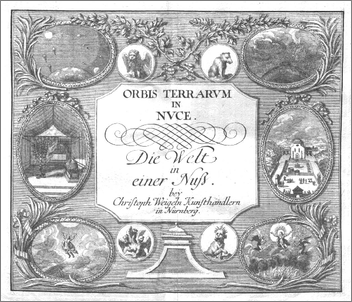
    Perhaps the most beautiful of early books for children is found behind this deeply designed title page, brought to us by Christoph Weigel (German, 1654-1726), the author, illustrator and engraver of Die Welt in einer Nuss oder die Historien vom Aufgang der Welt…1 published in Nurnberg in 1726.  The book was a tall, thin production, with 16 pages of text and 43 engraved plates, much like this one, emblazoned with emblematic studies and dedicated to a particular point in the historical continuum.  And it was intended, believe it or not, for children—the title can be basically translated as “The World in a Nutshell” and was absolutely intended for kids, compressing all of the human story into 16 terse pages and a whole bunch of gorgeous illustration. This image shows the second millennium after the birth of Christ, illustrated with seven engravings (secula septem).


     But the first of all of the encyucloepdia-like books fasiohioned for children–and the first with illustratiions–belongs to the very well studied 13. The fteeple-crowned, 15. add te thefe The bald-pated, 14.

    [ocr errors][merged small][graphic][merged small][merged small]

    [graphic][subsumed][subsumed][subsumed][subsumed][ocr errors][subsumed]

    [ocr errors][ocr errors][merged small][graphic]

    The Plow-man, i. yoketh Oxen, 3. to a Plough, 2. and holding the Flow-Rïlt, 4. in his left hand, and the Plow-ftaff, 5. in his right hand, ivith ‘which he remcveth Clods, 6. he еutteth the Land {ivhich ivas manured afore ,uiifh Dung, 8.) with a Share, 7. and a Coulter, and makethFurrows, 9. Then he foweth the Seed, 10. and harroweth it in with a Harrow, 11. The Reaper, I2. jheareth the ripe Corn with a Sickle, 13. gatheteth up the handfuls, 14, und bindcth the Sheaves, 45.<t¿í Threiher, 16.; threfieth Corn en the Barn-floor, 17. ,with a Flail, 18. .*. toffeth it in a winnowing bafket, 19.andfo ivhen the Chaff’, and the Straw, 20. are ßparatedfrom it, heputteth it into Sacks, 21 ,The Mower, 22. maketh Hay /я я Meadow, tutting do’wn Grafs with a Scythe, 23. and raketh it together üvith a Rake, 24. andmaketh up Cocks, 26. nvith a fork, 25. and carrieth it on Carriages, 27. into the Hay-barn, 28.

    [merged small][ocr errors][merged small][graphic][merged small]

    [graphic]
    [ocr errors]


    [ocr errors][merged small][merged small]
    [graphic]

    Vhe Bees find ota ¿r/warm, i. andfiet over it «Leader, 2. That Jkxiarm heing ready to fly away, is recalled hy the Tinkling ef a braaen Vefl.el, 3. and is put up into a neiv Hive, 4. They make little Cells nvith ßx comers, 5. and Jill them with Honey-dew, and make Combs, 6.cut of ivhich the Honey runneth, 7.The Partitions heing melted -with ßre, turn into Wax, 8.

    Grinding

    [merged small][ocr errors][ocr errors][graphic]

    In a Mill, i. « ft’one, 2. runneth upen a ft one, 3.A Wheel, 4. turning them ahout, end grindeth Corn poured in by a Hopper, 5. endparteth the Bran, 6. falling into the .Tro ugh, 7. from the Mealßipping through aBolter, 8.Such a Mill voasßrft a Hand-mill, 9. then a Horfe-miil, 10.. then a Water-mill, 11. anda Ship-mill, i2. amdatlaßt a Wind-mill, 13.


  • History of Children, 7/7–the First Illustrated Rendering of the World for Kids: the Military

    JF Ptak Science Books  Post 1291    Continuing the post 1285

    “Taking the Scarecrows out of Wisdoms Gardens”

    This is Part 7/7 of John Comenius’ great work, the first illustrated instructional to children, first written in 1676 and then translated into English in 1726–it is from this translation that all of the images (below) are taken.  This is the second of seven installments on introducing 17th and 18th century children to wide ideas, the other sections including: Part 1, Occupations; Part 2, Anatomy; Part 3, Books and Book Arts; Part 4, the Sciences; Part 5, Morals and Philosophy; Part 6, Games and the Arts; and Part 7, the Military.  

    The work itself: John Amos Comenius’ Orbis Senfualium Piélus: Omnium Principalium in Mundo Rerun/ &f m Vita АШопит,  translated as Pictura et Nomenclatur, the Visible World, or A Nomenclature, and Pictures of all Chief Things that are int he World, translated into English by Charles Hoof…1726.

    The purpose of the book, writes the translator in the introduction of the 1726 12th edition, is:  

    To entice witty children to it, that they may not conceit a torment to be in the school, but dainty/are., For it is apparent, that children (even from their infancy almost) are delighted with Pictures, and willingly please their eyes with these fights: And it will be very well worth the pains to have once brought it to pafs, that fcare-crows may be taken away out of Wifdom’s Gardens…”

    Even at this early stage of publishing books for children it was easily recognized that children learn better when eased into their subject with pictures.  This is not so far off the mark with the moderns, and in its own way a precursor to the Dick and Jane and Dr. Seuss books–not so much for subject matter, but for the very act of putting a book into the hands of a child and getting them comfortable wit the idea of reading.  It seems to me that this is by far the most important lesson-the actual content at tis point is secondary to the act of holding a book.  


    [merged small][ocr errors][merged small][graphic][ocr errors][ocr errors]

    [ocr errors][ocr errors][merged small][ocr errors][merged small][graphic][ocr errors]

    When aDeíign is undertaken, the Camp, i. is pitched, and the Tents if Canvas, гor Straw, Jarefaßened •with Stakes; and they entrench them aient, fer ßcurity’s fake, •with Bulwark?, 4. and Ditches, 5. Sentinels, 6. ere alí’ofel; and Scouts, 7. arefent out.SaUyings-out, 8.ere made for Forage and Plunder-fake,where they often cope with the Enemy, 9. infiirmijhing.. The Pavilion of the Lord General is in the midßoftht Camp, 10.

    [ocr errors]
    [ocr errors][graphic][merged small][subsumed][merged small]

    il to hi fought, the Army is/et in order, and divided into the Front, 1.the Rear, 2.and the Wings, 3.The Foot, 4. mre intermixed •with the Horfe, 5,That is divided into Companies, this into Troops.Thefe carry Banners, 6. tho/e Flags, 7. in the midft of them.Their Officers are, Corporali, Enfigns, Lieutenants, Captains, 8. Commanders of the Horfe,9, Lieutenant Colonels, Colonels, and he that is the chief of all, the General. The Drummers, 10. and the Drumílades, 11. as alfo the Trumpeters, 12. call to Arms, and inßame the Soldier, At theßrß Onfet the Mofitets, 13. and Ordnance, 14. areßot off. After•wards thtyfight, 15. hand to hand •with Pikes and Swords. They that overcome are flain, 16. tr taken Prifoners, ,r run away, 17. They that are for the referve, 18. come upon thtm

    [ocr errors]
    [graphic]
    [merged small][ocr errors]

    [merged small][ocr errors][merged small][ocr errors][graphic]

    A Sea-fight « terrihle, ,when huge Ships, like Caftles, run one upon another ivith their Beaks, 1 , or ßiatter one another with their Ordnance, 2. und/o, heing hored through, they drink in their own Deßnition, and art funk, 3. Or when they arefet on ßre, mid either hy the ßring of G un-powder, 4.

    [ocr errors][merged small][merged small][ocr errors][graphic][ocr errors][ocr errors][ocr errors][ocr errors][ocr errors]

    sr hreaking them doivn with Battering-engine!, 3, er demolifiing themwith great Guns, 4.or breaking through the Gates with a Petard, 5. er caßing Granadoes, 6. tut of M01 tar-pieces, 7. tuto the City,hy Engineers, 8. (ivho He hehind Leaguer-ha&ets, 9.) er 0 uerthroivingit avith Mines hy Pioneers, to. They thait are hefieged defend thtmfelves from the Walls, 11. •with ßre and ßones, &C or hreak out hy force, iz. A City that is taken hy Horra is plundered, deßroyed, andfomelimes laid evtl •with the ground.


  • How Long is the Coastline of Great Britain?

     JF Ptak Science Books  Post 1193

    [This pamphlet may be purchased from our blog bookstore site, here.]

    This is the first of a few short essays of the idea of pre-historic appearances of important ideas. I use the word “pre-historic” in its literal sense—that is, these papers were published before the concepts that they discussed were recognized and published, later, in more complete form and of course to greater fame. One will certainly be Gregor Mendl’s paper (Versuche über Plflanzenhybriden ) published in the obscure Verhandlungen des naturforschenden Vereines in Brünn, (Brno), and to be resurrected at the hands of Gregory Bateson thirty-odd years later to much acclaim. Another example is Vannevar Bush’s “As We May Think”, published in The Atlantic Monthly in June 1945, and which was a now widely recognized definite intellectual precursor to the construction of what we know  today as the Internet.

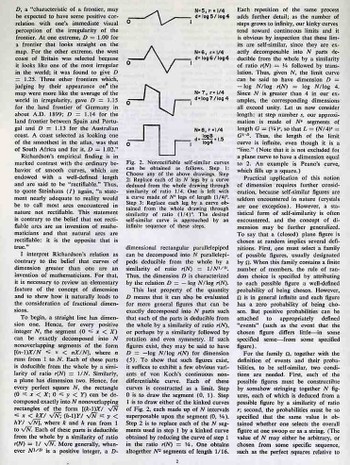
    Blogmandelbrot217_2Right now, though, I’d like to look at the pre-birth of fractals in Benoit Mandelbrot’s precursor (1967) paper (and in a weird, probably not-correct way, scooping himself) to his more famous effort of 1975, in which he coins the term and fully describes “fractals”, showing the measurement of the coastlines behave like a fractal over a range of measurement scales.
    The seminal paper, How Long Is the Coast of Britain? Statistical Self-Similarity and Fractional Dimension, published in Science magazine in 1967, is an introduction to the concept of fractals (which Mandelbrot would name later in 1975). The kernel of it all is found in the Lewis Fry Richardson graphs and more so in the small illustration on page three of the paper—the peek into the future world of fractals, seeing a fractal before it was named so.

    Richardson (a kind of Jevons, or Marey-like American figure on the history of 20th century science) did some very good thinking about the elusive nature of naming such a thing as the lengths of coastlines and other natural constructions: namely he determined that their measured length was dependent upon the scale of measurement. That is to say the measured length, L(G), is ruled the scale of G, approximating the function as L(G)=M(G)1-0 

    Mandelbrot moves on to discuss the coastline in terms of it being a self-similar object, which is something that is nearly exactly similar to a part of itself, or the whole having the same shape of one or more than one of its parts, and regresses. 


    ·Posted by :

    ·in:

    —

  • Catechizing the Sky–Writing on the Stars

    JF Ptak Science Books  Post  1166

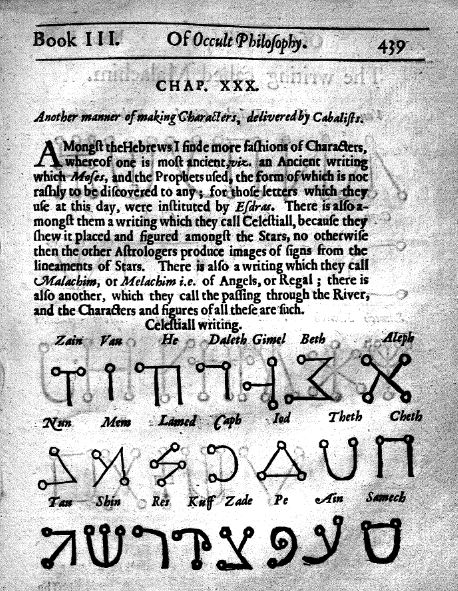
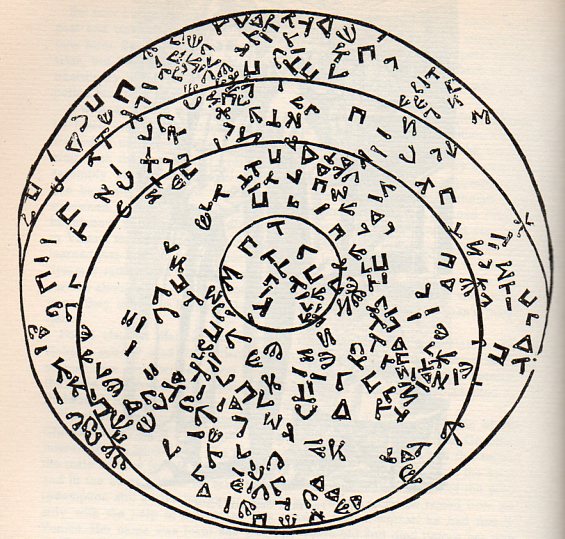
    Working on the next installment of cosmological images [and also a continuation of the series on writing systems] I put together a series on naming the stars, ideas providing the mechanics for naming the celestial kingdom, applying an alphabet for relative discussions of the heavens.  The most provocative of them all, I think, belonged to Guillaume Postel (1510-1581), a scholar who took flight in his imagination and who  established a world system which for him created  a harmony between all things that existed and the maker of the universe, and which basically was an attempt to move far past any identification system to a catechize the stars. Postel’s was a communication system between man and the beyond, not a coordinate system.  He incised the stars in his vault of heaven with Hebrew letters which would be the keys to understanding all things–and at the basis of all of this was his conception of a world unified religion which incorporated Christian ideas and values and to which all other religions would transpire. 

    Alphabet--stars  hebrew519

    There were numerous other attempts to establish divine alphabets, though none so far as I know were inscribed directly on the stars intended to serve as a means of transferring information and insight.  The extraordinarily accomplished (Renaissance man of the Renaissance, physician, astrologer, botanist, occultist, and general fill-in for whatever discipline needed help) Paracelsus’ Alphabet of the Magi also used Hebrew letters supplemented with magical alphabets for divination purposes, though not on the stars.  Heinrich Cornelius Agrippa (an astrologer/magician/theologian/occultist, 1486-1535) in the early 16th century came close to the Postel idea with his Angelic Alphabet, though this was used to communicate with angels and again was not incised on the stars themselves.  John Dee’s (a man of many and high accomplishments, a mathematician, occultist, astronomer, astrologer, alchemist and divine, 1527-1608) angelic alphabet was somewhat similar to Agrippa’s; his “Enochian” language used to communicate with angels.
    Alphabet--celestial

    Letters and numbers were of course used on stars but in general were used to identify the magnitude and position of stars in the constellations.  Johann Bayer (1572-1625) applied Greek letters to stars according to their relative luminosity in his revolutionar Uranometia (published in 1603).  John Flamsteed (1646-1719, and who was “The King’s Astronomical Observator” and  the first British Astronomer Royal)would come a little later and use an arabic numeral and Greek letter system, which would give the relative luminosity as well as the star’s position from the western-most edge of its constellation. 
                                       
    But it was this image by Postel which is the most astonishing, really, attempting as it did to read the heavens and the works of God without ever having to actually see the Creator (a thing most impossible, as stated in Exodus 33:20).

    ·Posted by :

    ·in:

    — — —

  • A History of Blank, Empty and Missing Things: the Importance of Nothing

    JF Ptak  Science Books  Post 1145

    {This is one in a longish series on the the History of Blank, Empty and Missing Things]

    There is importance and elegance, grace, necessity in nothingness.  That nothing happens is exceptionally important in almost all areas:  the meaning of silences between notes and longer pauses in musical compositions, the essential aspect of timing in a comedic routine, the special place that one goes in meditation, the distinction of wide margins in a beautifully designed book (magic that hasn’t been remotely approached by Kindle & Co., though it said that they have their own hidden beauties), and sometimes just the place where ideas are born.  The places for the beauty of nothing are endless.

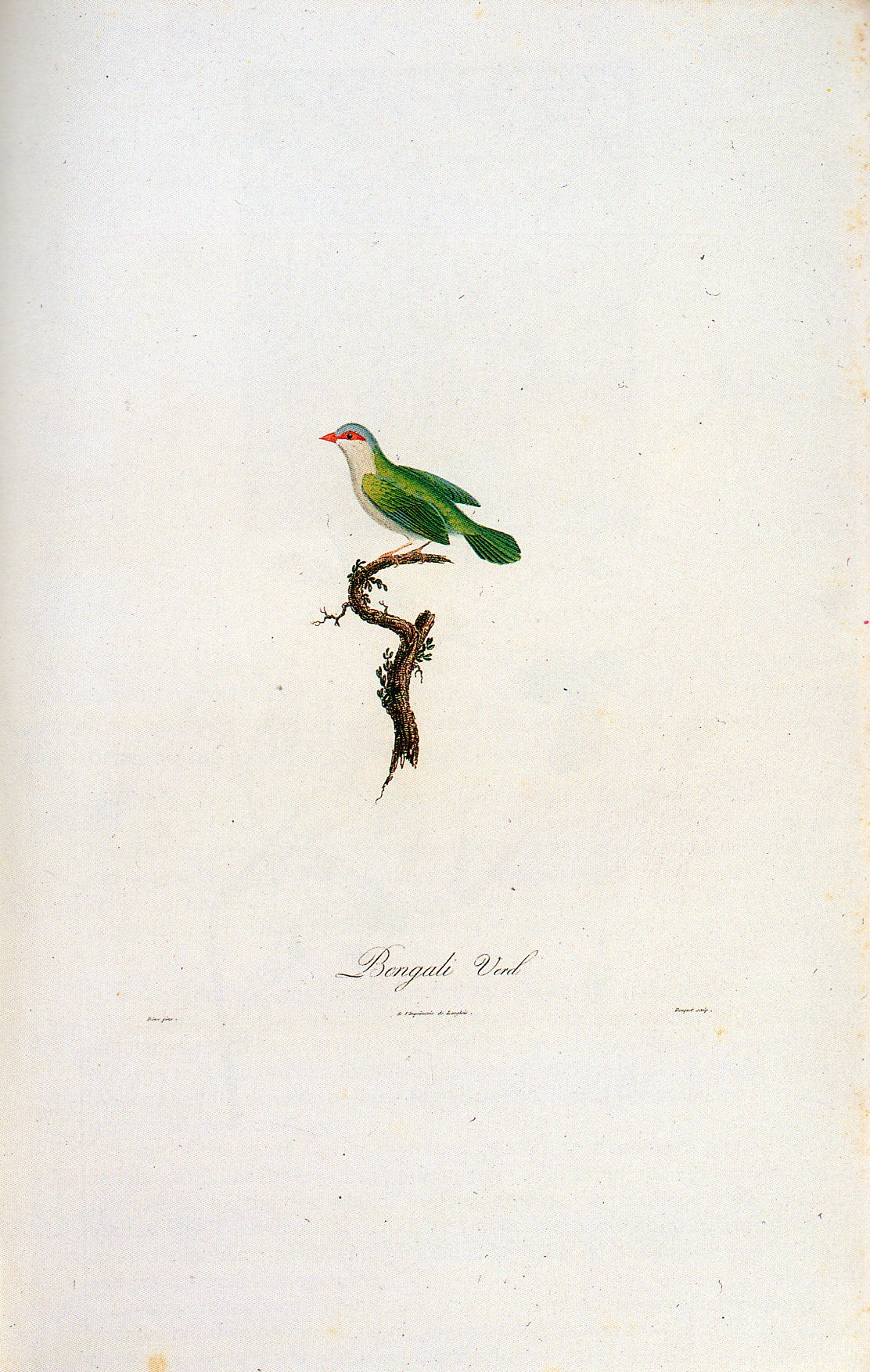
    The use of nothingness in art compositions an designs is of course essential–it is sometimes just a little odd to think of it as its own special, spatial element, as its own force of creation or design. 

    Take for example this beautiful use of not filling up space by Louis Jean Pierre Vielliot in his 1805 work on natural history:

    Patti--WIWFY-Cover design Bird407

    It would be so easy to crop out these gorgeous margins, and so kill the power of this image–you’re left with the main ingredient of the effort, but without its necessity, or power.

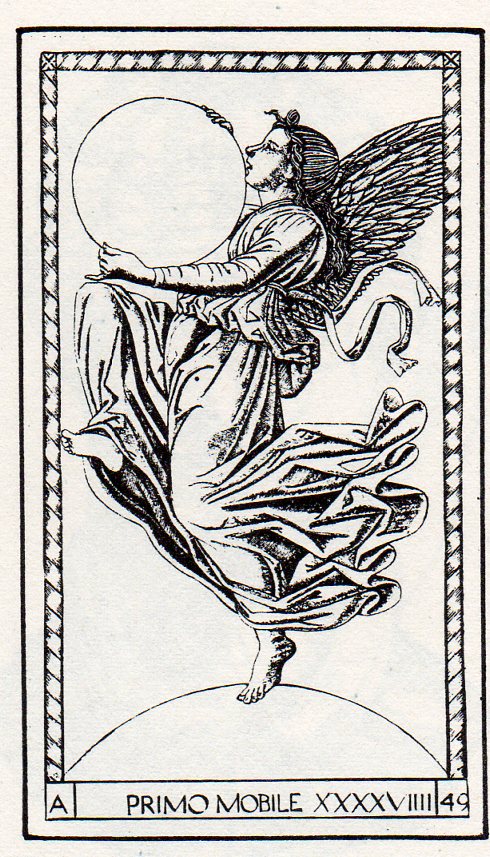
    Empty--tarocchi412 And of course there’s sometimes everything in nothing, seen here, with the universe in the hands of the Primum Mobile, (one image among 50 in a series known as the Mantegna Tarocchi,
    drawn and engraved by artists unknown ca. 1465, though it was once
    believed to be the  work of the great master Andrea Mantegna (and later
    the possible work of Bacci Baldini)). From my reading of this image, the universe is held  in the hands of the primum mobile,
    a spherical container of not-quite-nothing, waiting for the creator to
    breathe life into it.  The possibility of absolutely nothing was seen as
    an impossibility, a perfect vacuum, a space of certain nothingness, was
    a violation of theological belief.  That the sphere existed was a proof
    that–in the 15th century–you simply couldn’t have a container of
    nothingness. The very presence of the sphere confirming that there was
    something being contained by it.

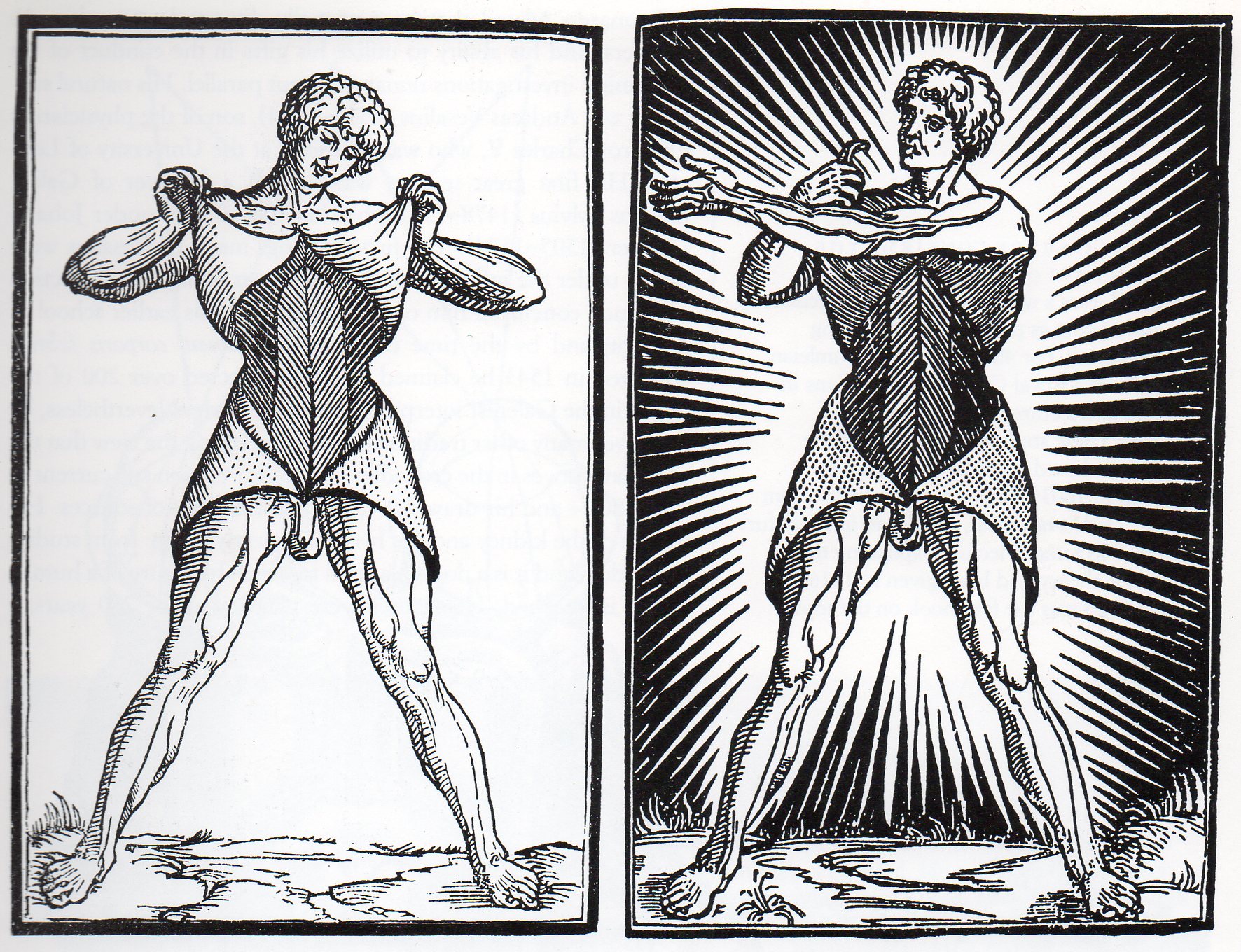
    Here’s an excellent example of the use of nothing as a design force (from Berengario da Carpi’s Commentaria siper Anatomia Mundini, published in Bologna in 1521), where we see what is basically the same exact dissection, except for changes in the internal shading and of course the lightning bolt background.  The simpler design is by far the superior.

    Empty--anatomy411

    It does take some confidence and courage sometimes to use big wide swaths of white, using complementary nothingness–and that’s a good thing.  Sometimes too much “something” isn’t nearly as useful or important as a little bit of “nothing”.


  • The Mess in the Message: Propaganda in Textbooks and the Control of Intelligence (with Examples from the Confederacy)

    JF Ptak Science Books   [A note on an idea for a future post.]

    Like my father before me, I grew up playing Cowboys and Indians.  In many respects, that game was probably not all that far removed from the history that we learned in our school textbooks.  Growing up in a myth and reading about other myths, its hard to disassociate yourself from the power of those words.

    I was thinking about this earlier, finishing a post on 19th century American occupational alphabets, and thinking of the ways in which certain classes and types of people are represented–stereotypes, radical misstatement of the truth, and outright lies were sometimes included, and as they were being used to help a young child learn the alpha-beta, they also formed the core, a foundation, of a belief system simply through association and repetition–a twisted mess that very well might have taken decades to unravel.

    In that light, I’d really like to see a history of propagandistic history as taught in American schools–that’s where early battles are fought, that’s where the power of words gain strength, and that’s where the basis of all future histories that threaten those introductory lessons come to a point of contention, if not conflict.  The power of language finds its way into the young vocabulary, and has a hard time being removed.           

    Someone wrote a book about everything that they ever needed to learn was learned by kindergarten.  That sort of education cuts both ways.

    Whether it is an assault on the integrity of the biological sciences and general logic for textbooks to include “alternative” in the teaching of the formation of species and the world, or representing geological time that began in impossibly late stages in the development of the Earth and the Solar System, or glorifying the presidency of Ronald Reagan, it is the control of language that leads to the control of thought, and it is on textbooks that many of these battles are currently being fought.  And have been fought. 

    If I had access, I would love to look at the following books, their titles suggesting a frontal assault on remedial and basic ideas of communication re-fitted to the place and time and people–language and definitions reconsidered to serve the purposes of  a new user group.  I’ve chosen these titles simply because of their titles, and also because I’m in the South. (And partially too because my wife’s great-great grandfather and three associated relatives fought in the Cause, against the Union, and that is part of their history.)

    And so the books that I’d like to see:

    Richard McAllister Smith unleashed quite a torrent over a few years:  The
    Confederate First Reader: Containing Selections in Prose and Poetry, as
    Reading Exercises for the Younger Children in the Schools and Families
    of the Confederate States
    (Richmond 1864) followed by The Confederate Primer (1863) and The Confederate Rhyming Primer [Or, First Lessons Made Easy. Designed as an Introduction to the Confederate Spelling Book] (Richmond:
    1863) and The Confederate Spelling Book, with Reading Lessons for the Young, Adapted to the Use of Schools or for Private Instruction. (Richmond 1863).

    Leverett, Charles Edward. The Southern Confederacy Arithmetic. By S. Lander, A. M.. Augusta: J. T. Paterson and Co., 1864.

    There was also the very concerted effort by Mrs. Marinda Branson Moore, including The Dixie Speller. To Follow the First Dixie Reader, ( Raleigh: Branson and Farrar, 1864), The First Dixie Reader; Designed to Follow the Dixie Prime (Raleigh: Branson, Farrar and Co., 1863), followed by her The Geographical Reader, for the Dixie Children.(Raleigh: Branson, Farrar and Co., 1863), and her  Primary Geography, Arranged as a Reading Book for Common Schools, with Questions and Answers Attached (Raleigh: Branson and Farrar, 1864). 
                                       
    Robert Fleming managed to really mix it up, and also to get all of it into the title of his book  The Elementary Spelling Book, Revised and Adapted to the Youth of the Southern Confederacy, Interspersed with Bible Readings on Domestic Slavery. (Atlanta: Franklin Steam Printing House, 1863.)

    Lemuel Johnson’s. An Elementary Arithmetic, Designed for Beginners: Embracing the First Principles of the Science. By L. Johnson. A. M., Professor of Mathematics at Trinity College (Raleigh: Branson and Farrar) published 1864

    ·Posted by :

    ·in:

    — — —