A Daily History of Holes, Dots, Lines, Science, History, Math, Physics, Art, the Unintentional Absurd, Architecture, Maps, Data Visualization, Blank and Missing Things, and so on. |1.6 million words, 7500 images, 4.9 million hits| Press & appearances in The Times, Le Figaro, Mensa, The Economist, The Guardian, Discovery News, Slate, Le Monde, Sci American Blogs, Le Pont, and many other places… 5000+ total posts since 2008.

Category: Naming Things

  • Hobo Signs Map, 1870

    JF Ptak Science Books   Post 1750

    Bloghobo_b200

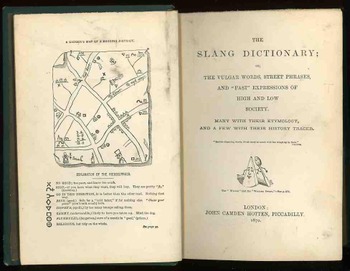
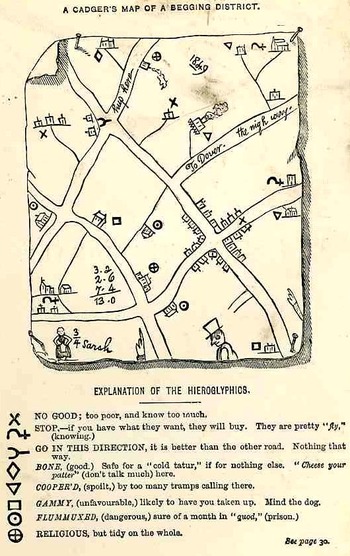
    This is the frontispiece to the delightful work with the luscious title of The Slang Dictionary; or, the Vulgar Words, Street Phrases and Fast Expression of High and Low Society… printed in London by John  Camden Hotten, in 1870.  It is a hobo or “cadger” (“a  mean or vulgar fellow who would rather live on other people than work for himself”)  map (or the map of “a tribe of vagabonds”) of Maidstone, in Kent, drawn by a “screever” (a sidewalk chalk artist who normally would draw religious images for money), and showing the various chalked and etched signs that the hoboes (“and other mendicant marks”)  would leave for one another, being a key to the town, for what was practicable, safe, dangerous, and the like.

    Recorded antiquarian hobo and tramp symbols like these are really quite rare, given their ephemeral nature to begin with; of course the need to record these obscure signs by polite society was not on a high order.  There are many indications that signs such as these existed, but not many illustrations.  For example in the book The Triumph of Wit; or, Ingenuity Display’d in its Perfection, edited by John Shirley. (1724), as well as works by Holyland and Borrow there is a description of English gypsies and their travels, and a short description of their use of boughs and sticks, set out for each other, so that a duplication of effort by different bands or families would not occur.

    (The figure of the woman, wonderfully named “3/4 Sarah”, probably connects this Sarah to a sort of popular dance.)Bloghobo_a199_2

    Hotten also published the following interesting and title-bending work in 1874:  THE ORIGINAL LISTS OF PERSONS OF QUALITY;  EMIGRANTS; RELIGIOUS EXILES; POLITICAL REBELS; SERVING MEN SOLD FOR A TERM OF YEARS; APPRENTICES; CHILDREN STOLEN; MAIDES PRESSED; AND OTHERS WHO WENT FROM GREAT BRITAIN TO THE  AMERICAN PLANTATIONS 1600-1700, WITH THEIR AGES, THE LOCALITIES WHERE THEY FORMERLY LIVED IN THE MOTHER COUNTRY, THE NAMES OF THE SHIPS IN WHICH THEY EMBARKED, AND OTHER INTERESTING PARTICULARS.


  • Classifying Mind Clouds

    JF Ptak Science Books    Post 1716

    Luke Howard achieved some fame and did the world a great service by (finally) identifying and classifying some of the most-overlooked objects in the natural world–clouds.  Throughout the history of humans giving names to things, even in the groups of the greatest of the classifiers, like Aristotle, clouds managed, somehow, to escape their classifying grid-vision–until Luke Howard, which took until the early 19th century. (I wrote about him here.)

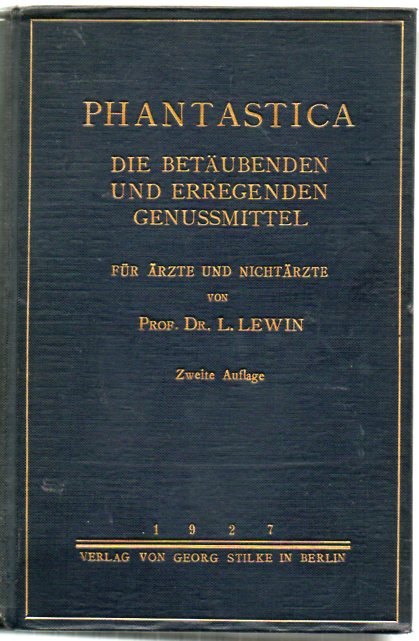
    Louis Lewin (1850-1929)–Dr. Lewin–classified another sort of “cloud”, more of the internal, botanically-induced psychoactive variety than the outside, high-in-the-actual-sky clouds.  Lewin was  a pharmacologist and leading toxicologist, and what he did, really,was help to establish the field of ethnobotany through his deep scientific investigation of drug use around the world.  This was an entirely new approach to this issue: by investigating how the plants produced their effects Lewin took another step into a new field apart from the prevailing anthropological approach, which looked at the methods and beliefs and such in the use of the drugs. Lewin experimented with peyote, te, heroin, coffee, annabis, alcohol, opium, kava and of course tobacco, as well as many other drugs, and published them in his book Phantastic, die Betaubenden und Erregenden Genussmittel fuer Artze und Nichtarzte (“Narcotics and Stimulating Drugs, their Use and Abuse) in 1924, expanding it in a second edition in 1927. 

    Lewin167

    Lewin organized and classified the drugs into categories that remained basically unchanged:  Inebriantia (inebriants such as alcohol or ether) ; Exitantia (stimulants such as khat or amphetamine) ; Euphorica (euphoriants and narcotics such as heroin) ; Hypnotica (tranquilizers such as kava); and of course the Phantastica (hallucinogens or entheogens such as peyote or ayahuasca). [This list with links transfered from an article on Lewin from wiki.]

    [The original of this interesting work is available on our blog bookstore site, here.]

    ·Posted by :

    ·in:

    —

  • Motion and Change in Natural Sculpture–The Galileos of Clouds and Snowflakes

    JF Ptak Science Books   Post 1692

    (I wrote this post two years ago in the bookstore section of this blog but never put it in the blog. Here’s an addition to the Howard material in a new listing in the bookstore section.)

    It is odd to think among the great classifiers of nature, including even the lofty-namer Aristotle, that clouds were not scientifically classified until the early 19th century.   Here they are, just about the biggest thing we have as earthlings that are gigantic and close to us, and nobody offered a good classifications scheme until 200-odd years ago—a pretty slim margin of time  in the terms of recorded human history.
    Blogcloud_howard

    Clouds are of course problematic, what with floating around and all—but if you didn’t already know the relative newness of their recognizable names isn’t it shocking to learn this bit of history? For the most part I think clouds must have been thought as being too transient, changeable, whimsical, wispy, to be given proper names.   The great scientist and classifier Lamarck tried to do so in his  Annuaire Méteorologique of 1802, and really is the first to try this, but his ideas weren’t terribly good (especially compared to the rest of his work), and it seems as though he left his best thinking effort on clouds at home.  For example, he gave us Hazy, dappled, massed, broom-like and grouped clouds as classifications (in French, respectively, en forme de voile, pommelés, attroupés,  en balayeurs and groupés).  They seem quite “French” to me, but largely outside the scope of being useful. 

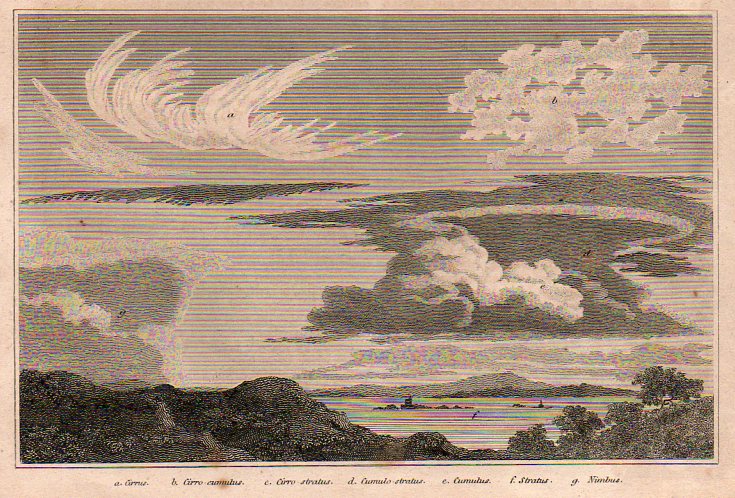
    It was the English pharmacist and chemist Luke Howard who in 1803 gave a greater bit of thought to structuring cloud names, classifying them according to size and shape and giving them Latin names—and this forms the basis of our naming clouds to this day.  Howard was perhaps the first, greatest, meteorologist, producing On the Modification of Clouds, (in which he describes his naming system, the “modification” part actually meaning classifying rather than changing),  The Climate of London, and the first textbook on weather,  Seven Lectures on Meteorology.  Howard’s system was expanded in 1887 by Abercromby and Hildebrandsson, who further classified clouds by height above ground as well as by appearance (and utilizing Howard’s naming system). 

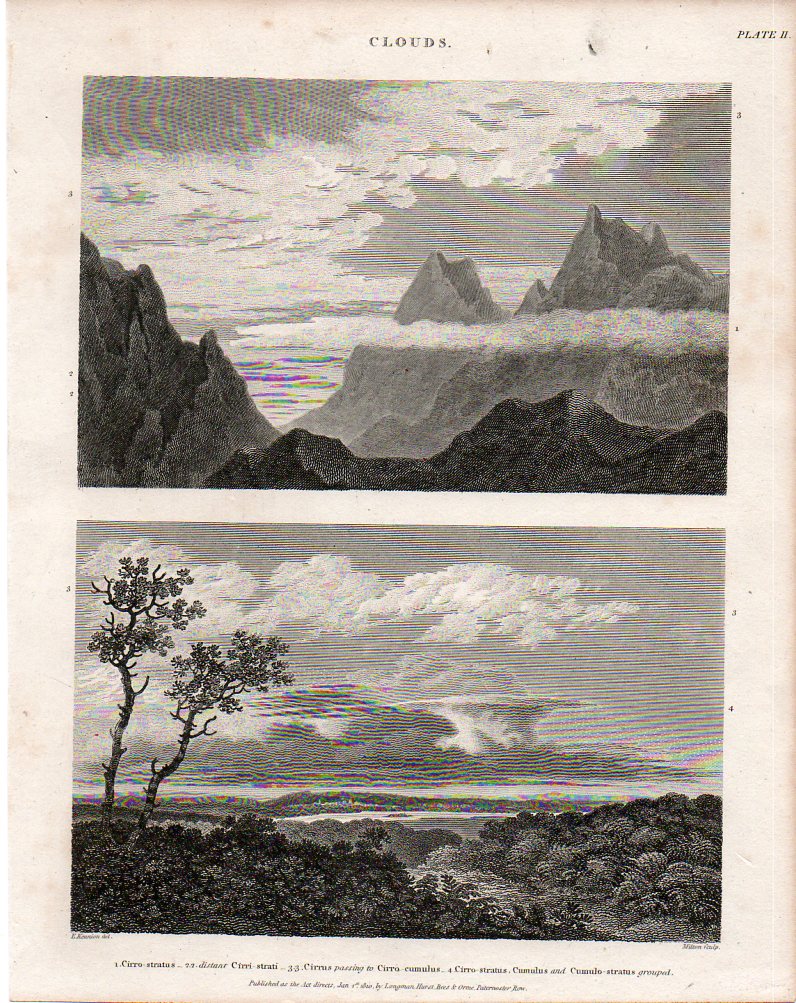
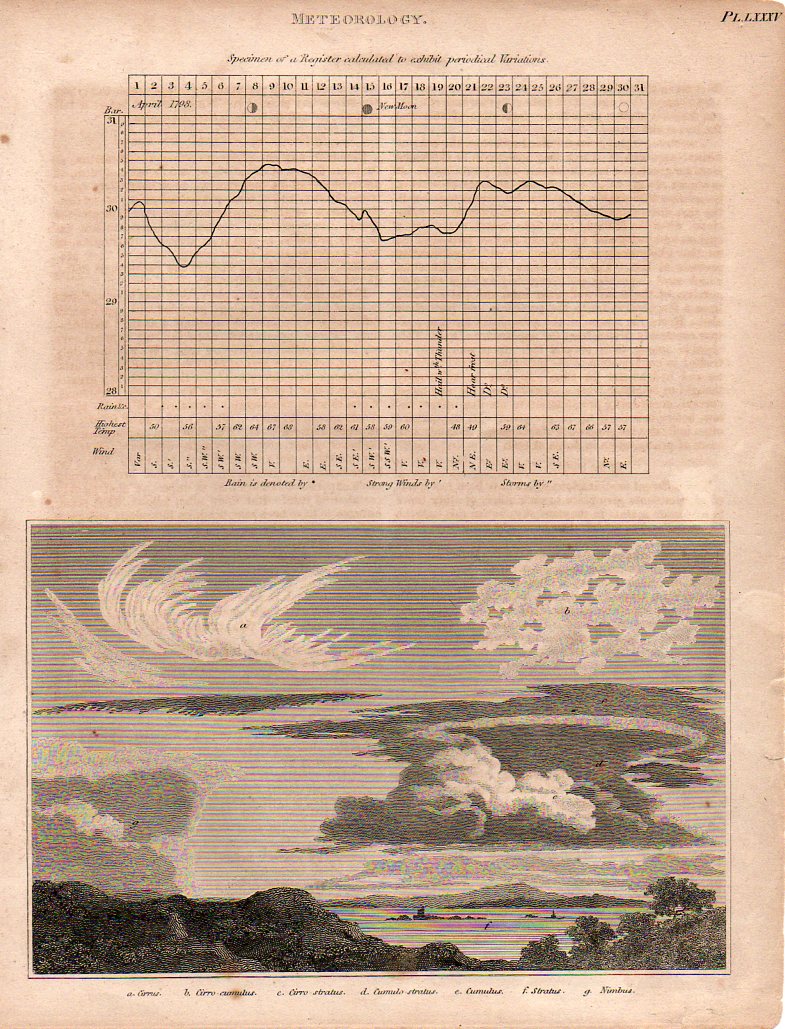
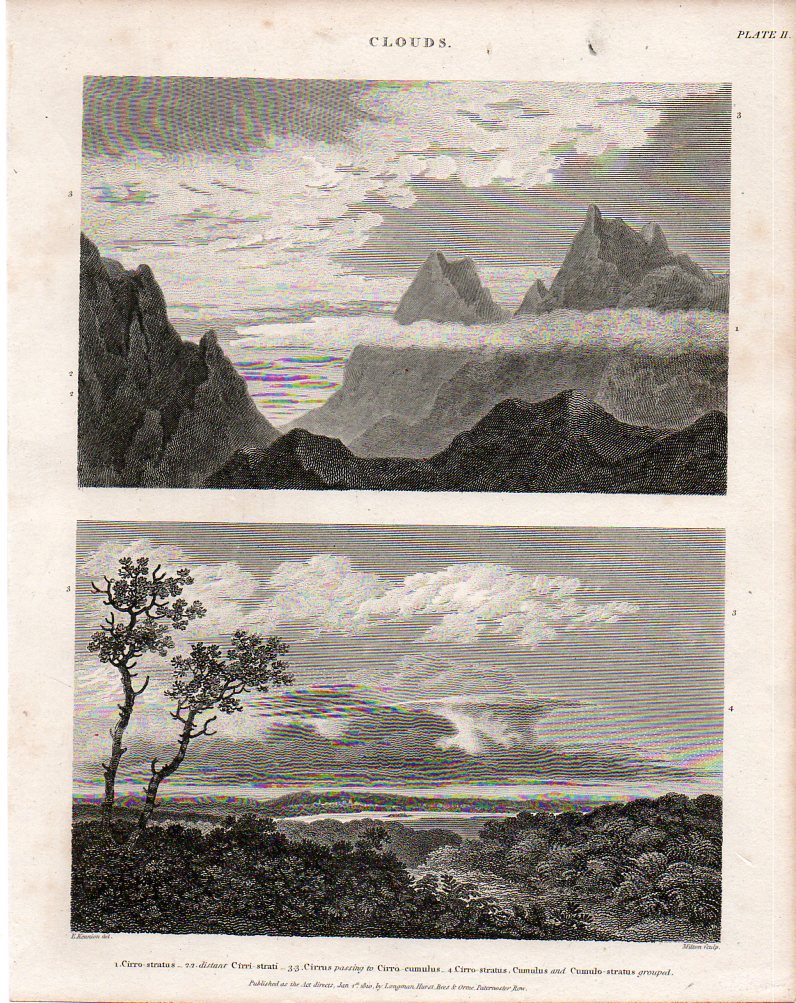
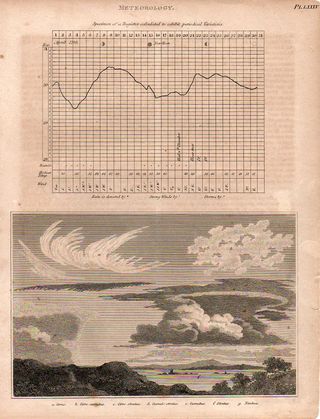
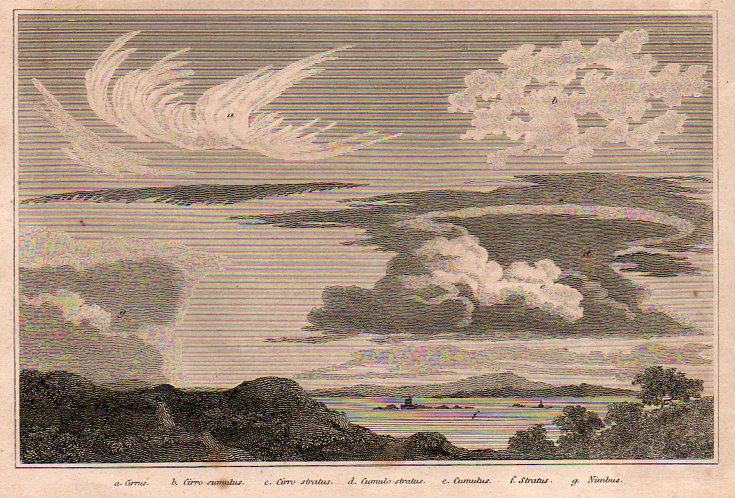
    Here (below) are two fine, early examples of cloud-naming for the scientifically-minded of the British elite, finding their way into print in the fabulous, ingenious and  mammoth (45-volume) Cyclopædia, or The New Cyclopaedia, or, Universal Dictionary of the Arts and Sciences, edited by Abraham Rees (1743-1825).  The work was published between 1802 and 1820, and was the resulting effort of 100 contributors who generally wrote monograph-length entries, contributing to a final tally of close to 40 million words.  I’ve particularly enjoyed the illustrations like those below—some of which have become iconic—and especially the fine and deep engraving of Wilson Lowry.
    Clouds875

    Cloudsb876Howard began his system by identifying three basic shapes to clouds: heaps, layers, and curls.  Heaps of separated cloud  masses with flat bottoms and bulbous, splayed, tops, which he called cumulus, which is Latin for heap; the Latin stratus was applied to clouds in layers which were much wider than they were thick; and again to Latin for cirrus, which called out the wispy curls of clouds.  (Rain clouds were given the Latin nimbus, for rain, and so on.) 
      Cloudsbdet877

    It is interesting and romantic to think of Howard being moved in his love of clouds as many Brits and Europeans were in the Volcanic Year of 1783 by the enormous eruptions of the Eldeyjar (Iceland) and Asama Yama (Japan) volcanoes—the force of their eruptions caused enormous changes in the skies (especially in Europe), creating vast sky-borne tapestries (the “Great Fogg” in England) and for such extended periods of time that it would have been impossible for the scientifically-minded Howard not to see them. 
    Blogsnowflake_bentley

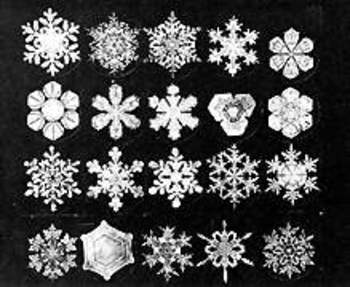
    Similar, in a way, to clouds is the snow crystal (snowflake)—they change forms in their lives from sky to ground, and may well disappear on contact with a warm surface.  Of course unlike clouds they may fall and be captured, kept even, though the ability to actually perform some sort of scientific something with them didn’t occur until 400 years ago, which means that snowflakes passed in and out of human existence being very simply named (in most languages) as a mass group, and not classified at all.
    Blogsnowflake_hooke

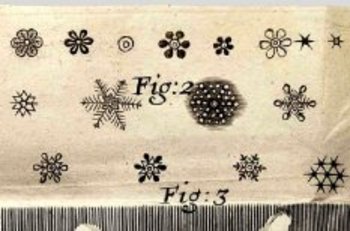
    Johannes Kepler thought very deeply in In 1611 publishing a short treatise called On the Six-Cornered Snowflake, thinking that perhaps their (mistaken) six-cornered symmetry revealed something much deeper about the basis of nature and the universe. The 26-year-old  Robert Hooke seems to be recognized as the first to throw the snowflake under a microscope, publishing drawings of them and just about everything else that he saw in his monumental (and tall, being 13-inches tall) Micrographia (1665)–the first truly scientific book of modern times.  The largest of the large images was saved for the flea, showing the unsuspecting public the great and beautiful nature of what seemed like a fantastical beast (under magnification).  Snowflakes appeared in the book, revealed in their intricate and seemingly-symmetrical nature.  Fantastic, unimagined images. This aside, he seems to have, um, borrowed these images from an earlier work, Thomas Bartholin’s  De Nivus usu Medico Observationes Varieae, 1661.  But so it goes. 
     

    The Galileo of the snowflake was Wilson Bentley (1865-1931), an autodidact Vermont farmer, seen by fellow hamlet-dwellers as odd and off, who figured out how to photographically and beautifully record the intricacies of the snow crystal world—no one had ever done this so dramatically, with such gorgeous results.  It really was as though he was able to record the heights of the mountains of the moon with a slender telescope in Pisa, 350 years earlier. The results of his decades of experience were published  in 1931 his book Snow Crystals, containing more than 2400 snow crystal images.  On the heals of Bentley’s accomplishments came the classically trained nuclear physicist Ukichiro Nakaya, who was truly the first person to apply a scientific classification to snowflakes, and who published his intrepidly-beautiful work in a 1954 book entitled Snow Crystals: Natural and Artificial.  His classification system of the various types of snowflakes would prove vastly more useful, interesting and appealing than that published by the 1951 the International Commission on Snow and Ice, and forms the basis of the discussion of snow crystals today—a classification system of a massively-occurring phenomenon that is younger than me. 
    ·Posted by :

    ·in:

    —

  • On Recognizing Things: “Outsider” Art


    JF Ptak Science Books  Post 1684

    On an early use of the term, Outsider.

    Outsider b075

    Sometimes a word is just a word, and the elements of recognition sometimes inhibits that.  Except in this case that the word seems to be just what it is and also indicative of what it would become.

    Outsider074
    Outsider, or outside, outside the recognition of “official” art, of critiqued-art, is the English language equivalent/translator coined in 1972 (by Roger Cardinal) to illustrate the term art brut (“raw art”) created by Jean Dubuffet.  Dubuffet created with others Compagnie de l’Art Brut in 1948, which in some respect was a reaction to a new sort of displayed art that had begun its life in the early 1920’s, mainly as the efforts of doctors treating psychiatric patients who were expressing themselves through their art.  (Two famous examples include Dr. Walter Morgenthaler’s Ein Geisteskranker als Künstler (A Psychiatric Patient as Artist), published in 1921 on the work of perhaps the most famous people in the Outsider canon, Adolf Wölfli; and another being  Bildnerei der Geisteskranken (Artistry of the mentally ill) published a year later by Dr Hans Prinzhorn.)

    [Adolph Wolfi]

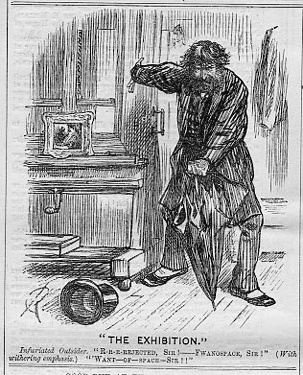
    Well, “outsider” as we  know it today in reference to the arts is definitely not what the editors of Punch magazine pursued in this cartoon for their issue of 6 May 1886.  The “infuriated outsider” was simply an artist left outside a show, whose work was not accepted for exhibition. (And from the looks of it, the small work on the huge easel, being rejected for the “want of space” might not have been the reason for the artist not making the list.)  

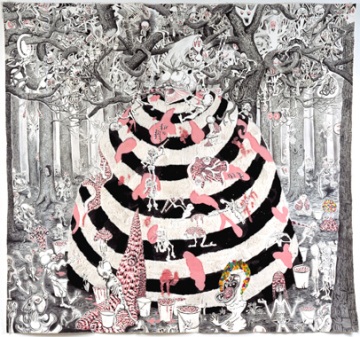
    Trenton Doyle Hancock, “AND THE BRANCHES BECAME AS STORM CLOUDS”, 2003, Mixed media on canvas. Photo courtesy James Cohan Gallery, New York and the American Folk Art Museum.

    [Henry Darger]

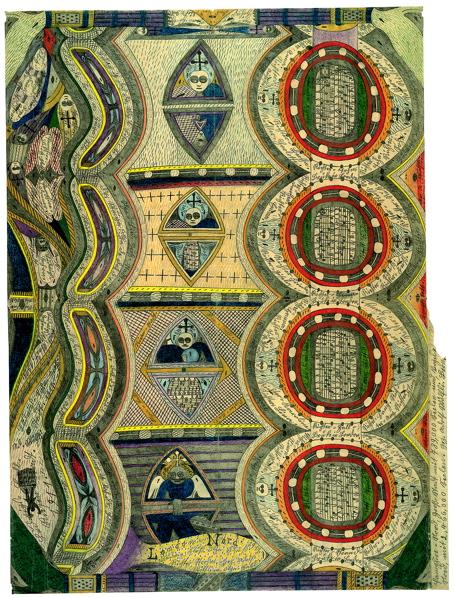
    This outsider was simply outside with probably-not outsider art.  Henry Darger (1892–1973), Martín Ramírez (1895–1963), Paul Gösch (1885–1940), Charles A.A. Dellschau (1830-1923), Willem Van Genk (1927–2005) and so on were Outsiders, their work being Outsider/Art Brut and also being left outside for a long time.  Far outside.  In the far-deep outsider, further and deeper outside than the more aesthete outsider varieties of “outsider” art–like Impressionist, Cubist, Dada, Constructivist, Futurist–ever got outside.  

    [Willem van Genk, detail]

    Anyway, I thought it curious to find the term stuck in the middle of a cartoon rant in an 1886 popular journal.


  • History of Lines: Clouds

     JF Ptak Science Books  Post 1629  (On Clouds and Not-Clouds, Part I)

    “…and they drew all manner if things–everything that begins with an M—‘

        ‘Why with an M?’ said Alice

       ‘Why not?’, said the March Hare.” –Lewis Carroll,  from “A Mad Tea Party”, in Alice’s Adventures in   Wonderland.

    Why not, indeed?  I’ve long had an interest in clouds, and since this blog is ostensibly on the surfacing or definition of Cloud Bones, I though to spend a little time on the origins of the depictions of printed clouds in art. Not being an expert by any means on the history of art, it just seems to me that after long exposure clouds are not well-represented in woodcuts, wood engravings and other early engravings, or at least not so well depicted as their landsmen in paintings.  There seems to be no shortage of effort to reveal gorgeous clouds  through the early Renaissance–but the doesn’t seem to apply very often to their representation in prints.

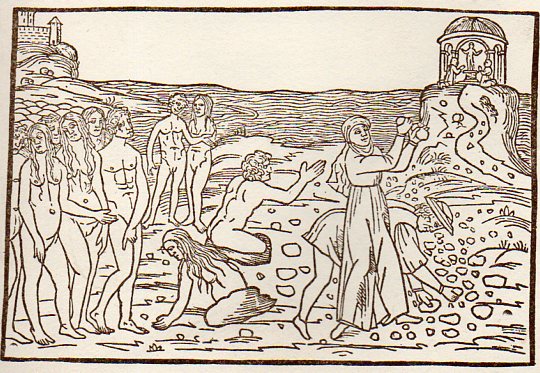
    And that of course is when the detail of the sky is depicted at all. It seems that more often than not, in woodcuts printed from say 1460 through 1550, that the sky is left blank, like this image from Ovid (Accipe Studiose Lector P. Ouidij Metamorphosin...printed in Venice in 1509:

    Clouds no couds livy913

    “You could not see a cloud, because
    No cloud was in the sky:
    No birds were flying overhead —
    There were no birds to fly”.–Lewis Carroll, Through the Looking Glass. 

    I could go on with many examples of the blank sky–the white, blank, settled nothingness–but exhibiting variations of nothing at this point isn’t necessary.  But illustrating clouds is.

    And for the most part, clouds don’t look very much like themselves in prints, not really, not for more than a hundred years.  For example, Martin Schoengauer‘s spectacular  The Temptation of St. Anthony, which was printed in 1470/5, has a beautiful, fluid circularity to it, full of an earthy roundness even as the saint is pursued by demons.  But the sky in the background is populated with nothing but dashes to suggest clouds. 

    http://thewholegardenwillbow.files.wordpress.com/2008/11/schongauer-martin-anthony103.jpg

    Perhaps clouds would have taken away from the moment; but if that were the case, why bother with the dashes?

    There are considerable exceptions to this practice, with Durer and Altdorfer coming quickly to mind–but in my experience, the oddly-formed cloud seems to be the majority rule in the woodcut.  

    At this time there were of course many depictions of skies with no clouds in paintings, bare suggestions of themselves, even in some of the most famous works–Botticelli’s Birth of Venus and Michelangelo’s Fall of Man in the Sistine Chapel are fair examples.  But once you move away from the golden Sienese skies of the14th century1, clouds are given full and beautiful shapes from early periods. (Giotto’s Christ’s Entering Jerusalem, 1305/6; Simone Martin The Road to Calvary, 1340; Duccio’s Christ Entering Jerusalem, 1308-1311; Fra Angelico’s The Dposition, 1436; Masaccio’s The Tribute Money, 1424; Lippi’s Annunciation, a perfect cloud treatise, 1442, and on and on. Other examples are found in continued reading below.)

    Clouds in prints are a different matter–I’m not sure if it was just too technically difficult to create clouds in wood, or if there was some sort of languishing Byzantine sensibility inherent in woodblocks that was not so in oil. I’m really not so sure about this, and as much as anything else I’m thinking out loud about this lack of cloud definition.  I don’t have an answer for it.  But I do want to share the beginning of a timeline for undefined clouds as they appeared (or not) over the course of about one hundred years,  from 1485 to about the end of the 16th century.   As I mentioned clouds appeared beautifully in paintings from earlier periods, and there doesn’t really seem to be a substandard-cloud complement in the painting world as there was in the print world.  Of course, in western philosophy and science, clouds were pretty much left alone from inquiry, even by a series of the great natural history classifiers–they wouldn’t really be given a fully taxonomic appreciation until 1803 by Luke Howard (which I wrote about in this blog earlier, here).

    A Timeline of Clouds in Prints, 1485-1596

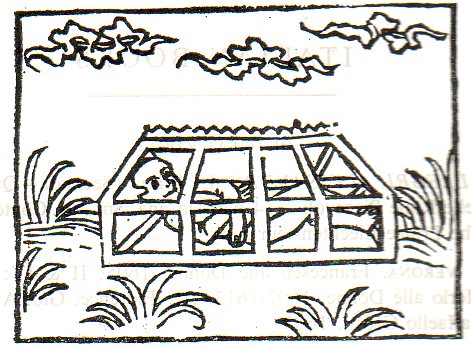
    Franciscus de Retza, De Generatione Christi, sive Defensorium Castiatis Beatae Virginis Mariae, a beautiful work in Gothic type–a picture book, really, with two illustrations of magnets.  Printed in 1485, this image depicts Isidorus in a magnetic coffin which is floating in the air:

    Clouds 1485908

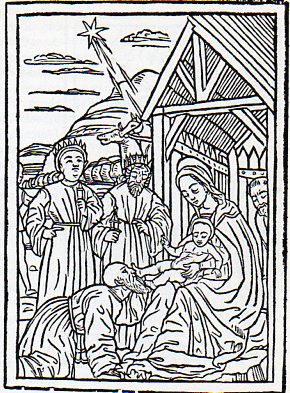
    “The Adoration of the Magi”, from Legenda Sanctorum Trium Regum, printed in Modena in 1490:

    Clouds 1490 adoration magi912
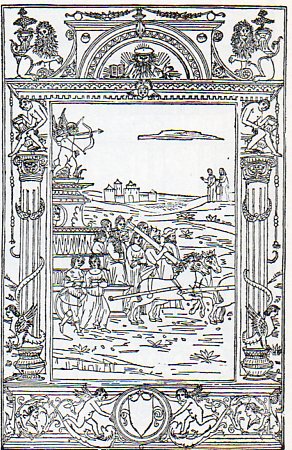
    The Triumph of Love, 1492/3:

    Clouds 1492 triumph love911


  • Did Galileo Know That He Was Galileo?

    JF Ptak Science Books     Post 1610

    Here’s an interesting lead sentence I found in 3QuarksDaily via Salon:

      “Karl Marx did not know what we know: he did not know that he was Karl Marx.”

    The author suggested that Marx would’ve had a better time in his life had he known what influence he wielded in what he was writing–basically, Karl Marx didn’t know that he was KARL MARX.  It is an interesting–and frightening–idea to think of someone laboring like that laboring (as it were) away in relative obscurity, or at least relative to the monumental influence it would come to have.

    The real question is not how many people might be in this category of not knowing who we know them to be, but if everyone is in this category at one point or another, and how long it took for them to understand the lasting significance of their work.  But for right now I’m interested to know what people think of the following ten science personalities, and to answer (in a simple survey), if they knew the significance of their work.

    The survey is simple and fairly straightforward, and asks questions regarding Copernicus, Harvey, Galileo, Einstein, Maxwell, Newton, Turing, Darwin, Lucretius and John Von Neumann. 

    You’ll have a chance to view the survey results at the end.  Thanks!

    Follow this link to the survey.


  • Two Gloriously Famous Bugs

    JF Ptak Science Books   Post 1605

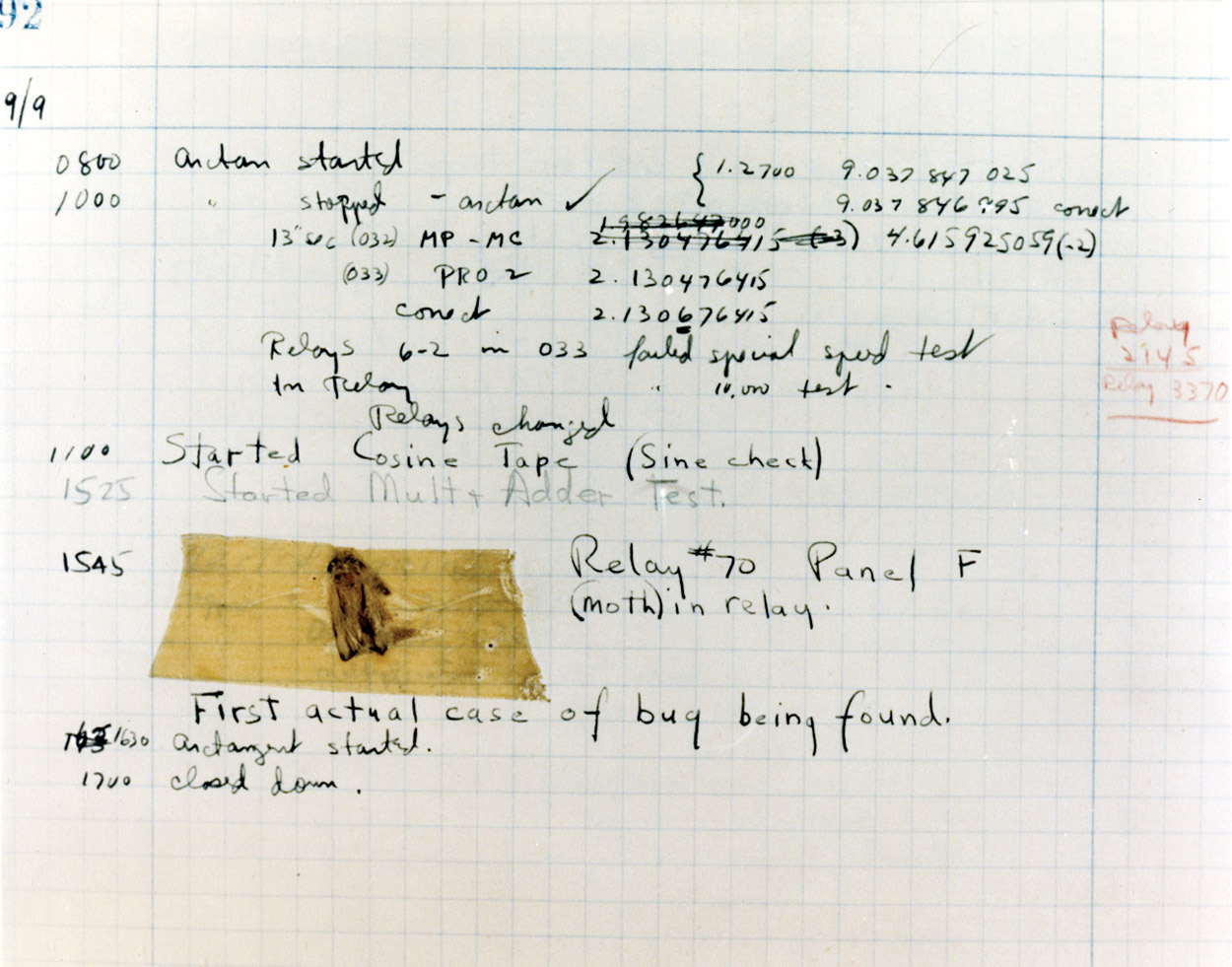
    September 9, 1947, is a big day in the page of The Big Book of Famous Bugs. This one found by Admiral Grace Murray Hopper in relay #70 of panel F of Harvard’s MARK II computer.  It was a 5 cm moth, actually, that was gumming up the works.  Hopper–an integral part of several teams  working on programming the earliest computers–witnessed the event, recorded the finding of the insect, and coined the word “debugging”.  She was an important figure in the history of computation, though Dr. Hopper is remembered by the general audience more for the bug than anything else.

    Grace Hopper Bug

     [Image source: https://yalealumnimagazine.com/articles/2633/you-can-quote-them]

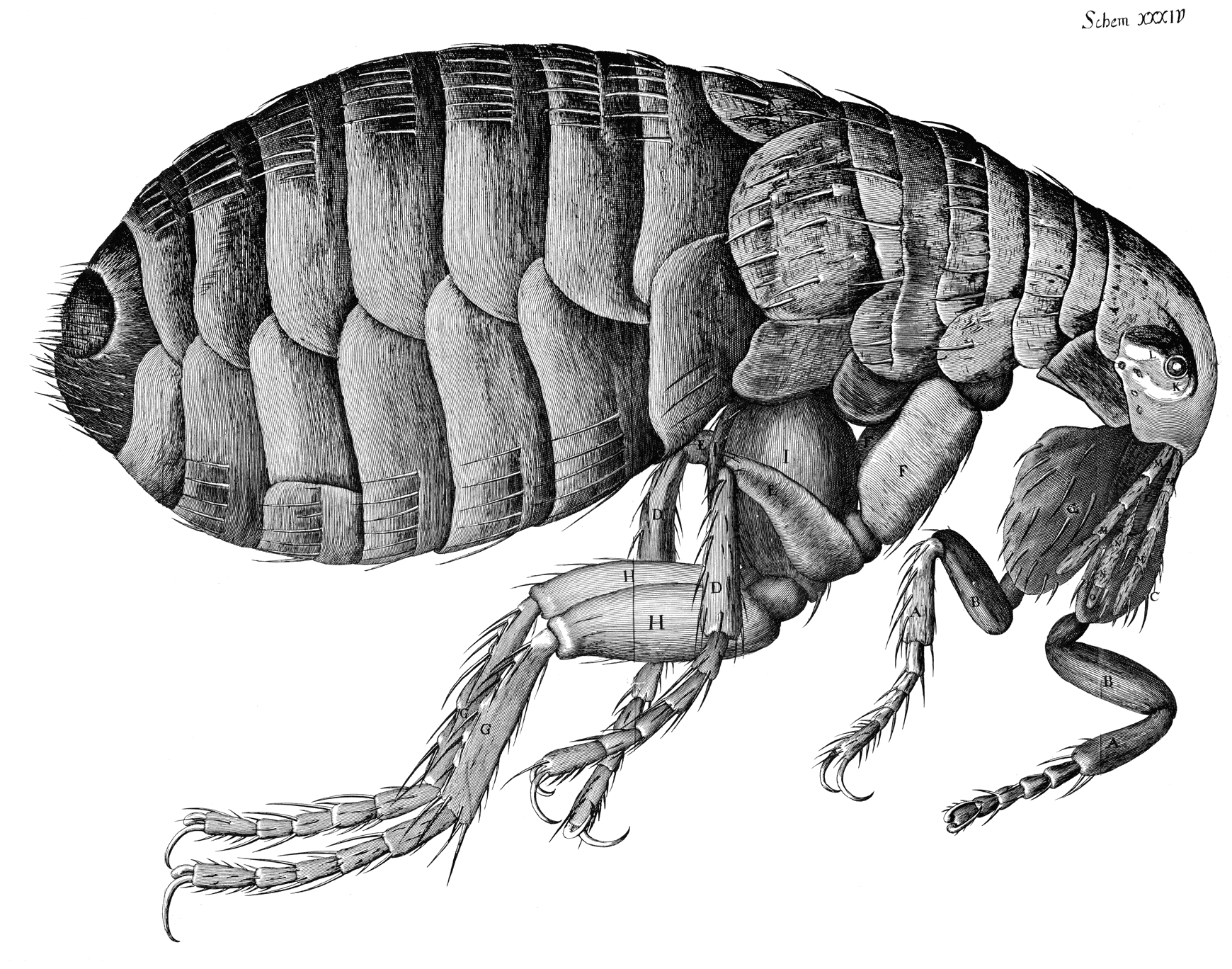
    The other famous bug, perhaps the most famous in the history of science, belonged to Robert Hooke.

    Hooke--flea

    I’ve written elsewhere in this blog about Robert Hooke, and how, if there had somehow and impossibly been no Newton, he might’ve taken Sir Isaac’s place in the popular mind.  He was a tireless, relentless observer and experimenter, who lost little effort in a stranded idea and pursued interesting and problematic questions relentlessly.  More than others too he chased his won glory—minor but long and insistent—the years of which wore thin on many people in the scientific community.  But there were many characteristics of the man that made him not quite so lovable and endearing—not that Newton was any of those things, as he was not, but if you are going to be a secondary luminary to a super nova you’ve got to have something else going for you that the other man doesn’t have—sharing, helpful, greatly generous—to get you into the long pre-dusty pages of history. Also it would’ve helped if Hooke chose his battles with a little more aplomb and ingenuity—the war which began in 1672 with Newton went very badly for Hooke and followed him to the grave (and far beyond). 

    What I’d like to talk about right now, though, of the many things to talk about concerning Robert Hooke, is the most iconographic image he ever produced, and perhaps one of the most famous scientific images of the 17th century—the flea. 

    The 28-year old Hooke published the results in a gorgeous and revolutionary book, Micrographia (a lovely e-text edition appears at Gutenberg, here) in 1665, which became an instant best seller and highly praised and valued. (Samuel Pepys, perhaps among the shiniest stars whose imprimatur was like a royal blessing, said the book (was) “the most ingenious book that I ever read in my life.”) There is no telling what the people of the mid-17th century thought of seeing such incredible discoveries in the little semi-invisible stuff that made up their normal, daily lives.  The only thing that somewhat equates to this would be if the first images of the Hubble were those of Earth-bound objects whose detail had previously been unknown.  Hooke’s observations and drawings of things like the common flea were just an astonishment—that such a creature of “low order” could have such intricate detail and design was a complete revelation.  The drawings of the fly’s eye, too, was an inescapable wonder, an incredible object to consider as having any detail pre-microscope, and then revealed to have unimaginable design and elegance.

    And so the famous second bug.

    …”it is my hope, as well as belief, that these my Labours will be no more comparable to the Productions of many other Natural Philosophers, who are now every where busie about greater things; then my little Objects are to be compar’d to the greater and more beautiful Works of Nature, A Flea, a Mite, a Gnat, to an Horse, an Elephant, or a Lyon.”—Robert Hooke at the end of his 28-page preface to Micrographia (1665)


  • Man is But a Worm–Darwin and Redon, 1881-1883

    JF Ptak Science Books   Post 1589

    http://cdn2-b.examiner.com/sites/default/files/styles/image_full_width/hash/b2/77/b277d4d3e88c41151d8a3c709696c8c8.jpg

    In the last tow years of his life Charles Darwin enjoyed some critical and popular success  with the publication of his The formation of vegetable mold, through the action of worms,  which was published by the steadfast John Murray in London in October of 1881.  It sold at a better clip even than On the Origin of Species, which had sold very well 22 years earlier.  By the time the cartoon (above) appeared in print by the relatively mid-brow Punch magazine (by Linley Sambourne, 6 December 1881) Darwin’s book sold about 7,000 copies, which for the time would make it a pretty good seller.

    Darwin only had a few months left to live at the time of the Punch publication (12 February 1809 – 19 April 1882), and I’m not too sure about what the old man would’ve felt in seeing it.  Actually, the Old Man wasn’t all that old, but at 73 and with a belly full of worms or whatever and a lifelong list of complaints real and imagined, Darwin was older than jis years.  After everything had been said and doen, and the tons of complaints heaped upon him from all quarters, I suspect that the cartoon would mean nothing to him.

    {Just for the record, we follow the evolution of worm-to-man in a trip one and a quarter times around the clock, starting with a big old (flat?)worm at bottom left, which develops counter-clockwised into a chimp-worm, then into a monkey-thing, then into a sort of comic-relief Darwin-ape-man, winding its course into Charles Darwin himself.  Not flattering to the man or the idea.]

    It would on the other hand be a curious thing to imagine Darwin meeting for a chat with the expansive evocateur Odilon Redon, who created some of the earliest (non-confrontational editorial) art based on Darwin’s Origin.  Redon (April 20, 1840 – July 6, 1916) published eight lithographs based on Darwin’s work in  Les Origine (Paris,  Lemercier and Cie), and they were unlike anything that I’ve ever seen regarding evolution–as a matter of fact (perhaps), Redon’s artwork in general was unlike most anything else that existed.  (Redon acknowledged this, of course, saying  “My drawings inspire, and are not to be defined. They place us, as does music, in the ambiguous realm of the undetermined.”)

    http://www.19thcenturypost.com/The%20Misshapen%20Polyp%20Floated%20on%20the%20Shores,%20a%20Sort%20of%20Smiling%20and%20Hideous%20Cyclops,%20Plate%203%20from%20Les%20Origines,%201883,%20by%20Odilon%20Redon,%20Museum%20of%20Fine%20Arts,%20Boston.jpg

     “The Misshapen Polp Floated on the Shores, a Sort of Smiling and Hideous Cyclops”, plate 3, 1883.

    But I don’t see that much being said between the two men, across a small table having tea–though I don’t have any hesitation saying that Redon would’ve had a lot of questions for Darwin.  My feeling is that Darwin wouldn’t have that many coming back. 


  • History of Normalcy and the Fluidity of “-isms”, 1867

    JF Ptak Science Books   Post 1578

    My wife, Patti Digh, and I have long talked about the history of normalcy—a history of what looks to be “normal”, or standard, or acceptable at one time that became not so over the course of time.  Buying and selling human beings, women and their children being property of her spouse, and Chinese immigrants not having (any) legal rights, are three good candidates (among thousands) for this history in the fluid mechanics of socially-accepted thought and practice.  It is an interesting proposition to think about—what things around you, or better yet, what thing you think or say or do, that look good and acceptable today might look embarrassing and unacceptable thirty years hence. What is today’s ridiculed or reviled _______ may be tomorrow’s standard practice.

    This small slug of a story (below) appeared in the 23 March 1867 issue of Punch, or the London Charivari, and takes all manner of French legal reasoning to trial. It is a good example of the changeability of the porous borders of rank belief, centered in this case on Catholicism–and it might as well have been virtually any other -ism that you can think of.   Evidently the editor, manager and even the printer of Libre pensee were hauled into court,subjected to prosecution, tried and convicted of what seemed like hate literature.  In a series of articles appearing in several issues of the journal in February and March 1867 the author launched particularly sharp criticisms at some religions, including Catholicism, which he described it as  “a rotten trunk, a receptacle of death whose fatal emanations spread all around desolation and solitude”.

    But that’s not why the editor and manager were thrown into jail for a few months, not really–the judge in the case took issue with the magazine bringing the issue to light and exposing the shortcomings of Catholicism–which he believed were many–and which could be believed by many (“if not all”) people who read the article.  It was also found that the rant against Catholicism was not without merit (“too much of it could be apparently proved”), and that it would receive little rescue in a refutation that was not conceivable (“Let us not, therefore, contemptuously leave it to meet with a refutation which it will not receive.”).  The complaint was that the editor and manager allowed the thing to be printed, a thing which could in the eyes of the court lead to unrest–jailed for printing what the judge considered a incendiary truth even though it was bound in deceit and defamation.

    The judge wrote:

    “It is not obvious. It is not manifest. There is too much verisimilitude in that description of Catholicism. There are too many people who are likely to believe a good deal of it, if not all. The truth, moreover, is that, if any argument about it were permitted, too much of it could be apparently proved. Let us not, therefore, contemptuously leave it to meet with a refutation which it will not receive. Our wisest plan is to silence its promulgators. Accordingly we will sentence the manager and editor of the Libre Pensee to fine and imprisonment.” This is logic.

    I think what Punch was responding to was “stupidism”:  “Here, in England, Papists and Protestants are free to abuse each other’s respective isms as much as they please, so long as they refrain from libeling one another or any one else. John Bull cannot see who is wronged by the abuse of an ism. Of course that blindness is owing to his want of logic.”

    There was no mention of what happened to the author, unless the author was the editor. 


  • George and Archie: Two Misty Names in Making Everything Into Nothing. Hiroshima, 1945.

    JF Ptak Science Books   Post  1523

    http://upload.wikimedia.org/wikipedia/commons/thumb/9/93/Tibbets-wave.jpg/300px-Tibbets-wave.jpg

    The names of Col. Paul Tibbets and the Enola Gay are instantly recognizable, instantly placeable in the history of the twentieth century.  Fact is though that Tibbets didn’t pilot his (well, Capt. Robert A. Lewis’)1 B-29 all the way to Hiroshima and back, and wasn’t at the controls when the bomb was released.  Tibbets (also known as “Old Bull”) shared some of the tactically flawless mission with his co-pilot  Capt. Lewis, and also with George.  Well, its actually “George”,  the personified names for the autopilot of the aircraft, and I guess on the long road to splitting the atom it doesn’t matter much who did what at the final moments, especially if you were on the ground in Hiroshima. 

    It was Tibbets who flew the Enola Gay most of the way, through perfect skies, nothing to stand in the way of the aircraft and the completed mission–no Japanese fighter aircraft to haunt and hunt, and no anti-aircraft coming from the ground, at least not at their  low altitude.2 “George” was at the controls at 0815 on 6 August 1945–Tibbets would take control of the plane as the bomb fell away3, ripping the plane into a steep bank in trying to put as much distance between the aircraft and the bomb in the 43 or so seconds that they had before the explosion. Everything else about the bomb and the mission at the moment of release was controlled by a human–except for the flying of the aircraft. “

    “Archie”4 is the other name not so much remembered on this morning.  This was the name given to the apparatus (there were actually four of them on the bomb) that would initiate the final arming sequence for the MK1 bomb, “Little Boy”, one of a component of a fusing system that triggers the firing system.  It was a nicer handle I guess than its official name, which was AP-13.

    Notes:

    1.  Lewis was the original pilot of the aircraft until Tibbets was chosen to lead the mission against Hiroshima.  Tibbetts was named on 5 August and acted very quickly to get a painter to paint a name on the fuselage of B-29 82–so quickly that the guy who painted Tibbets’ mother’s name on the plane had to be pulled out of a baseball game to do the job.  When Lewis saw it, saw his plane with “Enola Gay” on it, he reacted badly, as he was mighty pissed.  He confronted Tibbets about it, but the Colonel informed the Captain that there was nothing to discuss. 

    2. Intelligence reported that the only antiaircraft resistance that could be expected were from heavier guns, which also happen to be very ineffective at the low altitude at which the Enola Gay flew.  This also benefited another aspect of the flight plan, which was fuel consumption–coming in low meant a big fuel savings, which in this case was very important because of the enormous load that the aircraft was hauling. 

    3. The Enola Gay would climb at last to 31,000 feet to release the bomb, which exploded at about 1980 feet above the ground. 

    4.  An interesting document from General Groves sums up the Archies nicely:  “Memorandum dated 24 August 1944 to Major General L. R. Groves from R. N. Brode, subject: Personnel with Radar Experience. According to the latter, the APS-13 was originally called the “Charlie” and those units to be adapted to atomic bombs were to be rigged to operate at selectable frequencies between 250 and 500 megahertz. By 1 January 1945, the “Archies,” with a “natural” range of 405 to 435 MHz, could be tuned between 325 and 485 MHz.  (“Interim Report Archie Frequency Range,” Lt. Leo Gross, 1 January 1945)–The History of U.S. Electronic Warfare, by Alfred Price, Association of Old Crows, Alexandria, Virginia, 1984, p. 232.”

    “By the spring of 1944, the APS-13 “tail warning device” was under study for use as a radar fuse. Originally designed to warn a pilot of another aircraft approaching the rear of his plane, the “Archie” had an effective range of about 2,000 to 2,500 feet.” Source: The Swords of Armageddon: U.S. Nuclear Weapons Development since 1945, Chuck Hansen, September 4, 1995, vol. VIII, pp. 3-45.

    And more:

    “Four “Archies” were used on each bomb, with a network of relays so that when any two of the units signaled, stored current was sent into the detonators (one on the MK I and 32 on the MK III). The antennas for the “Archies” were attached to the sides of the bomb casings.

    “A barometric pressure-sensing switch closed when the bomb passed 7,000 feet; the bombs were dropped from altitudes between 31,000 and 32,000 feet. A bank of clock-operated timer switches, started by arming wires pulled out when the bomb was dropped, closed 15 seconds after release to prevent the “Archies” from being triggered, in case of baroswitch short-circuit, by radar signals reflected from the delivery aircraft.

    “The arming and firing sequence for the first two atomic bombs was (1) 15 seconds after release, when the weapon had fallen 3,600 feet, the timer switches closed part of the firing circuit; (2) at an altitude of 7,000 feet, the barometric switch closed another part of the firing circuit and allowed electrical current from batteries in the bomb to charge a number of capacitors and turn on the radar fuses; (3) at an altitude of about 1,800 feet, radar signals emanating from the “Archies” and reflecting from the ground completed the last part of the firing circuit and triggered the detonation signal.”