A Daily History of Holes, Dots, Lines, Science, History, Math, Physics, Art, the Unintentional Absurd, Architecture, Maps, Data Visualization, Blank and Missing Things, and so on. |1.6 million words, 7500 images, 4.9 million hits| Press & appearances in The Times, Le Figaro, Mensa, The Economist, The Guardian, Discovery News, Slate, Le Monde, Sci American Blogs, Le Pont, and many other places… 5000+ total posts since 2008.

Category: Naming Things

  • A Note on the Biology of Computer Virus Names

    JF Ptak Science Books   Post 2193        

    I was looking around for one of the original references to the earliest human-tech definition of “singularity” and found it in a roundabout way, a classic reference referenced in a classic paper on singularity. Vernor Vinge wrote a breakout paper in 1993 called “The Coming Technological Singularity:  How to Survive in the Post-Human Era”1.  Among many other things the San Diego State math prof quotes how the great Stan Ulam  paraphrased John von Neumann saying: “One conversation centered on the ever accelerating progress of technology and changes in the mode of human life, which gives the appearance of approaching some essential singularity in the history of the race beyond which human affairs, as we know them, could not continue.” This was in 1958, and it appeared in Ulam’s “Tribute to John von Neumann” in the Bulletin of the American Mathematical Society, (volume 64, number 3, part 2, pp 1-49).

    It struck me as ironic that the “singularity” would appear just at the time von Neumann2–perhaps without equal in this century in thinking in terms of the computer and its applications and overall sheer brain-power–died, Ulam surfacing the term in what was basically a memorial/obituary/celebration issue of the Bulletin, the carbon-based life-form container finally failing the great mind.  

    It was then that I came to realize how much biologicalization has taken place in compsci terminology–not the least of which is the self-replicating and damaging “virus”, which itself of course is a massive biological deal, though in the digital world it is not its most abundant entity3.  E-viriology is found just about everywhere, much like its bio counterpart, which is located in every ecosystem on Earth.

    Even the word “computer” has an earlier biological counterpart–the “computer” was a human tabulator, a person grunting out figures into some sort of tabulating device. (Tracts for Computers, a series that began in 1919 and edited by Karl Pearson, is filled with statistical elements intended for the human computer…)

    But what strikes me first are the bio references for the bad stuff.  The viruses, and then later, the worms, and Trojan horses.  (I should point out the “bug” enters the computer vernacular fairly early, in 1949, via (later Admiral) Grace Murray Hooper, though it doesn’t get listed by her in her 1954 glossary of computer terms as published in two parts in Computers and Automation, volume 4, 1954.  There’s no “bug”, though there is “de-bug”.) 

    “Virus” emerges in a science fiction effort by Douglas Gerrold in 1972, a few years before they were artificially produced, which was a few years before a virus was released into the e-phere (“in the wild”).  In 1975 John Bruner unleashes a “worm” in his Shockwave Rider. 

    Others early viruses have biological names:  Creeper (1970), Rabbitt (1974), ANIMAL (by John Walker, though not created for being malicious, 1975), Top Cat (1980),   Elk (1982), Whale (1990), Hare (1996),  Blackworm (2006).  There are of course many more names for viruses (and company) that are not biological, but it struck me of how many of the earliest examples do have animal names.  I’m not sure that I have much to say about this presently, though I did want to put the general observation out there in this note.  

    Notes:

    1. The abstract of the paper begins: “The acceleration of technological progress has been the central  feature of this century. I argue in this paper that we are on the edge of change comparable to the rise of human life on Earth. The precise cause of this change is the imminent creation by technology of entities with greater than human intelligence. There are several means by which science may achieve this breakthrough…”

    2.  Perhaps of most interest here is von Neumann’s 1949 paper, “Theory and Organization of Complicated Automata”, which looks as the logic required for the self-replicating machine, in A. W. Burks, ed., Theory of Self-Reproducing Automata [by] John von Neumann, University of Illinois Press, Urbana, pp. 29-87. This was based on transcripts of lectures delivered at the University of Illinois, in December 1949, and then edited for publication by A.W. Burks. 

    3.  “Virus” is an old word, and is Latin for “poison” or “poisonous”, and which first appeared in English in 1392.  “Virulent” appears in English in 1728, “viral” in 1948, “virion” in 1958.  “Virus” as we know it bioloigcally today has a somewhat complicated history, escaping Pasteur and his microscope until it emerges (again) with Martinus Beijernick in 1898.

  • Naming Things: Colors


    JF Ptak Science Books                                          Part of the series Naming Things

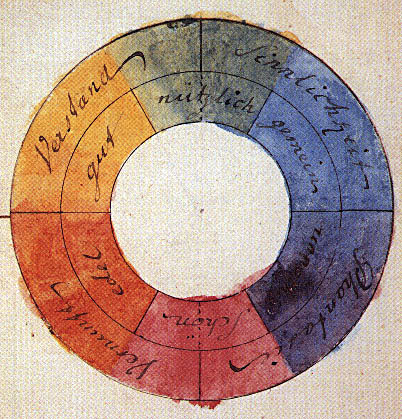
    GoetheFarbkreis

    (Almost) in the beginning were monsters.  The epic battle that Moses wages early on is not with Pharaohs, but with the dragon(s?) that the creator itself had fought on the opening whisper of creation (Book of Job 26:12, Psalms 89:10) and who would again meet at the very last bits of the closing days.  Behemoth, Leviathan, Rehab may all well have been monsters to these ancient folks, but they very well might look like rhinoceros or crocs or hippos to us.  Monster demons like Rehab (Psalm 87:4), a slaughtering beast who would be reintroduced to a different part of the world as Tiamar who would or could also be known as the Red Sea,  lifted straight from Mesopotamian mythology and placed directly into that of the Old Testament among the rest of the borrowed stories and beliefs, a problem by any other name.

    Following names and their cyclonic twists, and absences and sudden  re-emergence through the history of storytelling is dizzying—just consult your Robert Graves on myths  if you want to have  your memory plumbed (the great poet and writer doing not such a poetical or writerly job in this effort in my opinion though most people love it).  Keeping an eye on the mix and mash of gods and goddess and associated super beings from thousands of years ago, the god of the Old Testament makes it very clear and precise about just who he is in his self-introduction to Moses:  “I am the God thy Father, the God of  Abraham, the God of Isaac, and the God of Jacob” (Exodus 3:6)

    Equally almost in the beginning, again so far as the Bible is concerned, are colors—before that maybe everything was black and white, or just white, or maybe just black, depending on your epistemological concept of everythingness or nothingness.  (It looks like green may be the first color mentioned in the bible, (Gen 1:30 And to every beast of the earth, and to every fowl of the air, and to every thing that creepeth upon the earth, wherein there is life, I have given every green herb for meat: and it was so) though the mixing up of meat and veggie is a little confusing to me.))

    Over the years color names themselves have creepethed among themselves like a vocabularic ocean, a fluid dynamic of naming.  Names have flowed across their individual spectra, some names sticking, some not; the originator of the concept of the naming of “red”, the original namer of the color, lost to the earliest and deepest part f the collective human memory.

    I don’t know where many of the names of colors come from, or why.  Index to Color Names and Color Numbers of the Standard and Season Color Cards of America (published and created by the Textile Color Card Association), and published in 1923, is filled with color names whose meaning and origin are a mystery and whose necessity seem to hinge on sunspots.  Which is fine, though it might be interesting to have had color names more dependent on that which went before. Like the names of the streets on most of Connecticut Avenue in D.C. are alphabetical, and once the first 26 letters or so are monosyllabicly employed, the second set starts with two syllables, and then three.  It is a system that usefully indicates where long the long avenue you might be. It might be useful to employ such a method in color names; or not. 

    And I suspect it would be “or not”, unless the poetry and art and music inherent in these formulations would be imaginatively employed

    But on to the color names:  Ambulance, Basketball, Bosom,  Cowboy,  Squirrel, Chit, Old, Nymph, Old mephisto, Pelt, Racket are examples of some of the mystery colors.                             

    Some names which were part of institutionalized racism I’m sure are now gone:  Arab, Negro, African; Bagdahd (?), Bombay Brown,  Coolie Yellow, Coolie, Congo Brown, Egyptian Husk, Hankow (yellow), Kyoto Yellow, Korea Yellow, Mandarin Yellow, Punjab Brown, Kafir, Tar Baby.

    Colororgan But I’ve got to say, even though the names may not have much to do with the colors, most of the names in the pamphlet sound quite lovely, and many are yummy: London Smoke, Log Cabin, Leadville, Madonna, Naked, Pitchpine, Pompeii, Prelate, Smoked Pearl, Swamp, Lucky Stone, to name a few. Overall I doubt that this is what Newton, Goethe, Chevreul, Rood, Maxwell and the rest had in mind when they were figuring out what color *is*, but I do think that all of them had large enough poetic natures (Newton the weakest and Goethe by far the strongest) to appreciate the occasional beauty of naming.  The unbelievable Shakespeare seems not to have spent that much time on color (so far as I know, and I don;’t much about the Bard), but (in a dear-sweet-god understatement) other people did:  people like Richard Feynman synesthesically thought in mathematical color terms, others created musical  instruments which would produce color from music while most of the rest of the world produced music which conveyed color, and on and on.  And then of course there’s the whole world of art.

    But I won’t go there now–I just wanted to follow this loose thread in what seemed to be a pretty inert pamphlet–in the end it opened itself to a lot of possibilities with just a little thinking. 

    ·Posted by :

    ·in:

    —

  • An Alphabet of Ages of Scientific Terms

    JF Ptak Science Books    Quick Post                                                                Follow Me on Pinterest

    Teaching

    It is interesting to think about the newness of old things, particularly English words that we have in use every day.  In this case I’m referring to words in the sciences–and not necessarily the words coming in the 20th century following the explosion of modernity beginning in 1895.  It is surprising sometimes to realize the relative newness of some terms, like, for example, “scientist”. The word “science” is very old and very old in English, but the word “scientist” is coined only in 1833. It is surprising to think of the modernity of some of the words when by their constant use they seem as though they must be ancient, but of course are not so.

    Here’s a quick lising of some interesting candidates, everyday words with a not-very-old lineage, their dates taken from first-usages identified by the Oxford English Dictionary:

    Altimeter, 1847; Ampere, 1861; Aphasia, 1867;

    Bacterium, 1847; Biology, 1802;

    Cambrian , 1836; Centigrade, 1812; Chlorophyll, 1810; Chromosome, 1890; Claustrophobia, 1879; Cosmology, 1730; Cretacious, 1832;

    Diatom, 1854;

    Electron, 1891; Embryology; 1859; Ethnology, 1842;

    Gastritis, 1806; Gynaecology, 1847;

    Histology, 1847;

    Joule, 1882; Jurassic, 1833;

    Kleptomania, 1830;

    Morphology, 1830;

    Ohm, 1861;

    Palaeobotany, 1872; Palaeography, 1822; Palaeolithic, 1865; Palaeontology, 1838; Petrology, 1811; Pilocene, 1833;

    Scientist, 1833; Symbiosis, 1877; Synthesis, 1804;

    Taxonomy, 1828; Triassic , 1841;

    Voltmeter, 1882;

    Watt, 1882.

    ·Posted by :

    ·in:


  • An Early Scientific Screed-Rant on the Disparaging of the Sciences (1873)

    JF Ptak Science Books  Post 2175

    I always thought that the word “scientist” came to us from William Whewell in his Philosophy of the Inductive Sciences (volume 1, page 113) in 1840, the group of people dedicated intrepid seekers of standards and anomalies finally receiving a short and concise (if three-syllable) name for what it is they are (for even in death a scientist is still a scientist, no past tense there, like a Marine): once one, always one.  

    “We need very much a name to describe a cultivator of science in general. I should incline to call him a Scientist.”

    But I notice that an anonymous note in the Quarterly Review peeks its head under the tent, using the word six years earlier in 1834, though not favorably:

    “Science..loses all traces of unity. A curious illustration of this result may be observed in the want of any name by which we can designate the students of the knowledge of the material world collectively. We are informed that this difficulty was felt very oppressively by the members of the British Association for the Advancement of Science, at their meetings..in the last three summers… Philosophers was felt to be too wide and too lofty a term,..; savans was rather assuming,..; some ingenious gentleman proposed that, by analogy with artist, they might form scientist, and added that there could be no scruple in making free with this termination when we have such words as sciolist, economist, and atheist—but this was not generally palatable.”–Quarterly Review, volume 51, page 59, via the Oxford English Dictionary 

    Later in the year a prettier offer emerges, though it has more to do with beauty than truth:  
     
    “Leonardo was mentally a seeker after truth—a scientist; Coreggio was an assertor of truth—an artist.”–1840   Blackwood’s Magazine, volume 49, page 273.
     
    What brought me to the word “scientist” was an article/notice in Nature in 1873, where scientists are terribly put out by what the writer felt was a disparaging of the sciences–in short, a pissed-off mini-screed on the societal attack of ennui against the very idea of Science.  The thing is in the two paragraphs the word scientist doesn’t come into play.  So far as I can tell, this is the earliest scientific screed in this high-ish Victorian journal of proper and popular science,  Nature began in 1869, and even though it was eight volumes and four years into publication, I’m surprised that it took this long for a note like this to appear. It isn’t exactly a white-knuckled jumbleup venom-bomb from Dr. Hunter S. Thompson, but the anonymous writer does get the message across:   

    ·Posted by :

    ·in:


  • Public Service and the War Production Board, 1942

    JF Ptak Science Books  Post 2173

    The War Production Board (WPB)–the entity responsible for printing the leaflets below–was instituted 16 January 1942 as a federal effort to direct U.S. wartime production and allocation of essential commodities.  And time. The WPB centralized the effort to convert some peacetime industry to wartime production, as well as direct the production of existing wartime industries in the manufacture of critical goods, and rationed or prohibited the manufacture of other material that could possibly hinder the war effort.  Thus the WPB rationed things like sugar, heating oil, plastic, gasoline, paper, rubber, nylon and metals of all descriptions; it also controlled large swaths of the workforce, restricting wages and benefits as well as prices.   It was an essential element of fighting the war, and brought necessary control to an economy and industrial base that needed organization for what would become a total war.        

    War Production Board265
    Instituting a war-production base for American industry allowed production to ratchet way up, producing (for example) multiples more aircraft more in 1943 than in 1941:   1940, 6k aircraft; 1941, 19k; 1942, 47k; 1943 85k; 1944, 56k; 1945, 46k.  Also there were enormous production advancements for total shipping tonnage (reaching a wartime production total of 33 million tons), across-the-board huge increases in coal and iron ore (and especially in crude oil), and on and on.  The U.S. was able to mobilize itself and take advantage of its enormous natural resources, industrial base and civilian workforce in what was essentially an unreachable island economy, forming what was actually an unbeatable combination of war goods production. (Plus of course there was the atomic bomb, which is another story, but which also only could have been produced in the U.S., given the enormous quantities of energy and material needed to begin its production.)     

    ·Posted by :

    ·in:

    —

  • A Work on Hobo Slang by the Lifetime King of the Hoboes, 1947

    JF Ptak Science Books 

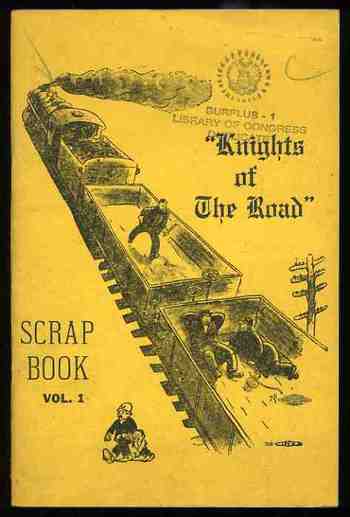
    1blog_oct_8_hobo_cvr785
    There have been many Kings of the Hoboes, and Emperor of the Hoboes, in the history of American Hobodom.  The most widely recognized of all this royalty is, probably, Mr. Jeff Davis, who was elected King of Hoboes each year from 1908 to 1935–in that year at the Pittsburgh meeting of the annual “Hoboes of America” his minions gave up elected him King for Life. Of hoboes, that is, the Knights of the Road.  Davis was also a real hobo, unlike the pretenders and throne-seekers, who in general were not. (Nels Anderson, in his Men On The Move, written just as the Depression was broken, (1940) observed: “Whatever else may be said of King Jeff, his romanticizing the hobo is not without a basis in reality, and his poetic interest in the species arose from experience. But King Jeff has placed on a pedestal a man who belongs to the past. The hobo belongs with the pre-Hollywood cowboy and the lumberjacks of the Paul Bunyan legends.”)

    ·Posted by :

    ·in:


  • What a Fascist Really, Really, Is: on Defining Things

    JF Ptak Science Books   Post 2096

    In the history of words and the history of writing them, the history of writing down what words mean came relatively late in the word game.  The first dictionary for the English language is difficult to establish–it wasn’t Dr. Johnson’s 1746 effort, as fabulous as it was.  There were more than a hundred earlier efforts, the earliest of which may be Robert Cowdry’s A Table Alphabeticall… as the first English dictionary, which was written in 1604. (Its more easy to determine the first American dictionary, Dr. Webster’s, 1828 .) It may be that dictionaries and assemblies of rogue/thieves language appeared well before Johnson, by perhaps as much as 175 years, providing the good readers and listeners in England with a ready tool for understanding “non-standard” (slang) words of the English language (with A New Dictionary of the Terms Ancient and Modern of the Canting Crew, by “B.E.”, being the best known of these early works, published in 1698.)

     It is interesting to me that in addition to Johnson et al another  writer–or rather set of writers–were responsible for the first Johnsonian-first dictionary in German, the  Deutsches Wörterbuch by the Brothers Grimm.  These are good examples of modernity, though there are earlier examples for other languages–Petrus de Alingio’s manuscript of 1286 and the Catholicon as the first printed alphabetical listing of Latin words appeared very shortly after Gutenberg’s Bible did on the same press.  But then these were both many centuries into the use of the language.

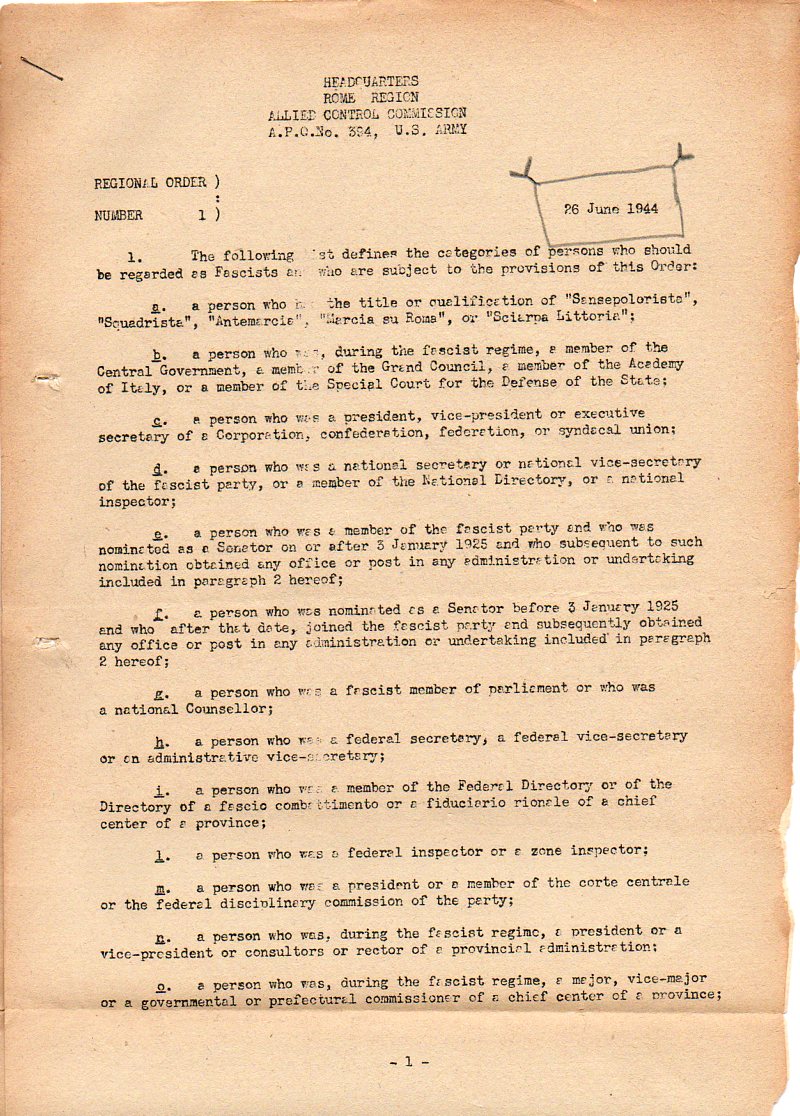
    WWII--Italy Fascist a042

    {More detail in the “continue reading section”, below; also, the original is available for purchase from our blog bookstore.]
    And this just to say how much I like the road to words–especially when they come from unexpected places. One fine example of this is the directive below, issued by the headquarters of th Allied Control Commission (“APO No 394″) in Rome in the summer of 1944.  (This would actually be the American arm of the ACC, which was commission set up by the Allied Powers to deal with the administration of defeated countries at the end of the war.  Three weeks after D-Day the end of the war was in sight (Bastogne and Co. not withstanding), though far more so in Italy than just about anywhere else, and so the implementation of governing and occupying plans needed to be established.  One of the primary features here was to ensure that the old Fascists not be included in the new Italian governments (along the lines of denazification in Germany, which had a more laissez-faire approach to defining Nazis, especially wealthy and useful ones), and the primary issue in finding and excluding Fascists was to define what was meant by “fascist”1.  These are those working guidelines, at least on 25 June 1944. 

    ·Posted by :

    ·in:


  • The Ophthalmology of a Redon-ized Bosch

    JF Ptak Science Books   Post 2026   Follow Me on Pinterest

                          Cave Cave Deus Videt (“Beware, Beware, God Sees”)

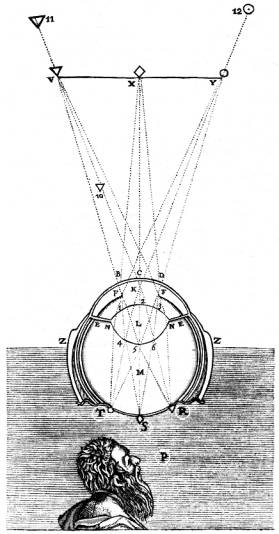
    Descartes dioptrique

    When I think of the early-ish thinkers on optics and vision, and consider their fantastic images
    of the anatomy of the eye and the mind/brain/eye connection, the work of Rene Descartes usually appears first.  It is a general go-to illustration in optics and biology, and it appeared in his Dioptique in 1637.  It is standard iconography.

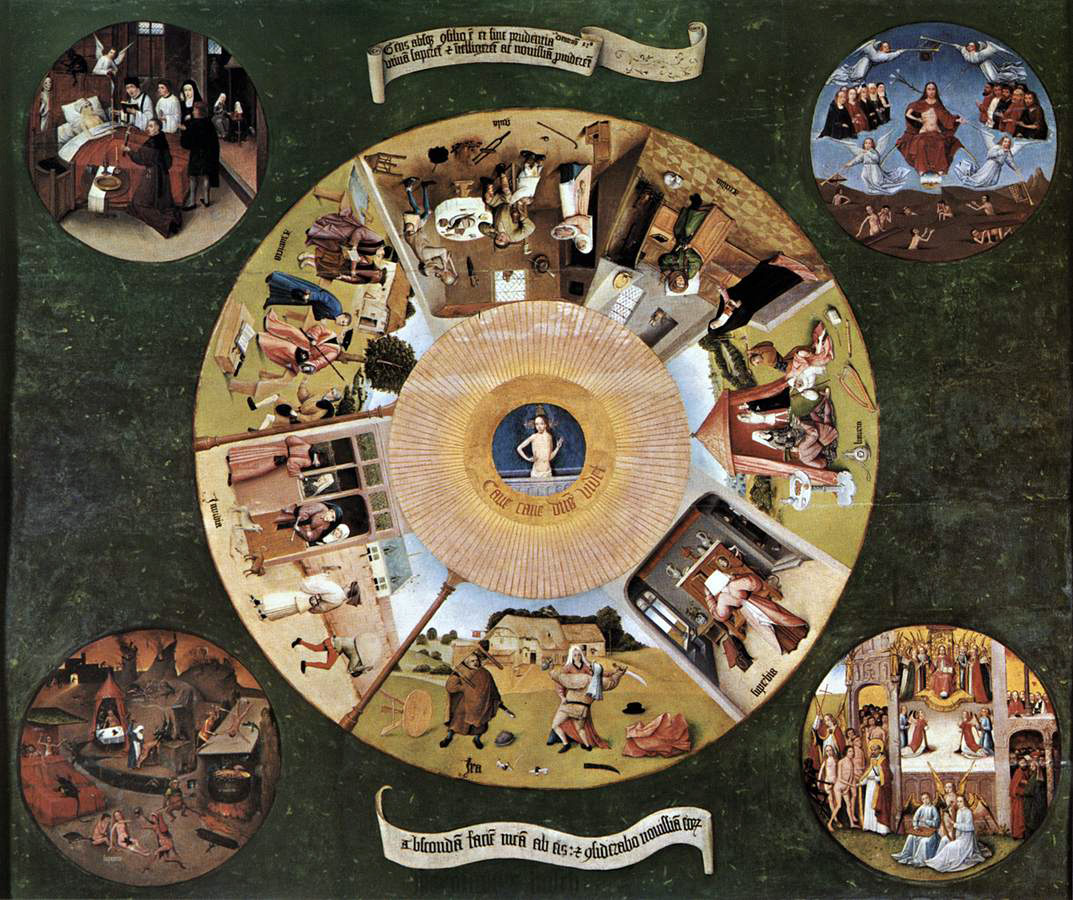
    For me, an antiquarian non-standard image of the eye appeared today. Hieronymous Bosch is not terribly well known as a person, as a walking and talking citizen of the world–it is known where he died, and where he spent the last twenty years of his life, but the details outside of this are scarce.  And even though he signed his adopted name of “Bosch”(he was born ca. 1450 as Jerome van Aken, and died in 1516) very boldly and clearly–and was among the earliest crops of artists to do so in the West–he never dated the paintings.  Scholars have determined their dates in some part by the increased realism and skill, which leads me to one of his latest works, the beautiful table top of the Seven Deadly Sins (ca. 1400). 

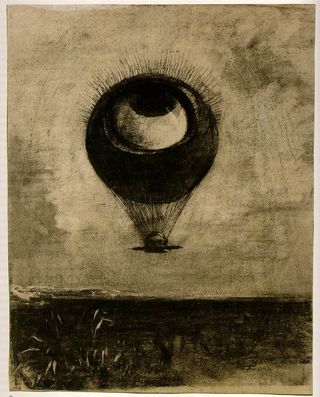
    Redon eye balloon

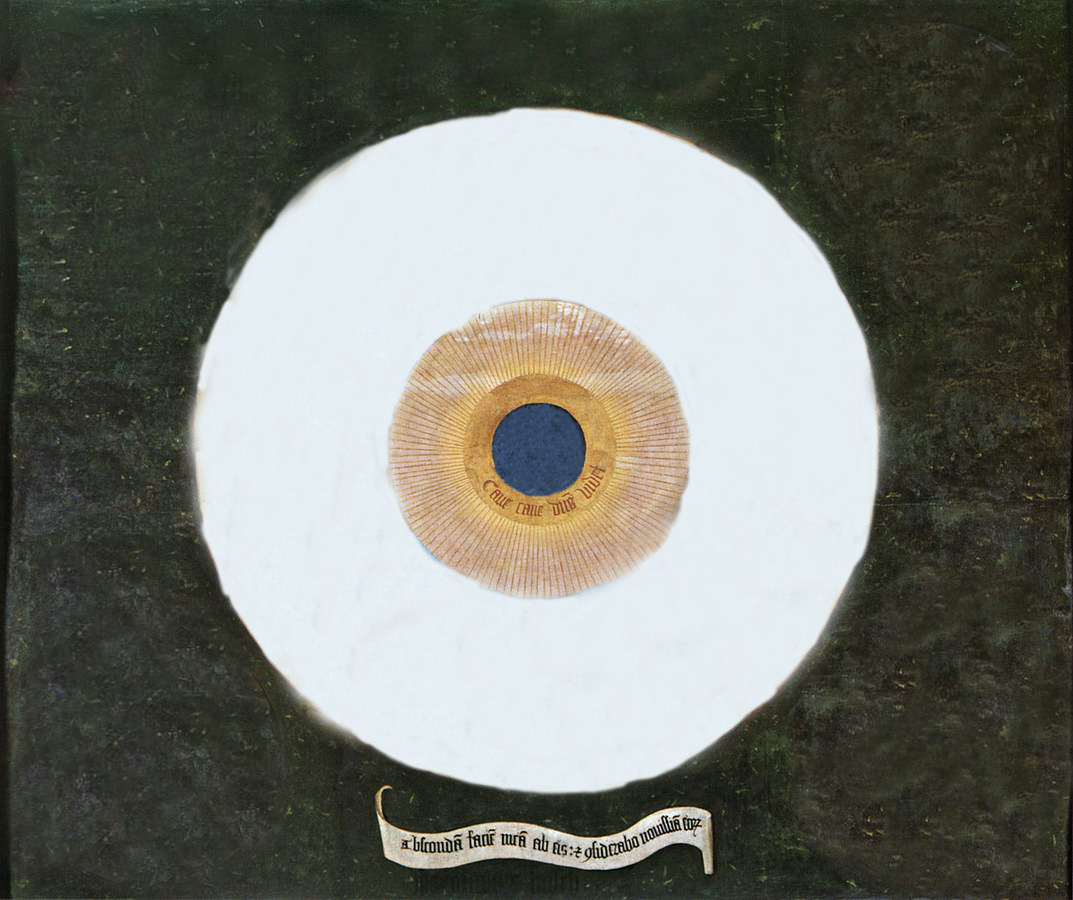
    I had never really noticed it before, but when I looked closely at some of the detail in the work it suddenly dawned on me that the central part of the work was an eyeball–this no doubt instantly seen by every other person, but for me it was a shock of recognition.  This became particularly clear when I (quickly and clumsily) photoshopped out most of the elements of the painting, leaving me with this:

    Bosch The Seven Deadly Sins eyeball

    Which is clearly an eye–and as a matter of fact the Latin inscription emblazoned underneath Christ reads Cave Cave Deus Videt ( or “Beware, Beware, God Sees”), meaning that the watchful creator sees everything and will be the judge and offer final dispensation depending upon past history.


    Rendered like this the work reminds me strongly–at least in a symbolist sense–of Ordilon Redon’s (1840-1916) Eye Balloon (1878). Well, mostly it is the sense doctored image that drives this recollection more so than the painting–removing almost all of the elements of the Bosch suddenly gave the piece an escapist flavoring, like something in the early modernist movements. 

    And the original (47×59″ in real life), with the roundels elements restored and Christ replaced in the iris of the eye:

    Bosch The Seven Deadly Sins

    The motif of the painting clearly works its way outside-in, with the all-seeing omnipotent being seeing-all, there at the center of the eye, surveying everything that takes place on the living dominion, surrounded at the corners by depictions of Death, Judgment, Heaven, and Hell, and then immediately encompassed by the seven deadly sins.

    In the floating banner above the main circular image reads “For they are a nation void of counsel, neither is there any understanding in them,” and then below “O that they were wise, that they understood this, that they would consider their latter end!”

    I found it very striking. 


  • Good Thinking on One Sheet of Paper

    JF Ptak Science Books  Quick Post

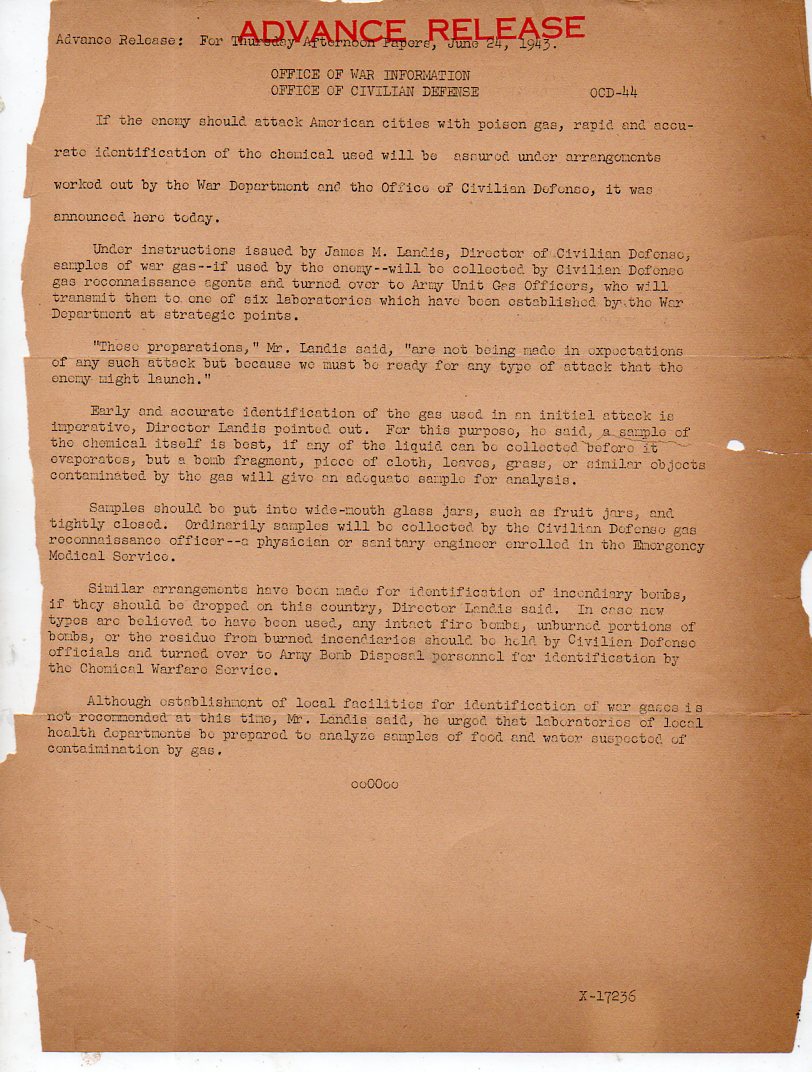
    These are two good examples of reasonable thought,. easily presented, and conveyed on a single piece of paper. A good job, well done.

    (I’ve written a number of times on gas attack in warfare on this blog, all searchable in the Google-box. But the two that come quickest to mind are the post on the one-page summary of America’s position on gas warfare, written in 1917, here, and the other on a “filmstrip” I put together from an Italian pamphlet on protecting civilian populations from bomb and ga attack, 1943, here.)

    Gas Attack037


  • Pre-Darwin Darwin, Without the Post-Darwin

    JF Ptak Science Books   Post 1962

    “…something might perhaps be made out on this question…”

    “WHEN on board H.M.S. ‘Beagle,’ as naturalist, I was much struck with
    certain facts in the distribution of the organic beings inhabiting South
    America, and in the geological relations of the present to the past
    inhabitants of that continent. These facts, as will be seen in the
    latter chapters of this volume, seemed to throw some light on the origin
    of species—that mystery of mysteries, as it has been called by one of
    our greatest philosophers. On my return home, it occurred to me, in
    1837, that something might perhaps be made out on this question by
    patiently accumulating and reflecting on all sorts of facts which could
    possibly have any bearing on it.”–from the introduction to On the Origin of Species…, fourth edition, 1866

    Maupertuis detail
    These eyes belong to Pierre-Louis Moreau Maupertuis  (1698-1759),  a French mathematician/philosophe who worked himself wide and deep across many fields, from mud to blood (geology, physics, math, bio).

    But what he saw particularly in regards to Darwin was the matter of relationship in bi-parental inheritance, that there was genetic basis for the inheritance of physical traits. Now he didn’t use these terms of course ,  but he made this sexual generation argument in his Dissertation Physique a l’Occassion du Negre Blanc written in 1744 (and published in Leiden).   There is an expanded version of this thought in his Venus physique (printed in 1745, and which is translated as The Earthly Venus), which was a direct confrontation with the belief and theories of the preformationists, who claimed that a being was preformed in either the spermatozoa or the egg. Maupertuis argued that the only way for the characteristics of both parents to be inherent in offspring was for the material to be a combination of the mother and father, and that the preformed theory did not allow for the equal distribution of hereditary characteristics1.  Maupertuis is now generally seen as having anticipated the theory of nutation (according to the standard history of medicine bibliography by Garrison and Morton2, appearing in that work as number 215.1).

    Darwin published the Origin of Species in a hurry in 1859–after having the idea in his head for 20 years, he was suddenly in the need to quick-publish given the fact that the very young Alfred Russell Wallace was about to scoop his great idea.  Part of that quickness evidently resulted in Darwin leaving out his debt to history, not addressing the precursors to his idea, leaving out the bibliographic part.  He heard about that very quickly upon the very successful publication of the Origin, which was sold out almost immediately upon publication.  Over the next few months he heard from a number of quarters about those who came before whose ideas may well have presaged his own–which of course was the case, and Darwin made basically no mention of work that had come before his own, even though it seems as though he had made am effort to do so at least in notes more than a decade before the publication of the great book.  This is a much longer story than I want to deal with right here, but Darwin set to work on addressing this issue and published an “Historical Sketch” which appeared in the authorized first American edition and the first German edition of the Origin in 1860.  As Rebeccca Stott points out in the first chapter of her surprisingly good popular history of evolution, Darwin’s Ghosts (2012),  Darwin included 18 names in his intellectual legacy. Six years later in the fourth edition of the Origin of 1866, the list had expanded to 37  names.  The vast majority of those included in the survey were modern to Darwin; generally all of the ancients were left out with but a scant nod to Aristotle, and there were two mentions of works before the 19th century, (which includes  Geoffroy Saint Hilaire (1744-1829), who dips just slightly into the 18th century and Darwin’s own grandfather, Erasmus Darwin, with his great two-volume work of semi-revolutionary poetry medico-philosophico-botanico 

    Zoonomia; or the Laws of Organic Life, which was published in 1794 though formulated decades before). 

    ·Posted by :

    ·in:

    —