A Daily History of Holes, Dots, Lines, Science, History, Math, Physics, Art, the Unintentional Absurd, Architecture, Maps, Data Visualization, Blank and Missing Things, and so on. |1.6 million words, 7500 images, 4.9 million hits| Press & appearances in The Times, Le Figaro, Mensa, The Economist, The Guardian, Discovery News, Slate, Le Monde, Sci American Blogs, Le Pont, and many other places… 5000+ total posts since 2008.

Category: Naming Things

  • A Victorian YouTube and the Anti-Hermit Hermit

    JF Ptak Science Books  

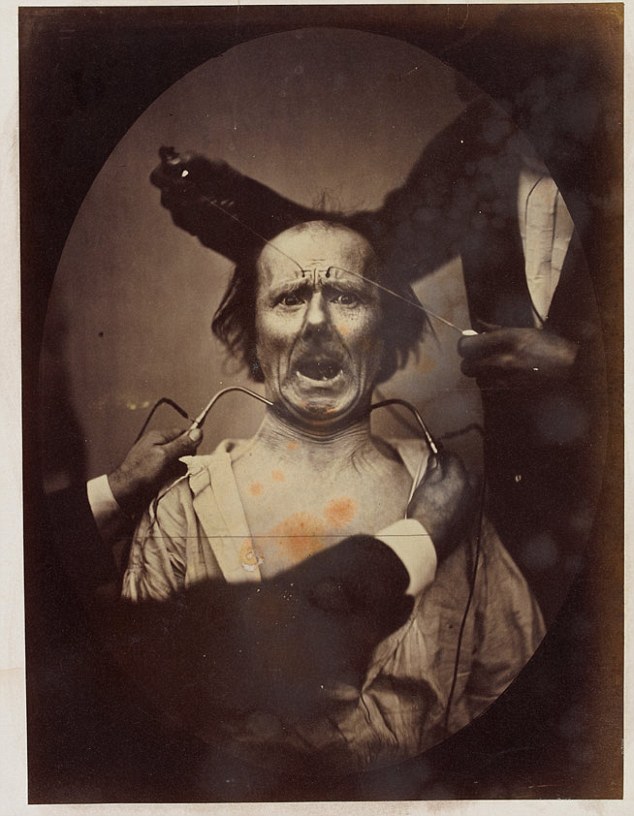
    The “eccentric” versus the “insane” in Victorian England may well have been identified by the amount of available disposable income–if you could afford your whimsy and misery, then you were “eccentric”; if not, then you  were “insane”, which also meant that you were culpable of being scooped up by The Authorities and interned if you turned out to be a larger/smellier/more obnoxious nuisance than a simple dot of the street.   That or you may have wound up as an electrically-prodded subject in an experiment by Charles Darwin (Expression of Emotions….).   In this way the past telescopes nicely into the present, less the electrical stimulation bit. 

    Darwin Expression[Image Source:  Daily Mail, here.]

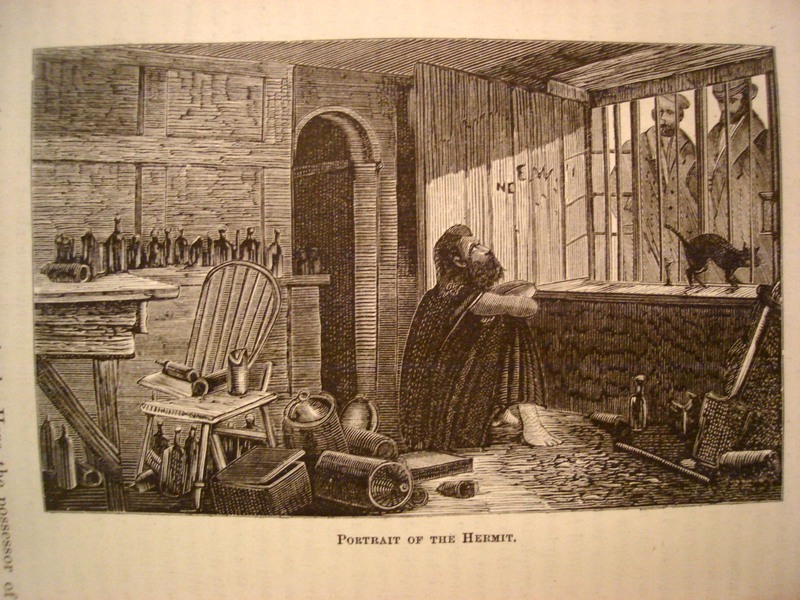
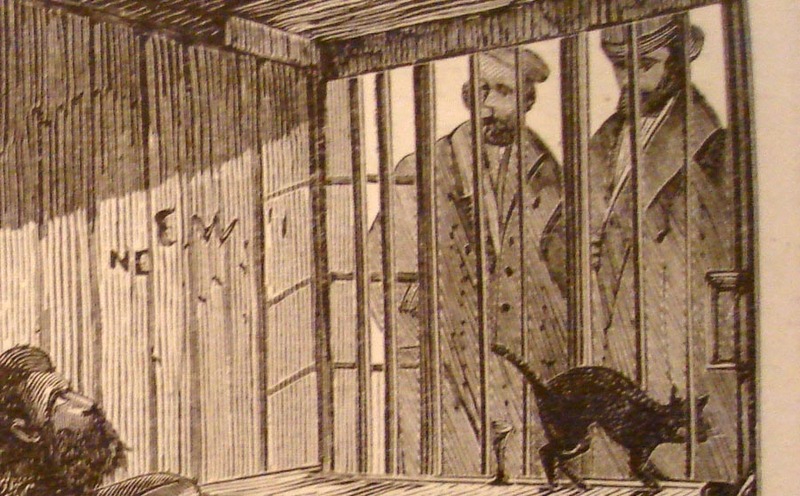
    The image shown below is that of Mr. James Lucas, “the Hermit of Red-Coat’s Green, (near Hitchens)”, living his life in a most uncommon hermit-like fashion, even for a hermit.  Seems to me that a hermit would be removed from society and be away from people; Mr. Lucas may be of a singular caste of that genre, living his life alone in the very midst of society–he lived in the kitchen of his townhouse, in a single room with a window to the street.  There he lived out his life in full and constant view of the passersby on the busy sidewalk.  Crowds would come by and stare, and Mr. Lucas would stare back–he would rarely, if ever, communicate, though he would (“he was not miserly”) give out “farthings and gin” to “swarms of tramps”, no to mention sweetmeats to children.   He’d watch people watching him.

    Hermit Insane

    He also didn’t write (except we are told “upon a check”), and made no physical effort to retain anything that he thought about; nor was the reason for his uncommon lifestyle made known.

    He was one son of “an opulent London merchant”, and in time proved to be an incorrigible and strong-willed non-conformist (with the funds to do so in some comfort).  He evidently went completely over the edge when his mother died, and after a year of keeping her body in the house removed to the kitchen, where he spent the rest of his days (living there from 1850 to 1874).

    Hermit Insane detail

     After he died and his room cleaned out for the sale of the family’s property, it was discovered that the floor was covered in two feet of ashes and soot from the kitchen fireplace.  Without the family money Mr. Lucas surely would’ve wound up on a cadaver table long before his seventieth year, suffering real social Dickensian travail rather than that which existed just in his mind.

    ·Posted by :

    ·in:

    — —

  • A Stone-Cold Alphabet and Geometry from Fr. Kircher, 1668

    JF Ptak Science Books   Quick Post

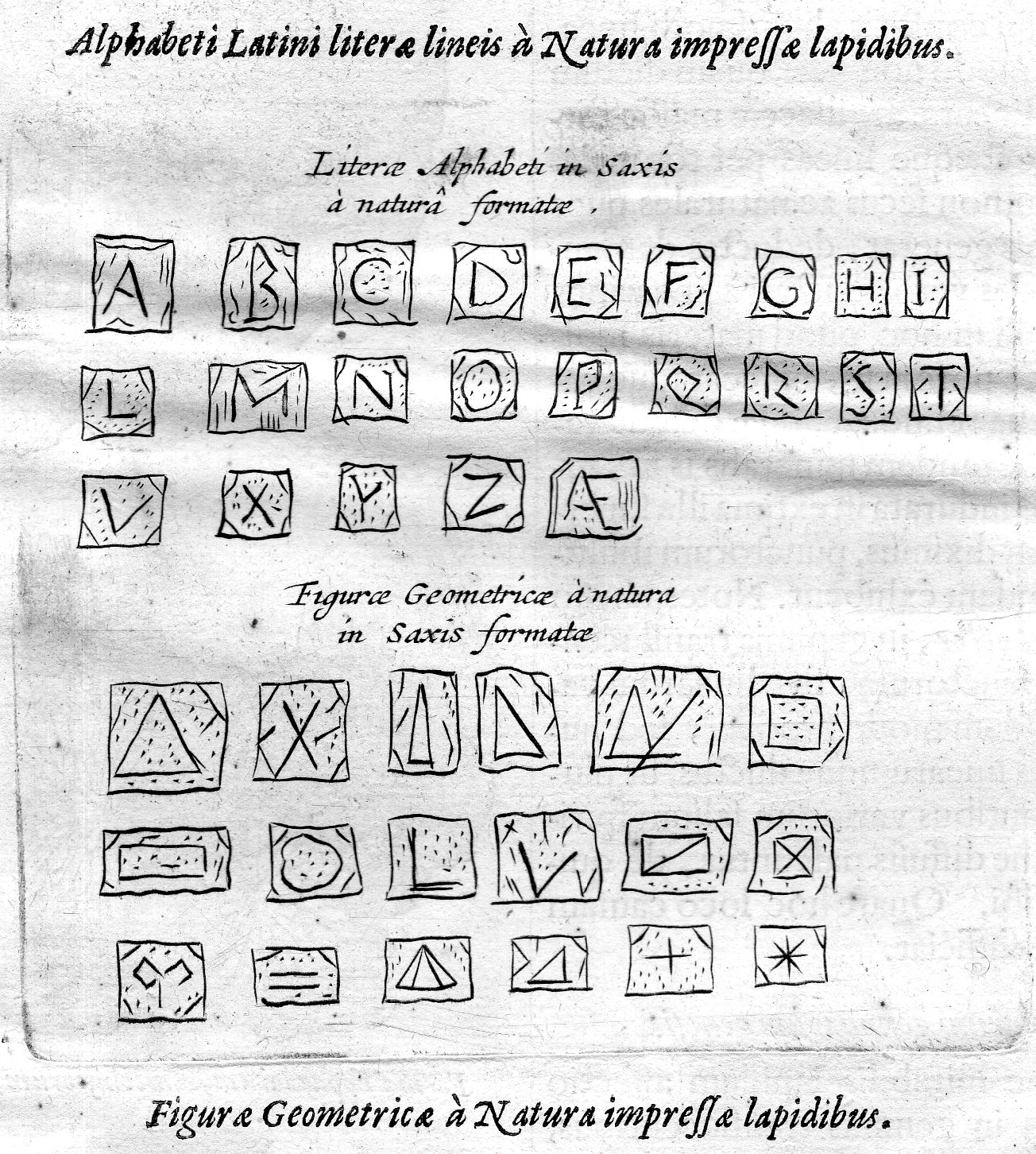
    This is another in a series of posts on images found in the glorious Fr. Athansius Kircher’s masterpiece, Mundus Subterraneus, printed in 1668. (One of the main posts on these images occurs here; there are many more if your search under Kircher’s name in the Google box at left.)

    This fine example of the depth of his observation finds the great Jesuit finding things in rock and mineral samples like agate–in this case he looks at a collection of samples that display found letters of the alphabet and geometrical shapes.

    Kircher alphabet 085

    • The original of this image may be purchased via the blog bookstore, here.

  • A Map of Currents and Seaweed, 1886

    JF Ptak Science Books    Post 2457

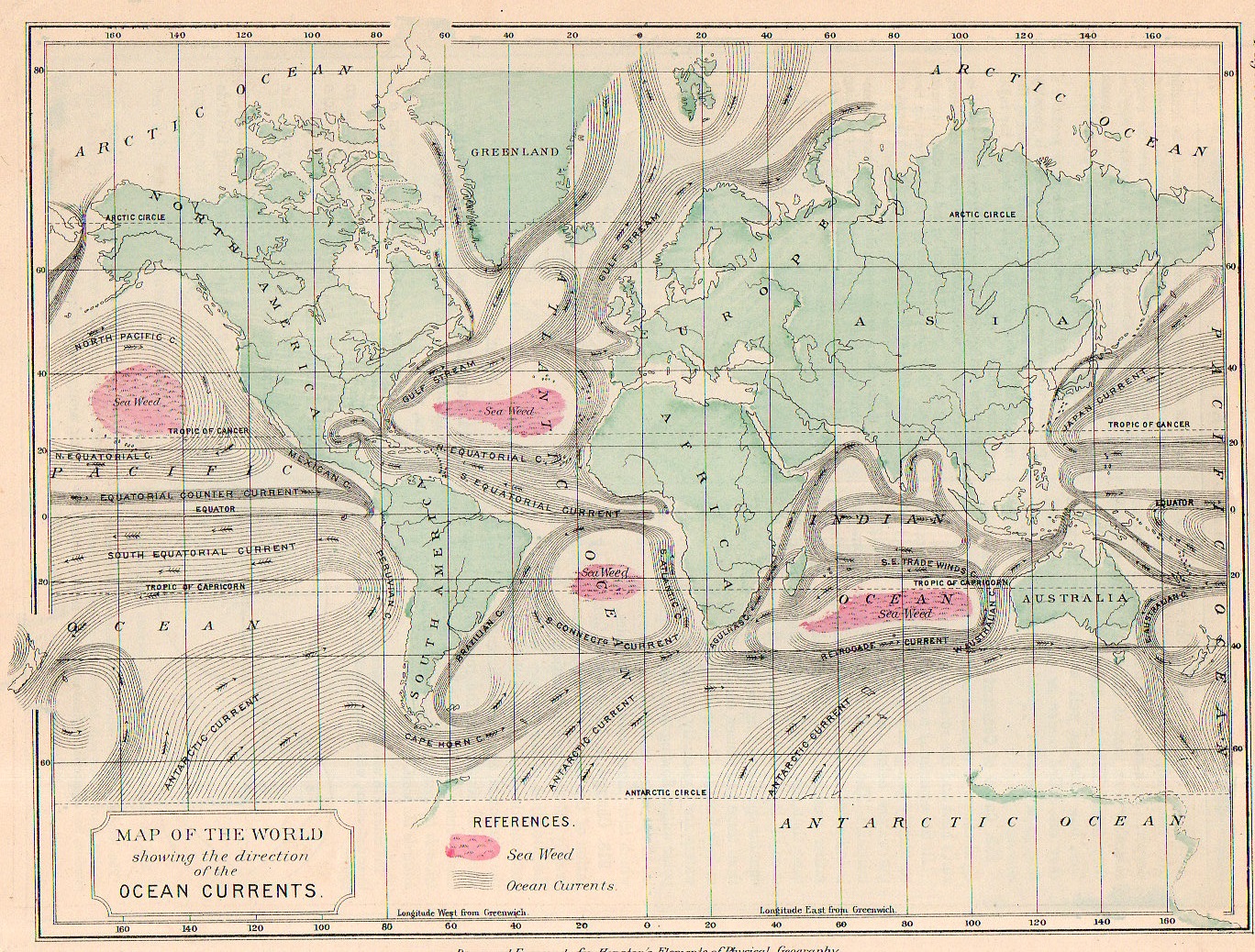
    Map ocean current 1886968

    I think that if you squinted your eyes a little to deform your visual field and then looked at this map of the Earth’s ocean currents that what you might see is…Mars.  At least that’s what I can see if I concentrate on it, or at least the Mars of 1880 or thereabouts, with its large and blotchy seemingly mobile and ambiguous forms skirting around the planet.

    • “This map may be purchased at the blog’s bookstore, here.  

    That said this map does represent a high achievement, displaying the elements of the still young-ish science of oceanography (or at least in the form presented by Matthew F. Maury) and showing the movements of the ocean currents.

    Map ocean current 1886969

    This maps comes about a century after the first map to truly distinguish the Gulf Stream (the B. Franklin/Folger map of 1768-1785) and shows the remarkable activity that must have come with the acquisition of the data necessary to show on even this popular map.  There were earlier attempts, of course, notably by the great/problematic Athanasium Kircher in his Mundus... of 1662 though his effort was largely theoretical (and for what it was worth likened the currents to something similar to blood moving though the body, which at least used the work of William Harvey) given the lack of available hard data.  (Eberhard Happel is on a similar wavelength as Kircher with the currents map, and published his map a few years later, though he was mainly a science popularizer who “relied” heavily upon the Kircher map and was nowhere near to being Kircher’s intellectual rival, his map is still interesting given its very heavy lining and beauty.) 

    In any event, the Houston map is clear and concise–and given its 7″x 9″ size, remarkably compelling.

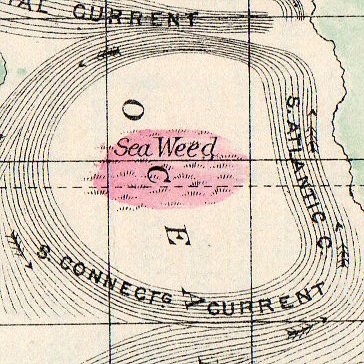
    And I just love the seaweed mapping.  


  • Robert Oppenheimer as a Ted Williams or a Joe DiMaggio?

    JF Ptak Science Books    Post 2407
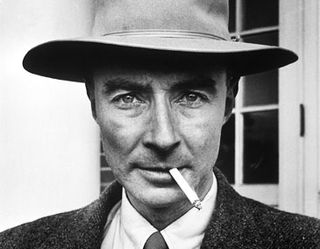
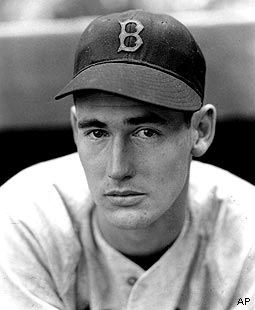
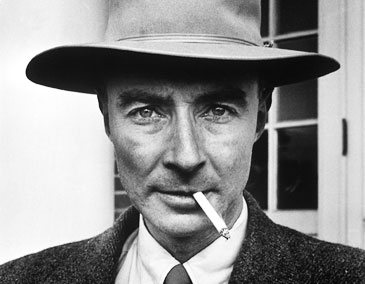
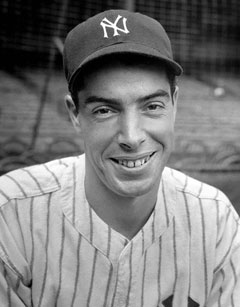
    Oppenheimer williamsOppenheimerOppenheimer dimaggio

    Years ago I phone-met the physicist Al Wattenberg. He started his long and fine career under the bleachers at the University of Chicago, working with Enrico Fermi where on December 2, 1942, they achieved the first controlled nuclear chain reaction.  (The moment was celebrated with a bottle of Chianti donated by Eugene Wigner, and it was signed by all those present at the creation.  It turned out that Wattenberg was the last man to leave the area, and he saw the abandoned Chianti bottle and rescued it–he gave it to the Argonne National Lab where it lives to this day.)

    One day I asked him about Fermi and what he was like when he wasn’t working. Wattenberg said that he used to play tennis with Fermi, who (paraphrasing here) played tennis like he did physics–meticulous, methodical, careful. He said he was frustrating to play with, and he never beat Fermi at the game.  

    I like these offbeat cross-interest metaphors for explaining complicated things. And it was this thinking that brought me to Oppenheimer and the New York Yankees–and that Boston team–in the hope of dislodging a little piece of insight that might come from comparing disparate things. And so far as I can tell discussing Robert Oppenheimer in terms of Ted Williams and Joe DiMaggio doesn’t get very much red carpet room as an idea, and I suspect that there are good reasons for it.  

    Let’s face it—Robert Oppenheimer left his theoretical physics career sorta behind when he went to win the war at Los Alamos in 1943. I was surprised to see today that his publishing career for the hard stuff stopped around 1950 He was an absolute brilliant light when he started out in 1926, and a massive influence in his field by 1940.

    Here’s what the production looked like: 

    • 1926-29:  16 papers
    • 1930-39   36 papers
    • 1940-42  10 papers

    Which makes 62 papers for the 1926-1942 period . After the war, from 1946-50, there were five papers. And after that, none. That’s not to say that he didn’t publish, because he did, and was prolific—it was just a different career. Also from 1926-1942 he was a theoretical physicist with wholly different responsibilities than those he would take on in 1942, when he became not only the brilliant physicist but also the brilliant administrator/director/curator, working an almost-impossible job with thousands of creative people and the U.S. Army in shacks  in the desert trying to beat the Nazis to a bomb that would end the war.

    After the war Oppenheimer helped to formulate the direction of physics in the U.S., leading Princeton’s Institute for Advanced Study as its director;  then he helped formulate American nuclear policy going into the Cold War as the Chair of the Atomic Energy Commission. And then there was the great tragedy of his “security hearings” (1954) which crushed him on a McCarthyite slab,  costing him much of the rest of his career. And then he was dead in 1967.

    Had he not gone to war, had he not taken the job only he could have done, what would he have become? His accomplishments were already large–the Born-Oppenheimer approximation, Oppenheimer-Phillips process, neutron stars, quantum tunneling. More than likely one of the things he would be well known for today would be his development of the discovery and understanding of black holes—a singularity that he discovered in with in a paper called printed in Physical Review on September 1, 1939, but this was somewhat premature for the time.  And then came the war.

    Millions of other people went to war, too, stopping their lives on one end, starting a new life on the other, and then returning to their previous lives with varying degrees of retention or creation. Two of those folks were Ted Williams and Joe DiMaggio.

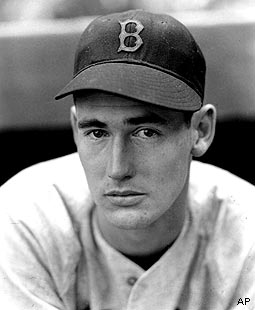
    Ted Williams went to war too, from 1943-1945. Williams just started out in his brilliant career hitting .406 in ; then two years later, he was gone. Williams was 24-26 years old for the war. Oppenheimer 38-40, though Ted got to play from 1946-1960 when he came back, absent a year that he spent as a Marine fighter pilot during the Korean War (“strafing Commies”). No doubt Williams would have piled up the numbers in a big way had he played ball in those four years

    Then there’s Joe DiMaggio, who also served for those years when he was 28-30. He had finished up seven years with the Yankees before he left, brilliant—perhaps the most stellar thing about it all (long pointed out to me by my friend, Mr. Baseball, Andy Moursund) was that he hit 219 home runs while striking out 196 times in 7 years. His batting averages were very high, and he was a slugger, and he didn’t walk all that much compared to Williams. This seems more in-line with Oppenheimer—a different sort of precision, one where DiMaggio hit for power and rarely didn’t hit anything at all, going up swinging but rarely going down swinging at nothing on the third strike. Although he was relatively young went he left for the war, he came back at 30, and played another 6 years,

    It may be too weird or nonsensical to think of these sorts of things, let alone thinking of Oppenheimer in units of Joe DiMaggios, especially since Oppenheimer knew/cared nothing about sports2. Plus in the alternative histories world we really can’t express the potentials of missing years, especially in terms of metaphors from non-related entities.

    On the other hand, I did create a physicists vs. mathematicians chess set, matching up people with what their possible position of the board might be, we can probably Oppenheimer to his baseball equivalent.

    Perhaps this is also my pneumonia talking rather than my brain, what with Spring Training approaching, and perhaps this was all useless–but for some reason if Oppenheimer suddenly appeared out in the front yard wearing a baseball jersey, I’d see him in pinstripes, with a “5” on his back.  
    ·Posted by :

    ·in:

    —

  • The Cold War and Spider Webs (1947)

    JF Ptak Science Books  Quick Post

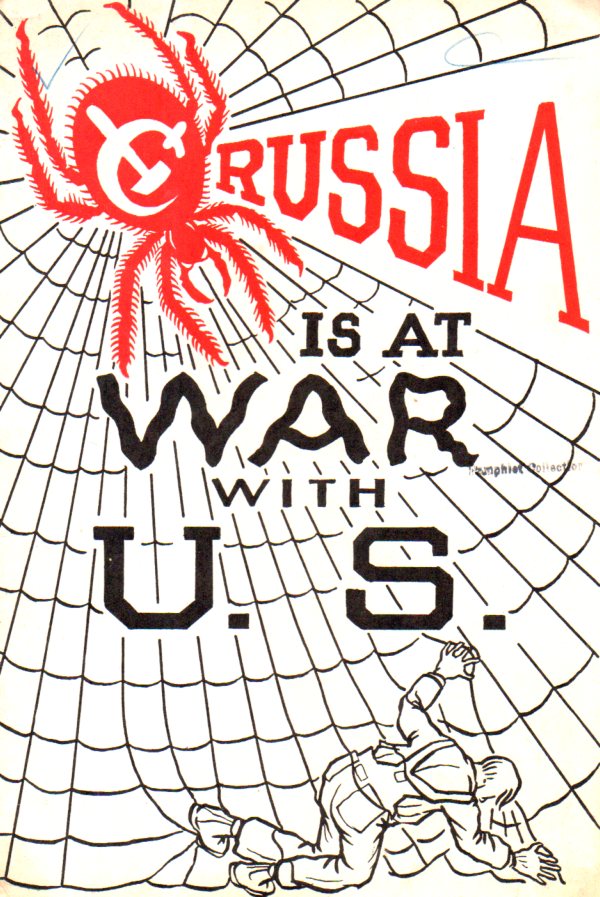
    Blanche Murray wrote this short pamphlet in 1947, the designer completing the cover in the Russian-spider/American-fly motif. Ms. Murray was trying to warn the U.S. that World War III was “happening now” and that Russia had crept into the U.S. on “cushioned paws”.

    Russia War US479


    The author was more or less correct in the WWIII part, though not so much in the creeping Commie part–my quick-browse didn’t find any “Cold War” reference exactly, but that is what she was talking about there in 1947, two years before the Soviets had their own nuclear weapons (with the so-called Joe-1 shot) and three years before the Korean War began. Mr. Orwell called it in October 1945:

    “For forty or fifty years past, Mr. H. G. Wells and others have been warning us that man is in danger of destroying himself with his own weapons, leaving the ants or some other gregarious species to take over. Anyone who has seen the ruined cities of Germany will find this notion at least thinkable. Nevertheless, looking at the world as a whole, the drift for many decades has been not towards anarchy but towards the reimposition of slavery. We may be heading not for general breakdown but for an epoch as horribly stable as the slave empires of antiquity. James Burnham’s theory has been much discussed, but few people have yet considered its ideological implications — that is, the kind of world-view, the kind of beliefs, and the social structure that would probably prevail in a state which was at once unconquerable and in a permanent state of ‘cold war’ with its neighbors.”–George Orwell, Tribune 19 October 1945 (“You and the Atomic Bomb”) Here, via Project Gutenberg. 

    In any event I like the cover design, which is probably the best part of the pamphlet. Sometimes that is all you really need.  

    ·Posted by :

    ·in:


  • Feynman on Symmetry

    JF Ptak Science Books  Quick Post

    Richard Feynman wrote this about symmetry in section 52 of the first volume of his Lectures in Physics (1963) the three volumes now beautifully available online at CalTech here. The last two paragraphs are also quoted in Mario Livio’s “The Equation that Couldn’t Be Solved”, Martin Gardiner in “The Ambidexterous Universe”, and many other places, probably hundreds of times; I’ve included the previous two paragraphs for interest’s sake.  Feynman, the symmetry master, included a statement about a beautiful gate in “Neiko” Japan, which must “Nikko”, though I can hardly identify the gate that he was talking about.  There seem to be many–see the UNESCO Shrines and Temples of Nikko, here–though the candidate in my mind is the extraordinary Yomeimon gate, here. 

    52–9  Broken symmetries

    “The next question is, what can we make out of laws which are nearly symmetrical? The marvelous thing about it all is that for such a wide range of important, strong phenomena—nuclear forces, electrical phenomena, and even weak ones like gravitation—over a tremendous range of physics, all the laws for these seem to be symmetrical. On the other hand, this little extra piece says, “No, the laws are not symmetrical!” How is it that nature can be almost symmetrical, but not perfectly symmetrical? What shall we make of this?…”

    ·Posted by :

    ·in:


  • Freedmen and Abandoned Lands Department

    JF Ptak Science Books  Quick Post    On Naming Things series

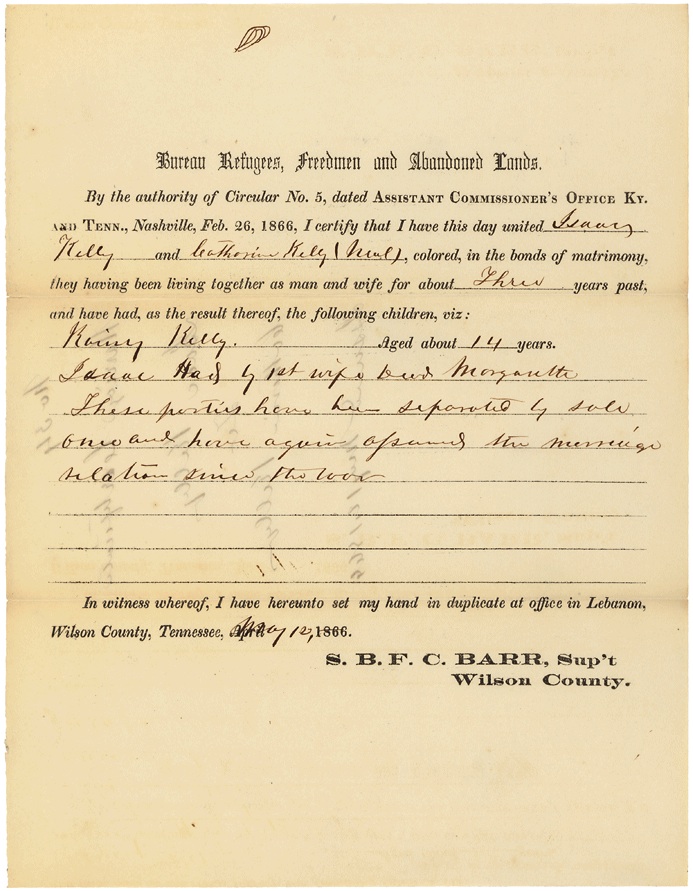
    Through the years I’ve known a little bit of something about the Freedman’s Bureau, but I think I’ve never known its full name:

    Freedman det

    This was an act of federal relief proposed by Abraham Lincoln in 18651 empowered to help the newly-freed slave transition to their new life.   The “Abandoned Lands” part was very unsettling, in a way equating refugees and newly-freed slaves with real estate.  But it was the language and practice of the time, and economy of presentation, and logic, I guess, that lead to this title.  The bureau here was the Military, which was run by General O.O. Howard.  The Bureau functioned from 1865 until it ran out of steam (along with other Reconstruction efforts and measures) in 1872.

    In a way it reminded me somewhat of the fight for the capitalization of the “N” in the word “Negro” (see here)–something that seems beyond the scope of thinking about nowadays, but it was a battlefield for decades after the Civil War, with that “N” not being decided positively until the 1920’s in common usage.  “Abandoned Lands” is not the same thinking-point as “N”, though it does make one think about what was in the common thinking that these three titles could be brought together as a single bureau, regardless of the hyper- and sub-text of the meaning associations via proximity

    Sec. 1. “…a bureau of refugees, freedmen, and abandoned lands, to which shall be committed, as hereinafter provided, the supervision and management of all abandoned lands, and the [92] control of all subjects relating to refugees and freedmen from rebel states, or from any district or county within the territory embraced in the operations of the army…”

    Sec. 2 “And be it further enacted, That the Secretary of War may direct such issues of provisions, clothing, and fuel, as he may deem needful for the immediate and temporary shelter and supply of destitute and suffering refugees and freedmen and their wives and children…”

     
    Freedman'

    [Source: with thanks to Rebecca Onion at Slate Magazine’s The Vault, who posted the original document earlier today and where the name of teh bureau struck me so heavily.]

    ·Posted by :

    ·in:


  • The Long Fight for Capitalizing the Letter “N” in “Negro”

    JF Ptak Science Books   


    N


    “I believe that eight million Americans are entitled to a capital letter.” W.E.B. BuBois

    The history of the power of words is long and complex, and for the most part is on one side or the other of the political and social mirror, at least in the United States. Controlling the meaning of a word or phrase controls the idea which alters the way people approach it, defining the very heart of what may control the impulse for war or peace, which means that people may die as much for words as they will for ideas.

    Sometimes the idea of control is even simpler than the word—it may be a simple letter.

    Like the letter “N”.

    Since the American Civil War (now in its 150th year as of last month) when the use of the word “Negro” was used to describe African Americans, it appeared in print overwhelmingly with a small “n”. The idea was simple—to use a capital “N” would give a certain amount of respect and social diligence in referring to this race of people with a proper salutation; the small “n” minimized all of that, a symbol that these people were not worthy of having the initial letter of their race capitalized, and that because of their inferiority.

    This was also the case with the word “Colored”, which was used in the decades before the Civil War and then lightly after that, giving way to for a short time to “Freedman” and then Negro–”Colored” appeared in print as “colored” in the vast majority of times.

    The capital N was a rallying point, a common point of singularity for a large percentage of the Black population in the U.S.–and a very tiny percentage of the White population. We can deduce this because major papers such as the New York Times did not adopt a policy of using the capital “N” until 1930. And as a matter of fact the federal government documents printed “negro” small “n” beyond 1930, even though heavily lobbied to use the more enlightened and respectful “Negro”. The issue was evidently sidestepped throughout the Hoover administration.

    There was in the country a racism so entrenched and engrained that African Americans were seen as being wholly unworthy of being dignified with a capital “N”, and it was the natural way of things. As the editor of the Eatonton, Georgia, newspaper Messenger said when asked about the capitalization issue, that he would not be a party to it, because “it would lead to social equality.”

    And that’s just what everyone ws trying to avoid. And like the federal government, the control of the capital “N” extended into historical control as well. When W.E.B. DuBois wrote an article for the venerable American Historical Review, the editor, J. Franklin Jameson, refused to allow the use of DuBois’ capitalized “Negro”. As the editor of the Dictionary of American Biography, Jameson refused the capital “N” in the publication until it was terminally embarrassed into doing so, in 1937.

    And so it goes, 60 or 70 years of fighting for the minimum respect of capitalization.

    And this doesn’t even address the use of the reviled “n” word, which is a story unto itself. And in which there was also debate over the years as to whether or not that be capitalized.

    Notes:
    The major source of the information in this post comes the fantastic article by  Donald L Grant (12/01/1975). “Some Notes on the Capital \”N\””,  Phylon (0031-8906), 36 (4), p. 435, who did a splendid job of research.  There’s also a bit of memory pulled from H.L. Mencken’s The American Language (4th edition), which was clear and concise, even though Mr. M. had a small social problem here and there with minorities.  It must be said in his defense that the magazine he edited, The American Mercury, “always” used the capital N. 

    ·Posted by :

    ·in:


  • Ghosts and Neutrinos, 1930

    JF Ptak Science Books  Quick Post

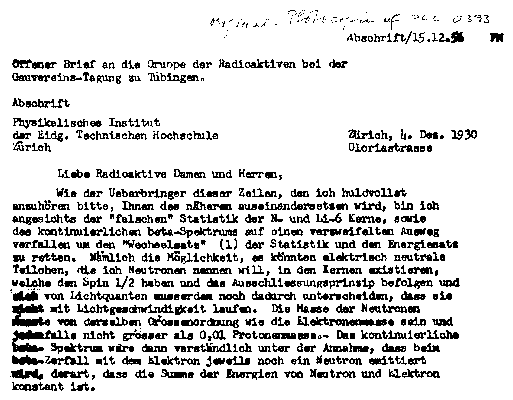
    I wanted to reproduce Wolfgang Pauli’s letter of 4 December 1930–in it he thinks very widely of missing stuff, of some of the basic bits of the universe, in a rather open and guarded way, about the ghost of the neutron.  He didn’t feel very comfortable with his ideas yet, at least for professional consumption–that would have to wait another three years when it was discussed at the 7th Solvay Conference (1933) and another three when it first came into print (1936). The name “neutron” would also be changed to the familiar “neutrino” (“little one”) by Enrico Fermi in 1933 to differentiate it from the much larger nuclear particle discovered the year earlier by James Chadwick–Chadwick’s paper was published in Nature, which would reject Fermi’s paper in 1934 as too radical a leap. 

    Pauli letter

    [Source: Exhibition of the ETH-Bibliothek to the occasion of the 100th birthday ofWolfgang Pauli  http://www.library.ethz.ch/exhibit/pauli/neutrino_e.html]

    ·Posted by :

    ·in:

    —

  • Atoms and Splitting the Atom in the OED

    JF Ptak Science Books   Quick Post

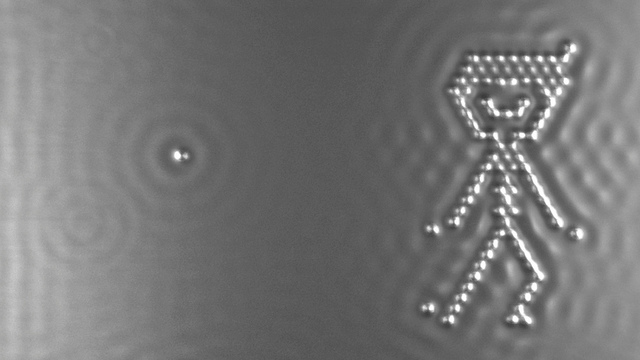
    Boy and his atom[Still from the IBM 2013 video “A Boy and His Atom”, where a team manipulated carbon monoxide atoms on a 45×25 nanometer frame.  Just for reference a human hair is 105 nm, and there are 24×109 nanometers to the inch. Small.]


    I was looking around, trying to figure out a chronology of small, of how small things can really be, when I decided to check out the basic terms of conversation in the Oxford English Dictionary.  I was surprised to see that the first reference to “sub-atomic” was much earlier than I expected, finding a place in the five-year-old science journal Nature, in 1874.  Just for the sake of it I’ve made a list of the atomic-related words that came to mind, just to see how they were entering relatively common usage in English.  And so, below:  sub-atomic, inter-atomic, atom, split the atom, proton, electron, and neutron.