A Daily History of Holes, Dots, Lines, Science, History, Math, Physics, Art, the Unintentional Absurd, Architecture, Maps, Data Visualization, Blank and Missing Things, and so on. |1.6 million words, 7500 images, 4.9 million hits| Press & appearances in The Times, Le Figaro, Mensa, The Economist, The Guardian, Discovery News, Slate, Le Monde, Sci American Blogs, Le Pont, and many other places… 5000+ total posts since 2008.

Category: Naming Things

  • Chess Pieces of Dusty Greats vs. Celebrity Mistakes: Robt Hooke vs. Paris Hilton

    JF Ptak Science Books   Post 1954
    Follow Me on Pinterest

    • QUESTON:  If great but not-popularly-known scientists could be represented as a chess piece, and that chess piece was on a game board opposite Popularly-Known-Celebrities-Not-Known-to-Scientists (and etc.), what piece would the great and dusty Robert Hooke be? And conversely, (on that opposite side), what piece would someone like, say Paris Hilton be?

    See also earlier posts: The History of Dots Part 9: the Cell and Robert Hooke  and Horse Poop and the Stars: Robert Hooke, 1673 (No, it Wasn’t Pegasus) and When a Compliment is Not: Newton and Hooke and the “Shoulders of Giants”

    I wonder about poor old Robert Hooke.  He was such a tremendous thinker, a terrific rush of ideas, with revolutionary insights in many fields; he was a leading architect, a physicist, a microscopist, a chrononaut, a mathematician, an everything. He carried the Royal Society for years, carried on hundreds if not thousands of experiments, and of course was famously on the other side of a bad series of arguments with Isaac Newton.  At the end of his long life, Hooke was afraid of not being remembered, of not having enough money to see
    himself through hi sold age, afraid of others taking credit for his
    work.  He just seemed not to matter, anymore, in the last decade of his
    life (and a period in which he was still doing significant work), and I
    just wonder why he managed to become so semi-invisible.
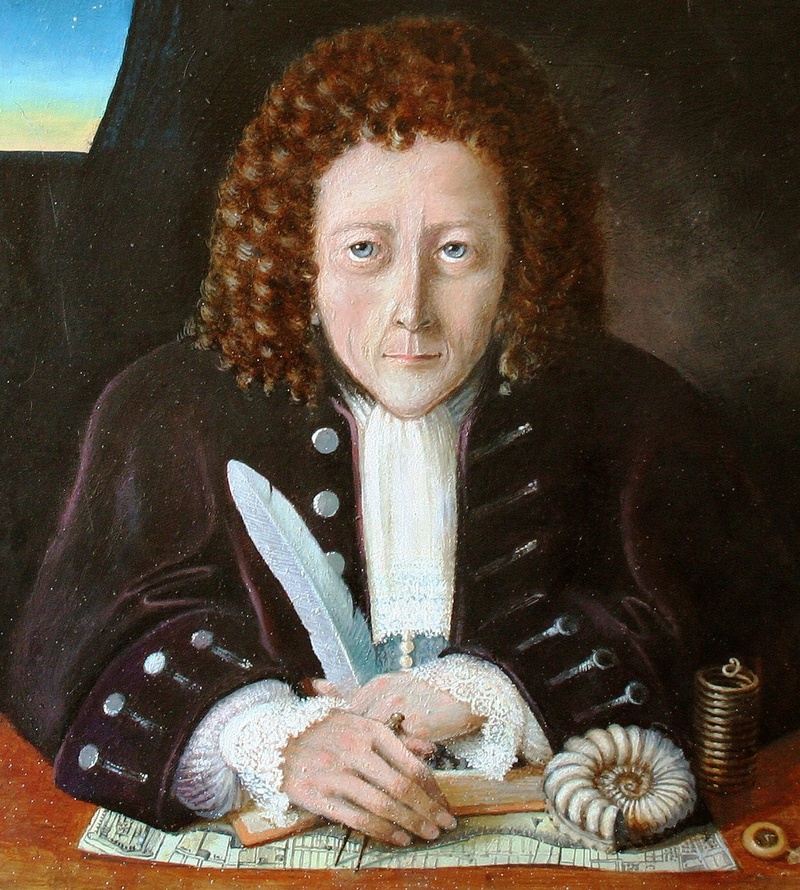
    13_Portrait_of_Robert_Hooke

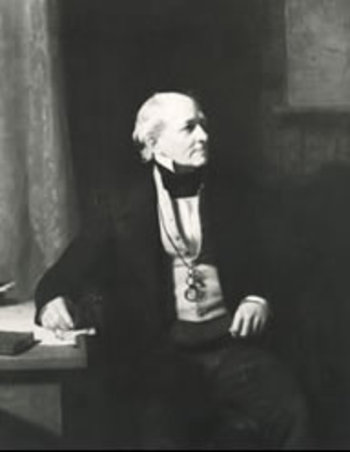
    He was so dedicated.  I have an image of him scurrying with a friend, removing the estimable library of a patron and donor to the Society, trundling the books in wheelbarrows across a mile and then-some of bumpy London streets finding a home for these great treasures.  He was an older man at this point, marching these books across parts of the city that he helped to restore after the fire, passed buildings that he helped to build and design, bumping his way through London, a great and famous scientist, saving books by the handful. [An idealized portrait of Hooke, at right.]

    He was a tireless,
    relentless observer and experimenter, who lost little effort in a stranded idea
    and pursued interesting and problematic questions relentlessly.  More than others too he chased his won glory—minor
    but long and insistent—the years of which wore thin on many people in the
    scientific community.  But there were
    many characteristics of the man that made him not quite so lovable and
    endearing—not that Newton was any of those things, as he was not, but if you
    are going to be a secondary luminary to a super nova you’ve got to have
    something else going for you that the other man doesn’t have—sharing, helpful,
    greatly generous—to get you into the long pre-dusty pages of history. Also it would’ve
    helped if Hooke chose his battles with a little more aplomb and ingenuity—the
    war which began in 1672 with Newton went very badly for Hooke and followed him
    to the grave (and far beyond).

    He just didn’t “catch on”, I think–at least he not for the long term.  His brain teemed with ideas, but perhaps by the last decade of his long life, his tireless brain still working on innumerable bits, he just sucked the air out of a room. 

    He also never had his likeness recorded during his lifetime.  And that is saying a lot.  And I still don’t know why.

    Back to chess:  I figure Hooke to be a Knight.  I prefer Knights.  He moved like a Knight.  He importance was “higher” than that of a Knight, but, well, the Knight seems a good fit (and so he seems to get downgraded, in a way, even in this game).  And Paris Hilton?  I think she might be a queen (with a small “q”)–as someone who is ultra-well-known but not for anything in particular except for the quality of being well-known. 
    ·Posted by :

    ·in:

    — —

  • Imago Frammeni: Boulle, the Dogon, Jouffret, the Simple and the Complex

    JF Ptak Science Books  Post 1914

    Changing the Mind’s View of Simple and Complex Ideas via Different Image Perspectives

    I’m always very interested in curious things, or standard, “average” things pictured in non-standard ways, as theDsc04588
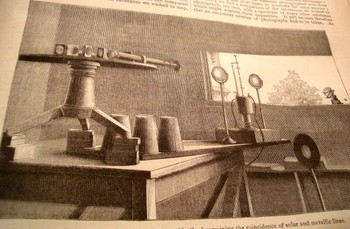
    change in perspective can lead to entirely new observations and discovery.  Seeing this illustration in an article by J. Norman Lockyer (Nature 1881) I was shocked by its clarity and usefulness—Lockyer was simply showing the arrangement of his apparatus for his solar spectrum experiments but the angle of observation (being at such an oblique angle as is normally found) was just, so, well, “correct”.  The image I thought was perfect for the reader—not only that, it was designed artistically and with grace, and one can see exactly what Lockyer was up to.  Diagrams would’ve worked almost as well, but there is just something so extraordinary here that you could just about work from the image if there was no description. 

    Dsc04579_2

    Looking at things differently is hard work—that’s why I think it is always good to refresh the neuronal sap and look at great examples of unusual , insightful imagery.

    Sometimes it works to read the description of what the image is before actually viewing it to see the differences of the image that you form in your brain before seeing the thing itself.  For example, when reading about the Dogon, a cliff-dwelling people of the plateau of Bandiagara, south of Tombouctou, and how they would make houses and then towns out of the rocks fallen from cliffs, you get what is probably a pretty benign image.  When you see photographs of these structures it seems as though the brain just simply isn’t ready for their impossible nature, though you quickly, instantly, recover (once you convince yourself the photo is real) and—voila—your mind has been expanded.  (This photo is from an expansive work by Bernard Rudofsky, Architectures without Architects, Doubleday, 1964.) 

    The (internally) spectacular Etienne Boullee can greet us in the same way with some of his eye-popping architecturalBoulle1
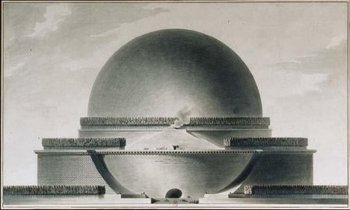
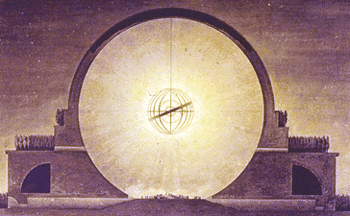
    creations (unbuilt architecture by an architect, in this case, compared to the built architecture of the non-architects above).  Boullee’s “Plan du Cenotaphe de Newton”, a gigantic memorial to Newton  that was dancing with necessary privacy in Boullee’s brain during the French Revolution (and also during a particularly un-Newtonesque time in on-your-knees-to-Cartesian-principles France)  is another superior example.  Reading the description of the structure just doesn’t quite do, and it seems whatever grand comes of that is tarnished and stripped away  by the obesely florid sentiment of none other than Ledoux’s poetic sentiments “…O Newton!  Sublime Mind!  Vast and profound genius!  I conceived the idea of surrounding thee withBoulle2
    thy discovery…”.  Oy.   Boulle adds to this inspirational atrocity by saying of the sphere:  “…we must speak of a grace that owes its being to an outline that is as soft and flowing as it is  possible to imagine…”   And once the demand of “oh  dear god just please show me the picture” is met, we are left with a turned-around brain and another heavenly exaltation, or profanity.  The Cenotaph is just Grand-Canyon-Spectacular. 

    Complex can turn on the simple in this way, where we can have those “a-ha” moments from, say, early efforts at picturing the fourth dimension or non-Euclidean geometry to a new perspective of looking at Roman ruins.  The arrival on the non-Euclidean geometries  in the 19th century posed new issues, not the least of which was representing the ideas.  Our saintly Hermann von Helmholtz believed –contrary to most elevated opinions—that the human mind could indeed intuit complex space and figures of these geometries.  (The difficulty not only from the obvious intellectual hardships in picturing the concepts but also because the geometry of Lobachevsky http://www-groups.dcs.st-and.ac.uk/~history/Mathematicians/Lobachevsky.html was called somewhat into doubt when some of its results were cast in doubt by contemporary astronomical observations.—and this even though so far as the great Gauss was concerned there was no deviation in Euclidean values.)   Helmholtz did this by employing the three-dimensional pseudosphere model of Beltrami.  (Reluctance to these ideas would end soon enough, for, as Linda Dalrymple Henderson points out with such sotto voce, “the convenience of Euclidean geometry would prove inadequate once Einstein” hit in 1905.)

    Dsc04585
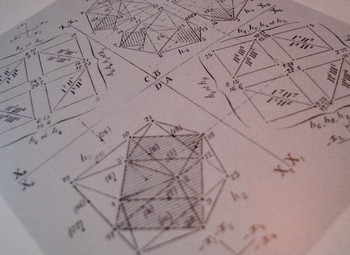
    The work of Beltrami  and H.P. Manning  (Geometry of Four Dimensions, 1914), and Jouffret  (Traite elementaire de geometrie a quarte dimensions, Paris 1903) in illustrating these complex ideas (the titles of which were in themselves daungting as with Jouffret’s “plane projections of the sixteen fundamental octahedrons of an ikosatettrhroid”) would in themselves prove to be entirely irresistible to the world of the arts.  Charles Howard and Maurice Princet I think had as much to do with  the creation of cubism and abstract art and the imaging of time than anyone, including the painter (I shudder to say his name) of Les Demoiselles (1907) or the lovely Georges Braque (Houses at Estaque, 1908) or Jean Metzinger or even the sublime comedian Duchamp’s Nude DescendingDsc04584
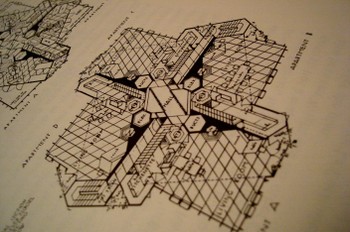
    (1914).  The hypercube starts to show up a lot in some Bauhaus genres and even into the palette of Frank Lloyd (“Stinky”) Wright (with his St. Mark’s Tower plan, NYC, 1929).Dsc04589 I can only imagine the shock to the brains of these creative geniuses in seeing the display of such a novel idea.  (For the ultimate treatise on this see Linda Dalrymple Henderson’s The Fourth Dimension and Non Euclidean Geometry in Modern Art, Princeton  1983).  And no the art didn’t come first. 
    Dsc04578

    But coming back to the simple, and in the same frame as the first example that we mentioned in Lockyer, we have the unlikely find of Giovanni Piranesi.  In my opinion his most spectacular work is found in his frammeni (the diverse bits and pieces of architectural and sculptural bric-a-brac found objects that are collected together on one stage) and in his archaeological detail.   His attention to new perspective in showing the crucial aspects of structure and building in Rome is tremendous andDsc04590
    unexpected—as an example we see here the child’s-eye-height view of three steps of the reconstruction of the theatre of Pompey.  I must say that I’ve seen a lot of architectural images in my time but nothing quite comes to me so surprisingly as this step-level view of the reconstruction of a Roman theatre,  This happens throughout the lesser-known Piranesi, with great details of tools, and cross sections of the very deep Dsc04591
    footings of bridges, and so on.  It is really refreshing, lovely, unexpected work. 

    We’ll return to this subject from time to time as I have hundreds of interesting examples to draw from—for example, the remarkable Emily Vanderpoel’s Colour Problems (which has surfaced in this blog from time to time) which is ostensibly an undecipherable attempt to quantify color arrangement in art but through the lovely examples displaying this attempt pre-date the modern re-invention of non-representational art by at least a dozen years.  Stay tuned! Dsc04592


  • Ancient Myths Modern: the Other Statue of Liberty, ca. 1911.

    JF Ptak Science Books     Post 1887

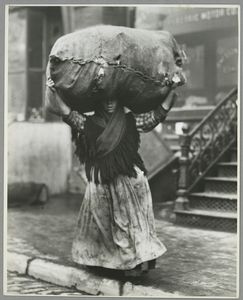
    In working on an alphabet of the occupations of children in 1910/1920 America based on the photographs of the immortal Lewis Hine (and found via looking at other materials on the excellent Retronaut website), I came across this extraordinary image:

    A tenement gleaner, New York C... Digital ID: 416509. New York Public Library

    The detail seems to show lip rings on what I think is a very young woman.  She is very slender (you can see very thin wrists), and is wearing a number of layers of clothes, not the least of which is a long white apron on top of which sit Civil-War-like shawls,  She is stepping into the street, caught mid-stride. It looks as though it is frosty, the sidewalk and steps seem to have a thin veneer of ice  It is cold. And she is carrying an ungainly, heavy burden, which might weigh half of her own weight. And she is young.  And she has no gloves.

    Where did she go?

    Hine--tenement gleaner detail

    It also that Hine–in his notes onthe back of the photograph– identifies her with kindness and grace as a “tenement gleaner”.  (In my notes I was less kind and called her a “ragpicker” I’m a little ashamed to say. Mr. Hine taught me a lesson.) Gleaner.

    Hine documented things that were part of everyday life that made cities like New York what they were, much of which went unnoticed, or scuttled by intentional indifference. People like this made the city run–then as now–and Hine was one of the early photographers in the United States who “discovered” these people and made their standing a cause of his life. 

    Like many other pioneers/artists/social observers, Hine (1874-1940) didn’t fare so well in his later life. After four decades of huge service in photography, people became disinterested in his past/present/future work, and Hine lost his resources. And his house. And then, in a few years, his life.  His personal collection of negatives and prints were given by a relative to the New York Photo League, but they were displaced when the League was dismantled in 1951.  Unsettled, they were offered out to places like the Museum of Modern Art, which rejected the collection. Ultiamtely, fortunately,  the George Eastman House in Rochester, New York, accepted the collection and saved it from the unknown.

    This image easily could have been Atlas, but Libertas seemed better.

    Source:  New York Public Library Digital Collection. “Photographs concerning labor, housing and social conditions in the United States. / L. W. Hine. ” 


  • Bits Towards an Alphabet of the Language of Flowers–Some Definitions of Flower Symbols

    JF Ptak Science Books   Quick Post

    photo

    I’ve put together a quick-and-dirty list of some interpretations of what the appearance of flowers may “mean”–-say in the hands of the subject of a painting, or as a gift, or a reference in a poem or piece of literature.  This in some ways reminds me of an earlier post on this blog, “An Unkindness of Ravens and a Murder of Crows”, here.

    Here’s a short list for further reading on the language of flowers:

    • Connolly, Shane. The Secret Language of Flowers, New York: Rizzoli International, 2004.
    • Edgarton, Miss S. C. The Flower Vase: Containing The Language of Flowers and Their Poetic Sentiments, Boston: Samual M. Dickinson, 1843
    • Greenaway, Kate. Language of Flowers, London: George Routledge and Sons, 1864.
    • Hale, Sarah. Flora’s Interpreter, and Fortuna Flora, Boston: Benjamin B. Mussey and Company, 1850.
    • Latour, Charlotte de.  Le langage des fleurs, 1830.
    • Lehner, Ernst. Folklore and symbolism of flowers, plants and trees, New York: Tudor Publishing Co. 1960.
    • Miller, Thomas. The Romance of Nature; or the Poetical Language of Flowers, New York: J.C. Riker, 1860
    • Powell, Claire. The Meaning of Flowers, Boulder, Colorado: Shambhala Publications, 1979.
    • Shoberl, Frderic. The Language of Flowers: With Illustrative Poetry; to which is Now First Added, the Calendar of Flowers  1830
    • Phillips, Henry. Floral Emblems, 1825.
    • Waterman, Catherine H. Flora’s lexicon: an interpretation of the language and sentiment of flowers : with an outline of botany, and a poetical introduction. 1855
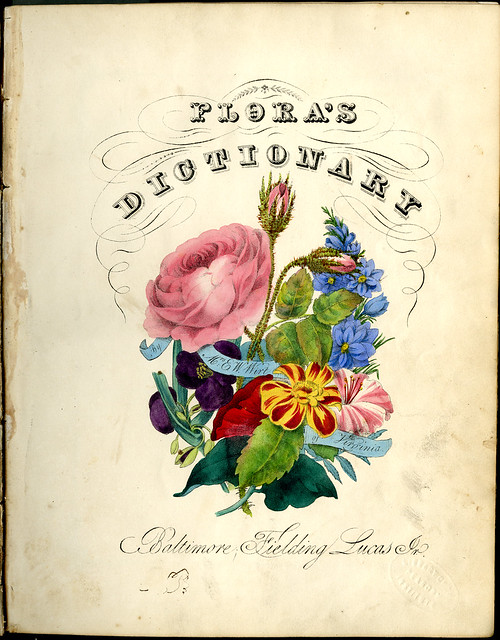
    • Wirt, E.W. Flora’s Dictionary, Baltimore, 1855.

    and an overall history

    • Beverly Smeaton, The Language of Flowers–a very interesting book where Smeaton compares the various meanings for flowers among the five early and integral 19th century flower-symbolism folks, beginning on pp 167.  A link to a free read is here.

    Some samples of the very rich descriptions of the meaning of flowers:

    Almond, flowering – Concealed love.
    Althea, Frutex – I am deeply in love.
    Amaranth – Immortality, or piety.
    Anemone – Fading hope.
    Arbor-Vitae – Unchanging friendship.
    Auricula, Scarlet – Pride. You are proud.

    ·Posted by :

    ·in:

    — —

  • “Kill Sin Pimple” and other Religious Nicknames of the 17th Century

    JF Ptak Science Books    Post 1841

    Barebones601

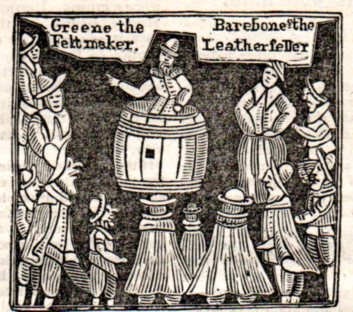
    Who Is that man pointing and speaking from the preacher barrel? 

    This quaint woodcut appeared as the cover illustration to a pamphlet entitled A Word to Fanatics, Puritanism and Sectaries1; or, New Preachers New, and it answers my question: the screamer is Mr. Praise-God-Barebone who is attended by his attender, a more-commonly named Mr. Green (“the Feltmaker”), and is shown preaching to a small crowd, many of whom are shown with long faces and in deep caricature, more so to mirror words they are hearing.  Barebones is not presented in a friendly light, as the pamphlet was a warning to the general reader of the rising crowd of untrained and possibly heretical religicos who were gathering attention in and about London in the (Cromwellian fanatical) 1640’s.  They were seen as diffident, destructive, and definitely of the dimpled damaged variety of street entertainer. The interestingly-named pamphlet and Mr. Barebone was reported by the  magazine, The Mirrour, (July 19, 1823) as “the object of the work is to ridicule such persons without education undertake to expound the Scriptures, and who, ignorant themselves, have the vanity to pretend to teach others”. The powers that be were not amused.

    After dispatching the screamers The Mirrour then lists a number of very compelling and some-never-heard-of-before-by-me nicknames, like Barebone’s brother “Christ Came Into the World to Save” Barebone, followed by these examples: Accepted Trevor, of Norsham; Redeemed Compton, of Battle; Faint Not Hewit, of Hearthfield; Make Peace Heaton of Hare; God Reward Smart, of Firehurst; EarthAdms, of Warbleton; Called Lower of Warbleton; Kill Sin Pimple, of Witham; Return Spelman, of Watling; Fly Debate Roberts, Britling; Be Faithful Joiner, of Britling; Mare Fruit Fowler, of ast Hadley; Weep Not Billing, of Lewes; and Meek Brewer, of Okeham.  The magazine claims official records as the source for these names, but, well, who knows–perhaps the editors were just attempting to put a larger exclamation point on their biting article.

    These are extraordinary names in some ways similar to the passive reportage nastiness of H.L. Mencken’s nickname walk-through in his The American Language, but not quite so–in that book, the old problematic sage of Baltimore staggers his way through unbridled American enthusiastic for the common person’s testing and misunderstanding of English.  The religious  nicknames  seem more like baseball nicknames from the 1920’s, or earlier.  But of course these names predate those efforts by nearly 300 years.

    Somehow I’d like to see trading cards for these guys–although half-ancient that don’t give much leeway to their modern sports varieties.  Baseball has provided ceaseless though a little limited entertainment, tending sometimes toward the poetic overstatement (the Chairman of the Board, The Mighty Slider, The Great Significance) though it does get down to business in the ‘40’s and ‘50’s (the golden age of BB nicknames).  Here are a few examples, minus the racist stuff:  Pork Chop, Tater, Gummy, Whale, Pickles, Rawmeat, Spud, Bunny, Beast, Kitten, Possum, Slug, The Rat, Pudge, Tomato Face, Buttercup. (The most effective nicknames could’ve been made by combining two of the single names:  “Spud Rawmeat”, “Pudge Slug” or “Gummy Buttercup”, for example.)  There’s an awful lot of them dealing with food, and a whole heck of  a lot dealing with facial features; they all seem to outweigh ball playing ability, by far.  All this said, I do have a sweet pull for the religious nicknames. 

    Notes:

    1.  Sectraries:   members of a sect, especially those who belongs to a religious sect that is regarded as heretical or schismatic.


  • Finding a Fat, Bald, Fencing Cake-Eater for Movie Roles, 1923

    JF Ptak Science Books   Post 1790

    I stumbled into an unintentionally iconic time capsule, a collapsible bit in the brevity and complexity department, that sifted out the “extraneous” artistic matter of early motion picture entertainment and got straightaway to the crux of the film-making biscuit, which was finding people to fill the roles in a film.  It sounds simple enough in a simpler time, but it wasn’t simple for them–and the residue of the difference between the two is interesting.

    Movie463
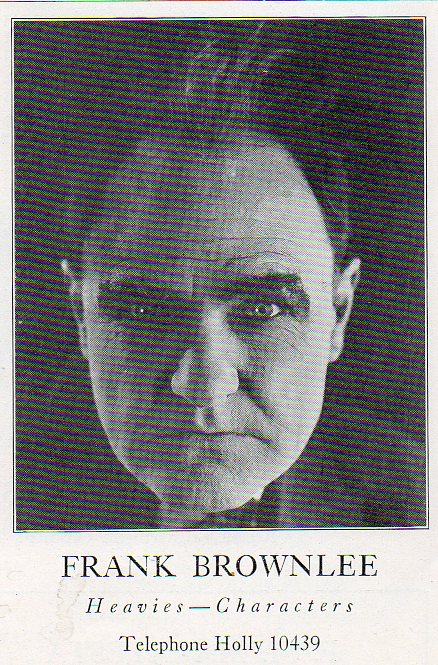
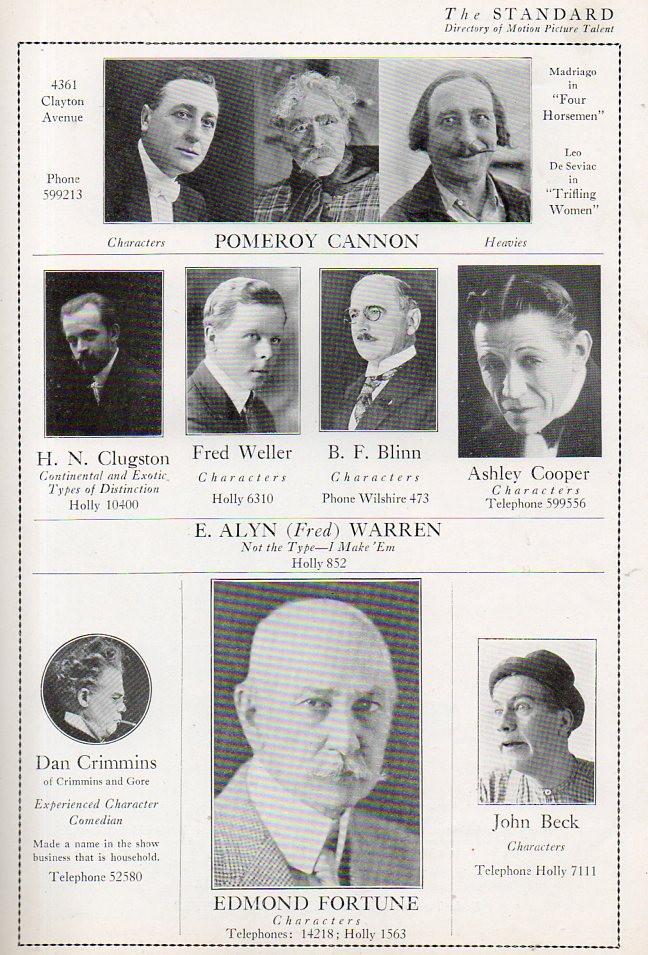
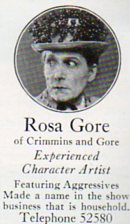
    In looking through some early documents on sound-on-film motion pictures (that’s simultaneous sound-on-film) I came across this nostalgic wonderful insight:  The Standard for March 1923. The Standard Casting Directors Directory was a film exec’s handbook, an advertising vehicle for actors and their favored parts, a picture directory of offerings of all scales of applied talent.  In addition to the lovely photos are the descriptions of what their casting specifications might be–including the titles of the specialties.

    For “supporting cast/specialty people” for men, the titles include (with actors’ names appearing underneath): acrobats, bald headed men, bankers, bearded men (old), bellhops, bit men, boxers, butlers. character men, chauffeurs, Chinamen, Colored Members of the Profession, comedians, cowboys, dancers, detectives, divers, doctors, Englishmen, entertainments, Europeans, evening clothes men (old) , fat men, female impersonators, fencers, footmen, Frenchmen, German types, Hawaiians, Hindus, hunchback, Indians, Irishmen (old), Italians, Japanese, Jewish (old), jockies, judges, juveniles, Mexican, monks, policemen, priests, Russian types, sheriffs, slickers–cake eaters, small town men, Spanish, stunt men, swimmers, tall men (over 6 feet), twins, underworld types, waiters,  and well dressed men”. 

    Movie462

    I haven’t looked to see if there are any cross referenced for, say, bald-headed fencing cake eater footmen.

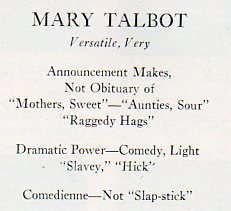
    Movie466There were 50 categories for the women (compared to 56 for the men), and included quite a lot of overlap, particularly in the stereotyping department. The more-or-less exclusive categories for women included cooks, dancers, flappers, ingenues, maids, matrons, models, mothers, nuns, nurses, old maids,
    stenographers, waitresses, witch types and tall old women. I doubt that there was very much money to be made playing a tall old woman (or a fat/matronly/old maid/tall old woman) but evidently it was more than could be made by playing a woman lawyer/doctor/insert other professional position here _________ .

    Movie465I realize that this was a simple and useful way of getting things done, of finding the necessary actors for movie roles, but taken slightly out-of-context this pamphlet becomes a little more than that–a small, swallowable capsule of what “normalcy” might have looked like for entertainment folks in a relatively mature medium in 1923. 


  • Chasing the Squamish: the Fremantle Doctor and Naming the WInd

    JF Ptak Science Books  Post 1784  [An Episode in the series The History of Blank, Empty and Missing Things.]


    Blogwind
    207 years ago Admiral Sir Francis Beaufort proved that he could record a seemingly unrecordable medium.  He was able to write on the air, basically, affixing a permanent and economical, understandable, common denominator to something that no one could actually “see” (but could see the effects of), and that everyone could feel and measure, but not capture.  He created the Beaufort wind force scale, and it has been in use as a lingua franca (with some modifications) ever since–the wind force scale.  It was a pretty important vocabulary (language, really) to establish, as there wasn’t any agreed upon terminology before his—a ‘stiff breeze” might mean one thing to a Mainer and another to someone in Santa Barbara, while a gentle breeze might mean something completely different to someone at Gibraltar than to someone else in the Kill Van Kull of Staten Island.  Beaufort fixed this problem, and fixed it good. 

    Oddly enough, Beaufort’s system was introduced at about the same exact time as  Luke Howard’s system (of 1803 versus 1805) for organizing another very fluid, gigantic, series of extraordinarily common and global occurrences that had escaped scientific classification for thousands of years—the clouds. (I wrote about this a little earlier in this blog.) 
    Blogwind2
    Classification systems for the wind have existed for a long time though they haven’t really been of a fundamental, descriptive value.  For example, reaching back into the misty Greek mythological past we find the four winds were personified as gods, called the Anemoi, including Boreas, Notos, Euros, and Zephyros) Another area of creep and crawl for wind classifications and descriptions can be found (slightly) in the Bible–blowing from the four quarters of heaven, (Jer. 49:36; Ezek. 37:9; Dan. 8:8; Zech. 2:6); parching east wind  (Ezek. 17:10; 19:12) and strong wind (Job 27:21), while the south wind was hot (Job 37:17, and so on, though they were all subject to the wants and needs of god (Ps. 18:10; 135:7), which is their greatest unifying factor (though of little use in descriptive transaction).  The named components of wind (geostrophic wind, thermal wind (not actually a wind but a wind difference between two levels), gradient and ageostropic wind) are newer and valuable additions but of course cannot compare to the overall importance of the Beaufort contribution. 

    There are many other examples from many other cultures, the discussion of the wind and winds can take up a chunk of the anthropological/theological universe.  A quicker,easier way to look at regional naming and classifying systems for the wind is to simply look at “individual” winds—winds that have certain characteristics, are particular to a location or time, and which also have a personality.  There are some highly descriptive and mysterious names among them:  for example, the Fremantle Doctor (afternoon sea breeze from the Indian Ocean which cools Perth, Western Australia during summer), and Squamish (strong, violent wind occurring in many of the fjords of British Columbia)      Again, the overall power of applying descriptions of the  Bayamo (violent wind on Cuba’s southern coast)  to the  Bora (northeasterly from eastern Europe to northeastern Italy)  to the Cape Doctor and the Passat are not terribly useful, especially if you were trying to communicate a wind system before you. 

    Beaufort supplied what was in effect Dalton’s table of the chemical elements (and the creation of the atomic theory, 1802), and did so, just as in the case with Luke Howard, incredibly, at about the same time:  Dalton in 1802, Howard in 1803, and Beaufort in 1805.  I’m just now appreciating the extraordinary organizing party that took place here over these four years:  Dalton organizing (with great prediciive powers) the unseen atomic world and the world of the elements; Howard applying scientific means to naming the greatest of the scientifically-unnamed whales of science in the clouds; and Beaufort, who performed a Luke-like task with the wind just two years later.  I’m not so sure that there was a better short period than this for naming anything in the history of science.  Ever. 

    A good modern chart of the Beaufort scale can be found here.


  • The Ouroboros and Infinity

    JF Ptak Science Books    Post 1762

    Ouroboros390
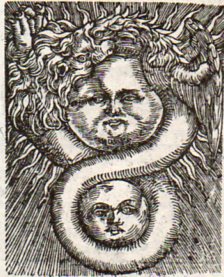
    The ouroboros–and in this particular case, the double, over-and-under ouroboros–is an interesting and ancient symbol.  In my experience, the single unit is to be expected, but the double seems uncommon. The symbol (“oura” or tail and “boros”, eating, in Greek, one who eats one’s tail) stretches back into the dim and dusty past, at least to the Egyptian Book of the Dead, and is Plato’s first living thing–its is the primordial unity, the rebirth of forever, death/life/birth/rebirth, continuing into infinity, the great world soul…a kind of Western equivalent of the Taoist Yin Yang.

    There’s much more to be said about this symbol, especially by such people as Erich Neumann and Carl Jung, but I’ll resist, mainly because it is just too complicated for me to make an intelligent statement. (I’ve tried to read the Great Mother as well as The Origins of the History of Consciousness by Neumann, but only made my way around the edges of the first, and picked through the interesting bits of the later.  Jung is someone I’ve never had much luck with.)

    The first symbol, and a gorgeous one it is, comes from the Theatrum chemicum (1659-1661, and published in six volumes by Lazarus Zetzner in Strasbourg), and shows the combination of what was supposed to be an alchemical highpoint:  the spiritual coming together of sulfur and mercury, elements of what the practioners believed were the basic constituents of all metals and minerals.  And of such stuff miracles were understood to be made, except that of course, they weren’t–the fact that this stuff never worked to produce something more substantial than mercuric sulfide wasn’t due to the theory or practice or thought but to the “fact” that the mercury and sulfur used in the process weren’t “pure” enough.  That said, the Theatrum was a very important work, the largest collection of alchemical works ever gathered and published together–it was also evidently much appreciated by Isaac Newton, who was said to consult it often and who owned the set in his library.

    A more classical appearance of the ouroboros (De Lapide PhilosophicoTriga Chemicum (Prague 1599) compiled by Nicolas Barnaud), depicting a dragon seizing the polarities of its soul, ultimately uniting them: 

    File:Ouroboros 1.jpg

    And in the discussion of the ouroboros and philosophical aspects of infinity it should be mentioned that there is some connection between it and the mathematical symbol for infinity, which seems to arise from (the remarkable and original) John Wallis’ De Sectionibus Conicibus, which was published in 1655.  Wallis employed the old Roman symbol for 1,000 to use for the mathematical infinity, which of course is the ouroboros on its side.  (Wallis it should be noticed was also among the earliest people to put into print the symbol for pi, as well.)

    ·Posted by :

    ·in:

    — — — —

  • The Reverse of the Origin of Species and the American Civil War, 1862

    JF Ptak Science Books  Post 1759

    Darwin elephant392

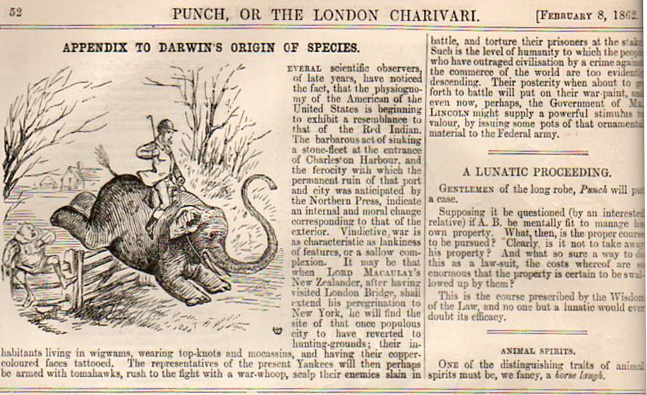
    This pungent bit appeared in Punch magazine 8 February 1862, and was a vicious attack against the Americans (almost entirely directed at the Union North)  in the second year of the U.S. Civil War.  What Mr. Punch saw in “his” editor’s mind was a “sinking” of the American race to the level of the “Red Indian”, the whole of the nation reverting to some previous developmental state, far removed by their actions to a more primitive people, a different sort of “evolution”–in fact, what the spoofing (?) and chiding editors saw in the Americans’ actions was a reverse of Darwin’s theory.  These same people were already uncomfortable with Darwin (at this point three years past the publication of the Origin1) but so long as using the book to a comfortable goal was concerned it seemed a perfect fit, a proof for the reverse of the Origin.  As we see in the second short article:

    “If there is any truth in the theory of the Origin of Species there may be an inversion of the originating process…”

    Chief (and first) among the complaints was the blockade action against the Confederate port of Charleston (South Carolina).  The “stone fleet” is incorrectly described in the wonderful “Science in 19th Century Periodicals” website as being of Confederate origin.  The Stone Fleet was actually part of  a Northern action, being a large contingent of ships brought south and sunk in the waters off Charleston Harbor in the hopes of preventing Confederate blockade runners from escaping the ring of Federal ships already present there.  There were also a number of ships sunk off the coast of beautiful Tybee Island, there to be used as breakwaters and landings for Union ships operating just south of Savannah. 

    The behavior of the United States, so far as Mr. Punch was concerned, just wouldn’t “do”.

    “SEVERAL scientific observers of late years have noticed the fact that the physiognomy of the American of the United States is beginning to exhibit a resemblance to that of the Red Indian.The barbarous act of sinking a stone fleet at the entrance of Charleston Harbour and the ferocity with which the permanent ruin of that port and city was anticipated by the Northern Press indicate an internal and moral change corresponding to that of the exterior Vindictive war is as characteristic as lankiness of features or a sallow complexion. It may be that when LORD MACAULAY’S New Zealander alter having visited London Bridge shall extend his peregrination to New York he will find the site of that once populous city to have reverted to hunting grounds their inhabitants hunting grounds their living in wigwams wearing top knots and mocassins and having their coloured faces tattooed. The representatives of the present Yankees will then be armed with tomahawks, rush to the tight with war whoop, scalp their enemies slain in battle, and torture their prisoners at the stake. Such is the level of humanity to which the people who have outraged civilisation by a crime against the commerce of the world are too evidently descending. Their posterity when about to go forth to battle will put on their war paint and even now perhaps the Government of MR. LINCOLN might supply a powerful stimulus to valour by issuing some pots of that ornamental material to the Federal army.”

    Later in the year Mr. Punch again addressed “Brother Jonathan”, (a reference from Revoutinary War days to Americans in general, but more so during the Civil War, when “Brother Jonathan” and “Johnny” were both used…its also intersting to note the use of “Johnny Red” and also the appearance in “When Johnny Comes Marching Home”) and again invoked Mr Darwin and the Origin, and again using the “Indian type” as the state to which the “model Republic” was sending itself towards, with Americans “descending to the very lowest place”, an “inversion of the originating process”. 

    “Thus Jonathan you see you are sinking from bad to worse from savage to lower savage and your manifest destiny at that rate of decadence is the zero of humanity.”

    It is a rather bad letter, brother-to-brother, so to speak., Mr. Punch claiming that Americans will descend to gorillas, “Apes with foreheads villainous low”.  Surprisingly (to me, anyway)   Mr. Punch slips easily into very vile characterizations of other types of human beings in use by metaphor–these don’t need to be singled out here but can be found in the original, below.  And so the Manifest Destiny of American–“declared” or at least the phrase originated just 17 years earlier by John O’Sullivan in the Democratic Review in an article “Annexation” regarding Texas–so far as England was concerned was to be excruciatingly, intolerably, low; so low inn fact that it is the very proof of the stuff that the Origin of Species theory runs in reverse.

    I’m not sure why the editorial cartoonist used the elephant in the hunt scene and how it relates to Mr. Darwin, though I guess it sends the overall message of The Ridiculous regarding the American affair, at least in the eyes of Punch–England still smarting from the Trent Affair, still newly developed.

    Notes:

    1. The title in full by C.R. Darwin, On the origin of species by means of natural selection, or the preservation of favoured races in the struggle for life, would stay so until it was shortened to The Origin of Species in its sixth edition of 1872. By the time these two articles in Punch appeared, the Origin already in its third edition (published in April 1861).  In all of this, the enormously popular book was printed in not-large quantities.  The first edition of November, 1859 sold out on the first day, and was printed in an edition of 1250 copies, of which about 1170 were for sale.  Darwin was immediately put to work on a second edition (rather than simply reprint the first edition), and the work appeared two months later, in January 1860, in an edition of 3000 copies.  The third edition appeared in April 1861 in an edition of 2000. The fourth edition appeared in 1866 (2000 copies); the fifth, in 1869 (2000 copies0, and the sixth and last in Darwin’s lifetime came out in 1872, in 3000 copies, the largest print run during CD’s lifetime.  So, the most important book in the history of biology (?) sold a total of 13,170 copies or so as published in England by John Murray. 

    ·Posted by :

    ·in:

    — —

  • Monopolis and Multiopolis: a Note on -apolises, -opolises, and Such

    JF Ptak Science Books   Post 1757

    Monopolis379
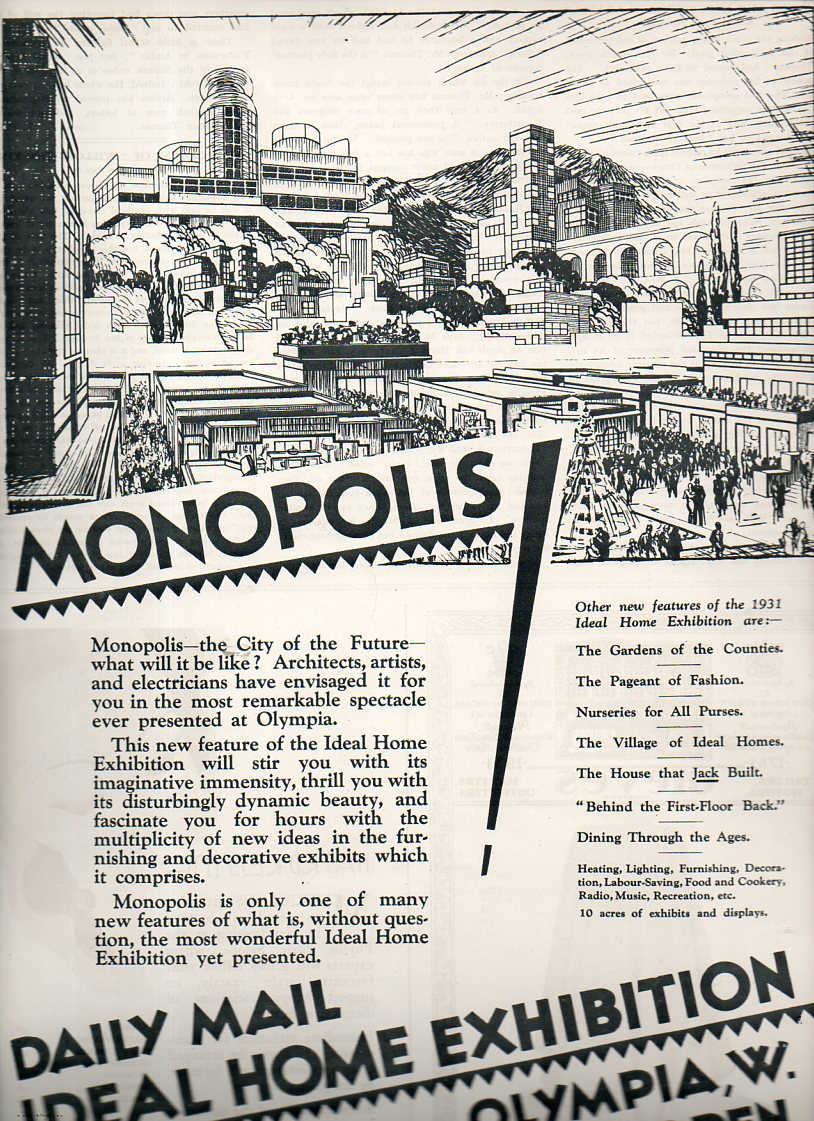
    Welcome to Monopolis!  “City of the future…imaginative immensity…disturbingly dynamic beauty…”

    The moment I look at it Monopolis suggests another word:  Multiopolis.  Although the originators of the Mono- word weren’t really suggesting plain vanilla wrappings for a one-size-fits-all existence, the more diversified-sounding Multi- at least sounds a little more enchanting and not so Orwellian.  It is also a little odd that I can find nothing on “Multiopolis”, not even in a popular Google search–and of course, having been printed in 1931, “Monopolis “can’t be “Orwellian” since Mr. Blair had not yet written any books, least of all 1984, which wouldn’t appear until the man was almost completely out of life. (Blair/Orwell wrote nine books in fifteen years, 1934-1949, and would die in January 1950.)

    Monopolis378


    “Monopolis” certainly suggests a gritty sameness, a suffocating city of similarity with no central decency.

    In this image (above), published in the Illustrated London News on 18 April 1931, Monopolis seems to live up to its promise in all aspects except for its name, which is actually pretty creative. The great building on the hill, the skyline in the mountain, all bauhaused-up with perhaps nowhere to go into the near-future, with really not that much, not too terribly much, to distinguish itself from a first-year architectural student’s semi-dreamed-upon work, though for some reason an aqueduct does makes an appearance to spice things up. 

    In the end, though, Monopolis was a simple title for a continuing series of new-house/design shows in London–it hasn’t much to do with anything, and was simply an interestingly-named bit for a bad advertising campaign.

    I wonder about a collection of “Opoluses”, like the Christianopolis of the Lutheran Christian Utopia, published  by Johann Valentin Andreae, in Reipublicae Christianopolitanae descriptio… published in Strasburg by the heirs of Lazarus Zetzner, 1619.  This is certainly among the most elegant of things ending with “-opolis”, even though it does look like a prison. Or hospital.  And no one would want to be in either in 1619. 

    [Source:  Martayan Lan with thanks]

    There is a small town in Kansas called Opolis, a place of 54 houses and 117 people or so.  It sounds like a perfectly nice bookend to places like Indianapolis and Minneapolis (and yes they’re both “apolis” and not “opolis”), not to mention Hotdogopolis, Bike-opolis, Planned-opolis, and the fantastically-named Possible-opolis. 

     I think that Monopolis just won’t do.