JF Ptak Science Books Post 1757
Welcome to Monopolis! “City of the future…imaginative immensity…disturbingly dynamic beauty…”
The moment I look at it Monopolis suggests another word: Multiopolis. Although the originators of the Mono- word weren’t really suggesting plain vanilla wrappings for a one-size-fits-all existence, the more diversified-sounding Multi- at least sounds a little more enchanting and not so Orwellian. It is also a little odd that I can find nothing on “Multiopolis”, not even in a popular Google search–and of course, having been printed in 1931, “Monopolis “can’t be “Orwellian” since Mr. Blair had not yet written any books, least of all 1984, which wouldn’t appear until the man was almost completely out of life. (Blair/Orwell wrote nine books in fifteen years, 1934-1949, and would die in January 1950.)
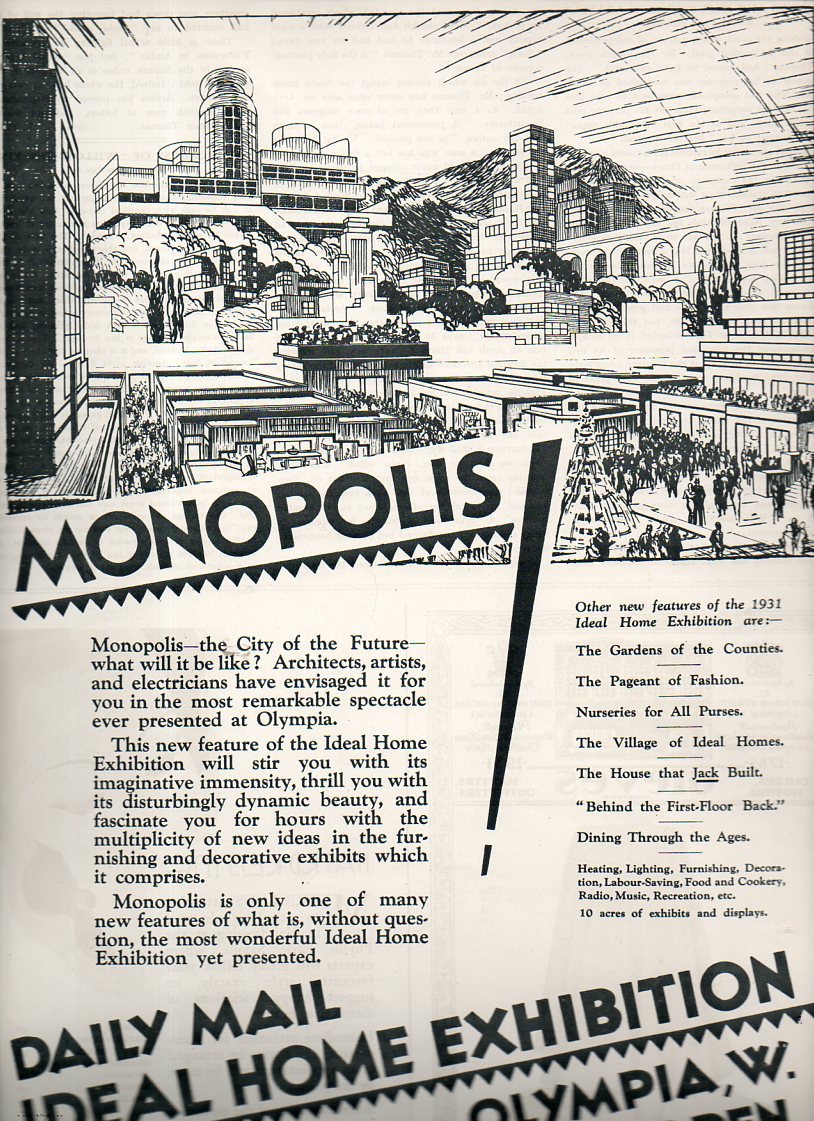
“Monopolis” certainly suggests a gritty sameness, a suffocating city of similarity with no central decency.
In this image (above), published in the Illustrated London News on 18 April 1931, Monopolis seems to live up to its promise in all aspects except for its name, which is actually pretty creative. The great building on the hill, the skyline in the mountain, all bauhaused-up with perhaps nowhere to go into the near-future, with really not that much, not too terribly much, to distinguish itself from a first-year architectural student’s semi-dreamed-upon work, though for some reason an aqueduct does makes an appearance to spice things up.
In the end, though, Monopolis was a simple title for a continuing series of new-house/design shows in London–it hasn’t much to do with anything, and was simply an interestingly-named bit for a bad advertising campaign.
I wonder about a collection of “Opoluses”, like the Christianopolis of the Lutheran Christian Utopia, published by Johann Valentin Andreae, in Reipublicae Christianopolitanae descriptio… published in Strasburg by the heirs of Lazarus Zetzner, 1619. This is certainly among the most elegant of things ending with “-opolis”, even though it does look like a prison. Or hospital. And no one would want to be in either in 1619.

[Source: Martayan Lan with thanks]
There is a small town in Kansas called Opolis, a place of 54 houses and 117 people or so. It sounds like a perfectly nice bookend to places like Indianapolis and Minneapolis (and yes they’re both “apolis” and not “opolis”), not to mention Hotdogopolis, Bike-opolis, Planned-opolis, and the fantastically-named Possible-opolis.
I think that Monopolis just won’t do.