A Daily History of Holes, Dots, Lines, Science, History, Math, Physics, Art, the Unintentional Absurd, Architecture, Maps, Data Visualization, Blank and Missing Things, and so on. |1.6 million words, 7500 images, 4.9 million hits| Press & appearances in The Times, Le Figaro, Mensa, The Economist, The Guardian, Discovery News, Slate, Le Monde, Sci American Blogs, Le Pont, and many other places… 5000+ total posts since 2008.

Category: Naming Things

  • The Beauty of Speed in Chess Notation

    JF Ptak Science Books   Post 2723

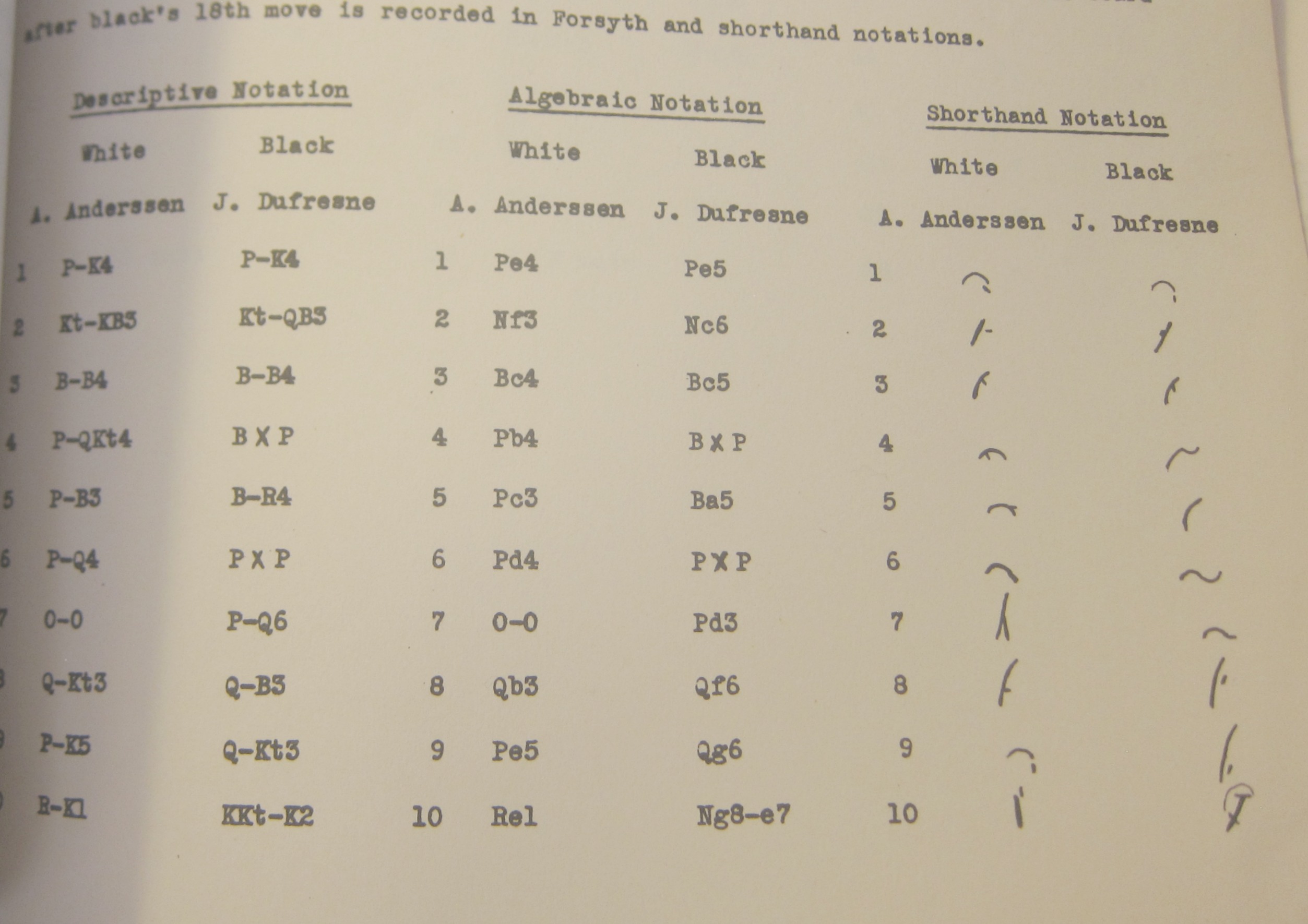
    In the occasionally speedy and occasionally not-speedy world of chess, it may sometimes be necessary to take speedy-or-not notes, and one attempt to address this need was made by Herbert E. Salzer in his non-mysteriously titled Chess Shorthand (1971).  Chess notation–like algebraic notation (in different iterations), English notation, ICCF notation, and so on–can reach back hundreds of years. Even the shorthand approach tried out here in mathematician Salzer’s short work dips back into the 19th century (‘Shorthand Notation” by M. Barnard, a short entry in  Chess Player’s Annual and Club Directory, 1893-94 by Mr and Mrs T.B. Rowland, London, 1893). But the Salzer work is really pretty interesting, and so I thought to at least surface the work.

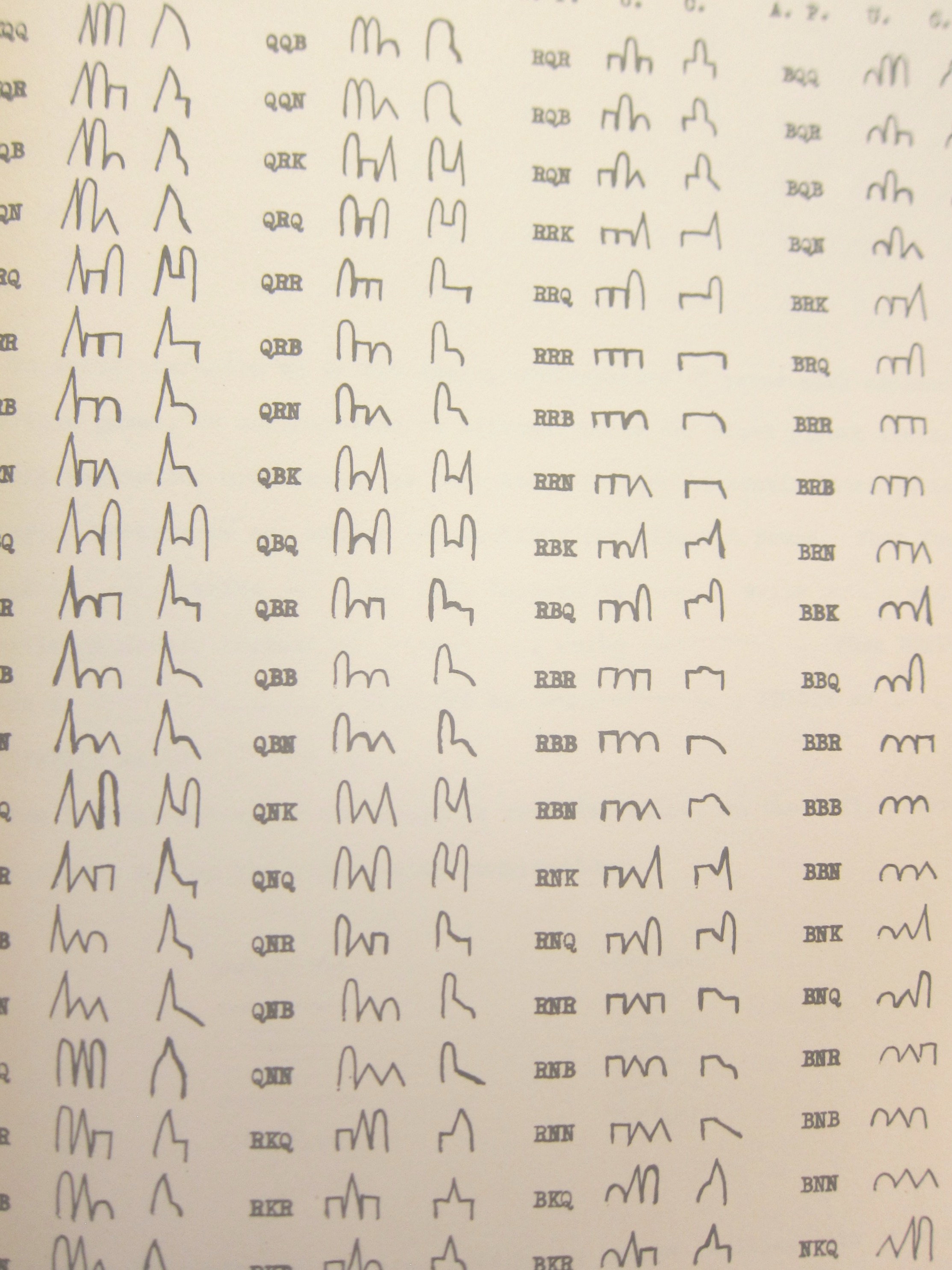
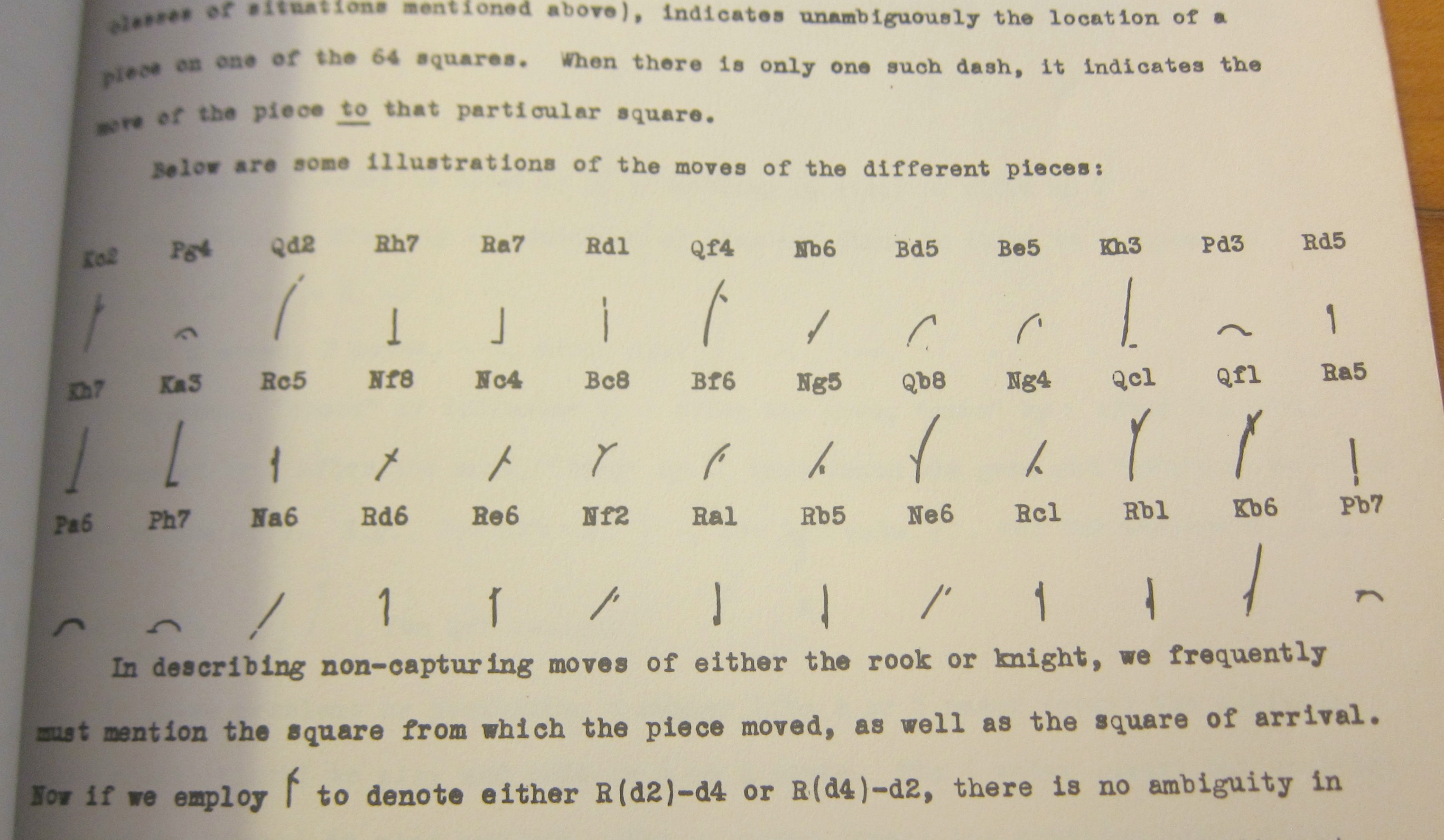
    The thing is is that Salzer’s work has a certain autonomous, musical, simple splendor to it–that or it has the feel of a cipher (or a double cipher). Here’s an example:\Chess ahorthand _1_
    On second thought a shorthand for chess at first (or second) blush doesn’t really seem terribly necessary, given the brevity of the notation that already exists or existed. The author though is convinced that such an effort was needed, or at least wanted the intellectual exercise of creating such a thing, and provides in twelve packed pages the foundations of recording chess moves quickly, if not inconveniently. The notation the author creates reminds me somewhat of Gregg shorthand, but not as much as alien written communication system, being mostly soft lines and bumps. More striking is that as soon as these abbreviated symbols are introduced, the abbreviations’ abbreviations appear. In the attempt to make things less complicated this system may complicate things—maybe not, because I really can’t tell. Perhaps if you became fluid and fluent in the new symbolic language the Salzer system becomes a godsend, or perhaps not. I can appreciate the thinking and the work, and the interesting road that the author took to his shortcut, but I’ve never been good at those, once taking a “shortcut” to a location directly south of me and finally getting to it 3x-longer than usual, getting to the place going north. All that said, I respect this work, though I really don’t understand it–in a certain way Mr. Salzer created a work of art in creating his writing system. 

     
    Chess ahorthand _1_
    Chess ahorthand _1_


    ·Posted by :

    ·in:


  • Writing on the Clouds

    JF Ptak Science Books  Post 2719

     “Euery Cloud engenders not a Storme.”–Shakespeare, Henry VI, Pt. 3 (1623) v. iii. 10

     “Vapour, previously unseen, makes its appearance as cloud, or mist, or fog.”–T. H. Huxley Physiogr. (ed. 2) 40  

    “But Howard gives us with his clearer mind
    The gain of lessons new to all mankind;
    That which no hand can reach, no hand can clasp,
    He first has gain’d, first held with mental grasp.
    Defin’d the doubtful, fix’d its limit-line,
    And named it fitly.—Be the honour thine!
    As clouds ascend, are folded, scatter, fall,
    Let the world think of thee who taught it all.”–Goethe, “Howards Ehrengedächtnis”, 1821

    The great cloud pioneer Luke Howard (1772-1864) first published on his cloud classifications in his papers “On the Modifications of Clouds and on the Principles of their Production Suspension and Destruction being the Substance of an Essay read before the Askesian1 Society in the Session 1802-3″ in 1803, launching him from general normal obscurity into the ranks of the internationally known. He had done what Aristotle and many others down the years hadn’t–classified (his “Modifications” of the title of his 11k-word effort) the moving mountains in the sky, making him a Linnaeus/Godfather of clouds, his nomenclature quickly adopted worldwide. 

    Howard, a pharmacist/chemist/meteorologist2 invoked a Latin nomenclature for his classification, which was a very smart idea, as Latin was already Latin (as it were) and didn’t need to face the difficulties and obstructions of being translated into other languages, as was the case with the problematic Lamarckian system introduced just a year earlier which was phrased out in French and which encountered many problems in translation. Howard’s universal nomenclature and his creative and poetic descriptions following deep study and endless sketches3 created a static environment from what was seen as an impossibly dynamic flow of changes in the structure of clouds.

    According to the Dictionary of Scientific Biography (the entry written by Richard Hambyn, the only person to write a book on Howard’s naming of clouds), “…he proposed that every cloud belonged to one of three principal families, to which he had given the Latin names: cirrus (meaning “fiber” or “hair”), cumulus (“heap” or “pile”), and stratus (“layer” or “sheet”). In recognition of the essential instability of clouds, Howard also introduced a sequence of intermediate and compound modifications, such as cirrostratus and stratocumulus, in order to accommodate the regular transitions occurring between the cloud types…”

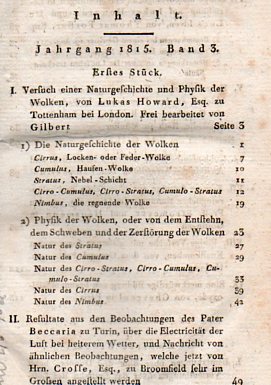
    I’ve written about Howard elsewhere on this blog, and he comes back to me today for his odd place in the realm of highly-visual-works-published-without-illustration, or at least the first German language treatment of his work appears so, without benefit of a single image, as with the first of the three iterations of this paper in 1803 in the Philosophical Magazine. (It was in the second paper of 1803 that three images of clouds first appeared.) The paper appeared very quickly in Germany, published as “Ueber die Modification der Wolken” in 23pp in the November 1805 issue (volume 21) of the Annalen der Physik, though without any illustration. (Howard’s “Versuch einer Naturgeschichte und Physik der Wolken” is published in the Annalen in 1815 also without an image, as do three of his other papers; the lone exception is one engraving illustrating his paper on waterspouts in volume 57.)  I wonder why the article is unembellished–it is almost in a sense a defeat of the classifying idea, not to have some sort of visual reference for the new taxonomy. Perhaps it was a rush to publish, though if that were the case a return to the paper with engravings in a later issue would have been a good idea. In any event, it was a work that demanded pictures, and even though Howard was an accomplished cloud artist, there was little of that lovely work seen until the “third edition” of his essay appeared in 1832. Aside from the historic difficulty of rendering clouds in art, I do not know why it was the case that the earliest works on clouds passed by largely unillustrated,

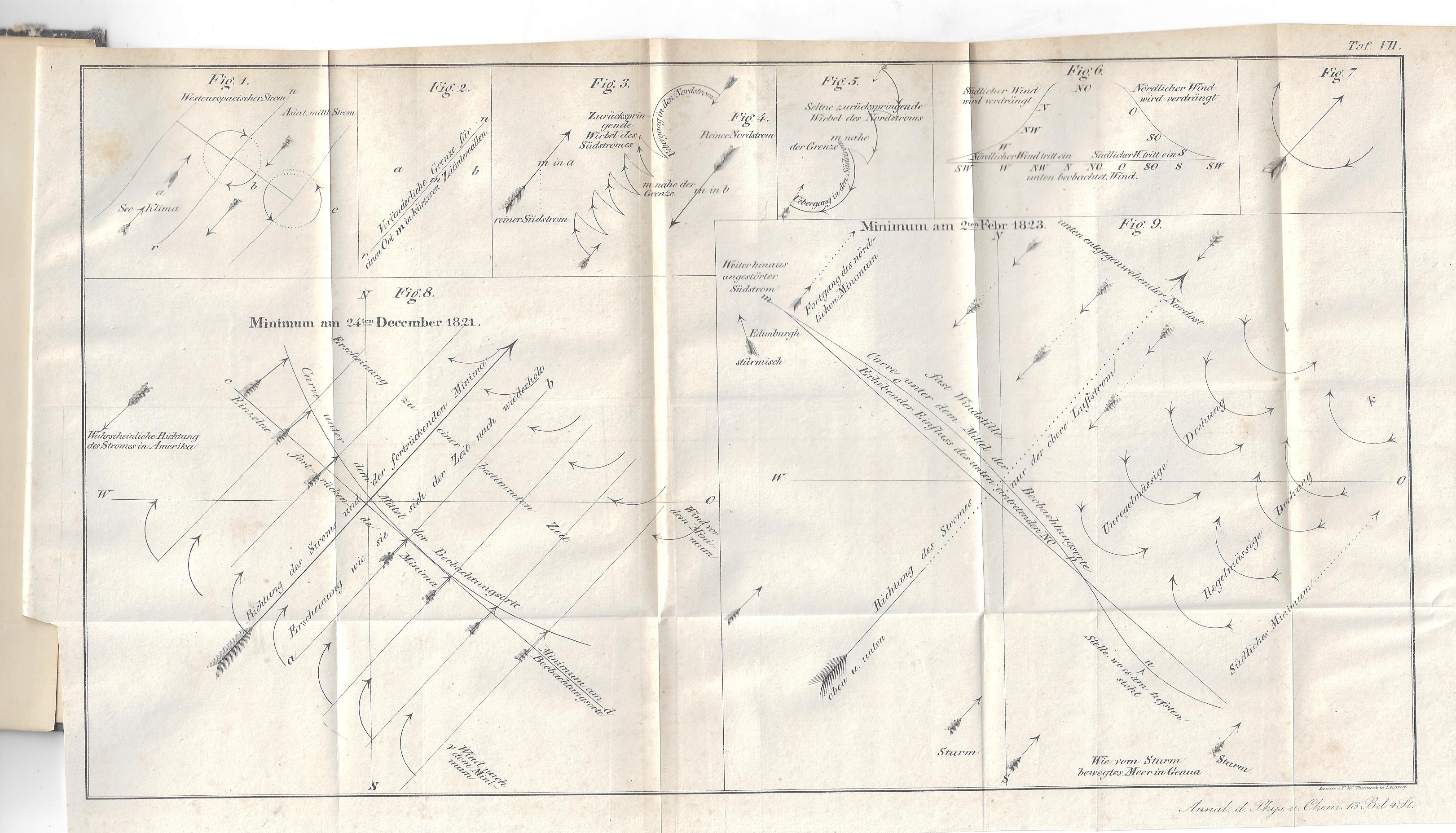
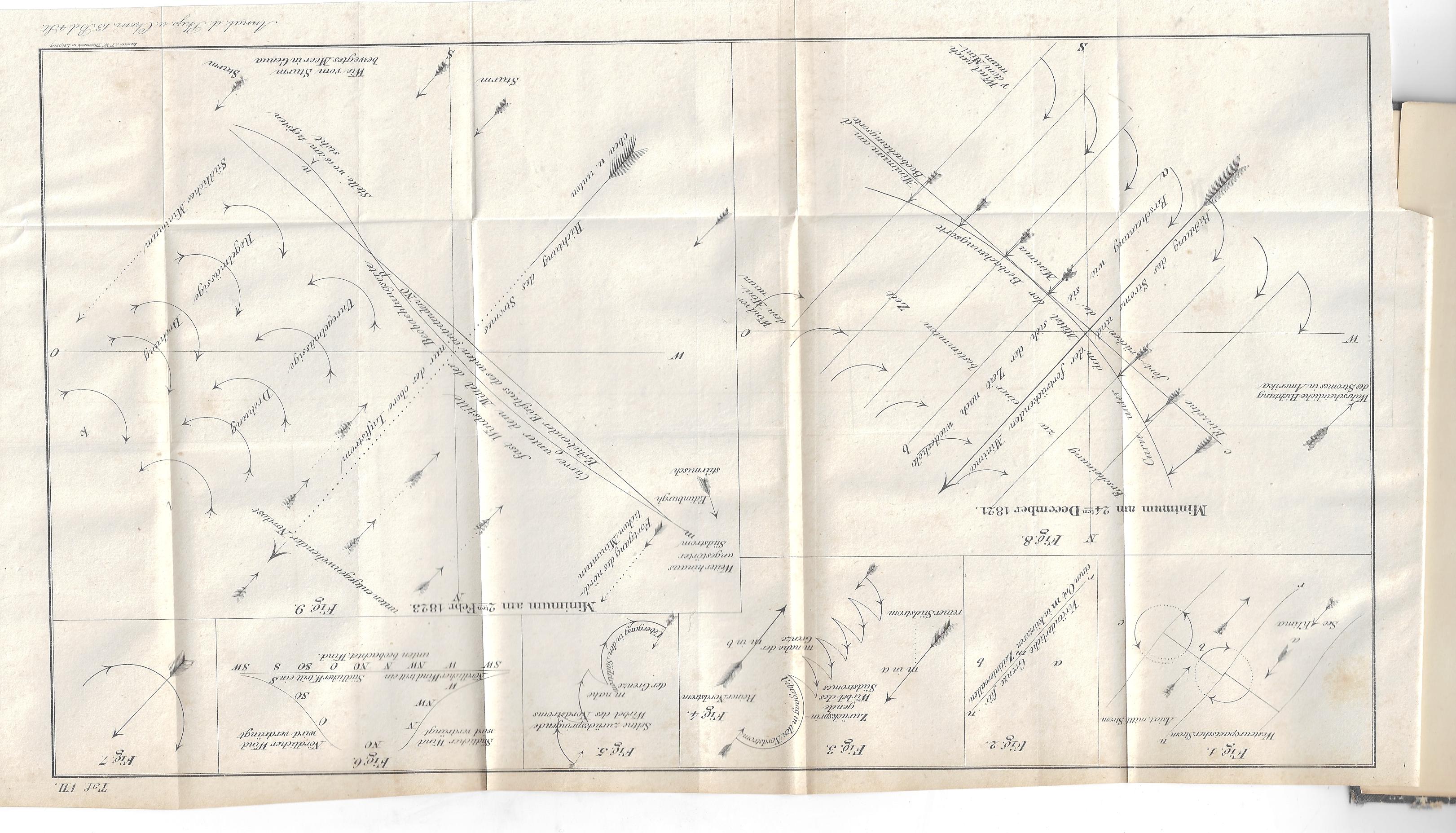
    No doubt there is room for a work on papers written on highly-visual ideas that should’ve been illustrated but weren’t–that’s partially how I cam to write this post to begin with, being thwarted by a very early call by Heinrich Brandes in the Annalen der Physik  (1816, noted by Gerald R. North in the Encyclopedia of Atmospheric Sciences, p. 290) for a system of making weather maps, but published without an example. And in pursuing that I came upon Heinrich Wilhem Dove’s paper “Ueber Barometriche Minima” in the Annalen  for 1828 on barometric pressure and the wind (where the wind seems to do a 360 turn generated by falling  pressure), the cartographic elements of which were said to be illustrated on a folding engraved plate and though the symbols are there in a pre-non-representational-art sorta way, the map part wasn’t….I mean, there’s just no “amp” to the map, except for a scant reference to a city, and that’s it. Anyway, it is a curious category that I’d rather read about than research. 

    Here’s the unusual Dove illustration:
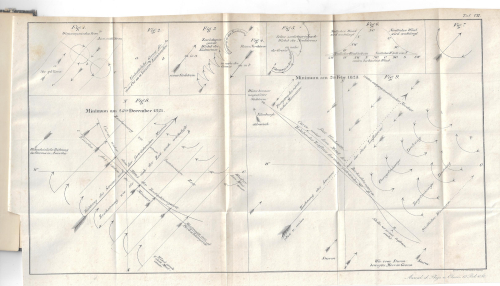
    Dove map corrected

    Images or no, the work by Howard was immortalized by Goethe, who admired and respected the man, painting clouds in poetry in 1817:

    “To find yourself in the infinite,

    You must distinguish and then combine;
    Therefore my winged song thanks
    The man who distinguished cloud from cloud.”

    …and then proceeded to describe the main four (of the seven) main cloud types described by Howard:

    “STRATUS

    When o’er the silent bosom of the sea
    The cold mist hangs like a stretch’d canopy;
    And the moon, mingling there her shadowy beams,
    A spirit, fashioning other spirits seems;
    We feel, in moments pure and bright as this,
    The joy of innocence, the thrill of bliss.
    Then towering up in the darkening mountain’s side,
    And spreading as it rolls its curtains wide,
    It mantles round the mid-way height, and there
    It sinks in water-drops, or soars in air.

    CUMULUS

    Still soaring, as if some celestial call
    Impell’d it to yon heaven’s sublimest hall;
    High as the clouds, in pomp and power arrayed,
    Enshrined in strength, in majesty displayed;
    All the soul’s secret thoughts it seems to move,
    Beneath it trembles, while it frowns above.

    CIRRUS

    And higher, higher yet the vapors roll:
    Triumph is the noblest impulse of the soul!
    Then like a lamb whose silvery robes are shed,
    The fleecy piles dissolved in dew drops spread;
    Or gently waft to the realms of rest,
    Find a sweet welcome in the Father’s breast.

    NIMBUS

    Now downwards by the world’s attraction driven,
    That tends to earth, which had upris’n to heaven;
    Threatening in the mad thunder-cloud, as when
    Fierce legions clash, and vanish from the plain;
    Sad destiny of the troubled world! but see,
    The mist is now dispersing gloriously:
    And language fails us in its vain endeavour —
    The spirit mounts above, and lives forever.”

    (Full text here for the illustrated third edition of 1865.  And, yes, this post is not illustrated.)

    Notes:

    1.  “Askesian”, meaning “philosophical exercise”, was “…a practically oriented and largely non-conformist group dedicated to natural and experimental philosophy”.  http://journal.sciencemuseum.ac.uk/

    2.  According to the OED, “meteorology” goes back quite a way as a word, popping up in 1563; “meteoroloician” appears in 1580, and “meteorologist” in 1683.)

    3.  “The location of many of the sketches gives us an initial hint of their Romanticism. For many years Howard travelled between London and the Lake District in order to capture the full range of what he termed ‘cloud modifications’, training himself in the notoriously difficult art of depicting clouds, of fixing them as they changed  “

    Howard begins his 1803 paper so:

    “If the necessary pursuit If clouds were the mere result of the condensation of var pour in the masses of atmosphere which they occupy if their variations were produced by the movements of the atmosphere alone then indeed might the study of them be deemed an useless pursuit of shadows an attempt to describe forms which being the sport of winds must be ever varying and therefore not to be defined. But however the erroneous admission of this opinion may have operated to prevent attention to them the case is not so with clouds. They are subject to certain distinct modifications produced by the general causes which effect all the variations of the atmosphere they are commonly as good visible indications of the operation of these causes as is the countenance of the state of a person’s mind or body…”
    ·Posted by :

    ·in:


  • Allied Nicknames for Japanese Aircraft, 1944

    JF Ptak Science Books   Post 2712   

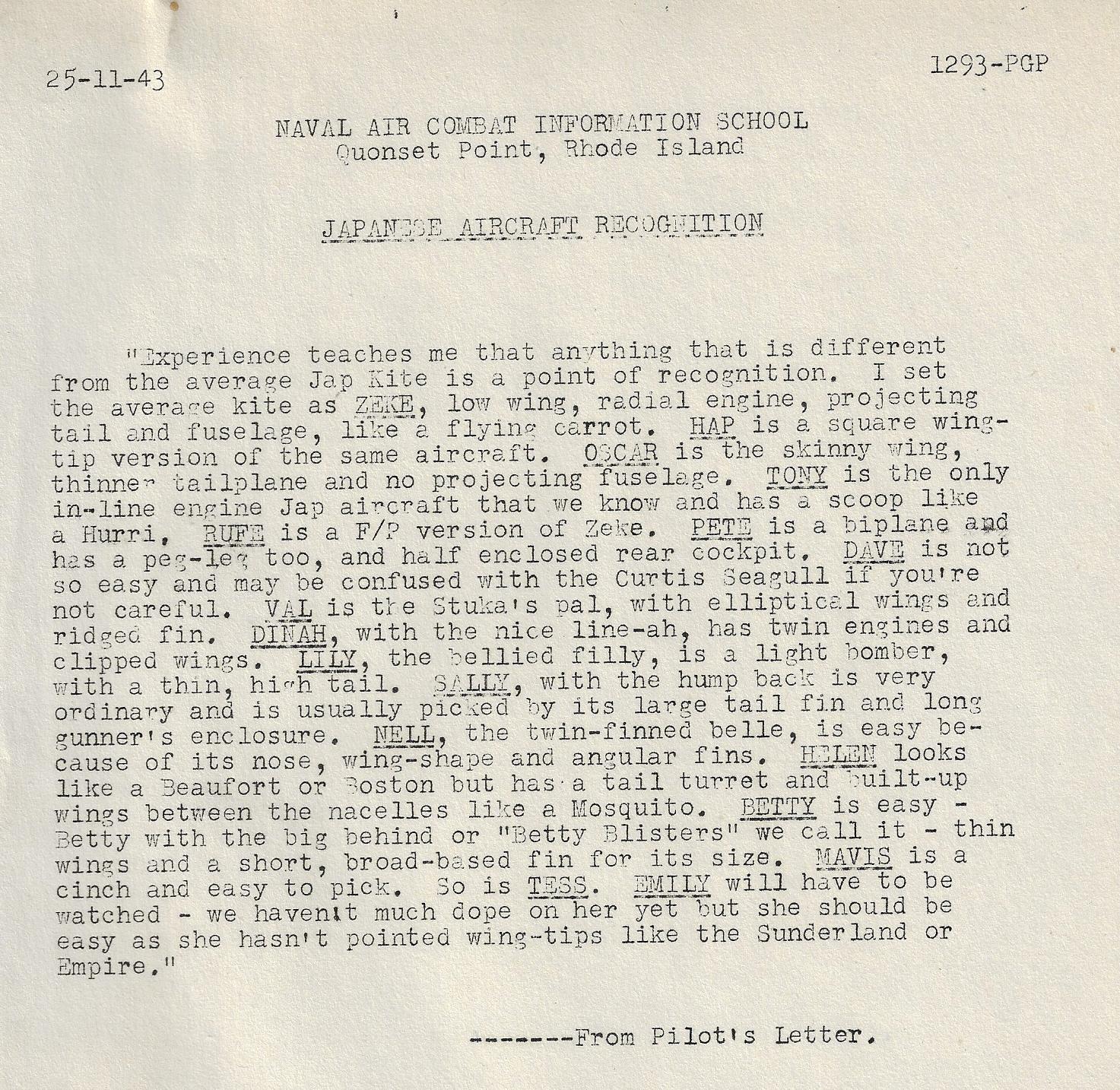
    The outline are details from a notebook written as classroom notes (ca. 1944) by a naval student of the Naval Air Combat Information School at Quonset Point, Rhode Island. Generally the diagrams are relatively small for the amount of information conveyed. The printed text for the curriculum and classes are nearly all marked “RESTRICTED” in the typed original of the offset pages.  The entire document is about 150pp long, and if there is interest in the contents I’d probably reproduce the entire thing–it is surprising how much can be learned and how much is revealed even in the multi-page lecture descriptions.

    This is an extract “from Pilot’s letter” describing the Japanese aircraft encountered and using the McCoy/Williams/Grattan shorthand-slang method for identifying the aircraft. Evidently using the Japanese names and designators was clumsy and complicated, so an alternative means was developed using common given names, trees, and birds to identify Japanese aircraft.

    NACIS Japanese plane names

    “In mid-1942, Captain Frank T. McCoy, a United States Army Air Forces military intelligence officer from the 38th Bombardment Group assigned to the Allied Technical Air Intelligence Unit in Australia, set out to devise a simpler method for identifying Japanese aircraft. Together with Technical Sergeant Francis M. Williams and Corporal Joseph Grattan, McCoy

    • divided the Japanese aircraft into two categories; fighters and everything else…
    • boys’ names to the fighters,
    • names of girls to the others…
    • training aircraft were named after trees.
    • single engine reconnaissance aircraft were given men’s names…
    • multi-engine aircraft of the same type were given women’s names.
    • (t)ransports were given girls’ names that all began with the letter “T”
    • Gliders were given the names of birds.”–edited, from Wiki https://en.wikipedia.org/wiki/World_War_II_Allied_names_for_Japanese_aircraft

    Here are the “translations” of the U.S. Names for Japanese aircraft in this short report in order of appearance

    • ZEKE: Mitsubishi A6M, Navy Type 0 Carrier Fighter. [This is the legendary “Zero” aircraft, so called as it was manufactured in the Imperial Year of 2600, or 1940, and adopting the final zero (or two) as a nickname in its Japanese designation. The “Zero” was “Zeke” for another six months or so before it was widely switched out. By the time of this report—November 1943—the “Zero”, which was recognized as the finest and most lethal carrier-launched fighter plane in then world, was decidely less so than, the Allies catching up by mid-1942 to make it roughly the equal of the best Alied fighter planes, and then increasingly less so until in 1944 it was considered outdated.
    • HAP: Mitsubihi AGM3, Navy Type 0 Carrier Fighter Model 32
    • OSCAR: Nakajima Ki-43, Army Type 1 Fighter
    • TONY: Kawasaki Ki-61, Army Type 3 Fighter
      RUFE: Nakajima A6M2-N, Navy Type 2 Interceptor/Fighter-Bomber
    • PETE: Mitsubishi F1M, Navy Type 0 Observation Seaplane
    • DAVE: Aichi D3A
    • VAL: Aichi D3A, Navy Type 99 Dive Bomber
      DINAH: Mitsubishi Ki-46, Army Type 100 Command Reconnaissance Aircraft
    • LILY: Kawasaki Ki-48, Army Type 99 Twin-engined Light Bomber
    • SALLY: Mitsubishi Ki-21Army Type 99 Dive Bomber
    • NELL: Mitsubishi 3GM, Navy Type 96 Attack Bomber
    • HELEN: Nakajima Ki-49, Army Type 100 Heavy Bomber
    • BETTY: Mitsubishi G4M, Navy Type 1 Land-based Attack Aircraft
    • TESS: Douglas DC2, Navy Transport
    • EMILY: Kawanishi H8K, Navy Type 2 Large Flying Boat

    ·Posted by :

    ·in:

    —

  • When Did the Term “Computer Science” First Appear?

    JF Ptak Science Books   Quick Post

    Some time ago I wrote a post on the origins of some scientific words, just to see how long they have been around–some are well-known in their newness (like “scientist” coming along in 1834, 1  anonymously referenced in the Quarterly Review, volume 51, page 59), others not so.

    Babbage eyes

    And so when an interesting word relating to artificial intelligence appeared I wondered when AI itself did (J. McCarthy 1955 and then Marvin Minsky 1956)…which led to the question of how old the term “computer science” is, and so on. Not wanting to spend more than a half hour on this I decided to establish the Oxford English Dictionary as the baseline for earliness in the first (or at least very early) appearances in English of these words and let it go at that. So here’s the list, a quick shake-and-bake on the early origins of some standard and not-so-standard words in computer science.

    A footnote here is that 10 of the 38 words here appear during the life of Charles Babbage (whose eye are posted above). 

    Notes:

    1.  The word is provided to us in the text of an article on Mary Somerville by William Whewell who references the word “scientist” coming from “a gentleman” who was  I guess himself; he uses the word under his own name in 1840.

      • Computer Science. 1956   N.Y. Times 28 Oct. iii. 21 (advt.)    “Unparalleled opportunities to associate with the prominent pioneers of computer science, at outstanding salaries. Electronic engineers (circuit designers and magnetics engineers), logical designers, [etc.].”

      • Computer programming: 1952   Proc. ACM National Meeting (Toronto) 20/1   “In fact three principles should apply to computer programming and operation in general, and not just to code checking.” This was followed by “computer programmer” after three years.  

    • And so:
      • computationalism, n.1979

      • computationalist, n….1956

      • computatist, n.1611

      • computative, adj.a1538

      • computator, n.1591

      • compute, n.1483

      • compute, v.1579

      • computed, adj.1680


  • When Did “The Great War” Become “World War I”?

    JF Ptak Science Books  Quick Post

    When does the Oxford English Dictionary establish the first uses of “World War I”, “World War One”, “First World War”, etc?

    World War, n.  

    A war involving many nations of the world; spec. that of 1914–18 or of 1939 45.First, Second, Third World War: see the first element.

    1848   People’s Jrnl. 4 250/1   A war amongst the great powers is now necessarily a world-war

    1864   G. Haven National Serm. (1869) Contents p.xx. (title)    The world war: aristocracy and democracy.

    1889   R. B. Anderson tr. V. Rydberg Teutonic Mythol. i. xxxiv. 139   From the standpoint of Teutonic mythology it is a world war [Sw. världskrig]; and Völuspa calls it the first great war in the world—folcvig fyrst i heimi.

    1900   N. Amer. Rev. Nov. 653   The South African war, following immediately upon the close of the Peace Conference at The Hague, has not yet reached its end, and already the horizon in Eastern Asia is lurid with the glare of a world-war.

    World War I  n. (also World War One, World War No.1) = First World War n. at first adj., adv., and n.2 Special uses 2b. Abbreviated WWI.

    1939   Time 18 Sept. 10/2   Exports of arms, munitions and related materials in World War I amounted..to only 25% of total exports to the Allies.

    1947   Time & Tide 29 Nov. 1269/2   The despair and cynicism that followed what it has now become fashionable to call World War One.

    ·Posted by :

    ·in:

    —

  • A First Taxonomic Description of Coffee (1713)

    JF Ptak Science Books   Quick Post

    Academie science 1713 coffee

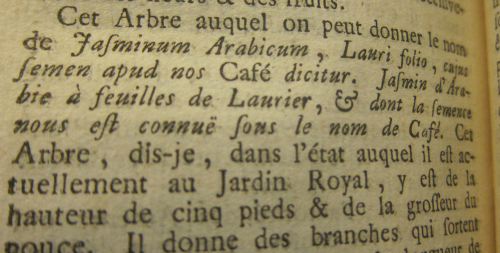
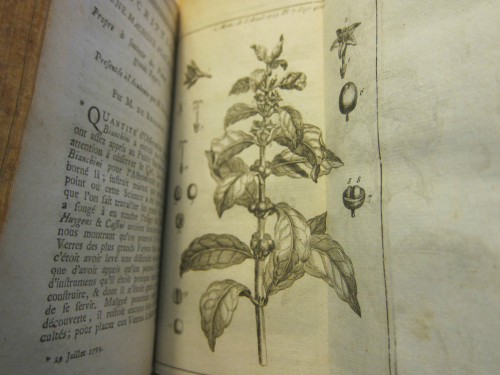
    The beneficial effects of “coffee” had been  known in Ethiopia, and Arabia, and Persia, and Syria, and Turkey, long before it was used and enjoyed in the West. where coffee didn’t make a strong appearance until the 17th century.  Evidently, though it took nearly another hundred years for the first taxonomic description to appear. That was the work of  Antoine de Jussieu (1686-1750) , and his effort appeared tucked away in a short article “Histoire du Cafe”in the scientific journal Memoires de l’Academie des Sciences in 1713. 

    The Jussieu is a coffee incunable in the Western world. It was described as “The first recorded taxonomic description of coffee…described a coffee plant from the botanical garden of Amsterdam as “Jasminum arabicanum, lauri folio, cujus femen apudnos coffee decir” in 1713 (“Arab jasmine, with laurel type leaves, the beans of which we can call coffee”)–(Wintgens, 2009, quoted by Caas Brazil, Coffee Taxonomy.) And although there isn’t an exact reference to the place of publication from what I can determine this must be the source–the article also uses a quote from the paper that is directly from this paper, which I reproduce above.  The Jussieu paper was also described as  “The first botanical description of a coffee tree, under the nam Jasminum arabicanum…made in 1713 by A. de Jussieu, who studied a single plant originating from the botanic garden of Amsterdam.” found in Charrier, A.; Berthaud, J.  “Botanical Classification of Coffee”, (1985), found in Clifford, M. H.; Wilson, K. C. Coffee: Botany, Biochemistry and Production of Beans and Beverage, AVI Publishing, p. 14. A wiki article on Jussieu references this paper but in a 1739 Paris edition of the 1713.  The 11-page article is also illustrated by an engraving of the coffee tree:

    Academie sciences 1713 coffee_2_

    Notes:

    ·Posted by :

    ·in:


  • Missing the Colors that Are Not There (1835)

    JF Ptak Science Books   Post 2704

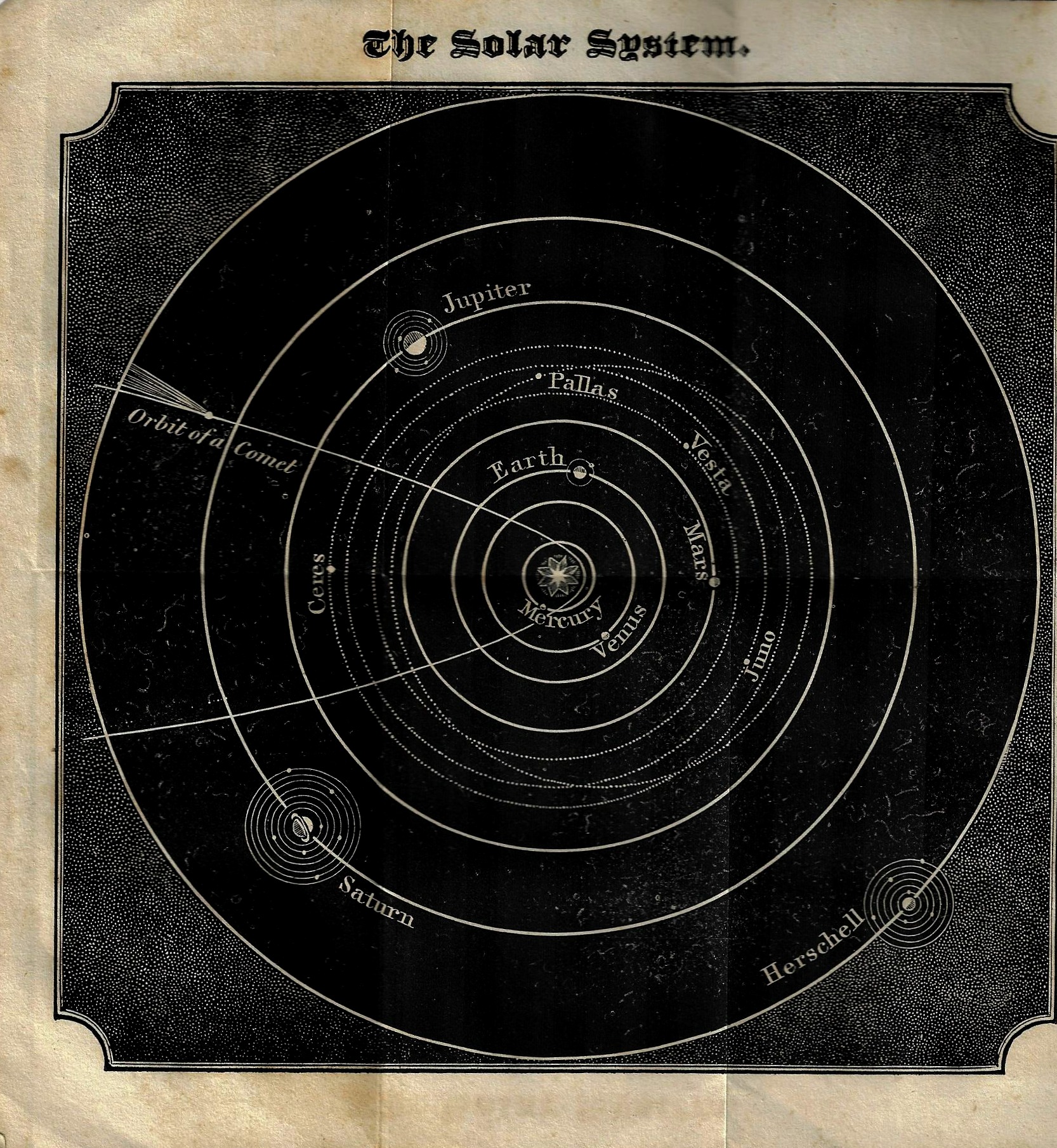
    I don’t know what there is in this engraving that speaks “color” to me when it should probably be just concerning itself with the blackness of its deep black (which for me is usually the case). Neither the blackness nor the dimensionality of the thing–it seems to give itself some height and depth at the same time–say anything louder than the representation of its missing colors, which we are clearly seeing nothing of in these wavelengths except that there really aren’t any colors here outside of the beautiful black & white.  The contrast is certainly there (“There are dark shadows on the earth, but its lights are stronger in the contrast.” Charles Dickens, The Pickwick Papers), especially in the corner bits, where on closer inspection the blackness is really more white than black. In any event, the print suggests “color” to me for no good reason, except perhaps that it looks very cold, and cold is suggestive of ice blue, and the good contrast for that is yellow. “The sound of colors is so definite that it would be hard to find anyone who would express bright yellow with base notes, or dark lake with the treble.” so wrote Mr. Kandinsky, who saw colors in his sound, and who in the midst of things wrote four experimental pieces of theater based upon this observation, the first and perhaps most prominent of which was called “Yellow” (1909).  And that is why this old engraving seems “yellow” to me (and this without any benefit of synesthesia).

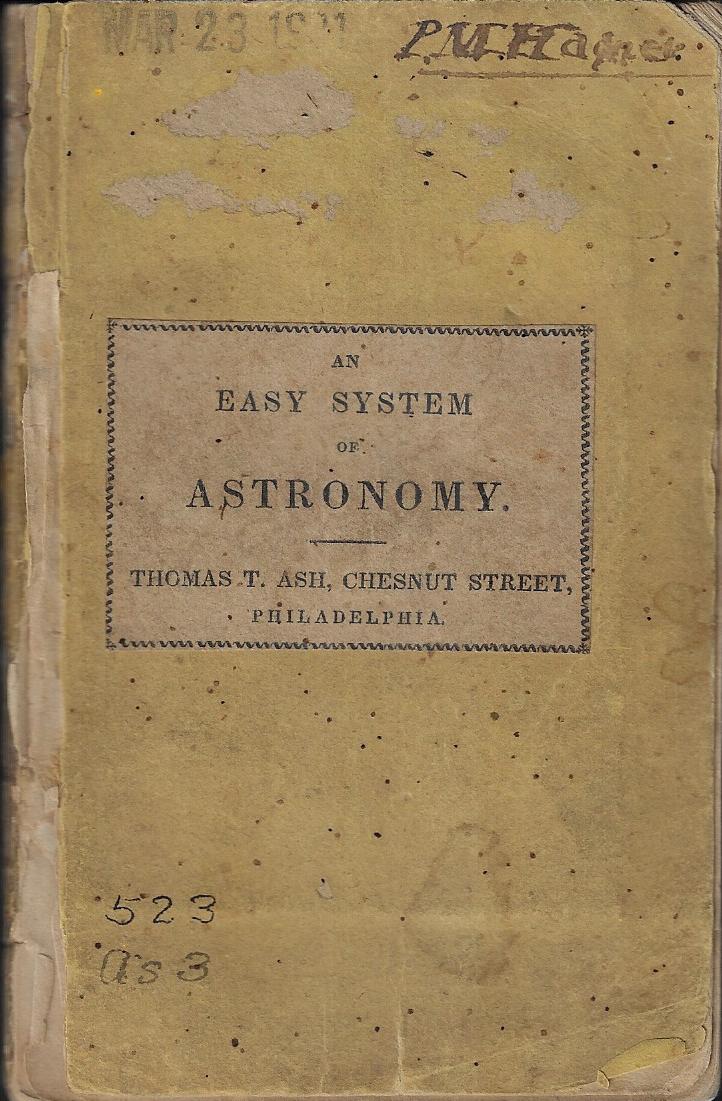
    The image in question, from An Easy System of Astronomy, containing an explanation of the Moveable Planisphere, together with a selection of problems, maps &c, intended to either accompany the planisphere or may be used separately in schools. This little guy (14cm) was published in Philadelphia in 1835 and unfortunately does not make mention of any detail of the “planisphere” other than that there was one that could be used. (This is evidently relatively rare, with only two copies located in WorldCat/OCLC–Columbia and the National Observatory.) 

    Astronomy easy system

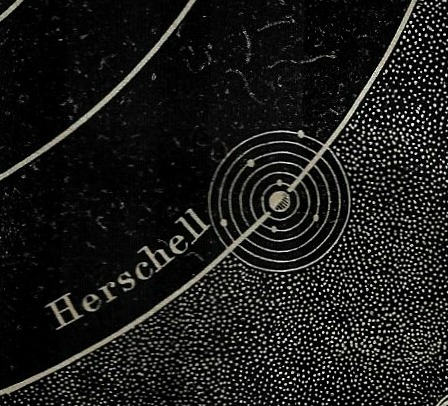
    If there was an equal weight assigned to white and black, the white in the corner sections may well outweigh the black, which also happens to show the planet “Herschell”. This was the first planet discovered since antiquity, and was done so by the Hannoverian Brit Friedrich Herschel, who found it in 1781 and who lived with its immediate fame for another 41 years until his death in 1822. Herschel, an enormous astronomical talent who also played and composed, proposed the planet be named  in fidelity “Georgium Sidus” after George III, though that name didn’t stay on the planet longer than a quick shadow. The French astronomer Lalande (who could probably not for genetic /national reasons use the name for George) suggested the planet be named for the discoverer, “Herschell1“, which really wasn’t that terribly popular though it did last for five or six decades, succumbing finally to Bode’s suggestion of “Uranus”. 

    Astronomy easy system detail

    This is a folding illustration for the following, which here appears much larger than the thing is in its real life, standing as it does only about 5″ (130mm) tall:

    Astronomy easy system cover


    Notes

    1.  From the entry “Uranus” from the Oxford English Dictionary:

    1783   New Rev. Apr. 325   Notwithstanding Mr. Herschel’s having named his planet the Georgium Sidus, Mr. Lalande persists in calling it the Herschel, Mr. Bode proposes Uranus, Mr. Sivry Cybele, and Mr. Prosperin, Neptune.

    1802   O. G. Gregory Treat. Astron. 128   By some astronomers it is called Herschel, in honour of the discoverer; though among almost all foreigners, it has acquired the name of uranius, which it is likely to retain.

    1830   Encycl. Metrop. III. 498/1   Both these appellations are, however, now nearly become extinct, that of Uranus being almost universally adopted

    1860   D. Olmsted Mech. Heavens 267   Uranus was the remotest known planet..until the discovery of..Neptune.

    1902   N. Amer. Rev. Aug. 225   Jupiter, Saturn, Uranus and Neptune are in too primal a state of fluidity and gaseousness to support life.


  • Found-Surreal Art, Elevated (London, 1876)

    JF Ptak Science Books  Quick Post

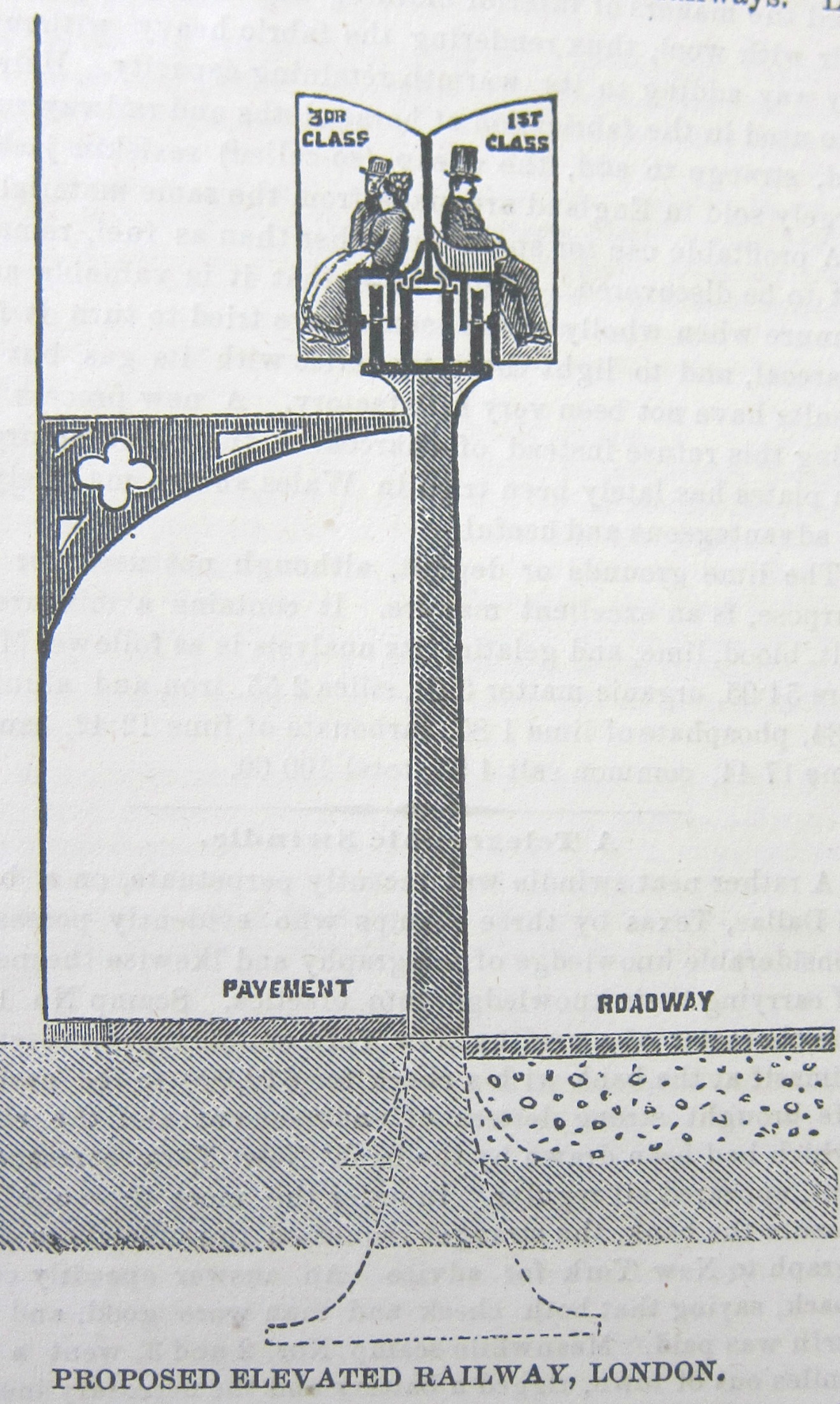
    The difference between first and third class in an elevated train seems to be (1) a chair with arms, (2) a taller hat, and (3) a big moustache.  Undoubtedly, there were actual creature comforts, though I suspect first class was meant to accommodate first-class people who would prefer not to be with not-first-class people, and enjoy the extension of that privilege in a comfortable seat.

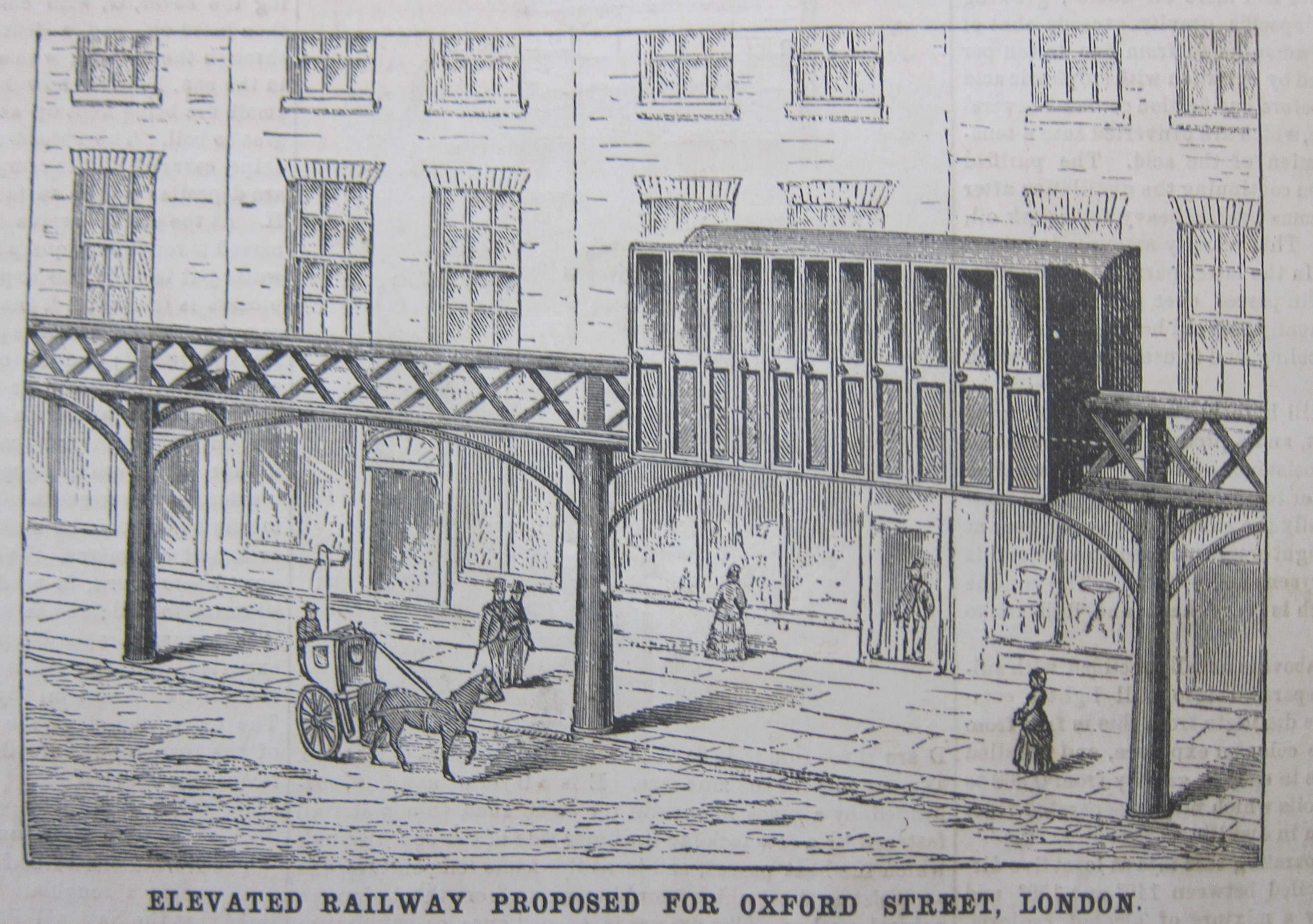
    What attracts me to this image is the way it rubs up against the accoutrements of modernity, looking like a piece of surrealist art.  Since the image was printed in 1876 this would be “found-Surrealist art” as the existence of non-representational art was still 35 years away and the man who basically created the Surreal movement in NYC in 1924–Andre Breton–wouldn’t be born for another 20 years. In any event, this is what this looks like to me, a piece of unintentional, out-of-context art with no contemporary name.

    Sci Am 1876 elevated London

     [Source, above and below: Scientific American, February 8, 1876.  The image above is a cross section of the image below.]


      Sci Am 1876 elevated railway


  • On Found-Poetry in a Work on Clouds by the Great Chemist, Michael Faraday (1827)

    JF Ptak Science Books   Quick Post

    Tucked away inside a volume of  The Quarterly Journal of Science, Literature,  and the Arts1  is this short contribution by Michael Faraday. Faraday is not particularly well-known for a writerly style although in his huge output of papers and books he was a very effective communicator. I found in this article, “On a Peculiar Perspective Appearance of Aerial Light and Shade” , that he was really very elegant and perhaps even poetic in describing what I think are cloud shadows– explaining the illusions created by cloud shadows, with the “aerial perspective” part perhaps not having to do with what is normally assumed to be the optical/painterly version of the term, although frankly I’m not sure.

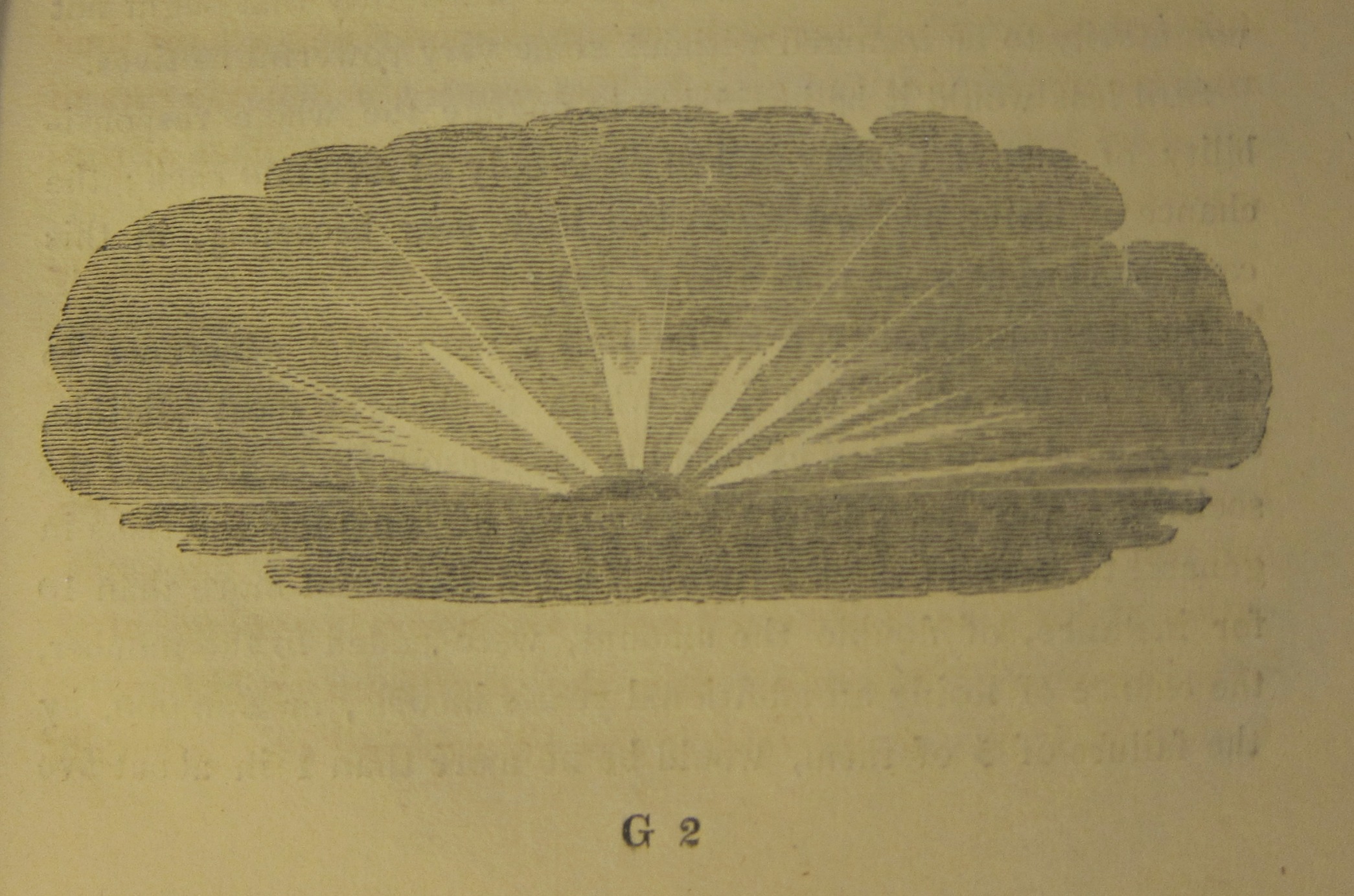
    This is the small woodcut that accompanies the three-page article, depicting the “rays” of light coming from a setting sun, which I think is charming in itself:

    Faraday clouds

    He writes:

    “Although the appearance on this evening was exceedingly beautiful and rare, and the more striking from the absence to the observer of the sun or clouds, and the complete insulation of the phenomenon, yet by close observation upon other evenings, it was found that partial effects of the same kind were very common, and from the manner in which these could be observed the explanation above given fully confirmed.”

    And the wonderful closing sentence:

    “All these phenomena with their variations were easily referrible to their causes and may be observed at almost any sun set in fine weather, but the effect of the first evening so similar in kind though so different in appearance was not again remarked. It is with a view of guarding persons who may observe the same effect against any mistake as to its origin that the appearance with its nature has been thus particularly described.” 

    I haven’t read that much in Faraday, but this does seem to be a bit of a departure–in form and content–and so I thought I’d share it a bit.  

    Notes:

    1. The Quarterly Journal of Science, Literature,  and the Arts (of the Royal Society of Great Britain). London, printed by John Murray,  volume XXII, 1827; 8.5×5”, viii, 418 pp,, 3 engraved plates.  Other interesting contributions in the volume include:  (Thomas Young), “Practical Application of the Doctrine of Chances, as it regards the Subdivision of Risks (by a Correspondent)”; (Michael Faraday, signed “M.F.” in the article), “On the Confinement of Dry Gases over Mercury”, in the Miscellaneous Intelligence section, pp 220-221; John MacCulloch, “Observations on the Geological History of the Formation of Coal”; and these shorter notices from the “Miscellaneous Intelligence” section including  Wollaston “On Electro-Magnetic Rotation” and  Becquerel “On the Conducting Power of Metals for Electricity” pp 374-378.


  • A Staccato of Abbreviations and Finding a Mystery Where There Probably Isn’t One

    JF Ptak Science Books  Post 2641  

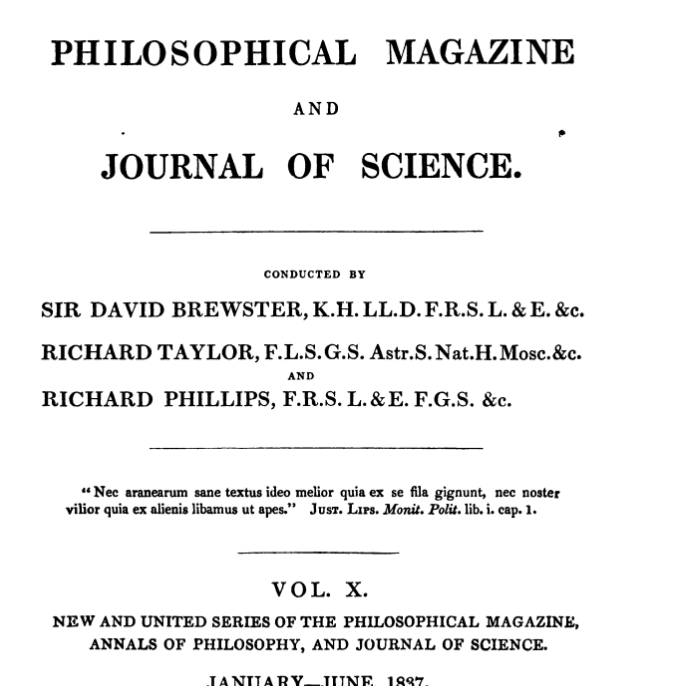
    Philosophical Magazine quote

    Philosophical Magazine quoteI’m a fan of some sorts when I see a string of abbreviations, the writer writing for a sympathetic readership with at least a common interest in the subject, knowing that spelling everything out isn’t quite necessary, especially if space is an issue.  On title pages this happens often with the academic heritage and awards of the author, as well as with quotes, which is where my staccato of abbreviations was found.

    The “misunderstanding”  here occurs in the reference to the source of the quote, which has lead me to look at a number of different editions of various works by the author.  It seems that I am missing something big in finding the source of the quote, because it seems impossible that an attribution right there in the middle of the title page of one of the most significant scientific periodicals of the 19th century will surely not be incorrect.

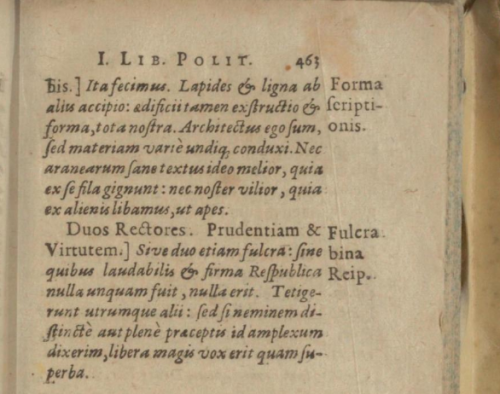
    First, the abbreviation for the origin of the quote (“Nec aranearum sane textus ideo melior quia ex se fila gignunt, nec noster
    vilior quia ex alienis libamus ut apes.”) starts out beautifully with “Just. Lips.” followed by “Monit. Polit. lib. i. cap. 1.”  

    This is simply the name of the author and the work and page on which the quote is found:  initially I thought I was dealing with Justus Lipsius’1 Politicorum sive civilis doctrinae libri sex : qui ad principatum maxime spectant. Additae notae auctiores, tum et De una religione liber…, printed at the Plantin Press in Leiden in 1589, book one (of the six books/sections comprising the work, or “libri sex”), chapter one.

    I don’t know the quote, and even though I have been working with the Philosophical Magazine for quite some time, I never had bothered to to it up until a few days ago, when I bumped into this question.  The thing is, the quote doesn’t really appear in I/1–it does appear in the Additae Notae section at the end of the book, on page 463, referencing I/1 on page 12.

    Then I figured out that this seemed to not be the correct book, although the quote was more-or-less placed correctly.  The “Monit” part of the extended abbreviations refers to Lipsius Monita et exempla politica : libri dvo, qui virtvtes et vitia principum spectant…2(1609), in which I did a text search for keywords and the quote but could not find it, which further confuses a matter that may not be confusing to someone more familiar with these works and era. 

    It seems impossible that the Phil Mag would be in error here on the issue of referencing a great classic and that it must be that I’m just missing something,  and no doubt someone reading this will let me know.

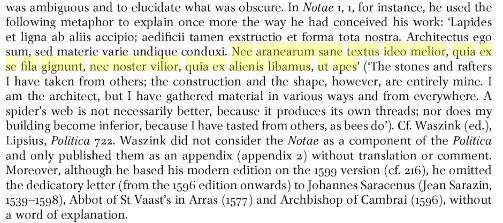
    In any event I thought I’d share this little ride I took on the back of this quote…which, by the way, along with the sentence preceding it, is quoted and translated  in  The Reception of Erasmus in the Early Modern Period, edited by Karl A. E. Enenkel (page 188. below):

    Lipsius

    Image source and full text at Internet Archive: https://archive.org/details/imgPiz59MiscellaneaOpal


    Lipsius notae translation

    Which in a sense is similar to the Newton/shoulders-of-giants quote, here the writers building upon that which has come before and making something different of it. 

    Notes:

    1.  Justus Lipsius  “…humanist and classical scholar…(Joost Lips, 1547–1606), described by his admiring correspondent Michel de Montaigne as one of the most learned men of his day (EssaysII.12), was the founding father of Neostoicism, a key component of European thought in the late sixteenth and seventeenth centuries…”–Stanford Encyclopedia of Philosophy (online))

    2.  Lipsius’ work can be seen here at the Internet Archive: https://archive.org/details/ivstilipsimonita00lips

    ·Posted by :

    ·in: