JF Ptak Science Books Post 1539
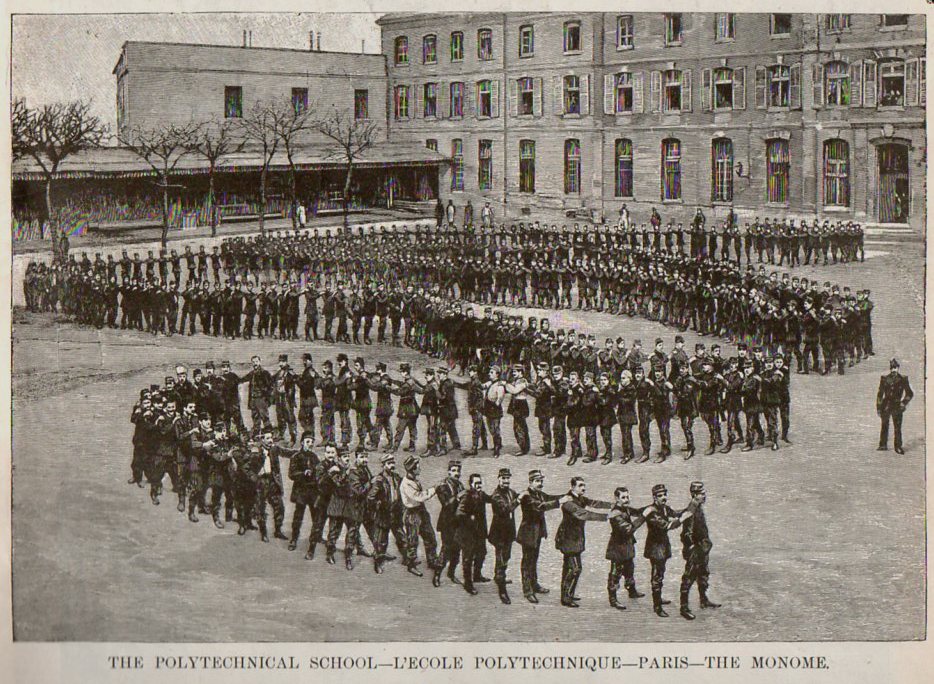
I’m about to start a series on this blog on a great constituent part of the concerns here of two other series: the History of Lines. This new bit will sit along next to the History of Dots and the History of Holes, and will begin to mention just some of those things that will bridge the gap among the three categories.
A lot of that–the History of Lines business–has to do with the interpretation of things on paper: heart rate, “brain waves”, the motion of a bumble bee, navigation, and of course, words. (The great Kickapoo tracker Famous Shoes in Larry McMurtry’s Streets of Laredo, one of the Lonesome Dove tetralogy, found that the one thing he couldn’t track in this world were the marks on the pages of a book.)
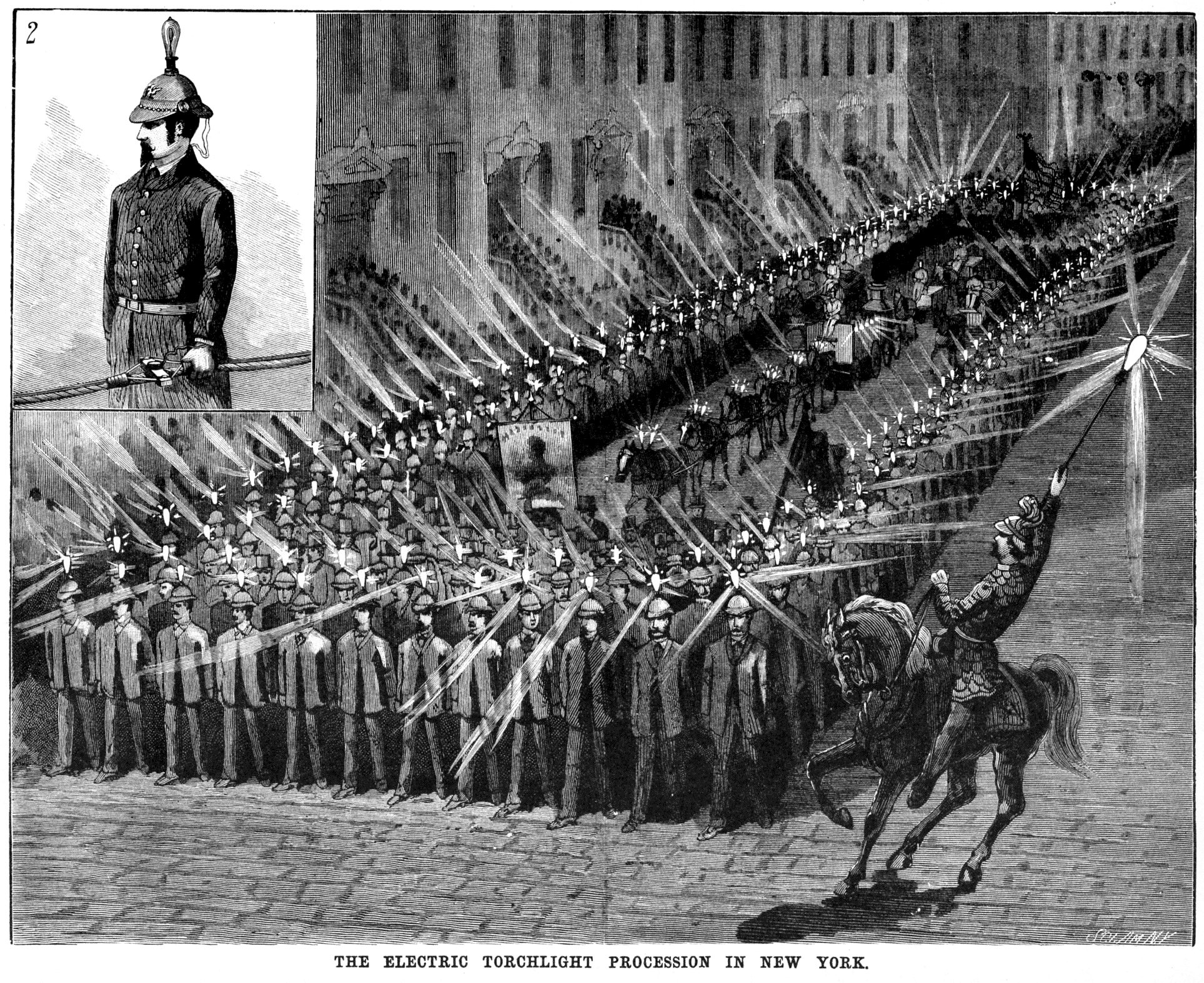
The business of lines is like that of dots and circles, together describing much of the physical world. For “lines” alone there’s just so much, an entire encyclopedia waiting to be written. There are unique lines, such as we see below from The Scientific American for 28 March 1885, in a line of workers for the Edison Electric Company holding an (electric) torchlight parade, the men attached by electrical wires that were in turn attached to the electric light bulbs on their helmets.
 There are lines of succession, code and graphs; Battle Lines, the Maginot Line; fishing lines, units of poetry, lines of a play; there’s waiting on lines, breaking the line, party lines; lines of fortifications, the lines on which music is written, and the foundations of geometry, and much more.
There were lines that occupied only a minute percentage of the landscape in which they were found, but were among its major controlling influences–such was the case in controlling the American West, except that one of the greatest of these lines, once completed and seemingly impenetrable, was briefly destroyed by its builders.
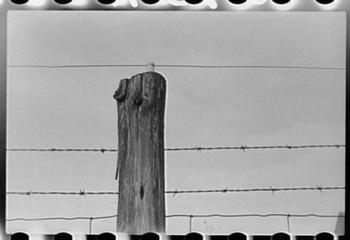 The story of the West getting filled up in the 1870s is a story of lines—railroad track, telegraph wires, barbed wire fences, and words on a page; big changes from disparate but related areas in technology and legislation, but when you looked at them from a distance and in the proper perspective, they all looked exactly the same.
The greatest of these lines may have been the invention of barbed wire in 1873, with Joseph Glidden, Jacob Haish and Isaac Elwood all managing to independently come upon the idea at about the same time. What barbed wire brought to the West was control and settlement. Prior to barbed wire there was open range grazing of cattle and extensive cattle drives, mainly because there was no fencing. There were also few farms due to this sort of grazing—the only thing a farm was here was in the way, and there was no recourse for the farmer to protect his
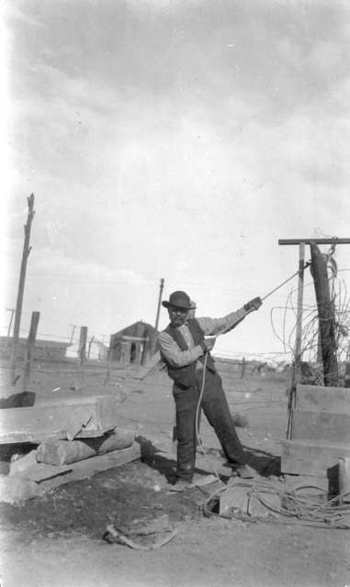 lands from a grazing herd. There was no fencing because there were no materials for the fence. Fencing was made almost entirely with lumber and stone, and on the treeless plains and the vast non-New England tracts of land, it was simply an impossible task. The introduction of barbed wire changed all of this very quickly, with thousands of miles of new fencing strung in the 1870’s alone. Fencing meant control, restriction of the use of land, of access to water, and to a way of life. It also meant that the farmer was now free to make a claim at a way of life on the plains, beginning a torrent of settlement and farms.
Another big line element of settlement were the texts (lines-on-paper) of three major acts of legislation which, over a period of just sixteen years, were responsible for moving more people than just about anything else in American history. The first of these was the Homestead Act of 1862. This was a revolutionary concept, legislated in 1358 words, effectively turning over 270 million acres, or about 8 percent of the country, of public lands to private citizens (“actual settlers of the public domain”). A claim could be made for a farm of 160 acres, for free, provided a structure was built on the land and it was maintained for five years. One could buy the parcel outright for $1.25 an acre as well. Next was the Desert Land Act of 1877 which opened drier lands, selling 640 acres at $1.25 an acre with three years to pay, so long as the land was irrigated by the end of the three years. Land that was deemed “unfit for farming” was sold to those who might want to “timber and stone” (logging and mining) upon the land with the third major piece of legislation, the Timber and Land Act of 1878. The act was used by speculators who were able to get great expanses declared “unfit for farming” allowing them to increase their land holdings at minimal expense. The Homestead Act alone accounted for the creation of almost 400,000 farms in the West by 1890. Farms meant parceling out land, “settling” it, having people on it, waiting when they weren’t working.
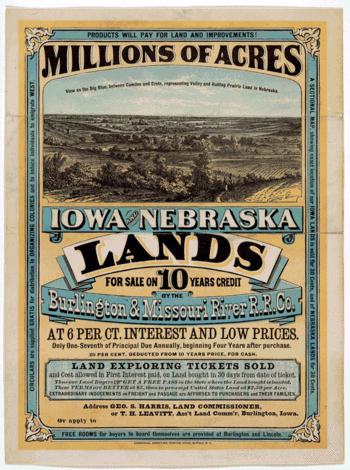
Settlement was dramatically increased by the written and published promises and speculations of mineral wealth—not necessarily just by the introduction of miners, but by securing the lands from and removing its Indian owners. The Custer expedition into the Black Hills in 1873, for example, reported some hope for finding gold in the sacred mountains of the Sioux. Thousands of miners responded to possibility of wealth, and Custer was again dispatched to secure safety for them in the restricted lands. This in turn lead to more settlers and coincidentally to the debacle of the Little Big Horn, which was the beginning of the end of the Siouian control over vast amounts of land. From prospectors to protection to conflict, ultimately making land more available for more people.
The spread of the railroads was also an enormous settlement factor, with the number of miles of track being laid in Texas and the Great Plains doubling in just 5 years. Not only could you get West more easily, and quickly, and with less pain and suffering, but you could also be much more easily re-supplied. 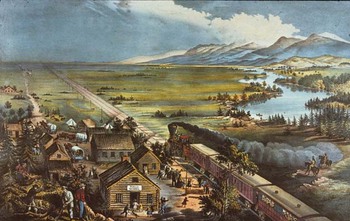
Telegraph wires tripled, making it easier to control events: and this means from being able to respond to Indian attacks more quickly to ordering boxes of nails, or beer, or shipments of newly-invented canned food.
One of the greatest and most infamous of these lines-controlling-the-West concept were the pieces of legislation and agreements and other legal and binding documents, between the U.S. government and every Indian tribe in the U.S. Promises were made to the Indians and of course not one of these treaties were ever actually realized. It was these written lines that even the greatest of Indian intentions could not penetrate, and that in the end, after everything was said and done and written, after hundreds of treaties, not one was ever followed.
And at the end of tying the first metal ribbon across the country, the meeting of the Central Pacific and the Union Pacific railroads at Promontory Point (Utah) in 1869, after the locomotives Jupiter and No. 119 touched cowcatchers, after the driving of the golden spike, after the completion of the massive effort to complete the railroad line, some men of the 21 U.S. Infantry (and others) hammered away at the rail to chip away some souvenir pieces of the occasion. So, the moment the great undertaking was finished, it was put out of commission, possibly by a coronet player from the regimental band, or whomever. Of course the line was only very briefly pu tout of service, and the damaged rails quickly replaced, but the folks celebrating the completion of the uniting of the rail line were the only ones who were really able to also prevent its completion.
Of course in the end all of the lines applied and enabling the closing of the West were personified by smaller and more precise lines: maps.
NOTES
The full text of the “Millions of Acres” (seen above) broadside is as follows:
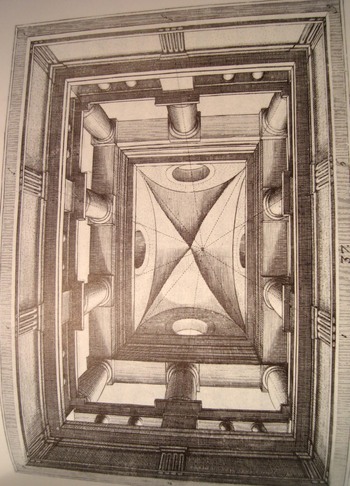
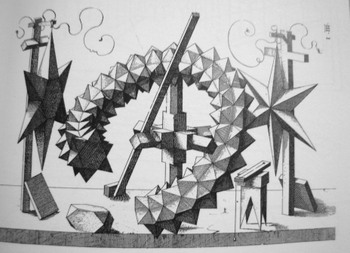 Wenzel Jamnitzer’s Perspectiva corporum regularium (1568) is a somewhat earlier work of great depth and beauty—this image is again just a “simple” arrangement of geometrical objects, but there’s really nothing very “simple” about it. The forms are difficult and arranged in a difficult presentation, and rendering them in perspective was a great achievement, and I think a wonder for the mid-16thc mind to see.
 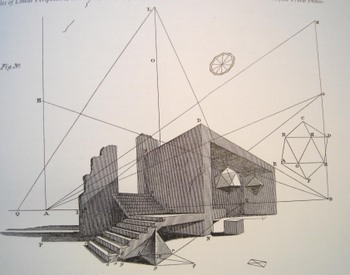 ,
, as it were the potentials of the beauty of excruciating detail that we see in these other works.