JF Ptak Science Books Quick Post Overall Post 5127
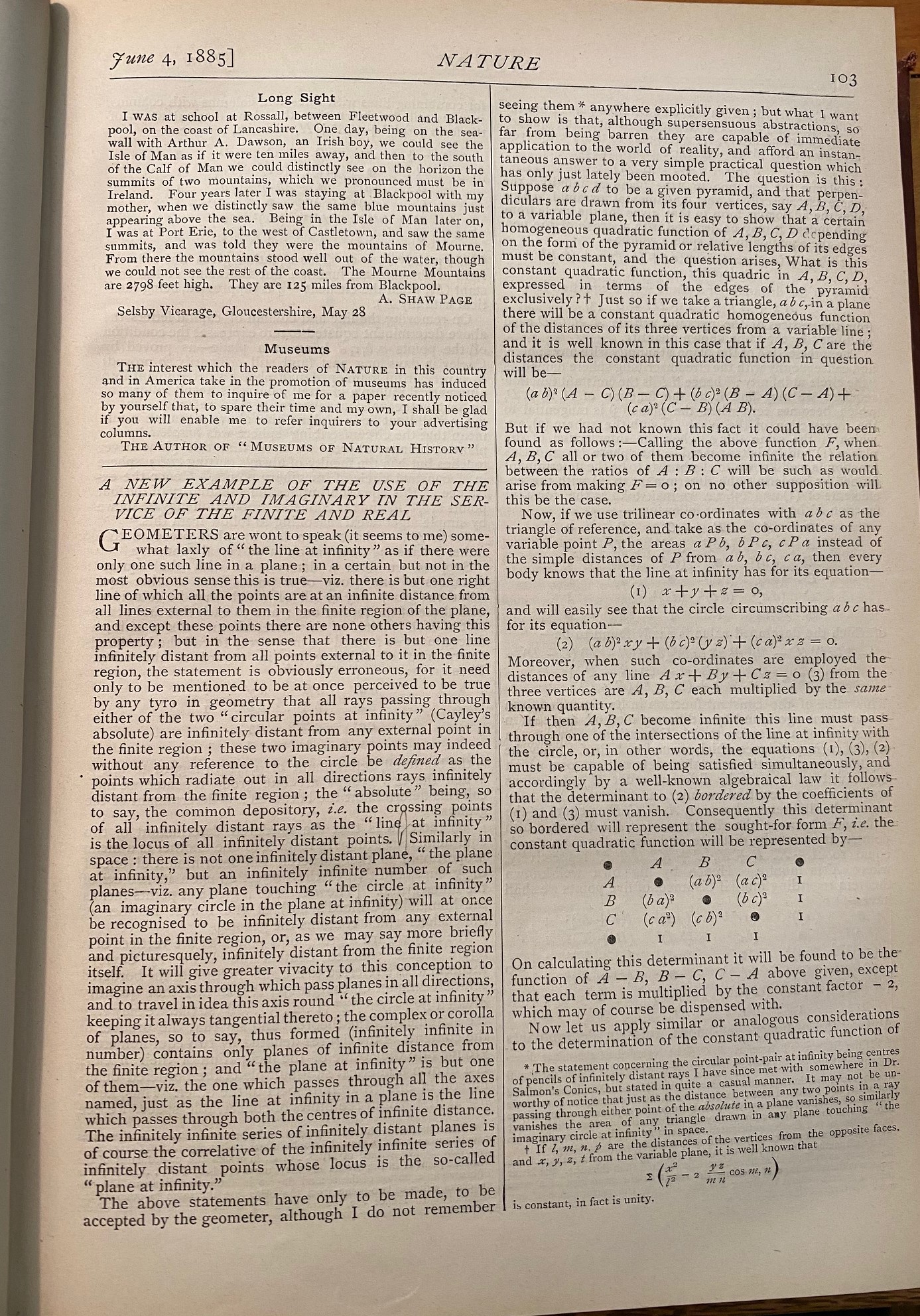 Over on my blog I’ve made a number of posts on “Found Poetry”–phrases and constructions of interesting structural images that when removed from a narrative form and subjected to a different display find a sort of light art form in themselves. The phrases and sentence are in their original order—spacing and delineation have changed a bit to focus their attractiveness. There have been posts on “Found Poetry” in the (sometimes very extended) titles of Renaissance books, recipes and instructions on cooking dainty sardines, a disintegrating machine from 1877, descriptions of clouds from 1726, and well, you get the picture. “Found art is where you don’t find it”, as M. Duchamp didn’t say—sometimes the found poetry is pretty obvious, sometimes not. Today’s entry has a terrific title, though the text lets us down a little, but then closes up very strong in the last paragraph. And so, from NATURE, volume 32 number 814, 4 June 1885, by the great and prolific J.J. Sylvester, “A New Example of the Use of the Infinite and Imaginary in the Service of the Finite ad Real”:
“GEOMETERS are wont to speak
(it seems to me) somewhat laxly of ” the line at infinity ”
as if
there were only one such line in a plane;
in a certain but not in the most obvious sense
this is true —
viz. there is but one right line of which all the points are at an infinite distance from all lines external to them in the finite region of the plan
and except these points there are none others having
this property; but in the sense that there is but one line infinitely distant from all points external to it in the finite region,
the statement is obviously erroneous, for it need only to be mentioned to be at once perceived to be true by any tyro in
geometry that all rays passing through either of the two “circular points at infinity” (Cayley’s absolute) are infinitely
distant from any external point in the finite region ; these two imaginary points may indeed without any reference
to the circle be defined as the points which radiate out in all directions rays infinitely distant from the finite region…
the “absolute” being, so to say, the common depository,
i.e. the crossing points of all infinitely distant rays as the “line at infinity”
is the locus of all infinitely distant points.