JF Ptak Science Books Quick Post
Just a quick notice here of an interesting note found in Scientific American (vol 83, no. 4, pg 54) for 28 July 1900:
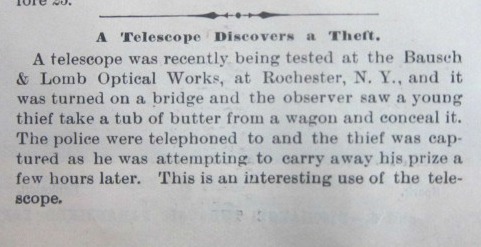
I wonder if this observation violated the expected zone of privacy of an individual, meaning a violation of the fourth amendment? Now this activity described above in Rochester took place on a bridge, so perhaps there was no expectation of privacy on a public street , especially if you are out-and-about and committing a crime. A quick look at the history of the fourth amendment gets immediately complex to me, and so I’ll leave it alone–except to say that it is not a clear-cut issue as to whether the above use of a telescope would’ve been a search-and-seizure issue. On the other hand, when this issue is discussed the idea of what would be “normally” observable to the unaided eye comes up–but what sort of unaided eye are we talking about? If the eye needed correction, would using eyeglasses constitute a challenge to the fourth amendment? I don’t know, as I’m not a law guy–but the question about the telescope and the fourth amendment seems mildly interesting.