A Daily History of Holes, Dots, Lines, Science, History, Math, Physics, Art, the Unintentional Absurd, Architecture, Maps, Data Visualization, Blank and Missing Things, and so on. |1.6 million words, 7500 images, 4.9 million hits| Press & appearances in The Times, Le Figaro, Mensa, The Economist, The Guardian, Discovery News, Slate, Le Monde, Sci American Blogs, Le Pont, and many other places… 5000+ total posts since 2008.

Category: Astronomy

  • Two Interesting Papers on Mars–Disappearing Continents and Re-Filling Canals. AND a Bit on the Origin of “Martian”.

    JF Ptak Science Books   Post 2783

    I came upon these three papers while doing some research on the bookstore part of this blog and thought to share them here. Three papers touching different and unusual aspects of Mars.

    The first belongs to Henri Jules A. Perrotin (1845-1904 and with Louis Thollon, 1829-1887), “Observation des canaux de Mars; “Lettre de M. Perrotin à M. Faye.” found in Comptes rendus1. Perrotin’s (mostly remembered I think because of his excellent use of the Cornu apparatus in establishing the best speed of light numbers until Michelson) communication establishes that the great canals (“canaux”) he observed and reported to the Academy in 1886 were still there, as expected and as hoped for and celebrated by Schiaparelli. There were also three other rather significant observational findings:

    • First, a continent had disappeared. “Clearly visible two years ago, it no longer exists today” he wrote ( “Nettement visible, il y a deux ans, il n’existe plus aujourd’hui.”). A flood, “or something else” (“Cette inondation ou autre chose…”) could well be a periodic occurrence that did away with the land mass.
    • Second, there is a new arrival of a canal 20-degrees in size just north of the disappeared/extinct continent (“…au nord du continent disparu…”).
    • Third, there was a sort of canal that suddenly appeared on the North Pole ice cap, connecting the two seas on either side of the pole. (“…sur la tache blanche du pôle nord, d’une sorte de canal qui semble relier, en ligne droite, à travers les glaces polaires, deux mers voisines du pôle”).

    ·Posted by :

    ·in:


  • Found Poetry in the Table of Contents of an Astronomy Book, 1874

    JF Ptak Science Books  Post 2783

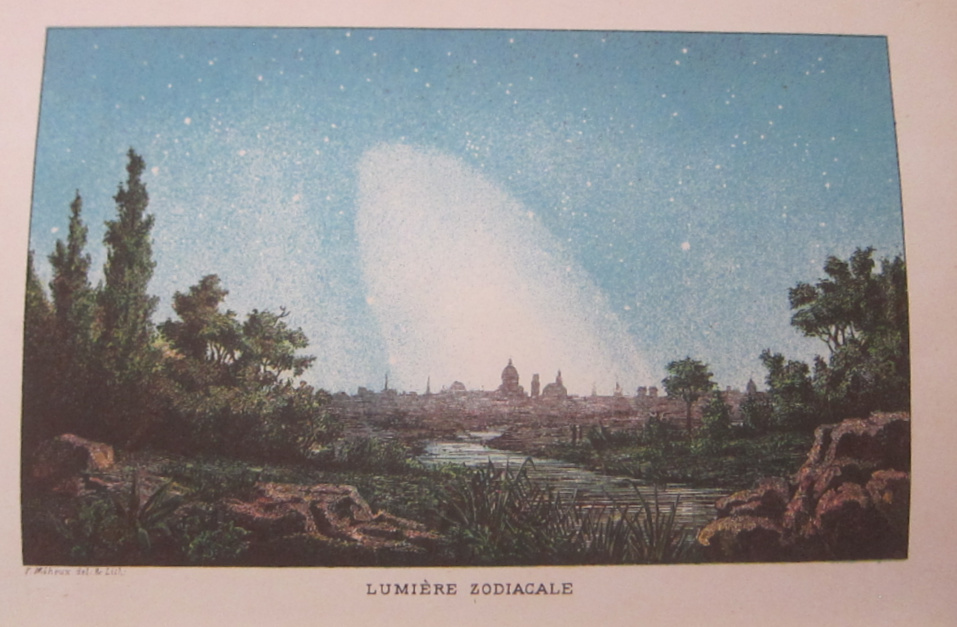
    Lumiere Zodiacale


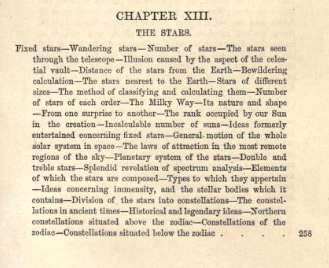
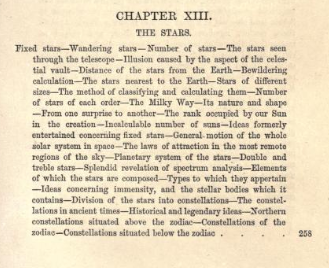
    Found poetry the starsI’ve written a number of posts on poetry found in unusual places: title pages of antiquarian books, technical manuals, unruly translations of commonplace literature, and so on. Here’s another, found in the table of contents for chapter 13 of a translation of Jean-Pierer’s Rambosson’s Histoire des Astres, Astronomie pour Tous. The edition I’m working from here is the illustrated edition of Paris, (1874) with its table of contents printed after the index at the rear of the text; the English translation’s table appears up front, and is pretty much the same as the French original (though the French sounds better).  I’ve got to say that there are some beautiful illustrations in this volume, not the least of which is a bright cross section of the Earth–it has exaggerated surface features out of scale to the rest of the planet to make a point in the text. (If this scale was correct then Vesuvius would be 500 miles in height.)

    So, the poetized chapter contents (and the original, at left):

    THE STARS. 
    
    Fixed stars, Wandering stars, Number of stars;
    The stars seen 
    through the telescope, Illusion,
    caused by the aspect of the celestial vault.
     
    Distance of the stars from the Earth,
    Bewildering calculation.
    The stars nearest to the Earth, Stars of different 
    sizes 
    The method of classifying and calculating them;
    Number of stars of each order.
    The Milky Way, Its nature and shape from one surprise to another. The rank occupied by our Sun in the creation Incalculable number of suns, Ideas formerly entertained concerning fixed stars, General-motion of the whole solar system in space.
    The laws of attraction in the most remote regions of the sky, Planetary system of the stars, Double and treble stars. Splendid revelation of spectrum analysis, Elements of which the stars are composed; Types to which they appertain Ideas concerning immensity, and the stellar bodies which it contains.
    Division of the stars into constellations the constellations in ancient times, Historical and legendary ideas Northern constellations situated above the zodiac Constellations of the zodiac, Constellations situated below the zodiac ....

    --Full text in English available from the Internet Archive: https://archive.org/stream/astronomy00rambiala/astronomy00rambiala_djvu.txt

    ·Posted by :

    ·in:


  • Early Views Extraterrestrial Views of the Earth and the Red Vegetation of Mars

    JF Ptak Science Books  Post 2762

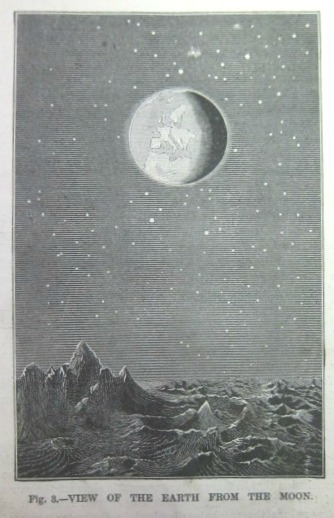
    Sci Am Earth from other planets _5_I am not sure of when it was that the first view of the Earth from another planet appeared in print. They are certainly rare prior to 1900, so that when I saw (the following) 19th century images of extraterrestrial landscapes in Scientific American (November 23, 1877) with the Earth in the background I was stopped by their unexpectedness–how unusual that unusualness is I don’t know.  I remember that the very busy and gifted Camille Flammarion’s published views of the Earth like these in his Astronomie Populaire in 1880, though the images that follow were published several years earlier in the SA. 

    The extraterrestrial landscapes are a leap of faith based on available observations, and no doubt that the readers of the late 19th century seeing these images for the first time would have been transported by their ingenuity and depth of understanding i n representing the Earth as just another bit in the sky when it is seen from other locations. 

    These images also led to a note about a paper that Flammarion wrote for La Nature1 in 1873 on what turns out to be the similarities of the atmospheres on Mars and Earth–and that led me to a somewhat earlier paper that he wrote for the Comptes Rednus that seems to have a little more punch than the later one. 

    In the short paper in the CR2 Flammarion observes that the Earth is mostly covered by water, and on Mars there is more “land/continental surface than maritime/sea surface”. “ L’étude détaillée de la planète montre que sa surface est bien différente de la surface terrestre, au point de vue du partage des terres et des mers. Chez nous, les trois quarts du globe sont couverts d’eau; sur Mars, au contraire, il y a plus de surface continentale que de surface maritime.”

    He then notes that according to spectrum analysis the Martian atmosphere and seas and snows are made of water just as they are on Earth. “…l’analyse spectrale montre que l’atmosphère de Mars est chargée de vapeur d’eau comme la nôtre, et que ces mers, ces neiges, ces nuages sont réellement composés de la même eau que nos mers et nos météores aqueux”. And at the end of the article, saying that the atmosphere of the Earth and Mars are very similar: “ La météorologie de Mars est à peu près la même que celle de la Terre; l’eau y est dans le même état physique et chimique que sur notre propre globe…”

    Also, there is vegetation on Mars which is very different from that of Earth, and that is what gives the planet its red color, as the plants growing there must be red. “…comme ce n’est pas l’intérieur du sol que nous voyons, mais la surface, la coloration rouge doit être celle de la végétation de Mars, quelle que soit d’ailleurs l’espèce de végétation qui s’y produise.”

    In his last summary point, Flammarion makes a case for the possibility of life on Mars, saying that conditions for necessary for life on Earth and life on Mars are familiar and similar for both planets (“…organic conditions there are not very different from those that have presided over manifestations of life on the surface of the Earth.”)“Enfin les raisons d’analogie nous montrent sur cette planète, mieux que sur toute autre, des conditions organiques peu différentes de celles qui ont présidé aux manifestations de la vie à la surface de la Terre.”

    And so some pretty strong observations about water and snow and life on Mars, all coming before the Schiaparelli developments and the canals four years later. 

    That was a long digression–the Earth from afar images follow the footnotes. 


    Notes:

    1. Camille Flammarion, “La Planète Mars d’après les dernières observations astronomiques” in La Nature – Revue des sciences, n° 10, page 145. (August, 1873) and is translated soon after for Popular Science https://todayinsci.com/F/Flammarion_Camille/FlammarionCamille-Mars.htm

    2. _____. “Sur la planete Mars”, in Comptes Rendus, vol 77 no 4, p. 278, July 28, 1873.


    ·Posted by :

    ·in:


  • Francis Galton, Life on Mars, and Extraterrestrial Communication (1896)

    JF Ptak Science Books   Post 2761

    Nature 1896 Galton MArs
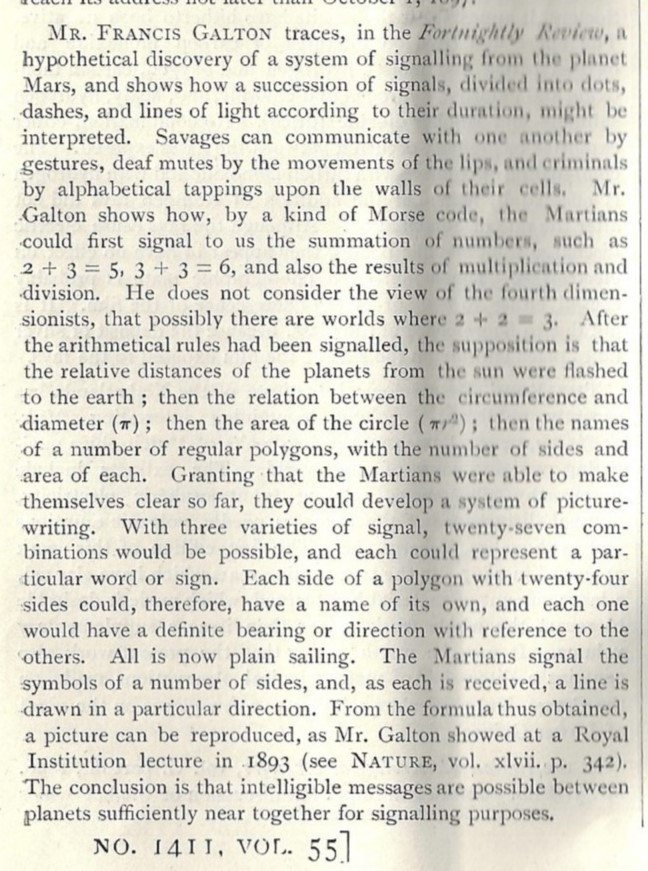
    Okay, these two images1 at the head and foot of this post have almost nothing to do with Mars and Francis Galton, except that they were advertisements in the issue of Nature (November 12, 1896) in which his notice on the possibility of extraterrestrial communication is discussed. That, and that the ads are very engaging, as is the report on Galton. Actually this is a report on a Galton paper that appeared two weeks earlier in the Fortnightly Review (“Intelligible signals between neighbouring stars”, volume 60, pp 657-64, November 1, 1896), and shared to a more scientifically-centered reading population than the other journal.  (Full text: https://galton.org/essays/1890-1899/galton-1896-fortnightly-review-signals-stars.pdf)

    It seems to me that the Galton—a genius who worked across many diverse fields—was having at a thought experiment in interstellar communication. Given the contemporary mileu of possible/expectant life on Mars, Galton thought about ways in which we could send some sort of communication, and what the logic of that “language” might be. He presents the idea of symbols, picture writing, with a combined arithmetic etymology to display an additive language that would show Martian observers a level of intelligence on Earth.

    Galton was hardly alone in figuring out a communication system though from what I can tell seems to stand out in his thinking on what was actually being said. The system itself was one of reflected light from the sun using a vast array of mirrors, an approach that would also be worked on by A. Mercier a few years later in 1899 and by W. Pickering (with a very mechanically-ingenious and enormous display).

    In any event it seems that at this point of the decade that the possibility of life on Mars was very distinct–almost in some cases a foregone conclusion.  To illustrate this, here is a short story about a short notice of a considerable prize offered by a citizen of France for scientific achievement. It was intended for astronomical and medical achievement, and was established by Anne Emile Clara Gouget (d. 1891), the wife of Marc Guzman, in memory of their son, Pierre Guzman. The amount was a very hefty 100,000 francs, which went a long long way in turn-of-the-century France, and which today would be equivalent to about $1 million or some such.

    The preference for the award is in astronomy—specifically, to the person/s who could successfully contact an alien civilization. That contact however does not include Mars. It was during this decade especially that there was much debate about the atmosphere on Mars, and whether it was vegetative, and whether there was an intelligent and advanced society capable of construction was what was seen by some as a massive system of canals across the planet. So with this in mind, Mme. Goguet-Guzman like many others assumed that there was some sort of life on Mars, and so Mars was excluded from the prize for contacting an extraterrestrial civilization.

    I’ve read in some sources that the astronomer/popular writer Camille Flammarion2 “announced” the prize in 1891, though the first published account that I can find appears in the Comptes Rendus in 1900. The notice states that Mars is excluded from consideration of the 100,000 franc prize, and in the event that no one wins another award would be generated from the interest compounded by the prize deposit every five years to a deserving person in science and medicine.

    Here it is in translation:

    “Mrs. Clara Goguet, widow Guzman, bequeathed to the Academy of Sciences a sum of one hundred thousand francs for the foundation of a prize bearing the name, Pierre Guzman, in memory of her son, and will be awarded to [the person] who finds a way to communicate with a planet other than the planet Mars.”

    “Foreseeing that the prize of one hundred thousand francs has not yet been awarded. The founder wanted, until this prize was won, that the, capital, accumulated for five years, constituted a price [in itself], always to be given in the name of Pierre Guzman, which would be awarded to a French scientist or foreigner who makes an important advance to Astronomy.

    The five-year prize represented by the interests of the capital, will be awarded,for the first time, in 1905.” (See the original French version, below.)

     Getting back to Galton, here’s the Nature summary in full:


    Francis Galton mars  _1_

    ·Posted by :

    ·in:

    —

  • Writing the Epitaph for the Martian Canals (1913)

    JF Ptak Science Books   Post 2760

    I wanted to amend a post from last week, “The Found-Poetry in Erasing Straight Lines from Maps of Mars (1909)”, which described the work of Eugene Michele Antoniadi and his superb observational and theoretical work of 1909 in describing the planet Mars. He had a very writerly way about him, more creative and conversational than most people who were writing on scientific subjects. In particular he was very gentlemanly in public and private correspondents who held opinions different from his observation facts about what was going on on Mars.

    In this 1913 paper1 in the journal Popular Astronomy, Antoniadi drives a very good-natured but very sharp spike into whatever it was that was left of the quivering heart of the collective who believed in (1) canals on Mars and (2) well, Martians. He gets to it right away, addressing the “wonderful phenomena” of overnight growth and decline in the numbers and dimensions of canals, the explanation for which escaped reason; for the Mars/canals believers “…the vast powers of Nature were found totally inadequate…” and so had to resort to more colorful and dramatic explanations to suit their needs:

    “Canals scores of miles wide, and hundreds of miles long, were observed in a few days, or even hours, to double, either by the formation of a parallel band, or by the disappearance of the original canal, and by the formation of two new parallel streaks separated by hundreds of miles. Nor were hesitations in these doublings neglected to be put on record, since canals were seen to be alternately single and double on the same night.

    “To account for these wonderful phenomena, the vast powers of Nature were found totally inadequate; and thus it was that Schiaparelli was led to enunciate the idea of the artificial origin of the canals, conceiving the larger of them to be composed of six different watercourses, whose dykes would be opened now and then by the Martian minister of agriculture.”–pg 417

    Antoniadi announced that these “speculations” of life and canals on Mars “have failed to do the utmost with their cherished idea”, and that on the face of it in order to accommodate one difficult aspect disagreeing with their theories—the appearance and disappearance of canals that “the Martian engineers would be constantly digging and destroying their watercourses”.

    “Speculations of such a character were eagerly embraced by M. Flammarion and other popular Continental writers. Yet it is to be regretted that the originator of this artificial theory, and his imitatore failed to do the utmost with their cherished idea. For, inasmuch as the canals appear straight about the central meridian, and also when carried by rotation near the limb, it is obvious that the Martian engineers would be constantly engaged in rapidly digging and destroying their watercourses, so as to make them look always straight to the observers on the earth. “pp 417-418

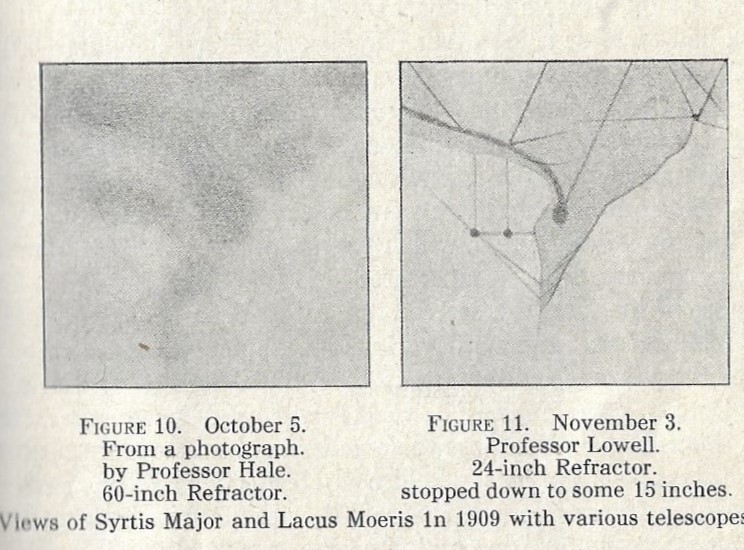
    He then discusses that the canals disappear under more powerful telescopes than those less-powerful preferred by the Canal people, and then devastates the idea of the “deceitful” nature of the discoveries by showing the imagery of the two instruments side-by-side, announcing at the end that the canal outlook “has been defeated, both by theory and by observation”:

    MArs 1913

    “The student who passes many consecutive hours in the study of Mars with medium-sized instruments, is liable to catch rare glimpses of straight lines, single or double, generally lasting about one quarter of a second …Here we have a vindication of Schiaparelli’s discoveries. But their deceitful character will obtrude itself on
    the observer using a large telescope, when, in the place of the lines, he will hold steadily, either a winding, knotted, irregular band, or the jagged edge of a half-tone, or some other complex detail… In their anxiety to prop their views against natural law, believers in the reality of the linear canals have presumed to champion the alleged superiority of small over large telescopes; and this either in revealing planetary detail, or in separating close double stars. But the attempt has been defeated, both by theory and observation…”–p 420

    And finally, the epitaph is inscribed:

     “Some observers will continue proclaiming the superiority of small telescopes. Ponderous volumes will still be written to record the discovery of new canals. But the astronomer of the future will sneer at these wonders; and the canal fallacy, after retarding progress for a third of a century, is doomed to be relegated into the myths of the past.”–p 424

    There was no room for a side-door escape for the Canal-believers in this paper as was the more mellow and accommodating paper of 1909. No prisoners in 1913.

    Notes:

    1. E.M. Antoniadi, “considerations on the Physical Appearance of the Planet Mars”, in Popular Astronomy, 1913, volume 21, pp 416-424. 

    ·Posted by :

    ·in:


  • Blank and Missing Things: Astronomers

    JF Ptak Science Books  Quick Post   

    • Part of a long series on Blank, Empty, and Missing Things

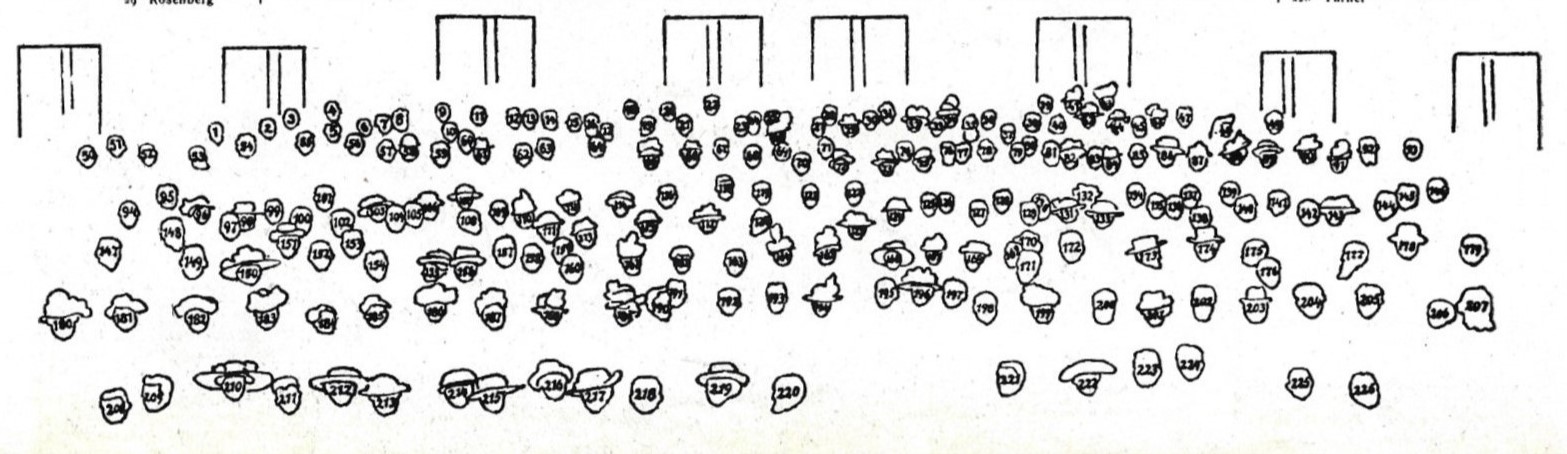
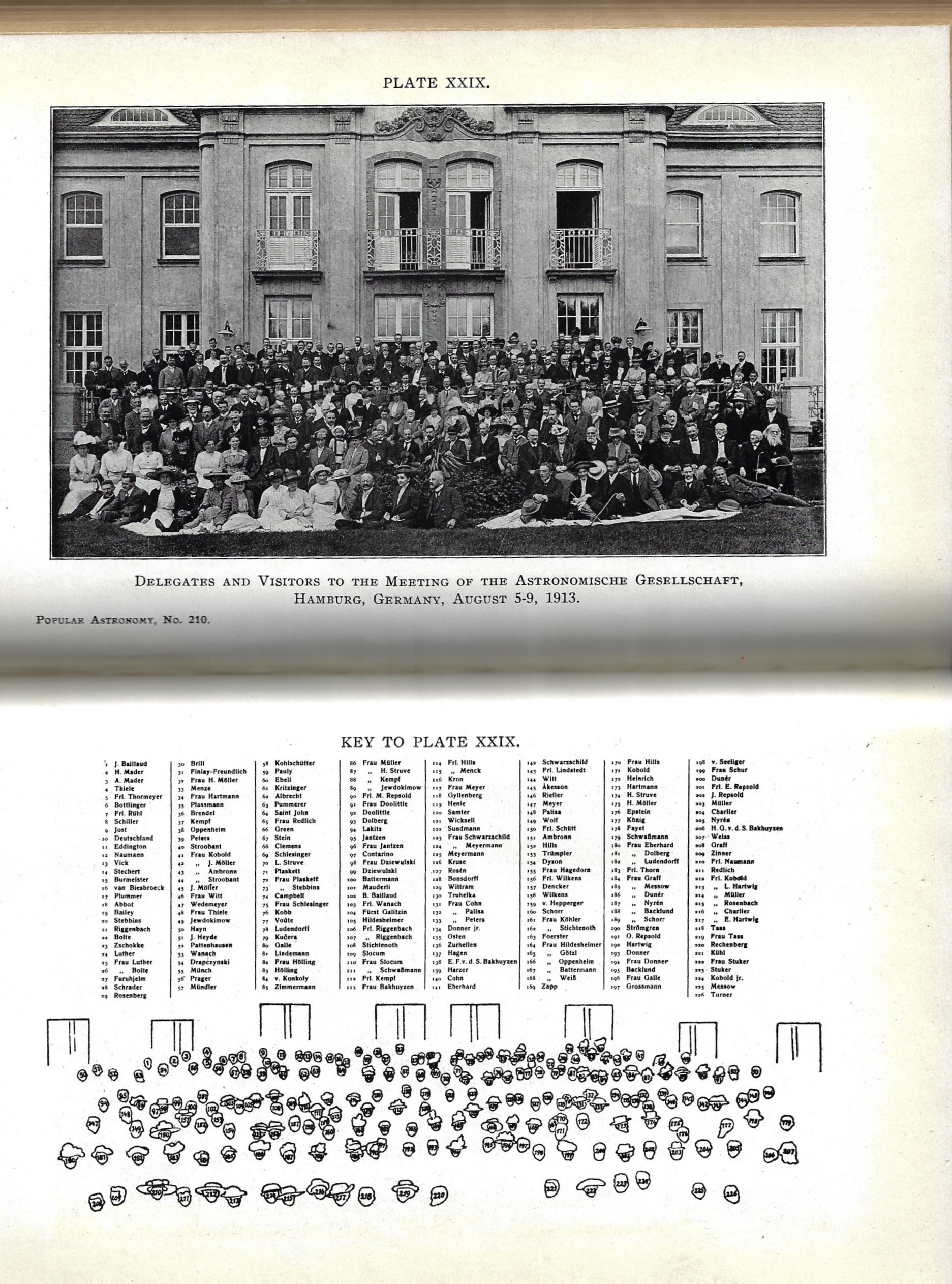
    I found this fantastic photograph of the attendees of the meeting of the Astronomische Gesellschaft at Hamburg, August 1913 in the December issue 1913 issue of Popular Astronomy. This is an august group, and of course they’re not “blank” or “missing”–its just a function of some out-of-context observations on the opaque overlay that serves to identify all of the folks in the massive group photo. (I’ve encountered these numerous times over the years and always have found the Found-Art aspect of them interesting and amusing.) The fact of the matter, though, is that there were some very high-powered people at this meeting.  Offhand I identify Mader, Eddington, Abbott, Mueller, Plassman, Struve, Plaskett, Campbell, Repsold(s), Jansen, Schwarzchild, Backlund, Seeliger, and numerous others. 

    Pop Astro 1913 group photo overlay detail _2_

    And the full presentation:

    Pop Astro 1913 group photo with overlay _1_


  • Found-Art in Algol

    JF Ptak Science Books   Quick Post

    Sci Am Algol eclipseHere we have another example of Found-Art in a scientific paper–this one looking Duchampian (again, especially if it were spiraling), or perhaps Dadaist, or Futurist.  In actuality it is something both “harder and simpler if you think about it) (referencing not-Duchamp) and “harder but simpler if you don’t think about it” (referencing not-Yogi Berra): it is an article meant for the general masses of pop science reading in the Scientific American Supplement for September 11, 1886 and it is trying to make sense of the famous and mysterious behavior of the star Algol. This is star B Persei, in Perseus, the constellation’s second brightest star, and as it would turn out it is an eclipsing binary star. The image below tries to make sense of the behavior of the star–the observation of which was published in 1671 (though the true first accounts may well be ancient.) The variability of the star would only be confirmed 60 years later, and then 50 years later until the remarkable John Goodricke determined the periodicity of the star. 


    ·Posted by :

    ·in:


  • The Found-Poetry in Erasing Straight Lines from Maps of Mars (1909)

    JF Ptak Science Books   Post 2759

    There was good strong debate on the issues of Martian “canals” and whether or not they were there by chance or by Percival Lowell’s (and others) intelligent design. The debate dates range from about 1886 to 1909 or so, though the real method in the intelligent life argument comes in at about 1895.  The “1909” part of the endgame is embodied in the interesting paper “Observations de la planete Mars, faites a l’Observatoire de Meudon”1 by Eugene Michel Antoniadi, which is also the holder of some superior and evocative vocabulary and imagery.

    Antoniadi made a series of painstakingly-executed photos of the planet with Europe’s largest telescope (the 33″ “Grande Lunette”) at Meudon. They revealed that the canals as hard geometric forms had indeed been a sort of optical illusion, and that the new and more-definitive photographs showed them in their true and far more complex existence, more as naturally-occurring objects than something that was designed by another life form.

    • (“During the planetary opposition in 1909, Antoniadi observed Mars at the celebrated 33-inch Meudon Observatory telescope, the largest in Europe. Although he observed for only nine nights during a month-long stay in Paris, he reported seeing Mars so clearly at times that the linear appearance of the canals dissolved into an intricate mess of smaller, irregular details, and he noted that ‘the geometrical “canal” network is an optical illusion; and in its place the great refractor shows myriads of marbled and chequered objective fields, which no artist could ever think of drawing’.)–“Mapping the Mars Canal Mania: Cartographic Projection and the Creation of a Popular Icon”, Imago Mundi, 58:2, 2006.

    The Antoniadi photos came only about five years after the true “first” photograph of what were thought to be canals was made by Percival Lowell’s assistant, Carl O. Lampland. (Antoniadi by the way spent nine years as a special assistant to Camille Flammarion at his personal observatory.)  In addition to the debate of how the “canals” came to be, there was another on whether the features identified as “canals” were there at all. It was Lampland’s work that seemed to settle at least that issue, establishing photographically that there was indeed something there. Lowell seized on this work as confirmation of his theories–that if the canals were proven to be there then it followed logically that his iterations of Martian intelligence would also be true. Here Lowell probably acted too rashly, as the photos showed that the canals also weren’t like the patterned and highly-geometrical structures shown in Lowell’s maps. (That said, the British Astronomical Society adopted the position in their 1906 annual meeting that the Lampland photos served as the confirmation that Lowell had been seeking…)

    The Lowell canals as constructed objects hypothesis lost steam after 1905, and met the large part of its end on the work by Antoniadi on what was evidently a perfect night of viewing on 30 September 1909, the primum mobili aspect removed in favor of natural causes.

    In the paper Antoniadi observed 50 canals and before he described them he defined them, the definition coming from one of the original namers of the canals as “canali” (or “channels”)–Schiaparelli–and not Lowell, who interpreted the “canali” as “canals”, with the armature that they were constructed by someone or something. Antoniadi writes with certainty in this paper: “a canal is a [banrle?] or greyish line of regions called the differences of brightness of neighboring points, which constitute the details of the image…”2  which leads us far away from the material intelligence argument.

    Antoniadi then sets down an 8-point descriptive list of canal characteristics, which is beautifully written and when presented in a certain way takes on a very poetic form. His original description reads: “(a) En ombres diffuses, plus ou moins îrréijulières, dont quelques-unes paraissent doubles d’une manière fugitive;  (b) en estompages noueux;  (c) en masses grises, informes et disjointes;  (d) en estompages irréguliers, minces dans le vcuMiiage d’une haie des mers martiennes, et s’élargissnnt en une ombre vaste et confuse plus loin, comme des neuves avec leurs tributaires, vus a une très grande distance; (e) en alignements d’un très petit nombre de lacs; (f) en lacs in-éguliers, simples et bien isoler-; (g) en bords de pâles demi-tons; (h) en lignes noires très courtes, sinueuses ou courbes.”

    Here’s the description, reformatted and translated:

    “Our observations lead us to divide the channels into several categories, namely:

    In diffuse shadows, more or less irregular, some of which appear

    double in a fleeting way;

    In gnarled blobs;

    In gray masses, shapeless and disjointed;

    In irregular, thin blurring, in the construction of a hedge of

    Martian seas, and widen into a vast and confused shadow further on, like

    new with their tributaries, seen at a great distance;

    In alignments of a very small number of lakes;

    In ‘simple lakes, simple and well insulated;

    In edges of pale semitones;

    In very short black lines, sinuous or curved.


    Antoniadi concludes (translated):

    “In this nomenclature, we have not understood the fugitive straight lines, often called channels, which are visible only during a fraction of second and which can be due to an illusion.. These first observations do not confirm the existence of a network of geometric straight lines, crisscrossing in all directions. Even, by very calm images, we have recognized, not in a fleeting way but for several consecutive seconds, a structure of continental regions quite different from the previous one. These regions are shown covered with a large amount of greyish mottling, irregular, complex and gnarled, which no artist can render.

    I was very surprised to find such a significant paper rendered in such a poetic manner.

    Notes:

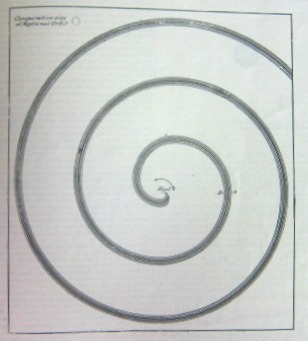
    1. ANTONIADI, E.-M. “Observations de la planete Mars, faites a l’Observatoire de Meudon. In: Comptes Rendus, 15 November 1909, pp 836-838 in the weekly issue, WITH a lovely full-page map of Mars.

    2. Antoniadi remarks elsewhere that the lack of geometry on the planet “was conspicuous by its complete absence”.–McKim, R. J., “The life and times of E.M. Antoniadi, 1870-1944. Part II: The Meudon years”, Journal of the British Astronomical Association, vol.103, no.5, p.219-227, 1993. There is a long report with 100 illustrations by Antoniadi in the Memoirs of the British Astronomical Association (vol XX, part II) published in the second year of the War, 1915–on the cover of that report is a very strong but still measured statement by George Ellery Hale: “The total absence of straight lines…seems to me significant”. 

    McKim goes on to note the polite correspondence between Antoniado and Lowell, including the very generous suggestion to Lowell that the later’s observations were obscured and complicated by Martian cloud cover. 
    ·Posted by :

    ·in:

    — —

  • A Good Question on the Canals of Mars: “Are They Really There?” (1903)

    JF Ptak Science Books  Quick Post

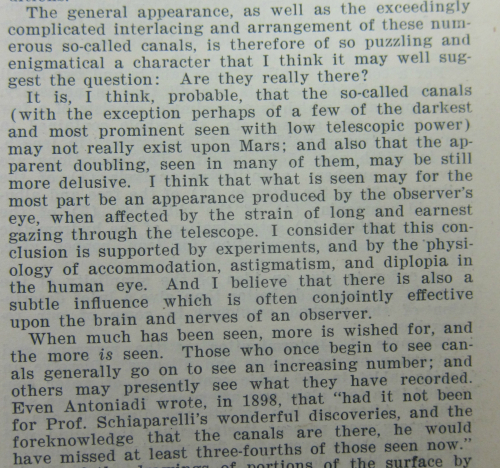
    Edmund Ledger (1841-1914, 38-year Member Royal Astronomical Society, professor of astronomy at Gresham College, 1875-1914) asks an excellent question in his short article, “The Canals of Mars”, in the Scientific American Supplement of 1903 (#1434 June 27, 1903, p 22983-4). He quickly reviews some current thinking on Schiaparelli’s canali and their reception as “canals”, made by Martians, and in his doubt asks the question: “Are they really there?”1

    Mars Ledger

    The canals had been questioned before of course, including by Ledger himself. Earlier in 1895 Ledger described one impossibility of the Seechi-named and employed-by- Schiaparelli canali as canals just in their sheer size: that in order for astronomers to observe the canals that they had to be at least 20 miles wide in addition to being thousands of miles long…a feat too great for anything to accomplish, something far beyond comprehension. (The Suez canal, completed not long before this, would have been nothing compared to the Martian works, being just about five times as long as the canali were thought to be wide. Also thinking no doubt would have been tempered in a bad way—like a poorly tempered anvil and its unpleasing response to being struck by a hammer—by the French failures in the decades that they squandered trying to build the 50-mile-long Panama Canal.)

    ·Posted by :

    ·in:

    —

  • Morse Code to Mars, 1921

    JF Ptak Science Books   Post 2750

    “Blapo”

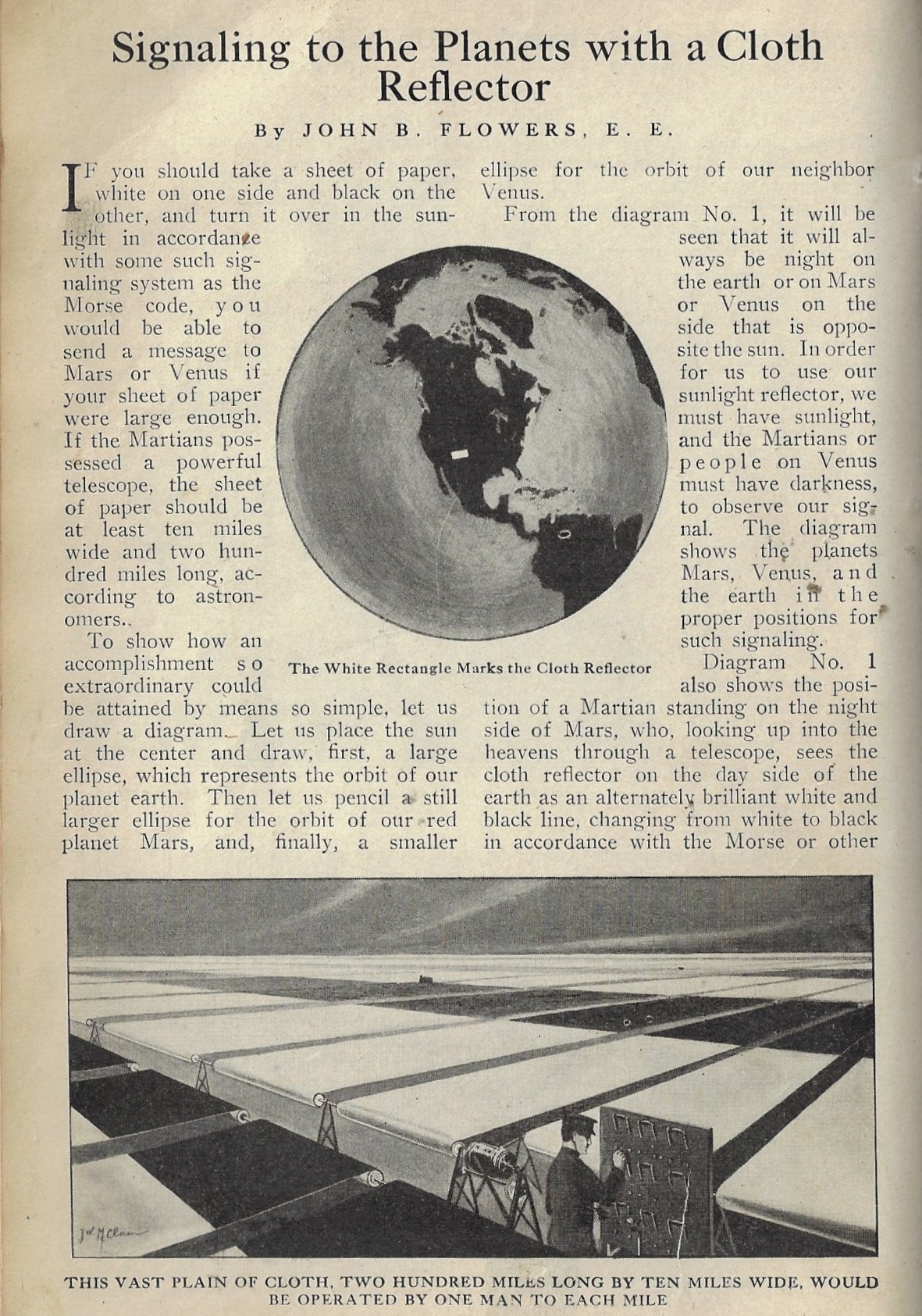
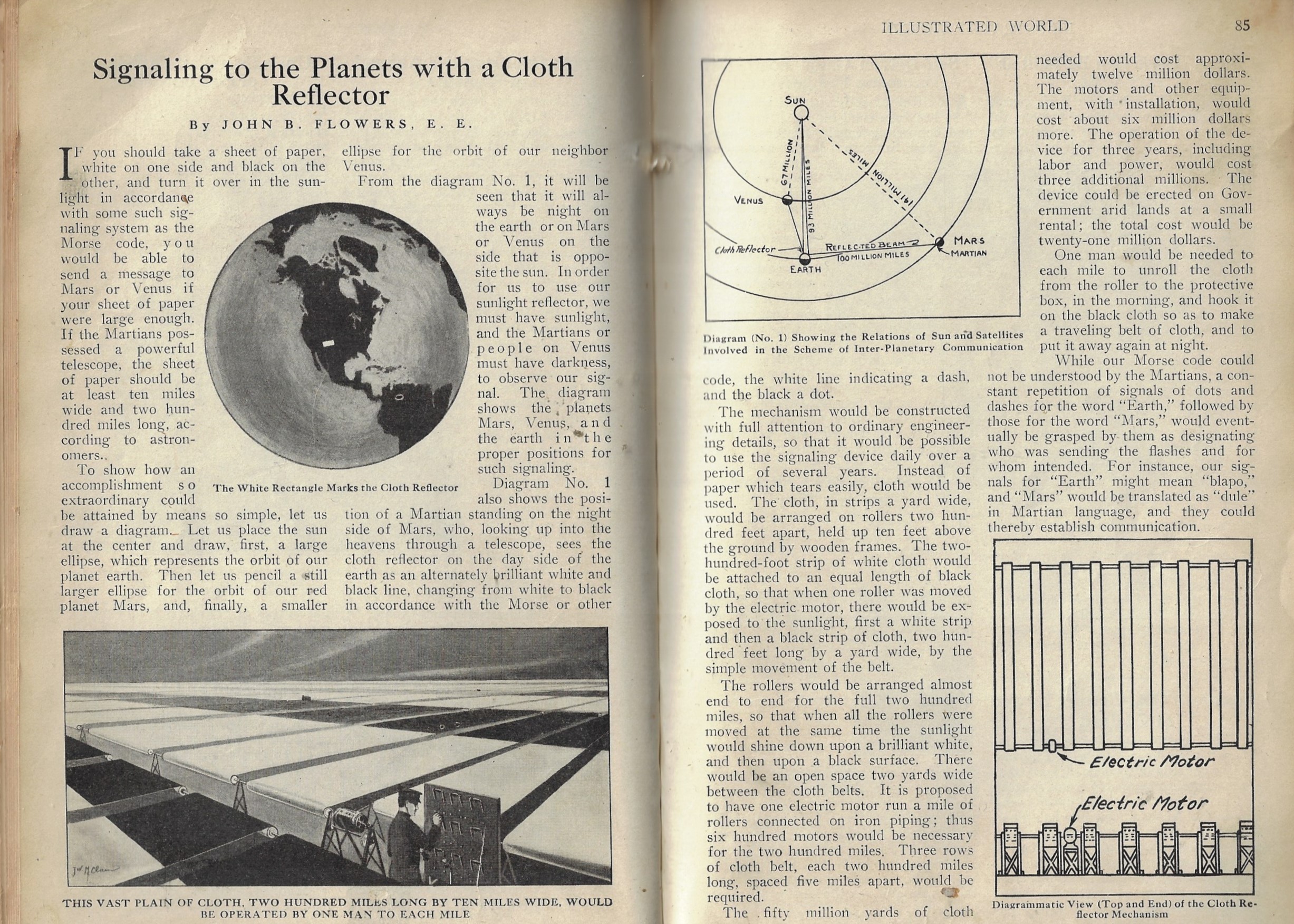
    A provocative article appeared in the somewhat obscure magazine Illustrated World suggesting a gigantic apparatus for signalling to possible observing beings on Mars. John B. Flowers, author of “Signaling to the Planets with a Cloth Reflector”, reported on a remarkable structure suggesting a possible way of communicating with intelligent life on the other planets–principally, it seems, Mars.  The briefest background here shows that the most popularizing idea of life on Mars came about as a mistranslation/interpretation  of astronomer’s Giovanni Schiaparelli’s observing term “canali” to be “canals/channels”, meaning an intelligent life form existed on the planet capable of constructing large technological forms. This idea was given full flight by Percy Lowell in his 1895 book Mars, followed just two years later by H.G. Welles’ War of the Worlds. 

    The uncredited idea in the Flowers article  called for a a series of connected mechanisms holding white sheets over a 200 x 10 mile (!) section of Federal desert lands, the movements of the sheets conducted by 600 large motors, making use of the segmented sheets to send messages via Morse code. The $21 million plan would repeat “Earth” and “Mars” over and over again until a response was heard. It was the hope that the Martians receiving the message would figure out the the dots/dashes related to Earth/Mars, finding that “Earth” was equal to their word for Earth (“Blapo”, for example) and “Mars” for (again, for example) their “Dule”.  And so on.  The article is only two pages long and for what its worth it spends a fair amount of space on the description of the apparatus, and a little on what it was that would be transmitted. There isn’t a word spent on what the consequences might be if the Martians returned the favor. 

    That said, the idea of life on Mars had mostly lost its pinkish pulse by 1920, though people still were still tinkering with ideas of how to communicate with alien forms of life over vast distances. Camille Flammarion, for example, advocated turning desert land into a massive Las Vegas, heating up the desert with millions of light bulbs and then using them to flash signals who-knows-where. Harvard’s William Pickering advocated an enormous mirror to reflect sunlight back into space somewhere, and R.W. Wood floated a similar idea to what is described by flowers, except the opposite, using black cloth over white sand. Over the next twenty years, into the 1940’s,  the interest seems less in communication than with the visiting the place.

    Notes

    • For a contemporary description of these ideas see “Hello Mars, this is Earth! Will the Martians Answer Us?”, in Popular Science Monthly, 1919, July-December, pp 74-5, full text here:  https://babel.hathitrust.org/cgi/pt?id=uc1.d0002769792;view=1up;seq=345
    • Also: here’s a good article (with the same title as the above but written in 2012) by Matt Novak in Smithsonian dot com exactly on this Pop Sci Monthly 1919 article. Well done! 


    Illus World Morse Code to MArs


    Illus World 1925 Morse to Mars 2pp