A Daily History of Holes, Dots, Lines, Science, History, Math, Physics, Art, the Unintentional Absurd, Architecture, Maps, Data Visualization, Blank and Missing Things, and so on. |1.6 million words, 7500 images, 4.9 million hits| Press & appearances in The Times, Le Figaro, Mensa, The Economist, The Guardian, Discovery News, Slate, Le Monde, Sci American Blogs, Le Pont, and many other places… 5000+ total posts since 2008.

Category: Astronomy

  • Outside Looking Out–Space, 1899.

    JF Ptak Science Books   Post 2751

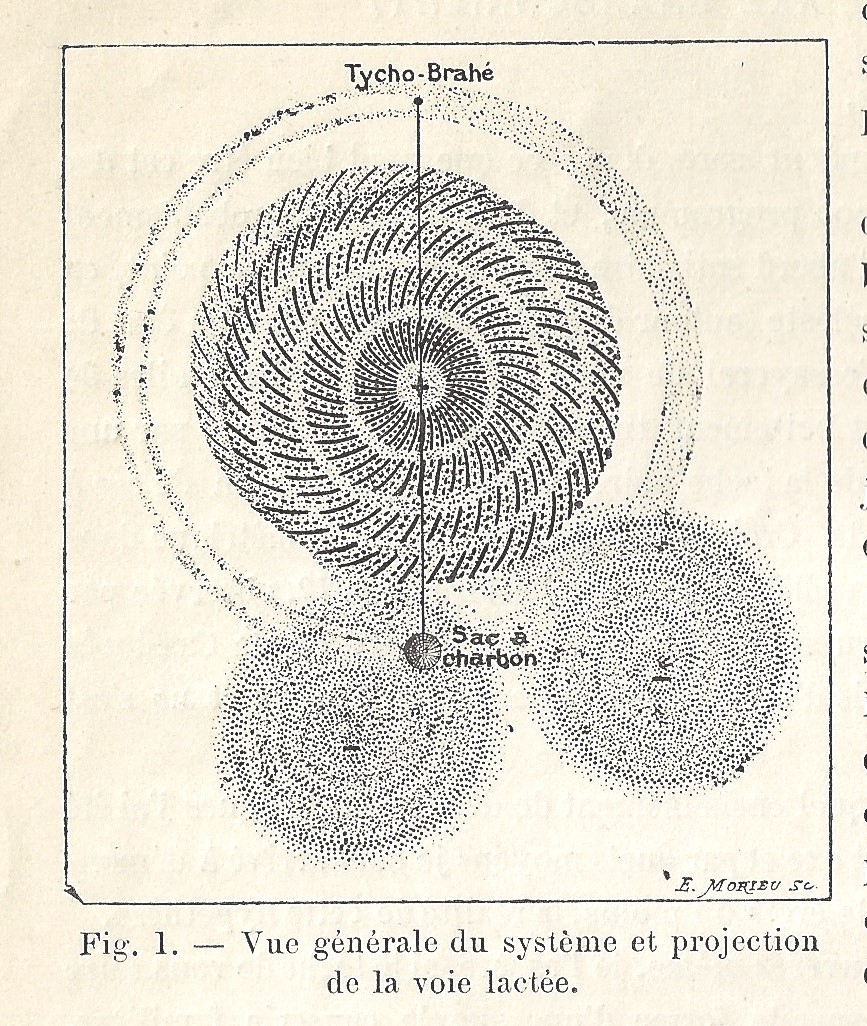
    Back in 1899 the astronomer Adolphe Duponchel1 published a pamphlet on his very involved theories of the motion of the stars and star clusters and the shape of the universe.  I couldn’t understand much of it, and when I thought about it more, I understood less, and probably less than that. I just couldn’t decide what the idea was that he was trying to decipher and share, except to say that it was big. 

    I wouldn’t have thought about this pamphlet at all it if was not illustrated, because the illustrations in this short pamphlet are quite, well, inspired:
    DocFile (3)

    Duponchel was an accomplished and published civil engineer, canal and bridge builder, and hydrologist, who later in life veered into cosmogony, publishing on the effects of meteors and solar activities on the distribution of stars, the structure of the galaxy, and the motions of the planets. He met with no success from what I can determine, though he seems to have been very active in his starry pursuits through the 1890’s, which was a prime period for French cosmogony. At the very least his ideas look entertaining, and as I said the imaging is quite lovely.
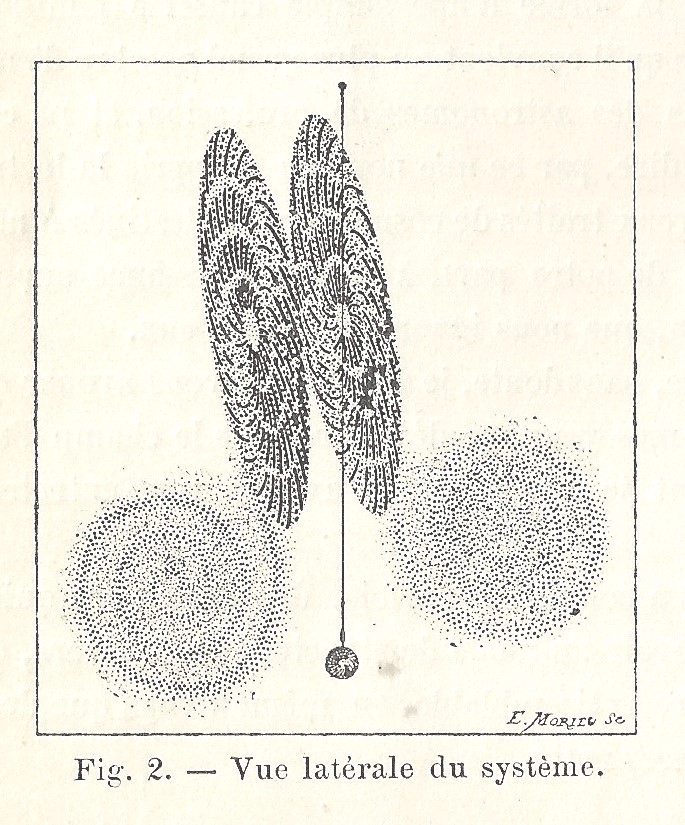
    DocFile (4)

    The truth of the matter is that I do not understand what he is talking about, though sometimes it seems as though he is talking about black holes and the motion of stars, except that he seems to be talking about “apex charbonnier” that are dark regions of space that could not be penetrated given the optics of the day. In general though he writes about what effects the “circulation” of the stars and star clusters.  Liberally translating he states that “no astronomical problem could offer more interest, and in the absence of a solution of a rigorously demonstrated accuracy can be I am happy to have arrived at finding a plausible and at least probable explanation of the simultaneity of all these coordinated movements in the same state of general equilibrium.

    After this very pro forma and enormous statement, we arrive at the unknown stuff of his insight: 

    “…points noirs isolate correspondent a des rayons visuels qui auraient traverse les mailles des deux reseaux sans rencontrer aucune etoile sur leur passage. Dans une seule direction, sur un espace sans doute assez restreint, mais parfaitement defini par son contour piriforme, cette illumination fait reellement defaut.” (“Isolated black/dark spots correspond to visual rays that would have passed through the meshes of the two networks without encountering any stars in their path. In one direction, on a space which is doubtless rather small, but perfectly defined by its “piriforme” outline, this illumination is really lacking.” The translation doesn’t help the original too much, which left me understanding nothing.

    Then, a few pages later, he writes: 

    “…étudier ici tapissant en quelque sorte les parois du vide de l axe s y trouveraient distribuées en anneaux ou pour mieux dire en tores successifs dont chacun correspondrait à une strate particulière en forme discoi dale d étoiles extérieures. Ces to res successifs (figs 1+2) correspondant aux sphères magnétiques qui accompagnent les noyaux solides du Soleil et des planètes comprendraient chacun un certain nombre d étoiles circulant autour de l axe du tore avec un mouvement de rotation ac célérée en spirale comme celui des sphères magnétiques mais avec des vitesses alternativement de sens direct et de sens inverse de manière à assurer des vitesses concordantes de même direction aux points de tangence de deux tores consécutifs…” Or, “Firstly, to study here somehow lining the walls of the void of the axis would be distributed in rings or, to put it better, in successive tori, each of which corresponds to a particular stratum in the form of a disc of external stars. These successive rests (fig 1+2) corresponding to the magnetic spheres that accompany the solid nuclei of the Sun and planets would each include a number of stars circulating around the axis of the torus with a spiral arc rotational movement like that of the magnetic spheres but with alternately direct and reverse direction so as to ensure concordant speeds of the same direction at the points of tangency of two consecutive tori…”  Again, a not-good translation, but I really didn’t have much of an idea of what he was writing about. 
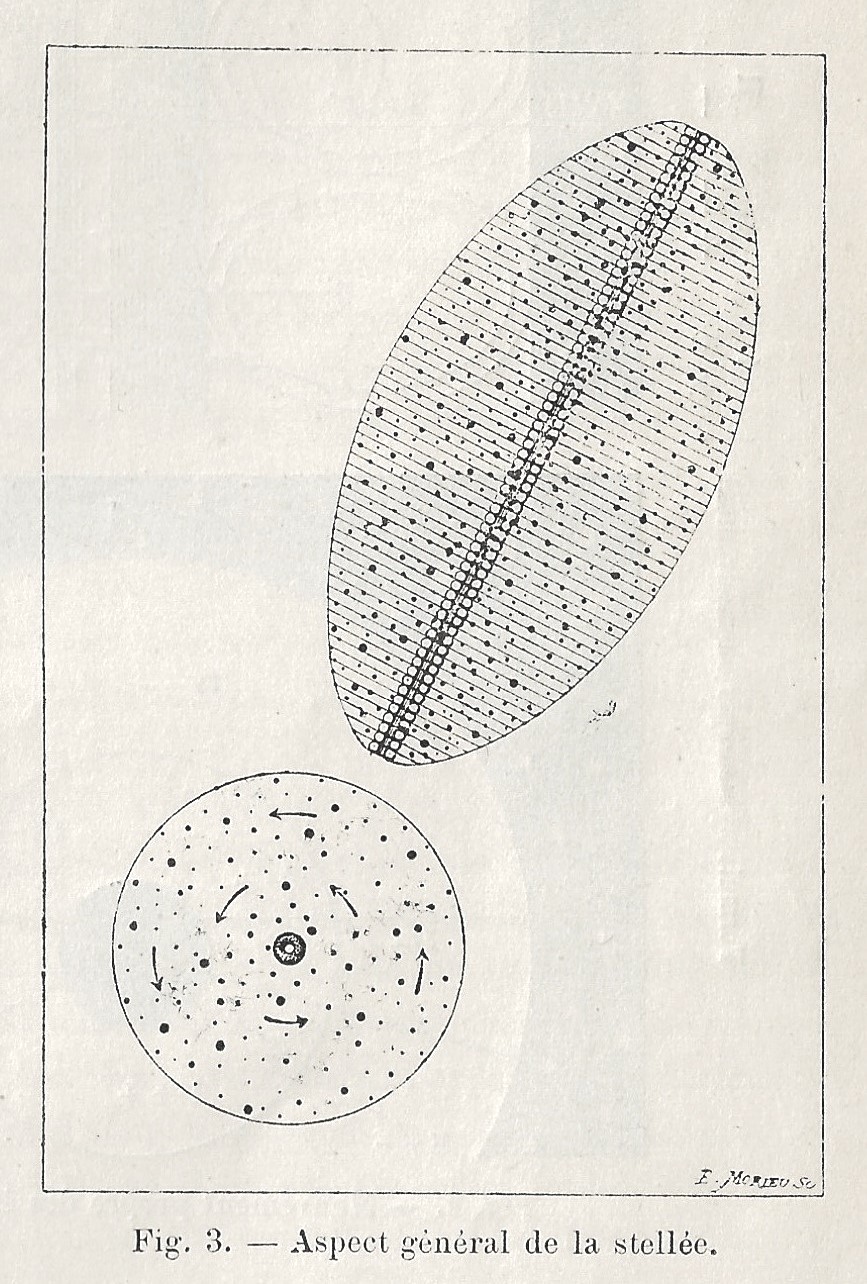
    DocFile (1)

    The pictures are pretty.

    If I’m missing something big, please let me know.


    Notes:

    1. Adolphe Duponchel,  “Circulation de notre groupe stellaire autour de l’axe charbonnier et mouvement parallactique de l’apex Solaire”. Printed by the author, in Paris, 1899, from its appearance in Societe Astronomique de France, 1 March 1899.  9×6″, 18pp.  WorldCat/OCLC reports 1 copy in the U.S. And either 1 or 3 copies at the Observatoire de Paris—otherwise there are no other copies of this work located. Provenance: Smithsonian Institution, and then the Library of Congress (small mostly-faded oval stamp for the SI on front cover, and the LC surplus stamp on the back cover).  

    “Et les individus qui participent à cet engouement pour la quête des origines cosmiques n’épargnent ni leurs efforts ni leur temps pour développer, étayer, rendre publique, et faire reconnaître leurs théories. Ainsi, l’ingénieur des Ponts et Chaussées Adolphe Duponchel (1821-1903), après avoir déposé un pli cacheté à l’Académie des sciences le 27 mars 1893 contenant le sommaire d’une brochure exposant ses « Principes de cosmogonie générale », fait imprimer celle-ci à ses frais et l’envoie à l’assemblée savante. Il n’obtient aucune réponse mais persévère et soumet six Notes ou Mémoires à l’Académie sur ce sujet entre 1893 et 1894. Ne parvenant pas à obtenir le soutien académique qu’il recherche, Duponchel va finalement publier sa théorie dans des revues populaires de science, d’abord dans la revue Cosmos le 2 septembre 1893 puis, sous une forme augmentée, dans la Revue Scientifique les 28 juillet et 4 août 1894.”Volny Fages, “Dire l’origine scientifique des astres. L’engouement pour la cosmogonie en France dans la seconde moitié du XIXe siècle”https://www.cairn.info/revue-romantisme-2014-4-page-32.htm

    See:

    ASTRONOMES FRANÇAIS 1850 – 1950 D’ABBADIE, Antoine.  www.obs-hp.fr/dictionnaire/astronomes_A-Z.pdf

    See: Agnes Mary Clerke , A Popular History of Astronomy During the Nineteenth Century, p 202, a review of some of the later 19th c solar astronomers.
    ·Posted by :

    ·in:

    — —

  • A Quick and Logical Dispatch of ET-Built Martian Canals (1895)

    JF Ptak Science Books   Post 2744

    A friend of mine forwarded an article to me that in one clear paragraph would seem to demolish the widely hypothesized belief in Martians (of some sort) building the relatively-recently discovered “canals” of Mars. As succinct and logical as it was, it seems not to have made much of a dent in the popular belief system of Martian structures having been built by intelligent life forms. The note was written by a Miss M.A. Orr and was published in the Journal of the British Astronomical Association (vol 5, 1895, p 209) and which also appeared in Publications of the Astronomical Society of the Pacific in their volume 7, April 1895, though this time the author was evidently mis-identified as “Mr. J. Orr”. The extraterrestrial debate for life on Mars is an old and long affair that I don’t want to set in motion in this short 20-minute post, so we’ll leave that for another time. For now, I’d just like to reproduce the body of the argument, which looks very sharp and compelling and has a nice hallmark of insight to it, and which I think could have been delivered as a debate coup de grace from which the opponent just could not recover without direct ET interference.

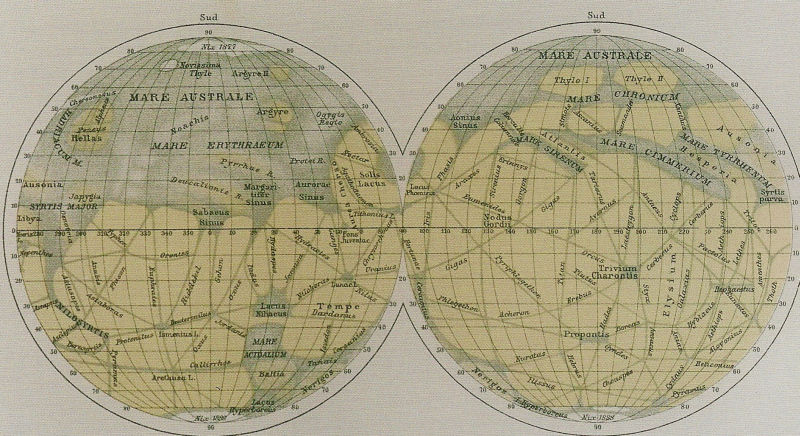
    Mars  Flammarion 1892 Schiaparelli

    Schiaparelli’s canali as shown in a  map from Flammarion’s book on the planet Mars, 1892.

    The short version of the short note is that the canals as identified in 1895 were iterated by Ms. Orr to have an average width of 33 miles,  an average depth of 70 feet, and an average length of 2000 miles, which is basically digging a ditch as wide as the English Channel but 2000 miles long (or from Dover to Moscow plus another few hundred miles)…for just one canal.

    Ms. Orr reckons that this would be the equivalent of constructing “1,634,000 Suez Canals”, and which would occupy a workforce of 200 million (Earthlings) for 1000 years.

    It is quite a mental image, no?

    No doubt there were many who dismissed the reasoning (as Edward S. Morse did with peppery ridicule and vinegar in his book Mars and its Mystery in 1907) because the life-on-Mars bit continued on for some time, exemplified by the astronomer Percy Lowell in his highly popular works on  pro-life views of Mars,  Mars and its Canals in 1906 and Mar as an Abode of Life in 1908.

    Why this argument didn’t pose a major roadblock to the thinking crowd of ET folks, I do not know, but from my brief survey, Ms. Orr seems to have had little impact on the debate with what looks like sound and simple reasoning.

    Here’s the text by Ms. Orr:

    “The Canals of Mars”, by Mr. J. Orr. Publications of the Astronomical Society of the Pacific, Vol. 7, No. 41 (April 1, 1895). 

    Mr. Pétrie read a paper by Mr. J. Orr, a member of the West of Scotland Branch, on ‘The Nature of the “Canals” on Mars.’ The paper, which had been read at Glasgow at the meeting of the Branch, was to show the almost absolute impossibility of the belief, which at one time somehow obtained popular currency, that the so-called canals were of an artificial character- the work of a supposed Martian race.

    By ruling grooves on a globe illuminated by a strong light, Mr. Orr calculated that the minimum breadth for visibility of the Martian canals must be about 33 miles. The length of an average canal, as measured on Schiaparelli’s map, is about 2000 miles; and since on our terrestrial canals a minimum depth is required, to insure a constant supply of water at the center (diminished by leakage, evaporation, etc.), a depth of at least 70 feet would be required in the case of such a Martian canal as Tartarus. Even granted that the diminished force of gravity on Mars would render the work of excavating a ditch 70 feet deep equal to a terrestrial one of 26 feet, it was calculated that the canals would contain about 1,634,000 of our Suez Canals, and would require an army of 200,000,000 of men, working for 1000 of our years, for their construction. Assuming that the population varies with the surface, since the area of the earth is about 3^ times greater than that of Mars, we should get a Martian population of about 409,000,000. All the adult males, and a large number of the women, must, herefore, have engaged in the great work.

    * The writer supposed the ‘ canals ‘ to be great fissures caused by the cracking of the surface in contraction due to cooling, the planet having reached a considerably more advanced stage in its life than the Earth.

    * Ά slide having been shown, representing the general canal system as given by Schiaparelli, the President (Mr. E. W. Maunder, of the Greenwich Observatory,) said he hoped that Mr. Orr’s statistical, but, nevertheless, amusing and instructive, paper might prove one more nail in the coffin of a very absurd idea, which had certainly got most undue currency – namely, that the canals on Mars could possibly be the work of human agents. The mere fact that the whole of the resources of one of the greatest nations in Europe had failed to dig a little ditch some 26 miles long, and, comparatively speaking, only a few feet wide, might, he thought, convince us that the people on Mars, supposing there were any, could scarcely excavate 80,000 or 100,000 miles of canals, 40 miles wide.

    ·Posted by :

    ·in:


  • A Note on Speculative Scientific Writing on “Infinitely Probable” Extraterrestrial Life, 1897

    JF Ptak Science Books   Quick Post

    Deep into a stellar, pioneering, and very productive 350-paper career  (Pierre Jules Cesar Jules Janssen, 1824-1907) wrote this interesting paper that appeared in Appleton’s Popular Science Monthly (volume 50) in 1897 (translated from his address to the French Academy of Sciences on 24 October 1896), speculating on the possibility of teeming life elsewhere and on the unity of the laws of science and nature. He was a great traveler in the name of astronomy, an independent researcher with a house in Montmarte and a maker of his own telescopes and spectroscopes (that in the first decade of the science), who via a mistaken identification of finding oxygen in the spectrum of Mars1 (1867-1869, in the middle year of that discovering helium), came to a realization that life existed on Mars. And from there Janssen went on to create the possibility of worlds throughout the universe, all brought about by the creation of the science of astrophysics in which he made such important contributions.  There’s a lot in these few short pages, including this interesting speculation:

    • “I say further that what we know of the unity of the chemical composition of the matter of the sun, the stars,
      and the nebulae permits us to make new inductions respecting the part performed by the bodies which are
      on the earth the most important factors of the phenomena of life. It is thus infinitely probable that hydrogen,
      oxygen, nitrogen, carbon, and especially water, which on the earth are the indispensable constituents of
      vegetable and animal life, fill a like office not only in the planets of our system, but throughout the universe.”

    Janssen is one of many who speculated on life in the universe, even among spectroscopists of Janssen’s time (including William Huggins, Angelo Seechi, Heinrich Schellen), part of a continuum of thinkers reaching back to Bruno (1584), Kepler (Somnium, 1634), Wilkins (Discovery of a World in the Moone..., Borel (1657), Fontenelle (the great Pluralitie des mondes, 1686), Huygens (1698), Derham (1714)…the list begins to get pretty crowded in the 18th century.


    Janssen life other worlds _a_

    • [Images sources all via Internet Archive, here: https://archive.org/stream/popularsciencemo50newy#page/812/mode/2up]

    ·Posted by :

    ·in:

    —

  • A Beautiful Solar Eclipse Print (1858)

    JF Ptak Science Books   Quick Post

    Eclipse913


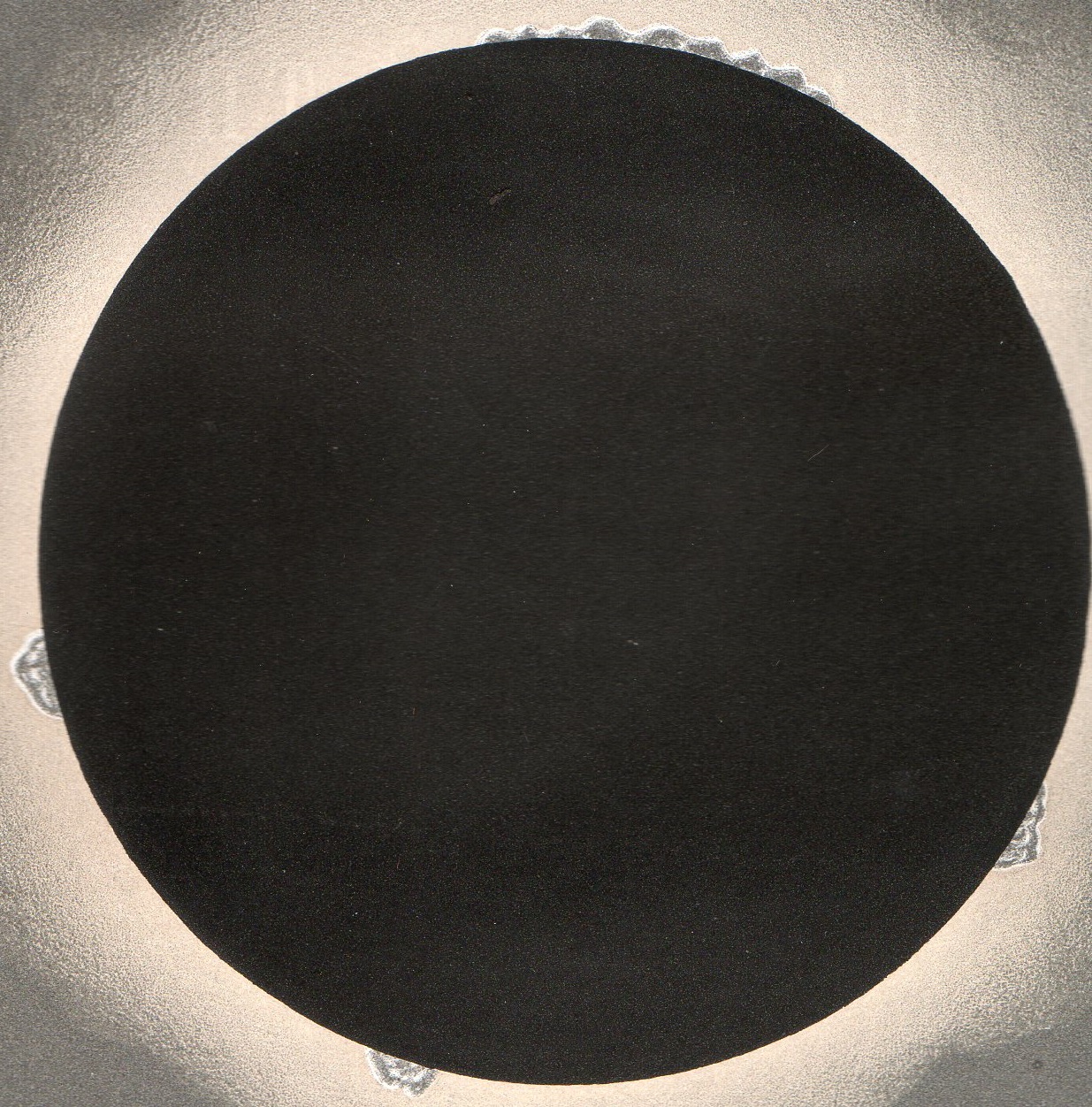
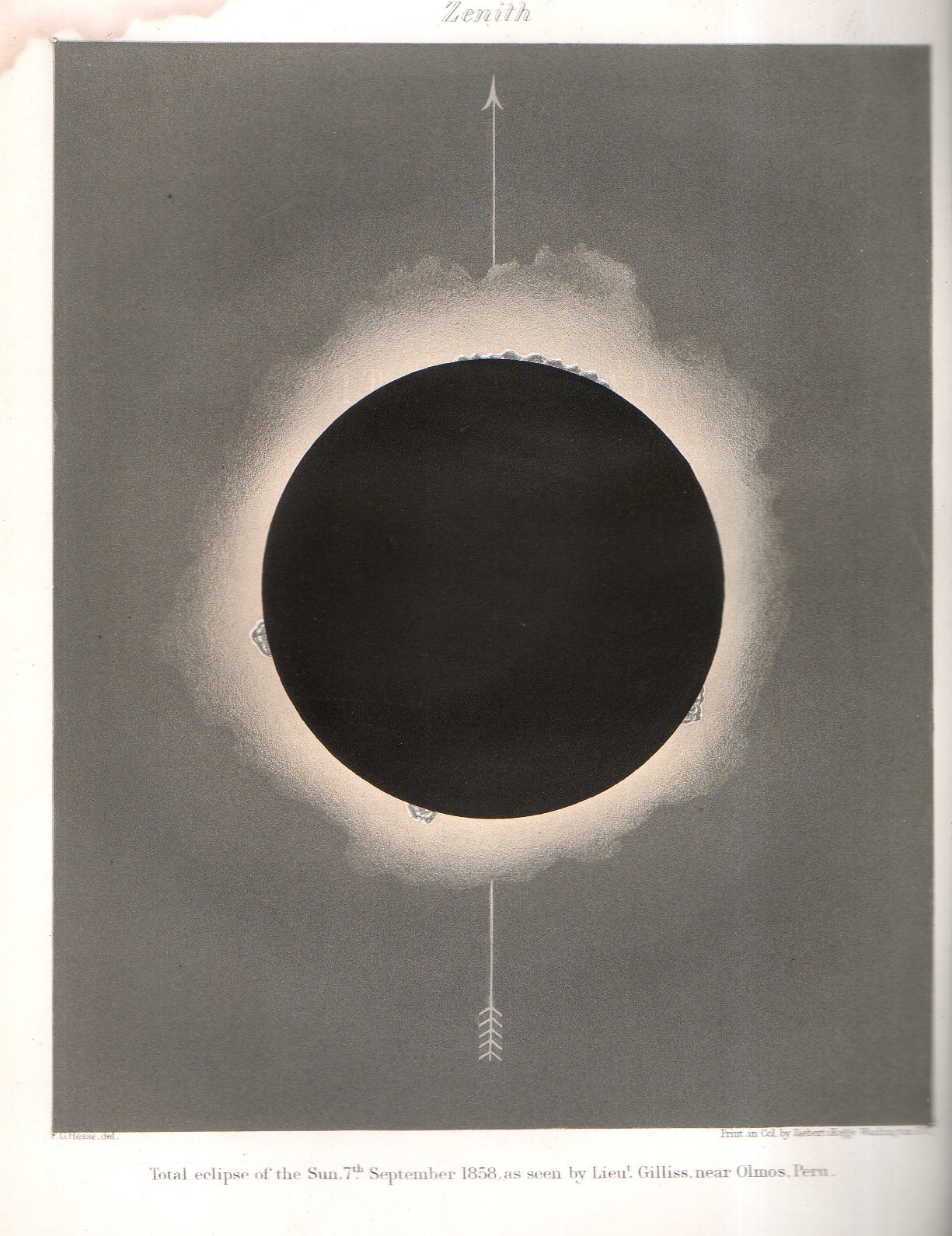
    F.G. Hesse captured this dramatic image of total eclipse at Olmos, Peru for Lt. James Melville Gilliss’ report of the event that he chased down for the U.S. Naval Observatory and the Smithsonian in 1858. Gilliss (1811-few months too short of the end of the Civil War in 1865) was a Georgetown boy who is buried in the beautiful Oak Hill Cemetery, and best known probably for being in charge of the Naval Observatory (previously the “National Observatory”), which was teh first national observatory established in the U.S.  He took over that position from Matthew Fontaine Maury1 (as in “Maury Day” celebrations in Virginia and being the father of American Oceanography and a prominent figure in the Confederacy) and was a position he held until his untimely death at age 53. The report in which the eclipse image appears is An Account of the Eclipse of the Sun, published in the Smithsonian Contributions to Knowledge series in 1859.

    In the report it sounds as though Gilliss was not prepared for the effects that the eclipse had on his non-experimentalist persona, and how awestruck he was to see it once in totality:

    “The screen of the glass [from the telescope] was hurriedly removed, and in the brief instant of doing so I found, to my surprise, that all the phenomena were distinctly visible to the unassisted eye.”

    “A corona light flashed out at the instant of totality. It extended farthest from the sun, in lines drawn from the centre through the solar clouds, but was nowhere traceable more than 15′ or 16′ beyond the lunar disk. There were no radial streamers, or bundles of rays, but only a uniformly diminishing, and slightly orange-tinted light, whose brightness and extent were apparently influenced by the mist-film, as the color of the clouds also may have been. Beyond the corona light, the color of the sky was of a grayish-black.”

    And then: 

    “It was a far more imposing sight without than with the telescope, and long has been my experience in the investigation of celestial phenomena, and calm and unimpassioned, at such times, as my temperament has become, the sublime majesty of the scene thrilled me with excitement and humble reverence.”

    During and after the eclipse Gilliss reported on the behavior of the town:

    “For some minutes previous, all work in the valley below us had ceased, and even the strains of martial music, which the Governor of Olmos employed to cheer laborers digging for water, two or three miles from town, were no longer audible. Superstition is still dominant here, and we hear the solemn toll of the church bell, whose sounds were intended to drive evil spirits from its vicinity.”

    “Neither at Olmos nor Piura, did any enceinte woman leave her room during the eclipse, whilst some from curiosity, but more through fear, were in the streets, yet not daring to look upon the sun, lest malady befall them. The somber green light gave them the appearance of corpses, and they apprehended that a plague might be visited upon them. Afterwards, the muleteers told us that their animals stopped eating, and huddled together in evident alarm.”

    Notes.

    1. Maury left the Observatory to become  a high-ranking official and overseas representative with the Confederacy at the outbreak of the war. The writeup for Gilliss in Wikipedia includes the coy and Victorian statement about Maury joining the Confederacy to fight for separation from the United States, with Gilliss promoted to the Maury position “when Maury responded to serve his state, kin and friends…” with no mention of the Civil War. 

    Eclipse912

    ·Posted by :

    ·in:


  • An Interesting Comment on Life in the Universe, 1933


    JF Ptak Science Books   Quick Post

    In the year that the human race started its very real plunge into the Wasteland, Frederick L. Leonard (Chair of the astronomy department at UCLA) had his eyes on another prize. In a short article in Popular Astronomy1, Prof. Leonard spent a few pages discussing the possibility of extraterrestrial life. He kept the discussion in one and two syllable words and was very straightforward, winding up talking about the possibilities of “life” in our own solar system. He quickly dismisses all of the planets as contenders save for Venus and mars, and then wasn’t really happy with that, at all, and opened the discussion more as to “life” might be. 

    There were several surprises in the article, including one about the authors of Astronomy ( Henry Norris Russell; Raymond Smith Dugan; John Quincy Stewart,  Astronomy: A Revision of Young’s Manual of Astronomy …) being “surprised” that there was no oxygen found on Venus. The bigger moment though was saved for Percival Lowell, who had long labored in support of advanced lifeforms on Mars, though the quote from him regarding extraterrestrial life was really very good. Leonard quotes him so:

    “If astronomy has taught us anything it is that man is but a detail in the universe, and the resemblants though diverse detail are inevitably to be expected…[humans] are destined to discover any number of cousins scattered through space.”

    The odds favor a statement like this, that human life is a “detail” of the universe and that there are not doubt other ‘details” to be found, resembling earth life or not. Odd as weren’t so much with Lowell in keeping with his intelligent lifeforms being on Mars, which is just a step or two away. In any event, I found the Lowell statement to be a pretty sober appraisal of the possibility of Life Elsewhere, in general.

    Notes:

    1. Frederick Leonard. “Life on Other Worlds”, in Popular Astronomy, May 1933, vol 41 no. 5., pp 260-3 in the issue of pp 239-294.

    ·Posted by :

    ·in:


  • A Smart Piece of Thinking that also Touches on Extraterrestrial Origins of Life on Earth (1875)

    JF Ptak Science Books   Post 2683

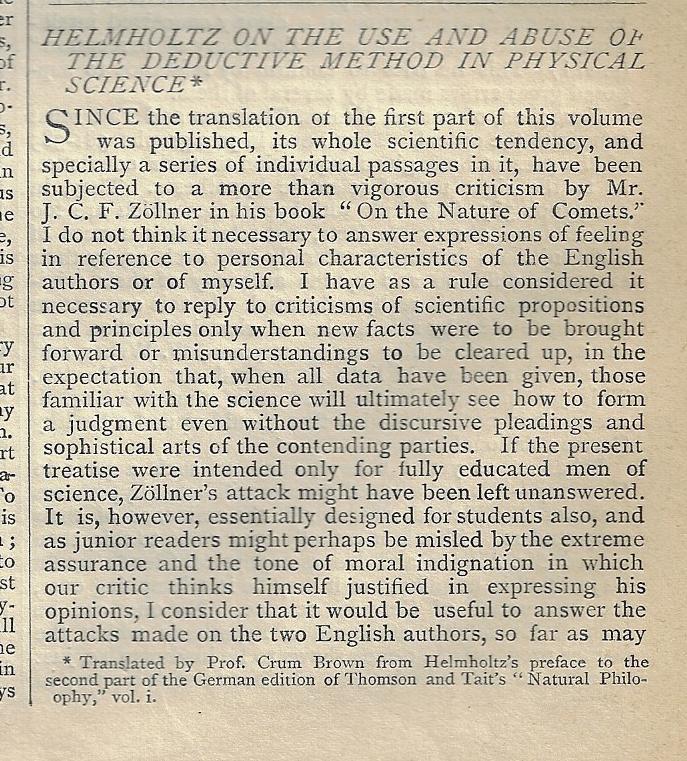
     A note on a short work by Hermann von Helmholtz. “On the Use and Abuse of the Deductive Method in Physical Science”, in a two-part article over two months in Nature:

    • December 24, 1874, pp 149-151 in the issue of pp 141-160 and
    • January 14, 1875,  pp 211-212 in the January 14, 1875 of 201-220pp.  


    Helmholtz pansperma one _1_

    These two pieces by von Helmholtz are just very nice pieces of thinking, delivering several wonderful insights into the nature of reasoning which spread out into other areas, one of which, interestingly, is on the origins of life. For example, in the first paper, in addition to defending his version of deductive reasoning he drops this bon mot into the equation in mentioning the infection of metaphysics in science:

    “Among the scientific investigators who have especially directed their efforts towards the purification of physical science from all metaphysical infection and from all arbitrary hypotheses, and, on the contrary, have striven to make it more and more a simple and faithful expression of the laws of the facts, Sir W. Thomson occupies one of the first places…”–pg 150

    In continuing in the second paper, von Helmholtz goes on to make a statement on the probable great longevity of life in the universe in general, and of the possibility that life could be as old as the universe (“whether it  [life] is as old as matter”), and that some germs could have been brought to Earth (for example) on meteorites, meaning that the origins of life could be extraterrestrial.  Helmholtz points out that William Thompson had addressed this issue in 1871, though Helmholtz himself ad spoken on the issue months before that. In any event, here is von Helmholtz again talking about the origin of life and cosmic pansperma, in 1875.

    “I will mention one other objection of similar scientific value, because it refers to Sir W. Thomson, though not to a passage of this book. The point in question is whether
    it is possible for organic germs to be present in meteoric stones, and so to be conveyed to worlds which have become cool. In his introductory address to the British Association at Edinburgh, in the autumn of 1871, Sir W. Thomson characterised this view as “not unscientific.” Here, too, if an error has been committed, I must profess myself a sharer in it. I had, in fact, indicated the same view as a possible explanation of the transmission of organisms through interstellar spaces at a somewhat earlier date than Sir W. Thomson—in a lecture which was delivered at Heidelberg and at Cologne in the spring of the same year, but is still unpublished. If anyone chooses to regard this hypothesis as highly or even as extremely improbable, I have nothing to object. But if failure attends all our efforts to obtain a generation of organisms from lifeless matter, it seems to me a thoroughly correct scientific procedure to inquire whether there has ever been an origination of life, or whether it is not as old as matter, and whether its germs, borne from one world to another, have not been developed wherever they have found a favourable soil. The physical reasons alleged by Mr. Zollner against the view in question are of very little weight. He points to the heating of the meteoric stones, and adds (p. 26) : ” Thus, even if we suppose that when the parent body was shattered, the meteoric stone covered with organisms escaped with a whole skin, and did not share the general rise of temperature, it was still necessary for it to pass through the terrestrial atmosphere before it could discharge its organisms to people the earth.”–pg 212

    There is a tremendous amount going on in just these few pages of created by one of the most able and expansive scientific minds of the 19th century.  

    ·Posted by :

    ·in:

    —

  • Missing the Colors that Are Not There (1835)

    JF Ptak Science Books   Post 2704

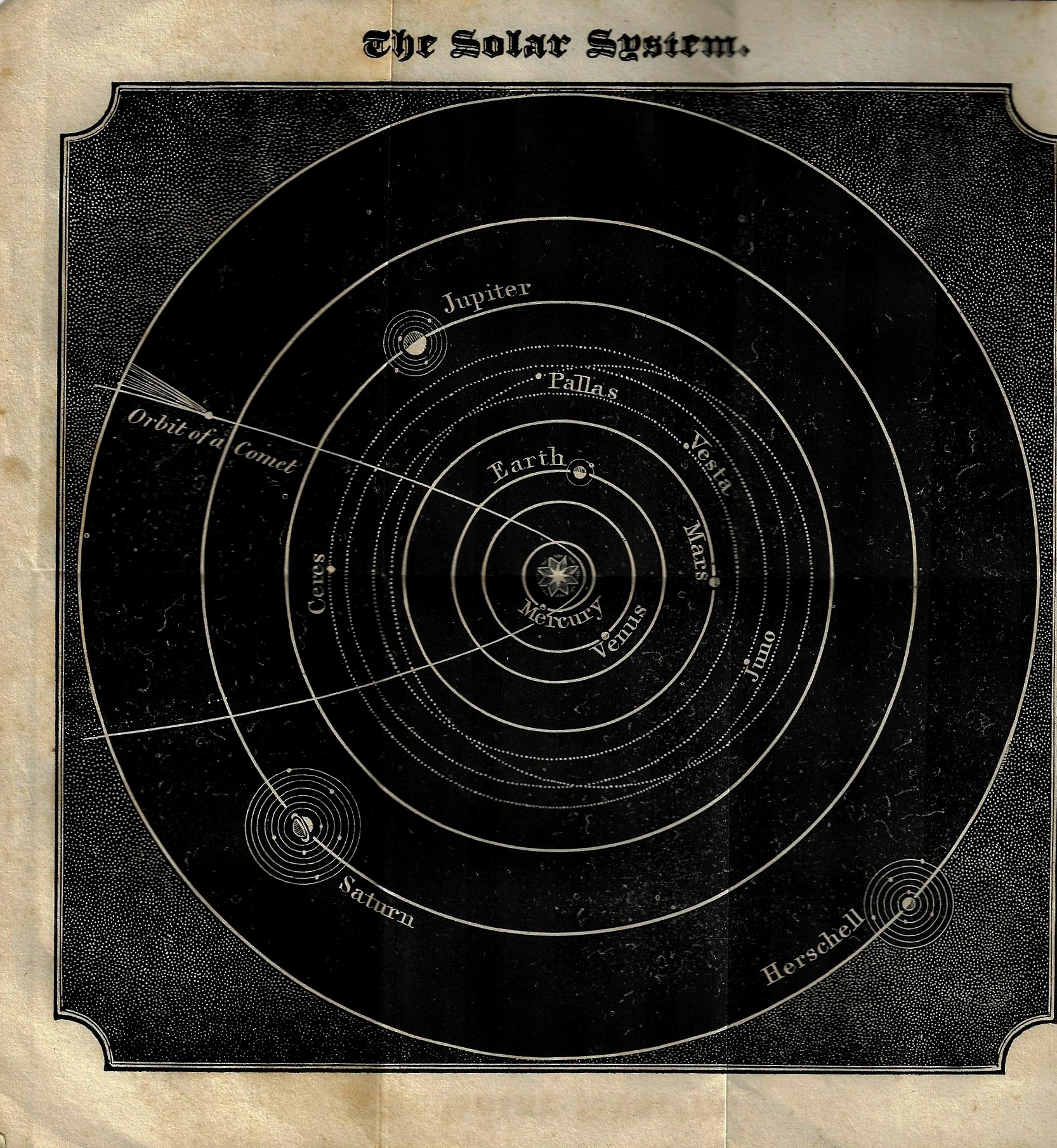
    I don’t know what there is in this engraving that speaks “color” to me when it should probably be just concerning itself with the blackness of its deep black (which for me is usually the case). Neither the blackness nor the dimensionality of the thing–it seems to give itself some height and depth at the same time–say anything louder than the representation of its missing colors, which we are clearly seeing nothing of in these wavelengths except that there really aren’t any colors here outside of the beautiful black & white.  The contrast is certainly there (“There are dark shadows on the earth, but its lights are stronger in the contrast.” Charles Dickens, The Pickwick Papers), especially in the corner bits, where on closer inspection the blackness is really more white than black. In any event, the print suggests “color” to me for no good reason, except perhaps that it looks very cold, and cold is suggestive of ice blue, and the good contrast for that is yellow. “The sound of colors is so definite that it would be hard to find anyone who would express bright yellow with base notes, or dark lake with the treble.” so wrote Mr. Kandinsky, who saw colors in his sound, and who in the midst of things wrote four experimental pieces of theater based upon this observation, the first and perhaps most prominent of which was called “Yellow” (1909).  And that is why this old engraving seems “yellow” to me (and this without any benefit of synesthesia).

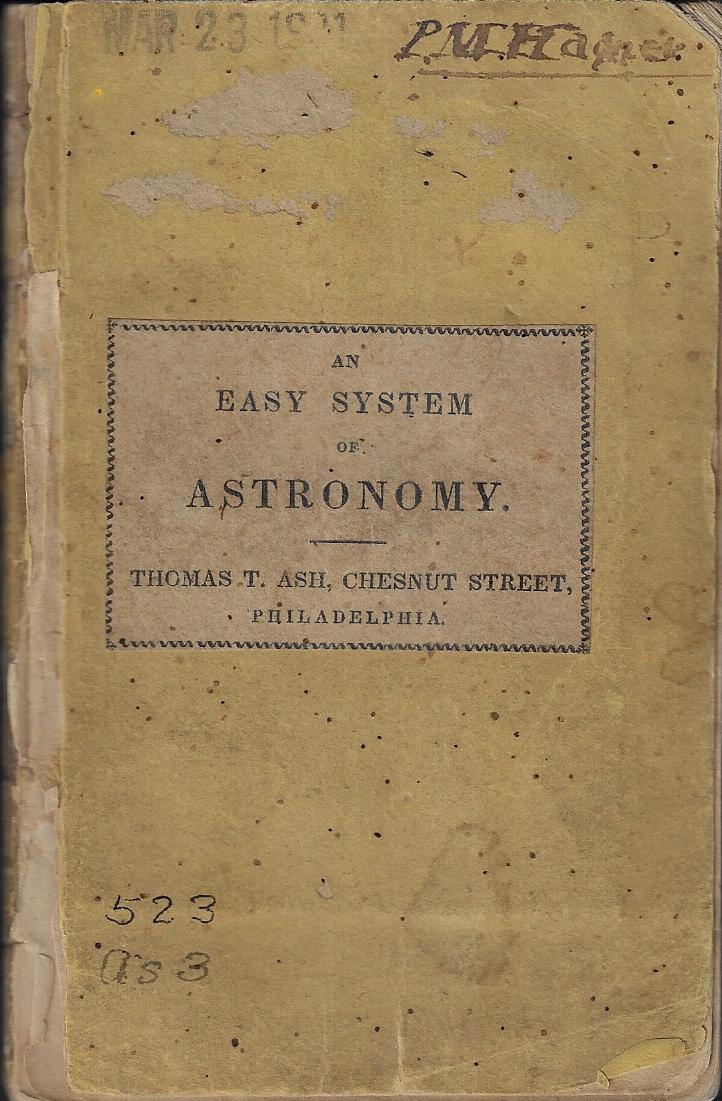
    The image in question, from An Easy System of Astronomy, containing an explanation of the Moveable Planisphere, together with a selection of problems, maps &c, intended to either accompany the planisphere or may be used separately in schools. This little guy (14cm) was published in Philadelphia in 1835 and unfortunately does not make mention of any detail of the “planisphere” other than that there was one that could be used. (This is evidently relatively rare, with only two copies located in WorldCat/OCLC–Columbia and the National Observatory.) 

    Astronomy easy system

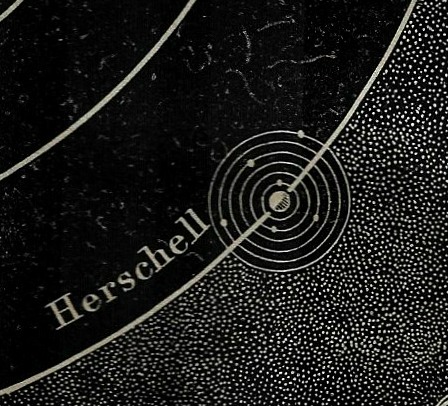
    If there was an equal weight assigned to white and black, the white in the corner sections may well outweigh the black, which also happens to show the planet “Herschell”. This was the first planet discovered since antiquity, and was done so by the Hannoverian Brit Friedrich Herschel, who found it in 1781 and who lived with its immediate fame for another 41 years until his death in 1822. Herschel, an enormous astronomical talent who also played and composed, proposed the planet be named  in fidelity “Georgium Sidus” after George III, though that name didn’t stay on the planet longer than a quick shadow. The French astronomer Lalande (who could probably not for genetic /national reasons use the name for George) suggested the planet be named for the discoverer, “Herschell1“, which really wasn’t that terribly popular though it did last for five or six decades, succumbing finally to Bode’s suggestion of “Uranus”. 

    Astronomy easy system detail

    This is a folding illustration for the following, which here appears much larger than the thing is in its real life, standing as it does only about 5″ (130mm) tall:

    Astronomy easy system cover


    Notes

    1.  From the entry “Uranus” from the Oxford English Dictionary:

    1783   New Rev. Apr. 325   Notwithstanding Mr. Herschel’s having named his planet the Georgium Sidus, Mr. Lalande persists in calling it the Herschel, Mr. Bode proposes Uranus, Mr. Sivry Cybele, and Mr. Prosperin, Neptune.

    1802   O. G. Gregory Treat. Astron. 128   By some astronomers it is called Herschel, in honour of the discoverer; though among almost all foreigners, it has acquired the name of uranius, which it is likely to retain.

    1830   Encycl. Metrop. III. 498/1   Both these appellations are, however, now nearly become extinct, that of Uranus being almost universally adopted

    1860   D. Olmsted Mech. Heavens 267   Uranus was the remotest known planet..until the discovery of..Neptune.

    1902   N. Amer. Rev. Aug. 225   Jupiter, Saturn, Uranus and Neptune are in too primal a state of fluidity and gaseousness to support life.


  • An Infinity of Suns and Planets (1798)

    JF Ptak Science Books   Post 2695

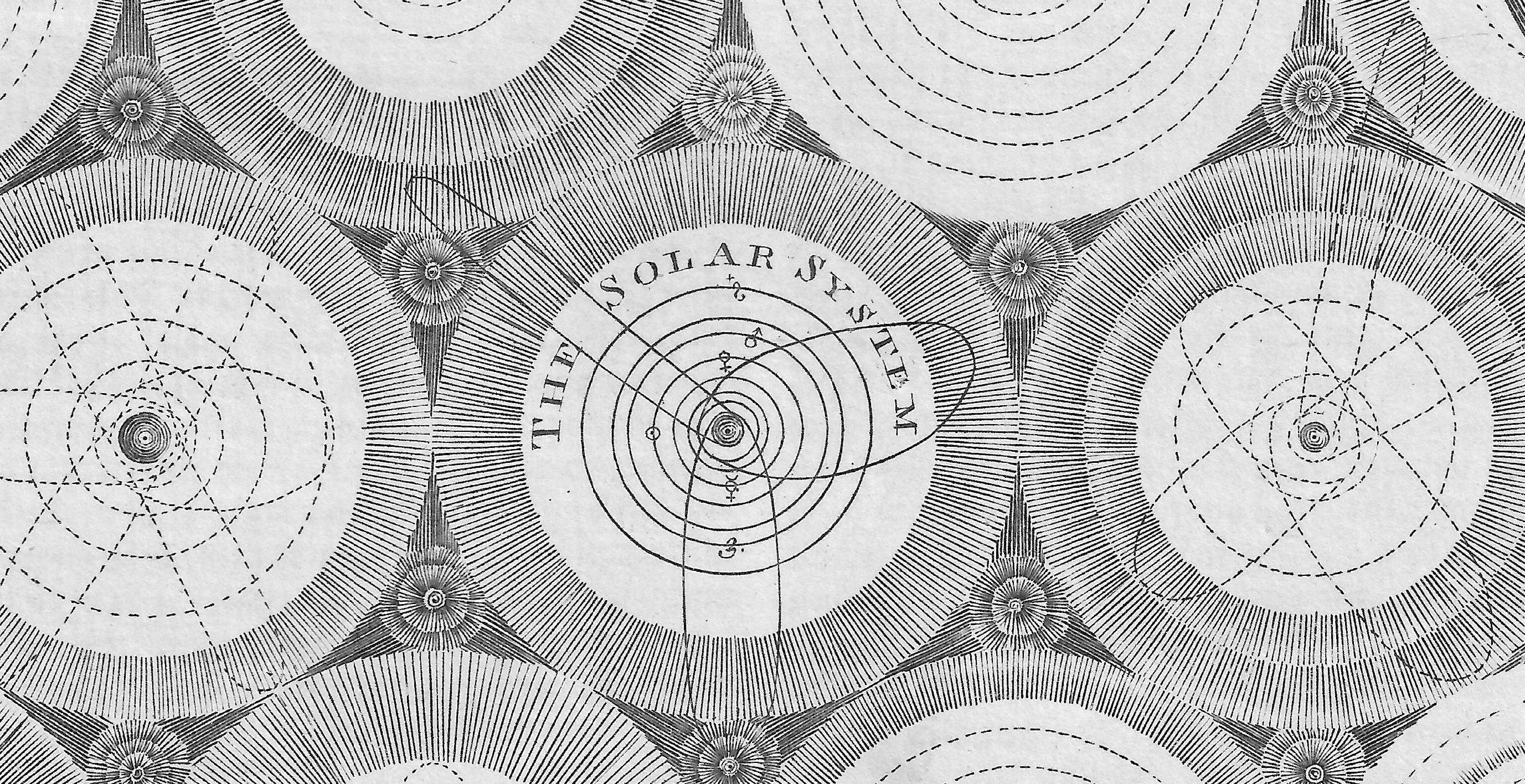
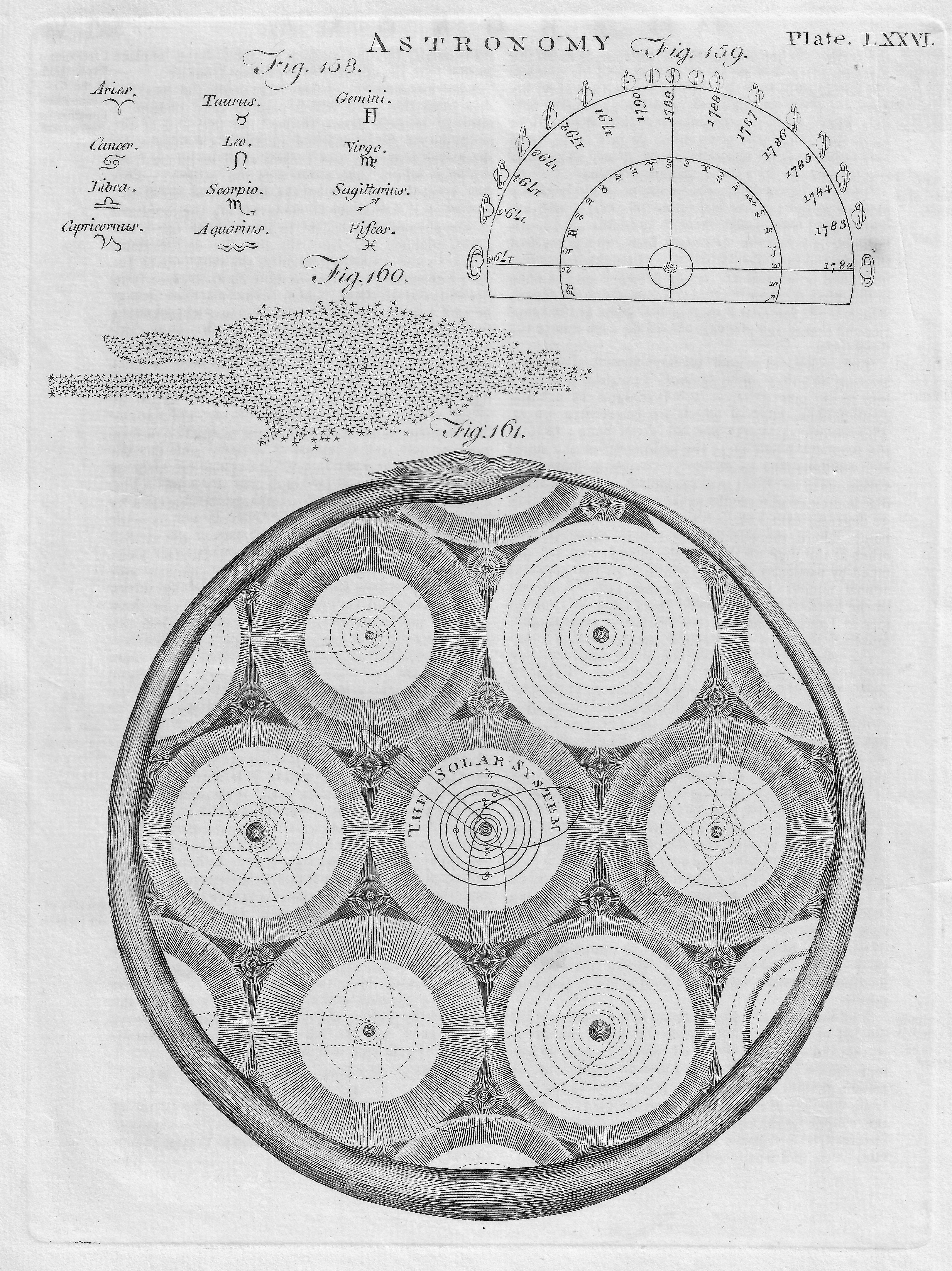
    This is a relatively early engraving showing infinite numbers of solar systems ranged within an infinite universe. It is found as plate LXXVI from the first American edition of the Encyclopaedia published at Philadephia in 1798.The concept of multi-solar systems was not a terribly common theory, and to see them here, arranged as part of a structured and logical system was very striking–particularly since there is an inference that our own solar system is positively not unique, and located in a cluster of others, all of which are contained within an Ouroboros, an ancient Egyptian symbol signifying an endless universe of expanding possibility.

    Astronomy ourobus detail

     [Detail of engraving below]  

    The idea of expansive collections of suns and planets varied quite widely from the images of other astronomical observers and theorists such as Thomas Wright (1711-1786), who in his book An Original Theory of the Universe (1750) gives the Milky Way a friendlier, homogenous manner, overruling his earlier theory that the stars were “promiscuously distributed through mundane space” and delivering a theory of the stars organized in a regular pattern based upon a hierarchical center of some sort around which everything else was positioned.  He also provided a fabulous image of the centers of galaxies as an immutable, transcendent force, with the eye of the creator at the center of each, rather than the simple, positive dot.

    This idea was picked up by Immanuel  Kant (1724-1804) who in his own work, The Theory of the Heavens (1755), expanded on the multiple centers of creation(s) (an “endless immensity in an unlimited plenum of creations”) of cascading and separate galaxies, and detailed a vast system of disk-shaped galaxies which revolved around centers which in turn revolved around other centers, becoming far vaster, though all were centered on a dominant, universal center.

    Above that image is one showing the phases of Saturn from 1782 through 1796, while to the left of that is a small display of the signs of the Zodiac.

    Towards the middle of the page is a very famous image made by William Herschel (1738-1822), who tackled the issue of what Everything looked like back in the 1780s.  

    Lucretius (95-55 BCE), in his Nature of the Universe, stated that  since there is nothing outside the universe, it must be infinite: “the universe stretches away…just the same in all directions without limit”;  it stretches far and wide into immeasurable depths.  All that is in it, he reasons, is distributed equally and in the same way.  But this is not the case, even in light of Edward Milne’s cosmological principle (1933),  stating that all  places in the universe is alike—which is true, except that there are vast disturbances in very large local areas that distinguish themselves from other places.  The work of Gamow/Alpher/Herman  (1939) and Penzias/Wilson in establishing the cosmic microwave radiation  (CMB)  shows that the observable universe to be very close to homogeneous and isotropic, and of course accelerating. (Suffice to say for this short post that there are models– Friedmann-Lemaître-Robertson-Walker (FLRW) model for example– which show the observable universe to be  “weakly” inhomogeneous and anisotropic; but generally and on average the isotropic models stand.) 

    Perhaps the earliest published “bump” in the calm waters of the equal-distribution universe occurs with this image by Herschel who in 1785 published a revolutionary image of the “Stellar System” (the Milky Way), showing its irregular pattern and the off-center placement of our sun amidst a panoply of other stars.(His image was remarkably and substantially correct, with the most grievous error being the placement of the sun too close to the center of the galaxy.) It was an image which bought the idea of a not-so-humano-centric idea into popular philosophy. This galacto-centric view remained until the work of Harlow Shapley’s globular clusters in 1918.


    Astronomy ourobus

    In all, it is just a beautiful image that tells a long story-without-words of the Shape of Stuff.  

    ·Posted by :

    ·in:

    —

  • The Spectrum of Chess, Dante, and 4 Trillion Kg of Wheat

    JF Ptak Science Books  Post 2571

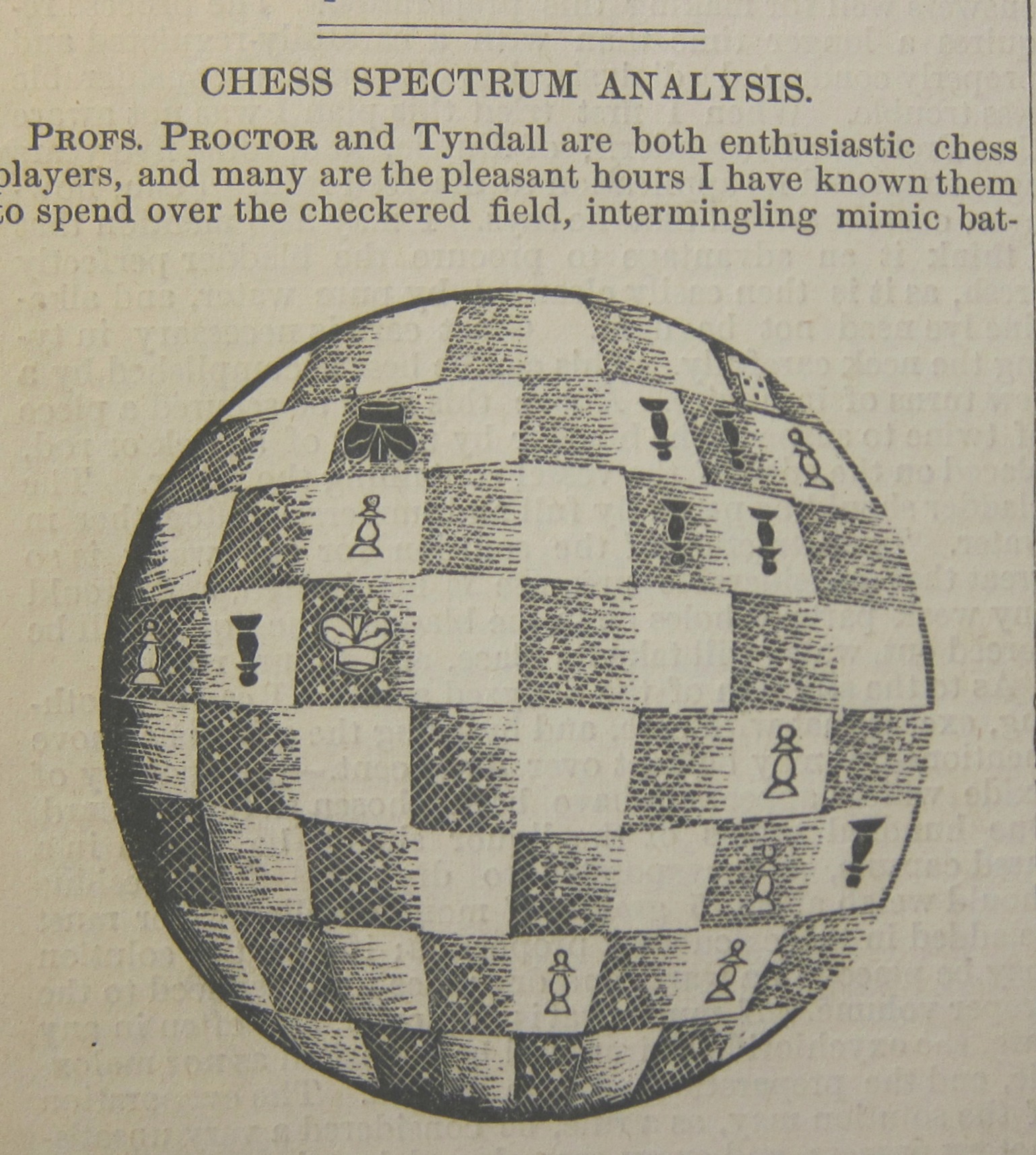
    As is often the case in looking through the early-ish issue of Scientific American, I usually find much more than what I was originally looking for, finding a lot that I had no idea that I needed to find, mostly because I had never heard of them before. And so grazing though the 1877 volume of the Scientific American Supplement I found in the weekly chess review in the back of each issue an extraordinary image and title:

      Sci Am Supp 1877 Ches spectroscopy

    I was tempted to add “Pre-Escherian” in the title to this post, but that would put the thing way over the top–but that is what came to mind first, a polished gazing ball with an interesting perspective. This was meant to illustrate an imaginary dialog between two astronomer-chess players (Richard A. Proctor and John Tyndall, though Tyndall’s interests were spread far and wide and deep and then not so much in astronomy), both of whom had made contributions to astronomical spectroscopy.  Further into the short article there was a little discussion of Dante and sunspots, which I was not aware of, though when I went looking for that reference I did find the following chess quote in Paradiso (Canto XXVIII) with our Poet in the ninth heaven:

    “So sparkled then those circles all and each And every spark did more and more abound, In fiery light and so their number grew, Beyond the chess board’s doubling problem’s bound”

    And another translation

    “And after she had finished with her speaking,  The circles all around began to sparkle,  Like red-hot iron shooting off bright sparks.  Each sparkle stayed within its fiery ring, So many that their number runs to more, Millions than the redoubling of the chessboard.”

    Moving on from the sunspots mentioned in the SA article, it has been pointed out by many that in the quote above that Dante may be referring to an earlier chess story, told at least by the 12th century, where the inventor of the game of chess agreed to give it over to the king if the king paid him in grains of wheat based upon the chess board, starting with one grain in the first square and then doubling the amount until the last square is reached. The big surprise for the king who agreed to this payment was a very fine lesson in the  quick-as-a-bunny expansion of exponential sequences: you’d move from 1 to 2 to 4 to 8 to 16 to 32 to 64  to 138 to 276 just in the first rank, 57 more squares of doubling to go, until you summed them all up on square 64 and find yourself with the number  18,446,744,073,709,551,615, which is a big number. Bigger still if you consider that this is in terms of wheat, and I figured the weight of that wheat to be about 4 trillion kg, 4 trillion being about the equivalent of stars in 40 Milky Way galaxies. 

    Even though the article was very heavy in the discussion of some real games, and light in the inclusion of our astronomers and their conversation, everything winds up and out in a whimsical fashion, with a discussion of Gutenberg and spell-check.  The author tells us:

    “It would take but little argument to show that a mere oversight of Guttenburg’s [sic] proof-reader made the world believe the moon was composed of cheese instead of chess”.

    And so it goes.  19th century astronomy/chess humor, as whacky as it gets.  


    \sum_{i=0}^{63} 2^i.\,


    ·Posted by :

    ·in:


  • Warm Sulphur, Coal, and the Cosmos, 1836

    JF Ptak Science Books   Quick Post    An installment in the History of Dots series. 

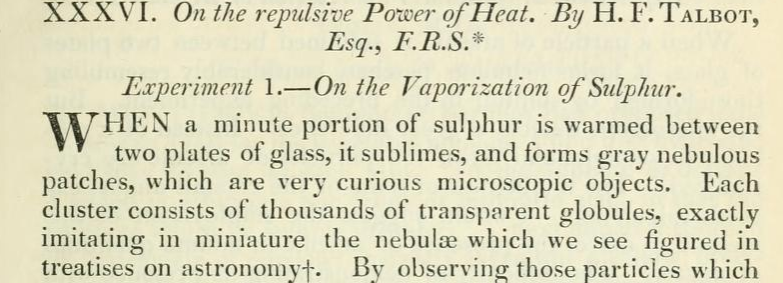
    William Henry Fox Talbot (1800-1877) was among the earliest of the photographic pioneers, or pre-pioneers, as he asserted priority of his photographic method for 1835 when Daguerre revealed his own (very different) method in 1839. Talbot (or Fox Talbot)  was also a practitioner of the art, publishing a stone-cold and revolutionary work of photographically illustrated books, The Pencil of Nature. The work I am interested in for the moment though is this interesting observation he made in the Philosophical Magazine (third series, vol 8) for 1836, when he unexpectedly turns somewhat poetic in the start of his paper:

    Talbot nebulae


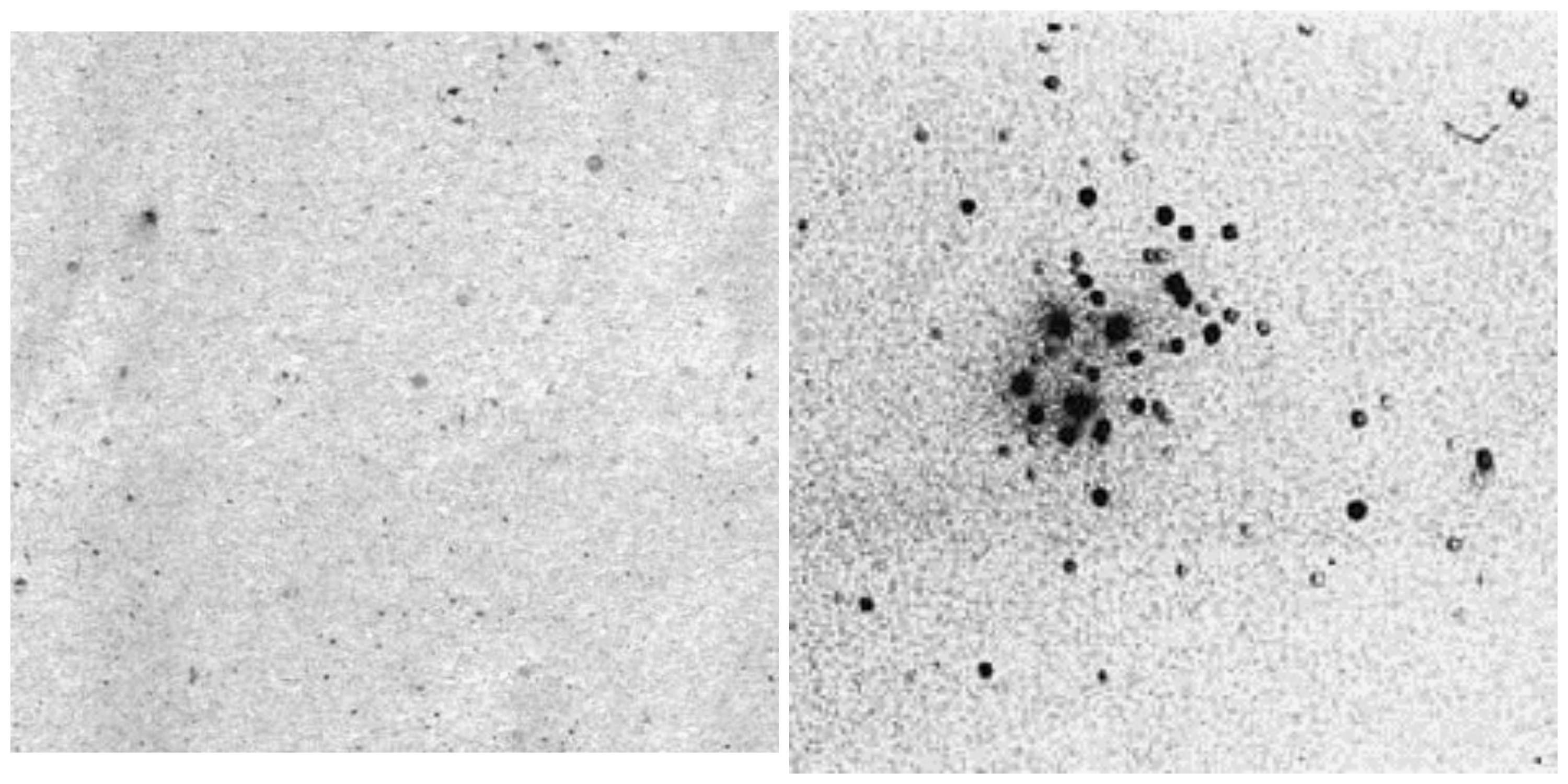
    I don’t know about the history of likening some collections of objects to a starry night of deep space–certainly it has been going on for a long time, with people finding similarities (and perhaps corollaries!) between collections of stuff (dust, moles, sand, so on) and the night sky. (There are several such observations on this blog, the most recent one, on deterioration of paper in a book and the negative of a deep space image, appears here:  https://historyofideasblog.com/thesciencebookstore/2016/08/page-in-a-book-or-stellar-field.html )  Funny thing here is that there is some small connection between my paper-damage-night-sky and the Talbot’s sulphur–some part of this ‘foxing”, those reddish discolored “dots” on the page of the book, is a product of the interaction of the paper and sulphur oxides, like sulphur dioxide, produced in the burning of coal. So: coal and the cosmos. 

    Here’s the image from that earlier not-Talbot  piece on the blog–one is a close-up of paper deterioration in a book from 1820, and the other is an ultraviolet photograph of the Pleiades made in 2009:

    Book universe montage

     Unfortunately Mr. Talbot only provided a thinking-image of his experiment…

    ·Posted by :

    ·in:

    —