A Daily History of Holes, Dots, Lines, Science, History, Math, Physics, Art, the Unintentional Absurd, Architecture, Maps, Data Visualization, Blank and Missing Things, and so on. |1.6 million words, 7500 images, 4.9 million hits| Press & appearances in The Times, Le Figaro, Mensa, The Economist, The Guardian, Discovery News, Slate, Le Monde, Sci American Blogs, Le Pont, and many other places… 5000+ total posts since 2008.

Category: Astronomy

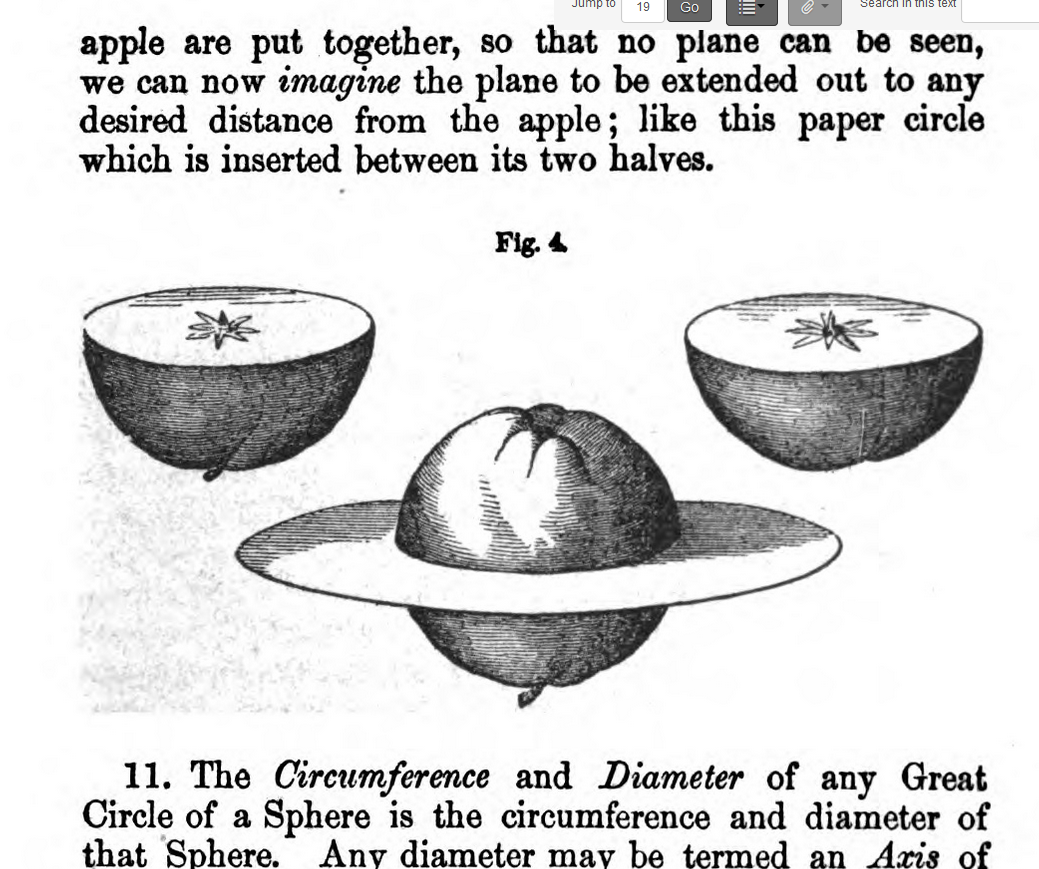
  • Non-Newtonian-Fable Apples in Astronomy (1854)

    JF Ptak Science Books  Quick Post

    After all of this time handling/reading/browsing books in the history of science, I believe that I’ve never seen an illustration an astronomy text utilizing an apple to demonstrate the sphere/globe—and here it is:

    Apple astronomy halves

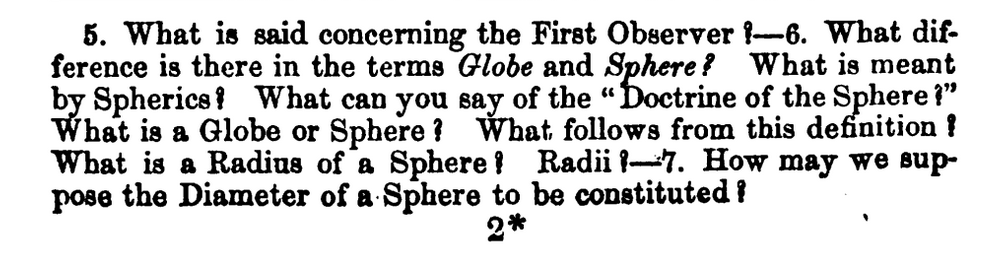
    I thought to include these footnote questions from the page preceding the woodcut because they were so good, and intended for a youthful audience:

    Apple astronomy questionsSource:  Emma Willard, Astronography, or, Astronomical geography, with the use of globes : arranged either for simultaneous reading and study in classes, or for study in the common method, 1854.  http://babel.hathitrust.org/cgi/pt?id=hvd.hnygp9;view=1up;seq=27


  • Note on Life on the Rings of Saturn and the Plurality of Adams & Eves (1859)

    JF Ptak Science Books  Quick Post

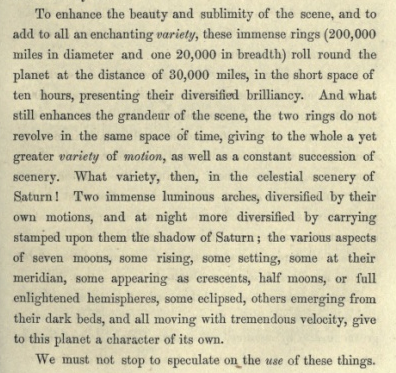
    I’ve been reading through the notes and bibliography of Michael Crowe’s  excellent  The Extraterrestrial Life Debate, 1750-1900  and decided to post a few of the early-modern scientific speculations on extraterrestrial life.  The first is from Hollis Read’s (1802-1887) concentrically-connective theo-explanations/celebrations of life in the universe, The palace of the Great King : or, The power, wisdom and goodness of God, illustrated in the multiplicity and variety of His works  (New York, Scribner, 1859). It is published in the same year as On the Origin of Species…, and takes a decidedly different theological spin on interpreting Nature. It does take a very interesting turn on page 224 though (not the probably-misprinted page 160 as Crowe notes) where Read speculates on intelligent life elsewhere, and winds up on the Rings of Saturn, which would have no doubt delighted Kurt Vonnegut. 

    In some sense Read buries his speculations on life on the rings, occurring in the middle of a paragraph in the middle of the book, and seems not to go any further with it.  He says that there are 28 billion square miles (on both sides) of the rings (“588 times the whole habitable portion of the earth”), which he feels could support a population of 8 billion, which he said is 10,000 times that of the earth.  It seems he just extrapolated the population/density of the Earth to that of Saturn’s rings to get that figure–I should point out that “billion” here actually means “trillion”, which was one custom of the day, so the 10k number Read came up with is more-or-less accurate.

    There really isn’t a reason given from I’ve read in Read for the possibility of life on Saturn’s rings, except that the beauty the rings must be fitted for something other than “waste and desolation”.  I’ve wondered about the theological issues about Life Elsewhere in natural law theo-scientific books like this–like, well, what about Adam and Eve?  Had they been present would they have been so just here on Earth, or would they have been better off on the rings?  Or are there Adams and Eves wherever they are needed? Or–to paraphrase an old story–would it have been Adams&Eves all the way down?  It seems as though that may have been a tricky question to answer…

    • [Source: full text of the Read book is available via the Internet Archive from the University of California, http://catalog.hathitrust.org/Record/006524997]


    Hollis Read Satrun  Life _a_


    ·Posted by :

    ·in:

    —

  • Fine and Uncommon Astronomical Images

    JF Ptak Science Books  Quick Post

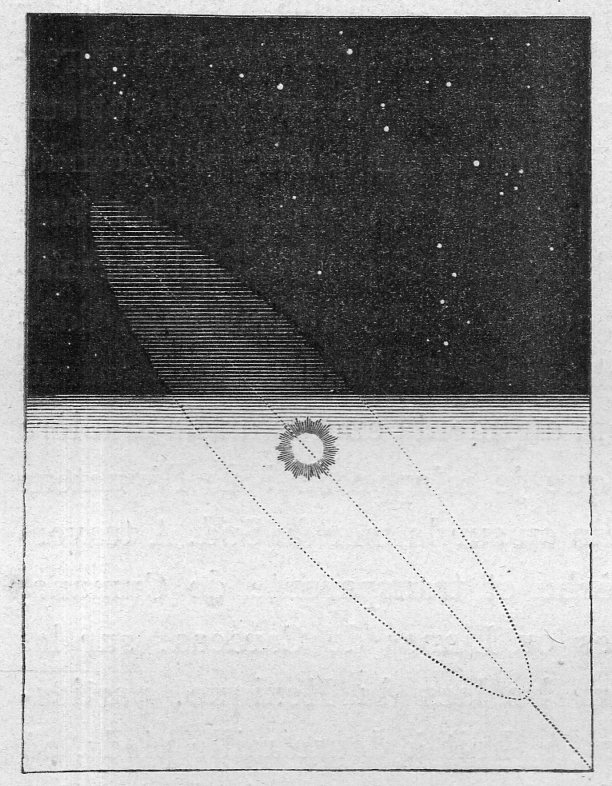
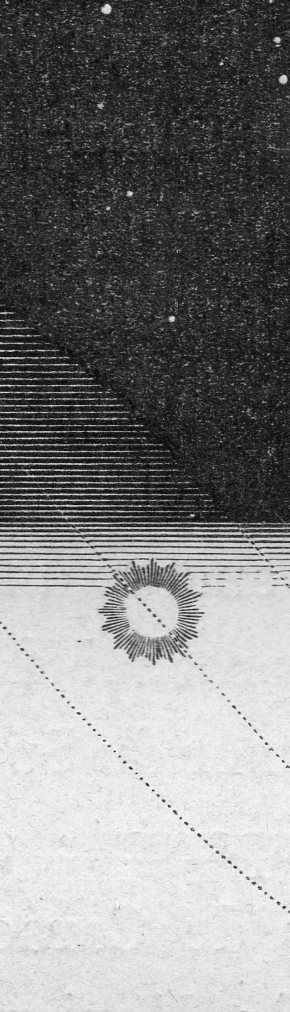
    This beautiful engraving (and its detail) comes from A. Guillemin’s (1826-1893) Le Ciel, Notions Elemenatiares d’Astronomie Physique ... (fifth edition, 1877) in the section “Lumiere Zodiacale”. (Full text available via the Internet Archive, here.) It is one of a series of very popular books that Guillemin wrote and edited in the last part of the 19th century, and in truth it is a small text illustration, barely three inches long–but the artistry for such an image as this is very high.

    Monde SOlaire683

    And the detail:

    Monde SOlaire685

    And this

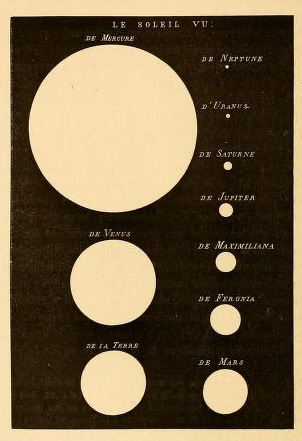
    Ciel sizes

    ·Posted by :

    ·in:


  • Glorious Gearworks, Extended–Models of the Solar System, 1817-1821

    JF Ptak Science Books  Quick Post

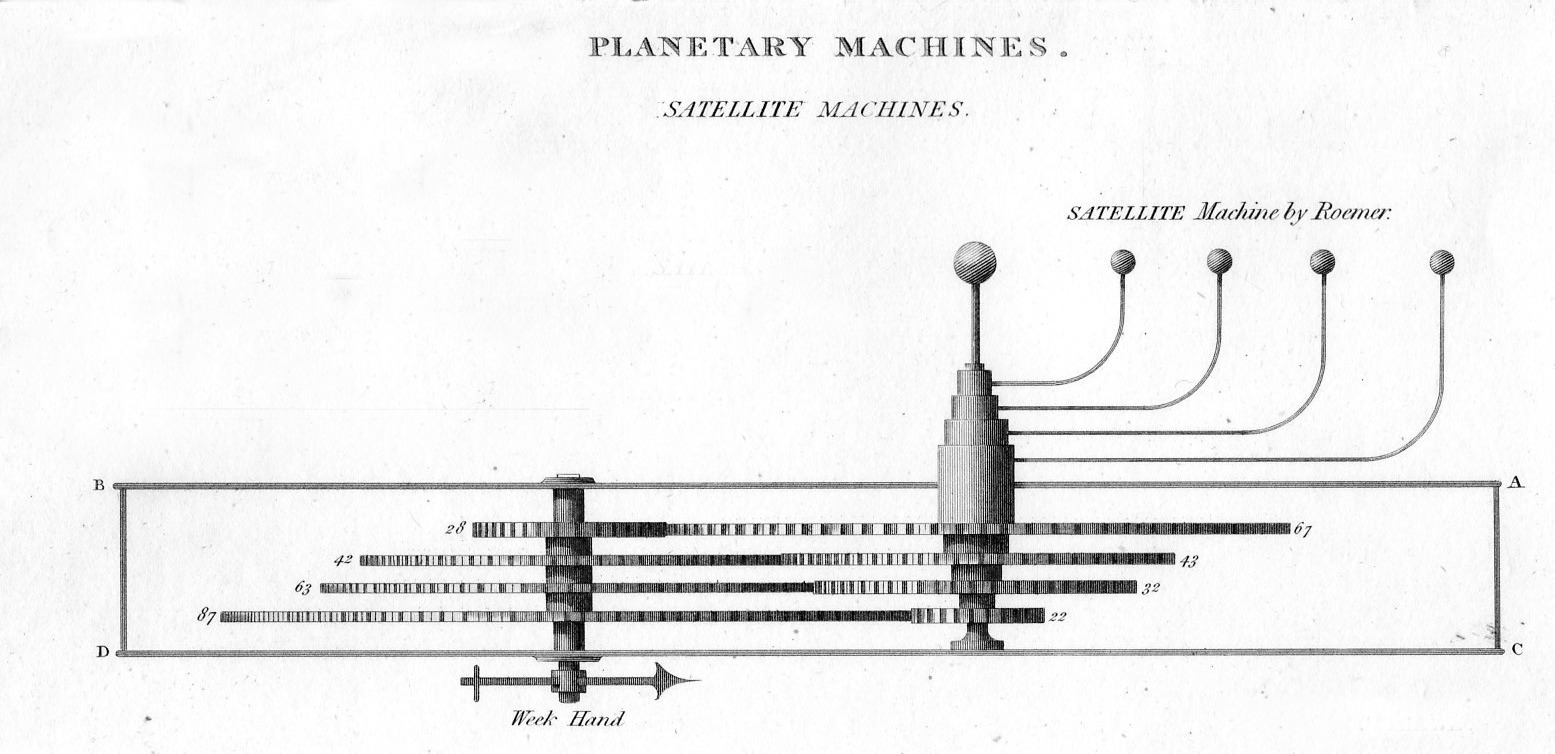
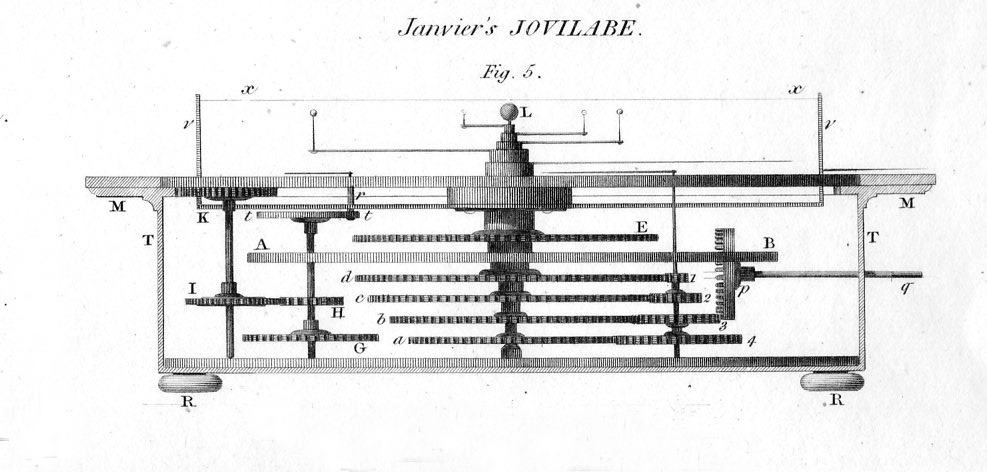
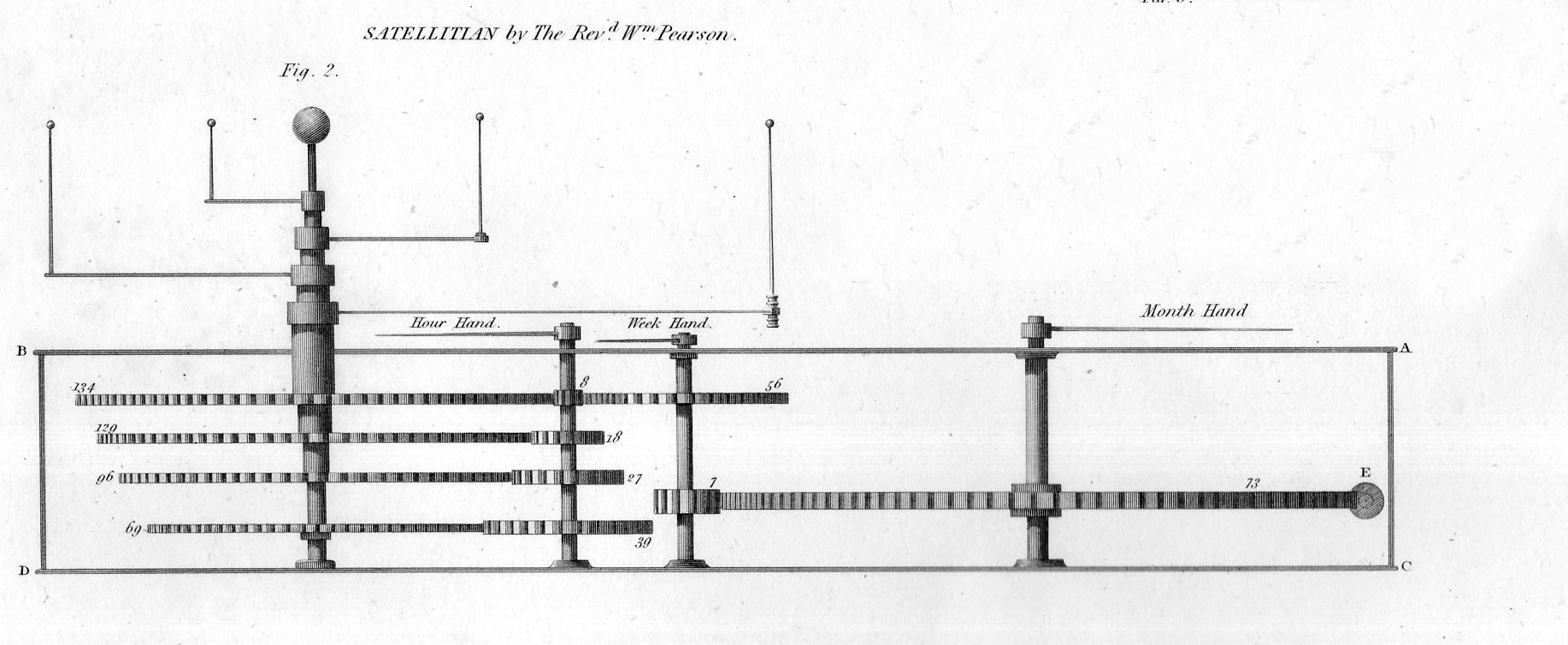
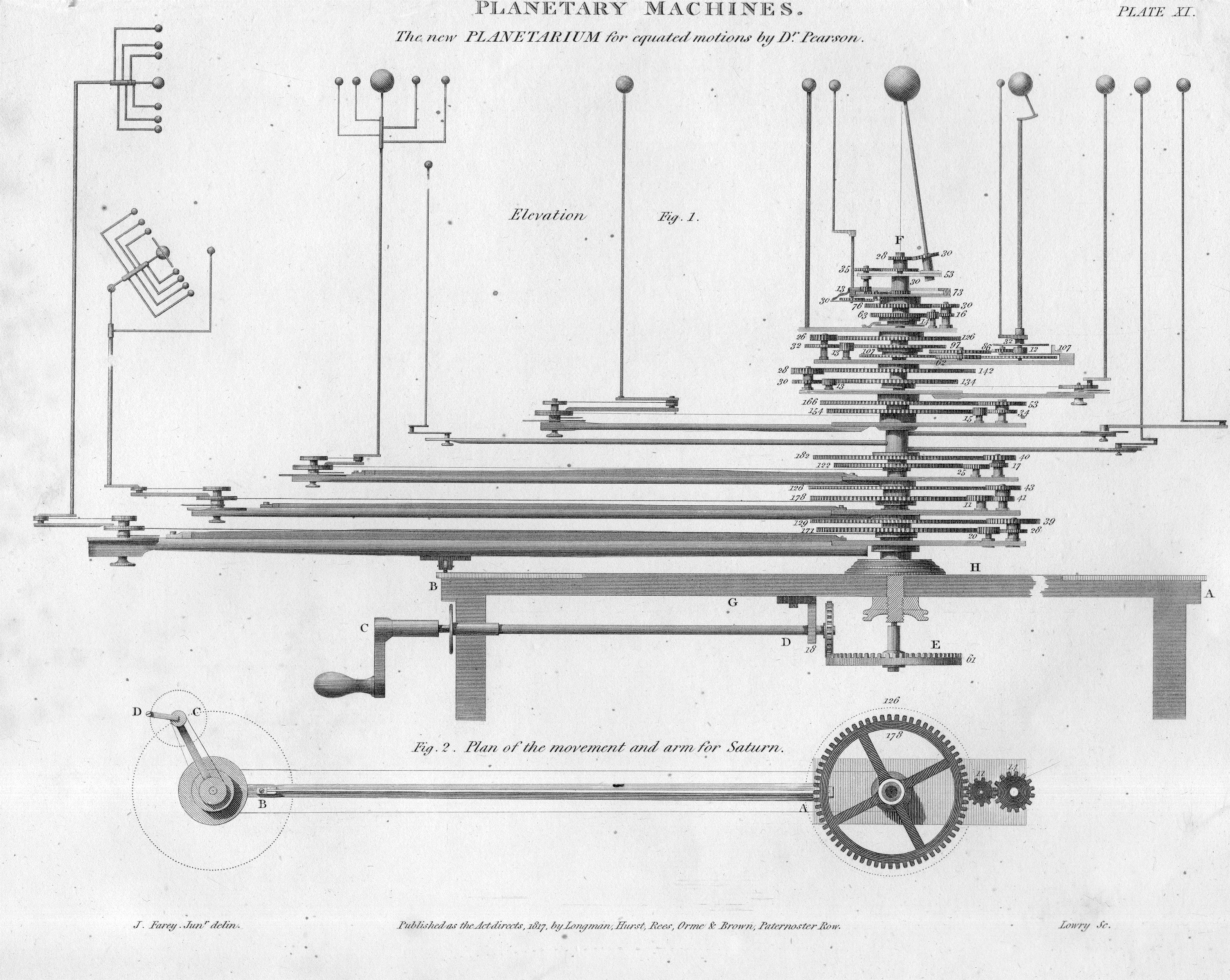
    I’d like to make a quick addition to an earlier post on a form of  Pearson’s planetarium.  This is from the same source, though from a few years later, and involves Pearson’s Satellitian, which was a differently-abled device.  All of the images appeared in the magisterial if not occasionally problematic Cyclopedia of Abraham Rees (1743-1825).

    The first image is a cross section for he “Satellite Machine by Roemer”, followed by “Janvier’s Jovilabe, and the with Willliam Pearson’s “Satellitian”, all appearing on the same 11×8″ sheet and printed in 1820.

    First, the Roemer:

    Planetary MAchine Roemer

    Here’s a description from Rees on the Roemer instrument (this courtesy of Google Books; the images are my own):

    • A good article on the Roemer and the Pearson machines appears in the Edinburgh Magazine, volume 15, 1832,  http://tinyurl.com/ogo36n9 

     And the Janvier:

    Planetary MAchine jANVIERb

    And the Pearson machine:

    Planetary MAchine Pearson

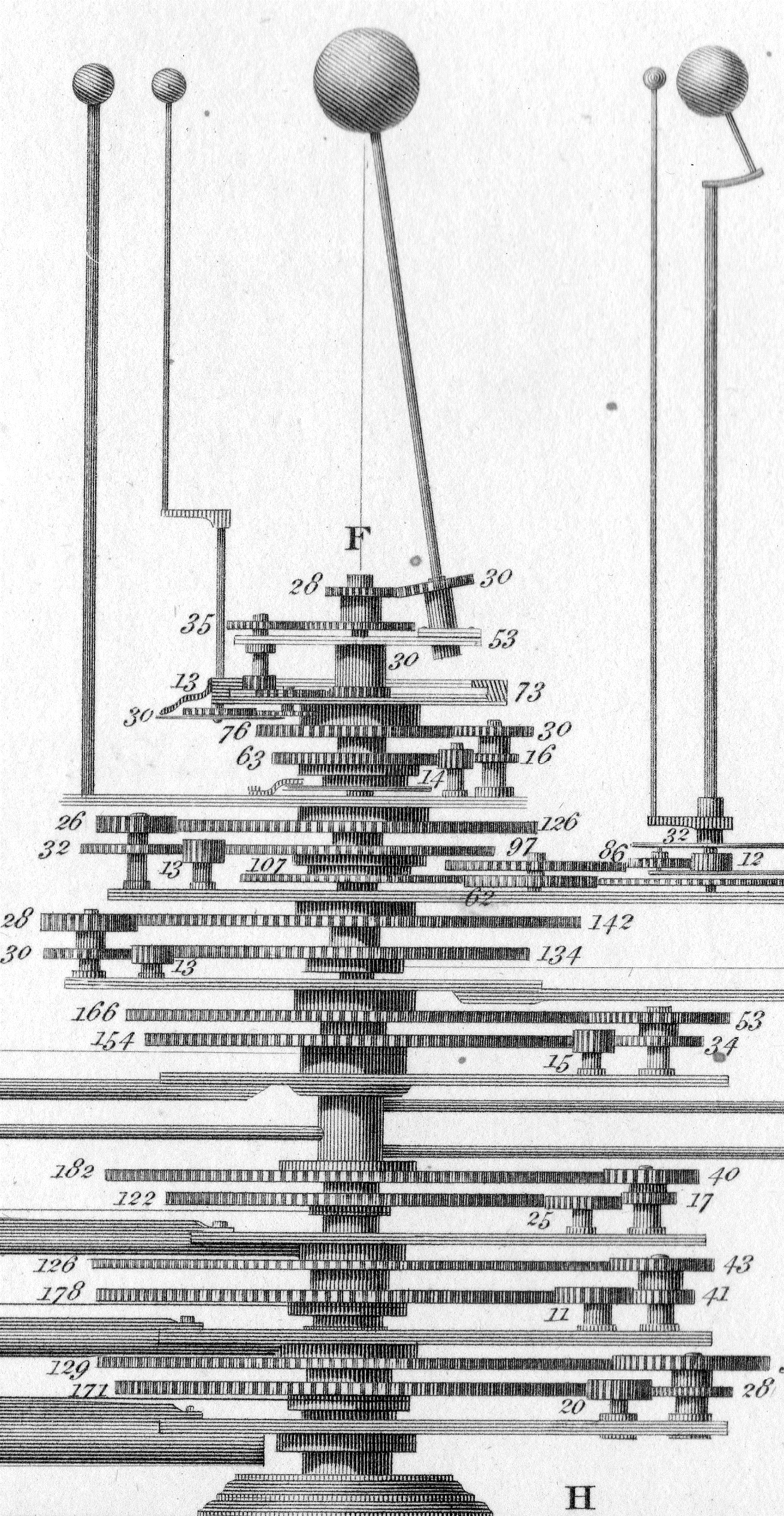
    This is the second Pearson instrument, the heart of  a beautiful orrey created by William Pearson (1767-1847, and one of the founders of the Royal Astronomical Society) as found in the 1817 volume of Rees, and features the main gearing for a mechanical display of the functioning of the Solar System:

    Planetarium916

    This is the detail from the following, full-length version, which is 8″x10″–so there’s a fair amount of detail in a limited field:

    Planetarium914


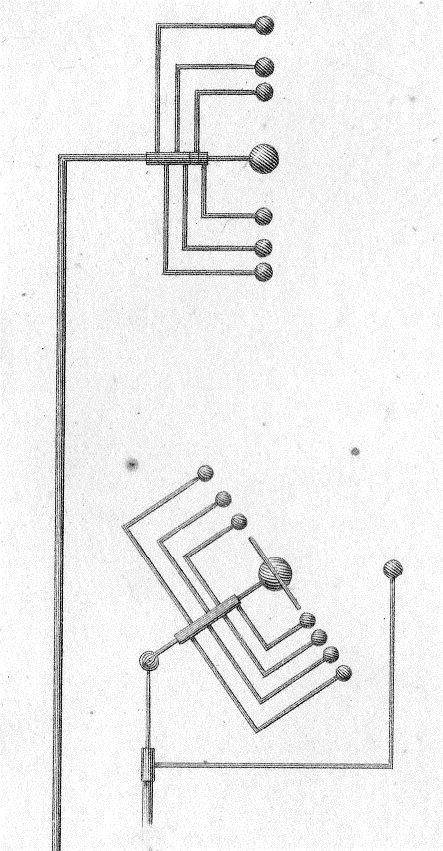
    And the beautiful Dadaist detail of Jupiter and Saturn:

    Planetarium915


  • A Musical Two-Step Trip to Mars in 1898

    JF Ptak Science Books (Expanding  Post 693  from 2009)

    Also have a peek at my post on pre-historic space flight: de Bergerac, Leonardo & Co.

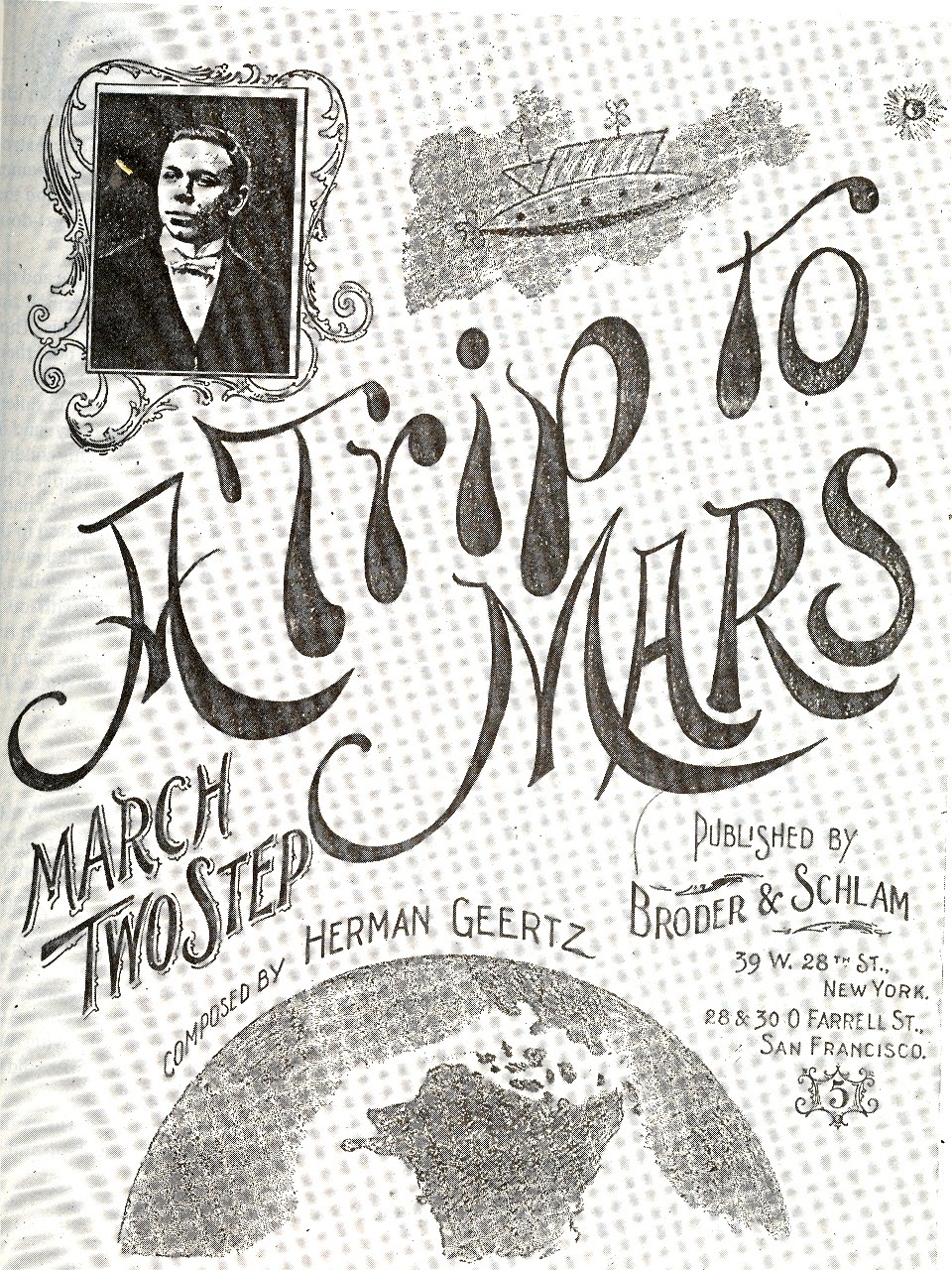
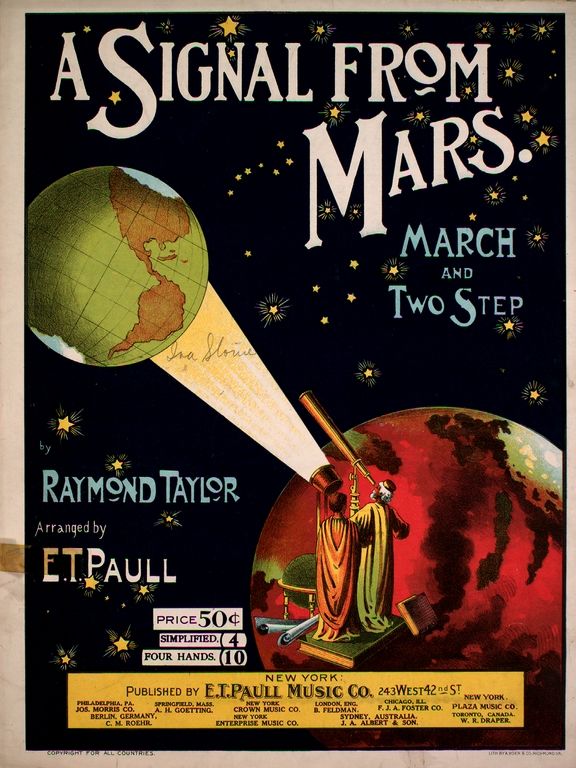
    Herman Geertz–a mysterious, unknown quality of a person to me–made a major contribution to the history of American spaceflight, albeit an unusual, ephemeral one.  In 1898 he published a song—with the firm of Broder & Schlam of San Francisco—called “A Trip to Mars (a March Two Step)”, and is perhaps the first piece of music ever published in the United States about interplanetary spaceflight. 
    ==Blog July 21=mars
    The musician–whose portrait appears in a frame at the upper left—also includes an odd view of the planet Mars, and, most important, an image of a space ship.  It actually took about 20 years for this sort of popularization of Mars to grab a hook in song, even though the interest in the planet and the possibility of life there had been bubbling since Schiapparelli’s  (misunderstood) work on the planet  in which he famously identified its “canali” (and which was infamously and wrongly translated as “canals”.  Much of this great misunderstanding was rooted in Percival Lowell’s book Mars in which he takes the canali idea and runs with it to the goal line of Martian civilization).

    One year later, in 1898, Kurd Lasswitz—a professor of math and physics, a Kant expert and philosophe, and an historian of science—published what was to make him the equivalent of Germany’s Jules Verne/H.G. Wells (in importance if not in quantity).  Auf  Zwei Planeten (first published in Leipzig in 1898) was an immediate best seller, as it was Germany’s first work of science fiction, and it made its scientist/historian an instant sensation.  It was an interesting, high-tech-utopian story that describes humans finding and dealing with an isolated Martian colony existing at the North Pole; humanity has its ups and downs, as do the Martians, the species trading moral highgrounds and such, until a peaceful co-existence comes into play between the two planets.  It was pretty heady stuff for the time.  Lasswitz saw into the future in this book, bits here and bits there:  space travel is rather accurately summarized as is a sort of television (that was actually a Martian tele-telescope) and synthetic fuels and foods. 

    Mars, signal from

    [Source: https://www.pinterest.com/pin/525584218990235994/  and Found on levysheetmusic.mse.jhu.edu]

    This period right before the turn of the century was particularly progressive for the sciences and for science fiction.  In the world of science fiction, for example, in 1895 there was Lowell’s Mars, Williams Morris’ The Wood Beyond the World; for 1896 there was Morris’ The Well at the World’s End, H. G. Wells The Island of Dr. Moreau and The Invisible Man, and Louis Tracy’s The Final War.  1897 saw Lasswitz’ Two planets, Bram Stoker’s Dracula and William Le Queux The Great War in England in 1897.  1898 rounded things out very nicely with Well’s War of the Worlds.

     Frankly though science outstripped the fiction part of the creativity index:   the end of 1895 saw an entirely new world intruded by Roentgen’s X-Rays; 1896 saw Becquerel’s discovery of radioactivity and Langely’s aerodrome; 1897 Thomson’s discovery of the electron; 1898, the discovery of radium by the Curies; 1899, Collin’s invention of the wireless telephone, 1899/1900 the introduction of the quantum theory by Max Planck and also the rediscovery of Mendel’s work by Correns.    It was, in short, a remarkable and remarkably-intense period whose outward reach seemed to be more dominated by the fiction aspect of science (with spaceflight and invading aliens) while the vast  new interior worlds of the previously unseen were totally dominated by the sciences, which was of course the stuff that would stick,  If you stretched this period by just another five years, the Einstein annus mirablis would be included, further deepening this unbelievable period of achievement.  Then again, nearly the whole of modernity is invented during this time:  from 1875-1915 or so nearly every genre of human pursuit entered the modern period.  New methods of writing in literature and for the stage, new ways of painting (from impressionism to non-representational art), through music and the sciences, biology and geology.  Everything changes, except for one field:  political science.  Actually, if you included the invention of the concentration camp during the Boer War(S) then I guess you could throw polysci into this group, though but by screaming and kicking. 

    ·Posted by :

    ·in:

    —

  • Mars Misspelled & Cleveland as Canada! (1908)

    JF Ptak Science Books   Quick Post

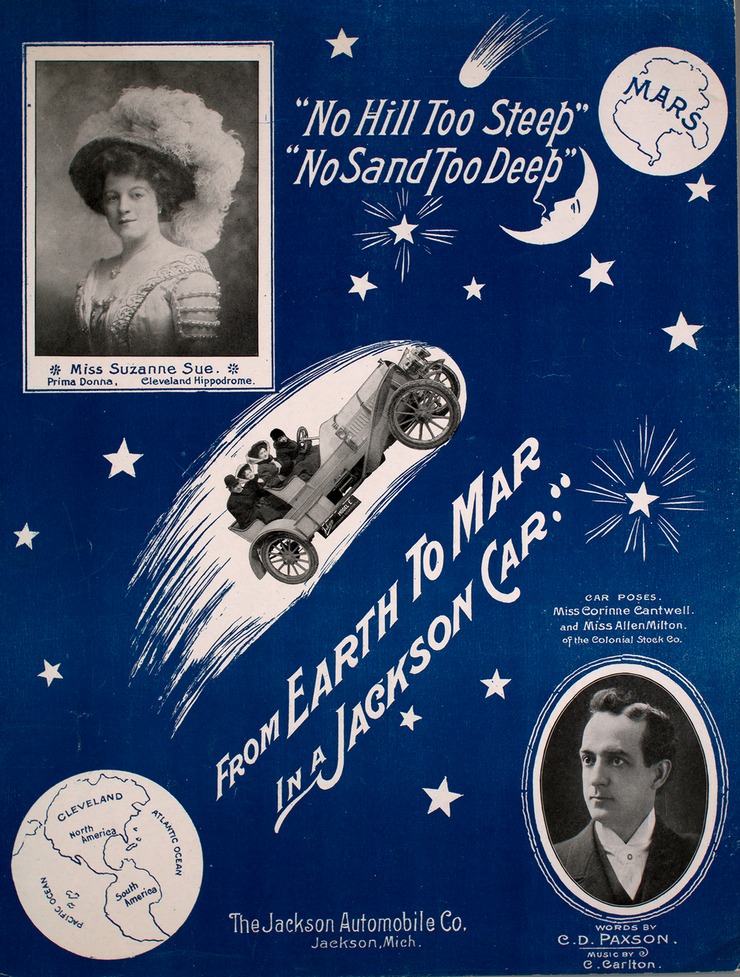
    In my big, old, sloppy cruiser that is this blog, I have misspelled may things, even after “editing” and forcing my way through squiggly spell-checks (sp?). I am not a good editor, so I appreciate one when I see it, And generally I squint m way through misspellings in others, until they get to be (1) very simple, (2) very obvious, and (3) published. The sheet music shared here is a great example of a something-I-cannot-identify:  first, it is pretty though not well designed; second, Mars is misspelled, somehow; and thirdly, “Canada” has become “Cleveland”.  

    I’m fairly certain that I have never heard anyone ask/wonder, “Is there life on Mar?”, or utter “Mar, the red planet”, or “we’re being invaded by aliens from Mar!”.  “Mar” looms large in the copy for the sheet music, and I just don’t know how that was missed–which means it probably wasn’t, and was made so to rhyme with “car”, though it would’ve been easy to spice up the slogan and make it all correct if “car” was plural.  

    The “cleve” part of  “Cleveland” (at least in the very earliest roots of the word) was no doubt applied to Canada because of the Cleveland to the featured/endorsing singer, Miss Suzanne Sue, of the Cleveland Hippodrome. Otherwise the Jackson car was made 100 or so miles away, in Jackson, Michigan, which means I guess that the Cleveland/Canada designation should’ve been “Jackson”. In any event it seems as though there is something for everyone in this sheet music cover.  

    MArs jackson auto

    [Source: Levy Sheet Music Collection, Johns Hopkins, http://levysheetmusic.mse.jhu.edu/catalog/levy:060.062]

    ·Posted by :

    ·in:

    —

  • Extraterrestrial Skies and Landscapes Depicting the Earth, 1877

    JF Ptak Science Books  Post 2520

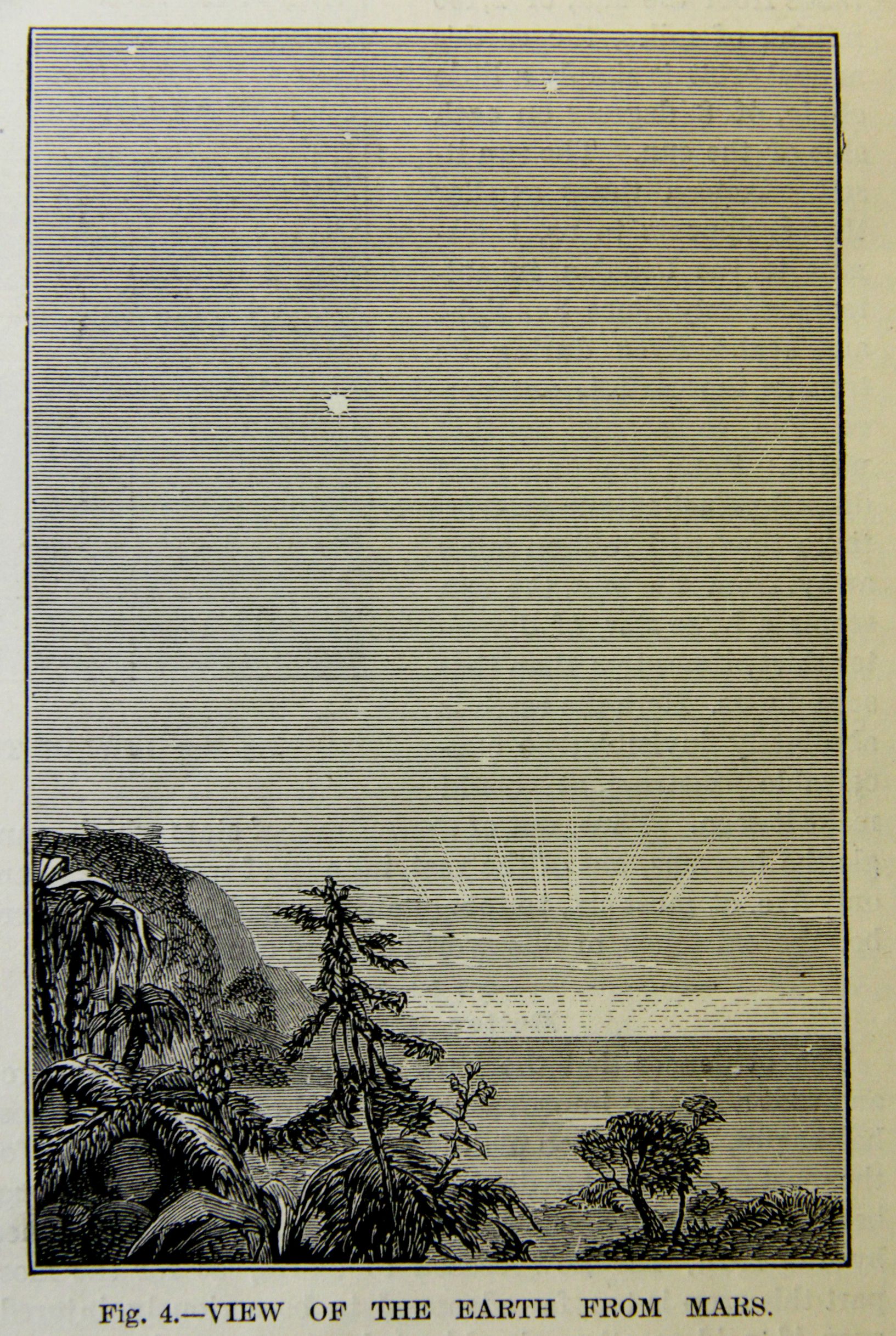
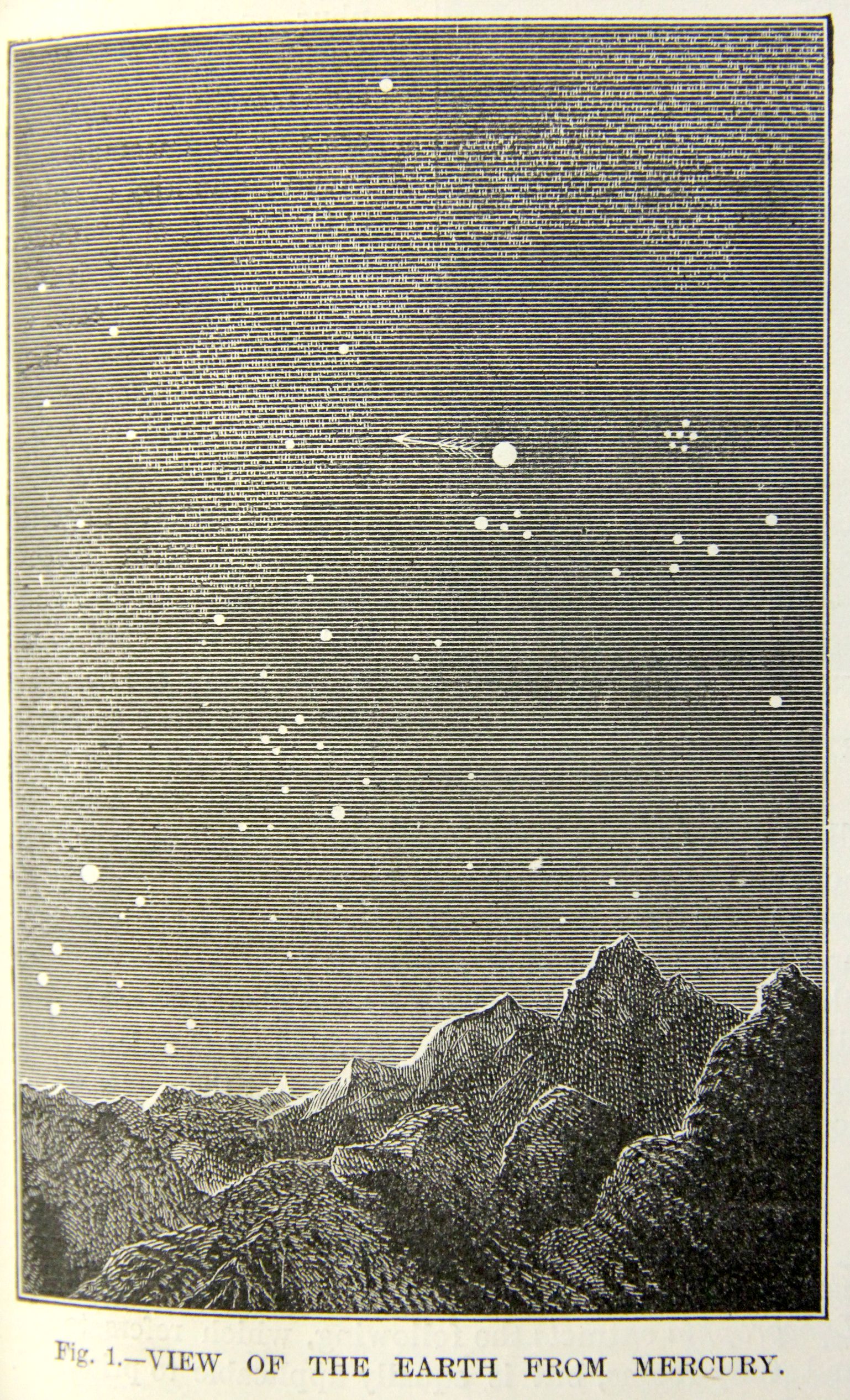
    Earth from other Planets MArs

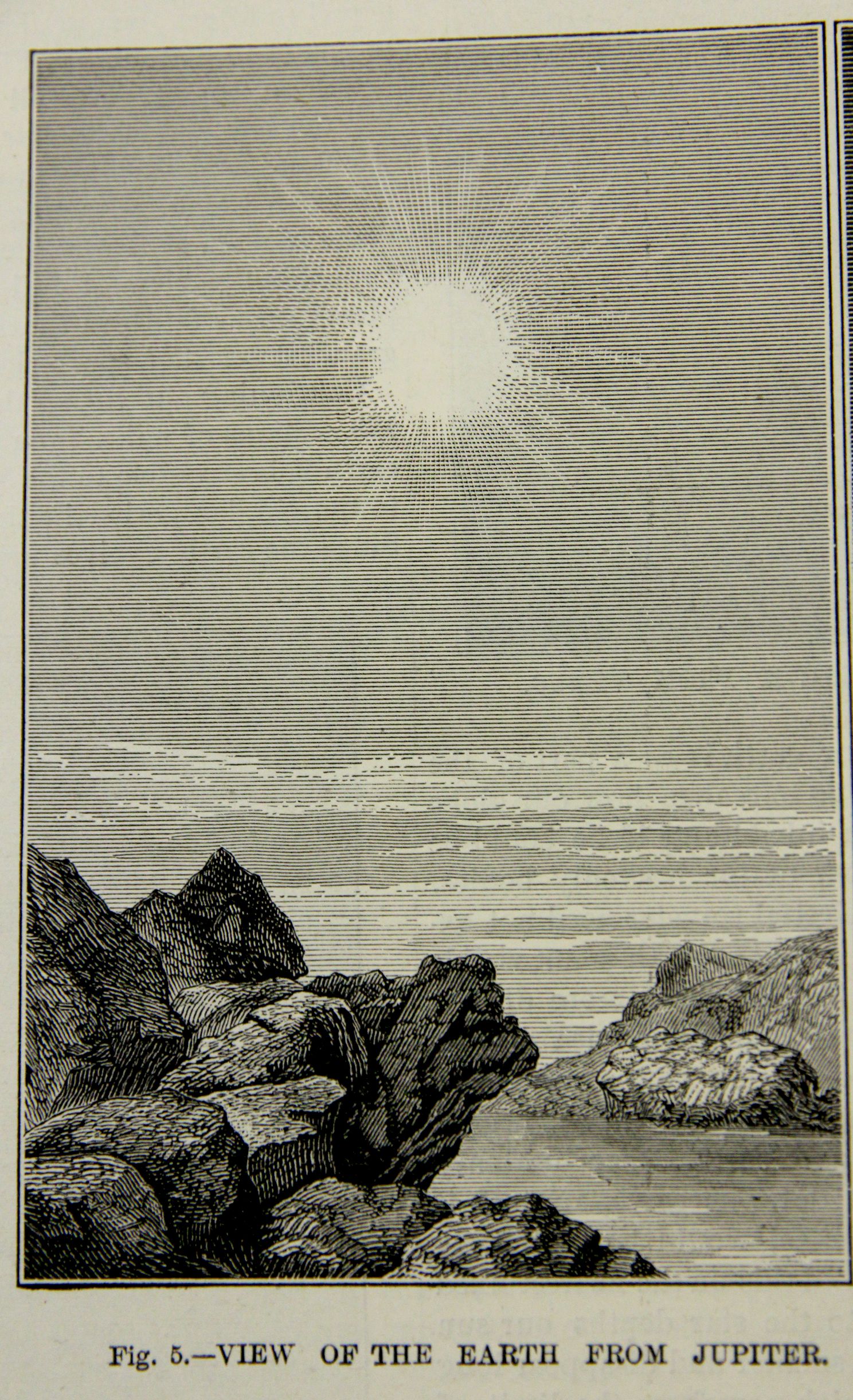
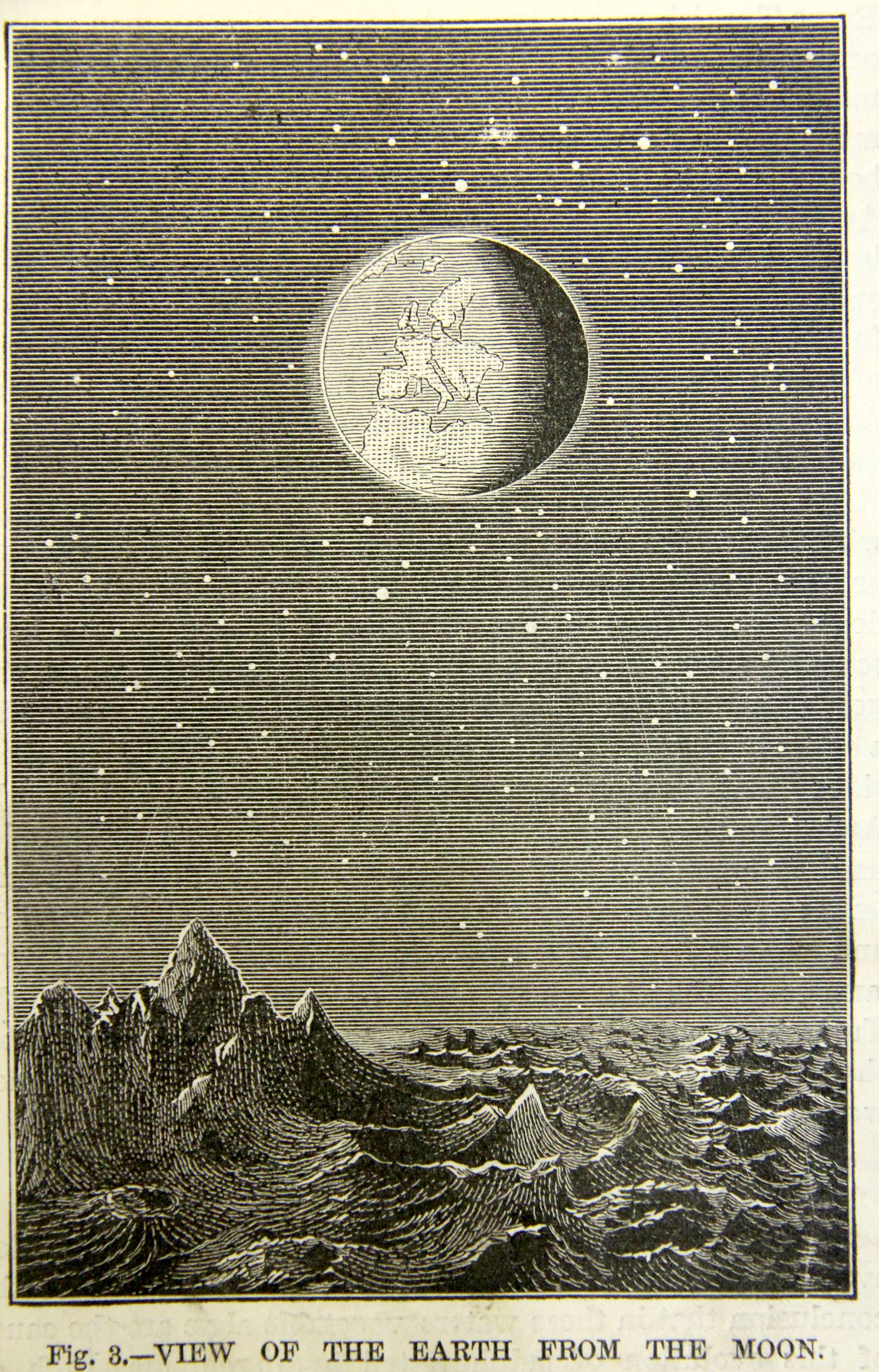
    I was struck by these images of the Earth as seen from other planets (and the Moon) in our solar system, mainly because I had associated at least one of them to Camille Flammarion (1842-1925), who I thought originated the view.  But that is not the case, evidently, as this Scientific American article appears November 23, 1877, and the Flammarion book in which it appears (Astronomie Populaire) was not published until 1880.  This is interesting in general because views of the Earth from other exact locations in the solar system are not common at this point in the late 19th century, and as can be seen in the illustrations there were some enormous (?) leaps of faith, though I am not sure how long a jump it would take to show a vegetative Mars in 1877.  

    Certainly the depiction of the Earth from an unspecified distance and location was very highly practiced in the history of astronomy, stretching back many centuries, but there is very little found for depicting an extraterrestrial prior to 1900–seeing the Earth in the sky with boots-on-the-extraterrestrial-ground is very uncommon. 

    This is really just a somewhat-related smidgen of a larger discussion on the history of the plurality of worlds and life elsewhere in the universe, an idea that is ancient, reaching back to the Greeks, and comes into play here with the Earth-like environment of Mars pictured above.  These views are sympathetic to an idea of another set of observational eyes looking up at the Earth as Earthlings might do in looking at Mars, a very individualistic view of the night sky, making it personal by setting the event very close to the ground of the planet/Moon rather than a view that was set nearby in space.  This is also conducive to the imagination of 1877 for visualizing not only the existence of life elsewhere, but also of interplanetary travel.  

    The somewhat-odd thing here is that it seems as though the Scientific American article was published independent of the famous reports of Giovanni Schiaparelli1 (“direttore del R. Osservatorio astronomico di Brera in Milano” ) which appeared in 1877/8 following his historic observations of Mars at the 1877 opposition  and in which he used the word “canali” which would later be mis-interpreted/-used as “canals” (when it was intended as “channels”).   Schiaparelli adopted new terminology for his great adventures on the surface of Mars including “ocean”(“the names I adopted will in no way harm the cold and rigorous observations of facts”2) though he did not intend for them to be used literally.  (He had in fact used the word “canali” as early as 1859, a yer after Angelo Secchi had employed the term.) Also the great William Whewell had hypothesized the existence of oceans and mountains and the possibility of life on Mars earlier than that, in 1854; and Anthony Proctor contributed greatly to the life issue with his work and map (featuring continents and oceans) in 1867, so I think that the presentation of the Earth-friendly vision of the Martian surface in the Scientific American could well have been accomplished independently of the Schiaparelli observations of 1877.  The idea of organized and technological life took off shortly after this in a sort of Martian-life-mania3, quickly reaching great new heights in H.G. Wells’ War of the Worlds in 1897, when Martians needed to have their own very destructive look-see of their own extraterrestrial sky.  It wasn’t unti the 20th century, really, when it became more a more common/popular thing to see the Earth imagined from a viewpoint on another world.  

    All this said, I do not know when the first illustration like this–a view of the Earth in an extraterrestrial sky with surrounding landscape–appears in print.  

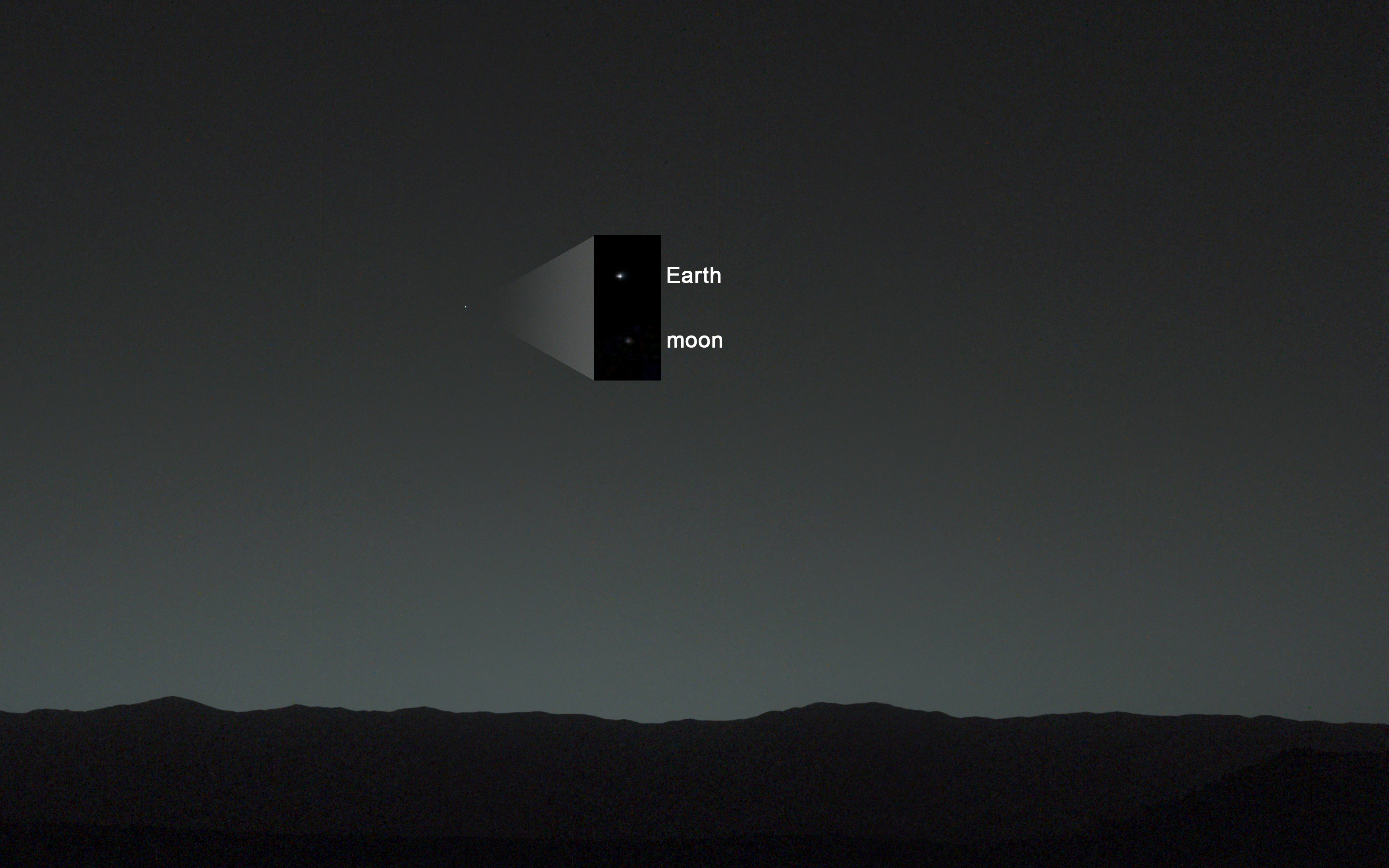
     A modern view, from NASA, Curiosity‍‍ , “first view of the Earth and the Moon from the surface of Mars(January 31, 2014)”:Earth from other planets  modern MArs

    [Source: http://photojournal.jpl.nasa.gov/figures/PIA17936_fig2.jpg]

    Earth from other planets Mercury

    And a very hospitable Jupiter:

    Earth from other planets Jupiter

    Earth from other planets Moon


    Notes:

    1.  G. V. Schiaparelli’, Atti della Reale Accademia dei Lincei: Memorie della Classe di sdenze fisiche, matematiche e naturali 3:2 (1877-1878): 3-13  The famous map by Nathaniel Green was published soon afterwards, Nathaniel E. Green, ‘Observations of Mars, at Madeira, in August and September 1877’, Memoirs of the Royal Astronomical Society 44 (1879): 123-40.

    2. Dictionary of Scientific Biography, volume 12, pg 161).

    3.  Not my term and a good one–found in K. Maria D. Lane, “Mapping the Mars Canals Mania….”, in Imago Mundi, Vol. 58, No. 2 (2006), pp. 198-211.


  • “Our Puny Earth!”

    JF Ptak Science Books  Quick Post

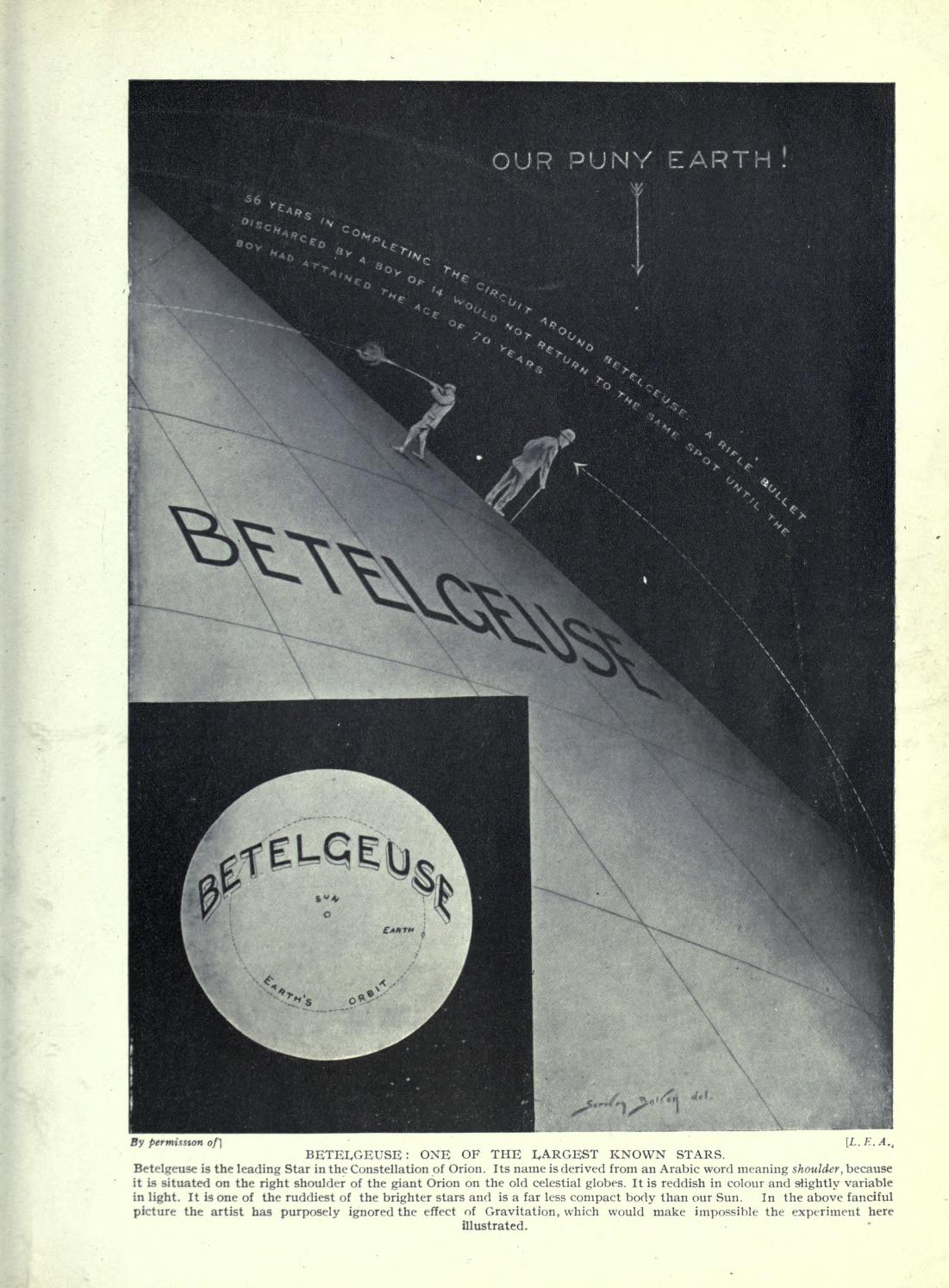
    Hutchinson’s Splendour of the heavens; a popular authoritative astronomy, by Theodore Philips and William Steavenson, was a splendid popular work filled with fine images, some of which were rather unusual.  One that I thought I had to share was the f=one below, which contains the first time that I have seen the phrase “Our Puny Earth!” in a non-comic book.  It is also a nice graphical display of data underneath the “puny Earth” bit–enjoy. 


    Astronomy  Betelgeuse[Source: Internet Archive,  https://archive.org/stream/hutchinsonssplen01philuoft#page/418/mode/thumb]


  • On the Color of Martian Water and Foliage, 1879

    JF Ptak Science Books    Post 2454

    • “The color of the water on Mars appears then to be same as that of terrestrial water…”  –Camille Flammarion, Scientific American Supplement, May 10, 1879, pp2787-2788
    • Image source: Google books, where the full text of the article is available. My own copy was simply too large for scanning.  
    • The original weekly issue of Scientific American with this article is available for purchase via the blog bookstore, here.

    I found this interesting map of Mars in the May 10, 1879 issue of the Scientific American Supplement.  The partially-anonymous author straight-away makes a provocative claim, 

    “WHEN sixteen years ago I published the last edition my work The Plurality of Inhabited Worlds I did expect to see the speedy confirmation that the progress astronomy was to give to my essay by allowing us so speak to put our finger on the manifestations of life”

    and then spends the rest of the article supporting the reinterpretation of Mars as another Earth.

    This is hardly an early assumption of the provocative thought of life elsewhere in the universe–there are  a number of authors who have written on the topic, and for hundreds of years prior to this. (Conversations on the Plurality of Worlds by the wicked-smart aesthete Bernard le Bovier de Fontanelle was published in 1686–the year before Newton’s Principia–and elegantly argued for teh plurality of worlds and inhabited earth-like planets revolving around other stars, spread throughout the universe.  Cyrano de Bergerac, Christian Huygens, J.J.L. Lalande–with an interesting Christian-based pluralist argument for not restricting the glory of the Creator’s efforts to simply life here on Earth, and (later) David Brewster, each wrote convincingly on the prospect of extraterrestrial life.)

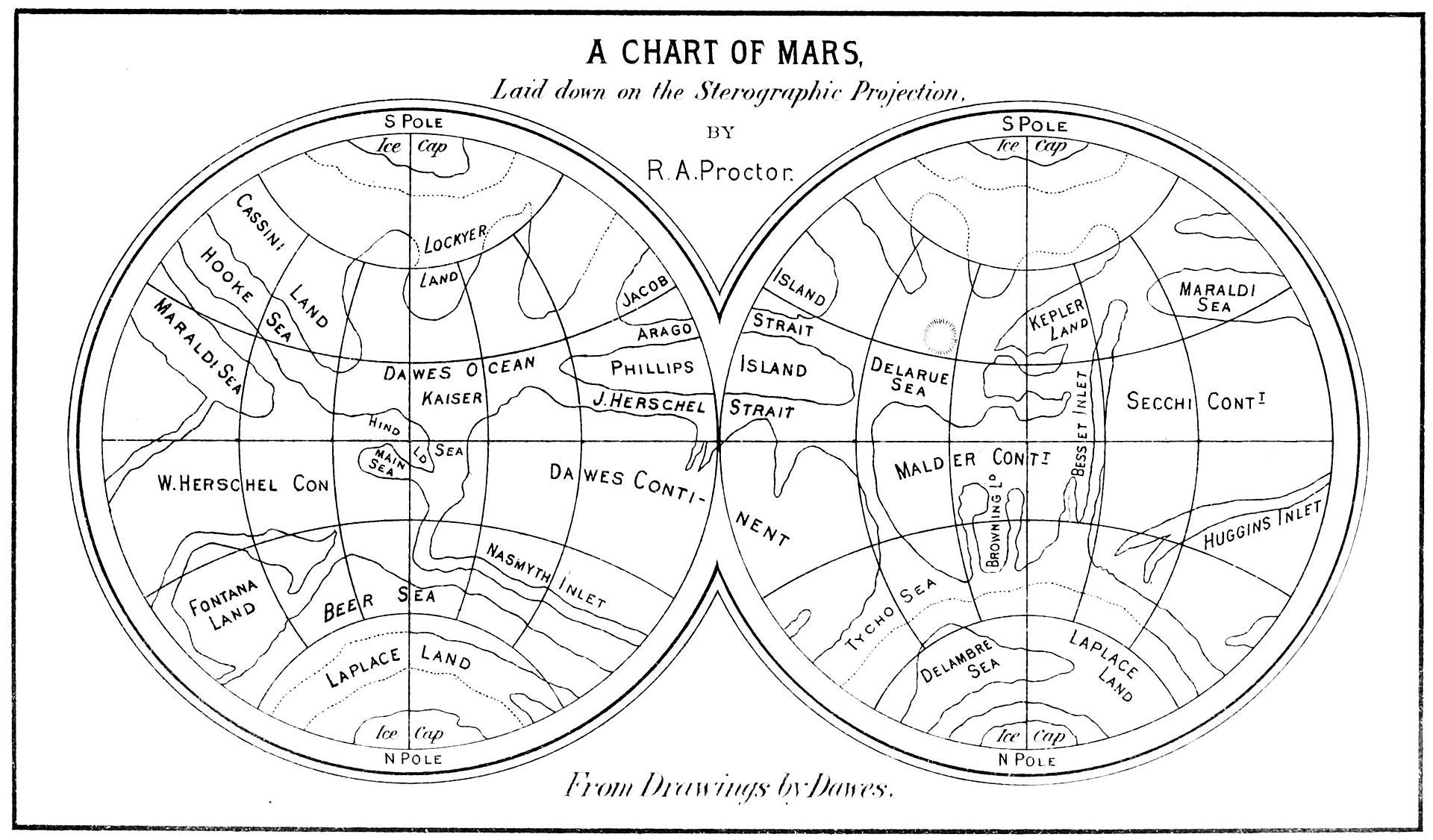
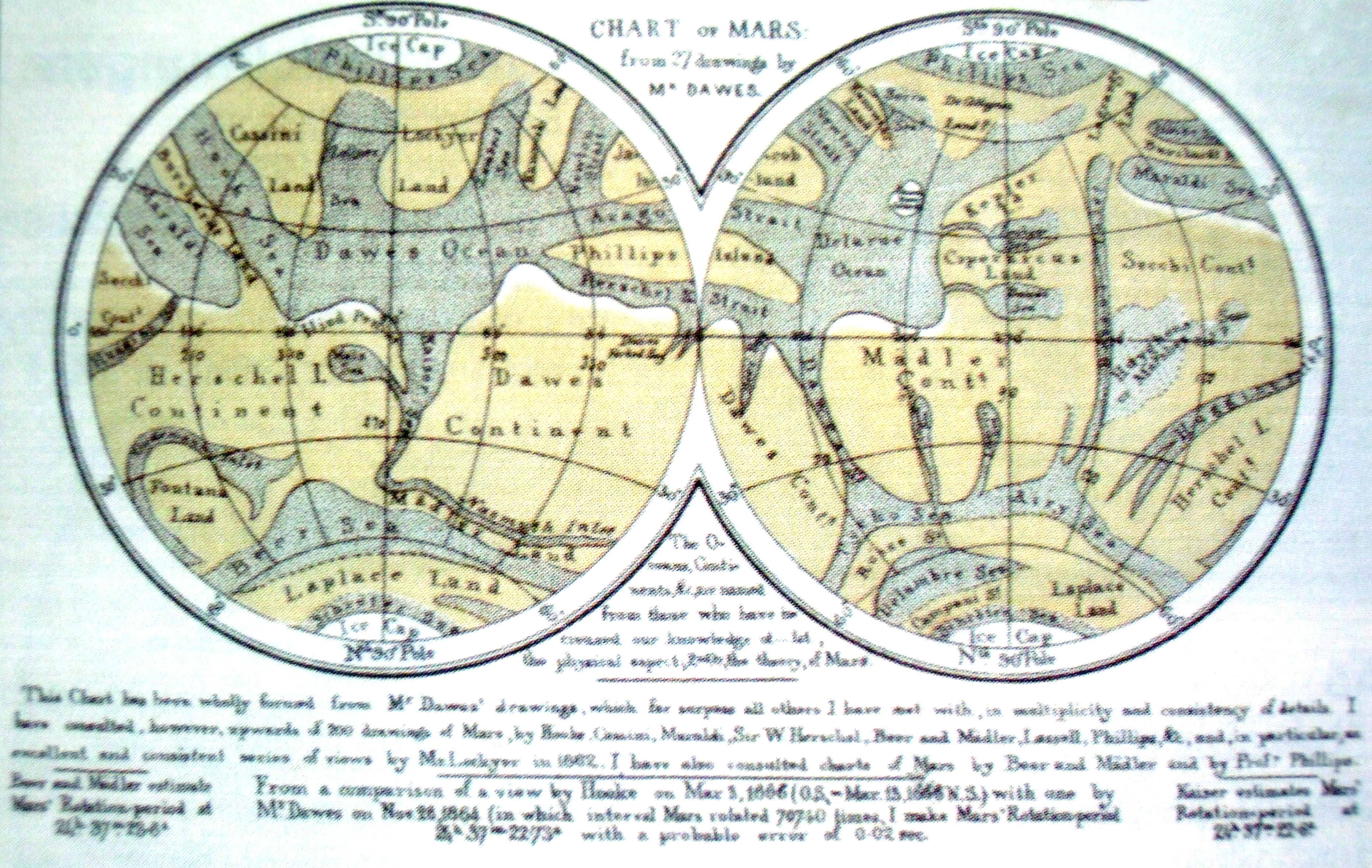
    The author of this article turns out to be Camille Flammarion, an abundantly creative writer and observer, perhaps not so well known today as he should or could be, a sub-Verneian astronomer/publisher/writer whose ideas did not make it much past the nineteenth century. (And perhaps he or the editors at the Scientific American felt it unnecessary to identify him except by the title of one of his books because he was so very well known at that point, being the author of 70 books and all, and also for being perhaps the most talented of pop-science writers.)  He does give us this map, though, and tries with a mighty effort to solidify the gauzy appearances of structure of the Martian surface.  He honors astronomers with the continents and oceans that he sees, and is far more universal/multi-cultural in his acknowledgement of scientific accomplishment. Here we see the oceans Kepler and Newton,  and seas of Hooke (somewhat surprisingly), and (Giacomo)  Maraldi (Italian, 17th c), and Huggins, Maedler; and land masses of Copernicus, Galileo, Herschel, Cassini, Tycho, Laplace, Huygens. This version of the map comes 14 years after Proctor’s first attempt at a Martian map1 (and evidently the first map of Mars with a precise nomenclature) and which itself came another 25 years after the first first map of Mars by Wilhelm Beer (1797-1850) and Johann Heinrich Mädler (1794-1874).    

    Flammarion makes a strong case for life on Mars even without evidence, or at most the scanty suggestion of scientific proof, which is perhaps one reason why his brand of scientific adventurism and speculation didn’t survive into very much of the 20th century. Here are some examples from the article:

    “Can there be red meadows and red forests up there? Can it be that trees with foliage offer a substitute there for our quiet and delightfully shaded woods and are our scarlet poppies typical of the botany of Mars?” 

    “Are we authorized create all these analogies?  In reality we see only red green and white blotches on the little disk of this planet. Is the indeed terra firma is the green really water and is the indeed snow In a word is this truly a world like our own?”

    The question is asked, and then answered immediately in the next paragraph:

    “Yes!  Now we are able to assert it. The appearance Mars varies constantly. White spots move about over disk too often modifying its apparent configuration spots can be nothing but clouds. The white spots at increase or diminish according to the seasons like our terrestrial circumpolar ice fields which would precisely the same aspect the same variations to an placed on Venus…”

    Elsewhere in his Celestial Wonders, Flammarion writes: “The world of Mars is so much alike the world on Earth that, had we traveled thither someday and forgotten our route, it would be almost impossible for us to tell which of the two is our native planet. Without the Moon, which would mercifully relieve our incertitude, we would run the enormous risk of calling upon the natives of Mars while assuming we have landed in Europe or in some terrestrial neighborhood.”

    Notes:

    1. The Proctor Map of Mars
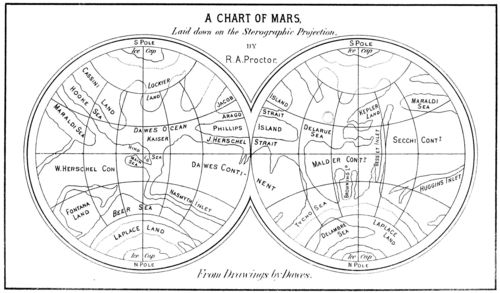
    Mars Proctor 1868

    [Source: Wiki, here. R.A. Proctor: Other Worlds than Ours. London, printed in 1870, page 94.]

    The Proctor map was in turn based upon earlier work by Dawes:
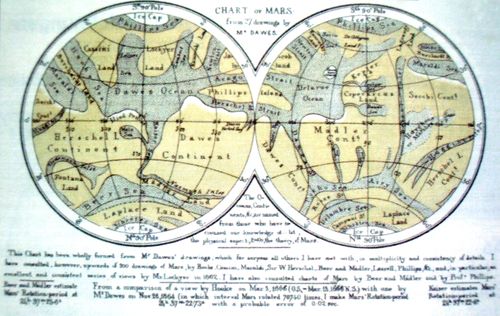
    Mars Dawes

    [Source: Planetologia, http://planetologia.elte.hu/ipcd/proctor_1865.jpg  And in general see this link for much more in-depth appreciation and history of the Proctor map.]


  • Outsider Cosmology and a Theory of a Firey Universe (1781)

    JF Ptak Science Books   Post 2451

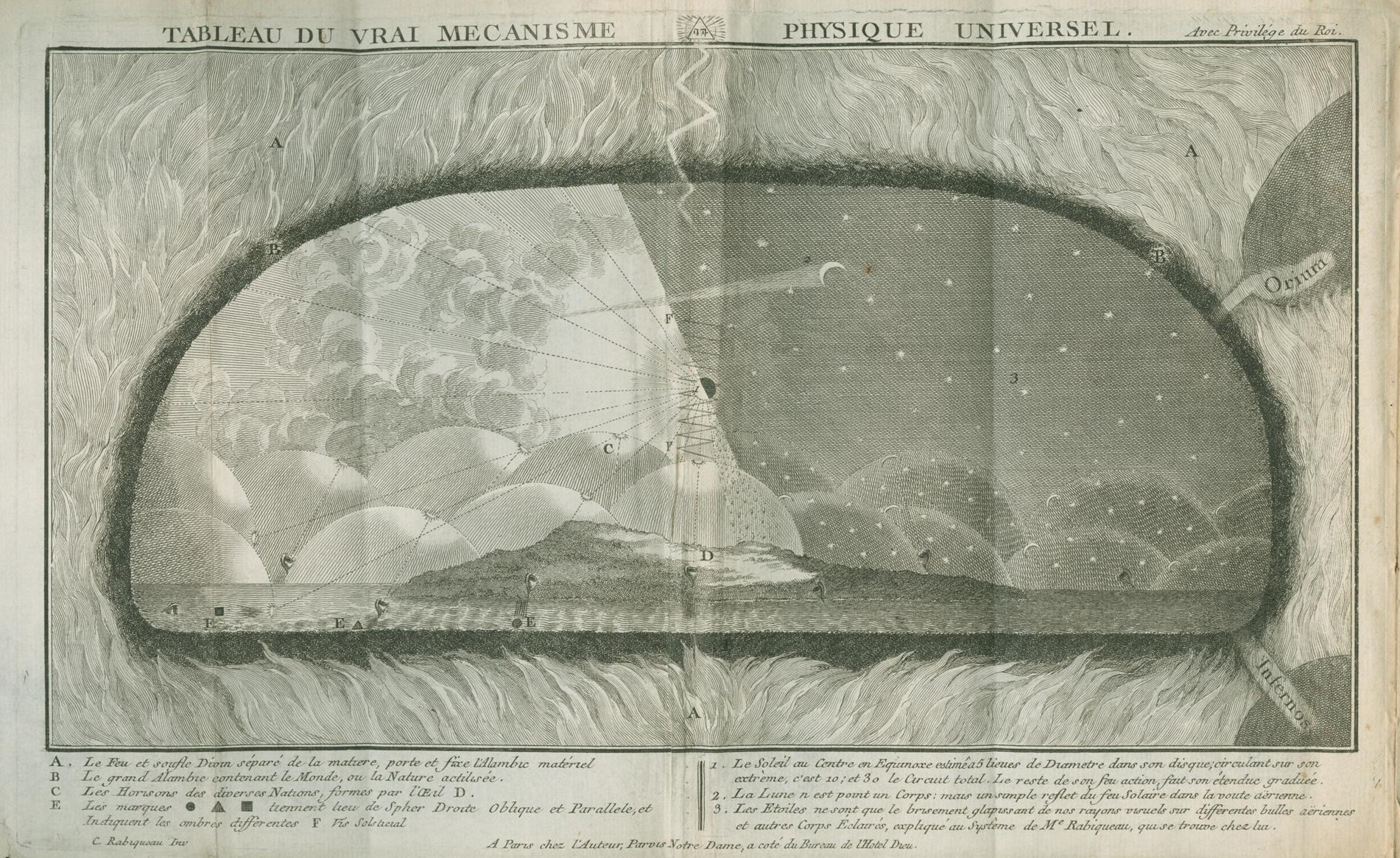
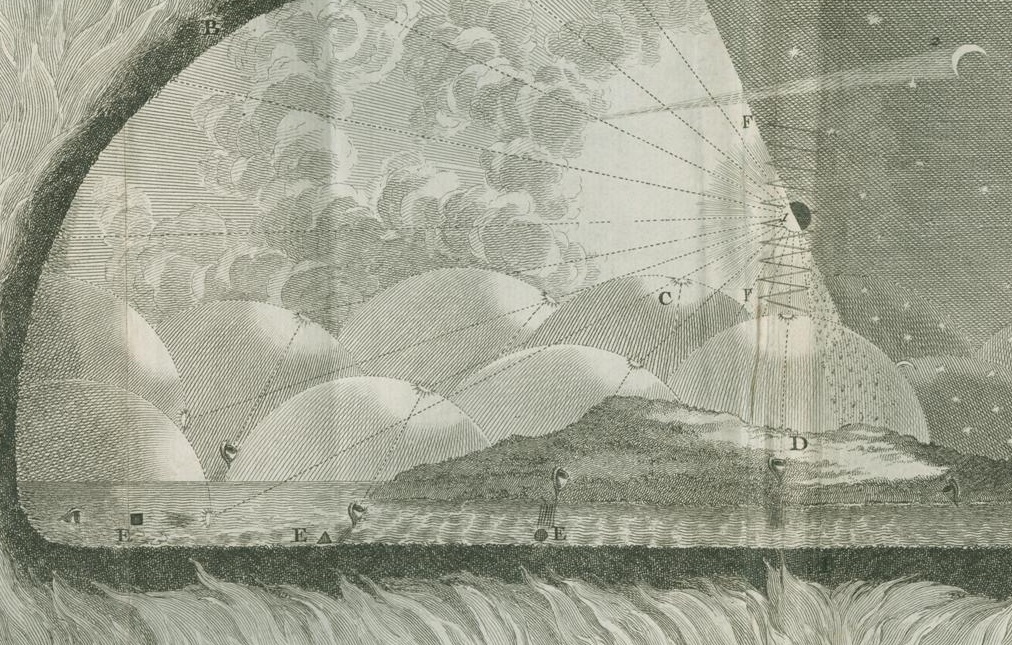
    Rabinqueau was a sort of intellectual performance artist provocateur, who made a living on his brain, writing scientific and pseudo-scientifically on a number of subjects as well as being a paid-for scientific performer. he would demonstrate to paying audiences various experiments in optics and light and electricity and magnetism, though he would sometime veer far away from the safely trodden fields of science into new scientific theories, many of which would put a considerable distance between himself and recognition from the Academie Royale des Sciences.  

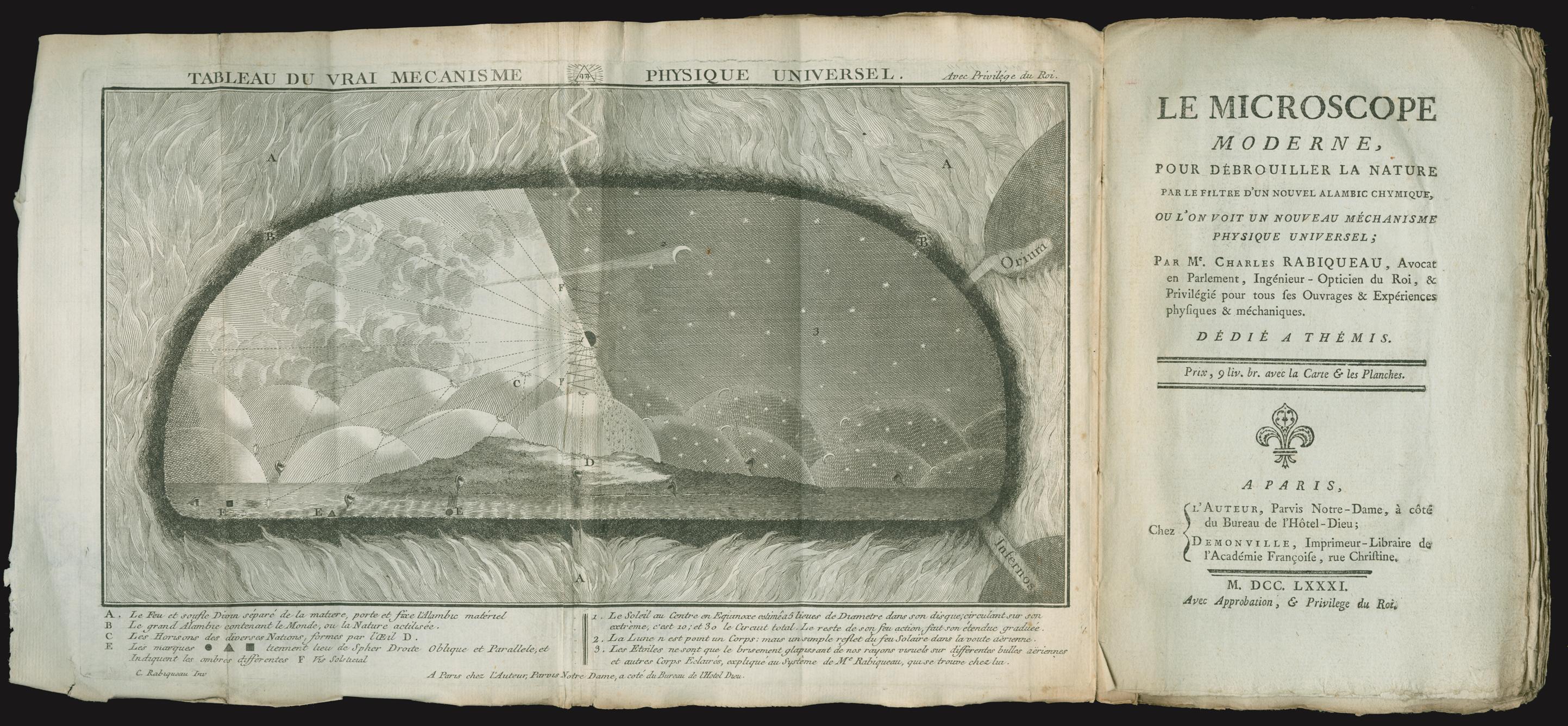
    For example, he developed a number of pseudo-magical physical ideas and astrological bits, as well as a fire-based theory of electricity in which the very substance of the universe is occupied by fire.  (See Popular Science and Public Opinion in Eighteenth-Century France, by Michael R. Lynn, p 51.)  Even though his ideas and results were far from the known science of such topics, he held a special affinity for the superiority of his own ideas, and stuck by them.  His universal fire theory at the very least resulted in an insistence for Outsidery consideration of cosmological questioning and display, as see in this beautiful engraving:

    Rabinqueau plate

    Rabinqueau


    The image appeared as the frontispiece to his Le Microscope moderne. [Treatise on cosmography], which appeared in 1781, and which seems to me to be sort of late in the game for these theories to be making an appearance. Source: Newberry Digital Library. (The image also makes an appearance with a different interpretation in Barbara Maria Stafford’s Good Looking, Essays on the Virtue of Images, p. 93.)

    And a detail:

    Rabinqueau plate detail

    Rabinqueau also developed an electrical, friction-based theory of the sexes, involving much rubbing and electrified ovaries, but this idea didn’t go very far. (See: The Psychoanalysis of Fire, by Gaston Bachelard, page 26.)