JF Ptak Science Books Post 2451
Rabinqueau was a sort of intellectual performance artist provocateur, who made a living on his brain, writing scientific and pseudo-scientifically on a number of subjects as well as being a paid-for scientific performer. he would demonstrate to paying audiences various experiments in optics and light and electricity and magnetism, though he would sometime veer far away from the safely trodden fields of science into new scientific theories, many of which would put a considerable distance between himself and recognition from the Academie Royale des Sciences.
For example, he developed a number of pseudo-magical physical ideas and astrological bits, as well as a fire-based theory of electricity in which the very substance of the universe is occupied by fire. (See Popular Science and Public Opinion in Eighteenth-Century France, by Michael R. Lynn, p 51.) Even though his ideas and results were far from the known science of such topics, he held a special affinity for the superiority of his own ideas, and stuck by them. His universal fire theory at the very least resulted in an insistence for Outsidery consideration of cosmological questioning and display, as see in this beautiful engraving:
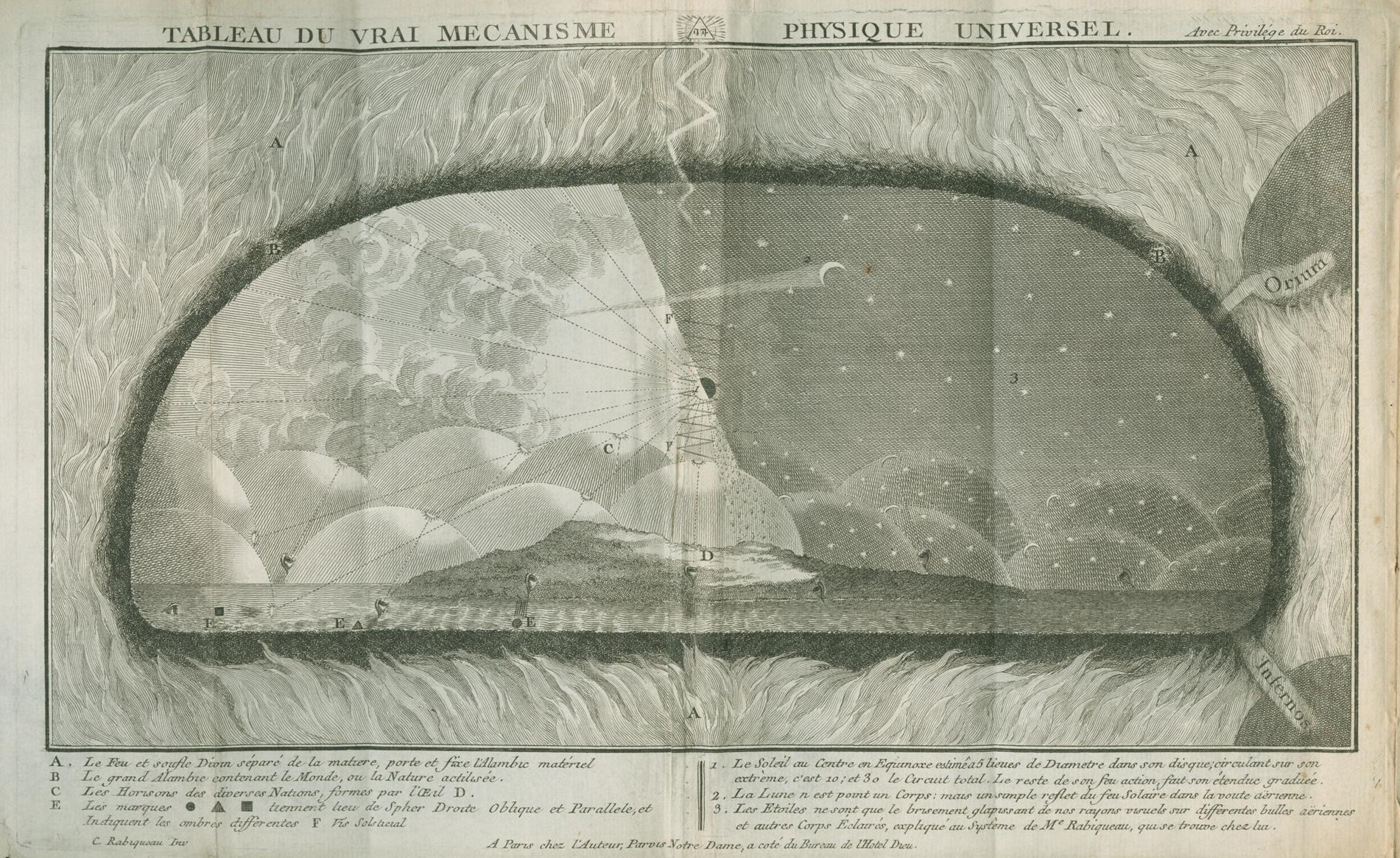
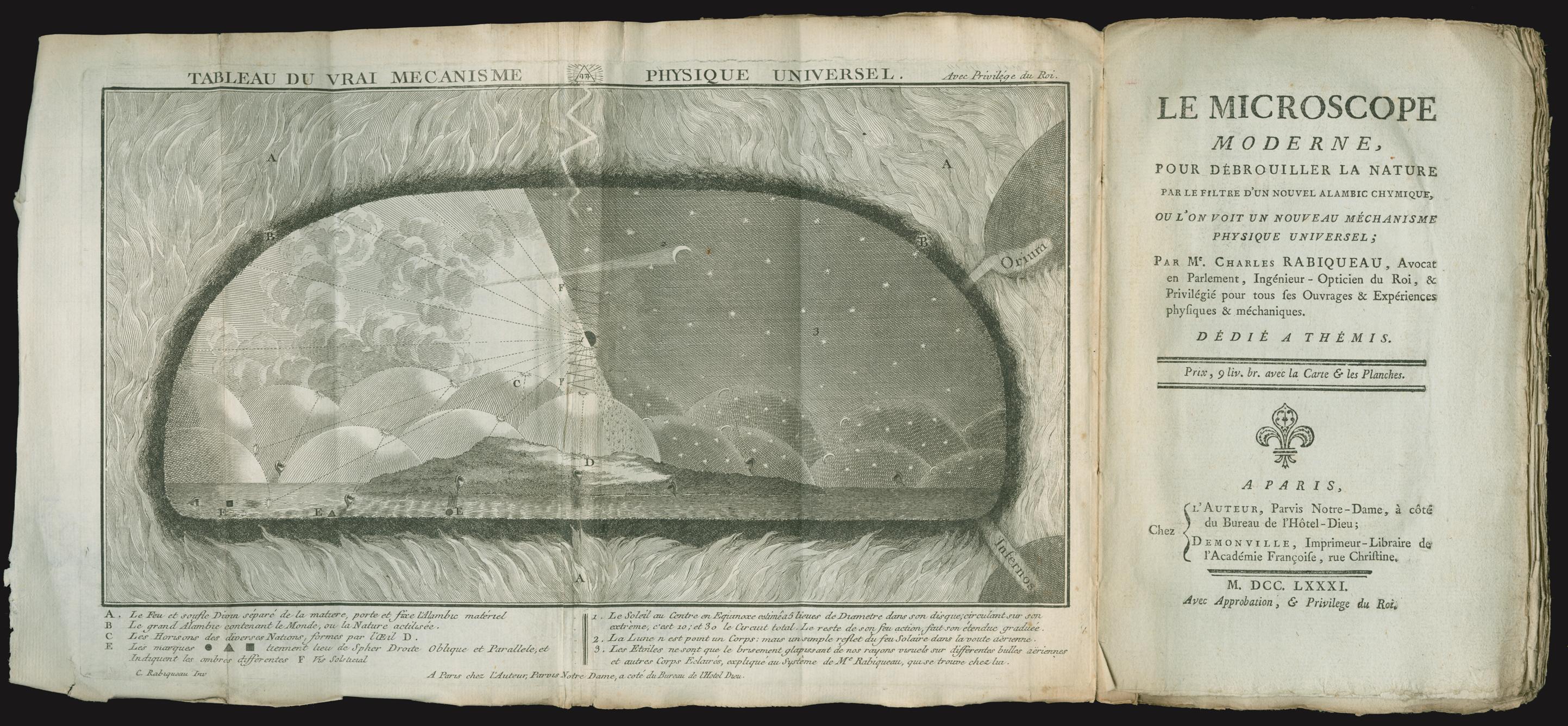
The image appeared as the frontispiece to his Le Microscope moderne. [Treatise on cosmography], which appeared in 1781, and which seems to me to be sort of late in the game for these theories to be making an appearance. Source: Newberry Digital Library. (The image also makes an appearance with a different interpretation in Barbara Maria Stafford’s Good Looking, Essays on the Virtue of Images, p. 93.)
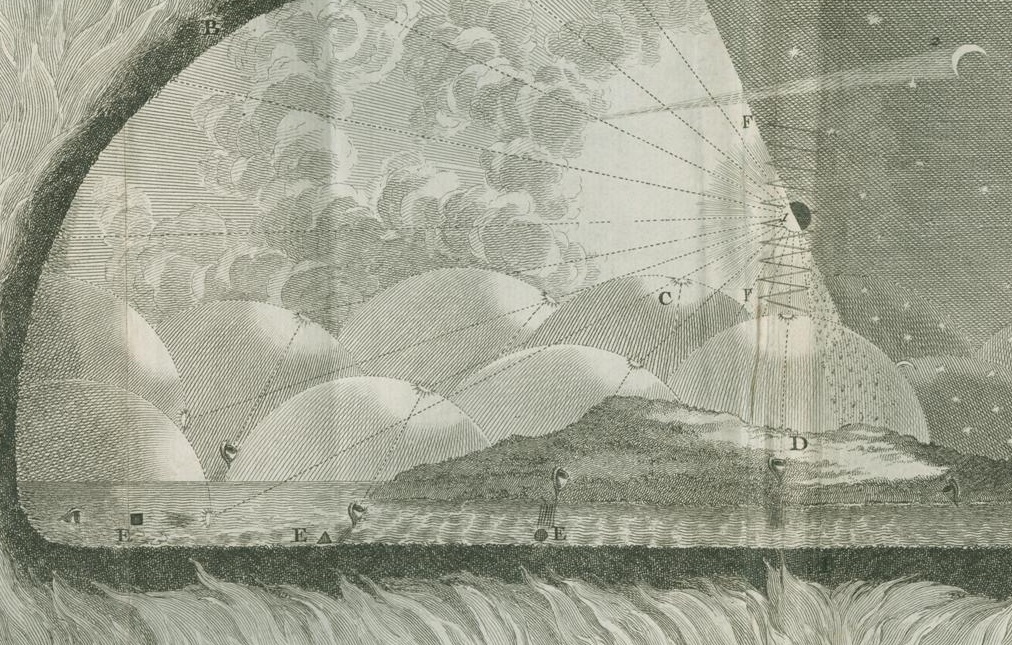
And a detail:
Rabinqueau also developed an electrical, friction-based theory of the sexes, involving much rubbing and electrified ovaries, but this idea didn’t go very far. (See: The Psychoanalysis of Fire, by Gaston Bachelard, page 26.)