JF Ptak Science Books Quick Post
The following is section is from mathematician/logician Augustus DeMorgan’s (1806-1871) classic Budget of Paradoxes second edition of 1912). It is a short expository on the plurality of worlds and life on them beyond the Earth, looking back over the history of the idea from Lucian, Huygens, Swift, Kircher, and others. DeMorgan’s footnotes are included at bottom (with a few added comments in italics).
“INHABITED PLANETS IN FICTION
There is a class of hypothetical creations which do not belong to my subject, because they are acknowledged to be fictions, as those of Lucian,[177] Rabelais,[178] Swift, Francis Godwin,[179] Voltaire, etc. All who have more positive notions as to either the composition or organization of other worlds, than the reasonable conclusion that our Architect must be quite able to construct millions of other buildings on millions of other plans, ought to rank with the writers just mentioned, in all but self-knowledge. Of every one of their systems I say, as the Irish Bishop said of Gulliver’s book,—I don’t believe half of it. Huyghens had been preceded by Fontenelle,[180] who attracted more attention. Huyghens is very fanciful and very positive; but he gives a true account of his method. “But since there’s no hopes of a Mercury to carry us such a journey, we shall e’en be contented with what’s in our power: we shall suppose ourselves there….” And yet he says, “We have proved that they live in societies, have hands and feet….” Kircher[181] had gone to the stars before him, but would not find any life in them, either animal or vegetable.
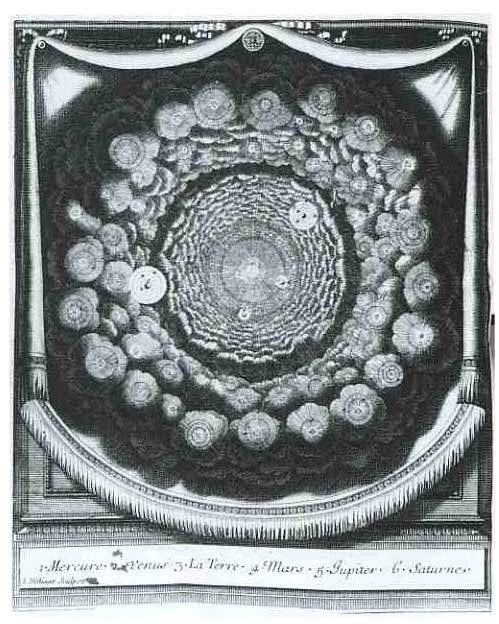
- [This lovely image belongs to Entretiens sur la Pluralitie de Mondes (Conversations on the Plurality of Worlds), written by the great French philosophe Bernard le Bouvier de Fontenelle in 1686 (just a year before publication of perhaps the greatest work in the history of science, Newton’s Principia Mathematica). The Plurality was a best-seller by the best-selling Fontenelle. An excellent attempt by a rather restricted writer to engage the population-at-large, writing a high-pop book on what was basically the history of astronomy and cosmology of the preceding century. Copernicus was a major feature of his imaginary conversations with a muse as he wandered through a metaphorical garden of questions, with the observations of Galileo and Cassini also very prominently featured.]