A Daily History of Holes, Dots, Lines, Science, History, Math, Physics, Art, the Unintentional Absurd, Architecture, Maps, Data Visualization, Blank and Missing Things, and so on. |1.6 million words, 7500 images, 4.9 million hits| Press & appearances in The Times, Le Figaro, Mensa, The Economist, The Guardian, Discovery News, Slate, Le Monde, Sci American Blogs, Le Pont, and many other places… 5000+ total posts since 2008.

Category: History of the Future

  • Fantasia of the Air–Cops, Booze, Marriage, and a Monkey. (1890)

    JF Ptak Science Books  Post 2776

    Well, not quite a fantasia, but more like a “fanciful/fantastical/imaginary” collection of  “flying objects” (“objets volants de fantaisie”), a whimsical look at the very near future (or so) of airship flight in 1890. This future seems to make room for everyone in the air, and celebrated by a collection of worldwide nationalities on the ground. There really isn’t a title for it,  and the print is indexed according to the posters/signs adorning the floating businesses and municipal pleasantries.  According to the excellent French library  site “Galica” the print is catalogued as “Sanatoir aérien du docteur Farceur, bureau volant de mariage, police aérienne [objets volants de fantaisie]”, which is entirely unpoetic and slightly galling given the subject matter, and merely describes some of the objects in the print. The only part of the title that hints at the delightful subject matter is the “police aerienne”, which would in spite of its clumsiness at least raise an eyebrow of just about any overworked research mole:

    Sanatoir_aérien_du_docteur_Farceur_[...]_btv1b53024091c (1)

    [Image source: Galica https://gallica.bnf.fr/ark:/12148/btv1b53024091c/f1.item]

    What vision of the future of aviation doesn’t include two flying doggies and a monkey? This one does. At top right we have part of the title, a marquee for a floating sanitarium run by “Dr. Farceur”, which is probably some very light wordplay implicating a medical jester. There’s the police station, marriage chapel, a hook-up joint (sounding better as a “ballon de rendez-vous”), and a bar/cafe/restaurant. The law is there directing traffic and making an arrest; there are two ships, one a warship with a skull-and-bones and the other probably not; there’s a pamphleteer literally dropping his suggestions, some ladies with attaches, and a long-shoe Flaneur. Belting it all together is some sort of chorus line, though these ladies aren’t attached to any flying thing save for the wings on their backs. All in all, this is a fine and pleasing work, full of action, and probably not so impressed with the actual future of human flight.  

  • Big, Big Guns (Real and Imagined)

    JF Ptak Science Books   Post 2763

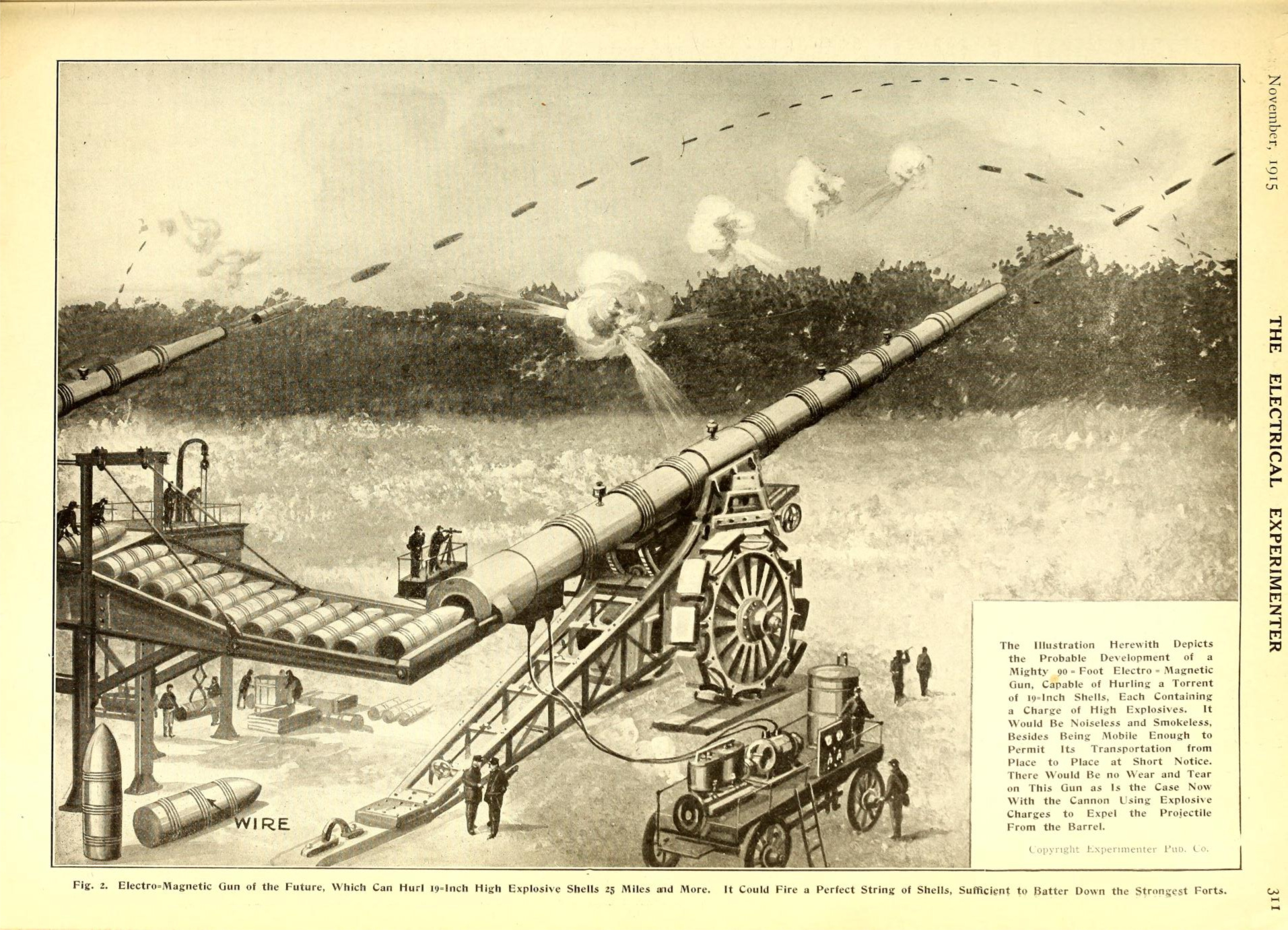
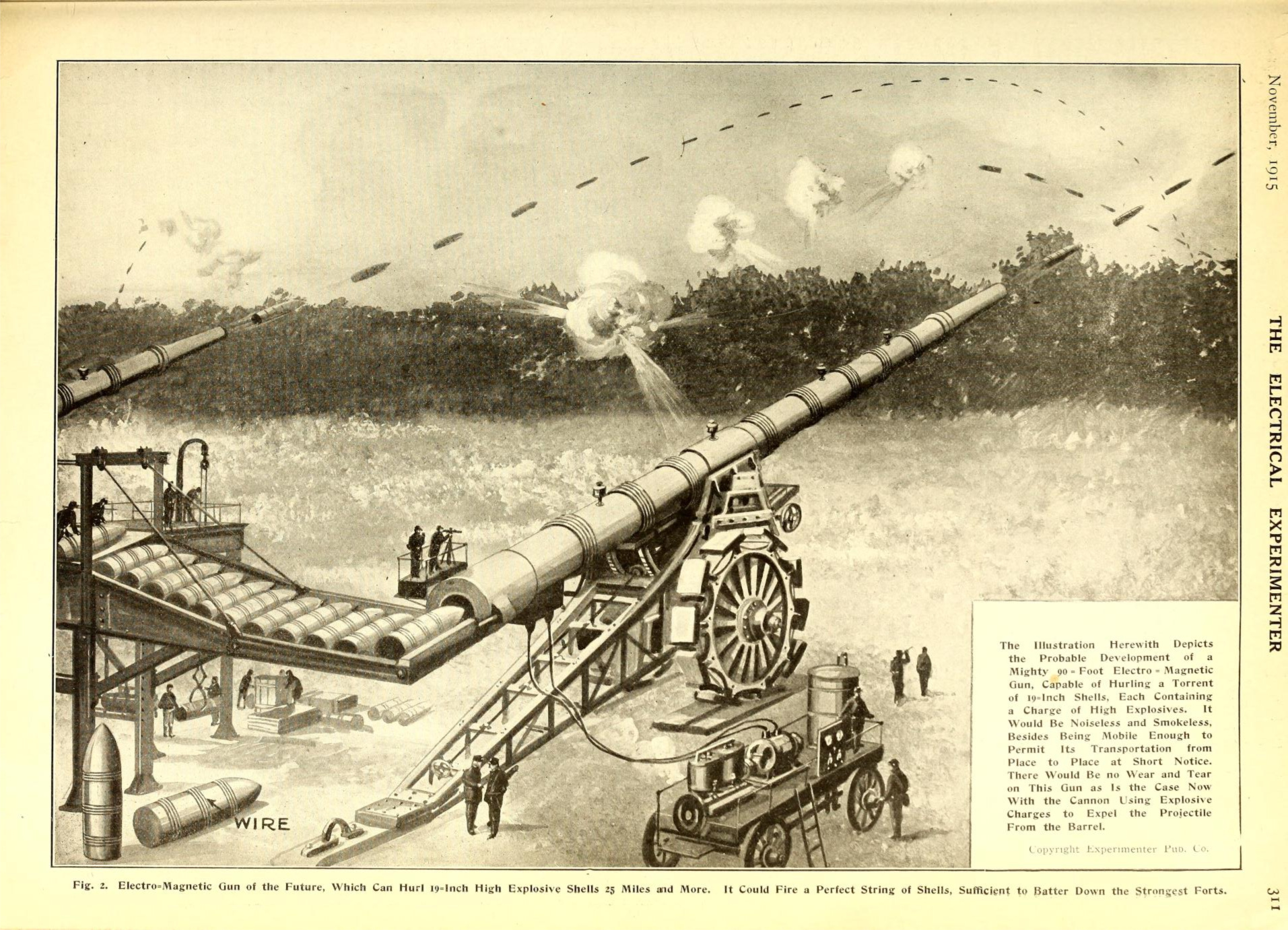
    While looking for an article on the imaginary gatekeepers of Martian canals in The Electrical Experimenter (1915) I found this illustration for a piece of speculative military tech (first image, below). The annoyingly-capitalized caption states this to be an “Electro Magnetc” gun 90′ long and rapid-firing 19-inch (480mm) HE. I guess they were somewhere along the very early reaches for the idea of what would become the contemporary EM rail gun being developed by the U.S. Navy. The power source for the gun shown above is not quite what the Navy has developed, as they employ something along the lines of a multi-million ampere pulsed DC power supply that creates the conductance to launch a shell with a muzzle velocity of 3500 m/s. At this point you don’t need explosives to cause damage at the other end–you just need a projectile. The 1915 version is far offline, except for the initial idea, which is a good one. Besides the shortcomings in the implementation realm of this weapon the writer here doesn’t have a very long vision for the future of warfare, saying that his cannon would be devastating to “forts”. This idea I thought was certainly quaint when written given that WWI was already into its second year, and unless by “forts” the writer meant “trenches”, this visioneer was very visioneering.  

    Electrical experimenter 1915 long gun[Image source: https://archive.org/details/electricalexperi03gern/page/350  Click to expand for a clearer image.]

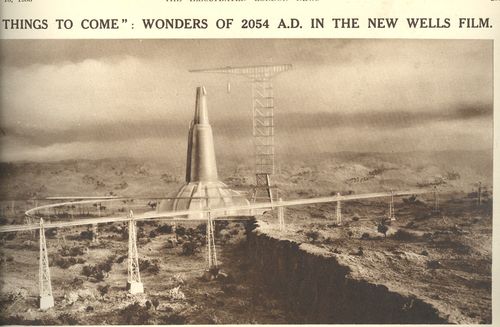
    Massive, monster cannons have existed for many years in idealized and theoretical, speculative worlds, like Tom Swift and his Monster Cannon.  In the history of early imaginary big guns H.G. Wells’ Babel-like cannon (pictured below in a still from the movie Things to Come (1936), an adaptation his The Shape of Tings to Come from 1931) is monumentally fabulous –1500 feet tall, with what looks like a  750′ base, all of which launched a 75′ tall capsule beyond the Earth’s

    Canons big wells

    gravitational pull with a spectacular explosiveness that would’ve made its occupants into instant jelly.  Tangentally-speaking here the launching of an object to escape the Earth’s gravity didn’t occur until 1946 when the highly-problematic but nevertheless-genius Fritz Zwicky fashioned a device to an experimental V-2 and via an electric explosive charge punched some object into space.


  • Dueling Intergalactic Rocket Ports, in Glorious BIG Color! (1938+1939)


    JF Ptak Science Books   Quick Post

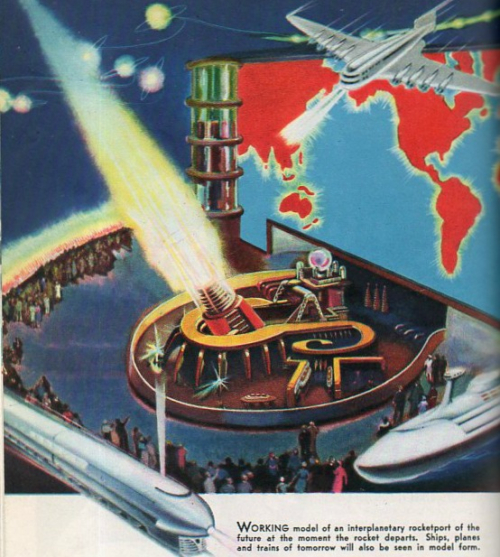
    This was a big gulp of a very colorful possible futureworld in which intergalactic travel has become possible, this image of this model being given an advanced peek prior to the New York World’s Fair of 1939.  “Intergalactic” is a big deal, because, well, there are galaxy-sized distances involved–even in Star Trek the Next Generation, the Enterprise never in the run of that series leaves the galaxy under its own power, and so the possibility of travel between the galaxies such that there could be a “rocketport” for it would be a very big deal, indeed.

    1939 worlds fair interplanetary701

    [Source 1: Popular Mechanics, volume 70, August, 1938]

    Perhaps that is what was needed at the New York World’s Fair of 1939, given the state of things–the Great Depression, the Munich Appeasement and the hollow “peace in our time”, the Austrian Anschluss, the seizure of the Sudetenland, Kristallnacht, the Spanish Civil War, and the continuation of the Japanese assault on China, all could have spelled out the need for some sort of relief even if that was fictional and in the future. Certainly intergalactic travel would qualify for that, as did a number of other pieces of speculative/scifi entertainment that year: Flash Gordon and Buck Rogers were alive and well, Superman appears for the first time, and Orson Welles scares the wits out of a certain segment of the population  with the Halloween-night performance of “The War of the Worlds”. Perhaps the time was ripe for the rocket port–especially in such vivid color. 

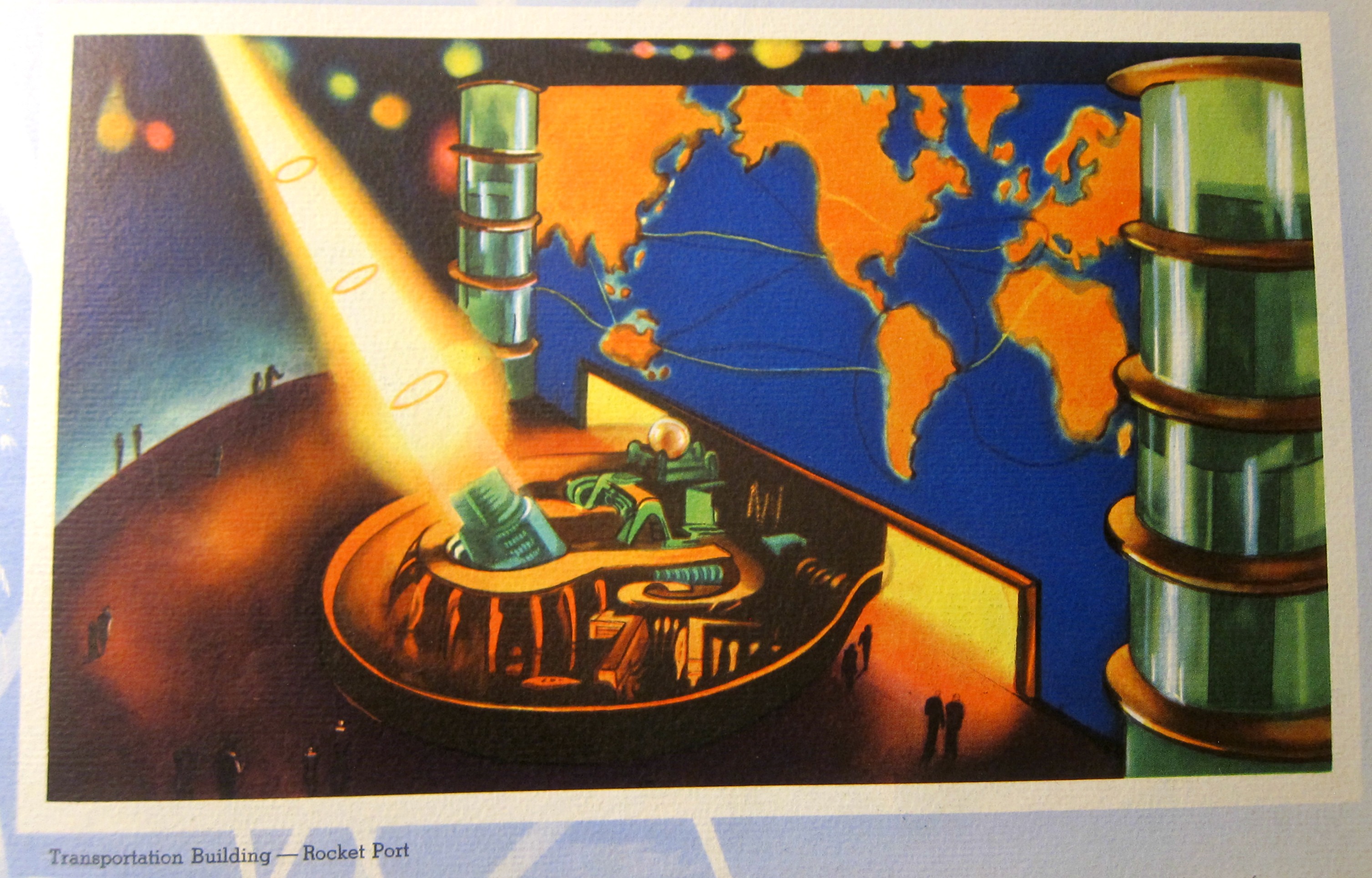
    The reason for the “dueling” int he title of this post is the following image that appeared in Views of the New York World’s Fair, 1939, published about a year later:

    Rocket port 1939

    The images are very similar, though the 1939 image is much fuller and a bit more contrasty, with heavier blues and more details in the “spotlight” or whatever that light source was in the center of the image. Also, there are no crowds to speak of in the 1939 image, jsut a few people scattered here and there, and there are also no futurismo boat or train.  I think I like the second one better….


  • Pre-History of the A-Bomb: Arming Nukes with Your Teeth, 1914.

    JF Ptak Science Books   Post 2741

    “Atomic Bomb” appeared in print for the first time thirty years before there was one. It appeared in H.G. Wells’ The World Set Free, written in 1913 and published in 1914, evidently before the appearance of the guns of August later in that year. The “set free” part of the world in Wells’ hands doesn’t come without an atomic struggle, though, much of the novel being a stage-up for the last bit in which people realize that atomic-bombing everything everywhere is not the way to go.

    There are other atomic-conjoined terms in this book besides “bomb”, and they are somewhat telling of the period. Wells does make a good strike with “atomic bomb”, “atomic ammunition”, and “atomic power”, and then goes on to describe the other bits that could benefit from this atomicity, including “atomic aeroplanes”, “atomic hay lorries”, “atomic traction engines”, “atomic riveters” (riveting at twice the pace of a human), and “atomic smelters”. So there are some weak spots here and there in his 57 mentions of “atomic-something”, and that’s okay—he did some pretty good sightseeing into the future with the bomb.

    And he was definitely the first to use “atomic bomb”, according to many sources and not the least of which is the OED (which also provides another interesting example of the word in use, quoting the Yale Review in 1917 “When you can drop just one atomic bomb and wipe out Paris or Berlin, war will have become monstrous and impossible”.) “Atomic-bombed”, “atomic bombing”, and “Atomic bomber” do not make their appearance in the English language until after August 6 in 1945.

    The first view of the atomic bomb in Wells finds that there not one but three of them, all contained in a “coffin-shaped box”, and even with a 2′ diameter were small enough to be stored under a person’s legs. The “essential element” in its construction was a substance named “Carolinum1”, which thus far had been “tested only in almost infinitesimal quantities within steel chambers embedded in lead”.


  • The 50 Million Volt Dust Curtain of Nikola Tesla (1934)

    JF Ptak Science Books  Post 2709

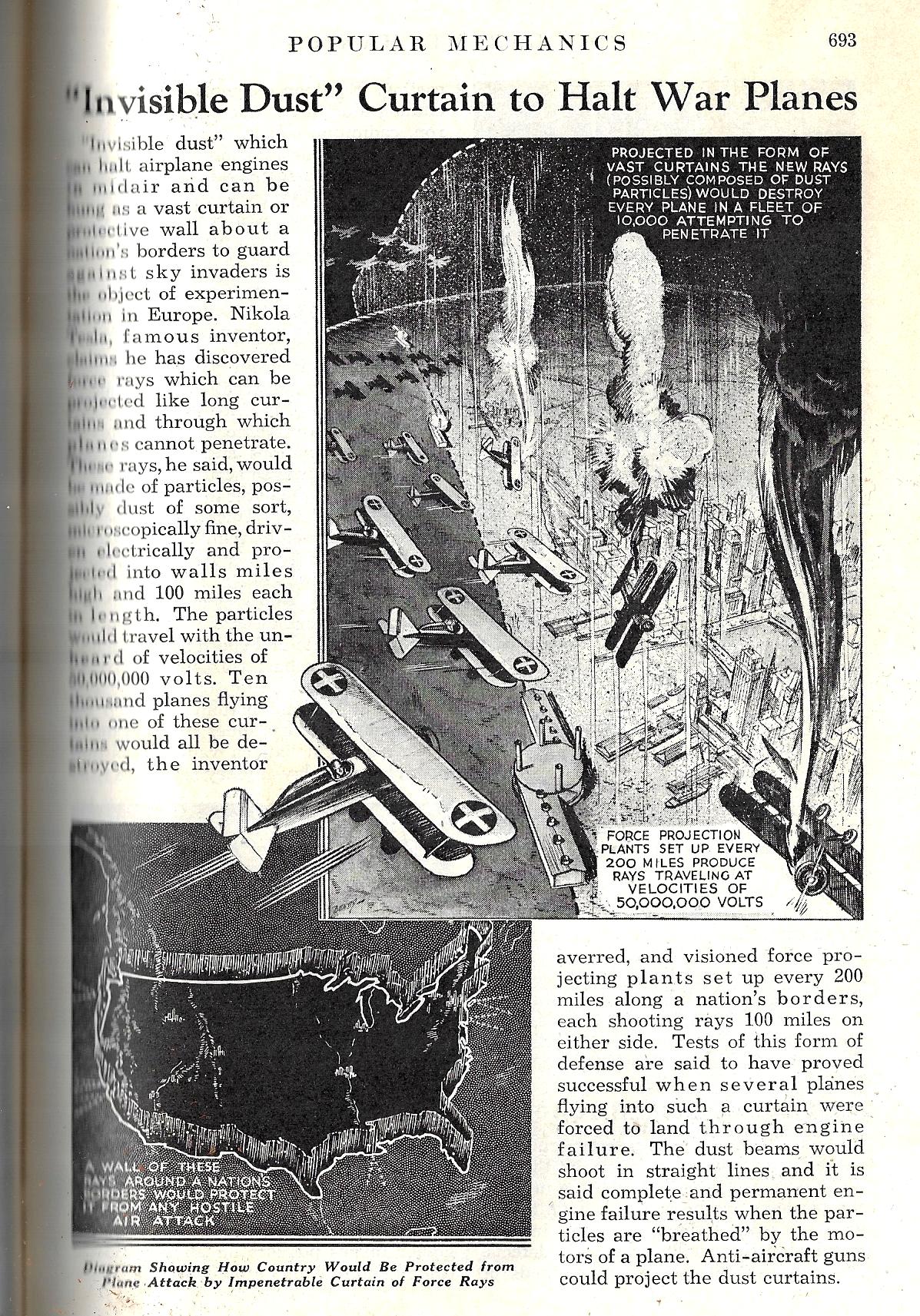
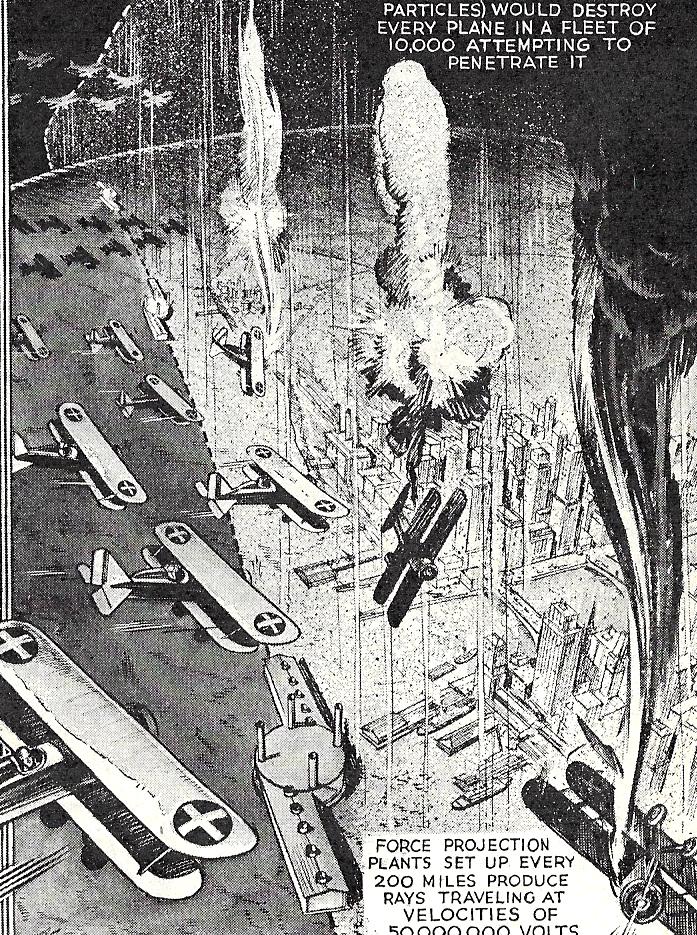
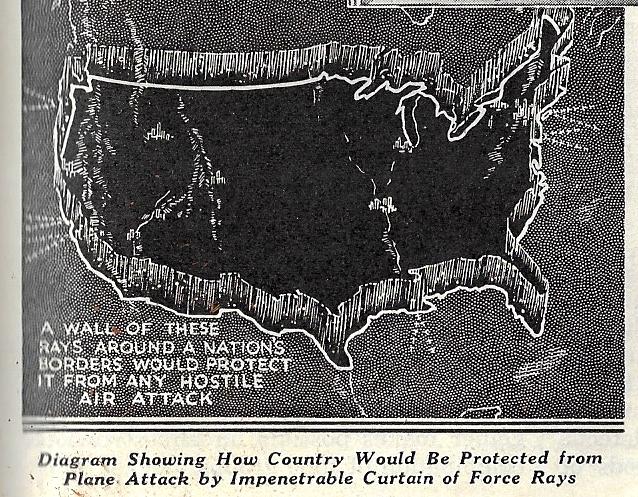
    Pop Mech 1934 TeslaThe “dust” in question here is not intended to be weaponized versions of those famous dancing bits of Brown and Einstein, but a very very high voltage-invisible-something that would obliterate any attacking air force or army. The idea is one in a long history of “death rays”, though this one belonged to Nikola Tesla (who had a much earlier outline for an idea on militarizing wireless telegraphy technology) and as such was received with considerable respect in the public and scientific spheres—or, at least in scientific areas, the low/no detail plan was given inspection and testing before it was dismissed.

    The popular press (Chicago Tribune, New York Times, Newsweek) reported that Tesla had plans for a country-wide defensive network that would basically make the U.S. Impregnable and put an end to war. One problem was that there were nearly no details offered for the plan—at least until this article (“Invisible Dust Curtain to Halt War Planes”) appeared in Popular Mechanics in November 1934. Even though this as an extended version of the idea, there’s scant detail in this article as well. But, Tesla being Tesla, the idea was given wide circulation.

    Simply put, the article reports that Tesla “discovered force rays which can be projected like long curtains and through which planes cannot penetrate” which was composed of “microscopically-fine” “possibly dust of some sort”bits “driven electrically” at “velocities” of 50,000,000 volts and which would form invisible walls that were miles high and surrounded the country. And so thus powered the weapon could destroy an army of one million and an attacking air force of 10,000. Somehow all of this would permanently disable aircraft engines as well as destroy soldiers.

    Pop Mech 1934 Tesla _2_

    Evidently the plan for this invention was based upon four other inventions which hadn’t yet been invented, which would explain the lack of details. Nevertheless, the National Bureau of Standards did investigate and attempt to reproduce something resembling the results that Tesla was trying to bring about, but obviously failed, even though Popular Mechanics had reported some successes in experimentation.

    It seems to me that Tesla’s technology was far more powerful and advanced than many of its fictional rivals like Flash Gordon and Buck Rogers, and maybe even so of the Martian weapons from Wells’ The War of the Worlds.

    Pop Mech 1934 Tesla _3_

    Notes:

    For an interesting read in this area I was surprised to what looks like a thorough and engaging work by William J. Fanning, Jr.: Death Rays and the Popular Media, 1876–1939: A Study of Directed Energy Weapons in Fact, Fiction, and Film (McFarland, 2015) page 95

    Also, it is a curious thing that when I googled “tesla” the first reference to Nikolai was at the bottom of the 9th page, nearly 100th in line after the car/company–and that is just all sorts of wrong.


  • The Invasion of Musical Robots, 1929

    JF Ptak Science Books    Quick Post

    Robot music _2__0001

    There is little doubt that scribes and woodblock cutters and such absorbed the stab of the movable type printing press, and that stationers felt the stab of modernity when the telegraph came into play threatening sales of paper generally used for letter-writing, an art form that they felt would be diminished by the new technology. At about the same time though came the second revolution in mail delivery, which made it cheaper and more regulated in using a more-competent mailing system, which meant an increase in letter writing. Ditto that for the telephone, which again would threaten written communication. Movies too threatened the theater, and on and on.  

    And so too for music, the musician, and recorded music. I suspect that in the 53 years since Mr. Edison’s invention of the phonograph that not many musicians made very much in the way of royalties for their recorded music, at least not at this early date. (On the other hand my guess is that there was a different economic experience in the sheet music department.)  On the other hand, there was a popularization of music far beyond what had been possible in the period before recorded music, so there was at least that direct and enormous benefit.

    Then came recorded music in theaters, which was a different thing entirely, as there was no real direct benefit to musicians–in this instance, live accompaniment would disappear in favor of recorded music, and so to the jobs of thousands of players.  

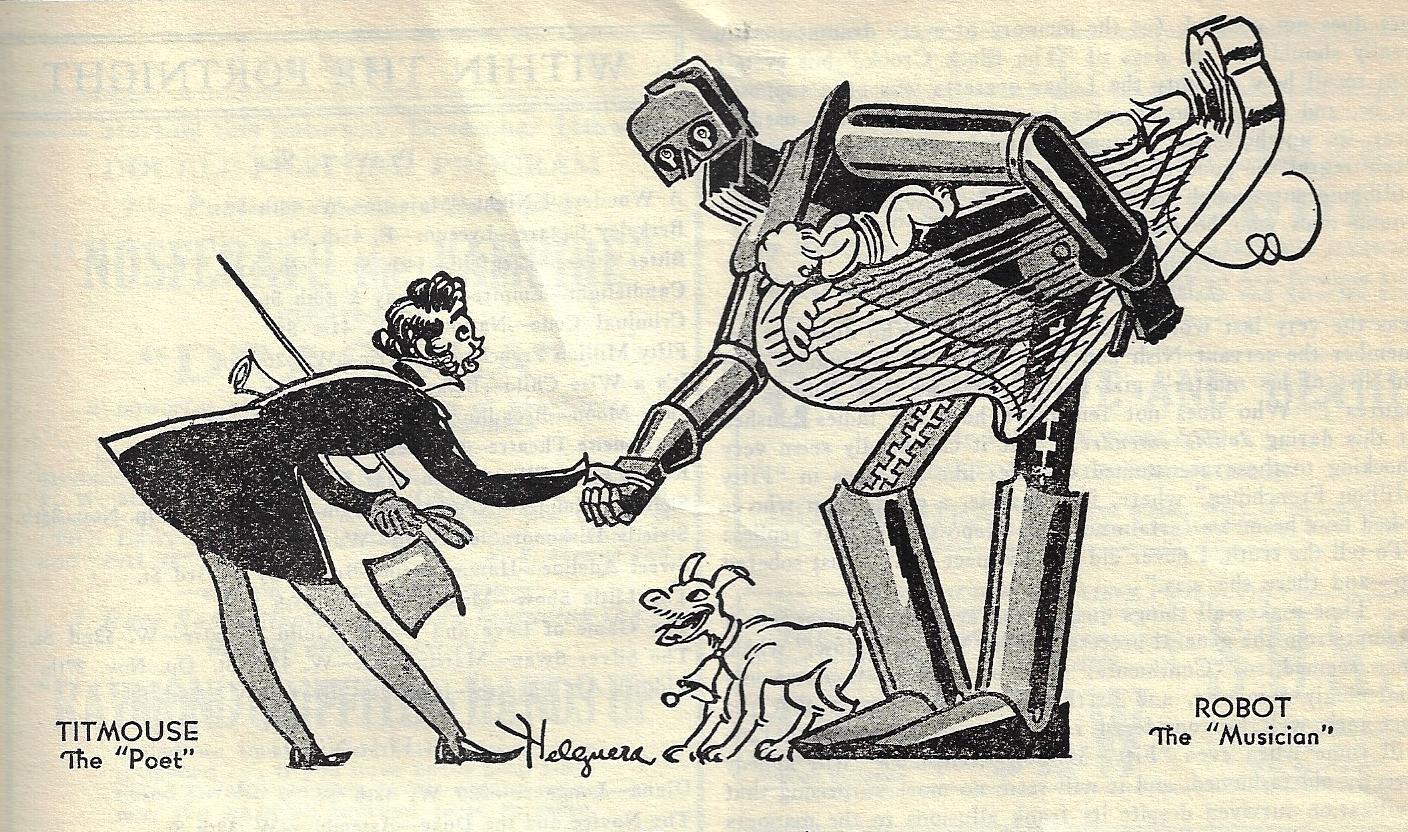
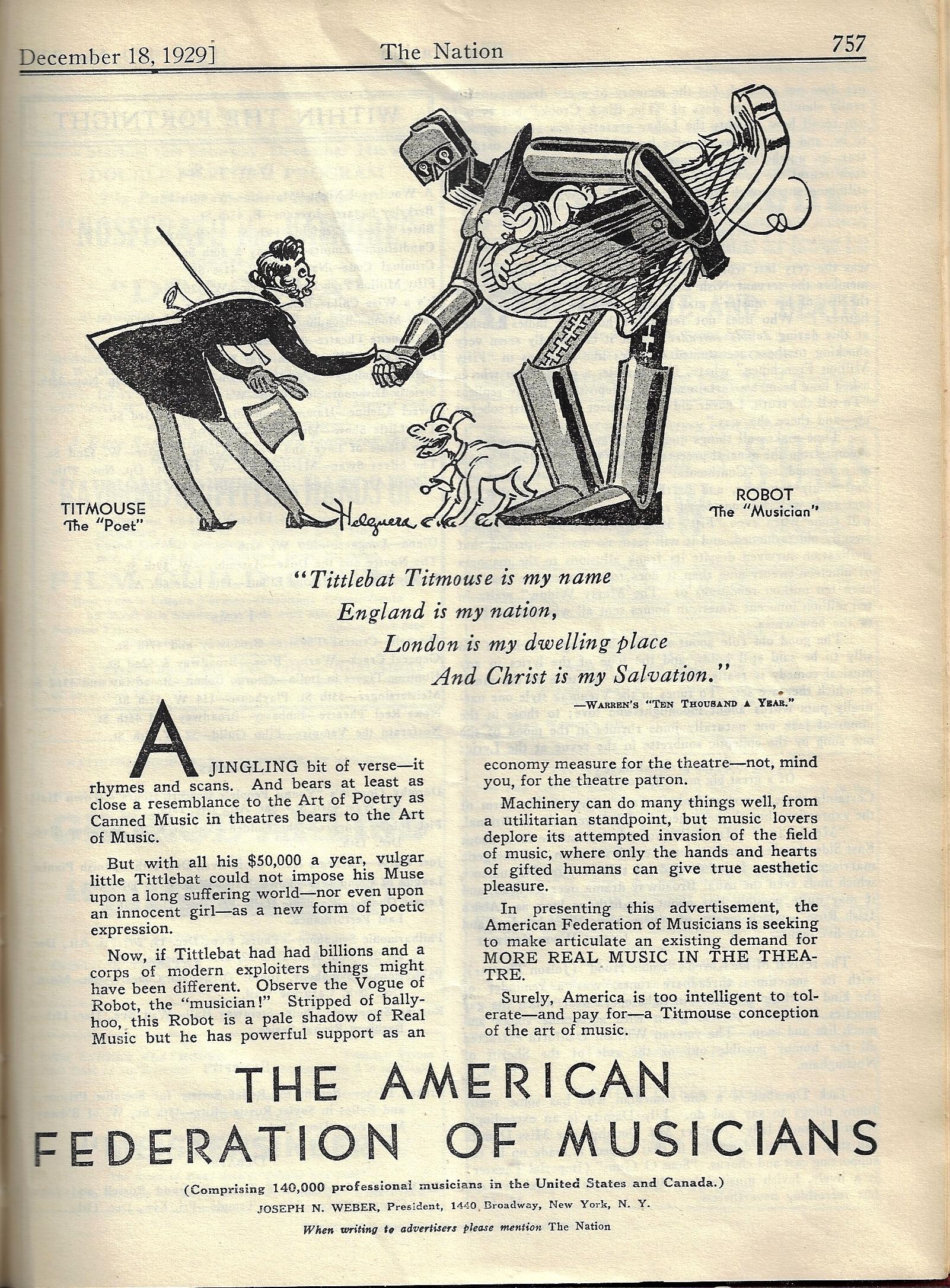
    And so the reason for this advertisement in The Nation, placed by the American Federation of Musicians, which found the idea of “canned music” to have nothing to do with “the Art of Music”, and representing it as a robot, “a pale shadow of real Music”. “Machinery can do many things well, from a  utilitarian viewpoint, but music lovers deplore its attempted invasion of music, where only the hands and hearts of gifted humans can give true aesthetic pleasure.”

    “Surely, America is too intelligent to tolerate–and pay for–a Titmouse conception of the art of music.”

    Robot musical _1__0001


  • A Peek at the Future in Which Jobs Are Not Threatened by Machines (1940)

    JF Ptak Science Books  Quick Post

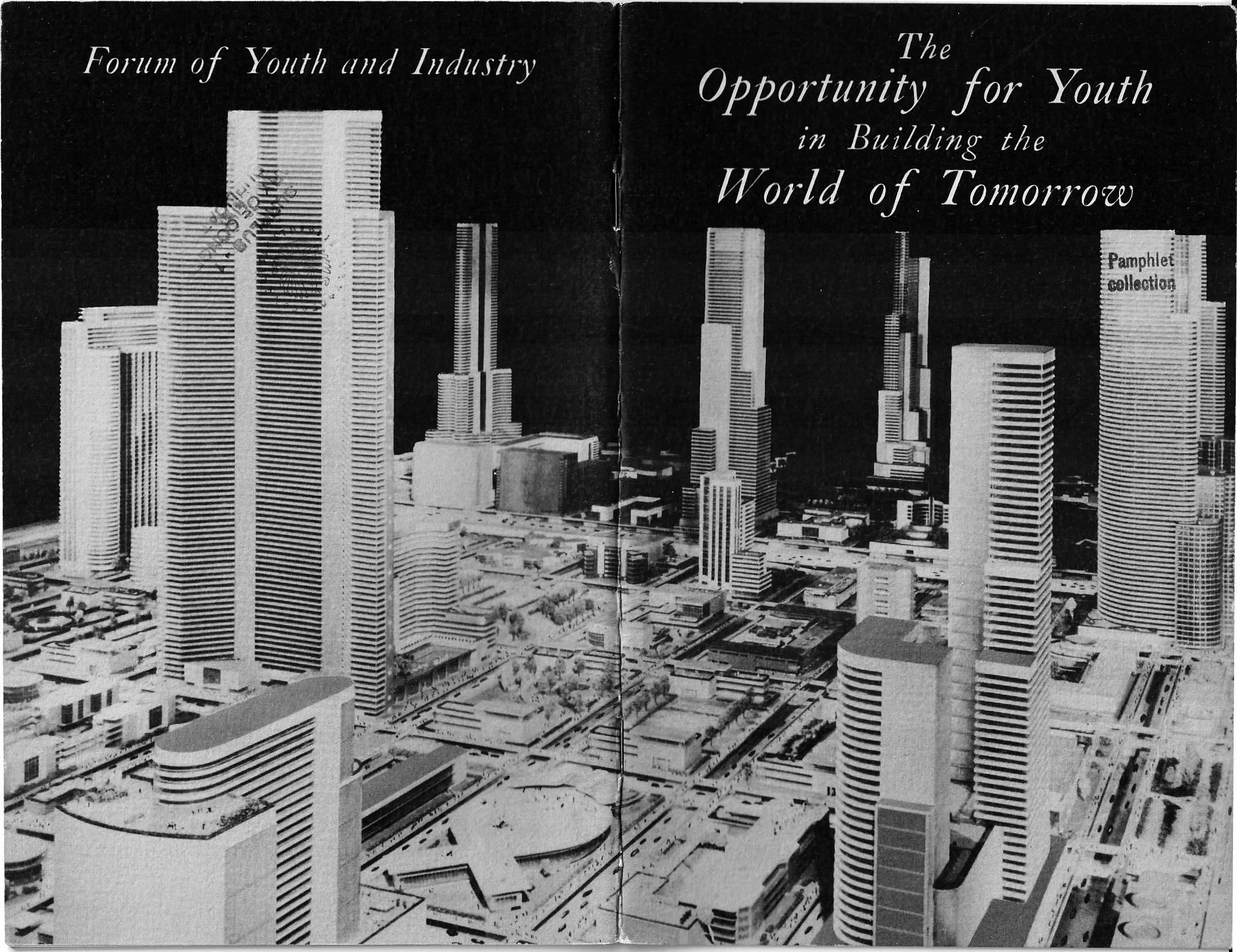
    Book covers world future architecture opportunity youth

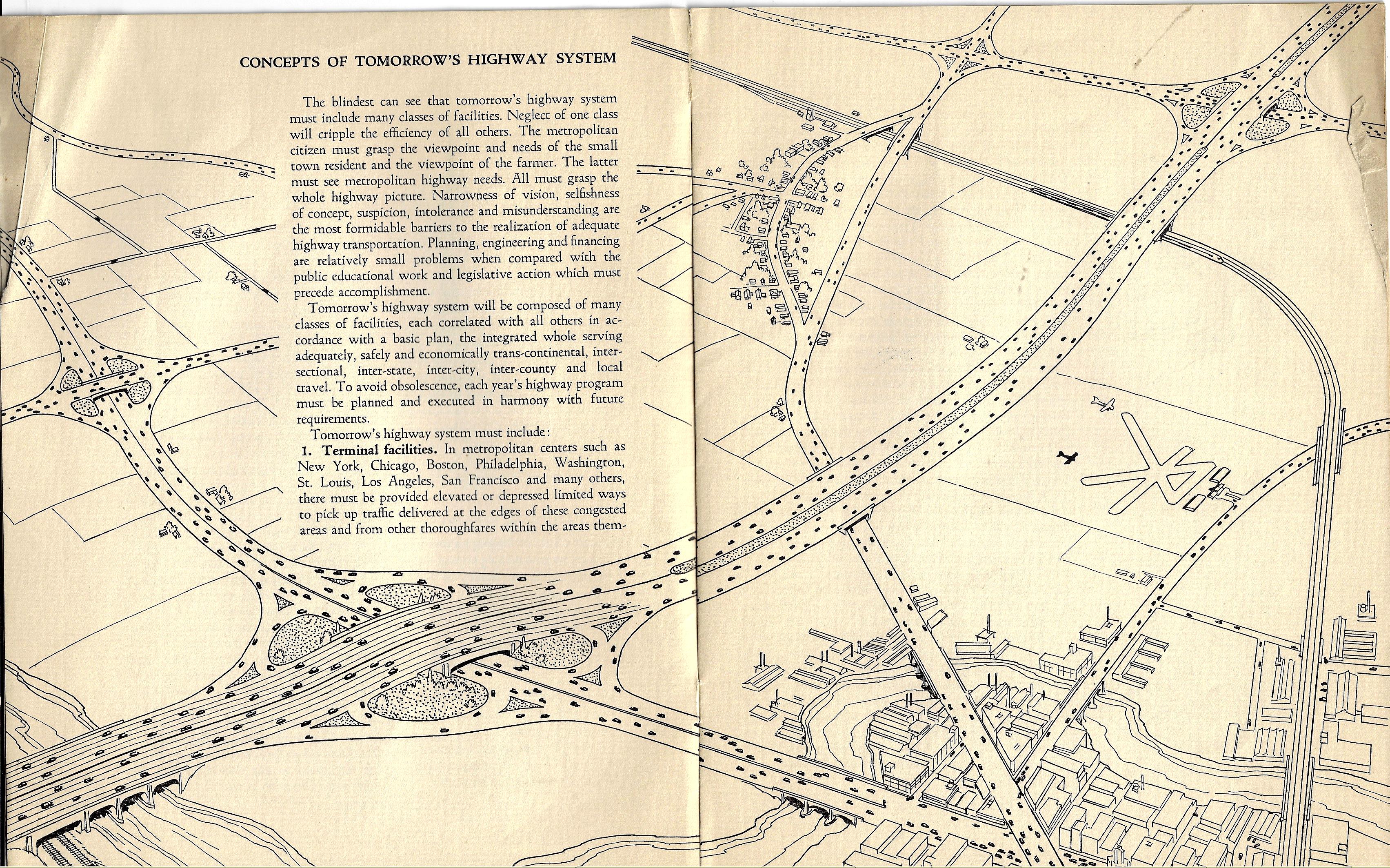
    This is the front and back cover of a little work directed at upper-aged kids in 1940 about how they might be employed and what life might be like in the future.  The Opportunity for Youth in Building the World of Tomorrow, published by General Motors in 1940, is a lot more sanguine and less interesting than its cover, sorry to say–but the cover is enough to reprint here, all on its own.  

    There is one odd thing, one missed peep into the future, and it is made by a great figure in the history of 20th century science, Karl T. Compton, who at the time was president of MIT. He responded to a question about the impact of mechanization in a short section labeled “Man vs. Machine”. Dr. Compton got a lot right in his life and saw a lot of things that other people didn’t or couldn’t, but in 1940, he couldn’t see very far into the future of the machine.  Of course there’s a particular irony with this vision and what would happen with humans v. robots at GM.  So it goes. 


  • The Highways of Tomorrow 1937 (and 1938)

    JF Ptak Science Books    Post 2701

    The future–as presented in the following two pamphlets–was coming, and it was guided on a 100′-wide flat ribbon of cement, with a life-blood moving along it at 45 mph.  It is presented by Frank Sheets (president of the American Association of State Highway Officials), and the world looked like the cement that would be produced and purchased from the publisher of this pamphlet, the Portland Cement Company. And they’d be right, there would need to be something for the exploding auto market to get to and fro on the expanding horizon of city- and suburb-spread. To that end there exists in this work a proposal for 3 million miles of highways at a cost of $57,000,000,000, which was equal to about 75% of the entire budget of the U.S. government. It was a big plan–the proposal itself can’t be found in the pamphlet.

    Highway of the future

    [Source: Frank T. Sheets, The Highway of Tomorrow, Delivered at the Annual Meeting of the Greater New York Safety Council at Hotel Astor in New York City, April 14, 1937.] 

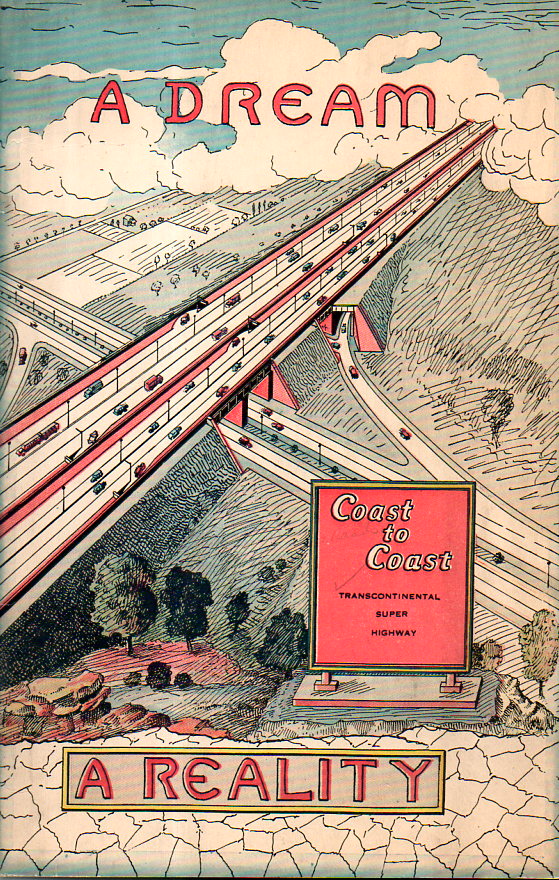
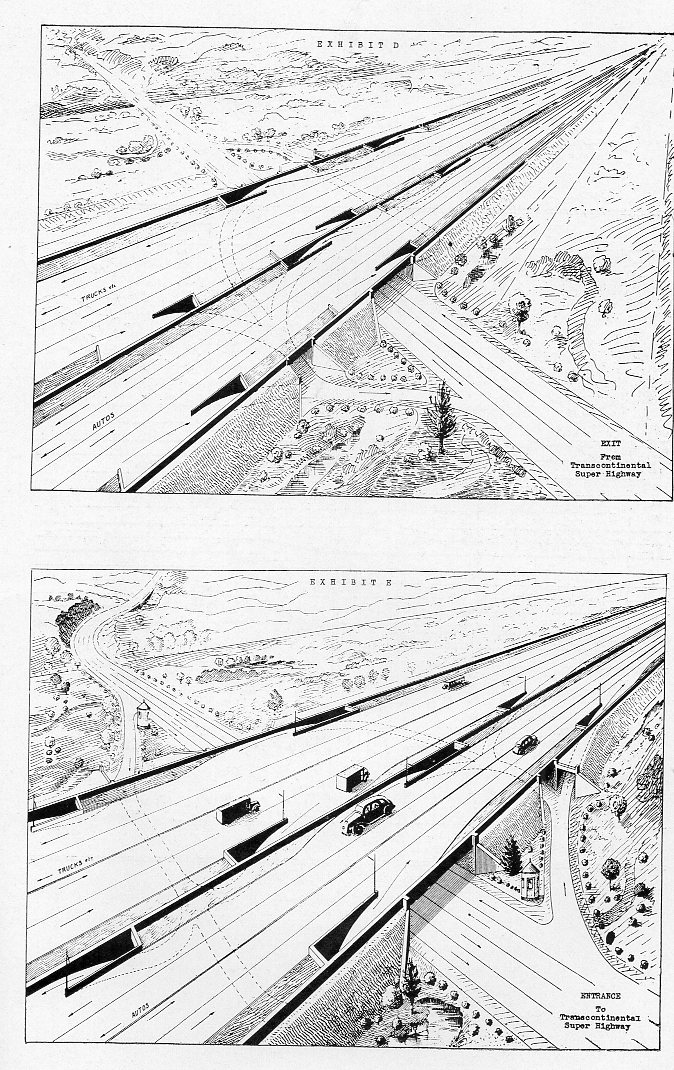
    Another vision of the future A Dream, a Reality” and/or “Coast to Coast Transcontinental Super Highway isn’t actually the title of this work even though they are on the cover; it is mostly a caption for an interior image though it somehow percolated topside.  The real title is The Highway of Tomorrow made Possible by the Ideal of Today, which gets to the subject of the work even though it is slightly unwieldy. It is difficult to say who wrote this though Mr. T.E. Steiner (“Sponsor”, of Wooster, Ohio) and which somehow found its way to a fourth edition in its two years of existence, published and promoted in undoubtedly small numbers by the “Transcontinental Stream-Lined Super Highway of the United States of America” in 1938.

    Highway visionary120

    This is all about super-highways, and mainly replacing the old roads with four new roads that are as straight as straight could be. A map of the proposals features one line of the highway is straight from San Francisco to Boston; another from Laredo, Texas (!) direct to International Falls, Minnesota (!);  a third not-straight shot from Boston-Allentown-near-Valdosta Ga-Miami; and another from near-Valdosta to Cleveland. A schematic of this map though drops near-Valdosta for Jacksonville, and has the Boston-Miami route further east to include NYC and D.C., which are omitted from the map.  Ah, well.

    I think that the author–an accomplished “business man” was was the head of a “manufacturing company” in Ohio and a coal company in West Virginia (and “employer of labor”) –was not much of an engineer, because the plan ignores topography and the highway design itself is pretty bad, especially the parts on exit/entrance (which the author takes particular care to note are separately copyrighted (?)) bits, which are killers. 

    Highway visionary121

    In any event, the super highway extending into the clouds on the cover is all I’m here for.  Mr. Steiner no doubt attracted some attention for the project because of the enormous pork and public works potential, what with the building of 6,000 miles or whatever of an 8-lane highway, which is billions of square feet of paving times some multiplier.  So a lot of money would be spent, which means, well, a lot of possible interest–after all, it did get so far as a hearing before the Committee on Roads, U.S. House of Representatives, on May 18, 1937.

    This no doubt was a “visionary”proposal of some sort, though the engineering aspects of it were more imaginary than anything else. 


  • Propaganda Maps–a Play for Greater Germany, 1938

    JF Ptak Science Books   Quick Post

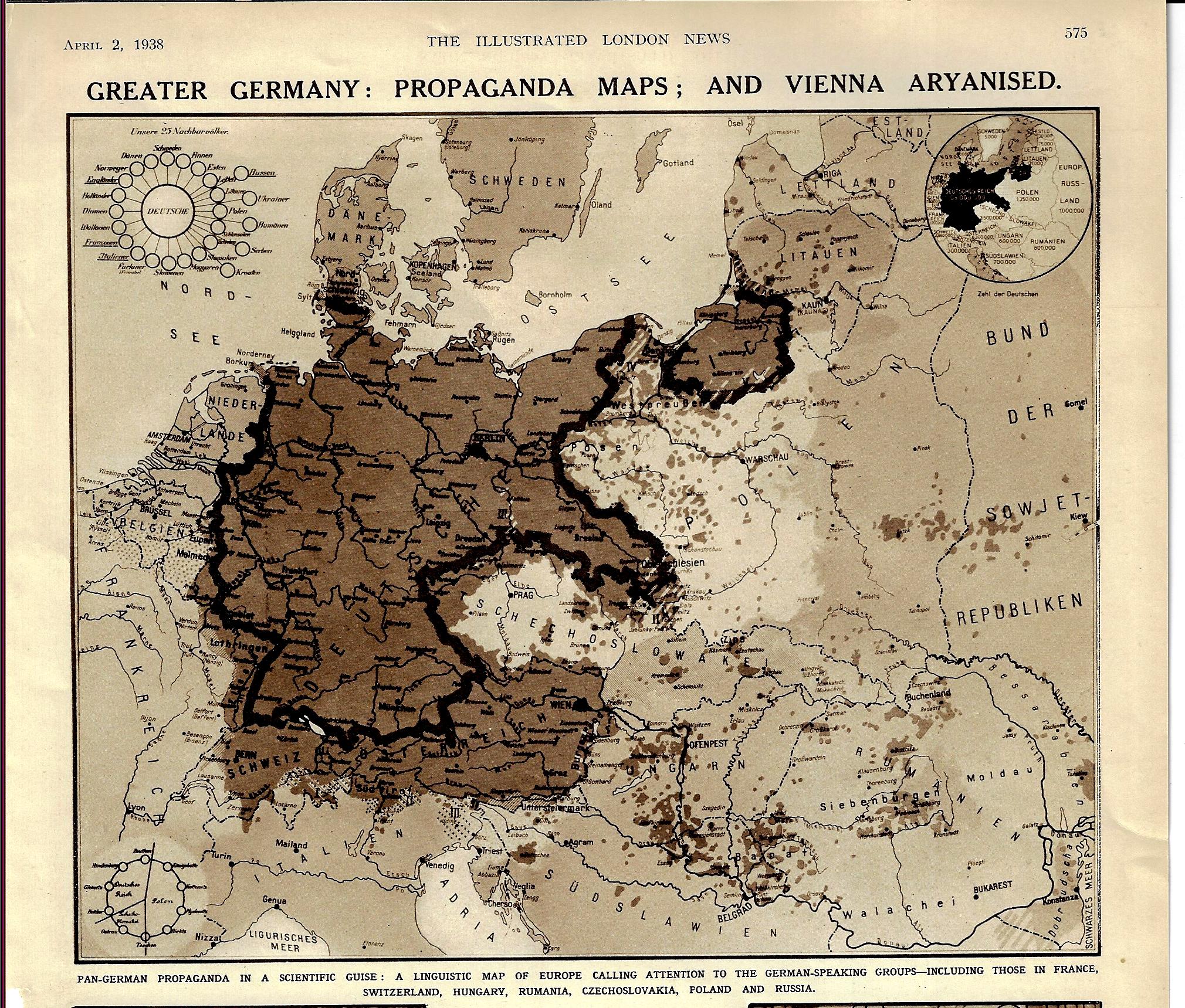
    Maps Propaganda German speaking 1938

    [Image: The Illustrated London News, p 575, April 2, 1938.]

    The title and the date of this map pretty much tells at least the partial story of the beginning of WWII. The “Aryanized” Vienna (Wien) shows up with the rest of Austria as German-speaking but also outside the boundaries of Germany, even though the Anschluss Österreichs occurred about three weeks earlier. “Pan Germany” was still figuratively so, in spite of the absorption of Austria.  Prague sits nearly surrounded by Germania irredentia, and of course Czechoslovakia was next, with Germany beginning the theft of the country that October, and then only about a year after the appearance of this article, Hitler was giving a speech at Prague Castle, also declaring Bohemia and Moravia to be the Protectorate of Bohemia and Moravia. This linguistic map certainly portrayed the gaping maw of the Nazi Kraken, Germany declaring that these actions was a natural right in the protection of Germans-outside-Germany. 


  • Moving Stationary People on a Moving Sidewalk and Not Moving People on a Stationary Sidewalk (1903)

    JF Ptak Science Books   Post 2684

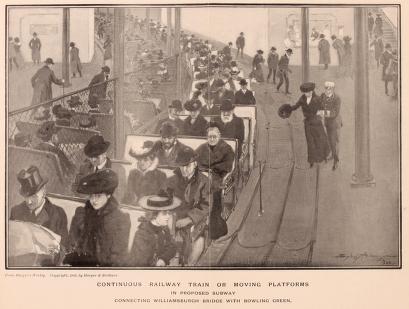
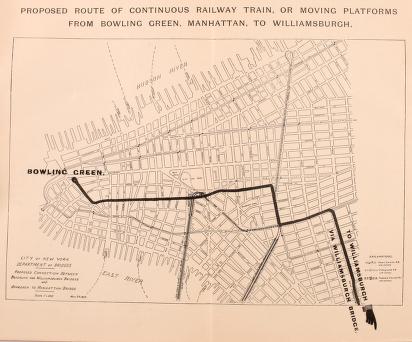
    I came upon this interesting pamphlet and thought to share it: Transportation of Passengers in Greater New York by Continuous Railway Train, or Moving Platforms.  Argument in favor of equipping the East River Bridges, and connecting subway to Bowling Green, Manhattan, with a continuous railway train or Moving Platforms. It was prepared by Schmidt & Gallatin, of New York, and printed in 1903. (Oddly it is the pamphlet that I started working on directly after working through a 1903 double-brick volume of the Journal of the American Chemical Society.) It is only 20 pages long, but decorated with four folding plates, including two maps, and two drawings of the envisioned walkways. 

    Sidewalks 3

    This seems a wonderful example of future thinking and city planning–but just not a very good idea.  It is hard to imagine a continuously moving sidewalk functioning in lower Manhattan. 

    From the pamphlet: 

    “Moving Platforms for the conveyance of passengers were recommended by Mr. Horace Greeley thirty years ago. They were successfully operated, first, at the World’s Columbian Exposition of 1893, where 2,700,000 people were transported. In 1896 they were installed at the Berlin Exposition, and again at the Paris Exposition of 1900, where they carried over eight million passengers. Few persons know what Moving Platforms are. From the face that sometimes they are called ” Moving Side- walks,” it is believed that they must be some sort of a pavement on rollers, on which it is difficult to step with safety and maintain equilibrium. The Moving Platforms are to all intents a railway, operated like other railways, propelled by electricity, with cars, seats, motors, passenger stations, ticket booths, guards, electric lights — in fact, everything belonging to a first-class railway.” 

    Sidewalks map

    “Where it differs from the ordinary railway is that the cars, or trains, are not running at intervals, but are coupled up continuously, so that there is no interruption of traffic at any time, but a large seating capacity at all times. It differs also in the construction of the cars, which are mere flat cars, provided with seats placed crosswise, and so arranged that all passengers face in the direction of motion. Each of these seats may be made wide enough to accommodate one, two or more persons. The most approved plan is to provide seats on one side of the cars only and leave the other for passengers to walk, thus giving them an opportunity to further accelerate their speed if they so desire…”