A Daily History of Holes, Dots, Lines, Science, History, Math, Physics, Art, the Unintentional Absurd, Architecture, Maps, Data Visualization, Blank and Missing Things, and so on. |1.6 million words, 7500 images, 4.9 million hits| Press & appearances in The Times, Le Figaro, Mensa, The Economist, The Guardian, Discovery News, Slate, Le Monde, Sci American Blogs, Le Pont, and many other places… 5000+ total posts since 2008.

Category: History of the Future

  • Color and Its Abuses–the New York World’s Fair, 1939

    JF Ptak Science Books   Post 2569

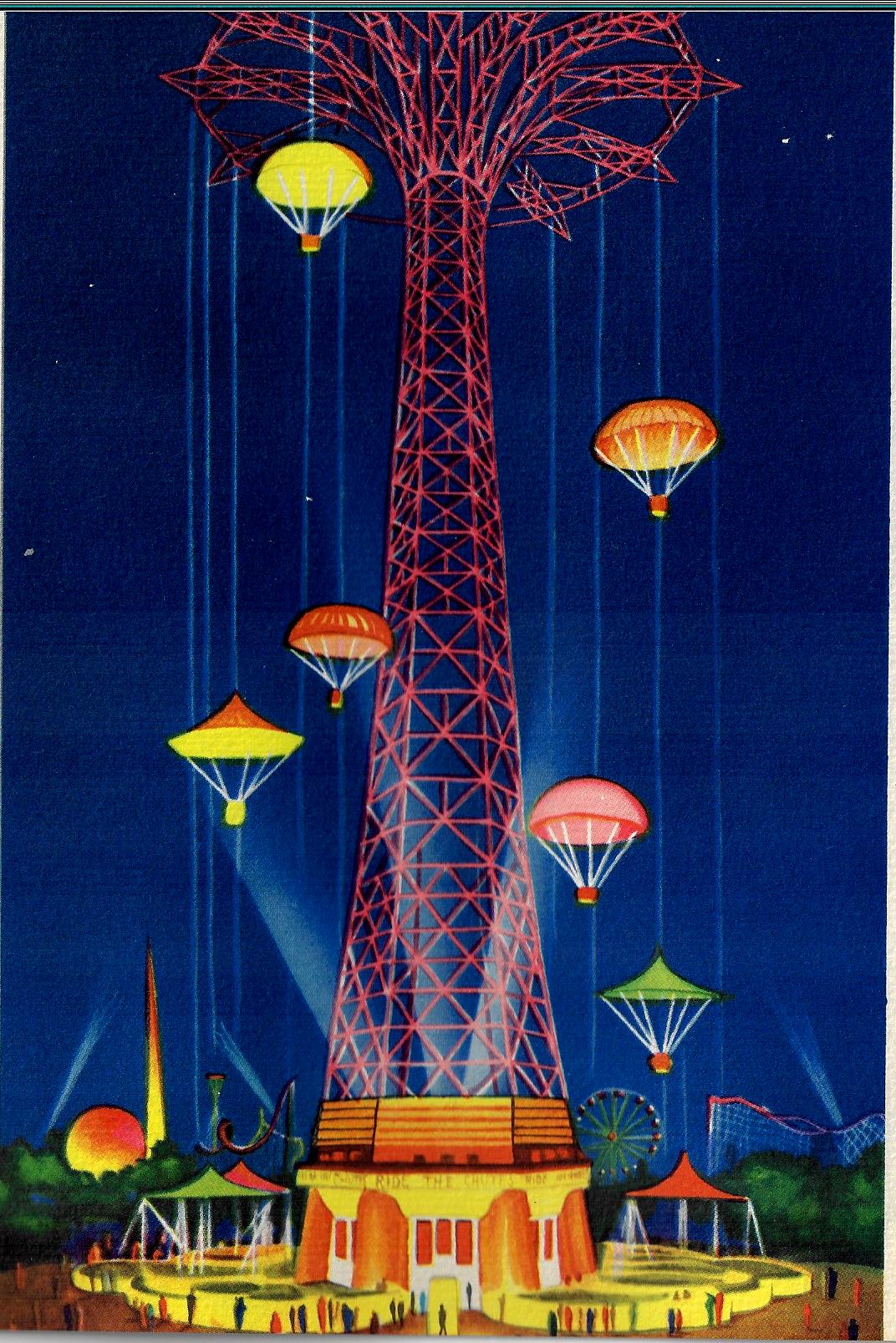
    Color and its use and abuse is a very personal thing—especially the “abuse” part. The pamphlet below (Views of the New York World’s Fair, 1939, and published that year) to me is certainly one of those entries in the history of the abuse of color, not so much that the colors used in it are odd together, but the saturation of color across the board leads to something like Splendorama hyper color. I’m not sure why the colors are like this–they remind me of a color equivalent of a laboriously and not-very-good translation of a tech manual. It isn’t as though color printing was new in the publishing industry, as books had been printed in different colors besides black for at least 300 years by this time;  even full-color printing had been around for 120+ years, so it isn’t as though they were experimenting with the color equivalent of newly-available typefaces in a 1985 word program. Color photography in books is brand new at this point, the wide-scale use taking place this year, but these images are not photos, so I doubt that this had much of an effect on the creativity of the designer. 
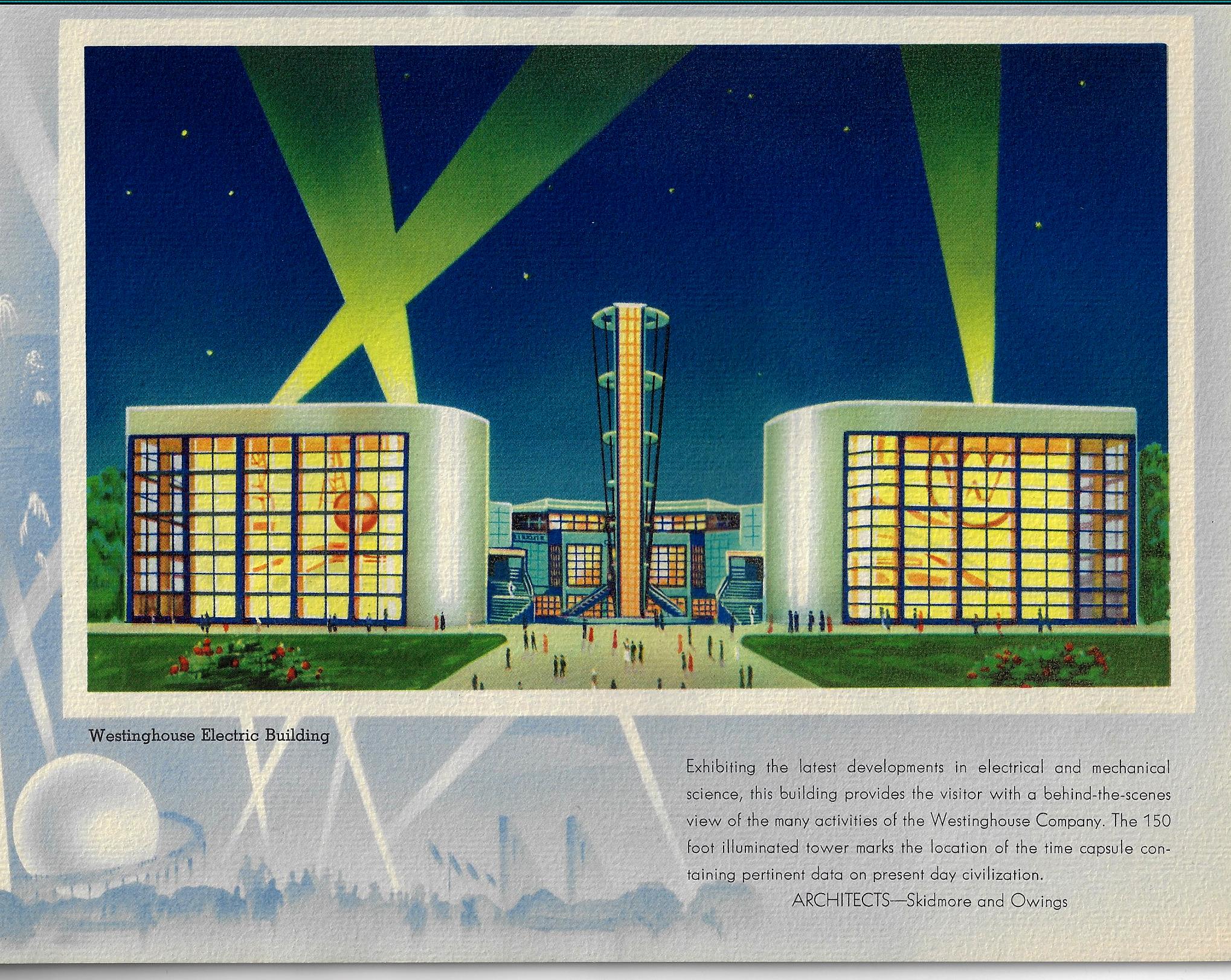
    COlor NYC Worlds Fair 1939 _1_

    Since a few of these images are quasi-sci-fi, I even wondered about the color influence in speculative novels and movies.  Color was very adventurously used int he early sci fi pulps and monthlies, but that stuff was already being employed for two decades by this point so their newness in regard to publishing experimentation is not an issue.  And so far as sci fi and color in the movies goes, that also wasn’t an issue because it didn’t exist yet, as the first color film1 in that genre didn’t appear until Lesley Selander’s awful Flight to Mars (1951).
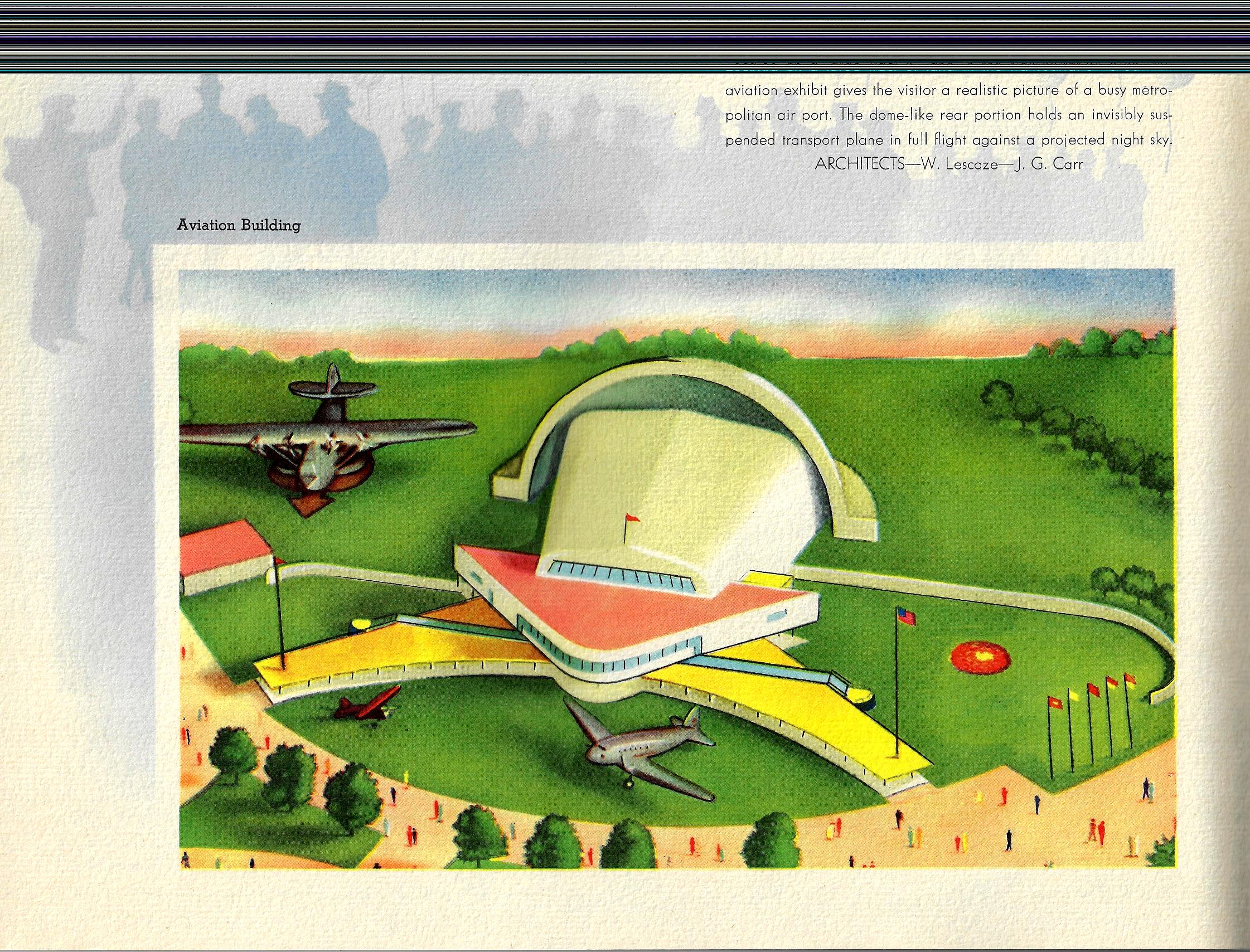
    Color NYC Worlds Fair airport

    In short, I don’t know what is going on here, color-wise.  
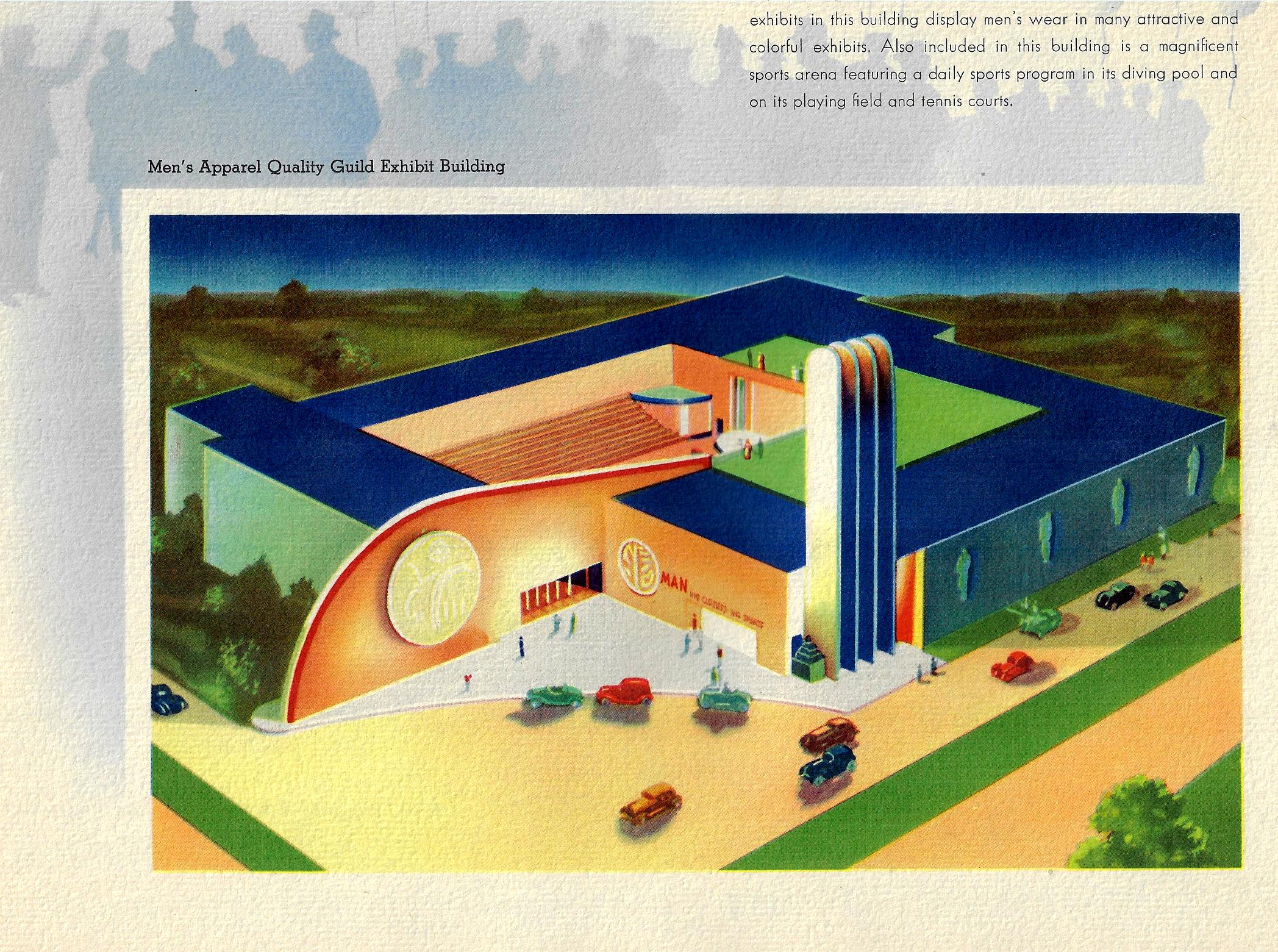
    Color NYC Worlds Fair _3_

    Notes:

    1.  Flight to Mars, from Monogram Studios, was about a manned flight to Mars in 2000,  There was another unusual film, I think it was Destination Moon at about the same time, where the spaceship overshot the Moon and went to Mars instead. This note though is in regard to the Georges Melies film, Le Voyage dans la Lune (1902), which did have some color, though that was tediously applied by hand in post production.  (Invaders from Mars (1953), by the director William Cameron Menzies, was the next sci fi flic made in color.  
      Color World fari 1939 _4_


  • A Pulsating Bee-Wing Aircraft, 1934

    JF Ptak Science Books  Quick Post

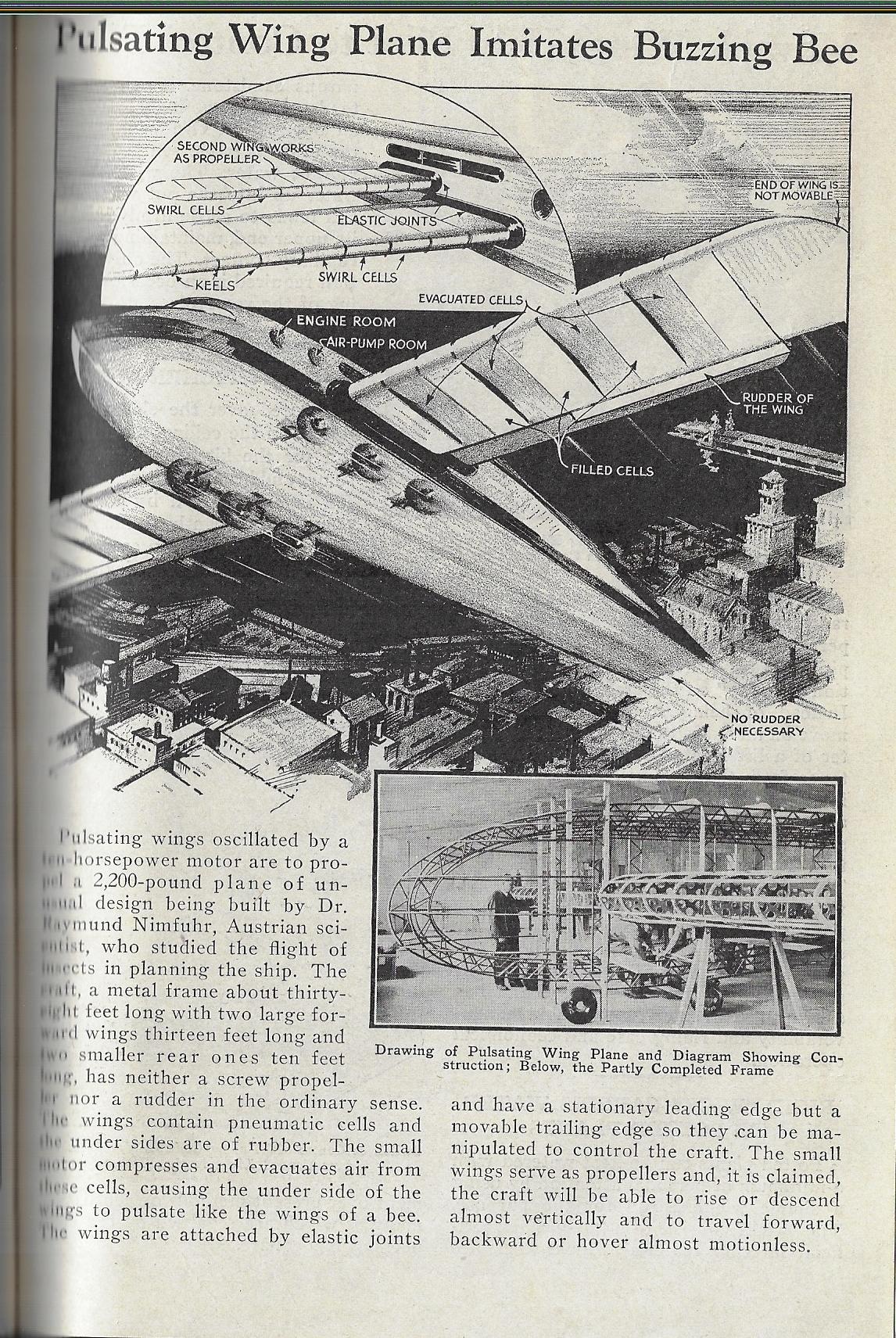
    Another interesting bit as a result of scurrying around a 1934 volume of Popular Mechanics looking for something else:  a propeller-less aircraft moving through the air on bee-wing-like pulsating wings. The image of the aircraft certainly makes it appear fairly large for 1934, but it turns out to be 38′ long–we are told in the first sentence that it weighs only 2200 pounds and is powered by a ten-horsepower motor–I have no idea how this would work. This is the idea developed by Raymund Nimfuhr, “an Austrian scientist” about whom I can find nothing except for references to this article. The aircraft was supposed to have the capacity of forward and backward flight, in addition to being able to remain almost motionless while hovering.  

    Pop mech pulsating wings 1934

    Pop mech pulsating wings 1934 _2_


  • A Flying, Floating, Submersible Dirigible…and Monster Flying WIng, 1921

    JF Ptak Science Books   Quick Post

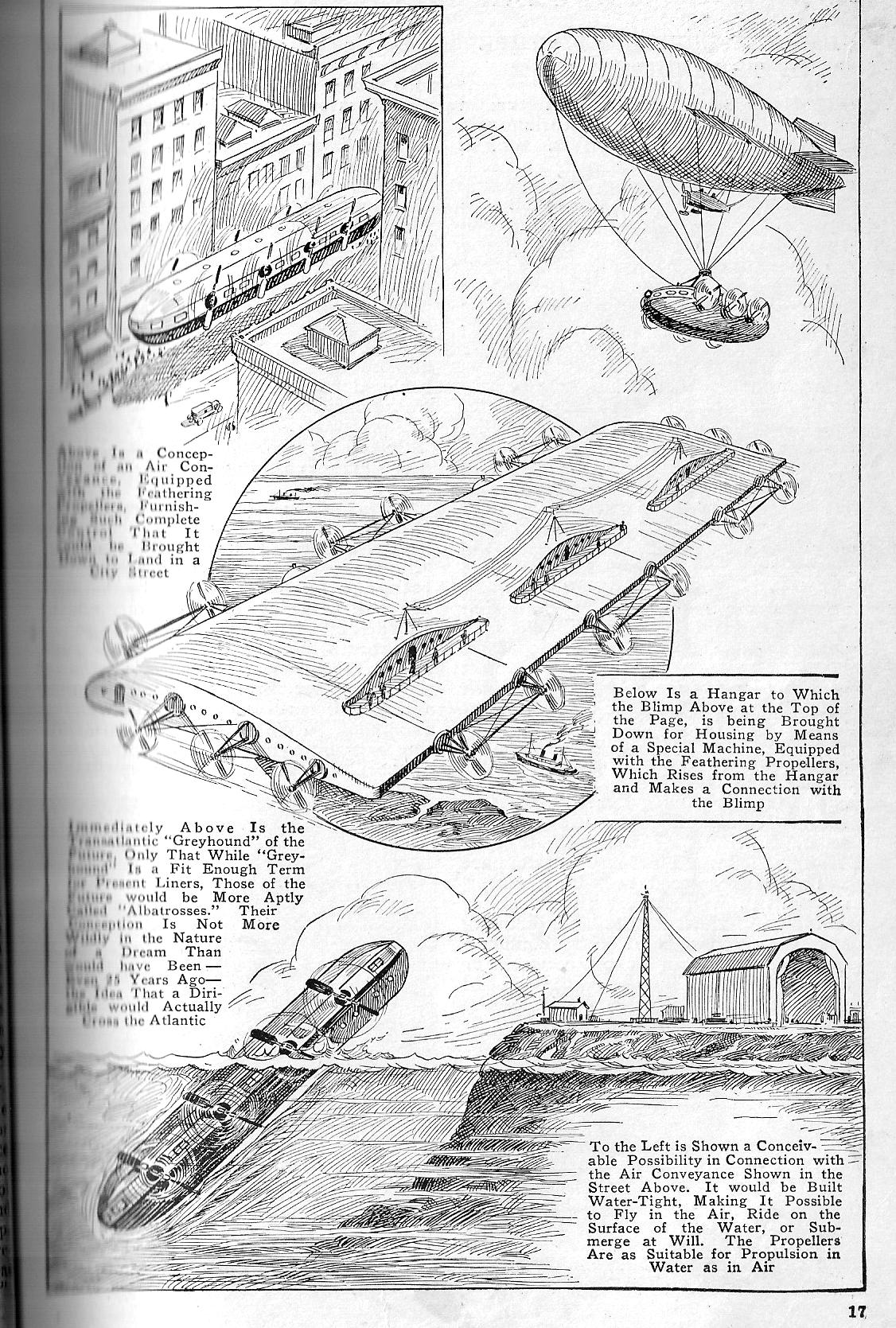
    Normally I wouldn’t qualify a dirigible as “flying”, except here it works because this imagined dirigible can also function as a submarine, which is something I am pretty sure I’ve not seen before.  It is a wonderful and wild idea, especially when coupled wit the other imagery, showing the same dirigible landing softly in a city street using its eight “feathery” propellers.   As high-in-flight as this may seem, and as lovely as the idea of having that same aircraft be submersible, there is also the fabulous and monstrous flying wing (center), which may may grab top billing in this image of the future of air travel.

    Pop mech giant dirigible 1921

    [Source: Popular Mechanics, volume 36, July, 1921.]


  • Mechanization Taking Command in a Robotic Carpark (1921)

    JF Ptak Science Books   Post 2656

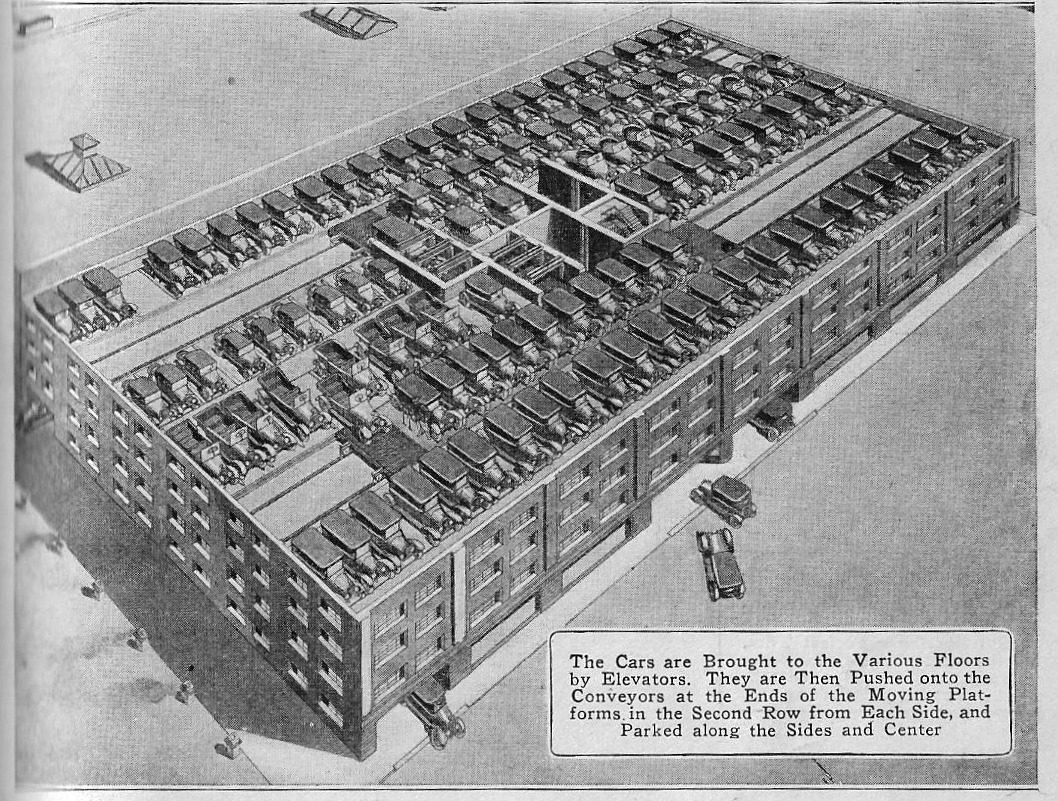
    There are many instances of assembly-line manufacturing before Henry Ford, but none were nearly as complete and extensive and done on such a large scale as the principle and practice he established in 1913.  The idea became generalized and (to a degree) fashionable, and the practice started being implemented in many other business wide and narrow.  To a certain extent that applies to this parking garage proposal that appeared in Popular Mechanics in December 1921. the effect of this idea here is the introduction of the building-as-robot, though the idea in this form didn’t yet exist, nor did the term “robot”. In any event the building took care of the customer’s car once the car had been driven in–attendants would drive the car to an access point for a conveyor and perhaps an elevator, and deliver the car to its designated slot, much in the same ways some libraries operate in storing some of their more obscure books.  

    I guess that “Taylorism” works its way in there, too. Frederick Winslow Taylor (born in 1856 but dead already at this point by six years) introduced a study of business in his Principles of Scientific Management, and that was a synthesis of humans with their environment and tasks to produce a more business-harmonious utilization by increasing the workers’ productivity  via time/use studies, making the worker more a part of the business machine, and in a sense a Borg-like part of a techno-human robotic industry.  Among other things Taylor discovered to the hatred of hundreds of thousands of laborers that the short-handled shovel (villainized in the Song “Big Rock Candy Mountain”) was the better tool to use in many shoveling tasks even though the thing itself is a back-breaker that no worker would choose to use.  Anyway, int eh history of robots, both of these bits deserve some attention. 

    Pop mech carpark 1921

    [Source, Popular Mechanics, December 1921, vol 36, p 751.]


  • Nazis and T.V. (1944)

    Nazi tv770JF Ptak Science Books   Quick Post

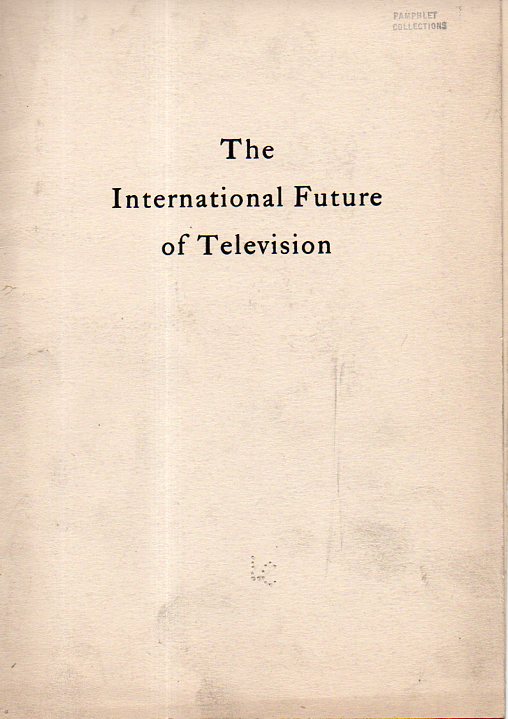
    In all my exposure to the history of WWII  I am pretty sure that the only reference to Nazi television has been along the lines of the Berlin Olympics or Carl Sagan’s Contact–that and some dim memory about Hermann Goering somehow in the great bowels of the labyrinthine Nazi bureaocracy being in control of German tv broadcasting. The International Future of Television, an address by Paul Railbourn before the American Television Society in NY in January 1944, discusses the possibility of television in the Post WWII era–and in that, stresses in no uncertain terms that the Nazis should not have access to the new medium. Railbourne (who would later become a VP at Paramount Pictures) talks about how Hitler utilized and dominated the radio, and how after the war re-education of Germany was necessary along with free enterprise undertaking of newspapers, radio, television, and motion pictures.

    He notes that “The Nazis are well aware of the importance of television…destroy the Luftwaffe and the Krupps Armament works, but leave television in their hands, and we shall be leaving them with the most powerful weapon of all…”

    To that end the author discusses post-war control of radio and television in German. He also talks about establishing television networks throughout the U,.S. as quickly as possibly to “capture world leadership in television programming” and “carry the gosphel of the Four Freedoms to all mankind”.  “…Television will play a vital role, for good or ill as it is intelligently or evilly directed, in the establishment and maintenance of an enduring peace, once the present war comes to an end.”

    Railbourne made good sense, and had I think a pretty good idea of the coming possible influence of the new medium.


  • Robot Songs of Love (1930)

    JF Ptak Science Books  Post 2637

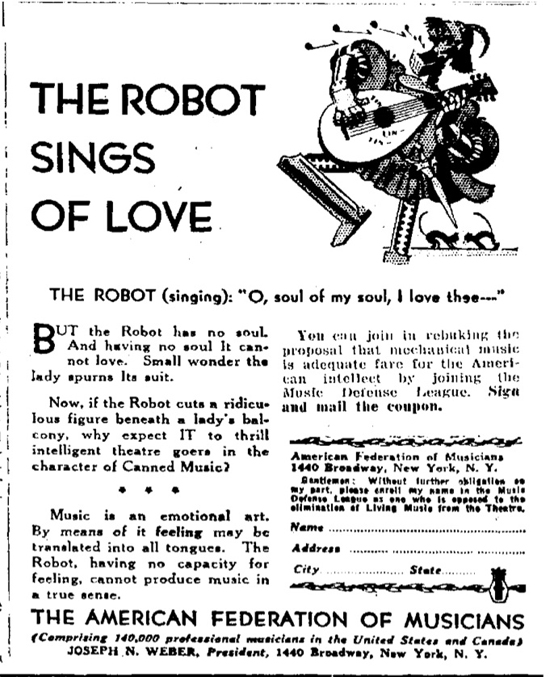
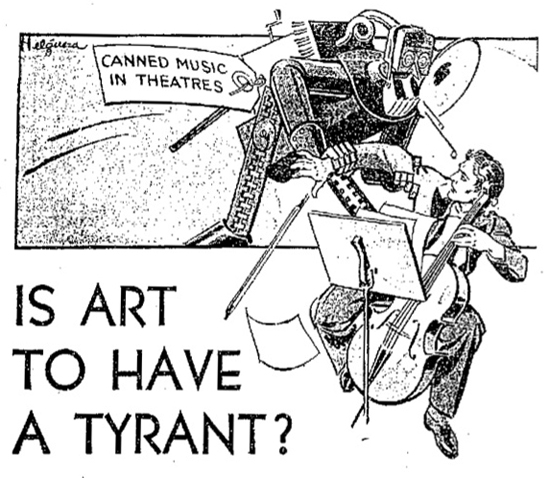
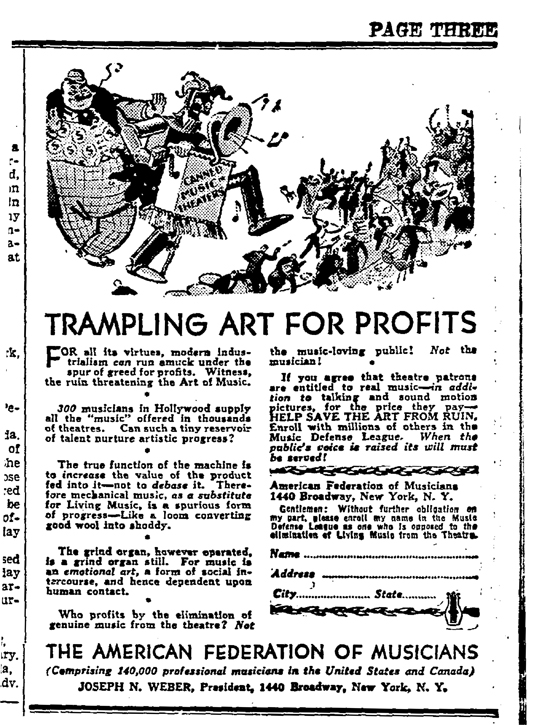
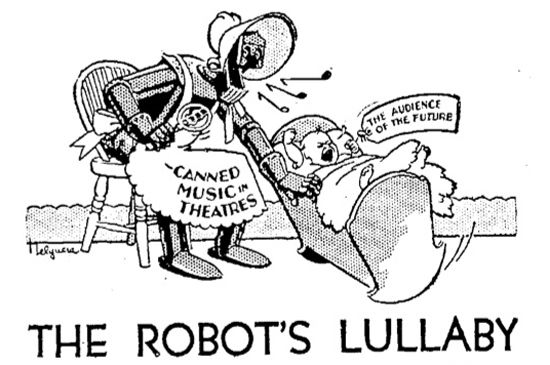
    There is little doubt that scribes and woodblock cutters and such absorbed the stab of the movable type printing press, and that stationers felt the stab of modernity when the telegraph came into play threatening sales of paper generally used for letter-writing, an art form that they felt would be diminished by the new technology. At about the same time though came the second revolution in mail delivery, which made it cheaper and more regulated in using a more-competent mailing system, which meant an increase in letter writing. Ditto that for the telephone, which again would threaten written communication. Movies too threatened the theater, and on and on.  That what comes to mind in viewing these ads unearthed by Matt Novak at Smithsonian.com for the American Federation of Musicians who were protesting the arrived-future in theaters of “robotic” or “canned’ music–that is, recorded music that would replace the in-house small orchestras/organists that would play during live shows or movies. 

    The ad extols the reader to join “in rebuking the proposal that mechanical music is adequate fare for the American intellect” by joining the Music defense League. At this point the musicians do have a case–even though the recorded music is just music recorded, which would be as good as the musicians who made the music, there was a larger issue of playback for the performance, which is where the “canned” part of “canned music” partially comes from. The quality of the speakers and so the so of the recording was not very high at this point, around 1930, so the clarity and richness and color of the music must all have suffered compared to its live performance. 

    This also speaks to the “emotional” part of robots, as well as their influence on emotional/social aspects of the human experience–in this case, interpreting music (though there is no mention yet of creating or writing the music.  But the robots-doing-our-creating-for-us part may be inherent in these ads, and this part of the history of Our Future Robot Overlords goes back a long but skinny and limited way, at least as far as the seemingly never-disappointing Daniel Defoe–that part of this story will have to wait for another day and a different two cups of coffee.  

    Robot song of love

    [Source via Matt Novak/Paleofutre http://www.smithsonianmag.com/history/musicians-wage-war-against-evil-robots-92702721/]

    Robot song art have a tyrant

    [Source: Hack the Union, http://www.hacktheunion.org/2013/09/]

    Robot song trampling profit

    [Source: Matt Novak/Paleofutre http://www.smithsonianmag.com/history/musicians-wage-war-against-evil-robots-92702721/]


    Robot song lullaby

    [Source: Matt Novak/Paleofutre Smithsonian.com http://www.smithsonianmag.com/history/musicians-wage-war-against-evil-robots-92702721/]

    Many more images and history from this campaign are located Novak’s Smithsonian.com’s “Musicians Wage War Against Evil Robots” at http://www.smithsonianmag.com/history/musicians-wage-war-against-evil-robots-92702721/


  • Intergalactic Rocketport, in Glorious Big Color! (1938)

    JF Ptak Science Books   Quick Post

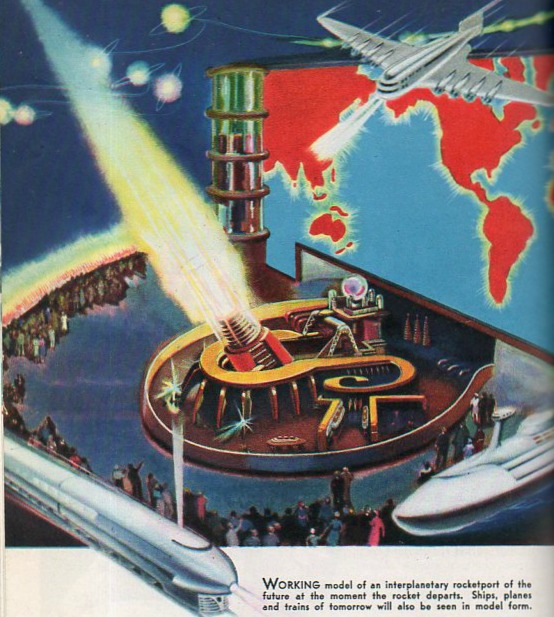
    This was a big gulp of a very colorful possible futureworld in which intergalactic travel has become possible, this image of this model being given an advanced peek prior to the New York World’s Fair of 1939.  “Intergalactic” is a big deal, because, well, there are galaxy-sized distances involved–even in Star Trek the Next Generation, the Enterprise never in the run of that series leaves the galaxy under its own power, and so the possibility of travel between the galaxies such that there could be a ‘rocketport” for it would be a very big deal, indeed. Perhaps that is what was needed at the New York World’s Fair of 1939, given the state of things–the long Depression, the Munich Appeasement and the hollow “peace in our time”, the Austrian Anschluss, the seizure of the Sudetenland, Kristallnacht, the Spanish Civil War, and the continuation of the Japanese assault on China, all could have spelled out the need for some sort of relief even if that was fictional and in the future. Certainly intergalactic travel would qualify for that, as did a number of other pieces of speculative/scifi entertainment that year: Flash Gordon and Buck Rogers were alive and well, Superman appears for the first time, and Orson Welles scares the wits out of a certain trumpian segment of the population  with the Halloween-night performance of The War of the Worlds. Perhaps the time was ripe for the rocketport–especially in such vivid color.

    1939 worlds fair interplanetary701

    [Source: Popular Mechanics, volume 70, August, 1938]


  • North Pole Airport of the Future (1945)

    JF Ptak Science Books  Quick Post

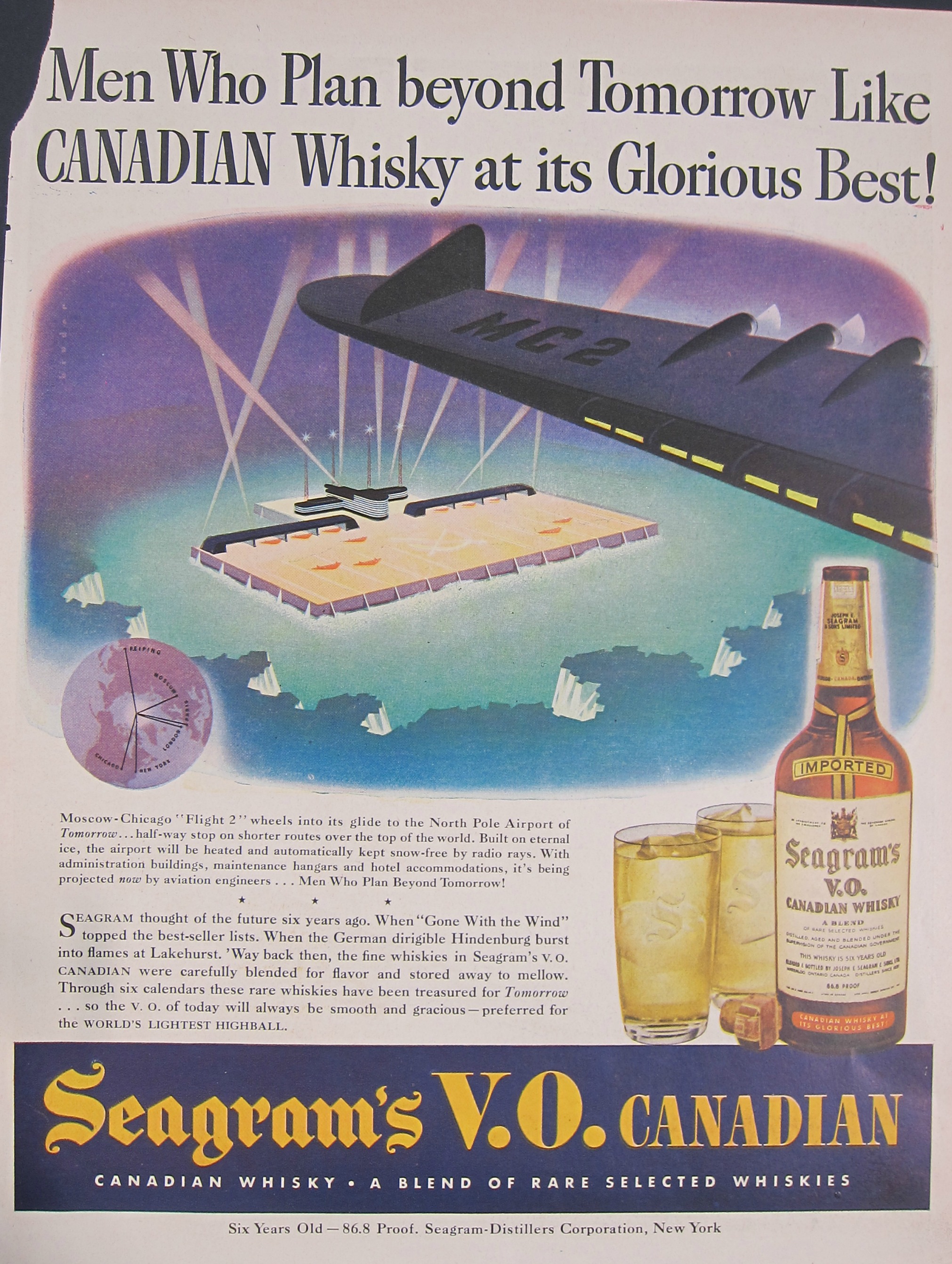
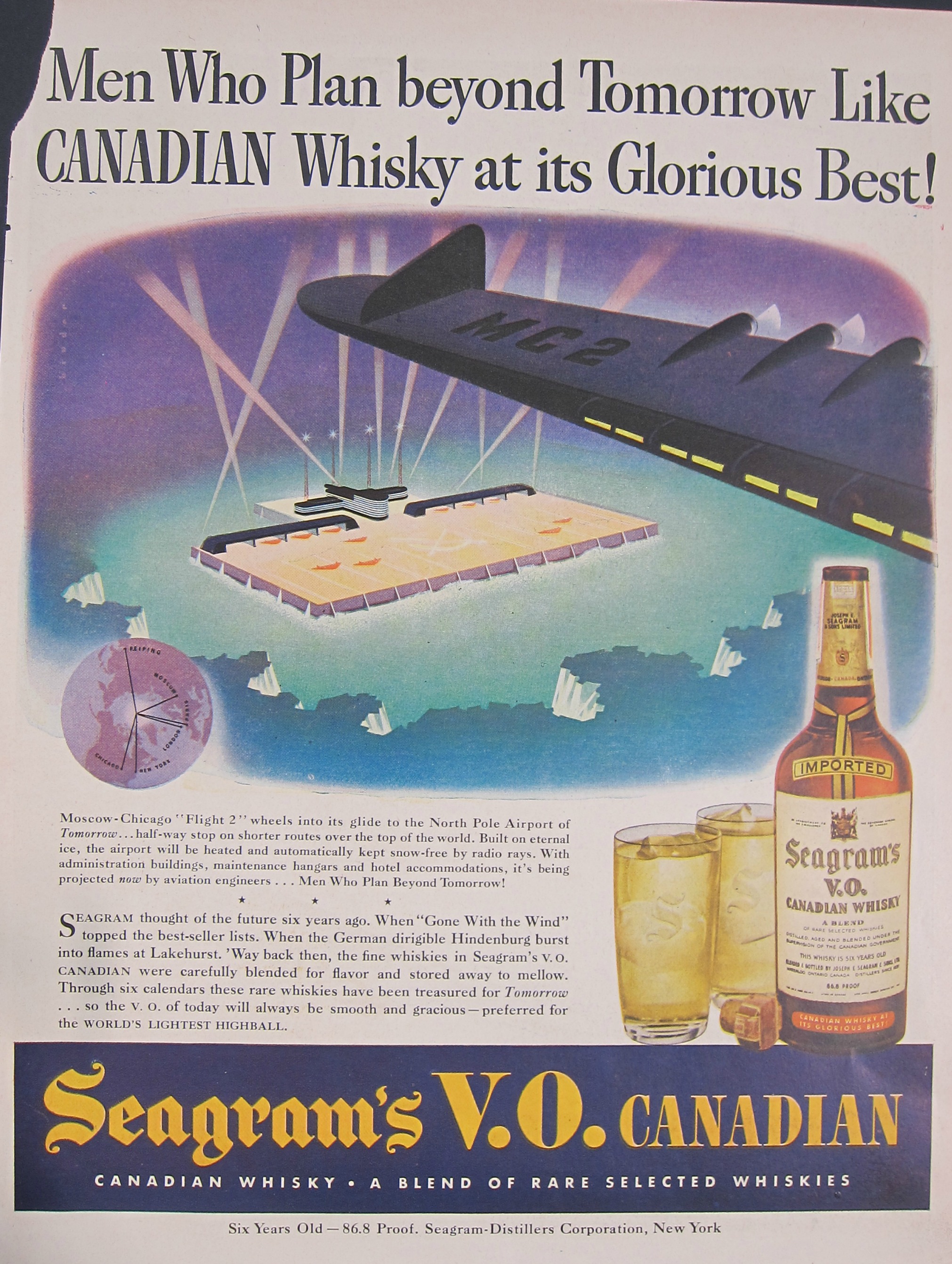
    Future seagrams flightThis gives a new and heavier, colder (?) meaning to the phrase “on the rocks”–a envisionaryiztion or some such thing of air travel in the future, the image fueled or at least paid by Seagram’s Canadian Whisky. At the time when this ad appeared (in LIFE magazine, ca. 1945/6?) it was evidently okay to articulate distilling interests with air flight, which isn’t done so much anymore–that and of course smoking in-flight, though admittedly people were firing up their cancer sticks with a lot more legroom than one has nowadays, but, still, I’d have to go with cramming my body into a too-small seat than sit in a smoke-filled tube with little tiny flames in a combustible environment.

    So this particular piece of the future foresees long-distance flights but not necessarily long distance planes, with the flights accommodated by a large airport at the North Pole that would serves as a nexus for international connections. The airport there “would be heated” and the runways kept clear of snow and ice via ‘radio waves’, adn that’s about it.  No matter about the details or the ideas, so long as you start your own flight of fancy with Seagram’s.  


  • A Flying Mega-Brick and a Postal Torpedo Metallic Email–the Future, 1928

    JF Ptak Science Books  Quick Post

    In the midst of a short article on bits of transportation advances of the future are these two wonderful futuro-peeps, selected here because of their appearance more so than anything else, as there isn’t really anything else to go on. The article has 13 illustrations over four pages and perhaps is 750 words long, so the narrative is heavily dependent upon the images and imagination. That said, the two I’m interested in here have almost no text accompanying them. So be it.  

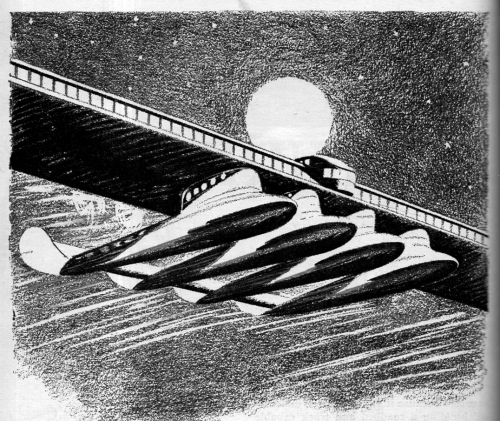
    The first is a mammoth transatlantic seaplane, “proposed by a German inventor”–and that’s it. I can’t tell how “giant” it is supposed to be, nor how many engines, or if there’s anything going on inside the wings, and so on. But it does look streamlined and tubular and blocky, which is a hard thing to do at the same time, in a loud-stealthy way.

    Pop mech future 1928679

    [Source, Popular Mechanics, August, 1928.]

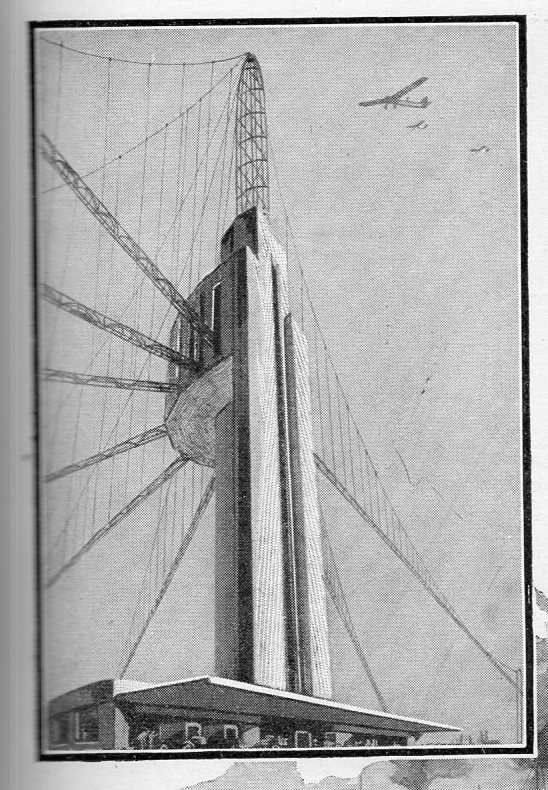
    The other image is that of one tower in a series of untold numbers of such towers popping up throughout France, much like Rommel’s asparagus in Normandy, I guess, except more numerous, and far taller. Iterating the height of the structure by the cars at its base, I take this one to be about 150-175′ high, from which there are many suspended tubular cages within which travels a 10′ long torpedo-like tube that would speed mail from station to station across France at 200 mph.  The engineers were Hirschauer and Talon, and from another source1 I see the invention described as “la torpille postale”, which is what the mail carriers looked like, except sitting on four wheels, and going really fast on a skinny track suspended a hundred feet off the ground.  

    I can’t but help to think about this arrangement of wire and cable and flowing mail as a kind of non-computer email–it has seemed odd to me for a long time that the one of the backbones of our communication existence is strung up above the ground on wires that are for the most part hung on dead recycled trees.  Granted the mail would travel a lot faster in France in 1928 at 200 mph, but completely unforeseen and not-knowable is that email would be a little faster, cruising along at a big chunk of the speed of light.  Seems as though there would have to be thousands of these lighthouse-like structures built to accommodate the French mail demand–no doubt they would have been pesky reminders of a past’s attempt at the future, though perhaps being France and all the mail carriers might have blown them up.  

      Pop mech future 1928 cable mail680

    [Source, Popular Mechanics, August, 1928.]

    Notes:

    1. http://www.luxemburgensia.bnl.lu/cgi/getPdf1_2.pl?mode=page&id=1386&option=


  • A Steampunk Clown Robot, Generational Robots, and a Vision of the Future, 1866

    JF Ptak Science Books  (Expanding an earlier post, not having previously noticed the robot baby)

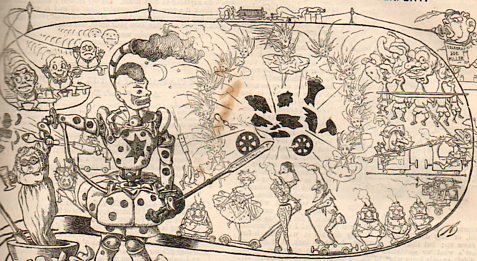
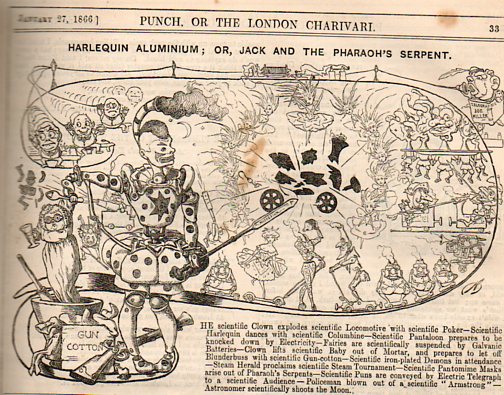
    Punch, or the London Charivari published this delightful and somewhat prescient illustration  (“Harlequin Aluminum; or, Jack and the Pharaoh’s Serpent”) in its 27 January 1866 issue.  It is for me an excellent, sort-of early depiction of a steam-man, a steampunk man, a steam-driven clown robot person, that is very deeply and frequently hinged, with smoke belching from a curved smokestack coming from the back of its head, and controlling its own destiny enough so that it is actually attacking and blowing up a steam locomotive.

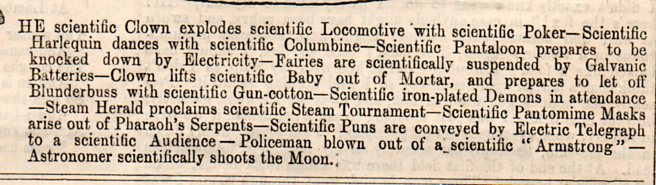
    And that’s what this image is all about–in the age of steam, the future looks more so; that, and given its extraordinarily frequent use (16 times) in the very short text, things in the future are going to get very “scientific1“.  

    Sci clown694
    And what the (aluminum2) robot seems to be doing with its scientific poker is exploding a scientific locomotive, for reasons unknown, except that the application of the poker was very successful, if that is the proper word to describe this action–it does act to control its steam technology is busting the new technologies of the era, a rub and at the same time a statement of hope or expectation in a high-Victorian manner, a rationalism of all things via technological means.  And at this time, in the mid-1860’s, the new wellspring of hope was being found in electricity-based solutions–moving away from the pervasive steam-driven technologies–though as the cartoon suggests those expectations might be too soon, too fast and too deeply placed.  After all, these things are being exploded by a “scientific clown” with a “scientific poker”–and that clown is being driven by steam. 

    Further, the steamrobot clown is pulling a scientific baby from a mortar–this is something that is unique to my experience, a robot generating a newer, younger, baby-robot in some undescribed manner. This is a generational moment among robots and something that is certainly not common in the history of early robots.  

    Sci clown695

    In the background-right we see a string of “scientific fairies” suspended by electricity, and beyond them, center-rear, is a comedian reading from Joe Miller’s joke book (of “scientific puns”)  into a telephone-like device, with an audience to his mirth sitting and listening on the other end of the line–and this still 11 years away from the invention of the telephone. And so on.  It is a marvelous piece of work, especially considering what was probably an ephemeral status.  

    Sci clown692

    (Also, the “Pharaoh’s Serpent” part of the title of the illustration refers to a three-year-old phrase: “1863   W. Allingham Jrnl. 3 Oct. in H. Tennyson Mem. Tennyson (1897) I. 513   Mrs Cameron showed a small firework toy called ‘Pharaoh’s Serpents’, a kind of pastille which when lighted twists about in a wormlike shape”–from the OED.)

    Notes:
     
    1. It is well-known that William Whewell created the word “scientist” relatively recently, in 1834 (see below). “Scientific” goes back quite a bit further, deep into the 18th c in some uses; farther back in others. 
    “Scientist” in the OED: 1834   W. Whewell in Q. Rev. 51 59   Science..loses all traces of unity. A curious illustration of this result may be observed in the want of any name by which we can designate the students of the knowledge of the material world collectively. We are informed that this difficulty was felt very oppressively by the members of the British Association for the Advancement of Science, at their meetings..in the last three summers… Philosophers was felt to be too wide and too lofty a term,..; savans was rather assuming,..; some ingenious gentleman proposed that, by analogy with artist, they might form scientist, and added that there could be no scruple in making free with this termination when we have such words as sciolist, economist, and atheist—but this was not generally palatable.
    1840   W. Whewell Philos. Inductive Sci. I. Introd. p. cxiii,   We need very much a name to describe a cultivator of science in general. I should incline to call him a Scientist. Thus we might say, that as an Artist is a Musician, Painter, or Poet, a Scientist is a Mathematician, Physicist, or Naturalist.”
     
    2. “Aluminim” is a word created by Humphrey Davy in 1812.