A Daily History of Holes, Dots, Lines, Science, History, Math, Physics, Art, the Unintentional Absurd, Architecture, Maps, Data Visualization, Blank and Missing Things, and so on. |1.6 million words, 7500 images, 4.9 million hits| Press & appearances in The Times, Le Figaro, Mensa, The Economist, The Guardian, Discovery News, Slate, Le Monde, Sci American Blogs, Le Pont, and many other places… 5000+ total posts since 2008.
Imaginary New York City Landscapes from CON-ED, 1938
JF Ptak Science Books Quick Post
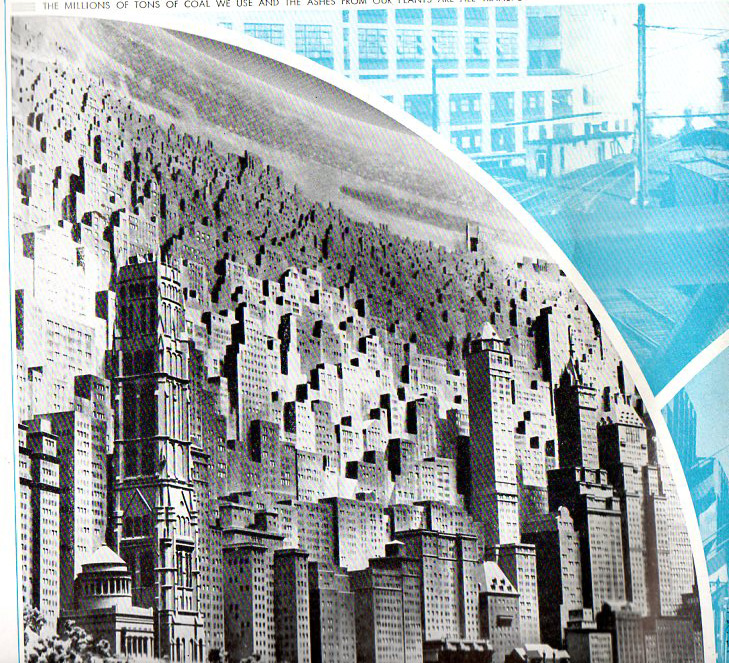
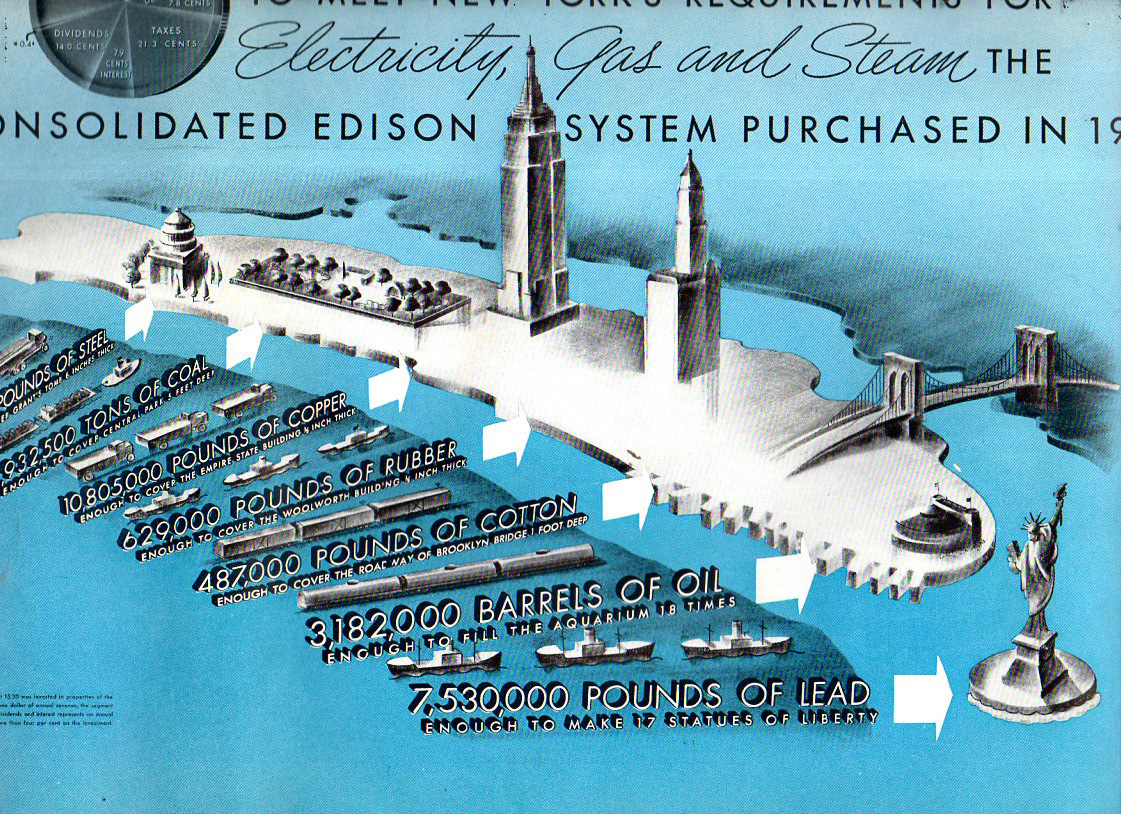
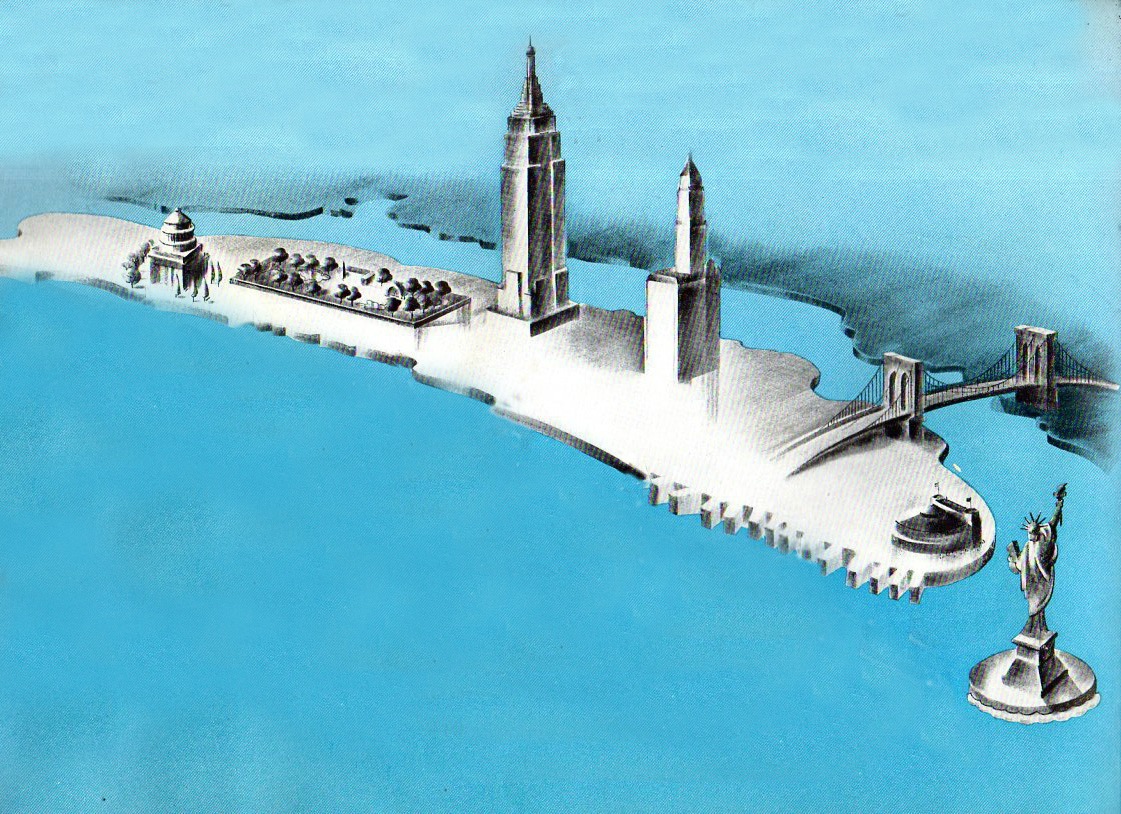
These lovely images are found in a long, shining and slightly darkroom-scented The City of Light, which was a pamphlet made for the Consolidated Edison exhibition at the New York City World’s Fair of 1939. Con Ed I think just wanted to get the point across that they saw into the future and were getting ready for it, NYC being stuffed to the gills with buildings and each window stuffed and outlined in Con Ed-supplied electric light. The vision is vaguely threatening to me, though, the buildings are drawn in a very odd perspective giving the city a stadium-seating arrangement that is unsettling, like they’re part of our robot-overlord future–someone or something must be living in those room filled with Con Ed light, though…
And here’s the version of the map above with text removed–given that it looks as though it is a chromed-over Manhattan of some sort of future:
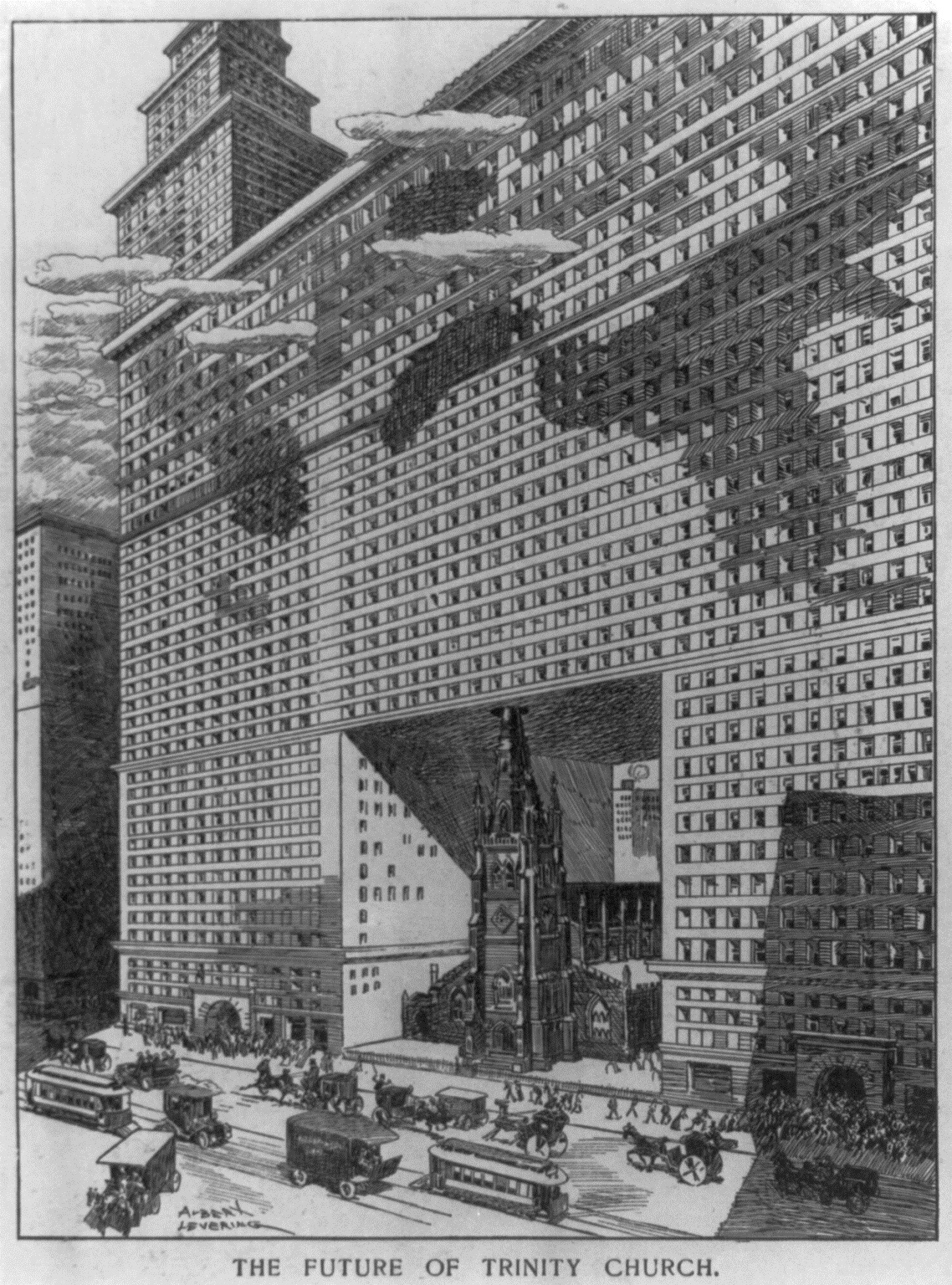
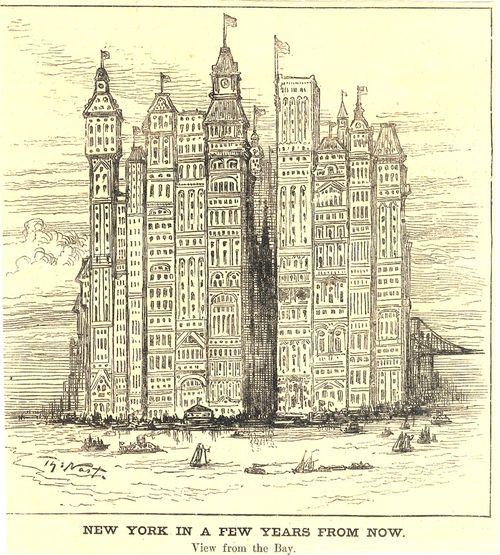
For many years the steeple of Trinity Church was the tallest object in Manhattan, but by 1907 when the city was entrenched or engulfed in a skyscraper building adventure the future of massiveness and of height knew no bounds, especially when the limits of those boundaries were attainable. And so this enormous structure grew around the church, with room-enough-for-steeple, built among the clouds. It turns out that the 284′ spire was the tallest thing in Manhattan until 1890, when the World Building was completed (17 years before the publication of this engraving) raising the new highest heights ceiling to 348′. If you iterated the scale of Trinity (below) to the rest of the imaginary building, the new structure would be about 750′ tall–the Metropolitan Life Insurance Company Tower would come close to that in another two years (and be the tallest building in the world until 1913), so the building shown below would have been probably the world’s largest in 1907, and easily the most massive.
[Source: Puck magazine, March 6, 1907, wood engraving by Albert Levering]
This reminds me somewhat of an earlier vision of an engulfed Trinity–Thomas Nast’s future Manhattan skyline of 1881 for Harpers Weekly, where the church is visible still but crowded out almost entirely by enormous structures which were still/only decades away:
[Source: an earlier post on this blog https://historyofideasblog.com/thesciencebookstore/2009/12/the-history-of-the-future-of-skyscrapers-thomas-nast-1881.html]
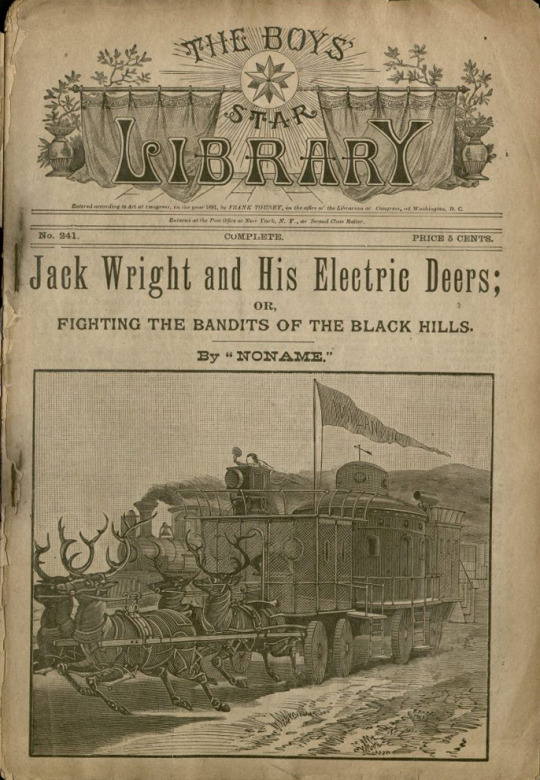
Rebecca Onion at Slate Vault surfaced this very interesting image of electric breath on her twitter account (@Slate Vault), showing early robotic creatures alive and well and living in the minds of thousands of young kids, placed their partially by stories like this found in the pulpy pages of Frank Tousey’s Pluck and Luck in 1892. The image (from the special collections library at the University of South Florida (here)) shows yet another work of genius/ingenuity by the endlessly adventurous “Jack Wright” a boy inventor, who seemingly went everywhere, did everything, and had the stuff to make it all happen.
I’ve posted1 many times on this blog about 19th century imaginary robotics, and had not seen this Wright story and his fabulous “electric deers”.
This Jack Wright adventure was written by “Noname”, who turns out to be by Luis Senarens (1863-1939)2, a very prolific and early sci-fi writer, a Brooklyn boy, who had been referred to as an American version of Jules Verne. Senarens wrote beginning in the 1880’s and was no doubt much taken by the new applications of electricity, and Senarens applied it quite liberally. In a quick browse, he introduced electricity inventively, sprinkling it liberally over powered machinery and introducing his own electric ocean liners, submarines, sledge boats, canoes, air-schooners, locomotives, balloon ships, torpedo rams, horses, and no doubt much else. I’m glad to have caught up to Mr. Senarens’ robots.
Notes:
Just search “robot” in the google search box at upper right.
See the Edward T. LeBlanc Memorial Dime Novel Collection for very much expanded info on this and other series: https://dimenovels.org/Series/734/Show
This short notice of work-under-way, “Seeing by Telegraphy” by William.Edward Ayrton (1847-1908, electrical engineer, F.R.S., and electrical infrastructure pioneer of Japan and India) and John Perry (M.E., F.R.S.), is one of those fascinating little “pop-ups” that appeared in the preeminent weekly journal Nature on May 13, 1880 (page 31). Nature of course published quick announcements of breaking scientific research in lengthier articles, and it would also publish short notices of articles appearing in other journals, and also would have shorter notices like the one below.
This is why it is so exciting to just browse/graze in these journals–you never really know what you might find. This was unexpected, though had it not been for the catching title, I would have no doubt passed it by.
It turns out that this is a very early rumination on the possibilities of “television”, though at this time that name didn’t exist, and the people working in the area of transmitting images by wire referred to it (for example) as “Seeing by Telegraphy” (Henry Middleton, 1880) and “Seeing by Electricity” (J.E.H. Gordon, again in an article in 1880). Earlier still (and perhaps first on the scene) is Adriano de Paivra (1847-1907), who wrote “A Telephonia, a telegraphia, e a telescopia” in 1878, introducing a fantastic and beautifully-named idea of the electric telescope, the telectroscope, or long distance vision by wire.
A longer article on the above appears slightly later in Science, in 1880, the full text available below.
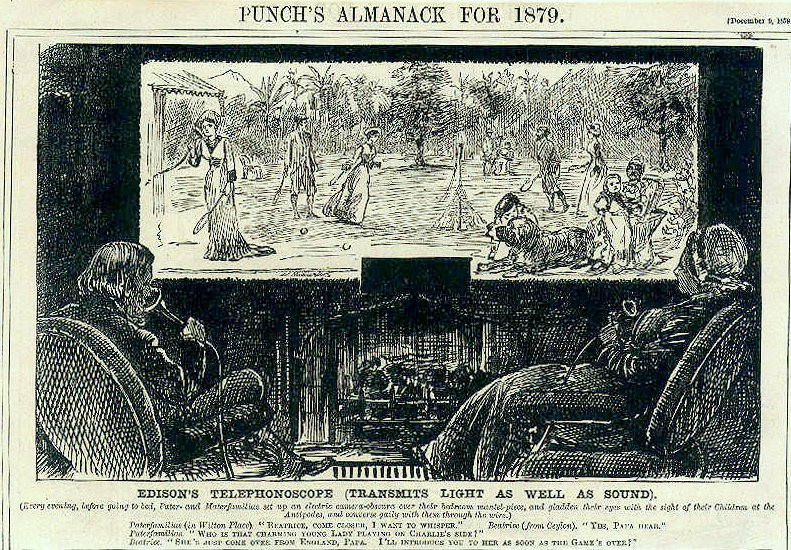
As it turns out, I’ve read that Perry and Ayrton were influenced/energized by a cartoon of the future of communication that appeared in Punch magazine in the “Almanak” section for 1879. This was supposed to be an invention named the “Telephonoscope”
Imaginary New York City Landscapes from CON-ED, 1938
JF Ptak Science Books Quick Post
These lovely images are found in a long, shining and slightly darkroom-scented The City of Light, which was a pamphlet made for the Consolidated Edison exhibition at the New York City World’s Fair of 1939. Con Ed I think just wanted to get the point across that they saw into the future and were getting ready for it, NYC being stuffed to the gills with buildings and each window stuffed and outlined in Con Ed-supplied electric light. The vision is vaguely threatening to me, though, the buildings are drawn in a very odd perspective giving the city a stadium-seating arrangement that is unsettling, like they’re part of our robot-overlord future–someone or something must be living in those room filled with Con Ed light, though…
Nothing quite sounds or looks quite so unusual as a forgotten piece of popular culture from a different generation, something that was stretching the boundaries in potentially cringeworthy ways. Of course everything is removed from context, so the historical/cultural part isn’t immediately neuronally available, though with just a little bit of digging into memory or archives these things would fit the thing nicely in place and time and would recover their sensibilities.
But as stand-alones, these exemplars of outre thinking might do little more than raise a surprised eyebrow to their unexpected appearance.
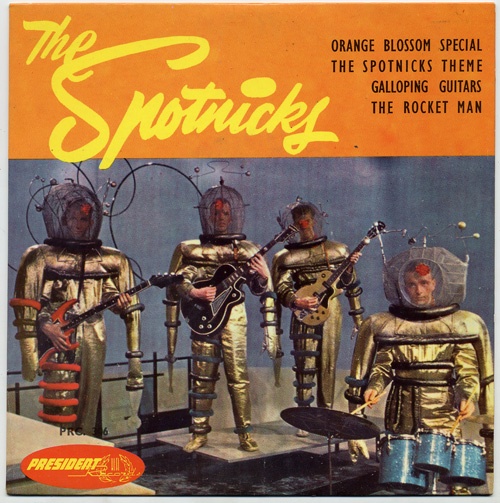
So, while searching for exotica/tiki music online, I stumbled upon and over “The Spotnicks” (read “Sputnik”), a groovy 1961 Swedish band that I guess was a semi-equivalent to a 70’s hair band, except these guys appeared in space suits there at the hot part of the space race. And: they were actually very proficient musicians, though, proficiency (and even giftedness) don’t necessarily a good band make. Never having heard of them before (I grew up in the era of The Rock and the Roll, though the music never really appealed to me much) I came to learn that the band is still around, and has made 42 albums, and sold 18 million copies of their music, which I would never have guessed to be the case. So, while the music might not necessarily be the stuff of which memories are made, it wasn’t bad, and the players certainly seemed to have some chops. (And their movement as they played seems to have come a decade or more before Devo.)
It turns out that space–themed music was a popular bit in the late 1950’s and into the 1960’s, though it seems from my brief dip into that genre that not a lot of it was outery-spacey, though the album covers were. (Sort of like “Atomic Cafe” or “atomic cupcakes”, where the idea of the “atomic” part was present but had nothing really to do with anything at all except for the name and signage.) That this, I did find this album from 1967, produced and sold while Star Trek was experiencing a small spike in the ratings. There are space-related themes here, present in Mr. Nimoy’s poetry and spoken word, so this at least has something to do with the music:
If you’d like, you can listen to it a bit, here: http://www.maidenwine.com/lps.html
So in my limited walk-about experience, genres like Exotica and Tiki seem to live up to their name beyond the album cover design; the sub-category of “outer space” Exotica music probably does not, though that might not matter so long as the album design is wicked good.
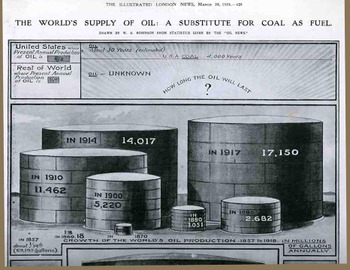
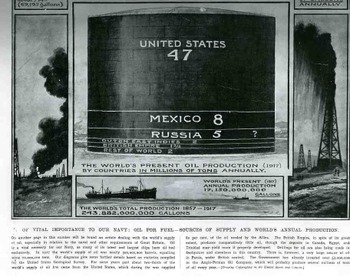
In 1919, at the end of WWI, The Illustrated London News asked (and answered) the vital
question of the day in the coal v. oil dispute and the feeding of its navy: which power source will last longer? The graphic designer displayed the answer right there at the top: American oil would last about 30 years, while its coal reserves would go for another 4,000 years. The bigger question though was about the oil production and futures for the rest of the world, which was left unanswered (and unanswerable, smartly). Its easy to second guess these guys and have a stab and a poke at their predictive power, but we’ve been getting the answers to these questions wrong every decade since then. Suffice to say that the Brits were doing some strategic thinking on the issue of power supply, which of course is probably the greatest issue in fielding an army of navy (just ask Rommel).
It is interesting to note that the British government was busily looking for oil in Derbyshire (oops) and other places. And as an end-note it is stated that the government had already invested about 2 million pounds in the Anglo-Persian Oil Company (which would become British Petroleum in 1957, known today as BP), which, beginning around 1908, was the first time that a company harvested the oil reserves of the Middle East. All of it was nationalized during the Iranian coup d’etat in 1953
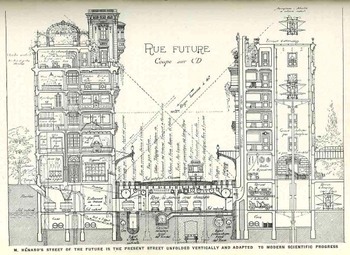
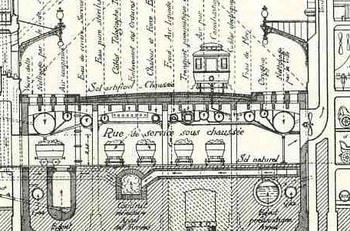
This cross section illustration (“Rue Future”/Future Street) is from Eugene Alfred Henard’s1 (1849-1923) article, “The Cities of the Future”, from American City, Volume 4, January, 1911. In this article Henard (architect of the city of Paris and from 1880 a life-long employee and advocate of public works in that city) looks into the future and sees the movement towards underground (or enclosed) vehicular traffic, “smart” buildings, pneumatic tubing for vacuum cleaners (“almost sure to come into general use”), an improvement in the system for water delivery and removal, replacing coal with natural gas, and more. He lays out a plan to implement his idea that, if implemented in the city of Paris, would cost $420,000,000 (or approximately $15 billion in 2006 money) over 100 years. [This part seems a little off given that the area for public roads alone in Paris at this time was 3,700 acres–nevertheless this was an interesting appearing plan, a significant portion of which has found its way into building and community planning albeit on a far smaller scale].
Henard was also acutely interested in the future traffic problems of Paris and other major cities, proposing revolutionary radial traffic patterns for moving cars around major metropolitan areas–which was really quite visionary as the mass production of automobiles had not yet really taken place–certainly automobiles were far more common by 1911 than 1905, but their numbers would be vaulted higher int he next decade with the first true approach to assembly line production of automobiles, making them affordable to the millions. His plan for a ring-lime system around the city of Paris was influential to some of the ideas in the early American planning reports for San Francisco and Chicago by the great Daniel Burnham.
What is particularly interesting for me in the Henerad plan is the room that he left for his future’s future–he attempted to make his plan adaptable for the time when the future he was writing about was becoming the past. And so he was leaving room in his underground plans (in particular) to accommodate some of what the future might hold in store for his city, leaving unused spaces and tunnels, so that the city planners in the future would not have to go through the enormous expense of putting these things in for themselves. Now that is future-forward thinking.
Notes:
1. Henard studied at the Ecole des Beaux-arts, graduating from there in 1880. For a decent short bio of the man see the Wiki entry, here: https://en.wikipedia.org/wiki/Eug%C3%A8ne_H%C3%A9nard
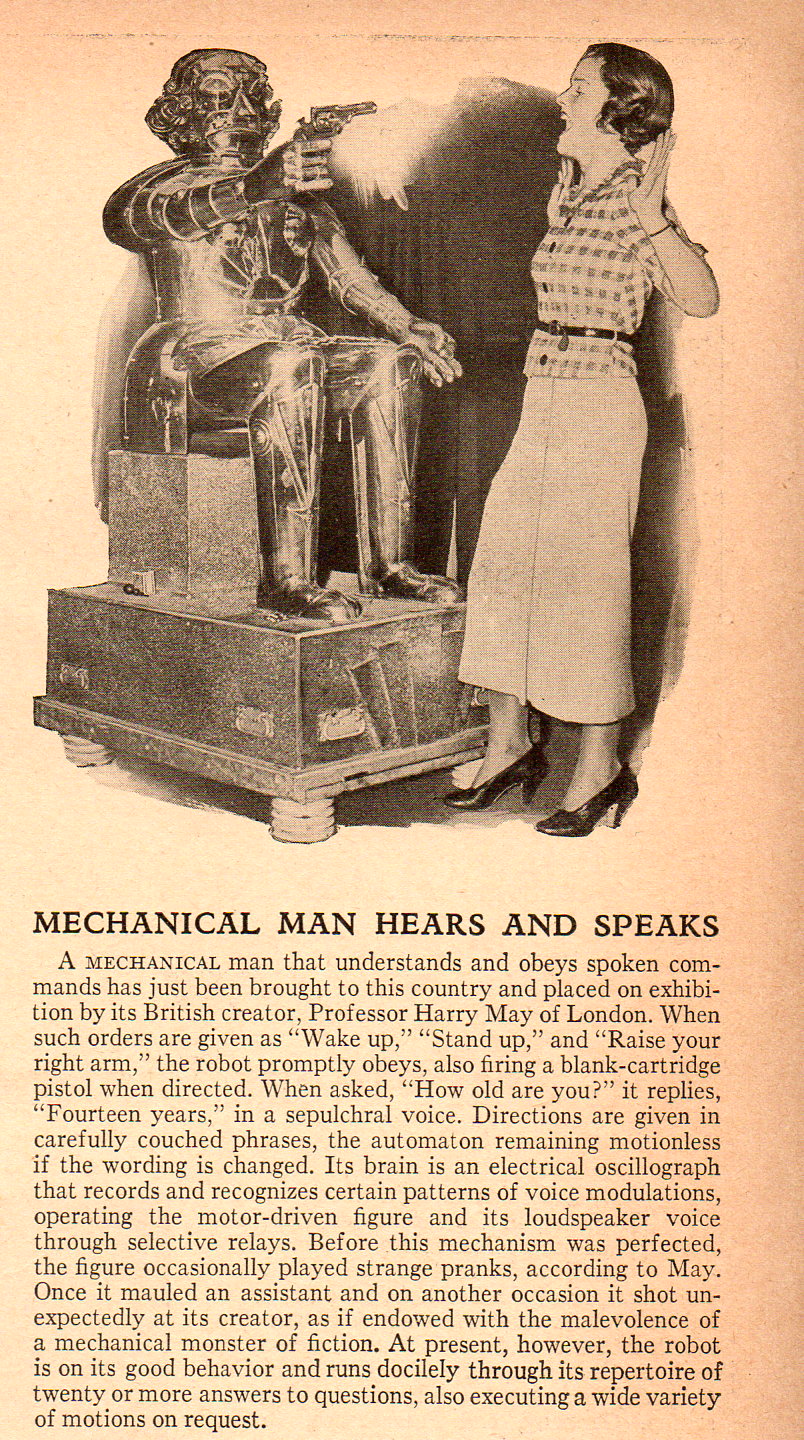
These poor early robots–some were designed to pretend-to-clean, others to pretend-to-smoke, and yet others (even at this tender age in the history of robots) were designed to threaten people and whatever else was in front of them with a pistol. It is a sad, thing, really–it is hard not to empathize with the amalgamated sorrow.
[Source: Popular Science Monthly, January 1935, page 19.]
I’ve written perhaps 15 or so posts on early robots (prior to WWII) and to me it seems that most were relegated to menial tasks–and when not menial, then they were often killing or threatening living humans. Perhaps when our robot overlords of the future (ROOTF) absorb the human interpretation of their early history they will take pity on us for representing their early possibilities in such unfortunate ways–they may get over the images of robots harvesting, pulling wagons, sweeping clergy, squeezing the blood out of workers, savaging scantily clad women of the future, and so on…or they may not.
For other posts on robots, enter “robots” in the google search box at left. If nothing else, the images are very good.
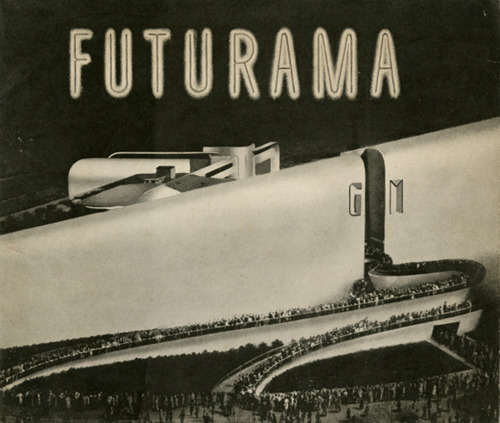
[Image source: FUTURAMA.Published by General Motors, 1940. 24pp. Original wrappers. Provenance: the Pamphlet Collection, Library of Congress. ]
The 1939 World’s Fair in NYC famously exhibited a spherical attraction that exhibited a semi-robotic display of what the future would be like–a future that was only 21 years away, in 1960. There would be an enormous amount of weight on the shoulders of 1960, given what the World’s Fair had to say about it in 1939. Few things were very right, and many of course were necessarily wrong–but that must be the case when looking into the short-ended future with a monstrous amount of anticipation. That–and since this was a feel-good celebration–nobody was talking about the world war that had already started.
One thing is for sure–the pavilion’s creator, General Motors, did foresee that highways and automobiles will be in high demand up there in the tomorrowland of 1960. The display was designed by the fantastic Norman bel Geddes, who actually expanded on his superhighway theme in the next year with his book Magic Motorways (which can be read here). Anyway people were very excited by the whole affair–waiting in line for a few hours, winding their way through the pavilion to take their seats in a circular gallery overlooking a vast and complex assemblage of miniature societal models, the seating arena rotated to give the viewers views of the entire display. More than 26 million people saw the display over a six month period.
26 million is a big number. Futurama drew as many people in six months as the three New York City baseball teams (the Yankees, Giants and Dodgers) brought in for almost the entire decade. It is also equal to all of the deaths suffered by the Soviet Union during WWII.
I guess this was as good a vision as any–or at least it didn’t seem to involve very much planning outside the new automatic automobile nervous system that would leech into the life-blood of the country. Other planned visions of the future do not look quite so good. For example, Le Corbuser’s demolition of central Paris to make way for his Soviet apartment block reconstruction in his Voisin Plan (1925):
Again, this is not a wholesale look into the future, just the resurfacing of one of the world’s greatest cities.
A man with a little bigger vision, Frank Lloyd Wright, saw a heavier future in his Broadacre CIty:
I’m not sure how these domed cities worked. B. Fuller had an idea like this for central Manhattan that I wrote about earlier in this blog, but his idea escaped me too.