A Daily History of Holes, Dots, Lines, Science, History, Math, Physics, Art, the Unintentional Absurd, Architecture, Maps, Data Visualization, Blank and Missing Things, and so on. |1.6 million words, 7500 images, 4.9 million hits| Press & appearances in The Times, Le Figaro, Mensa, The Economist, The Guardian, Discovery News, Slate, Le Monde, Sci American Blogs, Le Pont, and many other places… 5000+ total posts since 2008.

Category: History of the Future

  • Roadtown, Linear Cities, and Living in a Line: Edgar Chambless and Michael Graves

    JF Ptak Science Books  Post 855 


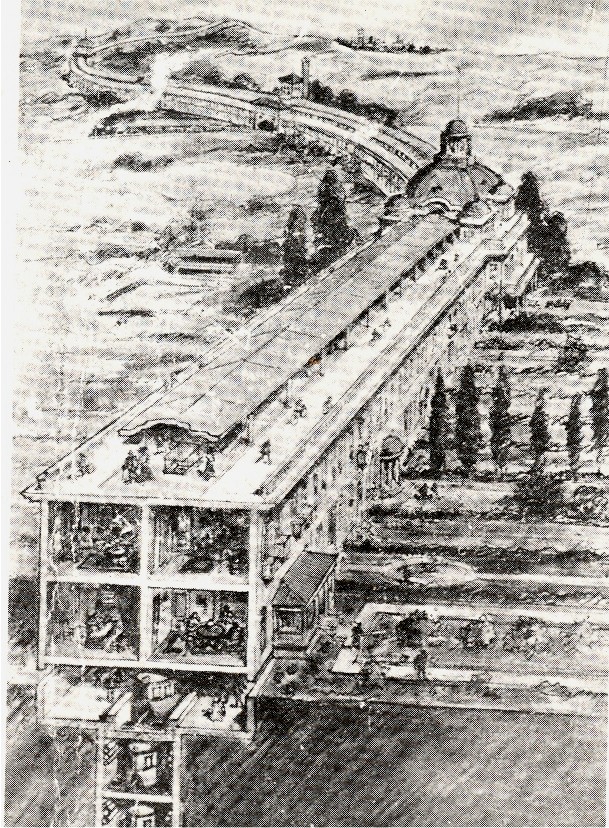
    I wonder what our human world would be like if we had evolved living in horizontal linear cities?  
    ++ Nov 29 roadtown chambless 1

    The idea had never occurred to me before seeing the work of Edgar Chambless, whose Roadtown (the entire 172pp of the 1910 work located here) projected the idea of super long linear road-cities.  Actually it was the illustrations that attracted me more than Chambless’ pamphlet, though I’m surprised to admit, there’s some interesting bits and pieces in that exceptionally odd work of city/future planning. 

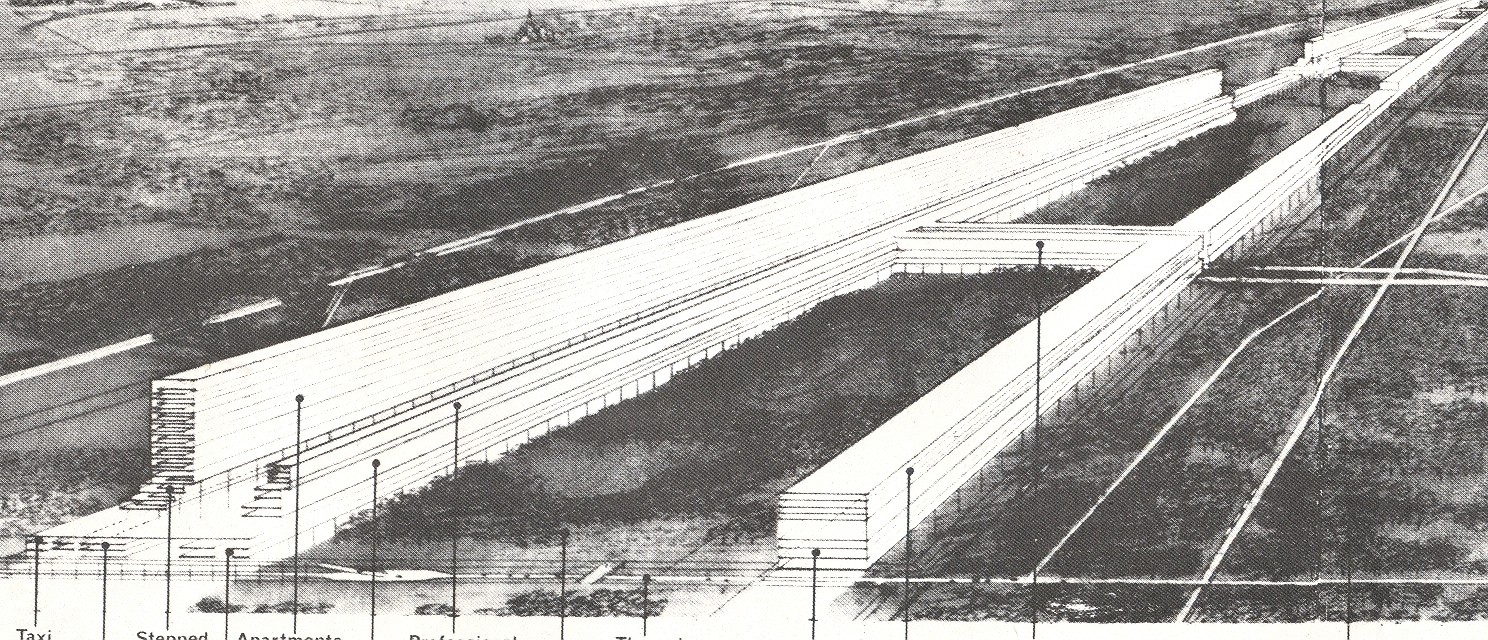
    Michael Graves also proposed a linear city [aerial perspective below] to form a contiguous, living corridor between New Brunswick and Trenton, and alluded to the development of “consequent new patterns of life” though doesn’t say what they might be.  

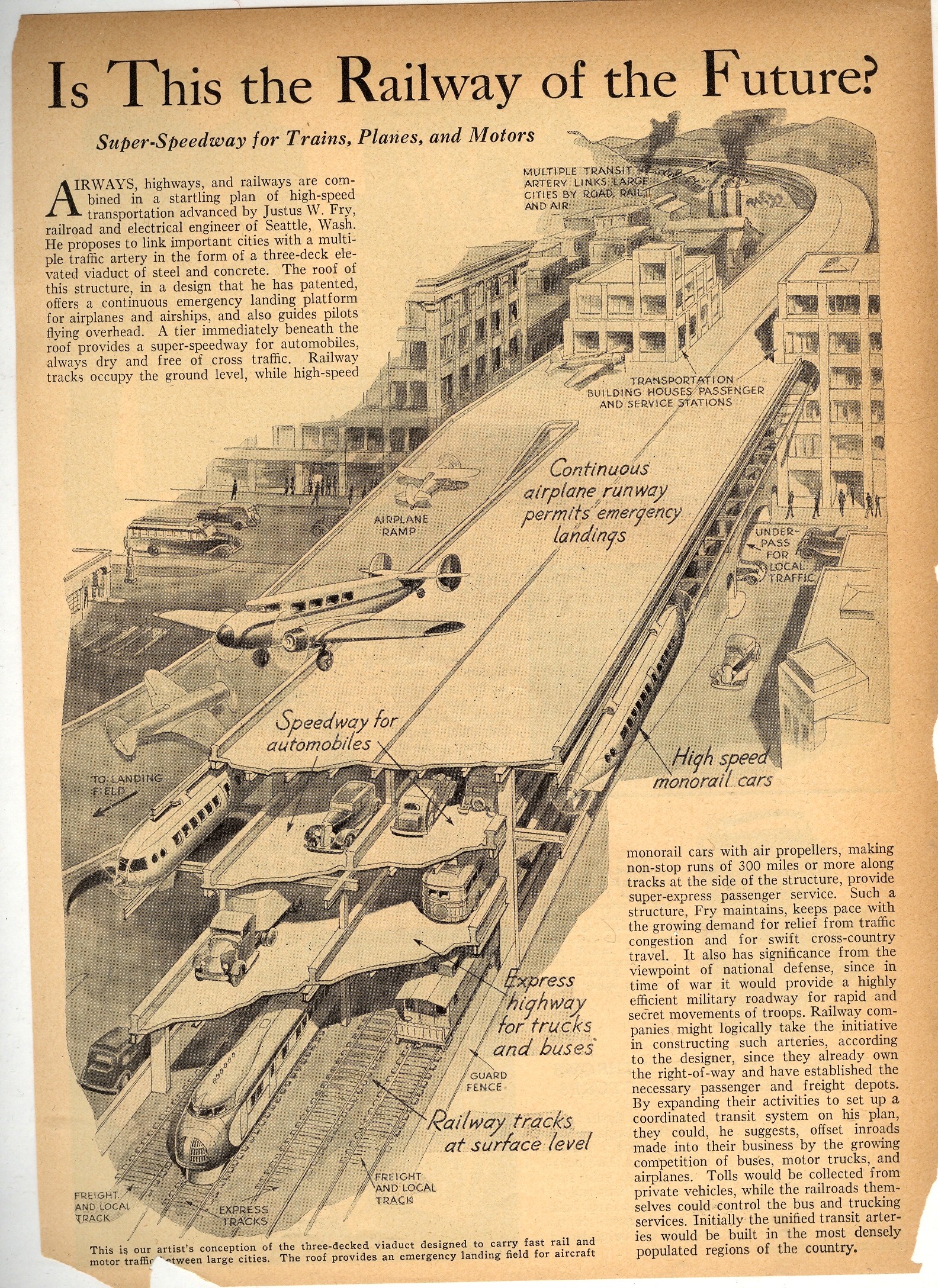
    And certainly there have been many plans for incorporating, engulfing, transportation systems into the very fabric of a city (as seen in the “Is This the Railway of the Future” image that ran in Popular Science in 1932), though the idea of combining transportation and the city itself into a linear creation is far more uncommon. 
    ++ Nov 29 roadtown graves


    But getting back to this living-in-a-line part:  according to some rough napkin-logic, I figure that in order to house 300 million Americans in one long structure, it would take something like a building 400′ wide, 12 storeys high and 3000 miles long (not including infrastructure and so on) to allow 400 square feet of living space for every person.  Oddly enough I randomly chose an individual unit of 400x800x120 feet to work with, which is within just a percent of two of the total volume of the Empire State Building (bizarre!), meaning that it would take about 20,000 Empire State Buildings placed end-to-end to perform the housing of every American in this straight J.G. Ballard-like world. 

    Now Chambless offered an architectural-something  much less complex1 than this notion I just imagined, though his philosophy of life and living in such a city was developed well enough to get the interest and attention of major movers and shakers (including Tom Edison).  There was evidently quite a buzz about Roadtown though that’s all that ever happened–buzz and no sting, meeting after meeting, happy attendees, then off to another meeting with apparently nothing to show for it all in the end, an interesting idea that took a decade or two to die. 

    ++ Nov 29 roadtown underground

    Notes:

    Edgar Chambless and Michael Graves images from the wonderful book, Unbuilt America, by Alison Sky and Michele Stone. (Sky and Stone–very close to sky above/mud below.)

    1. (From The People’s Almanac, 1981):  “In cross section, Roadtown would, beginning at the top, consist of: (1) a roof promenade–a glassed-in sun parlor in winter, shaded walk in summer, with bicycling and skating paths and towers housing schools, nurseries, recreation facilities, stores, and power plants; (2) a two-story, above-ground house, with a workroom at street level, a living area above it, and utility lines (electric wires and gas and water pipes) enclosed in a runway beneath the house; and (3) three below-ground levels of railroad lines for expresses and locals, to carry both passengers and freight”
  • Advanced Sci-Fi Dirigible Notion, 1909

    JF Ptak Science Books LLC  Post 854

    ++ Nov 28 dirigible

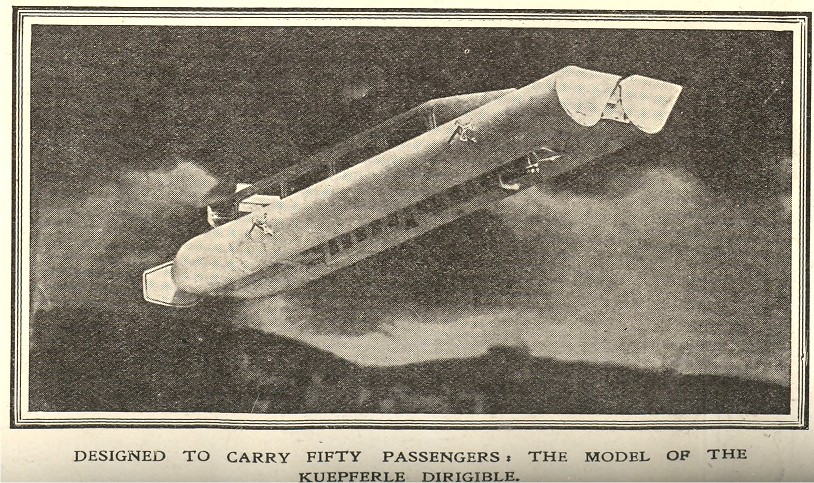
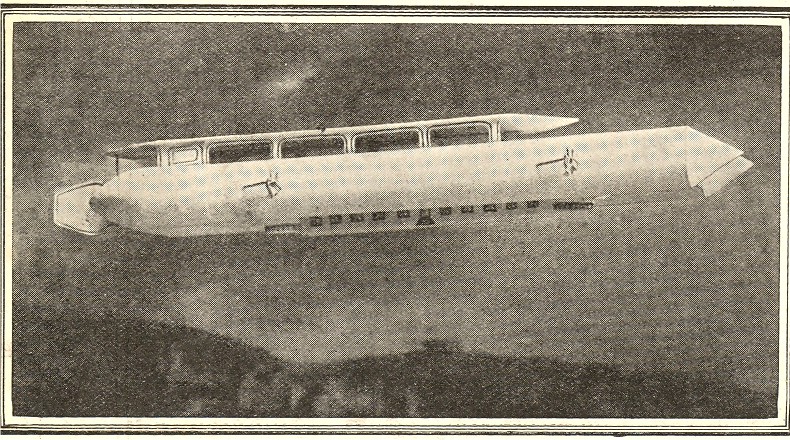
    Just a short post this evening on what looks to be an amazing futuristic vision of he dirigible, found lurking in the “science Jottings” page of the 14 August 1909 issue of The Illustrated London News. (This section has provided more than its fair share of entertainment, a consistent pleasurama of sciency bits all confined to a single page.)  The airship was noted as being designed by “Kuepferle”, unfortunately  without a first name, who was associated somehow with “authorities at Frankfurt”.  The ship was to be a fantastic 100 metres long, and was set to hold fifty passengers (with, I guess, a crew of 25?)  The structure on the the top of the aircraft was a screen to prevent the sun from heating the helium elements too much, which, somehow, were to be turned into a parachute in the case of a disaster.  The unnamed artist made his drawings from a model, while the “dirigible proper would be available before very long”. 

    ++ Nov 28 dirigible 001 

    ZR1couv

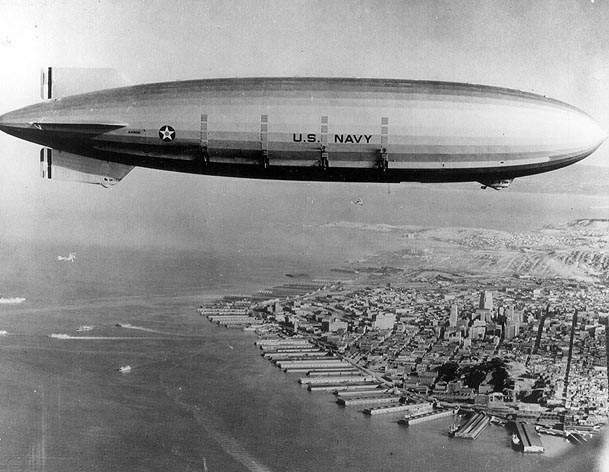
    The magnificent possible length for the airship–100 metres–was huge for 1909, but was eclipsed (in relatively short order) by the American Akron, a 1931 monster which came in at over 240 metres.  Still, the Kuepferle machine had a rich sci-fi design with a big Buck Rogers feel, a lovely thing.

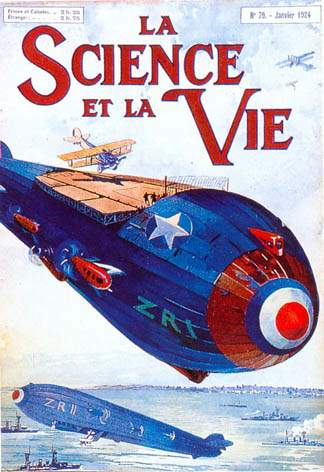
     It was certainly far prettier than this flying aircraft carrier decorating the cover of La Science et la Vie for January 1924.  I’m not sure what the efficacy was for this idea, this enormous beast catering to one airplane at a time…but it all sure looked pretty in blue. 

    The real thing, the Akron, below:

    Akron


  • Cars Driving in the Sky: the Future of the City, 1930’s

    JF Ptak Science Books LLC

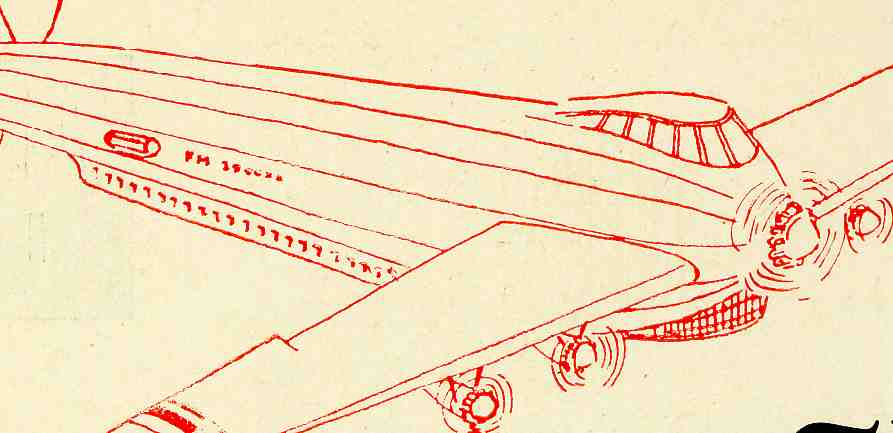
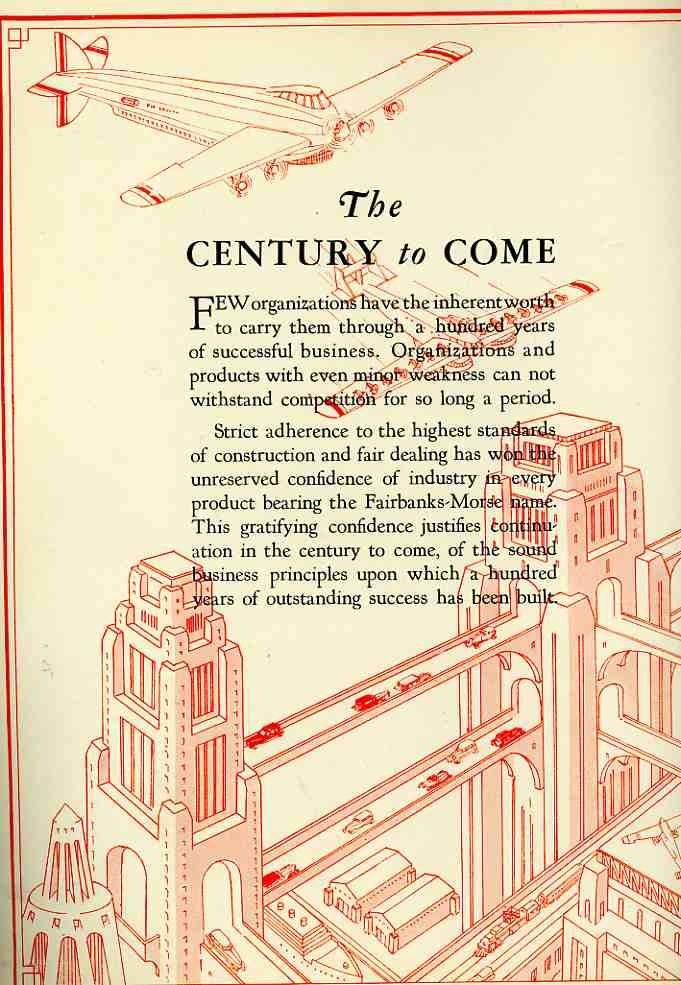
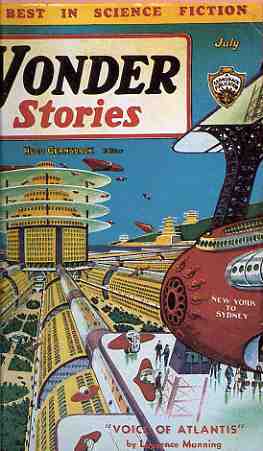
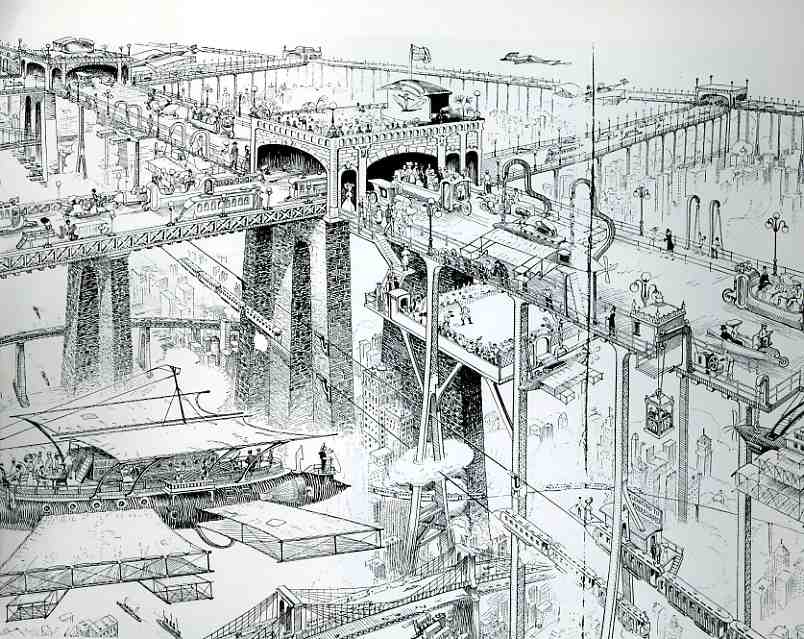
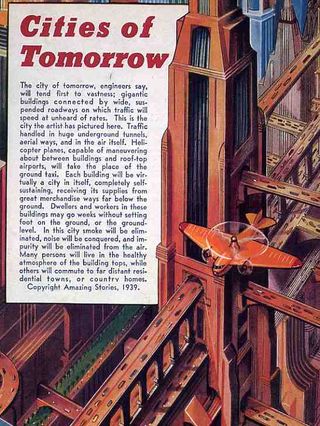
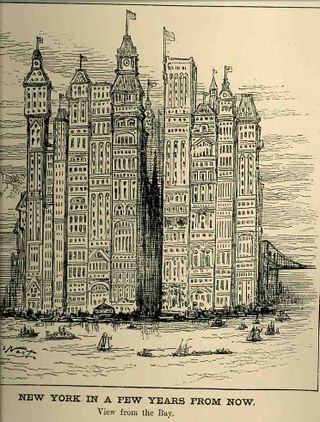
    0-blog---Nov 19 future085 In an earlier post here I wrote about  living a big life in a big airplane–I saw this weird little print and was attracted to its unrepentent awfullness and the sleeky bulbous nature of this exotically unflyable aircraft.  I guess it bothered me becuase even though it was unsupportably  big it didn’t bother to have any of the luxurious features that other, similarly bloated-enormous aircraft had at the time:  swimming pools, greenhouses, landing strips for other planes…  This one didn’t have anything like that, and didn’t really seem to make any sense, unless that big belly part was actually a zeppelin or something like that, filled with helium–but even that doesn’t make sense.  Perhaps we need to assume that it is supported in the air by something yet named and unknowable, powered by engines that were far advanced.  But what is more interesting in the print are the multi-tiered auto-skyways and suspended nonsensical roads that hang between the skyscrapers like a gravity marble game.

    0-blog---Nov 19 future084

    0--blog---dec 2 city future164

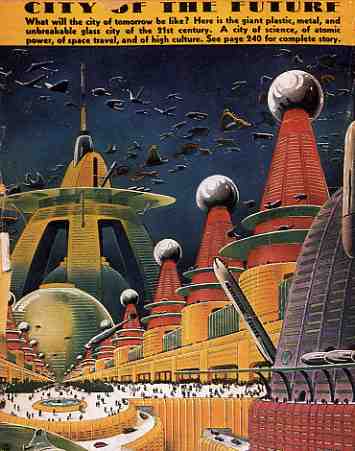
    These other cities of the future at least take a greater leap of faith in the belief of extraordinary inventions and abandon the generally stylized shape of known aircraft and propulsion systems.  At least for the next two images, even the architecture is mostly new.  What I’d really like to know is what people were doing in those buildings and where they were going in those hover cars.  For the most part in stories of the future like this people were simply going to work as they would in 1937, driving off with anti-gravity sumpin’ to Spacely Sprockets to do office work as it was in the past. 

    0--blog---dec 2 city future165 

    0--blog---dec 2 city future166 

    For the most part future vision seemed grounded in the past, techno-wizzardry 0--blog---dec 2 city future clean167 carved into the fabric of existing society.  I’m not so sure what was so “futuristic” about elevated railways stacked up on top of each other like flapjacks, but to someone there in the 1930’s past it looked like a great thing about to happen….in 1965. 

    0--blog---dec 2 nyc171


  • Food Packaging, Plastics and the New Desire: the du Pont Company, WWII.

    JF Ptak Science Books LLC Post 159
    Blogcandy282

    I was initially drawn to this small collection of pamphlets because of the very provocative assertion that candy is food (but is food candy?) which, I guess, it is, technically speaking.  (Maybe we should determine what food is on a sliding scale of what we would take to a deserted island somewhere and have to depend on those foods for survival.  I don’t think that I’d have a trunk full of Mounds bars with me.  Evidently if you had to choose one food product (and one product only) to survive on for a year it looks like the best thing to select is dry dog food.)

    The Candy is Delicious Food pamphlet was published in 1939 with the intent of instructing the grocer how to better sell candyFood—expressing the ease, storage and profit margin.  Curiously, the thing was published in September  1939, a few months into the war—I wonder if the publisher (saved for naming below to more effect) was prescient in determining the coming problems with food, and that candy would certainly not have those issues during a global conflict? 

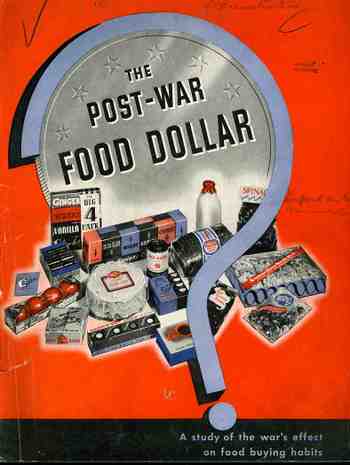
    The Post-War Food Dollar was also the product of the same publisher.  Published in 1943, this pamphlet exhorted the grocer to prepare for the coming peace, explaining where the new dollars might be spent once the war (and the supply and ration problems) was won.  Blogcandy_post_war287

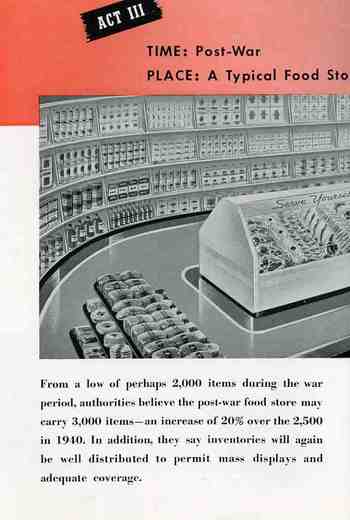
    As it turns out these pamphlets were mostly about display and merchandising, and finding the goods that looked best on the shelves—and evidently that which looked best was that which the product could be seen.  And the way that the product could be seen was with the use of the “new”packaging filament, cellophane, produced in the United States (almost exclusively) by du Pont (E.I. du Pont de Nempours & Co. with  their chemist William Hale Charch figuring out how to make cellophane moisture –proof, which led to very large-scale good packaging using the product.)   Another very big bit which turns up unmentioned but illustrated in this pamhlet is seen in this The Future is Now! scene of a modern supermarket–the “SERVE YOURSELF” butcher/meat section, which was a new idea in the early 1940’s, and one that was not at all common in the consuming world.  This idea wasn’t as big a deal as the invention of mass produced sliced bread (or, as Squidward Tentacles encountered in one episode of SpongeBob, “Bread in a Can–the best Thing Since Sliced Bread”), but it was a very important de3velopm,ent in marketing–and also another gargantuanly consumptive venue for the sale of the packaging element, cellophane.

    It was DuPont who published this series of pamphlets for the sole purpose of marketing foods and ideas to grocers that were almost entirely dependent upon cellophane, and DuPont manufactured 75% of all cellophane made in the U.S.  So, to me, it seems as thought all of this business about Food being Candy and the Post-War food spending dollar was really just about selling cellophane—the food was incidental, which is why the cellophane-encased candy was called “food” to begin with.  (It was Whitman Candies who first used cellophane in the U.S. , in  1912, to package their goods for retail.)
    Blogcandy_post_war285_2
    As an aside it is interesting to note that du Pont was brought to court in 1947 over their alleged monopolization of cellophane manufacturing in the United States.  Thus was the U. S. v. DUPONT (THE CELLOPHANE CASE)  filed December 13, 1947, which “charged Du Pont with monopolizing, attempting to monopolize and conspiracy to monopolize interstate commerce in cellophane and cellulosic caps and bands in violation of Section 2 of the Sherman Act”.   DuPont successfully defended themselves in this case.

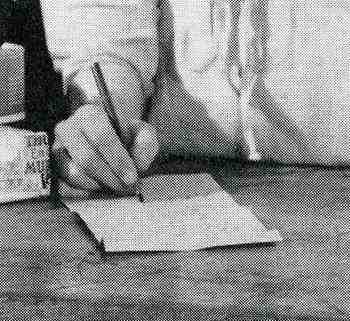
    The other, minor, thing here that really caught my attention was on page 10 of the Candy is Delicious Food pamphlet—an innocent picture of the grocer tallying up the customer’s purchases, sure enough, but if you look at the detail you can see the grocer writing it all down on the bag that he’d use bag up the purchases.  I have a dim memory of seeing this done in the across-the-street-from-the-A&P Mom & Pop grocery sawdust-strewn store (on Main Street, of course) in Great Barrington, Massachusetts, when I was a kid in the early 1960’s.  I
     
    don’t recall this being done after that, what with real cash registers and then, much later on, with more sophisticated inventory control hardware.  I’m sure that I recall this being done in hardware shops (almost all gone), and my Mother recalls this more recently—in the 1970’s—in butcher shops, but I think this recording practice was pretty much extinct by the mid  1960’s.  I know that this means nothing, but the picture of this guy writing on the bag was so sharp in my memory that I needed to record the emotion.
      Blogcandy_bag283Blogcandy_bag284


  • Bombing Manhattan, 1943: the Nazi “Amerika Bomber” by Eugen Sanger

    JF Ptak Science Books    Post #124 (with additions 25 October 2011)
    Manhattan_bombed_4
    That devlish working-for-the-Nazis scamp Eugen Sanger (dead before he was fifty, 1905-1964), a rocket designer and engineer (and developer of ramjet tech)  for the NSDAP, went to work for the French Air Ministry following the end of World War Two after doing his all and thankfully falling short for  the Reichsluftfahrtministerium (RLM, or “Reich Aviation Ministry”).  He worked without rancor there until he was nearly kidnapped1 by Joe Stalin—for the purpose I suppose of continuing work on what may have been his greatest effort, unfulfilled during the war years—the Amerika Bomber.  The Soviets evidently thought that this might come in handy in the late 1940’s.

    The Sänger Amerika Bomber (or Orbital Bomber, Antipodal Bomber or Atmosphere Skipper, and also known as the Silbervogel) was designed for supersonic, stratospheric flight, and had much more bang for the buck than the V2 (10,000 feet/second exhaust velocity, as compared to the later V-2 rocket’s 2000 meters/second, 6560 feet/second) and since it was stratospheric had a far greater range, coming in at better than 14,000 miles.  The 22,000-pound weapon carried one large 8000-pound free-falling bomb.

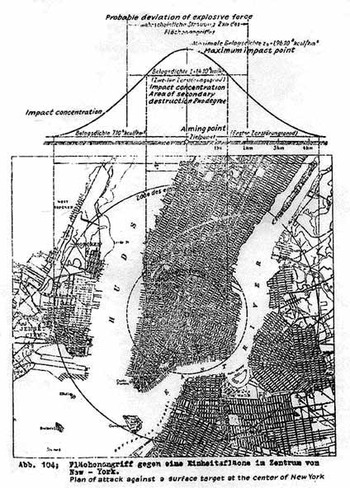
    Sanger’s idea in the early 1940’s was to get this bomb to around Times Square. And since the Amerika Bomber was a relatively inexpensive weapon compared to the damage it could cause, there was room for producing a lot of them.

    Seeing Manhattan in the cross hairs like this is quite sobering, and it is an image that is rarely made.

    Manhattan_bombed_bomber    


    Notes:

    1.  Maybe, maybe not.  Stalin did at least send his representatives–including his own son–to tr and convince Sanger to work for the USSR. THis attempt failed. It has been said that the NKVD was sent to kidnap him, and failed.