A Daily History of Holes, Dots, Lines, Science, History, Math, Physics, Art, the Unintentional Absurd, Architecture, Maps, Data Visualization, Blank and Missing Things, and so on. |1.6 million words, 7500 images, 4.9 million hits| Press & appearances in The Times, Le Figaro, Mensa, The Economist, The Guardian, Discovery News, Slate, Le Monde, Sci American Blogs, Le Pont, and many other places… 5000+ total posts since 2008.
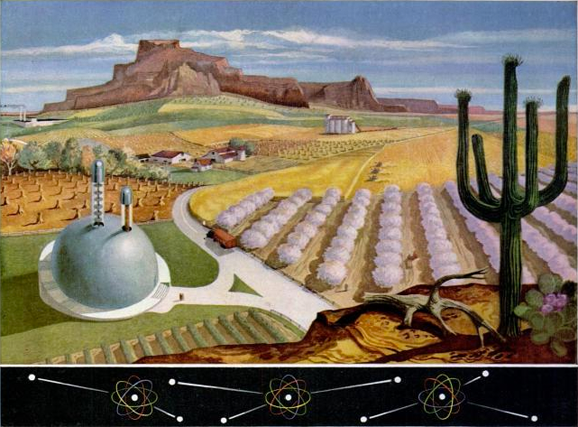
Seagrams V.O. Canadian Whiskey powered the future through a series of a dozen or so ads for itself in the 1945-1947 period, taking a usually-strangled though occasionally interesting peep into what the future might bring. (And of course the future is brought by men who drink Seagrams.) In this ad, appearing in the 12 May 1947 issue of LIFE Magazine, we are told “deserts will bloom through atomic power”–how this might happen is left to the imagination. Also left to fantasy is what exactly is being farmed there in front of the incongruous “atomic energy plant”. Plastic smoke? Taking a fractured approach to the possibilities one might say that atomic bomb mushroom clouds are being grown from seedlings here from the ground up, nurtured until the day they too will be as big as the blasts of August 1945.
Oddly enough, the illustrator–who after all was just trying to sell alcohol–came pretty close to the truth, except that they got the power source wrong. Rather than nuclear energy, it would be petrochemical industries that would lie there at the heart of America’s farm production (via seeds and fertilizers and so on)–I’m sure that it would’ve made more sense in a weak way back there in 1947 to believe the atomic story rather than thepossibility that it would be petroleum that would drive the entire production of food forward.
In another weirdly prescient image–“weird” anyway for a quick effort made by an artist trying to sell drunk juice–is this proto-internet office view, made in May 1945. There’s lots of passive solar going on here(though not really very effective when you consider the other ways of directing and filtering exterior light inside) in the office of tomorrow, but more important is the desk and the file cabinets. The seated man is talking to someone across the country via phone/wireless, with data en masse at his fingertips, a “computer” (in the old sense of the word, that being a person–and usually a women–given the charge of adding long columns of number or whatever and then doing the arithmetic, like a comptometer) working some sort of calculating interest on the largish calculating instrument. In general we see a decision-maker awash in responsibility connecting all of the parts of his world: a primitive, secular, analog internet. And this too just at about the same time that Vannevar Bush introduced his own vision of the informational future with his superb Memex (which I wrote about earlier on this blog here.)
“The oldest of us is thirty: so we have at least a decade for finishing our work. When we are forty, other younger and stronger men will probably throw us in the wastebasket like useless manuscripts—we want it to happen! They will come against us, our successors, will come from far away, from every quarter, dancing to the winged cadence of their first songs, flexing the hooked claws of predators, sniffing doglike at the academy doors the strong odor of our decaying minds, which will have already been promised to the literary catacombs.”–from the “Futurist Manifesto”, by F.T. Marinetti, 1909
They came for Mr. Marinetti a little earlier than that, and continued to come, though whoever it was that came couldn’t quite reach the founder of futurism, who seemed to be one invisible step ahead of oblivion. Or perhaps it was behind? I’m not sure.
But futurism as a movement was more in the past than in the future, barely lasting long enough to have anything but a past.
Not that the movement wasn’t important–it was, obviously–its importance branched out into other areas and movements, morphing into necessary branches, leaving behind a shell of the original tended by the originator. (It can be argued that this movement helped create the environment for Dadaism and Cubism [or at least Cubist-futurism as in the Russian sense of that art].) Marinetti had some unsavory and some jsut downright weird political and social ideas, having a long and vested interest in fascism.1 And not only the earliest part of Italian fascism –founded in 1919 with an interest in expanding the democratic process–but the later, Mussolini-controlled Italian fascism as well. Marinetti sought the protection of Il Duce,2 and even so during the war, when he sought to protect his movement’s art from being designated as “degenerate ” and therefore unacceptable and existence-deniable by Adolf Hitler.
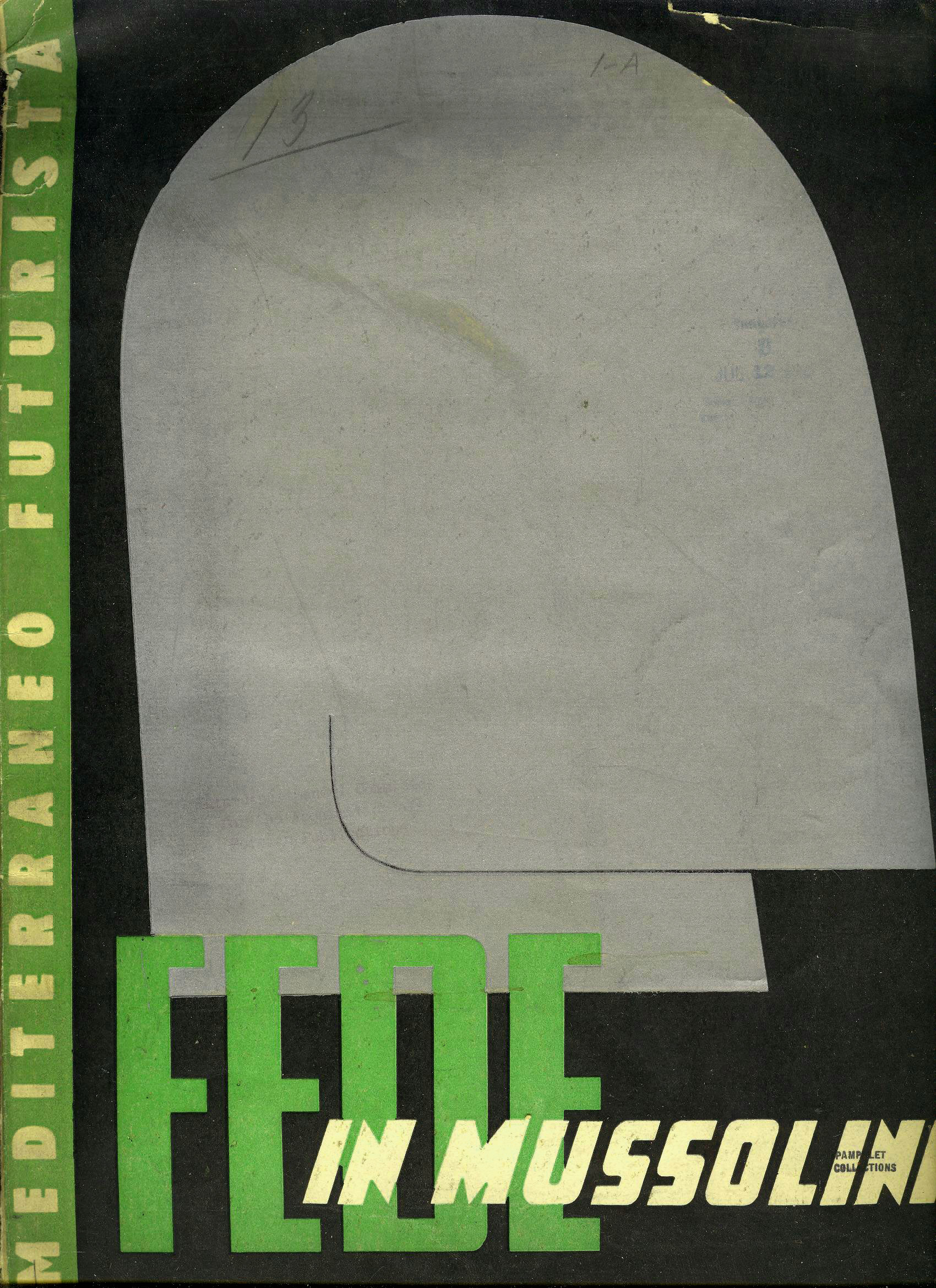
This is the cover of a magazine edited by Marinetti and others, a hagiographic-porn hommage to the leader of the Italian fascist government, Benito Mussolini, featuring a very striking portrait of the leader on the cover.
And so the unlikely prolonged existence of futurism–a movement transformed far beyond itself in a matter of years, held together by pieces of fluff and dust, supported in its old age on the hopes of a noxious political system which was itself doomed to rapid failure.
“At last they’ll find us—one winter’s night—in open country, beneath a sad roof drummed by a monotonous rain. They’ll see us crouched beside our trembling aeroplanes in the act of warming our hands at the poor little blaze that our books of today will give out when they take fire from the flight of our images.” –F.T. Marinetti, from his “Futurist Manifesto”, 1909
Notes
1. Marinetti’s goal was to establish futurism as the official art movement of the government–something he specifically wrote against in earlier incarnations of himself. He would come to loggerheads with much of his earlier social opinions, abandoning his beliefs in his never-ending quest to promote his movement. I must say though that Marinetti did publicly speak against anti-Semitism.
2. Marinetti sought to have the Nazi traveling exhibition of degenerate art–which included works by futurists–banned from Italy. So even though the Nazi fascists established futurism as degenerate, Marinetti was able to enlist the aid of Mussolini to shield Italians from what the Nazis thought of the art. But the futurist manifesto seemed comfortable with the while idea right from the start, as we can see in proposition #9 of its self-proclamation: “We will glorify war – the world’s only hygiene – militarism, the destructive gesture of freedom-bringers, beautiful ideas worth dying for and scorn of woman…”
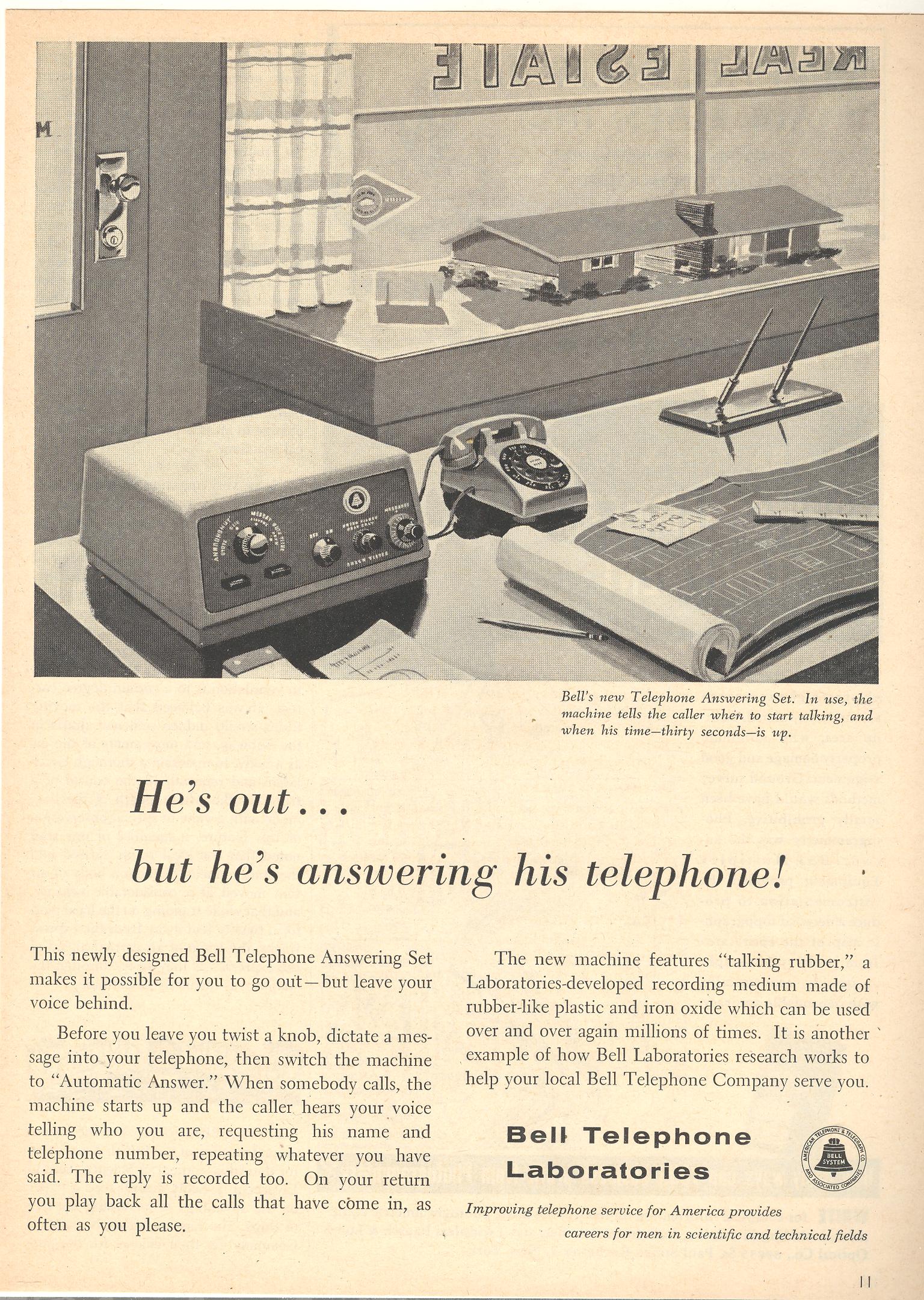
Is the telephone answering machine
the greatest non-transportation contributor to expanding human motion and time
in the 1850-1950 century?Certainly
photography (from an earlier period, invented in 1839 and more or less
popularized by the mid-1840’s) should be considered in this category, what with
the visual capture of a moment in time and all; Marey/Muybridge and their
primitive photographic motion studies is another; George Carey’s prehistoric
selenium/light sensitive “seeing by electricity” invention and the more modern
television by Jenkins and Farnsworth are others. And of course there is the invention
of the telephone itself by Alex Bellin
1876 (and a man whose house and lab was only a few blocks removed from where my
store used to be on Volta Street in Georgetown DC many years ago) as another
paramount example.
But I think the telephone
answering machine is certainly one of them, I think, and not a modest example
either.The answering machine (for “him”,
of course) allowed a person to be in two places at one time, allowing the
telephone to function not only as a communication device but as a secretary,
liberator, device as well.Now (in 1958,
when this ad appeared) that people had completely embraced the phone for
business and for pleasure, it added immeasurably to the well of free time.The telephone enabled immediacy; but for that
immediacy to work, a person had to be there to tend it.With the answering machine, however, a person
could in a way save that immediacy for a more convenient time, liberating their
necessary presence the telephone experience.
The telephone allowed as
person to instantaneously be in two places at the same time, basically; the
answering machine contributed a third (or more) place, and freed up the time
element.
In effect the thing was/is a
time machine, making it possible to either instantly speak with someone 12,000
miles away, or save the conversation for a more convenient time, sort of going
back into the past to replay the communication..(Or dump it, extracting the
necessary info or whatever without having to actually interact with the caller.
)
Its easy to slip and refer to
the machine as simply “an answering machine”, leaving out the “telephone part;
it would be nice to have a machine that could reliably answer questions like
that (though I think that this is what Google imagines itself to be).The “answering machine” four generations or
whatever from now may be something that is today unimaginable.Maybe there will be a general death of the question,
because everything has been answered.
Maybe the greatest machine in
the future will be the questioning machine, something that skirts all of the
known answers in whatever earth-sized database exists at the time.Something that asks for information or for a
synthesis of answers that doesn’t (yet) exist.
Anyway, I like what I think is
the great importance of the telephone answering machine.And I don’t know how The Rockford Files would’ve
functioned without one.
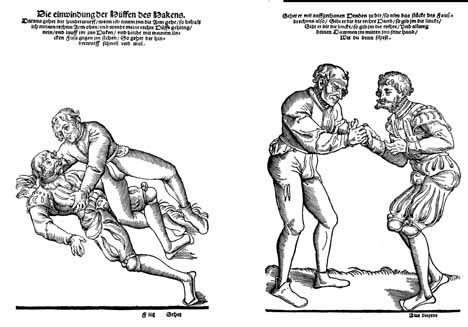
I came to this post backwards. My primary interest was the frontispiece portrait of the author of a 1539 book on wrestling, showing the somewhat long-in-tooth author with scraps of tuffy hair and a coy knowing grin–an unusual portrait, presented by the master Lucas Cranach. I looked further into the book and discovered that the well-illustrated document pictured varieties of wrestling moves, all demonstrated to students by the author, who most of the time was shown with this knowing grin, gripping and flipping and immobilizing his younger subjects. What slowly came into my head while looking at this book was how concise and instructive the images were, and that the whole was a great tutorial on wrestling motion, and the presentation of instruction on specific motions in general.
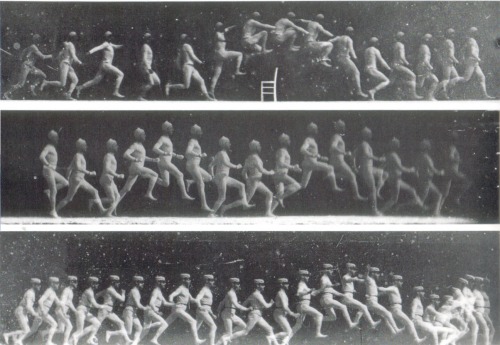
Prior to the invention of photography, printed works on how humans should move in a given way and for a given task are uncommon and, generally, somewhat complex. The image I have in my head is the epochal work of the somewhat forgotten Etienne Marey, who in the 1870’s created what was essentially the world’s first “slow motion” device1. One iteration of Marey’s apparatus was basically a long series of ganged cameras recording a motion for a simple task at a given time frame and presented on a continuous strip of photographic paper, sort of like a motion picture with the camera speed set at three frames per second. The resulting images were phenomenal and showed people for the first time the exactness of all manners of simple motions–motions that no longer looked so “simple” once all of its aspects could be studied from captured photographic evidence. Even the act of hopping over a small stool or bending to pick up a bucket of water were enormously revealing in a way like Robert Hooke’s Micrographia displayed the great detail and complexity of the seemingly simple fly. Perhaps the most famous of Marey’s series of images was that of a galloping horse, which also for the first time revealed what exactly the horse’s legs were doing and proving that almost every painter in the history of art represented the galloping horse incorrectly. But Marey doesn’t actually fit the mold of directing the motions of people for a particular instructional purposes, though he does of course photographically reveal hundreds of actions that led to a revolutionary understanding of the body-in-motion. This is why I’ve chosen him as the limiting point for this category. (And just for the record I’m not sure when the first book on the movement of animals–not including hunting/trapping books–comes into being.)
Early works directing people on how to move are not terribly common. There are general works on table manners, the appearance at royal courts, religious ceremonies, maneuvers for armies in combat, sword fighting, parades for triumphs and adulations, funeral rites, and so on.
For this first installment I’d like to look at two ends of the spectrum for displaying motion instructions clearly. The first is a book by Fabian von Auerswald, whose Ringer kunst: funf und Achtzig Stücke2, published in 1539 in Wittenberg, is one of the earliest books printed on the art of wrestling. It was printed by Hans Lufft3,the man who
was also responsible for printing Martin Luther’s translation of the Bible a few years earlier.
I like the images in this book, elegantly produced by Lucas Cranach–they also present the more-elderly author (frequently shown with a sly grin) demonstrating his wrestling moves to his students. Overall it seems to me that it was an excellent (if not fluid) presentation of how to direct body motions.
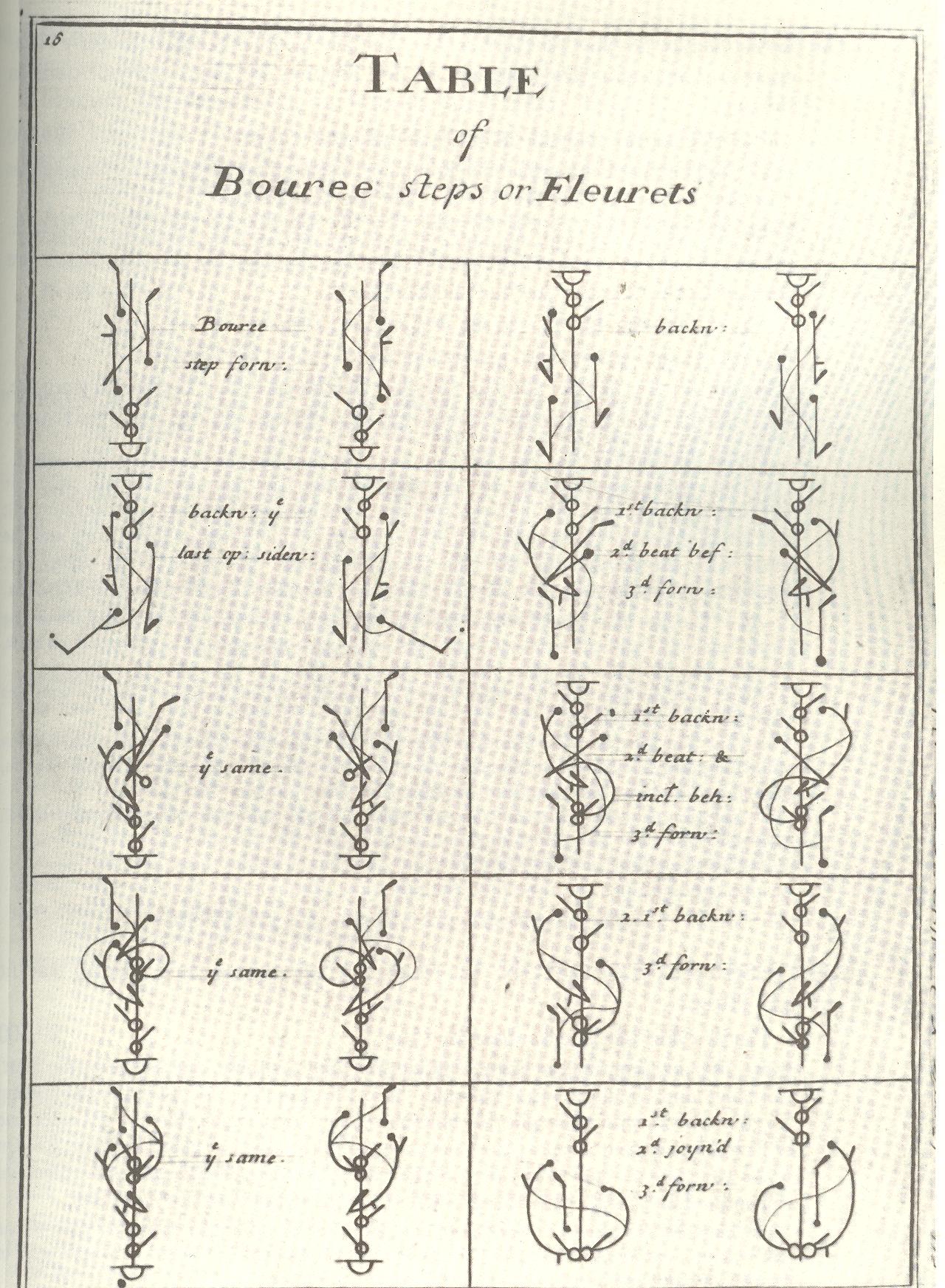
Not so quite as direct, or simple, or lucid, or useful, is Raoul Feuillet’s publication of Pierre Beauchamp’s Orchesography4, a work published first in 1700 (and then in English in 1706) and dedicated to instructing people on the movements of the dance. It was a good idea, though more useful to folks in the future than for his contemporaries. The book was a spatial geography of dance–the motion (feet and arms, both) was written in a similar fashion as musical notation, though not nearly as clearly. The dancer was to hold the book and view the steps as they would be from above, holding the book always (!) pointed towards the “upper end” of the dance room. (There were separate and complicated instructions showing how this was to be accomplished–imagine trying to perform the steps in a series of twirls, and keeping the book pointed “true north” so to speak. Not easy.)
As it turns out the work by Feuillet/Beauchamp may have been more important as a piece of dance archaeology because it was so terribly detailed; it may not have been an exemplar of teaching people how to dance, but it certainly was an iconic publication in recording the intricacies of dances that may otherwise have been lost to time.
1. I should also say that Marey was influenced by the work of Eadweard Muybridge’s photographs of motion—whom he credited of
course—and who I think expanded upon and exceeded those achievements.
2. The entire book located here; the translator writing here on
the philosophical/linguistic aspects of the book.
3. Beginning in 1534–the Luther Bible was printed in vast numbers by Luftt
(and appeared in the millions over the years) and others; the same can
not be said of the Auerswald book, which appeared in a small edition and
is quite rare today. It was in this edition that (in addition to much else) is found in Romans 3:28 the controversial “alone”: “thus, we hold, then, that
man is justified without the works of the law to do, alone
through faith”
4. The full title: Orchesography; or, The art of dancing by characters and demonstrative
figures. Wherein the whole art is explain’d; with compleat tables of
all steps us’d in dancing, and rules for the motions of the arms,
&c. Whereby any person (who understands dancing) may of himself
learn all manner of dances. Being an exact and just translation from the
French of Monsieur Feuillet. By John Weaver, dancing master.
In the history of archaic thought it doesn’t take very much at all to reach
the uncomfortable bits in the sulfurously tangled history of the subjugation
of women. But it is most interesting when you find the points at which the “backward-looking”
archaic parts are actually somewhat forward-looking for their time.
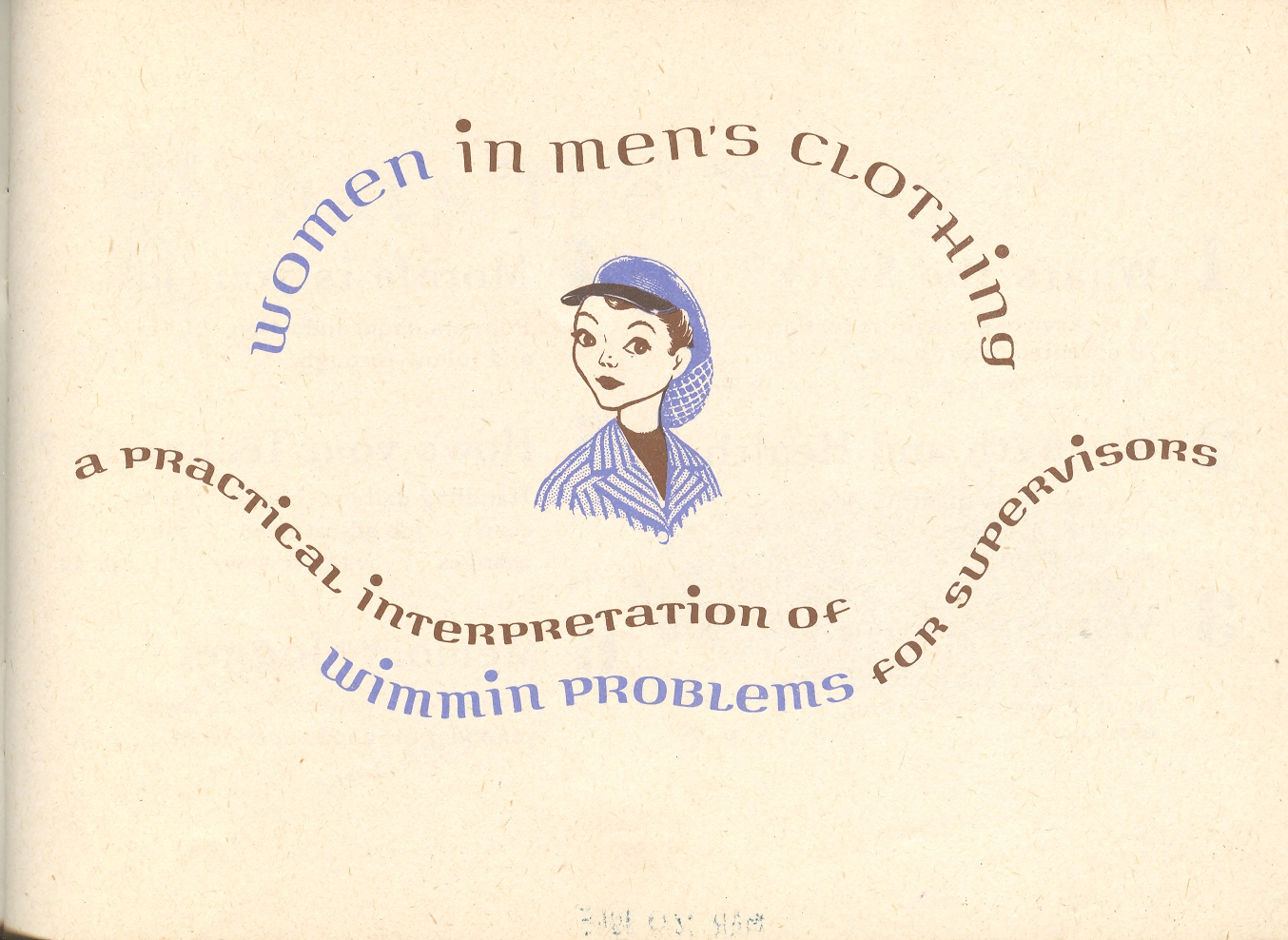
Such is the case with this odd and interesting little pamphlet, Women in Men’s Clothing, published by
the Vultee Aircraft Corporation, and published in 1943—it can be simultaneously
awkward as a broken product of its time and oddly, slightly, futuristic (with a grudging and clawing recognition of women as possible equals as members of the work force). Overall the publication looks pretty painful from today’s perch, but when you look a little past the winces you can see a little bit of recognition for women in general; at least this is far forward from anything that might’ve been published slightly before the war.
The pamphlet was intended as a human resources tool for managers and
supervisors in an aircraft production facility where women had been sought and
recruited to fill the very many vacancies brought on by the war.(Millions of women entered the workforce for the
first time between 1942-1945; millions of them exited too once the servicemen
returned from active duty to reclaim their jobs.)For most industrial supervisors, the prospect
of women in the workforce was not a welcomed one, and many had never before needed to think of such a diversified workplace. This slight publication translated the idea of “women/”wimmin” for these
men.
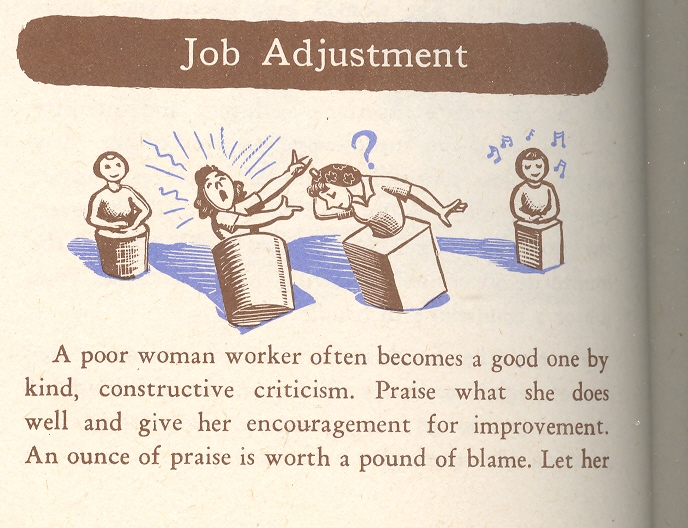
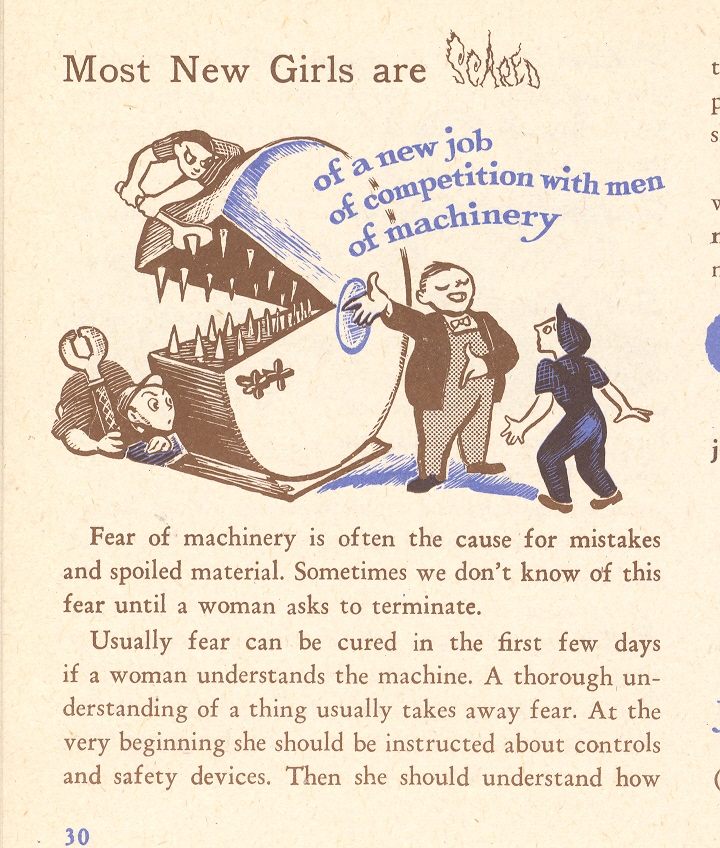
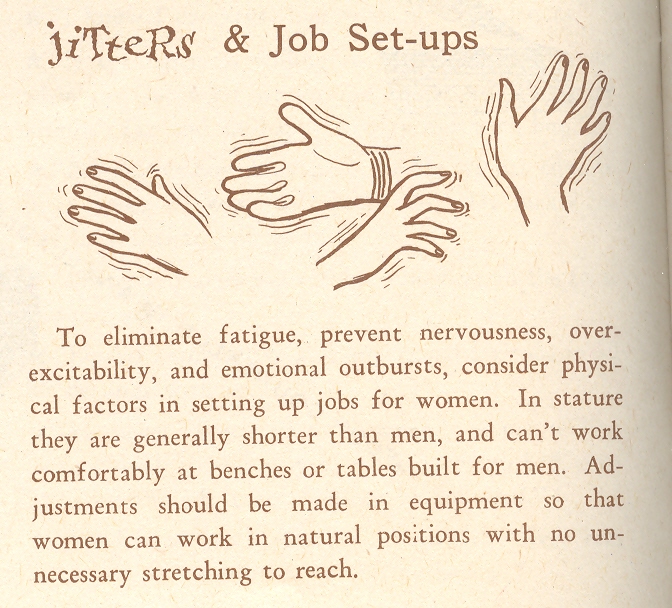
The “translation” of the understanding of women from home to the workforce doesn’t go very far to advancing the understanding of women at work–they’re pretty much the same (dogmatic, condescending, sexist, domineering).
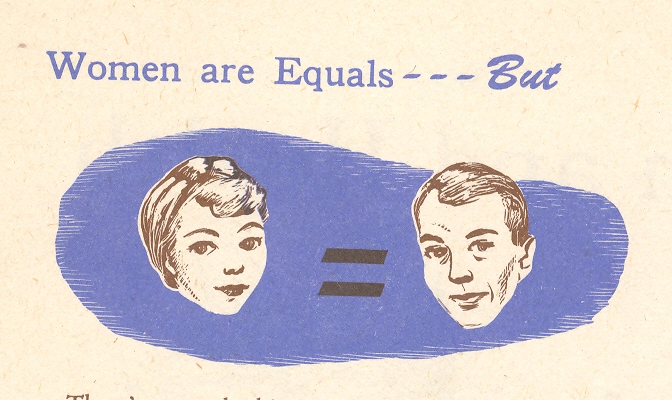
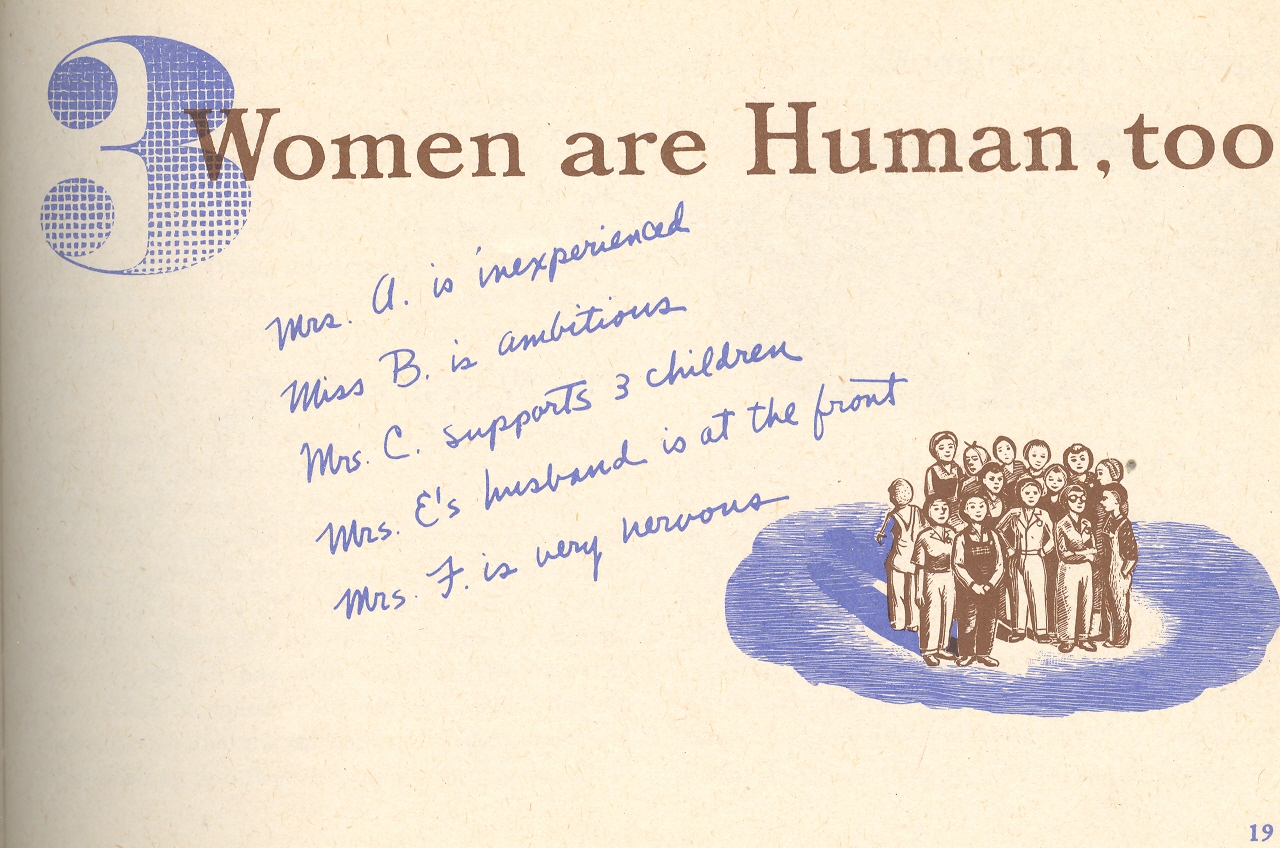
All of that is pretty well summed up by the first picture in this series–the asterisked “equality” between men and women. I must admit that I don’t think I’ve ever seen this “equals, but” label before, or at least so deep into the century.
And of course “women are Human, too” needs very little comment…as is the case for most of the images in the pamphlet.
1932 in my book turns out to be one of the most collectively epochal years in the history of science. Certainly others stand out for individual achievements, like 1905 (Einstein’s four papers over two volume of the Annalen), 1687 (Principia), but there are other yeas with fabulous achievements by numerous people.
1543 is one.That year witnessed the published of Copernicus’ De revolutionibus and Andreas Vesalius’ De humani corporis fabrica, two giant achievements for the outer and inner worlds, one challenging the structure of the universe and the other the Galenic tradition of physiology and anatomy. (To a lesser extent is Peter Ramus’ Animadversions on Aristotle which was a very sustained and elegant attack on the ancient-precept Aristotle an physics.)
1859 saw the publication of On the Origin of Species…JC Maxwell’s work on the kinetic theory of gases, Riemann’s hypothesis, and the spectacular invention of the spectroscope of Kirchhoff and Bunsen (that turned much of the invisible universe visible).
1939 (nuclear fission, chain reaction, neutron stars, magnetic moments, penicillin (advancement), Vit K, FM) and 1948 (nuclear structure, QED, transistor, Big Bang) also come quickly to mind.
1932, though is really quite something, seeing a sweeping array of discoveries in the large and small. Carl Anderson identified the positron while James Chadwick discovered the neutron; also, the Joliot-Curies’ made their monumental discoveries in radiation.1Iwanenko described the neutron as a constituent f the nucleus, while Heisenberg described the nucleus as composed of protons and neutrons. Knoll and Ruska built the electron microscope, allowing a vision of the interior parts of the interiors of the smallest things, offering images almost as spectacularly new as Hooke’s two centuries earlier. Looking up and out, in the same year, Lev Landau postulated the existence of neutron stars while Karl Jansky invented radio astronomy. There was also the perfection of the “Polaroid” process by Ed Land, and the isolation of ascorbic acid (Vit C, byCharles Glen King, and the beginning of a long war between him and Szent-Gyorgyi on priority of discovery). (In the non-sciences, there was the addition of Franklin Roosevelt and Adolf Hitler to their national agendas. It was also a banner year for literature: Death in the Afternoon, Ernest Hemingway; Light in August, William Faulkner; 1919, John Dos Passos; The Thin Man, Dashiell Hammett; Tobacco Road, Erskine Caldwell; Young Lonigan, James Farrell; Little House in the Big Woods, Laura Ingalls Wilder; and Brave New World, by Aldous Huxley…)
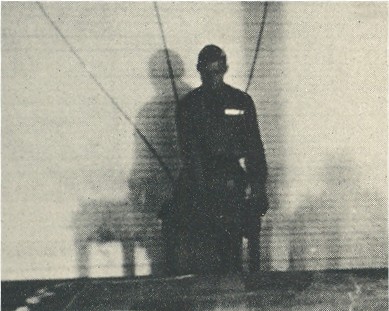
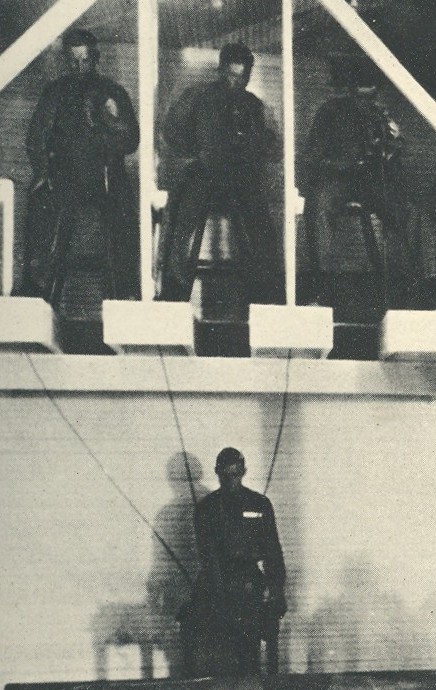
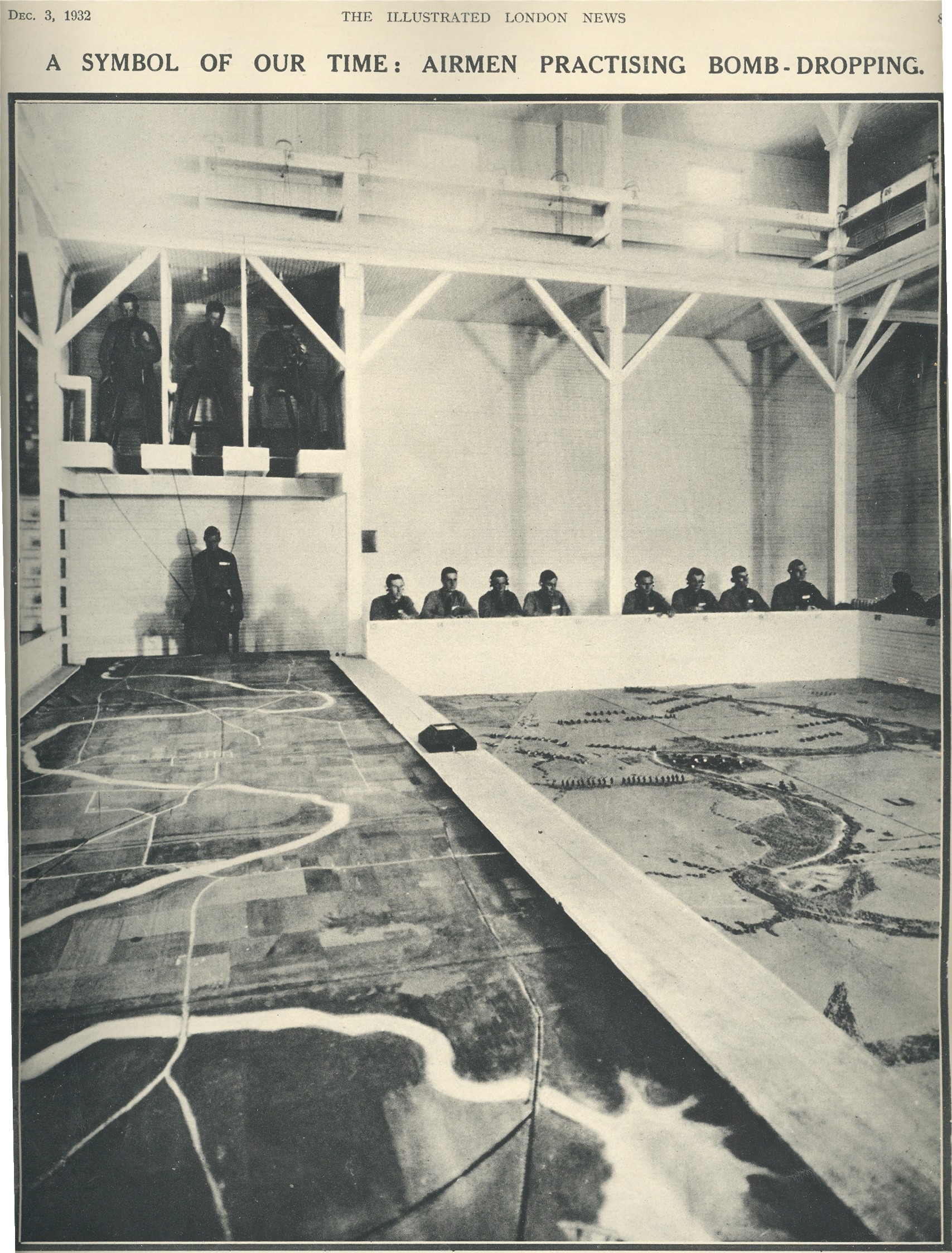
The thread of thinking about all of this came to mind looking at this image of a bombing instruction room for aviation in England in 1932.The image is also a great one; the aviator at far left looks like a marionette; the three men above responding to his piloting maneuvers as he concentrates on the endless panoramas of landforms that advances before him on a horizontal diorama.It is a fabulous analog flight simulator constructed at a time of great change in aviation
1932 is also the year of the publication of Carl W. Spohr’s classic future-vision/speculative fiction apocalyptic-atom bomb end-of-the-world two-parter (so many hyphens!) that appeared in Wonder Stories.2 The story begins with a relatively simple series of catastrophic bombings that lead to a sort of détente, a kind of mutually assured destruction, which is then upset when the combatants discover and construct the atomic bomb.MAD breaks down, and the ensuing massive exchanges result in adevastated world.Pretty prescient stuff, all-in-all, even so far as the policy goes—especially so when you wrap this sci-fi story around the elements of 1932—Chadwick, Anderson, Joliot-Curie—that made all of this stuff possible just 13 years later.
Notes
1 The Joliot-Curie discovery was called “one of the most important discoveries of the century… the consequences of the discovery of artificial radioactivity are immense” from Segrè, From X-rays to Quarks, 198-199).
2.Part one appeared in the March issue, which also carried stories like“Red April, 1965” by Frank K. Kelly; “The Eternal World” by Clark Ashton Smith; “Waves of Compulsion” by Raymond Gallun; “Mutiny on Mercury” by Clifford D. Simak; “The Time Stream” by John Taine (Eric Temple Bell), and others.Pretty good bumper crop of sci-fi writers in itself.
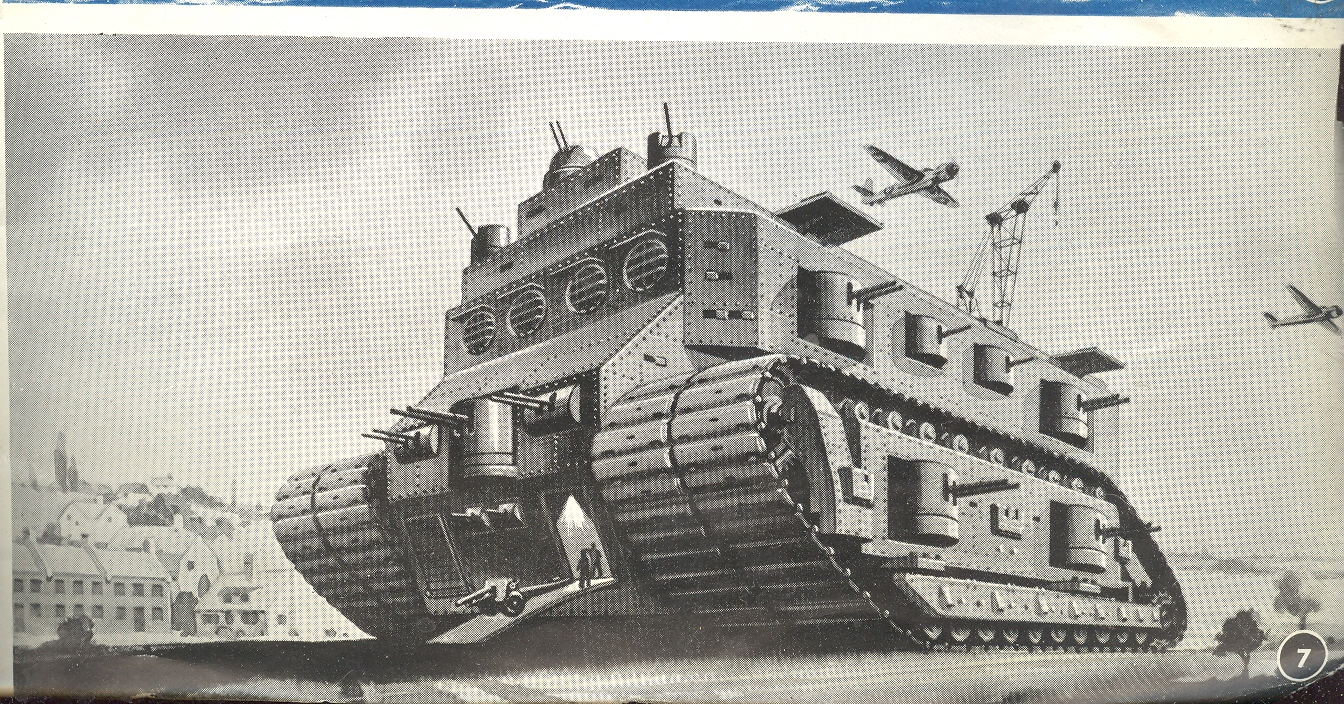
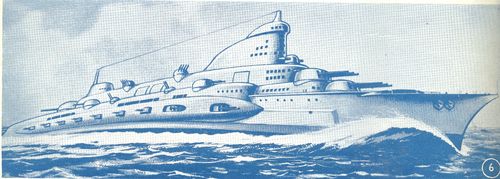
Nothing quite exceeds like excess said Mr. Wilde (and others) , and he/they could be no more correct when looking at this picture of a Movable Maginot Line—it is a mobile fort, complete with plane launching capacity, two dozen long canons, a crane, and a host of other stuff.
It looks as though it has ample room for all sorts of materiel though leaving little room for, perhaps, an engine. I just can’t see where it might be…perhaps it is near the not-room-enough-for-it-either ammunition compartment. Maybe they were in a smaller armed cart being pulled by the mothership? I reckon that this beast was 66 feet high, 100 feet long and 60 feet wide, which is a very big, heavy near-cube. Good luck with driving the thing in anything that was less than perfect conditions. A big profile like this, filled with guns and canons or not, also makes for a big target profile—a tall, broad target with flat/non-inclined sides. ( I should also point out that there are two 10’ loudspeakers mounted on the front of the fort to instill fear in the people that the thing was approaching with loud noise. The author points out that the Nazis used noise against the French with their “screaming dive bombers”, and so the fort would use the same tactics against the Nazis in the movable fort—not that the sound of the engines and the attendant noise wouldn’t’ve been enough of a fear factor in themselves…)
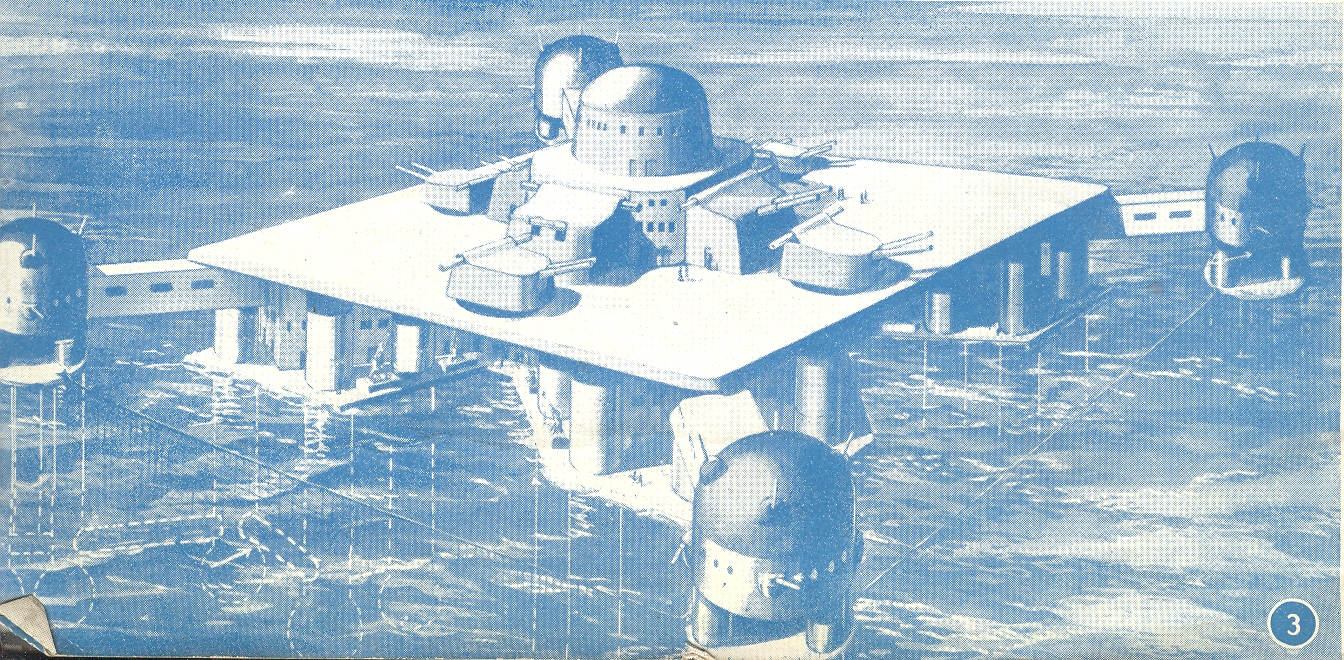
But the image of such a monster, sensical or not, was enough for the purposes of the pamphlet in which it appeared. The Brains to Win was a piece of British spirit/hope propaganda issued at about the time of the Battle of Britain in 1940, and it listed the sorts of technological breakthroughs that were going to push the nation over the top to victory. Some of the stuff was real, some not—like the moving fort/Howl’s Castle above, and the floating fort, below.
I’m not sure where a floating fort would make sense, especially one of that size. (Iterating the figures on deck into distance, it looks as though the deck on the floating platform was 150 or 200’ square. It would’ve looked like a big target from above.) Given the time and expense and material needed for such a thing, it seems that it would’ve been cheaper to make a moveable fortress not quite so big, with less of a profile, and more mobile—I think that this was called a “destroyer” or “battleship”.
But no matter, I’m just poking fun at some of the future vision that became archaic the moment it was drawn, punk retro-future. All the pamphlet was trying to point out in its 32 pages was that overall the Brits were smarter than the Germans and that would be the balance for victory in the war. “Hitler will get some very unpleasant surprises before this is over” the author very politely pointed out, no doubt with one eyebrow raised. The scientists agreed.
“One conversation centered on the ever accelerating progress of technology and changes in the mode of human life, which gives the appearance of approaching some essential singularity in the history of the race beyond which human affairs, as we know them, could not continue.”— Stanislaw Ulam, May 1958, referring to a conversation with John von Neumann [Ulam, S., “Tribute to John von Neumann”, Bulletin of the American Mathematical Society, vol 64, number 3, part 2, May 1958, pp 1−49.] This is also said to be the first use of the term “singularity”, referring to the sometime-in-the-future point where artificial intelligence reaches such a level as to create a race of super-intelligent artificially-enhanced human beings.
In the history of perfect tomorrows, what happens to people when we no longer die, or live to enormous ages, or replicate necessary organs to such a degree that cell death is no longer an issue, or are just able to get rid our biological corpus and live in something else?
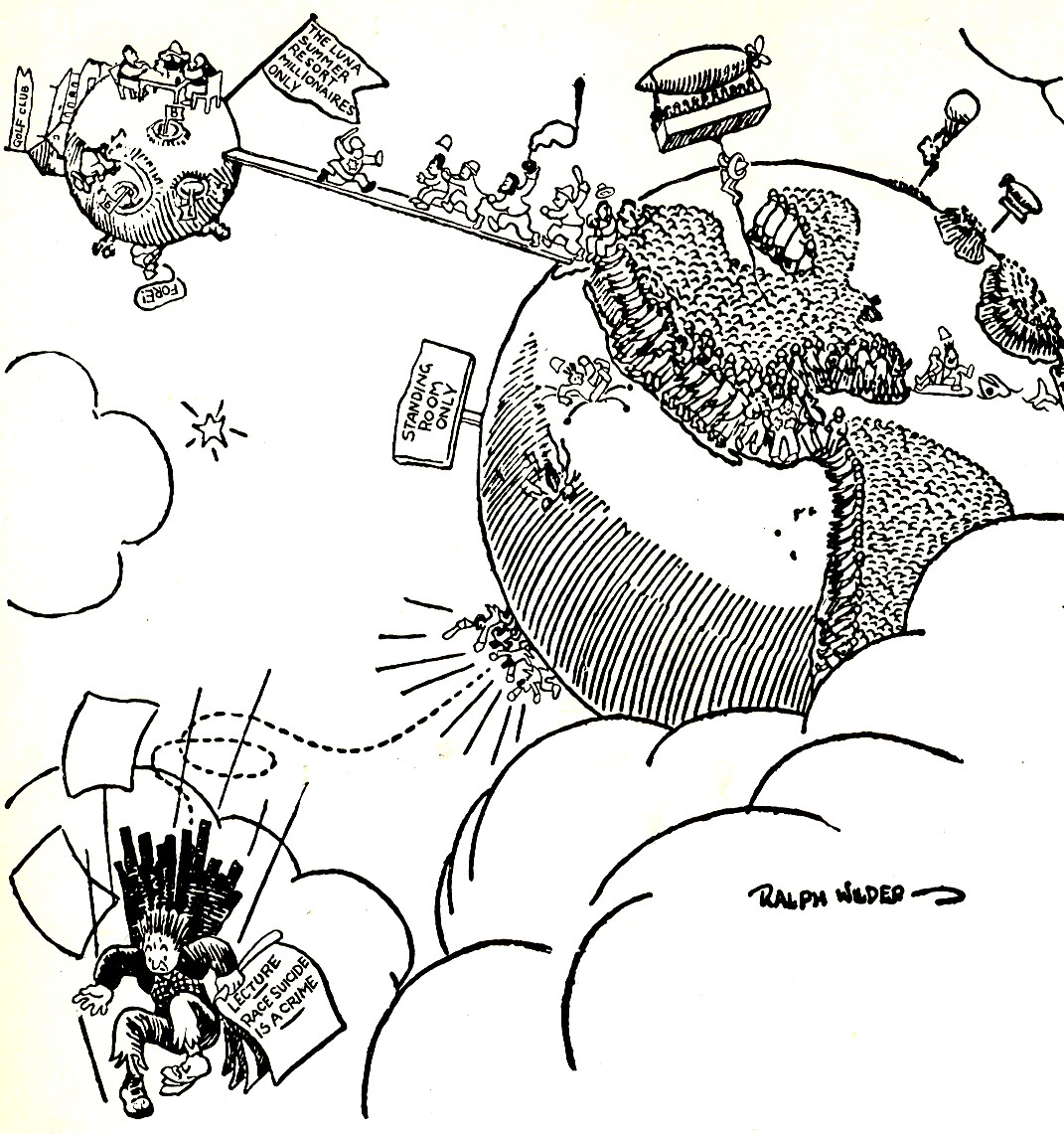
I can’t tell when the first references start to appear in literature, scientific or otherwise, regarding the sustainability of the population of the Earth, or of simply filling up the Earth, for that matter. This cartoon (above) by Ralph Wilder, published ca. 1915 (source unknown, unfortunately), may well be in the first wave of what must have seemed at the time to be absurd speculation.
It is impossible for me to imagine what the future of medicine and medical technology may hold for all/some of us in the next 150 years.I chose this number as it gets us back to one of the greatest advancements in the history of surgery—sterilizing instruments and keeping the surgical room clean.
This is the work of Dr. Joseph Lister (remember badly via a popular consumable) who in one fell swoop (and over the course of several years) brought the survivability rate for all surgeries up by half or so, an extraordinary feat, and only four generations old.It is less than 400 years ago that William Harvey figured out pulmonary circulation and paid hell for it for many years.To imagine the obverse, the medical advances that will occur in 2400 may be as foreign to educated us here in 2010 as 2010 looked to William Harvey in 1628 or Joseph Lister in 1863.DNA is only a few years older than me (discovered in 1953), and even though its discovery may seem antiqued at this point, the technologies and understanding initiated by that discovery may look as quaintly fundamental to those in 2150 as the necessity of having a clean surgical environment looks to us.
And who knows how advancements may spiral ahead of themselves once intelligent machines start producing machines that are more intelligent than themselves leading to god-knows-what.
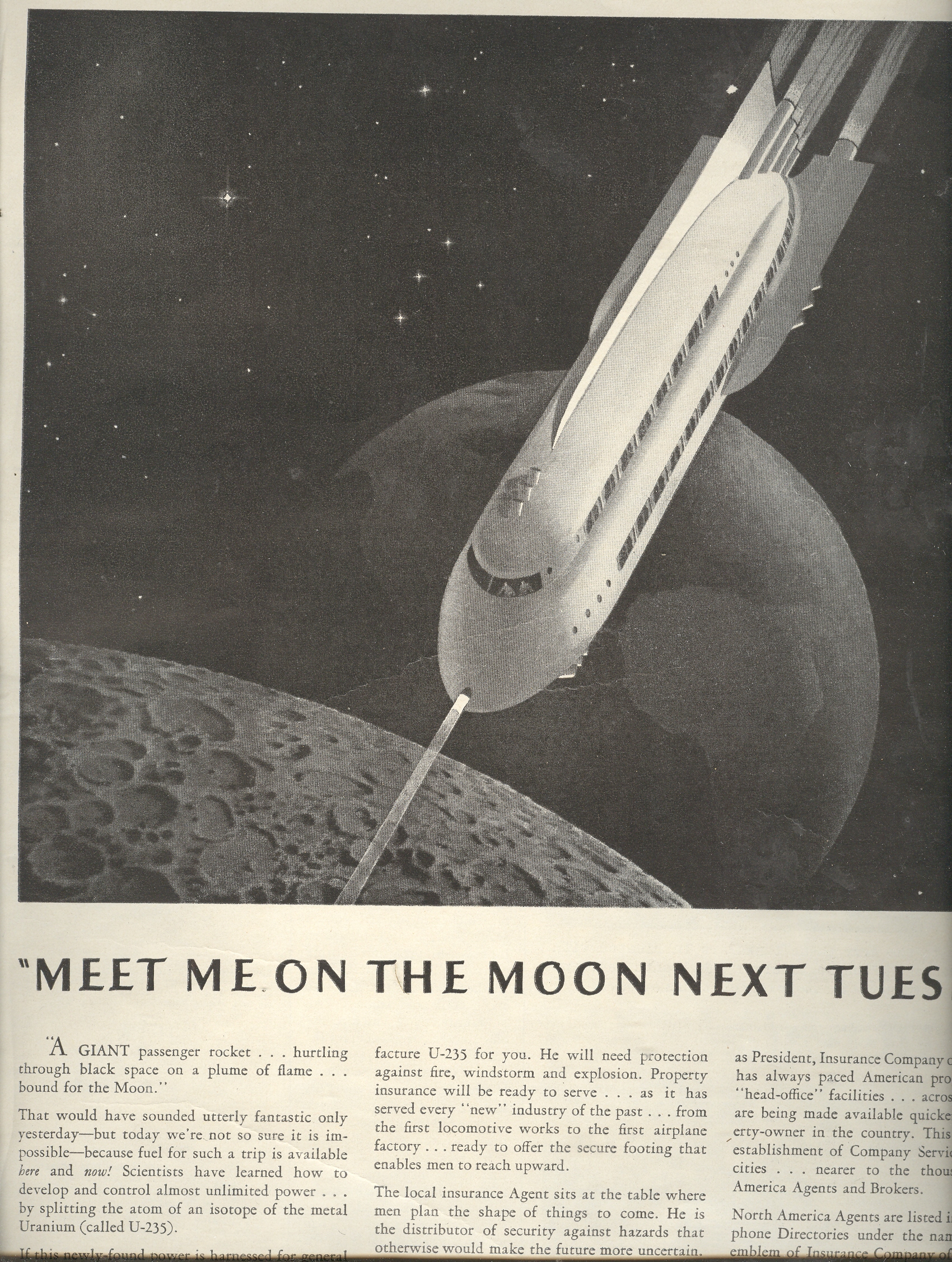
But back to the cartoon, and the mathematician Stan Ulam, who is really at the base of this post. The image depicts the Moon as an escape pod for those who could afford it, the signs suggesting that money would determine who had space to lie and who didn’t.Of course, there was the problem of actually getting there, which in 1915 or thereabouts was still science fantasy (being twelve years after the Wrights and four years before Goddard).
The second image, from LIFE magazine in 1941, shows a rather massive space vehicle powered by U-235. Discovered by Arthur Jeffrey Dempster in 1935, U-235 was a fissile material capable of sustaining a fission chain reaction. (Dempster, 1886-1950, was a Chicago Ph.D. who during the war would be the Chief Physicist of the great Metallurgical Lab at Chicago, from 1943 to 1946.) The ad (for an insurance firm) shows the ship being powered by what would be a series of nuclear explosions—quite a remarkable thing to be printing in a mass market periodical in the second year of WWII. As it turns out the Physical Review was still publishing sensitive articles on these topics ‘till right about this point, after which their appearances were suspended for the duration of the war.
And as it turns out the thinking here was prescient.It was Stan Ulam who first suggested this use of atomic energy in 1947; and it was Freeman Dyson and others who (beginning in 1958) took this many steps further with Project Orion.In short, this project was a think-sink for a pulsed nuclear propulsion system for a class of space vehicle that would range in (three) sizes from 8,000 tons to an incredible, space-insatiable 8 million tons.
Yes, that’s 8 million tons.That was for a city-sized space ship with a diameter of 400 metres and which could travel at 20,000-30,000 m/s with meganewton thrust, being pushed along by series of nuclear explosions, carrying fantastic payloads and enabling the construction of vast structures on, well, other places.
I don’t know how the thing would get off the ground.Evidently this was not an issue, for even in the late 1980’s drawings and plans for this monstrous ark were still being published. But even as I write this I wonder if my own incredulity with the possibility of such travel will be seen incredulous to folks just a few generations down the road. I suppose this is just another small stop in the history of the time it takes for absurd ideas to look not so.
I
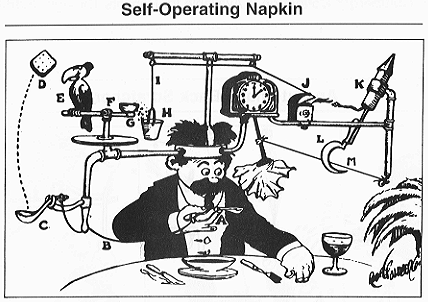
think no plumb line was ever so worked with pulleys and wheels, strings and
catclaws and other Rube Goldberg devices as were the demographic studies of
nuclear warfare.It is as though their
compass rose had no compass, with everything centered on the center, no way
out, no way in. just there.A faceless
clock face describing “G-2 o’clock” whenever it pleased.These studies seem to me the nuclear warfare
equivalent of the Bellman’s map (described earlier in this blog as the most
perfect map ever constructed): a pretty polygon describing a totally blank
surface.
I
have a number of these things here, some of which are restricted-distribution
publications, works of statistical fancy/fantasy meant for other eyes in the
same community dedicated to the fancies described, a tautological audience for
self-referential.
One
such bit, plucked from this pile is William W. Pendleton’s A Study of the
Demography of Nuclear War produced by “Human Sciences Research, Inc.” Outside
of its statistical foray in survivability and the procreative prospects of the
left-overs of vast nuclear exchanges, the work is a solemn attempt at
institutionalizing the death requirements of nuclear combat.The necessity of overwhelming carnage is
presented in ironic and underwhelming language, the first bits of which are
seen in the conclusion of pamphlet’s abstract1:
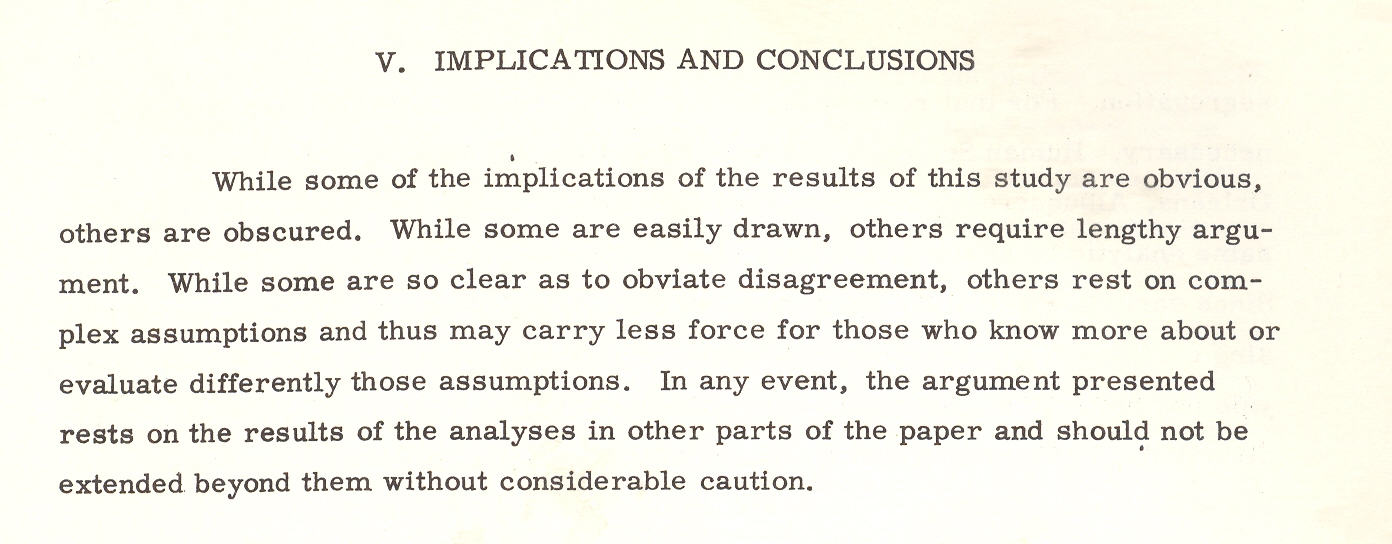
“Cities differ in the kinds and magnitudes of
change to which they might be subjected. Considerable variation in the demography
of surviving populations can be expected; that variation would be related to
policy decisions; and those decisions should therefore be examined for their
demographic implications.” [Emphasis mine.]
Put
another way, the city is the main focus of the survivability equations, and the
chances of the humans being bombed in those cities would change with—god help
us—the amount of bombing.
Cities differ in the kinds and magnitudes of
change to which they might be subjected.
This
is the key I think to understanding documents like this, making a simple
foundation statement so convoluted and tortured that it and most of what
follows make any sense outside of restating themselves. Which I guess is a
strength.
Back
to the pamphlet and the interesting table that attracted my attention.According to one study [and for the sake of
brevity I’m not going to describe the scenarios or data estimation methods and
so on] the U.S. would suffer 46% casualties [meaning immediate deaths and not
as a result of radiation or illness or starvation or the encyclopedia of
whatever that would lead to death somewhere down the road].The resulting demographic of the “perished”
by job description postulates that the most-killed category of worker would be:
(#1) aeronautical engineers, 86% dead; (#2) transportation equipment salaried
manager, with 79% killed; (#3), social scientists, with 78% of them going down
with their clients; (#4), authors, with 76% gone.
Authors?Of what, I wonder?The good ones with the bad?Are authors different from writers?And what do you call folks who produce tv
shows?Since the stats here are for 70
cities there’s no wonder that there aren’t any farmers in this table, as the
majority target areas (some 450 cities cited elsewhere as targetable, including
my own little burgh of Asheville, N.C.) would naturally have city
folk in them.And so I’m guessing that
three-quarters of all “authors” in 1960/6 were living in these target cities
and were going to go up in smoke.The
aeronautical engineers category is more understandable as every one of those
industries employing 50 or more people would be a target; frankly I’m surprised
that given the possible firepower of the Soviet Union
in 1966 that 14% would survive; I’d guess offhand that the number would be
2%.
Even
though this stuff is spread out in only 98 pages or so it would keep a person
busy segregating the Orwellian gems from those not; it would be a tricky
business as most of the “text” in the “not” category would be largely limited
to prepositions.
Here’s
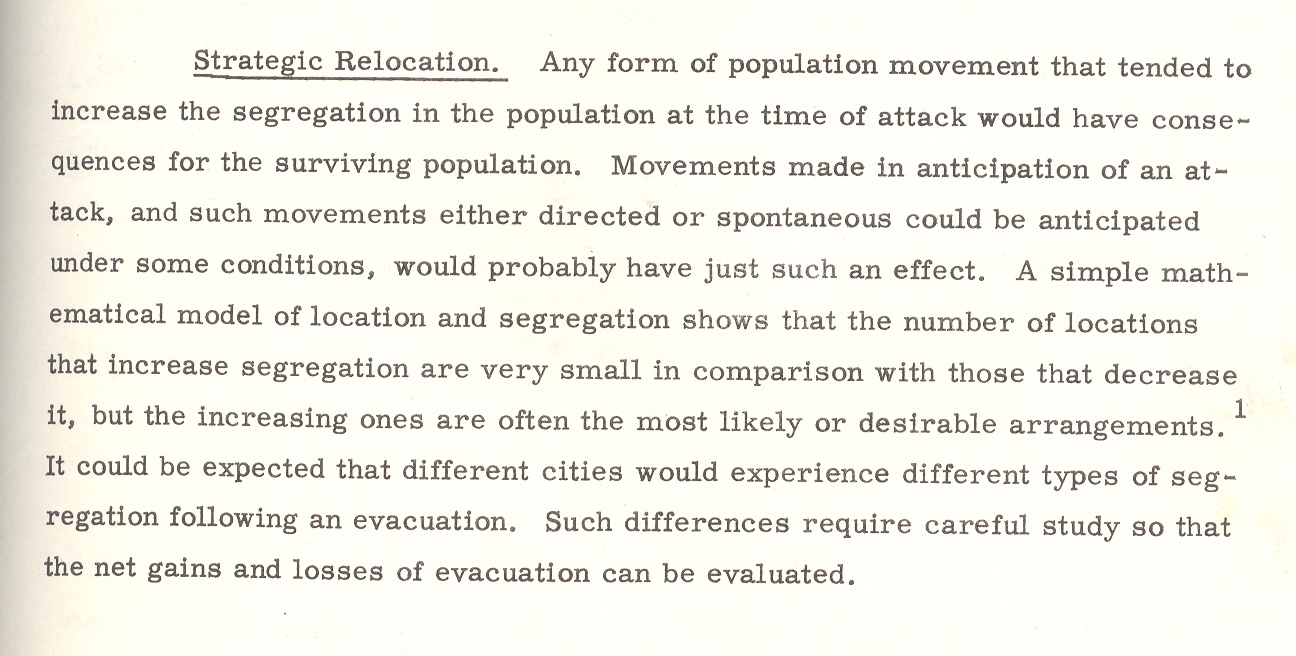
another bit:a parenthetic poke at the
post-attack composition of Congress. It is stated that the “postattack”
(hyphenated no longer) Congress would be “quite different”.It would also be (“in
their eyes”) “more Conservative than the pre-attack (hyphenated!)Congress. It isn’t a cause for great prognosticational (?) liberty to assume that
the Congress might be more Conservative, but why on Earth did the author
qualify the assumption by saying “their eyes”? Pish and posh.
The
paper goes on its merry way, connecting the necessaries of Goldbergian delight,
and somehow nothing ever happened, which to me is a secret miracle.Especially given the weight of papers like
this one, which seems to medicate the effects of war, assuming that there will
be a Congress and that people will report back to work once the factories are
rebuilt and that there will be more segregation in the colossal world of post-attack
America, and on and on into the red dawn.
Mr.
Mencken’s view of Warren Harding comes to mind when I read this stuff and
wonder about how it was that we didn’t blow the whole place up:
“I
rise to pay my small tribute to Dr. Harding. Setting aside a college professor
or two and a half dozen dipsomaniacal newspaper reporters, he takes the first
place in my Valhalla of literati. That is to
say, he writes the worst English that I have ever encountered. It reminds me of
a string of wet sponges; it reminds me of tattered washing on the line; it
reminds me of stale bean soup, of college yells, of dogs barking idiotically
through endless nights. It is so bad that a sort of grandeur creeps into it. It
drags itself out of the dark abysm of pish, and crawls insanely up to the
topmost pinnacle of posh. It is rumble and bumble. It is flap and doodle. It is
balder and dash.”
Notes
1. The
abstract from the above paper: “The basic problem with which this report
is concerned is that of determining the kinds of demographic change that might
result from a range of nuclear attacks, ascertaining the effects of those
changes on the future of the surviving populations, and indicating possible
areas for Civil Defense action and planning. Earlier studies of the demography
of nuclear war were examined and their relevant conclusions and methodology
incorporated in the report. A different methodology–expected to be more
sensitive to compositional effects–was then designed. The new methodology was
tested and found to be more effective than the old. Surviving populations
representing a wide range of variation in attack conditions were created on the
basis of both old and new methodologies, and the demographic significance of
these populations was examined. Assuming a range of post-attack demographic
conditions, a series of projections was made on the surviving populations. The
demographic significance of the recovering populations was then examined. On
the basis of the analysis a series of recommendations relevant to Civil Defense
planning was made: Within the framework of this analysis the crucial variable
is the demographic pattern of the city. Changes in composition, as well as
size, could be of substantial magnitude and would last for generations in some
cases. Cities differ in the kinds and magnitudes of change to which they might
be subjected. Considerable variation in the demography of surviving populations
can be expected; that variation would be related to policy decisions; and those
decisions should therefore be examined for their demographic implications.”
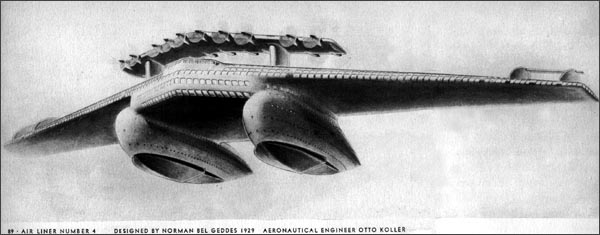
Sometimes things are designed that are so bulbous and so inflated and so terribly hyper-packed that they are just destined never to be built beyond the imagination. Among the largest of these things meant for the air was designed by a particularly streamlined designer, Norman Bel Geddes, who basically owned the concept of aerodynamic function at all levels of design in the 1930’s.
But Bel Geddes’ apoetically-named aircraft, Airliner 4, is an entirely different issue. It may possibly be the largest, slowest, lowest, fattest and most lumbering plane ever designed. (And by this I mean that it stood a chance of some sort of actually being built and flown, as opposed to the monsters with wing-topped tennis courts and such.)
This 530′-long 1.2 million pound beast took an hour to climb to its max ceiling of 10,000 feet where it would cruise along at an astonishing 100 mph. It would wind its way lovingly across the country, slicing off its travel hours like frozen bologna, 30 hours from coast-to-coast, slowly, methodically, so as not to disturb its 600 passengers in their sleeping rooms. But I’m not sure how much sleep would get slept, what with 20 (!) 1900 hp engines screaming overhead.
The passengers who didn’t sleep could do a lot besides sit and be serviced by the aircraft’s crew of 155–they might actually need guides to get them through the oddness of the plane’s 9 decks, 3 kitchens, 2 dining rooms, solarium, 100-couple dance floor, gym, barbershop and medical offices (with waiting room). Plus much, much more. (I like a plane with a doctor’s office waiting room; perhaps the real genius would’ve been to come up with the smaller, more interior, extra waiting room to which one graduates before seeing The Doctor.)
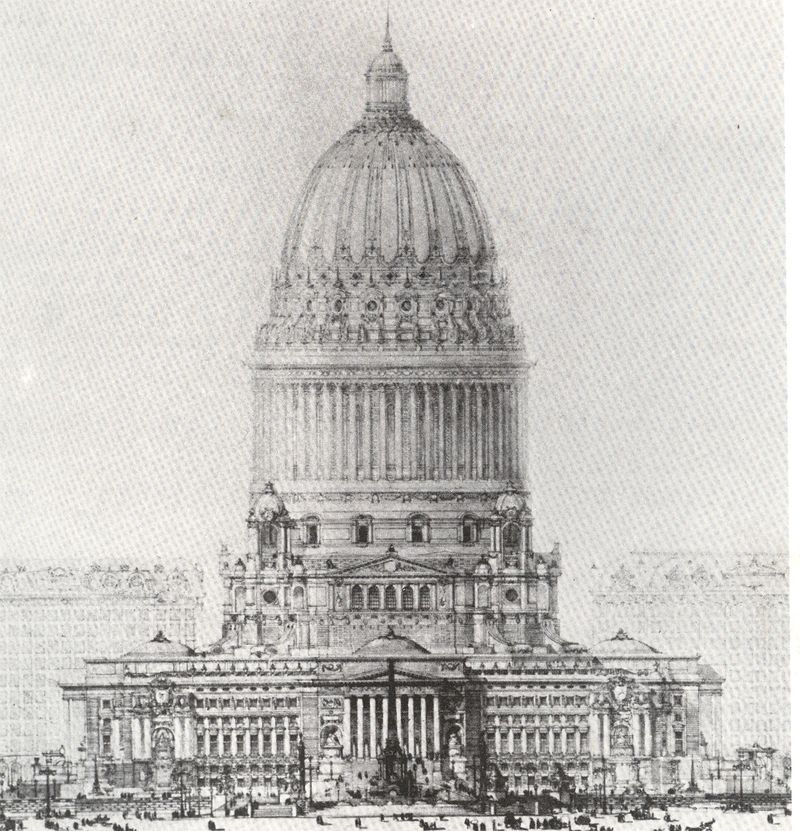
Getting closer to the ground is the plan for the Chicago Civic Center (1909) by the usually accomplished Daniel H. Burnham. This beast looks more like a stubby nuclear- pulse intergalactic Mothership than anything that anyone would have wanted to build on the ground—at least in space it would be out of sight.
In a struggling prose reminiscent of Lewis Sullivan Burnham writes1: “The Civic Center will be dependent for its effectiveness in the character if the architecture displayed in the buildings themselves…” which I think is self-referential, stating that the architecture’s effectiveness is dependent upon the architecture. If this is the case, the enormity of the Civic Center doesn’t save it from itself.
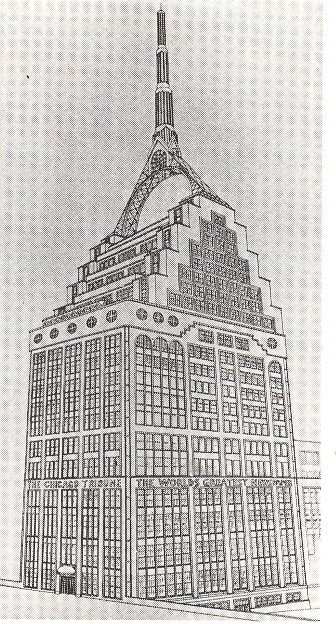
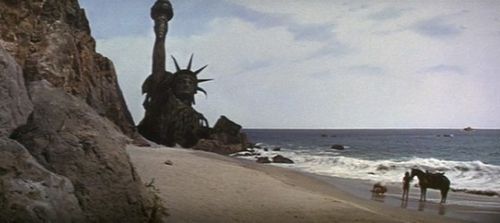
Staying in Chicago we find another proposal, this for the ChicagoTribuneTower competition of 1922—many of the works submitted seem to my eye big and wide and ugly, but perhaps none more so than that offered by Ludwig Koloch. This may well have been a nice design for the top third or so of a building, but not for three thirds–and actually, this may be four-thirds. It reminds me of something rising from the sands at a beach in the future, the remnants of destroyed civilizations. Without the apes.
Notes:
Daniel Burnham and Edward Bennett, Plan of Chicago, 1909.