A Daily History of Holes, Dots, Lines, Science, History, Math, Physics, Art, the Unintentional Absurd, Architecture, Maps, Data Visualization, Blank and Missing Things, and so on. |1.6 million words, 7500 images, 4.9 million hits| Press & appearances in The Times, Le Figaro, Mensa, The Economist, The Guardian, Discovery News, Slate, Le Monde, Sci American Blogs, Le Pont, and many other places… 5000+ total posts since 2008.

Category: History of the Future

  • Footnotes in the Future–Swift, Lull, Borges and the End of Writing

    JF Ptak Science Books   Post 1155

    “The most ignorant person at a reasonable charge, and with little bodily labor, may write books in philosophy, poetry, law, mathematics, and theology, without the least assistance from genius or study.”   Jonathan Swift, in Gulliver’s Travels

    “Hell is the kingdom of the animal that swallows up the memory of all things… Between life and death there is no destiny except memory. Memory weaves the destiny of the world..”  Carlos Fuentes, Terra Nostra

    “A people without history/ is not redeemed from time, for history is a pattern of timeless moments” — T.S. Eliot, Four Quartets.

    The future history of writing–it will tell us–was already written before it was written.   In the future, when everything that can be written has been written and everything spoken has already been spoken, perhaps the first footnote in the history of already-done things will be to Jonathan Swift.  The experience belongs to us through Lemuel Gulliver1, who after surviving two trips (one to Lilliput in which Gulliver is twelve times the size of
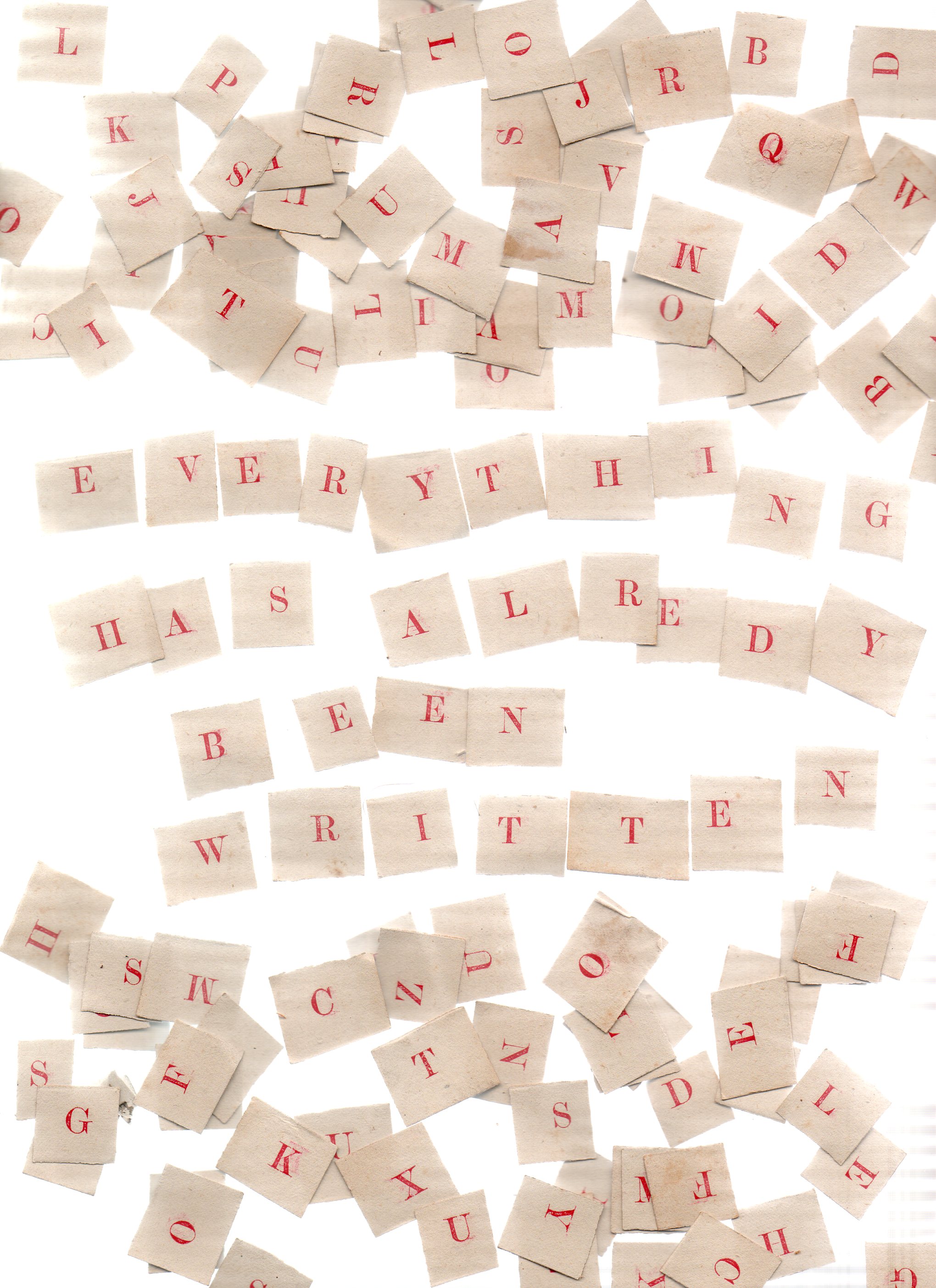
    Written468

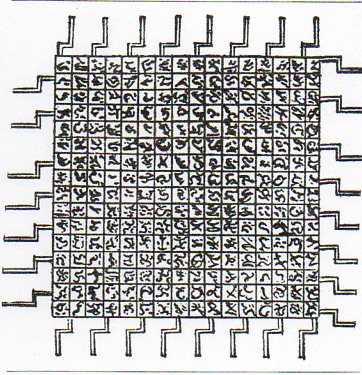
    everything else, and the second to Brobdingnag where he is one-twelfth the size of everything) comes to a third (of four2) in the land of Laputa.  It is here where he encounters a conversation machine that, when cranked, produces anything and everything, the known and unknown, the original and the copied, and have the thought and spoken
    word belong to the manipulator of the machine.  Everything that can be said is in that box, waiting to come.  The 20′ square was occupied by cubes with words on their sides, with 40 cranks and 40 handles and 40 operators to manipulate the mechanical vocabulary and associated scribes to record anything that made sense, and would be the springboard of “knowledge”operating without a manual or an intelligent primum mobile. (The image of the machine–which bears some resemblance to an integrated chip–appears in the third edition of Swift’s book, and as you can see is not a well-drawn thing, missing a row and a column and a crank here and there. A fuller description is found below.)
    Writtenc machine470

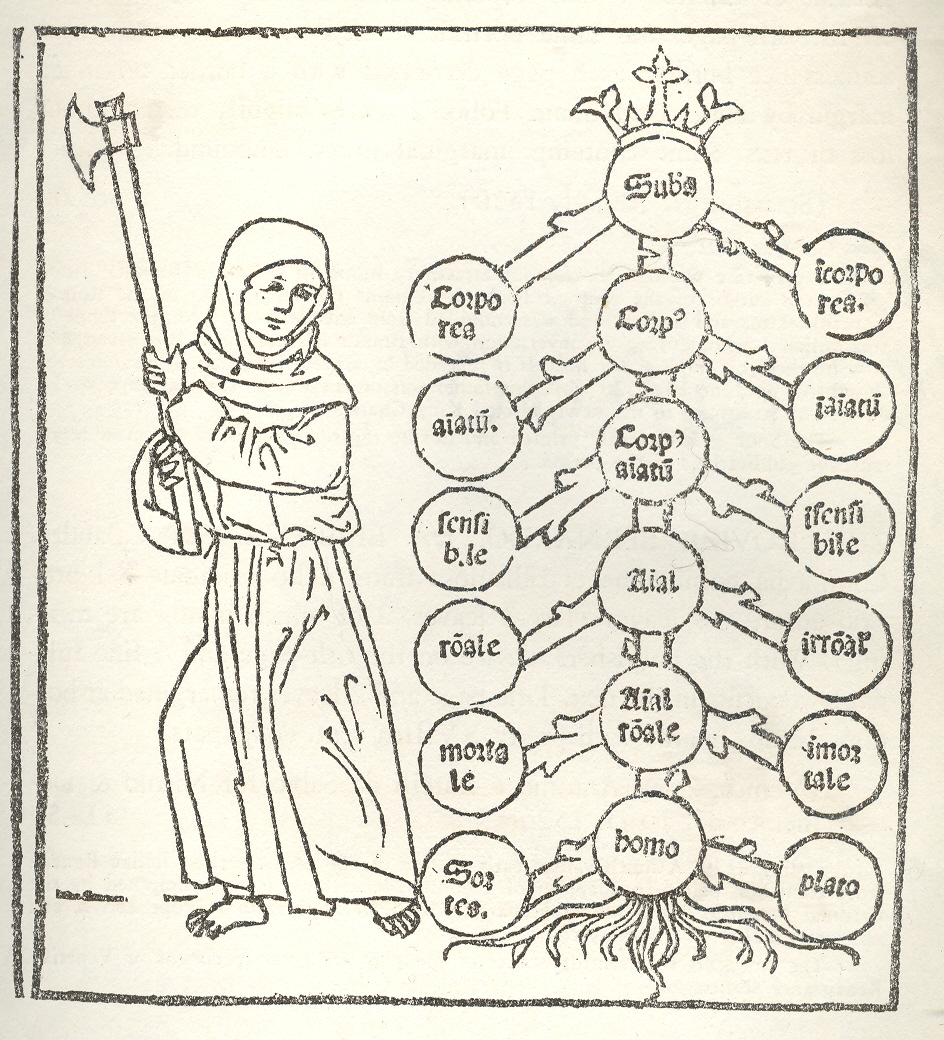
    The idea of a universal knowledge or an expanding, forever-library is very old, particularly if you expand the concept a bit to include Aristotle and the Tree of Porphyry3.  While not exactly a generator in the sense of Jorge Borges’ Library of Babel or the Swiftian machine, the ancients did 1--logic treeproduce very interesting, elegant, beautiful ways of story information and ordering information.  The Tree of Porphyry is far more concise–an abbreviation-compared to the infinitely expanding hexagonal rooms filed with books and attendant librarians in the Borges’ universe.  Or the Ars Magna/Thinking Machine of the 13th century Ramon Lull (also known as Ramon, Raimundo and Raymond, Raimundus and Raymundus Lull, Lully and Lullus and Lulio), the ultimate organizer of how sentences can be made and knowledge produced/uncovered (particularly if you want to please the logic of the church and the Creator), and which was almost certainly known to Swift (and which was also written about, described and worried-over by Borges4).  There are many other early figures in this category to be sure (Lewis Carroll, William Jevons, and even in a way Mr. Venn, not to mention Leibniz and his calculator,  and the changes in scientific method and (English/Dutch) mathematical concentration on applied mathematics of the 17th century that made thinking about the industrial revolution possible)), but that would be left to (at least) a longer post.  (The Lull wheel, below.)
                               

    How long will it take to digitize everything that has ever been written, or recorded, or composed? Several generations? Ten?  It may well come to pass in shorter time than we think; and when you compare this control of recorded human history to the centuries that will follow in developing “computers”, how can we possibly know what will become of all of it?  In the coming centuries and their attack on intelligence, when in the future the brain is a harvest of the computer, perhaps intelligence finally submits, and everything that can be done has been done, the progress of humanity snubbed to a stub. Or expanded exponentially.  It is such a tough call to make…

    Notes:

    1.  Jonathan Swift, Travels into Several Remote Nations of the World, in Four Parts. By Lemuel Gulliver, First a Surgeon, and then a Captain of several Ships.  1726.

    2. The third voyage was Part III. A Voyage to Laputa, Balnibarbi, Luggnagg, Glubbdubdrib, and Japan. The fourth finds humans as pets/inferiors in the island of the Houyhnhnms, a land of intelligent horses.

    3. The “tree” was a diagrammatic creation of a 3rd century Syrian mathematician/logician/philosopher named Porphyry who– much taken with Aristotle (and with the Categories in particular)– developed a systematic approach to the organization of thought in diagrammatic form.

    4. Borges J. L. (1999) ‘Ramon Lull’s thinking Machine’ in The total library: non-fiction 1922-1986 (Edited by) Weinberger, E., trans. Allen, E. Levine, S. J., and Weinberger, E. London, Penguin, on pp 155-160.

    It is interesting to note that Lull, who gave up everything to follow his calling into the church (and who was antagonized by the belief that his very act of missing his left-behind life to be a sin against god’s choice of him to follow his “career path”) was demonized by the church soon after his death, his works prohibited reading for hundreds of years.  He was resurrected in 1958 though on a path towards sainthood, a doctor of the church.  

    A description of the Swift machine:
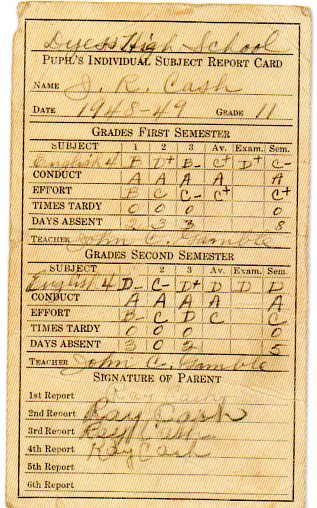

  • What I Learned from Johnny Cash’s 1949 Report Card

    JF Ptak Science Books   Post 1181

    This great relic of Americana–the report card of Johnny Cash from Dyess High School in 1949 –is the stuff of deep emotion.  It means that John R. Cash walked this (“Pupil’s Individual Subject Report Card”)  English report card home to his parents for review, the 17-year-old wondering about how they might react to his not-great grades in English and “effort”.  Or perhaps he wasn’t worried at all, perhaps he didn’t care.  He missed very few classes, and was never late.  He received straight A’s in conduct from his teacher, John C. Gramble.

    Johnny cash report card584
    [Image source: Cash, by the editors of Rolling Stone Magazine, 2007.]

    So, the young Cash, who had grown up lyrical, with music and words swimming in his head, was unmoved by “English” (which was probably more like “composition” than what we think of it today) and was not interested in trying to overcome his disinterest, overly.  Be that as it may, even though he was a D student, he was respectful of the class and teacher and classmates, always getting A’s in conduct.

    Mr Cash signed the report card each time, and I suspect that he knew exactly what was going on with J.R. in spite of the grades.

    Only six years later, in 1955, Johnny Cash had his first national hit in “Cry Cry Cry”.

    And so where was Dyess High School?

    As it turns out, Johnny Cash lived in a place in his early youth that owed its life to deep government intervention in the lives of its citizens.  The short story is that people–almost entirely farming families–who had lost everything in the Great Depression and the resulting drought were given an advance1 of money to buy a house and land and a chance to start life anew.  Ray Cash, Johnny’s father–born in 1897 in Rison, Arkansas–entered his family on the relief rolls and was one of 500 families selected  to settle a 15,000 timber-cut swath of Arkansas bottom land up in the north-east corner of Arkansas in Mississippi County, basically due north of Memphis Tennessee just this side of the border.
           
    The program brought to bear on this situation was the Federal Emergency Relief Agency (FERA), which was administrated on the national level by Harry Hopkins and in Arkansas by Alabama-born former teamster William R. Dyess.  The farms and farmland was administered through the Rural Rehabilitation program, which under Dyess’ direction in Arkansas started the “Colonization Project No. 1″ in May 1934.

    Ray Cash and family moved into House 266 on its 20 acres in 1936, one of five families selected from Cleveland County, and the same year in which Colonization Project No. 1 was incorporated as Dyess Colony.  In a short period of time construction in the new Colony included  “an administration building (and a )…town center (which)  included a community bank, beauty salon/barbershop, blacksmith shop, café, cannery, cotton gin, feedmill, furniture factory, harness shop, hospital, ice house, library, theater, newspaper (the Colony Herald), post office, printing shop, service station/garage, sorghum mill, and school. Members of the colony often performed community tasks on a cooperative basis, though the farms were worked individually.”2   
    ________
    Notes

    * “Criteria for the all-white community included that applicants be destitute from the economic crisis, come from the lowest poverty level, be of “good moral background,” and that husband and wife each have the physical ability to clear the land and farm their acreage. Each farmer would draw a subsistence advance to buy twenty to forty acres of land and one of the new five-room houses, plus a mule, a cow, groceries, and supplies until the first year’s crop came in. All were expected to pay back the advance. The town would operate as a cooperative in which seed was purchased and crops were sold communally.”Encyclopedia of Arkansas History and Culture.

    2. Encyclopedia of Arkansas History and Culture.

    Dyess had population of 2500 in 1936, now a town of 550 or so.  I cannot see any remnants of the wagon-wheel design of the farm houses that were built there in 1934/5 from Google satellite images.

    An excellent reference for the movement of families into the Mississippi River bottomlands is The final frontiers, 1880-1930: settling the southern bottomlands, by John Solomon Otto.

    And now for this musical video about Dyess:


  • Prescience of a 1953 TV Ad: the Speed of Isolation, and the Post-Forgetting Future

    JF Ptak Science Books   Post 1151 [Part of our History of the Future series]

    The History of the Speed of Things is an interesting category for a history of odd things: the speed of exploration, of curing someone with a gallbladder problem, of flashing across the White Sands desert in a rocket car, of the pulse of a human neuron, of the time it takes to go from 10 microns to 1000000 microns, of how long it takes to get to Tybee Island from Asheville North Carolina, of insurance information to tall ships coming over the horizon, of gravity, of light, of computing a billion place of pi, of calculating where to aim your anti aircraft guns at the incoming Luftwaffe, of diving to the greatest depth in a submarine, of running 100 metres, of a drop of mercury falling 1/1000 of an inch, of the speed of nightfall on the Moon, and so forth. 

    Future of thinking sparton 2449
                                                                                                                                                                 
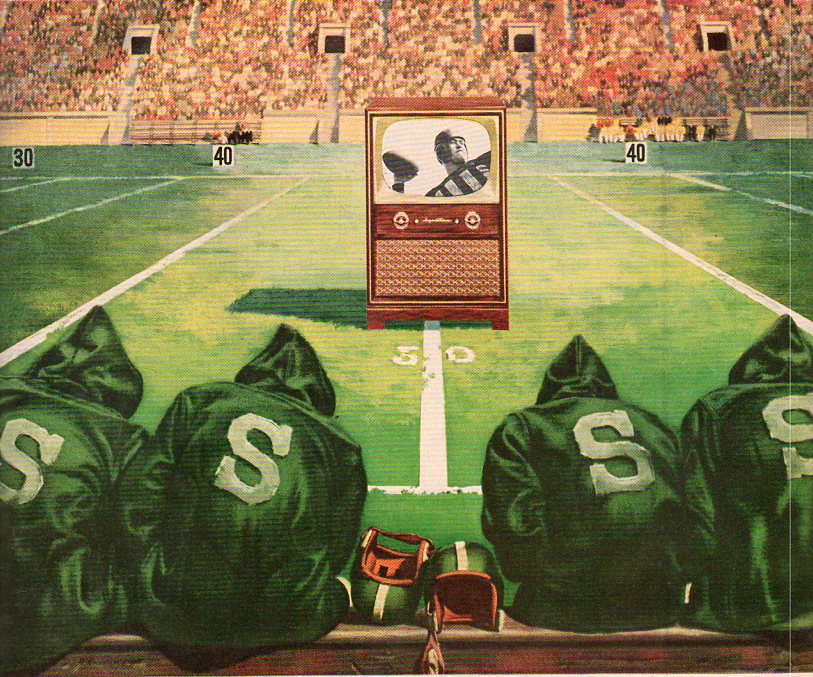
    The Speed of Things’ subcategory is the History of Speed of Knowing Things, with its interesting and proportional  subcategory of the The History of the Speed of Forgetting Things, both of which are associated with the point of today’s post, which was the sneak-peak of the future offered in a series of ads in Life magazine in 1953.  The full-page ads were formatted by Sparton Television Company to grab the attention of even the laziest semi-monied reader of the magazine, selling the promise of entertainment at home.  The cost for admission for this product was fairly luxurious and a little extreme once you translate the $400 entrance fee into its percentage of the average monthly salary (which was about equal) or of a new (general) Ford (about 25%) or of the average monthly rent (125%). The television as something to be reckoned with.              

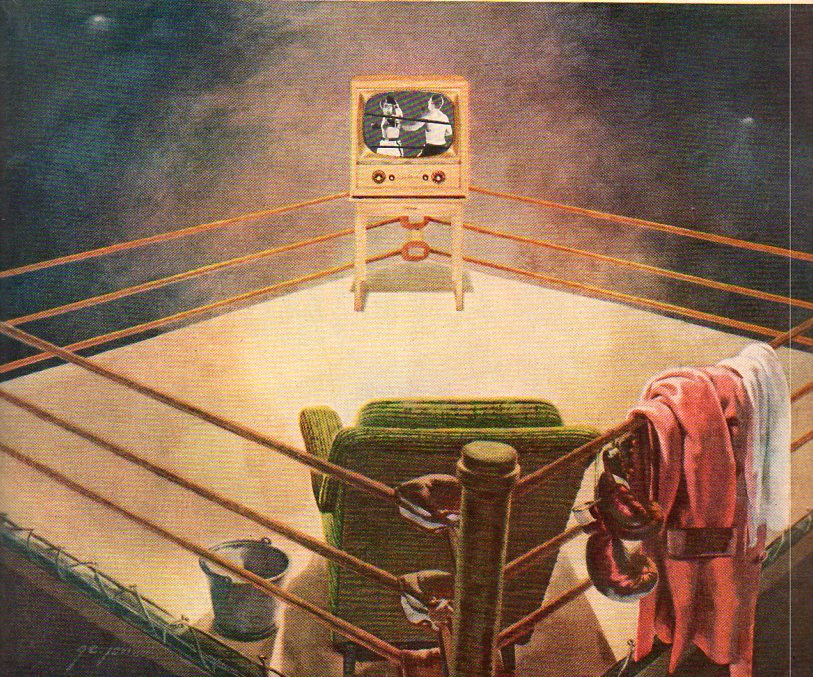
    Future of thinking sparton boxing450
    There’s something more to the ads that the designers and readers couldn’t have known at the time, though.  In the ads, the tvs are shown replacing the action that it is supposed to be transmitting–it has become the thing itself, a passive replacement to an action.  Rather than watch a baseball player at bat swinging at a pitch, we see a television with a batter in it, moving just as the pitcher is moving,.  The barcolounger in the ring of the prizefight is presented with the fight on a tv in the opposite corner, and the football players have been replaced by a black-and-white image on a television tube on a field of green. 

    The message then of course was that television was putting you into the scene, that the viewer was part of the action and not just a casual observer.  I guess.  Sitting here in 2010 though the ads seem to play to a greater truth, and might be more prescient for the coming future than the original advertisers could’ve possibly imagined.  All throughout the history of communication, I am certain that there was a  percentage of the population that viewed the newest invention as  not necessary and an affront to privacy and free time, of more deeply removing a person from the act of communicating–the semaphore, telegraph, telephone, wireless, airmail, overseas calls, email, bluetooth, twitter, and so on all presented this similar problem.  Just as these improvements were adding to the flow of information, they were also isolating the recipient from the sender.  The more access to info and data, the more it was accessed; the more access, the more time spent accessing; the more time spent accessing, the more time theoretically spent responding. And so on ‘tll you get to the so-called modern time, when there is data presented to us all of the time, inescapable info flows, gargantuan landslides of numbers and images and words and fluff, available at all times, and almost at all places.  The technology making it possible for people to more freely communicate is, in a way, replacing the person, allowing communication nodes to have a human interface connecting them.

    Now this might be a little extreme, at least for the present.  I’ve little doubt that some people feel as though they are simply connecting word threads to other word threads and passing it along, seeming as though the are piecing together the floating bits in an enormous flood of floating bits.  As my wife Patti Digh quotes the Buddha in her book Life is a Verb, “What is the appropriate behavior for a man or a woman in the midst of this world, where each person is clinging to his piece of debris? What’s the proper salutation between people as they pass each other in this flood?”

    I’m guessing that people would be uploading pictures of themselves googling the question, or receiving an image of someone in front of them, waving to them, as they are swept along in the flood waters.

    These pictures from Life tell the coming story, and I think can remind us that as foreign as they might seem then, and as uncomfortably true that they might seem to some now, that they could very well seem painfully/obviously true at some near point in the future.  The computer for all intents and purposes is only 65 years old; home computing is three decades old; the internet, two.  The changes brought on by all of this were almost invisible 25 years ago.  The coming of the future in regards to communication, even a future that is only 25 years from now,  may very well wind up being as difficult to see from 2010 as it was to see our year in 1985. 

    I wonder if in the future we’ll have to pay for silence, pay to be relieved of data, pay for relief from advertisements from a flood of products and services that we don’t ad will never actually “need”, pay for time for the silence to actually think?  When people are smoking and talking on a cell while riding a bike or texting while plasticizing their dog’s environmental offerings, when is it exactly that there will be quiet moments for extended thinking?   Where will our consumption of information be in 25 years from now, or 50? It is only too bad that the process of consuming info didn’t lead to some sort of generation of energy, like tidal power, because at least then there would be one certain positive outcome of data access. 

    And I know that accessing things will be much smarter even in the near-future than it is now, Google searches will look as quaint four-digit phone numbers.  But still there is the data, and at that point the data will be more pertinent, which means there will be more of it to spend more time on.  Its a Catch-22–we’ll waste less time, probably, on what we weren’t looking for, which means we’ll have more time to look at more things that we were looking for, except that there will be too much of it, and there won’t be enough time to read all of that, let alone to give it some thought.

     In all of this, the thing that might take more time to deal with than actual thinking might be the process of forgetting.  Perhaps in the deeper future we’ll just be born with all of this information, or have instant access to it, and then in that future where there is no forgetting we’ll just have to imagine that we’re imagining quiet time. 


  • Creating Bad-Hand Female Trouble, 1954–an Imaginary Reconstructed Filmstrip

    JF Ptak Science Books

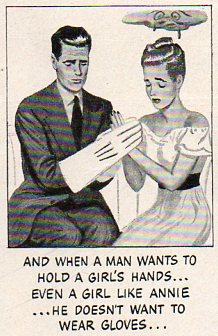
    Girl trouble 7360 Retroist excursions like this into the land of social propriety from not so long ago is a bittersweet thing–its concerns can remind of of how far away from something we seem to be, when in reality that distance in time and space just isn’t very far away at all; it is just slightly different,  renamed and repackaged.  For example, this advertisement from LIFE magazine for Trushay hand softener (1954) delivers pretty much the same message as most similar products today, except for the change in packaging and less obvious message.  The message may seem outdated but I think only in so far as the images and clumsiness of the delivery is concerned.  Products like this have increased by orders of magnitude, the target audiences age seems to have dropped considerably, and most of the time the pursuit of this 1954 end-result stays pretty much the  same. Exercises like this are peculiar, and can show us that the people who we are laughing at may very well be us. 

    The reconstructed ad is below.


  • Pictographic Messages to the Year 12,010: the Medium is the Mess.

    JF Ptak Science Books  Post 1103

    Talking to the Future: a Note of Pity to Ourselves in 300 Generations
    Nuke waste--dead251

    In the history of words I’ll take a wild guess and say that fractions of 1% of everything communicated is directed at ourselves in the future–or at least it has the possibility of being directed to someone else when our deeds are long, long since forgotten. 

    And by writing to the future I don’t mean in an off-hand way, our words being read in 12,010 by chance, idea archaeologists looking at what people were talking about 10,000 years earlier; and I don’t mean via “reconstructing” our radio or tv broadcasts (in the not-right Jodie Foster Contact kinda way).  I mean intentional messages to be read a long time from today.   

    A more problematic entry would be images and symbols design to be read by future generations, in the deep future.  This is not a very deep category, though a famous (if not well designed) example being the one associated with Carl Sagan that was attached to the 1972 Pioneer 10 and 1973 Pioneer 11 spacecraft, which attempted to explain what humans were should either vehicle  in any eon come into contact with other-than-Earth life.

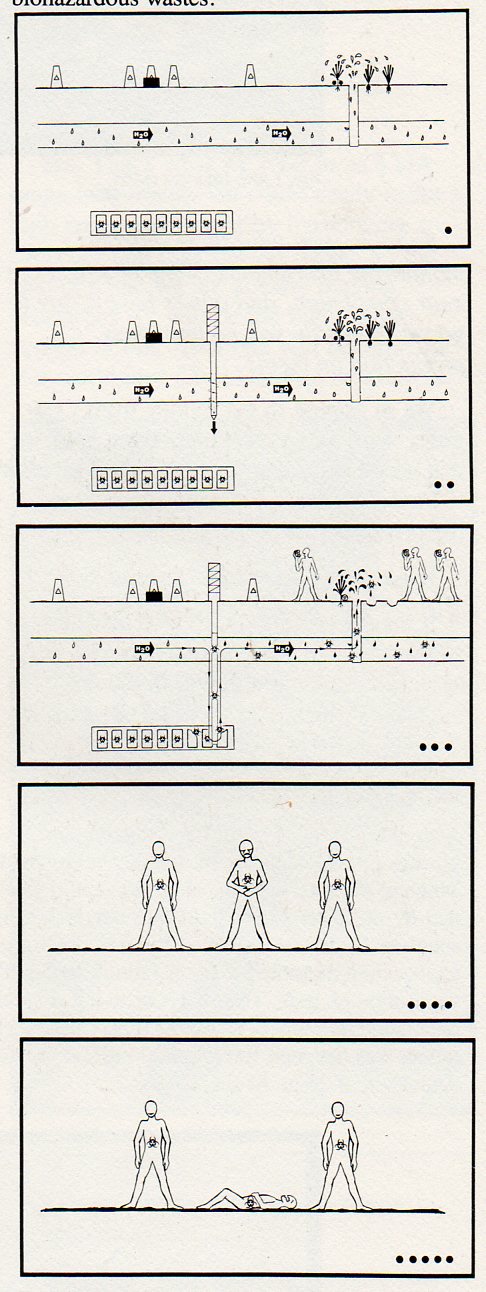
    Nuke waste--overall250 Another is the pictograph presented here, which appeared on page 117 of the ironically and extraordinarily-titled Reducing the Likelihood of Future Human Activities That Could Affect Geologic High-Level Waste Repositories1, the first half of which (bolded above) could make a nice departure for some other science fictiony type story.    But what these folks were talking about, plain and simple, was how to prevent future generations from digging into or other disturbing in any way buried masses of nuclear waste. 

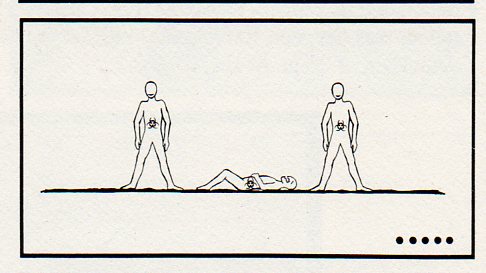
    This pictograph is meant to be a non-linguisitc, universally-understood  warning to future generations that the ground they are standing on is above a nuclear waste storage site.  The plan was that nuke waste would be solidified and buried in rock hundreds of meters below the surface in an effort to keep in line with governmental policy of waste disposal2. The pictograph relates to the restricting of future human activities part of the title of the work in question–that is, folks in the future who might muck around, drilling, into the nuclear waste site.  This pictograph tells them why they shouldn’t do so, because of all of the terrifically lethal mojo underground. 

    As one might guess by the title, the report has its own communication problems–it is dense, turgid and not a particularly clear document.  It is a fine document illustrating the problems of communication, but not in the way it would have wanted to be, celebrating a reverse triumph in a Darwin Award/IgNobel type of way. And all of this in spite of/or because of a healthy slice of linguists, semioticians, logicians, artists, graphic designs, politicians,. sociologists and so on constructing the thing.

    The sign basically says that if you drill at this spot (to some unspecified depth) through aquifer or underground stream or water source or something that some point you may reach the biohazard nasty, which will then get into the water supply and into humans, which will then kill them.

    The sign was designed for 10,000 years hence, and depended upon pictures to convey the message rather than words (except for H20, and the biohazard symbol).  Of course the radioactive nastiness will be there for millions of years, which would be an entirely different story in terms of imaging.  Perhaps. 

    The one thing the design of the pictograph has in its favor is that it is read top to bottom–no language on Earth (so far as I know) is read bottom to top, though there are many differences in reading right-left/left-right.  Beyond that, the pictograph stumbles over itself–except for the last two images, which may or may not tell someone that something bad is happening. 

    There are plenty of time capsules and idea-vehicles to the future–I’m saddened that this was seen to be one of the essentials that we would pass on to our future selves.

    Notes:

    1. Reducing the Likelihood of Future Human Activities That Could Affect Geologic High-Level Waste Repositories (Technical Report prepared for Office of Nuclear Waste Isolation, Battelle Memorial Institute; BMI/ONWI-537; May 1984)

    2. “Present society’s responsibility is to dispose of radioactive wastes in a manner that is safe, is environmentally acceptable, and does not require long-term maintenance or surveillance. This ground rule is consistent with the objectives in the U.S. Department of Energy.”Reducing…, page 2.

    The pictograph, explained,  pp 115-116 from Reducing….

    The pictograph…was developed using the concepts and guidelines discussed by Givens (1981). The objective is to convey to the reader the sense that if the area below the markers is disturbed, toxic substances will enter the ground water and lead t o severe consequences. relies on several visual images acting in concert to relay the message.

    The ground surface exhibits peripheral markers and a central monument to denote relevance to the site where those markers and monument exist.

    The ground-water system is indicated by water-drop shapes and by the chemical symbol for water (the only departure from icons, used as a redundant measure).

    A repository far below the surface is depicted with the biohazardous symbol. The fact that the object portrayed below the surface is a repository may not be at all evident to a future reader from the first frame; however, the movement of the dark material from the repository through the aquifer and into the vegetables in the third frame, coupled with the movement of the biohazardous symbol, should imply the burial of biohazardous materials below the surface.

    The pictographic sequence exaggerates reality with regard to the rapidity of contaminant transport and uptake, and with regard to the severity of the consequences. However, exaggeration is necessary because both the clarity and the relevance of the message may suffer if.the pictograph attempts to indicate contaminant transport time of thousands of years. Similarly, the consequence portrayed, a painful death, over-exaggerates the cause-effect relationship and the rate of the individual’s demise (one out of three suffer death in the pictograph, whereas a
    to chance would be more representative).


  • Strange Things in the Sky Department: Tetrahedra, Horse & Steamship Balloons, Swimming Pools & Exploding Moons.

    JF Ptak Science Books  Post 1120

    Rounding out the image dump from yesterday are these additions to the developing category “Strange Things in the Sky”.  The odd things in today’s issue include floating tetrahedra, an exploding Moon, a hovering anti-gravity Dr. Seuss pool, a Russian rocket pioneer’s enormous apartment building-like dirigible, and a steamship balloon.

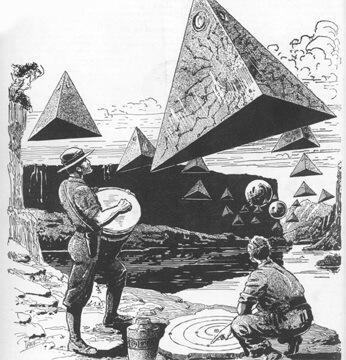
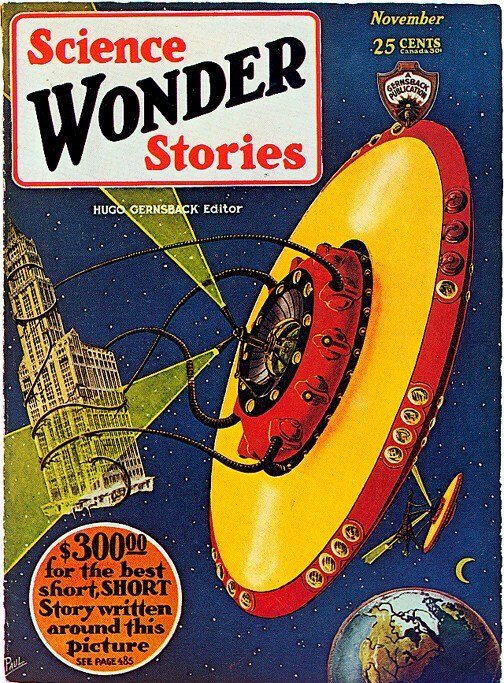
    The first, without any explanation and offered as a pure art form, is this illustration by Frank R. Paul for Wonder Stories of November 1931.


    Strange things in sky--tetra

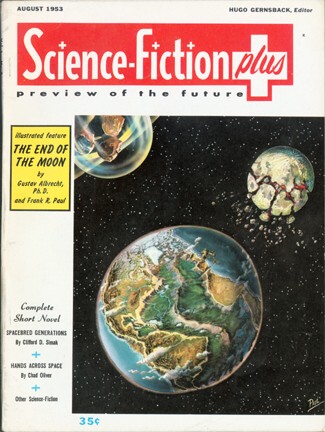
    Next, another Paul cover for Science Fiction Plus for August 1953, illustrating a story where the Moon explodes

    Moon exploded

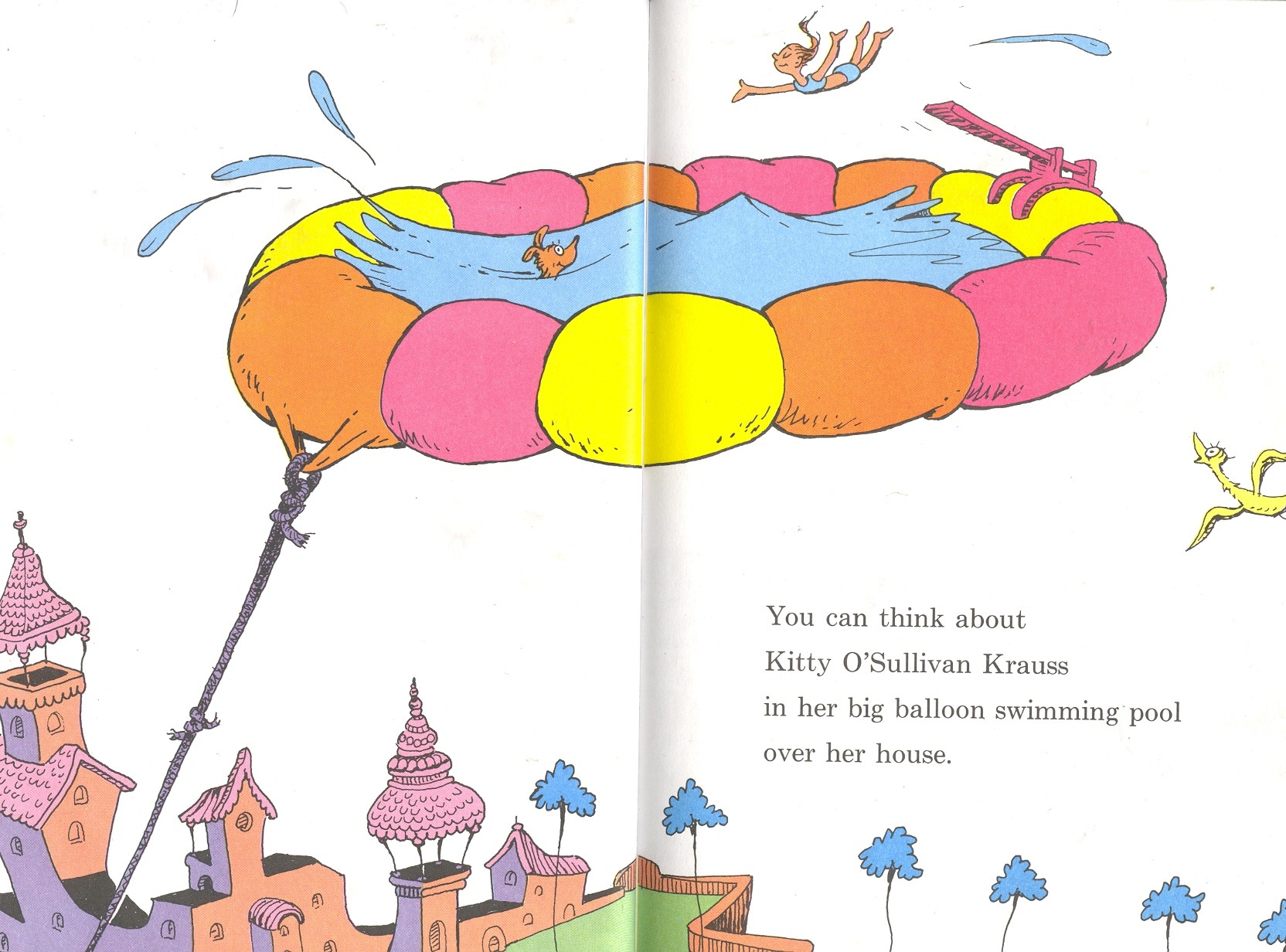
    Other strangeness in the sky is  Dr. Seuss’ swimming balloon pool from his Oh, the Thinks you can Think. .  I’ve seen some interesting
    images of balloons and dirigibles taken as serious efforts that reminded me of
    that double-page spread by the good Doctor.

    Blog jan 2 seuss


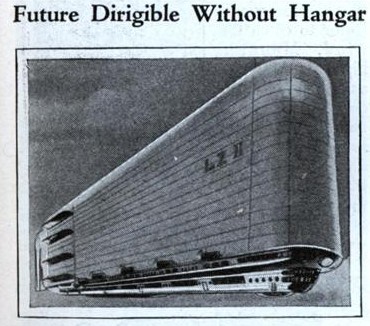
    Blog jan 2 tsilo dirig  

    This may have been the Omega end
    of bad ideas in the career of Zilkowsky, who is better known by the other
    spelling of his name, Konstantin
    Eduardovich Tsiolkovsky (1857-1835), a Russian misanthrope and space pioneering
    genius who wrote more than 500 works on rocketry and exploration including what
    is arguably the first tech word ever done in the field (in 1903,
    The
    Exploration of Cosmic Space by Means of Reaction Devices
    ). Tsiolkovsky somehow lasted through purges
    and Stalinist tirades, while few of his colleagues did—many mysteriously
    disappeared, while others went to prison and disappeared there.  (Stalin’s crude and insatiable blood lust,
    perhaps the worst of the century, knew no bounds, not even to the scientists
    who could conceivably hand him reigns of rocket/missile-propelled power.)  Anyway, Tsiolkovsky’s dirigible was composed
    of a collapsible metal so that the aircraft could form its own hangar when “docked”.  I don’t know where to begin with this one…

    Blog jan 2 lowe

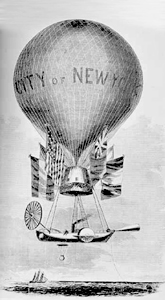
    The next entry is the ship-balloon of Thaddeus Lowe
    (1832-1913) One of Lowe’s great contributions in the
    history of ballooning was providing aerial reconnaissance via (panoramic)
    photographs to the Union army on Confederate army positions—particularly the
    Rebel positions at Richmond (1864) and Fredericksburg (1862). (He had a wide
    span of professional interests and wound up living the high life in L.A. in a half-acre
    home.)  This 130-foot diameter monster
    with a steam-ship escape pod (named The
    City of New York
    and then renamed The
    Great Western
    after the city couldn’t supply enough gas to get the thing
    inflated) was intended to be a transatlantic traveler.  Ready to try this fantastic adventure in
    1860, ready to take charge, ready to begin a very problematic trip across the
    Atlantic in a balloon, Lowe, seemingly ready, had his balloon ripped apart
    while waiting for launching by a chance and not-horrible wind.  Lucky for Lowe and the Union Army, this didn’t
    happen over the ocean somewhere out of reach, and the North’s important info-gatherer
    did not sink like a stone in the cold dark sea. 
    (I’m very cynical that the 100-foot-long, bulbously heavy steam-powered “life
    boat” would’ve landed right-side-up and softly enough to have been of any use
    save for providing some floaty bits that survivors from the balloon could’ve
    clung to for a while before being consumed by King Neptune.  

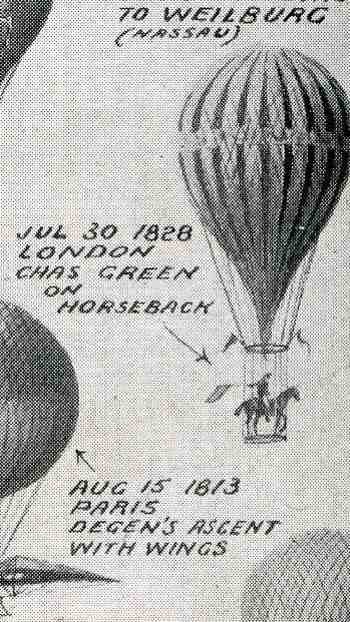
    Blogsept19_horses_in_flight607

    Lastly for today is this lovely history
    of balloon and aeroplane flight published in The Illustrated London News
    for 3 July 1909, called “The Evolution of the Great War-ships of the
    Air:  Balloons, Non-Dirigible and Dirigible, and Aeroplanes, from the
    Seventeenth Century to the Twentieth Century”.  It is more fully explained here in an earlier post I made to this blog, laboring the point that 8% of the 60 air vehicles involved a horse. 


  • Strange Things in the Sky Department: Floating Airports

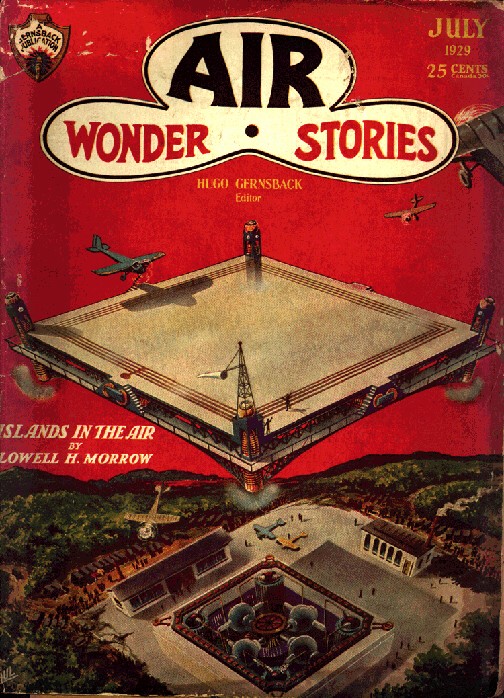
    JF Ptak Science Books  Post 1119Strange things--Floating airport

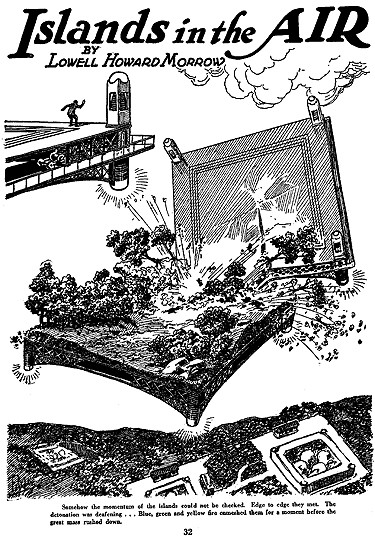
    I’ve written several posts here about floating an airport in the NYC narrows, as well as airports constructed over hundreds of acres of Midtown rooftops, hundreds of small landing strips crossing the Atlantic, innumerable planes and dirigibles with lad fields on/in them, and covering the Thames at Big Ben. (See here for some of these stories.) But I’ve not seen a floating or hovering anti-gravity airport until now. 

    The question for me would be–why, if you have somehow mastered gravity enough to float a large piece of concrete tonnage like an airport in the sky, why, oh why, are you still using airplanes? 

    The answer doesn’t matter, here, only the art does.Actually, the writing doesn’t matter, either; just check out the excerpt below.)   This again a piece of delicious imagination by Frank R. Pauil created  for the July 1929 issue of Air Wonder Stories.   The drawing below must be among the first of its kind to depict a collision between two anti-gravity floating/hovering airports. (!)

    Notes:

    The excerpt:

    “The Professor stared blankly a moment, then rushed away to the office. We followed breathlessly.

    The outer door had been forced, its lock being broken, but beyond
    this no damage had been done so far as we could discover. Anxiously we
    ran over the papers–not a print was missing….”

    It might have been more interesting if the thief had stolen all of the “e’s” from those papers.  There are 9,500 more words in this story, but I can’t make ir any further than this…

    And also this:

    Paul3.5C


  • New York City: Attacked by Tentacled Flying Saucers, Giant Flying Snakes, Glaciers, and Mining Missile Space Aliens, 1929-1941

    JF Ptak Science Books   Post   1118

    This is a simple, non-analytical image dump for some in a continuing series on images of New York City in fantastical and improbable situations–there’s artwork that show the city being consumed by glaciers, drowned by the tide, ripped from the Earth and flung into the sun, floating in the sea, floating in space, sunken, and of course simply attacked by any number of different things, though most of those weren’t real.  There is of course the great unknown classic that I stumbled across–the duplicate NYC on a duplicate Earth orbiting the Earth ((?!) and pictured at the end of this post). I doubt that there’s enough for a dictionary of disasters, though there’s plenty for a Doomsday Book.

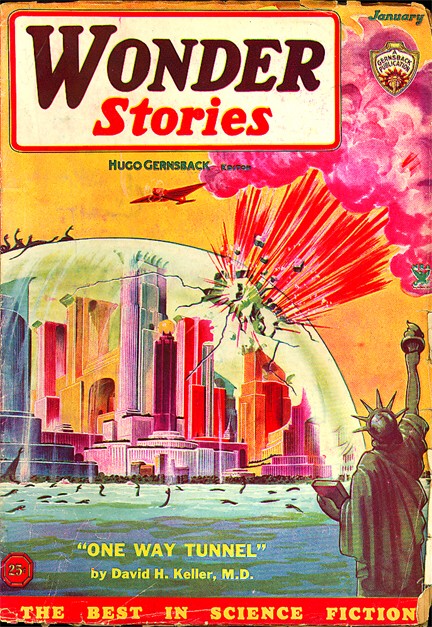
    For example the first image for this post shows a domed New York City–and in this scifi sub-classic,  like other major cities of the United States, NYC was suffering a catastrophic attack by winged snake monsters.  I don’t know why  the dome is exploding because the snakes don’t appear to be armed.

    NYC attacked

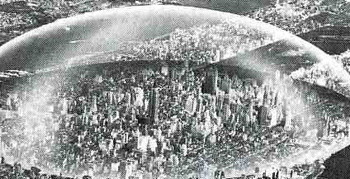
    This does remind me of an image from the mind of Buckminster Fuller, who
    came up with an extraordinarily bad idea to protect NYC against
    thermonuclear weapons. (Fuller’s dome appears here.)

    Big_archfuller_detail141 

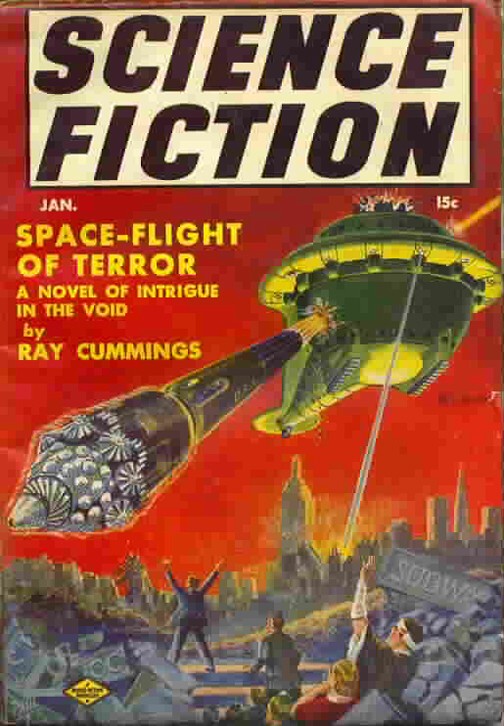
    Then there’s this magnificent cover for November, 1929, featuring a tentacled flying saucer removing the Woolworth Building into outer space (as well as the Eiffel Tower by another brethern craft (the Earth appearing again, as nearly usual, without cloud cover):

    Woolworth

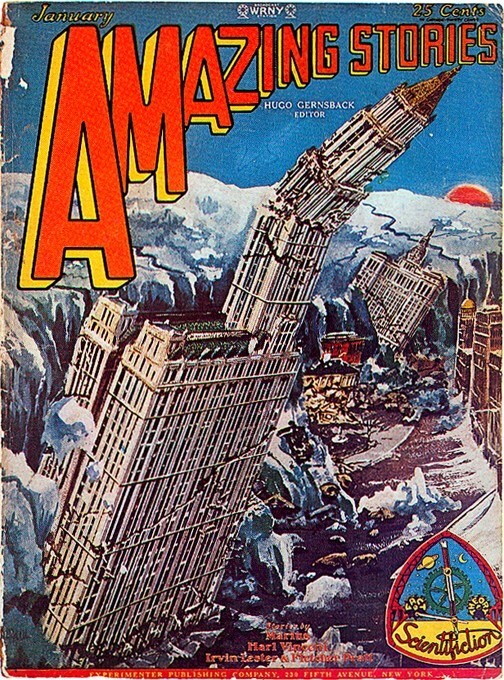
    And yet another destroyed Woolworth Building, this from January 1929, featuring an enormous glacier attacking the City:

    NYC destroyed--woolworth

    And this vision of a decimated NYC, coming at the hands of giant hovering mining/missile space aliens:

    NEw York City in Ruins

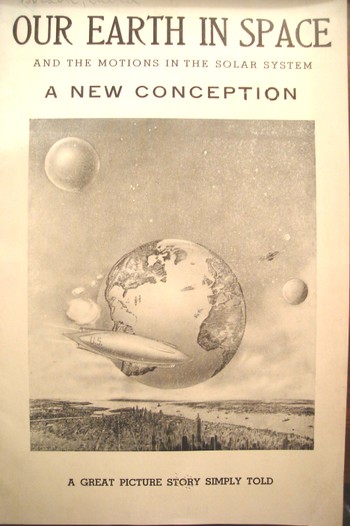
    And of course, the duplicate NYC on Extra Earth:

    Dsc04543


  • Triple Sci-Fi Negatives: Man-Tossing Giant Woman from the inside of Mother’s Wedding Ring (!) 1921

    JF Ptak Science Books   Post 1117

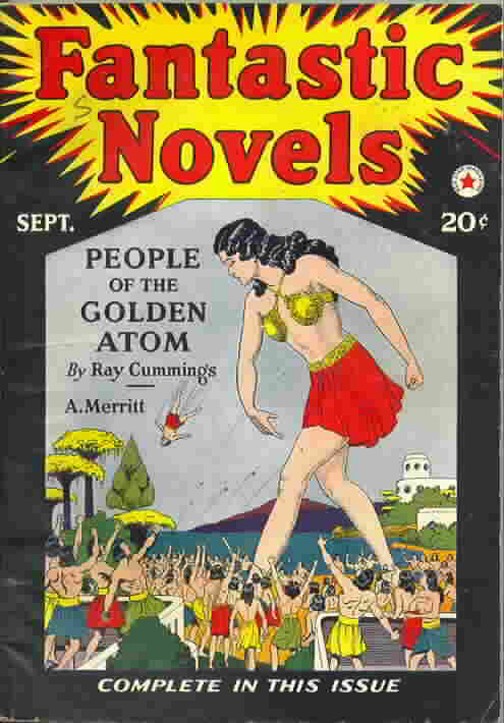
    There are times when even things that are made to look extraordinary and plainly, outrageously identifiable as what they are, simply aren’t–and sometimes they’re not even close.  For example, this cover of Fantastic Novels (1921?) seems to tell a straightforward story, but as it turns out the giant is giant but one living within a world in an atom of a gold wedding ring.

    Man throwing

    Author Ray Cummings (1887-1957) found a nice writing niche for himself in his fictional discovery of a drug that could make people as small as atoms and then, once inside the microworld, could be made as immense as micro-mountains.  The Girl in the Golden Atom was one of a five-part trilogy(?)1 and so far as I can tell, Cummings used the hell out of his original idea.  The prose reads like it is punctuated with invisible periods every fifth word2–evidently Cummings was so very busy writing 750 books and short stories that it  left him little time to edit or, maybe, think.

    Briefly and perhaps wrongly put, what I think that happens in this story  is this–four guys in a 1919 club do sumpin’, the chemist among them figures sumpin’ out and finds a micro world inside the atoms of his mother’s golden wedding ring where he falls in love with a chick  there and goes to visit her himself3; the shrunken chemist finds himself in the middle of a war and grows himself to gigantic proportions in microworld to help out his girlfriend’s people.  Or something like that. I don’t feel a need to understand this one. All I want is the cover art. 

    Personally, I’d rather be a giant rather than be miniaturized to somehow fight for my existence in the microscopical world.  Sure, finding sources of energy if you were 500 feet tall or whatever is going to be a problem; finding whatever problematic but less so. But at least nothing is going to try and eat/crush/liquidate you in the micro-world, where food is the least of your problems.  Color me in big.

    As I said, all my interest here is in the Frank R. Paul cover art.  I find very few images where giant women are throwing tiny men taken from a sea of tiny men into the far horizon. 
    ______   
    Notes.

    1. The other four parts of the five-part trilogy are The Princess of the Atom, The Man Who Mastered Time, The Shadow Girl and The Exile of Time)
    2. Here’s a sample of the writing:
    “Many things they threw,” Lylda [a giant woman]  answered. “But I was so big,” she smiled a little sad, twisted smile. “What they could do was as nothing. And
    because of that they fear and hate us so; yet never have I seen such
    fearless things as those they did. Death to the giants was their only
    cry. And I could have killed them–hundreds, thousands–yet never could
    I have made them stop while yet they were alive.”

    She was speaking to a character named Big Business Man. Makes my teeth fall out.

    3. Sounds like a lot of therapy source material


  • Anti-gravity Atomic-powered Sun-fed Underground Woman of the Year 5000!

    JF Ptak Science Books   Post 1114

    Paul-50.8
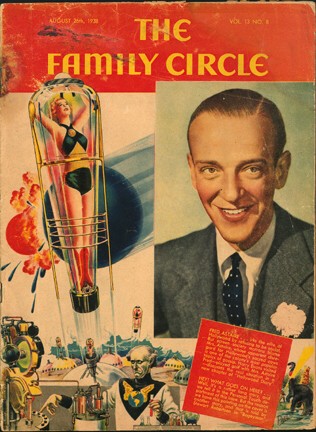
    The woman in this picture is rising from her subterranean world in an anti-gravity atomic-powered crystaline homunuclus, flying out for shopping while being fed by sunbeam converters.  No doubt there’s something strange going on with earth three milennia in the future–since the Earth no longer supports vegetation, people live underground and eat the sun directly via sciencey voodoo.     

    The artwork is provided by my newest favorite science fiction illustrator, Frank R. Paul, for the 26 August 1938 issue of The Family Circle.  And according to the elegant Paul-ophile website, the Frank R. Paul Gallery, the cover article is an interview with the artist, who goes into great detail (again, supplied by the Gallery site), about what exactly is going on in the cover illustration.  Without the explanation, I would not have been able to guess the meaning of the images.

    Another bit of the cover: the blue ball is “solidified energy” of space-time headed into the sun; meanwhile, genius scientists hope that to cushion the exploded sun’s blow to earth by launching burned tired gases into the stratosphere.  The rubber gas cushion worked, except that it would up being pierced by a renegade energy blob which crashed into the Earth and via a great miracle cured the Depression.  I would not have guessed this.

    Lastly, the guy at the bottom is not a mad scientist, but a Supreme Intelligence (as Paul tells us, he is denoted so by the “S I” on his chestplate, which evidently does not stand for “Sports Illustrated” or Staten Island”). I guess if the guy’s intelligence was really supreme he could’ve figured out a way to show more than North and South America in the single hemisphere on the chestplate.