A Daily History of Holes, Dots, Lines, Science, History, Math, Physics, Art, the Unintentional Absurd, Architecture, Maps, Data Visualization, Blank and Missing Things, and so on. |1.6 million words, 7500 images, 4.9 million hits| Press & appearances in The Times, Le Figaro, Mensa, The Economist, The Guardian, Discovery News, Slate, Le Monde, Sci American Blogs, Le Pont, and many other places… 5000+ total posts since 2008.

Category: History of the Future

  • Mrs. Kennedy’s T.V. Show, 1960

    JF Ptak Science Books   Post 1239

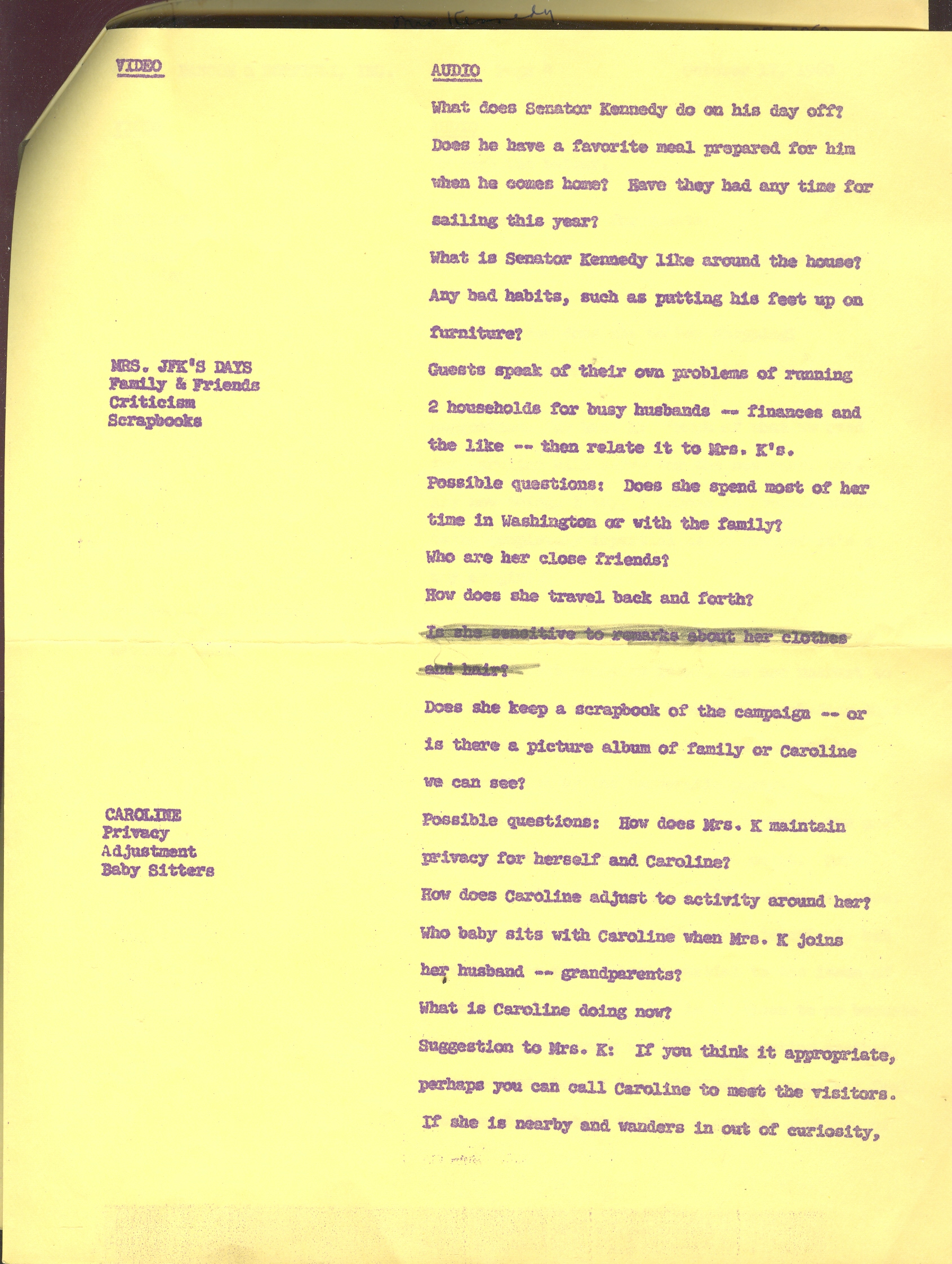
    “Much of what we used for Caroline will serve for the new baby, too. Any new things I buy, I choose in neutral shades, being completely impartial as to whether it’s a boy or a girl”–.Jacqueline Kennedy, on how she will dress her coming baby, November, 1960.
    Kennedy 4.3

    The Kennedy presidential campaign of 1960 was certainly of a different era–it had its fair share of good and bad, but what it lacked was the noble predator of massive television coverage.  There’s was a minor major attempt at utilizing the new medium, and certainly from where we sit today, the effort looks quaint, naive.

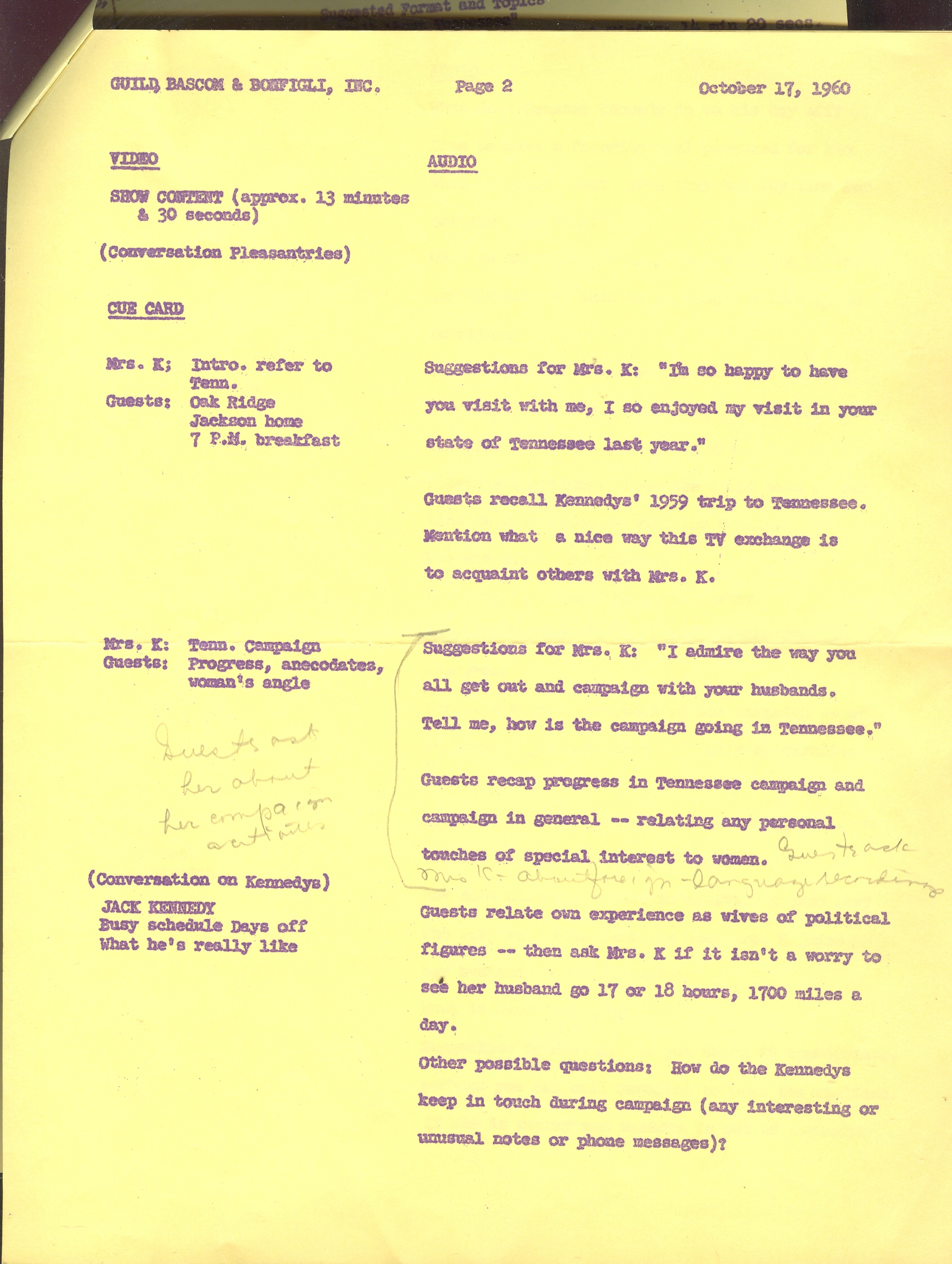
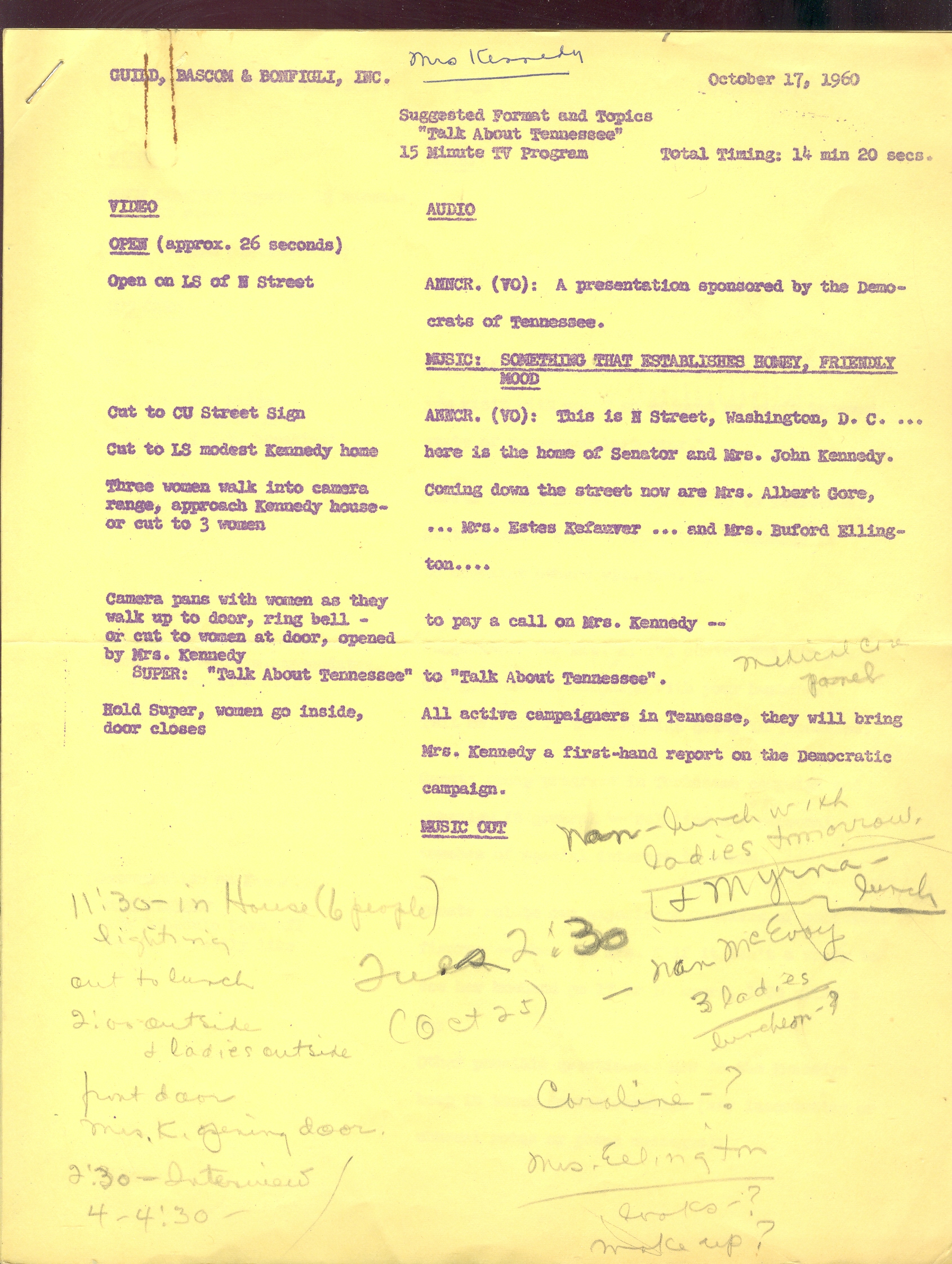
      What we have here is Jackie Kennedy’s copy of a script entitled “Talk About Tennessee”, (dated  Oct 17, 1960) for a 15-minute television endorsement for John Kennedy’s presidential campaign. Its a six-page insight into the workings of the campaign,  an x-ray of fifteen minutes of Jackie Kennedy talking with the leading ladies–featuring Mrs. Kennedy, Mrs. Albert Gore, Mrs. Estes Kefauver, and Mrs. Buford Ellington.of Tennessee–in a hearts-and-minds attempt for women’s votes. In fact, the scripts are titled “Mrs. Kennedy TV Show” in the hand of her acting social/press secretary, Gladys Uhl–it is in fact a full-fledged commercial spot, a long advertisement, though called something a little higher-minded than that.  But an ad is an ad, and this is definitely an ad. We see the enterprise from the director’s eye, who arranges the motion of the camera, the arrangement and style of music, and suggestions for conversation. [This document is available for purchase from our blog bookstore.]

    In the current era of micro-micro-management of micro-details, created nuance, utterly lost spontaneity, carefully crafted breathing and absolutely scripted off-the-cuff remarks, this effort seems extraordinary to the room that it left for instantaneous discussion.

    This material is from the estate of Mrs. Gladys Uhl, who served as the press liason and secretary for Mrs. Kennedy for a short time at the end of the election during the fall of 1960, though she did not follow Mrs. Kennedy into the White House. (Mrs. Uhl was the wife of Alexander Uhl, a very prominent and superb reporter who covered the Spanish Civil War in the front lines for several years, and who reported first hand on action during WWII, and covered many early civil rights movements for the Associated Press, the far-ish Left PM Newspaper, and many others. Her second husband, David Katcher, was the founding editor of Science Today magazine and who served a number of administrations in various high-level capacities.)

    The document, purple ink printed on yellow paper, and was evidently produced by Guild, Bascom and Bonfigli, Inc., and dated 17 October 1960, and is inscribed (in Uhl’s hand) “Mrs. Kennedy” in ink at top center of the document.  It details the look, feel and sound of the “TV show”, and also has suggestion about the content of the conversation. There are outlines for conversation *only* as there appears not to have been a definite script for each of the women. The entirety of the show does seem to be here, though, directing how the show should look to the viewer. The document is essentially divided into two sections, left and right, one side describing the video segment and the other describing the audio. A sample as follows:

    VIDEO (pg 1). “Open sequence on N street” (home of the Kennedys during this period was 3307 N in Georgetown, DC)

    AUDIO (pg 1). Music: “something that establishes homey, friendly mood”.

    VIDEO (pg 1): “camera pans with women as they walk up to door, opened by Mrs. Kennedy”.  [The conversation is mostly directed towards Jackie and the campaign.]

    AUDIO (pg 2): “guests relate own experiences as wives of political figures, then ask Mrs. K if it isn’t a worry to see her husband go 17 or 18 hours, 1700 miles a day”. 

    AUDIO (pg 2): “Other possible questions: how do the Kennedys keep in touch during campaign (any interesting or unusual notes or phone messages)?”.  Other questions put to Jackie: –what does Senator Kennedy do on his day off? –does he have a favorite meal? –how does Mrs K spend most of her time? –how does Caroline adjust to the activity around her? –has Mrs. K had time to fix up nursery, gather baby clothes? –where does she do her shopping? Then there is this nugget (on page 4) about a possible response for Mrs. Kennedy on her impending childbirth: “Much of what we used for Caroline will serve for the new baby, too. Any new things I buy, I choose in neutral shades, being completely impartial as to whether it’s a boy or a girl”.

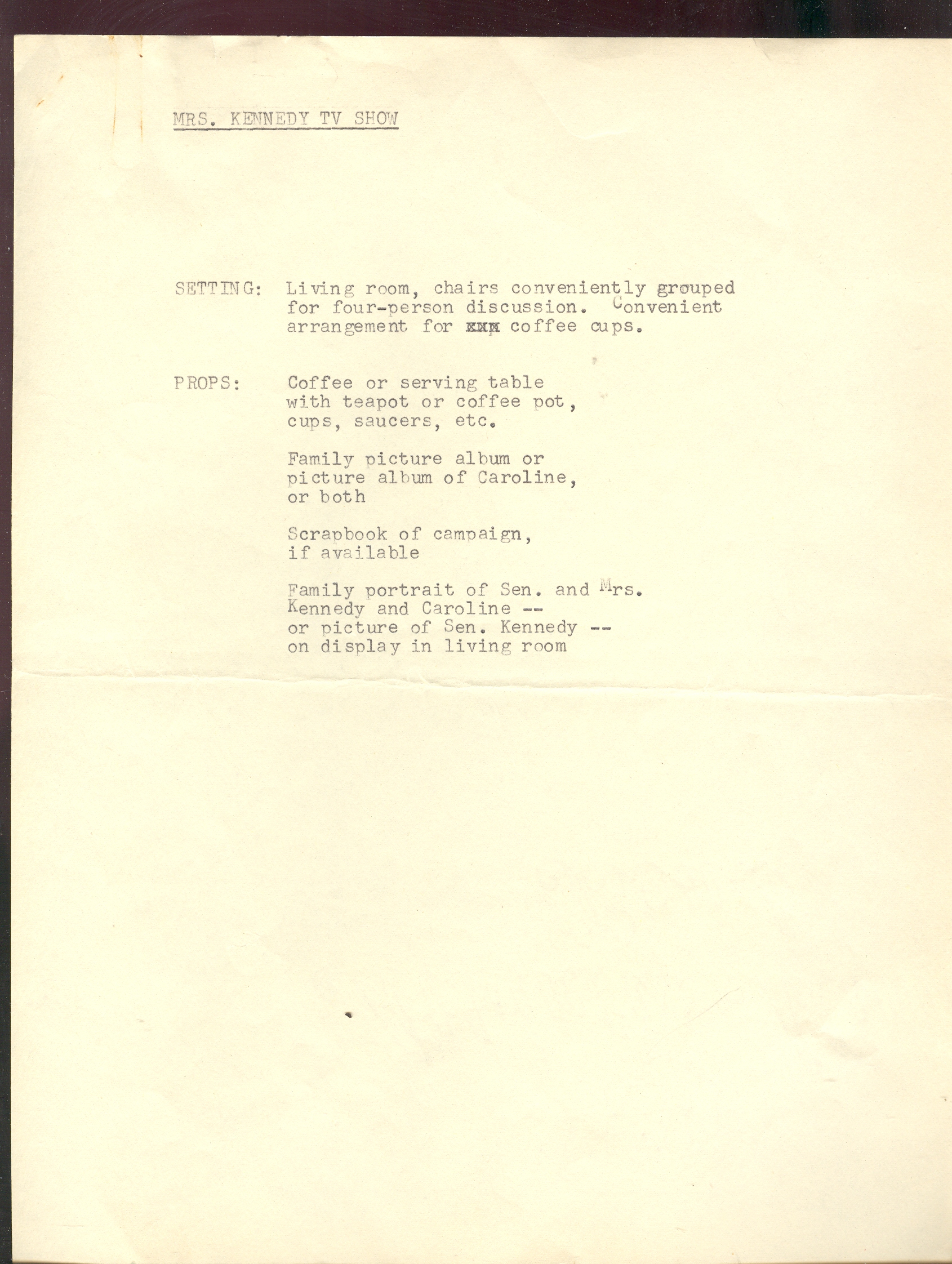
    VIDEO (pg 5): “suggested to close program: if there is a family picture, or a picture of Senator Kennedy in the room, someone might draw attention to what a good picture it is. Mrs. K could either bring it in closer or rise and walk over to it. Women would then continue in conversation, silent footage, while the announcer concludes the show, voice over.”

    VIDEO (pg 6): “Drop super, camera cuts to picture of Sen. Kennedy, if possible within the Kennedy household”. VIDEO (pg 6.) “Super: Vote Kennedy-Johnson the Democratic Ticket. Ending.”
     

    Kennedy 4.1 

    Kennedy TV SHow, pg 2

    Kennedy 4.2

    Kennedy TV SHow page 3

    Kennedy 4.3

    Kennedy TV SHow 4

    Kennedy 4.4

    Kennedy TV SHow 5
    Kennedy 4.5


  • Millions of Miles of Hole-Filled Paper–Dystopia, Entertainment, Vonnegut and Prison

    JF Ptak Science Books  Poat 1236

    {Part of this blog’s History of Holes and History of the Future series.]

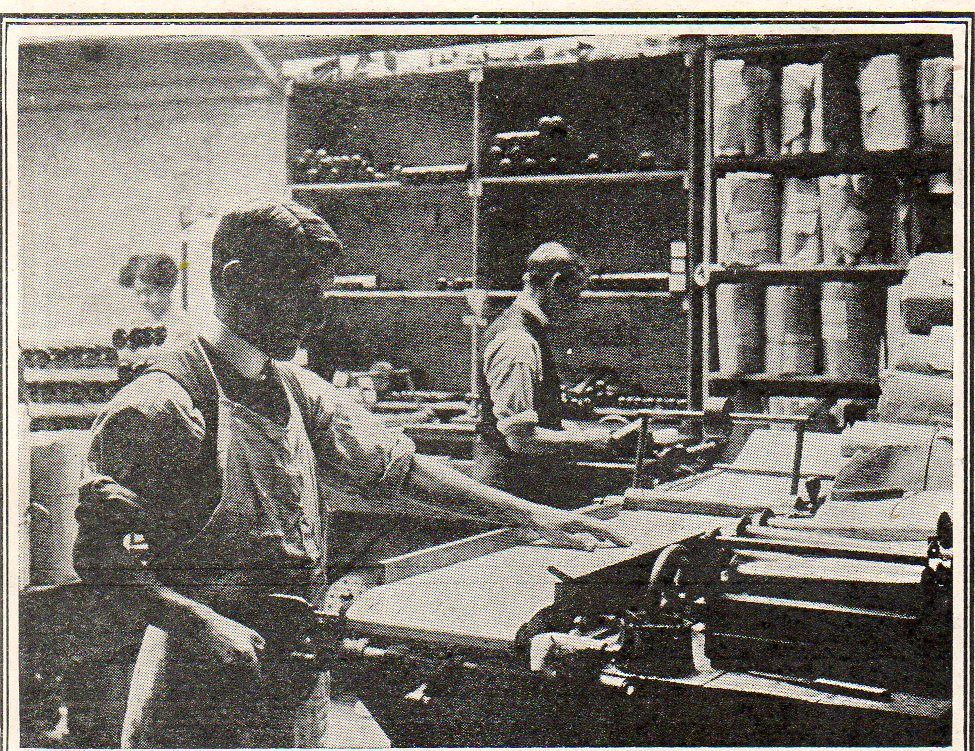
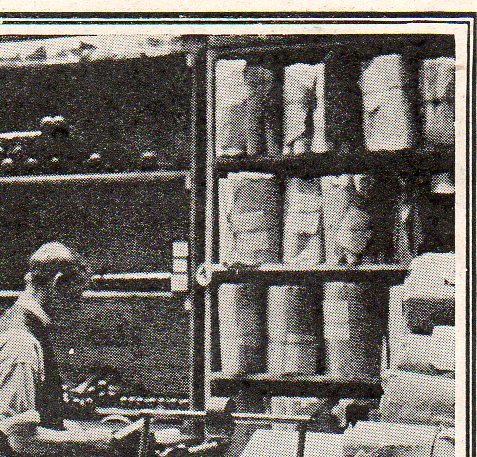
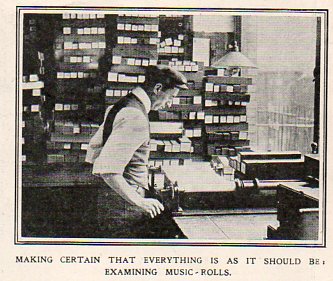
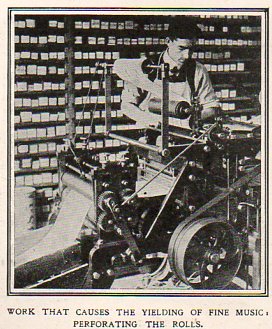
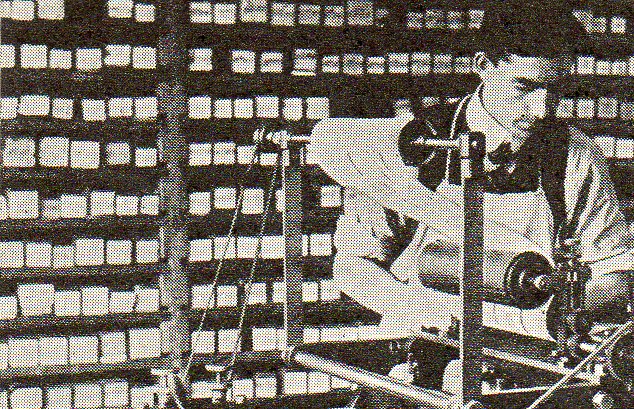
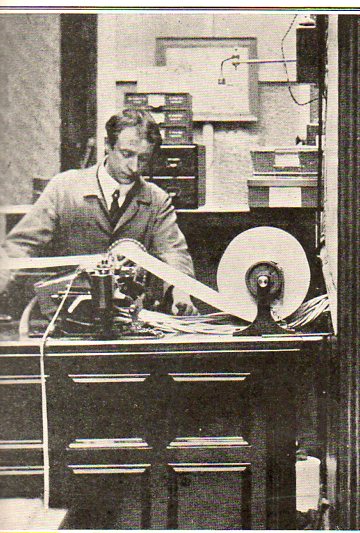
      Music role making--1871 There is a certain layered, geological dystopic quality to the  images of these men laboring at producing piano rolls for player pianos (and found in The Illustrated London News for 18 December 1909). This is true especially for the details, the small boxes in the background to where the rolls are being “processed”–music pounded out with metal points on a hard surface, as though produced by whatever it was that was in those little labeled wooden containers, far removed from the artistry of melody. These are images of a culture being made into hundreds of thousands of miles of hole-filled paper.

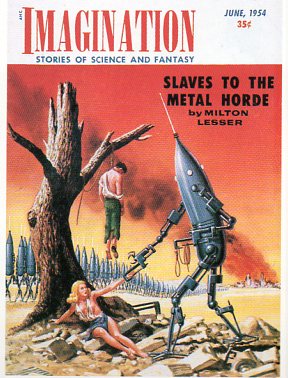
    The piano roles remind me of automatons replacing humans in entertainment, and then replacing the humans making the piano roles; of machines taking over the jobs of people writ large.  There’s a long and rich literary history of this idea, not the least (or first) of which is the appropriately-named Player Piano, Kurt Vonnegut’s first novel, written in 1952.  Like a tiny idea-machine, Vonnegut manufactured part of his tale from Brave New World, with Huxley having taken his bit from an earlier novel, We, written by Yevgeny Zamyatin in 1921–they’re all bleak images of a future dominated by machines, the humans acquiring numbers for names, like the replaceable and expendable units they became. 
    (Artwork by Malcolm Smith for Imagination, June 1954.)

    Robots in ocntrol--hanging human879

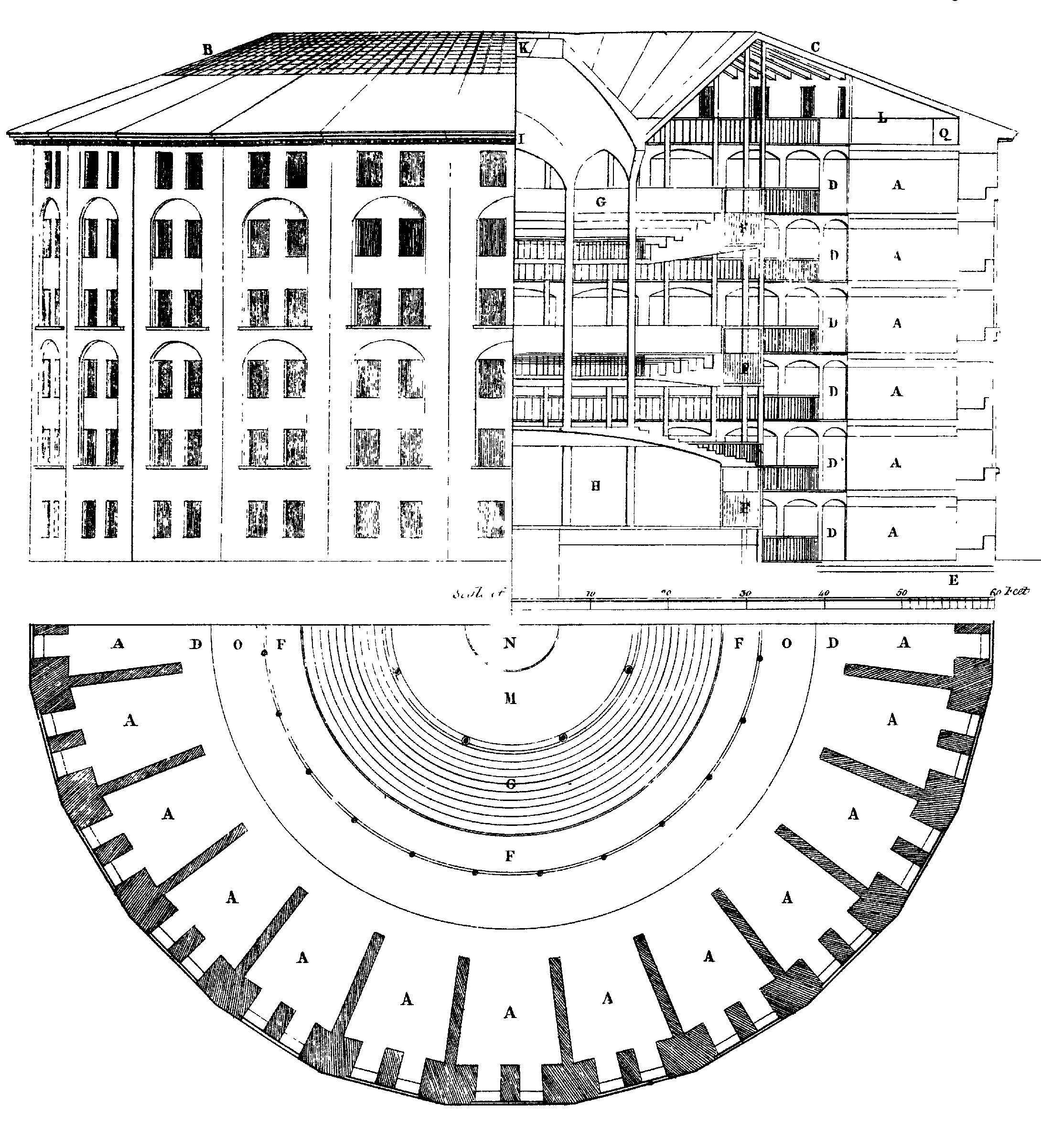
    The devices for producing the roles remind me of Jeremy Bentham’s panopticon, a functional prison designed so that all of the prisoners could be viewed from one central point.  The profile of the place reminds me of the geared punch machine for the piano roles; I’m not at all sure about what the function of the prison reminds me of.  But in the history of holes, I guess all it foes it fill u its empty holes with people, keeping them there for months or years or decades, and then replacing them with other people, part of a long and continuing series.

    File:Panopticon.jpg

    Here’s the panopticonal prison at Presidio Modelo, Isla De la Juventud, Cuba–with the walls laid flat, and some cells filled-up, and reduced, you may be able to make a certain music with it, like reading the scores made by pigeons roosting on a five-wire-strung staff of utility poles. My daughter Emma just suggested that there could be a Morse Code crossover as well!)

    File:Presidio-modelo2.JPG

    The plan and elevation of these prisons relate to the player paino paper, like the early dots and dashes of communication, like the punched cards that Vonnegut had in mind when he was writing his early classic. 

    Now, the rest of the Illustrated London News story (available here on my blog bookstore):

      Music role making--1det872
      Music role making--3865

    Music role making--4866

    Music role making--4det870
    Music role making--5867


  • Modern Antique Occupations

    JF Ptak Science Books   Post 1233

    Earlier in this blog I looked at the diminishing importances in antiquarian times–some occupations, formerly integral and important, have now become sufficient, occasionally a luxury to be afforded by folks who can pay for reigniting past importance.  This earlier example was found in William Pyne’s great-ish 1845 work, Picturesque groups for the embellishment of landscape..– it was a work of clip art for its day, really, showing, detailing, the attitudes and occupations of working people.  It was a book filled with the people who might ordinarily have gone missing from the work of the artists needing their images displayed in their brains by someone else’s labor; a book filled with figures to plug-up the blank spaces, round out that unkind bits that called out for a human touch. This new example’s lists (below) are interesting in this same way, though the jobs listed are less general and more “professional”, or technical, than the Pyne work–fishmongers and rat-catchers are not listed here. 

    The work is that of Edward Hazen who in 1837 described 68 specialized jobs in his Panorama of Professions and Trade. Unlike many other occupations from a less specialized list, nearly all of these jobs still exist, though many have been lowered to deep depths of obscurity (say, for “lithographer”), while others are changing whole-cloth but still quite popular (like my own profession as “bookseller”.  A bookseller from 1837 could see that some small percentage of the booksellers he met were indeed selling books in a way he recognized–but then there’s that knotty majority who even though were brothers-in-trade would seem I think to be almost entirely foreign to his antiquarian eyes.)

    Of all the professions listed below, only five, I think, are almost entirely removed from the public picture–jobs held by people now but by people who would be difficult to find. The short list–type founder, turner, wheelwright and stereotyper.  As I said, there are people who practice these positions, but their services are more luxuries than necessities, now.  Whereas my earlier post on the Pyne occupations was listed as a “Domesday tour” of disappeared professions, it it remarkable to see how many of the Hazen jobs continue to survive. 

    http://krisdedecker.typepad.com/.a/6a00e0099229e888330120a5f04659970b-pi

    http://krisdedecker.typepad.com/.a/6a00e0099229e888330120a6473e20970c-pi

    http://krisdedecker.typepad.com/.a/6a00e0099229e888330120a6473e20970c-pi


  • 1 Inch=$370 Million: a Great Height of Graphical Representation of Quantitative Data

    JF Ptak Science Books  Post 1227

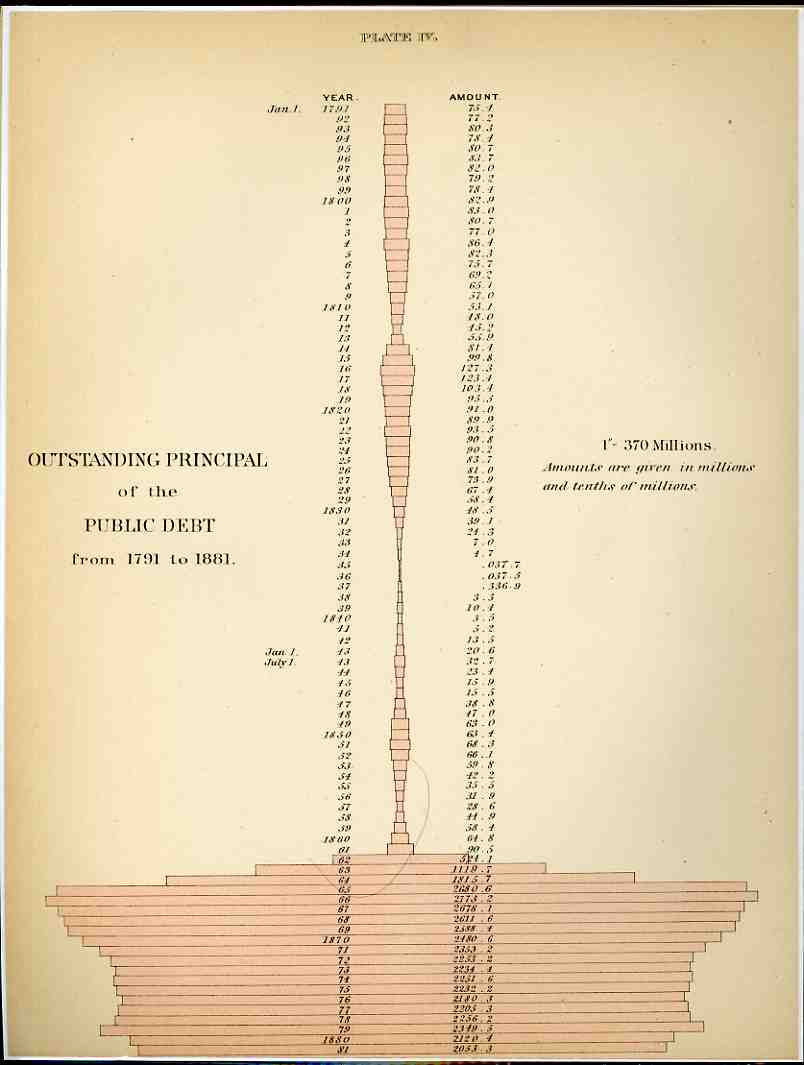
    0 ebay 13 graphs268[Click image to enlarge; both original images are available for purchase from our blog bookstore.]

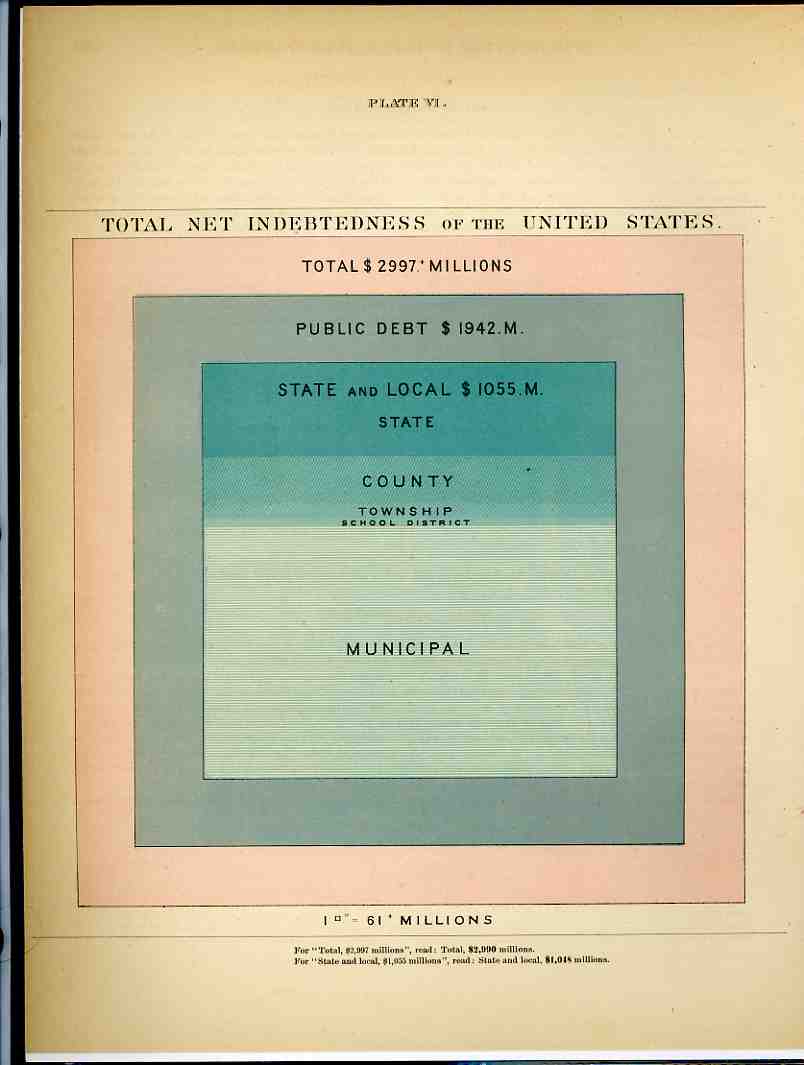
     It isn’t often that you see money represented by dry measure, but that’s what happened here in these two examples from the fantastic Walker Statistical Atlas ( Statistical Atlas of the United States based on the results of the tenth census 1880 with contributions from many eminent men of science and several departments of the government Comp. under the authority of Congress by Francis A. Walker, M. A., superintedent of the tenth census … and published in 1884).  What we see here is a history of American federal indebtedness from 1791 (when the public debt stood at 75.1 million dollars) to 1881 (about 2 billion).  Using the CPI (consumer price index) as a factor to translate that number in 2008 dollars (or so), the 2 bil grows to about $40 billion (a nickel then is about a dollar now). The interesting part of the legend–and what drew me to this graphic even before its somewhat unique shape–state “1”–370 millions”, that is one inch of pink horizontal bar stands for about $370,000,000, and the last bar on this graph is about 6 inches long, which, adjusted for inflation, would now be about 10 feet long. .That said, the really interesting part comes next–if we use this measure to graph a horizontal bar for the American debt as it stands in 2008, it would pink a pink bar that was about a HALF MILE long to express our 10(+) trillion dollars of debt.  OR, somehow, the old debt of 1881 would be about 1 story of a house, while the 2008 version would be up one side of the Empire State Building and down the other (and yes that includes the aerials).  I don’t know how to put this comparison in context, the differences are so staggering. 

    0 ebay 13 graphs269
    After having popped a neuron or two trying to get my head around that one, we’ll further confuse the situation with the second chart, which shows the total net indebtedness of the U.S. in 1881 in terms of square inches; or, at the bottom of it all, a 7×7 inch square represented the entirety of the $3 billion owed out.  49 square inches. Working backwards this time, our $10 trillion (or $10,000,000,000,000.00 writ large) adjusted back to a CPI value in 1881 would have covered about 88 PAGES of the atlas or 9,000 square inches.  Again, the numbers are just almost too big to mean anything. 

    We, as a country, owe one hell of a lot of money.

    And yes there are many different ways of trying to figure out what one 1881 dollar “means” in terms of 2008, but the CPI is the most simple to use and least argumentative and at least gives a pretty good idea of scale.  It would be more useful to try and establish the degree of difficulty  of turning the corner on the debt in 1881 compared to doing that today, but this is just a late-night post at the end of the week, and I don’t have a good clue about how to try and measure that bit simply.


  • The “Non-Violent” Ultimate Weapon Successor to the IBM? RAND Report, 1957

    JF Ptak Science Books LLC  Post 1218

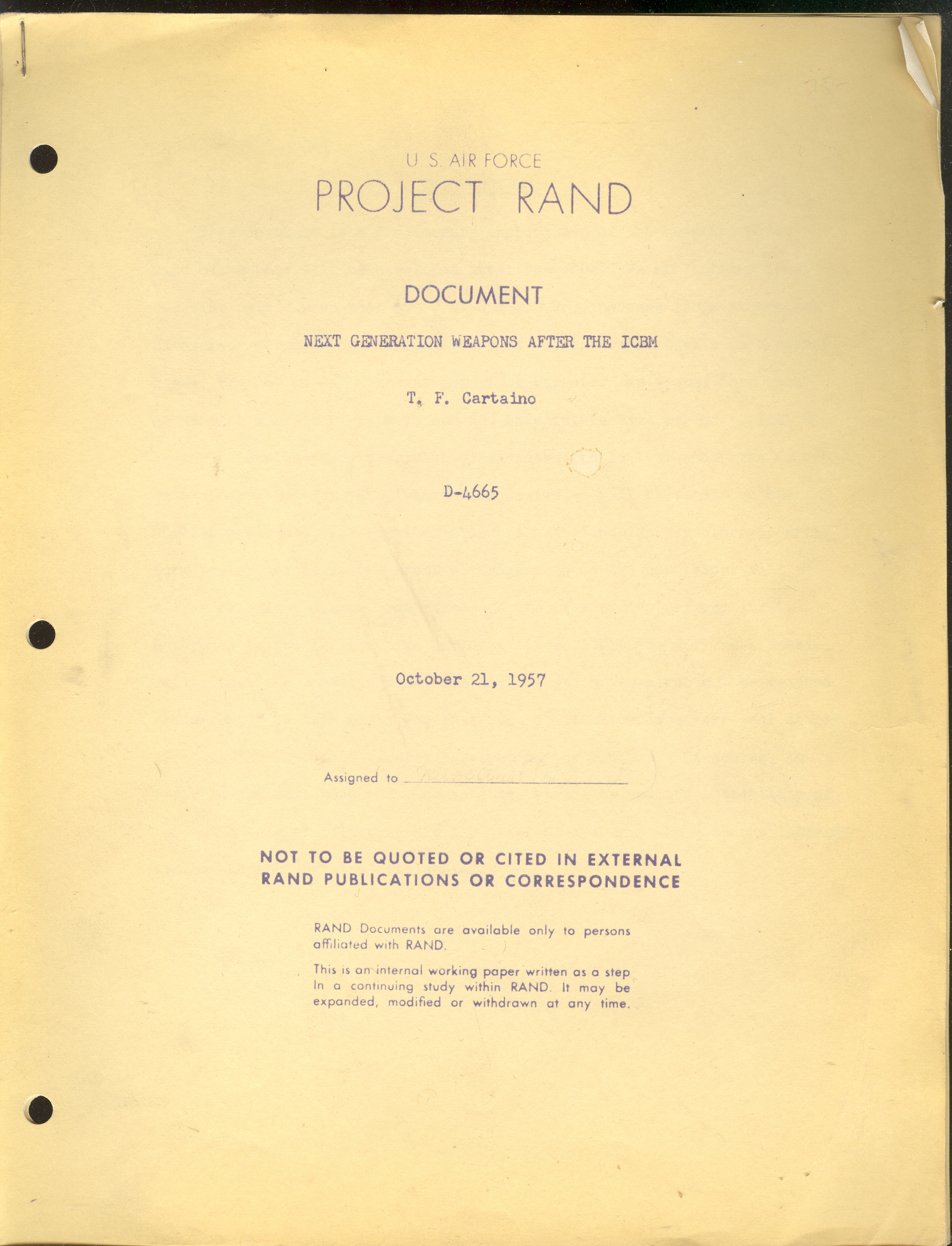
    +()+ebay icbm The RAND Corporation (Research And Development) is a think tank originally formed in 1946 by the US Army Air Force as part of a contract to the Douglas Aircraft Company.  After 1948 RAND Corp was funded by a number of different sources, private and governmental, and left the sphere of being a direct arm of the  U.S. military. (Maybe.)  It still did enormous amounts of work on behalf of the military, and seems to have been their chief  theoreticians during this period.  It was also the time that the policy of Mutually Assured Destruction (MAD) was formulated at , partially under the direction of we’ll-see-him-again-down-the-road Robert McNamara.  And of course much else.  [This pamphlet is available for purchase from our blog bookstore.]

    This publication is an internal RAND document, not meant for the eyes of the outside world, at least in 1957.  I own a number of these reports, and I must say that this one is odd—it is rather flippant, sometimes oddly and darkly (dare I say it?) funny.  It is also short (four pages) and gets to the very meaty part of the issue immediately.  The author(s) assume that the US and the USSR will have achieved a point of stasis such that it would make absolutely no sense for either actor to actually employ their arsenal (and excluding “the possibility of the button pusher ‘flipping his lid’ “.  The paper attempts then (“let’s jump right in and assume we find ourselves in this stalemated period”) to envision the next kind of war in which the ICBM would not be an active factor. “We therefore postulate here that the kind of war we will be engaged in…in the period of nuclear stalemate of the non-violent war, the opening phase of which has been called the cold war.”


  • Death from Above–the Fear of Aerial Bombing and Gas Attacks, 1932

    JF Ptak Science Books  Post 1209

    Aerial bombing from heavier-than-aircraft comes to a big anniversary soon, on 1 November 2011, a century after the Italian Lt. Giulio Cavotti dropped the first bomb from a plane on oasis-encamped Libyan troops at Tripoli.   Of course things rapidly in the few years following that, so that by the end of WWI people got a good taste of what it meant to controlling pieces of property without actually occupying them, raining chaos and destruction from

         Air attack iillus lond cvr778

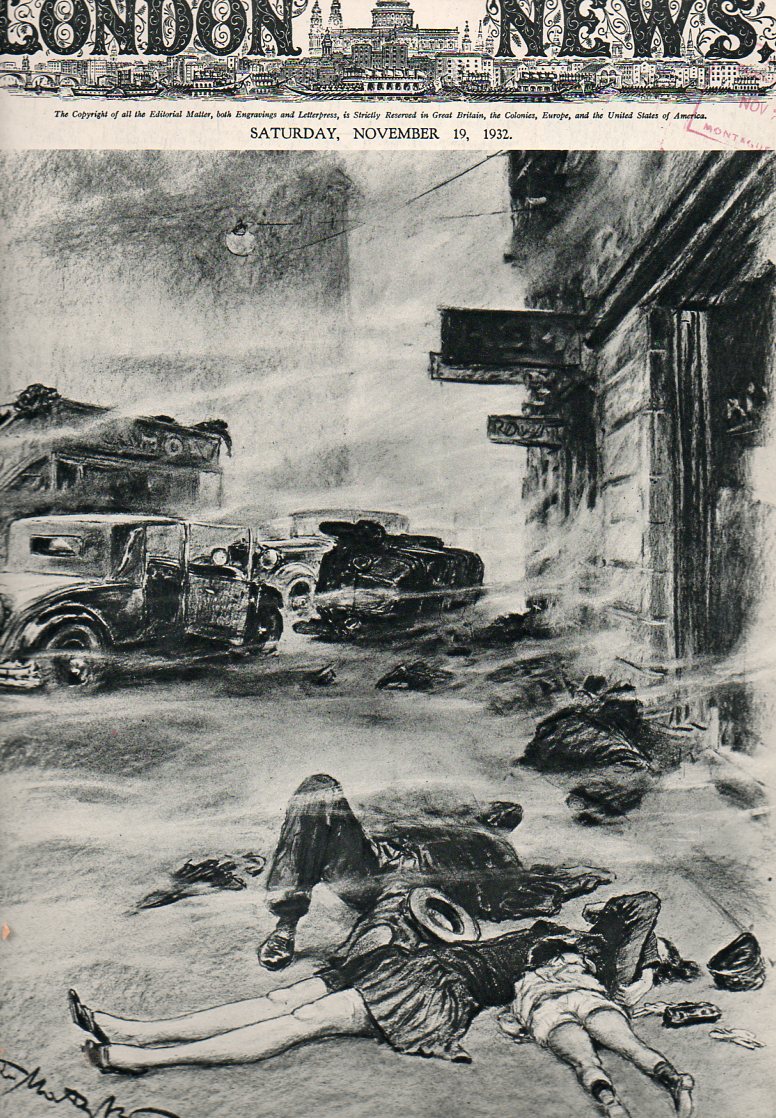
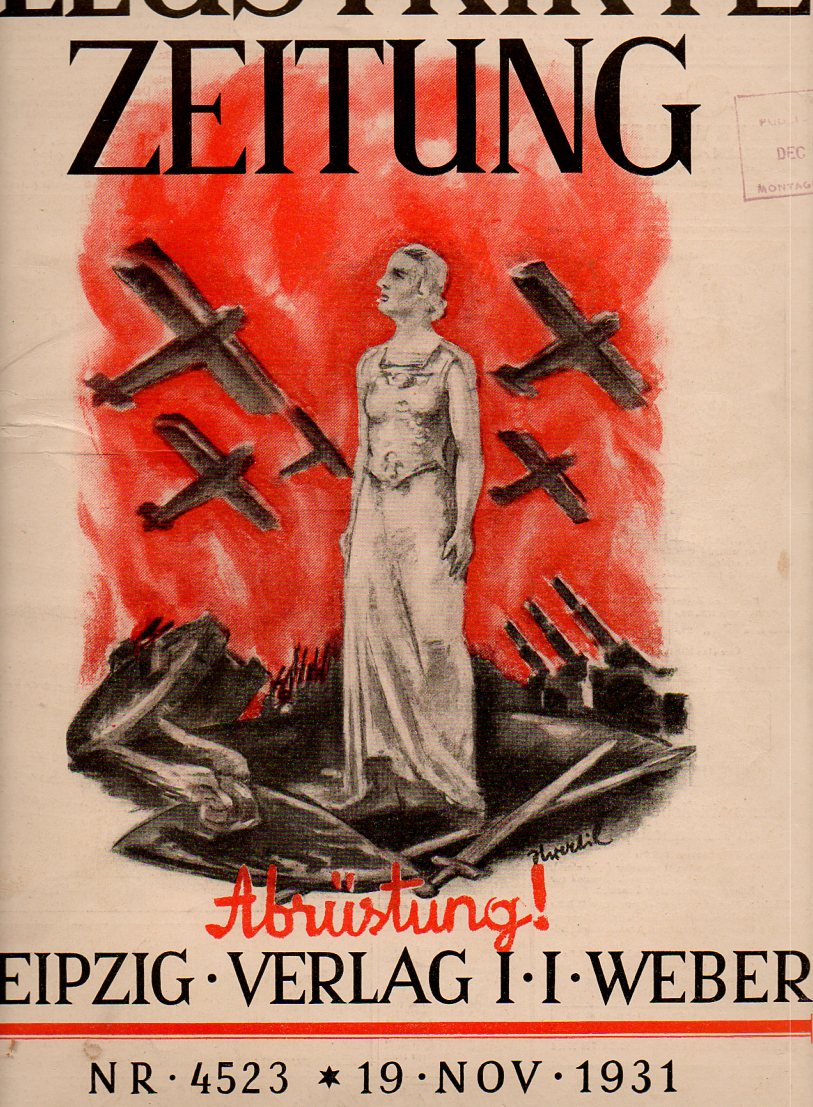
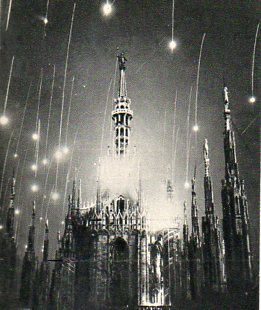
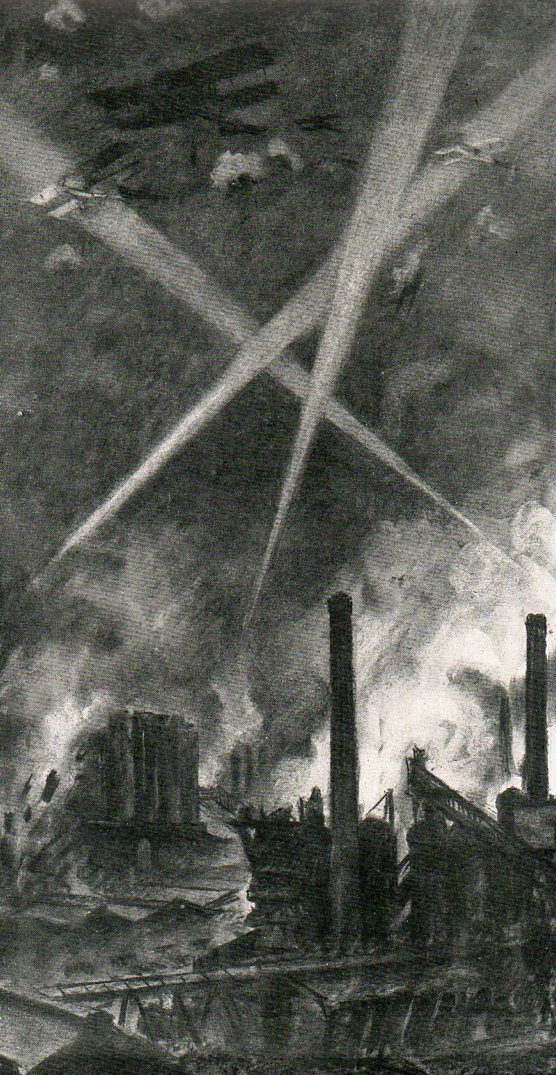
    above.  20+ years later, in the early 1930’s bombing became more sophisticated, including a new arsenal of poison gas weapons.  The threat from this weapon was agonizing and palpable–the results of gas attacks upon armed combatants in WWI and  the gassing of civilians in the 1920’s and early 1930’s  made a hard strike into the social fabric, an enormous gapping new hole to be filled in the heart of fear. [And of course this fear was felt everywhere, from London to New York to Leipzig to Moscow to Milan, as we can see in these few examples below. ALSO: these images may be purchased rfom our blog bookstore, here.]

    Air attack776
    And this interesting image of a mock (or “mimic” as it was called in the report) attack on Milan in August, 1931:

    Air attack madrid779
    There were a number of interwar aerial bombings that took place that kept the issue of mass destruction alive and well.  For example,  Britain used its air arm  very convincingly in Iraq, bombing many places including Bagdhad  in 1923; the Spanish bombed civilians into submission in Morocco, near Tetuan, in 1925, and the French crippled and destroyed  their opponents–both military and civilian, it made no difference–in Damascus, Syria, also in 1925.

    Air attack industrial777
    Fiction also harnessed the possibilities of air war, not the least of which included Armageddon-like scenarios for the semi-End of Days through the use of poison gas and “atomic” weapons.  For example, deadly gas used in Anderson Graham’s The Collapse of Homo Sapiens (1923) and Neil Bell’s Valiant Clay (where the poison gas kills 1.5 billion) and Dalton’s Black Death (1934), while Reginald Glossop’s The Orphan of Space (1926) created an alien atomic spaceship which delivered holocaustal death to Soviets and Chinese and Communists in general.  There were many more stories like this, not the least of which were the non-fiction strategy works, like Giulio Douhet, author of Dominion of the Skies (1921), legitimizer of the “strategic” bombing of civilian populations (in spite of the Hague Conference of 1907*), and  JFC Fuller’s The Reformation of War (1923) which emphsized the new importance of air war and power and which also allocated the use of gas, justifying that morality  because it could cause less harm than a conventional attack.

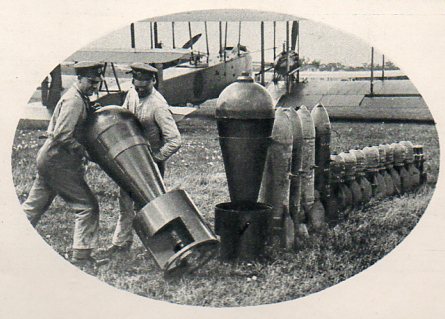
    [Image below from :Mr Baldwin on Aerial Warfare”, The Illustrated London News for 19 November 1932, illustrating the sort of aerial bombs that could threaten the population of London.]
    Air attack bomb780

    The fear was real, and the capacity to cause mass death (espcially from poison gas) was substantial, even if in a still-developing form.  Eight years hence, though, it would almost all come true (except for the poison gas part, at least for WWII), and in ways that weren’t quite imaginable in 1932–500 B-29s flying criss-cross over Tokyo would’ve seemed more fiction than science to the 1932-person, even though that technology was only a dozen or so years away. 

    Notes

    * This is where the bombing of civilian areas was specifically outlawed; what wasn’t defined, however, was what “civilian” meant–turns out that it was pretty loosely defined in the 20’s and ’30’s.


  • Footnotes in the Future–Swift, Lull, Borges and the End of Writing

    JF Ptak Science Books   Post 1155

    “The most ignorant person at a reasonable charge, and with little bodily labor, may write books in philosophy, poetry, law, mathematics, and theology, without the least assistance from genius or study.”   Jonathan Swift, in Gulliver’s Travels

    “Hell is the kingdom of the animal that swallows up the memory of all things… Between life and death there is no destiny except memory. Memory weaves the destiny of the world..”  Carlos Fuentes, Terra Nostra

    “A people without history/ is not redeemed from time, for history is a pattern of timeless moments” — T.S. Eliot, Four Quartets.

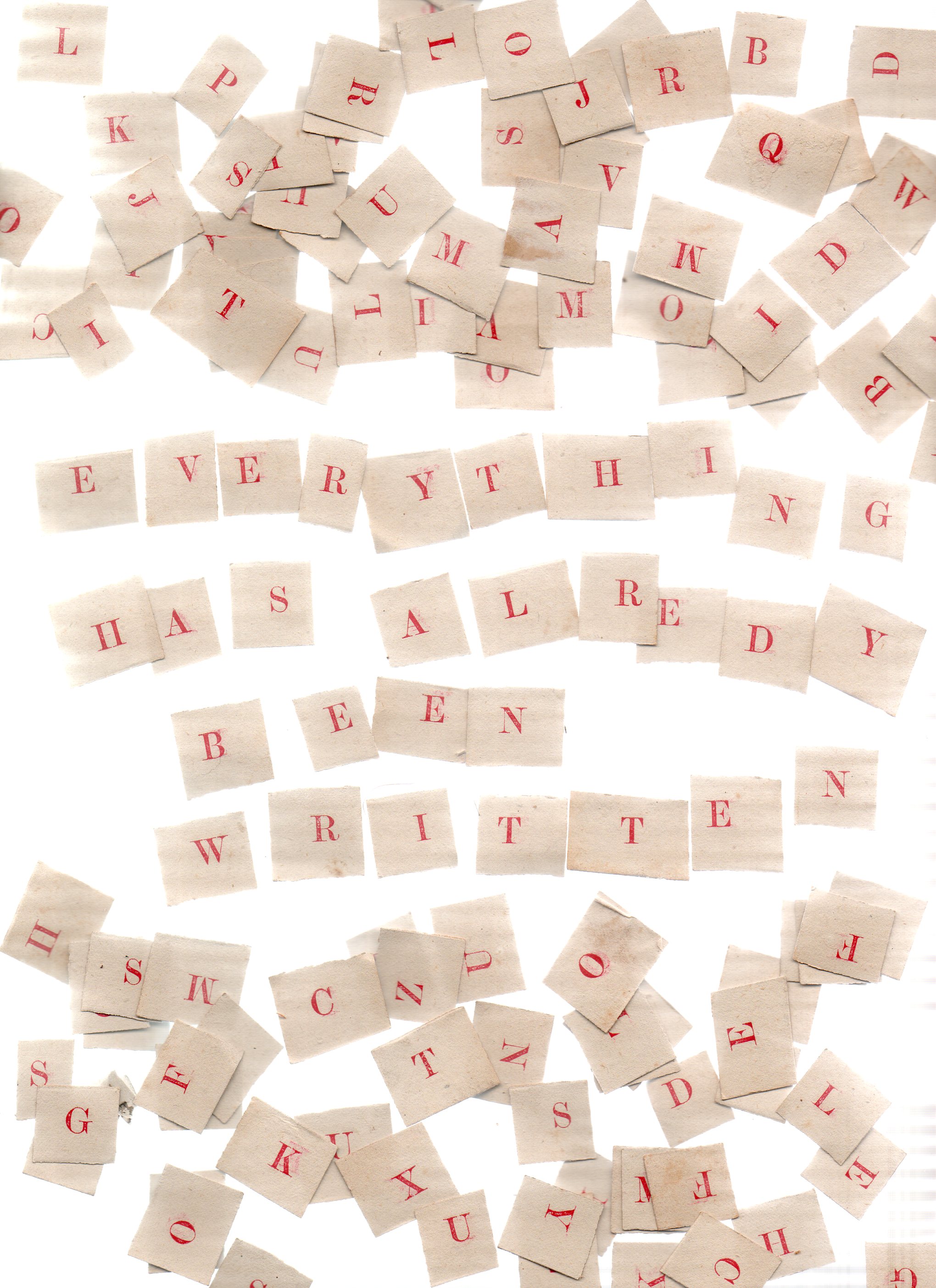
    The future history of writing–it will tell us–was already written before it was written.   In the future, when everything that can be written has been written and everything spoken has already been spoken, perhaps the first footnote in the history of already-done things will be to Jonathan Swift.  The experience belongs to us through Lemuel Gulliver1, who after surviving two trips (one to Lilliput in which Gulliver is twelve times the size of

    Written468

    everything else, and the second to Brobdingnag where he is one-twelfth the size of everything) comes to a third (of four2) in the land of Laputa.  It is here where he encounters a conversation machine that, when cranked, produces anything and everything, the known and unknown, the original and the copied, and have the thought and spoken
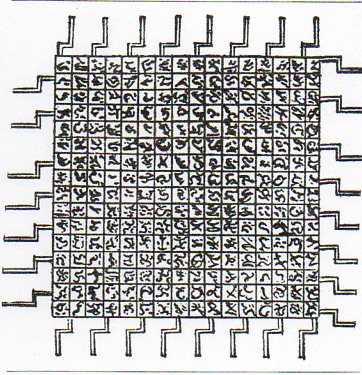
    word belong to the manipulator of the machine.  Everything that can be said is in that box, waiting to come.  The 20′ square was occupied by cubes with words on their sides, with 40 cranks and 40 handles and 40 operators to manipulate the mechanical vocabulary and associated scribes to record anything that made sense, and would be the springboard of “knowledge”operating without a manual or an intelligent primum mobile. (The image of the machine–which bears some resemblance to an integrated chip–appears in the third edition of Swift’s book, and as you can see is not a well-drawn thing, missing a row and a column and a crank here and there. A fuller description is found below.)

    Writtenc machine470

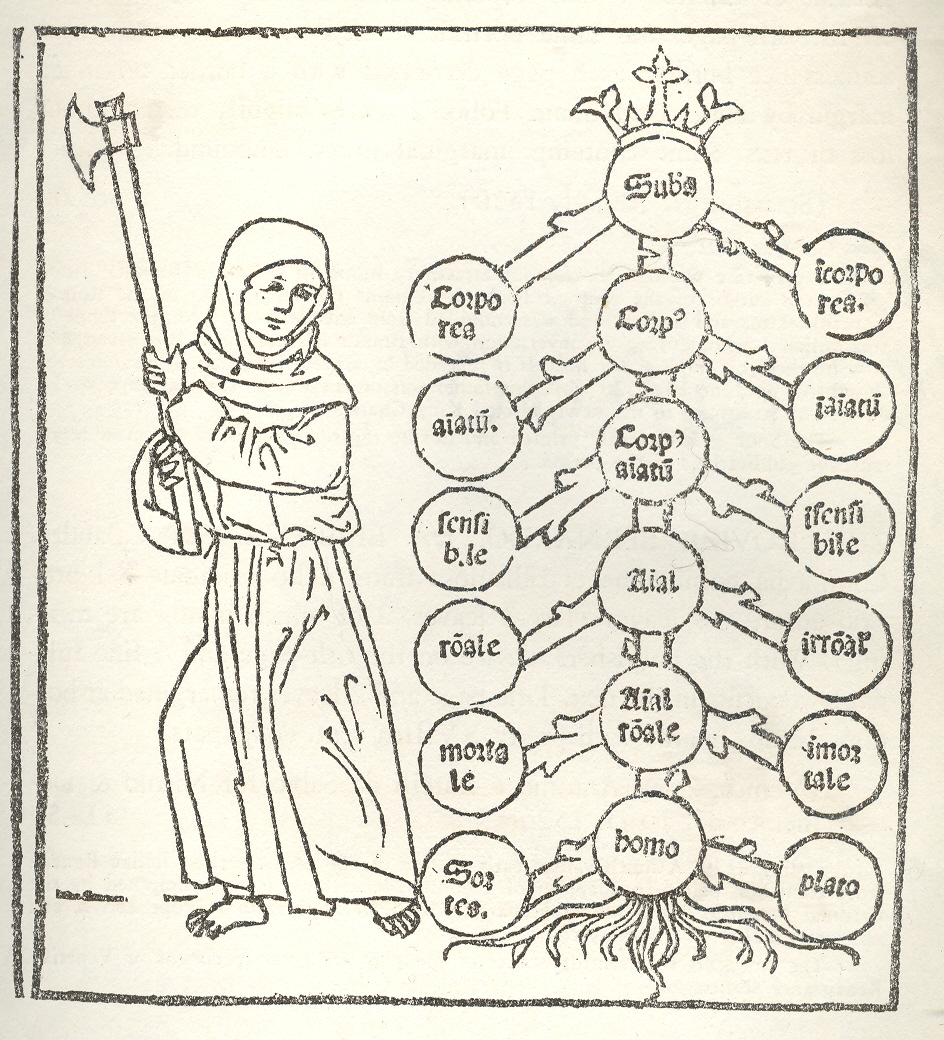
    The idea of a universal knowledge or an expanding, forever-library is very old, particularly if you expand the concept a bit to include Aristotle and the Tree of Porphyry3.  While not exactly a generator in the sense of Jorge Borges’ Library of Babel or the Swiftian machine, the ancients did 1--logic treeproduce very interesting, elegant, beautiful ways of story information and ordering information.  The Tree of Porphyry is far more concise–an abbreviation-compared to the infinitely expanding hexagonal rooms filed with books and attendant librarians in the Borges’ universe.  Or the Ars Magna/Thinking Machine of the 13th century Ramon Lull (also known as Ramon, Raimundo and Raymond, Raimundus and Raymundus Lull, Lully and Lullus and Lulio), the ultimate organizer of how sentences can be made and knowledge produced/uncovered (particularly if you want to please the logic of the church and the Creator), and which was almost certainly known to Swift (and which was also written about, described and worried-over by Borges4).  There are many other early figures in this category to be sure (Lewis Carroll, William Jevons, and even in a way Mr. Venn, not to mention Leibniz and his calculator,  and the changes in scientific method and (English/Dutch) mathematical concentration on applied mathematics of the 17th century that made thinking about the industrial revolution possible)), but that would be left to (at least) a longer post.  (The Lull wheel, below.)
                               

    How long will it take to digitize everything that has ever been written, or recorded, or composed? Several generations? Ten?  It may well come to pass in shorter time than we think; and when you compare this control of recorded human history to the centuries that will follow in developing “computers”, how can we possibly know what will become of all of it?  In the coming centuries and their attack on intelligence, when in the future the brain is a harvest of the computer, perhaps intelligence finally submits, and everything that can be done has been done, the progress of humanity snubbed to a stub. Or expanded exponentially.  It is such a tough call to make…

    Notes:

    1.  Jonathan Swift, Travels into Several Remote Nations of the World, in Four Parts. By Lemuel Gulliver, First a Surgeon, and then a Captain of several Ships.  1726.

    2. The third voyage was Part III. A Voyage to Laputa, Balnibarbi, Luggnagg, Glubbdubdrib, and Japan. The fourth finds humans as pets/inferiors in the island of the Houyhnhnms, a land of intelligent horses.

    3. The “tree” was a diagrammatic creation of a 3rd century Syrian mathematician/logician/philosopher named Porphyry who– much taken with Aristotle (and with the Categories in particular)– developed a systematic approach to the organization of thought in diagrammatic form.

    4. Borges J. L. (1999) ‘Ramon Lull’s thinking Machine’ in The total library: non-fiction 1922-1986 (Edited by) Weinberger, E., trans. Allen, E. Levine, S. J., and Weinberger, E. London, Penguin, on pp 155-160.

    It is interesting to note that Lull, who gave up everything to follow his calling into the church (and who was antagonized by the belief that his very act of missing his left-behind life to be a sin against god’s choice of him to follow his “career path”) was demonized by the church soon after his death, his works prohibited reading for hundreds of years.  He was resurrected in 1958 though on a path towards sainthood, a doctor of the church.  

    A description of the Swift machine:


  • What I Learned from Johnny Cash’s 1949 Report Card

    JF Ptak Science Books   Post 1181

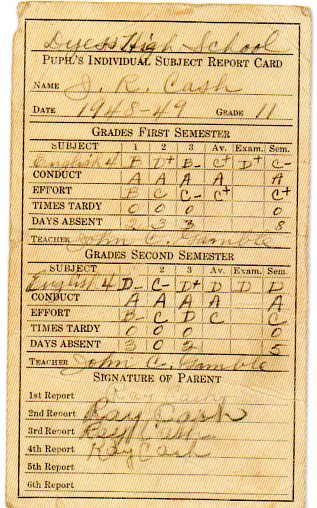
    This great relic of Americana–the report card of Johnny Cash from Dyess High School in 1949 –is the stuff of deep emotion.  It means that John R. Cash walked this (“Pupil’s Individual Subject Report Card”)  English report card home to his parents for review, the 17-year-old wondering about how they might react to his not-great grades in English and “effort”.  Or perhaps he wasn’t worried at all, perhaps he didn’t care.  He missed very few classes, and was never late.  He received straight A’s in conduct from his teacher, John C. Gramble.

    Johnny cash report card584
    [Image source: Cash, by the editors of Rolling Stone Magazine, 2007.]

    So, the young Cash, who had grown up lyrical, with music and words swimming in his head, was unmoved by “English” (which was probably more like “composition” than what we think of it today) and was not interested in trying to overcome his disinterest, overly.  Be that as it may, even though he was a D student, he was respectful of the class and teacher and classmates, always getting A’s in conduct.

    Mr Cash signed the report card each time, and I suspect that he knew exactly what was going on with J.R. in spite of the grades.

    Only six years later, in 1955, Johnny Cash had his first national hit in “Cry Cry Cry”.

    And so where was Dyess High School?

    As it turns out, Johnny Cash lived in a place in his early youth that owed its life to deep government intervention in the lives of its citizens.  The short story is that people–almost entirely farming families–who had lost everything in the Great Depression and the resulting drought were given an advance1 of money to buy a house and land and a chance to start life anew.  Ray Cash, Johnny’s father–born in 1897 in Rison, Arkansas–entered his family on the relief rolls and was one of 500 families selected  to settle a 15,000 timber-cut swath of Arkansas bottom land up in the north-east corner of Arkansas in Mississippi County, basically due north of Memphis Tennessee just this side of the border.
           
    The program brought to bear on this situation was the Federal Emergency Relief Agency (FERA), which was administrated on the national level by Harry Hopkins and in Arkansas by Alabama-born former teamster William R. Dyess.  The farms and farmland was administered through the Rural Rehabilitation program, which under Dyess’ direction in Arkansas started the “Colonization Project No. 1″ in May 1934.

    Ray Cash and family moved into House 266 on its 20 acres in 1936, one of five families selected from Cleveland County, and the same year in which Colonization Project No. 1 was incorporated as Dyess Colony.  In a short period of time construction in the new Colony included  “an administration building (and a )…town center (which)  included a community bank, beauty salon/barbershop, blacksmith shop, café, cannery, cotton gin, feedmill, furniture factory, harness shop, hospital, ice house, library, theater, newspaper (the Colony Herald), post office, printing shop, service station/garage, sorghum mill, and school. Members of the colony often performed community tasks on a cooperative basis, though the farms were worked individually.”2   
    ________
    Notes

    * “Criteria for the all-white community included that applicants be destitute from the economic crisis, come from the lowest poverty level, be of “good moral background,” and that husband and wife each have the physical ability to clear the land and farm their acreage. Each farmer would draw a subsistence advance to buy twenty to forty acres of land and one of the new five-room houses, plus a mule, a cow, groceries, and supplies until the first year’s crop came in. All were expected to pay back the advance. The town would operate as a cooperative in which seed was purchased and crops were sold communally.”Encyclopedia of Arkansas History and Culture.

    2. Encyclopedia of Arkansas History and Culture.

    Dyess had population of 2500 in 1936, now a town of 550 or so.  I cannot see any remnants of the wagon-wheel design of the farm houses that were built there in 1934/5 from Google satellite images.

    An excellent reference for the movement of families into the Mississippi River bottomlands is The final frontiers, 1880-1930: settling the southern bottomlands, by John Solomon Otto.

    And now for this musical video about Dyess:


  • Science Noir and Steampunk–the Magic Lantern and Major Kong

    JF Ptak Science Books   Post 1177

    I wonder if there is any such thing as Science Noir? There is certainly science fiction noir, and Cyber Noir and associated reaches, but, well, what about a purely Science Noir?  Scary, off-center, distracted, chilling, nightmarish science?  I’m not so sure if this is even a real question, but when I think about arguments made for the cultural and supposed artistic impacts in the creation and direction of some aspects of scientific development, I wonder if it makes any sense at all to think of science in terms of the noirish aspects of culture.

    Emma Alvarez Gibson made the suggestion to me that Science Noir might be a version of Steampunk, and she may well be correct, although the frightening aspects of vast machinery shrouded in noise and smoke and shadow–the very definers of Steampunk and massive Victorian-era machinery–may be itself one version Science Noir.

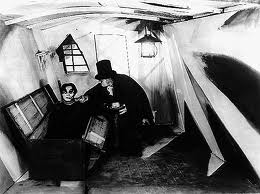
    But what comes first to mind of course is film noir, the edgy use of cinema that came about during the late stages of the Expressionist movement and the early stages of motions pictures.  Expressionism comes just after the first real influx of motion pictures, around 1910 or so, and it seems a little surprising to me that such a huge developmental leap was taken in film so quickly after the first initial mass public success of the film industry.  Perhaps it is incredible that a movie such as The Cabinet of Dr. Calgari–seen as the first adventure into Film Noir and an enormous leap of creativity in film–came so quickly: after all, the first NYT film review appears in 1909, the first movie magazine (Photoplay) appears in 1912, the first animated cartoon (the great Windsor McKay’s Gertie the Dinosaur) in 1914, the same year as the first appearance of the Little tramp.  And then five short years later, almost a decade into the Expressionist movement, comes the Cabinet.         

    Science noir--caligari
    Film Noir was a new experience in motion pictures–it tested reality, coming to the audience in a shadow, fractured, sharp angled crossed line existence, dark, potentially unreal, teasingly chaotic, establishing a waking nightmare.  The mood was questioning, the atmosphere sharp and highly contrasted. It was scary–especially in the case of the deeply creepy Dr. Caligari the deeply disturbing sets continuing to stay as existence in the film even after it is revealed that everything that had happened previously was a dream…except that the dream’s landscape was not relieved. 

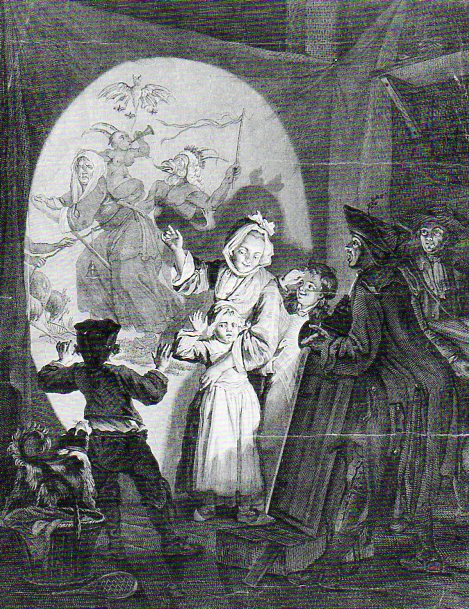
    Perhaps the earliest brush of Film Noir was Science Noir.  The earliest removed images in real time that were seen moving eerily across the probable clay/adobe walls of a camera obscura must have seen fantastic to the first observers.  The earliest projected images from the magic lantern–seen here in the engraving La Lanterne Magique by Jean Orvrier and published around 1770–included many frightening portrayals of witches and demons in addition to their general stable of scientific, technical, literary and travel images. I am quite sure that the earliest viewers of these scenes must have felt as though they were witnessing something extra-ordinary, something beyond simple optical amusements shown on white cloth, something more real than not–particularly since it seems that many people were exposed to these images by traveling magic lantern itinerants more so than scientific lectures. The images of spectres and demons may well have felt to be the things themselves.

      Science noir--magic lantern565

    Perhaps the magic lantern is the first bit of Science Noir, the Steampunk without the steam.  And metal. The noirsh aspects of this science was in projected light and the imagination, leaving the worst effects of the  visual aspects of this fear to the imagination. 

    But I think that Ms. Gibson is correct, and that the most vivid aspects of Science Noir are left to Steampunk, the threat of metallic enormities of power and noise simply overwhelming the viewer.  I suspect though the  greatest science noir of the 20th century would best be seen through the eyes of Stanley Kubrick’s Dr. Strangelove, a masterpiece of black humor layered in incredibly stark, high-contrast black and white scenes, the threat of entire annihilation made to feel somehow ridiculous, humorous and possible, the viewer laughing  as Major Kong rides the nuclear weapon “Hi There” all the way down in Nukepunk cowboy glory through five minutes of an insistent “When Johnny Comes Marching Home” soundtrack. And then, suddenly, the silent, brilliant flash, and the laughing stops, and there’s nothing left but cold heat. 

    I guess that’s my first take on the vision of modern Science Noir. 

    (The except below from Dr. Strangelove is longish, about five minutes,  but it is well worth the buildup.)


    _
    Notes
    The oldest extant magic lantern-like machine comes to us from Christian Huygens from about 1656.  Huygens is a scientist of enormous energy and capacity and genius, and more often forgotten than not nowadays, at least in popular culture


  • The Invisible Influence of the Highly Visible? Comets and Meteors in Astrology

    JF Ptak Science Books   Post 1176

    “When beggars die there are no comets seen; The heavens themselves blaze forth the death of princes.” – Shakespeare.

    “Threatening the world with Famine, Plague and War: To Princes, Death! To Kingdoms, many Crosses; To all Estates, inevitable Losses! To Herdsmen, Rot; to Plowmen, hapless Seasons; To Sailors, Storms, To Cities, Civil Treasons!” De cometis by John Gadbury, London, 1665

    It is unusual to me that in the long history of early astrology, some of the greatest elements of the night sky–comets and meteors–are little used, perhaps even unuseful outside of adding flavoring to readings given the time and place of their appearance. They had been seen for milennia–appearing in Gilgamesh and the Book of Revelation for two samples– as prognostic of future events, John of Damascus and Aritotle and Ptolemy and Albumasar all writing about that quality.

    Comets 5564
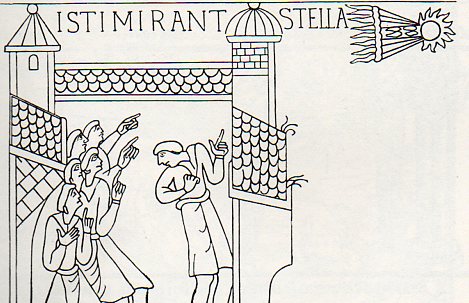
    [The Bayeux Tapestry illustrating the appearance of the comet of 1066, later to be known as Halley’s comet.]

    Comets and meteors didn’t really affect anything in the physical world, and in the astrological one their purpose was to perhaps predict a kingly death or the appearance opf warts on women. They were also seen by people like Aristotle to be atmopsheric events, living out their exsitence in close proximity to the Earth, incapable of having any undue affect on Earthly matters.  Meteors would appear and then disappear, comets were surprises and visible for just short amounts of time; the rest of the night sky remained the same, intact and unaltered after their appearances.  They were not understood, though they were seen by some as raging battles between forces of good and evil, personifications of the struggle between the angels of god and the elements of the devil. Meteors and comets were mysterious, unconquerable, unknowable, suspicious elements, and were evidently not useful to the early astrologers.

    Comets 1560
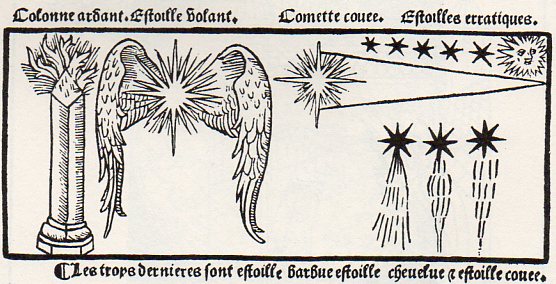
    [Nicolas Le Rouge, Le Grand Kalendrier et Compost des Bergieres, published in 1496 in Troyes. 

    The night sky is a mnemonic device, a place to store memory and a holder of the alphabet of myths and beliefs of all, a culture written large across the sky. Meteors and comets were not predictable, and could add nothing insofar as a consistent bit of storytelling was concerned, though they certainly created their own stories in each observed appearance; they could also add punctuation and exclamation to whatever constellation they appeared in. For example if one appeared in a juncture with Jupiter, a major event for royalty would possibly be foretold.   But as a permanent element to the visualization of the night sky, they had little power even though they seemed to be displays of fantastic energy and power in themselves.

    Comets 2561

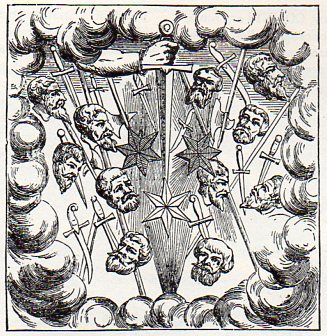
    [Amrose Pare illustrated the comet of 1528 in his Livres de Chirurgie (in a chapter titled “Des Monstres Celestes”), published in Paris in 1597. Even though Pare was a towering figure and great intellect, he still personified the wandering stars with human faces, with hair and beards, accompanied by swords and shields.  There were many other scholars who saw such things in comets and meteors, not the least of which was Maupertuis, who envisioned the tails as clusters of jewels; many others seeing many other things.

    Comets 3562
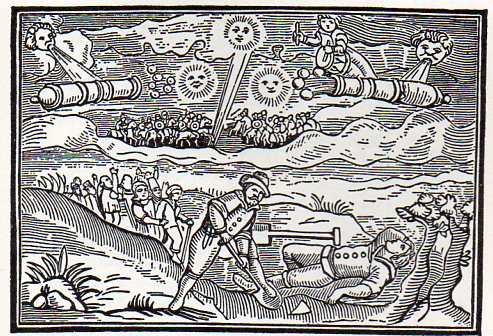
    [For some reason the celestial court, divided by sunlight and flanked by two other sources of light, have ofund it expedient to issue comets from the mouths of Heaven Canon.  I’m not sure what’s going on in the forground with the fellow working his spade next to the triangular blankness.  the man to his right seems to have been overtaken in fear (as have the group of people visible to the left over the shoveler’s shoulder).]

    Comets 4563

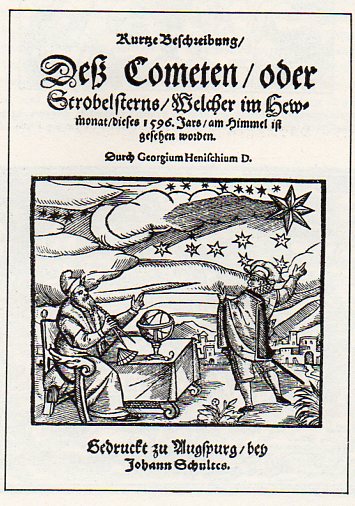
    [Halley’s comet appears again on the title page of this work by the Hungarian George Henischius, a prfoessor of rhetoric, mathematics and medicine at Augsberg.]