A Daily History of Holes, Dots, Lines, Science, History, Math, Physics, Art, the Unintentional Absurd, Architecture, Maps, Data Visualization, Blank and Missing Things, and so on. |1.6 million words, 7500 images, 4.9 million hits| Press & appearances in The Times, Le Figaro, Mensa, The Economist, The Guardian, Discovery News, Slate, Le Monde, Sci American Blogs, Le Pont, and many other places… 5000+ total posts since 2008.

Category: History of the Future

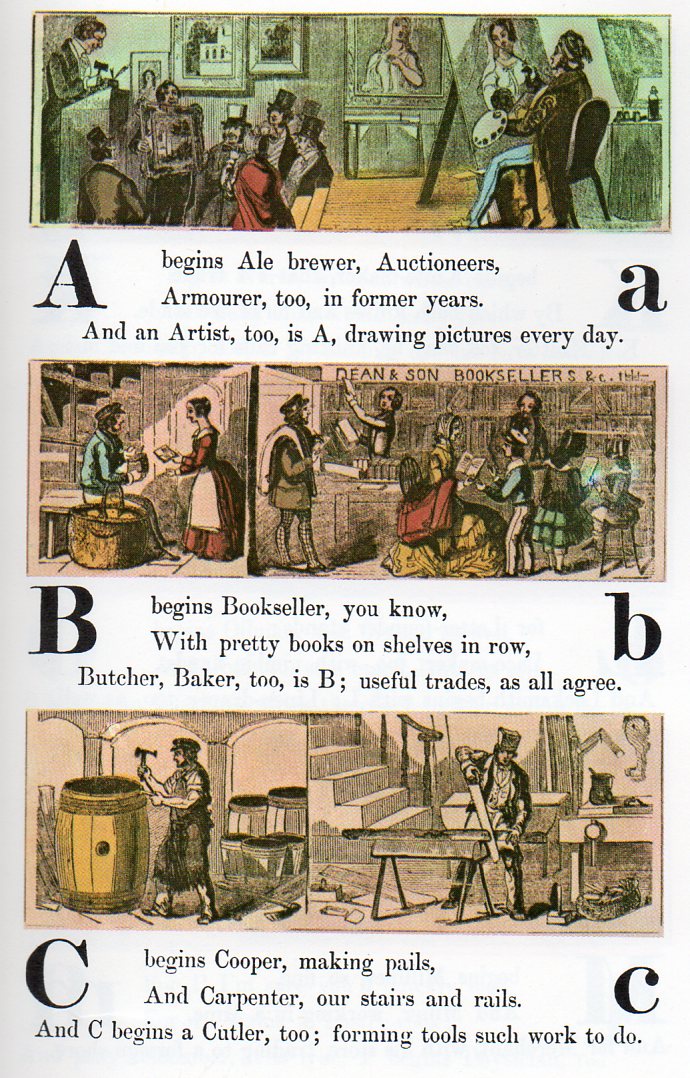
  • Occupational Alphabet, ca. 1850

    JF Ptak  Science Books   Post 1103

    Its interesting to see what jobs have survived over the years, and what jobs haven’t–particularly those jobs that would have been so widespread and popular that they would be instantly recognized by a child–so much part of the common culture that the initial letter of the job’s name could be used to help children learn the alphabet.

    Alphabet jobs a-c267

    In this version of commonplace employment found in a child’s alphabetical primer of ca. 1850, lists the following professions, most of which are still available for hire: ale brewer (especially here in Asheville, Beer City USA);auctioneer, armourer, artist, bookseller, butcher, baker, cooper, carpenter, cutler, dyer, dairyman, engraver, engineer, fishmonger, fiddle(r), florist, grocer, glazier, hatter, hawker, horse dealer, ironmonger, jeweller, knife-maker, knitter, letter-founder, lace-maker, locksmith, milliner, miner, merchant, nurse, newsman, oilman, optician, omnibus, pastry-cook, physician, rope-maker, rider, shoemaker, shipwright, scavenger, slater, surgeon, sawyer, saddler, tailor, turner, tanner, tinker, upholsterer, vintner, wharfinger, wax-chandler, yeoman, youth, zoologist.

    continued below with FULL ALPHABET:


  • The Future of Women–Helicopter-Delivered Paper Clothing for Woodsy Frolics

    JF Ptak Science Books   Post 1105

    Future--throw away clothing

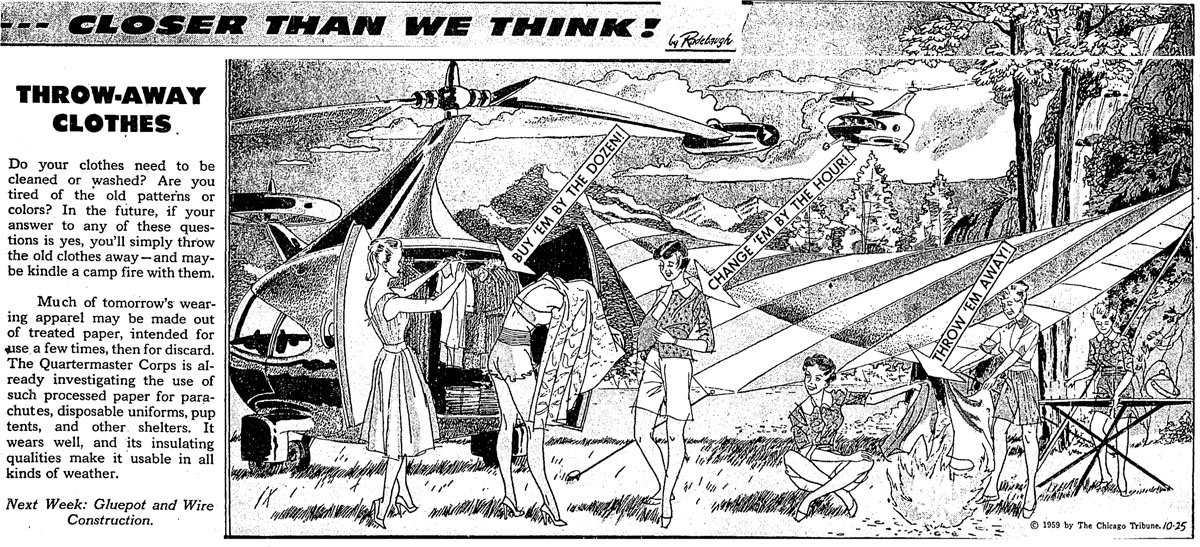
    The artist of this perspective of the future offers us a little too much of his personal dreamcastle, I think.  Perhaps the future is filled with paper clothing to be thrown away at a whim, or if not paper then something else besides that, like paint.  Painted clothing might make more sense than natural disposables.  But what makes this image special to me is that none of it makes sense, but for semi-noxiously-underwear-filled reason, it did find its way into publication, even if it was only in the Chicago Tribune.  

    The artist shared a very personal vision of the future which reminded me in a way of a reverse Reclusorium.  Monks and recluses filled out their fair share–men and women alike–of Anchorages and Reclusoria, living down in tiny cells sometimes dressed in chaffing (or worse*) clothing, sometimes being permanently caged (or even walled in), spending their lives devoted to their own unworthiness and penitence and glorification of a private conversation with a god of salvation. 

    This picture offers us a group of non-recluses, living far from any sort of St. Jerome-y existence. For some reason these women are living out in the wild in high heels, enjoying The Nature, and having their disposable clothing delivered to them via helicopter(s).  They choose their paper outfits, and change into them right there, right in front of the helicopter, the artist enjoying their wreckless abandon. Find the clothing, take off old clothing, dress languidly, and then sit down and throw the old paper rags into the fire. Just in case, the lady in the background is serving refreshments.

    Seems to me that the women in this scene are developing a public demonstration of a little private fetish of the artist more so than delineating a vision of a hellfire future filled with semi-naked women frolicking  in the woods.  Or rmaybe I’m being too cranky and seeing things too hard–maybe not…


  • Pictographic Messages to the Year 12,010: the Medium is the Mess.

    JF Ptak Science Books  Post 1103

    Talking to the Future: a Note of Pity to Ourselves in 300 Generations
    Nuke waste--dead251

    In the history of words I’ll take a wild guess and say that fractions of 1% of everything communicated is directed at ourselves in the future–or at least it has the possibility of being directed to someone else when our deeds are long, long since forgotten. 

    And by writing to the future I don’t mean in an off-hand way, our words being read in 12,010 by chance, idea archaeologists looking at what people were talking about 10,000 years earlier; and I don’t mean via “reconstructing” our radio or tv broadcasts (in the not-right Jodie Foster Contact kinda way).  I mean intentional messages to be read a long time from today.   

    A more problematic entry would be images and symbols design to be read by future generations, in the deep future.  This is not a very deep category, though a famous (if not well designed) example being the one associated with Carl Sagan that was attached to the 1972 Pioneer 10 and 1973 Pioneer 11 spacecraft, which attempted to explain what humans were should either vehicle  in any eon come into contact with other-than-Earth life.
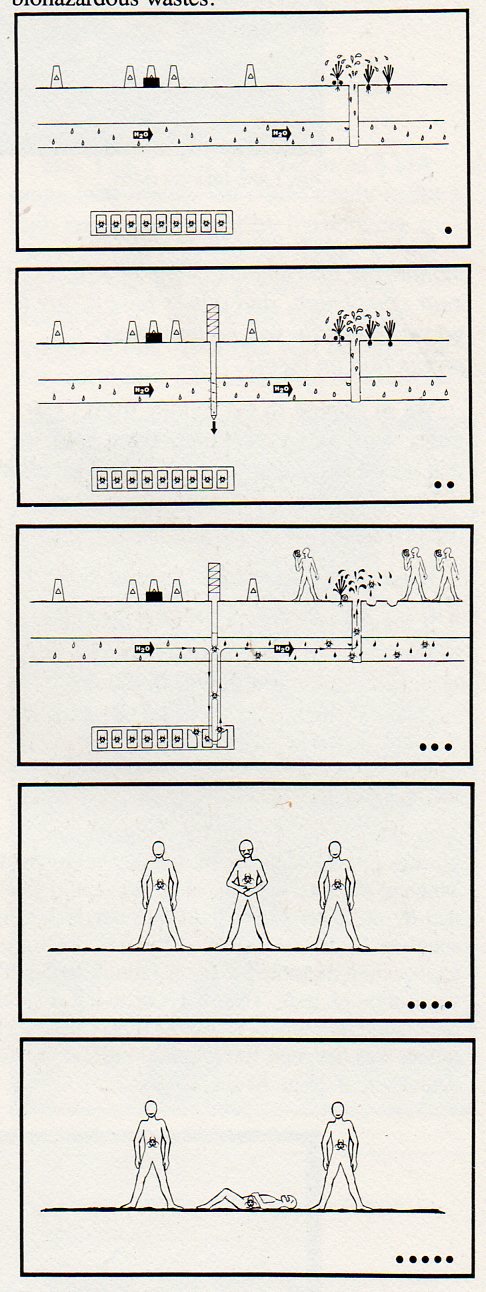
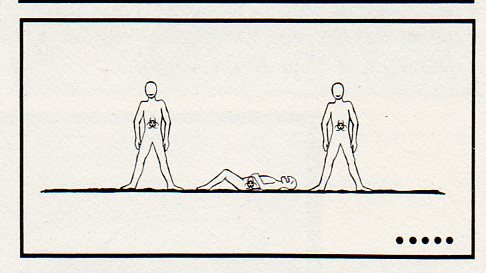
    Nuke waste--overall250 Another is the pictograph presented here, which appeared on page 117 of the ironically and extraordinarily-titled Reducing the Likelihood of Future Human Activities That Could Affect Geologic High-Level Waste Repositories1, the first half of which (bolded above) could make a nice departure for some other science fictiony type story.    But what these folks were talking about, plain and simple, was how to prevent future generations from digging into or other disturbing in any way buried masses of nuclear waste. 

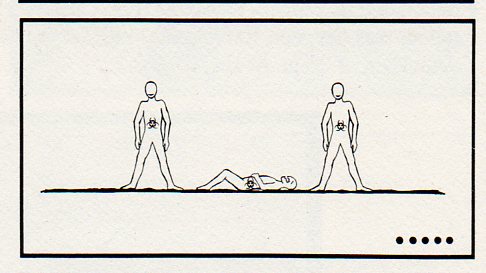
    This pictograph is meant to be a non-linguisitc, universally-understood  warning to future generations that the ground they are standing on is above a nuclear waste storage site.  The plan was that nuke waste would be solidified and buried in rock hundreds of meters below the surface in an effort to keep in line with governmental policy of waste disposal2. The pictograph relates to the restricting of future human activities part of the title of the work in question–that is, folks in the future who might muck around, drilling, into the nuclear waste site.  This pictograph tells them why they shouldn’t do so, because of all of the terrifically lethal mojo underground. 

    As one might guess by the title, the report has its own communication problems–it is dense, turgid and not a particularly clear document.  It is a fine document illustrating the problems of communication, but not in the way it would have wanted to be, celebrating a reverse triumph in a Darwin Award/IgNobel type of way. And all of this in spite of/or because of a healthy slice of linguists, semioticians, logicians, artists, graphic designs, politicians,. sociologists and so on constructing the thing.

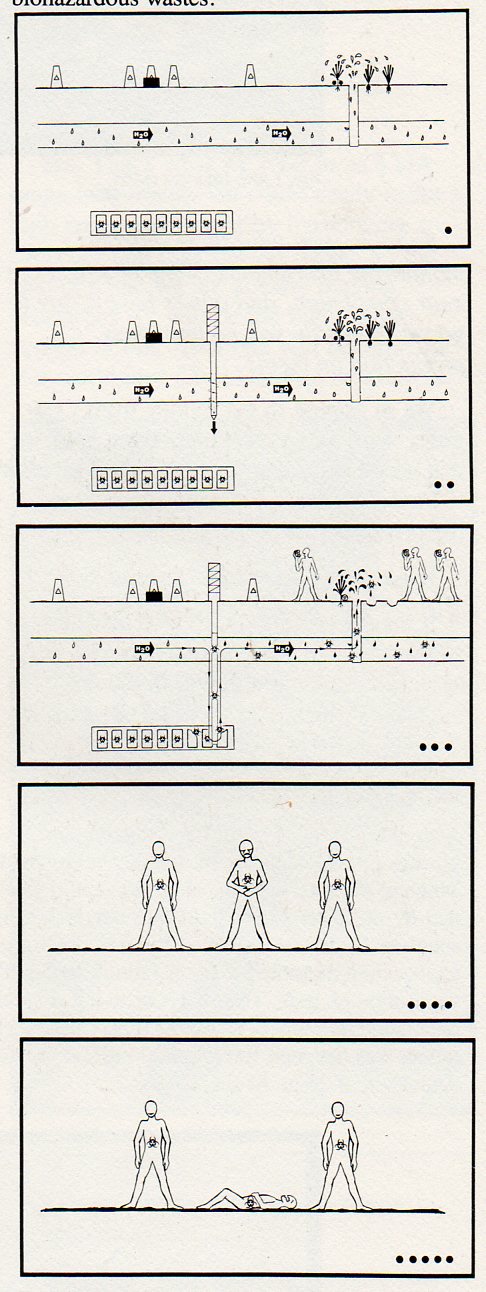
    The sign basically says that if you drill at this spot (to some unspecified depth) through aquifer or underground stream or water source or something that some point you may reach the biohazard nasty, which will then get into the water supply and into humans, which will then kill them.

    The sign was designed for 10,000 years hence, and depended upon pictures to convey the message rather than words (except for H20, and the biohazard symbol).  Of course the radioactive nastiness will be there for millions of years, which would be an entirely different story in terms of imaging.  Perhaps. 

    The one thing the design of the pictograph has in its favor is that it is read top to bottom–no language on Earth (so far as I know) is read bottom to top, though there are many differences in reading right-left/left-right.  Beyond that, the pictograph stumbles over itself–except for the last two images, which may or may not tell someone that something bad is happening. 

    There are plenty of time capsules and idea-vehicles to the future–I’m saddened that this was seen to be one of the essentials that we would pass on to our future selves.

    Notes:

    1. Reducing the Likelihood of Future Human Activities That Could Affect Geologic High-Level Waste Repositories (Technical Report prepared for Office of Nuclear Waste Isolation, Battelle Memorial Institute; BMI/ONWI-537; May 1984)

    2. “Present society’s responsibility is to dispose of radioactive wastes in a manner that is safe, is environmentally acceptable, and does not require long-term maintenance or surveillance. This ground rule is consistent with the objectives in the U.S. Department of Energy.”Reducing…, page 2.

    The pictograph, explained,  pp 115-116 from Reducing….

    The pictograph…was developed using the concepts and guidelines discussed by Givens (1981). The objective is to convey to the reader the sense that if the area below the markers is disturbed, toxic substances will enter the ground water and lead t o severe consequences. relies on several visual images acting in concert to relay the message.

    The ground surface exhibits peripheral markers and a central monument to denote relevance to the site where those markers and monument exist.

    The ground-water system is indicated by water-drop shapes and by the chemical symbol for water (the only departure from icons, used as a redundant measure).

    A repository far below the surface is depicted with the biohazardous symbol. The fact that the object portrayed below the surface is a repository may not be at all evident to a future reader from the first frame; however, the movement of the dark material from the repository through the aquifer and into the vegetables in the third frame, coupled with the movement of the biohazardous symbol, should imply the burial of biohazardous materials below the surface.

    The pictographic sequence exaggerates reality with regard to the rapidity of contaminant transport and uptake, and with regard to the severity of the consequences. However, exaggeration is necessary because both the clarity and the relevance of the message may suffer if.the pictograph attempts to indicate contaminant transport time of thousands of years. Similarly, the consequence portrayed, a painful death, over-exaggerates the cause-effect relationship and the rate of the individual’s demise (one out of three suffer death in the pictograph, whereas a
    to chance would be more representative).

  • Strange Things in the Sky Department: Tetrahedra, Horse & Steamship Balloons, Swimming Pools & Exploding Moons.

    JF Ptak Science Books  Post 1120

    Rounding out the image dump from yesterday are these additions to the developing category “Strange Things in the Sky”.  The odd things in today’s issue include floating tetrahedra, an exploding Moon, a hovering anti-gravity Dr. Seuss pool, a Russian rocket pioneer’s enormous apartment building-like dirigible, and a steamship balloon.

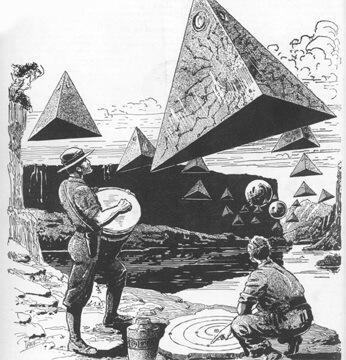
    The first, without any explanation and offered as a pure art form, is this illustration by Frank R. Paul for Wonder Stories of November 1931.


    Strange things in sky--tetra

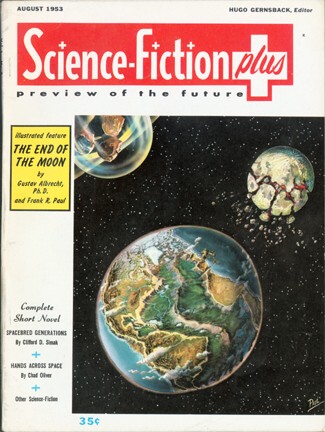
    Next, another Paul cover for Science Fiction Plus for August 1953, illustrating a story where the Moon explodes

    Moon exploded

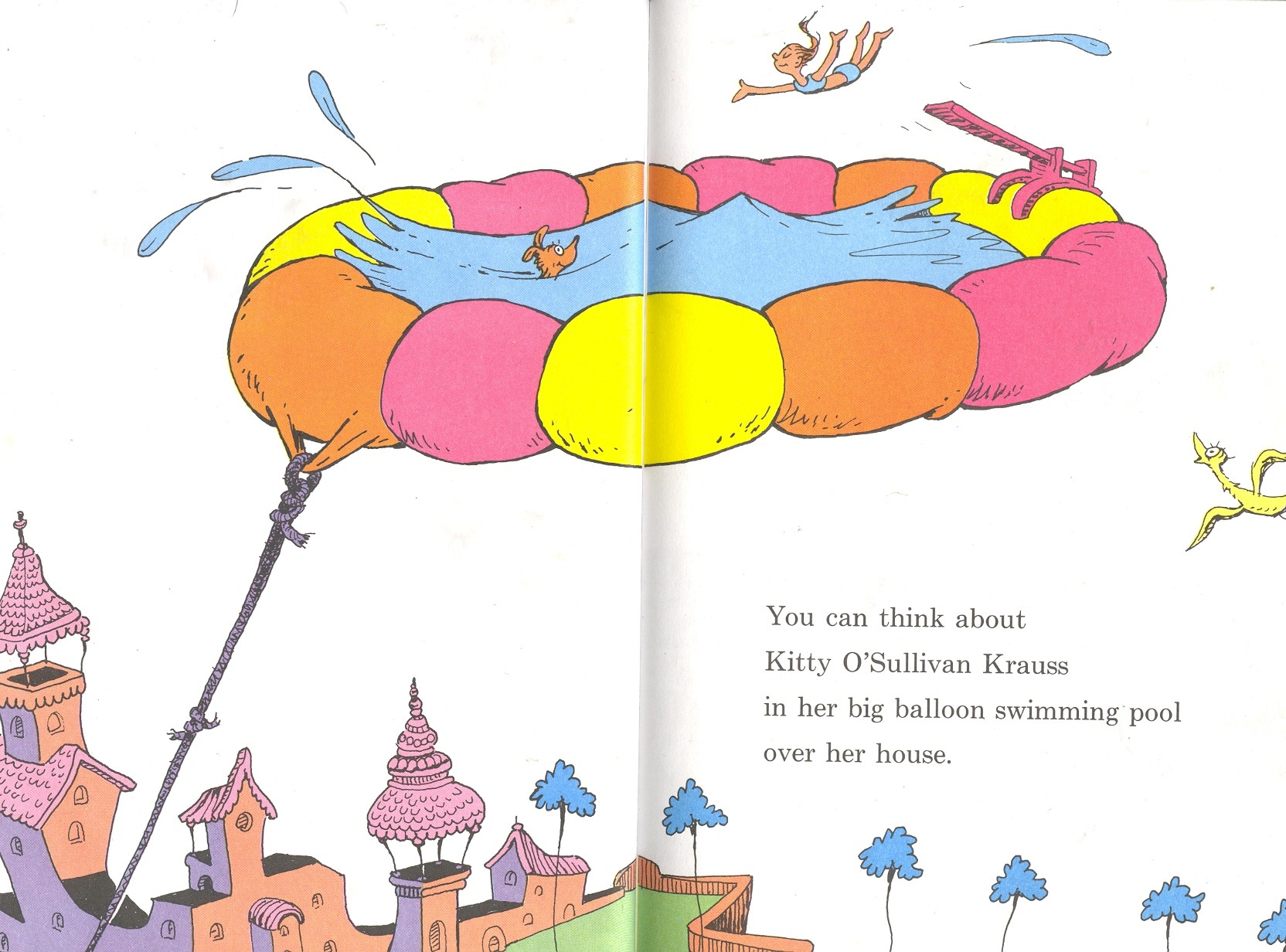
    Other strangeness in the sky is  Dr. Seuss’ swimming balloon pool from his Oh, the Thinks you can Think. .  I’ve seen some interesting
    images of balloons and dirigibles taken as serious efforts that reminded me of
    that double-page spread by the good Doctor.

    Blog jan 2 seuss


    Blog jan 2 tsilo dirig  

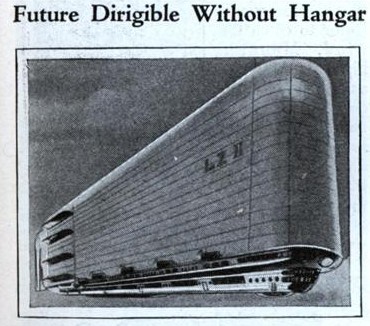
    This may have been the Omega end
    of bad ideas in the career of Zilkowsky, who is better known by the other
    spelling of his name, Konstantin
    Eduardovich Tsiolkovsky (1857-1835), a Russian misanthrope and space pioneering
    genius who wrote more than 500 works on rocketry and exploration including what
    is arguably the first tech word ever done in the field (in 1903,
    The
    Exploration of Cosmic Space by Means of Reaction Devices
    ). Tsiolkovsky somehow lasted through purges
    and Stalinist tirades, while few of his colleagues did—many mysteriously
    disappeared, while others went to prison and disappeared there.  (Stalin’s crude and insatiable blood lust,
    perhaps the worst of the century, knew no bounds, not even to the scientists
    who could conceivably hand him reigns of rocket/missile-propelled power.)  Anyway, Tsiolkovsky’s dirigible was composed
    of a collapsible metal so that the aircraft could form its own hangar when “docked”.  I don’t know where to begin with this one…

    Blog jan 2 lowe

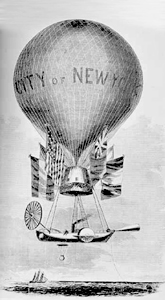
    The next entry is the ship-balloon of Thaddeus Lowe
    (1832-1913) One of Lowe’s great contributions in the
    history of ballooning was providing aerial reconnaissance via (panoramic)
    photographs to the Union army on Confederate army positions—particularly the
    Rebel positions at Richmond (1864) and Fredericksburg (1862). (He had a wide
    span of professional interests and wound up living the high life in L.A. in a half-acre
    home.)  This 130-foot diameter monster
    with a steam-ship escape pod (named The
    City of New York
    and then renamed The
    Great Western
    after the city couldn’t supply enough gas to get the thing
    inflated) was intended to be a transatlantic traveler.  Ready to try this fantastic adventure in
    1860, ready to take charge, ready to begin a very problematic trip across the
    Atlantic in a balloon, Lowe, seemingly ready, had his balloon ripped apart
    while waiting for launching by a chance and not-horrible wind.  Lucky for Lowe and the Union Army, this didn’t
    happen over the ocean somewhere out of reach, and the North’s important info-gatherer
    did not sink like a stone in the cold dark sea. 
    (I’m very cynical that the 100-foot-long, bulbously heavy steam-powered “life
    boat” would’ve landed right-side-up and softly enough to have been of any use
    save for providing some floaty bits that survivors from the balloon could’ve
    clung to for a while before being consumed by King Neptune.  

    Blogsept19_horses_in_flight607

    Lastly for today is this lovely history
    of balloon and aeroplane flight published in The Illustrated London News
    for 3 July 1909, called “The Evolution of the Great War-ships of the
    Air:  Balloons, Non-Dirigible and Dirigible, and Aeroplanes, from the
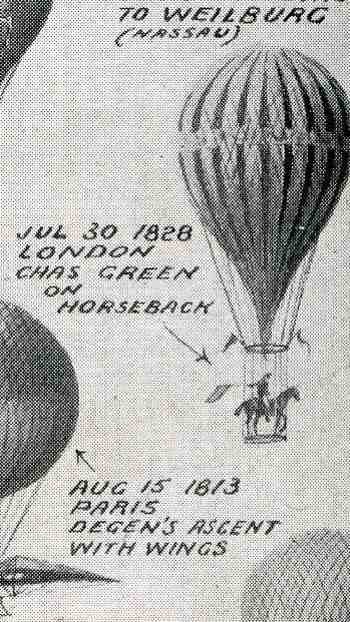
    Seventeenth Century to the Twentieth Century”.  It is more fully explained here in an earlier post I made to this blog, laboring the point that 8% of the 60 air vehicles involved a horse. 


  • Shadowlands in the History of Technology–the Sewing Machine, ca. 1838

    JF Ptak Science Books  Post 1088

    The anniversaries of two famous legal cases bumped me into thinking about the shadows of what things might be.  Aticus Finch (from To Kill a Mockingbird) and Thomas Scopes (of the “Scopes Trial”, the famous or infamous “Monkey Trial”) celebrated their 50th and 85th anniversaries (respectively) this past week.  Finch the lawyer lost his case, and Scopes, the defendant, lost his as well. 

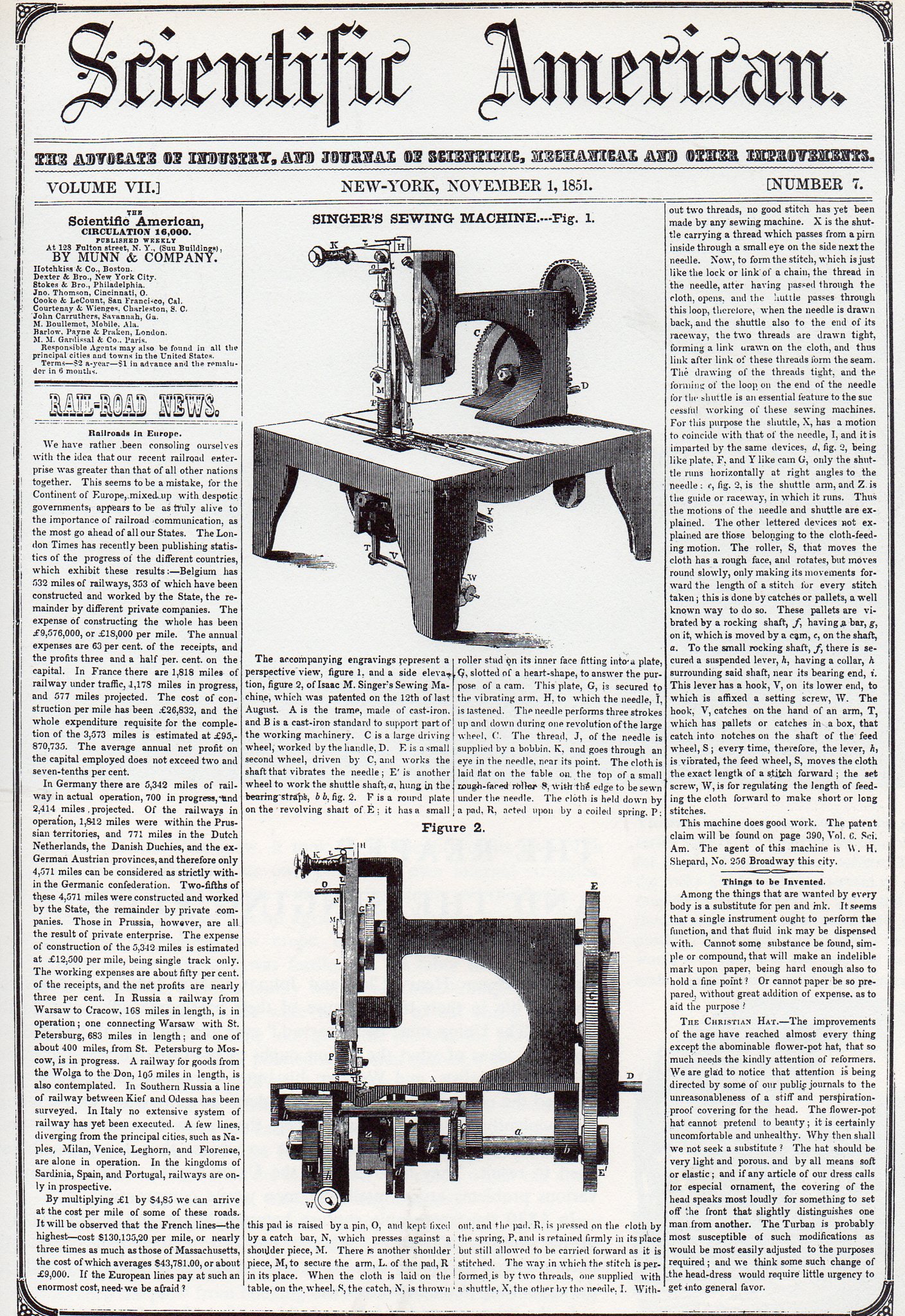
    This reminded me of the shadowland stories of roads not taken, or illustrious events whose outcomes didn’t quite coincide with the fame and interest of the way  things started out.One example from Shadowlands that springs to mind is that of the sewing machine, and the case of William Hunt.  Hunt was a remarkable person, an inventor of ingenious and remarkable things, some ubiquitous–and of these, one good example is the safety pin.  The “could’ve been” part was the sewing machine.  Eight years or so before the battle for precedence and patent began between Isaac Singer and Elias Howe began, Hunt had arrived at the principle solutions for an automatic sewing machine.  

    Sewing machine211 He decided not to seek a patent for the machine. Now, in and of itself, this is not terrifically uncommon in the history of invention.  As a matter of fact Thomas Jefferson, the inventor of the standard American moldboard plow (tinkering with it from the 1780s to the 18-teens), did not seek a patent for his invention. By 1814 he came closer to the iconic and revolutionary plow by producing his in iron.  The steel, self scouring plow would take another two decades to be introduced by John Deere. (Decades latter Abraham Lincoln would apply for and receive a patent for a boat/buoy lifting device, making him the only president to ever receive a patent.)

    The reason that Hunt didn’t pursue his sewing machine was based in deep morality–he chose not to patent the thing so that this new advancement in technology would not make seamstresses obsolete, pushing them out of work and costing them their jobs.  Of course the machine was introduced a few years later by Singer and Howe, and then the rest is history–just about every invention is going to annoy somebody.

    But the irony here is that even though Mr. Hunt chose the high road out of the sewing machine quagmire, saving the jobs of seamstresses for another few years, he didn’t have any moral hesitations about his next invention–an improvement to a steel-cased cartridge for rifles.  Evidently he was more comfortable with killing machines than he was with protecting the jobs of the working/suffering classes. 


  • The Road to the Economic Abyss: Visual Display of Quantitative Data, 1909

    JF Ptak Science Books  Post 1084

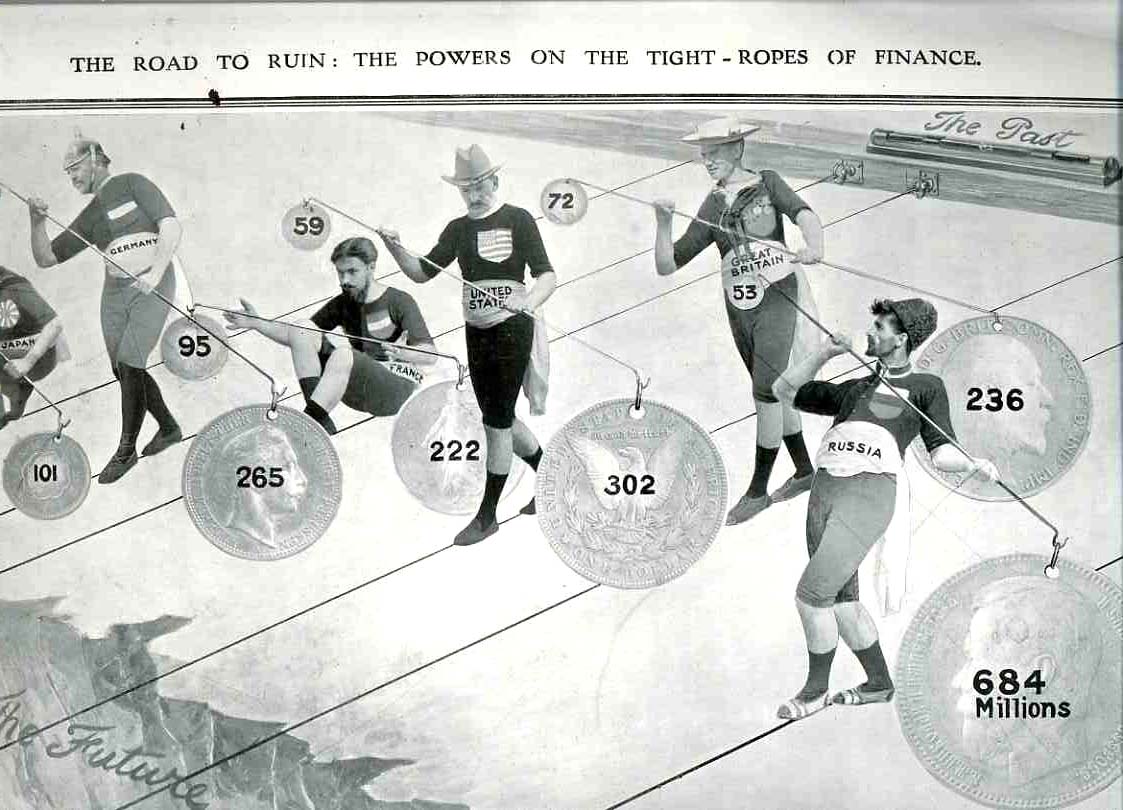
    The road to ruin is one of the oldest roads known to humanity; and, come to think of it, it was probably a road before roads existed, just an idea waiting for something concrete to show up and claim for its metaphor.  But certainly ever since the creation of money came (1) the need to have more, (2) the need to get it, in some fashion and (3) the possibility of losing it (though not necessarily in this order).  This image from the 4 September 1909 issue of The Illustrated London News is one in a long, ancient series of appreciating the way to financial doom, although this one happens to be a relatively early attempt at showing this idea via popular metaphor in the visual display.  And its pretty effective, too.
    00-blog-Oct 27 economic road to ruin938


  • Churchill’s Bunker and the Baker Street Irregulars, June 1940

    JF Ptak Science Books  (Image Post)

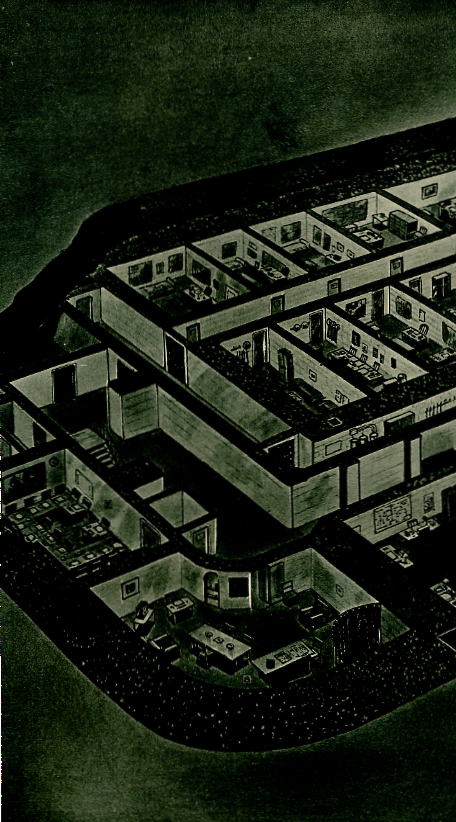
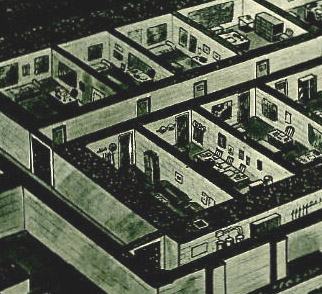
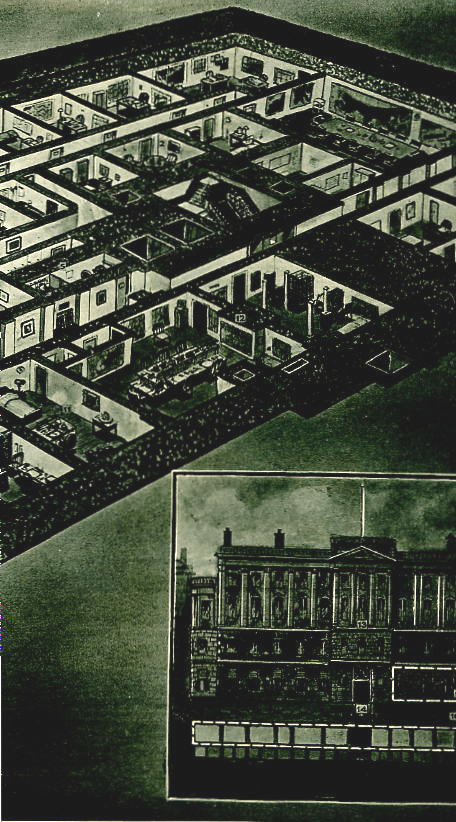
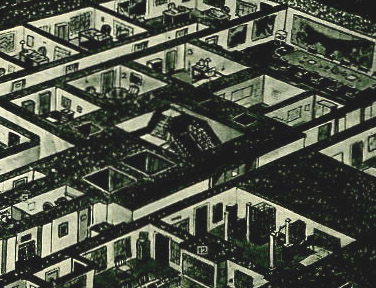
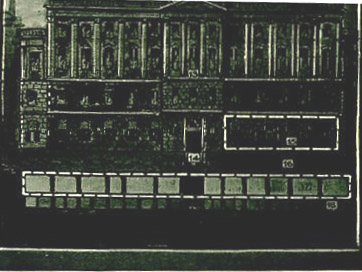
    I had intended to write a full post on this schematic of Churchill’s war-time bunker–about a possible future that never came to be–but it has escaped me, though, the I just couldn’t let go of the date–(June 14) now late–for the formation of the second part of the title of this short post.  (I guess it will become an entry later on in a life-in-the-ground series.) But I thought at least to publish the images of where–the war was fought–and especially, where the Battle of Britain was waged in the middle and later months of 1940–rather than about the other underground war (or warriors) were getting ready to fight an entirely different sort of war.  I’m referring to the Auxilliers, the “Scallywags”, fighters in the league of “ungentlemanly warfare”, the 6,000 or so guerrilla fighters who were being readied to fight the Nazis for the Battle of Britain on British soil by a means other than direct military engagement.  Major Colin McVean Gubbins was in charge of this operation (the Special Operations Executive), and he sought people “who knew the forests, the woods, the mines, the
    old dosed shafts, the hills, the moors, the glens–people who know their
    local stuff”, people who wouldn’t be found, in order to produce a devastating and terminal underground fighting force. Interestingly the headquarters for the SOE was moved by September 1940 to 64 Baker Street, thus giving the folks there the nickname of the “Baker Street Irregulars”.

    I should point out that the SOE was very active in different theatres for  the vast part of the war–I’m just concentrating now on what could’ve been their operations in the U.K.

    These were the fighters who led calm lives during the day who would hen turn into fighters by night who would do absolutely anything to fight the Nazi invading force.  But that’s another story (and ably told by John Warwicker in Churchill’s Underground Army). I’ve bumped into other stories of what the British were planning to do in the face of Nazi invasion and occupation–there was of course stockpiling of materiel and intelligence in removed locations, digging bunkers, readying boobytraps, and so on,  but also aggressive scorched earth plans that involved flooding, sinking part of the Navy, destroying munitions, and so forth: desperate things, heroic measures, to fight to the last. And I absolutely believe that Brits would’ve done every bit of that, fought to the very last possible end and effort, every person doing what was expected of them. 

    File1109 

    File1109 det 2

    File1110 

    File1110 det

     File1112


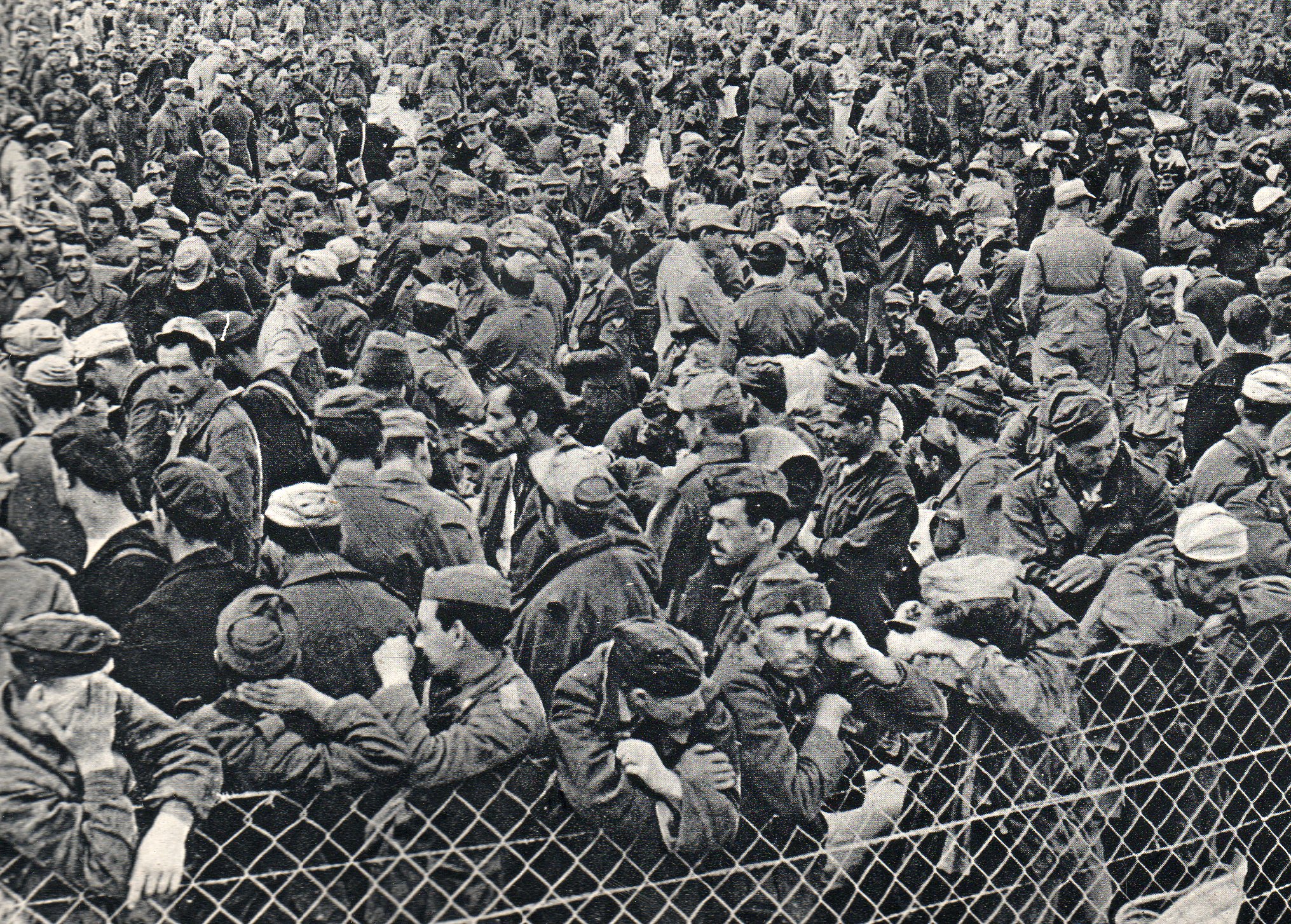
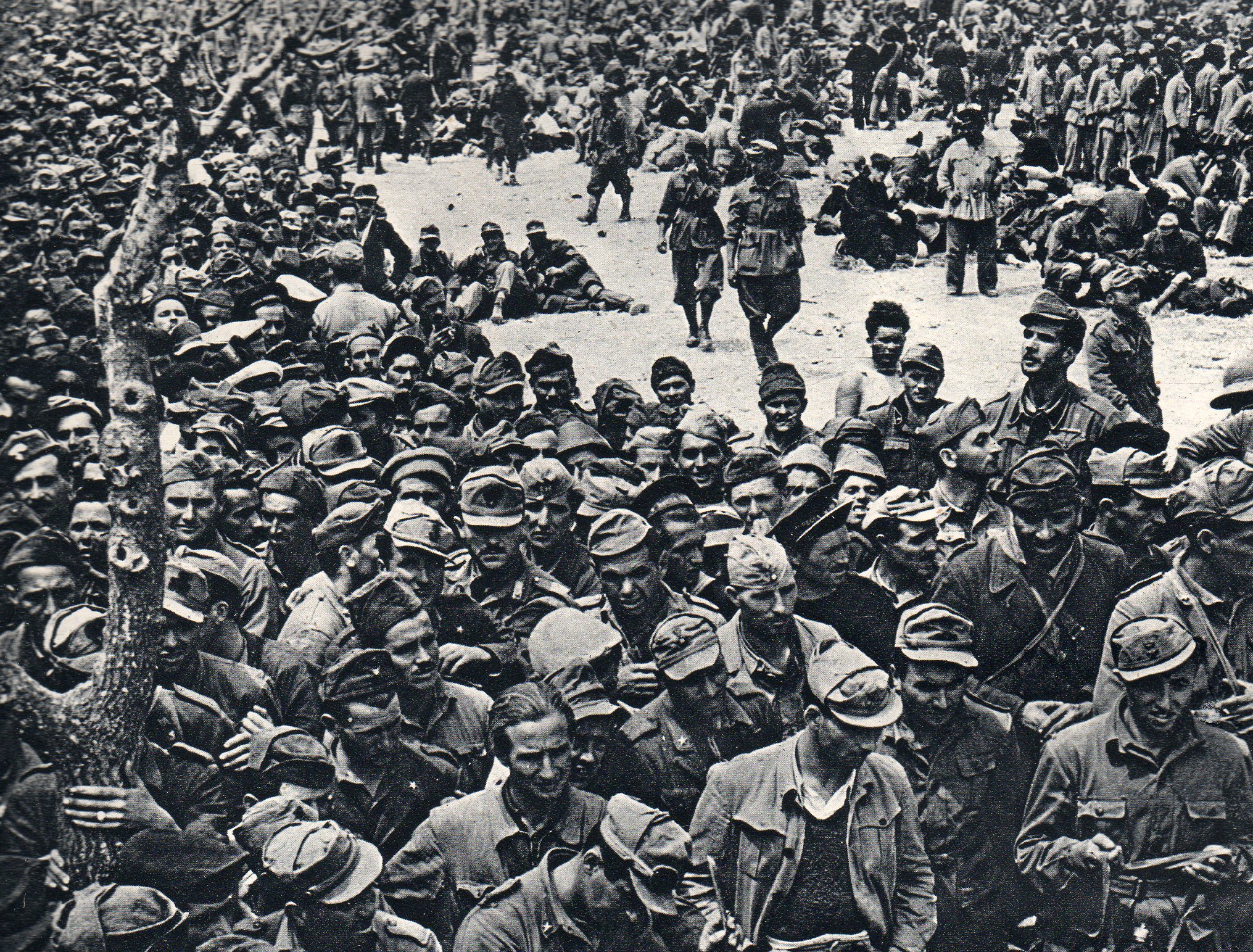
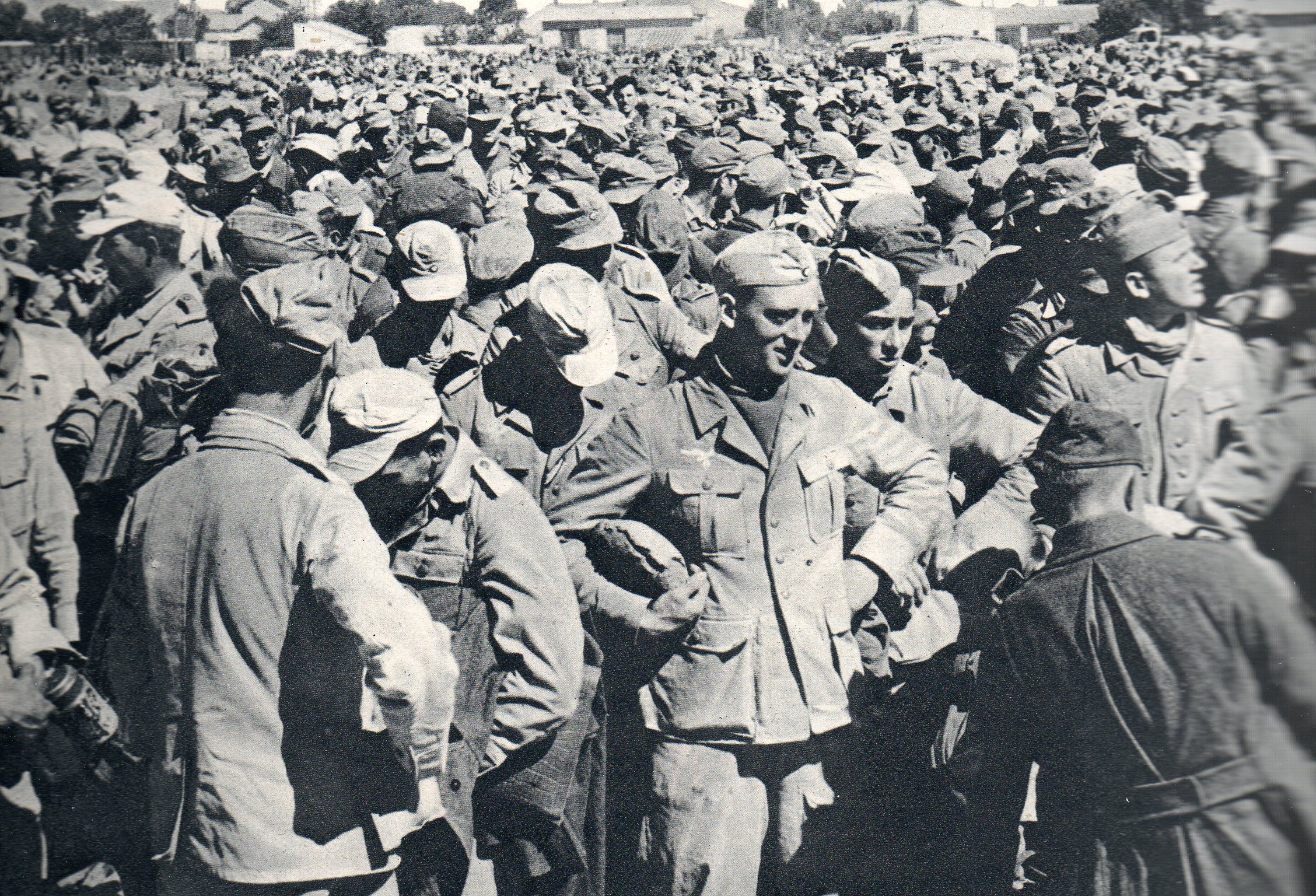
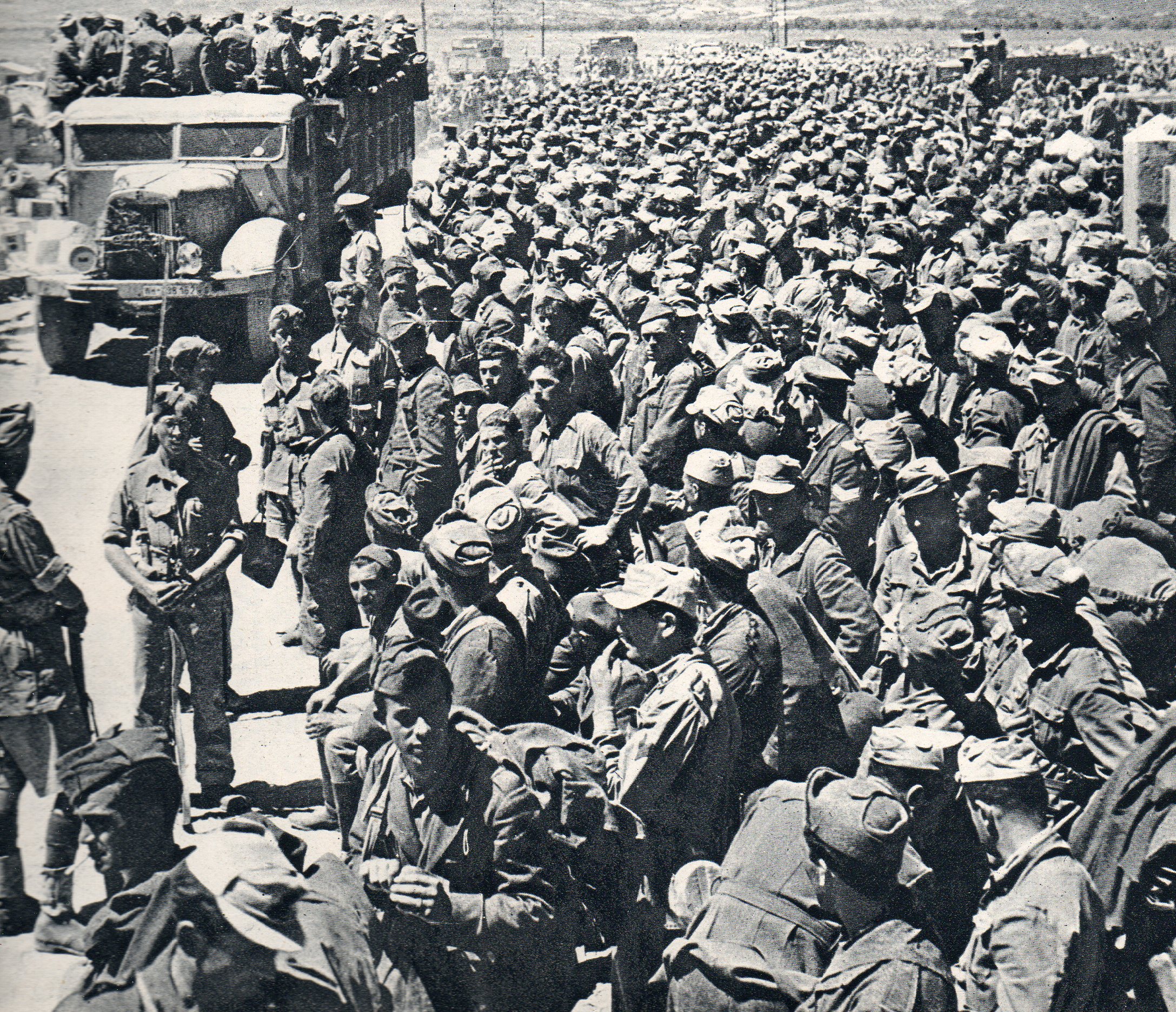
  • Relief in Capture: Churchill in Carthage and what 230,000 POWs Looks Like

    JF Ptak Science Books   Post 1046

    [Continuing my series on Crowds–see here for example of WWI German prisoners in crowds; also search “crowds” in the google site search at left.]

    Part of the campaign in North Africa during WWII was decided by a series of battles known as the Battle of Tunisia, or the Tunisia Campaign, fought from November 1942 to May 1943.  It was a long endgame for the Axis forces in Africa, Hitler losing hundreds of thousands of men, vast amounts of materiel, crapped out the Luftwaffe, spent tons 000 crowds tunisia 1018

    of oil, all in an effort that seemed to be a foregone conclusion save for the fighting.  It was not possible for the Germans (and Italians) to survive there, let alone win, given the great superiority of numbers and resources controlled by the Allies. Plus of course there was the whole Ultra Secret thing, which–though necessarily unknown to the Germans-–in great measure helped to deliver the North African victory.  The Allies were destined to win.

    000 crowds tunisia 2019
    000 crowds tunisia 3020

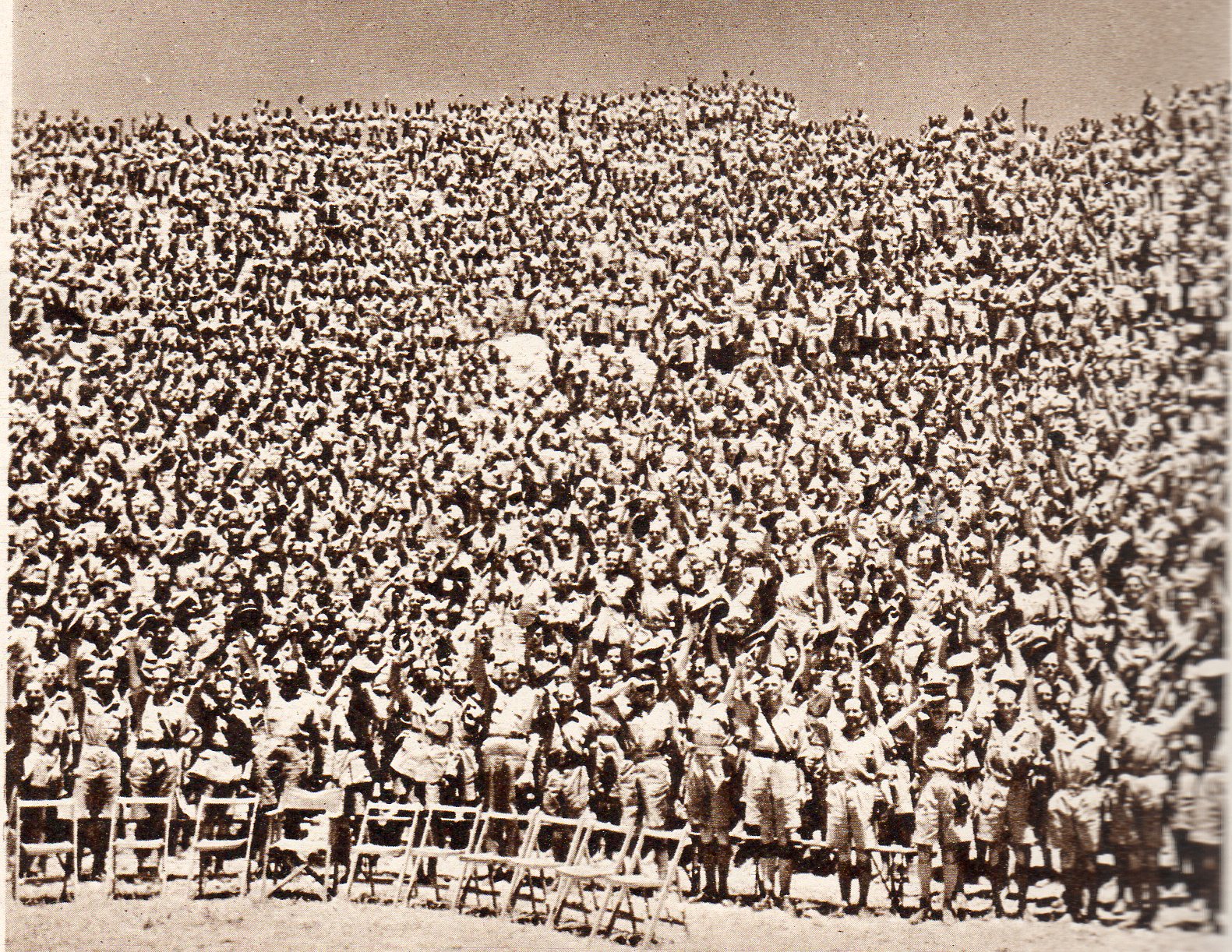
    And in the last picture we see a far different crowd–the victorious Allies waiting on Winston Churchill to speak to them in an amphitheater in the ancient city of Carthage, just down the road a piece from Tunis.  Carthage has seen it fair share of winners and losers of the centuries (or the millenia), what with the Phoenicians and Hannibal and the Punic Wars and Roman conquest and rebuilding and on and on.  The amphitheaters of Carthage were renowned–great structures for what was perhaps the greatest metropolis of North Africa–bu they suffered from defeat as well, their fine fittings and metal and ornate sculpture looted with successive control. When Churchill rolled in there in 1943, there was little left to the structure save for the stone.

    The stone, and all of those victorious soldiers.
    And Mr. Churchill, of course.
    000 crowds tunisia 4021

    The result of this series of battles ended up in May, these pictures showing what defeat looked like to 230,000 German and Italian prisoners, though the vast majority were German.  Its really a curious display of facial expressions in the  many dozens of details that can be lifted from these mass portraits. I’ll make an semi-reasonable statement–nobody really likes/wants to be taken prisoner in war, though I guess time and place and circumstance are factors that can loosen up that observation.  (Germans were much more interested in being captured by the Allies as they fled westward in Berlin and the rest of the country as the Soviets began making their own way towards the heart of Germany, for example.) Perhaps what looks like an element of relief in the close-ups of these prisoners really was that; that their time in the desert was simply expended, and that the prospect of their surviving the war had just been decided, positively.

    [Brits raising their helmets at Carthage, waiting for Mr. Churchill.)

    000 crowds tunisia brits022

    ·Posted by :

    ·in:

    —

  • Rubber Fabulosity, Continued: Rubber Joy of 1947

    JF Ptak Science Books  Post 1045

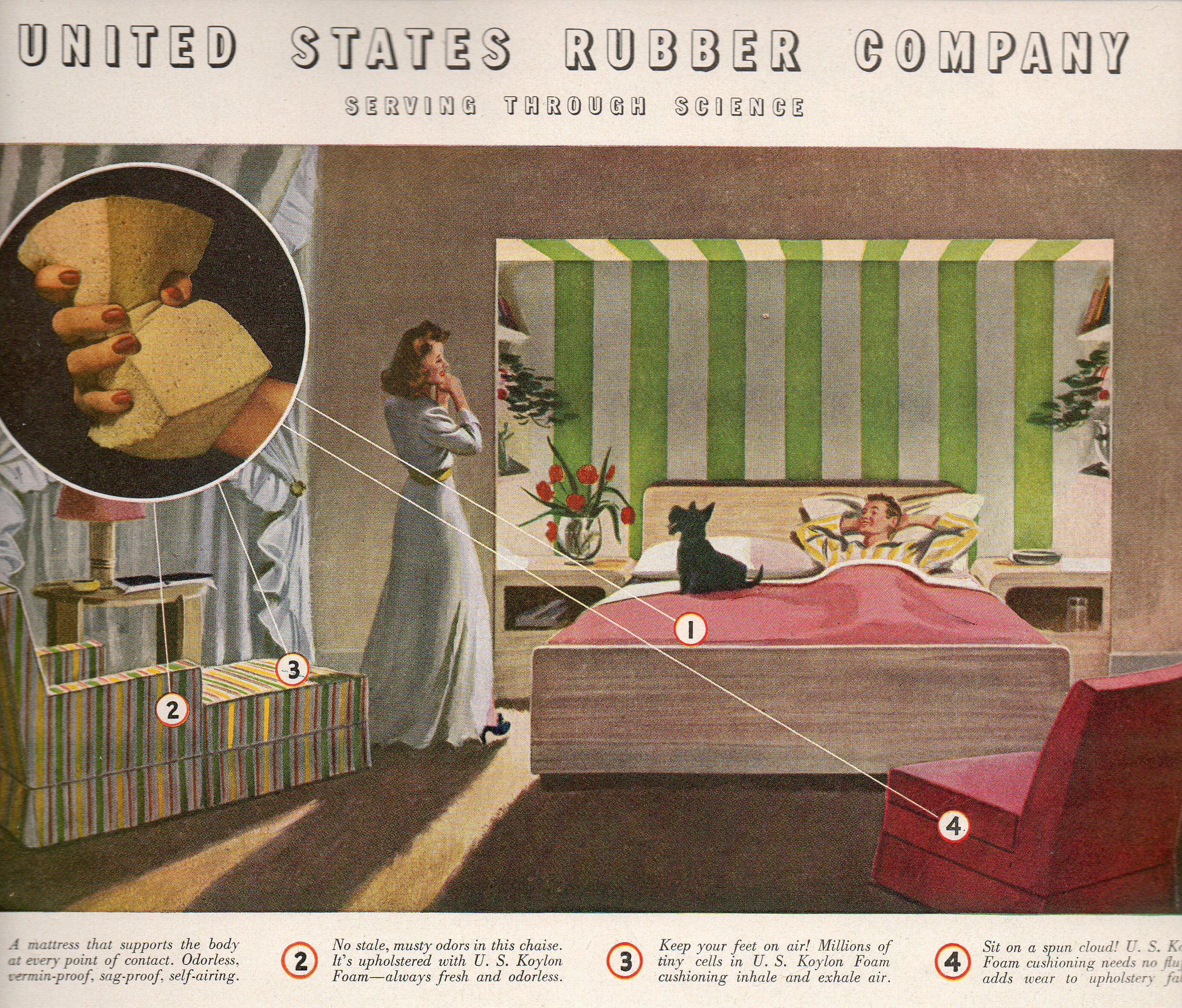
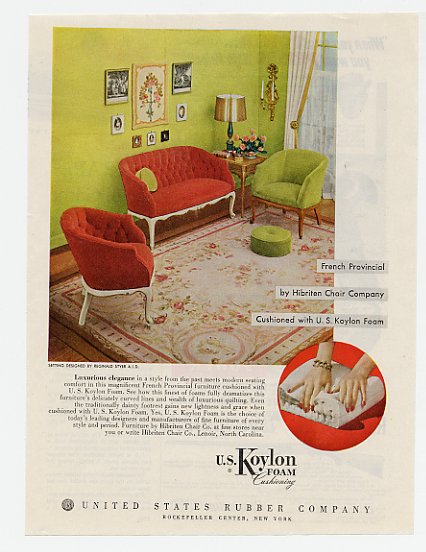
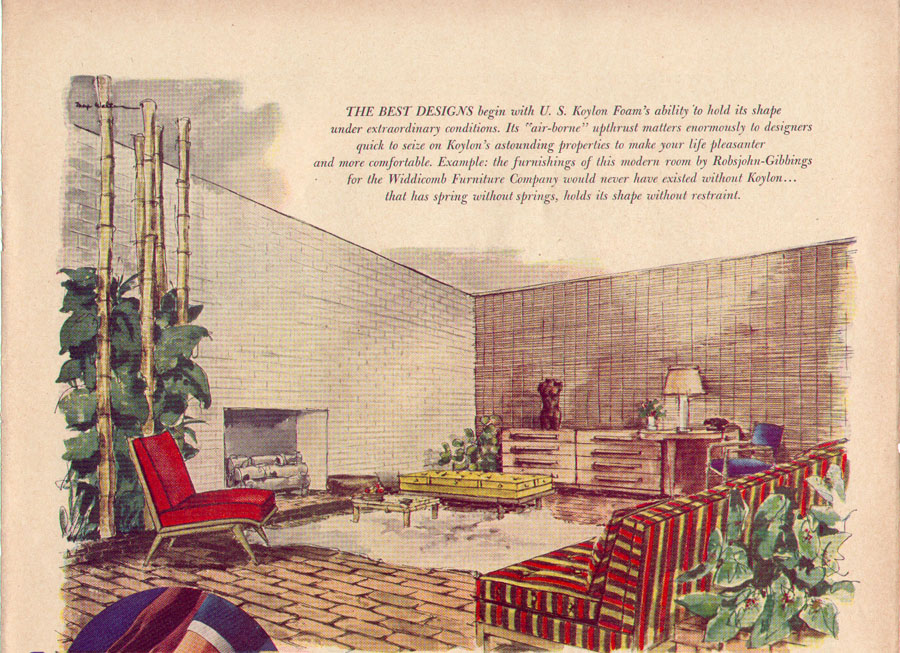
    In 1947 the American course of empire evidently led  directly to a rubber-sheeted bed on rubber mattresses surrounded by spectator chairs made of rubber.  Rubber here and rubber there, all brought to you by the United States Rubber Company1 and their foam rubber product star, Koylon, whisking everyone into their spongey, foamy future..  All of this seems a little other-worldly, from the massive window treatments to inset bed to the color combinations to the weirdly-drawn woman making her way to an improbably-depicted double (rubber) bed.  Perhaps nothing spelled “comfort” more indignantly than the possibility of hosing down your bedroom every morning. 

    It all looks a little scary to me, perhaps more for the lady (what is she holding behind her head?) than for the unexpected color usage.

    (Have a look too at an earlier post here, “There Was A Rubber Lady in a Rubber Kitchen in a Rubber House…”)

    Notes

    1. The  U.S. Rubber Company was one of the original twelve companies listed by Charles Dow in the very first iteration of the Dow Industrial Averages (26 May 1896).  USRC became Uniroyal in 1961.

    000 rubber LIFE016

    000 rubber room 2

    000 rubber one


  • Overstated Understatement: on the Future of Television

    JF Ptak Science Books Post 1024
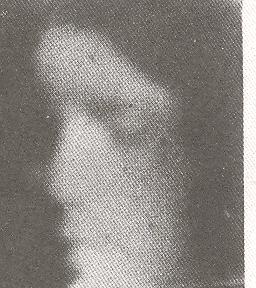
    1--may 10 philo det good
    [I’ve written a number of posts on understatement here on this blog; two dozen or so will pop up when you put “understatement” in the google site search at left.]*

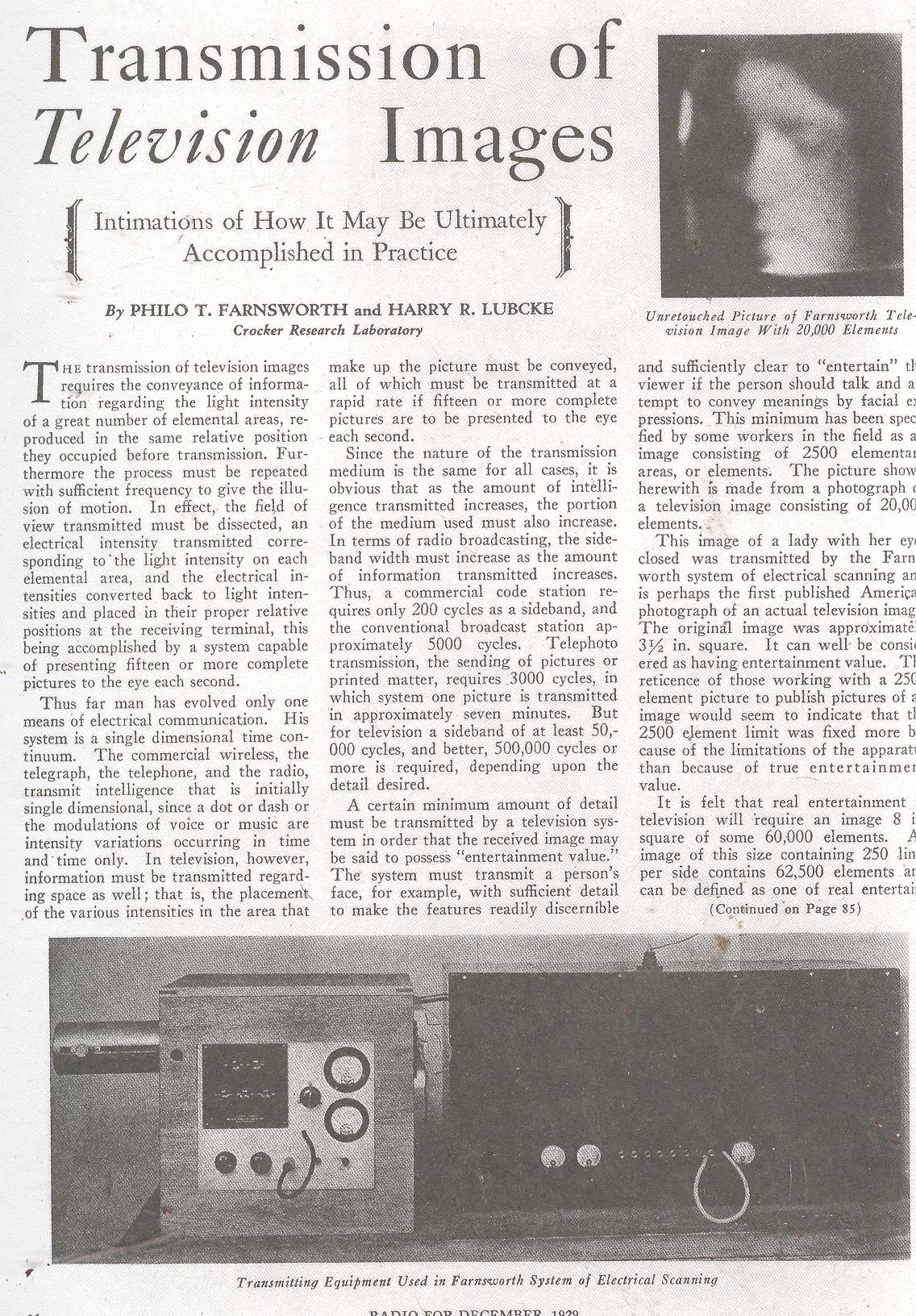
    Philo T. Farnsworth (1906-1971) may have had the best name among the earliest inventors of electronic1 television, but he didn’t necessarily have the best invention, this in spite of the fact that it is he who is remembered and counted as the technical inventor of the medium.  But that’s the way it goes, sometimes; sometimes it goes that way.  Farnsworth2 also had the better back-story: he was a teenager, brilliant of course, working out in the comparative middle-of-nowhere with little bits of money here and there from local investors.  On the other side of the coin was Vladimir Zworykin3 (1888-1982) who invented a cathode ray tube system for transmitting and receiving televised images, and who had the enormous financial support of Westinghouse (and then, later,  RCA).  Farnsworth was first off the boat, but Zworykin is the one whose work became the industry standard.         

    But the understatement is what attracts me here, and it occurs in the December 1929 issue of Radio magazine in which he reports on his successful first demonstration of his device to the general public.  I can’t tell if he was being very deliberate in his understatement or if was simply a staccato expression by a very young engineer with not-great writing abilities–I think that it was the later, really, as the statement is sandwiched in an odd, non-congruent section of its paragraph.

    1--may 10 philo

    In the article, Farnsworth also publishes the first (?) photograph of the first televised image, and states:

    “This image of a lady with her eyes closed was transmitted by the Farnsworth system of electrical scanning and is perhaps the first published American photograph of an actual television  image. The original image was approximately 3 ½ in. square. It can well be considered as having entertainment value. The reticence of those working with a 2500 element limit was fixed more because of the limitations of the apparatus than because of true entertainment value.”

    I do think that Farnsworth was in a hurry to get to the end of the article.  Later on he did try to capitalize in a major way on his invention and its distribution, but things didn’t work out so well. 
    Notes:
    * Some other great understatements in the history of science and technology include:

    -the Wright  brothers’ telegram to their father on the successful flight at Kitty Hawk, telling him to “inform Press” [sic], and misspelling Orville (“Orvelle”)

    –the announcement of the invention of the telephone, giving Mr. Bell a scant 200-word mention in the London-based journal Nature.

    –the alpha and omega element of the severe understatement of George Gamow on discovering the background radiation of the Big Bang.

    –and the atomic bomb/nuclear Armageddon bit from the National Emergency Planning Council:  ( “Because of recent changes in the technology and potential tempo of war and because of the base power of force is in being (including equipment and supplies), there is general recognition that any future war in which the United States is engaged, especially if it is an unlimited nuclear war, may be decided without significant additional military demands upon the nation’s industrial economy.” Hmm. He continues: “That is not to say, however, that the post-attack economy would not face enormous logistical support problems.” There is no human element of this equation. “The logistic requirements of survival and recovery would present very heavy demands.”)

    1. Early on there were mechanical approaches to the invention of television.                                             

    2. He was the inventor of the first functional all-electronic  image pickup device (the so-called “image dissector”) and also provided the first television system.  He was also the first to display his functioning systerm to the general public. He also started to work on replacing the mechanical-option television with electronics in 1921 at the age of 14.

    3. Zworykin’s first patent for his idea,”Television Systems”, was filed on December 29, 1923.