JF Ptak Science Books LLC Post 152
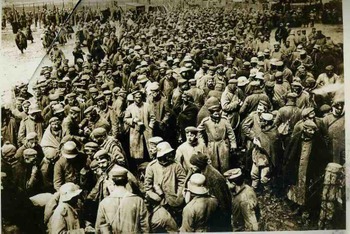
This image comes from a collection here of First World War news service photographs, showing German prisoners being readied for transport home, and dated 20 November 1918. This group had evidently surrendered just before the armistice was signed, and was sent directly and instantly to a staging area for transport back to the Fatherland. The way that many newspapers obtained the war images that they published in their papers was via a semi-centralized pool of war images. The newspaper would request, say, a photo of German prisoners, and would contact one of these photographic agencies—in this particular case, it was the Central News Photo Service of 26-28 Beaver Street, NYC—and purchase the rights for republication, and then print it in the newspaper along with the story. In almost every case the photo would be accompanied by a caption mimeographed onto an attached piece of cheap paper, and in this case it reads: “Waiting to Return Home/a photo just received showing a batch of enemy troops who surrendered just before the signing of the armistice, joyously discussing the coming of peace and the opportunity of returning home to their families.”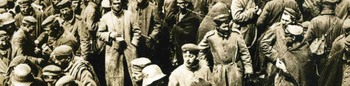
I seriously doubt that the copy editor could read the minds of either the photographer or the troops in the photo. I would imagine that they were definitely joyous about going home ALIVE to their families, but when looking really closely at the picture the thing that seems to dominate the actions of the people is food. Or cigarettes. But mostly when looking hard at the faces in the photo, the men just look tired. 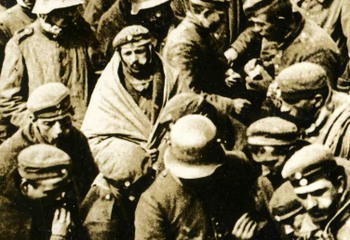
Looking very closely at these types of images has always been fascinating; look close enough, under high magnification, and the large photo becomes composed of dozens of smaller photos. The whole is an assemblage of vignettes, each in themselves a work of art.
Continuing in a more odd tone, I’m also reasonably convinced that after looking at hundreds of faces in a photo like this that you’ll find a picture of yourself.
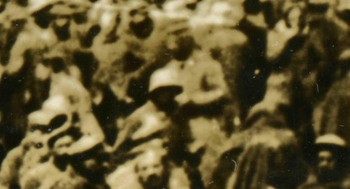
I did. This section is a 3200 dpi scan of a 15×10 mm section, and I am undoubtedly and unquestionably the bald bearded man (one of the few people in the image without a hat) at center-bottom.