A Daily History of Holes, Dots, Lines, Science, History, Math, Physics, Art, the Unintentional Absurd, Architecture, Maps, Data Visualization, Blank and Missing Things, and so on. |1.6 million words, 7500 images, 4.9 million hits| Press & appearances in The Times, Le Figaro, Mensa, The Economist, The Guardian, Discovery News, Slate, Le Monde, Sci American Blogs, Le Pont, and many other places… 5000+ total posts since 2008.

Category: History of the Future

  • The Starship Enterprise, 1929

    JF Ptak Science Books,  Quick Post

    Starhip enterprisew 1929049

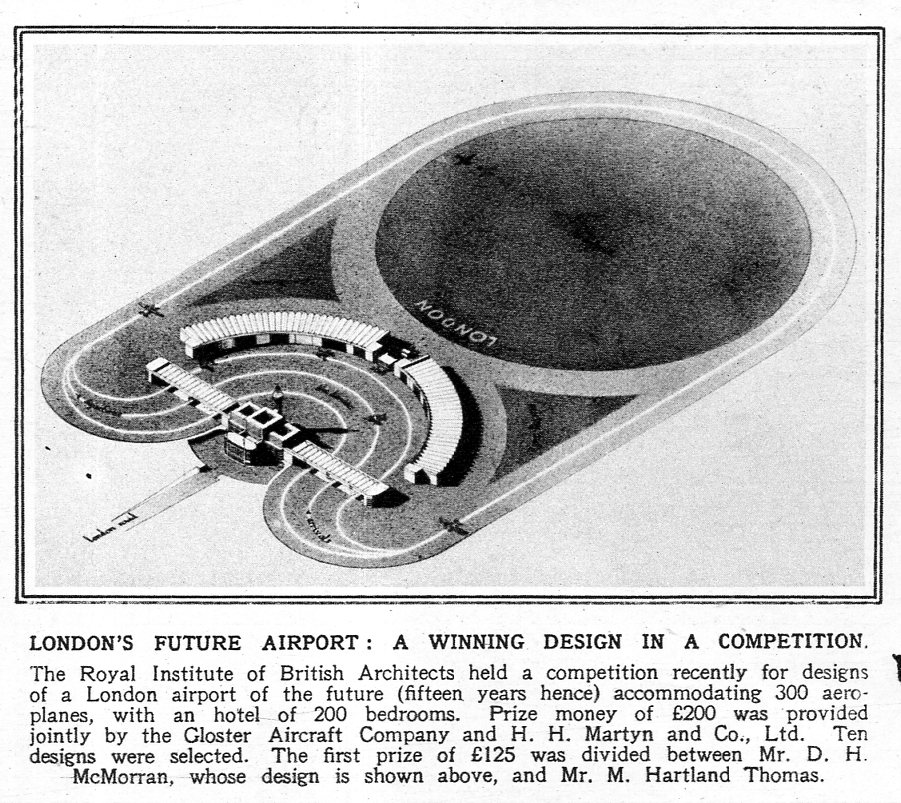
    I wonder if this design had anything to do with Captains Kirk’s/Picard’s great and lovely ship, the USS Enterprise?  It seems as though it is of a singular inspiration, this futuristic airport of London’s futuristic future, designed by Mr. D.H. McMorran.  Mr. Matt Jeffries, the man who design the Enterprise for Star Trek, was certainly alive at the time (1921-2003), though it seems a slim chance that the Illustrated London News for February 2, 1929 (in which this thumbnail image appeared) would have found its way to his boyhood hands in Lebanon, Pennsylvania.  More likely for his engineering/design muse is the electric range heating coil, which seems to be the standard story of where the design originated. Still, this airport design does bear a striking resemblance to the Starship.  

    StoveCoil1

    And just in case, here it is:

    Star trek uss enterprise 1920x1080 wallpaper_www.wallpapermay.com_50


  • Another Rooftop Airport/Helipad, 1945

    JF Ptak Science Books   Quick Post

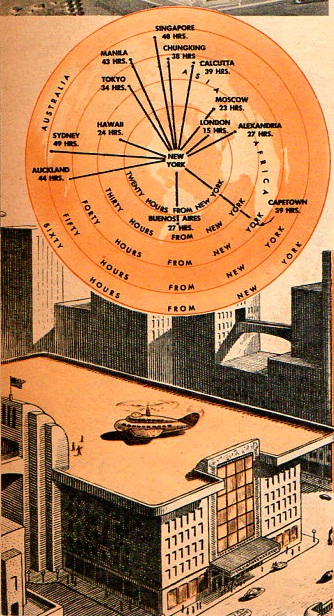
    There have been several posts to this blog regarding unusual airport construction–covering part of the Thames, floating in the NYC bay, on top of numerous/differential rooftops, floating and/or moored in the ocean, on top giant airplanes, landing and launched from dirigibles, and so on (including a vertical airport where the aircraft are dropped in tubes).  The example I have just found this morning is a mild twist on this topic, as it is a helipad–a futuristic one, judging from the Harley Earle/Buck Rogers-style design.  

    See, for example:

    • Floating and Airborne Airports: https://historyofideasblog.com/thesciencebookstore/2015/03/floating-and-airborne-airports.html
    • Underground Airports 1935-1941: https://historyofideasblog.com/thesciencebookstore/2015/04/underground-airports.html
    • Rooftop, Elevated, Floating Inner-City Airports  https://historyofideasblog.com/thesciencebookstore/2010/08/elevated-rooftop-innercity-circular-airports-1919.html

     (There are other examples scattered around the blog–just check out “airports” in the Google search box for more.) 

     There is also a time/distance map of air travel originating from NYC:

    Airport helipad rooftop014

     [Source: Popular Mechanics, February, 1945]


  • Under Under-Statements on the Bomb

    JF Ptak Science Books   Post 2447

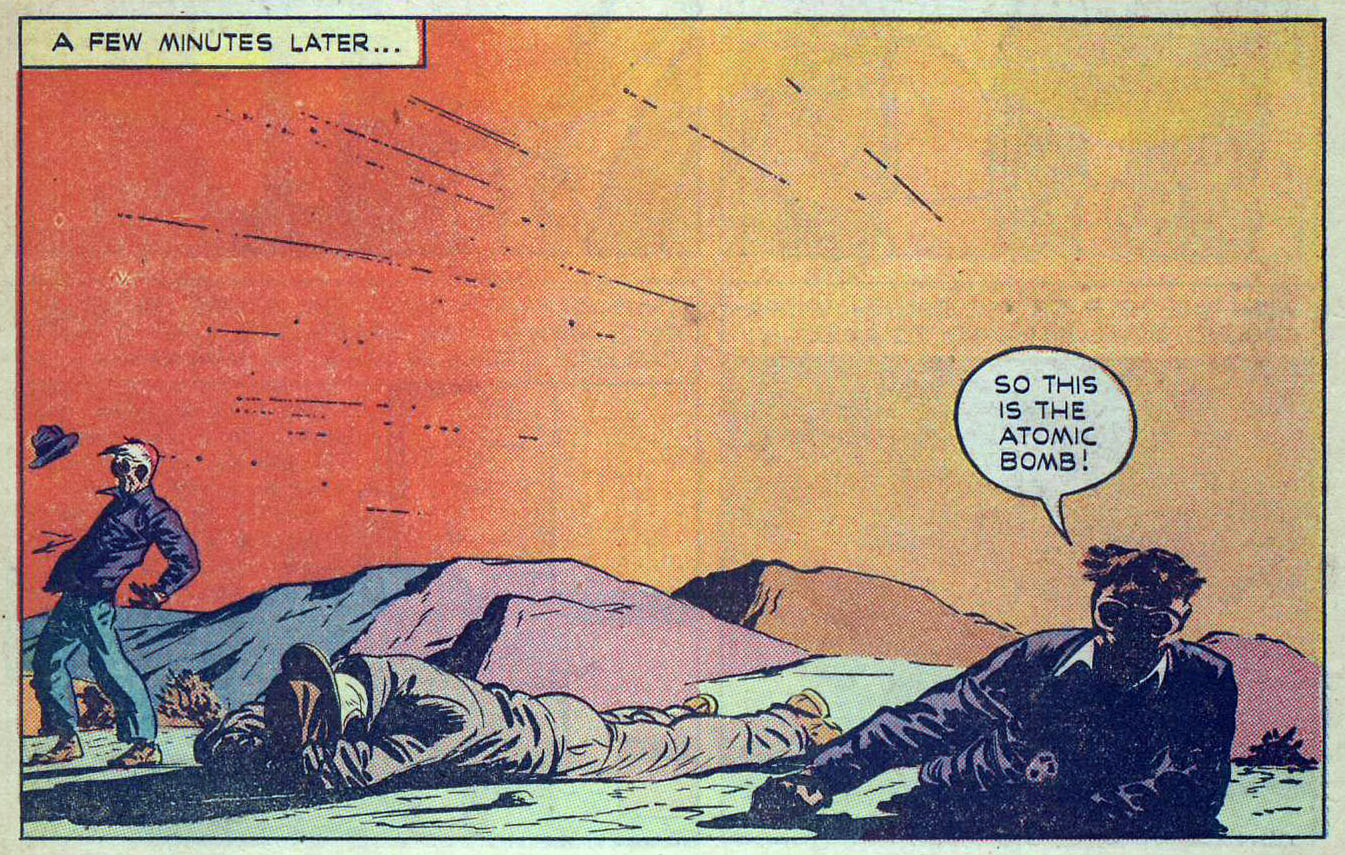
    There’s nothing quite so ironic as understatement when the understatement is understated even in advance of itself.  I’ve noticed this here and there with the depictions of atomic/nuclear war in the bomb’s early history, say 1946-1960, as seen in comic books.  For example, here’s something I posted last week that is a fairly representative understatement done in a small way about a big thing: 

    Atomic_ so this is the atom bomb

    See here.

    It is I think representative of an entire class of mid-century image of atomic understatement.

    Having found this one others were quick to follow. 

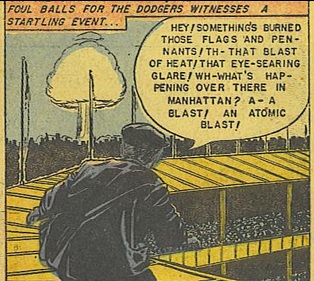
    The comic World War III is a  caustic of advanced crispy-crunchiness, and set in the year 1980, where the future found the Brooklyn Dodgers still playing in NYC.  For some reason, the photographer on the roof of the Polo Grounds takes a slow burn of realization that something big was going on, processing the burned pennants /heat/glare before settling on the enormous mushroom cloud rising four miles above Manhattan… 

    Atomic blast Dodgers game

    [Via the Internet Archive,  full text & lurid illustrations here http://ow.ly/Mqcox ]

    Atomic bomb polo ground

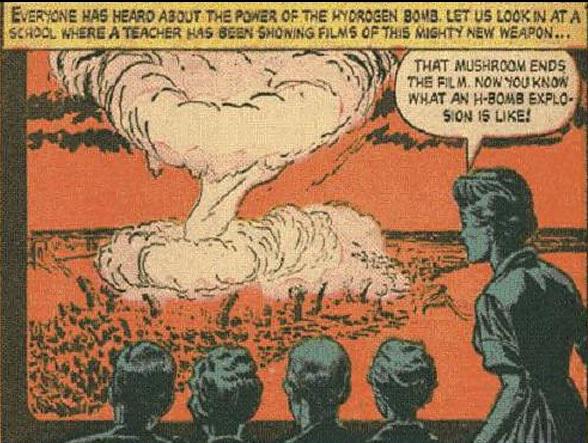
    And another fine example, this graduating to a hydrogen bomb later in the decade, a bomb far more unimaginably powerful than the unimaginably powerful 20kt bombs of 1945. Okay, there are red skies and a firestorm the width of a city, and the “mushroom” ends the film, but there is only a perfunctory statement of the too-close-together heads that they now know what a hydrogen bomb explosion was, or is, or could be:

    Embedded image permalink

    [Source and full text via the Internet Archive,  http://ow.ly/Mqbpw ]

    I know it is difficult to describe the Grand Canyon as it would be to witness a nuclear explosion (let alone be in one).  But these under-nucleated statements is sort of the equivalent of describing the Grand Canyon as something along the lines of “We’re here now and looking down”.  

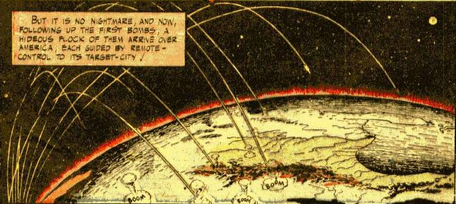
    And this is about as loud as the screaming gets in Capt. Marvel’s adventures with the atomic bomb. This is surprising mainly because the comic was published only about a year after Hiroshima/Nagasaki, and imaging a “flock” of missile launched atomic weapons falling all over the U.S. was a salient look into the possible future.  

    Atomic war capt marvel

    [Source: http://ow.ly/MqlGV] 

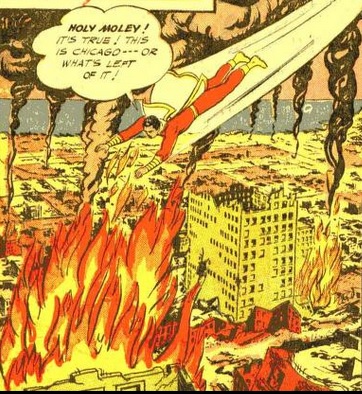
    And in the face of the unspeakable, Capt Marvel seems unflappable:

    Atomic bomb holey moley

    On the other hand there are excitable statements regarding the bomb:

    Atomic bomb from moon

     But it does make one wonder about featuring shock-of-recognition statements about the apocalyptic  bell ringing of nuclear weapons as expressed in comic books as a comparative whisper in the description of the thing.  It is almost as though if the Cornishman spoke quietly enough he wouldn’t make the wakening giant angry.  


  • Underground Airports, 1935-1941

    JF Ptak Science Books  Quick Post

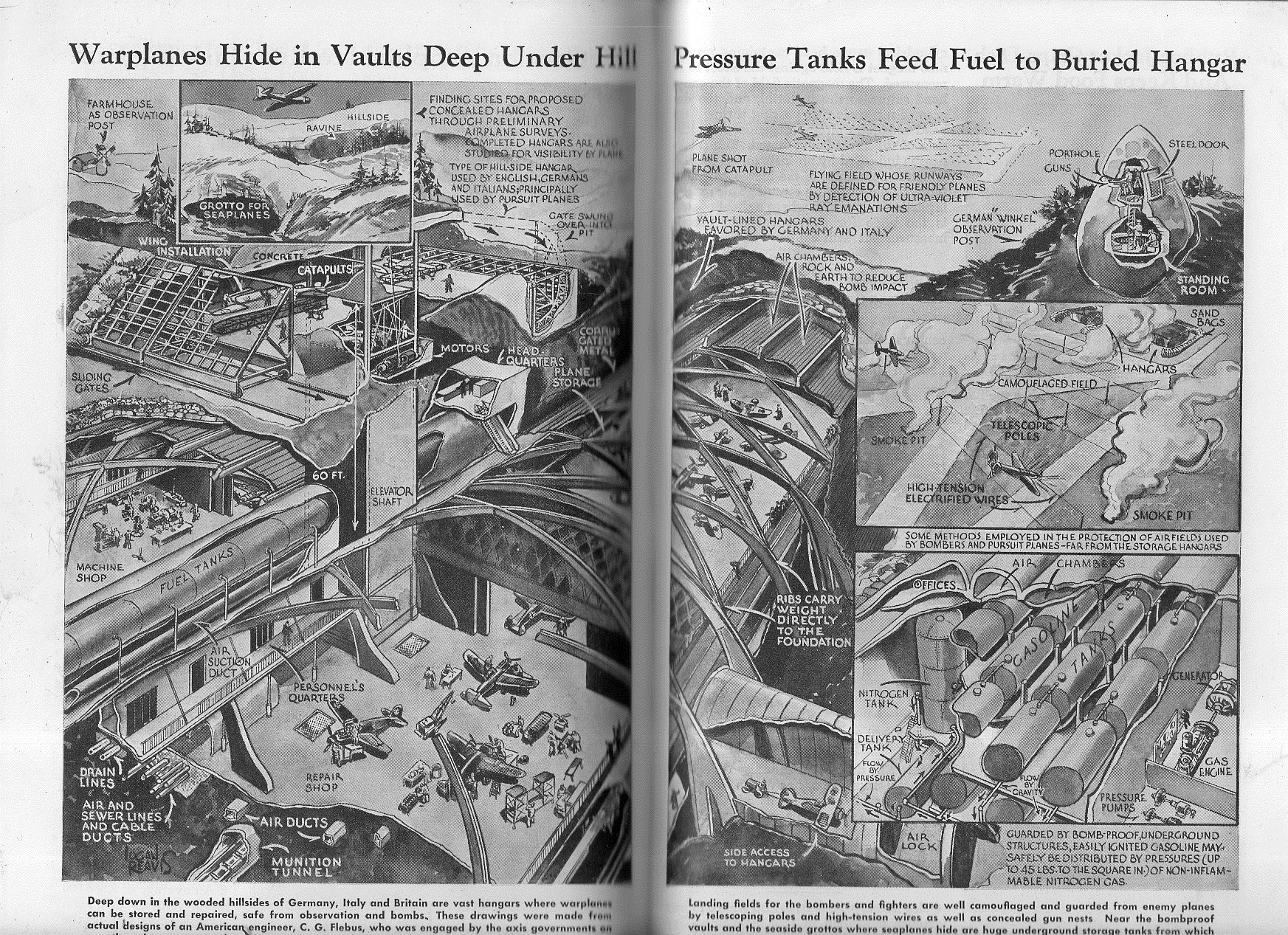
    I’ve seen a number of plans from the 1925-1935 period calling for skyscraper-topped airports, and airports built over a largely cover-ed themes, and over a covered-up Central Park, and floating in NYC harbor, and so on. I have not seen too many future visions of underground airports. This plan appears in Popular Mechanics for June 1941 and advocates a very tightly controlled underground environment for airports.  The war in Europe was nearly two years old at this point, and the bombing war from the air was very advanced. There is little doubt that all sorts of plans were being considered to protect air force complexes from bombing, though something of this scale, dealing with so few number of plans, could hardly have made it further than this public outing.) 

    Cross section under groun air908

    [Image is expandable]

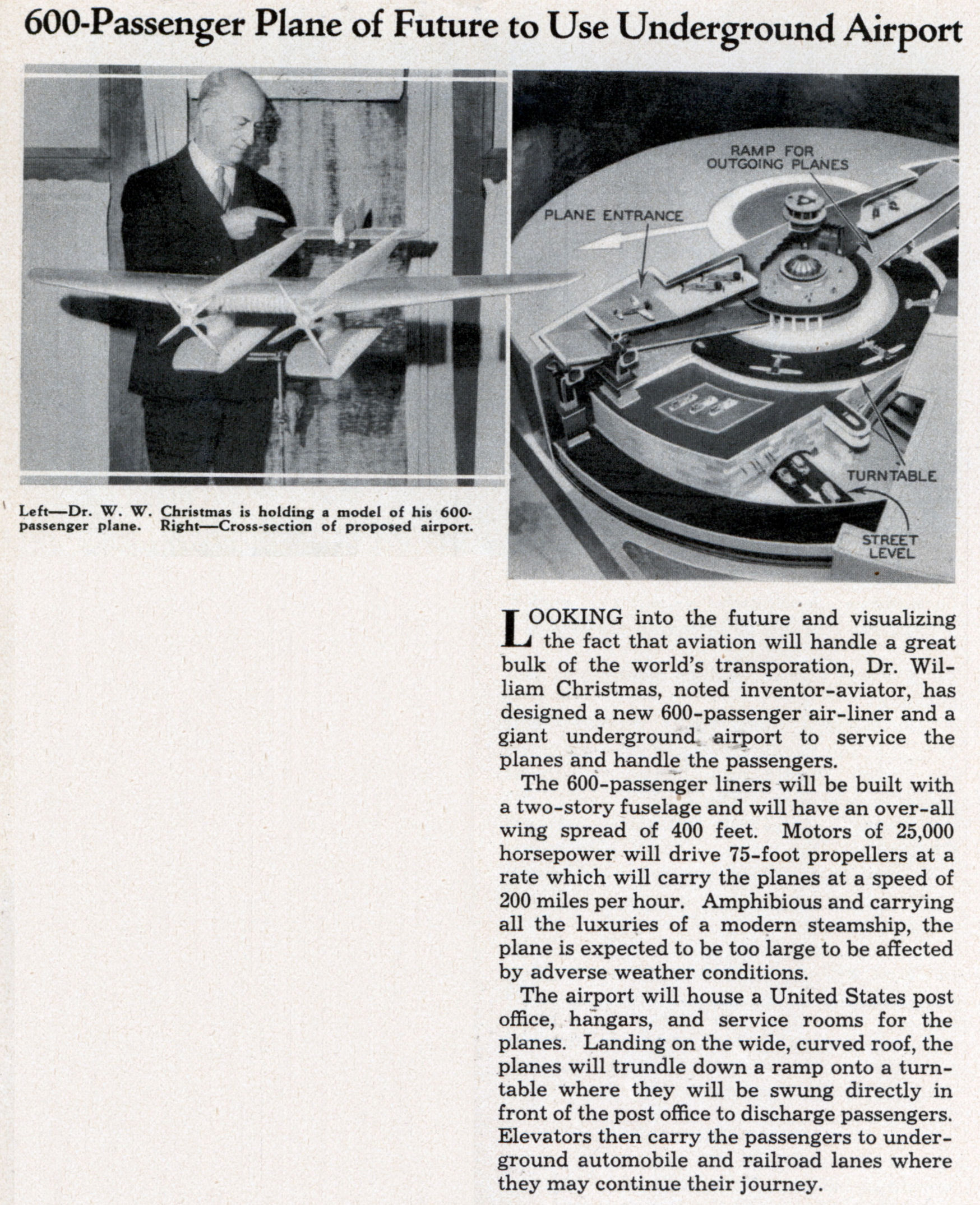
    An earlier and peace-time example of underground tech is found at the great Modern Mechanix blog, and features an April 1935 article in the journal of the same name an effort to remove the airport underground.  Dr. William Christmas is the chief major domo in the piece and he is depicted with his visions of flight of the future,  holding a model of his 400′ 25,000hp plane with 75′ propellers set to cruise at 200 mph.  The monster could not be accommodated by the plans for an underground airport at right, which frankly looks like a hard drive, and which seems like a positively enormous amount of engineering for a spinning platter underground airport with room for eight planes.  

    Underground airport

    [Source:  Modern Mechanix, http://blog.modernmechanix.com/mags/ModernMechanix/4-1935/under_air.jpg]


  • Alphabetical Apocalypse(s): Apocalypse Now and Then

    JF Ptak Science Books   Post 2431

    “Just as psychoanalysis reconstructs the original traumatic situation in order to release the repressed material, so we are now being plunged back into the archaeopsychic past, uncovering the ancient taboos and drives that have been dormant for epochs… Each one of us is as old as the entire biological kingdom, and our bloodstreams are tributaries of the great sea of its total memory.”–The Drowned World, J.G. Ballard, Millennium 1999, p. 41.

    Is there a plural of apocalypse? Is there even a need for one (plural)? There is, of course, even if it is a word that is supposed to spell out the end of times–there can be more than one apocalypse, and they can happen at the same time, although given my very limited knowledge of the scifi genre I don’t know of any books addressing dual/multi-combative apocalypses. (And here I’m not talking about one apocalypse generating all manner of associated badness, but a second, completely unrelated, apocalypse.) 

    So in trying to understand the nature of apocalypse storytelling I decided to make a very abbreviated  overview of a vast literature of the end of times/apocalypse/technocaust/end of the world themes.  This is just a short working list, really, and includes only short stories or novels, and to keep it relatively crisp I’ve chosen the artificial delimiter of an alphabet of apocalypse types.  In many cases there is just one example (where there could be hundreds, so please don’t fault the list for completeness because that would take years of assembly and understanding). The same goes for the categories of apocalypse–I’m certain I not included the majority of them, though I think that this is a good start (There are no movies or television shows listed independent of a text, so Soylent Green will show up but under Harrison’s Make room! Make Room!. I think that tv shows/movies etc  must be enormously outnumbered and the scale of orders of magnitude by the print media.) 

    Evidently this list can be reproduced in the same spirit but with iterations–for example, Juvie Apocalyptic Lit (see here).

    Also–the list is a little heavy with Wells, Chrisopher, Aldiss, Heinlein, and Ballard; this simply because I’m a little familiar with these writers.  So, the list:

    Alien Invasion:  the great initiator, The War of the Worlds 1898, H. G. Wells; The Moon Men 1926, Edgar Rice Burroughs; The Puppet Masters, 1951, Robert A. Heinlein. There were other earlier incarnations of extra-terrestrial visits, especially if you considered religious/mythological aspects, though in literature it was far less common–like Swift’s mathematicians of Laputa and Voltaire’s titans in his Micromegas. For the modern era though it is Wells who seems to create this idea. 


    Apoca war of the worlds Apoca--heinlein puppet
    [Of course this could not possibly be complete by the genre-bender/creator H.G. Wells’ War of the Worlds–Flavorwire has a selection of 15 different covers for this classic best-seller, here.  ]

    Botanical endgame virus destroying all plant life: The Death of Grass by John Christopher.  On the opposite end is  1962 novel Hothouse by Brian Aldiss where the plants take over everything.

    Apoca--aldiss hothouse

    Climate Change: apart from the state of globa;l warming as we know it now, The Drowned World by J.G. Ballard 1962 is perhaps the best and most well-known adventure in this field.. In this book in 2145 solar radiation has shrunk and mostly melted the polar ice caps, which is a lot of water, and has turned most cities into architectural swamplands of vertical mangrove. Conversely Ballard wrote the novel The Drought  in 1964 about all of the water on earth drying up.

    Apoca--ballard drowned world


    ·Posted by :

    ·in:

    — —

  • The Old Bridge’s Future Bridge

    JF Ptak Science Books  Quick Post

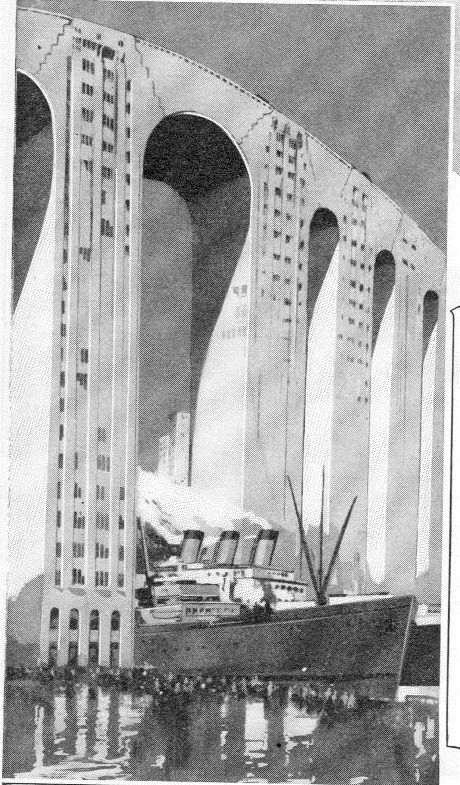
    This view of a future “skyscraper bridge” appeared in the May 1928 volume of Popular Mechanics (volume 48). It is an interesting idea , though very much on the high side, what with the structures being hundreds (500?) of feet high, towering over the shipping lanes. It is an old idea, the new bridge, and it reminds me of a lovely example in the Ponte Vecchio (literally, the “Old Bridge”) of Florence, the recognizable image of it rebuilt in the 14th century. (It was probably designed by the great Taddeo Gaddi (remembered so well in narrative by Vasari and in portraiture by Paolo Uccello.)  There was no Gaddi at work on this bridge, which was set to unite Chicago.  

    Future bridge558

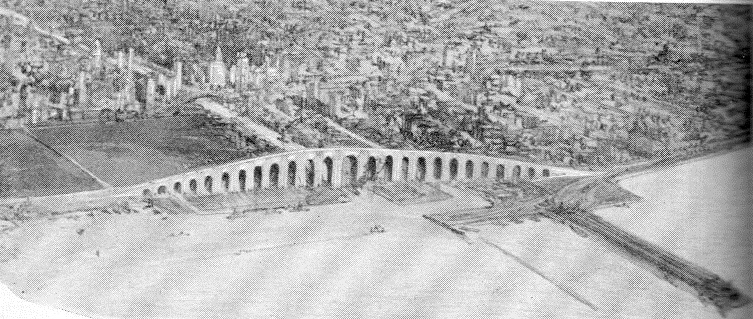
    And the bird’s-eye view of the enormous structure:

    Future bridge559


  • The Future in Blocks and Chunks (1928)

    JF Ptak Science Books   Quick Post

    There have been a few dozen posts on this blog concerning the history of the future, and the present addition

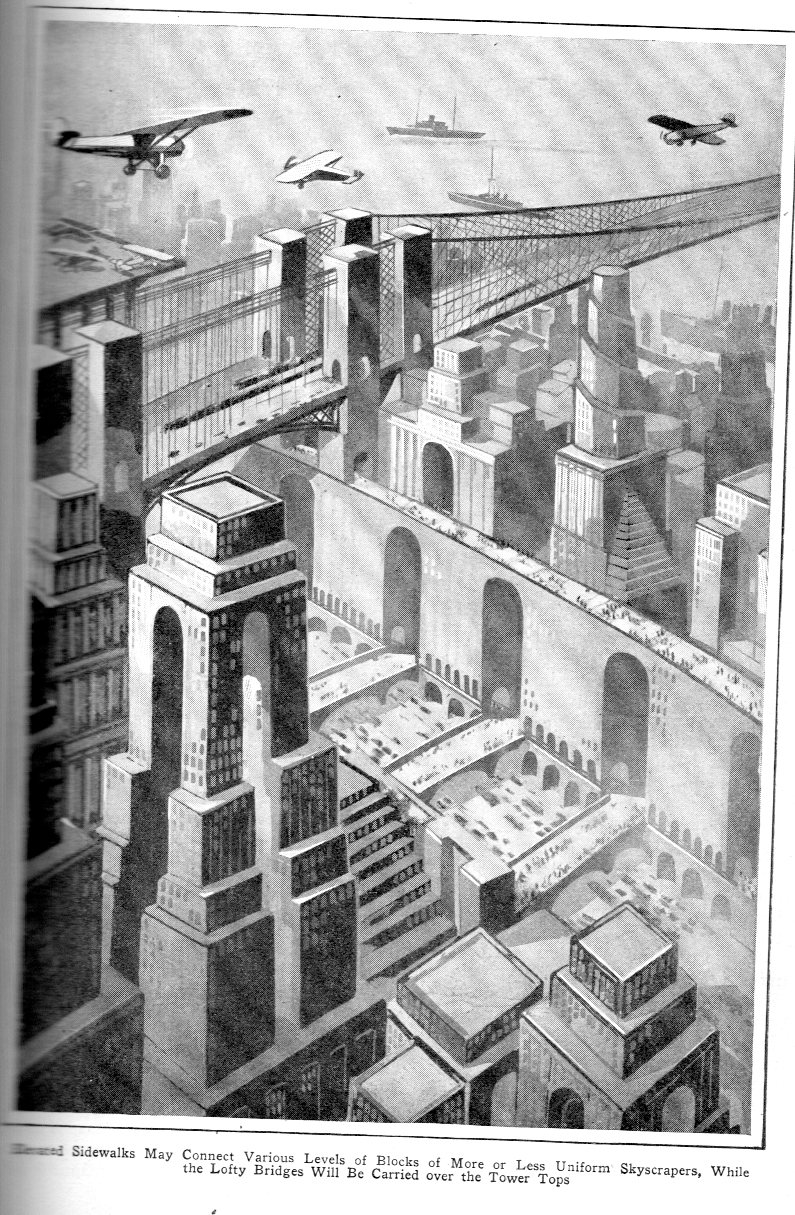
    The near-future of urban living evidently includes a lot of walking space for pedestrians, because in spite of the enormous increase in airplanes and cars and trains and so on, there is still a need for massive construction for folks to walk on.  For example, take a look at this Babylonia-International style cityscape–it is a sort of concretized Craddle of Italo-Fascist Civilization, with lots of space pancaked one on the other, including skyscraper pedestrian bridges:

    Future 1922533

    [Source: Popular Mechanics, January, 1928]

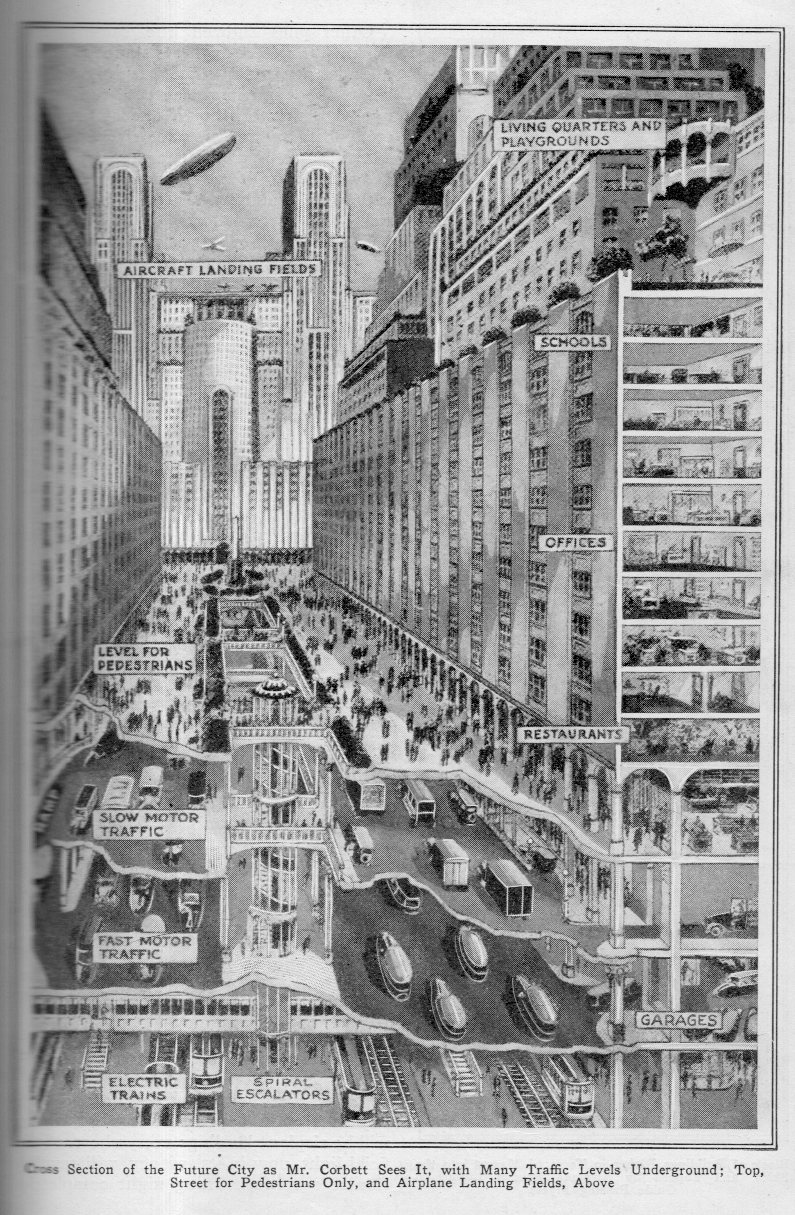
    And further on we see another example of very segmented spaces for the comings-and-goings of urban progress, with people able to mill about on vast rooftop-like structures while the mechanized conveyances take place on three different levels.  One of these levels is above-ground, and two are below: the slow traffic of commerce and delivery is still above ground, though beneath that and segmented again are the fast/slow traffic and buses and trains:

    Future 1922532

    In the massive blocks of buildings is where the other living-of-life things occur–shops and restaurants at bottom, followed by offices , and the above them are the schools, and then finally above all else are apartments and playground. Oh: and atop it all are dirigible airfields.  

    Looks like it would all be pretty dark, to me.  


  • A Picture of the Near-Future: Czechoslovakia, 1938

    JF Ptak Science Books   Quick Post

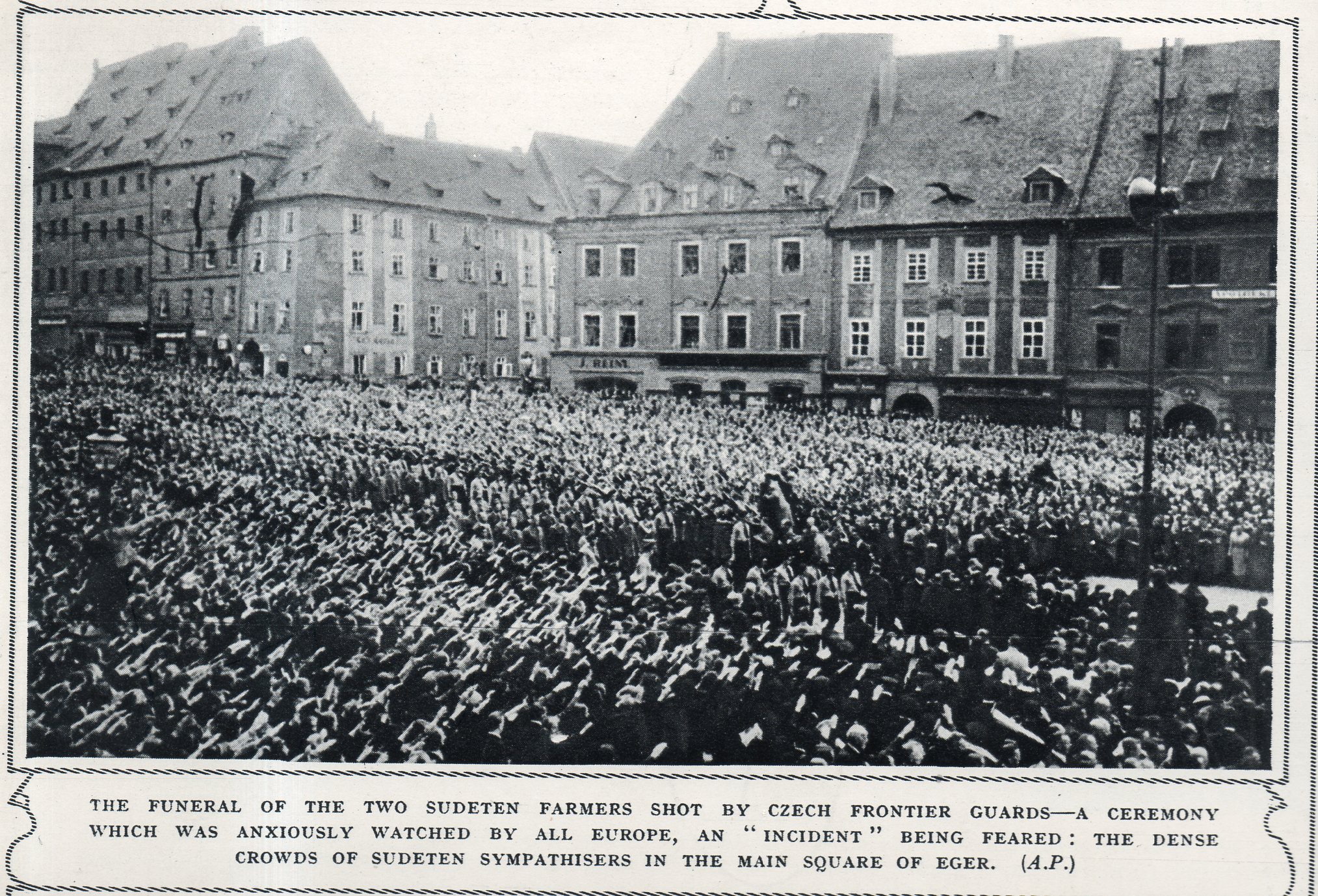
    Czechoslovakia 1938813

    This is a picture of the future–the main square, Eger, Czechoslovakia in June 1938, from the page of the Illustrated London News.  It depicts the massive outpouring for two slain Sudeten farmers, supposedly murdered by Czech border guards. If you look a little closely, you’ll see that everyone is giving the Nazi salute.  This comes just a few months after the Nazi seizure of Austria in the Anschluss (March 11-13, 1938), and a few months before the Sudetenland was handed away to Hitler in the Munich Agreement (September 29, 1938). Then it would all be over.  

    It is a picture of the future–the very near future.  Hitler would be in that same square in a few months, on a “goodwill tour”; the next year he would return as the conqueror. Six years later, the war would be over, and the great figurative majority of the people in this photo would be gone. 

    It is a big picture of a big group of people making a big mistake.  

    Czechoslovakia 1938811


  • Future Sky Cop, 2000 (from 1882)

    JF Ptak Science Books    Quick Post

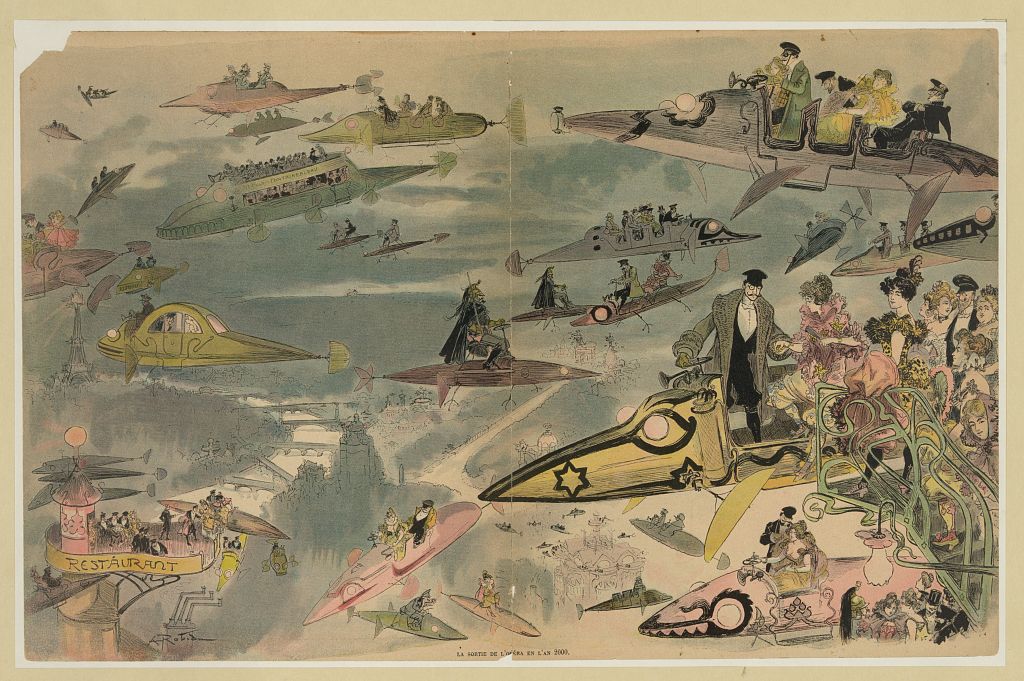
    Robida paris opera[Image source: Library of Congress, here.]

    Albert Robida (1848-1926) imagined many things in his long and illustrative career, seeing deep into the futures that would/didn’t come to be. Perhaps this one is nearly coming true but in a different format–his imagination 1882 inspiration of what the future of air traffic would be like attending the Paris Opera  (“Le Sortie de l’opéra en l’an 2000”) might seem more prescient of the view was in 2030 and the taxi cabs and other air chariots were drones instead.  In this version of the future there are restaurants and limos and buses and private air vehicles galore, all anthropomorphically cluttering the environment 1500′ above the city-center of it all though is a blue centurion, riding a futuristic Electra Glide, a helmeted cop on a small and sleek vehicle, right in the center of the sheet. 


  • Man as Robot and Robot as Man

    JF Ptak Science Books  

    I’ve written earlier in this blog about the advent of robots and human machines, and I’d like to add these two images to that thread.    Both are male, which is not horribly surprising since the earliest creation of a female robot belongs to the fertile Fritz Lang, who used his creation in his extraordinary movie Metropolis in 1927.  (Male robot-like creations go back fairly deeply into the 19th century; so perhaps the creation of female robots was verbotten because of the possibilities for unacceptable sexual fantasies in the high- and post-Victorian world, struggling under the weight of many and multiply-applied public inhibitions. Perhaps it was because of the possibility of sexual relations with an inanimate object that was the cause for uni-gender robots, or perhaps it was a fear of a powerful, intelligent, unstoppable, superior creation that was also “womanly”.  I don’t know.)
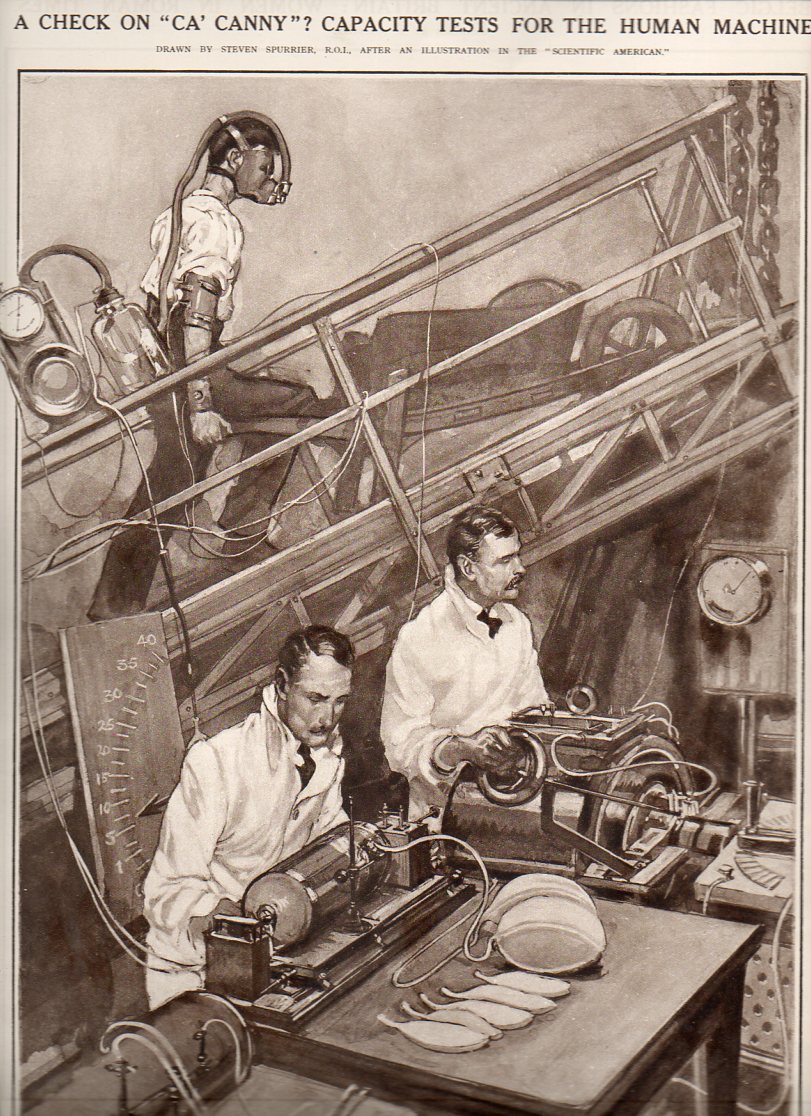
    Robot human machine817

    [And by the way “ca’ canny”–which I’ve never bumped into before–is evidently a practice of deliberately slowing down work.]

    The first is an image of the “human machine”, a cog-like adaptation of human workers in a Frederick Taylor-like Scientific Management study.  Though many people had written and worked around Taylor’s 1911 semi-revolutionary book (and not necessarily a good revolution, but one nevertheless), I’m not certain that I’ve seen the worker trussed up so before this, encumbered by so many technical testing elements as to make him look like a cyborg (though that term would still be a while coming into the vocabulary.  

    This image is actually testing a person’s energy expenditure while pushing a wheelbarrow on an incline, and utilizes the newly-created equipment of the French physiologist Langlois, which in 1921  may well have measured for the first time  the real-time changes in the rhythm of the heart and blood pressure, changes in body temperature and lung capacity of humans in an activity.  I have no doubt that the results would have been very interesting to cardiologists, and probably didn’t mean a thing to industrialists like Henry Ford, who would’ve plowed ahead with their demands on their workers regardless of what tests said, schedules being schedules and all. 

    Robot steam816 

    (I’m no tsure where this experiment fits in, historically speaking, even within the context of biological advances for that very year.  Frederick Banting was able to do some pretty nasty stuff to dogs in a basement lab somewhere at the University of Toronto and come up with a successful treatment for diabetes mellitus–insulin, which would save the lives of millions and earn Banting a Nobel two years later.  In the quasi/fake biological arenas came two biggish events: Jung’s creation of the concepts of introvert and extrovert, and Hermann Rorschach’s one-way conversational device for detecting psycho-pathological conditions (in people).  I suspect that the Langlois data would fit in there somewhere along the rough edge of Jung and Rorschack, if only because the data was real.          

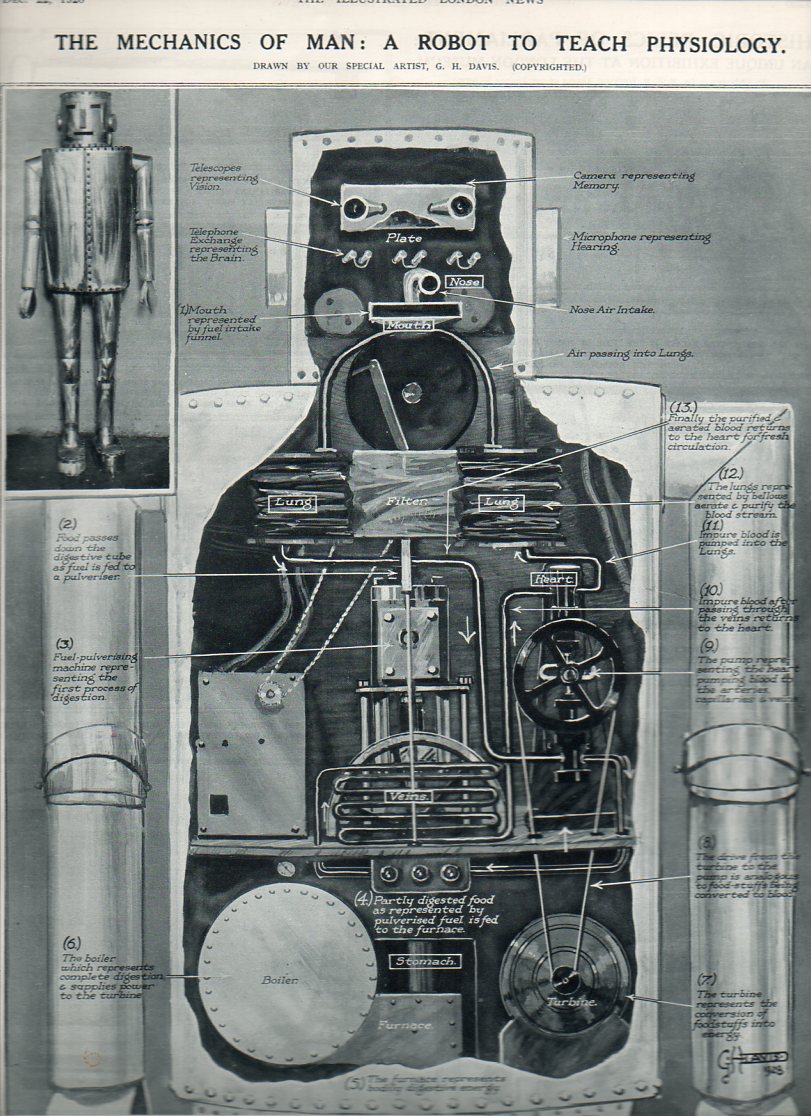
    The second image is in a way a reverse sequence of the preceding–an out-and-out robot that was being used to teach human physiology.  In this case, the robot was a steam engine, constructed for the Schoolboys’ Exhibition at the New Horticultural Hall for 1928, perhaps under the  influence of Karel Capek’s newly published drama R.U.R., which coined the term “robot”. The biological functions of humans were reinterpreted along a more user-friendly vocabulary of the steam engine, using pumps, boilers, hinges, belts, pulleys, filters, compressors and a furnace to explain the functions of respiration and circulation.   It was an interesting approach to show these functions on their most basic level–and in less than 75 years, many of these mechanically represented organs were actually replaceable by real mechanical units performing the same task as the biological (as in the heart), while others could be replaced (via transplant). 

    Man as machine and machine as man.